Up, Up, and Away, My Friends

In 2014, about four or five years ago I’d been in Canada for a long time. I hadn’t left the country since about 2009. My passport had long since expired, along with my formerly independent student life, and I ended up living at home with my parents again. At the time, I didn’t really have an excuse to travel. I had few others that wanted me to visit at that point in time, and those that did were in other places in their lives entirely. I basically had no reason to go anywhere.

That changed in 2014. For the first time in about six years, I had an excuse to visit the United States. I went through all the ridiculousness of filling out a whole new passport, including going back to the office, and having to explain to them that I needed it sooner so I’d have it for my trip. That began the first of my four year Greyhound commuting trips: from Canada to the United States. And, you know what? I was happy. I was happy to see the windmills, the grass, even horses, the change from Canadian to American streetlights, and even the feeling of relief of getting through the usual customs routine. Hell, I was lucky back then in that I didn’t miss my connecting bus: that hell would happen later.

When I was there, amongst many other things that first time in six years in the United States, I went to a place called the Dawn Treader Book Shop, in Ann Arbor. In it where so many different vintage science-fiction and fantasy books: so much so they crowded the aisles in, well, piles. I remember that day well. I’d eaten a really good lunch, and here I was browsing these different books. It was a warm, sunny summer afternoon, and anything felt possible. Life was still complicated, and I knew I’d have to go back home eventually and all that entailed, but I was there, and I was happy: possibly for the first time in almost two years at that point.

I almost didn’t get anything at that Shop. I tend not to buy much of anything for myself when I travel. Part of it is because I always try to limit my baggage to carry-on luggage, because I don’t need more complication in my life. Another is, really, I can get most of what I want online or through the mail. But then, before I left, I found that the place also had other media. Namely, there were DVDs. And while most of them didn’t interest me, I found this.
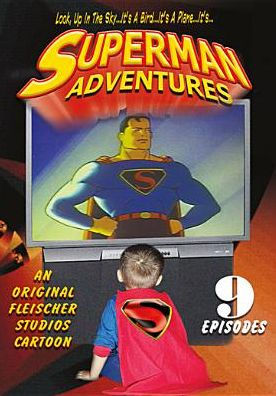
And I couldn’t resist. The old 1940s Fleischer cartoons of Superman: a series created by two Canadians who came to the United States to make something new for themselves, and ended up creating a legend. There was something, I don’t know, auspicious about that. I like Superman. I’ve mentioned it before. I suppose some people who know me might be surprised that I like his character. I mean, many might tag me as a Marvel child, or a Batman fanatic. Certainly, these days and when I grew up, I grew to appreciate Wonder Woman.

But Superman had been with me since my earliest childhood. I had a poster of him on my old closet door, and I Am A Super Kid frame with the younger version of myself on it. Maybe I’d felt like, on some level, finding this was all about feeling reborn in a way. Like I was beginning some kind of new life, and the vistas were not dark and gritty like a lot of Revisionist comics out there, but golden like the Reconstructionist comics afterwards: stories that drew from the original creative well, but brought a whole new level of maturity and heart to them. Like something you love growing up with you: a thing I think a lot of jaded, more cynical people do not completely understand beyond deriding a sense of nostalgia.

I thought I found an artifact of freedom, perhaps. I kept it in its Dawn Treader paper bag, and took it home with me. It was easier getting back home through Customs than going through, and when I eventually came to Toronto again and its convoluted mess of city-roads, I went to the Silver Snail and picked up Brian K. Vaughan, Steve Skroce, and Matt Hollingworth’s We Stand on Guard.

Basically, the premise of this is that in the future America would go to war against Canada for its supply of fresh water in our ice. I thought it was ridiculous, in that it didn’t quite capture my own experience of being a Canadian citizen — whatever the hell that is given how diverse we all are — but I was entertained, and the characters were believable. But what attracted me to this comic, initially, was one of the rebels talking about the tattoo he had of Superman. The other rebels hated the Canadian that wore it, thinking they were a traitor for wearing an American icon. But he explained that Superman had not only become an international symbol of hope, optimism, and inspiration but he had been made by Canadians. Hell Joe Shuster, Jerry Siegel’s creative partner, was the relative of Frank Shuster who had been the comedy partner of my cousin the Canadian comedian Johnny Wayne. Degrees of separation, I know, but it struck a chord with me, and I got the first issue just for this tenuous connection alone.

I remember, on the subway ride back from Dundas Street East, reading this issue and recalling how uncomfortable I’d felt under the scrutiny of the American border agents, and the feeling — having traveled to America for the first time by myself as an adult — of it actually being another country. It wasn’t Canada. It wasn’t where I grew up. No matter how much television I’d seen about it, or visited it as a child, I would never be American. The closest I’d be would be North American, and what does that ultimately mean in the end? But I kept thinking: America and Canada being enemies like the nations had been in the past, during the Colonial and Victorian eras? It was silly. And yet … I couldn’t really shake that feeling: that what if our longtime friend became something else for other, unforeseen purposes? Was it conceivable that such a friend could become a stranger or, worse, an enemy? And what would we do? What would I do?

For five years and over seven months, I never opened my Superman Adventures box. For ages, it sat on my desk in its Dawn Treader white paper bag, and I never took it out. I wanted to save watching this old cartoons for … something. For some special occasion. I just didn’t know what that might be. It was something special to me. Something golden that on some level, perhaps, I thought I could preserve forever in that crinkled paper. And I thought, I would be able to go back to the Dawn Treader one day. I’d be able to relive that moment, or have others like it.

But I never did go back to the Dawn Treader. The closest I came was watching the old BBC adaptation of the book, the third book of C.S. Lewis’ Chronicles of Narnia, also from my childhood and part of what formed me as a person — of my heart, from YouTube while I was there. And despite everything, I was happy then. I was happy, until of course, I wasn’t.

This was a year or so after the American Elections when pretty much everything changed. That time was gone now. This was reality. All of it. That sunlight still exists somewhere as starlight, distant, in another galaxy that perhaps Superman might be able to travel to if he actually existed. But it isn’t here anymore, and it hadn’t been for a long time.

I don’t know how long Superman Adventures sat on my desk. Even the paper around it seemed unreal, as though despite what it said I could have just got it anywhere. I took the bag and put it away, where I didn’t have the heart to see it anymore. Then it sat under a bunch of other DVDs I didn’t watch. I got busy with life, and chaos, and shadows, but I knew it was still there. It was still waiting.

Finally, today — or I should say last night — having had too little sleep, I took the box out. And I realized, then, that it was time. It was time to do this on my own terms.

So I watched all seventeen episodes in one go. The discs were basic. There were no special features, and only poor attempts at titles screens on both volumes. There was no restoration, beyond perhaps the basic, or digital remastering. But I didn’t care about any of that. I had to see them. I had to see them through.

Most of the episodes were self-contained and basic. When I read up on the animation style later, I realized just how avant garde it was for the time: how they used some rotoscoping — tracing live action figures from film footage — and how animators inexperienced in drawing, and illustrators inexperienced in animating came together and made this work. The detail in the background is excellent, and you can see all the care that went into it. And the cartoon animals, still possessing anthropomorphic flare, remind me of Disney, even though I have to remember that Fleischer Studios also created Felix the Cat by that logic.

The first Volume dealt with Superman fighting mad scientists, and bank robbers. Lois Lane gets herself into a lot of trouble, and takes a lot of risk while always banking on Superman to save her, and outclass Clark Kent with her scoop while he always seems to look at the screen, breaking the fourth wall with the expression of “We all know I am the best though, right? I’m the real star here.” Volume Two, which contains episodes made after the Fleischer brothers were removed and the company making them renamed Famous Studios, has a lot of those same elements and … some unfortunate — read racist caricature stereotype — particulars that happen when you are essentially creating WWII propaganda. Nevertheless, given history — and contemporary circumstances — it is fitting that these episodes be mentioned, and not forgotten. I mean, can you just imagine the media that will be created after our time if we all survive it?

They were all, like I said, self-contained episodes, and Superman almost always rescues Lois Lane, she writes the story, and he saves the day. Patterns always repeat themselves. There is no Lex Luthor, possibly no Jimmy Olsen, and Perry White is just a person that introduces stories to his reporters. For some reason Superman was adopted by an orphanage instead of Ma and Pa Kent, and apparently the Fleischers were the ones that gave Superman actual flight instead of accelerated jumping: meaning that they first introduced it, and later DC Comics adapted it into their own comics … something I had no idea about until I read up on it.

I also read up on the fact that … all the episodes are online, and public domain. In other words, as far as I know I never needed the DVDs to see these anyway. I don’t know what that says, really, when you put it into the philosophical and retrospective context with which I had framed the whole thing. Perhaps, there isn’t any meaning at all, to any of this except for what you put into it.

I am glad I watched them, though, in the way I did. The last two days of the year, of 2018, where so much changed for me just seemed appropriate. I am definitely in a different place now than I was even a year ago. Perhaps this isn’t the New Year’s post that you were expecting. To be honest, neither was I. But sometimes, while some patterns and mythic cycles are eternal or beloved — and you can learn from them — others become tropes or stereotypes — tired and worn sentiments — from which you just need to break away. Perhaps, one day, that light will come back, or another light in another form. I haven’t gone to the United States since that time, and I do not see myself doing so in the near-future, but there are other places to go, and other things to find.

Perhaps, in the end, I should take Superman’s catch phrase — the one in this title — into account. Until then, my friends.

Whatever else, I am still a Super Kid.

Peering Back In and an Update

I think it would be an understatement to say that I haven’t written here in a while.

There’s a pretty good chance, in fact, that I’ve even said this before. I remember when I used to write on Mythic Bios a lot. And when I mean a lot, I mean every single day. Then it became every other day. Then every two days, and after that, well …

Life happens, I guess is the best what to sum it all up.

How do I even catch up at this point? What highlights can I share with you?

Well, I can tell you that I’d been working on two very long pieces of fanfiction on A03. Both of them are set in the Fate/Stay Night universe. One of them, Fate/Stay Unlimited Bullets is finished — despite the errors I keep reading over and correcting — but the other, the longer one, Fate/Stay Life has gone into something of a hiatus. I know how I want to continue it. I know what parts need to be elaborated on. And I also know that if I sit down with it again, I will be able to continue more or less from where I started. But Unlimited Bullets really took a lot out of me: more than I thought. And given the content in FSL, I suppose it makes sense that because of a transitional period in my life it does make sense that I’m taking some time away from it. I do plan to come back to it, this 96 chapter monstrosity and ongoing thing mind you, but not right now.

But I know there are a few of you, who still read this Blog, that aren’t here to hear about my fanfiction, though you can definitely feel free to read it if you want as I am Ma_Kir on A03.

I’ve thought about writing more Alternative Facts short stories. I even have ideas and words and turns of phrase typed out in a draft somewhere. But … I don’t know. I just haven’t felt the impetus to continue for a time. Between having to find the right epigraphs, really focus on the language I’m creating, and think about what’s … going on, or could have gone on in Amarak, and just how derivative it all is, it is a lot of work to go through. I find that the stories don’t really work on their own, but you need to read through all of them in a certain order for them to get … some idea as to what is going on. I find it’s not as accessible, and I wonder just how good they really are when it comes down to it. If I have a story that is really pressing, rest assured I will share it with you. If not, they have been an interesting experiment in speculative political fiction.

I am, however, working a lot more on another universe. Actually, I have been working on two: creating one, and participating in the continued development of another. My original universe is derivative as well, with a Frankensteinian mix and mash going on, as these things go, and I hope to write two more stories in the series before attempting to get more readers to look at it. I play with horror archetypes and subvert a lot for human stories in that world. I hope them to be more accessible and while world-building is happening as a result or consequence, it is really the character interactions and more relatable characters that are forming that I hope to have stick. I look forward to sharing them, one day.

As for my other endeavour … I’ve written about 20th Century Boys before on this Blog, a long time ago now. In that manga, a group of children created a game — a game of make-belief — where they are a group of heroes fighting against the forces of evil. They made a whole mythology that someone, years later, adopts into an evil plan to take over Japan. I’m not really involved in something like that, but I can relate very much to a project or a world built between friends from childhood, and watching it grow with us.

My friends and I have been playing a homebrew world our DM created long ago for years now. I started playing it, with them, in 2001. I played one character from 2001 to 2004: developing him from a slave to essentially a demigod at the time. It was this process of collaborations and player verses player sessions, as well as solo sessions, that helped develop the game from a science fiction derivative to a more unique and quirky epic fantasy world. It isn’t entirely accurate, of course, but the the gist of it. I played again in 2005, as another character in the same world. Then I was gone for … about eleven years until 2011 when we continued the game where our old characters more or less became gods, and we played new characters in that world. And then, our DM made a multiverse in the form of various campaigns with these characters and elements which figured into it in 2012-2013 or so. They were fun in themselves.

I’ve roleplayed as wizards, mages, necromancers, sorcerers, alchemists, artificers, and the like. I have even been an assassin and a cleric at times. But the funniest thing is that the most enjoyment I’ve been having as both a player — and as a creator — is my current bard. I attempted to play a haunted bard in a Ravenloft campaign, and wanted to really add poetry — as an imitation of singing, or playing an instrument — to bring the bard to life. I had a choice, this current campaign and going back to our mainline homebrew world to either be a bard again, or a monk: which was another class I’d been thinking of trying out.

But I decided to be a bard. There was another game we were going to play where one of my characters in a faction setting was going to be one, and I just liked the idea. And she developed slowly from there, from a concept to more of a person. It’s funny. These days I tend to play female characters for some reason. Maybe I attempted to do so in 2012, to differentiate one alchemist character from another I was playing in a D&D campaign with my same friends. It … didn’t go well, for that character, and it impacted my experience.

But then in about 2016 or 2017, I tried it again, and I find I really like these characters. And my bard is one of the best. I have been writing whole epic “Ballads” of our adventures and certain world lore, in an attempt to spread information and misinformation on the world: to unify factions to deal with a greater evil. But I find I really get a lot out of this game writing these Ballads and actually reading them aloud in session. I haven’t really read anything I’ve written aloud in a while, never mind write something out by hand. I find it does affect the game, and not just because the DM gives us Inspiration or sometimes some bonuses, or even in my case EXP.

I just feel more immersed in that world. I feel like, when I write stuff like that, I am accomplishing something. Between that, and my own original creations … I could seriously live my entire life doing something like this. I wish I really could. If we ever made a studio, and I was asked to be a writer for it, I would do it in a goddamn heartbeat.

I find that the issue with my life right now isn’t that I don’t know what to do, or what I am doing. I do know what I want to do. Often, it’s just the world that won’t cooperate, or do what it’s told. Lol.

More realistically speaking, I just need material to work with, and collaborators, and people and resources that can help me make something tangible that will … support us. And the focus to do so, along with the determination in a hard, ridiculous world to keep going.

I’ve accomplished some other things too. I wrote some letters that got published in comics series. I’ve helped edit, and even make some character concepts for my friends’ — my role-playing group’s own game — Ankle-Biters: Pixies Vs. Gremlins game. And I wrote a Sequart article about the film adaptation of How to Talk to Girls at Parties that got retweeted by Neil Gaiman himself: which made my day for a really long time.

So I have not been completely idle or brooding in this time I’ve been away. Sometimes I think I should take my friend up on his old offer and see if I can redesign this Blog and make it look less … choppy, and plain with its ads. And maybe with something more substantial to offer besides my nerdy speculations and fanfiction, and the occasional story, I can build something more noticeable. Perhaps there is a way to get my works to interrelate. That would be sweet.

It’s been a stressful time, in an uncertain age. But I just wanted to write here to let you know that I am still alive, and I have not forgotten this Blog: or you. Hopefully, we will be seeing a little more of each other, if not here then elsewhere. Once again, thank you all for reading.

Alternative Facts: An Alternate Perspective On You and I

This is one of my first Mythic Bios revisits today. I said before that I didn’t conduct my examination of Alternative Facts in order. And now, to complicate things even further, I realized I actually forgot some things and instead of adding them to my previous entry, I thought about it, and came to the decision that these elements deserve their own.

In my last article, I mentioned how the first draft of “Lost Words” didn’t really work. The spirit of it was there, but it wasn’t really direct. I wrote about a few reasons why it had issues, and while most of them were structural and still trying to figure out what they were beyond a gimmick or two, there is one major change between the first and the succeeding drafts.

The first draft of “Lost Words” was actually in first-person. The narrator, who was a student academe, was talking to their teacher. They are separate from the reader, they and their teacher at the Freed Dome. The entire situation is outlined for the reader through the dialogue and some small description on the part of the narrator. In a way, they are basically telling you what is going on more than anything and as I said in my “Alternative Facts” analysis, it is a more “Gee Willikers this is the World, Batman” dynamic and feeling more than anything else. In other words, it felt cheap. It felt like, as I said before, a gimmick to sell one idea. And some of that is fair as I never thought there would be an interconnected story after this until a friend of mine said all but said they wanted to see a story about the Repos that survived their official disbandment and their exile from the main State of Amarak.

The first draft wasn’t even a Word Document. It was an inline text email that I’d sent to my girlfriend at the time, and then my friend a few months later after we reconnected. To be honest, I even forgot about what literary perspective I used. For a while, I even thought I wrote it in third person limited perspective because there were two characters having dialogue with one another. Talk about degrees of separation and cognitive dissonance: thoughts that are appropriate given the title of the series, and the times that has inspired it.

I don’t remember why I chose to rewrite it, and then rewrite and write the succeeding stories in second person perspective. Second person perspective is not a common literary narrative point of view. It is the kind of thing you would expect in a Choose Your Own Adventure book, or a video game, or the post-card fiction I was told about by my World Literature teacher back in Grade 13 or OAC. I thought it interesting, and I played with it when I designed Twine narratives and even some of my own Choose Your Own Adventure and Roleplaying Game experiments back in the day.

But as I planned to hone the story down … you see, it’s clever. Not me, but … one of those age-old exercises you always get in literary classes is to determine what narrative perspective you are using. And even as I reviewed my stories for this article, I see how tricky it is. Technically, “Lost Words” is first-person perspective. However … the narrator is talking to an audience. They are talking to you.

It isn’t as clear, perhaps, in the first story but from “Freedom” and onward, while there is an “I,” there is also a “You.” Certainly, Alternative Facts stories like “View From the Badlands” and “Beyond the Wall” actually have specific narrator characters, and the others have a clearly delineated group talking to the reader-audience, to you, but that is just it, isn’t it? It feels as though they are talking to someone. There is always a you in this narrative.

Even in “Lost Words,” there is a general “you” when the narrator talks about their research into the past. This tenuous link between the first and second perspectives in the narrative, arguably and from my obviously “unbiased” opinion, makes it so that you aren’t only watching an interaction, or passively having the information revealed to you. The idea is that you are involved in the process. You are supposed to be immersed in this world, through this pronoun become a verb. You aren’t separate from it. This isn’t another place or another time. And even if it is, you are there with them: actively discovering this.

Of course, you have to suspend your disbelief or pique your interest to do this little bit of roleplaying. You can remind yourself that you aren’t in this. That you are beyond it. But as I think more about it, in this convoluted way, given the subject matter about politics and horror, and the movement of a world, what is the difference between “I” and “you.” I refers to one’s self, but when “you” is used it refers to another. It can be exclusionary, but it can also be inclusive, an invitation, a realization that one is — that you — aren’t separate, but rather in the same place. Maybe not in the same situation, but you have that invitation to being invited to being a part of the story, to even the illusion of actively exploring it.

I’m looking at what I’ve written already, and I wonder if there was any point to it: if I have actually communicated anything worthwhile at all. I suppose, if I really look at it, the way that Alternative Facts takes “I” and “you” sometimes makes them distinct, but also makes the boundaries between them finer … almost erasing them entirely. It takes some doing to see where one ends and the other begins, to see which one is true, and which one is not. It gets muddy, and a bit unsettling even to talk about: and not just because of the strange hodge-podge language.

And maybe that is the point. Or something.

Alternative Facts

I’m doing this all out of order.

This is an examination that should have happened either before I wrote my stories, or after when I had — or could still have — more of them. It is fairly clear that this entry is not a story in itself, at least not a fictional one, in my Alternative Facts series: whatever else it is. After all, where is the epigraph, right?

I started making epigraphs for some of my stories, in general, far before this point. You can blame Frank Herbert’s Dune series for my occasional, but fierce, love of putting quotes from other sources before my prose in addition to my love of classical science-fiction. In a way, while Dune has little to do with what I’ve been writing on my Mythic Bios Blog lately and before the New Year, it did teach me to look at the current world and what it could be in different ways, and I would be lying if I said that I had the idea behind Alternative Facts only recently.

It’s quite presumptuous of me, really. All of this is. Here I am writing, retrospectively, about a writing experiment as though it’s some kind of legitimate, published literature: as if it’s all finished, polished, and done. As if I may even continue it.

I’ve always known this world was imperfect. Even while, publicly and for the most part, staying out of politics I knew that human nature and what it builds is flawed on a fundamental, foundation of being. That’s why I always appreciated dystopian literature. George Orwell’s 1984 and Animal Farm come to mind, but also Aldous Huxley’s Brave New World, Yevgeny Zamyatin’s We, Philip K. Dick’s The Man in High Castle, and Margaret Atwood’s The Handmaid’s Tale. When you also add Russell Hoban’s and Alan Moore’s post-apocalyptic language play in Riddley Walker and Crossed +100 respectively, you can see all of these influences on a very basic and hardly comparable level with the series that I chose to share publicly.

It almost didn’t happen.

A little while ago, Neil Gaiman wrote a short story “The Man Who Forgot Ray Bradbury.” In this story, you see this protagonist’s view of the world change dramatically, even degenerate, but ultimately becoming defined by the absences of where Ray Bradbury’s work, knowledge, and presence used to be within their mind. I found it utterly fascinating, this mnemonic shift, and I tried to replicate it in a poor attempt at a story about someone forgetting Neil Gaiman and looking at the world through their eyes. I wasn’t ready then. I almost understood what I was trying to do, as much as I can still even attempt to put it into words, but reason wasn’t enough. I had to intuit it, and pass that spark into some writing.

Fast forward this a few years. The politics of the Western world, of North America, shifted: or at least what already existed became clearer to me. The Internet doesn’t allow you to ignore the rest of the world as readily as other media anymore, or at least for now. I realized, far later than many other people more qualified than myself, that this was something I couldn’t afford to ignore. Then, at one point, the term “alternative facts” was introduced into the world conversation. It’s true that you can refer back to Orwell or even 1930s Germany when you think about those words, but they stuck with me. At one point, on my social media, I wrote something along the lines of taking “Alternative Facts” and making some kind of dark science-fiction or speculative series based off that title.

Even then, I knew I was only half-joking.

But I didn’t do this for a while. It was a nice, snarky thought as the world seemed to be proving itself to be more stupid and self-destructive than even I originally thought. I thought about the American elections, and how in my mind it should have gone: that forces utilizing hate and hate speech should have failed —  utterly — then turned on each other, and become utterly forgotten: an embarrassment to society and civilization, polite or other wise. I started off this post by saying I was doing this all out of order. And I remembered what ancient civilizations used to do with dynasties and regimes that caused them chaos before they finally fell. They would go out of their way to erase every monument, every artifact, every word, and every mention of those former ruling groups: for good or ill.

Then I remembered something else. I had a friend I used to talk with from Germany. Among many other things, we would discuss history. Of course, the Nazi Party came up. This was before a lot of the turmoil that became prominent during 2016 and now onward, which is reminiscent of parts of history. My friend, when we talked about Nazis, never called them Nazis. They called them National Socialists. And that was exactly what their name was, the National Socialist Party. But then it was abbreviated, and from then on and over time, they have been called Nazis. It doesn’t matter what they styled themselves, or what their original aims were in other forms, or even their influences. That is how they are known now.

Just like my Repos, the former Repo Party, mentioned in my first story and elsewhere.

At first, I just talked about the Repos. And then, one day during August of 2017 when so many people were talking about politics and fascism, when I was wondering if I would ever see my girlfriend or any of my other loved ones in the United States again, I decided to try my hand at uniting these concepts into a story. What would happen if something so bad occurred that even as civilization in one area reconstructed itself, it either lost much information, or actually went as far as banning it — erasing words — to make sure they would become lost?

The first draft of “Lost Words” wasn’t really good. It got clunky and you could tell that I was still exploring a lot. The protagonist talked with a teacher and it all felt like very scripted excitement, very “Gee Willikers.” And the ending was choppy and rather flat as well. I sent it to my girlfriend, but even before she said anything else, I knew I could have done better. So I abandoned it.

Four months passed. It was probably in the back of my mind, just as our conversations and my rudimentary notes sat in fragments  on a draft email. Science, and laws are being changed and challenged. Political horror as a genre is rising again, or people are paying more attention to it. I had time to think about the power of words and ideas existing, and being erased. Certainly, even before this working on Sequart articles focusing on Alan Moore and Jacen Burrows’ Providence, along with the “Agents of HYDRA” arc for SHIELD really helped me examine some concepts that, for me, still needed a creative outlet. I also thought about some of the work I did researching and looking at Lawrence Gullo, Fyodor Pavlov, and Kelsey Hercs’ LGBTQ+ Bash Back comic.

I honestly can’t remember why I resurrected and rewrote “Lost Words,” not when I left it for dead. Not when I almost let it no longer exist. I know I reconnected with a friend of mine and wanted to show it to them: thinking it right up their alley. But I had been working on it even before that. At least I think I did. As I say in “The Spectrum” story, it’s hard to say when something was born, or destroyed, or made when it seems as though it always exists on some level.

All I know is that I wanted people to see it: even the shoddy draft that I could just put on my Facebook and be done with it. But I didn’t leave it at that. I honed it down. I made the narrator more definite. And I added a layer of metaphor to it, something to mirror the main story and give it that resonance I needed. It was only later, after I wrote “Freedom” — from the perspective of the Repos of all people — that I added an epigraph retroactively into that story, based on the fact that I made one for “Freedom.” And the trend began, if such a thing can be said what with there being only four stories so far.

It is funny what you can tell about a world, like Amarak, by what isn’t said. I realized that writing each story from a different perspective, with epigraphs that complemented and contrasted with the narrative content, was effective for me. They are like dispatches from another place, another possible time. The word play is incredibly reminiscent of classic science-fiction to the point of it being very pretentious and derivative of classic science fiction of the twentieth century. I take fragments of Latin, I mess around with English and abbreviate words, attempting at times to make sure they have multiple meanings. It isn’t anything special. I am no Russell Hoban, or Alan Moore. And in terms of the stories and their conceits, as a friend of mine once said to put me in my place long ago, I am no Neil Gaiman. And in the wake of the twenty-first century, with its far more sleek and genre-savvy science-fiction and speculative literature I know there are many voices looking at these issues that are far more diverse than my own.

But I did it regardless. And I found it funny how Lost Words, which I thought was the most clever, was a story some readers just didn’t understand. I thought it was clever. But I suppose that is the problem: cleverness does not always a good story make if you don’t make it relatable. Weirdly enough, Freedom with its mythic and almost religious quality seemed more accessible, and The Spectrum in particular seemed to really hit a chord in people, or punched some subject matter rather unsubtly in the face. By We Are the Grass, though, I basically went “full circle” and wrote about what I thought: take it, or leave it.

I don’t really know, at this point, where to go from here. I just came back from a visit to the States and I am tired. But even before that, I wasn’t sure where Alternative Facts was going. I originally thought of it as something of a dark speculative anthology series, with tongue and cheek political tones, but a world — the land of Amarak — grew out of it instead. It is still a possibility of course that I will continue with my original plan if Amarak becomes too exhausted.

And I have some ideas. The fact is, I require more inspiration. I hit my stride with this, and another series I’m working on at the moment — a private one I was focusing on before this one attempted to supplant it like the usurper that it is — so I need to keep that fire going. I believe watching films like Get Out, as well as Netflix’s Black Mirror, along with reading Pornsak Pichetshote and Jose Villarrubia’s upcoming Infidel comics series in a few months could help recharge my batteries of pure dark fire towards the world. Or, you know, continuing to watch and read the news: that works too.

When it comes down to it, though, I feel as though every story I write, every story I’ve ever written is filled with “alternative facts”: is in fact an “alternative fact” in and of themselves. I don’t mean that they are lies, though some stories are lies and, as a great writer once said, all writers are liars. But they are all still stories and they do say something about the storytellers, and the place from which they come. And sometimes, some things just speak for themselves. And sometimes it is better that they do instead of remaining silent. Silence is the ultimate death though … sometimes what isn’t said can speak incredible volumes.

I think these are my thoughts for now. Feel free to read my stories if and when you have the time. It is good to place something on this site. It has been reposted on, and neglected for some time now. It feels good to put something on here again, especially something that feels worth while. Everything still is out of order. I should have ended this post with the previous paragraph. But, somehow, I feel as though whatever this is is just beginning. Or it is always here and I am just one more person speaking it: one more letting it speak through me. Take care everyone.

My Fanfiction Origin Story

The title is more epic than it actually sounds, but when I think about it the entire thing had been a story long in the making.

Some writers believe that fanfiction is a waste of time. Certainly, you can’t really profit off of it unless you have the original writer or creator’s permission, and you do not want to run afoul of copyright infringement. But that’s not what I’m here to talk about today. I’m partly here because it’s been a while since I’ve put anything on this Blog, my Writer’s Blog, that hasn’t been a repost from my Sequart work, or elsewhere.

I suppose I’d … always written fanfiction. In fact, I did it ever since I even learned how to write. Often I’d watch the 1990s Peter Pan cartoons and attempt to write the further stories of Captain Hook, Teenage Mutant Ninja Turtles, and more. In the eighties and nineties though, as a young child, I was mostly interested in horror stories and mostly rehashing the old urban legends and Hammer film derivatives of horror classics more than anything else.

I don’t know if I remember it properly, but I think it really began in Fine Arts Camp. It was at the MacDonald House in Thornhill, once owned by the Canadian Group of Seven artist James Edward Harvey MacDonald. At the time, in the 1990s, I fancied myself something of a graphic artist. I was really passionate about drawing and creating cartoons. It made sense given my interests and my immersion into old DC and Marvel comics and a lot of the stuff coming out in the nineties. Certainly, I wasn’t all that interested in landscapes or other forms of graphic art. Just cartoons. Just comic books.

To be honest, Fine Arts Camp for all its fascinating old MacDonald House that was a good place to tell children urban legends and horror stories near a church and a community swimming pool, wasn’t always so ideal for me. For one, I had terrible allergies and being almost always in the middle of a woodland, surrounded by many trees, did not do me or my lungs that felt like they were getting kicked by horse hooves at night any favours. Also, well, when you are a child and generally an indoors one you have to understand that for all a camp will call itself a Fine Arts Camp, they will still force you go outside in various temperatures and play sports more than you will want. It was the same in the Computer Camp I went to, thinking I’d learn about animation and programming, and it was the same here before it.

Also, when you are extremely introverted like I was, you don’t tend to make a lot of friends: especially not from children your age or, worse, older. To make a long story short, aside from arts and crafts, and even some walks, I didn’t really always like being at Fine Arts Camp. But, I did discover something there that has sat in my head, with me, for the rest of my life.

I don’t remember his name. I’m not even sure he was the same person. But I knew a kid there, a few years older than me. He had in his hands, at the time, something I coveted the most. It was the Wizard Magazine: X-Men 30th Anniversary Special. In that magazine was all the information I’d been looking for about the X-Men and more, so much more than the Marvel cards and their lore that I had been collecting then.

For all the little squabbles we all had there, being kids, this guy was generous and he let me actually read parts of the Magazine. And, even though the other campers really thought I was weird for doing this and it probably gave them more fuel to push me around later, I was actually taking notes on all the information I could find. It wasn’t enough and eventually, after much pleading on my part and my grandmother’s reluctance to spend or let me spend all of twenty dollars, I got my own copy: which is still somewhere down in my basement somewhere.

But the important thing I want to note here is that this same guy, and may not necessarily be the same guy, liked to write. He told us that he would type up his stories on an old computer. Somehow, I remember him saying he had the Internet and frequented BBSes looking at stories based on franchises like Star Trek and Star Wars. I might just be projecting that, as I had no idea what the Internet beyond school was or what a BBS even was at the time. But I remember him saying that he liked to write stories where Star Trek and Star Wars crossed over, and perhaps something about Locutus of Borg meeting the Empire.

It blew my mind.

I don’t remember all the details, but I recall the way he described his ideas and his stories. I think he even brought in some old computer paper with rings on the sides and clunky font. And I definitely remember wanting to write franchise stories.

I wanted to make those crossovers. I wanted to write Star Wars. I wanted to write comics and all the things.

That’s how it really started. There was an attempt at a Star Wars expanded universe story in my Seventh or Eighth Grade Writer’s Club anthology: where Luke Skywalker and the others meet a Dark Jedi fighting against the Empire and the Phantom Fleet. But you can imagine how well that was written at the time, and even more so how it aged since.

But I roleplayed out original Star Wars, X-Men, and Power Rangers episodes with my best friend Sean, and I kept writing. I still attempted to write my own works, but they were derivative of R.L. Stine’s Goosebumps and Fear Street, along with some Christopher Pike, so you can imagine what those might have been like.

I think my writing skills started to be honed after high school, after reading more and writing an original short story in which I won a Senior Literary Award in 1999. I joined TheForce.Net again in 2005 and wrote what I thought were clearer iterations of Prequel stories. Unfortunately, despite all their assurances that everything would be saved, a lot of my works were lost when the Board attempted to transfer its data to a new server and most of my old works were heavily truncated.  It’s something I never really got over, after all this time and, frankly, it’s kept me from really writing there as much anymore.

But I learned a lot out of writing in different pre-made worlds.. I learned about what writing I liked and what I didn’t. They gave me ideas and frameworks for them. And sometimes they gave me an outlet to tell stories I wasn’t prepared to tell when I didn’t have a voice for them. Yet I think, most of all, fanfiction keeps me writing when I don’t feel inspired to write my own work, or when I’m getting overly critical and analytical.

Recently, I’ve joined AO3 to give some of my fanfic pieces a broader audience. I didn’t really like the freeform administrative style of Fanfic.Net, and TheForce.Net’s administration can be … sporadic and highly dogmatic in terms of poster interaction at best. But AO3 has a lot of variety and also maturity at times with regards to their work. So far I am liking it. And I cross-post all the time. Right now, in-between writing critical and opinion pieces for Sequart and thinking of some of my own original pieces, I’ve been writing a Fate/Stay Night fanfic I’ve been pondering over for a while and a few other shorter vignettes as well.

They keep me going, and I don’t think I realized how I missed it until I stopped. In addition, they also keep me writing new things and attempting stuff I hadn’t thought of or had the metaphorical balls to dare try. At the moment, this variance helps keep my mind fresh: and, who knows, I might have some of my own creative breakthroughs.

Some might even say that this how literature itself continues, minus all of these labels and copyright issues. Someone creates something and others want to emulate it: with perhaps reading and interacting with the materials that the original creator made to understand it better and eventually find their own voice.

Even so, fanfiction allows me to interact with the material that I love on a creative level without the pressure of feeling like I have do it professionally or for a need for money. I think there is a lot to be said about it, if you learn and grow from the experience, and even just have fun. I don’t know. I do know that I have come a long way from coveting wanting to write a Star Wars story, which I thought was beyond my ken at the time. With time, research, and will I can write almost anything now.

I guess that, in the end, I just need to remember that. After all, I think it is always useful to pursue inspiration: wherever you can find it.

What’s Going to Happen

I’m not sure when I’m going to be on here next, so I thought I’d stop by and tell you about some of my plans and perhaps a few upcoming events.

A little while ago, I decided to write full-time for Sequart. This means that I write 15000 words a month: including integrating graphics into those articles that talk about comics and sequential art. When I made this decision, it was part of my plan to supplement my writing and keep generating content while I spend time on my more creative works.

Something happened though. I began writing about LGBTQ+ issues through specific works. Then the 2016 American Election happened, and I have been writing about that a little bit. These have been areas that I have skirted around and didn’t really engage beyond acknowledgement as they weren’t in my area of lived experience, or my comfort zone. But this crop of articles has challenged how I write and I’ve realized since then that I do have a non-fiction writing style: something I cultivated on this very Blog.

The Editor-in-Chief of Sequart, Mike Phillips, gave me the following LinkedIn recommendation:

“Matthew is a great writer. One of the best Sequart.org has ever had, actually. Some smart people don’t know how to successfully, stylishly convey their intellect to the written word, but Matthew doesn’t have this problem. His non-fiction is meticulous, yet prose-like. That’s no mean feat! I’m so glad to have him on board here, and any publication would be better with him on their team.”

It really hit home for me that I am particularly specific in what I write about, what terminology I choose to use, and that I put in a little bit of flippancy and no small amount of geek references into my writing. But even when my writing is non-fiction, I write it as if it were a story. I particularly honed this after reading a few key books in a course at York University called The Literature of Testimony by Professor Sara Horowitz. I noted the power of their narrative voices and tried to emulate that and bring my own experience into it. It was on Mythic Bios, though, that I really started to let my voice come publicly into my own and put my ideas where my keyboard is.

But lately, with regards to Sequart, I feel like I’ve really been challenging myself. And I’ve realized that I’m actually fairly good at what I do. I was burned out from academia and I vowed never to go back to it after completing my Master’s Thesis. But when you make an article for a magazine, depending on what that magazine is, voice, relatability, your audience, and your enthusiasm can matter more than footnotes.

It’s been almost two months already and it took me a while to realize that I can actually do this, and if this is what I can do — along with making contacts along the way to keep doing it — then I can more than live with that. It’s funny. If you’d told me years ago, when I was a kid and I just read superhero comics that I would be writing articles on Sandman, LGBTQ+ issues, some politics, and Alan Moore I would have no idea what you were even talking about. It’d have been beyond my ken. I wouldn’t have understood what I was even making right now: even if a few years later some part of me, after discovering Philosophy, would do my damnedest to try and figure out just what the hell my future self was talking about and why it was so important to me.

Some things still get lost in text and you can only really figure out in experience. I wouldn’t have even dreamed of doing some of the things I do now. It’s funny how that works.

I’ve also applied for another writing job and we will see if anything comes from that. And I want to finish my comics script, possibly adapt a story of mine into a novel, and keep working on something that is the equivalent of a novel. I also have a lot of ideas for more articles.

But right now, I can’t focus on any of that. For the next two days, I’m going to be busy. I’m going to the opening night of Rogue One tomorrow and then the next day I will be roleplaying more Star Wars with my friends.

wp-1481782899858.jpg

Some of my life is still not ideal right now, but it does feel like a few steps in the right direction. I may well be onto something if I keep up this groove.

If you’re interested, you can find my Sequart articles right on my profile.

I think, really, I wanted to write here about how far I’ve come: if only a little bit more before next year starts. I might have one or two posts on here before then, but if I don’t, I hope you all have an excellent New Year better than 2016 and that this amount of progress will continue. Take care all.

Finding My Friend in Steven Universe

I remember when I would come home from school and turn on Fox 29. I’d watch Fresh Prince of Bel-Air, Blossom, Bonkers, Goof-Troop, and all the Disney cartoons. Even in the morning, I recall enjoying Gargoyles and the Saturday afternoons with Hercules, Xena, and Sinbad. And I practically lived on YTV. It felt like they were always there. It felt like they would always be there.

But that’s not right either. I think what I always thought was going to be there was that mid-to-early nineties time. You know: that period where you’re at school, where it’s sometimes easier to meet up with your friends, you’re outside a lot more, and you have more child to adolescent responsibilities going on. That is a lot of generalization, I know, especially given how no one’s childhood is exactly the same for a whole lot of different reasons but I hope that I said enough to which somebody can relate.

Fraggle Rock

Yet what I think about the most is the early nineties, perhaps even the early to late eighties when musical shows like Fraggle Rock existed. Talk about a belated nostalgia alert. Fraggle Rock was like the Rainbow Connection Muppet Movie Song extended and made into a race of beings that lived all communally with one another, discovered things in wondrous environments, and took care of one another. God felt like a kindly but brusque and clueless old man named Doc whose Dog Sprocket only occasionally was a well-meaning force nature intruding on a world of friends. I think I like that version of God more than some others I’ve seen.

I think aside from Under the Umbrella Tree, Today’s Special, and Alvin and the Chipmunks, that was the first time I really felt like there was a show that was a friend to me. They all felt like my friends and perhaps more real than the rest of my life at the time while, somehow, also managing to encompass it.

I remember the Fraggles Gobo, Wembley, Red, Boober, and Mokey. I recall how close they were together. I think about that episode when everyone got sick and they took care of each other complete with a song “Sister and Brother,” and there were lessons about life and death and storytelling. And I remember really thinking the world was like that. I definitely wished that it was.

Fraggle Friends

But time goes on and no matter how much I wanted to stay with my friends, it always going to be different. I grew up and saw sing-alongs as something silly and embarrassing. I saw talking about feelings openly as something children did: as something that made adults weak. Despite how much I gained the habit of not trusting, and even detesting the world as an adult, of wanting to go back to some idyllic time that can’t exist again, I gave up on ever really feeling like I belonged again, that there was some extended communal family like Fraggle Rock that was there somewhere in the back of my heart. It’s all differences, and hard angular edges, and expectations that you put on others.

It was Gaming Pixie that introduced me to Steven Universe.

Steven Universe

As with most recommendations I’m given, especially towards shows that everyone is talking about, it takes me forever to watch them. This is especially true when I have a whole lot of other things going on.

When I came to visit her almost a year ago, she had the opportunity to get me to watch the series as it was. It started off very slowly. It seemed silly and strange. A child’s cartoon. I’ll admit, I wasn’t even fully paying attention as I was on social media responding to people about The Force Awakens that we’d just seen recently.

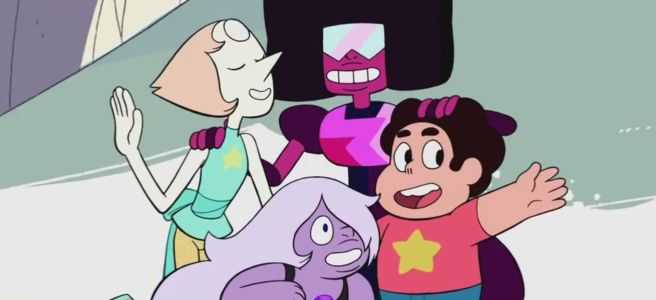
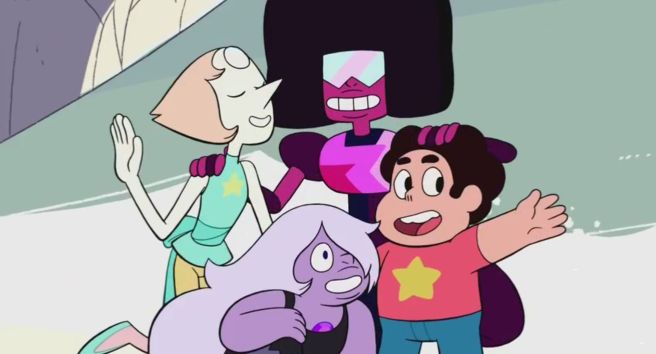
Then … there was this point. It was about the point when I became to realize there was continuity to each episode. When the background of the world began to spread more constantly, and seemed to tell a more quiet and larger story while Steven, Garnet, Pearl, and Amethyst were more vocal in theirs. It may have been when the Gem species and the Crystal Gems’ Homeworld was introduced that I started to pay attention.

With more questions and mysteries to match each answer, I rewatched the old episodes with Gaming Pixie and then the others afterwards. I remember just watching Power Puff Girls casually when I was younger, and then hearing about the renaissance of My Little Pony and thought Steven Universe was something along those lines. Back in the day, I might have thought it mostly geared towards a mostly younger female audience and felt ashamed of watching it due to some perceived notion of masculinity, but nowadays I know better: especially coming to grips with having been invested with Sailor Moon on YTV.

Perhaps it all ties together. I just thought it wouldn’t relate to me. Or I didn’t want to become emotionally invested into something else. Combine that with the fact that music, especially musicals, can create a sense of vulnerability in the layer of irony making up adulthood and you might have a greater picture as to why it took me some time to get into Steven Universe, and why it affected me so much when I let it in.

Steven and the Crystal Gems

There is something very Scott Pilgrim about Steven Universe himself with his neotenous features, his pink shirt, and the star in the middle of it. But whereas Scott Pilgrim as a character lacked a lot of maturity, even though Steven continues to grow he has a lot of wisdom for a young child. He grows up in a non-normative family, with three moms, aunts, sisters, whatever role they are, and his father. The Gems themselves are all, from human understanding anyway, female.

Describing this show is a lot like trying to explain a certain kind of music without actually just getting you to listen to it. I think what really gets to me, aside from watching Steven grow, is how the show deals with diverse contemporary issues like ethnicity, gender, and sexuality without being preachy, and by telling an excellent story with natural character development. But more than that, it isn’t afraid to be vulnerable. It isn’t afraid to sing, and its song isn’t oppressive or intrusive. It allows you to get used to it first. It allows you the choice of listening to it and perhaps remembering part of why you loved music, and imaginary worlds to begin with.

It also makes me really value Steven. It makes me appreciate the wonder and the heartbreak he goes through as he grows. It also reminds me that he has a large and diverse family, not unlike the communal one that Fraggle Rock will always be in my heart: that perhaps Sense8 might be in a more live-action and grittier adult sense if the series continues on as well as it has.

Above all, watching Steven makes me want to paraphrase something his biological mother told him on video tape, and tell the Gems, his father, and his friends that he will need them, to take care of him: to encourage him to continue to be the awesome person he’s meant to be.

 Steven Universe feels like this generation’s Fraggle Rock, with Rebecca Sugar and her crew’s storytelling equal to Jim Henson, and I’m just glad that — in some ways — I can feel that way at least twice in my own life. We are lucky to have a friend like this — with friendships like these — again.

Displacement: A Twine About A Learning Disabled Experience

People almost always gravitate towards personal stories. I’ve probably said this already in some way or form, and I know if I haven’t many other people have.

For the longest time, even though I’ve been very busy, I’ve wanted to have an excuse to make another Twine story. I almost did a few times: such as when I was tempted to create a Twine called Bureaucracy Quest in which you have to go on a scavenger hunt of varying documents, while keeping labyrinthine and mandatory appointments, while running into dead-ends and recursive story loops which are specifically designed to make you shut off the Twine from complete and utter frustration. But, fittingly enough, I didn’t have the patience to make this game while living the experiences that inspired it.

It was one night, between other projects I’ve been attempting to work on, that the cynical idea came to me. I was still waiting to hear back from my legal counsel as to whether or not I was going to get on the Ontario Disability Support Program settled out of court, or if I were going to need to attend the hearing that was going to happen this month. The good news is that the community lawyer working on my case was excellent and got me onto this new system. But at the time, I’d been waiting to hear back from ODSP for about a year and I didn’t know what was happening at the time.

There was a series of muscles I must have been holding for over a year, and a few days before I finally heard the decision on the phone from my lawyer, a lot of different elements began to gather in my mind. It began with the first rejection letter I’d ever gotten from ODSP: essentially stating that according to their guidelines I didn’t have a permanent disability.

I had been diagnosed as being learning disabled, as being what nowadays might be called “non-neurotypical” since I was a child. I had to attend special kindergarten, then classes, and then alternate classes. I had an especially hard time in high school: as I only had one class that dealt with learning disabilities and I had to get extra help from the teachers themselves without much in the way of a department to back me up.

My plan was simple. I had gradually weened myself off and away from the programs that I had difficulty completing. I mean, you can imagine how disabilities such as dyscalculia, spatial difficulties, and even challenges in hand-eye coordination and mental focus — in needing finer instructions — can get in the way of mathematics, geometry, fine arts, geography, and even aspects of the hard sciences. Phys. Ed was especially bad for me due to physical coordination issues. So I got through them with the bare minimum. And then I replaced them with philosophy, sociological, historical, and literary courses. I focused on what I was strong in doing: and even then I needed special help with regards to tests and exams.

But I was told, and I hoped, that by University I could take the courses that I wanted and build the education that suited me: making me ready for a career in academics. I was going to focus on my strengths and leave my weaknesses behind. I was going to make it so that my learning disability was irrelevant and I wouldn’t have to identify with it anymore. I believed that I could succeed through sheer merit, through personal work, discipline, and sacrifice: and that, with some help and support behind me, I could excel.

What I didn’t understand, at the time, was that our society is not — and has never been — a meritocracy. It is a bureaucracy: with specific rules and procedures. Networking is also a social skill that is integral to navigating the labyrinth. And while I had instructors and academic representatives that told me about the importance of this element, I just couldn’t relate to it. Not really. Again, I thought it was about what you did and not who you know: or even who knew you.

Then there are the psychological factors to consider. Other kids are hyper-aware of differences and if you have trouble socializing, or counting fast enough, or telling directions, or the fact that you rock back and forth when you are excited or nervous and your hands fidget, or even when you talk to yourself they will notice. They will notice and they will laugh at you, or bully you, or avoid you.

And those are just the children: your peers. I’m not even talking about the adults. Between having my grandfather thinking of my math disability as a sign of laziness, and others snapping at me to stop fidgeting or talking to myself — for fear that I would “look ridiculous” — you can already understand why I’d want to leave that all behind me. You can also more than imagine where a lot of my anger comes from, and where some of my own present difficulties spring.

I was also lucky. My parents recognized that I had cognitive difficulties and got me as much treatment for them as possible. But as such, most of the family emphasis was less on me learning life skills as it was actually succeeding in school: as that was a major difficulty of mine. But it cost me: as by the time I moved out a few years ago, I didn’t really know how to take care of myself. I didn’t really have a stable network of people to help me with that, and I was left to figure out a lot of these things on my own, or deal with people and organizations that gave me basic — or bad — advice and nothing really of substance.

There was a lot of weight on my mind in getting through my Master’s and juggling real life: and I hated, absolutely resented the idea that my learning disabilities — that the make-up of my brain — was still affecting me despite all the calculators and GPSes of the world.

So you can imagine that when I finally swallowed my pride, the first time with Ontario Works, and the second with ODSP that when I got my first rejection letter telling me: “By our guidelines you do not have a permanent disability” that it was the equivalent of a slap to the face.

I had a long time to think about this. It took a while but I had to accept that my disabilities, that my “non-neurotypical” brain are still parts of my life. It took me even longer to embrace the fact that I have to identify what is just another wiring of my brain and experience as a disability: in order to get the current social structure to help me survive it. I thought about all the people that have told me to “suck it up” or just tolerate what I can’t focus on in order to exist. I’ve had to fight against the idea that I am “coping out” when I identify as being learning disabled instead of “earning my place like everyone else”: whatever that means.

And so I decided to call ODSP on its punitive structure. I sent in my forms and my diagnosis from my therapist, which they rejected the first time. I had them do an internal review, in which they found no fault in their decision. And then I faced down a hearing in a game of “Chicken” to see who would give way first. I am a really stubborn person when I have a mind to be. In fact, I do extremely well when I have something passionate and real to focus on instead of settling for something less than.

I’m also aware of how privileged I am. Between my family that actually recognizes learning disabilities and finds itself there for me, to the community counsel that got my case settled out of court, to the best therapist I’ve ever had with or without Canadian OHIP, and a lot of Affirmative Action protocols, I have been exceedingly lucky. And I know that just as all learning disabled people aren’t the same, many others haven’t had — and don’t have — the backgrounds or resources that I do.

But there is one other thing that stuck with me after that experience of having my disability and experiences not acknowledged until I faced them head on. I thought about how we all experience and interact with the world. And that night, a few nights ago, when I was thinking about how best to communicate what it was like to be in the world with a learning disability, I came up with this idea for an interactive story.

I asked myself this: how would someone navigate a world if they had trouble reading maps or telling directions? What would it look like, in words, to see someone with dyscalculia doing equations or basic math? How would I portray the psychological baggage that comes with dealing with these issues since childhood? Can I do all of this and show they have something of a commonality?

And can I communicate my experience — my voice on this — through a creative medium with which I still have limitations? Can I express my story simply through the description of perception and emotion?

I realized, a few days before the bittersweet moment of finally having ODSP recognize that I have a permanent disability, that living with spatial, mathematical, and even body movement issues is like existing out of the same space-time as most people. You are somewhat out of synchronicity with the rest: both cognitively and socially. And that was where I eventually got the name for my story idea the following day.

Displacement.

It’s by no means an exhaustive story about all learning disabilities, or even the different gradations of the ones that I possess. It came out very rough in its first iteration — I had to par down the psychological elements — and even now I think I could have portrayed the experiences of the narrator more effectively: such as using that recursive loop of repeating hyperlinks I mentioned earlier to symbolize getting physically lost. But I also don’t know how accurate that would be and, honestly, I think right now this is as good as it gets.

This will have been my third post dealing with learning disabilities on this Blog: or at least the latest one after my experiences from this past summer. I hope, after this, to go back to writing posts about video games, comics, fictional universes, and projects that I’m working on. Those are the things which I want to be known by and remembered.

That being said, I would like to thank Gaming Pixie for looking over and providing input into the Twine story that I have linked above. Whatever else, I hope you find the story, and this post, educational at the very least.

Anthony Martignetti From the Mouth of the Wolf

I met Anthony Martignetti in 2013. Actually, that is something of an exaggeration on all accounts. I read about Anthony at the time and not long afterwards I read his memoir Lunatic Heroes. Then I wrote a review of it and sent it to him. After all, he had put his email address and Twitter handle at the back of the book: and Amanda Palmer had his information on her Blog.

It was about that point that Anthony and I started talking. And while he took issue with the fact that I gave Lunatic Heroes a four out of five (I knew that he could do better: that he had more stories to tell), he liked my review. He put a link to it on his Endorsement page and he and Nivi Nagiel — his editor, writer peer, and friend — sent me a green Lunatic Heroes T-Shirt that I wear when I know I am going to be facing something particularly tough with which to deal.

Then we sometimes played games of witty pithy words on Twitter. There was even one point he accused me of getting my new budgie drunk as he wore his bell as a party hat. And then he challenged me to write a review of his next book: Beloved Demons. It was challenging: not just because it was about his adult life this time around, but also due to the fact that I had other projects and Toronto had been hit by a freak ice-storm that made me aware of just how powerless I really was. That pun was unintended, I assure you, but I suspect Anthony would have appreciated it.

The last time we really talked though, and I mean really interacted, was outside my parents’ house for a change. I was staying overnight at the Toronto Global Game Jam of 2014. I had my own computer and everything. So here I was at this computer at George Brown College’s School of Design, surrounded by creatives in a field that sort of related to my own, and having come from a particularly bad day with Ontario Works and bureaucracy when I got an email from Anthony.

He sent me a link and, sure enough, all the work I’d done with Nivi to polish my review of Beloved Demons had paid off and he included a link to that article on his Endorsement page as well. It inspired me. It encouraged me even more when I sent him something that I wrote and he gave me some feedback on it. He promised, when he had time, to give me a more indepth critique of the work and to look at some of the other things I sent him.

But there was one thing he sent me during that time, when my own loneliness was changed by into gentle solitude by the creatives around me, that I won’t forget. In response to the story that I sent him, Anthony quoted an old operatic and theatrical Italian saying:

“In Boca al Lupo . . . crepi il Lupo.”

I admit I actually took a while to find a good translation of the idiom, but ultimately it seems to amount to this: “In the mouth of the Wolf … may the Wolf die.”

I knew, somehow, that I could use this. I knew it even before I found a smooth enough translation and it was appropriate. In a small, but meaningful way that was the apex of our conversations: our relation to each other.

These words stayed in my head as I introduced my own therapist to Anthony’s work and they had actually had their own interaction. I am glad I did my part to help them meet at least on some level. But I wasn’t entirely accurate when I stated that the Game Jam was the last time Anthony and I interacted.

The last time we actually talked was when I sent him a copy of my first published story “When You Gaze Into An Abyss” in the Heroes in Hell anthology Poets in Hell.  It too was appropriate, all things considered. Anthony emailed me back to let me know that he got the book I mailed him and that he would read my story first.

I never met Anthony. I only talked with him online. He had touched many peoples lives: and that doesn’t even include the books he wrote after Amanda all but had to strong-arm him into doing so. I always knew he had been sick, and sick for a long time, but it’s weird. Even with that knowledge there are times I still find myself expecting to see something on his Facebook page, and I even ponder sending him more things. But I never really forget that he’s gone.

I’ve been sad for a little while and it took me a while to actually put one of the reasons into words. Last week, there was a memorial service for Anthony: held by his writing group the Souled Out Artists. I unfortunately couldn’t attend as it was in the States, in Boston, I have been dealing with anxiety issues, and I just didn’t have the logistics for a stay there. But I were to be perfectly honest, those are just part of the reason. Anthony said, once, that he and I should one day meet for owl sandwiches. He also said he wouldn’t have minded a phone call.

The fact is, I didn’t know whether or not he was being facetious. I didn’t dare ask, but jokingly said sure. But as I said, we never did physically meet. And I never phoned him. I regret that sometimes.

Many people that attended that service, or didn’t attend, actually knew Anthony personally. And, in retrospect, I would have felt weird being there. I was just a person on a fringe of lives that happened to appreciate his writing and influence. I wasn’t a family member, or a patient, or a student. At best, I’d to think we were casual friends that sometimes had time for each other for non-serious things and an appreciation for good writing.

I am glad that people went to Boston to the Souled Out Artists to celebrate Anthony’s life. His stories will continue on as living signs in the people that loved him. And his idiom of the Wolf will be an epigraph at the beginning of a novel that I plan to release one day: and it is all thanks to him.

Anthony understood the importance of mythology. He knew that the Wolf was symbolic of a great many dark things. And in so knowing, he created stories that fulfilled his old Italic proverb.

In the mouth of the Wolf … may the Wolf die.

Those are some words that I hope I will continue to live by. You can find more about Anthony’s stories here. Trust me: they are worth reading.

wpid-wp-1447229690679.jpeg

SilSol: A Dark Crystal Vignette

Here is my second, and last Dark Crystal character sketch. I made a lot of speculation as to which urSkek SkekSil and urSol came from: especially from the second volume of The Dark Crystal Creation Myths. To me, this writing represents what I could have done, and what I did actually do. I hope you will enjoy it and appreciate this in the spirit that it is meant. 

SilSol flew through the lines of stars and suns with his brothers as they finally left Thra through the Crystal of Truth. His own mind, though clearer, now was no less blurred as they passed the point beyond space and time and perception.

He looked down at his form: such as it was now. It was a brighter orange: almost a bright white light. Once, UngIm would have told him that a white corona symbolized a process of healing. And he, above the rest of his brethren, shone the whitest of all.

Even now, travelling with the others, it was hard to think of Thra: of the place of their banishment. He remembered wanting to leave and rejoin his people so badly. He hovered in the skies far across the ocean and sang in a place where he thought no one else would hear them. To the Gelfling people, he taught them songs of growth, and peace, and love. But to himself, singing to an audience that no longer listened to him, that he was no longer a part of by virtue of being a “he,” of being an individual, he sang of loss and loneliness and the clinging to of false hope as temporary staving off of despair. But it had been a deceptive salve, one that ate away at his very being, that stained his reddening form with a spreading blackness … it had proven just as corrosive and as ineffectual a balm as essence, as vliya

Deep regret flowed and passed through SilSol’s ethereal form. He had not known the mariner Gyr had been there that day, listening to his song. It hadn’t been the Gelfling’s fault. It had been none of their faults. In his spite he thought them primitive savages and only Aughra was considered even remotely equal to his kind. But she had been wiser than he in many ways, though he did not spend nearly as much time with her as TekTih had, and the peoples of Thra had their own songs, their own rhythms and variations. It was the very opposite of the former unity and symmetry—the perceived perfection—of the communal consciousness of his own race. Once, long ago, SilSol knew his music had been as precise and perfect—as crystalline—as mathematics and the physics of the cosmos. But he had split away down a quantum path into something else, like the rest of his brethren and he hadn’t been able to find that perfect note again, that rhythm that he needed, that he craved for balance …

Is there no place in all the realms of the Crystal where a single being will show me compassion!?

It wasn’t even Raunip’s fault that he had finally unleashed his anger and bitterness. That one had his own imbalance, his own lack of connection with himself to deal with and SilSol had not envied him. In the end, SilSol blamed Thra, the place that graciously took them in, for this sense of loss: though the fault, he knew now, lay within himself.

Dark Heart, Raunip named him, once.

Is there truly no love for me in all creation!?

The Crystal, and Thra, and the Universe had answered him. They had always spoken to him. He just did not hear it. He chose not to hear it. Like the Chanter that he had been, he closed his hearing to everything but his own song, letting it play around him and drown everyone out, let it deafen the world, let himself become deaf …

He knew now that his brothers had been the same: had denied their darker impulses, had secretly hoped to purge them with the light of the Crystal, to go home … SilSol had just been the catalyst to ignite and rip apart their wilful ignorance.

But it did nothing to assuage his guilt. Better urSkeks than he: so many others including TekTih and the great SoSu passed on fragmented while he, the catalyst that made the Crystal divide them, remained. He recalled the Division vaguely: remembering the scorn of his brothers and their hatred of his one discordant note: for the vestige, that grating reminder of what he had cost them, of what they had lost and he had taken from them when they were all whole. He went around and used that crooning voice, that one note, to tell lies and ruin lives … At the same time, he recalled the Valley and the peace, though unearned, that he had finally found for his soul there, for the love he had of the planet he once disparaged, and the time he spent singing with his brothers, with the Gelfling Jen that was like their child …

As these fragmented memories unified, the pain in SilSol eased and flowed out of his body into the darkness of space, into the streaming of his brothers’ light. Even fragmented, he taught Jen his songs, and his selfish part—the part that caused so much pain—guided him to where he needed to go. Unity and symmetry won out at the end of the day, disparate notes becoming a single song again.

Around them, as they continued to travel, his brothers began to sing. UngIm, at their forefront where SoSu had once been, beckoned him forward. SilSol found his light becoming a brighter white and gold again. He understood that he would heal—that they all would heal and had healed—together. With this thought, this solace, his two voices—become one once more—joined the rest of the chorus as they, all of them, continued on their final and eternal journey together and whole again.

Urskeks