If My Mind Were A Movie

Not too long ago, I made an argument that The Room can be seen as the inside of a mind or perspective of life made into a cinematic experience. But as I finished that line of inquiry, two other questions came to mind:

What would happen if I made view of reality into a film? And what would it look like?

I don’t really plan to get all intricate about this but I think the film that represents how my mind works, and how it attempts to relate to reality goes a little something like this.

It would start from different time periods. Some parts would have voice-overs while others would have words on a screen. In fact, voice-overs will be reflections of the past and words on the screen will be internalized thoughts. I would have epic video game electric body music play, in addition to some John Williams and Murray Gold, for some of the most pivotal moments in the movie while the more uncomfortable moments — such as dealing with bureaucracy, breakups, public transportation, and loneliness — will be filled with complete and utter stifling silence. Internalized subtitles here will have ellipses.

There would be scenes of wandering and scenes where I play a character that sits in one place almost all the time. I will have my character in long-shot views of his own life. He will particularly be in the background of his past when he is a child, a teen, and a younger adult. Maybe we can go for blurry after-image effects here. Each version of him will attempt to tell the other something about their future. One might try to change something, while another might say nothing at all. I think I’d also play an antagonist to my protagonist: who enjoys breaking things.

My narrative would be tangents. There would be epic, almost wuxia level, duels and combat with understated special effects. Epic speeches ranging from “the reason you suck” to philosophical digressions all the way to lots of swearing and profanity will happen. There will be intermittent, but gratuitous, intimate sex and a focus on the pull between connection and distance. Human kind would be depicted somehow as ignorant, self-involved, and small, individuals as fascinating, and the whole humanity as sometimes frail and sad and impermanent with a few motes of true self.

That all said, many hijnks will also ensue. There would be melodramatic screams and explosions in the background as punctuation. And budgies: sometimes as pets but also attacking the populace at large. There might even be a budgie totem of imitation and mimicry in a strange version of an Australian Dreamtime involved. My character will find himself walking into different times in the same places. He will get lost a lot in all manner of different interpretations.

I’d have books and comics and, copyright permitting — though most likely through having to create analogues — have my character immersed in a world of them. He lives in there and entering it is this permeable membrane of reality: a portal that gets harder and more narrow to access as he gets older. I’d be tempted to, but probably not use CGI effects, to show a piece of his soul splintering off for every year he gets older.

I think I would design the film like a multiverse of different spaces and times: a kaleidoscope. I would make it so that there are worlds where all of his dreams happened, places where none of them did, some others where he died, and others where he never existed to begin with. Sometimes my character will be a complete bastard, other times weak and wishy washy while spending most of his time remembering his future while another lives in the past. And all of these tangents will circle round and round each other, closer and closer until they collide and everything goes completely crazy and my character jumps from one fractured reality into another: navigating a grand plan gone to chaos … something built up just to be destroyed and rebuilt again.

I also think there would be a reality where concepts are people and they shift around too: and unfinished artwork will be their own entities and have their own world. Maybe they will eat people.

There would be friends on the phone and friends online. Some of them will have strange avatars. And maybe for the end, they will all come together, or perhaps he’ll go to them.

Of course, like a certain other director I won’t name I’d probably keep adding stuff the film as I go along and take stuff out and have constant director’s cuts. If I had to sum this all up, I’d say that my film would be an independent, tragic comedy of a mythic cycle with meta-narrative, nerdy references, and a whole lot of poignant moments and what the ever loving fuck. And crisp, witty dialogue. I can’t stress that enough.

And a good ending. Maybe my film, filled with regret, passionate anger, suffocation, cackling joy, fidgeting anxiety, headaches, serenity and the whole gamut of glorious insanity that we call human experience would be a multiple choice ending situation: if such a cinematic narrative is possible.

I might call it Not My Magic Eight Ball.

Because why not?

But I will leave film directing and script-writing to more capable hands. I’m just describing what my film world would be like if it existed. It’s been a while since I’ve been personal and creative and I just wanted to try something new today: or write about something old that keeps growing.

Writing this actually felt kind of good.

So tell me: what would a film of your mindset look like?
To The Room: You Fail At What You Pretend To Be … And That’s Ok

So let me just say, right now, that I watched Tommy Wiseau’s The Room. In fact, not only did I watch The Room, but I read Greg Sestero’s The Disaster Artist even before seeing the film which, I’ve been told, is highly irregular in the scheme of things.

A long time ago, I read Thomas Mann’s “Tonio Kröger.” And there is this one scene in that story that never left my mind. The aforementioned protagonist is watching his classmates dance. They are blond-haired, blue-eyed, and uniform. The dancers do not pay as much attention to why or how they dance, so much as they are just good at performing this communal act. Meanwhile, dark-haired Tonio knows that he can’t dance as they do, but he actually observes and understands their dancing far better than many of them ever can.

And then, there is the character of the dark-haired girl. She, unlike Tonio, doesn’t understand — or perhaps want to understand — that she doesn’t fit into the synchronous dance of her peers. Still, she continues to dance with them. She dances with them while stumbling around awkwardly, and even physically hurting herself. Her movements are not at all in unity with the other dancers and she stands out from them no matter how much she wants to fit in.

Now consider that someone like Thomas Mann’s dark-haired girl knows, deep down, that they’re different and just thinks that more intensity will make up for it: more passion, more resources, and more random elements. Aside from the fact that someone should definitely, if they haven’t already, write a story from the perspective of the dark-haired girl, I think you can see where I’m going with this comparison with regards to The Room.

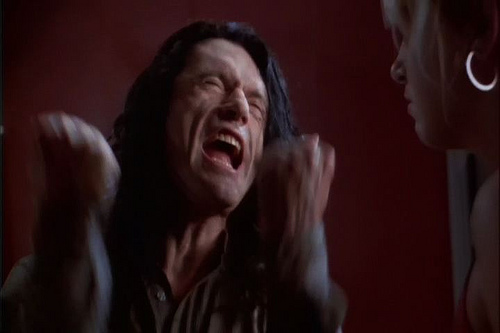
I’m not going to go into the many flaws of this film because many more qualified people have gone to great lengths to describe them all. But what I think is really intriguing here, especially since I read The Disaster Artist first, is how you can arguably state that this is the closest thing I’ve had to seeing the inside of another person’s mind on film.

So here is my own tentative reading of The Room.

When I watched The Room I thought of a mind that wants to accept reality at face value: both with regards to its immediate environment and its cultural surroundings. It searches for all the tropes, all the archetypes and stereotypes: all of the human stories. In particular, it looks at American culture: at the American Dream of the frontier and wide open spaces, a successful career, romantic love and marriage, friendship, family, and relations between the genders verses a cramped psychological place of disappointment and dysfunction. In particular, it tried to go into that place of love and tragedy to create something of a … narrative.

This attempt to create connection between these elements fails. There is a dissonance underlying all of this mind’s attempts. You see it in the way that words and sounds are out of sync with the actor’s mouths: particularly those of the protagonist Johnny. The film opens up with an almost pastoral theme amid a distant sunny splendour that never seems to completely reach the characters except for those rare moments of sublime silliness between them. Love and sex is accompanied by music that sounds suspiciously like a stereotypically tacky and kitsche soft-core porn soundtrack: while ending off the film after the final death.

And sex and death are seen as awkward, dissociative things. Bodies never really quite find themselves in the right places: and even the death at the end is a long time in coming. It’s like a mind and perspective that just can’t link the ideas, emotions, and people together no matter how badly it seems to want to do so. You can see it even in how the actors behind the characters, and how the characters themselves want to reveal their truths and themselves. They’re trapped in the marble of ideas and meshed together: only connecting intermittently.

The parts and ingredients are all there: even if it seems like the mind of this movie is looking out at its world from a mishmash of extra body parts. It’s like a soufflé that didn’t rise, or a Frankenstein creature that never galvanized into life. And I think it is a horror story in how causality and even space and time are never really consistent, with the strangeness of the roof exit and the unexplained additions and disappearances of different characters.

At the same time, I also look at The Room as something of a tragedy: of realizing that there is a mind that so desperately wants to hold onto the conventions of its surroundings that it ends up revealing their flaws. In an attempt to reveal a truth through non-sequiturs– of pathways leading nowhere — it unintentionally and accidentally satirizes and parodies what it attempts to love and glorify: be it American culture, the Dream, human relationships, humanity, life, and itself. And yet, even in all of this, there are moments of sublime ridiculousness — in the form of football throwing for instance — that are almost peaceful and serene in the way that the characters play with each as though they are children. Those are perhaps some of the most wistful, surreal, and innocent segments of this entire film: this strange cinematic reality.

The writers David Gilmour and C. Anthony Martignetti both seem to agree that our minds play our lives, desires, and pain within the theatres of our mind’s eyes. And here, in Tommy Wiseau’s film, we are looking into one such theatre. And this mindscape, this inner theatre, this place is called The Room. Certainly, after reading The Disaster Artist the movie’s scenes with Johnny talking about how he met Lisa, and Lisa explaining how Johnny takes care of Denny take on a whole other connotation.

I’m not going to lie: The Room, and The Disaster Artist exposed me to something of a paradox from which my brain is still attempting to recover. The experiences I witnessed and read about were painful, hilarious, sometimes depressing, and just outright puzzling at times. But all of it was a fine study in just how someone creates their own mythos: a creative process that seems to have translated over to Tommy Wiseau’s sitcom project The Neighbors. Certainly, there is at least a consistency in how Tommy Wiseau seems to act and work if you are interested in looking at his AV Club Interview: and I can’t help but wonder what would happen if he had ever met the former Torontonian bicycle shop owner Igor Kenk with his own unique world-view. Would they get along, or would the universe implode?

But when this is all said and done, I think The Room is its own person: a mindset that fails — spectacularly, beautifully — at being what it pretends: namely, at what it thinks is normalcy. And that’s okay. Here, at Mythic Bios, I absolutely adore being able to examine another form of personal reality. In fact, I’d like to think if The Room were an incarnated personality it’d be what would happen if the dark-haired female character from Thomas Mann’s “Tonio Kröger” tried to dance with our contemporary reality: except she would be a blonde and she insists on being what she pretends to be instead of who she really is: and what I think is an even greater tragedy. She attempts to embrace what she thinks is supposed to be normal yet she can never be so by her very nature.

And her name would be Lisa. Because, even after watching you Lisa, you are tearing me apart.

The Room

This is Halloween

This will be the first of two posts that you will see today.

I spent a lot of weeks before and during Halloween differently. When I was a child I would be inundated with television specials, movies, school events, and trick-or-treating. As an adolescent, I spent some time with my group of friends. In my early adulthood I spent a lot of it by myself trying to remember how happy I used to be and imagining all the other people who were having fun that I did not. I spent the rest of my young adulthood, alternatively, with friends and sometimes on my own.

I almost went to a Halloween party last year but I didn’t. I was too depressed and I did what I often do in that state: sleep and work.

This past while I’ve been doing something different for Halloween. Instead of wandering around outside at night in the dark aimlessly, or watching television, or hanging out with friends and lovers I have been busy.

I have been busy.

Last week or so, I covered six films in the 2014 Toronto After Dark for GEEKPR0N. I even covered an extra day, a Wednesday, so I could watch one film that was recommended to me. Those of you that read this Blog or my work at GEEKPR0N already know about this. I wrote reviews on The Drownsman, Wolves, Late Phases, Wyrmwood, The Town That Dreaded Sundown, and Why Horror?

And it was difficult. There were many times I thought I could just watch the films, then go straight home, and write something out that night. But even though I got wiped out, it was totally worth it. The irony is that once, long ago, I was told that I should write reviews for movies — or movies like these — and I didn’t think I was qualified to do so. It’s only in relatively recent times that I’ve realized that the only way to be qualified to do anything is to make yourself so, and start to believe it.

I got some other things published in honour of Halloween as well. Not only did I write a nice short article on the end of Kris Straub’s Broodhollow Book Two, but I got to examine and see just how a creepypasta created by Eric Heisserer the subreddit no/sleep truly lures readers into fear and trepidation. If you have read my articles on creepypastas, you know something of what you might be in for when you read this particular piece of mine.

But I think there is one achievement in particular that I can really be proud of mentioning. Do you recall, that week or so ago before I went off the Mythic Bios grid again, that I was doing another interview: this one live and in-person? Well, with the help and guidance of GEEKPR0N and Toronto After Dark organization … the following actually occurred.

David Hayter Fav and Retweet

Not only did David Hayter, the screen writer of the first two X-Men films and Watchmen as well as the voice of Solid Snake favourite and retweet my review of his movie Wolves I also got to interview him before Werewolf Night at the Toronto After Dark.

You can find my interview with David Hayter right here.

So that has been my time leading up to Halloween so far. The rest of what I intend to do, however, is as follows. Later this evening I am going to the Silver Snail Halloween Party: the same one I didn’t end up attending last year. I don’t have a costume idea as of yet and I’m having some difficulty finding make-up after my last misadventure but I’m going and to anyone living in Toronto or nearby, I hope that you will join me. It’s organized by GEEKPR0N, in part, and it makes some pretty awesome parties and I don’t intend to miss this one this time around.

The next day I’m going to the Comic Book Lounge and Gallery to pay a visit to Drawing For Deb: In Support of Epilepsy Toronto. There will be signings and a 12-Hour Comics Marathon: Special Edition there to raise money to combat epilepsy which claimed the life of Debra Jane Shelly: a well-known friend of the comics community and someone that I only began to know when I first started coming to the Lounge. She was an awesome person and there will be some good people there. I’ve realized long ago that I am just not an artist with pictures, so I will be attending to pay my respects and I may not be there the entire day.

And then the next day I will be going to Horror-Rama: an all-horror convention where I want to explore and particularly meet Jovanka Vuckovic: the brilliant upcoming director of the Jacqueline Ess film adaptation.

Then somewhere, somehow I will catch up with my Doctor Who recaps and next week get back to my fiction writing and probably sleep for a few centuries as I am bloody exhausted.

So this is both what I have been doing, and what I am going to do. It’s funny. When I was reviewing Why Horror? I started thinking about just how it is effective. When I was a child I read many abridged versions of horror stories, listened to and read written down folktales and urban myths. And I would spend time in the now-defunct Hollywood Movies store reading the backs of horror film VHS tapes. I would attempt to avoid watching them, scared of being caught in the web of their details and becoming committed, but so very fascinated with what I might find.

Not much has changed. I think the reason that horror is so fascinating is the fact that when you look at all the gore, the grisliness, and the uncanny you see what you are not and you also get to see a bit of what you are. You are ultimately safe and in sensible surroundings, or so you think, and it gives you a rush of life — of vitality — in the autumn.

That’s why some people have sex after watching horror. That’s why some people have an urge to create stories and study mythologies after watching horror. That’s why people gather around their friends and celebrate their grisly façades: the orange light in the darkness. That’s ultimately why I’m rambling right now.

I’ve spent my life fascinated by, and avoiding life. But it lures you in. It is the ultimate horror but it is also a spectacle, and best experienced in good company. I hope that, today in sharing all of this with you, that I got to be the latter.

Happy Halloween, my friends.

Writing Time Again: And More To Come

Hello everyone. I’m glad I got to spoil you with two articles last week, but this will probably be an exception and not the rule. Still, for a while there it felt almost like old times and it was all creative writing: as I obviously have Doctor Who on the brain.

Basically I am going into writing and deadline mode again. So I am going to be focusing a lot of my energies on my current assignment and, when it’s done in some way or form, I’ll be back in force. But before I go, let me tell you a little bit about what has been happening with me so far.

Very soon you are going to be seeing a lot of GeekPr0n articles. In fact, you already have in some ways. Cyan Worlds even retweeted my article on their plans to make a Myst television series. Myst was prevalent in a lot of my young adulthood and there is something very full circle about being recognized by its creators: especially as it is an article about worlds — Ages — linked to by Writing.

But that all said and done, it’s the season of Halloween and I found a lot of current news to talk about. As the zombies moan, spread the love and you know where to follow me.

There are two things of note that I’d like to mention, though, to this regard. First, I had an important interview with someone who has informed many a geeky childhood and is currently doing some good work. The second thing I’d like to mention is that I will be covering some of the upcoming Toronto After Dark for GeekPr0n.

And it’s funny. For years I had nowhere to go and nothing to for Halloween night proper and now I have two events around that time which I am going to attend. I’m excited and I feel different these days. There is still a lot I have to deal with but, and I think this has been happening for a while, I am not the same person that I used to be.

It’s hard to explain and it doesn’t involve spiritual or alien possession, cloning, mutations, or the dark side of the Force as far as I know. I’ve been producing words like a fiend and even though I didn’t get to undertake my Twine projects like I planned, I still haven’t ruled them out and they will be in my thoughts for the future.

In the meantime, I have some other writing to do and I hope to see you all soon and well. Once again, take care everyone. You are all awesome.

Change

I spent much of my youth somewhere else.

It’s not too much of a surprise really: especially when you consider what I was and what I would ultimately become.

You would find me reading one of the Oz books during a special session of class. Or reading a book from The Belgariad in the car on the way to a funeral. You’d better believe that I was reading comics when I was dragged to synagogue and philosophy texts were my in-depth friends in my adolescence. I’m not going to even go into the many games, arts and crafts, and stories I wrote to distract myself from being bossed around and general tedium when I was sent off to summer day camp. And I would watch and rewatch old Muppet and Disney cartoon movies on my VCR whenever I was home from school.

But the fact is, from grade School all the way through the end of high school I must have created and read most of my life away. I miss the immersion that staved off the banal mundane world and its gritty, disappointing, adult reality from my life.

It got harder to keep the world away once I got into university. My magical rotes, such as they were, began to falter and fail. Once, when I had to do so many things I hated or tolerated I always had that space to retreat into: that alternate place where I could focus on more intellectual and imaginary matters.

I had so much time. When I was younger, time was limitless and most of it was spent wanting to be somewhere else when I didn’t want to do something else. But then time began to speed up. Sometimes it would slow down again and become stagnant with the dead-end nature of reality.

Reality again. It was creeping in. It’d been doing that towards the end of high school and I always knew it was there: just waiting for me. And it scared me. It was more complex and wondrous than the terrors of daytime Fox talk-shows. It was politics, and plurality, and many experiences, and human horror, and girls.

I’m glad I met the girls.

I think that explains a lot about the person that I am now: for however long that lasts.

It’s strange. These past few years time feels like it slowed down, or went by in the blink of an eye. Sometimes I wonder if that span even existed. You see, time did slow down but in that stagnant place of perceived adult failure. The thing is: I had gotten out into the world, if you want to call academia part of the world as it is.

I couldn’t handle the rest of it. And the refuge of books, films, comics, and cartoons were only temporary retreats in front of a cold, grey reality. And I know that age-old danger: of knowing it could be worse, that it can and for some it really is that.

I got tired.

But something has been happening. Time is moving fast again. These past two years, some of it spent by myself, I still knew that my time was not infinite. But it is getting faster again, if that makes sense. Things are happening. Things have been happening.

My reality marble of purely writing all the time is harder to keep around me against that perception of reality of which I’ve not done much in the way of justice. Things are happening.

Things are changing.

It scares me. It scares me to know that after some years of being sedentary I’m going to be moving around again. I’ve gotten too used to my sense of exile. I know how dramatic that sounds in this somewhat disjointed post. I didn’t even know what I was going to write this time around considering all of my circumstances but I think, when it is all said and done, that this a good thing.

It is the only thing. I’m changing and I can’t always keep up with those changes and their multitude of event horizons. But I can try. And I know and I have to believe that there are people who will be there alongside me, who will still be patient with me, as this continues to happen.

Soon I’m going to be out of my bubble. And you know, it’s time.

My rotes may not work as well as they did, but perhaps now is not the time to dwell in other spaces.

Now is the time to act: in this space.

Matthew and the Daleks

Star Wars: Preludes and Interludes Of A Space Opera

I think that if I were a Time Lord, I’d be a unique one that specializes in travelling to alternate timelines: not because I originally intended to, but due to the fact that these are places to which my senses are attuned.

Lately, not to mix metaphors, I’ve been thinking about Star Wars. I mean, when aren’t I? But bear with me. Imagine, in that period between 1980 and 1983, when The Empire Strikes Back made people truly want to know what happened next, George Lucas came up with a plan: a long-term plan.

We already know and suspect that by Return of The Jedi, Lucas was planning on heavily merchandising the hell out of his universe. Some people even think the addition of Ewoks in the last film was an attempt to particularly appeal to children and their love for toys. Even after the sixth film, we had cartoons like Ewoks and Droids.

But what if it didn’t stop there? What if aside from the made-to-TV Ewoks films George Lucas had wanted even more merchandising. At the time, LucasFilm was in the process of developing its special effects technology that would be utilized not just by itself, but by other companies and film productions as well. Even so, by the time of the cartoons it had only been a few years since Return of The Jedi and people — particularly children — were still fresh off of a galaxy far, far away and wanted more. More than that, and I can speak for myself here, fans had questions: about the Jedi, about the Republic before the Empire, and the Clone Wars themselves.

Many of these questions had been answered with the new CGI Clone Wars cartoons and the Prequel films — albeit with some gaps even now — but there was a gap of at least, what, seventeen years or so, between the films: where many of us waited after the re-release of the Old Trilogy to find our answers and immerse ourselves into new Star Wars.

Yet what if during that time, we had something else to tide us over during near two decades of waiting?

Indulge me and imagine this. After the last film and the initial cartoons, LucasFilm decides to release oncoming series that takes place during The Clone Wars. Perhaps Lucas calls them, collectively, Interludes. During this time, we get to essentially see the Republic and the Separatist Crisis, and the Jedi Knights. We get to see a young Obi-Wan and Anakin actually growing together but, more importantly, we get to see something else as well.

Jedi Team

We are witness to other characters — other Jedi and galactic denizens — and we get to watch them grow. We are introduced to the clone troopers early and see them as individuals: while always wondering why they look so like and unlike stormtroopers. And there are hints of Anakin’s back story and how he met Padme. At this stage, perhaps a few seasons or an interrelated series of cartoons (perhaps aided in the 90s by one young Genndy Tartakovsky) and live-action programs: space opera serials not unlike the material from which their structure was derived. Can you imagine that? Coming home from school to watch your Star Wars show?

And yes, the intervening years between the early 1980s and the late 90s might not have much in the way of advanced graphics or special effects by our contemporary standards but imaginary worlds have been built on much less and with more attention to detail. I mean, look at some anime from that period, or even the Old Trilogy and how immersive it was for looking all run-down, and world-weary and real: letting our minds fill in the rest. I could have seen LucasFilm making a lot of money during this time. I mean, think of an Interlude series of Star Wars: Clone Commandos playing alongside G.I. Joe. Don’t tell me that wouldn’t be bad-ass.

Clone troopers

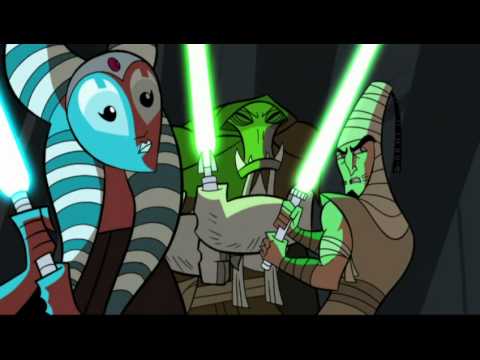
So during this whole time, you have all these background characters getting built up, living, and dying. You get immersed in their lives. Shaak-Ti, Aayla Secura, Kit Fisto, Plo Koon and the other Jedi have many adventures and you get attached to them. You see the Jedi Initiates as children and you want to be a Jedi: relating more to you directly as a child than even Luke does in the movies. Hell, you might even want to be Clone Troopers, have their special armour and play Clones Verses Droids along with Rebels Verses Imperials in the playground.

Of course, there would be comics and books as per usual. And then periods where there are no cartoons or shows. It makes the audience wait with anticipation. You build on the culture that you have already cultivated and created. The important thing is that you leave the questions. You have Anakin refer to his time on Tatooine and being a slave and you never know everything that happened. He has moments of darkness and you don’t know what caused them. You can tell Palpatine is doing something, but you don’t know where it all began or what even started the Clone Wars at all. Then there are the other questions about what will happen to the Jedi: particularly your favourite Jedi and their friends and comrades in the clones.

1999 comes around. Perhaps there has been some intervening years where the Interludes — The Clone Wars cartoons and live-action serials — have died down. Everyone is waiting. Now take the movies know from our timeline. If you want, imagine that the ideas created by George Lucas were written out by other writers: as he had those in the Original Trilogy. Maybe he even has others giving direction to the actors: those who can relate to them and have them react in believable and human ways. Scene-sequencing is interspersed with equal amounts of dialogue and action. CGI is cut down considerably and used sparingly: with a greater reliance on prop development and real world scenery.

The Phantom Menace reveals Anakin’s origins and just why the Jedi think he is so important. Attack of The Clones, three years later, shows us how The Clone Wars began. And, finally and heartbreakingly, we have Revenge of The Sith: where not only do we see Anakin fall, but all those Jedi characters that survived up until this point are mercilessly cut down by the clone troopers that we have, despite our better judgement as adults and adoration as children, grown to love.

Think of the impact of this alternate timeline. Think of how much we could relate to the death of Aayla Secura if we had seen her in various shows fighting for worlds and having her private moments with Kit Fisto. Think about Plo Koon and his time being a part-time mentor for Ahsoka Tano — perhaps even tutoring her in piloting — only to have his ship blown apart by one of his own clones. And the Younglings, those children you saw becoming Jedi … think about the horror in that.

How would you have viewed even the Prequels that we have now if there was all that build-up to the tragedy — a well-written tragedy — that was their Trilogy and the beginning of The Empire.

So now the Prequels are over. You know what happens. And yet … there are still some mysteries. Some Jedi are still alive or unaccounted for. A Rebellion has yet to form. LucasFilm, and perhaps Lucas Arts as it might still be around this alternate timeline can play with that. The fans are devastated by the impact of the Rebellion and Luke Skywalker is felt even more keenly. You watch the films again to know that the Empire fails.

Perhaps Star Wars cartoons and shows are divided into the Preludes — those dealing with the events before the Empire — and Interludes — those focusing on events during the Empire. Maybe some of these shows happen after the Prequels in real-time and others during the 80s and 90s. This is all you have to go on so far.

But everyone wants to know what happens next. They want to know what Luke and Leia do after the Empire falls. They have only had their appetite whet with the Clone Wars and the origins of the Empire. They want more.

And then, after 2005, ten years later after more shows and merchandising — and perhaps with the aid of Disney’s resources — we have: the Sequel Trilogy. The New Trilogy.

Of course, many people might have their own alternate ideal Star Wars watching timeline. Maybe there were no Clone Wars or Prequels. Perhaps the Sequel Trilogy happened right away. But there is something else to consider and it took me a while to personally understand and accept this.

It was Tony Pacitti in his pop culture memoir My Best Friend is a Wookiee that made me consider it. Perhaps one day, if not right now, there will be a new generation of children born. These children might watch The Phantom Menace and Attack of The Clones. Then they might watch The Clone Wars. Then Revenge of The Sith. Then the Old Trilogy. And the New Trilogy. They will see all the standalone films. And right now, it is all open to them. It isn’t perfect and there are gaps and questions, but they have mysteries to explore and wonder to consume.

It would be like us discovering the magic of Star Wars for the first time and their experiences would be different but similar to our own. They have so much more to see and know. They get to do what we can only dream of doing: living a life of imagination inundated by a variety of Star Wars: decades of Star Wars. And no matter way you look at it, this will be their first step into a much larger world.

What I Want To Twine

While I’ve going through some personal and bureaucratic issues lately, I thought I would take the time — late at night and recovering from a cold — to write about some of the things that I’ve been wanting to do.

Both of the projects that particularly weigh on my mind are Twine games. I haven’t made a new Twine narrative since The Looking Glass for the Global Game Jam and I meant to do more before other responsibilities and projects came my way. I don’t want to reveal too many spoilers at this point, but maybe this is as good a place as any to voice out some of my “workshop talk,” as it were.

There is one narrative I’ve been thinking about for a little while. It combines Near Eastern, Far Eastern, and some children’s literature. I’ve gathered notes, done some basic research, and even wrote down my own quotes and sentences that I want to use: those structures that often evolve or become centralized into larger stories. Remember: something always comes from something larger, even if that larger thing doesn’t exist yet … even if you haven’t made it. I’ve really wanted to work on this one as something of a response to a piece — a chapter from a story — that I keep on getting sent to me for some reason which has evolved in my brain into something else entirely.

The other Project I really want to spend at least some time on is my Twine novel. For those of you who have followed this Blog for some time, you may remember what I am talking about. For those of you who don’t know or recall, before I even had a basic working knowledge of Twine I wanted to make an epic story that dealt with some ideological and very personal ideas. I still haven’t finished all of the “chapters” or “worlds” and I have to remember and keep track of which world links to what and how to get them to do so after I’ve written them out.

Yes, I have been writing this Choose Your Own Adventure narrative game by hand: or at least I did for a while before I had to seriously focus on my work for Poets in Hell. As for my game, I know there are three worlds I want to write out. After that, I can take a break from it for a while and do something else and eventually complete it all.

I’ve been so terribly busy and fighting to keep focus and motivation. I just wanted to let you know that although I’m facing some challenges and difficulties, it is not all doom and gloom. I’m glad I got to write a bit about my creative processes again, even as I look forward to actually working on these creations and showing you all what I intend to do.Looking Outward

What Scares You Will Be Its Soul: My Dead Girlfriend and Project: Dark-Seed

This post contains horror, disturbing images and, worst of all, *spoilers.* Reader’s discretion is advised. 

When Dream created the Corinthian a long time ago in Neil Gaiman’s Sandman, his original aim was to construct a sentient dream that represented humanity’s fear of its own darkness. In the end, of course, he became more like a simple serial killer than anything as grand as a being that could make dreamers face the worst parts of themselves.

Corinthian Uncreated

The Corinthian’s initial failure as a dark mirror in which humanity could see the other part of its soul is a fitting metaphor when you hear discussions about the horror genre: particularly how gore and spectacle can take precedence over slow, creeping, uncanny elements out of the corner of your eye and the fear of the unknown or the forgotten.

And then you have creepypastas.

Kris Straub is already doing a web series called Scared Yet in which he looks at and dissects creepypastas: examining how they work, and how they don’t. He said once, in his now defunct Ichor Falls Blog, that many creepypastas fall into a formula or a series of tropes. You know: Jeff the Killer that is the result of bullying and acid being thrown on his face becoming ala the Joker analogue, a whole series of cursed video games bought from a creepy old man who may or may not vanish after a purchase, every story about Disney symbolizing institutionalized and secretive evil, and all the rest of it.

Many beginning writers can do this: they find stories that appeal to that part of them and they imitate them. Even so, many of these pastas have somehow become viral memes as they tap — sometimes even in a shallow manner — into that sense of universal horror and dread in humanity.

But then there are others …

There. Are. Others.

I have talked about Candle Cove before: created by the aforementioned Kris Straub. But a few days ago this little gem manifested itself:

My dead girlfriend keeps messaging me on Facebook. I’ve got the screenshots. I don’t know what to do. It is a story that was created on a subreddit called r/nosleep: where people seemingly write stories that commenters respond to as if they are real accounts. You can find a more polished version of it right here. But in many ways the original is much more diabolical and I will explain why.

First of all, like Candle Cove, it uses its medium to effect. But while Candle Cove emulates a Message Board, complete with user typos and all that loveliness, My Dead Girlfriend is already on a subreddit: a forum that functions as a series of comments stacked up on each other in a grey background with faded white fonts.

But goes further than that. My Dead Girlfriend also has links to what seem to be screen captures of Facebook Private and Public Chats. It utilizes Tags in empty spaces. And then there is the writing style to consider. While Kris Straub utilizes typos in Candle Cove, natesw or Nathan — which I suspect are personas — writes this from the first-person in something of a epistolary format: a series of journals or reports of the phenomenon occurring. Moreover, the writing from natesw’s persona on r/nosleep is clear, with no typos whatever, and possesses proper sentence structure, spelling, and grammar.

Yet the Facebook Chats he has “screen-captured” have the typos and fragmented sentences. And the dialogue between him and his dead girlfriend gets juxtaposed and played with like a twisted form of poetry. These two modes, the first-person of the subreddit text and the third-person and visual aids of the Facebook images complement each other. Unfortunately, if you go by the subreddit the ending could be lost: if it is indeed the ending.

Read the second, cleaner tickld version though: and look at the very last image that it shows you.

Creepy, no?

Remember, you have to find Candle Cove. My Dead Girlfriend finds you.

Ghost Writer

It’s still finding us. When Candle Cove was first sent to me, it had been around for a few years. Right now, though, My Dead Girlfriend is still spreading.

And the story had me before that image too. My friend and I were talking about this into the wee hours of Sunday and she told me that it had her at “FRE-EZING.” This was the only original word that “Emily” was able to construct, or revealed. You see, we never know whether Nathan’s torment is the result of a sick hacker, Nathan’s own subconscious mind projecting the grief of his trauma into messages from Emily, or … the fragments of Emily’s traumatized essence not completely realizing that she is dead and going to the place and person that she knows more than herself: perhaps even trying to make up for the reluctant displays of affection that she showed Nathan in life before she died on her way to their apartment.

Basically, the story is left open-ended. And there is the challenge in the recipe right there. You have to basically know that balance between detail and that open-endedness. If you have too much detail, people will question the specifics and your creepypasta will deflate into skepticism. On the other hand, if you are too grandiose and you try to encompass everything your structure will either never grow or will fall apart at the seams.

I think one element to know what medium you want to use and how you want to structure it. At the same time, you need to know what story you want to tell. Images, photoshopped or otherwise, help too. Another advantage that My Dead Girlfriend has is the fact that it has many commenters either playing along (being the poster’s friends or general fans of the subreddit) or are so taken by the Orson Welles’ War of the Worlds Effect that they are genuinely giving the poster natesw advice. But this story also manages to tap into the general and the specific. The characters and personas have names. There are dates. The accident that took Emily is revealed in slow and painful detail. The uncanny is tapped.

And that is the difference right there: that last ingredient. You can study the remnants of a miracle, but you can’t really reconstruct its soul from what is left. Or, in my case and in the case of other writers, you can’t create an original soul of a new story by purely examining leftovers alone.

I can tell you how these stories work, but it’s like deconstructing a joke. It’s just not funny after. It’s just not horrifying. And anything that I make from this, as it has been a long-term goal of mine to create a viral horror meme after my girlfriend had showed me Candle Cove, would just be a shallow or empty form.

I have many ideas for a creepypasta. It was the very aim of my Project: Dark-Seed. But after that conversation with my friend last night, I realized something. I realized just why the Corinthian was such a failure to Dream.

Dream even admitted that the fault was his own. Dream created the Corinthian to embody humanity’s fear of its own darkness, but despite the fact that Dream is an embodiment of the sentient impulse of imagination and dreaming, he isn’t human. Until his imprisonment in Preludes and Nocturnes, and slowly before with his human friend Hob he never tried to get close enough to humans to actually understand their perspective.

Dream could observe human darkness, but he didn’t really know how they experienced it. He couldn’t relate to his audience. The Corinthian, who was intended to be a classic horror tale became a gory spectacle because he only engaged humans on that superficial level. Unlike Dream’s other stories, other dreams and nightmares, the Corinthian wasn’t made from a pre-existing concept or a sentient being made into something more. He was Dream’s attempt at original creation and imitation of life and he failed.

He was an empty shell that tried to fill himself with gore and eyeballs and attention. As Dream’s creepypasta to humanity, the Corinthian falls short. That is the same reason why some creepypastas and horrors stories fail because the creator doesn’t try to relate to their audience. In terms of comedy, the joke doesn’t amuse them.

The story doesn’t scare them.

But what would have happened if the Corinthian scared Dream? What would have happened if Dream thought about what scared him and made the Corinthian in that image? What happens when a horror writer creates a monster that scares them, that makes them feel goose flesh at the mere thought of it: of that thing at the corner of their consciousness that they logically know can’t happen or exist, but deep down knows?

Who knows. Perhaps Dream’s re-creation of the Corinthian after his own imprisonment and exile changed the model. Perhaps he just needed a catalyst to tap him into that deep black pool of universal horror and white noise, take a piece of it, and fashion from its substance a soul to fill the emptiness.

Static

Perhaps a creator only needs to find something to be scared of in order to create a nightmare that can be shared with the world.

Now if that isn’t the beginning of a story of one’s descent into creative damnation, I don’t know what is. The powers help me. I think I have been writing too much in hell. But the moral of this story is that some people like their pastas filled with gore or emptiness.

I like my pastas to be filled with darkness: from the heart.

Corinthian

An Interview and A Voice for Hell

I promise that, eventually, I will stop talking about hell. But it will not be this day.

Instead, allow me to present two new developments. ZombieZak, or Bill Snider, and his team have compiled a POETS IN HELL Playlist. Vocal recordings are still ongoing, so look forward to seeing more audio get added to this list. Let me just add that Chris Morris, the primary interlocutor before each clip, reads beautifully with a wonderfully diabolical cackle of glee.

I’m also very proud to say that my vocal clip has also come in. Usually the sound of my own “normal” voice grates on me, making me feel a certain amount of chagrin, but I rather like how this — albeit short — recording turned out. And you get the added bonus of hearing my voice for the first time if you haven’t already.

But that is merely one voice in hell. For the first time ever, I actually had an interview. In fact, not only did I get interviewed by Alex Butcher of the Library of Erana about my work in POETS, but she even managed to get Nietzsche himself to speak a few words about his current existence in Janet Morris’ hell.

It was challenging. I seem to be saying that a lot, but it’s no less true in this case. Having to explain your creative process, especially with regards to how it works in a collaboration is difficult enough, but also needing to speak for a man who has been dead for a century or so, whose original language isn’t English, keeping all of his facts straight, and trying to figure out how to reconcile all of these issues in a supernatural realm really keeps you on your toes. Nietzsche’s character interview pushed me to about a similar limit as it does attempting to write from his perspective in my story. Sometimes I don’t know if I understand it or even get all of the facts right, never mind translating his own particular tone, but fiction can be forgiving and I hope that my readers are, if not forgiving, at least understanding of the matter.

If I could have told myself that one day I would be attempting to write from the perspective of Friedrich Nietzsche, I would have thought that my future self was insane.

Of course, we all know by now the answer to that implicit question.

The very least I can say for myself is that I don’t think that I’m Dionysus yet.

So please visit the Library of Erana with its fine Mage, listen to an account how I found hell and how I find it, and give some time to Nietzsche. He may not be the most modern individual and I don’t always agree with what I understand of him, but he can be genial if somewhat self-deprecating, and despite his experiences there is still a bit of mischief in him somewhere: especially when you consider the things that he doesn’t tell you.

And if that doesn’t catch your fancy, there are other interviews with other fine writers: including Janet Morris and the Devil himself. Now there is the real voice of hell.

Poets in hell press release 1

Kids Games Never Finish: Urasawa Naoki’s 20th Century Boys

Children are excellent at creating mythologies. And some of the mythologies that you make with your friends can affect you for the rest of your lives.

That is one of the first thoughts I probably had when I began reading Urasawa Naoki’s manga series 20th Century Boys. Much in the way that its protagonists struggle to remember all the details of their childhood, I find I’m having difficulty recalling how I even found this series.

I found some of the Viz Media-translated books at the Toronto Public Library and read Books One through Fifteen from 2011 to early 2012. They didn’t have all of them yet and I suspect that some of the books themselves weren’t even translated for purchase during that period. I admit: I was attracted to the simple prototypical white, grey and black elegance and faded colouring of the covers and, of course, the premise on the backs of the books themselves.

Yes, it’s not so much that I judge a comic book by its cover, but more specifically its back cover. And I was also intrigued by context.

It didn’t hurt that 20th Century Boys title is was actually taken from the catchy song 20th Century Boy by a music group called T. Rex, that the twentieth century itself covers so much ground with regards to modern history, and footnotes. Yes, a manga series that has footnotes about Japanese culture and–specifically–manga, anime, television, and geek (or otaku) culture. There’s this special magic in starting off a story of any kind with literary and cultural references: hence the reason why I tend to start some of my narratives with epigraphs, or quotes from other works real or imagined that appeal to me.

You can blame Frank Herbert’s Dune for that.

I’m also really hesitant in committing to most series. I admit it. There is this vulnerability in opening yourself up to a story that is bad, becomes bad, or is so good that you get attached to the characters and you just wince at what is about to come: especially when it hit something home for you much in the way of a children’s baseball game.

But as I was saying, it was the story premise that got me. In 1969, the time of the first Moon landing and Uri Geller’s spoon-bending psychic phenomenon, a group of children create a story where they are a society of heroes rising up against a league of evil that has destroyed the world. They create together a Book of Prophecy that outlines all the events that will lead to their battle. This is their symbol: that of friendship.

20th_Century_Boys_symbol

Eventually, when they lose the field with their “secret base” they leave a time-capsule with the book and then, as childhood friendships are want to do, they move and drift apart. However, just as the symbol above represents an image in some manga that tells the reader to turn the page (with an eye drawn over it), this story isn’t over yet.

Years later Endo Kenji, one of the group and the creator of the Book of Prophecy, is an adult and with the suicide of one of his old friends notices the rise of a cult led by a mysterious figure named “Friend:” a man that uses and wears their childhood symbol as a mask. Kenji and his other friends begin to reunite and realize that someone is reenacting the scenarios of their childhood into a very grim adult reality.

What I really liked about this series was how it took the tropes of the superhero, the supervillain, and even Japanese mecha and juxtaposes them over an adult and human world. Even as the protagonists themselves have to suspend their own disbelief and, indeed, try to remember the distant memories of their childhood in order to find out who “Friend” is and to stop him, “Friend” himself subverts the archetypal story and creates something truly horrific. It’s almost as though his actions and their consequences on the world around him not only mock the characters, the genre of adventure hero manga but our own expectations as well.

Friend

[Welcome to the *Real* Friend Zone]

From my perspective, reading 20th Century Boys is like Alan Moore having been born into an alternate universe where he came from Japan and was influenced by Tezuka Osamu, Yoshihiro Tatsumi, anime and manga for most of his formative years and became the person that exists in our world: Urasawa Naoki. However, don’t let my bad analogy deceive you. This is not a comics Revisionist series. While Urasawa did make a grittier and darker version of Tezuka Osamu’s Astro Boy world of robots through his series Pluto, 20th Century Boys is its own world and story that utilizes, parodies, subverts and pays homage to the otaku and twentieth century symbolism of his, and so many others’, childhood and culture.

In fact, now that I think about 20th Century Boys reminds me of the realistic and gritty style of gekiga. I wrote a sloppy Blog post about this a while back with a focus on a lack of superheroes in Japan, but this book is making me reconsider some of my original points. It actually does remind me of Julian Darius’ explanation about Reconstructionism.

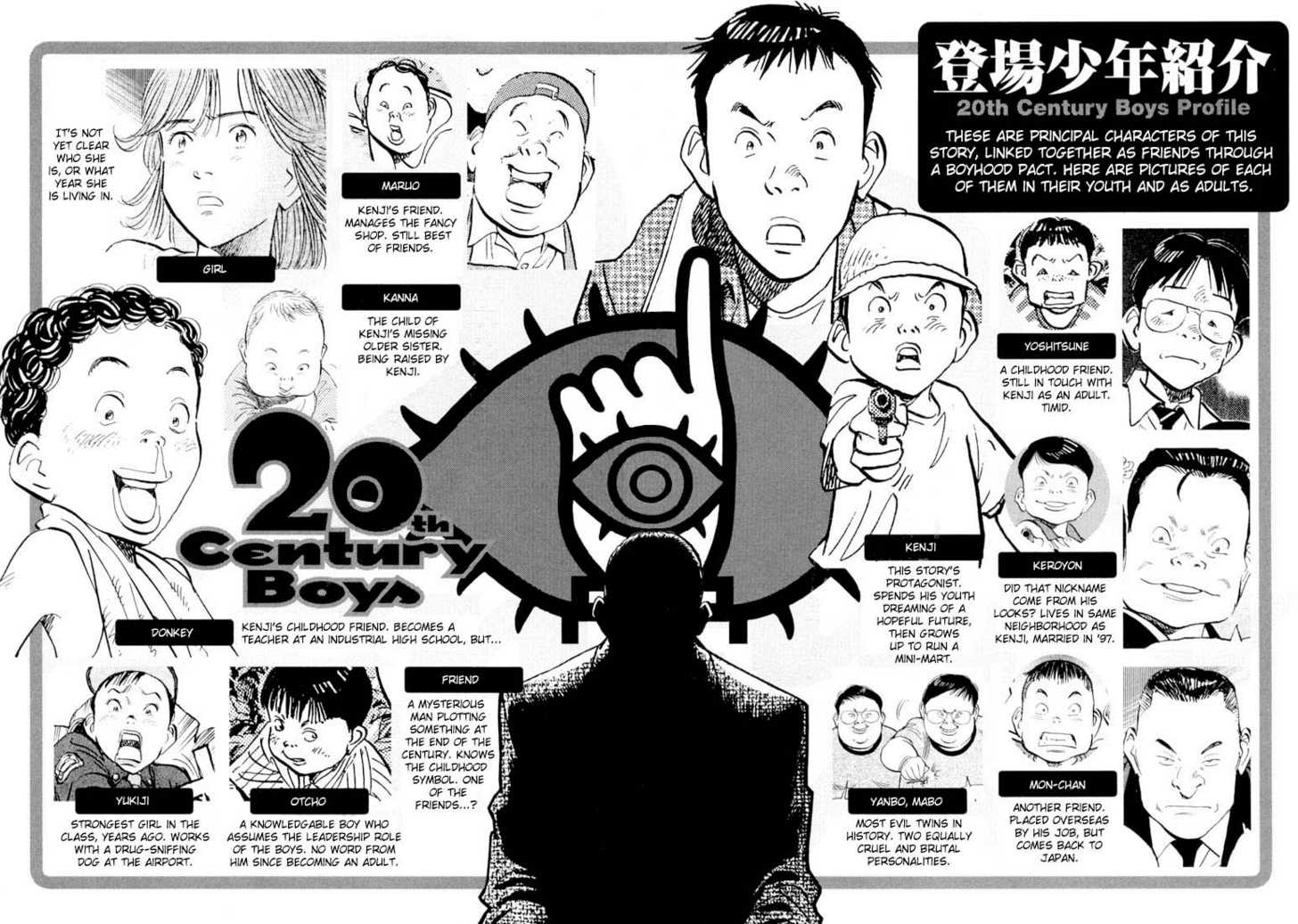
20th Century Boys Characters

As children, the main characters are very iconic and essentialized while they are surrounded by a realistic background. In fact, even when they grow older they still maintain traces of that youth–of that neoteny–only matured and “grown up.” And isn’t Reconstruction what creating stories is ultimately about: especially when you consider that children form stories in much the same way that put Lego pieces together. You have your basic building blocks that exist in reality and then you rearrange them to create some other kind of meaning. That’s what Kenji’s Group does. And then imagine the story continuing to build itself after them. Later in the series, a character even flat-out states “But kids games never finish.”

And sometimes reading 20th Century Boys is like watching a child’s game continue imperfectly. It’s true. Between the introduction of ESP into the story which seems to serve little significance to the characters but to hearken back to the spirit of the late twentieth century, people miraculously being able to walk away from explosions that should have killed them, the use of some stock and stereotypical characters, and a lack of visual closure with regards to the narrative build-up of some emotional relationships (which I hear is typical of Urasawa in his other works as well) the story is not exactly perfect.

However, consider this: the plot of 20th Century Boys is that “Friend” made a children’s playground out of the destruction of the world: turning a childhood dream into a dystopian nightmare used against its dreamers and all humankind. It was like Urasawa combined Field of Dreams with The Prisoner and 1984. It is terrifying and fucking beautiful in that the only way the protagonists can beat him is if they play the game that they all made together.

It makes me wonder what would have happened if some of the roleplaying games of my childhood and long-term friendships were ever applied to the real world. A long time ago, some of my friends, influenced by the Dune II computer game, created a whole world of interactions that I had a part in creating to this very day.

I won’t lie: becoming the secret Emperor of the world does intrigue me from time to time. But what 20th Century Boys illustrates is how even a childhood dream can cost the lives of billions. Even so, what a beautiful story that makes in fiction.

I would definitely recommend this series. It was only recently that I finished reading them online. Unfortunately the ones I read were not Viz English translations: which was one of the reasons why I hesitated in looking elsewhere for so long. No translation, from Japanese to English or any language for that matter is the same. So if you can find those Viz English editions, please read them. If not, consider the following:

The Friend cult sometimes has to purge some of its members. While the literal translation of their euphemism is generally translated as “banish,” the Viz version uses the word “reject.”

So tell me, my … friends, doesn’t the phrase, “Reject him,” sound so much more satisfying? And doesn’t it remind you of childhood: where acceptance and rejection can make all the difference in how your perceive your identity if not your very life? Keep that in mind when you read 20th Century Boys and you wonder who the heroes are, who the villain is, what their motivations are, and how some parts of childhood affect you forever. There is never full closure.

The games of children never end.

20th Century Boys True Friend