Chasing Amy And Reviewing The Laurel Leaves

I wasn’t originally going to watch this film. In fact, my plan was to avoid it into the unforeseeable future. In the beginning, back in 1997 when Kevin Smith’s Chasing Amy was first released, I just wasn’t interested. At the time my interest in comics and superheroes was waning and I was in the phase in my life before I went into any conventions, panels, geek communities, or had any relationships. Later, after I got back into comics and saw them for all the adult potential they could contain, I still didn’t watch this film because I’d heard about the messiness of the relationships between them and, at the time, I didn’t understand and I wasn’t interested in subtexts of other sexualities, geek subcultures, the minutiae of romantic comedy and failed relationships beyond the theoretical, and I felt safer in my own head.

Much later, after opening myself up to more life experiences, the reason I avoided Chasing Amy was out of fear. In retrospect, it was always out of fear. It’s only know that I’ve realized that by avoiding Chasing Amy that I’ve actually been running towards it. And tonight, for the first time, I decided to actively run towards what I can see of its heart.

If you don’t want Spoilers to a 1997 movie, please don’t read any further.

I think there are two reasons I kept away from this film. The first was that I knew how it was going to end. Knowing how a work is going to end before you experience it definitely affects how you might react to it.

And the second reason is that I knew its setting — at a convention amongst comics geeks and creators — would hit close to home. Holden and Banky’s introduction in signing their ridiculous superhero parody comic Bluntman and Chronic (modelled after the in-movie and in-Smith universe Jay and Silent Bob characters), with Holden’s high-brow intelligence and Banky’s sarcastic and hair-trigger irate temper — along with how they dealt with and understood their fandom — already threatened to draw me in. Even Hooper X and his ludicrously over-the-top Black Power White Man hating persona — to the point of claiming Darth Vader to be an icon for Black slavery and repression — got me to smile when I realized it was all a clever subversive act to keep up his image.

Then there is Alyssa Jones. She is the creator of what seems to be an even more subversive take on the Archie comics genre through the creation of Idiosyncratic Routine: a comic with what seems to be lesbian or queer oriented relationships story. I really appreciated some of the subtext here: that throughout the interactions in the beginning of the film towards the end we are seeing the difference between generic superhero comics and the personal stories of which they are capable of telling.

Idiosyncratic Routine

To be honest, I didn’t want to like anyone in this film. To be fair, it would have been worse when I was younger: back when I hated crudity and was taught to think it was wrong. Even now, the fact that all four characters had — at times — had superficial relationships with people. However, I also know there is a difference between casual talk at a bar and a character’s actions: as well as context.

The thing is, I can understand why each character does what they do and Kevin Smith takes pains to show us little details along the way. You can see Banky’s over-insistence that he isn’t gay, his homophobic comments, and his need to carry around an excessive amount of porn magazines as a major source of emotional compensation. He likes, at least his long-time homosocial friendship and creative partnership, with Holden and doesn’t want it disrupted in any way.

You can even understand Holden: at least in the beginning. Imagine being in a small bubble of society and only hearing about other things beyond it through spectacle and fiction. Then imagine you meet someone and you totally hit it off with them, or so you think — even getting invited to event by this person — only for them to begin making out with their partner right in front of you for an extended period of time. When I saw Holden sitting at that bar table with Banky, and watching — or trying not to watch Alyssa and her girlfriend of that time — I could see that for every time he told Banky to shut up, he was really venting his disappointment and discomfort: all the way to the point where he just wanted to straight out leave the bar.

Of course, there is Alyssa herself. As you get to know her, you realize she is a woman of some extremes. Sometimes, she genuinely seems to act like a very perceptive brat: knowing that she’s doing some shit-disturbing but entertaining herself in the process. And I say this with some fondness. She is witty, clever, and awkward in a way in which she can laugh at herself. At the same time, when she gets angry: she gets … angry. I’ll admit, Joey Lauren Adams’ voice has an extremely high-pitch and it can be off-putting: especially when drawing on the self-righteous fury of her character. But often, when she gets angry, it’s because Holden manages to trigger a place of hurt inside of her and she reacts accordingly.

But one thing I like about Alyssa is that even when she is an angry manic pixie girl, she still possesses enough self-consciousness to admit her faults and, honestly, has some painful moments of eloquence.

This is a woman who has spent a good portion of her life discovering who she is: experimenting with what she likes, who she relates to, and going to places that sometimes cause her pain. Unlike Holden and Banky, she’s a lot more aware of who she is and what she wants due to the struggles in getting there.

You have to figure Alyssa has gone through a lot. She experimented with her sexuality when she was younger and less mature. Boys took advantage of her and spread rumours and video tapes depicting her acts with them. By the time where Chasing Amy starts she has already dealt with having to come out of the closet and deal with her sexuality in college, fully identifying herself as a lesbian.

And then she and Holden meet each other.

Alyssa’s sexual orientation is not primarily where the tragedy begins in this dynamic. Imagine coming out of the closet: to yourself, to your family, and friends. You have a group of friends that orient their group and political identity around a particular sexual orientation. Then imagine meeting someone, a person, who challenges all of those preconceived notions. Holden, who seems to be a straight man, can’t begin to understand just what the implications of their attraction actually might mean for her. Alyssa could, and seemingly does, get exiled from her group of lesbian friends. And while I’m sure this doesn’t always happen, this phenomenon is definitely known to occur. In fact, what Alyssa seems to go through, at least in that one brief scene around the table with her friends, is reminiscent of works such as Gaming Pixie’s What’s In A Name? in which some gay-identified people consider bisexuality to be a fake designation: a cover for someone pretending to be gay but who is secretly straight.

It’s tempting to say that just as Banky’s internalized homophobia might be the result of repressed homosexual feelings towards Holden, Alyssa runs — and arguably succumbs — to the danger of dealing with some internalized and externalized biphobia. However, as I said Alyssa has done the work before and gradually accepts Holden as the person that she loves beyond sexual orientation, social structuring and despite — even because — of his messiness as a human being.

Holden, unfortunately, can’t seem to afford her the same courtesy. He has never had to deal with figuring out who he is to this regard. Moreover, he is still hung-up on power dynamics and hierarchy: on needing to feel equal to Alyssa in terms of experience. He ignores the fact that she loves him as an individual and not for the “prestige” of being “the first man” she’s slept with.

Chasing Amy Breakup Scene

One sad element about Holden is that there are points in the film where you can see him beginning to change. You see him calling out Banky on his homophobia and questioning just what kind of creative work and legacy he wants to undertake instead of the shallow superhero story of Bluntman and Chronic.

You see just all the time Holden and Alyssa spend together: even before they know they are developing romantic feelings for one another. Hell, there are points when Alyssa and Banky seem to get along. You’d think that she would get incredibly offended by Banky’s homophobic statements, but the way I see it to her they are a lot like Archie Bunker’s comments and she can at least respect the honesty of them if nothing else.
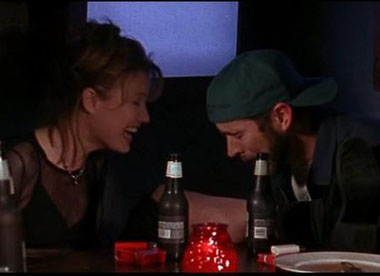
Alyssa and Banky

Certainly, Banky’s prejudices are a whole lot more open than Holden’s internalized ones: ones that he thinks he can overcome by virtue of being with Alyssa. Also, the characters themselves are crude and open about matters generally: though Holden himself due to his more reserved and conservative nature does this a lot less.

For me, Chasing Amy is less a romantic comedy and more of a tragedy: especially as you get this horrible mounting dread as the film moves towards its end. Holden just can’t shake off the taboos and power-structures in his head in time to save his relationships. In a horrible mangle, he tries to create a threesome between him, Banky, and Alyssa: after vehemently rejecting Alyssa for her sexual past with other men. This is a breakdown of communication and the terminal phase of a relationship gone dysfunctional. From my perspective, Alyssa should have told him about this past but, really, Holden should have been the one to ask her in a direct and respectful manner, outside of a hockey game, and with time put aside. Of course, Holden also should have borne in mind that many of the qualities he admires in Alyssa comes from all the experiences, mistakes, and work that she had undertaken.

Banky could have looked at himself and realized his feelings for Holden: or at least communicated just why Alyssa bothered him so much. I really noticed that the three of them could have easily been friends if nothing else.
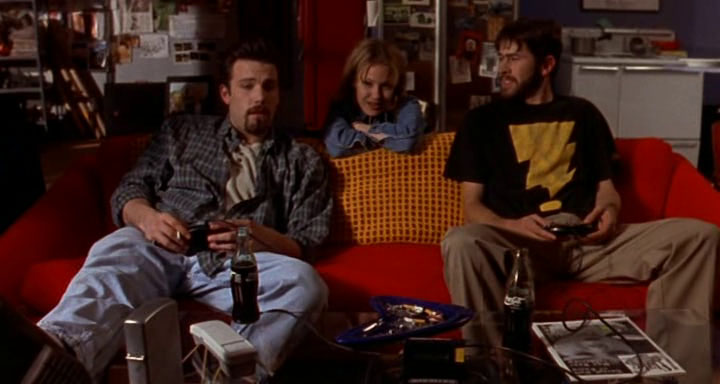
Holden, Alyssa, and Banky

And then there is the fascinating element of Alyssa herself. When I was watching this spectacle unravel and she was explaining to Holden just why it wouldn’t work, I realized that Alyssa wasn’t just talking about the threesomes and play that she had done in the past. Even in her lesbian relationships, I strongly suspect she and previous partners attempted polyamory: or at least some kind of non-monogamy. As she states, there are many permutations of how it might not work out, and Alyssa herself saw those earlier relationships as experiments that she went through before finding what and who she wanted.

Alyssa, at least at this point, is monogamous and wants to be so with Holden. But Holden’s arrogance and insecurity poisons and destroys what they had: or could have had. Certainly, Holden’s fever-logic idea of creating a threesome to eliminate insecurities would, by Alyssa’s own words, have only made things worse. Perhaps with time, effort, patience, and actual talking — maybe even experimentation on Holden’s part and Alyssa’s understanding — all of this could have been salvaged. Instead, Holden loses Alyssa and Banky. Due to his own actions, he is essentially left with nothing.

The end of the film reminds me of the ancient Greek myth of Daphne and Apollo. The god Apollo seeks the naiad Daphne and she is not interested in his romantic overtures. He ends up pursuing her: chasing her to the point where she asks her river god father to change her into a tree to escape the god. Daphne became the first laurel tree. Apollo, in his grief, takes on her laurel leaves as his new crown. Laurel leaf crowns were awarded to ancient Greek athletes and victorious Roman warriors: perhaps reminding them of that kernel of defeat and loss at the centre of triumph.
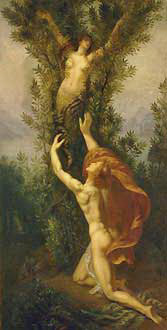
Apollo and Daphne

Silent Bob tells Holden the story about a girl he knew named Amy who, because of her previous experience with multiple men, he couldn’t accept: leaving her and realizing, only too late, that she loved him just for who he was. Hence we have the title of the film: Chasing Amy.

A person is not an ideal even if they can, by their presence and loss, inspire creation. Holden ends up creating a new, personal comic sharing the title of the film. He gives a copy to Alyssa a year after their relationship ended. It is a comic book whose pages are laurel leaves and whose panels are lost moments of time. It is made up of the beauty, maturity, and understanding that he gained after losing the woman he loved by chasing an impossible ideal and, in doing so, chased away the flawed, vulnerable, and ultimately human person that she is.

And Alyssa? She ends up dating women again and doesn’t even acknowledge what Holden was to her newest partner. Even though he still clearly means much to her, he is part of her past now: the same past that she hid from him and so many others in order to psychologically protect herself. I’m even tempted to say, in a very less than qualified way, that she buries down what might have been a delving into bisexuality to embrace the relatively easier notion of homosexuality once more, leaving us with perhaps an example of bisexual self-erasure. Or, again sexuality doesn’t come into it. This was just about people relating to one another: and failing.

I am not in the LGBTQ spectrum and I know this film has been written about many times and probably in better ways, so hopefully you’ll understand when I say that I hope you take everything I’ve written with a grain of salt. After seeing the movie, I kind of wish that we could see another one: not from Holden’s perspective in gaining his laurel leaves, but Alyssa’s, or Amy’s — or even Daphne’s — defiance of that trope.

Chasing Amy Comic Cover

As such I hope it goes without saying that women, obviously, do not exist so that they can “be lost” by men in order to gain them a certain level of maturity and humility. But there is a trope here — a Western and Classic idea in which love is a “forbidden knowledge” that you must fall into, and that only through loss can you begin to understand who you are — and it is tragic in that it exists at all. The truth is, I didn’t want to like Chasing Amy: a personal enlightenment tragedy wearing the layers of romance, comedy, geekdom, comics arts and meta-fiction that it is. And I realize the reason I was so afraid of it was because there were many times in my life that I almost became Holden. Sometimes I’m afraid it still might happen.

Fear of loss is reason is why I didn’t want to get attached to the characters: to become affected by their loss and their pain of loss. But by not becoming attached to something, you attempt to hold off relating to it — and by not relating to it you can let an opportunity pass you by, develop a dysfunctional relationship with it, or let a part of yourself become mangled and ruined before it can grow. And I can’t do that any more.

I’d like to think that, in watching Chasing Amy I took a chance and looked at the forces that shaped it. As I have attempted to do in my own relationships, I accepted the experiences it had — and has with others — and realized that they only made it all the richer for me to learn from and relate to in my own right.

Connecting the Doughnuts: Amanda Palmer’s The Art of Asking

Even though I’m not a musician, or even a complete music literate (whatever that ultimately means), I had been looking forward to Amanda Palmer’s first book for quite some time. And now that I finally finished reading it a few days ago, I’m now in a place where I can actually say something about it.

Amanda Palmer

It wasn’t easy and, to some extent, it’s still very challenging. The Art of Asking is something like what might happen if you take a blender, to borrow one of Amanda’s creative sayings, put it on a low setting, and introduce autobiographical anecdotes, self-help philosophy, social media excerpts, a few literary quotes, and of course musical lyrics, to the blade and mix. Chronological events are sometimes parallel with each other in the narrative, but these instances are often separated by philosophical musings and personal moments.

Whatever else, The Art of Asking is, it’s definitely not an ordinary book: as if something that’s a fusion of the creative and the personal can ever be ordinary.

I’ll also admit that it took me a while to get into the book, and sometimes I had trouble actually staying inside it. I mean, I knew that — even based on the title — that Amanda’s book would have some significant roots in her TED Talk of the same name, but it is both fascinating and sometimes off-putting to consider that there is a fair amount of her book that you can already find to some extent in her Blog and even in her introduction to Anthony Martignetti’s Lunatic Heroes.

The intertextuality, the way her book relates to the narratives and circumstances behind Anthony’s Lunatic Heroes and Beloved Demons, as well as to Neil Gaiman’s Ocean at the End of the Lane really does intrigue me and it puts some elements into perspective. I’d argue that The Art of Asking has details that can give you something of a holistic approach to looking at all four narratives upon risk of falling into the authorial fallacy: of looking at the people behind the works instead of the works themselves on their own merits.

I mean, it’s no secret that Amanda encouraged Anthony to hone and publish his personal stories — many of which he’d already told her before during their time together — and that Neil’s Ocean was the result of a story that he actually wanted to tell her while she was in the middle of her own solitary creative struggles. When you look at how those narratives talk to each other, like the people that made them and talked to each other in turn, The Art of Asking is almost something of a bridge between three different and creative spaces. It is my opinion that they all belong together.

The downside was that sometimes these references felt like filler. I think what really confused me was something that Amanda said which, ironically, I truly appreciated. It was a reference to another part of her creative process. After a fascinating look at different types of creative processes from her perspective, Amanda mentions that to create something is to “connect the dots” between things that you gather or experience. This, for me, pretty much sums up how creativity happens. As a creator, you take things that don’t seem to relate to each on the surface and you find or make connections between these elements. This thought particularly jived with me.

Unfortunately, at least from my perspective as a reader, I couldn’t always see how Amanda connected the dots of her ideas and anecdotes or even her musical lyric interludes within the structure of The Art of Asking itself. Perhaps I just don’t have a good eye for it, or for that matter even a good ear. Maybe, as Amanda herself isn’t generally a book writer — this being her first one — she writes prose much in the way her mind generates rhythm and lyric: through music. This is just a thought that I’m throwing out there myself. However, maybe the narrative is a lot like Amanda herself in that her art and her performance seems to be a 24/7 deal where you cannot particularly separate them: even in another medium.

The Art of Asking, to me, felt like a balancing act: much like the way I reacted to it. The tone of it got to me sometimes. On one hand it sometimes felt like it was rather self-involved, but on the other hand it is to some extent a memoir and of course Amanda would be talking about her experiences and her feelings. At times I felt a self-help vibe from the book and I had a personal reaction to whenever Amanda would talk about giving herself to trust and love as, in my own experience, most people who expose surrendering themselves to absolute abstracts of benevolence, revolution, peace, and love often want something from you and are anything but the ideals that they claim to represent. Something about Koolaid comes to mind.

Then again, these very sentiments on Amanda’s part are tied into some considerably shrewd business and people sense. The Art of Asking specifically outlines how love and trust are relational. What I mean is that by opening yourself up to other people, by interacting with them, by actually relating to them as fellow human beings you create a bond — at least on some level — and they will become more willing to actually help you. Amanda very correctly identifies this precept in why some crowdfunding campaigns excel and why others fail completely.

In asking for help without shame and taking what is offered you without forced expectations or, again, humiliation, you are attempting to embrace a different mindset. I can personally respect and even understand this idea. Amanda even applies it well to just why her former label and the music industry are simply failing to understand their customers: as they only relate to people as customers, artists as commodities, and not as people.

Really, what I learned from this as a potential crowdfunder artist myself, is that I have a long way to go — in building relationships of some kind with my readers, in networking, and in relating to others — before I can even begin to approach the place where others can support me: and where I can provide consistent content for their support. It’s actually very humbling, and sometimes discouraging as I am not a natural extrovert and I don’t have access to the support that I need to get there, or a coherent and stable vision to attract others. Yet.

In this sense, it’s not about connecting the dots per see.  It isn’t even about giving out “the flower,” a metaphor and literal fact from Amanda’s time as a living bride statue in her early busking years that can be accepted or rejected in an attempt at staring someone in the eye and relating to them.

To me, it’s about doughnuts.

In late November 2014, I actually attended the last part of Amanda’s Book Circus Tour in Toronto. As we waited in line outside of Lee’s Palace, a volunteer kept handing out Timbits: small, round, balls of assorted doughnuts. During the event itself Amanda actually read us a part of her book in which apparently David Thoreau, during the time he wrote Walden, accepted free food from his family as help in completing his work. And Eric Alper, Amanda’s guest and interviewer bought us all tons of Timbits to hit home the point that it is okay to “Take the doughnuts.”

The way I ultimately see it, The Art of Asking is a collection of Timbits: a collection of little doughnuts of many kinds. Some might prefer specific flavours of Timbit, or all of them, or none at all. Yet all of them are doughnuts and all of them are offered to the reader.

As for me, I took my favourite doughnuts from Amanda. Some of them were crisp and instrumental. Some were multiple flavours that branched into different places, that reminded me of other things, and gave me insight about my favourite people behind the scenes. I know I ate one or two confections that Amanda had never offered before outside of her book: and the flavours hit me hard and without mercy: that were real. At least one was a moment that touched me to the core.

But all of them, even the ones I don’t always like or require an acquired taste, are in the same box of words: a bread and circuses on paper thanking everyone that it asks.

If My Mind Were A Movie

Not too long ago, I made an argument that The Room can be seen as the inside of a mind or perspective of life made into a cinematic experience. But as I finished that line of inquiry, two other questions came to mind:

What would happen if I made view of reality into a film? And what would it look like?

I don’t really plan to get all intricate about this but I think the film that represents how my mind works, and how it attempts to relate to reality goes a little something like this.

It would start from different time periods. Some parts would have voice-overs while others would have words on a screen. In fact, voice-overs will be reflections of the past and words on the screen will be internalized thoughts. I would have epic video game electric body music play, in addition to some John Williams and Murray Gold, for some of the most pivotal moments in the movie while the more uncomfortable moments — such as dealing with bureaucracy, breakups, public transportation, and loneliness — will be filled with complete and utter stifling silence. Internalized subtitles here will have ellipses.

There would be scenes of wandering and scenes where I play a character that sits in one place almost all the time. I will have my character in long-shot views of his own life. He will particularly be in the background of his past when he is a child, a teen, and a younger adult. Maybe we can go for blurry after-image effects here. Each version of him will attempt to tell the other something about their future. One might try to change something, while another might say nothing at all. I think I’d also play an antagonist to my protagonist: who enjoys breaking things.

My narrative would be tangents. There would be epic, almost wuxia level, duels and combat with understated special effects. Epic speeches ranging from “the reason you suck” to philosophical digressions all the way to lots of swearing and profanity will happen. There will be intermittent, but gratuitous, intimate sex and a focus on the pull between connection and distance. Human kind would be depicted somehow as ignorant, self-involved, and small, individuals as fascinating, and the whole humanity as sometimes frail and sad and impermanent with a few motes of true self.

That all said, many hijnks will also ensue. There would be melodramatic screams and explosions in the background as punctuation. And budgies: sometimes as pets but also attacking the populace at large. There might even be a budgie totem of imitation and mimicry in a strange version of an Australian Dreamtime involved. My character will find himself walking into different times in the same places. He will get lost a lot in all manner of different interpretations.

I’d have books and comics and, copyright permitting — though most likely through having to create analogues — have my character immersed in a world of them. He lives in there and entering it is this permeable membrane of reality: a portal that gets harder and more narrow to access as he gets older. I’d be tempted to, but probably not use CGI effects, to show a piece of his soul splintering off for every year he gets older.

I think I would design the film like a multiverse of different spaces and times: a kaleidoscope. I would make it so that there are worlds where all of his dreams happened, places where none of them did, some others where he died, and others where he never existed to begin with. Sometimes my character will be a complete bastard, other times weak and wishy washy while spending most of his time remembering his future while another lives in the past. And all of these tangents will circle round and round each other, closer and closer until they collide and everything goes completely crazy and my character jumps from one fractured reality into another: navigating a grand plan gone to chaos … something built up just to be destroyed and rebuilt again.

I also think there would be a reality where concepts are people and they shift around too: and unfinished artwork will be their own entities and have their own world. Maybe they will eat people.

There would be friends on the phone and friends online. Some of them will have strange avatars. And maybe for the end, they will all come together, or perhaps he’ll go to them.

Of course, like a certain other director I won’t name I’d probably keep adding stuff the film as I go along and take stuff out and have constant director’s cuts. If I had to sum this all up, I’d say that my film would be an independent, tragic comedy of a mythic cycle with meta-narrative, nerdy references, and a whole lot of poignant moments and what the ever loving fuck. And crisp, witty dialogue. I can’t stress that enough.

And a good ending. Maybe my film, filled with regret, passionate anger, suffocation, cackling joy, fidgeting anxiety, headaches, serenity and the whole gamut of glorious insanity that we call human experience would be a multiple choice ending situation: if such a cinematic narrative is possible.

I might call it Not My Magic Eight Ball.

Because why not?

But I will leave film directing and script-writing to more capable hands. I’m just describing what my film world would be like if it existed. It’s been a while since I’ve been personal and creative and I just wanted to try something new today: or write about something old that keeps growing.

Writing this actually felt kind of good.

So tell me: what would a film of your mindset look like?

To The Room: You Fail At What You Pretend To Be … And That’s Ok

So let me just say, right now, that I watched Tommy Wiseau’s The Room. In fact, not only did I watch The Room, but I read Greg Sestero’s The Disaster Artist even before seeing the film which, I’ve been told, is highly irregular in the scheme of things.

A long time ago, I read Thomas Mann’s “Tonio Kröger.” And there is this one scene in that story that never left my mind. The aforementioned protagonist is watching his classmates dance. They are blond-haired, blue-eyed, and uniform. The dancers do not pay as much attention to why or how they dance, so much as they are just good at performing this communal act. Meanwhile, dark-haired Tonio knows that he can’t dance as they do, but he actually observes and understands their dancing far better than many of them ever can.

And then, there is the character of the dark-haired girl. She, unlike Tonio, doesn’t understand — or perhaps want to understand — that she doesn’t fit into the synchronous dance of her peers. Still, she continues to dance with them. She dances with them while stumbling around awkwardly, and even physically hurting herself. Her movements are not at all in unity with the other dancers and she stands out from them no matter how much she wants to fit in.

Now consider that someone like Thomas Mann’s dark-haired girl knows, deep down, that they’re different and just thinks that more intensity will make up for it: more passion, more resources, and more random elements. Aside from the fact that someone should definitely, if they haven’t already, write a story from the perspective of the dark-haired girl, I think you can see where I’m going with this comparison with regards to The Room.

I’m not going to go into the many flaws of this film because many more qualified people have gone to great lengths to describe them all. But what I think is really intriguing here, especially since I read The Disaster Artist first, is how you can arguably state that this is the closest thing I’ve had to seeing the inside of another person’s mind on film.

So here is my own tentative reading of The Room.

When I watched The Room I thought of a mind that wants to accept reality at face value: both with regards to its immediate environment and its cultural surroundings. It searches for all the tropes, all the archetypes and stereotypes: all of the human stories. In particular, it looks at American culture: at the American Dream of the frontier and wide open spaces, a successful career, romantic love and marriage, friendship, family, and relations between the genders verses a cramped psychological place of disappointment and dysfunction. In particular, it tried to go into that place of love and tragedy to create something of a … narrative.

This attempt to create connection between these elements fails. There is a dissonance underlying all of this mind’s attempts. You see it in the way that words and sounds are out of sync with the actor’s mouths: particularly those of the protagonist Johnny. The film opens up with an almost pastoral theme amid a distant sunny splendour that never seems to completely reach the characters except for those rare moments of sublime silliness between them. Love and sex is accompanied by music that sounds suspiciously like a stereotypically tacky and kitsche soft-core porn soundtrack: while ending off the film after the final death.

And sex and death are seen as awkward, dissociative things. Bodies never really quite find themselves in the right places: and even the death at the end is a long time in coming. It’s like a mind and perspective that just can’t link the ideas, emotions, and people together no matter how badly it seems to want to do so. You can see it even in how the actors behind the characters, and how the characters themselves want to reveal their truths and themselves. They’re trapped in the marble of ideas and meshed together: only connecting intermittently.

The parts and ingredients are all there: even if it seems like the mind of this movie is looking out at its world from a mishmash of extra body parts. It’s like a soufflé that didn’t rise, or a Frankenstein creature that never galvanized into life. And I think it is a horror story in how causality and even space and time are never really consistent, with the strangeness of the roof exit and the unexplained additions and disappearances of different characters.

At the same time, I also look at The Room as something of a tragedy: of realizing that there is a mind that so desperately wants to hold onto the conventions of its surroundings that it ends up revealing their flaws. In an attempt to reveal a truth through non-sequiturs– of pathways leading nowhere — it unintentionally and accidentally satirizes and parodies what it attempts to love and glorify: be it American culture, the Dream, human relationships, humanity, life, and itself. And yet, even in all of this, there are moments of sublime ridiculousness — in the form of football throwing for instance — that are almost peaceful and serene in the way that the characters play with each as though they are children. Those are perhaps some of the most wistful, surreal, and innocent segments of this entire film: this strange cinematic reality.

The writers David Gilmour and C. Anthony Martignetti both seem to agree that our minds play our lives, desires, and pain within the theatres of our mind’s eyes. And here, in Tommy Wiseau’s film, we are looking into one such theatre. And this mindscape, this inner theatre, this place is called The Room. Certainly, after reading The Disaster Artist the movie’s scenes with Johnny talking about how he met Lisa, and Lisa explaining how Johnny takes care of Denny take on a whole other connotation.

I’m not going to lie: The Room, and The Disaster Artist exposed me to something of a paradox from which my brain is still attempting to recover. The experiences I witnessed and read about were painful, hilarious, sometimes depressing, and just outright puzzling at times. But all of it was a fine study in just how someone creates their own mythos: a creative process that seems to have translated over to Tommy Wiseau’s sitcom project The Neighbors. Certainly, there is at least a consistency in how Tommy Wiseau seems to act and work if you are interested in looking at his AV Club Interview: and I can’t help but wonder what would happen if he had ever met the former Torontonian bicycle shop owner Igor Kenk with his own unique world-view. Would they get along, or would the universe implode?

But when this is all said and done, I think The Room is its own person: a mindset that fails — spectacularly, beautifully — at being what it pretends: namely, at what it thinks is normalcy. And that’s okay. Here, at Mythic Bios, I absolutely adore being able to examine another form of personal reality. In fact, I’d like to think if The Room were an incarnated personality it’d be what would happen if the dark-haired female character from Thomas Mann’s “Tonio Kröger” tried to dance with our contemporary reality: except she would be a blonde and she insists on being what she pretends to be instead of who she really is: and what I think is an even greater tragedy. She attempts to embrace what she thinks is supposed to be normal yet she can never be so by her very nature.

And her name would be Lisa. Because, even after watching you Lisa, you are tearing me apart.

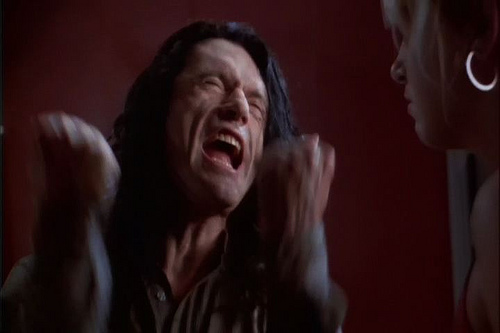
The Room

Of Serpents and Foxes

Hello again everyone. I’ve been away, and busy, for a change but I want to start writing again on Mythic Bios at least once a week as I originally planned. I didn’t actually feel like writing anything until I got another Project of mine finished, but I feel the need to you updated on some of the things that I’m doing and to keep a record of some of my work as well.

It’s been tough for me this past while. I’ve had this Twine idea in my mind for some time and it was only at this year’s Toronto Global Game Jam that I’d been able to even start on it beyond the modest notes I’d researched and taken.

Unlike last year, I didn’t force myself to stay up until twelve or two in the afternoon to finish off my game. Aside from the fact that I had a headache during the Jam, even when I was better I realized that rushing through it and making something out of pure exhaustion would only give me sloppy work and very little to show for it: never mind the fact that it wouldn’t have even been a working narrative.

I’d gotten as far as creating an entry for it on the Global Game Jam site. At the moment, my Twine creation is called The Serpent and The Fox. I spent a whole night trying to think up a good abstract summary and a title for my creation in progress. Unfortunately, the late first night of the Jam cost me in stamina: to the point where I couldn’t even create an outline.

In the end, though, it was just as well. Most of my creative works each have their own unique processes and this one didn’t really want a pre-existing outline. Rather, it wants to use the fragments I’ve written down or have in my mind and flesh itself out from there. However, what’s really interesting about this interactive narrative is that it may well be the most structured Twine game that I’ve made to date.

Each part of my story is going to be an interlinking series of haiku: a poetic structure of five syllables, then seven on the next line, and five on the last. Of course, for the sake of storytelling — and sanity on my part — they are probably not all traditional haiku. They don’t all deal with descriptions of nature, and while I attempt to capture emotion in them, sometimes I need to use them to detail other matters. And while haiku apparently aren’t supposed to utilize metaphors, I might have to break those rules: if only to make them part of a metaphorical structure themselves. And while I will be using the five/seven/five schema when I can, I will vary up how many lines I use in each section and take essential creative liberties.

This brief discussion of poetic structure aside (and years ago I wouldn’t have dreamed of talking about this, never mind finding it remotely interesting), I am particularly focusing on the perspective of the story. I can tell you right now that my story seems to start from a third person perspective, but depending on the choices that you make as a reader — on where and what character you click on — this will change.

What I am pondering at the moment is whether to follow the usual Twine and interactive choose your own adventure tradition of the second-person perspective, or go right into the first-person.

If I make it first-person, then you can see into the minds of the characters themselves even as you can choose their actions. However, ironically enough the perspective of “I” can be alienating for a reader: it’s just another divide between them and the character even if it might provide more insight. One of the texts that inspired me to make this Twine uses the first-person and I can see its strengths in that.

On the other hand, the second-person flat out, through its use of “you” makes you — the reader — into the character. It places you into their mind and body. When you make the choices that the game provides you with, you could feel a greater relation to that character. But then there is the issue of what happens when the character feels something and narrative attempts to claim that you are feeling it or thinking it too.

Either way, there is going to be some audacity involved. Another issue is that I wonder if I can get the different character perspectives to intersect again at some point and become unified depending on what the reader-player chooses: without being totally boring and repeating myself. And would the second-person, would “you” be able to relate to another character and feel the beginnings of some kind of relationship compared to whether or not you are an “I.”

I will have to find a healthy medium and keep exploring this issue further. I was reluctant to talk about this, link my entry to Mythic Bios, or even mention the name of a work that isn’t finished yet. I generally like to either link to finished works or just hint on the unfinished. It’s been weighing on my brain for a little while and taking up a good portion of its memory (I am also a less than closeted perfectionist).

Me and my Head


But it’s been a while and I thought you’d find this digression interesting in some way.

I hope I will be able to continue and finish this. I want to see how people react to it and I want to move on with my writing and other plans. I hope the world is treating you all reasonably. Hopefully I’ll be back next week. Until next time.

On A Half-Written Page

For those of you who don’t follow me on GeekPr0n or know me, surprise: I’m still alive.

This may well be the first and last post I make for this December and before another year takes us. I remember when I used to write so much on here. I used to write a post on Mythic Bios every day, and then every day, and then every two days, one day, and now occasionally. I suppose what I didn’t realize, at the time I started this, was as I began writing more I would have less time to Blog than I once did.

At the very least this has not been the result of a creative block or major depression. I have been busy this past while. I’m not even going to try to catch up on what I’ve been doing since my last post because so many things have happened.

I think what I really wanted to write about this time around was something about writing and life: as I’ve not done in a while. I’ve been working on a long-term project this past while that has taken a lot of time, energy, and concentration on my part. I made good progress on it for a while. I planned to have it finished before seeing my girlfriend for Thanksgiving.

Of course, that didn’t happen.

Instead, after dealing with writing other articles, interviews, and life stuff I had to put it aside and prepare to recharge for a while: but not before going to my first Amanda Palmer Book Circus when she came to Toronto. I still haven’t had the time to read her Art of Asking. That is how busy and preoccupied I have been.

So I came back from a well-deserved hiatus to my assignment only to get stuck. Some writers might tell you that the worst thing in the world, aside from deadlines, is staring at a blank page and having nothing come to you. Well, I’m here to tell you that this is not the worst that can happen.

From my experience, be that as it may, the worst thing that can happen to a writer is looking a half-completed work of theirs and totally having lost their train of thought, while knowing how the story continues in their head, but fighting the details to get it all down. It is downright infuriating and it’s made all the worse when you just want to get it out of your system, and move on with your life.

Sometimes you’ll even begin to develop some performance anxiety and avoid looking at it. It will sit there in the back of your mind, but you are torn between wanting the fucker done, and despairing that you will not do it well enough. Procrastination becomes your writerly alcohol or drugs: that is, if you don’t like alcohol or drugs already.

A little while ago, I finally managed to get my story to where I needed it to go. It’s not perfect but now I feel the excitement again: and the passion and momentum to keep pushing forward. There will be editing and formatting and such to keep in mind, but those are secondary concerns at the moment: as I now feel that this will happen.

I think that what I’m trying to say is that, because a year where some promises and potential breaks didn’t pan out, where I sometimes wonder what I’m doing with my life and if I will get anything out of it, that — right now — I don’t feel like a fucking failure. 🙂 And I’d like to say that’s pretty something.

I’ve also been getting used to going outside again without feeling a whole lot of tension: though it will take some time. I’ve decided that Tuesdays are now my Suspect Video days with alternating Library days as well: to keep my mind fresh with films, books, and comics so that I don’t go completely insane. And who knows, I might even learn how to socialize again and function outdoors without too much anxiety after all this time.

Anyway, I hope that the next time I see you all in Mythic Bios will be when I have finished my work and I get to finally work on something new.

Until then the writing: it continues.

The Spooky Ghost, The Spider, The Bat, And The Count

I promised you all a second Halloween post a few hours ago and so, somewhat against my better judgement, I am going to show you the first Halloween story I ever made.

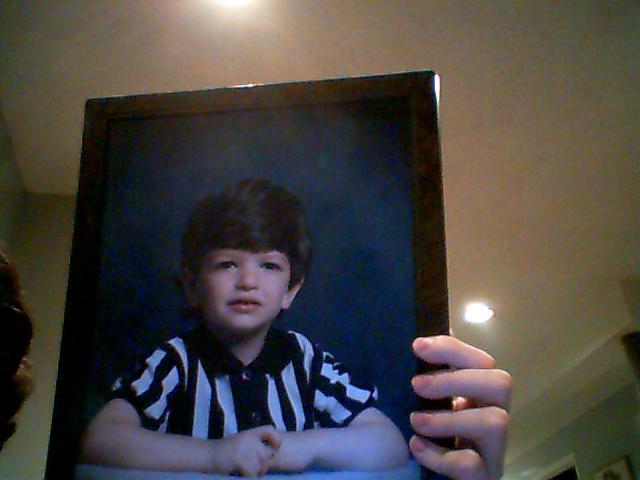
And when I say the first I mean the first. I don’t know how old I was when I wrote it, but I must have been extremely young because someone had to transcribe it for me. They may have even helped guide my ideas while somehow letting me keep my child voice. I found this creased and rusted paper wedged somewhere in my old desk drawer. I can also barely remember having toys or some figures that inspired the characters. 

And no matter how much parts of this very short bit of juvenilia make me wince, no matter how many parts of it make me want to edit it and shake my head, I have to remember that we all start from somewhere. So in honour of this Halloween and all the progress I’ve made, I just want to show you a little bit of where I used to be.

Trick-or-treat my friends. Happy Halloween, Past Child Me. 

Once upon a time there was a castle and there lived a spider, a spooky ghost and a red bat. And then count was visiting the witch. The count won’t take too long.

The next day when it was nighttime it was dark in the castle. The bat was sleeping.

“Oh!” Somebody open the door. I’m getting scared!” said the count.

The candle was lighted and one candle was turned off, and one was on, and one was dead. Then the count was sleeping, the spider was sleeping, the bat was sleeping, and the ghost was sleeping.

“What was that?”

They were all afraid.

Something said, “Oww!”

It was a wolf.

“Help!” said the bat and the spider to the count.

“There’s nothing to be afraid of,” said the count, “Just go to sleep.”

The ghost said, “Boo!”

The bat said, “Eee!”

The candles burned and they chased the wolf away. They lived happily ever after.

The end

Child Me

This is Halloween

This will be the first of two posts that you will see today.

I spent a lot of weeks before and during Halloween differently. When I was a child I would be inundated with television specials, movies, school events, and trick-or-treating. As an adolescent, I spent some time with my group of friends. In my early adulthood I spent a lot of it by myself trying to remember how happy I used to be and imagining all the other people who were having fun that I did not. I spent the rest of my young adulthood, alternatively, with friends and sometimes on my own.

I almost went to a Halloween party last year but I didn’t. I was too depressed and I did what I often do in that state: sleep and work.

This past while I’ve been doing something different for Halloween. Instead of wandering around outside at night in the dark aimlessly, or watching television, or hanging out with friends and lovers I have been busy.

I have been busy.

Last week or so, I covered six films in the 2014 Toronto After Dark for GEEKPR0N. I even covered an extra day, a Wednesday, so I could watch one film that was recommended to me. Those of you that read this Blog or my work at GEEKPR0N already know about this. I wrote reviews on The Drownsman, Wolves, Late Phases, Wyrmwood, The Town That Dreaded Sundown, and Why Horror?

And it was difficult. There were many times I thought I could just watch the films, then go straight home, and write something out that night. But even though I got wiped out, it was totally worth it. The irony is that once, long ago, I was told that I should write reviews for movies — or movies like these — and I didn’t think I was qualified to do so. It’s only in relatively recent times that I’ve realized that the only way to be qualified to do anything is to make yourself so, and start to believe it.

I got some other things published in honour of Halloween as well. Not only did I write a nice short article on the end of Kris Straub’s Broodhollow Book Two, but I got to examine and see just how a creepypasta created by Eric Heisserer the subreddit no/sleep truly lures readers into fear and trepidation. If you have read my articles on creepypastas, you know something of what you might be in for when you read this particular piece of mine.

But I think there is one achievement in particular that I can really be proud of mentioning. Do you recall, that week or so ago before I went off the Mythic Bios grid again, that I was doing another interview: this one live and in-person? Well, with the help and guidance of GEEKPR0N and Toronto After Dark organization … the following actually occurred.

David Hayter Fav and Retweet

Not only did David Hayter, the screen writer of the first two X-Men films and Watchmen as well as the voice of Solid Snake favourite and retweet my review of his movie Wolves I also got to interview him before Werewolf Night at the Toronto After Dark.

You can find my interview with David Hayter right here.

So that has been my time leading up to Halloween so far. The rest of what I intend to do, however, is as follows. Later this evening I am going to the Silver Snail Halloween Party: the same one I didn’t end up attending last year. I don’t have a costume idea as of yet and I’m having some difficulty finding make-up after my last misadventure but I’m going and to anyone living in Toronto or nearby, I hope that you will join me. It’s organized by GEEKPR0N, in part, and it makes some pretty awesome parties and I don’t intend to miss this one this time around.

The next day I’m going to the Comic Book Lounge and Gallery to pay a visit to Drawing For Deb: In Support of Epilepsy Toronto. There will be signings and a 12-Hour Comics Marathon: Special Edition there to raise money to combat epilepsy which claimed the life of Debra Jane Shelly: a well-known friend of the comics community and someone that I only began to know when I first started coming to the Lounge. She was an awesome person and there will be some good people there. I’ve realized long ago that I am just not an artist with pictures, so I will be attending to pay my respects and I may not be there the entire day.

And then the next day I will be going to Horror-Rama: an all-horror convention where I want to explore and particularly meet Jovanka Vuckovic: the brilliant upcoming director of the Jacqueline Ess film adaptation.

Then somewhere, somehow I will catch up with my Doctor Who recaps and next week get back to my fiction writing and probably sleep for a few centuries as I am bloody exhausted.

So this is both what I have been doing, and what I am going to do. It’s funny. When I was reviewing Why Horror? I started thinking about just how it is effective. When I was a child I read many abridged versions of horror stories, listened to and read written down folktales and urban myths. And I would spend time in the now-defunct Hollywood Movies store reading the backs of horror film VHS tapes. I would attempt to avoid watching them, scared of being caught in the web of their details and becoming committed, but so very fascinated with what I might find.

Not much has changed. I think the reason that horror is so fascinating is the fact that when you look at all the gore, the grisliness, and the uncanny you see what you are not and you also get to see a bit of what you are. You are ultimately safe and in sensible surroundings, or so you think, and it gives you a rush of life — of vitality — in the autumn.

That’s why some people have sex after watching horror. That’s why some people have an urge to create stories and study mythologies after watching horror. That’s why people gather around their friends and celebrate their grisly façades: the orange light in the darkness. That’s ultimately why I’m rambling right now.

I’ve spent my life fascinated by, and avoiding life. But it lures you in. It is the ultimate horror but it is also a spectacle, and best experienced in good company. I hope that, today in sharing all of this with you, that I got to be the latter.

Happy Halloween, my friends.

Interviews and More Writing

I’m still doing my writing, but I just thought I’d go into a little more detail about what I was talking about in my last post.

If you remember I talked about an interview I did for GEEKPR0N. That interview was actually with Larry Wilson: the co-writer and co-producer of Beetlejuice, The Addams Family, and the writer and director of Tales From the Crypt for six seasons. Our interview centred around his current project the web series Cindy: a twenty-first century retelling of Cinderella with elements of Reality TV parody, dark humour, and just plain weirdness.

To be honest, I never dreamed that I would be talking to one of the people integral in creating a large feature of my childhood. I first got to know Beetlejuice through the cartoons and it goes without saying that while I knew about The Addams Family before the film, I recall spending a recess in the corner of my elementary school reading its novelization. And I’m not even going into the time where I would to sneak up late and watch some Tales From the Crypt on Fox.

And I will tell you right now that if I had the money and even basic screenwriting experience, I would definitely take up Larry’s script consultation reward. I honestly hope that if I can’t, someone else does.

I’ve also written a little something for Clive Barker. Yes: that’s right. You read that correctly. Basically he has put a challenge out there to write a story for an image he painted and posted on Deviantart. I will link to the image and I’ll post what I wrote here: because one requirement was placing the narrative in the Comments section.

ON WHOSE DREAMS

They built cities to keep them out.

People will tell you all manner of more pragmatic reasons for the creation of cities. They will mention the intersection of culture and trade, of the need for propaganda art to cow enemies and citizens alike, of a place to better house the billions of human beings being born every day.

But some will tell you something else. They’ll inform you, secretly where they think no one else can hear, that all of that art and architecture, the arrangement of the paths, streets, and buildings, and even the placement of certain homes and peoples were arranged as a pattern: to ward them off.

Yet ultimately it is the enclosures that are the thing.

They are no new innovation. It’s well known that ancient humans and their predecessors would hide in their caves during the night after saying farewell to their loved ones, their friends, and their enemies. And even now they would like to forget the howling outside, the scraping against the rock walls and their paintings of animal blood,  the hunger deeper than the tunnels in which they hid and the pleading: to be accepted back among their people.

However, all of them are wrong. They remember it all wrong. Cities weren’t made for the living to hide and hoard their food against the seasons and the predators. The lost weren’t put outside to roam around for eternity. No. The tribes often placed their lost in their homes: sealing them up and painstakingly maintaining them. They would bring them food, tools, and the results of trade. Over time they bargained with them, prayed to them … worshipped their memory and what yet remained.

Caves like wombs became camps. Camps became villages. Villages towns and towns cities. The monuments grew higher each day: growing from the foundation of countless generations and those that tended their ground: which they still do to this very day.

So now do you understand? Do you know why sometimes you feel so tired: so drained? Even as the symbols lengthen like shadows into the sky and expand across the land, nothing truly changes. It is amazing how, simultaneously, you are cramped and alone: like you are the one living in the coffin. You are the one that’s trapped here.

No. Cities were not built to keep them out, but to keep them in.

For cities are not built for the living, but for the dead: in which everything within truly belongs.

So to say I’ve been busy would be something of an understatement. I’ve already told you about the fact that I’m going to be covering the Toronto After Dark. I actually tried to do this last year with Mythic Bios and for my efforts I got an invitation to view and write a review of their opening night. This time, however, I’m attending on behalf of GEEKPR0N. Expect to see me there for the Sunday and Thursday showings.

And I am going to be interviewing someone else. Again, I’m not going to go into any details as of yet but I will say that it will be my first in-person interview ever and I’m both cautious and excited over that prospect.

I remember once being the person that never even dreamed of having these opportunities or being this person as immersed in geek culture as I am now: even when people encouraged me to do so. And well … here we are.

Don’t worry. I will take time to peer in here and update all of you. I just thought you’d like to know about this. And please, read my articles and tell me what you think. It means a lot to me. Yet again, take care everyone. 🙂

Change

I spent much of my youth somewhere else.

It’s not too much of a surprise really: especially when you consider what I was and what I would ultimately become.

You would find me reading one of the Oz books during a special session of class. Or reading a book from The Belgariad in the car on the way to a funeral. You’d better believe that I was reading comics when I was dragged to synagogue and philosophy texts were my in-depth friends in my adolescence. I’m not going to even go into the many games, arts and crafts, and stories I wrote to distract myself from being bossed around and general tedium when I was sent off to summer day camp. And I would watch and rewatch old Muppet and Disney cartoon movies on my VCR whenever I was home from school.

But the fact is, from grade School all the way through the end of high school I must have created and read most of my life away. I miss the immersion that staved off the banal mundane world and its gritty, disappointing, adult reality from my life.

It got harder to keep the world away once I got into university. My magical rotes, such as they were, began to falter and fail. Once, when I had to do so many things I hated or tolerated I always had that space to retreat into: that alternate place where I could focus on more intellectual and imaginary matters.

I had so much time. When I was younger, time was limitless and most of it was spent wanting to be somewhere else when I didn’t want to do something else. But then time began to speed up. Sometimes it would slow down again and become stagnant with the dead-end nature of reality.

Reality again. It was creeping in. It’d been doing that towards the end of high school and I always knew it was there: just waiting for me. And it scared me. It was more complex and wondrous than the terrors of daytime Fox talk-shows. It was politics, and plurality, and many experiences, and human horror, and girls.

I’m glad I met the girls.

I think that explains a lot about the person that I am now: for however long that lasts.

It’s strange. These past few years time feels like it slowed down, or went by in the blink of an eye. Sometimes I wonder if that span even existed. You see, time did slow down but in that stagnant place of perceived adult failure. The thing is: I had gotten out into the world, if you want to call academia part of the world as it is.

I couldn’t handle the rest of it. And the refuge of books, films, comics, and cartoons were only temporary retreats in front of a cold, grey reality. And I know that age-old danger: of knowing it could be worse, that it can and for some it really is that.

I got tired.

But something has been happening. Time is moving fast again. These past two years, some of it spent by myself, I still knew that my time was not infinite. But it is getting faster again, if that makes sense. Things are happening. Things have been happening.

My reality marble of purely writing all the time is harder to keep around me against that perception of reality of which I’ve not done much in the way of justice. Things are happening.

Things are changing.

It scares me. It scares me to know that after some years of being sedentary I’m going to be moving around again. I’ve gotten too used to my sense of exile. I know how dramatic that sounds in this somewhat disjointed post. I didn’t even know what I was going to write this time around considering all of my circumstances but I think, when it is all said and done, that this a good thing.

It is the only thing. I’m changing and I can’t always keep up with those changes and their multitude of event horizons. But I can try. And I know and I have to believe that there are people who will be there alongside me, who will still be patient with me, as this continues to happen.

Soon I’m going to be out of my bubble. And you know, it’s time.

My rotes may not work as well as they did, but perhaps now is not the time to dwell in other spaces.

Now is the time to act: in this space.

Matthew and the Daleks