15: Alternative Facts: Unseen


“Good friends, Nobody is trying to kill me by violence or treachery.”
– Homer, The Odyssey, IX:408

Can you see?

Guess you glean what I did there. Nah. The problem is you can’t see by the sunset. 

Long fore, these small domes, our little sancts, our suntowns came something divise in the dark. But was always the sunsets. One eye turning way, the up-firm bleeding read, pink and purpled bruises, the orange of fire. So ease to get lost in the sight of site, or the site in sight, in the paint bathing everything the same, the light burning, making the shades so much longer, and more ease to hide in the gutters of sleep. A pretty dream. 

The real thing’s that it’s hard to where sunset starts, and the downtime comes. That’s where we lived. That’s where we died. 

See, or don’t, that our suntowns had wights – deadskins, you glean – in the lights, mourning in morning, and then wight knights at night. All Anon. It’s always Anon. They got to have that light to hide. To burn us above and bury us below. Then they used the dark to hunt. Making us sight and siteless. The beauty in their cold, dead hating-hands. They got to have everything. They owned all the colours. 

Bending the laws of light, that’s how they did it. All round they made the rite of invisibilis. That was it. That was the trick. 

You get me?

Nah. You won’t. 

They didn’t. See, they didn’t want to see us. And when they didn’t want to see us, they didn’t want to be seen. They were Anon. That was the coustume.

Til we took it from ‘em. 

Was what Freed Dome prob call approps. Aft we made for – and made – the Gulf of Amarak got made in the Second Disunity, aft Precedent Forty-Seven, and all the Repo Fiefs started to go away with their Gilder Booms, and their Eagle-Eyes, their Baggers and Speculars, their Wags and their fucking Nation night knights, we came like the Free Sancts after Summer Camp, like haints falling up and down the blews forever. 

We’re the blews in the read and wights. We kept the deadskins out while taking their breaths and trumpets away. We’re the colour that the Not-Sees never found – not even in the Demos Tripartite – and when we came Anon, hunters came hunted, if you glean. All those Not-Sees, and their vanceguards, and the knights and their Nation got learned to fear the come of Night. We’re the undocted that nope their Novax, calling their prophets profits, their traders traitors, bagging their Baggers, guiling their Booms, passing on their poison, slitting their Dragons, and smashing their ice. 

And no one gleans. Nobody, nobody stabbed them. You follow? 

Nobody found us. Not in the mourning. Not by knight. You can’t hear our songs. You don’t glean our dance. We’re silent to your ears. You can’t touch us anymore. You don’t get us. You can’t. 

You didn’t see us in the Freed Dome. In the Speculars and the Eagle-Eyes in your Interface. In the pits of MePo. You never gleaned us when the Repos rose again, and you never knew the Colour Revolve made approps. 

You don’t glean us. You never gleaned us. And you never will.

Now go. These are ghost towns, moving, unsettling, where killers kill those that kill, and we come from sunken lakes and sunless seas at Night to feed hunters free lunches of lead, to chain them down to finally hear us, to stay in what was first our place, for the final lesson. 

Go now, and accept that we gleaned the truth. Because we took back from Not-Sees what they had from Libertas. We cleave to inside-out bonds of lightning weaves to come free. Surviving is to come what you haint. We are Anon now. We took our sunsets back, where now we live. With her

Only she gets to see us now.

 And she is blind. 

(C) Matthew Kirshenblatt, 2025.

14: Alternative Facts: Body Politik


But see, amid the mimic rout,
A crawling shape intrude!
A blood-red thing that writhes from out
The scenic solitude!
It writhes!—it writhes!—with mortal pangs
The mimes become its food,
And seraphs sob at vermin fangs
In human gore imbued.

– Edgar Allan Poe, “The Conqueror Worm”

It’s Aft-Hallows. The treats are tallied. The white sheets pulled away.

The masks come off. 

It’s been many cycles since I searched the Freed Dome for that re-image. For that lost word. I walked through many Governs, Festives, and sub-cultics trying to find it.

Trying to find the true face of Amarak.

I’ve been gone long, deep into the Interface, deeper into the Land. And still, I didn’t know how one word would lead on, to the place of the Interregnum, and the heart of ultimate divise, of the Second Great Disunity. 

My parens always told me to bury the plague-bare. To avoid the Nats. A commonsensical. The Nats, the Novax, helped the Disunity. Ended the Disunity. But did they?

What is sickness? Is it just the body, or gleaning itself? So many words from so many places in the knowing space in my head now. The Rangers in the Badlands had a secret. Many secrets. In their Interface, sep and divise from the Repolitik, I saw a legend. 

The scholars of the Freed Dome Collective said that the Forty-Fourth Precedent was the last. But there was word of Forty-Six. Fore the Novax, the legend says, they said Two Teeth held Amarak, barely, two pinpricks of an old man. Two teeth, and four, keeping back the blood red tide. An in-oculate, a grafting, against disease. The Predicts say two women could have saved the Politik, fore and aft.

That was when the Novax came. The true Novax.

They did not see. They refused to see anything.

There is another view. We never had Precedents. Only Presents. A Forty-Sixth Present of the Demos, beyond the Forty-Fourth,  tried to save us from the sickness coming. But the Land has always been tough soil. Tangled. Twisting. A morass. The Repos, and their Fiefs and their Barrons called our Land a Swamp. And they never fallow, but always grow it. Ever-growing cycles. Revolves. That seeming’s that Aft-Hallows has always been a Colour Revolve: an Orange Revolve that tried to rule Time. One look between the veils, a moment, a box opening is and isn’t, death and non-death … 

And then, no more Present.

The Rangers have an old saying. When the death birds fly, they make no eggs. They also have another saying: the Orange Revolve is always led by Red Caps. The Freed Dome Collective is fallen. The Tripartite squabbles. Secret festives. Opportunes. Eagle-Eyes everywhere. The Interface compromises. The factions are occupied. It is only the start.

I think about what I gleaned about the Nats, and the Novax. And I see. It has never been Nats. You can’t run from something that isn’t there. And the Novax isn’t just sickness. It isn’t only a disease. Two Teeth cleaved the red deep under the binding of the blue, but it could only do so much agont the rot underneath. Agon the maggots. There is no cure, no in-occulate for the chronic Revolve. Death’s greed for life. For hate. 

And this answers my query. We didn’t know. We did not learn. There was no Present during the Interregnum. No real Present Aft. There is no real Present now. Just Ever-Now, for Amarak. 

(C) Matthew Kirshenblatt, 2025.

13: Alternative Facts: Can You See

It’s Fore Hallows at Freed Dome. 
It’s Fore Hallows at Bost. 
It’s Fore Hallows at Blunder. 
It’s Fore Hallows at Sancts Lost.

If you have to ask, 
wear a mask,
better bearer than bare
against the Nats and the Novax,
and the Fall of the Ere. 

It came from Sunder,
it walks in Nomens, 
and travailed the Pasiph League,
the world, the veil, the scien of Predicts,
from here and back it will leave its mark,
it will always bleed.

We member the days
Fore Hallows, it will not die.
It doesn’t long to Hate or Gilder Boom,
no matter how loud they cry. 

Fore Hallows is ours, from Cycle to Pride,
and Badlands far from sun
it comes to gain the oldest harvest 
and the Land, Folk, Fire that we have won.

Fore Hallows, fore State, and Trunk, and Ass,
we wear, in air, our mantles, always, from the time
fore score our face and words come frozen by this rime.

Fore Hallows never cesseeded 
into the glare of blue cover, the white sheets, the plague-bare 
suspended all twili, and grey, 
though its treats were grim, and cold tricks came its faire
come fallen where they lay. 

This is why, past the Dark we don’t member,
we will always ask 
that every Cycle, tween the Poles,
that we parti-pate a Great Unmask. 

Populli, Fore Hallows, ‘tend to be things
but let things not be populli, Abominate upon boght wings. 

A hush wind breath blows not in the bellows 
of louder miens  and means thrown down,
it might be now the time of ere, and auctumn
but ne’er forget the Revolution of the Orange frown.

Fore agon the idea in the making of hollowed leaves a crown,
and member that Fall every populli shows and knows
that the Precedent wears no clothes. 
Recall the Broken Star on a stalk of holly,
cover your breath, but not your eyes from this great old folly.

Fore Hallows now Hindsight,
Fore Hallows the Festive of the Open Track,
Fore Hallows for good or ill, 
let it be the begun again the Doom of Amarak. 

© Matthew Kirshenblatt, 2020

12: Alternative Facts: Natural Medicine

“Physician, heal thyself.”
—  Luke 4:23

It’s a caution: of the boogey.

“Beware the Nats.” The old tales say. “They carry the Novax.”

Back cycles ago, no other chill was strongest than a call, or word of Novax. Fore the Disunity, and the Interregnum, and the supposed “Great Reunity,” a people went their own way. They believed the Land — all of it — healthy, holy, sacred. That all that grows from the ground is good. And all that came from making and artifice was sick, unclean … cursed. They espec feared the start of aughts, or a state of oughts: running from them, making themselves Sep from techne, from gleaning, that everything of the Land would save them, that all other things were poison.

They looked to find Dise, and discovered Doom instead.

They made themselves no defense … agon the old horrors. They were not immune. Droves of them, the old tales said, from Mas and Fem to their childer, dropped. They were all over every Land, as well as our own: not just in the South but the North too. And that was the most abominate of all.

Where they sat, ate, drank, shat, coupled, or stilled they brought it with them — the Novax — sickened and killing all people with them. And it spread during the Interregnum, just like they did, into the Repo Fiefdoms and the Demos Brigaders and away from them. When the Disunity happened, they fled. They left — becoming Resists — even during the Unquiet in the most distant parts of our Land: trying to get back to the Land, the old tales say, to the soil, to everything that grows.

That’s one way why, after a while, even though they once proudly — vainly — named themselves Novax, they became called the Nats.

They should have died. All of them. Espec during the Dark Times when medicine was low, for everyone, on both sides of the Wall.

Many found were purged, the ones that didn’t fall on their own. We had our own Reunity, made our medicines and techne for our defense. So many sick, then, and dying, we drove the plague-bares fore they could spread into our Prides, our Spectra, from the Borders into the deepest Badlands. Many went on their own, for new Land: to be isolate. Pure. They never came back. We thought it was over.

We still use the Interface. We glean there are still pockets of their spots in the North, even in our Lands now. Some even try to adopt into our Prides. We deal with them. But the plague-bares, the Great Infests, are mostly old tales now. Old fear fire stories to scare childer.

We were born of theory-head, of Sacred Thot, when they made Mas bleed.

We tell the other Spectra what they need to glean. It was why we were born. Agents of the Heterodox are still in us, and sometimes the Joys and Llangs still listen, even now when they are playing HetSoc. Utter abominate what they will do. We do not need mech-wooms. Our surrogates, our Vessel of Trade, between the loyal Prides do us just fine. We’ve not the numbers to deal with that infection in the Spectra, just enough brethren and sestra left behind to fight the Traitors, to deal with the soul — the purity — disease.

We were the scourge. We burst their pockets among others. Stamped out their spots, and drowned their flesh-fires. Sent a few back to the Heterodoxy and their Dark Age. Sent more to die in the Badlands. Long, the Heterodox claimed we were sick, but they made us sick, made us swallow the sickness they didn’t want, made it internal in us. But this — we would not countenance this. We …

Those calling themselves Novax were purged by our own fire. Our Prides buried their fallen. The Nats were exterminate. We spread only word, and sight: our historia made safe again.

Yet now, brethren and sestra, is the truth. We were born to tell and fight. To purge. We were gleaned that Silence is the Foe of All Spectra. Of the HetSoc and their Heterodoxy. But here, now, we take the tool — the other armament of the Oppressor. We use it to prevent the spread of the Willing Sickness.

Again, the Nats — their infest — lives. It has become adapt. They are still adapts, even in the middle of the Badlands that kill us when we go in too far. Maybe they were left in the ruined Domes, deep in the Badlands. Maybe Domes are caerns. Toom-woom incubae, spreading infests of the plague-bares. Somehow, even now, they grow. They rise in isolate, and move out. Just coming into their Resists enough to catch the dread Novax. They do not fight. They never have. They are have strong Resist. Their bodies keep the horrors in them and fight for them, agon us. They are even dangers when they are dead. Espec dead. In numbers.

And we were made, from blood, to fight all Sickness. Our fore goal.

We are still Mas and Fem, Monog and Nonmonog strong. We try. We must be main the scourge and the flame, the word and the silence. The infests, the Resists, go deeper than we glean. We keep this from the Joys and the Llangs and their toys, the Binary and Trans Gen Traitors: Heterodox agents and infests of Poison Mas that will one day be Sepped permanate. Most of us stay here, near the Badlands — deeper — our lives sacrifice. Many have joined the Nats, the Novax taking the body but not our purity. Our hearts stay with the earth. We must memor our oath agon the dangers, and the tribuls. We must bring it all to bare.

We are the fire that Climbed the Walls of Sickness. We will keep the Prides Liberate, and destruct those that turn on us. We will keep back the Sickness made by the Heterodoxy. We do what we must to guard the Spectra, and keep it all clean.

We are Meides, and we have Hearts of Stone.

(c) Matthew Kirshenblatt, 2019.

It Came From the Heavens

An old attempt at mythological revisionism, and an alternate history: depending on how you want to view this. It was a gift to my father, and myself. Somehow, I think it appropriate: at least, to my own experience. 

“And every spring,” the old kohen told them, “we celebrate the days of Passover.”

“Isn’t Passover based off of the ancient pagan fertility rituals of spring?”

The old man beamed at the young woman. “I’m glad you asked that. The answer is yes. Spring itself is a renewal of the world’s life cycle. The Elohim created us all: making the times of our lives mirror the seasons of the Earth. We are born in spring, young in summer, in our middle years in autumn, and we pass away in our winter. Many of the ancient pagans saw this truth as well, but they viewed each season and element within it as a god in itself. However, we see it as part of the cycle of all things that the Elohim set in motion.”

“So, kohen, spring isn’t just a time of birth, but rebirth as well?”

“Yes.” The old priest said, reclining back into his pillows. “All life is created and destroyed conversely to allow for life to flourish again.”

“But kohen, we are born, we grow old, and we die … yet we do not come back.”

“That is correct. We live a linear existence. Like you say, we are born, we live, and we die. Yet our world and the generations of us live in a cycle of life, death, and rebirth. We live on through our descendants, our plenitude, and through the dust in which we return we even live through the ecosystems of our world. We now know that in this way we are all eternal.

“When Pharaoh held us — our ancestors — as slaves in Egypt we were stuck in winter: in an endless cycle of toil and suffering that only ended in Death.”

“But kohen, Passover took place in the Desert.”

The priest laughed. “Yes, my child. But the deepest Desert can be as stark as the coldest winter night of all: a place of extremity where life barely survives and that which does is all the sturdier — all the hardier — for it. Yet no thing could live there without the blessing of the Elohim. And we would never have lived at all as we are now without Moses: the King of the Hebrews.

“He was the descendant of Joseph — beloved advisor to Old Pharaoh — descendant of Jacob who took his brother’s birthright, descendant of Isaac who was spared by the Elohim, and descendant of Abram who turned away from the gods of Ur to begin the Elohim’s legacy.

“Though the Patriarchs were great, they had only succeeded in taking Canaan: the Land of Milk and Honey. They made no cities nor did they cultivate the land that was given to us. Eventually, it became fallow and Joseph–who was sold into slavery by his jealous brothers — allowed us to live among those that ruled the Egyptians as friends and advisors. Yet the former rulers of the Nile — the Hyksos — were driven away after Joseph’s lifetime and we were made into slaves by the new Egyptian dynasty.

“Moses’ story, you already know. The Pharaoh harboured great fear that a male child of the Hebrew people would overthrow him. Yet while the other baby boys were slaughtered his mother sent him in a basket down the Nile. To this day, the Egyptians believe the Nile to be sacred and that it–and their gods–blessed Moses while others considered him a new incarnation of their hero or their own god. We believe, however, that the Elohim blessed him to begin his work: our work.

“He was found and adopted by Pharaoh’s daughter: raised and schooled amongst the elite of Egypt while we toiled. Yet blood told and he knew us as his own. After he killed a cruel overseer, Moses fled: fled into the Desert of Egypt’s Lower Kingdom. It was there that the Desert became the crucible that changed him and the Elohim spoke to him through the vessel of the burning bush. From that point on, Moses was transformed. He was not a god, of course, but neither was he completely mortal. Instead, he became a white-haired messenger of the Elohim.

“And so he came back to Egypt and fought its sorcerers with his superior magic. He brought plagues upon the Egyptians when they refused to let his people go. The heir of the Pharaoh–the Prince–attempted to kill Moses and only the tribesmen of his first wife’s people saved him: may their descendants be honoured forever.

“Yet when the final plague killed all the first-born of Egypt — young and old and including the wicked Prince — the Pharaoh realized his mistake. He and his own priests believed that Moses was not only the incarnation of their Horus, or a demigod (of which we do not believe), he also proved himself by the divinity surrounding him and his cause to be the rightful heir of Egypt.

“Thus Pharaoh released the Hebrews from bondage and gave Moses the Blue Crown. They executed the most wicked of the slavers, overseers, and those who defied Moses as Pharaoh. Yet the Egyptians were allowed to keep their ways — their own understanding of the Elohim — while they were also allowed to adopt ours as well. Men and women were honoured — as they are today — as vital aspects of the Elohim. Yet this in itself was not good enough for Moses: our King.

“And hence the true story of the Exodus. Moses remembered his promise to the Elohim and his people. He decided to reclaim the land of Canaan — the Land of Milk and Honey — that we abandoned centuries ago. He took an entire Egyptian host and all those among us that he raised and trained. It was during this long time that he created the Sacred Code of Conduct that we live by — the Twenty Commandments — to make us stronger and more disciplined.

“Yet even the might of all Egypt and Hebrew combined could not withstand the intense heat of the Desert for long. Even when Moses parted the Dead Sea with his power, there was still much distance to travel even by Chariot. Our crude travel flatbread ran out almost as soon as our drinking water. Many soldiers and people died. Weapons cannot be held under the intense heat of the sun. Shields cannot protect burning skin. Riches cannot in themselves slate parched throats.

“It was only when Moses, his brother Aaron and his disciples — when we all of us prayed for deliverance — that the Elohim answered our prayer. Remember, children, he or she that does not recite the Story of Manna has not fulfilled the essential requirement of the Passover ceremony.

“One night, it fell from the heavens. Some say it rained down. Others say that small red birds from paradise itself brought them to us. But whatever the case, our ancestors woke up to find great white flakes coating the ground. Moses ordered us to gather and make from them cakes and breads. And he said that each night as we approached the Land of Milk and Honey, it would rain food, mennu …or as we know it manna. Manna,” the old kohen paused, “was like celestial hoarfrost, snow, or,” his eyes twinkled at the youngest smiling children, “frosting. It is said that it tasted like cookies or wafers of honey; that could be melted and condensed into the sweetest of juices; and that no matter of the form it could also fill a human being’s appetite. Some in the world call manna ambrosia: the nectar of the gods. But we see it as the salvation of our ancestors by the Elohim.

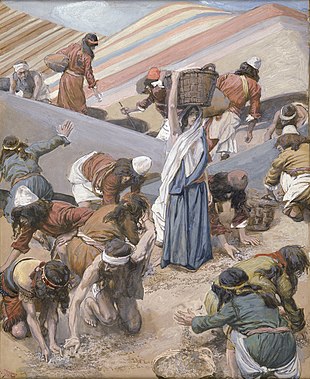
Photo Credit:  The Gathering of the Manna by James Tissot

“Afterwards, there were enough stores of manna to revitalize us, the Egyptians, and their vassals. And we took Canaan and we created a new nation and way of life for the entire world. Yet the story of Passover — the true story — is not how the Shadow of Death passed over the sons of Israel by tyrants or the slaying of the Egyptian first-born and Death sparing our own.

“Rather, the story of Passover is the Story of Manna. And to complete our ritual tonight, look at the feast of Manna bread in front of you and all the food and wine that our ancestors began to run out of in the Desert. Look upon the food of our Judean Empire, eat, drink, be merry, and celebrate life.”

And so the kohen and his disciples looked down at their frosted breads and cakes — at their feast — and they began to eat.

11: Alternative Facts: Among The Populii

“The lady doth protest too much, methinks.”
— William Shakespeare, Hamlet, 3.2.

Bowing the knee. Showing the Old Ways. That’s what you want to we to see.

I glean better.

Welcome to the Free Sancts of Amarak. That’s we. Not the Repolitik. Not the Tripartite. Not the Demos. Not the Grass. We. Amaraki.

Amarak.

From Freed Dome? I glean it. Your bow was too rated, too much for show. Like a glad-fighter from the Repo Arenas of old. Like anything from the Cap. But it got our Eye. And I glean that you come for the Childer of the Secret Motive.

Come.

We glean why you’re here, I see. The mask of a Loyalty Test, of the Pledge. There are no antiq-IDs here. No ethnoi outside of MePo. We haven’t gleaned a Dead Skin here in cycles. We, all of us, are just “One-Backs.” Ha. That’s what they called us, once … and even now, in the Borderlands.

Ha. We’re North, but we still glean the South, the Borderlanders and the Badlands. Our Interface’s just fine, thank you. We mind our Border here, too: between the State and Nomens. That’s part of the Test, right?

We know our historia. Don’t mind talking it to you, while you’re here. After the Forty-Fourth Precedent, everything went to fuck. No other way to talk it. Many of we, memor our history all the way from the First Disunity. We had Motives then, too. From Underground. For the ethnoi. Ones not taken by Repo Gilder-Booms for shot-pract, or slaves by the Baggers.

The Demos Brigaders kept moving to Freed Dome, then. Left we, and the rest in other places to take care of the ethnoi that couldn’t pass, the Rainbows and Prides that couldn’t run, or hide. A few lived with we. Most we passed: to Nomens.

I glean your face. We memor the Beast of Burden. We are it. The Cap, Freed Dome, takes on the Five-Point Arms of the Gram. Others think themselves the Sunbird. Cocks. But we’ve always gleaned what we are. No shame in that.

We were the Demos, the first patch of Grass when the Arm of the Demos laid itself down. Some called us Arns, working with Nomens, with the Razor Leafs. Poisoners from the South, those not our sibs: Repos and Cons, all of them.

Damned Red Caps.

But the only way we were Vivalists, like the ones in Nomens, is that we wanted to live, and no one to die cause of skin, or the stuff tween legs and chests and necks, and minds. Mostly, we’re just hardworkers. Blues. The first meaning of the word.

Even then, we gleaned what’s what. Blue always needs be on top, keeping the Red down. Red needs to stay inside, not out. Might bleed all over the place, otherwise. Might burn everything. Like it did. Has a belt of stars too. You’ve seen it. Binds the Red under the Blue in good govern.

When we first fought the Repo Fiefs — the Great Fief of Hate — cycles ago, past the Second Disunity, into the Interregnum, a Predict came up with some lines. Went something like this:

When Turtle Isle is broke,
and from its shattered shells, the blood is woke,
the Red will Spread a drumming,
be wary: the Red Caps are coming.

Has a ring, right? Only thing worse are the plague-bares … The Nats. Not many these days, here, after the Purges. Still … During the Interregnum, when all the Weather Domes were down, the Repo Fiefs’d attack us. Again and again. Damn right we cleaved to the Vivalists from Nomens. Sanest there were when the Brigaders left us to ourselves, when they weren’t in divise against each other.

Nomens used to be named something else, called after the lines of a Predict of She. When the Repolitik broke, and Turtle Isle turned underside down with the Weather Domes all burst and broken like childer all shelled out on its belly, Nomens was the only one left. We memor. Sunder left the Pasiph League cycles fore, cross the Ocean. One thing the Red Caps hated more than Nomens were the Pasiphs.

But when Sunder broke away from the League, they left a whole: one that Nomens joined. Nomens had us. Like I said, we are all Vivalists. Nomens helped us, the first Grass, and the Demos. Took some time: not just Underground this cycle, but also from the Water and Air, these Motive Paths we show you. And Nomens had its own Fjord, with its flight of Razor Leafs — red through the snow — to cross. But we did it. We brought Amarak back. We do not forget who helped us.

Just like we took ethnoi cross to Nomens, even when the Cap of Freed Dome was made, and spent more time coming up with MePo — with melting we together — and their Hate Speech Accords to actually feed we all. So don’t eye us down. We memor the way the House came silent — came the Still House — even when the Demos spread through it like the Grass it said it still was, with its ties to the Land.

We also memor the Childer’s Contracts, and the many Scapes from Turtle Isle we aided. What would the Burning Library of the Grass have gleaned, when she spread through the Little House like wildfire, or the Graceful Voice, the Defenser Who Halts All Walls?

All Predicts of She, those who would have gleaned what it is to bow the knee.

Don’t talk to we about loyalty. We glean our place, even with your Cis-Trans War and the Repo hate cults at the borders. The Cap gleans our place in historia too. To do what we must. They can pay to be beyond Gen, and play their Opposing games. If you’re truly jects of Freed Dome, perhaps you laugh at we. Some think our Beast — the one that carries we, all of we and our burdens — is made of gold. A fine ass.

But there’s a reason why breeding our Beast with other, faster, gilder beasts makes mules. Smarter, perhaps. Or so it gleans. Longer-lived. But … truly sterile. Jects, not of populii.

And now … you come to we, bowing like we did to show our member in the ancient Motive, to make us see your gleaning, do you know the mean?

There are many reasons to bow the knee. You say it is to learn, from us, but in this cycle, in these times — in all times — there are other Motives where that is a part:

To obey, to respect, to perform … or to defy.

So where, on what Path, in what Motive, do your loyalties lie?

(c) Matthew Kirshenblatt, 2019.

Alternative Facts: An Alternate Perspective On You and I

This is one of my first Mythic Bios revisits today. I said before that I didn’t conduct my examination of Alternative Facts in order. And now, to complicate things even further, I realized I actually forgot some things and instead of adding them to my previous entry, I thought about it, and came to the decision that these elements deserve their own.

In my last article, I mentioned how the first draft of “Lost Words” didn’t really work. The spirit of it was there, but it wasn’t really direct. I wrote about a few reasons why it had issues, and while most of them were structural and still trying to figure out what they were beyond a gimmick or two, there is one major change between the first and the succeeding drafts.

The first draft of “Lost Words” was actually in first-person. The narrator, who was a student academe, was talking to their teacher. They are separate from the reader, they and their teacher at the Freed Dome. The entire situation is outlined for the reader through the dialogue and some small description on the part of the narrator. In a way, they are basically telling you what is going on more than anything and as I said in my “Alternative Facts” analysis, it is a more “Gee Willikers this is the World, Batman” dynamic and feeling more than anything else. In other words, it felt cheap. It felt like, as I said before, a gimmick to sell one idea. And some of that is fair as I never thought there would be an interconnected story after this until a friend of mine said all but said they wanted to see a story about the Repos that survived their official disbandment and their exile from the main State of Amarak.

The first draft wasn’t even a Word Document. It was an inline text email that I’d sent to my girlfriend at the time, and then my friend a few months later after we reconnected. To be honest, I even forgot about what literary perspective I used. For a while, I even thought I wrote it in third person limited perspective because there were two characters having dialogue with one another. Talk about degrees of separation and cognitive dissonance: thoughts that are appropriate given the title of the series, and the times that has inspired it.

I don’t remember why I chose to rewrite it, and then rewrite and write the succeeding stories in second person perspective. Second person perspective is not a common literary narrative point of view. It is the kind of thing you would expect in a Choose Your Own Adventure book, or a video game, or the post-card fiction I was told about by my World Literature teacher back in Grade 13 or OAC. I thought it interesting, and I played with it when I designed Twine narratives and even some of my own Choose Your Own Adventure and Roleplaying Game experiments back in the day.

But as I planned to hone the story down … you see, it’s clever. Not me, but … one of those age-old exercises you always get in literary classes is to determine what narrative perspective you are using. And even as I reviewed my stories for this article, I see how tricky it is. Technically, “Lost Words” is first-person perspective. However … the narrator is talking to an audience. They are talking to you.

It isn’t as clear, perhaps, in the first story but from “Freedom” and onward, while there is an “I,” there is also a “You.” Certainly, Alternative Facts stories like “View From the Badlands” and “Beyond the Wall” actually have specific narrator characters, and the others have a clearly delineated group talking to the reader-audience, to you, but that is just it, isn’t it? It feels as though they are talking to someone. There is always a you in this narrative.

Even in “Lost Words,” there is a general “you” when the narrator talks about their research into the past. This tenuous link between the first and second perspectives in the narrative, arguably and from my obviously “unbiased” opinion, makes it so that you aren’t only watching an interaction, or passively having the information revealed to you. The idea is that you are involved in the process. You are supposed to be immersed in this world, through this pronoun become a verb. You aren’t separate from it. This isn’t another place or another time. And even if it is, you are there with them: actively discovering this.

Of course, you have to suspend your disbelief or pique your interest to do this little bit of roleplaying. You can remind yourself that you aren’t in this. That you are beyond it. But as I think more about it, in this convoluted way, given the subject matter about politics and horror, and the movement of a world, what is the difference between “I” and “you.” I refers to one’s self, but when “you” is used it refers to another. It can be exclusionary, but it can also be inclusive, an invitation, a realization that one is — that you — aren’t separate, but rather in the same place. Maybe not in the same situation, but you have that invitation to being invited to being a part of the story, to even the illusion of actively exploring it.

I’m looking at what I’ve written already, and I wonder if there was any point to it: if I have actually communicated anything worthwhile at all. I suppose, if I really look at it, the way that Alternative Facts takes “I” and “you” sometimes makes them distinct, but also makes the boundaries between them finer … almost erasing them entirely. It takes some doing to see where one ends and the other begins, to see which one is true, and which one is not. It gets muddy, and a bit unsettling even to talk about: and not just because of the strange hodge-podge language.

And maybe that is the point. Or something.

10: Alternative Facts: Summer Camp

“Sometimes by losing a battle, you find a way to win the war.”
— Donald Trump and Tony Schwartz, The Art of the Deal

You’re back. You came to us, to the Badlands fore, cause you wanted our historia. Our mythologia. The mythologia of the State. Of the Cycle. Of Amarak.

To think your search started with just one word. I recall wording with you about the Cycle of Opposing, and its roots in the mythologia of Ground Zero. About the ethnoi, and ethnos. About the Disunity. About divise itself. Opposing, and divise start inside. You glean that. But it goes outside, too. It has to.

You found the Climbers. They told you, worded with you, about walls: about where they come from, how they form, and what they do. We traded lore for lore. You were told no Wall was made in Amarak. The Wall was always there.

Once, as the Pains of the Hidden Lady told you in Repo Land after you walked the zigzag path of the Hidden Festive, that they worshipped Libertas. And the last son of the Eleuth told you of how his lost Maters and sestra Pride named themselves after the Lady of the same name. Even now the center of the Repolitik is called Freed Dome: what our Land, this failed Rene Project, was supposed to be.

But that was Lye, as the Repos call it now, in the end.

Amarak was always a prison. And if there was a god of prisons, if it ever had a name, it would be the prophet of profits. Or the profit of prophets. Or the edicts of predicts, and predicts of edicts. Most populii came to Amarak — birthed Amarak — to serve, to live, to die: made by Europa to be monster, and labrys cleaved together. That is the story here.

The mythologia of the Sancts.

It was said to have happened after the Cycle of the Forty-Fourth Precedent, fore the Interregnum, when the Repo Party ruled. Many other States burned, then. Ethnoi were purged. Populii died. Amarak was free. It was a Sanct. It was made of Sancts. But those Sancts were iron vaults. They were lost time. Dark. They were prisons.

Amarak was a prison.

The Repos always talk about earning freedom. Their Gilder-Booms talk of sacrifice. But they have other words too.

It’s said that when populii wanted to flee their State, to come to Amarak, they could stay. They could be a part of it. Like the Amaraki of old. For a price. The diablo’s gamble. The Bargain.

The Bargain has been here as long as Amarak, throughout every Repolitik. Every Cycle. From the beginning of the Cycle. The terms just change. The stranger, the ethnoi, can’t pay to come in. They are feared. Hated. They are in divise with the State. Some try to, in the words of some of the Prides, climb the Wall, and they fail. Or they do it, facing the mercy of the Law. Of freedom. Of Amarak.

But Amarak is a prison, and a game. And Laws are Rules. The Coustume Guardians have ever been their enforcers. It’s clear. You can enter, or leave. But when you enter, you will be a part of that prison.

And your children will go to camp.

Fore the Interface, familia were sepped in the Dark of that Cycle, snatched away, placed in cages, in grey and metal. Not allowed to see their familia. Not allowed to play. Or touch. Or be touched by Amaraki Caretakers though, sometimes … They were.

It’s said that the children were supposed to be released fore long. As were their parere. Some were. Some never saw their familia again. Some never saw the children again. Or their camps of simmering summer garbage ruled by ice. These child prisons. These child Sancts.

The true Interregnum, the Dark Age, began with the silence of the child Sancts. When the Second Disunity started. Most of the child Sancts were under the so-called Great Repo Precedent, where it was said that work set them free, one way or another. Others were taken by Demos Brigaders and their princeps, the children freed. The populii wanted to bring down the regime. Others, were still lost. It’s said that even now, a thousand years later, there are still parere looking for their children, children wandering for their parer, forever sep … And others, even now, dwell in the husks of the Sancts, lost to the labrys of a lost Repolitik, starving, lonely, angry, and isolate.

You’ve been to Freed Dome. During the Reunity and the beginning of the Tripartite Repolitik it was built on the ruins of a tyranny, made into a Collective for young academes, Affirmation Groups, and visitors. It was made Sanct, one of many to memor the atrocities of the Lost Sancts, just like the remains of the Coustume Posts and their flower gardens. Some Sancts, in the former Repo fiefdoms, remain as more ruined memors, while others are cities made Reserves for “exotic” antiq-ID ethnoi, or those that grew in the Sancts. Over time, during the wars and the retreat of the Repos, forgotten by them and the Demos, the children of those Sancts grew, and traveled.

There is another story as well to tell. There is mythologia we have made collect, from our Eyes in the Interface, from the Badlands to the Borders, that some of the Sancts still remain: that they have made liberate themselves over many gen. Some may have met each other throughout, embraced the silence that killed so many, and become Co-operative. We have heard a few whispers that perhaps some, called the Free Sancts, actually exist: beyond Repo and now Tripartite Repolitik gleaning.

If true, they don’t seem to be on the Interface, Markers, and all. But we want to glean them as well: to glean their historia… their own mythologia. The Gilder-Booms would have you know, by their own coustume, that their children are made hallow by the armaments to which they have destruct themselves, and others. But if there is any hallowness, any heroism, in any of this, after all this time it’s that true sacrifice is what the children of the Free Sancts suffered, thrown away, used, destruct, or left to keep the Wall — the Prison — of Amarak alive.

But if they live, beyond this, without the control of the Repolitik, then perhaps they did it, broken away from the Cycle. Perhaps they did win the war that the Repos lost despite them.

Maybe now, they really are what Amarak should be: children in summer. Perhaps they are the children that are now, truly, free.

(c) Matthew Kirshenblatt, 2018.

9: Alternative Facts: Beyond the Wall

“But one man’s golem once grew so tall, and he heedlessly let him keep on growing so long that he could no longer reach his forehead.”
— Jakob Grimm, Zeitung für Einsiedler (“Journal for Hermits”)

I was a Llang. I am also Mas. This is my Test on this Interface during what the Heterodox call the Cis-Trans War.

My sestra, part of the Queen’s Pride, we knew about the Spectra. But we were Sep: Deep Sep. Our Fore-Climbers, they believed in the Lady. The Lost Lady. We left the Walls of the Heterodoxy behind us after the Maters met with the other Prides and made the Spectra. Our Maters and Ladies would talk to the Joys and the rest, while we lived our lives Sep to heal: to heal from Mas turned poison — Poison Mas — by the Heterodox.

We embraced the ways of Fem, in our land, deep in the Borders. We farmed and wove like the rest of our small Pride. The Llangs, our Queens … our Aunts, our elder sestra, were hosts. Our line took on another path, another name. Eleuth. We … we were Eleuth, after our Lady. I still believe in her, even now, even after everything …

I was divise. I couldn’t help it. I felt … divise, but not Joy. Never really Joy. I’d never seen one. Few of us did, until that day … Even now, it is hard to say how I gleaned it. I just felt it, even as a child. My sestra Eleuth, they didn’t judge me. That is not the story I am going to tell. They knew I was divise, diverse, but of them. I was still borne from my Mater, my Maters … after receiving the Vessel of Trade from the Joys and Mas Binaries beyond our small proper: the way most of us are made. I was still their child by the Accords of Life, agreed by the Spectra over a thousand years ago. I was still part of my sisters.

The Eleuth do not hate Mas. They did not … They did not have agon with me. They loved me. Even though, by the rites of our Pride I knew I would have to leave one day, I knew I was not poison. I became their only son. Their child.

We knew nothing about the War. I grew and found a wife. We were going to have a child together by Trade and the Accords of Life. Of course, that was the point. That was what changed everything. The Eleuth couldn’t have us stay. Even so, we had their blessing. We would go to a new Pride. They were going to prepare a Leavetaking for us. It was sad, but joyous. A Sep of another kind. But there was acceptance. We were in the middle of it, when …

The Meides came.

The Eleuth rarely ever saw them. I’d learned since, why they were made. The Gen-Que, those I’ve met, said a thousand years ago — when the Spectra was still young — they feared attack from the Heterodox. Even in their Disunity, in agon with each other, and after in their Interregnum when they were just healing, as we once had, their disunities threatened to spill over and poison our land. We fled from them once before, before the Second Disunity. We needed protection.

It is said, by the Gen-Que, that they helped the Spectra make the Meides. Brethren and sestra to work for the Spectra, and all Prides: chosen for strength, and passing on word to each Pride and its smaller Prides. They were to fight the Heterodoxy and the Heterodox. They were to find spies. They were to send word and defend us if we were under attack. Warriors and truth-tellers, the Gen-Que told me later, their hearts to be made of Stone the Gen-Que said, to their everlasting shame. That was how the Meides began.

The Meides that came to the Eleuth, to the distant sestra of the Llangs that day, were filled with Joys and Llangs. It was the first time we’d seen Mas, of any kind aside from … me, in our land in cycles. I could smell the discomfort, the … fear from my sestra. If there were Trans-Gen or Binaries among them, they were quiet. The others were not. They told the Maters of the Eleuth that there were Traitors among the People. That the Heterodox was poisoning us again, causing trouble, and war.

They pointed at me. They saw me and my wife. They said I was Heterodox, that I was infected with Poison Mas — I was Poison Mas — and that they needed to take me in: that I was a Traitor to our Pride, and the Spectra. The Eleuth couldn’t glean it. It didn’t make sense. We are … we were Sep from Mas, mostly, but the Maters knew — believed — that the Spectra embraces Binaries, even let Binaries leave the Eleuth or … or Trans-Gen to go into the other Prides that they need. I was not overt. My hair was short and I wore legs, but that didn’t mean anything. My sestra let me stay as I hunted, with them, and only wanted to live. I never said I was Mas. I didn’t have to.

We didn’t know, I didn’t know, about the Pan-Binary Prides and their agon with the Spectra. The Meides, that day, told us about the … Traitors, the Binaries and Trans-Gen, in agon with the Spectra and using the poison of Heterodoxy to betray and murder the rest of the Prides. That the Spectra’s peace with the Heterodoxy was our fault: and we were just helping them poison our People … helping them by letting me stay here.

The Gen-Que, later, told me the Meides lost their way. Even at their height, no one ruled them, not even the Spectra. Only themselves.

I saw them, then. I saw their armaments. I was going to do it. I was going to go over. Even then, I gleaned what would happen if I didn’t. The Maters … my wife, my sestra, refused. They appealed. They asked to talk to the Llang, to our Honoured Aunts, to at least let me go to another Pride with my wife, to the Trans-Gen, or the Binaries if need be …

The Meides leader said something, I still recall. She said: the Llangs knew. They let them through. That those who can pass through the Wall, must be destruct.

They shot first. That’s all I can recall. My wife pushed me away. The Maters and the sestra, they fought. They told me to run. I didn’t want to. I wanted to fight. I felt agon. I could hunt, but I couldn’t kill.  What good was being … being who I was if I couldn’t fight, embrace agon, to defend those I loved? To do even that? So much I didn’t understand and no one to teach me, in the middle of madness. It made no sense. Why send a Traitor to so distant a place? So isolate? Who told them about us? About me? Nothing made sense when my wife fell. When my sestra died …

My own Mater told me to run … That they would win if I stayed. If I died …

I don’t know why I ran.

I should have died with my sestra.

I kept running. I don’t glean, even now, how they didn’t find me. Maybe the deaths of all the Eleuth, was enough for them. Maybe they believed they got me. I ran. I ran deep into the Borderlands, near the Badlands. The Maters always told us to keep away from them, more than anything else. There are no Domes, just the wrecks of them, and the Nats and their holes. The elders told us the Nats are danger: rejecting techne, scire … even medicine … to be one with the World … It was said, that the Heterodox, during the Disunity and the Interregnum, used to send people to the Nats to die of the disease they embraced, that they became.

I used to think they were just tales to scare us, to scare children … Until I saw them too.

Warped, twisted … I don’t recall. Sick. I was so sick. Infected. Poison Mas … Maybe I did have it. I ran deep into the Badlands, passed where even the Nats live … Burning … I should have died.

The Eleuth had another tale, though. About the Badlanders.

I woke in a tent. I don’t glean, even now, how long I was with death. No one was with me, but water and food. And a tablet. It linked to the Interface. I’d never even gleaned it existed, among the Eleuth. We just told each other what we needed to glean, and the Elders told us the rest from our Queens, our Aunts, our Greater Maters … who betrayed us.

The tablet had a missive. It told me I could find them, here. Or, I could join up with something called the New Spectra. But that I should know about my sestra … and my brethren.

Brethren … an alien, but comforting name. It fit in me, even with the emptiness without the Eleuth, my Maters, my wife  … I put my hand on the word for brethren on the tablet. I slept again.

Until I was found by my new family.

A few cycles have passed since I’ve joined Those Who Can Pass the Wall. The Climbers. Mas, Fem, and even Is. And Gen-Que. The Gen-Que taught me about Gen and Affinities. The Trans-Gen, helped me through the Rite of Transformation, sometimes the body, and sometimes the mind … diverse for each person. My spirit knew what it was, though. I always did. The Newtons, or the Tess as they also like to call themselves, sometimes showed me genii. I showed them the tablet. The Binaries and Pan, sometimes Dual, or Faire, or in Units, they showed me how they love … and fight by Passing Through the Wall, affecting one Affinity to glean information from the Joys and Llangs that thought they were the same, or the Trans-Gen who passed affecting Gen to do the same.

I gleaned more. The Meides never thought we were “pure” — that we were too diverse, too potential Heterodox — and the others share this idea. The Spectra is HetSoc, but they are not Heterodox, or so they say to themselves: Playing Reunity only to get what they want. The Heterodox claims to want diverse, on their terms, to claim diverse and make themselves a mask of mercy for their polit-societas. In turn, the Heterodox promises the Spectra, the other Prides — the majority of Joys and Llangs — mech wooms and changing seed techne and scira to replace the Vessel of Trade and the Accords of Life. The rest of us are expended to them. It makes me think about my Maters. About my wife, and the child we never had. The Spectra plans to erase us. Or at least do nothing while the Meides come for us, and kill them after they are done.

But we are not done.

Just as I learned, from the Meides, that those that can pass through the Wall must be destruct, I also gleaned from my sestra and brethren, my family, the lessons of the Fore-Climbers against the ancient Heterodox: the ones that made the Spectra that failed us.

Our ID is our weapon. Our weapon is our ID.

The Joys and Llangs have their favourites: their consorts still Trans-Gen or Binary, and have just embraced quiet. Just wearing another wall. Hiding fluidity in a Stone. Sometimes, we appeal to someone through one ID that is really another. Sometimes, we take from them with that same ID. Other times, we kill them under the ID of another.

That is my personal agon. My fight. This is my Test on this tablet. On the Interface. I was Llang. I am now Mas, and I am the last of my Pride, the only son of the Eleuth. And I will never forget. I will never forget the lesson. And I hope you will not forget this Test.

© Matthew Kirshenblatt, 2018.

8: Alternative Facts: Sacrifice

“She had told her few friends who persisted in visiting her despite their brusque reception, that she had received a message from the spirit world warning her that all would be well so long as the sound of hammers did not cease in the house or on the grounds.”
— “Winchester’s Widow Dying. Work on Her House in San Jose, Cal., Has Never Ceased,” New York Times, Vol. LX., No. 19497, 1911.

You’re here now, for the Night Terror.

Maybe the Baggers, our brothers, gathered you from your shacks at the Borders, with their prods. Saw your twitchy nubs, or bird eyes. Got libbed from the Pats for your trouble, and sent our way. We know family when we see you. Or maybe you were a Bagger, got us prey — every damn time — for our Great Pratik, and good. If that’s truth, good on you. You’re already one of us: getting your Mas or Fem. Or our Wag brothers and sisters told you about the fire and glory of the Cycle, how we’ll make the Arns see the piss, shit, and blood of the Terror again. And you’ll get that chance, if you’re good enough. And if you’re Nation, well, blood’s only cleaner when you spill it.

The Elders, the Pats, tell us that we’re the real Cycle of the Land, the whole lot of us. There’s Land, Folk, and Fire. No more, and no lack. And while we’re all Family here, it’s us, that are always — always — at the front: moving to the horizon. We’re not at the back or the side.

We’re the ones that ride the Cycle shotgun.

No Wags, no Baggers, no Nation, or Eyes, or Elders. No bullshit.

Just us.

You got that so far? Good. Cause whatever you were fore, you are us now, if you earn it. If you get better. If you live.

How it is, is how it was. There’s one Law. And that’s the Second Law. The Sacred Law, brought down by the Lohim Almighty, the Fathers, the Holy Writ, and the power of the Folk. And that power is the power of the Land.

At the First Cycle, the First Rebbing, the Red Coat Commies — those damned godless Tyrants — drew and quartered the Land — our Land — and our homes, and our bodies to be slave. Their armaments were the Law. And when we rose up, took the Law, and made the Second: taking their armaments, their thunder, as our own. Making them hallow. Making them our hallows.

We’ve been milit and soldered. That’s how the State, our Land, began, and that’s how it’s going to end: at the end of our hallows. It doesn’t matter that the Demos Usurpers and the Arns think they took this Land from us, taking away our Precedent, driving us off to the Borders, taking our hallows. We were the first in, at the ready after earning our fiefs and propers under the Precedent, and the last ones out when the Traitors took them away. They call us Repos, but they’re the thieves. They stole from us everything, but we fight for it back.

And they’ll see truth from our end. The only end.

Land, Folk, and Fire. Only we’re blessed with the duty, the glory, of wearing Gilder, the sheen around our hallows. We are the Hunters of sustenance, our holy power blazing to fill the bellies of our Folk, and the souls of our feeling against the Usurpers. It is our duty. Our right.

But our right must be earned. We’re the ones chosen to hold the Peacemakers, the Desert Birds, the Horses, and the Wind. The rhythm of our hallows are what we think. Fire and smoke are at our knees. The trigger our appeal. Prey in our prayers. It’s truth.

Our brother Wags are the mouth. The Baggers gather. The Nation purifies. But we, and we alone, are the only ones that dare to bear the sacred flame. Our hallows have changed over a thousand, thousand seasons, but the spirits are still the same. And the vessels, in our hands, where they dwell must be purified, must be proven … must be bloodied time and again in the Cycle that is Amarak!

And we enter the Great Pratik in recall of the Old Battles where we pray with our hallows, hunting all prey that is called Abominate. Rainbow scum hiding deep, the disease of the Nats living away from Domes in their Badlands Plague Pits, the dirty One-Backs bred by the Usurpers — these “new Amaraki” — either or any will do.

It’s truth! The Land rebels because it’s hungry. We hold its arms, its branches, its trees. We light its suns held by our sons, young or old-time, Mas or Fem, at the end of the sticks of the spirits to honour the turnings, the ever-turnings, that make the Land go on, to restore what’s true to the Folk: the Law to fight and fight back against those that take from them.

The hallows take all in equal in the end, espec us. The Land demands blood: taken, and offered. To take the thunder of the spirits of the Lohim demands sacrifice of foe and friend and brother. Too many of us have made that rite in Battle, cornered, or in the front. Sometimes the hallows take us at peace, fired off to recall of us its power to take. All the Gens of us …

Even the Young know the power of the hallows. Our Young, they have them at six cycles, gleaning the truth of the Land away from the Lye we will overturn. That’s when our Young start to serve. For blessed are those that meet their end by the hallows in peace: made all the more holy by that of a child. For in fire, they are made divine. In ash, they spread the Land. From the smoke, from what we burn, from what will stamp out in their name, they rise from our trumpets, from the tune of Amarak proper: made true heroes.

May we Gilder Booms take back the power that the Usurpers stole from us … in vain, just as the Tyrants once did, to keep the Land alive, and strong, and its Folk forever. May you, standing here now, prove yourselves, take stand with us, and take back what’s always been ours.

For Land, Folk, and Fire … For the Young. The next Gen … The true heroes of Amarak!

(c) Matthew Kirshenblatt, 2018.