I know the above title is a low blow for attention, but I really couldn’t resist.
Whenever I write something on Mythic Bios, I try to make the language and the content as accessible as possible. I know I don’t always succeed, but in the case that I don’t my hope is that I have a little something for everyone that I am also interested in writing about.
In my later years in high school and throughout my early years at University I was really interested in Philosophy. I liked writing that made me think and that also played around with ideas of varying kinds with regards to, well, pretty much existence. But even then, before I realized how didactic–how dry and rambling it could get–I had one other issue with Philosophy and texts that purported to be as such.
Sometimes, they would reference subject matter that I wouldn’t understand or, in my case even worse, begin to quote a language of what I was not at all familiar. And it annoyed me. A lot. To be honest, it still does.
Philosophical texts are not the only culprit in this non-crime of course. Many literary classics–novels–do this exact same thing: at least from the Modernist era. And, finally, there are comics that do the exact same thing from time to time. Take Alan Moore for instance. Alan Moore is a genius. He creates multi-layered plots that start off very slowly but ultimately become very epic and grandiose. And even though his characters have tended to lean towards the cynical side of humanity, his characterization is very human and excellent.
But I will tell you now: when he has whole passages of From Hell and Lost Girls in German, or I believe Punjabi in The League of Extraordinary Gentlemen: 1910, or even … freaking Martian in the second Volume of The League I start to get … annoyed.
Don’t misunderstand: I like the authenticity he brings to the characters and the fact that you can clearly see how his well-read nature and research is paying off in the background. Now I am not just talking about his appropriate use of other languages, but his many, many literary and historical references that make me feel very under-read as a reader and overwhelmed as a writer. He simply makes so many references and allusions that I can’t always keep track of them, or even know what they are. I can see how other people would really have difficulty relating to this. I guess it’s like what Austrian Emperor Joseph the Second purportedly once told Mozart: that his work has “too many notes.”
I know that when he has used other languages, I feel a bit … cheated: because I want to know what the hell the characters are saying! It’s that simple. Likewise, I want to get all the references. I’m greedy like that and it feels like I’ve reached a certain level of understanding, and then I hit a wall.
A language is another perception of reality. Really, another language is a different world. This leads me to the other perspective on the matter. Anna Anthropy has said a few times that one of the issues with regards to video games is the very exclusive culture or subculture that has developed around them. More specifically, she talks about how video game design and dialogue around it becomes this interaction of in-jokes and references that people outside the circle do not always get. I would imagine that this is something, especially with regards to games as an expression of art–of language–is something that Anthropy believes we should watch out for.
On the other hand, Anna Anthropy is also one of those who wants to allow for a different voice or perspective in the medium of video games. For Anthropy this seems to have been in the form of making games for different genders and practices outside what was–and still is–the social norm. Essentially, and others like her, use this chosen medium to subvert it and change it: to reveal its full potential through a new perspective.
Alan Moore did something very similar. He, and others like Will Eisner, took a medium that became very associated with superheroes and some two-dimensional character development and morality and injected a whole different kind of perspective into it: using comics to talk about scholarly, metaphysical, philosophical, sexual, and realistic matters as well as still telling a story. Eisner and Moore are known for bringing the idea of the novel to the comics form and–eventually–leading to a place where a larger audience could access and relate to the stories being made in this medium.
In a way, they were making a new language as all languages are made: through innovation of an older dialect.
Anna Anthropy seems to believe that video games still need to “grow up” and deal with these matters as well: with gender and sexuality and life experiences in an accessible way. And one of these ways is to make the audience for games grow by trying not to make so many exclusive references within a game’s structure. Geeks by their very nature are exclusive in that they tend to know many obscure facts and bits of knowledge and trivia, and I don’t think that is a bad thing.
But I would argue with Anna Anthropy–at least with regards to knowledge and not necessarily that sense of shared social experience–that if a player doesn’t understand one element in a game, there are resources online and elsewhere that they can access to understand what is going on. And I suppose that is why, with regards to Alan Moore, there are so many Annotations of his works out there. I do think that it is more than okay, especially with regards to continuity and art, to make references that a reader doesn’t always understand: provided that there is enough that they do understand and enough impetus for them to go and learn something new.
It is strange how my knee-jerk reaction to seeing other languages in a primarily English language comic is a feeling of exclusion and also this annoyance: as though the author is trying to be pretentious and show how smart they are instead of telling a story that I can relate to. Sometimes I feel it to be very elitist. This is the same with references at times. On the other hand, I know–especially with regards to the latter–that I do the same thing regardless of how well I might explain it, and that I should really take it as a challenge.
I don’t want to be talked down to, but I also don’t like it when things go over my head. And this is me as a reader and–as such–I need to keep it in mind as a writer too. I also, as I said, don’t always succeed.
I like to think that Alan Moore doesn’t write in different languages in his works for the sake of being clever, but he actually does it to keep his characters in character and to maintain a continuity in his world-building. Granted, he could <do what some other creators do and but triangular brackets around dialogue to indicate a different language like so>, or make a different font for those words, but it would not be the same. There is no real solution to that, I’m afraid: not for me anyway.
But there is something that my studies in Philosophy also taught me. Whenever I do come across things I don’t understand, as I said I look them up, or I try to find a speaker of the language. I can tell you that it was enjoyable having a German-speaking friend of mine translate some words to me as I typed them out to her so long ago. And when I don’t get a reference, I consider it a real challenge and it is like an easter-egg hunt that allows me to reread Alan Moore’s text and graphics all over again. And sometimes, I find something new I didn’t get in the first reading.
I would never bring up any of this at a signing–should Alan Moore ever come to Toronto one day and I can access the line–because that is not the time or the place. But I do have this place to talk about it. Alan Moore helped take a medium that people did not always take seriously and made it into some serious literature: and as long as “serious literature” is always questioned, always makes you think, and can function on its own merit– and can take you into another perspective–then it is definitely a past-time, and a calling, that I want to continue for my own: because there is always room for growth.
So hopefully this made sense. My Mythic Bios is another world itself and perhaps a language of differing ideas sometimes reaching critical mass, or becoming exercises in poetry. Or it’s that fine line between talking down, and or being the wind over someone’s scalp. I’ll leave that up to you, my awesome readers.
So I’ve been commenting on some Star Wars news and rumours lately. And it has gotten me to thinking–thinking long and hard–about some issues: specifically about the nature of the Saga as an epic structure, the Expanded Universe, and what I want in the former.
The reason I’ve started writing about Star Wars again–and anyone who knows me is aware that it doesn’t take much to get me to go on about it–is that I became aware of a particular rumour circling around about the existence of Star Wars: Reclamation: essentially what seems to be an animated tie-in into the Episode VII is that is scheduled to happen in 2015. Now, I’m not going to argue whether or not this is legitimate or if it is a hoax, or one of many projects that Disney effectively cancelled by closing down LucasArts not so long ago, but the prospect of it is very fascinating.
Think about it. We have no idea what the next Star Wars film is going to even be like. There are, again, some rumours but nothing definite.
Which brings me to my first point.
Star Wars is a space opera. There is music, there are opening scenes, clearly delineated heroes and villains and all those who fall in-between, epic battles, moments of levity, romance, and tragedy. In fact, most classical operas can–arguably–be divided into the genres of romance and tragedy if you really think about it. Romance in itself is not merely about love, but also the sublime and grandiose in nature. It is a great epic adventure that encompasses many elements: especially the mystery of existence. Tragedy can also arguably have these traits, but there is usually a very clear circular arc in the Classical sense: the hero begins from nothing, becomes great, and through some fatal flaw–hamartia as the Greek word goes–the hero gives into hubris and falls: and falls hard. This is also known as a reversal of fortune.
I would therefore argue that the Star Wars Prequels–in terms of thematic structure–are a great big space tragedy: take from that statement what you will. However I know that when I am watching or reading something and I know that many of the characters I see will eventually die, it is kind of hard to really get attached to them or any of the events that are going on. I mean, that has always been my issue with the Prequels and The Clone Wars cartoons: I just see that every struggle is essentially engineered by Palpatine and it just … cheapened it for me. But if you view these adventures as the ancient Greeks might have known tragedy–because every legend and myth that was adapted into tragedy was already known to the audience and were therefore judged by the skill of the playwright–then I can see the allure.
But I guess it doesn’t help that I: (1) Read the EU books and (2) believe that the plot and some of the characters in the Prequels and Clone Wars were not given as much depth as they deserved: though granted I did not see many of the latter cartoons. Now I want to talk about some other influences on Star Wars with regards to “space” and “opera”: and how this influences what I want to see in the Saga.
When I talk about space operas there is also the science-fiction adventure genre to consider. You know: that Sunday matinee serialization of different episodes that people in the 1950s or so would watch. I always like to bring up the fact that Flash Gordon and Buck Rogers influenced George Lucas a lot in creating Star Wars. You can read the posts, I won’t repeat them. But these particular science fiction adventure stories also leave their mark on Star Wars in another way: one that channels an even older idea.
This idea is that of redemption. It is redemption that really stands out in the Star Wars Saga. If the Prequels were a tragic and angst-filled arc, then the Old Trilogy was arguably an adventurous and redemptive arc.
I can argue that while hubris is more of a human trait, redemption is as mysterious as the Force itself. There is so much of the romantic, the sublime, and the grand adventure in the Old Trilogy–of things we didn’t know–and it just opens a path to seemingly limitless vistas: much akin to that sense of wonder that existed in the science-adventures of George Lucas’ youth and so much more. After all: who could see the villain becoming, for one brief moment, the hero: someone to be both pitied and respected? Yes, it was a twist moment and some people probably predicted something like it, but it was magical: just as what happened afterwards.
Now let me get back to the other matter: the Expanded Universe after the Old Trilogy. I’m not going to lie. I know that many of the stories in the EU–with some exceptions–are pretty inconsistent in themselves and aren’t always on par with what I liked about the Old Trilogy. That much I can personally can let go.
But I’m also going to make another admission. After the publication of Timothy Zahn’s Thrawn Duology, I stopped really reading the Star Wars EU. I think the biggest mistake was the fact that instead of continuing with what that galaxy contained–instead of bringing back the Sith or a Dark Side threat after the peace treaty with the Imperial Remnant, the authors introduced the Yuuzhan Vong: some extra-galactic sadomasochistic warriors using bio-technology and hating machines. As far as I am concerned, that was the beginning of the end of the EU for me and it only got worse when they tried to introduce the Dark Side in some of the most plot-contrived ways I’d ever seen it.
In the end, they killed at least two of the most interesting characters in the Expanded Universe–Jacen Solo and Mara Jade–with the former killing the latter and becoming a half-assed Sith Lord–and the series and what came after it became progressively darker. It is like the criticism that some people have for comics nowadays: that writers are just copying the grit and darkness of larger story arcs before them. But instead of it being comics makers of DC and such imitating Alan Moore and Frank Miller without their nuances, it is writers working with LucasBooks who imitated the darkness of the Prequels: pieces that at least had structural nuances. The mysteries just became contrived and it became all about the angst: all about the tragedy and an attempt to make something epic out of nothing.
It seriously made me just want to quote Lando and say, “This deal is getting worse all the time.” To be fair, I know that the Sith were supposed to be incorporated into the EU earlier, but apparently LucasFilms had issue with that: probably because of the development of the Prequels at the time. Also, George Lucas generally did his own thing, didn’t pay much attention to the EU, and many of these writers always had to “tow the line” as it were with regards to what innovation they could bring to the stories set in Lucas’ universe.
Really, here is what I want to say as succinctly as possible. If there is something like Star Wars: Reclamation–and that title is fitting on so many different levels–then so be it. I wouldn’t mind seeing most of the Expanded Universe rebooted: or at least given an alternative series of stories as they are doing with The Star Wars comic based on the rough draft of the original film script.
Really, the only elements I would miss about the EU as it is now would be the Legacy comics, Mara Jade, the Solo children, Republic Commando, X-Wing, Wraith Squadron and Grand Admiral Thrawn and friends. The rest of it was pretty mediocre in retrospect. I also really don’t like how Luke settled to be another Old Guard when he had so much potential to become something more.
In some ways, the fact that Disney stopped production of Clone Wars and many of the video games–which I feel are rehashings of old ideas and cycles–may be one of its best decisions yet. Even Star Wars 1313, for all of its excellent graphics and the idea that you are not playing as a Force-user, looked like it was just going to be a shooter game set in the Star Wars Universe: and there are so many shooter games out there already.
It all kind of reminds me of how, when something doesn’t work for me anymore, I just destroy it and start from scratch. I am that scarily absolutist when I am driven to that point. My only regret is, aside from potentially losing some characters I did grow attached to, that this is the closest we will ever get to seeing a Star Wars reboot: the best being a silence about the Prequels or anything to do with them after this.
But I am also skeptical about what might be going on. Even if you look at that Reclamation script excerpt you will notice that certain species from the Expanded Universe still exist. This is also assuming the script is legitimate and will survive the light of day. I am however really leery of the fact that Disney closed LucasArts down and and laid off many of their employees: whatever Kotaku and other sources might be saying about its productivity level. It could be that they are, as they say, focusing all of their talent on the future of Star Wars–which theoretically sounds ideal–but I have to wonder about that.
In fact, the very title of this article is a misnomer on my part. I mean, how can any outside party “reclaim” something that wasn’t originally even theirs?
I know it seems like I am saying a lot of things at the same time. And I am. But here is what it comes down to me for me: I am willing to see a lot of the EU disappear–or be placed into an “Old Expanded Universe”–so that something can be created that will need to something potentially new and good. Ideally, I would like to see the Prequels and Clone Wars disappear or change too: leaving only Legacy, The Old Republic, and Tales of the Jedi and other such more “ancient” stories in the Star Wars EU intact. But that is too idealistic for my own good.
I also realize I have gotten a lot more cynical in my old-age of thirty-one. Once, I would never have even considered wanting the EU to be gone or changed. I was just as much into continuity as anyone. To an extent I still am. Tragedy and angst have their place, but I want to see so much more now. I am not completely all Crisis on Infinite Earths DC where I want to see it all burn–much–but just like the viewers of the old days and their adventure serials I do want to anticipate what will happen next as opposed to the minutiae of what is already going to happen. I want to see alternate avenues, new mysteries, and characters that could go anywhere and whose futures are not seen as written yet: new adventures with depth, romance, and wonder.
That is ultimately what “Long, long ago in a Galaxy far, far away” means to me.
I want wonder, and something to look forward to.
ETA: Disney has very recently announced that they plan to release a Star Wars film every summer after the release of Episode VII. Now, the idea is that each film will be a spin-off movie aside from the main Episodes. These are more in line in some ways with the old science-adventure serials of the 50s: in that there are more of them. Now whether they will incorporate some of the EU into their creation, or make a whole other alternate story with them from the books and literature that exist is another matter entirely. And really interesting for it. Limitless horizons indeed.
ETA: According to a LucasFilm spokesperson, Star Wars: Reclamation is not real. This does not surprise me, but at least it made for a good title to my post.
I will say here, off the bat, that there are some video game and article links below that can be construed as Not Safe For Work. Player’s discretion is advised, though enthusiasm is also encouraged. I am also hoping that I can communicate and do justice to these ideas and some of my own creative license as best I can.
I’m not sure how I first met Anna Anthropy. Actually, that is not entirely true. I do remember first being introduced to her when I discovered Rise of the Video Game Zinesters: though how I came across that book to begin with is a memory now lost to time.
I did plan to buy that book eventually, but then life got in the way. One day, after a series of insane events, I found myself brought to the 2012 CanZine Toronto Event by some friends who thought I needed to see it: and I did. What I didn’t know, or what didn’t really bridge the cognitive dissonance in my head was that Anna Anthropy was there with her partner Daphny David and that they were selling the very book that I had been so interested in.
I’m going to admit that I felt sad, but I was still getting used to that endless process of being social again that I tend to find myself in and by the time I realized that they had been there, it was too late. So I bought the book for myself later instead.
There are many very good reviews that detail what the contents of the book were about: how it worked, how it possibly didn’t, and all of those various details. But there were a few things that stuck out at me. The main message that I got from Rise of the Video Game Zinesters was that Anna Anthropy wants there to be more accessible technology and means for anyone to create a video game. My younger self, the boy that really wanted to make games, would have totally agreed with this concept: even if he didn’t have the knowledge at the time to understand many of the other details surrounding it.
Essentially, Anna Anthropy wants there to be a means for a game-making technology or software–a manifestation of communication and language–that is easily accessible for anyone to use for the purpose of, well, making games and creating ideas. Or taking names and kicking ass: whichever definition you prefer. Of course, there is more than that. The idea is that by having different people of different backgrounds, social classes, career-paths, sexual and gender orientations, queerness, life practices, and a wide gamut of humanity that does not necessarily understand coding you can vary up the content and the gaming experience of a game without an industry-ruled homogeneity: where plots and stereotypes are recycled to keep a sure profit.
It is a very seductive idea. Anthropy compares this “much needed” product and the mindset behind it to the creation of the printing press in Renaissance Europe: thus freeing the production of literary articles from the Catholic Church’s scribes and making them accessible to everyone. The fact that the printing press allowed for religious texts to be made with vernacular language–the words of the everyday layperson–instead of a Latin known only to nobles, priests, and scholars is probably an analogy not lost on Anthropy when she brought up the image to begin with when you consider that she looks at games as a language that all men, women, humans, and other sentient beings should be able to relate and have access to.
She also briefly looks at the history of game-making itself and equates video game development with the earliest forms of games: with symbolic piece and board games, carnival games, arcades, all the way to modern board games and more miniaturized computer games. In addition, Anthropy makes a very compelling case as to how video games were and are in the providence of an elite minority: that it was male computer programmer students and the academy that developed code and the games that came from it. Yet it is also clear that there are changes that are–and have been–in the works to that regard.
I’ll tell right off, as some other reviewers of Anna Anthropy’s work have mentioned, I don’t always agree with what she says but she makes some very intriguing observations. There is one point in particular that sticks out at me. Anthropy writes that a single game creator in sole control of their project can make a much more focused and more personal form of art–a game–than a large team of staff members can. I don’t know if I am articulating that thought as thoroughly as I should, but that is what I got from that. What I find really interesting is that Will Eisner, in his book Comics and Sequential Art, also makes a very similar statement with regards to the development of the comics medium and storytelling within it. These are two different mediums, both of which had to fight to gain recognition as a legitimate medium, yet it is really fascinating how two of their advocates come to similar conclusions.
Eisner did mention, however, that there was nothing wrong with a collaboration between two or more artists on a work. Indeed, in his book Graphic Storytelling he goes into a lot more detail with regards to that. And even Anna Anthropy, in her book, mentions that she is writing the book not merely for game creators but for anyone: writer or scholar that is fascinated with her topic. It should also be noted that Anna Anthropy has collaborated with a few other artists in her own works: such as the fun and frustrating Lesbian Spider-Queens From Mars, the very personal and visceral Dys4ia, and the thought provoking puzzle game Triad. While much of this collaboration has been in the form of graphics and sound, even programming for the latter game, it is still a form of collaboration: though obviously not an industry-mandated one. Rather, these are the product of an agreement between artists that respect one another and actually work together to make something cohesive while still keeping the personal element of Anthropy’s own vision.
Now, to get beyond the book and go a bit into Anna Anthropy’s games. I like them. I like the concept behind them: of taking a video game form and using it to communicate a personal experience. There is something really beautiful about that. I know that Anthropy may not be the only person who does this–and I suspect she hopes she isn’t in the only one either–but she is the one that really introduced this to me on more than a cursory level. I think she is one of those who reinforced for me that the games of my youth–that inspired me as a creator–are more than just frivolity or an inferior art-form. Some have said the same thing about comics, about film, and–back in the day–even theatre and other forms of painting and art.
Some people have been giving Anthropy flak about her games: about how they all tend to follow a very similar pattern or themes of lesbianism, BDSM, and transgender issues. The thing is, well there are two things. The first is that all of the above things are not mainstream in video games: at least not from someone who has all of those elements in their own life. The second is the age-old adage: write about what you know. And Anna Anthropy knows about all of this. She writes about and makes what she knows. Her viewpoint is just as valid as anyone else’s and it is more than okay for her to make games about what interests her: because there are others out there who will relate to it.
The fact that she uses similar themes in her work, and I would say never quite in the same way with regards to game play mechanics, is irrelevant to me: because the industry does the same thing for the most part with many mainstream themes and even the best creators make what they know.
I think what I admire about Anna Anthropy and others like her is that although I can’t always agree with them, they do something that is remarkable. Sometimes the people in charge of publishing or video game industries and coding are called “the gatekeepers.” And what Anthropy and others are doing is they are becoming gateways: gateways and fiery Bodhisattvas into alternate perspectives and the potential for the creation and expression of new game experiences.
This is something that I deeply respect and it is a thing that greatly motivates me now. There is one thing I have mentioned before in this Blog: that I am looking into Twine game-making because of Anthropy’s mention and use of it. Twine is a software that lets you create a “choose your own adventure” style text game without a knowledge of coding, or with enough video tutorials to get into it. I want to do the same thing that she and others are doing now. I want to make a game that can communicate my own–albeit different-experiences: ones I’m not sure even Anthropy will always agree with. I want to have the ability to put someone else into my own shoes: as it were. Or use my experience to make something else entirely and let people make their own choices.
Frank’s article adopts Anna Anthropy’s writing style from Rise of the Video Game Zinesters: emulating Anthropy’s own combination of history and criticism and inter-dispersing it with her own personal experiences in a seemingly scattered narrative but ultimately bridging the gap between the reviewer and the creator of personal expression while Cara Ellison actually makes a Choose Your Own Adventure Game using Twine–Twine–in order to bring her interaction with Anthropy across. Just looking at the styles and mediums used by these two women is utterly fascinating: Frank does not necessarily agree with Anthropy’s statement that everyone should make a game–though she wishes on some level that she had–while Ellison flat out makes a game to express her interaction and her influence from Anthropy’s philosophy in a very demonstrative manner.
I will also say right now that this article was a long time coming. I just didn’t have the words then. But if Ellison’s Twine article further influenced me to make my own game (and I didn’t even realize she was using Twine to do it at the time, another example of my cognitive dissonance), Frank’s article actually encouraged me to write this. And I have been influenced by Anthropy in other ways as well: you will probably see relatively soon outside of this article.
But if I had to sum up everything I have written here, I will say this: that in terms of video-game storytelling, its potential as a medium, and her own potential influence on its future, Anna Anthropy is immensely important.
P.S. My favourite Anna Anthropy Twine game is this one: Hunt for the Gay Planet. There is a story behind its creation that she can explain far better than I, but what really inspires me is the story of a person who tries to find other people like her and goes on a long well-written intergalactic journey. This piece inspired me so much that I bought the Choose Your Own Adventure book from Anthropy’s own site: which is coincidentally on my Blogroll as well.
This wasn’t a planned post of mine, but it’s amazing how Star Wars makes me do that. Not too long ago, I heard that Disney is shutting LucasArts down. I did grow up with the games that this company made tangentially and it does make me wonder exactly what it is that Disney is planning to do with the Star Wars franchise.
But I don’t really feel like I have much to say on this matter. Yet while LucasArts is currently being dissolved, there is another–perhaps more understated–Star Wars event happening as well. I’m talking about the comics adaptation of George Lucas’ Star Wars film script.
The original draft.
If we go by the theory that the original that a character is based off of has a considerable amount of resonance and power, then these figures will definitely stick to whomever will read this limited edition series.
I won’t go too much into the details of the thing. In fact, if you’d like, you can read some news accounts here or here on the matter. This is not the first time I have heard about or read anything about Lucas’ original script draft. In fact, I’ve seen one or two fanfics take these Star Wars proto-characters and their prototypical universe and make some really interesting things out of them.
But they are, however the writing may be, the root of many of the elements of Star Wars that we recognize today: in the Old Trilogy, in the New, and in a lot of the Expanded Universe.
What we are seeing, in comics form, is an alternate universe in a galaxy far, far away and what was once the providence of fanfiction is now–to some degree–being created and sanctioned by LucasBooks such as it is. It is like finding out that the new J.J. Abrams’ Star Trek alternate universe films were being created in a smaller comics form: save that his alternate universes are his own and not Gene Roddenbery’s.
But what really gets me is looking back on two posts I made on Mythic Bios about Star Wars. I wasn’t really satisfied with Star Wars: Back to the Basics, to be honest, though I do think that my post When You Wish Upon a Star, Far, Far Away does have some merit apart from its rather witty title. I think my issues with the first post were that I had a lot of supposition and hearsay, but not a lot of proof. I wanted to compare Star Wars to Buck Rogers and Flash Gordon: to show that the latter really affected the former from Lucas’ own formative years and that the Prequels were a hearkening back to that original source material. I even had trouble trying to find pictures to make nice parallels: save that at least the “opening crawl” receding into the distance in both the Old and New Trilogies had a parallel with the old Buck Rogers serial introductions.
But if you look at the links to the news pages that I attached above with regards to the comics being made from the old script draft, just read how the characters are described and look at the accompanying art work that is being made currently. In my second article, I went into some brief speculation about a Star Wars reboot: much in the way of Star Trek. I doubt this is going to be wide spread and I certainly don’t think the next Episodes will be reboots, but it is worth looking at the fact that in some medium this creator-made “pre-boot?” is being made.
The way this script is described, it not only seems to be closer to the film materials that Lucas was inspired by and are mentioned in the linked articles, but there is something very … Princess of Mars about their aesthetics and attitudes.
If you want to talk about prototypes or preceding archetypes, Edgar Rice Burroughs’ world of Barsoom really influenced a lot of science-fiction: with almost archaic looking costumes, vintage laser weapons, and a lot of emphasis on royalty and nobility even beyond the usual Star Wars: or at least the Star Wars of the Old Trilogy. You can also argue that some of the images in the articles I linked to also look a lot like Buck Rogers aesthetics as well. And Star Wars, while it is epic fantasy, borrows and wears enough of the science-fiction aesthetic to be examined in this manner. I would say that this is an attempt to hearken readers back to a retro-Star Wars, but this “predates” and pre-exists that vintage. A Pre-Boot Pre-Retro? Now, that just sounds bulky to say and I am sure there is a better way to say it.
I think that, in the end, what I find really fascinating about this–in this really simple overview of the matter on my part–is that we are in a time now which is really interested in the retroactive: in Retro itself. For many of us born and grown up in the 70s and 80s, perhaps even the 90s, the present has become the past. I go into it a lot here, but this decision on LucasBooks’ part seems to really feed into that growing niche in popular and geek culture now.
Or this is just a very strange and fascinating look into an experiment that could have been and admittedly has a very limited lifespan: an oddity that has existed for years collecting dust on the shelf and in the recesses of Internet chatrooms and forums which is now really getting acknowledged.
I would never have known about any of this as a child and–indeed–if I had known about either LucasArts’ end and the Original Draft comic coming out a few days ago–on April 1–I would not have believed it. As it was, I read about the Original Draft being adapted to a comic during April Fool’s and didn’t know what to even think about that!
But I like oddities and strange things. I make them all the time. I am making them right now. I thought that the Star Wars Prequels were a hearkening to older space opera shows of the 50s or so, but maybe they were also referencing this older, weirder, prototypical universe: an elder reality. I want to see what will come of this. They would at least make for some interesting toys.
And I don’t know about you, but I want to know if the reptilian Han Solo still shoots first. I’m messed up like that. 😉
You’ve played that Level. You’ve played that Game.
That Game can be a mess of crude 3D polygon confusion. Other times it is a beautifully rendered realistic environment populated by generic places and shallow souls. Sometimes it is a two-dimensional caricature where you can jump up and down and turn all around on pre-set paths and pre-determined destinies.
Maybe it is turn-based when it is an organized, reasonable world, or a great bird’s eye map somewhat hidden from you as you get to plan out your strategies but–more often than not–it is a side-scrolling affair of linear time. You have to keep moving forward and you can never go back.
Except in your mind.
So you jump through hoops. You try to avoid the spikes and the pitfalls. You repeatedly hit your head against a golden block: always looking for a different result. That edge near the lava, and those platforms over the abyss become far too captivating and even far more terrifying for their 8-bit sense of vertigo.
But you dodge the fire and the ice, the darkness and the light, the electrified mines and the bullets, the cute little walking bombs and the fake-out illusions. You spend time solving the clever and tedious puzzles below the mountains or up in the sky: so much so that you sometimes fear you will be stuck in those places forever. Your musical theme begins to change or it cycles into a cheery purgatorial loop inside of your mind.
And you haven’t even gotten to the Boss yet. The Boss waits for you at the end of the teleological road though, in retrospect, it was always there for you. It almost always seems to be larger than you. Often, it has more power than you do. You know there is an angle in which to approach it, some kind of slant, but it does its very best to allude you.
And even if you figure it out, your eyes are so gritty, your palms are so sweaty on those controls, and your heart is beating so fast that it is a challenge in itself merely to concentrate: because then you realize that this is less about the Game and more about you and this Boss.
That is when you realize the truth.
Sometimes Life is like a Boss with 99 lives while you are a character with only one. But then another thought occurs to you: that as long as you can knock at least two of those lives off before you go down, or in some way engage it as a multi-player effort before leaving it as such, then it was all worth it.
The Dead Alewives comedy skit reference aside, there are two classes of spell-caster in Dungeons and Dragons that have always interested me. I would imagine that most people who are familiar with the fantasy genre know what mages are. Mages are essentially spell-casters that use magic through rigorous study, research, and memorization of rotes and ritual. Much of the phenomenon that they create and observe is practised in a manner not unlike science: although inevitably it is a science based on a different kind of reality and series of physics intrinsically different from our own. Essentially, add animism–the idea of a sentient or semi-sentient spirit–inside all organic and inorganic matter and you see how mages can create a science of pacts, magic circles, and artifacts to understand, classify, and control their surroundings.
Then you have sorcerers. Sorcerers are also people who use magic. However, they can’t learn to harness their power through textbooks or even teachers. Whereas mages have a very stratified and hierarchical arrangement of knowledge–of learning and politics–sorcerers tend to be loners, and have to learn how to use their power through trial and error. You will notice that I make a distinction. Mages use magic and work with or twist the rules that exist around them. Sorcerers have their own power. It is, at least in some depicted worlds, inherent within them. In some D&D worlds, they are considered Dragon-Blooded or something along those lines. Essentially, sorcerers have a power that they can only access through experimentation and direct experience: and the power expresses itself differently depending on the personality and the focus of the person that harnesses it.
I’m also not saying that sorcerers can’t have teachers, but these teachers are generally more like mentors: in that they can give them hints and show them how they use their power, but in the end it is ultimately up to the sorcerer to find their own way.
As you can imagine, mages have an advantage with regards to resources and guidance. They have a craft or a science with very clear rules that they can work with or seek to circumvent entirely. Basically, the most ambitious mage operates on the principle that it is only by knowing the rules that you can eventually get around them, make new rules, or surpass all of them entirely.
However, the sorcerer does not solely depend on a book of spells or external sources to empower them. They have that spark inside of them and, if they survive long enough or adapt to that point, they can summon the power they need and do it in a way that is customized solely to their touch. In other words, no one else can cast magic the way that one sorcerer can. In addition, they do not have centuries of tradition or hierarchy to limit their very perception of what can be experimented with.
Mages are usually part of an academy. Sorcerers are often autodidacts: those people who teach themselves what they need to know. You could make an even greater generalization and state that mages are the academics of a relatively established system of magic while sorcerers are artists of their own personalized mystical arts.
But here is the thing that always strikes me: where is the line?
Let’s say that writing is magic. There is a large amount of theory and documentation about writing. Universities and colleges teach one about grammar, spelling, and various conventions and genres. Schools have teachers. You are taught to view something analytically and you are exposed to various selected texts to influence you. It is also argued that at least in the Modernist era many writers had this form of formal education and knew what the rules were before experimenting with them. You can also apply this model to fine art: learning the basic shapes of various elements before you can experiment with them.
It might be tempted to say that people that work with such matters would be the equivalent of mages. But then consider this. After the academy, the mentorships, and the peer-reviews you are left to your own devices. Or better yet: you were never exposed to these. You were taught just enough to know the basics and then encouraged by something inside of you to seek out those things that greatly interest and resonate with you and work with them. You are not in the classroom with its specialized language and jargon. You often find yourself in strange and unconventional places: perhaps doing even more unorthodox things. You keep recording these experiences inside of you and you express them in different ways: making as though you are dreaming, or screaming, or just being.
But where is the line? Isn’t it possible to have that spark in you from the very beginning: to learn the rules and conventions of an established system and then go out into the world and learn your own words with and beyond that structure? I know that I may have merely described another mage with this extended analogy, but consider when a science and craft verges past that line into personal art. Sometimes a person can’t learn how to use their power of expression through established or conventional means. Sometimes you make or conceive something that can’t be replicated through a formula.
But is it at all possible to learn the basics from a formal education and then use personal experience and that spark–whatever it is and if it even exists–to make something new: or at least a really interesting variant of something that already exists?
I think, for me–in this analogy–that I was born a sorcerer but trained as a mage for most of my life. In my time at the academy, I sought to follow my own work through less travelled paths and eventually came to a point where I realized that I needed to pursue the knowledge I needed on my own. My teachers and my University gave me tools and selected readings and their own perspectives. But I know, after my time in a Creative Writing Program, that while teachers can teach you how to write or how something works, it is ultimately up to you to express your own personal voice. No other writer, artist, academic, book or work can do that for you. It is both a difficult challenge and an incredibly awesome task which, in the end, is entirely up to you.
Therefore, in the end–having gone far past the danger of making faulty analogies and false dichotomies–I feel like a mage with the heart of a sorcerer.
And with that, I cast magic missile into the darkness.
In high school, I carried around a clipboard with a manuscript’s worth of lined paper in my backpack along with a book. I would sit in the front entranceway of Thornhill Secondary, outside the door of a class, in the cafeteria, in the quad, on one of the chairs in my Drama class, and in classrooms before class began scrawling onto that paper with a black or blue pen.
Almost everyday, someone would see me sitting there: in my strange clothes that I mostly wore because my Mom got them and I had to wear something, my Blue Jay baseball cap to keep me hidden from people, blue jeans (because I was bullied over wearing sweatpants in Grade Nine), and my backpack with its many compartments and my handy-dandy pencil case with all my utilities: colour pencil crayons, pencils, pens, erasers … all of that fun stuff. I even had an Art Kit back when I fancied myself a graphic artist: a large bag with an ink pen that I loved, various sized pencils, a grey puddy eraser and a sketch book.
And yes, I did draw characters from my novel.
My novel was called Order and Chaos. It was seventy-five computer pages long with a glossary at the end. It was about a man named Derem who was born in the future after humankind colonized a new Galaxy and created a brand new Empire. There was a war between the human scientists and mages: and the mages lost … their territory disintegrating into an unstable vortex of space known as the Xarion Region. It was thought that magic had died out, as it had once before back on Earth millennia ago, but there were survivors and people still born with the gift.
My world was ruled by a secular humanist technocracy (which my younger self would have loved to have the words for) that was the Empire: composed of different noble Houses that each had a particular division of labour. This same Empire also made the acquaintance of other alien species who stayed out of the whole conflict, and they have differing relations with them.
Derem was a young man who discovered that he was a mage and a Chronomancer: someone who could manipulate time itself. There was an evil villain named Jagan D’Karos, leader of House D’Karos, that wanted to take over the Empire from House T’Jal: that was dying out. D’Karos was a borderline madman who secretly wanted to rediscover magic in order to essentially dominate existence and there was a rebellion against him, and all that lovely stuff.
There were supposed to be two more books. I created outlines for all of them and tried to fill them out. Book One was the only one that truly lived in its way. I also recall holding the entire stack of paper together with one multi-layered bad-ass paperclip. Yeah. Pretty much.
I know for a fact that people noticed me in my school and when I worked on it at summer camp. In many ways, it was my constant companion in addition to the books I read. I wanted to be the next Tolkien obviously. I also wanted to look busy and to focus all of my imagination in a world of my own creation that no one else could really see as of yet.
I had my influences: the Dune II video game my friends were so interested in and which inspired our own role-playing games, Final Fantasy VI (which I knew as III) where magic was a terrifying lost weapon that even helped make Magitek Armour and where there were Espers and epic moments, and I was probably also influenced by Dragonlance and Forgotten Realms.
But essentially, I was inspired to write my first novel by video games.
I would have once been ashamed to admit that: that video games are just for fun and are not real literature. Of course, by the same token, I was all like “screw real literature,” this is is what really does it for me. Basically, I just wanted to tell a story and Final Fantasy VI and Dune II pushed me to do it. They pushed me to go beyond my limits and keep working on something: something beyond me, but was still a part of me.
They influenced me in other ways. I went from the Dune game to reading Frank Herbert’s books and–in addition to Star Wars–got really interested in human political machinations and manipulations. Final Fantasy VI on the other hand showed me the majestic beauty of soundtracks, the utter diabolical power of evil, story lines, character development from a seemingly simplistic 16-bit sprite model, a great depth of humanity, and a variety of different ways to interact with things.
It was not the last time games would influence me to that extent either. As I went up through the Grades, and people watched me–as I would learn directly later–I discovered Chrono Trigger and really changed. Order and Chaos was, to put it charitably, a novella in length. Deceptions of Nevermore was even longer: though it was supposed to be a Trilogy that didn’t survive past the first book. And the title may have been influenced by Secret of Evermore: that I never actually played.
That one was a story that took place in a high school: in a small town called Eldara. There was a great evil buried before the founding of the town and the last survivors of a civilization of virtually immortal mages try to keep it from awakening. But there is one mage that wants to wake it up. Centuries later, a girl named Rachel stumbles onto all of this with her Wicca friend Chara, a borderline obnoxious half-demon named Karnak and so on. I also admit that Joss Whedon’s Buffy played a large role in the development of this story.
I also recall there being a story I called The Epic Project with the working title Revelation’s Saga. I vaguely recall working on it after Order and Chaos but before Deceptions of Nevermore. In any case, it was a post-apocalyptic world where an empire called The First Technocracy cloned and resurrected different species of magic-using creatures called Psytans as slave-labour. As the First Technocracy fell and became the Second, many lands had free Psytans or some that actually tried to coexist with humankind. The term Psytan was a blanket bastardized term that defined dryads, goblins, elves, and other creatures as an entire species. They were cloned from something older and I made a whole world with different cultures.
How the humans treated the Psytans reflected a lot on the different cultures. I remember the Sor’cerin Imperium: where women ruled because I reasoned that more women than men would be magic-users and thus have more power. Psytans there would be fellow Bond-Mates to the sorceresses and the Empress. Whereas the Technocracy was more or less equal in that they wanted to mechanize and control all life.
I was definitely influenced by X-Men, and Final Fantasy–especially since my main character was a young woman named Amnah–but also … Pokemon. All right, that last revelation was a little more reluctant on my part even now, but back then I had a whole system figured out. This book went on for hundreds of lined pages. It was my first insanely long novel. I remember working on it everywhere and I mean everywhere … even in some places I no longer go to.
Like I said, I felt a combination of shame and defiance for video game inspiration with my first novels but they helped me make all of this. They helped me deal with the realities of high school and adolescence. You know, once I showed an excerpt of my Epic Project to the Del Rey Writer’s Workshop when it was a free online community. One person said I should have made it a children’s story and I got really offended by that. But looking back, I was essentially a young adult writing young adult stories. They may not have been very good, but they were mine and the product of my time.
For a while, like some people, I thought that our time had nothing more to say. But what I like right now is that everything from our childhood and onward has a meaning and isn’t as fragmented or diluted as others might claim. I do read classical literature now, but I also read comics and sometimes I even play video games. It has changed and it is still changing me to this very day. It’s also clear that there were and are many more people like me to this regard: upraising the things we love and even when we make fun of them, still see them and make them beautiful.
And I wouldn’t have it any other way.
That said, I’m still working on fulfilling that prophecy from my last Yearbook:
Imagine Calvin and Hobbes, with A Christmas Carol, a Sherlock Holmes detective mystery parody, an English fairy-tale, some steampunk, and a hint–just a pinch–of true love in a whole lot of wonder.
And those were some of the most immediate feelings I had watching the Prequel to “The Snowmen” Christmas Special of Dr. Who.
Now, I am going to go into “The Snowmen” Episode itself: into Spoiler Territory.
First off, from the trailers and the title alone, I got a major Attack of the Deranged Mutant Killer Monster Snow Goons vibe: especially from the beginning when a young lonely boy–Walter Simeon–has a snowman of his own creation begin to talk back to him in 1842. I couldn’t help but feel sympathy for Walter because most of us have been there: where we don’t understand children our age–or even relate to them–and would rather have imaginary friends instead. Unfortunately, Walter made a very bad imaginary friend who would continue to be there with him for the next fifty years: essentially becoming a giant steampunk snow globe and, well, mutating with more snow being added onto it.
Also, a word of advice: if someone ever offers to feed you, it would probably be prudent to figure out of there are more words in that sentence: you know the ones after “I will feed you …” as the now-Doctor Simeon’s workers discovered to their chagrin.
Anyway, then we get introduced to Clara. And then we get reintroduced to The Doctor.
Clara goes outside of the bar that she is working at to see a Snowman appear there pretty much out of nowhere. We then see The Doctor walking by in passing and she accuses him of making it. The Doctor looks very different now: as much as the same Regeneration can. He looks … tired, and subdued. Really, he is very sad and he has reason to be when you take into consideration what happened to his last Companions. He wants nothing to do with anything save for the bare minimum of contact with some of his allies.
So after he gives her some advice, he leaves. But even when very depressed and angst-ridden, The Doctor says interesting things or his mere existence is a curiosity in itself. So what does Clara the barmaid–and later as it turns out part-time governess do? Well, it’s quite simple.
She follows him.
So we go from a the beginnings of a weird horror story to what is now a Christmas fairy-tale adventure as Clara continues to stalk The Doctor and discovers more strange and new things about him. The Doctor has a Sontaran friend/servant named Strax that attempts to get a memory-worm The Doctor has to erase Clara’s memories under his order. Strax is hilarious in that he often advocates militaristic force in all situations and speaks something like this, “Impudent human scum. Prepare to be destroyed … I mean, may I have your coat please?” The Doctor also refers to him as a Potato more often than not.
Of course, with such a mentality Strax keeps touching the memory-worm and forgetting where it is: though there is evidence to believe that the former clone soldier isn’t quite as “stupid” as he attempts to act and often does these things to annoy people if it amuses him: especially The Doctor. Also, Clara doesn’t really want her memory erased, but plays along with interacting with The Doctor: which is consciously what he doesn’t want to happen–he doesn’t want to make a new bond–but subconsciously continues to converse anyway.
This won’t be a part-by-part dissection of the entire Episode, just to let you know. The Doctor realizes that robbing Clara of her memory wouldn’t be a good idea because she needs to remember to “not-think” about the Snowmen so they don’t multiply and try to kill her … conveniently enough.
But while The Doctor is trying not to get involved with the world or–really–people, there are two other people trying to figure out what Dr. Simeon is up to. So if you watched the Prequel link above, you’ll know that there is a Silurian woman named Madame Vastra and her human maid-wife Jenny Flint who essentially solve crimes in the Victorian era.
Dr. Who has always, aside from being an epic show of crazy linked ideas has–at least in the twenty-first century–been very open-minded and progressive. I mean, Jack Harkness is an omni-sexual being and there is such a wide array of civilizations and times out there in the Whoverse that something like different kinds of sexuality is just a given really. So a primordial lizard woman and a human woman being a couple–and being married–in Victorian times is not very shocking to me.
In fact, aside from Vastra–and even then people rationalize her existence as having something of a “skin-condition” (I find it hilarious how the people of Earth’s past never react at all to aliens in Dr. Who or even The Doctor when he or his Companions are wearing entirely different styles of clothes from that time-frame: it just goes to show you how most humans are either oblivious, more open-minded, or simply do not give a damn than even we believe)–two women having a relationship and even having an arrangement not unlike marriage in Victorian times is not unheard of at all. It is pretty telling that for the past while and it seems especially now in 2012, same-sex marriage has been gaining a lot of acceptance and support in–or at least is now really challenging–the social consciousness of many places. But really, I just like how these two characters work together and understand one another: actually complementing each other’s strengths and actions.
These two confront Dr. Simeon about his activities and he doesn’t seem bothered by this (in fact he doesn’t seem to have much emotion at all), and he states that it doesn’t matter what they do because, get this:
Winter is coming.
Oh, Steve Moffat. That reference to A Song of Ice and Fire was hilarious. My Mom didn’t know why I was laughing so much.
So Vastra and Jenny eventually find Clara: whereupon they ask her why she is so interested in The Doctor. By this point in the game as it were, Clara has seen the TARDIS after climbing a spiralling ladder like Psyche chasing Cupid, or Jack going up the beanstalk, into a cloud where it is resting and she knows that there is some bad stuff about to happen at the house that she is a governess at: particularly with a pool that is frozen over after a previous governess died in it. One of her wards has been having dreams of this former governess coming back to punish her and her brother. She knows she needs The Doctor.
Vastra and Jenny force Clara to answer the former’s questions with one-word answers. At one point, Vastra flat-out asks Jenny why she thinks The Doctor should help her. Of all the words that she could have chosen, she spoke one word.
Pond.
Yeah. Of all the words. That one.
So this does get The Doctor’s attention. So he starts parodying Sherlock Holmes: figuratively and literally. He beats the giant snow globe with a stick. Then he later he does more sleuthing where, despite himself he goes up to the manor where Clara is staying after exchanging hand gestures at each other. After Clara and her wards are being confronted with a snow-version of the former governess that drowned, The Doctor pulls a Punch and Judy play by having the wee-little puppet man of Mr. Punch use his sonic driver on her.
Because, you know, “That’s the way to do it!”
In fact, making another popular cultural reference, this whole episode was–like many of them but particularly this one–a Tragical Comedy, or a Comical Tragedy. Yes, I am a Neil Gaiman fan. It also doesn’t help that Mr. Punch is an enduring English symbol and archetype. Or maybe it does.
It turns out that Dr. Simeon and the Snow Globe want the Ice Governess: to use her as a prototype to make a race of ice people that will supplant humanity. Clara and The Doctor lure the Ice Governess away. This is not before The Doctor tells the children’s father that he is Clara’s “gentleman friend,” though far less eloquently and more abstract-awkwardly as he usually says things and Clara herself decides to take matters into her own hands and kiss him. Because she seems to have a special kind of impulsive streak tempered and complemented by daring and a strange form of intuition. Not deduction like Vastra: Clara is pure intuition with a devil-may-care attitude. Right: that is my last Punch and Judy reference for today.
Finally, in the TARDIS, after Clara surprises The Doctor by not being predictable about her first impressions of said TARDIS, The Doctor finally seems to give into something that he really wants and gives her a key. You know the key: the one to said TARDIS. You also know what that means. This is a big thing for him to do: after everything that has happened. I honestly don’t know how he survives losing everyone he cares for, and I can understand why he has periods where he wants nothing to do with anything.
I also understand how he can’t not stay away when events conspire to bring him and this strange Victorian girl: who speaks Cockney and free in her pub job, and “proper crisp English” with a hint of mischief as a governess for upper middle-class children … and who is also immensely beautiful. Yes. I said it.
Their relationship unfolds fast, but what is Time to a one thousand year old Time Lord and to a human being, who only lives, let’s face it, in a brief moment of said Time? It’s everything.
That is the point where the Ice Governess comes after them and drags Clara and herself to a death by falling off The Doctor’s cloud.
Because the Universe seems to be a bitch to The Doctor like that.
Of course, it’s not so simple as all that: Comical Tragedy or Tragical Comedy as it all may be. The Doctor ends up having his confrontation with Dr. Simeon and his Snow Globe. Dr. Simeon is the proprietor of the Great Intelligence Institute. There was something really ominous about the name “Great Intelligence”: as though it had more significance than being a one-off Dr. Who monster. The Doctor critiques his antagonists as stating that making a world of snow people is “Victorian values” incarnate: at least overt values.
See, that is the thing about Victorian times. There was how you were in public and how you were in private. Some people understood that you could be different in different spheres and there was an implicit understanding that what you did in private was your–and yours–own business. Of course, there is other side of it: in that some people chose–or felt forced–to embody stratified notions of gender and social interaction in all aspects of life.
The father of the two children that Clara cares for does not think it proper to show affection or even take of them himself, for instance. In addition, there were real laws in place that forbid overt or “discovered deviant behaviour”: otherwise known as displaying affection or sexuality in a non-sanctioned manner. Think of Vastra and Jenny’s relationship, or even the fact that Clara did not use her Cockney accent with the children often: to the point where they called it her “other voice” or the other voice of the lower class of Britain perhaps? Perhaps only in a society like this one can an accent be considered another voice.
Now consider that Dr. Walter Simeon grew up in this strange schizophrenic culture. The adults were sad and even considered it unhealthy that he wouldn’t interact with his peers at all. But while Clara flouted and manipulated the rules, and Vastra and Jenny were exceptions and lived as “an open secret”–with a great deal of geniality, politeness, honesty, and a whole lot of “none of your business,” Simeon dealt with it by deciding that human beings were “silly” and that he didn’t need anyone.
The Great Intelligence is a highly psychically-receptive being. It took all of these impulses from Dr. Simeon and anyone around it: shaping itself. Of course, it goes deeper than that. The Doctor talks about how the snow that is the extension of The Great Intelligence only mirrors living beings around it. But there are a lot of mirrors in this entire Episode: especially The Doctor and Dr. Simeon. Both–in a lot of ways–are scared and withdrawn little boys that do not want to interact with the Universe as it is. Dr. Simeon patterns the Great Intelligence with his need for order and an inner emptiness.
It actually reminds me of another mirror that The Doctor’s other mirror possesses:
His new Control Room desktop-theme is much different than the other recent ones. It is apparently reminiscent of the Fourth Doctor’s TARDIS room, but there is something more angular, far sharper in angle and just …. colder about that blue light in there. The inside of his TARDIS represents his past mood and mind after the loss of his Companions. Bear in mind, this is the first time we have seen this desktop of his and it is no coincidence that it looks as cold as the season of 1892. The fact is: Winter came to more than just Great Britain. If things hadn’t been challenged, The Doctor’s life would have been what the Great Intelligence wanted to make the world: a land of “always winter, but never Christmas.”
I also feel I need to make special note here: I do not say that Clara or any of The Doctor’s Companions are mere mirrors of him. Writing about mirrors reminds me of something that Virginia Woolf stated with regards to how women had–and are–perceived only entities in relation to men. This can be applied to Dr. Who and his trend of female Companions. All of them, especially Clara, are entities and fully actualized people in their own right: something that Dr. Who writers Davies and Moffat attempt to express. Whether or not this is successful is something that can be debated at length, but I personally think is something a very fine distinction that needs to be made: that just as The Doctor gives definition to them, they give definition to him as well. As it is, even though The Doctor’s desktop remains as it is so far, The Doctor himself is brought out of that mood by the warmth of another–exemplified by Clara already asking where the kitchen is in his TARDIS–prompting him to express his own and no longer deny what he is feeling.
Then you have Simeon, or the impulses that drive this otherwise emotionless man, that can only seem to function around extensions of himself … or hollow shells. Even the wrathful Ice Governess, the result of his and the Intelligence’s progress is just a mirror–a symbol–for the repressive aspect of the Age of Victoria. But as it turns out, it is Dr. Simeon who becomes the hollow shell when The Doctor’s attempt to destroy Simeon’s memory–as the thing that fuels the Great Intelligence as its mirror–backfires and the Intelligence possesses Simeon. However, as with most of The Doctor’s enemies, it made one miscalculation.
Ignoring the rest of the human emotional spectrum.
Remember Clara? Well, she is dying. And the Intelligence feeds from emotion and memory. So as Clara is dying, everyone in the manor–the children she cared for, their father that cared for her, and the others–grieve and their feelings manifest on the Snowmen and turn into water.
Or, as The Doctor put it, he can no longer stay on his cloud … because it has turned into rain.
So the Great Intelligence seems to dissipate and Clara dies.
Or do they?
In the end, there are some … interesting details about Clara. You know, even without knowing these things before hand, I knew–from her very interaction with The Doctor–that Clara would be special. Each of his Companions is special, but she will be more so.
We have essentially been watching The Doctor grow up from his first incarnation onward. Each Companion has been integral to this. It is strange to watch The Doctor interact with his future wife River Song in temporal-reverse and she will only associate with him so far because she has intimated that he has a long ways to go before he is the man she paradoxically will meet later.
I’m going to intimate some more and possibly be very, very wrong. Now we’ve seen how The Doctor acts with his other female Companions. We know he had a family on Gallifrey ages ago: though they may have all been artificially Loomed. I believe he has been married before and is no stranger to having a romantic relationship. But consider that his whole world was destroyed. He has struggled with survivor’s guilt and has a certain kind of detachment to cope with it. Even when he travels with others it just reinforces that safety protocol of distance.
I will say this now and possibly be wrong, but the only time I had seen him look at someone like he did with Clara was with Rose.
And that says a lot.
Just that one scene where they looked at each other as he gave her that silver key.
All right, I admit it. I am a romantic. But I want to express one main thought: Clara made this entire episode. Period.
So as this look at “The Snowmen” comes to a close, I just want to say a few more things. I looked up The Great Intelligence. It has in fact been in the Whoverse before and … has Lovecraftian origins even. That just makes me smile. And that is it. It is good to see The Doctor up and out again. I look forward to seeing him try to figure out the physical–if not the humanly unique and individual–mystery of Clara Oswin Oswald and where he might have … seen her before…
So now I’m going to do an actual review of Peter Jackson’s The Hobbit: The Unexpected Journey. And yes, there will be spoilers in addition to Middle-Earth references. So watch the movie first please, and I will try to be more specific with my Tolkien knowledge as well.
Anyway, let me start this off by stating that the last time I’d seen so many singing Dwarves was back when I first watched Snow White.
But all joking aside, I really liked this film and the entire world, the story thus far, and even the singing elements were incorporated well. The narrative begins slowly and much in the way that the multitude of trailers suggested that it would. I smiled when I saw Bilbo on the screen writing in what would become the Red Book of Westmarch.
I was puzzled, though not completely surprised, to see Frodo in those initial scenes as well. I know that many people have had some issues with him being there: saying that his and Bilbo’s interactions were superfluous to the plot and point of the story. But it was refreshing to see Frodo there: young and unburdened by the absolute hell he will be thrust into much later on in his own saga. He also provided a nice counterpoint to Bilbo as an old, and as a young Hobbit.
So now let’s get to the adventure. I’ve not actually read The Hobbit in some years, or read all of The Unfinished Histories and Tolkien’s notes, so you Tolkienites please bear my ignorance as much as you can. I really liked the encounter and banter between young Bilbo and Gandalf. But I think what I caught my eye in particular were two things in this beginning. First, I appreciate how each Dwarf that comes to Bilbo’s home looks and acts differently from his fellows. They looked very different from my kind of generic view of Dwarves in my head when I first read the story.
And then there is Bilbo. I’ve realized now that Bilbo has always been my favourite Hobbit for a variety of reasons. I guess I can relate to him: as the unwanted person thrown out of his comfort zone and not always wanting to be there. But there was one part in the beginning of the movie that Gandalf states: namely about how once Bilbo used to take after the adventurous Took side of his family before his mother died. And that really turned my head because, from what I inferred from that comment, Bilbo almost seemed to become sedentary and stuck in his ancestral Hobbit-Hole after his parents were gone. For a few moments, it made me wonder if it was a bit of fear or grief that changed Bilbo from a child to a more conservative Hobbit at the time. Even if it was unintentional on Jackson’s part, it was a nice detail.
The Dwarves, like I said, were fleshed out well and their singing more than appropriate given the nature of Middle-Earth as we have seen it through Jackson’s perspective and the gravitas of their quest. I talk about some scenes that really touched me when I watched this film and made me really relate to it, so now I can go on and mention some things I didn’t talk about in my previous post.
The panoramic views of the Shire and the path the company of fourteen (or thirteen and a half) take are breathtaking as always. I think that sometimes the film compensated for certain aspects by adding a lot of battle scenes. I don’t, for instance, recall Gandalf being involved with Bilbo’s dealing with the Trolls quite the way he had. At the same time, I loved how other things were inserted into the film narrative.
I absolutely loved Radagast the Brown. He is so unlike Gandalf or Saruman. He is kind of goofy and ridiculous, but he is still an Istari–a Wizard–and he acts like one when he needs to. There is something very shamanic about how he looks: especially with his fur robe and hat, and his sleigh of rabbits. I loved the nod to Middle-Earth lore with the mention of Ungoliant being the ancestor of the giant spiders of Mirkwood, and also Gandalf mentioning the two Blue Wizards whose names he … can’t particularly recall after two thousand years (which is fair because even now not everyone who has read the Middle-Earth books is sure what they were called or really whatever happened to them in the East). Now, what really intrigued me was the White Council. You know: Gandalf, Galadriel, Elrond and our favourite White Wizard-before-he-becomes-an idiot-Saruman.
I do recall Gandalf disappearing, or not appearing, in the book’s narrative at various points and apparently Tolkien’s notes and The Unfinished Tales have explanations as to what the Grey Wizard was up to during those times. And believe me, he was not just smoking pipeweed or drinking red wine or … letting Galadriel stroke his hair. I like how they draw The Necromancer into this saga and even how Saruman has some hilarious lines. Really, he was so serious in the Lord of the Rings films, but his comment about Radagast, as short-sighted and arrogant as it is, is really kind of funny. It also makes some matters clear with regards to what might happen in the other two Hobbit movies, and I will get to that later.
Before I move on though, I really like that gesture between Gandalf and Galadriel. All I can say is that Elves have a very different culture from the race of Men and a very radical understanding of the world. Galadriel actually has a husband and consort–Celeborn (who is known as the wisest Elf on Middle-Earth, take from that what you may)–so the gesture between her and Gandalf could be as an old friend and colleague comforting another.
At the same time, it should also be mentioned that Gandalf is not human, nor is he an Elf. He is a Maiar spirit: one of five sent from the Undying Lands by the Valar (or gods) of Middle-Earth to help the land deal with Sauron: who is also a Maiar. He is a powerful spirit that has been manifested, or chose to manifest in flesh. Galadriel herself is thousands of years old, but Gandalf is much older. He could have looked very different back in the day and they both lived in the Undying Lands once. Also, he has worked with her and the White Council closely and Galadriel herself is probably the most approachable consolatory member of the rest. So whatever the case, there is definitely a history there between them and it is fun to think about.
Now onto other matters. I must say that I have never heard of, or really recall the stone giants in The Hobbit or anywhere in Middle-Earth and it makes me wonder if Jackson simply put them there. They look like animated humanoid rocks that throw each other, and I will avoid making a pretty self-evident crude joke about the matter, but they were jarring to see in an otherwise seamless film.
I really appreciate the rapport of riddles and then the subsequent treachery between Bilbo and Gollum. I never get over how sorry I feel for Gollum and the way that he is almost friendly but vicious with Bilbo, ultimately insane when his ring is gone, and then completely despondent. That last is actually heartbreaking to watch.
So … now for the end. My brother wondered just why it is that the Great Eagles took the whole company only halfway towards the Lonely Mountain and not directly to the Mountain itself. I also wondered about this and I’m pretty sure that How It Should Have Ended would have addressed this much in the same way they did Lord of the Rings. But it actually makes sense when you think about it. Gandalf and the White Council were very reluctant to let the company go to disturb the Mountain because of the Dragon Smaug. Even Gandalf was concerned that Smaug might awaken and ally himself with Sauron.
Now, if you’ve seen that ending and you see what one bird managed to do can you imagine what would have happened if a whole flock of giant Eagles with twelve Dwarves, a Wizard, and a Hobbit with a Ring of Power (that he might not put on as of yet) came to the Mountain right away instead? Place your bets as to who would actually prevail in that immediate struggle. Then wonder what Smaug might do after that. He might just go back to sleep. Maybe. Anyway, it’s kind of a moot point at this time considering.
All in all, it was an excellent movie. I suspect that the second movie will deal with Smaug himself, and then the third will focus on the aftermath and the Battle of the Five Armies. But for now, I give this film a five out of five because, I think I am quite ready for another adventure.
P.S. And my answer to How It Should Have Ended‘s Lord of the Rings are Nazgul … on Fellbeasts.
Potential Hobbit Book and Film Spoilers. You have been warned.
This past weekend, a day after its first official release, I saw The Hobbit: An Unexpected Journey. And it was important that I did.
I mean, yes, as a fanboy and someone who loves Middle-Earth I would not have been able to look at myself in the elven enchantress Galadriel’s mirror if I hadn’t gone to see it, but I’m talking about something else. It seems like I’m almost always talking about more than one thing these days when I look at, and share, what I love.
I honestly … didn’t know what to think when this movie finally became a reality. It reminded me of all the times back in the early 200os where, once a year on a cold winter’s night I would go with friends to Silver City in Richmond Hill and get to see these films unfold. There is a warm, epic feeling involved in watching something like these films in the heart of the season. I can’t even describe it, but the closest thing I can tell you is that it was like I was coming home.
Home.
Yes, that is the word and it is a very apt one. In 2001, I was nineteen years old. I had just entered University and it was overwhelming. After I’d graduated high school, my friends went to their separate Universities and jobs. Also at this time, I had been involved in an online roleplaying community that just … wasn’t meshing well with me. Or that I wasn’t meshing well with. Really, it was probably a bit of both. I couldn’t find an offline equivalent of this game with actual people–partially because I was shy and introverted–and there never seemed to be a game going on. And I always felt, at the time, that I could never say the right thing. The irony was that it was a game about magic.
In those days, I was pretty smart and I read what I could, but I was also in that age-range or with that personality type back then that either didn’t want to admit that I didn’t know something, or felt entitled to be educated, or by admitting ignorance somehow thinking that this excused it.
I was also not very happy with my life. So here I was at Lord of the Rings: specifically TheFellowship of the Ring. I had no idea what to make of it or what it would be like. And then … it happened.
I was transported into a whole other world that I had read to me as a child. The music was beautiful and terrifying and fun depending on the moments. The characters–as Hobbits–were very relatable. And the scene where Gandalf fell actually made tears come to my eyes. As I watched this movie, then, I thought about everything else in the back of my mind. I found it ironic that I was having so much difficulty and frustration with a game about magic and then it occurred to me that I was watching magic–real magic–right in front of me. I remembered what it was all about.
The only thing that really happened after seeing this incredible movie was that I dropped out of the game and tried to focus on the things that mattered: my work, my friends, my life and … my own stories again.
The long-winded point I’m trying to make is that the first Lord of the Rings movie clicked something back into place way back when. The other two never quite did it, though they were good, and as far as I am concerned Fellowship was the best film of the whole trilogy. It just had such symmetry, and life, and warmth in it. It was complete in itself. I was utterly in love with the magic of it.
So then The Hobbit comes out. It’s December 2012. I’m thirty years old and am in another transitional time. I have moved on from school. My friends tend to do their own thing now and my other friends and I have since drifted apart. I’ve graduated from Graduate School, but I’m still looking for work and money. I’ve been tired and frustrated. I have been dealing with depression and anxiety to the point where sometimes I barely go outside. In addition, I’d recently been delving into personal and creative matters that had left me in a really bad mood. Sometimes being a writer does that: you mine the material inside of you that starts to flame up like any Balrog, and you can delve a little too greedily, a little too deep into that black ore of you.
I used to go out a lot more and explore, but as time has gone on I have become more and more sedentary due to many of the above elements. I gave up on a lot of things, and ensconced myself in my hole almost as much as Bilbo Baggins himself.
A long time ago, my friend Lex forced me to navigate my way to her old place in Toronto on my own. It tells you something that I didn’t have the knowledge or the confidence to do so on my own. I was a very sheltered person and I pretty know that this trait has led me to some of the above difficulties: especially for a natural introvert.
One day, after I did indeed learn how to get to her place, I did something entirely spontaneous and went to a gathering of new and unknown people deep downtown on my own. I remember Lex actually saying that she was proud of me. That day I remembered Bilbo Baggins and something he said that I quoted as a heading on my old online journal. He said, “I think I am quite ready for another adventure.”
I look back on those words that I quoted and the years that I followed them. You know, people think that my role-models are wise figures and Dark Lords, and most of the time I would agree with them. But in that one moment, my role-model was a Hobbit: a particular Hobbit who after a lifetime of anxiety and adventure, very calmly and benignly realized it was time that he went on another one.
So now we have Peter Jackson’s movie opening the day before on Friday. And I pretty much gave up on seeing it anytime soon. I was going to wait maybe a few days or a week. I was in a really black mood: dwelling on things from the past and staying away from people. But somewhere I still hoped that Saturday that my parents and I could go see this film that I wasn’t sure I was waiting for. I was almost scared to see it for reasons that I wasn’t conscious of at the time. So my Dad came to the basement and I had every reason to not only say that there was no way we would be able to see that film the day after its first release, but that I really didn’t want to go out to a movie–or anywhere else–at all.
The truth is, I wanted to see this movie badly. So much that I had to convince myself that I didn’t. I know some people who got advanced screenings and I was a little jealous of this. My reasons for not going to see this movie were pretty sound: there would be a crowd, times would sold out, there would be no parking, I had to meet my friends the next day and so on and so forth.
I had every reason not to go except for one. And this one gnawed at me like a small ember coming a reluctant inferno. And the anger I was feeling towards a lot of things became something else. So I went to my Dad and said to him, “Well, we can try it. If not, well we had an outing and we can try it again some other time.”
So we eventually all left and went to Silver City. We were in luck. We had left early and the line wasn’t bad. My Dad got parking and we got the seats that we wanted. That ember was still burning in me and I didn’t want to fuel it too high, but just enough to get me through this. I was remembering the season of the first movies and how I role-played a custom made world with my friend Noah back when he lived closer by. How I felt then with that magic from that world and ambiance.
Then, in that line that was not as long as I thought it would be, I realized why I was hesitating throughout all of this. I realized I really needed to feel that magic again. I needed to feel it now. Right now. I delved into a necessary darkness, but now was the time to stop delving and writing and just experience something beautiful. And I was afraid–terrified–that The Hobbit wouldn’t provide that magic from 2001, and other times: that I would still be feeling the unhappiness–the sheer bitterness–in me and I just couldn’t bear it.
I’m no fool though. This was a movie: just a movie. It was–and isn’t–a cure-all for all woes. It isn’t a psychologist or medicine. It is a piece of entertainment. But that was exactly what I was looking for. Entertainment. And immersion into a whole other world: a familiar warm world in the cold of the winter night.
Experiencing The Hobbit at thirty was different than experiencing Fellowship at nineteen. Sometimes it felt like it dragged a bit. Other times the fighting got a little much. I over-thought some things and tried to remember the book it was based from. The singing … was strange in that my impulse would have usually been to wince, but I just couldn’t find the strength to.
I think the most poignant moment for me was when Bilbo woke up in his Hobbit hole–after Gandalf almost cheerfully “ruined his good morning” by inviting thirteen questing Dwarves that drank and messed up his place–and found the place spotless again.
And found himself alone.
I thought about that. I thought about Bilbo completely out of his element and Gandalf doing his damnedest to wreck his peaceful life out of very intrinsic good intentions. I thought of the laughter, mirth, the drunkenness, the storytelling, the sombre singing of the Dwarves that lost and wanted to reclaim their stolen home from an impossible monster, and I thought of Bilbo with his books and armchair encountering all of this and finding that spark growing inside him: making him uncomfortable in his comfort that was never really comfortable for who he was at all.
Then I thought of him finding himself alone in the peace and quiet again: with the adventurers’ contract that he never signed.
And I’ll be damned. I will be damned. I will be three-times damned if I had not felt the same way too many damn things (four times) in my own life.
So Bilbo ran like a crazy little man after the Company of boisterous Dwarves and a meddling old red-wine drinking Wizard. I sat there in a theatre seat and watched. I also watched as he entered and left Rivendell: first with wonder at its beauty, and then with longing for its peace. For me, that was the second poignant moment for me: because we all know that the next time Bilbo–now a young man–goes back there, he will be much, much older and with only one journey left to him then. After the film was over, I came home and went on my Facebook. I thought of writing this Blog entry: which in the end took much longer than I thought. Then I thought about how the next day I was going to be playing a favourite old game with Noah and the others.
It didn’t end up happening, but since I was out anyway I decided to explore a bit. I ran into an old friend on the subway, then I hunted unsuccessfully for a camera, and then came back home. That darkness I was feeling is still there. It will always be and I don’t pretend otherwise. But I’m feeling a levity. I’m not “cured” of myself. I have a lot of work to do and I know it will take one step at a time to balance out my life, but now I am remembering that I can actually adapt. I can work around the anxiety and the bad moods.
I might not have a meddling Wizard to carve a strange bit of graffiti into my door, but I guess I can fulfill dual roles for myself. I have to move at my own pace, a little faster than that of an Ent’s, but I will do it. I have plans. My journey isn’t over. The writing is just part of it and will benefit in the long run from the things I plan to do. Each day you live once and I want to do different things each day: even the small things.
So before I wrote this Blog post, I went on my Facebook and wrote the following as my status. And I quote:
“Matthew Kirshenblatt thinks The Hobbit was awesome. In fact, I think I’m quite ready for another adventure.”


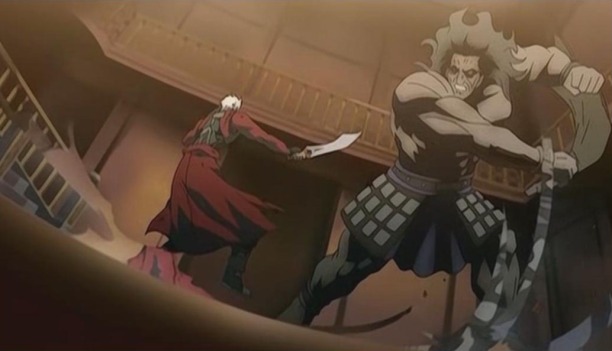

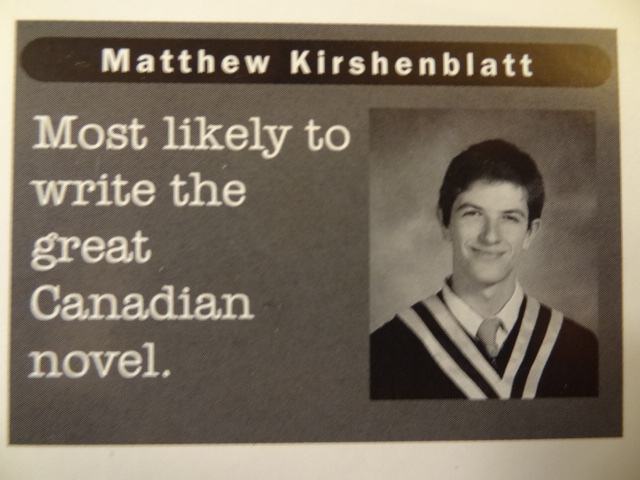


 Mythic Bios