Doctor Who: A Deep Breath Against Uncertainty

Do you happen to know how to fly this thing?

This was the question posed to us at the end of the last season of Doctor Who. It might as well be the quintessential Whovian question directed towards both The Doctor and the writers of the show. The program itself always explores what it is, always changing, while at the same time attempting to keep the core of itself the same. After watching “Deep Breath,” the first episode of Season Eight, this weekend I realize there are a lot of ways you can look at it.

A little while ago, I was examining the different eras of Doctor Who and comparing them to the Ages in comics. I had a theory that, after “Time of The Doctor,” we would be moving past the dark angst-ridden era of Doctor Who revisionism begun by Russell T. Davies and into a reconstructionist phase: a place where everything went back to basics with a modern sense of storytelling. I actually thought the presence of Tom Baker in “The Day of The Doctor” hinted on a season that was a return to wonder and adventuring. I thought, with the rescue and quest to find Gallifrey, that the darkness would finally be banished or at least heavily minimized.

Of course, I was very wrong.

You see, I forgot something when making these comparisons. I forgot about the so-called “Golden Age” of Doctor Who. Just like the Golden Age of comics, those early adventures could be dangerous, sinister, and downright creepy. And The Doctor himself was not always a trustworthy Time Lord and you always had to kind of watch your back around him. If the Eleventh Doctor’s run felt like witnessing a fairytale, then it really seems like the Twelfth Doctor is a throwback to the terror of the original: like the ancient cautionary folktales of old attempting eat their sanitized offspring … only far grittier and even more discomfiting.

“Deep Breath” is almost a warning to the audience. It starts off with a dinosaur running amok in Victorian England and spitting out the TARDIS that Peter Capaldi’s Doctor hasn’t yet learned to fly. You have the Paternoster Gang: complete with the Silurian detective Madame Vastra, her wife and maid Jenny, and good Sontaran Strax. It seems to begin like any strange wild, wacky Doctor Who adventure. 

Doctor Who Dinosaur

It’s not.

It’s no surprise that The Doctor is confused and disoriented in his new Regeneration. We’ve seen him deal with similar situations in the past. But this time, when you consider how he was an old man in “Day of The Doctor” and all the other events he survived, watching him attempt to remember things and fail is actually quite unsettling. The part where the Gang brings him to a bedroom at Vastra’s home really stands out at me as he was actually terrified of being in a small enclosed space that was small on the inside and separated by different rooms. He just couldn’t understand it and, if your last memories are of being in something like the TARDIS, this disorientation — along with his Time Lord conception of space and time around him — makes a fair amount of sense.

I think it was actually hard for me to watch Clara deal with this. She is watching her best friend, who she doesn’t even recognize any more, suffer from what looks like dementia. This new man is not The Doctor that she loves and it takes her a while to admit that to herself.

It takes Madame Vastra, with Jenny to moderate her patience, to make Clara face this. The Silurian makes a very fascinating point about how The Doctor’s previous Regeneration — if not the other two before it — were attempts to fit in among humankind: almost like a veil. For me as a fan, I was both sympathetic to Clara — as she was very much in love with the Eleventh Doctor — but just as annoyed with her too as Vastra was: though for a different reason. In the previous story arc it was very clear that Clara jumped into The Doctor’s timestream and created different versions of herself throughout his various timelines. While I’m not sure how extensive her memories are of her other scattered selves, the fact is she has seen him in all of his incarnations. Even in “Day of The Doctor” she met the Tenth Doctor and The War Doctor. She knew he could change and that he had been different people. But suppose what we are seeing here is the loss of her Doctor and her process of having to accept this.

Clara Disturbed

Meanwhile, The Doctor himself is trying to get used to the person he has become: or rather becoming the person that he now is. Even though some of his traits are familiar, such as his need to talk to the point of babbling and getting lost in his own thoughts, his anger is much more apparent now.  After running away from Vastra’s house, he calls everyone around him “pudding heads” and promptly dives into a river. At one point, when he demanded a man’s coat I was genuinely concerned that this person — whom many of us saw as a hero — was going to attack and rob some poor, scared drunk old man.

And then there was the part in the show when he seems to actually abandon Clara to their enemies.

I have to admit: even though I’d had some impatience with Clara before, and on some level I knew he wouldn’t just leave her I … actually wondered. Clara’s shock and grief were very clear and a part of me hoped that when she got out of her predicament, she’d get the chance to outright slap him.

That all said, I really loved the monsters in this episode. They were essentially Clockwork droids that had crash landed on Earth ages ago and used human flesh and organs as spare parts to keep them going. They mostly reacted to humans, but there is something very grisly about watching them move around jerkily wearing motley suits in various stages of decorum and decay. Basically, they are from the sister ship to the SS Madame de Pompadour and wear human skin. It’s even at a point where they have absorbed so much human matter that they believe they are attempting to rebuild their ship and find a “promised land.”

Deep Breath Robot

The fact that a “repaired escape-pod” of theirs utilizes a hot-air balloon made of human skin really tells you a lot about the spirit of this episode right there.

What I find fascinating is the clockwork element in this episode and potentially others. The introduction sequence is composed of a collection of synchronized golden-worked gears. At one point I was under the impression that Steven Moffat was attempting to sabotage the Miltonian clockwork perfect universe of Russell T. Davies by creating his “tears in space and time,” but it looks like I was wrong again. In fact, there is a very steampunk look to this episode: even and especially when you look at The Doctor’s new suit with its white shirt, black coat and red in-lining the very end.

I think that, for me, this episode actually — for the first time — made me afraid of Doctor Who. The monsters were genuinely disturbing. The Doctor himself seemed to display more anger, ruthlessness, and a lack of dependability hearkening back to the First. And there was one time I wondered if the Gang was going to survive.

I wondered if The Doctor was even going to come back for Clara: and that sense of abandonment of her and our expectations was a horror far more terrible than any human-harvesting robots.

This isn’t even mentioning the ad in the paper that brought Clara and The Doctor back together, or why The Doctor’s new face seems so familiar to him. There are some hints that go back to previous episodes on those little details alone. And then there is the presence of a mysterious woman named Missy at the very end of the episode.

It’s funny. When Doctor Who began in 1963, it was meant to be a children’s show. At the same time, however, the monsters were always meant to be terrifying and the adventures truly harrowing even as it was clear that The Doctor himself wasn’t necessarily meant to  be a hero. In fact, his new musical theme  such as it is — sounding like a wind raking the night with a hard cold edge — is something I still need to get used to.
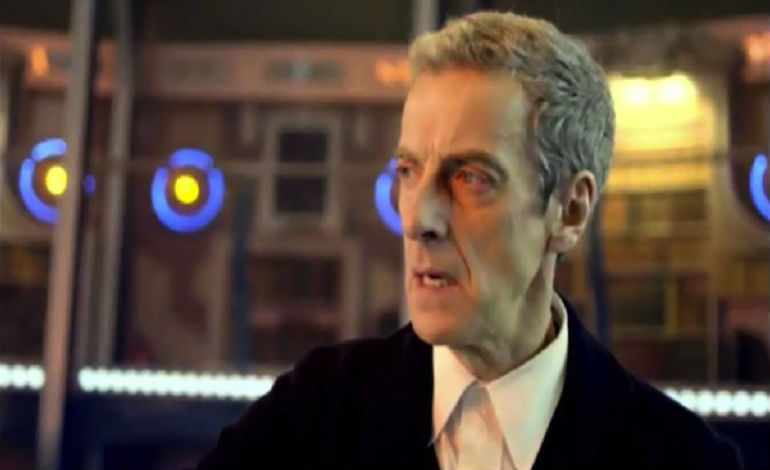
Twelfth Doctor

So where might this all be going? Does Steven Moffat know how to fly this thing? In the past, the shaky episodes and moments of questionable continuity have made me wonder. But if “Deep Breath” is any indication of what we might expect in the future, we might be looking a season that isn’t going to pull any punches.

Because there is a difference between personal angst and dark speculative fiction, and while we might have moved past the former there is still a whole wide multiverse of uncanny adventure for which to look forward.

Infinite Diversity in Infinite Combinations: David Mack And Speculative Fiction As A Harbinger of Diversity

Star Trek would have you believe that, one day, Earth will become a virtual utopia. War, famine, and poverty will be eliminated. Advanced civilizations will come and help humanity solve its problems, and even explore the very stars themselves. Humanity, through a United Federation of Planets will encounter new species, societies, and ways of living. And while there will initially be conflict and fear, it will ultimately give way to tolerance, peace, and love.

Personally, I don’t find this realistic. Strip away the technology and science, even accepting the caveat that somehow unlimited resources and energy can be had, and you still have human beings that still feel greed, possess hubris, and fear what they don’t understand. And that is how we treat our own fellow human beings. I think that, if anything, our interactions with each other and other species would be a lot more like the scenario set in the universe of Babylon 5: where there are differences of opinion, internecine and squabbling politics, sanctions, and warfare but a degree of acceptance and understanding among individuals. But that is assuming that human nature will remain the same. Certainly, the anonymous reader that wrote a letter deriding the lesbian relationship between a Vulcan and Klingon in David Mack’s Star Trek novel Harbinger reflects some current human traits all too well.

It can be disheartening to consider that such bigotry exists — and has done so for some time — in speculative fiction and geek fandom. Even David Mack, in his epic open letter rebuttal of this reader’s email, admits that diversity is not nearly as represented in the Star Trek television series as it could have been. And even if the writer of the email to Mack wasn’t a hardcore Trekkie, this is not an original sentiment in whatever might constitute itself as geek culture or the various fandoms that make up some kind of community. I don’t think it is too much of a revelation to state that Star Trek — or speculative fiction itself — and fandoms can be problematic with regards to gender and cultural diversity.

But there is more to this. There always is. I think what really stands out at me is the Star Trek: Deep Space Nine series. Part of the reason I bring this up is because of the image that Katharine Trendacosta uses in her i09 article Star Trek Writer’s Defense of Diversity in Sci-Fi Is Damn Near Perfect. It depicts the episode “Rejoined” where Jadzia Dax encounters Lenara Kahn. In fact, both women are Trill hosts for their respective symbionts: whom had been married. I was either in the latter stages of elementary or in the middle of high school when I first saw this episode, and I didn’t understand it.

Dax and Kahn

It wasn’t that I didn’t understand why Dax had feelings for Kahn. I assumed, then, that she was just experiencing echoes of emotion from her symbiont’s last host. Naively, I was more confused as to how she could even pursue a relationship with her even though the symbiont no longer had a male host and if disrupting the rules of their society was worth the trouble. I will even admit that, at the time, it made me uncomfortable. In retrospect, many adults seemed to feel the same way, or so Star Trek producers believed. Years later, of course, I realize that the Trill philosophy of wanting to prevent symbionts from “limiting their experiences by relationships from their previous lives” was another way of stating that people were uncomfortable with two pansexual beings — who both happened to be women this time around — from continuing and having new experiences with their relationship. You can say that it was the nineties and that we weren’t “quite there yet” (and we still aren’t in a lot of ways), but when I look back at that episode and even my own naivete and ignorance, I feel a kind of righteous anger that they couldn’t pursue that relationship further.

There are many other instances of how Star Trek poorly handled their depictions of gender and ethnic diversity, but there is one other story line that particularly got to me: though not, again, until recent years. There was a story arc between Miles O’Brien, his wife Keiko, and the Bajoran Major Kira Nerys embodied best by the episode “Looking for par’Mach in All the Wrong Places.” Due to a potentially lethal accident, the O’Briens’ unborn son had to be transferred into Kira’s womb. During this episode, Kira moves in with the O’Briens so that they can take care of her in the meantime. Miles and Kira end up spending a lot of time together, which Keiko actively supports. Their family dynamic changes during this time and Miles and Kira actually end up developing feelings for each other. Nothing comes of this, however, and after she carries the child to term Kira leaves the O’Briens.

I definitely remember being distinctly uncomfortable with this arrangement at the time: seeing the two characters bordering on cheating. Certainly, while life happens in chaotic ways, their situation was no time to develop a relationship. But now I can’t help but feel that there were a few possibilities in how that relationship could have turned out. While the resonance feels more like something Robert A. Heinlein would create as opposed to Gene Roddenberry or other like-minded writers, it would have been fascinating to see a polyamorous or non-monogamous relationship dynamic form from that particular episode: another kind of diversity and representation in a futuristic series priding itself on philosophical and human progress.

Kira Miles and Keiko

Even so David Mack, in his own open letter, states that “those of us who write the licensed Trek fiction continue to do our best to depict a more progressive, enlightened, open, and harmonious future, not just for humanity but for all sentient beings.” And maybe it was these words, along with seeing Dax and Kahn again, that reminded me that although the writers of Star Trek couldn’t be too radical, they pushed the envelope of diversity as far as they thought they could: particularly in Deep Space Nine.

It’s funny. When I think about it, Deep Space Nine and Babylon 5 both aired more or less during the same time period. Perhaps that’s why I mentioned both programs in the context of this article. Maybe it reminds me of how different I am from the child and adolescent I used to be. But I also learned something new. David Mack, in his rebuttal to his anonymous reader over the accusation of “remoulding the Vulcan persona to suit himself,” quotes the Vulcan philosophy of IDIC: Infinite Diversity in Infinite Combinations. It even has its own symbol worn by many Vulcans: including Spock himself. Whether or not Gene Roddenberry created the symbol to sell merchandise is kind of irrelevant but it reminds me of something else. I realized that even if that utopian ideal is unrealistic and will never happen, it is something to strive for. That sense of hope and wonder in the form of sheer possibility and diversity is what Star Trek is, and what it should ultimately be about.

This is what speculative fiction and geekdom should be about: what it should be the vanguard for.

David Mack, in not only being unashamed of the lesbian relationship between his two characters but even supporting and rejoicing in it, states that he will continue to support diversity in his writing. When you look at current fandom and some of its displeasure over other changes or recent iterations in franchises such as a Black Captain America, Thor now being a woman, and a female lead in a Spider-Man film you begin to realize something else. Not only is diversity important in representing various people in the franchises that they love, but it is utterly integral in keeping those worlds fresh and alive: keeping them changing.  Closed mindsets will be maintained and never challenged. No one will care about stories that never change or make them feel a part of them.

Without diversity, without change, genres and mediums will die.

It is my hope that writers such as David Mack continue to travel these places and bring us along on the ride: to make a place where a story is judged by the quality of its writing and interactions and not solely by an idea that hasn’t been fully fleshed out, or reactionary responses.

To boldly go where no one has gone before, or to go to where other people go and you don’t.  Frankly, if this is a journey that doesn’t suit you, then you shouldn’t come for the ride. As for me, I want to see where these explorations will take me.

My Impossible Girl. Thank You, And Goodbye: Jenna-Louise Coleman To Leave Doctor Who?

According to an article for Mirror written by Simon Boyle, the actress playing Clara Oswin Oswald will exeunt from The Doctor’s time-stream after one last role in a Christmas Special. If true, it wouldn’t come as too much of a surprise. Aside from the fact that there have been rumours of Coleman’s leave-taking for some time, it already seems clear that Clara’s relationship with the Twelfth Doctor will be much different from the one she had with Matt Smith’s Eleventh.

Gone will be the flirting and skirting around the edges of mutual affection. Peter Capaldi’s Doctor, we are told, will be more random, cantankerous, and far less patient and open about his priorities. Still, for me personally it rankles a bit. I have a confession to make. The truth is, I didn’t really like Matt Smith’s Doctor completely. I mean, he wasn’t a bad Doctor and he definitely had his moments. I suppose I truly appreciated Christopher Eccleston and, of course, the epic David Tennant. And I will also admit to you that I have something of a romantic streak and I really appreciated the relationships that Nine and Ten had with Rose Tyler. Back when the Time Lords were extinct and he only had so many lives left to him, I felt for him and hoped that he would find companionship with what time he had left. There was this great dichotomy of his physical age not matching his chronological or even intellectual capacity.

For me, Clara Oswin Oswald was built up to be this great mystery and in the beginning a very compelling and strong character. I admit I was fan-shipping them. I won’t lie: there was an excellent parallel between Clara existing in different historical eras and The Doctor traveling throughout all of them. I actually wanted to believe that she could have been that Companion that not only had the romantic love that Rose did, but could have been the first one that The Doctor actually consummated a relationship with. It’s true that he has had other romantic relationships, such as the one he had with River Song, but his relationships with his Companions have always been different. I personally hoped that with Clara there would be that interlap and, for the first time the man who was never involved with his Companions in that way,  might have truly found something else in his Impossible Girl.

I know many Whovians would like The Doctor to keep his other relationships separate from those that he has with his Companions or, indeed, not have any relationships but Platonic and asexual associations but there were so many hints, or I believed there to be some, that Clara — who has been in his time-stream and seen all of him — might have stayed much longer and created a different dynamic.

I also admit that while I’ve had issues with Steve Moffat’s writing style and how he portrays relationships, but at least this would hopefully not be like an otherwise brilliant writer such as Russell T. Davies and the cop out that was Rose Tyler and the Meta-Crisis Doctor. I do find it odd that someone who has been that close to him, indeed knowing him his entire lives, would just leave him. But, nevertheless, the prospect of seeing just what happens to Clara intrigues me and though whether or not we will all get to see Jenna-Louise Coleman’s final performance as The Doctor’s Companion some Christmas soon — or if this is just more conjecture and rumour — remains yet to be seen.

You And I have Unfinished Business: Tarantino Reveals The Whole Bloody Affair

They say there is just so much carnage that you can pack into one film. Director Quentin Tarantino doesn’t agree as he plans to release an uncut version of Kill BillThe Whole Bloody Affair.

Many fans of Tarantino’s Kill Bill already know that the two volumes of the film were meant, by its creator’s conception, to be one movie. What’s more is that there were quite a few deleted scenes: including the animated sequence in the film with O-Ren Ishii killing both the crime boss and the assassin that murdered her parents. That particular animation was supposed to be thirty minutes long: making the film in its entirety roughly four hours.

What is also fascinating to consider is that what would be called The Whole Bloody Affair was, in fact, shown to audiences before. It was shown at the New Beverly Cinema as the original print which, in turn had been shown at the Cannes Film Festival in 2003 complete with its French subtitles still intact. It even has a musical intermission between parts. The only difference is that the original print doesn’t have the extended animation sequence that Ghost in the Shell animators I.G. didn’t completely finish in time for the original release of the film. Germain Lussier’s /Film article ‘Kill Bill: The Whole Bloody Affair’ Has Small Changes That Produce Big Results goes into some considerable detail as to what the original print was like compared to the two volumes that we all know now.

And it was during this past weekend’s San Diego Comic-Con and in an interview with Collider that Tarantino himself not only announced that he would be adding the whole animated sequence by I.G. into his film, but that The Whole Bloody Affair will be released “with limited theatrical engagement” by 2015. 

But while fans are probably elated by this news, a “limited engagement” seems to entail that it will only have a select few movie theatre showings: at least initially. And I’m sure there are many more fans that look forward to a DVD release of this film: myself included.

Either way, Kill Bill: The Whole Bloody Affair is definitely some unfinished business that many will look forward to seeing.

Another Body of Work: The Soska Sisters to Direct Painkiller Jane

It is easy to say that horror is a moralistic genre. After all, we all know what happens when adolescent characters have sex — or at least once upon a time — in a horror film. But over time, and under the guidance of particular writers and directors, horror can also become something that observes certain moralities:  even creating commentary on them. Likewise, superhero comics have also been historically seen as vessels of “good” and “good laws” triumphing over “evil and immorality”: while nowadays they can be used to look at human nature in a very sophisticated and literary fashion.

Superhero comics and horror both use relatively iconic characters to represent particular ideas and tell stories with them. Of course, many of these stories are exaggerated, dramatic, and over-the-top. Body horror — a sub-genre of horror itself — utilizes bodily functions, dysfunctions, sexuality, mutilation, torture, infection, death, and the mind’s alienation from the flesh to add spectacle and say something about the human condition. And women’s bodies add a whole other context to this dynamic when you consider how they are often depicted as objects for the desires of others, belonging to others, in conflict and contrast to the idea they belong to women with their own thoughts and feelings.

So what happens when you take a female superhero, whose primary superpower is an accelerated healing factor that does nothing to cancel out the pain of her injuries, and allow her to make the acquaintance of two female directors with film backgrounds in body horror?

What you get is Jen and Sylvia Soska directing the new movie of Painkiller Jane.

It might sound strange, at first, to know that the directors of Dead Hooker in a Trunk and American Mary are involved in creating a superhero film until you consider their backgrounds and that of Painkiller Jane herself. The Soska sisters have been vocal about the rights and issues of women and LGBTQIA individuals both in and out of their films: while possessing a fascination with body modification, grindhouse gore, and pain. And Jane Vasko — created by Jimmy Palmiotti and Joe Quesada in 1995 — was a sarcastic and brusque undercover police officer, markswoman, and bisexual woman who, after a failed mob infiltration was left critically injured until she realized her power. However, even though her healing power is the only superhuman ability that she has, the fact that Vasko can — and is willing — to use it to her advantage despite feeling all the pain of her injuries — to maintain agency of her body after another character alters it against her knowledge and will, and in the middle of violent situations — says something about her strength of will and her drive for justice or vengeance.

Unfortunately, I have not read the Painkiller Jane comics, or watched the videos or television series already based on the character: so I know there are a few iterations of her origin story. I haven’t even had the opportunity to see the work of the Soska sisters themselves. Nevertheless, I’m interested to see how they will use their background and experience in fleshing out the pain and drive of this character. The Soska sisters talk a little bit about the aesthetics and the antagonist of Painkiller Jane in their interview with William Bibbiani of CraveOnline.

As for the rest, I’m intrigued to see how they choose to retell her story, how close they stay with the original source material, and how they might critique and subvert certain audience and reader expectations. And in case any of you comics fans might have any doubts as to what they might do with Jane Vasko, consider this:  the Soska sisters are also comics and superhero fans.

And one of their heroes is Deadpool.

The Wizarding World That Lives: Fantastic Beasts And Where To Find Them

It seems that after 2011 and the end of the second part of Harry Potter And The Deathly Hallows, we will get to look forward to the return of cold, darkness, winter, and the warmth of the Potterverse coming once again to the theatres near us.

Since September of 2013, it’s already been established that the Fantastic Beasts And Where To Find Them trilogy, based on J.K. Rowling’s supplementary in-universe book, will take place in the 1920s and focus on the ventures of Newton Scamander: the famous Magizoologist that examines and explores the nature of magical creatures and eventually creates his book: which is standard text-book reading in Hogwarts and the Potterverse.

I have to admit that I didn’t really expect a film like this to be made.  As I mentioned earlier, Fantastic Beasts And Where To Find Them is a lore compendium created by Rowling to expand on her universe beyond the main Harry Potter narrative. It was created for the Comic Relief Charity back in 2001. I’d seen the book around, but I didn’t focus on it in particular and I never dreamed that J.K. Rowling would write a screenplay from it. Nevertheless, there are a lot of possibilities here. Fantastic Beasts itself illustrates the fact that the universe created around Harry Potter can be considered a fully realized and complex place in and of itself without its protagonist.

Rowling herself has said that this story is neither a prequel nor a sequel to Harry Potter. Even so, it’s interesting to look at the timeline of this book in the Wizarding world. In the 1920s Dumbledore was still a young man and hadn’t had his epic duel with Grindelwald yet. And Voldemort himself wouldn’t be born until 1926. As a result of these mainstays being either too young or non-existent yet, there is a lot of ground that can be explored here.

And look at Scamander himself. Not only is a wizard that specializes in magical creatures, but when he attended Hogwarts he was actually part of House Hufflepuff. Think about that for a few moments. For those of us that have read the books and seen the films, we have seen some very notable members of Houses Gryffindor, Slytherin and even Ravenclaw. But the Hufflepuffs, at least in my opinion, have always been given the short end of the wand, as it were: even though they are known for hard work, honesty, and loyalty.

For some reason, I keep thinking to myself that a great majority of wizards and witches in Rowling’s Wizard world have come from Hufflepuff (at least in Britain) and while the Gryffindors act courageously, the Slytherins plot, and the Ravenclaws study and innovate the Hufflepuffs keep everything running. The best geeky analogy I can think of is that while the other groups are like the Jedi Knights, Hufflepuffs are the original clone troopers and commandos: the rank and file of the Wizarding world that get the job done and thoroughly so. So to see a character from that House as what seems to be the protagonist of this trilogy will definitely be something for which to look forward.

I think, in the end, Rowling’s decision to expand on this book into a new film trilogy also hits something home: namely, it is more of a misnomer to call her universe the Potterverse than it would be to consider it her own Wizarding World. It is definitely a place where you can tell a lot more stories. I, for one, would definitely not mind seeing some Rowling Wizarding World films based off of the dark witch and wizard fairy stories within The Tales of Beedle The Bard. In some ways, I liked those stories even more than her entire Harry Potter story arc.

Fantastic Beasts And Where To Find Them will have its release date on November 18, 2016.

Vuckovic and Headey Explore Jacqueline Ess: Her Will And Testament

Clive Barker’s short story “Jacqueline Ess: Her Will And Testament” is not only being adapted into a horror film by the Canadian and Torontonian film director Jovanka Vuckovic, but Lena Headey will be playing the role of Jacqueline Ess.

While until this announcement I was unfamiliar with Jovanka Vuckovic or her work, and I only know of Headey through her roles in Game of Thrones and 300 as Queens Cersei and Gorgo respectively, I have read “Jacqueline Ess” and it is a fascinating story. Beware my friends, if you intend to read this story there will be spoilers.

Books of Blood

“Jacqueline Ess” is a story found in Clive Barker’s Books of Blood. It is about a woman by the same name who, after being neglected and passive-aggressively abused by her cheating husband and being dissatisfied with her overall life, attempts to kill herself only to be brought back from death with–for lack of a better word–some strange, flesh-crafting abilities. Think of it as telekinesis that can only affect human flesh and organs. Now imagine all that rage and pain that she has suppressed her whole life in being the good wife or woman and patronizingly being told what how she feels by men.

But the story is so much more than simple revenge. It subverts stereotypes. It changes Ess from a victim to an accidental instigator of manslaughter, to a murderer, and into someone who examines the very nature of power. Her sexuality, which was used by men, becomes her most overt weapon. However, again, she is not simply a monster or a villain, or a Carrie that lets her repressed emotions completely rule her powers. She is an intelligent woman that not only wonders about this power and what it means, having gained it by temporarily piercing the veil beyond death, but she also truly examines what the meaning of life is in light–and despite of–the discovery of her powers.

The very weapon that is her power, that is her sexuality, that is her body, becomes a weapon that ultimately turns on her. What this might say about social perspectives with regards to female gender and sexuality is a whole other subject entirely that will hopefully be explored in further depth, but I will say that the story manages to move this power from the place of the stereotype into the dark, red realm of the archetypal: of that primal place where life comes from, where it is changed, in that plane suspended between sex and death and, when you get right down to it, even a sense of enlightenment and acceptance.

Clive Barker has an interesting sense of horror: at least in his earlier stories such as those found in The Books of Blood. For him, horror is not only your fear of the unknown, but your secret desire for it and that place where your anxiety is forced to meet your sense of anticipation in the language of the flesh.

Lena Heady

I suppose you can tell that I really took a lot away from this story. Certainly, I can see Lena Headey making an excellent Jacqueline. Not only does Headey have a sense of portraying women of power in Game of Thrones and 300–characters that exist in traditionally male-dominated spaces–but particularly in the first Season of Game of Thrones to me she actually portrays a more sympathetic version of Cersei Lannister: someone who has power, and knows she has power as a woman in a traditional role, but who was never trained to understand it to its fullest extent or to protect those that she loves.

Headey’s Cersei understands just how subjugated and micro-managed women in Westeros truly are and even in Season Four you can see just how powerless and vulnerable she can be when her father takes her son from her. To me, it’s almost as though Headey’s Jacqueline may well be a parallel to the character of Cersei: both start out with affluence but are limited by the men and patriarchal structure of their lives, but while Cersei stays with the trappings of power and never seems to explore their origins, hopefully Jacqueline will portray her vulnerability and continue to explore her more literal and supernatural power and its nuances on the environment around her.

As I said before, I didn’t even know who Jovanka Vuckovic was before news about her film came out. However, if she can explore the details of Jacqueline’s evolution and its effects on the men and society around her, while keeping in mind Barker’s own horror genre sensibilities we will definitely see an interesting multifaceted blood-soaked gem of a strong female character and what she says about our own world: as a master of the horror genre, the sub-genre of body horror, and the medium of film tends to do.

Given the fact that Jovanka Vuckovic was an Editor-In-Chief for Rue Morgue magazine, author of Zombies! An Illustrated History of the Undead, founder of She Wolf Films, studied physical anthropology, and the fact that she made The Captured Bird, a horror-fantasy short film about a young girl that discovers a black-inky evil underlying her world only adds to the fact that I very much look forward to seeing what she does with this film. I know that many of her friends in the Toronto geek community–including some here at GEEKPR0N–wish her and her endeavours well.

Sansa Stark is a Strong Female Character

There will be book and television spoilers in this article. Reader’s discretion is advised.

A little while ago, when I first started reading George R.R. Martin’s A Song of Ice and Fire series, the books which the Game of Thrones television show is based from, I started thinking about the female characters of Westeros. I thought about what cultural practices and processes shaped them and influenced their minds into the different personalities that we as readers and as an audience get to see.

Lately my friends have been talking about Sansa Stark: particularly motivated by Julianne Ross’ article Why Sansa Stark is the Strongest Character on ‘Game of Thrones.’ Ross makes a point of stating that she is focusing on the character in the television series and not how she is portrayed in the books. She specifically goes into how even though Sansa identifies more with the traditional idea of the feminine, of the courtly lady, how she is no less a hero in doing so.

Sansa Stark is one of those characters that also receives a considerable amount of contempt: being seen as spoiled, weak, cowardly, or even treacherous but more than certainly naive.

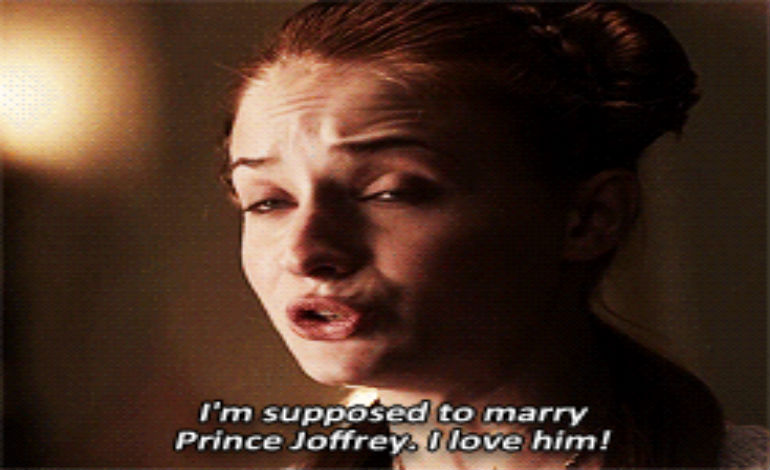
Sansa Loves Joffrey

I will admit that when I first read A Song of Ice and Fire, I didn’t particularly like Sansa. She came off as spoiled, arrogant, and downright ignorant and selfish. But then I looked at where she came from. In fact, I looked at where she and other women came from. If you watch the television show or, more specifically, read the books you begin realize that while Westeros seems to be an awful place for anyone to live, it is particularly bad for women. You have this setting, this social structure from Westeros to Essos where rape seems to be a given act in the many wars that are constantly going on. And these are for the smallfolk women.

In Westeros, the women of the nobility or the various Houses seem to have a better existence. They are taught how to read and write. They are generally protected as they grow up and they have the guidance of various mentors and a good name to back them up. Of course, there is the patriarchy of the entire thing. When it all comes down, highborn women in Westeros marry whomever their fathers say they will marry. They are little more than dowries, breeders, and bargaining chips exchanged between the Houses in an arrangement that is otherwise part of the political bandying known as “the game of thrones.”

Now, some of these highborn women learn how to use the traditional feminine role to their advantage. They hold court and meet with their friends. They organize social settings, or they make themselves popular within these settings. Some begin to understand that power is not merely a sword or an army or even a drop of poison, but information and the right word whispered to the right or wrong ear. The point I’m trying to make here is that those women who understand how to use what is traditionally considered feminine in Westeros and are capable blending into that role, do so in order to survive and thrive in an environment that they can navigate or even subvert. This is, of course, not always the case. Arya Stark’s interests are more in line with the smallfolk, the commoners of Westeros, and martial considerations whereas Brienne of Tarth doesn’t have what many consider to be traditional “feminine traits” and prefers the straightforward and “masculine-gendered” idea of chivalry and battle prowess.

Sansa and Arya

And as Ross in her article states, audiences generally seem to consider these kinds of female characters as stronger and more heroic. However, heroism is a questionable word at best. Throughout our own history, and that of Westeros, heroism has been applied to people who have done morally questionable and even reprehensible acts. And sometimes heroism glorifies a certain kind of suffering or struggle that is, really, in the end all about survival. Someone can be in a terrible place and have to act a certain way in order to keep on living or maintain their sense of sanity because–in the end–they have no choice.

Sansa Stark, at this point in the television series, would not consider herself a hero and right now, she too and despite her adherence to a more conventional archetype of femininity, has no place in courtly intrigue. Right now, Sansa Stark is a child. Sansa is a girl who has been sheltered by her lord father in Winterfell and kept from seeing the worst of humanity. She doesn’t hate her servants and she even has a friend in the form of Jeyne Poole her father’s Steward’s daughter. But she has been raised with stories of courtly love, nobility and true knights. She is the girl that always wanted to meet her Prince Charming and ride off with him. Her instructors and her mother Catelyn in particular train her to be the “perfect young lady.” In fact, Sansa really has no idea about politics or the game of thrones and what is done to maintain power.

Sansa Holding On

She is a girl that takes her world for granted, and the illusions behind it even more so and when she gets to King’s Landing she has that veil slowly ripped off of her. Here is a girl whose childhood wolf pet Lady gets slaughtered because another wolf attacked Joffrey. Here is a girl who looks up to the beautiful Queen Cersei as something of a fairy-tale surrogate mother before she knows how dysfunctional and shallow and cruel she truly is. Here is a girl who finds her beloved prince and learns the hard way that not all princes are noble and kind.

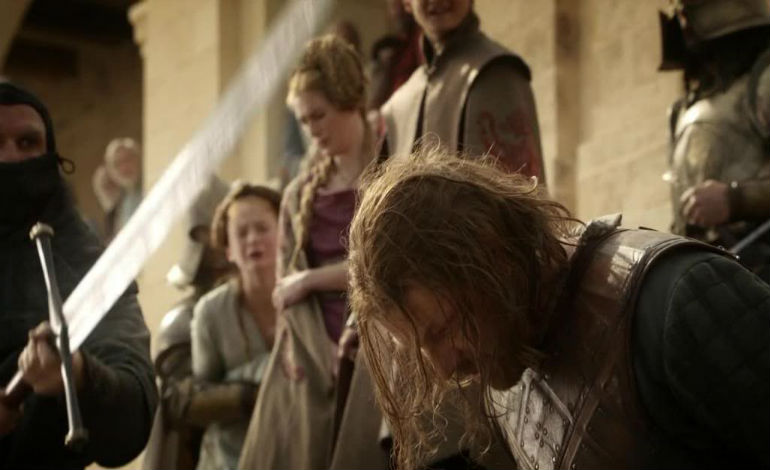
Sansa Watches Ned Die

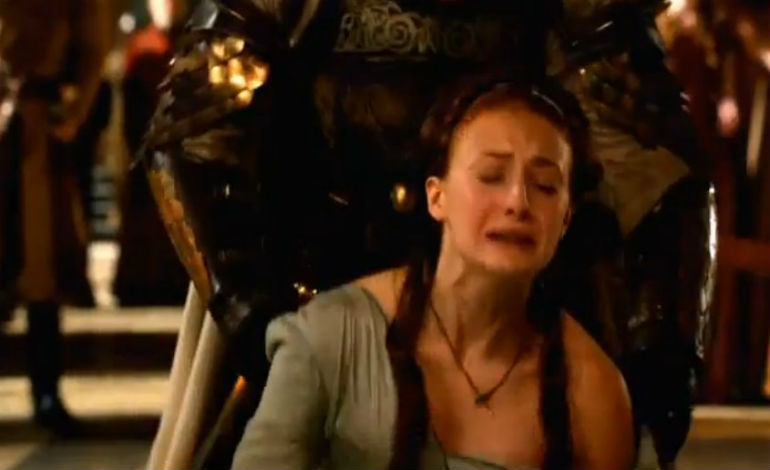
Here is a girl who is coerced into betraying her own father for political games she has no understanding of, who watches her father get executed, who has to look at his decapitated head and gets beaten by knights for the King–her former beloved’s–amusement.

Sansa Beaten

She is married into the House that ends up instigating the slaughter of most of her family and to a man she doesn’t love.

Here is a girl who likes tales of maidens and true knights and lemon cakes.

And Sansa gets used. And used again. And again. She ends up getting her first menstrual cycle, which her mother should have been there to talk her through, and has to share that with Cersei: all the while dreading that natural human function because of what it will mean for her value as a woman, as a breeder, in this situation. That one scene sticks out at me the most and if everything else wasn’t enough to make Sansa grow up in such a traumatic way, that symbolized it the best from my perspective.

Sansa and Cersei

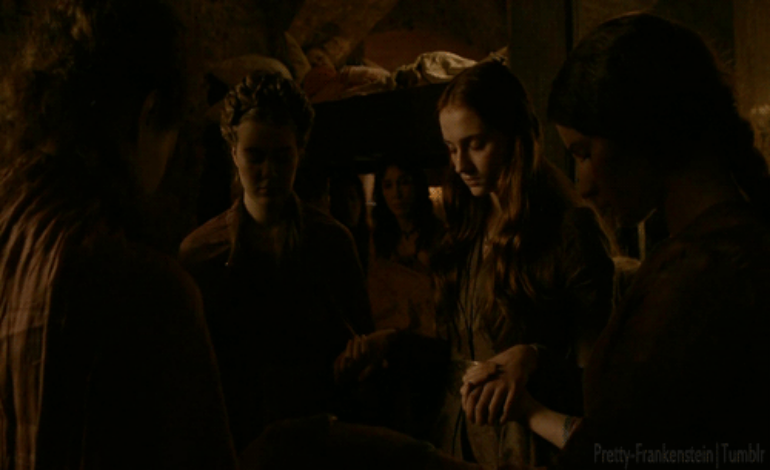
Even so, she still believes in those tales her mother and tutors used to tell her. But more than that, Sansa actually cannot stand to look at cruelty and even pleads for Ser Dontos’ life when he arrives drunk to one of Joffrey’s celebrations and when she tells Margaery Tyrell of Joffrey’s true nature. An even greater example of Sansa’s moral nobility is when, during Stannis Baratheon’s siege of King’s Landing and Cersei’s descent into despair, she actually leads the women hidden away in the castle in prayer:  keeping up morale and hope while their Queen essentially fails them and feels sorry for herself. The fact is, there is still that honour and decency that her father and House Stark instilled in her as well her own sense of compassion.

Sansa Morale

She is a girl who hasn’t been warped by bitterness and shallow displays of power like Cersei or her aunt Lysa Arryn, or blinded by the idea that political power will always benefit family first like her mother Catelyn (which was far more pronounced in the books where she wanted Lord Eddard Stark to go to King’s Landing as Hand), and she is definitely not as shrewd or as clever as Lady Olenna Tyrell but again, she found herself in this entire situation as a child. And now, for better or worse, Sansa is growing up: and she is learning. She is learning the rules of how to survive in her suddenly very cruel world.

I won’t say very much more about Sansa’s journey, but I will tell you this much. She may not be a warrior like Brienne, or a rebel like Arya, or even the fierce woman that Daenerys Targaryen forced herself to be by necessity but Sansa has many strengths that already exist inside her: great intelligence, a growing knowledge of the court and its rules, as well as compassion. I suspect she might become more ruthless in some ways, but never callow or vain or arbitrarily cruel. She won’t be as direct in her lessons of power, but she will do what she has to and, if she can, maintain her integrity and capacity for empathy in doing so. And, more than this Sansa Stark has also demonstrated, through her morality, the ability to take charge and provide a deep sense of moral support, inspiration and hope: as some might think that a good queen should.

In the end, I don’t think that Sansa Stark is a hero, or a coward, or a weakling. I think that she has her own personality and will eventually find her way through the game of thrones. I think, by necessity, she will continue to be a strong female character: perhaps not the strongest, but definitely one of them.

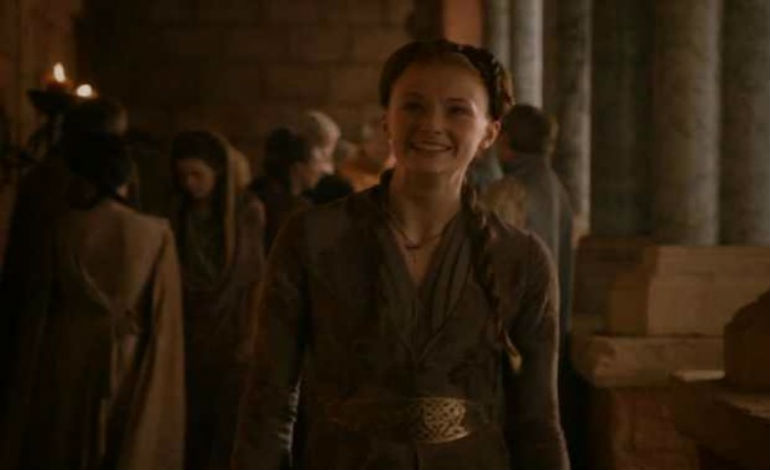
Sansa Smiles

The King in Yellow Spreads the Sign

I just want to state, right off the bat, that I am a fan of H.P. Lovecraft. It took a very long time for Lovecraft and his Cthulhu mythos, specifically the idea that something ancient, eternal, and either uncaring or malevolent underlying our conception of space and time, to come to some kind of mainstream appearance in geek culture. It was on my quest to read everything eldritch and gibbous by the man who was Providence and spurred on even further by Alan Moore’s The Courtyard and Neonomicon comics when I came across something called “the yellow sign.”

I followed this up online and found a book called The King in Yellow. The book contains a series of short stories published in 1895 written by Robert W. Chambers: a writer of many genres but especially romance, decadent literature and, in particular, horror. In four of The King in Yellow‘s stories, “The Repairer of Reputations,” “The Mask,” “In the Court of the Dragon,” and “The Yellow Sign” as well as some mention in “The Prophets’ Paradise” we are introduced to the idea of a play in a book that drives people insane, a malevolent entity known as The Yellow King that is a part of the play or summoned by it, and “the yellow sign”: last of which is a symbol associated with the King that can manipulate or distort the minds of those who see it.

They were some fascinating tales, by favourite being “The Repairer of Reputations” but aside from taking some notes on them, I thought that they would remain some fascinating but otherwise obscure stories even though it has a specific following and Lovecraft himself read them and alluded to their content in his story “The Whisperer in Darkness.” But I thought that would be the last I ever saw of them.

So how does this book from 1895 have any bearing on geek culture right now?

The answer is possibly a lot. Very recently I watched a recent video interview with the author and editor Joseph S. Pulver Sr.: who is an expert on the mythos of The King in Yellow. I knew that he would say some very interesting things on the stories, but what I didn’t know then until he and the interviewer, The Arkham Digest’s Justin Steele, mentioned it was that there is a recent television program that draws heavily from The King in Yellow. Please don’t click on the video unless you want spoilers from True Detective.

I’ve had a friend or two suggest that I watch True Detective and I just thought it was another generic police show or a derivative of Criminal Minds until this little nugget was revealed to me. Two detectives undertake a seventeen year old hunt for a serial killer named The Yellow King:  a quest that seemed to have come to its conclusion this past weekend. Steele and Pulver seem really enthusiastic about The King in Yellow becoming more mainstream as a result of this plot development in True Detective. Indeed, for years Pulver himself has been instrumental in gathering The King in Yellow‘s stories for Chaosium anthologies and then even editing and encouraging writers to create stories in Chambers’ particular universe. Pulver takes great pains to point out that despite August Derleth’s attempts to make The King in Yellow a part of the Lovecraftian or Cthulhu mythos that these stories exist in their own continuity and outside of Lovecraft.

In addition, Pulver himself is in the process of gathering further King in Yellow stories from new writers: particularly female horror writers. It is quite fitting in a way. After all, unlike Lovecraft whom the mythos of The Yellow King is often attributed, Chambers was definitely not afraid of writing female characters into his stories that weren’t monsters, one-dimensional throwaway characters, or that just pretty much exist at all.

Justin Steele’s interview with Joseph S. Pulver Sr. is very fascinating and I would definitely recommend watching the above video if you are at all interested in the origins of The King in Yellow as well as reading Pulver’s article on the subject at The Lovecraft eZine. Also, please check out True Detective: Season One is now over and there are only eight episodes in the series, so it shouldn’t take you long to get through them. Finally, I should point out that you can read The King in Yellow for free online.

As an added bonus, it seems that H.P. Lovecraft himself and a Southern doppelganger, reanimated for YoutTube by Leeman Kessler, have their own opinions about both True Detective and The King in Yellow.

In any case, you will find that the mythos of The King in Yellow is a very mysterious thing of poetic fragments and goose bumps not unlike its yellow sign. This is just as well: as that sign, whatever its shape or purpose, makes minds receptive to madness.

See you in Carcosa.


Star Wars: Rebels and “Lost Missions”

It’s funny that though I am a big Star Wars fanatic, I’ve not really found the opportunity to really talk about the series on G33kPr0n until, well, now. And today, I find that I have a lot to talk about.

I’ll admit I’m mildly surprised, and at the same time not, that Star Wars: Rebels is still going to happen. Between Disney buying LucasFilm, LucasArts closing down, the cancellation of Star Wars: The Clone Wars and especially the Lucasfilm Story Group’s “re-organization” of Star Wars canon into a potentially cohesive sense of continuity, I know that I assumed Rebels would just be another abandoned project. Aside from the introduction of the unidentified “Inquisitor” character, who seems to be a Dark Side Adept, member of the Inquisitorius and antagonist in the series, along the release of some really fascinating Imperial propaganda posters, nothing else was really known about the plot until recently with the revelation that one of the show’s lead characters will be a Jedi survivor of Order 66.

I’m not exactly sure what to think about it myself as a Star Wars fan. Even though Obi-Wan Kenobi’s exact words to Luke Skywalker were “Now the Jedi are all but extinct,” which doesn’t necessarily mean that he and Yoda are the last, this idea has been done before. In fact, if you look at the character he is kind of reminiscent of a young General Rahm Kota from The Force Unleashed games. Even the idea of the Inquisitor being an agent sent by Darth Vader to hunt down the remaining Jedi Knights is eerily similar to the tasks that he entrusted to his own secret apprentice Starkiller. Of course, these characters are different in and of themselves and there will be other main characters to consider as well. But a former Jedi as a gunslinger with perhaps looser morals could be interesting to watch in action. And the forces of evil can never have too many minions. I just hope they will give this Inquisitor a name of his own.

But while Star Wars: Rebels isn’t a lost mission, The Clone Wars are. “The Lost Missions” are thirteen previously unreleased episodes of the cancelled Season Six which will premiere on Netflix in North America on March 7. I myself had mixed feelings about the program itself, but I will admit that its teaser scenes in the trailer below are very intriguing when taken in themselves.

What do a “malfunctioning” clone trooper, a mischievous AWOL ancient Jedi Grand Master, an unknown bounty hunter, and a lightsaber found in the dusty remains of an abandoned ship with ominous Dark Side music in the background all have in common?

For now, just a common sense of mystery and one that many fans will look forward to exploring.