Seven Day Children

Jenny

It’s easy to lose track of time when you are on an adventure. I’ve learned a lot about time and space since that first day, on what could’ve, and should have, been my last mission: the last day of my last war of my last life.

I had a lot of learning to do and, to be honest, that much hasn’t changed at all. After Messaline was finally changed and united, I just had to … well, run. I took a shuttle and ran through the stars. And I saw so many different things: different people, places, societies … I thought the Hath and the Humans were strange and diverse on their own, my fellow soldiers, my former enemies, but there is so much more.

It’s like the Source, that elemental ball of shifting and flowing energies back on Messaline released an entire universe before me. Expanding out and every outward I discovered new lives, saved worlds, revelled in my victories and learned from my failures.

Someone should have told me about the failures and the defeats. The machine that made me wasn’t much a teacher. If you failed during the War, you died. You died and the machine took your stored DNA and replaced you with someone else to fight and die: until victory or death. It seemed so sensible, so natural until I met my Dad.

Dad …

Perhaps Dad and his Companions were my first real teachers. One of them named me, you know? Jenny. Out of the word “progenation.” I’ve learned since then that other species do not necessarily reproduce like we did back on Messaline, though I’ve heard rumours about others …

You see, I knew — even before Dad would speak to me, not having expected me or even knowing what to do with me — that I was different from the other soldiers. I could see eddies and whirls around me. My reflexes were faster. There were angles in which I could perceive and move that our basic programmed training could not have possibly covered. And I just did them naturally.

Of course, having some hearts to hearts talk with my Dad really cinched it for me. The point is: even before I left I knew I was different.

I think my new adventure began when I found a vortex manipulator. It was an old one. Dad must have been a boffin: a quaint British word from Earth referring to tinkering and invention. You see, I learned something new when I travelled there back in the Sixty-First Century.

When I fixed, and dare I say improved, on the manipulator I realized something that not even Dad’s words could convey. The universe was not an expanding diaphanous cloak of velvet and glittering lights. It is a series of dimensions refracting off of one another: like a gem with different facets but all one gem. And I could, somehow, see those angles on this one surface: knowing that each was different but all of it was unified. In this kaleidoscope of existence, everything is connected.

That was basic Time Lord philosophy, but I don’t think I would have understood it from an Academy. This came later: a lot later or whatever constitutes itself as later when you are even a basic time traveler.

It was this basic understanding of time and my failure to protect so many lives that made me realize something. It’d been fun until it got serious, but I knew then that I couldn’t be alone.

And I did my best not to be alone. I looked for Dad, but I never found him. Sometimes I’d come at the tail end of his passing, or meet some people that knew him. As a soldier, because you never forget your basic training as a soldier, I didn’t inquire too closely as I knew from our brief time together that he had enemies. I wanted to help him. I remember how lonely he looked and how happy he’d been when I made the decision not to kill.

I came close once. One time I was actually abducted by one of his enemies. I briefly a few of his Companions. One of them even rescued me. But I had been taken during an important time and I had to go back. I don’t think I could have faced him if I’d abandoned all those people. As hard as that decision was, it was the right thing to do.

I had friends along the way. I suppose you can call them my own Companions. And they helped me in my new adventure. Perhaps out of a need to know where I came from, to know how I did what I did, and even out of a sense of needing some connection with my lost Dad I scoured space and time to discover more about my father’s people: the Time Lords.

There wasn’t much left.

When he said that their War had been bigger than the Seven-Day War on Messaline I had no idea. Even now, it boggles my mind to consider the horror of a war waged across space and time: obliterating places and people out of existence, warping and twisting basic matter, and creating literally endless and eternal suffering. From what I could gather, and from what didn’t kill me, I cried. I cried for my father’s people, for the races and civilians caught in that War.

And for my Dad: who must have suffered beyond any form of sanity. We had more in common than I thought, and I wish we hadn’t.

But my goal to know more became very important when, it was made clear, that the Enemy wasn’t dead. There were clues. I admit that in my quest to know more about Dad’s culture that I looked for the remnants of their enemies: particularly on a ruined world called Skaro.

I wish I hadn’t.

They literally are the Enemy. It was like seeing the attempted genocide on Messaline writ large and made into a whole other species. It’s the end result of war and hate. And I knew that Dad was their ultimate enemy. And despite what he thinks, he can’t deal with them alone.

So I had to jury-rig a people together. A family.

Messaline welcomed me back with open arms. I could’ve come to them in the future or even before the Seven Days, but it would have been disingenuous. The progenation machine had been shut down after my Dad ended the War. But I needed to look at it even if I didn’t want to get the Hath or Humans involved in this. However, I knew that if the Enemy and their … sickening puppets had gone as far as they have everyone was at risk.

All of us on Messaline are soldiers. My friends in the Human population knew I was something big and they were willing to help me. If my own people, my Dad’s people, were all dead then I would have to bring them back: in a way.

I learned something about Regeneration in my crash course through the remains of Gallifreyan history. It was like progenation — genes being reconfigured into genetic variation by a force that is both mother and father — except for the fact that it uses a pre-existing material template, a body, to create a new adult person. I always wondered how I came back to life after being shot by Cobb. One theory is that I got caught in the energies of the Source which was, in its own way, literally regenerating the whole of Messaline.

But I also know that right after Regeneration occurs for a Time Lord that they are filled with a bio-energy that, for a while, will repair wounds or even regrow lost limbs and organs. I realized that I had just been born the day that Cobb shot me. And even though it was one of my hearts, integral to Regeneration, that I was essentially a new “limb” or being with those same energies coursing through me. The Source might have helped as well.

Only a few on Messaline have even this basic knowledge of what I intended to do. It was risky, but worth it: to see my children born. The first ones had to be adults. I modified the training programming. While we have basic combat ability, there is more room for reasoning and thought. And, much to my mixed delight — as I don’t like being hurt or seeing one of my children in pain — I realized Dad passed on more to us than I thought. We can, in fact, Regenerate.

This makes things easier in some ways. My children have taken a variety of different forms and interests since that time. Where it would have been immensely hard for me to find a TARDIS Graveyard alone or with non-Time Lord Companions, they helped me. We are even developing something of a rudimentary telepathic bond: a shallow echo of the collective consciousness that the Time Lords, our Predecessors, used to possess. But it’s dangerous. I know enough that the Enemy has its own collective and should they ever find a way to access those of others …

In my own travels, I learned how to shield my thoughts and I’ve taught my children to do the same. We are less an army and more a series of cells through space and time.

We’ve suffered some setbacks. During our attempts to salvage from the few Graveyards we could find, and to harvest and grow the necessary coral for our vessels, we began to discover that all Time Lord knowledge and relics vanishing throughout the universe. Even the black markets, which were usually somewhat lucrative in the past and who I’d dealt with somehow forgot about any of our dealings. There was so little of it left to begin with and, to this day I’m not sure what was responsible for this: the Enemy, Dad, or something else entirely.

But we keep working. We’ve been trying to repair some of the damage that the Enemy, and the War, did to other civilizations and time periods: but always behind the scenes, always on the move. Dad’s First Rule: Always run.

And we kept working. We worked when something old, powerful and on fire with rage materialized for a few moments in our minds: just to vanish back into past flames. We even took time to deal with the cracks in existence that began to appear before memory failed us and, somehow, we were back in reality: with the multiverse repaired and somehow better.

Somehow I know Dad did that.

I wish I could thank him, but I have other concerns now. My vessel, Unity, has grown to something the size of a station and has seen and protected us from the very beginning. I decided to make the timeline of 6012, Vector N-6012 of the Multiverse, our home. I have, at least unofficially, made Messaline a protected-planet under my jurisdiction. Our vessels grow as do my children and theirs: who are allowed to be children and to choose their path as I did all those years ago.

I’ve gone through a few Regenerations since passing a few centuries and surviving more than a few scrapes. I’m Mom to an entire people. We are not Time Lords, but while not as powerful we are something else: something new. My descendants have taken to calling us the Travelers: for all the exploration and running that we do.

Looking back, it’s miraculous when you think about. From the seed of a soldier grown in one day of seven, not meant to last for even a week, we’ve created a people that might one day live for thousands of years. I just hope that, one day, instead of living short lives in war we will all live long lives in peace.

I never found my Dad, but I’m proud of my Travelers, my Seven Day Children, as we continue to explore, to defend, to help, and to keep running: together and as a family.

Jenny and The Doctor

Continuity

I am Alaya. The irony that I’m going to have a lot time to write in this journal does not escape me. I suppose I should be grateful. Our sister Felicity and myself are relatively safe, all things considered, and I still have this psychic paper journal that Mom got me into my first century.

If you can read this journal, our language, and the unseen ink which it’s written, then you are hopefully a fellow Traveller and you will materialize this journal and its contents at Home Vector N-6012. I don’t have to tell you that family is important and I want our Mom to know what happened, and what we have done.

Our original quest from Mom was to help repair the damage done to the Fourth Great and Bountiful Human Empire around Vector N-200,000. It was a worthy goal, but we had to be careful. Navigating the soft, grey areas surrounding the fixed points in time is difficult at best. Perhaps the Predecessors might have had an easier time: with more technological aid at their disposal along with skill and experience.

Mom likes to remind us that we lost much: so much that even she, during The Reconstruction, “a jury-rigging of civilization” she said that Grandfather might have called it, still hasn’t found everything. We even lost our own sense of calendar and chronology if, indeed, they can even be called our own all things considered. But we make do. We have to.

Felicity was particularly adamant about helping the Empire. I understand. It fell victim to the temporal machinations of outside forces. When the Council sent us on this mission, Mom made sure to have Parity, one of our oldest and most honoured vessels, to carry us. She made it a point to warn us against the potential of … puppets or agents left behind even after all this time.

I had my reservations, you understand. We are still finding out more about where we came from and what we are capable of doing. Does it make sense to help others rebuild when we are still in the process of reconstructing ourselves? Still, that drive to help — which came from Mom, and from Grandfather before her — burns through my veins too and my protestations were one-hearted at best.

Again, another unintentional pun about time. It took very little of it, all things considered, to begin the process. Felicity has a knack of seeing the eddies and whirls around particular situations, and specific individuals. But it was me, using Parity’s natural resources, that helped to create the crude prototype tectonic manipulators that would begin to give the humans some idea of what to do. It was perfectly plausible. Frankly, they should have developed this technology ages ago and if they want to take the credit for it, that is perfectly fine with me.

So aside from materializing some supplies and upgrading infospikes into something less intrusive and far more miniaturized, at least by our standards, we were about to leave. But I would be disingenuous if I said that we didn’t notice the anomaly within the area.

There were strong temporal energies situated around an old satellite. We knew enough about this Vector that our Enemies had managed to manifest here. After Mom’s own researches, we also knew that Grandfather had been involved in stopping that threat in this very spot.

All of you know just how much Mom wants to find Grandfather. In all of her travels through finding coral, the Graveyards, the ephemeral remnants of the War, and saving all the lives she could she never found him again. Even as she trained her senses, she couldn’t find his mind. And for all our small number, we are nevertheless more than one and our tenuous collective will still couldn’t find any others.

We still couldn’t find our Grandfather. Perhaps we weren’t at his level: at the place we should be. Or perhaps he is gone.

Whatever the case, Parity needed some time to recharge. Unlike the Great Behemoths we found in the Graveyards, she is still small and sleek. Her circuit hasn’t grown in quite the way our gifted sister The Geneticist planned, yet more things we don’t know — yet more — but she manoeuvres well and, unlike the others of the past, only requires two pilots to assist her. Besides, in case of discovery she makes due with the perception filters for which we’ve all been equipped to utilize.

It was fortuitous for us that the site of Satellite 5 was powerful enough a spacerift to feed Parity. We took the time to examine the station . Other Travellers had come here and taken the Satellite’s logs to Mom already, along with samples of cosmic dust and irradiated bodies. We meditated here to honour the sacrifice of the humans and focus on the hope that we would make their lives better for it. Mom gained so few scraps about Grandfather from this venture, but something was different this time.

Parity had recharged ahead of schedule. The rift was simply that powerful. And it was fluctuating. Something happened. Something changed somewhere. Even after hearing Parity’s quiet, silvery tone, I began to … perceive things. They were almost after-images: blurring, merging, and separating from each other. Sometime in environments like this, we see resonances of the past and future. But this was different.

It’s … imagine possibility. There are an infinite number of different things that can happen. And then somewhere in that something does happen or will happen. But the quantum branches of potential actions and reactions still occur. We see it, sometimes, out of the corners of our eyes but it’s always so far and out of reach. But not that day.

Even as my senses expanded out farther than they’d ever done, Felicity saw the rift open first.

It bloomed like a flower of flux and twilight in the darkness of space. And after a while even I could see the golden energies surrounding it. It reminded me of my Mom’s vessel, of great Unity herself and the times under her control panel when something pulsated and thrummed: a slumbering but active power.

Like a heart.

And I could even see it resonating in sympathy from Parity’s control panel. Something was calling to Parity. We could feel her responding to the call even as this wave of possibility rushed into us. It was impossible, you understand. Mom and the Council only heard rumours that, once, there were Other Ways. We had only just learned to travel through space and time. Most of us still use reverse-engineered and augmented vortex manipulators. That was how Mom began adventuring and rediscovering even a fraction of what we know.

But only the Predecessors knew how to travel to alternate realities. I examined the frequency and programmed it into Parity for future reference. It will be included in this journal’s equation and music section: transmitted through the mind through tactile-mode.

Felicity was excited. We found a gate to an alternate reality near one of the places where Grandfather and his vessel left a definite imprint. And then she perked up at something else. It took me a while to feel it too. It was … for lack of a better word, it was the shadow of a mind. It felt confused somehow. Muddled. Felicity could probably feel more, but from what I understand it is old. It is very old. Sad? Content?

And so familiar, like Mom but … different.

We debated this. Our mission to the Empire had been a success though the seeds of our work, like coral, would take a little more time to grow. Parity’s communications weren’t strong enough to pierce the fluctuating veil around us. I wanted to wait and deliver our findings, but there was no guarantee we would get another shot at this.

So we decided to go forward. In one of our best vessels and a copy of the temporal signal to go on, to perhaps replicate for our return and future explorations, we not only decided to investigate a rift to an alternate reality, but also fulfil a lifelong unspoken quest.

To find Grandfather.

It’s funny. In our dealings with Vector N-200,000 and others we had to make everything seem plausible. Felicity is good at finding errors and inconsistencies. I excel at creating possible solutions to those issues. Continuity is the key.

Continuity …

It never occurred to us, as we entered that rift, as it flashed and closed behind us, just how like editing — like writing — our quest had been.

Everything seemed so neat and tidy as the birthright of our wanderlust took us. There was only one other being we knew about who could have possibly had even a shadow of a psychic feeling of that kind.

It’s too bad. Because what we found beyond that rift wasn’t Grandfather.

He wasn’t Grandfather at all.

I Am Getting Published In Hell

I was away last week, but I had a pretty good reason: one so compelling that I actually changed the article that I was going to post up here today.

For those of you who have been following me, you know that I’d participated in the Dark Crystal Author Quest. Unfortunately, I had too many other tasks at the time and I couldn’t deliver on that story beyond the outline and crude introduction that I posted on Mythic Bios a while ago.

What some of you might also remember was that I’d been working on another project at the time. Some months before, Janet Morris–the creator of Heroes in Hell–approached me and asked me if I wanted to write a story for her universe. Of course, I agreed. Not only do I find the world she created captivating, but it would be the first opportunity I’ve had in getting a short story of mine published into print.

Of course, I didn’t want to say anything too soon. There was not guarantee that I was actually going to get my story published. First of all, it had to be accepted first. There were a lot of challenges in even creating this story, and then editing it. Two weeks ago I was going a little crazy: hitting a major learning curve in the collaboration process. This was happening for a while, but in particular almost concurrently after showing off my Twine game and attending the GeekPr0n Third Anniversary Party.

But I was lucky in that there were good people to help me through the process, including and especially Janet Morris herself. So now, let me make it nice and official.

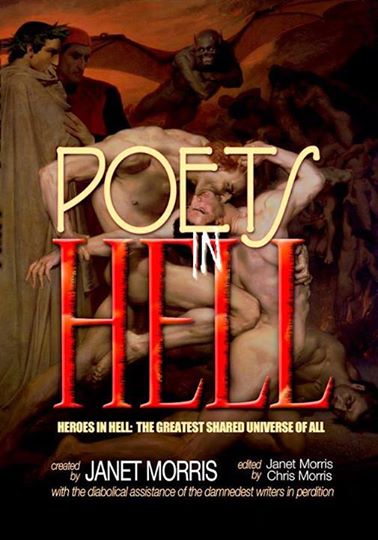
My story WHEN YOU GAZE INTO AN ABYSS has been accepted into the latest volume of Janet Morris’ Heroes in Hell POETS IN HELL.

Poets in Hell

As a bit of background information, Heroes in Hell is a shared universe that operates on the premise that anyone who has had an interesting life will have violated one of the 613 commandments intrinsic to the fabric of a moral universe and will thus find themselves in hell. So imagine hell filled with underworld gods, fallen angels, demons, monsters, mythological figures, historical figures, genii, mass-murderers, thieves, and–well–humankind in general. And make no mistake, my friends. This is literally hell.  If you think our world is bad, and it has a lot of bad qualities, reading this will make you appreciate our world a whole lot more: as all good and intelligent literature should.

My story “When You Gaze Into An Abyss” features Lilith, the apocryphal first wife of Adam, and the German philosopher Friedrich Nietzsche — amongst other diabolical friends.

I look forward to hearing what you think about this story and the volume that it comes in. I can’t reiterate enough that this will be my first short story ever in print. Expect POETS IN HELL to become available on Barnes & Noble, Amazon around June to July 2014. I also believe it will be on Kindle as well along with its other volumes. I will update you all with more images and links when they arrive.

Suffice to say, and considering all the struggle it was to get to this point in time, it feels good to be a poet of hell.

There’s No Place Like Home

“I am Oz! The Great and powerful …”

I ignore the floating green skull and its superior glare, hovering theatrically in its own flames as I make my way to the red curtain not too far away.

“How dare you!” the terrible voice booms, “You have not been given permission to go there!”

The sounds of thunder explode throughout the great chamber. Lights not unlike lightning explode into my eyes. I continue to stalk towards the booth with the red curtain with Apollonian purpose, an ironic reference in itself. Mists and fog swarm around me, and frightening admonitions echo throughout the great throne-room. These sights, and sounds and smells almost make me dizzy.

“Taking a scrap from the Pythia’s scroll, I see,” I speak aloud and continue walking.

“Cease this insolence!” the other cries, his below prompting a burst of orange flame around me, “Or I will summon my Guards to destroy you!”

“No,” I say calmly and without feeling, “you won’t. As an Oracle, you can’t afford to have your men that close,” I get closer to the booth, “besides, we both know they are already dead.”

I walk through the illusionary flames, images channeled there by glittering panels from the corner of my eye.

“Desist, or be struck down by the power of Oz the Great and Terrible!”

“I’m surprised, really,” I tell him as I get closer, “I’m surprised that in a world of magic and strangeness like this one, they wouldn’t have seen right through your disguise. Of course, a magician of any kind–mystical or otherwise–does his best work,” I come up to the curtain, “in plain sight.”

I rip open the curtain. And there is great maniacal laughter.

The man behind the curtain … is not a man at all. It is something else dressed in long emerald coattails. The bronze creature lunges for me with its blade. I barely dodge it, and meet it with the sword in my own hand. Then the curtain completely collapses and two more metallic creatures wielding great silvery wicked-looking scythes surround me. I parry the central construct’s blade even as the others come towards me from the sides …

And promptly collapse into pieces.

The central construct, the Tik-Tok as my companions outside called them, halted. In its beady clockwork eyes, I can almost see fear before it too shudders, steam bursting from its neck-bolts, and falls to the ground with its fellows in one great ruinous scrap-heap.

I hear the click of the weapon at my neck before I even turn around.

“Steam-powered clock-work automatons,” I nod, “I’m impressed.”

“Why thank you,” the voice behind me said, “it took me quite some time to create them.”

“I can imagine.”

“Get up.”

Slowly, I turn around. He’s dressed in the same green coattails that his construct wore. He’s short, and stout, and his receding hair is grey, almost silver. Anyone who saw him would probably have thought him some kind of minor janitor in the Emerald City, a harmless and perhaps even friendly old man. But the hard eyes behind the small rectangular spectacles say otherwise.

“There’s always one in every crowd,” his voice quavers somewhat nasally without the machines to make it sound fearsome, “someone who just won’t believe in the magic.”

“So that’s what you call it,” my words are cold, and final.

He trains his weapon at me, a black antique Colt pistol, “Young man, it is all magic. It’s all one spectacle. Bread, and circuses, you know,” he drawls casually, “It’s just very rare that you find one in the crowd that sees through the trick,” his eyes narrow, “But since you seem to know how my tricks work, it’s only fair–from one magician to another, mind you–that you tell me yours.”

“It’s a trade secret.”

The man laughs, “It was Elphaba, wasn’t it?”

“And what makes you think the Witch is the only one with magic?”

“Well, she isn’t. Not really. She is just more skilled at it than most here. You’d be surprised how much ‘magic’ is left in even these lands.”

“Actually,” I tell him, “I’m not.”

“Tell me what I want to know, young man,” his nasal voice becomes low, the weapon in his hand clicking again, “we are not in Kansas.”

“Though we do come from the same world,” I relish telling him this, now, “Oscar Zoroaster.”

The man seems to freeze in place. His beady eyes seem to dilate like that of a bird’s, “What?”

“Oscar Zoroaster Phadrig Isaac Norman Henkel Emmannuel Ambroise Diggs,” I repeat, “You were a showman in the United States, probably in the late nineteenth century. A minor conjurer, traveling magician, and tinkerer. You know a lot about mirrors, tricks, sleight of hand, sophistry, clock-work devices, and the power of steam, your Age being what it was before you … left.”

“So …” he says after a while, “You are from Earth.”

“From a different time, yes. You missed a lot since you’ve been away, Oscar Zoroaster.”

“I am Oz now,” he grins at me, waving his gun at me, “the great and powerful Wizard of these Lands.”

“You’re an artificer at least,” I amend, “Like I said, you must have spent a lot of time here, letting you hone your craft. You made one great Industrial Revolution here, I’ll grant you that much, but not much else. I wonder though … how much of it was your innovation, magic filling the gaps … or slave-labour.”

“Merely dirty Animals, and savages,” he says dismissively, “no one will miss them. I brought peace here. Stability. I brought them civilization.”

“And all the horrors of Industry to go along with it,” my mouth clenches and I remember why I want to kill this man, “Like I said, you missed a lot after you left us. Pollution, starvation, two World Wars, and mechanized genocide. An entire century of human atrocity and dehumanization, anticipated by and brought to scale right here by a carny-man. You are an Oracle after all, ‘Wizard’: a retrograde Oracle from our world more than anything else.”

“Hush now,” he growls at me, “you only live because I want to know how you know about me. I mean, you could have researched, but there are things … perhaps you read The Book. Elphaba probably learned …” he shakes his head, “a pity I can’t let you live beyond this.”

“It won’t matter what you do or don’t do to me,” I tell him, “you’ve already lost, ‘Wizard.'”

“I can recover easily enough. My men are a dime a dozen, and there are many exits to this place. I know. I had it built myself,” his gaze becomes considering, “And then I will rebuild. It won’t take long. None of it really did in relative terms. Then …”

“Your Madame Morrible is already dead. I’m sure that Elphaba and Glinda of the South made sure of that by now, even as we speak,” I allow a smile to appear on my lips, “By the time you kill me, they will be right here. Them and the flying monkeys you experimented on. And all of this, all of this here will be even more meaningless than it already is.”

“You’d be surprised how quickly one can disappear,” he takes aim at me, and pulls the trigger.

There is a sharp click. And then nothing. I let him pull the trigger of his gun again. And there is still an empty click. His small eyes have dilated further into shock, disbelief, and then fear. Very calmly, I take the gun from his hand.

“This is quite the antique you have here. It’s almost as dated as your Vaudevillian antics,” I throw it on the ground.

“Please …” he backs away from me.

“It is already too late for that. And no, I don’t want emeralds, or power, or ruby slippers,” I grab the collar of his shirt, “you’ve already taken enough from these Lands as is.”

“H-how …”

“Oz is a magical place, as you well know. Back in our world, I always had a knack for causing my machines to malfunction. But Oz … seems to make things less obvious things very pronounced, taking concepts and rounding them up to the next most cosmically ridiculous common denominator. It’s like one great Caricature.”

I let my rage fill my eyes, “But it was a Caricature I loved. Dearly.”

I throw him to the ground, “Your mistake, you murderous charlatan was that I watched this place from the very beginning. I saw it grow. I grew up with it. And saw you. I used to think you were pretty something. I used to think, much like Elphaba did, that you were a wise and benevolent Wizard. Even when I knew you couldn’t use magic. I looked up to you,” my voice cracks, “I liked you, and your hot air balloon until I realized that the only thing in your heart is precisely that. Hot air.”

The next thing I know, I’m shaking with fury, and pointing his own gun at him with one hand, “You ruined the Land I loved, that gave me any meaning in my life — poisoned it with the exact same nationalism, and war, and death from our own world. Our own garbage. You … had … no … right! I should kill you right now.”

I walk back a few paces. And then, I do the unthinkable. I toss his own gun back at him. He catches it, with shaking hands and trains it on me again.

“I helped Elphaba figure out how to read The Book. All of The Book. I didn’t have to do much. You can run anywhere you want. You can hide. You can try to kill your way through. But she will find you. Her and all the citizens of Oz: the Munchkinlanders, the Vinkus, the Quadlings, and the Animals. Especially the Animals. They’ll find you, and make you wish you were dead.

“But I don’t want them to get any more blood on their hands on your account. So you have two choices really. Choose wisely.

I wait and watch him. He knows he can’t run from me. And I can see that he knows that even if he can, they will find him. Elphaba even knows who he is. It doesn’t take long for him to make the choice. I swallow violently and look away after. Even after all he did … I almost wished that what I saw come out of him was spilled oil, and shattered coils and springs. An advanced Tik-Tok mechanism that was created with benevolent intentions, then went out of control and killed his real creator: enchanted to look like a man. Like him. But sadly, all that hot-air inside him was not merely the result of steam-power.

It was just the result of another man playing at being God. I feel less like a child now than ever.

But there is just one more thing for me to do. I search around for a little while until I find it. The green elixir.

I hide it in my pocket before she comes back in. She stands there, surrounded by her winged monkeys and Vinkus allies. They scatter and start securing the room. She sees the body on the floor. Fiyero isn’t here yet, so it falls on me to get to her first. Elphaba doesn’t flinch from the sight. But even after all this man did, I can see in her eyes that her heart is broken. I hold her and she holds me back tightly.

“Glinda is fine,” she says to me, “she handled Madame Morrible. I came here as fast as I could …”

“I know,” suddenly I find a lot of my wordiness is gone.

“It’s done then,” she looks sad, and lost, but at the same time there is a great flush of strength from her emerald skin, “I suppose … you have to go now.”

I look at her. We stand at the same height. None of the literature from my world ever really did her justice. This time, I look away from that penetrating stare, “I … don’t want to,” I admit it. I love this world. I love it and its people, and the magic and the friends I’ve made here. I want to see them grow, and prosper. I want to be with them. There is so much wrong with the world that I came from, so much that disgusts me and isolates me there. There is just too much potential to become petty and small again. To forget everything. And her.

“But you have to,” this is not a question. For a few insane seconds, I want to ask her to come away with me, to fly with me on the Wizard’s hot air balloon back to my world. But although my world is more politically correct in some places, she would be no less green to anyone there as she is here. And she would know that. Those few seconds are gone. She has a life here … and a new life to begin. This entire Land has a new life to begin, and Earth and those few people from it have already done enough to it.

I look at this amazing person who is the best of both worlds–though she would never know it–embodied into a beautiful green form with discerning intelligence and an even greater heart and I know that Fiyero is a lucky man, whatever else he is now. A choking feeling sits hard in my chest, not unlike the one I felt as a child when I saw another farewell scene.

“There must be people who care for you,” she prompts, and then hands me something. It is The Book.

“Elphaba …”

“No, I want you have this. Glinda, and I learned everything we needed to. We want you to have it and keep it safe. Who knows …” she smiled, sadly, “maybe one day it will lead you back to us.”

Then she wraps her arms around me and I hold her.

“What will you do with all of this?” I ask her, looking at the throne-room.

She smiles, “I think I might have a plan or two.”

We hug again, and then I manage to walk away. I don’t know what I’ll do now. Maybe I will go back home. Maybe I will succeed in finding the hot air balloon in one of those workshops that the self-styled Wizard had lying around. Or maybe I’ll take it and ride across the clouds to other places, others untouched by time and always going. A little girl and her family one day will move to Oz, hopefully under better circumstances. Maybe I will find the Oz I knew from my childhood again. Though it would be one without her.

No, it will be better to find other Lands. To keep travelling. A young girl from Kansas once said that there is no place like Home.

But I now know, however, that Home is where I carry The Book: this Book and story, that I now keep on living.

Photo and Collage Credit: Beth Ann Dowler

Out

Sometimes I can still hear it.

It’s the end of the night and Dead Can Dance’s Rakim drifts and rhythmically rumbles through the musty air before the undulating chant of the female singer through the night. The DJ knows what he’s doing. The frenzy of Electric Body Music with its violence of movement and the wry painfulness of clarity that is Alternative Rock have taken their course and had their place in their club.

Now the bar is closed and the black-jacketed, white dressed, neon colour-haired patrons are fewer and dancing with each other in pairs: slowly in tempo with the music. All of reality itself seems to wind out like a wavering road as the woman sings and the man chants in a deeper voice, with stranger words, accompanied by the hollow tap of drums and waves of languorous, synthesized sound.

Everything downtown, far away from where I sleep at the time, unfolds a path in front of me as I watch them dance. I see everything that has happened before and I know that even before being here it had already been in my head: this simultaneity. It gestates through countless songs, and observations, and the weird jerking near-violent movements and pseudo-martial forms that I called dancing. This feeling will continue to grow long after my long bus ride home.

“A million faces, a million lies,”  VNV Nation’s Chrome wavers out before I ever knew its name, accompanied by a weird looping music that somehow taps my heart.

“The streets are cold, the lights go by…”  Like a strange, throbbing, secret whisper it tells me about walking downtown the first time by myself at night, the passing of the streetcar away from Brock, a lost white grin and electric blue eyes, words on a screen leading nowhere, that summer on Euclid Avenue, friends at a Noodle Shop, wishing my friends were there in a bar dancing, a worn convenience store open past three, Higher Ground and Eglinton, cold darkness, past chances, taken chances, lost chances…

When that music comes on, it’s as though my life isn’t linear but multiple-choice: my thoughts fragmenting but somehow being pulled back together again. Then I remember EBM and rock music and it’s as though I’m fighting against the inertia of my life in the epic battle I’ve always fought in my mind: alone and proud.

But then at the end of the night, my favourite night of the week, my Friday night, after dancing through the endless possibilities and talking mutely with people over thundering percussion, I’d see the reality of it. Two men in glistening black leather kilts dance with a white-blonde girl between them. A tall girl moves with a shorter darker one. Then Rakim winds down for the night, the male singer’s last reverberating, “Since forgotten…”

I remember these Friday Nights well as I skirted the rim of the dance floor and danced in the middle of it in my own bubble of space. I interacted with the people much in the same way, just as I still in some ways do. I remember that I don’t relate well to groups. I am like the girl in “Tonio Kroger” that tries to dance like others, on the periphery, but unlike her I know I have my own dance that few can or could care to match. Perhaps I’m getting too old to dance now, too hermetic to move as often. Maybe I already had my chance to find something special in the night.

Yet sometimes, even now, I have this insane urge to contemplate another Gothic Picnic in High Park drinking the liquid essence of fruit salad and watermelon juice alongside white-painted people wearing black leather and lace. Or maybe I’d dress up like the Crow again and go downtown to lose myself in the role while dancing: laughing at those who think I’m Heath Ledger’s Joker instead.

At the very least, I can take comfort in knowing that I can still dance well in one place: through the diaphanous smoke screen of my own words. Right here.

The Crow

For Crystal and Castle: An Author Quest Ends and a Gelfling Gathering Begins

Last week, The Dark Crystal Author Quest to write the first novel of The Gelfling Gathering finally ended. Twenty-five excellent writers were given honourable mention and five were chosen as finalists. It still really disappoints me that I couldn’t find the time to enter the story that I had planned. I was working on another submission at the time and I had to make a choice. Suffice to say, it was not an easy decision to make and, hopefully, I will be able to show all of you the fruits of that decision one day soon enough.

However, I did manage to do something during that time. As a treat and in honour of the Author Quest’s success, I want to show you the introduction that I created to start off my Dark Crystal Gelfling Gathering tale. I hope you will take it in the spirit that it is given and enjoy. Its working title was Dark Crystal: For Crystal and Castle.

It was over nine hundred trine ago that the Great urSkeks, wonderful, luminous, glorious beings from the highest realms who had come to bring wisdom and enlightenment to our beautiful world of Thra, finally left us. They had come to our home for contemplation and, having gained the revelation of their true selves from the divine Crystal of Truth, they left us with one final task.

Before the urSkeks, we were small and lowly. It was not until their blessing that were chosen as Stewards of their Castle of the Crystal: to guard it, Gelfling, Podlings and all of Thra from the evil that still surfaces to this very day.

For the soul stealers, ugly, twisted monsters that would take Gelfling children in the night for their shadowy sorceries were locked away: banished to their prison in the Mystic Valley from which they shall never fully escape. Our Adversaries were held back and imprisoned behind the wards of the urSkeks, whose power we still maintain and they cannot ever fully escape: let alone dare approach the Sacred Crystal to see what cowards they truly are inside.

Nevertheless, the soul stealers are crafty and clever.

To this very day, led by their dark and insidious Master, these cruel wizards still lure Gelfling victims to their Valley. And sometimes it is even worse. Sometimes, some–not all, but some–of the soul stealers find ways out from the barriers that seal them their infectious nature from the rest of Thra and seek to interfere with, and corrupt, our great and glorious realm.

This was the reason why the paramount of our kind, the beloved and enlightened Emperor skekSo First and Only of His Name, created the elite Castle Guard and made his Empire of all Gelfling civilization and Podling principalities. This is why we have decided to teach those worthy among you Gelfling the arts of war and defence.

And while a soul stealer cannot be destroyed by Gelfling or Podling hand, with your help we can capture and contain the menace of the wizards–to keep the dread Sixteen from liberating their entire body–until that great and glorious day when a thousand trine shall pass and the Third Great Conjunction brings glory to the Empire, peace and order to its loyal citizens, honour to the Guard that defends our Lordly Stewardship and the Crystal of Truth, and eternal oblivion to the soul stealers and their corrupted followers.

Until that momentous day we must remain forever vigilant. Everything is connected and it will only be through our sense of connection and our trust in his Imperialness the Great skekSo that we will all find true harmony.

This is our duty and our gift. This is our peace to all of Thra.

Remember the oath of our Guard: “For Crystal and Castle.”

— written by skekLi, Noble and Humble Poet Laureate of the Skeksis Empire

File:Castle of the Crystal - Pure.jpg

This was, sadly, as far I officially got. But I had plans. I’d written a whole lot of notes asking myself questions about the Skeksis, the urRu Mystics, and the Gelfling, their different Clans and what kind of plot I could make out of all of it.

But as the second part of my treat, I will tell you what I roughly had in mind.

I really planned on writing about Rian, the Woodlander Gelfling Guard slowly discovering that his beloved rulers were in fact some of the most evil monsters that he has ever met. I wanted him and his Spriton friend Jul to be rivals in the Guard and when Rian finally did defect away from the Skeksis, he would have to face his best friend until, finally, the latter saw the truth and came to his side.

During this time, the Guard are actually trained and led by three Skeksis: skekVar the General instructs the Gelfling in land-based combat, skekSa the Mariner drills them in naval war, and skekMal the Hunter teaches the Guard survival skills and the art of stealth and, well, hunting. I wanted to make three things clear. First, skekGra the Conqueror was once a leader and instructor of the Guard before he was exiled by the Emperor along with skekLi the Satirist. The second is that Emperor skekSo sometimes displays his martial prowess during Castle Festivals and the Guard are in awe of his speed and sheer power. And, third, that all the Guard feel very uneasy about skekMal. He has this way of looking at them as though they are just pieces of meat. Sometimes, some of the Guard go missing during the night. Not always, but occasionally and while the “soul stealers” are blamed, some of the Guard wonder.

Of course, it is revealed later that skekMal basically trains the Guard to hunt only to hunt them down, in return, much later after he puts on his mask and tracks them. It is basically a sport to him to “play with his food.” Even the other Skeksis find that somewhat disturbing. He comes and goes whenever he feels like it and he supports the two Skeksis in exile when it suits him. I was also toying with the idea that it is on a mission to “find” the exiled Skeksis that Rian discovers more about them.

Basically, this side story, or first book even was going to have the Emperor send the Guard to stop skekGra and his associates from attempting to make their own rebellion with Gelfling followers. If skekHak the Machinist hadn’t been killed in the second volume of Dark Crystal Creation Myths, I would have used him to create a makeshift essence-extractor: a cruder version of skekTek’s. However, perhaps skekMal had his own portable device made when he threatened skekTek. Remember: the Gelfling Gathering takes place before the Emperor had sole access to essence, so it is possible that something like this could have happened.

But in any case, I saw Rian and the Drenchen Gelfling Gurjin as childhood friends. Gurjin, for a swamp-dwelling Gelfling, was the more scholarly of the two in my mind and he wasn’t a part of the Guard. When they weren’t playing Jarra-Jen and Creghel the Tyrant, they played Three Suns and the Moon: each of them was one of the suns and an old childhood female friend was the moon. I picture her as a Vapra and perhaps, in their minds, the future Queen of the Gelfling Clans.

Eventually, Rian discovers that there is a Gelfling Resistance led by the hidden Gelfling Queen. As it turns out, almost a century ago, the Sifa Gelfling Gyr and the Vapra Lady Kel witnessed the actual creation of the Skeksis and the urRu. Kel, becoming the next Gelfling Queen, secretly passed on the knowledge of what happened through dreamfasting with her successor and a select group of loyal Gelfling. They didn’t know what to make of what they saw and so they waited. They waited for a few generations: knowing that they didn’t have the power to oppose the Skeksis directly and that their own pacifist nature, with the exception of perhaps the Spritons that were so close to the Skeksis’ corruption, would limit whatever they could do for now.

I decided that Rian first acts as their spy in the Castle and then he finally just can’t stay there anymore. Maybe I will tell that story one day: though it will definitely be fanfiction unless the Henson Company or Grosset and Dunlap are ever looking for short stories. That story was going to be my entry. And if the third Dark Crystal Creation Myths book doesn’t destroy its continuity, then it definitely will be a fanfic.

But as for the rest … Rian sees the beginnings of the proto-Garthim developing in the cave tunnels of the Castle: supervised by skekUng the Garthim Master who wants to supplant skekVar as General and skekTek who hopes to get more prestige out of helping him. I see them as red and raw without their organic carapaces at this stage. Rian and his friends run into the real Gelfling Queen: a young and mute Dousan Gelfling. She has mastered Dream-etching: the precise ability needed to bring something from dreaming into physical being. She will become the central architect of the Wall of Destiny. They attempt to mobilize the other Gelfling, but they need resistance and disbelief. But gradually, they would pass on what they have learned through dreamfasting.

At this point, the Skeksis become aware of what is going on. As they pass the cover story of there being missing shards of the Crystal, as the Gelfling group has revealed that it is damaged, the Castle Guard is led by Emperor skekSo himself, along with his minions, to take care of the Rebels. Unfortunately, for the Skeksis, the Guard are all converted to the Rebels through dreamfasting. I planned, at this point, for the urRu to get involved: as the protagonists were staying in the Valley: having realized that the Skeksis’ accusations against them are obviously false and the Skeksis are the ones kidnapping and “draining souls” from Gelfling.

There was an epic duel between the four-armed combatants: urSu the Master and skekSo the Emperor. These are not the decrepit beings we saw in the film, but two powerful opponents in the prime of their lives. Each blow they land on each other also affects the other one and they gain cuts and injuries that match each other’s own. SkekSo only retreats when he realizes that his Guard have defected and his other Skeksis are facing similar problems. SkekSo vows revenge and flees. The Gelfling either do not notice this phenomenon or simply do not understand and it is understated. It is also during this time we are introduced to urVa the Archer: the one Mystic who seeks to actively destroy his counterpart in the form of skekMal.

UrVa spends much time teaching Rian and the others how to fight, as he is a martial arts master, and when the time comes to leave the Valley and go to organize the other Gelfling, he chooses to go with them: being the only urRu who can actually find it in himself to actively interfere in what is going on. Later, as they get to the site where the Wall of Destiny will be built, this is when the Skeksis get nasty and they send the three militaristic Skeksis with a mass of essence-drained Gelfling husks, literally zombies, to destroy the Rebellion.

By this point, it is a bloodbath. And what is worse is that skekMal starts picking off Gelfling from the shadows of the Vapra’s trees (I assume this their territory is close to where they are building the Wall) with his crossbow. He and urVa have a standoff. UrVa hates everything that skekMal stands for, representing the aggressive side of him he despised as an urSkek, while skekMal hates urVa for being that weak and hesitant part of his original self whose deliberations cost lives back on the urSkek homeworld.  In the end, they both shoot each other at the same time: a former whole being in conflict with its dual aspects.

Rian holds urVa’s dying form in his arms. UrVa asks Rian to kill him, but Rian doesn’t understand and refuses. He then goes and finishes off skekMal: who had killed his father not too long ago. Both Skeksis and urRu die. Then the seven Gelfling Clans, all knowing what the Skeksis truly are, congregate and the Wall is created.

File:Prophecy.jpg

It awakens the essence-drained Gelfling husks from their living death and the remaining Skeksis are forced to retreat. But Rian, the Queen and the others all know that this far from over. Nevertheless, there is still hope and wonder in Thra.

This is, sadly, as far as I got in my notes. And there are so many gaps. I still have difficulties describing our world’s geography, never mind Thra’s and its unique solar system. There is also so much story there and many story lines that I could have done with the mariner Sifa, the desert-dwelling Dousan, and the underground Grottan. I did plan on having each chapter dedicated to, and function from, the limited third-person perspective of the character: Skeksis, Gelfling and perhaps even an urRu. You know: much in the same that George R.R. Martin structures his chapters in A Song of Ice and Fire.

But I didn’t get to it. Nevertheless this process of world-building kept my mind occupied and got me into some good discussions on The Dark Crystal Community Forums. I’m also pretty sure I learned something and, in the discussions themselves, I even suggested corrections for their entries into the Encyclopedia. And what is even more awesome is that the other authors that didn’t get into the finals have a similar idea to mine and have posted links to their stories in the Forums and in the Fanfiction section of the Dark Crystal website.

The fact is that my experiences in the Quest, for all I didn’t make a story, deserved its own honoured place in my Mythic Bios and it is excellent way to show you how my creative process and, well, my mind works.

I will say it again: everything is connected. Everything is connected and I am glad I connected my creative mind to the world of Thra. Therefore I salute my fellow writers and posters, as well as the Henson Company, and my story that could have been and in the words of the Castle Gelfling Guard I planned to create let me proclaim proudly, “For Crystal and Castle.”

A Traveler’s Account of Katrina Elisse Caudle’s Darkmoon City

On the surface, Twine is about making games. But that is just one way of looking at it. To be more specific, Twine software allows one to hyperlink from one page or another through the click of a word. Words link together different pages and, ultimately, different ideas. Now, take that bare-bones concept and link together not only Twine narratives, but short stories and real time events. Essentially, in doing so, you would be creating a reality from multimedia.

Someone at the Toronto Global Game Jam made this suggestion to me after I showed him the Twine game I made at that particular event. However, what he didn’t realize is that others have already thought of this idea, and have utilized it.

In creating Darkmoon City, Katrina Elisse Caudle is one of these people.

I am not entirely sure how I found Darkmoon City, back when it was called Faerie Dark and focused more on its own content and less on outside activities. Katrina’s site itself has evolved quite a bit. At one time it was a textured grey interface in which you had to input the names of the Twines or stories that you wanted to see in a search bar. It was arranged in such a way that inputting the title of the work was a lot like participating in an agreed-upon ritual or the casting of a particular spell or evocation that would interact with the world of words and code that Katrina embedded into that world. I will admit that sometimes it confused me and it was hard to search for what I wanted back then. I even had the odd error or two. But, eventually, I “said” the words and found a part of her world.

At the time, there was only one Twine game: one interactive hyperlinking story. It was, and is The Edyn Project. I played this game during a time when I was still beginning to figure out how Twine games worked and attempted to see the different kinds and qualities of such that existed. Essentially, you find yourself in the White City: the former seat of arcane learning before the plague that wiped magic, and a good portion of the global population, off the face of the earth. The Edyn Project is an attempt by various powers to utilize technology in order to create a utopia from a Dark Age.

It was here that I began to see a different world-view emerging: especially with regards to how the White City’s new bitcoin economy is supposed to function. To this day I’m still confused about bitcoin, but the game did succeed in introducing me to the layout of the City and some of its history: including the presence of an ambiguous artificial intelligence program guardian named Edyn. I didn’t know, then, that the game wasn’t completed yet and indeed I reached a point where I didn’t know what else to do and got caught in a looped event at one point when going back to deal with my character’s blood work.

I really got to know the world of the White City through its short stories. Liminal Creatures of Heaven depicted something of a creation mythos and a different cosmogony from that of our own solar system. It even has its own astrological charts and celestial cycles.

But it wasn’t until The City With No Animals that the spirit of what would become Darkmoon City really began to slowly and subtly set into my mind.

Imagine a world where animals no longer exist: to the point of them becoming legends and myth. Now imagine a world where homosexual, bisexual, queer and polyamorous relationships are not only seen as commonplace but as part of an unquestioned norm. Then consider a place where there are more than two kinds of gender, where people can alter themselves in an almost transhuman sense, all of this is an ingrained and understood part of that world as well. The pronouns of he, she, and they are simply there in sentence and conversation. Now add to the fact that magic once existed and is in the process of being replaced (or complemented) by science and technology of questionable nature and a new bitcoin economy while the vestiges of the supernatural remain as ghosts, and faeries, and other things.

Now imagine writing this world with characters that experience varying degrees of emotions while exploring old and new secrets, and each other. You would basically be creating a whole other kind of paradigm or mentality from our own world. Katrina basically does all of this. It takes some getting used to and sometimes there is even still a bit of culture shock, but once you watch the characters’ interactions with the world and each other you begin to focus on them a lot. What I really loved about “The City With No Animals” is the fact that Katrina captures well that feeling of sweet confusion when you are discovered by those you know are special and could be, or might not lovers even as she also depicts the warmth of intimacy between childhood friends. “The City With No Animals” is a long story of four-parts, it has a unique writing style, and it is definitely worth reading.

I said a whole lot of other things about this story to Katrina herself, but unfortunately much of this correspondence was lost and now I can only focus on my impressions of what I read from that time. Indeed, Katrina changed the layout and name of the site from Faerie Dark to Darkmoon City. I’m not sure if she reloaded all of the older stories that I can’t recall, but she did add some newer elements to the new layout that she has created.

In addition to another interactive Twine called Happy Birthday Smoke!–in which you play as a character from “The Edyn Project” who is discovering her uncle’s creation of bitcoin and thus giving you a tutorial into what it is for the very first time–there are the addition of more creation myths and legends in the form of new stories.

I mentioned earlier that Katrina has a very unique writing style. I think what really stands out for me is in addition to a world with different ideas of gender, economy, science and magic, there is this very fascinating blend of Far East Asian and ancient Western culture, philosophy and mythology that exists in her overarching, and interlinking, narrative. If each world of fantasy and science-fiction is part of a multifaceted lens looking at an alternative perspective of reality, then Katrina’s world of Darkmoon City feels like a pale violet-tinted part of the cosmological kaleidoscope. Her language and sense of pacing are languid, flowing, and beautiful: and they put you into an “alien” and external mindset intimately and to the point where you realize it may not be that dissimilar from your own.

There is one more thing I want to mention before I wrap this retrospective up. A little while ago, while Faerie Dark existed, Katrina had another Twine game called Chrysalis. There were a few interesting elements about this game. First of all, and as far as I know, it was the only game that required payment: the small amount of $2.99. Secondly, it was a Twine that incorporated images and audio into its structure. But the third and most important element that I want to look at is what the about was about.

Essentially, Chrysalis was a Twine game in which you visit a courtesan named Rabbit. Its premise is almost an answer to the questions that the Canadian comics creator Chester Brown seems to pose in his graphic novel Paying For It: what kind of world would result from the creation of a society without the stigma of paying for sex, or even on non-conventional relationships? What kind of morality would exist where an exchange of services for intimacy and learning is condoned, honoured, and even encouraged as healthy?

You had to progress by learning various lessons through interaction with Rabbit. Should you have not been interested or wanted to skip ahead, you were always invited to leave if the terms no longer suited you, or if you could not follow or respect them. I didn’t always understand the astrological elements within the game itself which, may or may not have made Chrysalis into part of Faerie Dark (or Darkmoon City now) or as a standalone in and of itself. Sometimes the audio did not work and it did verge into some specific areas of sacred sex and spirituality. Sometimes the audio segments seemed long as well. But what really struck me about that game, aside from being a creative attempt to depict a different form of society where sex work is an inherent part of the culture and you learn about intimacy, sensuality and just what constitutes as an important exchange between consenting adults, as well as navigating the places between different emotions and a process of personal growth, is how Katrina applied her own experiences and the paradigm of her creative world, and bitcoin, to the scenario of Chrysalis.

It was not an explicit game, but it was definitely a very involved and thoughtful meditation on pleasure. Sadly, my words aren’t doing this game any justice as I can no longer access this game. It came in the form of a code I purchased for Faerie Dark‘s search bar that now no longer exists. All that is left are Katrina’s above account and ethereal fragments of audio to give you some idea of what this game was like. But it, and the other stories, were an excellent look into the creative mind and imagination of Katrina and what could be.

Darkmoon City is still very much a work in progress, with its own Patreon page, and as a fellow traveller into the realms of fancy, I look forward to walking where the White City journeys from this particular foundation.

The Treasure of La-Mulana

So I have been stabbing my Mythic Bios notebook with my golden pen, but for one brief moment I am going to re-materialize back from the ether to leave you with something. I made this, my third Twine story, a little while ago after watching Deceased Crab play through both the original and the remake of La-Mulana.

This game … for something I have never played and probably never will because I neither have the patience nor the hand-eye coordination, got into my head: into that mythic space that permeates my very being. La-Mulana is an adventurer-archaeology game created by the game company NIGORO and filled with puzzles, riddles, deathtraps, insanity, lore, and vintage video game goodness. It is a fun, but notoriously hard game. But the world and story that NIGORO created got into my mind so much, and so badly, that I went online at one point and looked for fanfiction based on it.

It was there, online, that I found madamluna’s long slow collision and Bones. It was the first story, a Twine narrative itself, and the news that there would be a sequel to the game itself that cinched it for me.

So now: to business. What you are looking at here is a homage–a fanfic–to a game I’ve only seen on Let’s Plays, written in Twine. Basically in addition to this being my third Twine story, this is my first polished Twine fanfic to an awesome and insane game. So while I might not be a “real” fan of the game, in that I haven’t played it, I hope you can all accept me as one in spirit if nothing else.

In other news, I am still hard at work and I plan to make a New Year’s post of some kind. I hope you enjoyed this surprise and impromptu post of mine. I hope to return relatively soon. But, since you have all been very good readers I now leave you with my modest attempt at a homage, at something that will probably be completely debunked and repudiated by the actual sequel to La-Mulana itself. It is a story with events meant to bridge the gap between the two games. So such, please remember that there are Major Spoilers. I hope you will take this in the spirit that it is given.

So good night, fellow explorers, and allow me to leave you all with The Treasure of La-Mulana.

La-Mulana

My Second Twine Game: Haunted

Me and my Head

I am apparently now in the habit of posting late. So a week or so after the WordPlay Twine Workshop with Christine Love, and exploring Faerie Dark’s world of interconnected Twine games and stories–essentially the progression of a universe-seed in progress–I felt compelled to make another Twine.

My first Twine game was mostly an experiment to see what I could apply in a very basic way to the software medium. I wanted to see if I could tell a story and use the medium to mimic page-turnings, or panels, or–if you prefer–punctuation. With this game, I wanted to do two things.

First off, I wanted to make sure what I did before wasn’t a one-off and I wanted to keep up the practice for when I create some of my more involved works. Luckily I have the template of “Level-Up” to work off of as well as some Twine tutorials and the instructions of Anna Anthropy and Porpentine as well as Gaming Pixie’s advice to go off of too.

But the second reason I made “Haunted” is because I wanted to make both a longer story and something personal. And this story is personal. I don’t just mean that it is based off of some of my life experience, which it is, but it really taps into feelings. I wanted to make sure that I could do this. It feeds into part of a feeble excuse in which I didn’t edit the text or anything, just because it was something I wanted to say and express while it felt real and fresh and, more importantly, tangible and cohesive in my mind. So, in part, I am basically taking Twine and telling a story as flat-out as I can and I admit that process is rather cathartic, if nothing else.

This also gave me an opportunity to explore the boundaries of my own ignorance. Right now, I am at the stage where I am basically taking basic Twine hyperlinking and knowing how to make titles and attribute my name and nothing more. I don’t know how to grey-out or eliminate links once they are chosen. I don’t know how to affect the game when certain items are chosen or not, or when certain places are clicked on or not selected. I have to be mindful about what words I will be using to click from one plot box to the next.

Sometimes I have made mistakes. In my old Twine story, I didn’t even unload it to Philome.la, a free Twine Twitter-based hosting site, properly. It took a few tries and I succeeded thanks to the very prompt and patient guidance of one Colin Marc. This story, such as it is now, is structurally limited but it is more of a game than the first one is. There is more exploration and you will have some–albeit simple–options. I am still focusing on story and expression, this time more personal expression, but I hope to eventually make a stronger game mechanic to make that exploration more potent … with editing, I assure you.

That said, I can see some “dictatorship of the narrative” going on here and I don’t know how well a more generalized audience will be able to relate to this game, but as I have said many times this is a story and I am working on one thing at least that might be a bit more inclusive. At very least and if nothing else, I made an experience and a story.

So here is my answer to the question of whether or not you can haunt the places of your own life. I hope you will appreciate it, and take it for what it is. Until next time, my friends.

For now, become Haunted.

ETA: Based on scraps of what I can remember from Christine Love’s Workshop, I believe I recall what the vertical bars, the |s do. They actually create Headings so that you can Rewind your game to that point and start off from there again instead of doing it all over. I will keep that in mind next time once I figure out how to utilize it properly.

My First Twine Game: Level-Up

I know that in my last post, I asked for all of your help. And very soon, I am going to show you how you can help me. There is just a little more work to do, but once that is taken care of I will explain everything in my next post this coming Thursday.

But right now, I want to talk about something else in this belated post of mine. This Saturday, at Christine Love’s Twine Workshop during the first-ever WordPlay event, set up by the Hand-Eye Society, I made my first ever Twine story. The reason I call this my first story is because, technically, it is not a game.

So here is what I am going to do. I am going to paste the link of my creation onto Mythic Bios and then, afterwards, I am going to talk about the Creative Process of it a bit. This is my experiment–my first Twine by action if not in planning–and for what it is, I am extremely proud of it. So without further ado, and without images or sounds or other fanfare allow me introduce to all of you, my loyal readers to …

Level-Up

All right, now that you played through it I want to talk about what went on behind it. Basically, a little while ago I had a story sketch in my head that almost–almost–became an entry for Mythic Bios. Really, like a lot of my creative works, it grew from a single sentence. This single sentence formed in my head and I needed to create a home for it. Then I found out, and signed up for Christine Love’s Workshop. If you have been following this Blog for a while, you will know that I have the utmost respect and enthusiasm for Christine’s storytelling and her game-making. So you will understand that I could not allow the opportunity of attending one of her Workshops to pass.

And when I was accepted onto the reservation list, I realized that I wasn’t just going to learn how to make a Twine game. I was going to make one right there, at the Toronto Reference Library, in about little over than an hour.

You have to understand that I generally plan out my stories in advance, or I take a lot of time actually making them. But Christine took the time to talk about the basics of Twine in fifteen minutes and, the next thing I knew, we had five minutes to think of an idea and then the rest of the time to implement it.

And I did.

What you are about to see here is what happens when a world is being processed in your brain for a lot longer than you thought it did. It seems I am almost always world-building in the back of my head: even when I should be doing something else … or especially then.

But this isn’t a game. This is a story fragment that somehow functions well. I made up for my lack of knowledge and technique with Twine by attempting to create the right transitions or hyperlinks. Basically, I was aiming for making a rhythm for clicking through the story from one screen to the next.

Yet, as a friend of mine who is now working on his own Twine as part of my Challenge to him observed, what I didn’t really do with the medium of Twine at this stage I attempted to do with descriptive storytelling and dialogue. Also, my second-person perspective–you–might have gotten into the mind of the character in question. Or maybe you won’t. You’ve also see that it is extremely short and lacks sound and images: hence the storytelling that is my strength.

So allow me to thank Anna Anthropy for introducing me to Twine through Rise of the Videogame Zinesters, Christine Love for her Workshop and giving me the excuse to finally go beyond the theoretical and do something hands-on with the software I plan to work with, Gaming Pixie for her support and to all you for all experiencing my very first, and not my last, Twine story. It is not part of the two that I have been planning for ages, but I have to remember my priorities at this point. Also, anyone who can guess which line helped to form the entirety of the story will get bonus points from me.

Take care, my reader-player audience. I will be back here this Thursday … with news.

Looking Outward