On A Half-Written Page

For those of you who don’t follow me on GeekPr0n or know me, surprise: I’m still alive.

This may well be the first and last post I make for this December and before another year takes us. I remember when I used to write so much on here. I used to write a post on Mythic Bios every day, and then every day, and then every two days, one day, and now occasionally. I suppose what I didn’t realize, at the time I started this, was as I began writing more I would have less time to Blog than I once did.

At the very least this has not been the result of a creative block or major depression. I have been busy this past while. I’m not even going to try to catch up on what I’ve been doing since my last post because so many things have happened.

I think what I really wanted to write about this time around was something about writing and life: as I’ve not done in a while. I’ve been working on a long-term project this past while that has taken a lot of time, energy, and concentration on my part. I made good progress on it for a while. I planned to have it finished before seeing my girlfriend for Thanksgiving.

Of course, that didn’t happen.

Instead, after dealing with writing other articles, interviews, and life stuff I had to put it aside and prepare to recharge for a while: but not before going to my first Amanda Palmer Book Circus when she came to Toronto. I still haven’t had the time to read her Art of Asking. That is how busy and preoccupied I have been.

So I came back from a well-deserved hiatus to my assignment only to get stuck. Some writers might tell you that the worst thing in the world, aside from deadlines, is staring at a blank page and having nothing come to you. Well, I’m here to tell you that this is not the worst that can happen.

From my experience, be that as it may, the worst thing that can happen to a writer is looking a half-completed work of theirs and totally having lost their train of thought, while knowing how the story continues in their head, but fighting the details to get it all down. It is downright infuriating and it’s made all the worse when you just want to get it out of your system, and move on with your life.

Sometimes you’ll even begin to develop some performance anxiety and avoid looking at it. It will sit there in the back of your mind, but you are torn between wanting the fucker done, and despairing that you will not do it well enough. Procrastination becomes your writerly alcohol or drugs: that is, if you don’t like alcohol or drugs already.

A little while ago, I finally managed to get my story to where I needed it to go. It’s not perfect but now I feel the excitement again: and the passion and momentum to keep pushing forward. There will be editing and formatting and such to keep in mind, but those are secondary concerns at the moment: as I now feel that this will happen.

I think that what I’m trying to say is that, because a year where some promises and potential breaks didn’t pan out, where I sometimes wonder what I’m doing with my life and if I will get anything out of it, that — right now — I don’t feel like a fucking failure. 🙂 And I’d like to say that’s pretty something.

I’ve also been getting used to going outside again without feeling a whole lot of tension: though it will take some time. I’ve decided that Tuesdays are now my Suspect Video days with alternating Library days as well: to keep my mind fresh with films, books, and comics so that I don’t go completely insane. And who knows, I might even learn how to socialize again and function outdoors without too much anxiety after all this time.

Anyway, I hope that the next time I see you all in Mythic Bios will be when I have finished my work and I get to finally work on something new.

Until then the writing: it continues.

The Spooky Ghost, The Spider, The Bat, And The Count

I promised you all a second Halloween post a few hours ago and so, somewhat against my better judgement, I am going to show you the first Halloween story I ever made.

And when I say the first I mean the first. I don’t know how old I was when I wrote it, but I must have been extremely young because someone had to transcribe it for me. They may have even helped guide my ideas while somehow letting me keep my child voice. I found this creased and rusted paper wedged somewhere in my old desk drawer. I can also barely remember having toys or some figures that inspired the characters. 

And no matter how much parts of this very short bit of juvenilia make me wince, no matter how many parts of it make me want to edit it and shake my head, I have to remember that we all start from somewhere. So in honour of this Halloween and all the progress I’ve made, I just want to show you a little bit of where I used to be.

Trick-or-treat my friends. Happy Halloween, Past Child Me. 

Once upon a time there was a castle and there lived a spider, a spooky ghost and a red bat. And then count was visiting the witch. The count won’t take too long.

The next day when it was nighttime it was dark in the castle. The bat was sleeping.

“Oh!” Somebody open the door. I’m getting scared!” said the count.

The candle was lighted and one candle was turned off, and one was on, and one was dead. Then the count was sleeping, the spider was sleeping, the bat was sleeping, and the ghost was sleeping.

“What was that?”

They were all afraid.

Something said, “Oww!”

It was a wolf.

“Help!” said the bat and the spider to the count.

“There’s nothing to be afraid of,” said the count, “Just go to sleep.”

The ghost said, “Boo!”

The bat said, “Eee!”

The candles burned and they chased the wolf away. They lived happily ever after.

The end

Child Me

What I Want To Twine

While I’ve going through some personal and bureaucratic issues lately, I thought I would take the time — late at night and recovering from a cold — to write about some of the things that I’ve been wanting to do.

Both of the projects that particularly weigh on my mind are Twine games. I haven’t made a new Twine narrative since The Looking Glass for the Global Game Jam and I meant to do more before other responsibilities and projects came my way. I don’t want to reveal too many spoilers at this point, but maybe this is as good a place as any to voice out some of my “workshop talk,” as it were.

There is one narrative I’ve been thinking about for a little while. It combines Near Eastern, Far Eastern, and some children’s literature. I’ve gathered notes, done some basic research, and even wrote down my own quotes and sentences that I want to use: those structures that often evolve or become centralized into larger stories. Remember: something always comes from something larger, even if that larger thing doesn’t exist yet … even if you haven’t made it. I’ve really wanted to work on this one as something of a response to a piece — a chapter from a story — that I keep on getting sent to me for some reason which has evolved in my brain into something else entirely.

The other Project I really want to spend at least some time on is my Twine novel. For those of you who have followed this Blog for some time, you may remember what I am talking about. For those of you who don’t know or recall, before I even had a basic working knowledge of Twine I wanted to make an epic story that dealt with some ideological and very personal ideas. I still haven’t finished all of the “chapters” or “worlds” and I have to remember and keep track of which world links to what and how to get them to do so after I’ve written them out.

Yes, I have been writing this Choose Your Own Adventure narrative game by hand: or at least I did for a while before I had to seriously focus on my work for Poets in Hell. As for my game, I know there are three worlds I want to write out. After that, I can take a break from it for a while and do something else and eventually complete it all.

I’ve been so terribly busy and fighting to keep focus and motivation. I just wanted to let you know that although I’m facing some challenges and difficulties, it is not all doom and gloom. I’m glad I got to write a bit about my creative processes again, even as I look forward to actually working on these creations and showing you all what I intend to do.Looking Outward

An Interview and A Voice for Hell

I promise that, eventually, I will stop talking about hell. But it will not be this day.

Instead, allow me to present two new developments. ZombieZak, or Bill Snider, and his team have compiled a POETS IN HELL Playlist. Vocal recordings are still ongoing, so look forward to seeing more audio get added to this list. Let me just add that Chris Morris, the primary interlocutor before each clip, reads beautifully with a wonderfully diabolical cackle of glee.

I’m also very proud to say that my vocal clip has also come in. Usually the sound of my own “normal” voice grates on me, making me feel a certain amount of chagrin, but I rather like how this — albeit short — recording turned out. And you get the added bonus of hearing my voice for the first time if you haven’t already.

But that is merely one voice in hell. For the first time ever, I actually had an interview. In fact, not only did I get interviewed by Alex Butcher of the Library of Erana about my work in POETS, but she even managed to get Nietzsche himself to speak a few words about his current existence in Janet Morris’ hell.

It was challenging. I seem to be saying that a lot, but it’s no less true in this case. Having to explain your creative process, especially with regards to how it works in a collaboration is difficult enough, but also needing to speak for a man who has been dead for a century or so, whose original language isn’t English, keeping all of his facts straight, and trying to figure out how to reconcile all of these issues in a supernatural realm really keeps you on your toes. Nietzsche’s character interview pushed me to about a similar limit as it does attempting to write from his perspective in my story. Sometimes I don’t know if I understand it or even get all of the facts right, never mind translating his own particular tone, but fiction can be forgiving and I hope that my readers are, if not forgiving, at least understanding of the matter.

If I could have told myself that one day I would be attempting to write from the perspective of Friedrich Nietzsche, I would have thought that my future self was insane.

Of course, we all know by now the answer to that implicit question.

The very least I can say for myself is that I don’t think that I’m Dionysus yet.

So please visit the Library of Erana with its fine Mage, listen to an account how I found hell and how I find it, and give some time to Nietzsche. He may not be the most modern individual and I don’t always agree with what I understand of him, but he can be genial if somewhat self-deprecating, and despite his experiences there is still a bit of mischief in him somewhere: especially when you consider the things that he doesn’t tell you.

And if that doesn’t catch your fancy, there are other interviews with other fine writers: including Janet Morris and the Devil himself. Now there is the real voice of hell.

Poets in hell press release 1

After Hell, Other Dragons, Other People: Gaming Pixie’s She Who Fights Monsters

“He who fights with monsters might take care lest he thereby become a monster. And if you gaze for long into an abyss, the abyss gazes also into you.”
— Friedrich Nietzsche, Beyond Good and Evil, Aphorism 146

When last we left off in my article Life and Identity, Eden and Hell: The Twines of a Gaming Pixie, said Pixie left us in a second-person perspective hell of “You”: having left her penchant for placing us in the autobiographical of her Twine shoes and moving on to other worlds entirely.

But some things always come full-circle before revolving outward into a spiral.

swfm-title-final

Gaming Pixie writes a little bit about the origins behind why she made She Who Fights Monsters, this interactive combination of autobiography and fiction, far better than I ever could. If you want more information about that, read the previous link or look at her other posts on the subject on her developer’s Blog Gaming Pixie Games. This is not what I’m going to be focusing on.

Instead, I’m going to write about my impressions the basic plot and structure of the game, examine a bit of its creative evolution, and focus a bit on some of the game’s implications: especially with regards to its premise, its protagonist, and its ending. I will admit, right now, that I had a lot of trouble initially coming up with a way to write about She Who Fights Monsters. But it was Gaming Pixie herself who told me, when we last talked about the matter, to write about my own reactions to the game. There is something ironic about talking about the personal — about my feelings with regards to interacting with this game and its subject matter — in lieu of scrutinizing the autobiographical.

But in any case, do not read on if you don’t want to be exposed to potential triggers or spoilers. Reader’s discretion is advised.

It is no accident that this article begins with the above aphorism from Friedrich Nietzsche though, when the Alpha Demo for the game first came out, I had no idea this would even play a part in it. The Demo itself was called Fighting the Monster: which took place on Day One of the game’s chronology.

The story premise presented in this Demo translated over to the Beta Demo — called She Who Fights Monsters — and the subsequent game of the same name. You, the player, control the sprite of Jenny: an eight year girl who must survive the presence of a monster in her home for no less than seven days.

Of course, it becomes clear that Jenny’s battle is not merely with one monster.

This distinction is all the difference between two ideas embodied by the Alpha and Beta Demos. I will admit, right now, that I thought it would have been easier for Gaming Pixie to remain with, and work from, the spirit and aesthetics of Fighting the Monster. But make no mistake: both of them came from the same idea.

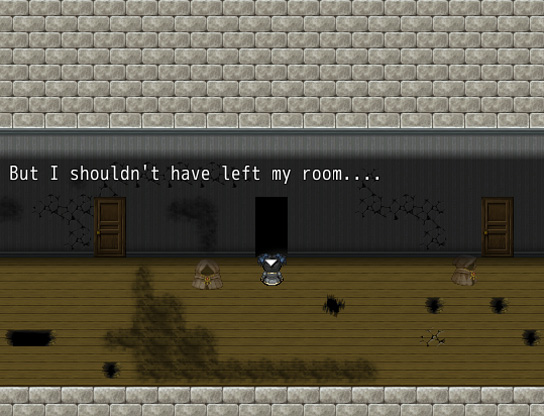
Let me try to articulate this as best I can. The overt antagonist, the monster, in She Who Fights Monsters is Jenny’s alcoholic father. Fighting the Monster, the Alpha Demo, was simpler. It was crude and more elemental for it. For me, it felt a lot more like a generic RPG: especially when you look at Jenny’s room and the imaginary haven inside her closet. But there was an old, faded texture to even these safe childhood places: like that of an old memory. The darker places, however, were dingier. Grittier. It set the tone of a stereotypical, old and dilapidated home where dysfunction and abuse are almost always typically depicted. And even here, it still felt like the aesthetic shell of an old 16-bit role-playing game.

screenshot04

And the monster is clearly Jenny’s father. If you judge the context by the Demo alone, he is the threat that Jenny must avoid. He breaks through all of her childhood illusions of magic, fairness, and innocence through cursing at her. Her Tears and her Innocence do not save her in the simulated turn-based RPG battle. In this one Demo alone, her father’s words feel like a slap in the face but the atmosphere of this world has been building to it. Even so, with Jenny’s mother’s revelation at the end of the Demo, that her father is an alcoholic, it sets a straightforward tone for the game and makes the Demo itself feel self-contained and continuous.

But Gaming Pixie never meant her game to be straightforward. So in the process of changing the game’s name, she also developed its aesthetics in the She Who Fights Monsters Beta Demo that would inform the rest of her game. And I will admit: it felt jarring at first.

screenshot02

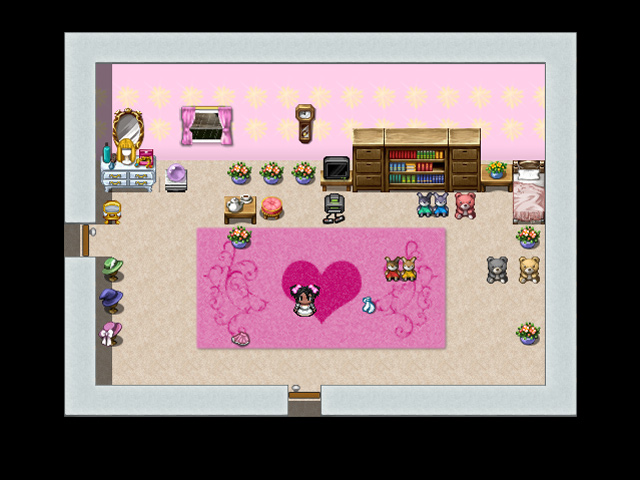
Gone are the dinginess and grit and the fading of peeling memory on the walls. You find yourself with Jenny in a much more colourful and vibrant world. Her toys are brighter. The details around her stand out and the temple that is her imaginary place in her closet is grander and more elegant. Even her home looks more comforting: as much as any middle class home made by 16-bit pixels. Everything, even the nightmares, is vital and alive with colour: as much as any child’s world is at that age.

swfm-room-final

I feel it was designed this way: to make the player feel safe before immediately and brutally introducing them to the world of abuse and its effects on Jenny’s highly impressionable and figurative mind. And, this time around, when the trauma of encountering her verbally abusive father passes she finds herself in her room and her mother entering without even a single explanation. It was most likely made to function as an interactive preview in order create more ambiguity: so that the player could gradually, through the rest of the coming six days, see past the daydreams, imagination, and nightmares of a child to the adult reality of an alcoholic parent.

In some ways, it is even worse this way: to depict a normal childhood and have it impinged upon by the violence of an unknown and terrifying adult world, and the understanding that it will change Jenny’s life. It is a real life horror story of an ordinary world shattered by something aberrant and always lurking under a façade of normalcy.

I felt that both Demos were almost dress rehearsals for the psychodrama that was to come. The title itself says a lot: in that there is more than one kind of monster at work, and as such there are consequences for facing them.

So now we come to the real She Who Fights Monsters. The graphics are further improved — with even greater attention to detail — and you can explore Jenny’s entire house. Day One happens pretty much like it did in the Demos: with one interesting exception. Gaming Pixie ends off Day One from the part depicted in the Alpha Demo where Jenny’s mother flat-out tells her about her father’s alcoholism: the part that did not exist in the Beta Demo. And the scene where Jenny goes out to get some cookies becomes a background reminiscent of strange organic Giger-aesthetics of the horror game Yume Nikki or the Earthbound Giygas battle.

swfm-darkworld02

You, as the player, now know what you are facing and you must play through the remaining days. Yet there is one more thing that you need to consider.

The Memory Bloom is a giant flower that you find past the Temple in the closet. It didn’t exist in the Alpha Demo and I almost missed it in the Beta until Gaming Pixie pointed it out in one of her developer’s blog posts. In the Demo the Bloom itself tells you that it will only become important in the main game and, make no mistake, it is crucial. You will get Locked Memories throughout the game and it is critical to interact — or not interact — with this flower. If you do, you will also realize that not all of Jenny’s memories and experiences with her father are bad. In a lot of ways, it makes it even worse: in that these positive moments and traits in an abuser often make a victim feel bad in attributing negative emotions to that person. It makes the situation all the more complicated than simply Fighting the Monster. What you decide to do will determine Jenny’s future.

swfwm Memory

After all, it took Seven Days, in the Christian New Testament, for God to create the world and its inhabitants and She Who Fights Monsters demonstrates that seven days can create an entire human being depending on the choices that you make, and how Jenny responds to the monster in front of her and the ones forming inside of her head.

There is a quote often attributed to the writer G.K. Chesterton which states that “Fairy tales are more than true — not because they tell us dragons exist, but because they tell us dragons can be beaten.” However, there is another quote, from the fantasy and horror writer Stephen King that is also equally true, that “Monsters are real, and ghosts are real too. They live inside us, and sometimes, they win.”

These are both words to bear in mind as you progress: when on the Seventh Day even the illusion of childhood safety will be ripped away and Jenny will have to start on the path to self-actualization — to adulthood — far sooner than she should. For me, that and my scary and heartbreaking decision to unlock her Final Memory were the hardest parts of this game: to deal with them and to determine what Jenny should do beyond it.

Do you remember when I said that in some ways She Who Fights Monsters is a subversion of a 16-bit RPG? This still holds true even past the Alpha Demo: but in an even more subtle way. I mean, you already understand from Day One that any attempt to fight the game like it is a turn-based battle will end in failure. You already know that not fighting will end in failure. The fact that the game narrative text boxes are in third person-limited perspective, always referring to “Jenny,” “her,” and not “you”: the distance only provides you some illusion of safety.

The perspective is perhaps designed to make you feel that disassociation that a child facing ongoing emotional trauma and abuse would experience: only made more jarring during Jenny’s first-person interludes. These narrative perspectives are very notable departures from Gaming Pixie’s previous Twine-based games: not unlike Christine Love’s don’t take it personally, babe, it just ain’t your story where you are not the character, or even acknowledged as a player. This simply isn’t your story, even if you do influence it.

And when the game does get to the point where it feels like a turn-based RPG battle? Be careful — be very careful — because the thing you need to remember is the end of the first “battle” with Jenny’s father, particularly the words, “Nobody wins.”

The subversion goes deeper when you also consider that there will come a Day where Jenny is hiding in her room and there are clues around. They are extremely clever elements of potential foreshadowing and they are a nice contrast to the beginning of the first Day. For me, the freedom of exploration in Day One — of finding the bathroom, the kitchen, living room, basement, and crawl space —  seemed to set up the beginning of a horror survival game, of knowing all the hiding spots and thinking you have discovered potential secrets only to make it purely about the psychological and the inner world of demons. Aside from the clear mindscape influence of the Silent Hill series, this game is reminiscent of the game Eversion in that sense: only instead of the aesthetics and gameplay changing over time from something brighter into something grimmer, it is a dynamic that goes back and forth between states of atmosphere — always in Jenny’s head, because we are all seeing this from Jenny’s head — until a final decision is made.

When I first heard about the concept behind what would become She Who Fights Monsters, I was reminded of another game based on a child creating an imaginary world to deal with an alcoholic parent called Papo & Yo. Yet aside from the fact that both games have autobiographical elements, child protagonists, and monsters for fathers that hurt them even as they love them there are obvious differences. Papo & Yo takes place in a fantastic equivalent of a favela –a Brazilian slum — and in all realities it is three-dimensional, while despite the aesthetics of its Alpha Demo She Who Fights Monsters takes place in a normal looking middle-class home. Monster, the Papo & Yo protagonist’s enemy is sometimes his companion when he isn’t in a rage, while it is clear that despite some good memories Jenny’s father is never really her friend nor does he help her in her game. While Papo & Yo is more distinctly a puzzle and deadly hide-and-seek game, She Who Fights Monsters is indeed a story that you mostly observe: sometimes very helplessly. And, of course Quico is a young boy and Jenny is a young girl.

You might think that the latter distinctions mean very little and indeed, they are both children placed into situations that no child should ever have to deal with: confronting their parents as enemies. But then there is the elephant in the room to consider. In a segment of her article regarding Gaming Pixie’s epic Twine game Eden, Soha Kareem observes that the former is “an accidentally political game.”

swfm paths

The fact is, Jenny is not only female but she is also “a person of colour.” It can’t be stated enough that, at least to my knowledge, just how rare and unique it is to be playing a game with a young Black girl as its protagonist: in her own story. In a medium that is still struggling to represent different identities in its games, it is definitely something to take note of. However, I am not qualified to talk about “race” or its implications: and how the race and class of Jenny’s family affects her story, if at all, is a matter I will leave to more capable writers than myself. Indeed, this matter seems more “incidental” than “accidental” and Gaming Pixie herself is more focused on the situation and survival of Jenny as opposed to her background.

But there is something else I’d like to note that Soha Kareem also states. In her writing on Gaming Pixie’s Eden, she points out that “The game’s endings and achievements are determined by your karmic choices.” She goes on to explain how, in Eden, how Gaming Pixie subverts the video game trope of the protagonist needing to manipulate their love interest as an object into a relationship by making it so that the player must genuinely act like “a good person” in order to gain that level of trust. The point is, Gaming Pixie is both sneaky and honest in the sense that your choices have clear moral consequences. Even in She Who Fights Monsters, depending on what you do with the Memory Bloom and what you choose to remember, some paths will be open to you, some closed, and some will exist only for one tenuous moment of conscience.
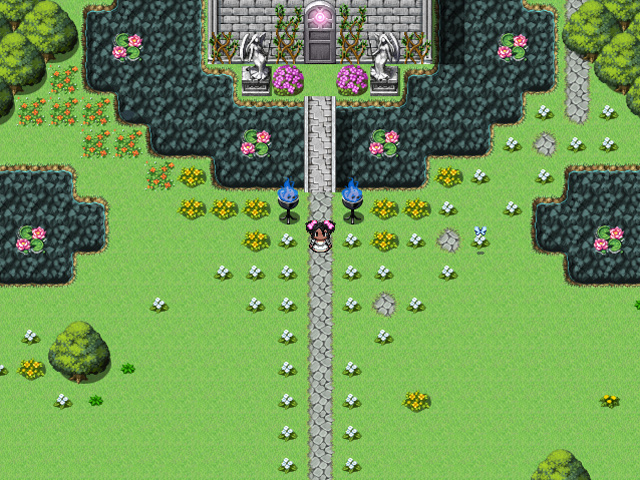
temple-final

I won’t spoil the endings for you, but I will say this. When I play a game, particularly one with this kind of detail, I like to get all of its information so that I can actually make an informed decision. Even so, remember what I mentioned about being careful when you find yourself in a combat situation in this game? Well, if you make a certain choice and you like to be violent and go all Sith you should know that, if you do, there are consequences. You may become the monsters that you are fighting, the demons in your mind, and it might well lead … to a whole other game entirely.

So please, download Gaming Pixie’s She Who Fights Monsters — which is supported by donationware — and determine how this horror story ends, and where others might well begin.

Poets In Hell: Kindling the Flame Till Wildfire

I’m going to warn you, right now, that I will be promoting and talking about POETS IN HELL for some time.

There is still a lot more left to do. The infernal delights of hell are not finished yet and I will definitely keep you all posted on those: or, rather, they will keep you posted.

It’s funny, you know. When I started Mythic Bios about two years ago, I was in an autobiographical head space. Many of my stories were personal, or taken and worked from personal material.

And now? Well now, I find that I have quite a few ideas for story and projects but –with a few exceptions — none of them are really about me anymore. And perhaps that’s not such a bad thing. Before my work in hell (take that phrase any way you’d like), I wrote about my life as though it was pretty much academic at this point: as though many of my greatest achievements had already been put behind me and I was just existing to record and rework what was left. It was a quiet, contemplative core of time within a chaotic sea of workaholism.

But now, it’s less about me and more about the work: if that makes sense. The work will always be a part of me and my experiences and knowledge-base will inform it. Nevertheless, I like working in other worlds … and making my own.

So now, let me finish this post off by presenting to you our first press release of POETS IN HELL:

Poets in hell press release 1

This was created on Friday the 13th on a full moon. I’m afraid that unless it was also made and released on all Hallows Eve, you can’t get more hellish than this. And that isn’t even taking into account the pain, suffering, diabolical delight, metaphysical explorations, philosophical quandaries, myth-making, and maniacal humour found within these pages. And seeing my name next to all of these awesome writers makes it all worth while.

I’m still a workaholic. There is still chaos, but now my core in this madness is active. And, as I said before, there is still so much work left to do.

So please: spread this release to herald the reign of Poets and consider, if you pardon the phrase, helping to kindle its flame.

You Never Know: Resurrecting a Phoenix and Moving On

I’ve been writing a lot on here lately again. There is so much else that I am needing to do, but now I just want to spend some time and really get contemplative on something.

I still find it really amazing just which of my articles garner the most attention. When I first wrote my When I Recognized Elfquest article, I had no idea that so many people would find it fascinating or even relate to it: never mind having the Pinis Favourite, Retweet, and Share it throughout the Elfquest community. The fact is, you can never predict these things. I wrote that article back in 2011 and it sat on my Facebook without input of any kind until I realized, after my hiatus, that it was time and I brought it here–with some revisions–to where it rightfully belongs. I actually have another Elfquest personal story in me. I’m not sure when or where I’ll post it but hopefully I will share it one day.

And then there is my Sequart article On the Art and Cycle of Proper Suffering: The Artist Figure in Phoenix: Karma. That article has its own personal story as well and, as I sit here late at night, I consider the place from where it came. It was originally a paper for a class in my Master’s Program. It was conceived and written in the 2008-2009 period when York University was on strike and, as such, many deadlines and time tables were severely messed up. We ended up having to do Fall term papers during the beginning of our Winter term. It was not a pleasant situation.

Nevertheless, I liked my class and I decided that I wanted to write a paper on Tezuka Osamu’s Phoenix: Karma: as I consider myself an artist, who sometimes emotionally suffers and, as such, finds sympathy with that work. I had a lot of challenges to face when writing that paper. Between continuing to live on my own at the time, and juggling my other assignments and relationships in addition to the readjustment of the school year I found that I had to ask for a few extensions on the paper.

It was towards the end of summer, or what I termed at the time the Summer of Hell when everything seemed to be falling apart, that I finally emailed the final draft to my professor. There were a lot of things wrong with my paper back then. I barely grammar-checked it, never mind read through it, and it was barely twenty of the twenty-five pages that it was supposed to be. But I reached a point where, quite honestly, I just didn’t give a damn any more. It had been hovering over my head for so long and I just wanted it done so I could finish the last of the original term’s work and move on.

After going to a much needed vacation at Dragon Con in Atlanta, I came back to find that my professor marked my paper and left it for me. I remember telling myself to prepare for the worst. Despite that, it was both a surprise and a slap in the face. The comments that my professor left on my paper amounted to the following: that I hadn’t done the work I was supposed to have and that this was not Graduate school material. He ended up giving me a B- which, I have to admit, was pretty damn generous of him.

And suddenly, the reality hit me and I felt a great deal of shame. Here was this excellent comic that I read in the remaining years of my Undergrad, while I vowed to write a modest paper on and which I rushed when I just couldn’t take it any more. I didn’t understand my professor’s instructions, despite asking him a few times and it frustrated me. I was also, before all of this, a good student and to see those words in front of me, that what I made wasn’t Grad School material, honestly made me angry. It made me so angry after everything I’d gone through that I wanted to quit my Program.

Of course, this was all ego talking and most of the suffering I went through had nothing to do with academics and more to do with the choices I made in my personal life. In the end, it was too much and I just took the paper, put it in my desk drawer, placed it under a pile of other papers and tried to forget about it and the lingering shame of failure.

Fast forward a few years. I was living with my girlfriend and we talked about the paper. She gave me a bit of a reality check and told me what I already knew: that my professor had been damned generous. So I called up a digital copy of my paper and read it. I actually read it. I looked at all the grammatical errors, the bad sentence continuity, the lack of flow between ideas, and even some outright preventable errors. And when I mean preventable, I mean I made spelling errors. I even misspelled one character’s name.

It did not sit well with me.

So I spell and grammar-checked that son of a bitch. I made more transitional sentences. I made the word flow a whole lot less awkward and painful to look at. I didn’t know why I was doing it. I finished the assignment years ago. There was no point. Maybe I planned on publishing a better version. I do know I was toying with doing more research and going beyond the narrow limits of books that my University had available on this subject at the time. But then life happened and I forgot about it again.

A year or so later, Julian Darius saw my comments and my work on Mythic Bios and asked me to join Sequart. At one point, another year later, we were informed of it being Manga Week: that we had something of a call to papers or articles to do with manga, its creators, and culture.

That was when I realized something. My professor was right. Maybe “Proper Suffering” wasn`t Grad School material.

But it is Sequart material.

There were some difficulties of course. I’d evolved a different style of writing thanks to Mythic Bios: a combination of the formal and the profane as I like to say. Even my article on The Stitching Together of a Mythos: Kris Straub’s Broodhollow, for all of its relatively extensive footnoting, still had the informal aspect of contractions and some personality on my part. In the case of “Proper Suffering,” my idea was first to re-adapt my old paper into an article that specifically focused on the manga of Phoenix: Karma itself and then get rid of the internal citation and the formal arrangement of language in the paper. But first, I eliminated the extra material on Japanese modernity in the paper. I narrowed and focused it solely on the manga. I added more to the title of the thing. And then I remembered something another professor said to me about my work with comics at York. She told me that I needed graphic examples to complement my written work as that was the medium I had chosen to examine.

So I looked for scans of Phoenix: Karma panels on the Internet. I did not find much. I tried to scan my own copy professionally but it didn’t work and it would been too expensive: especially for bad copies. I did work on Neil Gaiman’s The Sandman Overture #1 in the meantime and forgot about it until I was asked to contribute another article. So that was when I decided to bite the bullet, place the graphics in that I could get, create transitional sentences between parts because, at this point, I realized “Proper Suffering” was at least three serialized parts in Sequart format. I even added in an extra part examining the kleptomaniac Buchi, whom I didn’t have the time or the energy to look at before, though she was important in the artist Akanemaru’s future decisions.

Then, finally, I sent it in.

And there it is. It still isn’t perfect. Sometimes I wish I added a bit more about how the artifice in the ancient Japanese city of Nara in Phoenix: Karma was representative of the Hindu and Buddhist concept of maya: that all of reality is an illusion of sensory addiction and suffering and how Nature leads to a truer state of non-being beyond ego: or nirvana if you’d like. I feel as though some of the graphics are not quite positioned in flow with the words of my article and then there is the occasional awkward sentence. I thought very few, if any people, would want to see something so painfully, bluntly, academic. It was a relic from another time in my life and I had reinvented myself in many ways much like Tezuka’s emblematic fire-bird.

But then I noticed something. People were retweeting my article in all its three parts. Not just Sequart and my peers there, but other places and people like Brigid Alverson and Tezuka in English. I mean, I was told by Julian that there were few scholastic English sources that focused on manga in depth, but I didn’t believe him. I thought what I made was mediocre at best or at least serviceable. I still think that to some extent.

Yet having “On the Art and Cycle of Proper Suffering” acknowledged really vindicated something for me. It’s one of the few things that from that point in my life that I could go back and give another chance. It was the only thing I could fix. And I did fix it. I resurrected that work like the namesake of the book that I examined and made it better. I suppose, in the end, in doing so I didn’t just make a good and reasonable article but in so doing I also redeemed a perceived failure and honoured a part of my life: with something to show for it in the end.

Perhaps that is one of the real lessons that Tezuka’s characters should have taken when hunting for the legendary phoenix. Like the ancient Sumerian hero Gilgamesh realizing that a mortal life of accomplishment is far better than one of perceived eternity and perfection, I realize it was the process of searching for the phoenix and that even though the pain was a part of it, it was only part of a totality.

So yes, sometimes you just don’t know which of your articles or writings people will like, or become relatable. Sometimes you just have to keep moving on.

Tezuka's Phoenix v4 p108

For Crystal and Castle: An Author Quest Ends and a Gelfling Gathering Begins

Last week, The Dark Crystal Author Quest to write the first novel of The Gelfling Gathering finally ended. Twenty-five excellent writers were given honourable mention and five were chosen as finalists. It still really disappoints me that I couldn’t find the time to enter the story that I had planned. I was working on another submission at the time and I had to make a choice. Suffice to say, it was not an easy decision to make and, hopefully, I will be able to show all of you the fruits of that decision one day soon enough.

However, I did manage to do something during that time. As a treat and in honour of the Author Quest’s success, I want to show you the introduction that I created to start off my Dark Crystal Gelfling Gathering tale. I hope you will take it in the spirit that it is given and enjoy. Its working title was Dark Crystal: For Crystal and Castle.

It was over nine hundred trine ago that the Great urSkeks, wonderful, luminous, glorious beings from the highest realms who had come to bring wisdom and enlightenment to our beautiful world of Thra, finally left us. They had come to our home for contemplation and, having gained the revelation of their true selves from the divine Crystal of Truth, they left us with one final task.

Before the urSkeks, we were small and lowly. It was not until their blessing that were chosen as Stewards of their Castle of the Crystal: to guard it, Gelfling, Podlings and all of Thra from the evil that still surfaces to this very day.

For the soul stealers, ugly, twisted monsters that would take Gelfling children in the night for their shadowy sorceries were locked away: banished to their prison in the Mystic Valley from which they shall never fully escape. Our Adversaries were held back and imprisoned behind the wards of the urSkeks, whose power we still maintain and they cannot ever fully escape: let alone dare approach the Sacred Crystal to see what cowards they truly are inside.

Nevertheless, the soul stealers are crafty and clever.

To this very day, led by their dark and insidious Master, these cruel wizards still lure Gelfling victims to their Valley. And sometimes it is even worse. Sometimes, some–not all, but some–of the soul stealers find ways out from the barriers that seal them their infectious nature from the rest of Thra and seek to interfere with, and corrupt, our great and glorious realm.

This was the reason why the paramount of our kind, the beloved and enlightened Emperor skekSo First and Only of His Name, created the elite Castle Guard and made his Empire of all Gelfling civilization and Podling principalities. This is why we have decided to teach those worthy among you Gelfling the arts of war and defence.

And while a soul stealer cannot be destroyed by Gelfling or Podling hand, with your help we can capture and contain the menace of the wizards–to keep the dread Sixteen from liberating their entire body–until that great and glorious day when a thousand trine shall pass and the Third Great Conjunction brings glory to the Empire, peace and order to its loyal citizens, honour to the Guard that defends our Lordly Stewardship and the Crystal of Truth, and eternal oblivion to the soul stealers and their corrupted followers.

Until that momentous day we must remain forever vigilant. Everything is connected and it will only be through our sense of connection and our trust in his Imperialness the Great skekSo that we will all find true harmony.

This is our duty and our gift. This is our peace to all of Thra.

Remember the oath of our Guard: “For Crystal and Castle.”

— written by skekLi, Noble and Humble Poet Laureate of the Skeksis Empire

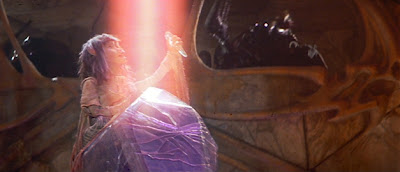
File:Castle of the Crystal - Pure.jpg

This was, sadly, as far I officially got. But I had plans. I’d written a whole lot of notes asking myself questions about the Skeksis, the urRu Mystics, and the Gelfling, their different Clans and what kind of plot I could make out of all of it.

But as the second part of my treat, I will tell you what I roughly had in mind.

I really planned on writing about Rian, the Woodlander Gelfling Guard slowly discovering that his beloved rulers were in fact some of the most evil monsters that he has ever met. I wanted him and his Spriton friend Jul to be rivals in the Guard and when Rian finally did defect away from the Skeksis, he would have to face his best friend until, finally, the latter saw the truth and came to his side.

During this time, the Guard are actually trained and led by three Skeksis: skekVar the General instructs the Gelfling in land-based combat, skekSa the Mariner drills them in naval war, and skekMal the Hunter teaches the Guard survival skills and the art of stealth and, well, hunting. I wanted to make three things clear. First, skekGra the Conqueror was once a leader and instructor of the Guard before he was exiled by the Emperor along with skekLi the Satirist. The second is that Emperor skekSo sometimes displays his martial prowess during Castle Festivals and the Guard are in awe of his speed and sheer power. And, third, that all the Guard feel very uneasy about skekMal. He has this way of looking at them as though they are just pieces of meat. Sometimes, some of the Guard go missing during the night. Not always, but occasionally and while the “soul stealers” are blamed, some of the Guard wonder.

Of course, it is revealed later that skekMal basically trains the Guard to hunt only to hunt them down, in return, much later after he puts on his mask and tracks them. It is basically a sport to him to “play with his food.” Even the other Skeksis find that somewhat disturbing. He comes and goes whenever he feels like it and he supports the two Skeksis in exile when it suits him. I was also toying with the idea that it is on a mission to “find” the exiled Skeksis that Rian discovers more about them.

Basically, this side story, or first book even was going to have the Emperor send the Guard to stop skekGra and his associates from attempting to make their own rebellion with Gelfling followers. If skekHak the Machinist hadn’t been killed in the second volume of Dark Crystal Creation Myths, I would have used him to create a makeshift essence-extractor: a cruder version of skekTek’s. However, perhaps skekMal had his own portable device made when he threatened skekTek. Remember: the Gelfling Gathering takes place before the Emperor had sole access to essence, so it is possible that something like this could have happened.

But in any case, I saw Rian and the Drenchen Gelfling Gurjin as childhood friends. Gurjin, for a swamp-dwelling Gelfling, was the more scholarly of the two in my mind and he wasn’t a part of the Guard. When they weren’t playing Jarra-Jen and Creghel the Tyrant, they played Three Suns and the Moon: each of them was one of the suns and an old childhood female friend was the moon. I picture her as a Vapra and perhaps, in their minds, the future Queen of the Gelfling Clans.

Eventually, Rian discovers that there is a Gelfling Resistance led by the hidden Gelfling Queen. As it turns out, almost a century ago, the Sifa Gelfling Gyr and the Vapra Lady Kel witnessed the actual creation of the Skeksis and the urRu. Kel, becoming the next Gelfling Queen, secretly passed on the knowledge of what happened through dreamfasting with her successor and a select group of loyal Gelfling. They didn’t know what to make of what they saw and so they waited. They waited for a few generations: knowing that they didn’t have the power to oppose the Skeksis directly and that their own pacifist nature, with the exception of perhaps the Spritons that were so close to the Skeksis’ corruption, would limit whatever they could do for now.

I decided that Rian first acts as their spy in the Castle and then he finally just can’t stay there anymore. Maybe I will tell that story one day: though it will definitely be fanfiction unless the Henson Company or Grosset and Dunlap are ever looking for short stories. That story was going to be my entry. And if the third Dark Crystal Creation Myths book doesn’t destroy its continuity, then it definitely will be a fanfic.

But as for the rest … Rian sees the beginnings of the proto-Garthim developing in the cave tunnels of the Castle: supervised by skekUng the Garthim Master who wants to supplant skekVar as General and skekTek who hopes to get more prestige out of helping him. I see them as red and raw without their organic carapaces at this stage. Rian and his friends run into the real Gelfling Queen: a young and mute Dousan Gelfling. She has mastered Dream-etching: the precise ability needed to bring something from dreaming into physical being. She will become the central architect of the Wall of Destiny. They attempt to mobilize the other Gelfling, but they need resistance and disbelief. But gradually, they would pass on what they have learned through dreamfasting.

At this point, the Skeksis become aware of what is going on. As they pass the cover story of there being missing shards of the Crystal, as the Gelfling group has revealed that it is damaged, the Castle Guard is led by Emperor skekSo himself, along with his minions, to take care of the Rebels. Unfortunately, for the Skeksis, the Guard are all converted to the Rebels through dreamfasting. I planned, at this point, for the urRu to get involved: as the protagonists were staying in the Valley: having realized that the Skeksis’ accusations against them are obviously false and the Skeksis are the ones kidnapping and “draining souls” from Gelfling.

There was an epic duel between the four-armed combatants: urSu the Master and skekSo the Emperor. These are not the decrepit beings we saw in the film, but two powerful opponents in the prime of their lives. Each blow they land on each other also affects the other one and they gain cuts and injuries that match each other’s own. SkekSo only retreats when he realizes that his Guard have defected and his other Skeksis are facing similar problems. SkekSo vows revenge and flees. The Gelfling either do not notice this phenomenon or simply do not understand and it is understated. It is also during this time we are introduced to urVa the Archer: the one Mystic who seeks to actively destroy his counterpart in the form of skekMal.

UrVa spends much time teaching Rian and the others how to fight, as he is a martial arts master, and when the time comes to leave the Valley and go to organize the other Gelfling, he chooses to go with them: being the only urRu who can actually find it in himself to actively interfere in what is going on. Later, as they get to the site where the Wall of Destiny will be built, this is when the Skeksis get nasty and they send the three militaristic Skeksis with a mass of essence-drained Gelfling husks, literally zombies, to destroy the Rebellion.

By this point, it is a bloodbath. And what is worse is that skekMal starts picking off Gelfling from the shadows of the Vapra’s trees (I assume this their territory is close to where they are building the Wall) with his crossbow. He and urVa have a standoff. UrVa hates everything that skekMal stands for, representing the aggressive side of him he despised as an urSkek, while skekMal hates urVa for being that weak and hesitant part of his original self whose deliberations cost lives back on the urSkek homeworld.  In the end, they both shoot each other at the same time: a former whole being in conflict with its dual aspects.

Rian holds urVa’s dying form in his arms. UrVa asks Rian to kill him, but Rian doesn’t understand and refuses. He then goes and finishes off skekMal: who had killed his father not too long ago. Both Skeksis and urRu die. Then the seven Gelfling Clans, all knowing what the Skeksis truly are, congregate and the Wall is created.

File:Prophecy.jpg

It awakens the essence-drained Gelfling husks from their living death and the remaining Skeksis are forced to retreat. But Rian, the Queen and the others all know that this far from over. Nevertheless, there is still hope and wonder in Thra.

This is, sadly, as far as I got in my notes. And there are so many gaps. I still have difficulties describing our world’s geography, never mind Thra’s and its unique solar system. There is also so much story there and many story lines that I could have done with the mariner Sifa, the desert-dwelling Dousan, and the underground Grottan. I did plan on having each chapter dedicated to, and function from, the limited third-person perspective of the character: Skeksis, Gelfling and perhaps even an urRu. You know: much in the same that George R.R. Martin structures his chapters in A Song of Ice and Fire.

But I didn’t get to it. Nevertheless this process of world-building kept my mind occupied and got me into some good discussions on The Dark Crystal Community Forums. I’m also pretty sure I learned something and, in the discussions themselves, I even suggested corrections for their entries into the Encyclopedia. And what is even more awesome is that the other authors that didn’t get into the finals have a similar idea to mine and have posted links to their stories in the Forums and in the Fanfiction section of the Dark Crystal website.

The fact is that my experiences in the Quest, for all I didn’t make a story, deserved its own honoured place in my Mythic Bios and it is excellent way to show you how my creative process and, well, my mind works.

I will say it again: everything is connected. Everything is connected and I am glad I connected my creative mind to the world of Thra. Therefore I salute my fellow writers and posters, as well as the Henson Company, and my story that could have been and in the words of the Castle Gelfling Guard I planned to create let me proclaim proudly, “For Crystal and Castle.”

A Surprise Post Appears! La-Mulana, an Age, and Solo Jamming all Entwined.

I have been meaning to write here for a very long time. So I am going to write behind my own designated schedule and wave hello at all of you.

So I am still alive and I am hoping to write here again a lot more often now. For those of you don’t know, I went on something of a hiatus to finish a short story that may have me see actual print: as in something actually published in print in addition to my poem in the art book Klarissa Dreams. That is all I can really about that at the moment, but please stay tuned.

In the meantime, however, I have been busy with other things as well. So where do I even begin?

Well, I participated in the Unwritten RPG Kickstarter Campaign. I essentially made an Age for them. In case you don’t know, Unwritten is a table-top RPG based on the universe of Myst: in which you must go through several Descriptive and Linking Books that connect to other worlds. The D’Ni civilization figured out a way to write Books that allowed people to link to other worlds or gradations of a particular world: or Ages as they are called. I read the books and played two of the games in my formative years and for about a decade I had an idea for an Age and a people.

There were some changes I had to make, but what resulted is pretty impressive based on a creative collaboration with the team. I can’t wait for it to come out so I can show people that I was part of the Guild of Writers and I finally made my own Age. My nineteen year old self would be proud of what the thirty-one year old me has become capable of doing: at least to that regard.

I also admit one other thing. So you know the game I vowed never to play? Well, I am playing La-Mulana now. In fact, very soon the La-Mulana 2 Kickstarter will be making more Fan Art Updates and my Twine story The Treasure of La-Mulana will be featured in one of them. I will be on the look out for that and at some point I will link that update to all of you. It’s funny. I have gotten to know quite a few people through this game and it is perhaps one of the few sources of real community that I’ve felt in a really long time, if not ever. I am not a game-designer in the programming sense. I am a writer. Of course, Christine Love herself said the same thing and look at the places she is at now. Granted, she has programming knowledge and I don’t. But that’s ok.

In fact, I hit another milestone relatively recently. I attended the 2014 Toronto Global Game Jam. As some of you know I participated in the event last year, but armed with a basic understanding of Twine, I registered as a Solo Jammer and completed my first Twine game as such. I go into a little more detail about that on my G33kPron article Experiences from the 2014 Toronto Global Game Jam, but given what this Blog is about I wanted to talk a little shop about my game.

The Looking Glass was an experiment. After my Treasure of La-Mulana fanfic, I realized I could tell an extensive story with Twine, and use the hyperlinking transitions to control how much text the reader sees, and how much I wanted to pace the narrative. My Haunted Twine was an earlier attempt at this, but it was a lot clunkier and it still has issues that I need to address in future works. But I wanted to add more of an interactive element besides clicking on words this time around.

In addition, I was following a person’s experiences with a particular game online and, as my brain often works, I combined a few ideas together and came up with a concept and a few notes that you can see in all of their natural idiosyncratic handwritten glory down below.

I had a choice between this and a game about a serial killer. I was at first happy with neither of these concepts as I wanted to make something very personal and me for this Jam, but when I realized that my version of a “choose your own adventure” Twine game about my experience at the Jam itself would not be good enough at this stage in my development, and not really feeling the killing thing by the second official day of the 48-hour Jam I went with my original, very complex yet simply elegant idea that I should have taken more than two days to do. I may create more games like this one in the near future. In fact, I may be personally showcasing this one at the Toronto Global Game Jam Arcade in April. We shall see.

So now that I have at least four working Twine games or stories, I decided to expand a branch of Mythic Bios to contain them. You can find it on the menu bar above or click here on this link. I thought I would only make two relatively big Twine novels, but it seems my brain had, and needed, other plans. Perhaps sometime in the near future I will see what will be done with those.

And seriously ladies, gentlemen and other sentient beings, this is it for now. As I said before, I hope to be writing here more often again and I have some plans, as always. I have a few posts that are overdue and I want to fee more time to explore while continuing some of the work that I have been cultivating in my long self-exile. Poor January only had one post. Let’s see how many posts February will have as result shall we? 🙂

La-Mulana 2

Oh and before I go, please support NIGORO and Playism’s La-Mulana 2 Kickstarter Campaign. The universe of La-Mulana is both an archaeologist’s and a gamer’s dream and worst nightmare: it will challenge your ingrained assumptions about gameplay and mechanics. It also has a really nice unfolding story and a quirky character about it that few other games I’ve seen can match. So please check it out. You will not be disappointed and we might get to unlock some goodies without the spikes.

Mostly. Err …

Take care everyone.

The Treasure of La-Mulana

So I have been stabbing my Mythic Bios notebook with my golden pen, but for one brief moment I am going to re-materialize back from the ether to leave you with something. I made this, my third Twine story, a little while ago after watching Deceased Crab play through both the original and the remake of La-Mulana.

This game … for something I have never played and probably never will because I neither have the patience nor the hand-eye coordination, got into my head: into that mythic space that permeates my very being. La-Mulana is an adventurer-archaeology game created by the game company NIGORO and filled with puzzles, riddles, deathtraps, insanity, lore, and vintage video game goodness. It is a fun, but notoriously hard game. But the world and story that NIGORO created got into my mind so much, and so badly, that I went online at one point and looked for fanfiction based on it.

It was there, online, that I found madamluna’s long slow collision and Bones. It was the first story, a Twine narrative itself, and the news that there would be a sequel to the game itself that cinched it for me.

So now: to business. What you are looking at here is a homage–a fanfic–to a game I’ve only seen on Let’s Plays, written in Twine. Basically in addition to this being my third Twine story, this is my first polished Twine fanfic to an awesome and insane game. So while I might not be a “real” fan of the game, in that I haven’t played it, I hope you can all accept me as one in spirit if nothing else.

In other news, I am still hard at work and I plan to make a New Year’s post of some kind. I hope you enjoyed this surprise and impromptu post of mine. I hope to return relatively soon. But, since you have all been very good readers I now leave you with my modest attempt at a homage, at something that will probably be completely debunked and repudiated by the actual sequel to La-Mulana itself. It is a story with events meant to bridge the gap between the two games. So such, please remember that there are Major Spoilers. I hope you will take this in the spirit that it is given.

So good night, fellow explorers, and allow me to leave you all with The Treasure of La-Mulana.

La-Mulana