A World Coming Together, A Possible Paradigm Forming, and Other Stories That Find Themselves On Their Way

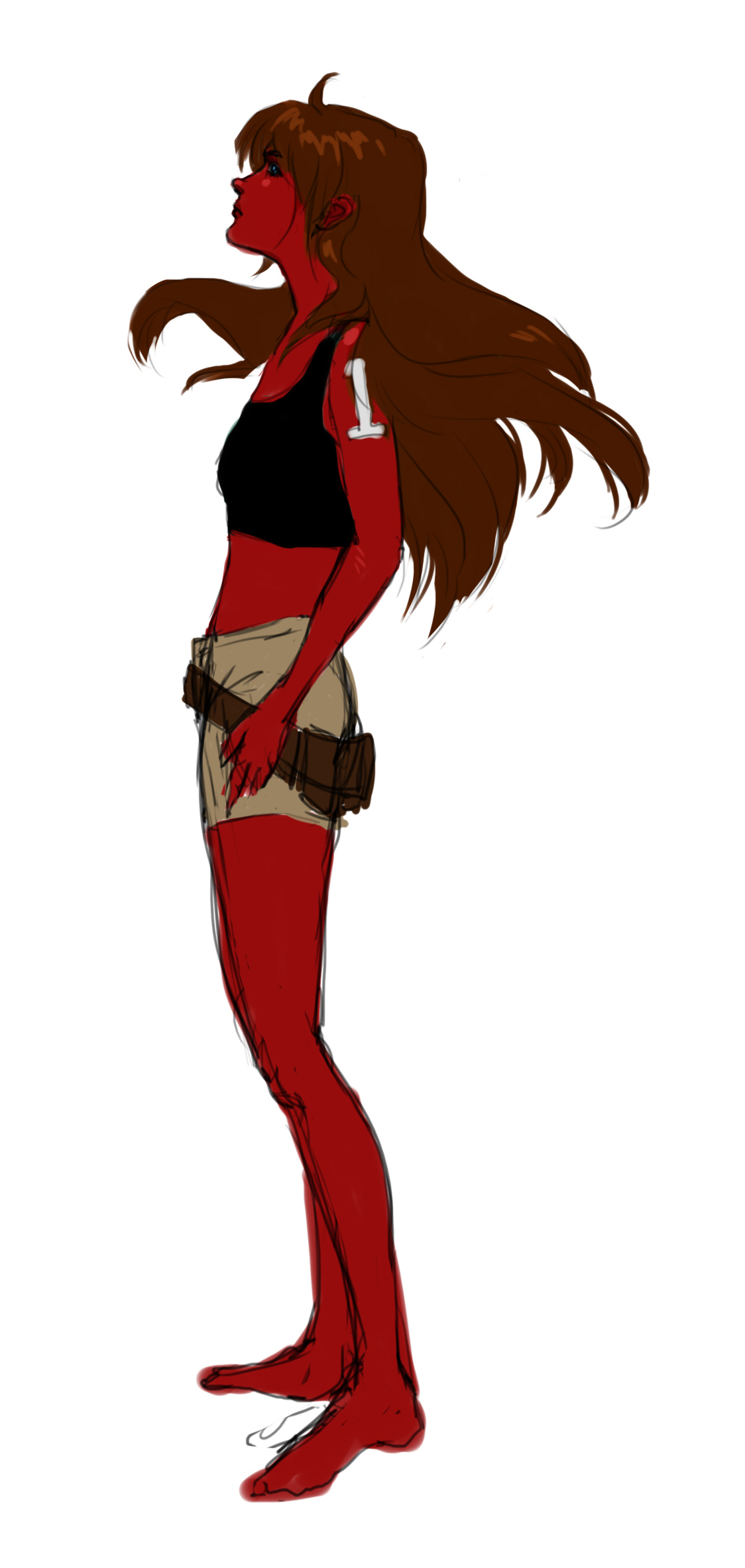
This is Red-One. She is the protagonist of the comics collaboration that Angela O’Hara and myself are undertaking. One day, to inspire herself, Angela decided to create this digital art piece. It is a conceptual drawing of Red-One at about seventeen years old or so, and she is definitely quite beautiful.

So, I did end up naming the characters that we are working on. That might seem strange given that it is supposed to be a silent comic, or a comic without words, but it is a point of reference for us to work from and it adds more character and background to work with too: to bring across onto the page through facial expression, body language, and action.

We have also decided on a structure for the comic. It will be about twenty-four pages and it will have panels. There is just too much, even with the basic story structure that I’ve already made, to dedicate a page each to a different action. Panels will actually give us more room by giving us more pages to work with in expressing the narrative. Like I said, I do have a basic story outline finished and I am going to attempt to do at some point is take a scene from what I wrote, expand on it a bit, give it to Angela and experiment with panels and the page layout.

Panels and page layouts are diabolical in that they both seem to be the same thing, but they’re different. For instance, you can make one panel and then have to decide what goes on in that panel, whereas the page layout is actually how more than one panel–or lack thereof if you want to get experimental about it–is arranged as an overall pattern on paper or screen.

I have attempted with previous works to include panel breakdowns and detailed layout structure for each page into script form–this without an artist partner–and I have to say that it is challenging at best. Luckily in this case, I can hopefully communicate the essentials of what I want to see to Angela, talk through it, see a few versions, and come up with a happy medium. Angela has also been working on a few more conceptual drawings and eventually things will be coming together.

So there is that.

Another thing I have been doing lately is that I am looking into published other works while this collaboration continues. That is to say, I am going to now actively–again–send out stories to electronic and material magazines in order to get more things published. I have a few candidates and a few ideas with regards to what I am going to send. I think I’ll go into that a little now.

I’ve had at least three Lovecraftian story ideas that I have been building on in a purely note-written or scribbled way for a little while now. When I’ve finished one or more, I might send some to Innsmouth Free Press, or Weird Tales (which right now is closed to Fiction Submissions, oh well). I love the fact that Lovecraft is not only public-domain, but there is so much potential to his ideas. His stories are mainly “congeries” (he loves that word, among others)–or connections–of seminal ideas: of things that have informed so many other works long since his time.

Lovecraft’s mythos is not the only thing I am focusing on however. I’m also contemplating sending a science-fiction story of mine to Strange Horizons. There is also a story of mine that I meant to finish long ago, set in Toronto, which I may send to Broken Pencil’s Death Match Contest or directly to the magazine itself.

In addition, I have a few stories I’ve already finished that I realize may be tapping into a niche that is emerging or has been emergent for quite some time now. The niche, paradigm, or Zeitgeist (the “Spirit of the Times”) I’m thinking of is the 1980s-and onward geek nostalgia that is becoming more prevalent every day as well as the usage of allusions and literary references to video games and comics. I have actually been experimenting with this for a long time and I have been polishing off what I have.

I guess the danger is whether what I relate to in this regard will become obsolete sooner than I can do anything with, or even in the future. I mean, will years from now someone know what Google is if it is referenced into a story or will it be some small obscure technical footnote somewhere? Or is our society changing so much with regards to technology that Google and other programs, and even video games will become part of a historical documentation: if only an electronic one? I’m pretty sure cultural shifts celebrating “retro” elements come in cycles, but you can never really predict these things. Sometimes, you just have to go with it.

As for me, the reason I am making strange stories like these–tapping into this–is because I can relate it and it interests me. I can’t tell the future (which is probably for the best) but I’m doing my best to express the forces that have influenced me in the way they have influenced me: if that makes any sense.

So these are my goals along with a few others. I hope to be able to Blog more about these other developments and also be able to keep up with the challenges that I have set myself.

Here’s Johnny: An Introspective Look at a Life in Kan Gao’s To the Moon

All right, there will be Spoilers, so if you haven’t played To the Moon and you want to, please do so and don’t read this yet. As always, you have been warned.

So in my previous article, Going to the Moon with Kan Gao, I basically reviewed the game, its graphics, some of its game-play and story, and also talked about the Workshop I did with Gao himself as well as a little bit about the nature of video games. In that same post, I went a little bit into my personal reaction towards the game, but not as much as I would have liked. Actually, aside from getting to some of the basics, I was a little dissatisfied with what I wrote and felt that there could be more that I had to say.

I logged onto Steam and came across this Kotaku Gamer’s Guide article Steam Users Can Now Buy To The Moon, A Game About Marriage, Memories, And So Much More by Kate Cox: where she writes her interpretation of the events that occur in Kan Gao’s game. And here is where I stop talking about video games and media and go into the matter that I am really interested in: storytelling and character development.

The game itself has you and your player characters–Dr. Rosalene and Dr. Watts–going back through Johnny’s mindscape in order to find a place to create new memories for him so that you can fulfill his dying wish: to go to the moon. But why does Johnny want to go to the moon?

When you find Johnny to do your job in fulfilling his wish, he is an old man on his deathbed. You end up having to go through his mind, and his home, to find out more about him. You are told by his housekeeper that he has always been a very quiet man that keeps to himself. Then when you get into his mindscape, you do find out a lot more about him.

You follow him backwards through his life. You see him as a sad old man mourning his wife–River’s–passing, as a middle-aged man getting increasingly frustrated with fulfilling his wife’s dream and taking care of her while being deeply afraid of losing her, as a young man that is ignorant of his wife’s condition and yet still wants to help her, as a sullen and scared adolescent who wants to feel like he is different, and finally as a child who has hopes for the future.

It is easy–very easy–to get to the point where you start to think that the story is about River and not Johnny. Even the Doctors Rosalene and Watts sometimes get distracted by these memories to that point. But this isn’t about River. It’s about Johnny.

So here’s Johnny.

Screenshot

As we go back further and farther into his past to implant the new memories that will fulfill his dying wish in his mind, we look at Johnny’s life: the good and the bad.

We see a young boy watching his mother accidentally hit his twin brother with her car as she backs out of the driveway. As the investigation of Rosalene and Watts goes on, we find out Johnny was given beta-blockers to take the edge off of that traumatic memory. In fact, if it weren’t for this discovery, their own work with Johnny would never have been completed: those memories being cut off from Johnny and from their own access.

Johnny is a boy who started off with a twin brother named Joey and dreams: who’s life is shattered before it even begins. What’s worse is that he met River as a child then and they promised to meet in a place once a year to watch the “lighthouses in the sky” and by watching them, making sure they will not ever be lonely. He even gives her a stuffed platypus that she carries with her for the rest of her life. They actually promise to meet on the “the rabbit’s tummy” which is–essentially–the Moon surrounded by a star shape they created themselves. Johnny throws a hackey sack down on the spot they stand in to signify this.

But then he loses his brother Joey and the beta-blockers block or severely blunt all of those memories. In other words, he doesn’t even remember meeting River then.

Johnny gets older and he has friends. He finds himself attracted to River, also in the same high school as they are, and seeks to make a date with her. He tells his friend Nick that he only wants to be with her because she is “strange” and he doesn’t want to be “another typical kid in a sea of typical people.” He wants her strangeness–her Otherness–regardless of what she wants, to fill that … need in him: that emptiness that has probably existed since he lost his brother. On a deep and intrinsic level, Johnny knows he isn’t normal–that everything isn’t all right–and he uses the idea of River and wanting her to somehow fill that need created out of hurt and suppressed memories. Of course, perhaps on some subconscious level, there is a part of him that still feels that kinship with her from that forgotten night all those years ago when they were children, and alone, and they looked at the sky together.

Some people have intimated that River probably has Asperger’s Syndrome, but I am not so sure about that. I know that this condition manifests in different ways and there is a spectrum. I do know that River does not perceive reality in the same way as other people and is often very literal in some ways: while highly figurative in others. As time goes on, Johnny discovers that she thinks of merely being in the same room together, and being close together bodily, as pretty much the same thing. And she always asks him questions about what something means to him and what he sees in that thing. For all River is sometimes quiet, she is also very intuitive in a way that Johnny and most other people are not.

Sadly, Johnny has the ignorance of a lot of young men his age. Combined with the trauma and repressed memories of his early life, there is a disconnect between him and River that–at least initially–limits his empathy. He doesn’t understand River’s condition and he doesn’t want to: which is horrible and even more hypocritical considering how–at least consciously–this was the trait that attracted him to her to begin with. It is also clear that this decision is motivated by fear and perhaps even the guilt of seemingly being attracted to her solely because of her difference: as though he is afraid of actually further reducing his sense of her to the “illness” that her doctor wants him to read about.

At the same time, he also coddles her–even going as far as to say that marriage means having responsibility for her–and ignores statements of hers in which she tells him some very clear things about what she wants. When they do marry, he seems to even think of it as more of a responsibility than a joy while River doesn’t feel anything about it at all. At one point, Johnny admits to her the secret of why he had asked her out to begin with: revealing the shame that he felt. They are in the spot where they first met years ago as children. River ends up taking a hackey sack and throwing it on the ground. After that, she starts making origami rabbits: a lot of origami rabbits.

Maybe Johnny didn’t think she understood, or even worse, was angry and resentful at him for the “initial reason” he liked her. Finally, after a while, River begins to get sick. But before this, Johnny promises her to create a house near the lighthouse Anya–named so by River–so that “this star” that was the lighthouse would never be alone. Unfortunately, River begins to get sick and Johnny finds himself in the situation where he has to choose between spending their money on finishing the house (River’s wish), or saving River’s life.

At this point, Johnny breaks down and almost gives up on finishing the house: just to save River. But this is where River puts her foot down and reiterates her wish. Johnny doesn’t understand why this lighthouse or the house is more important than River’s own sense of health. He creates a song for River that even she can see isn’t really about her, and it is incomplete and fragmentary: a cycle that symbolizes what is going on in Johnny’s mind.

Yet, in the end, he fulfills her wish and continues with the house. And two years before the events of To the Moon begin, River dies.

It’s very easy to judge Johnny for what he did, or didn’t do until you remember and realize a few things. River was not the one who was broken. Johnny was. River seems to have a highly metaphorical mind. She threw that hackey sack down on the hill that night to remind him of the real reason he sought her out all those years ago: mirroring what he did as a boy. She always carried the stuffed platypus toy he gave her: even though he didn’t remember that either. And each origami rabbit she made was her way of trying to remind Johnny that they had promised to meet on “the rabbit’s tummy”: on the moon.

Screenshot

Although these actions were non-verbal, River showed that her mind didn’t seem to be bound by linear time. She even hated the sound of clocks: of a construct of time. Everything he told her about his selfish reason in pursuing her, in be willingly ignorant of her condition–whatever it was–didn’t matter a damn to her. All that mattered to River was the boy that Johnny was promising to meet her so that neither of them would be alone.

Then there is Johnny again. He went from being someone with dreams, to being in a haze, to having friends, to finding someone he loved and didn’t understand–and having the answers right in front of him the whole time–to living the rest of his life in the house that he built for his wife: alone. Another thing to also consider is that even though the beta-blockers made Johnny’s childhood hard to remember, he could ruminate on the rest of it: on every mistake that he ever made with River. It is no coincidence that most of the memories Dr. Rosalene and Dr. Watts travelled through circled around Johnny’s regrets. It also makes you if–when the two doctors gave him the scent of roadkill to reawaken his earlier memories of his brother’s death–if on some level of consciousness it made him remember everything. Absolutely everything.

In any case, when he was conscious Johnny had two years after his wife died to think about everything, to regret everything he had done, and make sense of it all.

Screenshot

At the same time, the mechanism of travelling through his memories only chose particular memories of his. The thing to remember is though certain memories of Johnny–powerful ones–came to the fore in this game, he and River probably had many more and they weren’t all bad. Even the prominent memories weren’t all awful. Johnny and River undertook equestrian therapy and actually had fun despite Johnny’s initial misgivings. They went to the movies. They danced in the lighthouse that Anya made. They spent time with their mutual friends Nick and Isabelle.

After River was gone, Johnny kept everything of hers: rabbits and platypus. And he fulfilled his promise to her: even after his own death by giving his house to his housekeeper and her family so that the star of Anya would never be alone. They spent practically their whole lives together and though there was tragedy and misunderstanding, they still had a life, and it was very clear to me that despite their differences they loved each other. Or, as Death from Neil Gaiman’s Sandman might put it, they got what everyone got. They got a lifetime.

In a strange way, what Dr. Rosalene and Dr. Watts do for Johnny at the end of his lifetime lets him meet River on her own terms: in a figurative reality that specifically bridges the gap between them. Dr. Rosalene herself even states somewhere along the line that what she is creating for Johnny in his memories is what River would have wanted. In essence, they–particularly Dr. Rosalene–write a plausible story based on memories and the emotions that were involved. Johnny doesn’t consciously know why he wants to go to the moon because of trauma, but he does on a very integral level. It is the same reason why River made the rabbits and threw down that hackey sack on the hill. River wanted to meet on the moon because Johnny would be there. And Johnny wanted to go to the moon because River would be there: at that meeting that he never made it to again in life.

Johnny’s story in To the Moon was a heartbreaking story about a very fallible but well-meaning man who had a life that despite misunderstanding, moments of ignorance, selfishness, and loss actually meant something. The last scene where Johnny is in his new memories and River takes his hand as they travel to the moon on their NASA rocket-ship–in retrospect–is a tremendously satisfying moment of completion and understanding beyond words.

It’s a story that really makes you look at the intricacies of a life with people. I know it made me look at mine. And, as I’ve said before, it is a story totally worth playing through.

Building a Character to Make a World: Our Project Continues

About a month ago, I said that Angela O’Hara and I would working on a comics collaboration together. So here is an update on our Project thus far.

I gave Angela a whole list of comics artists to research in order to get the right aesthetic for our world. The following inspirations were Jonathan Lethem’s Omega the Unknown, Chris Ware’s “The Super-Man” stories, Saint-Exupery’s Le Petit Prince, the rugged elementalism of the anime Gurren Lagann, Sarah Howell, and Neil Gaiman’s run of Miracleman.

At the time, Angela was not completely sure how to go about this: which was fair given the fact that all I had seen of this world I’d envisioned were a few scenes and figures inside of my own head. It’s amazing how something in your mind cannot always be so easily translated into real life.

After a summer of proposing this Project, I was galvanized into action when Angela said she was going to be pursuing her drawing career full-time now: which is excellent because she is a gifted illustrator and a comics-creator. This was when I realized I needed to give her what I had and, once I did, I realized I gave her more than enough to work with at that point.

In the end, I created a fairly detailed back-story (or at least something far more detailed than what I thought it would be), some character outlines and descriptions, and even some notes on the minions that I’m keen on including in this strange new world of ours. So armed with artistic inspirations as well as character descriptions, names, a background story, and a rough idea of the main plot Angela began drawing.

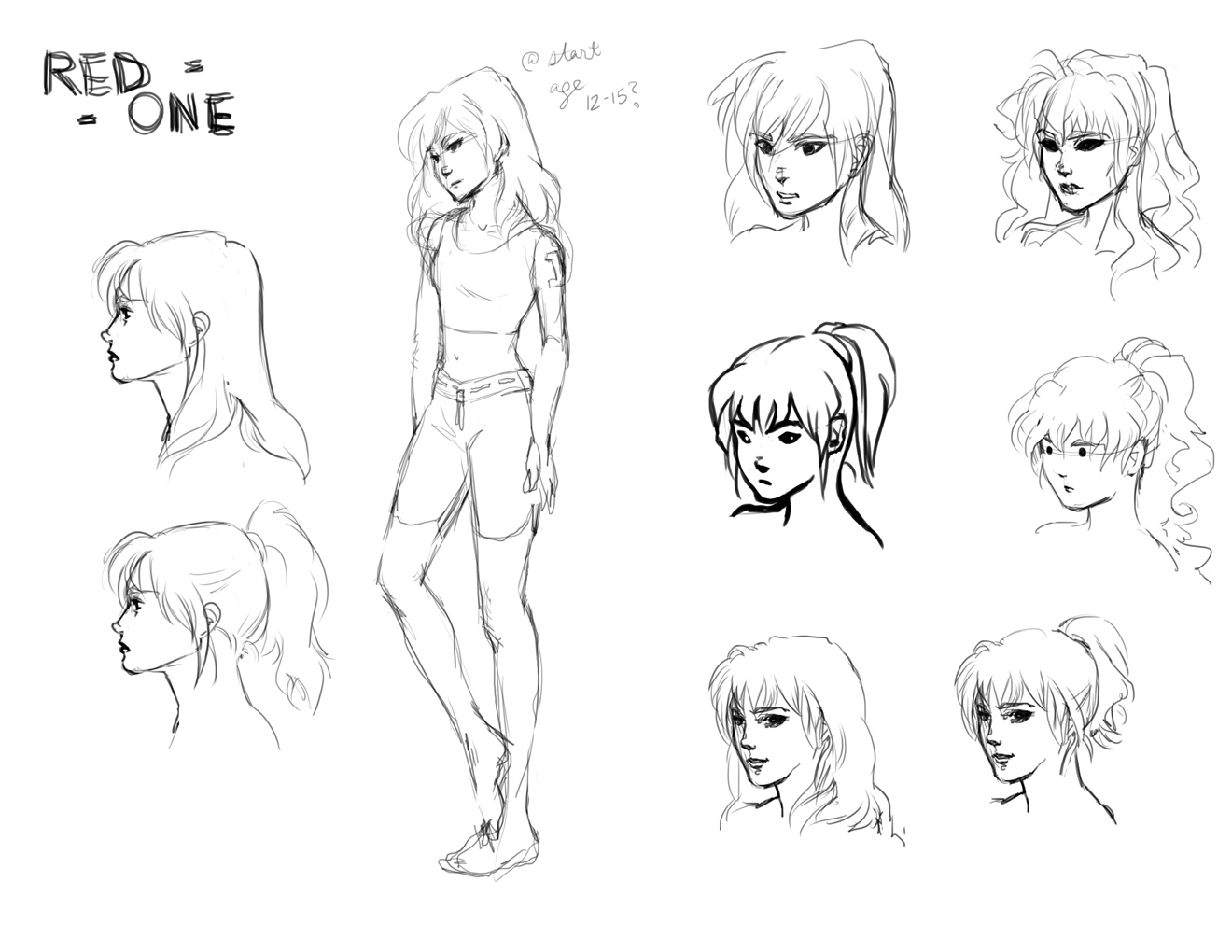
It was when she sent me these first pictures that the challenge really began. As you can see, they are all excellent illustrations of the main female protagonist. Usually, I could have just selected a few and suggested some details here and there, but her features were not as distinct in my mind as I would have liked. Then I started to think about what the world would be like: specifically what we wanted our aesthetic to be.

For two days, I thought about this and luckily Angela and I managed to talk about it. She told me that she wasn’t completely sure what aesthetic–of the inspirations I chose–that she was supposed to use so she decided to draw different pictures of our character in various styles. I felt really torn: because I wanted to see this world as an elemental place of basic shapes but some very realistic elements, but Angela drew all of these really good illustrations. It made me question the fundamental substance of what I wanted our world to look like.

But Angela has a good way of asking the right questions. Not only did I manage to answer some of her questions, but I started to add some details of my own. Another question that really got me was how old our protagonist was going to be and what she would be wearing before she got her costume. These were definitely questions that I needed to answer and in the end we decided on her being twelve or so, with rudimentary clothing that she had been forced to create herself.

Angela was also curious about what costume our character was going to have. She experimented a bit and showed me this:

This is what prompted me to tell her the idea I had with regards to the main character’s costume: and how that was going to fit into the plot. Let’s just say: it’s less than she chooses the costume, but rather that it chooses her … and in unexpected way.

Finally, Angela had an “Aha!” moment and after I chose a few of the profiles that she created and made some suggestions, she managed to mix together something of Saint-Exupery, and something very reminiscent of Mark Buckingham’s drawing style in the illustrated story section of Miracleman #20: Winter’s Tale. As you can see, our protagonist looks like she is painted and has very bright colours. And yes, you’ve seen it right: she is red. 🙂 As of right now, this is the closest working illustration and aesthetic that we have and Angela is still working on it: along with drawing out a few more of our characters. It is just so beautiful, lush, and artful.

Another excellent advantage to having this working model of our whole aesthetic is that I have inspiration. There is nothing more buoying than seeing something you envisioned becoming as close to a tangible image as can be made possible to really encourage you to keep creating. The added bonus of this feeling is that with our last Project, Thebes was supposed to be based off of our re-interpretation of mythology: of stories and characters that already existed. With this Project, we are making something relatively new: something that didn’t exist before quite the way we see it.

I mean, I know: I understand that all superheroes are archetypes and variations of Superman or older mythical figures, but the characters in this story have their personalities and I try to look at the basics of what they can do as much as possible … of which I am now figuring out. It is also very helpful that, right now, Angela and I are on a very similar wavelength in figuring these details out.

In fact, all of this is a process of figuring things out: as though Angela and I are spying on another world and trying to translate it into ours as much as possible. When we’ve done more work on this–and I create at least a rough outline of the booklet–I will start calling the characters and our Project by name. Until then, both will be as silent and as wordless as our comics work itself.

The Power of the Original, the Creativity of Change

In The Source and Its Creative Feelings, I wrote about the emotions and energy that can power inspiration and ideas. In this article, I’m talking about the material and the quality of it that can fuel that kind of inspiration.

So I was watching the classic 1963 film Jason and the Argonauts last night, and it occurred to me just how much it was tangentially in there in the culture of my childhood. It wasn’t so much the movie itself as it was the aesthetics and the attitude of it. In fact, the only film that really comes to my mind with that same spirit is Cecil B. DeMille’s The Ten Commandments.

Whenever I thought of the ancient past or mythology as a child, I used the imagery of these movies and others like them to inform myself of how both should have looked like. Then I fast-forward this concept of mine by a few years. I used to think that the fantasy genre were all stories like The Hobbit and Lord of the Rings, followed by Dragonlance and Forgotten Realms, and I tried to write exactly like them: especially the latter two series.

I thought that some of my more weirder story ideas–including an alternate storyline with The Ten Commandments–were silly and a waste of time, or at the very least beyond my means and personal faculties to create at the time.

This was before I realized that there was original source material.

Every story ever made is an echo of another story that exists before it, or coexists alongside of it in another form. But every story as a source: a prototype or “Ur-Text” (Ur being a term for the mythical first of something, such as the first ever human city-state) or place that is tapped into.

I believe that every creator taps into that source. However, I also think that the strength of a creator’s link to that source all depends on where and how they tap into it. Originally, I was going to say that a creation inspired by an original source–or the closest known or accessible thing–depends on one thing, but after thinking about it a bit more I realize there are two elements involved.

The first element is, like I said, finding the earliest myths or art-forms that you can read, understand, or learn to understand and take inspiration from them. They are the closest things to the source, or what the famous mythologist Joseph Campbell called “the mono-myth”: the supposed first story that all sentient human stories come from. I feel that once you learn to understand the spirit of the earliest story or source that you can find with regards to your work–and specifically use it to gain your own personal creative slant on it–then you have gained something powerful and you are more than on your way to augmenting or discovering your own creative voice.

But then there is the second element that I thought of very recently: which is that once you gain an idea of the original source material that created the story or story-type you are working on, you must make it timeless in a way that everyone can relate to, and therefore make it relevant. Take what you have learned or understood and apply it to your time and the issues and themes that are important to you as a creator, a person, or even both.

Think about it: before DeMille’s Ten Commandments, or Jason and the Argonauts, all there was to determine how the ancient world was, and how their myths functioned were books, broken sculptures and fragments of art. The creators of both films had to go through all of that material and decide what they were going to use or change. I won’t even go into Ten Commandments, because there have been many other films and stories created from that Biblical tale at different points in time, and even the ancient Greek myth of the Argonauts has changed throughout time and culture as well.

But what I am saying is that the creators of both looked at the original sources as much as they could and made something, and added character and motivations that audiences could relate to. Even J.R.R. Tolkien looked at ancient Nordic tales and history in the creation of his Middle-Earth: which in turn informed how a lot of the fantasy genre derived from it would be for a time.

Like I said, I do think that knowing the original source of something gives you a special insight into that thing and in making something that is either a homage to it, or a unique derivation. This is what I have adopted for a lot of my writing and creation process. It gives you more to work with and more to change should you choose to do. And that is the key here: knowing the closest source gives you more choices … especially with what you want to reveal what is important to you about them and other people.

When I was growing up, I took films like Jason and the Argonauts with its stop-motion clay animation less seriously than I did the developing CGI graphics coming around then. But now, looking back I realize just how much of that influenced the creation of CGI and what film-making could be: as well as storytelling. Maybe it’s because as a culture now almost everything that is “retro” or considered old is popular and new again. Of course, as some other popular cultural articles suggest this could be all be just part of a cycle that happens with every decade or era.

My era of the 80s and onward, as well as the things that inspired them in earlier years, has become a lot of my source material and now I am starting to realize that I can express it. This is a good thing. The possibility that some of the quirky weirdness in some of my stories may have been inspired by Joss Whedon’s irreverent flippant dialogue in Buffy and other shows is an added bonus: from my perspective anyway.

Really, I just like creatively messing around and reading and watching old, good things and good new things for universal and innovative storytelling ideas. I probably could have summarized this whole post into that one sentence, but there you go. 😉

What Nostalgia is Made From

It was in the winter of 2008-2009 that I came up with Nostalgia. It was my first winter living on my own and as such I was spending a lot of time in my apartment. This was the point where I was training myself to write something each day–publicly–to put my writing out there and alleviate some of the isolation and loneliness that I was feeling at that time.

Spending a lot of time in such a relatively small space–in a room of my own–gave me time to think. I thought back to the woods behind my old high school of Thornhill Secondary and how a friend of mine and I used to walk through them talking about different things. I had a few key lines of “Nostalgia” written down already at that point, but I needed a context for them.

Originally, I imagined a scenario with two childhood friends–two boys–who meet in the forest. One of them leaves and goes on with his life, while the other one stays in the woods and never ages a day. Then one day, the friend that left returns as a much older adult–having been worn down by time and experience–while the other is still young but in many ways much, much older than the other. I was also inspired by the times when my class in elementary school would go on overnight trips to places like Montreal or Paris, and I’d stay behind in the “skeleton-crew” class. At one point I’m pretty sure I was the only student of my grade in one class.

Sitting in my apartment made me think about a lot of those feelings, and the past, and that essence of it that I wanted to capture in a very precise way: an eternal and universal moment. I’m not sure what made me change the story to what it is, and making it only one central protagonist: one little girl. If I ever knew, I’ve forgotten, but it worked out well.

It is the best vignette I’ve ever made and I am proud of it. It cuts like an icicle into a human heart, and drifts away as transitory as a snowflake … or a shriveled balloon into the distance. It deserves to be seen, and have more company again. One day. Soon.

A Collaboration Project in Progress

So a little while ago, I mentioned I was starting a new project. I know that for some people who know me, that really doesn’t narrow it down a lot. I’m always thinking about short stories still in the queue of my head, the graphic novel script that’s been languishing in my binder, and a few other things as well.

This one is different. A few years ago my friend Angela Jordan, now Angela O’Hara, wanted to do a comics collaboration. At the time, I really wasn’t that skilled with creating comics scripts and–even now–they take more effort to create than a play or film script, or even a short story. Our original idea was very ambitious and I eventually created a very elementary and simple first story that I hoped Angela and I could flesh out into a comic. I had no knowledge of panels then and even now I still have issues with figuring out anything other than some of the basics in my head of how a page layout is supposed to look like.

We went our separate ways for a while: Angela taught in Japan and eventually got married, while I moved out to York residence and started my Humanities Grad Program. Years later we got back in touch and I decided that there was a way we could side-step some of the difficulties we were facing before.

Superhero comics have been done so often that people often see it as the comics medium itself as opposed to a genre. It’s interesting because comics didn’t start out with superheroes–if you look at old slapstick comic strips and political cartoons as examples–but they did gain popularity for the medium.

Based on some of the work I’ve seen Chris Ware–a cartoonist who loves creating beings (including superhero figures) of basic geometrical shapes on vast, empty and existentially lonely backgrounds, the strangely small and greater world of Saint-Exupery’s Le Petit Prince and Alan Moore and Neil Gaiman’s Miracleman along with a great many other superhero comics I’ve looked at in my life something started to come together in my head. It wasn’t really until I looked at Sarah Howell’s silent comic pamphlet–reminding me of their power–that I found the form for this thing I wanted to make with Angela.

Yet a lot of the above is stuff that happened after the fact. Actually, the idea for the entire thing–still in development now–was brought on by a video game song. It’s amazing how music can help you visualize certain scenes in your head.

So right now, I am in the process of creating the story for this “silent superhero comic.” I’ve given Angela some sample art to look at as foundations or influences for the work’s potential style while telling her about the scene I made in my head. But right now I need to do more. I’m now developing a bit of the world and the main characters. I think I will have to crudely sketch out what I want them to look like. One thing I’ve learned through making a few “ordinary” comics scripts, is that drawing out a rough look at what the page should look like does wonders to help you and someone else know what it is you want to write about.

The difference this time is that we plan to make this a small pamphlet of sixteen or seventeen pages–possibly double-sided–for each part. I originally wanted this to be a one-shot thing to allow us to brush up on our skills again before doing anything else, but at the same time I can see the potential in some of this.

It’s funny. I once thought I’d grown past superhero comics but I’ve been researching and talking about concepts behind them a lot this summer. They have certain rules and conventions that can be followed, bent or broken. But I’ve learned that going back to the essentials or “the basics” can be very important no matter what else you might do and all the more so for superhero archetypes that are really extensions of the stories of heroes and gods. When you also think of cartoons and children’s illustrations as archetypes as well, you can see where a lot of my influences want to come in. So you can probably see why I’ve had a bit of a superhero obsession lately. Lately. Okay, somewhat.

Basically, I want to post updates of this as of officially unnamed silent comic project or, as Angela put it even more eloquently, this “superhero fairytale” whenever I possibly can. It’s been a while since I’ve written anything besides stuff on the creative process, reviews and articles: but finally I get to begin to play around with some world-building and alongside a really talented artist.

You can find Angela’s work in two of her Deviant Accounts: her Angela Jordan one, her Angela O’Hara account, and her professional artist’s website. Here is one sample of an image she created from our previous collaboration: one I always look at even to this very day.

As for me, I need to keep working and also keep my creative side fresh. As someone might have said, if it isn’t in writing it doesn’t exist. Well, now it is in writing and now, I hope to to do my part to make it happen.

So What Now?

I know I said that I would write a post every Monday and Thursday, and that this is a little late, but I had to think a while about what it is I wanted to write this time. I do have a story I’ve been meaning to print out on here, but I think I will do that another time.

So what do I want to say? Well, this Blog now has forty-one Followers: forty-one followers and such one of you are awesome. It’s hard to believe that I started this Blog almost four or five months ago. In a lot of ways, it is a summer Blog.

I might have mentioned earlier on in a previous post that Mythic Bios had been a Blog I meant to create for a long time before I eventually got the impetus to do it. Part of the reason I made this journal was to showcase my strange reviews, articles from off the top of my head and, of course, my stories and creative works. I also made this Blog to get my bearings straight.

You see, this month is a weird one for me personally. Many Septembers ago I would have been going to University or school. In terms of University, I had been going there for nearly a decade. Now there is no school in my life. Mind you, school was different for me as a Graduate student because a lot of my work became very independent and existent outside of a classroom. Some past few Septembers I had my Master’s Thesis hanging over my head: my damned Damoclean burden I used to call it.

This September I find myself thinking about my student loans, finding a job and actually beginning to construct a whole new life. The fact of the matter is, it terrifies me. It’s been disconcerting feeling summer turn into fall in the way that only your body and a peripheral sense of atmospheric change can perceive. Once I was a student and I had classes to look forward to, now it’s employment that I’m having to face along with what I’m going to do for the rest of my life.

I can’t really get more eloquent than that and I’m sorry if you were expecting something more clever or creative tonight. It’s just: I was nineteen when I first started Undergrad. I turned thirty as I finished Grad School with few breaks in-between and a lot of life things happened during that time as life often does. There are no schools or planned lessons that teach you how to be an adult: and if there were, I missed them.

This Blog has been helpful in organizing a few things that I do and putting them in a space that I can influence. It is also obviously not my whole life. I do not want to always be creating reviews or be known solely for that. As is, I know that won’t be the case anyway.

I think that I’m going to retire some of my older projects that don’t inspire me at the moment and work on some new things in the meantime: the creative things that I am meant to be doing. And thus ends the update of this week. There will be something else on Thursday as promised. Take care.

Showing and Telling, Ambiguity and Obscurity: Or Author What the Hell is Going On?

So I’ve joined a Creative Writing group and I’ve so far gone to my second session of it. It’s actually been a long while since I’ve gone to a Writing group and it’s about time.  It also  seems we are all learning as we’re going along.

One thing I’m finding, which is both really weird and really interesting, is how Creative Writing advice can be applied “wrong.” I’m talking about something I find in my own stories and writing in particular. For instance, anyone who has ever written anything has probably one time or another clenched their teeth against that age-old cliche and absolute “Show us, don’t tell us.” It’s easy to say, but it is not always something that you can do. One time, I wrote a story as if I were “telling” it just out of pure creative spite. I could even tell you stories about how many times “Show us, don’t tell us” has been told to me, but that would just be boring.

Instead, I’ll tell you how–over the years–this advice helped me and how I haven’t always applied it well. It forced me to stop info-dumping. You know, explaining every single little thing to the point of ridiculousness. I learned to have all that information in the back of my head or–better yet–written down on various sheets of paper for consultations depending on what kind of story I was making.

So I would write things and slowly reveal the information. I even toyed with vague descriptive sentences that played with the seeming of things: especially in paranormal settings. Unfortunately, that is where I went wrong a lot of the time. You see, I was so focused on making a surface of a complex thing that a lot of that complexity was either lost or obscured. My problem was that the line between the ambiguous and the obscure blurred for me. Being ambiguous means that you leave something open, but it’s clear that it’s open whereas being obscure is purposefully with-holding information and thinking that your readers will guess it through reading your work.

There is something to be said about writing clearly and concretely enough so that people know what is going on. I just take it for granted that my readers know what I’m talking about. I mean, granted again, I do write for a particular audience and I never thought I would be a bestseller–which I’m not–but everyone reads differently. There are always different interpretations of things and that is perfectly natural, but it makes it all the more important to write something clearly and concisely.

I tend to go into detail about some things and then skimp on detail in others that some readers might actually be interested in. I guess I show some things and do not show others, or I “tell” the things I should show. I don’t really know. I do know that there is a nice alchemical medium somewhere and that perceptual environment–the mind of the reader–can make all the difference.

Often though, it feels just like this:

And that is my workshop comment for today. I hope it was helpful. As for me, I have plenty of work I still need to do.

Just Write It: The Perils of World-Building

When I was in Grad School, I studied the concept of mythic world-building as the focus of my Master’s Thesis. To study and work with archetypes to build a whole other kind of world–reflective of the one we live in–can be a very rewarding and even more time-consuming quest.

I was talking with an acquaintance of mine about world-building: about doing research, getting the details just right, figuring out how the laws that govern your world actually work, what events have happened before the main story, the various back-stories that have occurred before and essentially the entire works. It is a necessary process: whether you are trying to make a narrative copy of the world that exists around you or a whole new one that–let’s face it–has some basis in history or imaginings that have happened before.

However, too much world-building can cause problems. I know: that sounds really weird, doesn’t it? How can world-building cause a writer or a story problems? How can there be such a thing as too much?

Well, the answer is that there is. Earlier on, I said it was very time-consuming and it is. You can spend months and years creating a whole world and know the ins and outs of every rule and power that exists there. You can spend that time modifying it too and rewriting it: which is all very well and good until you ask yourself where the story is. You know: the spark or idea that made you so enthusiastic to make all of this to begin with.

Like I said, it can be fun to create your setting, but it isn’t fun when you get so bogged down with the details that you can’t write the story that you set out to make. I imagine that this happens a lot with novelists, but I know from experience that it can definitely happen to short story writers.

So now that I’ve stated the situations, what is my advice on the matter? Well, I’d say–just like I said to my friend–if you have a story you need to write, write it. Just write it. You can deal with details and and corrections later. You can expand on what you have. But if you  don’t have anything and only notes, you do not have a story. If you have a crude story, it is still a story and you can build from there: like taking a cutting from a plant and putting it in water … or cloning a whole human being from a limb.

So really, before you get bogged down in too many notes, just write the damned thing: or a damned thing. Damned stories being interesting aside, you will thank yourself for doing this later.

Now, to follow my own advice.

Athena Bursting From the Brain: Or Dealing with the Habits of a Creative Mindset

When you make things, do you ever have these moments where something just won’t get out of your head?

You know: there’s a story you know you should be working on, or an article that wants to be written, or some addition to a work you already have just can’t wait or you’re afraid that if do wait in adding it–or creating it–that you’ll soon forget what it was to begin with and it just won’t happen?

Well, since I’m writing about it I can tell you right now that I’ve had all of this happen to me: and more. Sometimes when I have something creative in my mind, it just uses up a significant portion of my memory or mind. It’s like downloading something large on your computer and it only has so much memory space left that can slow things down. That’s a pretty good analogy for being preoccupied with a creative project I think: albeit not perhaps the most positive image in the world.

To mix metaphors even more dangerously, I tend to call it my “autistic mode.” When there is something I’m working on or that I want to make manifest on paper or screen I tend to tune things out a lot. I’m always thinking about it and I have to concentrate on it. My patience can become virtually non-existent (mostly being invested into work or the idea I want to work on) and, as such, I don’t always take to interruptions well. Do not even get me started on telephones or other loud and sudden intrusive noises: you won’t like it after a while. I also tend to retreat a lot more into my natural introverted self and become more of a hermit with less inclination to socialize or make any small talk.

Then when you add to the fact that I have a certain degree of impatience with regards to just writing my work out the first time so I can move onto other things and struggle with some ridiculous perfectionism–of getting it close to being “right” the first time–and you have some of my behaviour during my creative process right there.

It isn’t always this way. Sometimes I can get myself into a calm mindset either right when I wake up or just before I go to bed late at night where things get clearer in my mind and they can actually “come out.” My “process” works even better if I’m just doing something spontaneous and the things in my head flow into place. That is a very nice place to be.

It gets more difficult if I’ve written some quotes that I have to keep in mind beforehand or if I’ve had notes from research. Stories that involve research tend to slow me down a little bit: because it does take time to figure things out and “get them right” in my head. Also, very formulaic mediums like comic book and script forms tend to slow me down a bit as well: though I know that once I complete them I have something very solid to work with. It’s just the journey of getting there that can take a while.

Like I said above, it is that fear of losing “the spark” or impetus in doing the work, or the idea itself that adds probably a lot of unnecessary stress to me. But that’s only part of it. I’ve also noticed that when I have a lot of different ideas that I want to work on simultaneously and I don’t know which to work on first, it can confuse me. I’m no Dr. Manhattan: I have to work with one body and one mind in three-dimensional space and time. It helps when I write down my ideas in note form and I focus on the one that really interests me or seems more imminent in coming.

I just almost always want to get something done now, though I know that’s not always realistic. I have to pace myself, sometimes wait for more details or information, and then move on. Another thing I also try to do is work on something else if the project I’m currently working on is becoming too frustrating.

The alternatives I’ve presented to deal with some of my creative habits and behaviour work with varying degrees of success. A lot of it is attitude and the idea that I need to “download” or finish certain ideas in my head before “making room for more.” I don’t think I will ever fully succeed in doing that and as that TED Lecture Elizabeth Gilbert made with regards to creativity states, some these things happen when they want to.

And sometimes it’s just like Athena: wanting to explode out of Zeus’ brain. Fun times.