Contains Language: Reader’s Discretion is Advised!

I know the above title is a low blow for attention, but I really couldn’t resist.

Whenever I write something on Mythic Bios, I try to make the language and the content as accessible as possible. I know I don’t always succeed, but in the case that I don’t my hope is that I have a little something for everyone that I am also interested in writing about.

In my later years in high school and throughout my early years at University I was really interested in Philosophy. I liked writing that made me think and that also played around with ideas of varying kinds with regards to, well, pretty much existence. But even then, before I realized how didactic–how dry and rambling it could get–I had one other issue with Philosophy and texts that purported to be as such.

Sometimes, they would reference subject matter that I wouldn’t understand or, in my case even worse, begin to quote a language of what I was not at all familiar. And it annoyed me. A lot. To be honest, it still does.

Philosophical texts are not the only culprit in this non-crime of course. Many literary classics–novels–do this exact same thing: at least from the Modernist era. And, finally, there are comics that do the exact same thing from time to time. Take Alan Moore for instance. Alan Moore is a genius. He creates multi-layered plots that start off very slowly but ultimately become very epic and grandiose. And even though his characters have tended to lean towards the cynical side of humanity, his characterization is very human and excellent.

But I will tell you now: when he has whole passages of From Hell and Lost Girls in German, or I believe Punjabi in The League of Extraordinary Gentlemen: 1910, or even … freaking Martian in the second Volume of The League I start to get … annoyed.

Don’t misunderstand: I like the authenticity he brings to the characters and the fact that you can clearly see how his well-read nature and research is paying off in the background. Now I am not just talking about his appropriate use of other languages, but his many, many literary and historical references that make me feel very under-read as a reader and overwhelmed as a writer. He simply makes so many references and allusions that I can’t always keep track of them, or even know what they are. I can see how other people would really have difficulty relating to this. I guess it’s like what Austrian Emperor Joseph the Second purportedly once told Mozart: that his work has “too many notes.”

I know that when he has used other languages, I feel a bit … cheated: because I want to know what the hell the characters are saying! It’s that simple. Likewise, I want to get all the references. I’m greedy like that and it feels like I’ve reached a certain level of understanding, and then I hit a wall.

A language is another perception of reality. Really, another language is a different world. This leads me to the other perspective on the matter. Anna Anthropy has said a few times that one of the issues with regards to video games is the very exclusive culture or subculture that has developed around them. More specifically, she talks about how video game design and dialogue around it becomes this interaction of in-jokes and references that people outside the circle do not always get. I would imagine that this is something, especially with regards to games as an expression of art–of language–is something that Anthropy believes we should watch out for.

On the other hand, Anna Anthropy is also one of those who wants to allow for a different voice or perspective in the medium of video games. For Anthropy this seems to have been in the form of making games for different genders and practices outside what was–and still is–the social norm. Essentially, and others like her, use this chosen medium to subvert it and change it: to reveal its full potential through a new perspective.

Alan Moore did something very similar. He, and others like Will Eisner, took a medium that became very associated with superheroes and some two-dimensional character development and morality and injected a whole different kind of perspective into it: using comics to talk about scholarly, metaphysical, philosophical, sexual, and realistic matters as well as still telling a story. Eisner and Moore are known for bringing the idea of the novel to the comics form and–eventually–leading to a place where a larger audience could access and relate to the stories being made in this medium.

In a way, they were making a new language as all languages are made: through innovation of an older dialect.

Anna Anthropy seems to believe that video games still need to “grow up” and deal with these matters as well: with gender and sexuality and life experiences in an accessible way. And one of these ways is to make the audience for games grow by trying not to make so many exclusive references within a game’s structure. Geeks by their very nature are exclusive in that they tend to know many obscure facts and bits of knowledge and trivia, and I don’t think that is a bad thing.

But I would argue with Anna Anthropy–at least with regards to knowledge and not necessarily that sense of shared social experience–that if a player doesn’t understand one element in a game, there are resources online and elsewhere that they can access to understand what is going on. And I suppose that is why, with regards to Alan Moore, there are so many Annotations of his works out there. I do think that it is more than okay, especially with regards to continuity and art, to make references that a reader doesn’t always understand: provided that there is enough that they do understand and enough impetus for them to go and learn something new.

It is strange how my knee-jerk reaction to seeing other languages in a primarily English language comic is a feeling of exclusion and also this annoyance: as though the author is trying to be pretentious and show how smart they are instead of telling a story that I can relate to. Sometimes I feel it to be very elitist. This is the same with references at times. On the other hand, I know–especially with regards to the latter–that I do the same thing regardless of how well I might explain it, and that I should really take it as a challenge.

I don’t want to be talked down to, but I also don’t like it when things go over my head. And this is me as a reader and–as such–I need to keep it in mind as a writer too. I also, as I said, don’t always succeed.

I like to think that Alan Moore doesn’t write in different languages in his works for the sake of being clever, but he actually does it to keep his characters in character and to maintain a continuity in his world-building. Granted, he could <do what some other creators do and but triangular brackets around dialogue to indicate a different language like so>, or make a different font for those words, but it would not be the same. There is no real solution to that, I’m afraid: not for me anyway.

But there is something that my studies in Philosophy also taught me. Whenever I do come across things I don’t understand, as I said I look them up, or I try to find a speaker of the language. I can tell you that it was enjoyable having a German-speaking friend of mine translate some words to me as I typed them out to her so long ago. And when I don’t get a reference, I consider it a real challenge and it is like an easter-egg hunt that allows me to reread Alan Moore’s text and graphics all over again. And sometimes, I find something new I didn’t get in the first reading.

I would never bring up any of this at a signing–should Alan Moore ever come to Toronto one day and I can access the line–because that is not the time or the place. But I do have this place to talk about it. Alan Moore helped take a medium that people did not always take seriously and made it into some serious literature: and as long as “serious literature” is always questioned, always makes you think, and can function on its own merit– and can take you into another perspective–then it is definitely a past-time, and a calling, that I want to continue for my own: because there is always room for growth.

So hopefully this made sense. My Mythic Bios is another world itself and perhaps a language of differing ideas sometimes reaching critical mass, or becoming exercises in poetry. Or it’s that fine line between talking down, and or being the wind over someone’s scalp. I’ll leave that up to you, my awesome readers.

Becoming a Gateway: Or What Anna Anthropy Twines Together

I will say here, off the bat, that there are some video game and article links below that can be construed as Not Safe For Work. Player’s discretion is advised, though enthusiasm is also encouraged. I am also hoping that I can communicate and do justice to these ideas and some of my own creative license as best I can.

I’m not sure how I first met Anna Anthropy. Actually, that is not entirely true. I do remember first being introduced to her when I discovered Rise of the Video Game Zinesters: though how I came across that book to begin with is a memory now lost to time.

I did plan to buy that book eventually, but then life got in the way. One day, after a series of insane events, I found myself brought to the 2012 CanZine Toronto Event by some friends who thought I needed to see it: and I did. What I didn’t know, or what didn’t really bridge the cognitive dissonance in my head was that Anna Anthropy was there with her partner Daphny David and that they were selling the very book that I had been so interested in.

I’m going to admit that I felt sad, but I was still getting used to that endless process of being social again that I tend to find myself in and by the time I realized that they had been there, it was too late. So I bought the book for myself later instead.

There are many very good reviews that detail what the contents of the book were about: how it worked, how it possibly didn’t, and all of those various details. But there were a few things that stuck out at me. The main message that I got from Rise of the Video Game Zinesters was that Anna Anthropy wants there to be more accessible technology and means for anyone to create a video game. My younger self, the boy that really wanted to make games, would have totally agreed with this concept: even if he didn’t have the knowledge at the time to understand many of the other details surrounding it.

Essentially, Anna Anthropy wants there to be a means for a game-making technology or software–a manifestation of communication and language–that is easily accessible for anyone to use for the purpose of, well, making games and creating ideas. Or taking names and kicking ass: whichever definition you prefer. Of course, there is more than that. The idea is that by having different people of different backgrounds, social classes, career-paths, sexual and gender orientations, queerness, life practices, and a wide gamut of humanity that does not necessarily understand coding you can vary up the content and the gaming experience of a game without an industry-ruled homogeneity: where plots and stereotypes are recycled to keep a sure profit.

It is a very seductive idea. Anthropy compares this “much needed” product and the mindset behind it to the creation of the printing press in Renaissance Europe: thus freeing the production of literary articles from the Catholic Church’s scribes and making them accessible to everyone. The fact that the printing press allowed for religious texts to be made with vernacular language–the words of the everyday layperson–instead of a Latin known only to nobles, priests, and scholars is probably an analogy not lost on Anthropy when she brought up the image to begin with when you consider that she looks at games as a language that all men, women, humans, and other sentient beings should be able to relate and have access to.

She also briefly looks at the history of game-making itself and equates video game development with the earliest forms of games: with symbolic piece and board games, carnival games, arcades, all the way to modern board games and more miniaturized computer games. In addition, Anthropy makes a very compelling case as to how video games were and are in the providence of an elite minority: that it was male computer programmer students and the academy that developed code and the games that came from it. Yet it is also clear that there are changes that are–and have been–in the works to that regard.

I’ll tell right off, as some other reviewers of Anna Anthropy’s work have mentioned, I don’t always agree with what she says but she makes some very intriguing observations. There is one point in particular that sticks out at me. Anthropy writes that a single game creator in sole control of their project can make a much more focused and more personal form of art–a game–than a large team of staff members can. I don’t know if I am articulating that thought as thoroughly as I should, but that is what I got from that. What I find really interesting is that Will Eisner, in his book Comics and Sequential Art, also makes a very similar statement with regards to the development of the comics medium and storytelling within it. These are two different mediums, both of which had to fight to gain recognition as a legitimate medium, yet it is really fascinating how two of their advocates come to similar conclusions.

Eisner did mention, however, that there was nothing wrong with a collaboration between two or more artists on a work. Indeed, in his book Graphic Storytelling he goes into a lot more detail with regards to that. And even Anna Anthropy, in her book, mentions that she is writing the book not merely for game creators but for anyone: writer or scholar that is fascinated with her topic. It should also be noted that Anna Anthropy has collaborated with a few other artists in her own works: such as the fun and frustrating Lesbian Spider-Queens From Mars, the very personal and visceral Dys4ia, and the thought provoking puzzle game Triad. While much of this collaboration has been in the form of graphics and sound, even programming for the latter game, it is still a form of collaboration: though obviously not an industry-mandated one. Rather, these are the product of an agreement between artists that respect one another and actually work together to make something cohesive while still keeping the personal element of Anthropy’s own vision.

Now, to get beyond the book and go a bit into Anna Anthropy’s games. I like them. I like the concept behind them: of taking a video game form and using it to communicate a personal experience. There is something really beautiful about that. I know that Anthropy may not be the only person who does this–and I suspect she hopes she isn’t in the only one either–but she is the one that really introduced this to me on more than a cursory level. I think she is one of those who reinforced for me that the games of my youth–that inspired me as a creator–are more than just frivolity or an inferior art-form. Some have said the same thing about comics, about film, and–back in the day–even theatre and other forms of painting and art.

Some people have been giving Anthropy flak about her games: about how they all tend to follow a very similar pattern or themes of lesbianism, BDSM, and transgender issues. The thing is, well there are two things. The first is that all of the above things are not mainstream in video games: at least not from someone who has all of those elements in their own life. The second is the age-old adage: write about what you know. And Anna Anthropy knows about all of this. She writes about and makes what she knows. Her viewpoint is just as valid as anyone else’s and it is more than okay for her to make games about what interests her: because there are others out there who will relate to it.

The fact that she uses similar themes in her work, and I would say never quite in the same way with regards to game play mechanics, is irrelevant to me: because the industry does the same thing for the most part with many mainstream themes and even the best creators make what they know.

I think what I admire about Anna Anthropy and others like her is that although I can’t always agree with them, they do something that is remarkable. Sometimes the people in charge of publishing or video game industries and coding are called “the gatekeepers.” And what Anthropy and others are doing is they are becoming gateways: gateways and fiery Bodhisattvas into alternate perspectives and the potential for the creation and expression of new game experiences.

This is something that I deeply respect and it is a thing that greatly motivates me now. There is one thing I have mentioned before in this Blog: that I am looking into Twine game-making because of Anthropy’s mention and use of it. Twine is a software that lets you create a “choose your own adventure” style text game without a knowledge of coding, or with enough video tutorials to get into it. I want to do the same thing that she and others are doing now. I want to make a game that can communicate my own–albeit different-experiences: ones I’m not sure even Anthropy will always agree with. I want to have the ability to put someone else into my own shoes: as it were. Or use my experience to make something else entirely and let people make their own choices.

So Anna Anthropy won with regards to me: because she has influenced me to make a game. But I think what is also remarkable is how she even affects her reviewers and critics. Take Jenn Frank’s Rise of the Existential Crisis: How One Woman Nearly Never Finished a Book Review, or Cara Ellison’s Choose Your Own Anna Anthropy Interview.

Frank’s article adopts Anna Anthropy’s writing style from Rise of the Video Game Zinesters: emulating Anthropy’s own combination of history and criticism and inter-dispersing it with her own personal experiences in a seemingly scattered narrative but ultimately bridging the gap between the reviewer and the creator of personal expression while Cara Ellison actually makes a Choose Your Own Adventure Game using Twine–Twine–in order to bring her interaction with Anthropy across. Just looking at the styles and mediums used by these two women is utterly fascinating: Frank does not necessarily agree with Anthropy’s statement that everyone should make a game–though she wishes on some level that she had–while Ellison flat out makes a game to express her interaction and her influence from Anthropy’s philosophy in a very demonstrative manner.

I will also say right now that this article was a long time coming. I just didn’t have the words then. But if Ellison’s Twine article further influenced me to make my own game (and I didn’t even realize she was using Twine to do it at the time, another example of my cognitive dissonance), Frank’s article actually encouraged me to write this. And I have been influenced by Anthropy in other ways as well: you will probably see relatively soon outside of this article.

But if I had to sum up everything I have written here, I will say this: that in terms of video-game storytelling, its potential as a medium, and her own potential influence on its future, Anna Anthropy is immensely important.

P.S. My favourite Anna Anthropy Twine game is this one: Hunt for the Gay Planet. There is a story behind its creation that she can explain far better than I, but what really inspires me is the story of a person who tries to find other people like her and goes on a long well-written intergalactic journey. This piece inspired me so much that I bought the Choose Your Own Adventure book from Anthropy’s own site: which is coincidentally on my Blogroll as well.

Let’s Play

I have a friend who believed that he could gain enlightenment from a video game. He sat in the school cafeteria and the quad every day: just plugging away at his old Gameboy with its off-white frame, chartreuse buttons and yellow green-grey screen. Come to think of it, I don’t think there was any place I hadn’t seen him playing that game, except after … stuff happened.

His favourite game was Link’s Awakening: the first of the Zelda series ever made on Gameboy. I’d see him there–especially in those latter days before graduation–immersed in piping miniaturized synthetic tones and colourless 8-bit sprites as he sought Link’s sword for the millionth time … and attempted to find something else as well.

He didn’t always play it, mind you. We table-top role-played as well: old-school gaming with paper, pencils, Lego figures and dice. We were part of a group that even now still meets up from time-to-time whenever our schedules allow. My friend was–is–a good, quiet person: the kind of guy that you could always talk to. At the same time, he would sit stiffly and tense: as though uncomfortable in his own body … or his surroundings when he wasn’t occupied with something. But this all changed whenever we had a game on. You just couldn’t get him to shut up. The tension, wound in him like a spring, would uncoil and he’d get crazy energized. He got aggressive and vicious in-character: becoming this very manipulative, charismatic monster of a mage or dark warrior.

It’s funny how an introvert who liked to play Zelda games also liked to play the bad guy.

One time, when we were bored, I asked him why he kept playing that one video game. I mean he passed it several times at that point. Of course, he was still playing it while I asked him that question, but looking back it was one of the only times he really started talking about anything else outside of our game sessions.

He told me that Link’s Awakening was the only game where you got to see Link develop as a person: a person not defined by rescuing a princess. The way he saw it, Link left Hyrule and Zelda to find himself again … or even find himself for the first time. He argued that Koholint Island–the place where Link finds himself marooned–is a space inside his own head where he could confront his personal demons and know who he is.

My friend also told me that every time he played the game, he found something new: some small detail that he’d missed during his last few playthroughs and that over the years many of the challenges, as well as the in-and out-of game references started to gain more sense and nuance with time. He said that the puzzles became like koans that he meditated on through interaction: small little mysteries that he liked to solve.

Although he didn’t go into much more detail than that, which was deep enough, I also think he liked the repetition of it: the symmetry of those puzzles, the rhythm of the battles and the cycle of music that played and linked it all together. It’s really fitting in retrospect that he used the word “koan,” because I think these elements more than anything else let him come close to a Zen-like calm while he played his game. It was probably the most at peace I had ever seen him.

The more … stuff changes though, the more it stays the same.

My friend doesn’t play that game anymore. In fact, he doesn’t play any video games these days. Now he only watches “Let’s Play” YouTube videos. I’ve seen him. Sometimes he looks satisfied watching other people resolve conflict, combat, and puzzle solving in nice, immaculate patterns. Other times, he gets utterly exhausted and falls asleep in front of his laptop: with the forlorn beauty of a nostalgic 8-bit track playing in the background on a feedback loop. But there still many more times where it’s like he’s watching for something, looking intently at those video recordings while trying to find something new or rediscover something lost with a silent kind of desperation.

Ever since he stopped trying to help Link awaken, my friend is a different man. He’s still polite and helpful, but he’s somehow quieter, less tense, but … emptier somehow, and very, very tired. When we role-play nowadays, he doesn’t play villain characters anymore. Instead, my friend likes to play heroic characters with good and honourable intentions: even when they go horribly wrong.

That, more than anything, says something to me. In fact, it speaks volumes.

At Least You’ll Leave a Beautiful Score

You know what it is.

You’ve played that Level. You’ve played that Game.

That Game can be a mess of crude 3D polygon confusion. Other times it is a beautifully rendered realistic environment populated by generic places and shallow souls. Sometimes it is a two-dimensional caricature where you can jump up and down and turn all around on pre-set paths and pre-determined destinies.

Maybe it is turn-based when it is an organized, reasonable world, or a great bird’s eye map somewhat hidden from you as you get to plan out your strategies but–more often than not–it is a side-scrolling affair of linear time. You have to keep moving forward and you can never go back.

Except in your mind.

So you jump through hoops. You try to avoid the spikes and the pitfalls. You repeatedly hit your head against a golden block: always looking for a different result. That edge near the lava, and those platforms over the abyss become far too captivating and even far more terrifying for their 8-bit sense of vertigo.

But you dodge the fire and the ice, the darkness and the light, the electrified mines and the bullets, the cute little walking bombs and the fake-out illusions. You spend time solving the clever and tedious puzzles below the mountains or up in the sky: so much so that you sometimes fear you will be stuck in those places forever. Your musical theme begins to change or it cycles into a cheery purgatorial loop inside of your mind.

And you haven’t even gotten to the Boss yet. The Boss waits for you at the end of the teleological road though, in retrospect, it was always there for you. It almost always seems to be larger than you. Often, it has more power than you do. You know there is an angle in which to approach it, some kind of slant, but it does its very best to allude you.

And even if you figure it out, your eyes are so gritty, your palms are so sweaty on those controls, and your heart is beating so fast that it is a challenge in itself merely to concentrate: because then you realize that this is less about the Game and more about you and this Boss.

That is when you realize the truth.

Sometimes Life is like a Boss with 99 lives while you are a character with only one. But then another thought occurs to you: that as long as you can knock at least two of those lives off before you go down, or in some way engage it as a multi-player effort before leaving it as such, then it was all worth it.

http://menotblogger.files.wordpress.com/2007/09/fsn07.jpg

Make-It Me: A Film Review of Wreck-It Ralph

File:Wreckitralphposter.jpeg

When I first saw previews for Wreck-It Ralph, I admit that my expectations were not very high. I immediately thought two things: first that the CGI would be an excuse for a poor story-line and that, second, it would be a rip-off of Donkey Kong. I mean: just look at Ralph and Donkey Kong, or even Fix-It Felix Jr. and Jumpman/Mario.

Then after a while, I heard good things about it and there was one commercial that I saw which really got me attracted to it, namely this one:

After that, I couldn’t not see this movie, seeing as I am interested in super-villains and video games and … I admit I imagine having a Boss musical theme. =)

So I saw it and I’m just going to tell you now, that I will be focusing more on how the world of Wreck-It Ralph works more than really going into the story-line: though the two are very neatly together and excellent. As such, I feel obligated to place a Spoilers warning before I continue on.

So the spoiler warning having been said, I do have to go into the plot a little bit. Essentially, there is this video game boss named Wreck-It Ralph whose role it is to destroy a penthouse building while his heroic counterpart Fix-It Felix Jr. (whom their world and game is named for) fixes what he destroys. However, these are just roles. They, and other video game sprite denizens live their lives and even interact in a hub that exists at an internal intersection between their arcade cabinets. Everyone in the world of Fix-It Felix, Jr. loves Felix, but they do not like Wreck-It Ralph: though all he is doing is essentially his job which is just important as the hero’s job. Wreck-It Ralph decides that he wants to become a hero so that he can live somewhere better than his garbage dump home and also gain friendship.

That is essentially how everything begins. Now let me go into how their world works. So each game is its own world and there are borders that need to be crossed in order to get to the central hub where different game sprites can interact. This particular world exists in an arcade: which is now almost an anachronism given that arcades are not as popular (at least in North America) as they once were. Each world continues to exist so long as their game does not malfunction. That means that all heroes, villains, and supporting characters need to maintain their roles and stay in their games when someone from the arcade is playing them. Otherwise they get a dreaded “out of order sign” and their game is shipped away while they either become homeless in the hub or cease to exist entirely.

So far so good right? Well there are also the existence of beings known as “glitches”: characters that “shouldn’t” exist and are somewhat buggy. They can’t even leave their game world and go into the hub: which is something that plays a larger role later on. Then there is one more rule in this world which is very important. Never go Turbo.

I admit, I felt like I knew that I should know what that term meant. I thought it was a reference to a game that didn’t work out or some homage to some really bad character or video game idea from our world. But essentially, Turbo was a character created solely for this film. He was a racer character that was jealous over a new arcade game brought in that was taking attention away from his game. So he essentially left his own game and hijacked the other one. This caused it to malfunction and as a result both his original game and the one he invaded were declared “out of order” and thrown away. Essentially, because of his selfishness and his inability to accept his role he destroyed two worlds. So he is used as a cautionary tale for other sprites that might have similar ideas. It’s actually a really creepy idea and story when you really think about it: but also really cool too.

It also seems like only the really old arcade games were exposed to the “going Turbo” phenomenon while some of the new games with their more graphically-advanced sprites have either never encountered it yet or never thought of it. And some characters, like Sonic Hedgehog, are apparently so important that they have billboards with automated advertisements coming from them. They are “too good” to show up in this world: though I don’t know what that says about the Bowser and Princess Peach cameos. Maybe Mario himself wasn’t even mentioned either because of copyright or because he would take too much attention away from the protagonists. Yes, I am such a world-building nerd. I know.

Aside from said world-building, I think I really liked this movie because–in addition to drawing on the nostalgia and the video game culture my generation grew up with–I could really sympathize with Ralph. It is ironic that while the film is called Wreck-It Ralph, the game he lives in is called Fix-It Felix, Jr. This is essentially a film about a video game super-villain and boss character: made solely for this movie of course. It shows him subversively overcoming his “villain” role to be a real hero while, at the same time, accepting and coming to peace with his true nature and being a villain again: with everyone else accepting that it is just a role and not everything he is.

The character of Vanellope was also excellent. She is essentially a glitch that Ralph grudgingly befriends in another game. What she sees as a liability ultimately becomes a strength of hers. As a glitch, she flickers in and out of existence, or appears from one spot to another. She looks really cool too with glitter in her hair and a no-nonsense but mischievous attitude. She looked like her game’s main character and, well … 😉 She was also made an outcast because she wanted to get into a race with the main characters of that world: showing a caste-system between “sprites” and “glitches”: although I’m not sure if this distinction is only in her game or in the others as well. I relate to her because I knew that her “weakness” was actually a strength if properly applied.

But I think my favourite part of the whole film was that I couldn’t really predict it. I mean, first you have the danger of the Cy-Bug–a creature accidentally taken by Ralph from a first-person shooter Hero’s Duty world to Vannellope’s kart-racing Sugar Rush game–multiplying and spreading throughout all games. You have Ralph trying to get his Hero’s Medal. And then you have King Candy–who looks like a combination of the Mad-Hatter and the Wizard of Oz–tyrannizing Vanellope and keeping her out of his car race.

And then, then you realize that … Turbo is not quite as gone as the video game urban legends around him make you believe and that he has had a lot of time to … hack other games for his benefit. Thus the roles of hero, villain, player character, protagonist, and glitch get subverted and changed in awesome ways while strange new rules are made for strange playable universes.

That is Wreck-It Ralph for me. Aside from what I mentioned, I think one other reason I really like it is because it reminds me so much of ReBoot in concept: a world called Mainframe that takes place in a computer where sprites and binomes live and Guardians (anti-virus programs) from the Net fight against Viruses and other threats as well as Game Cubes (chortles, and the Nintendo Game Cube, not really related to anything here, didn’t exist at the time of this show) that were sent down by mysterious entities known as Users. I always wondered what sprites would be like in console universes: realities totally dedicated to the playing of games. Perhaps they would be something along the lines of “career game sprites.” 😉 Another Hunger Games reference and show parallel aside, the meta-narrative aspects of both ReBoot and Wreck-It Ralph make me very happy inside. I also had to stop myself at one point from saying, “Game over. User wins,” especially when one arcade winner didn’t in fact win. ;P

The fact is, I hope they make more films set in the world of Wreck-It Ralph. I would love to see how they would handle video game consoles and PCs. But I think what really intrigues me is a character like Turbo that can hack into other game-realities, but instead of doing it to gain attention or simply subverting a pre-existing game, they can actually use all existing information and code in that world as part of a pre-made kit in order to create their own game entirely. Think about that: a sprite can use code to rewrite and make their own world where they are the protagonist or the god of their own game. Maybe it is a homage to the Do It Yourself gaming literature I’ve been reading and watching lately. But essentially, what I’m saying is that Turbo was thinking too small and too petty, and with the skills he learned he could do so much more.

I learn the wrong lessons, it seems. This movie was all about accepting a role but also having the flexibility to go beyond and here I am sounding like I want to be a super-villain.

No comment.

But anyway, this movie gets a 5 of out of 5 and I want to see more of them. This is Make-It Matthew continuing on: to the next level, and the sequel that I keep getting promised. And no, I am not going Turbo.

I am going Make-It. 😀

What I Got Myself Into

I’m sorry this took so long to post, but I underestimated just how potent post-Game Jam lag can be. There have also been some tech issues, so you can look at the previous sentence as a double entendre if you’d like.

In any case, I had my first Toronto Global Game Jam! Yay TGGJ 13!

I started off the day by appropriately enough finishing off Anna Anthropy’s Rise of the Videogame Zinesters: How Freaks, Normals, Amateurs, Artists, Dreamers, Drop-outs, Queers, House Wives, and People Like You Are Taking Back an Art Form (which is an awesome book of historical and cultural perspectives as well as the seed to make you want to make more games) before making my way to George Brown College’s Game Design Centre.

There were many possible scenarios in my head as to how this was going to turn out. And I have to say that none of them actually happened. I registered as a Solo Jammer with the belief and understanding that I would have a chance to become part of a group. What I didn’t know, and what I should have realized in retrospect is that many people would be attending the Jam with their own pre-established groups.

I knew a few people at the Jam and I got to socialize a bit with them before the ultimate theme of the Game Jam was announced: which was the sound of a heart-beat. So after this really excellent theme idea was revealed, I found myself with two choices. The first was to actually Solo it and learn how to use Twine–a text-based choose-your-own-adventure video game maker–on the go while making an entirely new story from scratch, and the second was to find or make a group with whoever else was interested.

So I found a group of two other people: another writer and a graphic designer. We realized that we lacked a programmer or coder, so we decided to make a Board Game. There was a lot of brainstorming, debating and spirited arguing but together we managed to create some working game mechanics. I also kept using the quote from William Faulkner’s Banquet Speech that George R.R. Martin likes to bring out whenever he talks about character development, namely: “the human heart in conflict with itself.” This was an appropriate quotation on so many levels and one that helped me work with the Jam theme.

I don’t know. There was one point where the lack of sleep, food, and the concentration on game rules and content, began to intermix with Anna Anthropy’s Rise of the Videogame Zinesters and Hermann Hesse’s Glass Bead Game inside of my head. I started to realize or remember that games are rituals in which we interact with other people and a created reality: an experience. During those two days, we were all essentially working and manipulating cultural information to create an interactive art form: making some kind of new meaning: or add our own personal touch for others to experience in some way.

Or something like that. At least I didn’t start calling anybody Magister Ludi.

So our group finished the game dynamics and some of the background notes. My fellow writer was taking notes as I was throwing out various ideas. Unfortunately, he had to leave early and he didn’t come back on the last day. In his defence, he did say that I had this, ;P. Also, all printing shops in the immediate area were closed so even when it was just myself and the designer, we didn’t have an accessible way to make a material copy and I didn’t bring any supplies to make a crude prototype. In the end, I had to interpret my co-writer’s notes and charts and tried to make everything as simplified as possible for the designer and myself.

Then to top it all off, we and a good majority of the Jammers missed the deadline for uploading our games and writing files onto the Global Game Jam site. The rules were there, but they were surrounded by a lot of text and weren’t completely clear. I’ve heard that one of the organizers might be talking to the Global site about letting us upload our games, but I have yet to hear back about that. If this does happen, I will definitely give you all a link to the game on the site. If not, I will see what I can do about this.

I think some of the most fun I had at the Game Jam was when I could actually just work on the writing without feeling like I had to manage other aspects in addition to that. I am not technologically skilled and that was why I counted on being in a team to begin with so I could focus on the field that I was good at. But I did learn a lot and we completed what we set out to do.

We made a game.

I also got to socialize a fair amount. It is really something to be surrounded by a group of friendly introverts–volunteers and game-makers–working on their own thing, or sleeping, or drinking free Starbucks coffee and tea, and shooting each other with Nerf guns. I slept on a mat. Someone slept in my sleeping bag and then returned it to me. There was pizza.

And I also helped a new friend with his own game after both my teammates were gone. Talking with other game-makers (now I am getting a Hunger Games reference in addition to The Glass Bead Game, I’m sorry to mention), made me remember my own old attempts to create video games when I was much younger.

I was the kid that messed around with Mario Paint for animation purposes and had vague ideas to record the animations to make a continuous pixelated cartoon with my own music. I made Warcraft II scenarios. I also used Civilization II Fantastic Worlds’ editor to make my own icons and game scenarios. I won’t even go into the board games I’ve made as well: which I had much better skill in doing (inspired by Snakes and Ladders, Monopoly, and The Addams Family Board Game and such). When I talked to people at the Jam about Super Mario Brothers, it occurred to me that I had started playing it in the late 80s, while many of them had played it much later on. I remember when it was all new. It can feel strange to realize that you are suddenly old.

You know, I had a really good time. And I learned some valuable lessons too. If I do plan to be in a group, I will either come with a friend or with a pre-made group to do food runs, stand in lines, and do shifts as we work or whatever we decide to do. The second possibility is that I will learn how to use Twine and come Solo so that I can work on an interactive short story challenge and pace myself: allowing myself time to socialize and relax into the writing process. It all depends. I could go either way.

So, if I were to summarize GGJ 13 into an appropriately creative sentence, I would end it and this post in the following manner:

“I’m sorry, but your princess: she is in another castle … with some coffee and a machine gun.” 🙂

P.S. It also occurs to me that we were all recorded by camera people and even interviewed once. So I might have a link to that as well. I might even go into more detail on our game. We shall see.

Global Game Jams, Big Vikings, Full-On Support, ScrewAttacks and Other Battles

So here is a long overdue update about what has been going on in my own life.

I entered and got accepted into the Global Game Jam in Toronto. This is a 48-hour event in which I and a group of programmers and other artists meet–for the first time–and create a video game together. My profile can be found right here on the site. I’m both anxious and really excited about what what is that my collaborators and I are going to create.

This is my first Game Jam and in fact my first official time helping to create a video game at all. I got accepted into this not too long ago and I thought I should mention this here. Part of the challenge will be the fact that whatever we make will be determined by a theme already created by the Global Game Jam. Of course, we don’t know what this theme is yet: just as most of us, I imagine, don’t know who we will even be working with.

In the end, while I have a few ideas already with regards to story and game-play, whether or not these will happen depends on the theme and what my team will want to be. That’s what I’m going to be doing this coming Friday the 25th all the way until Sunday the 27th. Whatever happens, I really look forward to this.

Now, the second thing of note that I want to mention is that my friend and collaborator Angela O’Hara has gotten a job at Big Viking Games as a video game artist.

I’m excited for Angela because she has essentially fulfilled one of her greatest dreams and can share her wonderful talent in a medium that she loves. It is not every day that someone gets a job doing something that they actually love: their dream job. When you have the opportunity, please check out Angela’s work and look out for her new video game design work as well. You will not be disappointed.

I’ve also gotten a lot of “Likes” and Follows this past while and I would, as always, like to thank everyone for continuing to follow this Blog. I always want to add some new content and vary things up a bit in order to keep things interesting. I don’t know if that is what actually happens, mind you, but I really like being able to express of the ideas I have in the way that I usually do.

There is one totally off-topic, but awesome thing that I do want to address and it is with regards to ScrewAttack’s Death Battle series. It is an excellent pairing of entirely different popular cultural and geek fictional characters: to determine which one would win in a battle to the death. It is that simple. These pairings are all enjoyable with Ben Singer and Chad James’ running commentary and Jordan Lange’s excellent animation. The first two give you a breakdown of what each combatant is capable of, and then a battle “postmortem” while Lange animates the entire fight: usually with 16-bit sprites, but sometimes with much more complex designs.

I will admit that I didn’t quite agree with the result of Batman Vs. Spiderman, but I really liked and agreed with the new and long-talked Dragon Z Star Goku Vs. DC’s Superman Death Battle. They are all things that my friends and I thought about for ages and it is really awesome to see it all animated.

You can even go on ScrewAttack’s Youtube channel or Death Battle’s Facebook page to suggest Death Battles of your own: which apparently ScrewAttack actually looks at. I have suggested the following verses matches:

Emperor Palpatine Verses the Dark Lord Sauron. Alan Moore’s V Verses The Joker. And Superman Verses …

The Doctor.

Yes.

I am that much of a geek and if any else wants to also vote on these, particularly … the latter two fight ideas I really wouldn’t mind. 😉

Anyway, I hope you enjoyed this smaller post, update, and geeking. Let the battles continue.

File:Kampf der untergehenden Götter by F. W. Heine.jpg

The Rise of a Geek or How Video Games Made Me Want to Write Novels

I wrote my first novel in Grade Ten.

In high school, I carried around a clipboard with a manuscript’s worth of lined paper in my backpack along with a book. I would sit in the front entranceway of Thornhill Secondary, outside the door of a class,  in the cafeteria, in the quad, on one of the chairs in my Drama class, and in classrooms before class began scrawling onto that paper with a black or blue pen.

Almost everyday, someone would see me sitting there: in my strange clothes that I mostly wore because my Mom got them and I had to wear something, my Blue Jay baseball cap to keep me hidden from people, blue jeans (because I was bullied over wearing sweatpants in Grade Nine), and my backpack with its many compartments and my handy-dandy pencil case with all my utilities: colour pencil crayons, pencils, pens, erasers … all of that fun stuff. I even had an Art Kit back when I fancied myself a graphic artist: a large bag with an ink pen that I loved, various sized pencils, a grey puddy eraser and a sketch book.

And yes, I did draw characters from my novel.

My novel was called Order and Chaos. It was seventy-five computer pages long with a glossary at the end. It was about a man named Derem who was born in the future after humankind colonized a new Galaxy and created a brand new Empire. There was a war between the human scientists and mages: and the mages lost … their territory disintegrating into an unstable vortex of space known as the Xarion Region. It was thought that magic had died out, as it had once before back on Earth millennia ago, but there were survivors and people still born with the gift.

My world was ruled by a secular humanist technocracy (which my younger self would have loved to have the words for) that was the Empire: composed of different noble Houses that each had a particular division of labour. This same Empire also made the acquaintance of other alien species who stayed out of the whole conflict, and they have differing relations with them.

Derem was a young man who discovered that he was a mage and a Chronomancer: someone who could manipulate time itself. There was an evil villain named Jagan D’Karos, leader of House D’Karos, that wanted to take over the Empire from House T’Jal: that was dying out. D’Karos was a borderline madman who secretly wanted to rediscover magic in order to essentially dominate existence and there was a rebellion against him, and all that lovely stuff.

There were supposed to be two more books. I created outlines for all of them and tried to fill them out. Book One was the only one that truly lived in its way. I also recall holding the entire stack of paper together with one multi-layered bad-ass paperclip. Yeah. Pretty much.

I know for a fact that people noticed me in my school and when I worked on it at summer camp. In many ways, it was my constant companion in addition to the books I read. I wanted to be the next Tolkien obviously. I also wanted to look busy and to focus all of my imagination in a world of my own creation that no one else could really see as of yet.

I had my influences: the Dune II video game my friends were so interested in and which inspired our own role-playing games, Final Fantasy VI (which I knew as III) where magic was a terrifying lost weapon that even helped make Magitek Armour and where there were Espers and epic moments, and I was probably also influenced by Dragonlance and Forgotten Realms.

But essentially, I was inspired to write my first novel by video games.

I would have once been ashamed to admit that: that video games are just for fun and are not real literature. Of course, by the same token, I was all like “screw real literature,” this is is what really does it for me. Basically, I just wanted to tell a story and Final Fantasy VI and Dune II pushed me to do it. They pushed me to go beyond my limits and keep working on something: something beyond me, but was still a part of me.

They influenced me in other ways. I went from the Dune game to reading Frank Herbert’s books and–in addition to Star Wars–got really interested in human political machinations and manipulations. Final Fantasy VI on the other hand showed me the majestic beauty of soundtracks, the utter diabolical power of evil, story lines, character development from a seemingly simplistic 16-bit sprite model, a great depth of humanity, and a variety of different ways to interact with things.

It was not the last time games would influence me to that extent either. As I went up through the Grades, and people watched me–as I would learn directly later–I discovered Chrono Trigger and really changed. Order and Chaos was, to put it charitably, a novella in length. Deceptions of Nevermore was even longer: though it was supposed to be a Trilogy that didn’t survive past the first book. And the title may have been influenced by Secret of Evermore: that I never actually played.

That one was a story that took place in a high school: in a small town called Eldara. There was a great evil buried before the founding of the town and the last survivors of a civilization of virtually immortal mages try to keep it from awakening. But there is one mage that wants to wake it up. Centuries later, a girl named Rachel stumbles onto all of this with her Wicca friend Chara, a borderline obnoxious half-demon named Karnak and so on. I also admit that Joss Whedon’s Buffy played a large role in the development of this story.

I also recall there being a story I called The Epic Project with the working title Revelation’s Saga. I vaguely recall working on it after Order and Chaos but before Deceptions of Nevermore. In any case, it was a post-apocalyptic world where an empire called The First Technocracy cloned and resurrected different species of magic-using creatures called Psytans as slave-labour. As the First Technocracy fell and became the Second, many lands had free Psytans or some that actually tried to coexist with humankind. The term Psytan was a blanket bastardized term that defined dryads, goblins, elves, and other creatures as an entire species. They were cloned from something older and I made a whole world with different cultures.

How the humans treated the Psytans reflected a lot on the different cultures. I remember the Sor’cerin Imperium: where women ruled because I reasoned that more women than men would be magic-users and thus have more power. Psytans there would be fellow Bond-Mates to the sorceresses and the Empress. Whereas the Technocracy was more or less equal in that they wanted to mechanize and control all life.

I was definitely influenced by X-Men, and Final Fantasy–especially since my main character was a young woman named Amnah–but also … Pokemon. All right, that last revelation was a little more reluctant on my part even now, but back then I had a whole system figured out. This book went on for hundreds of lined pages. It was my first insanely long novel. I remember working on it everywhere and I mean everywhere … even in some places I no longer go to.

Like I said, I felt a combination of shame and defiance for video game inspiration with my first novels but they helped me make all of this. They helped me deal with the realities of high school and adolescence. You know, once I showed an excerpt of my Epic Project to the Del Rey Writer’s Workshop when it was a free online community. One person said I should have made it a children’s story and I got really offended by that. But looking back, I was essentially a young adult writing young adult stories. They may not have been very good, but they were mine and the product of my time.

For a while, like some people, I thought that our time had nothing more to say. But what I like right now is that everything from our childhood and onward has a meaning and isn’t as fragmented or diluted as others might claim. I do read classical literature now, but I also read comics and sometimes I even play video games. It has changed and it is still changing me to this very day. It’s also clear that there were and are many more people like me to this regard: upraising the things we love and even when we make fun of them, still see them and make them beautiful.

And I wouldn’t have it any other way.

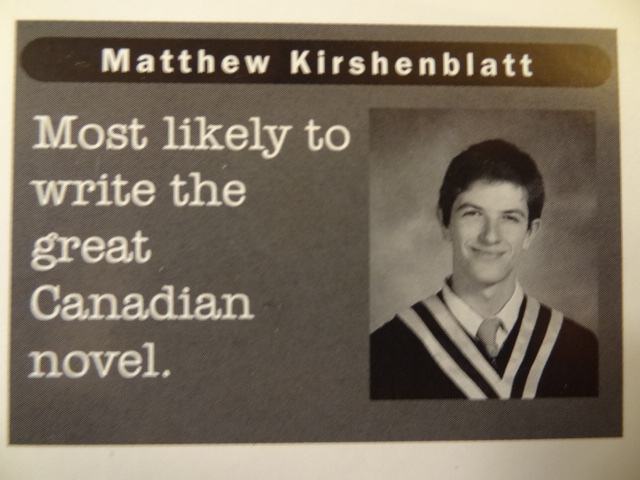
That said, I’m still working on fulfilling that prophecy from my last Yearbook:

High School

Paradigms Lost, Paradigms Regained: Looking Back and Looking Forward Can Be Both One and the Same

Foregone Warning: the title of this post is a play on words and borderline off-key rhyme. It almost verges into the territory of the pun. Actual warning: this article is going to be a very link extensive post and I hope it will all make sense towards the end.

In my post A World Coming Together, A Possible Paradigm Forming, and Other Stories That Find Themselves On Their Way, I make a lot of promises and claims but there is one in particular that I feel I need to go into a little more detail about.

I said before that it seems like we are in the process of the rise of a new paradigm: based on the geek nostalgia of the late seventies, but mostly the eighties onward to early 2000. As I said before, I feel I need to be more specific about this. What I actually mean is that we have been, for some time now, at a point where we can look back what was the present not too long ago and actually subvert and critique it. I mean, we can actually ask some questions about a lot of things that we took for granted: either in all seriousness or through satire.

For instance, look at Robot Chicken and how it makes fun of a lot of popular culture from the 80s and onward. The thing about Robot Chicken, however, is that it makes fun of generally everything to a warped and twisted degree of hilarity: and I wonder if this hasn’t also been a product of the past thirty or forty years or if it takes a paradigm about that amount time to gestate and create itself.

I guess I am trying to talk about a few things at once: which is not the first time something like this has happened for me. So I’m going to take a risk and bring up some theory, and then see what I can do with it from there.

In about the 1980s, there was–or even is–this theory that we had entered something called post-modernism. There is a lot of debate as to what post-modernism actually is, but from my understanding it seemed to be a period in which  literature and other media had become fragmented or combined with one another to make entirely different meanings from what they once were, or could have been. In addition to this was the rise of another idea called deconstructionism which, in the very reduced way I’m explaining it, is a theory that likes to take things apart. When you combine these ideas together, you essentially create writings and cultures that are incredibly ironic, sometimes “self-aware,” and that like to dissect themselves while at the same time attempt to reveal a multiple amount of different meanings.

There are a lot of scholars and artists that dispute these terms, of course, and say that every generation or paradigm goes through a phase of critiquing what came before and making something new from these elements afterwards. I like to think that the 80s and onward really favoured making pastiches–narratives and stories created from parts of things like patchwork monsters–to either subvert something that once existed or make as unique as is humanly possible.

Now, take that idea. You can definitely apply that to Robot Chicken. But it goes further than that and it doesn’t always manifest in the same way. For instance, take ItsJustSomeRandomGuy. As I mentioned in another post, he takes primarily Marvel and DC superheroes and villains and actually makes them aware of their fictional status but keeps them in character in doing so and even manages to make some incredible meta-narrative plots with a whole lot of geek culture references. I‘m A Marvel, I’m a DC is a whole lot less “profane” than Robot Chicken, but they operate on similar principles. I also would be greatly remiss if I forgot the How It Should Have Ended series: where popular movies and videos are depicted as cartoons and their plots are changed or subverted by … well … common sense. But since when do good fictional plots make sense with common sense? 😉 We can argue that point.

The whole idea of popular cultural or geek references, sometimes to the point of being self-referential in different media seems to have originated from Joss Whedon’s Buffy The Vampire Slayer: where in addition to a whole lot of witty “dialogue without pity,” there was a regular string of different kinds of references. The issue, however, is that I’m not sure this where it came from, or one of the points of entry into mainstream culture and entertainment. All I can say is, it was for me.

I have noticed, however, that a lot of my examples of this paradigm are very television and Internet-based. And there it is. I would argue that a paradigm or a culture is created when it evolves to the point of being able to look at itself and critique itself. And right now, this impulse, which may have started in the 80s as we know it, has sky-rocketed as information technology has advanced.

Look at the Abridged series for instance. Abridged series are fan-made parodies of television shows and cartoons. Parodies like LittleKuriboh’s Yu-gi-oh Abridged and Team Four Star’s Dragon Ball Z Abridged have become very popular and entertaining shows among fans: so much so that many other fans create their own Abridged series, or parody the Abridged series that exist. They are practically viral phenomena.

And these are just the fictional examples. I haven’t even begun to go into the actual Critics  like The Nostalgia CriticThe Angry Video Game Nerd and Cinemassacre Productions, Nixie Pixel, G33kPron and countless others who review and critique video games, movies, and geek culture old and new. They also use the pastiche form in some cases to make various verbal and media references. There are also so many more people we do this as well.

Now, somewhere in all of this fictional and non-fictional stuff … is me.

It took me a really long time to realize that not only was I already a part of this nebulous process, but that it was legitimate and more than okay to be so. I’ve had at least one teacher or two who would have once considered comics and video games utter dreck: or at the very least very un-serious diversions from real life. And I’m not going to lie to you or myself: there is a lot of garbage out there that isn’t even entertaining like “YouTube Poop”: videos created specifically to be obnoxious. But every literary and media culture has garbage. They also have gems and other treasures.

Think about this prospect. All the video games you’ve played and the comics you’ve read are becoming references that more people from a generation of thirty or forty years understands. These references make it into literature and criticism. Moreover, we exist in an Age of Information: where many obscure and old elements of our childhood are much more accessible to us now than ever before.

Some scholars have even argued that we are–or we were–in an age of Hypertext: a situation where we can click on a vast amount of chain-information through links and linked words on the Internet. You know, like when you are on Wikipedia or anywhere else, and you search for one thing, and then click on a highlighted word or phrase to be linked to another–or multiple other–online pages. In part, this allows us to look back on “our childish things,” and we don’t turn our backs on them, but instead we embrace them with an adult perspective and understanding that only someone who knew them way back when can give.

Moreover, we can even take this perspective–possibly created from our own nostalgia–and apply it to times that existed before us, or take that and make something entirely new in our time now. But also think about this: in addition to having more information technology, we are developing more interactive technology as well. Video games are much in the same place that comics, and film used to be–and to some extent–still are in public opinion. They have not always been respected, but as we continue to make them we can add more content, more distinction, and more variety. We can–and we have–gotten to the point where video games can even make references or “literary allusions” to other video games and culture in general. I am definitely going to revisit this thought at some other people.

Then consider the other people who participate in these interactive narratives and add the Internet to that fact: which connects people all across the world and different forms of life. Sometimes, I believe–in my more optimistic moments–that we could be on the cusp of creating something truly great and maybe even in our own lifetime. I can’t even imagine what will come after this if all goes well.

So in all of this, I am trying to find my own place: to find my niche. I want to take advantage of this time and do something that matters. This Blog, in no small way, is a part of this drive. It is here that I can combine my geeky interests with my academic background and my creative impulse to construct new things and state my opinions. I want to be a part of this. I want to do something great as well.

I grew up in the nineties or, as a friend of mine likes to chant, “90s 90s, living in the 90s!” Once, it was my present and sometimes it’s weird–really weird–that it and the early 2000s aren’t anymore. Sometimes, I feel time-displaced. I feel lost. I have another acquaintance who once stated that the children of the 80s, and even those before are a Lost Generation: of people who never really achieved their full promise in today’s world. But we’re not. We’re really not. I think we have been coming into our own and we will continue to do so as we ascribe a multiplicity of new meanings to old things, and create things that will make other things together.

Because there it is: perhaps post-modernism and deconstructionism might have taken things apart to see how they work, as they work, but we–whether we are in a Hypertext age or not–are starting to put them back together … and make different things entirely. Now that is something to celebrate.

I Don’t Have a Witty Title for Sexism or Elitists, But Here is What Really Matters

Me and my Head

For the purpose of the rhetoric in this article–its method of expression–I am going to be using the general second-person pronoun of “you.”

I’ve gone to Conventions before. They are some of the few places that have the opportunity to actually relate to people who have similar interests as mine. I’ve been to the crowded, but varied Toronto Fan Expo. I went to Anime North with all of its variance of cosplayers. I have gone to, and volunteered at the Toronto Comics Arts Festival. I even went all the way to Atlanta to go to what is arguably a grandparent of them all: Dragon Con.

I don’t go to nearly as many as I should: given what this Writer’s Blog is about, and the fact that I’d like to meet with more people who have similar interests to my own.

So I’m not really going to say anything new. There will be no insight into anything here that you already haven’t read a thousand times before. The sad thing is that I feel like I even have to repeat this at all because you would think, by now, that this would be common sense. But I have two points that I’m going to make.

First of all, when a girl or a woman–or anyone–is at a Convention, they want to be there. Period. If they have taken the time, such as at Anime North, or Fan Expo, or Dragon Con, or any other Convention or Festival to dress up as a fictional character or otherwise, chances are they want to be at this Event and they know who they are dressed as. Some good friends of mine, and people I love create their own costumes from raw sewing materials. Also, I’ve been told that–as such–it is more than okay to compliment someone on their costume–self-made or otherwise–and to ask to take pictures of them. Hell, you might even talk with them and make a friend.

Hey, it could happen, or so I hear.

So please do not talk about who knows what about what character, or series, or franchise and then some.

And even if they don’t, they are there–after paying money and a substantial amount of money at that–to have fun. That is what a Comics, Video Game, Film, and Geek Convention or Festival is ultimately about. To have fun.

They are not there for you and they do not have to fulfill your standards as to what a “true geek” should be. And here is some more common sense, I don’t care what their costume looks like, you do not have the right to touch someone without their permission. This is basic kindergarten knowledge. Do not touch someone without their permission. Period.

Also, here is an exercise. Imagine that women can create, buy, review, play, and add to Geek Culture. Or, you know, simply enjoy it.

Well, you don’t have actually imagine this, because this has already happened. And it is happening right now. Because guess what: women are people. People make choices and sometimes different choices from those you might make. Therefore it is pretty foolish to make generalizations or assumptions based on intrinsically different individuals who happen to have flesh bodies like all human beings do.

So here is something constructive that I can suggest. Talk to a woman like a human being and treat her like one (because well, duh, she is one), and you might learn something about another human being who may or may not share the same interests as you. Encourage them to create and review works. In fact, encourage anyone to do that. Moreover, if you do not agree with what they have to say, insults, threats, and sexist remarks really will not help your case or make you look any more intelligent by comparison. If you have something constructive to say, take the time to say it and remember that you are talking to another human being who has their own thoughts, feelings, and experiences.

And as your parents will tell you, if you don’t have anything nice to say, don’t bloody say it. This man here astonishes me not so much because of his views with regards to “a majority” of female cosplayers–of which I don’t agree with in the slightest–but because he is an artist and he decided that it was wise to publicly post this for anyone to see. I can’t really fathom it, to be honest. As an aspiring creator, cultivating an audience is important to getting your work off the ground, and to continue supporting it, and this just looks like a whole lot of personal sabotage of everything he has ever collaborated in. It’s just sad. It’s just really sad and unacceptable.

So I am going to get into the second part of my rant now, which will also begin with the word “unacceptable.”

Just because you like a certain work, or have followed something for a while, or bought a wide range of products, or have Joe Shuster’s autograph, or written ridiculous fanfics, or created other works, or any wide variety of Geeky things does not make you better than other people. I’m now really talking about the overarching issue here in addition to sexism: elitism.

Now, you can find jerks in any human endeavour or culture of some kind. They’re jerks: enough said and you don’t need to waste your time with them if they bother you that much. But–but–that does not give you or anyone else the right to make the judgment that they are not “true geeks” and it doesn’t reflect well on what you love by disparaging others who may not meet “your standards.”

What is a geek? Honestly, I believe that a geek is someone who really loves something to the point of obsession–or bordering on it–and it can be a wide range of different subjects and objects. Just because a geek might not know as much as another, or doesn’t own as many toys doesn’t mean they are any lesser. The term “geek” and indeed any label is problematic at best, so the rest of this is going to be more of my opinion: as if you haven’t already heard enough of it.

Do you know what I think a “true geek” is? I think a true geek is someone that loves something so much that they are willing–and happily so–to share that love with someone else. This could be in the form of education, or telling stories, or hanging around each other, or making things together, or playing games together, or trading knowledge, skills, and experiences, or something even so basic as simply acknowledging that–even if you don’t share the same interest–that you can at least respect it.

Because here’s the thing. When you get to the point of trying to prove you are better than someone, you are entering a pissing match.

And the thing about pissing matches is even if you win, you’re still going to be covered in urine.

So keep that in mind. I actually like Conventions and I’d like to it to stay that way. And if they can be even better, then I am all for that too.

Credit: Matt & Kristy on Flickr, whose picture and costumes these actually are.