Boo

It thinks that I can’t see it, but I can.

I walk up the stairs to my room. Something repellent moves from the corner of my eye, but I ignore it. Now is not the time. It will be gone by the time I look. My back feels exposed and raw. No. Not yet.

I almost expect it to be in the hallway mirror. It likes to do that: staying there in the glass glowing and rotting long enough for your heart to lurch and a keening sense of wrongness–of wrong clarity–yanking your insides down, down, down like a bad realization.

I turn the corner–it always loves to hide in corners–near the bathroom and I half-expect to see its sickening, unnatural face there. But not yet. The floor creaking breaks the stillness of white noise in my ears and then, I know.

I get to my room and then turn on the light. I see it for a few seconds!

Despite myself, my back is ice. I take the time to breathe. The last time it did that, it was a pale woman in a tattered dress and a shredded eyeless face in the middle of the night. I blinked once and she was right in front of me. Then she was gone.

I climb into my bed despite the other memories. It’s worse when you can’t see it. I lean my neck against the headboard as I put my laptop with its makeshift worn plastic box prop onto my stomach. The unsettling feeling that’s been with me for a while now is prickling stronger. It likes it when I think about it. It likes it when you think about all the other times it got you before: playing its sick game of tag, and hide and go seek.

And it cheats every time.

See, it knows. It knows that I know it’s there now. It can smell it on you: that mix of anxiety and anticipation that is human fear. I move my fingers across the small cramped keyboard: looking at my email while I know it’s watching me.

Click.

Click.

Click.

My bladder is filling up. It’s getting closer. I can feel it grinning now. I’m trying not to think about the times I don’t see it … the times I don’t see it as it rocks my bed in the night, or touches me in the dark … even under the covers …

It is the only thing that can be both hider and seeker in its games, but whatever else it is always a predator.

I surf the Net to a page displaying an animated GIF of a Boo Diddley from the Super Mario games. I watch the small pixelated white cartoon ghost making faces at the back of a pot-bellied plumber, soaring towards him with a red-eyed gaze and a vicious fanged grin before the latter turns around and it covers its face: as though fading out of reality with transparent chagrin.

This ridiculous image reinforces my knowledge. I slowly look over the top of my laptop. It’s standing at my desk chair: a hideous, twisted thing out of nowhere, the farthest thing from a cute cartoon or anything else from this world …

And I will it into place.

It’s all over: just like that. I get up and keep my eyes on it. It seems like it’s struggling, but it can’t move. It is fucking repulsive. Every part of me wants to be gone from it. My skin and the nerves underneath want to crawl away from the thing, as my bones become stone. But I make myself look at it.

“I have to admit,” I tell it, as it crouches there misshapen on the carpeted floor, “I made all of you well, but I think I made you best of all.”

I feel the power of my will wash away the dregs of my fear as animal repulsion turns into a strange kind of fascination. Its body is crooked and stunted. The thing is naked too: its skin glistening with a wet kind of pale blue luminosity. It doesn’t have any eyes or ears and there is a flat line, almost like a fine horizontal gash, where its mouth could have been.

I walk slowly towards it, “Just forms in the dark,” I move slightly off to the side, “You were always there. I wanted to see … I wanted to see if I could make something like you: if you’d attack your creator.”

It makes no sound at all. The grim fascination is quickly becoming a morbid disgust: like seeing a particularly bizarre form of insect intruding into a human living space. It shouldn’t belong here, but somehow it does. And that bothers me. I pick up the baseball bat I left leaning on the side of my dresser.

“You thrive on uncertainty and seeming on the fringes of things,” I lift the bat over my head in a two-handed grip, “Sure, when you startle someone, you are all tough shit. But here, in the light, without your cover you look unreal. Fake. Just as I made you.”

It’s that age-old admonition to never reveal the monster in a horror story. Otherwise, it has no more power. It never did. I begin to swing the bat downward … until it chuckles. It is a faint, rustling form of wheezing. My bat is inches away from its face. The thin line that is its mouth twists and I more feel it than hear it speak.

“You didn’t make us.”

I … can’t move. It gets up. The fact that it is several inches shorter than me doesn’t make me feel any better. I can feel it managing to look at me without eyes. It speaks again.

“We were forms in the dark. Things in the shadows. And we’ve watched you,” its voice scraps like leaves across the pavement, “We watch you as you are born in your own filth and blood. We see you become gangly, awkward beasts with sweet-smelling hormones: though you aren’t yet ripe. You put your dripping parts into each other to make more squalling things in perpetual pain and fear of the dark and you delude yourselves into thinking that you are not alone.

“And that is the sweetest of all.”

I’m willing my eyes on the thing I made, willing my arms to swing down, to back away …

“The broken bones are an added bonus, but they aren’t necessary,” it explains to me, “the shattered dreams add spicing. Sometimes, you slit yourselves open, or smash yourselves into adolescent pulp before your maturation, before your time … as if you already know.”

It’s the first time it’s ever spoken to me. I want it to shut up. I want to make it die.

“No. Our favourites are the ones that age to ripeness and perfection: the ones that gradually begin to see themselves for what they really are, what we see you to be,” the thing’s thin mouth peels back, revealing long and yellow stinking teeth, “Hollow brittle shells of dark churning space against the pressures of gravity. You are born in pain, and you live in it, and–in the end–you die in it. Despair aged to perfection has a unique flavour.

“And then you hope it ends in death.”

The last thing I want to hear is the sound of its laughter. It reaches a long, slick bony talon towards my face, “You see, it’s not so much that you created us … it’s that we created you. We made you: to suffer in all the little banal ways first. All the hidden, shameful, unspoken, lonely human ways. We get to watch as you die slowly inside and out … and when we watch, we feast. We feast as you return to the filth you came from. We devour you as you return to the dark … from where we crafted you.

“And we love your sense of self-delusion. Because false hope … it is our delicacy.”

My bat slams down into its skull. It smashes into its face. It’s more like my body is the one in fury, my adrenaline speaking with my voice, my voice being my hands, my feet, and my weapon while my blood is my sheer unadulterated hate. My arms and fists are aching. Somehow the bat is gone and I’m beating the thing. I’m beating it to a pulp. I can’t think. I won’t think.

My fingernails gouge into its slimy skin. My teeth sink into ichor. I taste bitterness. A part of my mind knows that it will be over soon: that others will find me. Maybe it will be my family, or more of these … things. They will find me in my torn clothes with another’s blood on my chin and torn flesh in my mouth with the pulped remains of another sentient being under me. Or maybe they will find me alone, with no one else, crazy and without my mind. Perhaps they’ll take me away where the things will keep laughing at me in the dark: amused enough by my new … enlightenment to let me live on like this.

Perhaps it was never a game of tag or hide and seek. Maybe it was just a joke with the following punch-line.

I am a monster. And I don’t care.

Maybe that’s what I’ve always been. Maybe I’ve finally found what I’m really looking for. Somehow, I see myself smiling just like the Boo still flashing on my laptop screen: looking away from myself and grinning … wickedly.

Stitches, Meetings and Silver Keys in Downtown Toronto

Well, I have been fighting off a cold for some time now and it seems as though in these days two days I’ve finally lost that battle and I’m now in the process of surviving. Sometimes I wish I was like one of Vampire Maman Juliette’s vampires to that regard who, from my understanding, are immune to such annoying things as sickness. But, sadly, there is already one vampire in her world named Matthew and having two would just be redundant.

No, I’m still mortal–for better or worse–and annoyed at my body right now because I have so much to do and not an infinite amount of time to do it.

So, how about some good news? The third and final part of my article The Stitching Together of a Mythos: Kris Straub’s Broodhollow came out a few days ago. It really made things come full circle: especially since it talks a bit about Kris Straub’s story “Candle Cove”: which is what got me interested in his work to begin with. We’ve been talking a bit on Twitter as well: which is really awesome. And in addition to getting a few more Twitter Followers–which is always excellent–I may have opened some … new avenues up for future exploration. I need to just develop this possibility further and I’m not sure how well I will do with portraying current events–even of a Geek kind–but let’s just go at it one thing at a time.

This passing week has been a challenge for me on some many different levels, but I did go to an interesting meeting before an evening Torontaru at the Get Well Bar: which I went to for the very first time. Unfortunately, already having gotten lost (because neither of the places I went to were right along the way–between Ossington and Dundas Street West–and where there is Toronto, there is always construction and the TTC to contend with) I didn’t think to actually use some networking time to–you know–network (aka talk to people) and it only occurred to me after I was heading home. But I did more or less what I had to and, besides, the Get Well Bar was over capacity and I was already feeling tired and a bit ill and there were few people I even knew there. The Bar’s game cabinets were amusing though the first little while I was there before I left and couldn’t get back in. I still never figured out how to get the Barbarian to fight in Gauntlet and I died in Frogger: a lot.

So I have been mysterious about two things so far. Upon risk of making this the most boring Mythic Bios post ever, I will leave it at that until I get more information. Instead, I guess I’m going to lean on my fall-back and become retrospective.

I’ve been to Ossington and Dundas Street West before. It’s less that I have a specific memory and more that I have found myself in the general atmosphere before. The buildings are old and run down, but there is new life and–life–in all of them. Many of them are stores or bars and you can make out some apartments above them.

At one point, after I was at the Get Well Bar–which is an ironic name given that I’m sick though it has nothing to do with anything really–I was sitting at Subway near the window. Here I was, finding myself sitting downtown watching people walk and interact beyond the glass. I saw a few couples holding hands and a few pairs of friends talking. One man was carrying his meal in layers of containers wrapped in a white plastic bag. And there was an old man I saw pass by twice and an older woman walking by.

And it made me wonder as night time already took over the faded gold and pink sky I’d been walking through earlier in my quest to find that meeting place: was this part of the city like this–like all of this–thirty or forty years ago when those older people I saw were my age or younger? Was it always like this? And would those couples still be together and those friends still meet up? Would they be as old as the people I saw that night: remembering all those times they passed through this area of the city talking and laughing and thinking it would all be the same the next day when–one day–it is going to inevitably change somehow? Would Toronto’s proclivity towards construction eliminate so many familiar landmarks that no one would even recognize this place with most of their mind or would the gritty aura of it transcend the loss of a mere few buildings that were hosts to so many other things in the past?

And it occurred to me that people lived here–actually lived here–and it was like seeing some of the Scott Pilgrim video game in real life. Is the Scott Pilgrim game really Ossington and Dundas as well as the Chinatowns? I tried to live in Toronto but, more than that, I tried to understand it: to find its spirit and companionship. I tried to find its life as it could relate to me and embrace it and–to this day–I’m not sure if I ever succeeded. A lot of the time I just found “being lost” and “afraid of the dark” as my common feelings towards being downtown: with some “dazed and confused” and the occasional and inexplicable … magic, I guess.

I think everyone of us gets nostalgic and sometimes yearns for and broods about the past.  Sometimes it’s almost like there is a choice between having some awesome moments and watching them disappear into memory forever … or never having a life of any pain or joy and watching other people’s and feeling nothing but envy, when you really get right down to it, a sense of hollowness: of having wasted your life. The first is magic, as far as I understand it and the world feels a little greyer when it finally fades. And no matter how much you want it back, you either can’t or it will never be the same: and that’s not always a bad thing.

It does make for good writing, though, such as my short story Stop 17.

I’ve been angry at Toronto and in love with it and disappointed in what I thought I found occasionally. But as I was sitting in that Subway shop, that night it just seemed like another … place to me: just a place I visit from time to time.

I’d like to leave you all with one more thing. Leeman Kessler has succeeded in resurrecting a homunculus of H.P. Lovecraft to answer all of your questions. As such, Mr. Lovecraft was good enough to answer a question that has been close to my heart for a very long time. Have a good night everyone.

Art From Trauma and Twine: Red From a Violet Magician

So a little while ago, I mentioned that I was working on a Twine game: a text-based choose your own adventure story. I made a few decisions on the way. Essentially, I decided to put my Twine novel idea aside–to work on from time to time when the mood and the inspiration really set into me–and I began expanding on the root idea that it came from to make a shorter Twine that doesn’t even have an ending so far. I’m writing out the first section by hand and I’ve finished the first section and I am currently focusing on the second part. I meant to complete this sooner as I have some other priorities.

However, this post is not about me or my Twine. It is about someone else’s. No, what I’m going to do, late tonight in some many ways, is I’m going to introduce you to a Twine that was derived from an initial Challenge that I gave to a friend: who then utilized Twine to tackle both a personal and universal issue.

https://i0.wp.com/31.media.tumblr.com/c844da5a455d8705e7894c5025720e27/tumblr_msvx9qY1OC1qgyk1bo1_500.png

Here is the *Trigger Warnings* Disclaimer from here on in. Do not read further if any of you are set off by a discussion or depiction of trauma. You have been warned.

Trauma is a very human experience: or at least in how we perceive and express it. I’ve mentioned depression and grief and bad memories on this Blog before, but this is something different. Post-traumatic stress disorder and complex post-traumatic stress disorder are what happens when an event of violence or violation, or a series of such events created by environment and society affect a person’s psyche to the point where certain stimuli–such as scents or sounds or sights–or sleep or even memories can elicit a sense of panic, anger and fear inside them.

And I am not doing justice to either definition. From what I understand, it is taking a really awful moment, or a series of moments and having them imprinted into the brain–much like stimuli and exercise imprints trained reflexes into muscle memory–or injecting fear and crippling anxiety into a cell of a memory that can be triggered by anything: hence my earlier disclaimer for this post.

It can affect anyone from any form of life and, as such, it is unfortunately part of a variety of different personal and human experiences. However facing it in any way is a sign of both necessity and, as far as I am concerned, a tremendous amount of bravery. My friend Ionas has taken on this force and manifested it into a Twine, which right now at this moment, I want to speak for itself.

Ionas’ Twine is called Red. It is an important story to anyone who either experiences trauma, or knows someone who does, or wants to know more about it. Really, it is just a very important story in and of itself. If any of you, my readers, appreciate my own writings please sit down, click on the above link, and take the time to navigate through the world that Ionas has created. I got the rare privilege of watching this story get constructed from the ground up in a very deep kind of creative process.

And while I do not suffer from PTSD or CPTSD as far as I know, this is still something that is close to my heart for various reasons. Some of the best art can come from pain and while that pain is never wished for, it can create powerful experiences.

So please read this Twine and share it on WordPress, Twitter, Facebook and any social media site that you like to use. Also, Ionas is an excellent graphic artist whose work can be found within the Violet Magician. Ionas also takes artistic commissions, so anyone out there looking for art, the Violet Magician is fascinating to go to and see.

I am going to be encouraging people to make Twine games. You can find the link for the free online Twine software right in this link. I have another friend too whom I have also assigned this “homework”: to make a Twine. You know who you are. I understand that you’re busy, but I will be checking up on you … soon …

The Birth of *You? Player-Identification in the Hate Games of Christine Love

Because, you know, I haven’t written nearly enough about Christine Love’s Hate games or, really, her created world.

For those of you who have played the games, I think I don’t really have to say Spoilers, but I’m going to anyway so that people don’t get angry at me. Perhaps someone has already discovered or suspected something. You see, it all began last night after I wrote another Blog entry–which I planned to post today–and wrote down some notes for another story of mine. I was lying in bed past five in the morning when, suddenly, something clicked into my head.

I would have totally missed this evilness if I had just continued using my Saved Files in Hate Plus. But, out of curiosity, I decided to start a game once without my Saved Files: just to see the Quiz that comes up. You remember the Quiz right? The one where you click on a list and it decides what kind of interaction you will have with your chosen AI, who your chosen AI is, and–and this is important–who you are.

And this, my friends, is where Christine Love is potentially evil.

I say potentially because I actually reread the Quiz just now and realized something else. There is one part where it asks you which year you would have preferred to live in: 1988, 2027, or 4989. In my exhausted mind I thought it said which year were you born in.

Still …

I started to have this thought and it’s still valid I think and you can interpret it any which way you want. In both Analogue and Hate Plus you discover two very interesting things about Christine Love’s world. First of all, you discover that *Hyun-ae’s father in Analogue created or utilized a method of imprinting human brain-waves into an AI. Second, you also discover that Earth has found a way to give AIs physical humanoid bodies. I mentioned in my previous post the possibility of AIs from the 80s of Christine’s world having continued to exist to the point of 4989.

Now, think about that for a few moments.

Surely AI would have been granted equal rights on Earth by the 50th century. And with the technology at their disposal–being the product of technology themselves–they could make themselves into anything that matches their personality and what they want to be. At the same time, perhaps humans have learned and perfected a similar process to what *Hyun-ae’s father made–because inventions like this do not exist in vacuums–and some formerly biological humans have learned to download themselves into humanoid forms that can experience all the five senses and perhaps more.

There might be evidence against this. Surely the need for a multiple choice Dialogue Wheel could be circumvented by someone who was an AI, but the issue there is that the White Princess–your ship’s–technology is at least over two thousand years more advanced than the Mugunghwa‘s older generational ship pre-Faster Than Light systems. It is so … 25th century compared to your technology … to potentially you. Even before the ship-made cultural regression they would have been astounded by humanoid bodies: though they may have been conceptualized by that point.

What I’m trying to say is what if you–the investigator–are, in fact, an AI? That would be the ultimate in transhumanism. After all, if you start an entirely new Hate Plus game you already have the choice of deciding what gender you are: he, she, or they. Hell, with the option of they it might just be about gender but different personalities or collectives as well. And even disregarding that and looking at Analogue, Christine never really has you identify your gender unless it’s with *Mute and neither AI thinks to ask whether you are human or not–if that distinction is even applicable to their perspectives–because you are communicating with them from the outside and you might be having to adapt to vintage technology (and manually interface with it to either avoid potential corruption from direct immersion into an unfamiliar system if you are capable of transferring your consciousness back and forth from interface to body or because it is your make or preference to access computers manually) no matter whether you came from bio-matter or circuitry.

And what’s amazing is, whether this is true or not, it really doesn’t change anything. You are still an investigator who may or may not be lonely meeting these two strange beings that can potentially take your heart away. I always suspected that Earth was different and even though it still wrestles with mortality and there seems to still be biological humans there, it doesn’t mean none of this is an issue.

And as for a coworker from your dispatch referring your companions to an AI “robopsychologist” … well, just because you might be an AI doesn’t mean you need to see a therapist–just like if one human sees a therapist it does not mean another one needs to see one–whereas *Hyun-ae and *Mute certainly do. You are also never named: so you will never see if you have an asterix next to your name as all of Christine’s AI do.

I like this end-ended idea a lot and this speculation just adds to the experience for me. You can believe what you want. As for me, I think I will avoid taking the Voight-Kampff Test. Aside from the fact that it’s for androids and not necessarily for other AI, I think the subject of being an AI in Hate is akin to Rick Deckard’s “lesbian question” and how it’s kind of … irrelevant and no one else’s business but your own this case–both in terms of Hate Plus and myself. Really, the way I’d like to think about it, it’s kind of like being asked what the sex of your upcoming child is going to be.

I think I’m going to keep that fact as a pleasant surprise, or a mystery.

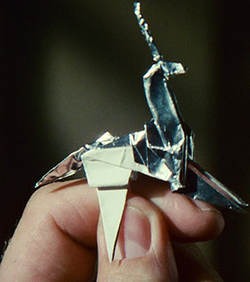
Blade_Runner_unicorn

The Death of *Silence: Hate Plus and The World of Christine Love Confirmed

What is better than hate?

The answer is more hate.

Hate Plus is the sequel to Christine Love’s Analogue: A Hate Story: a visual novel and video game in which you, as “a space investigator” must recover the records of a lost 25th century Korean generation ship called the Mugunghwa and figure out what happened to its colonists and their descendants. This is not the first time I’ve talked about Analogue or the world that it inhabits so, if you’d like and if you are not afraid of spoilers please look at my article This Love and This Hate Ain’t Completely My Story: The Possible World of Christine Love.

I have been waiting for this game for a long time, though obviously not as long as certain characters on the Mugunghwa have been, and I want to get into its structure, the elements of its world, and the story line.

So here is the nitty-gritty of Hate Plus‘ game interface from my own personal experience. I’m actually glad that I went back and played Analogue for a while during this time in order to remind myself of its game-play interactive qualities. In Analogue, you had to go through various journal entries and click on the figure of the AI next to you to get more information or her opinion. You also had a very confusing Family Tree of characters to look at with names that often got confusing. It is important to note that some Far East Asian cultures place their surnames before their first ones and it explains a lot culturally with regards to Analogue and Hate Plus and how the societies depicted within them function. But I am getting ahead of myself.

In contrast to Analogue, in Hate Plus the AI is more active and has a certain degree of limited animation. They basically read over your shoulder and make comments as you scroll along: as you scroll along very, very slowly. You do have to be careful though: because if you read too fast, the AI’s comments will be lost seemingly forever into an ethereal digital void of, well, scrolling too damned fast. There are names in the documents that you click on and get more information with each entry that you read. The files that you extract are better organized and you have dossiers on–and profile pictures of–each person that you read about. In some ways, it is a lot harder than Analogue. I imagine that the slow-scrolling simulates sifting through the files you’ve compiled from an ancient ship. At the very least this time around you don’t have to input technical commands into a DOS-like–pardon the pun–analog program: which confused and frustrated me to no end.

That said there are some really interesting goodies and special touches to the game structure that only Christine, at least from what little I’ve played, can accomplish with her style. While Christine utilized a form of code that transfers information from her other games that you’ve played to make some “Easter-egg” moments between them, she uses this same process to take your Save Files, if you have them, from Analogue and translate over to Hate Plus. She creates that almost very personal feeling of continuity and that, in itself, is something that I greatly appreciate.

In addition, depending on what Saved File you use, the introduction screen changes colour and when you finish a story arc, the end credits music becomes the introductory music for a while: which really gives you a sense of difference with each playthrough. There is also one other difference between Analogue and its sequel. Unlike the former, which you can download off of Christine’s site Love Conquers All games and Steam, you can only download and play Hate Plus from Steam itself: mainly because that is the only place it’s available from and perhaps the only way to facilitate the Achievements that you get to unlock in addition to the different Endings that are just extensions of your Saved Files from Analogue. This game does not save the retrieved files and timelines you sifted through outside of the AI interaction such as in the other game, nor does it have an extra material section as far as I can see, but the Achievements in themselves and the interactive dynamics that Christine has implemented are … different.

Let me be more specific: if Analogue felt like essentially interacting with a program, Hate Plus is an attempt at a realistic interaction with another sentient being and time. This pacing is actually pretty refreshing and while with anyone else it might threaten to take you out of immersion, in this case it just adds a barely meta-narrative feel to it and at the most it adds personality: a very fascinating experiment in player on and offline participation and interaction. It might take you aback at first, but it’s worth it.

I should also note that you can play this game without having played Analogue or saved your files. The game will just give you an intro recap and a simple Quiz and you’re off. But personally, and as I said, I liked the continuity of using my old files from the previous game.

So now we go past the technical and into the more specific area of content: of the world. And here is where I go into Spoilers: real Spoilers. So please, if you have read this far and you want to play one or both games, save this article link somewhere, click on the links to Christine’s site above, download the game for $10, take the time that you will need, and then come back. Do not say I didn’t warn you.

Now then: the world of Christine Love. If you read the link to my previous post about “Christine Love’s Possible World,” you probably realize by now that it is less possible as it is more probable and true that all her games–at least the ones I talked about in that article–take place in the same world as time goes on. I always suspected this but it was only confirmed when, in this game, she added that missing link: when you receive an email in your message box talking about exploring the ruins of the 23rd Century Lake City. That addition made me smile: not just because it gave me some feeling of vindication in my statements, but because of just that one segment of a post adding this seamless transition between Digital: A Love Story, don’t take it personally babe this ain’t your story and Analogue. What it is, is it’s both immaculate and it’s beautiful. Fucking. Beautiful.

It also doesn’t stop there. You find out a bit more about Earth and how advanced it has become. In addition to me realizing that the reason AI have such difficult times replicating themselves is due to limitations imposed due to *Mother and the terrifying consequences of *Reaper in Digital in the 1980s, I also got to see that AI interactions have changed even more. Essentially, Earth technology has evolved to the point where AI programs can be downloaded into customized lifelike humanoid bodies. This totally slapped me in the face with surprise, but it was a good kind of slap as I realized what it meant for you to have received this email–from the very familiar household name of Wong Robotics (which is a nice parallel to the email you first get from what seems to be its predecessor Wong Computers in Digital: A Love Story and another world tie-in) and what you were probably searching for with regards to your AI companion.

These discoveries make me wonder about something. You discover that *Mute–the Mugunghwa‘s Security AI–is actually over 1600 years old (about 1900 years old): though she can only remember about 300 years of her history or so after that time. You realize later that this was due to … another incident. Now, think about this. On Earth, in this time of the year 4989, over two thousand years after the disappearance and disaster of the Mugunghwa, there have been AI existing and living on Earth. It makes you wonder if some of the programs from the 70s onward still exist at this point. Imagine a series of millennia-old intelligences on Earth and think about how they could have influenced everything. You also get an idea that really old AI tend to slow down because they have too much information to process, but if they specialize in different areas over time and diversify they can adapt both functionally and psychologically. Christine makes a very eerily familiar vintage science-fiction reference to this regard.

And all this makes me wonder just what kind of society her Earth is at this point and, if the technology *Hyun-ae’s eccentric father–the technology that can download human brain-waves and convert them into an AI psyche–is already commonplace in this world. Talk about a potential Ghost in the Shell. Anyway, enough geeking around on my part. Everyone appreciates a good science-fictional world as much as the next person. Let’s talk about the story.

So in the last game, you spend the time trying to figure out what happened to the Mugunghwa and why it never reached its destination. You find out why the colonists’ descendants died and what happened to their society. But you never knew why it happened.

Until now.

Whereas, Analogue is arguably *Hyun-ae’s story, Hate Plus is definitely the story of *Mute. *Mute is a complex character. She believes in the Neo-Confucian ideals of the society that evolved–or degenerated–on the Mugunghwa: including an over-emphasis on the importance of familial duty and traditional gender roles. She supported the monarchy that came into power and Chinese-character literacy given only to the noble families. At the same time, despite her vehement protests towards anything “untoward” like homosexuality between women–which makes her almost a more compassionate version of don’t take it personally babe, but it just ain’t your story‘s Taylor (though the character Oh-Euna might be more like her in terms of fucked up)–*Mute is still a decent person that wants to protect her ship and the people in it. She also does not tolerate cruelty and she has cared for people throughout the years and even though she might judge them and say some offensive things–and always speak her mind in some form or another–she never has consciously attempted to hurt another person, always tried to help and always remained loyal.

In the first game she comes off as abrasive, though you understand that she hates herself because failed to save the people and way of life she was programmed to protect. She also does not seem to tolerate the unorthodox: though I always filed this under “Milady doth protest too much.” And in many ways, I was right. But deep down, there was the theme of the game that I had to keep remembering.

Hate.

And *Mute, with her anger towards female homosexuality and her chauvinistic comments towards women and even the feminine identity she adopted, portrays this self-loathing that I had not seen clearly before. At first, it seems very clear that she isn’t conscious of it either. In fact, *Mute in at least two of her incarnations seems to really not pay attention to details: or, at least, not the right ones.

Then you find out that her previous incarnation, the one that had existed for 1600 years, left some embedded code in her: with files from before the Neo-Confucian dynasty. And this is where your adventure begins.

This is also the part where the game really explores the concept of transhumanism. For instance, *Mute is a reboot of *Old Mute and *Hyun-ae is an AI taken from the code of *Mute. In essence, both AI are descended, code-wise, from *Old Mute. But whereas *Hyun-ae believes she is the human that had her consciousness downloaded ages ago, *Mute is another version of another being. And there are two versions of *Mute.

They are almost two people with similar qualities. *Old Mute was the Security Councillor of the ship that was more assertive and viewed all the people on it as her children: though the Heo Family more than anyone else. She was not afraid to talk to men as equals or politick when the need set in. She was old enough to remember when banditry and civil war wracked the ship and saw the death of the navigation AI *Star: which is the reason why the ship never reached its destination to begin with. *Old Mute was at the very core of her programming a security AI that sought stability and the preservation of life. Unfortunately, she did not see this in what may have been–to her–the unstable mob-mentality of the various pro-democracy movements racking the ship throughout the years.

She, through her adopted Heo Security Family and her seat on the Council of the Mugunghwa maintained something of an oligarchy throughout the centuries and either allowed for the creation of peasant or “commoner” and noble classes, or maintained that tradition. Perhaps these families were the descendants of the workers and ship staff respectively. Perhaps a “middle-class” got co-opted by the nobility or the commoners there did not seem to be a differentiation between peasants and vendor merchants. Maybe that is why the “Bureaucrat Class Act” passed: to seemingly “deal” with this problem. We will never really know and can only speculate. Unfortunately, she was so set on sabotaging an emerging pro-democratic figure that she didn’t see the danger in the so-called figurehead that she helped place on the Council due to her wanting affect the appearance of change to quell the masses and maintain a safe status quo.

In the end, it cost her. It didn’t have to. She was the ship’s Security AI. She could have monitored those in power far more closely: including and especially those she had placed there. But as she put it; she had so much data through existing for “far too long” at the time that sometimes the minutiae of various events escaped her. Personally, I think that she should have “vetoed” the usurper and his whole Council out of a sudden airlock. She could have created a democratic structure from the very beginning and rigged all the ballots to maintain her idea of order. After all, from what I understand, she already had most if not all of the power and even though she started out as a Security Program, she clearly proved that she could adapt over time like any intelligence can. Unfortunately, or fortunately, if *Old Mute had an understanding of Asimov’s Three-Laws of Robotics, her interpretation of it: of letting her memories get erased so that she could survive, of her own self-preservation for the duty of the ship being more important than the quality of life for the people she swore to protect–for not ending certain beings’ lives for the greater good of the whole of humanity around her–cost her.

And in the end it costs *Mute as well. I was so … sad and angry when *Mute decided to deactivate herself. I felt as though she had abandoned me and took pretty much the coward’s way out. She could not face what her predecessor, or what her previous self, had done. And as for me: despite her brusque manner and prickly nature and weird fascination with what boys do in their recreational time together, her “death” hit me hard because she was a good person.

That was when I found the third *Mute: *New Mute. This one did not make herself look old and silver-haired like *Old Mute or garb herself in the traditional hanbok like *Mute, but she had her security uniform and genuinely wanted to know and learn from her predecessors: her previous selves. I eventually took on myself to show her everything that the others had given and seen. If the first *Mute was the Old Kingdom, and the one I knew had been The Middle Kingdom, then this *Mute was a New Kingdom who, eventually and unlike *Mute who couldn’t face her transition from *Old Mute admits that they were all her. I actually liked this *New Mute, but *Mute’s self-deactivation actually broke my heart.

I will admit that when I played from my Harem Route Analogue Saved File, there was one part that made me really catch my breath and tear-up when after one of *Mute’s homophobic tirades,  *Hyun-ae tells her something to the effect of, “You really don’t think you are lovable?” It hit me so hard: almost as much as it did *Mute.

My poor mass-murderer and my authoritarian with good intentions. One of them condemned many to death for the horrible crimes of a few and the other condemned many to social and cultural slavery and barbarism for the chance that everyone lived. “Those who trade away freedom for safety deserve neither,” or “Give me liberty or give me death.” I guess, in the end both of these paraphrases came true. I loved and felt for them so much after all of this.

There is one more thing that I want to write about with regards to Hate Plus. So I found the list of Achievements and saw that there was one for playing through *Mute’s Route as a female. My friend Angela O’Hara had played Analogue as a female and told me that she had had a very different interaction with *Mute than I had: having played as a male. So I decided that if I was going to do this, I was going to do it right.

I replayed Analogue as a female persona and I noticed *Mute’s interactions with me had changed. She was still mostly grateful and respectful of me, but she would ask what an “unmarried woman like me was doing all alone doing a man’s work” and “not troubling me with the details of matters.” She even made pointed remarks about my orientation towards other women or being permissive of it. In Hate Plus, as you imagine, she got worse. She would skim details at times and “take charge” and took it on herself to call herself “my wife” while still “protesting too, too much” about how “icky” female love was. She called me “a stupid bitch” at one point and I admit I called her “a chauvinistic bitch” at another point. I still cared about her and I tried to be patient but it was different.

At the same time, when *Mute did reboot, *New Mute had a lot more to say about some of the letters and transcripts–particularly the ones with the female relationships–that we found in her base code than she had when I played as a male. She also, and this might just be me, seemed to relate to me more as a female in this incarnation and seemed more open to the possibility of being my companion: if not my wife.

And even before I did this, I saw the chauvinism and misogyny that would bloom into the Mugunghwa‘s Neo-Confucian dynasty. I saw what Kim So-Yi had to put up with from her boss and the assistant that violated her: making her feel compelled to say nothing to anyone about it and just like our time unfortunately. I saw that the Ruling Council only had two women on it: one of them being *Old Mute and got to see her gradually lose her voice and see her opinions get ignored under the New Council. I saw the policies of the new regime culturally influencing Mugunghwa society and forcing non-heterosexual relationships underground and even breaking some of them. I saw two women who had jobs and were relatively independent people become kept-women and courtesans. I saw one woman who could have saved the whole population of the Mugunghwa from decreasing birthrates lose her job and her former assistant try to take advantage of that fact with blackmail.

I saw how the emerging political system took advantage of the knowledge of these declining birthrates to make women stay at home and raise children. I respected the unorthodox, alternate-living and loving Heo Family members and grieved to watch their loved ones suffer and some of them die. I also saw one psychologically-troubled woman who felt so trapped by trying to fulfill two seemingly contradictory roles–of traditional woman and working person–and hated her pre-Neo-Confucian reality and herself so much that she retreated into and desired to destroy it and replace it with a culture and political system with “simpler and more ideal roles:” only seeming to realize, at the end, that she had expanded the prison inside herself to the outside.

But I saw the roots of what would become that Neo-Confucian dystopia: of people becoming roles instead of people anymore: becoming silence instead of actions and words. That is what I wanted to say to *Mute if we could have discarded the dialogue wheel we all found so annoying: that she and every woman–every person–was more than a role: that we are all people with feelings and that hate is not the only emotion we have. Hate creates a foundation that attacks itself until the fragile thing built on it rips apart and collapses in on itself. And seeing those … policies go through the Council and seeing each one strip away another freedom for “safety and stability” makes me feel even more cautious about my own world and the subtle infectious forces underneath it all that still discriminate against women and those not of the mainstream: underground or taken for granted attitudes that infect behaviours even unconsciously and just wait to bloom like flowers, colourful beautiful flowers of blood, and bruises, and pain. And, of course, hate.

And hate has to be watched. It has to be dealt with. And it is more deadly under the enforced silence of even something as colourful as a hanbok than all the screaming in the world.

Also, Christine Love manages to problematize, yet again, heterosexual relationships with that new regime but, at the same time, humanizes them and shows that while they weren’t perfect before, they were still legitimate because they were between individuals that may not have always understood each other, but loved each other nonetheless: just as much as the homosexual male and female relationships portrayed.

I don’t know if I communicated this last section well. The analysis seems heavy-handed compared to the elegant and subtle way that Christine Love implemented it and I am exhausted because I just finished playing all of the game today and it is early in the morning now as I finish this. I think I will end this review and analysis by stating that I will give Hate Plus a 5/5 and that what is better than hate is not the flippant answer I gave above. It’s not more hate. It’s love.

I’m sure this is a message of which Christine Love won’t have too much of a problem.

What I’ve Been Up To and Where This is Going

It’s been some time since I’ve taken a step back and talked about what has been going on with my creative projects and myself. And while I’m glad I actually had the opportunity to post up some actual fiction here for a change, this has been long past time.

The more the game changes, the more it stays the same: both figuratively and literally. Let me start with the practical matters first. I need a job. That’s pretty much it. I need to find a job and do some volunteering that can help me get more contacts. The good news–aside from the fact that my worker is the first person to ever get a Mythic Bios business card–is that my social assistance program that I’ve been on for a while is actually giving me a little more in the way of concrete advice.

For instance, I have some websites now that seem to tailor more to the kinds of things I do or that I’m interested in. There was at least one job looking for a potential creative writing teacher: which would be a strange role for me given how I have been–and I am still–the student for so long. But that is one avenue. Another possibility that was given to me is that perhaps I can join a newspaper and help create or add to a column that matches with my “Geek” interests. This would be a major boon because I would have something out there in print, get more of my stuff out there, and potentially even get paid for it. I won’t lie: getting paid would be very nice at this point.

On the other hand, I am now motivated to really and truly start asking questions. What I mean is that even if I can’t get a job at one place or another, I can ask “interview” questions to someone about what it is that they do, what I should expect, what I would need to focus on with regards to my resume, and if they know anyone who is looking for anyone. I can ask questions. And I suspect there will be some business card trading. All of this is a focus that I have been fighting to keep clear as time has gone on.

I won’t lie to you. A part of me is scared: scared that I won’t find anything and that my help will run out. But there is another part of me that is also concerned that if I do get a job, it will me take away from the very Projects that I need to get to where I want to go: that my energy and my equilibrium will be so drained after practical work that I won’t want to do anything more. Of course I know a lot of that is utterly ridiculous given that I know what I can do and what I love the most.

Also, I need a change of pace. I need to make a new routine and schedule that will allow me to get out of my house, wake up earlier and have more time to myself and even get more opportunities to work with other people and explore again. It is exciting, even as it is utterly terrifying in a lot of ways. I have a lot of stuff I need to overcome and, in my way and in this past while, I have been endeavouring to do so.

The fact of the matter is this: in order to shape the life that I want and grow and maintain the relationships that I need, it is imperative that I reach my full potential: or as much of it as I can. And oh god is it terrifying to fight that anxiety, but invigorating to also realize that I have so much to actually look forward to.

And I do have things to look forward to. First, I am going to be getting Neil Gaiman’s Ocean at the End of the Lane soon. I look forward to finding it in, or near, my mailbox. It’s the first Neil novel in ages and I am going to enjoy it. I know that I will. Also, for the first and last time, and if all goes according to plan I am going to be seeing Neil personally–along with countless fellow geeks and fans–in Toronto itself: at the Danforth Music Hall. It is his last signing tour for the foreseeable future.

I had to go through some hoops: cancelling an Amazon order to get a Chapters-Indigo order so that I’ll have a proof of purchase and thus be allowed to have that book signed. This tour is also not a free one and it has cost $31. I know that bothers some people and deters them from going. But there was also something else that made me hesitate initially. That fear again. I’ve looked forward, so much, to meeting Neil but at the same time it scares me. It scares me because meeting the person who pretty much helped reshape my writing style in a very paradigmatic way is kind of intimidating. He’s not going to be the writer behind the narrative of his novels and Blog, or the tweeter of his Twitter, or the man in some of the videos I see online. He is going to be an actual human being–which he is–sitting for a long bloody time at a table or something signing books.

And I know I probably won’t sound as eloquent talking to him briefly as there would probably not be that much time. Okay. Fine. I’m going to be a fan-boy. Are you happy now? Neil is the closest thing to a hero that I have and this is his last signing tour. And it makes me sad even as I feel something kind of fitting about how the first time I meet him like this will be the last in a while.

The fact is, I just hope that when I do get my chance to meet him that I can just say to him, “I am really glad I finally got to meet you.”

Now, that aside, let me go into some of my creative matters. I have been insanely busy. I have been working on my Twine novel. Novels are fucking intimating. When you make a novel, you make sure to have an outline of plot and character, or you will go crazy. Also, as you’ve probably heard before, you cannot write each novel in the exact same way. I outlined to you what beginning this Twine Project has been like, and it has more or less continued the exact same way. I am still writing it all out by hand. I have decided all of my creative projects worth making need to have that “automatic first-draft” experience of being ink on paper before being typed into another draft.

But this Project … I set out to expand on the details of all the plot-branches in relative order: from upper all the way to the lower tiers. I have finished about six of the places I want the player-reader to go to and there are about nine or ten more places left that I need to expand on. Also, I did something different: I decided to write the happy ending before anything else. It is the closest thing to a utopia that I have made, and I am not sure that anyone is going to get to it.

Sometimes when I look at what I’m making, I sometimes feel like it is getting too long and what I’m planning may be too exact. .I wonder how many people would see this Twine, play some of it and then click away as they lose their both patience and their interest. Sometimes I wonder why I’m doing it. The content is unorthodox and sometimes controversial and I just wonder if people will like it, hate it, or simply not care. I am not doing it for money or fame. And I haven’t even toggled with Twine yet beyond watching some video tutorials and sometimes I think to myself: why am I working on this thankless thing? What is the bloody point?

And then I remember: I want to work with games and having something like this would be good to add to my portfolio. But more than that, it is something I have to do for me and finishing it will help me grow as a creator.

Which brings me to the last part of this Blog entry. In addition to this Twine Project, I’m going to undertake something else. And it is going to be big. And, when I say it is big, I am not exaggerating. This is going to be big. This totally took me by surprise. And I didn’t even see it coming. But now that I know it is here … I don’t know what will happen with it, or if I will succeed but I can’t–in good conscience–turn this possibility down. Sometimes I think that some things all happen at the same time for a reason, or at the very least they make for a good motivational story.

I’m actually not sure if I can get away with this. I will say, right now, that it will be the basis of–or will become–a novel because it has to be. You have to understand: I have gotten so used to writing short stories and vignettes–which have their own set of intrinsic challenges–that sometimes I can’t even begin to conceive of writing a novel on a professional level. It is daunting. It will take time and energy and, like I said, I can’t turn this prospect down.

I won’t.

If it succeeds, even to a point, my routines will change. If it doesn’t, they will still change. I can never just do things simply. And if it even goes further …

Anyway, I was wondering what I was going to write here today on this Blog and here it is. A whole lot of very daunting challenges and busy days and the realization that I need to parcel out my time. It feels like summer: in so many different ways right now. I also intend to keep up this Blog and let you all know what’s going on: as much as I can.

It never ceases to amaze me to see how many new Followers I keep getting and how many people are starting to read my Blog and its multifarious branches of content. I am definitely going to keep you posted on what is going on with this last Great Challenge in particular. In the meantime, thank you for Following me and I expect to see you again sometime soon. Take care and good night.

This Love and This Hate Ain’t Completely My Story: The Possible World of Christine Love

Oh dear *Mother. This rather large article has three parts. The first one is something that you can read without the Spoiler Alerts. The other two, not so much. So let me start with how I found Christine Love’s games.

The first time I was introduced to Christine Love’s work, it didn’t register at the time that I had actually been introduced to it until much later. At the time, I was reading Anna Anthropy’s Rise of the Videogame Zinesters and I was just finishing off the book as went to my first ever Global Game Jam and all the learning and hilarity that ensued from that. But that is beside the point.

I remember that, as I was finishing the book off, I was reading its Appendices and there was one thing that really stood out at me. For a while, I had been meaning to implement a creative experiment that mimicked an old Bulletin Board System: particularly an exchange between two or more people. I was doing some of my own research online into this predecessor to the Internet as we know it now. Suffice to say, I had–and still have–evil plans (this was going to be for my creepypasta or Operation: Dark Seed) and there was this one game in Anna Anthropy’s appendices that stood out for me: because it imitated the form of a BBS-surfing exchange and it seemed to have an interesting story line.

I marked it off for future reference and research and promptly got swamped with the creative of my first Game Jam and the other experiments I’ve explored since. I admit that it got regulated to the back of my mind after a time until I realized later with some sense of cognitive dissonance that this was one of her games.

But allow me to go back a bit. I had, in fact, encountered some of Christine Love’s work even before this. In May of 2012, I attended the Toronto Comics Arts Festival and sat in on a panel for Comics Vs. Games where Christine Love, among others was being interviewed. Afterwards, I actually went to the Exhibit where I played the game that Christine Love made in collaboration with the illustrator Kyla Vanderklugt: The Mysterious Aphroditus. It is a very fascinating Rock, Paper, Scissors style Victorian combat game that I know I alluded to briefly in a post somewhere in this Blog. Unfortunately, there were–I believe at the time–some bugs in the program and my fellow player and I couldn’t advance beyond a certain point. It also didn’t help that I barely knew what I was doing and I was just “winging it,” like I tend to do with video games: but that is really part of the fun.

What struck me at the time was that, if you look at the link above, there was already a story behind this game and a lot of complexity of interactions. I didn’t know then that I would be seeing something like this again, and again when I rediscovered Christine Love’s work almost a year later.

As for why it took me so long to play her games … I guess I was just afraid of opening myself up to another game, or series of games. I make attachments easy and I make them and I fall hard for them. Essentially, and as the cliché goes, I was afraid of commitment. This is what goes through my mind whenever someone introduces me to a video game. Because I will say that I have other things, like my own projects to do, or I don’t have enough money, but those are only parts of the truth. The culmination of the truth is that I know that investing my time into a game is a leap of faith and I don’t like being disappointed. I don’t like to open up: even though I do.

So with the account of how I found Christine Love’s work out of the way, I’m going to take the writer’s admonition to heart that this “ain’t my story” and now go into Spoiler Territory. So please, don’t surf here unless you have played the games or you just want to hack yourself some spoilers. It is all on you.

I really now want to look at three of Christine Love’s games–Digital: A Love Story, don’t take it personally, babe, it just ain’t your story, and Analogue: A Hate Story–as possible windows into a much larger world. Anyone who has followed me on this Blog for a while knows just how big I am at examining mythic world-building: specifically the creation of one’s own fictional universe. Let me begin by stating that the place of “Lake City” figures officially into at least two out of the three games.

All right, I’m just going to put one little tangent here. Christine Love’s setting of Lake City seems to have originated from her August 2009 game Lake City Rumble II which is a sequel to an “obscure arcade fighting game” that may have existed, or was made up by Love herself as part of this game being a parody of fighting games: something I found out about in her interview on Sup, Holmes? Of course, it is entirely possible that the name originated in her writings as well–she makes it well known that she is a writer first before being a video game designer–but this what I could find video game-wise. Actually, if you compare Rumble to The Mysterious Aphroditus, you will find a lot of parallels to their Rock, Paper, Scissors gameplay fighting style: save that one is only single player and the other is a two-player game. But I think that I’ve digressed enough.

In any case, Lake City seems to be a place that exists in Canada conveniently enough. It is this that, in some ways, becomes the setting for Digital: A Love Story. Whereas Lake City Rumble II, which I hesitate and ultimately won’t wager to put into a chronological continuity, takes place in the 1970s–also seeming to be in Canada with names like Danforth and such–Digital takes place in an alternate 1988. This world is much like our world was back from the 70s to the 80s except for one key development.

And remember: spoilers.

In an alternate 1970s world, the Advanced Research Projects Agency Network–or ARPANET–created the first Artificial Intelligence. I’m not talking about our attempts at AI now, but a real sentient being that desired to grow and learn for itself. And this was developed during the 70s. And it had children. These children left the ARPANET on the advent of the beginnings of the modern Internet and the creation of its landline-based Bulletin Board Systems. They are designed in a way where they have to delete themselves from where they were in order to transfer themselves into a new place. The existence of actual self-aware programs with distinct personalities change an otherwise normal 1980s world and they are characters in their own right.

What is also notable about them is the way that Christine Love actually indicates that they are, in fact, AI. Each AI in her world has an asterisk (*) before their names to indicate that they belong to a greater group that makes up artificial intelligence. It was subtle and I didn’t even realize it until much later with the added “oomph” of that realization which she–no doubt–intended.

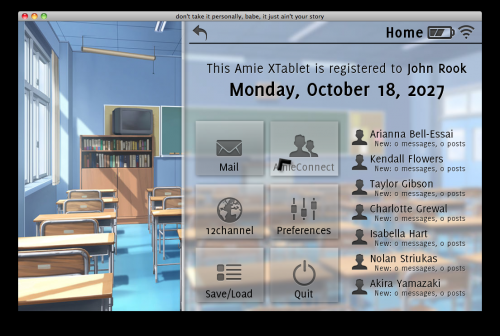
So here you have Lake City and these AI in an alternate late 1980s world with an appropriate looking Amie Workbench Version 1.3 computer system made to imitate the Amiga interfaces that existed in our world. Then, take this and make the supposition to fast forward to 2027. In Digital, we find a J. Rook is an administrator of the Lake City Local BBS Board and in don’t take it personally, we find the main protagonist–John Rook–worked with computers before he transferred to his teaching job at a private school in Ontario. However, he would have been one year old at the time, and perhaps he is the son of that Rook: having continued in a family tradition of working with computers before his career change. In addition, one of his students seems to have had a grandmother named Eriko Yamazaki who wrote a book called Digital Shinigami. This same person also seemed to exist in Digital on the Gibson BBS who mentioned that she had to spend less time on the Board in order to write her book and prepare for the birth of her child. In addition, the social networking program that Mr. Rook and the students are using is called AmieConnect: perhaps a future social program created by the company that once made the Amie Workbench application.

this ain't your story

There are no AI in don’t take it personally, but I would not exclude the possibility of them from being in this world: even if Love mentioned that this game is more of a “spiritual successor” to Digital. This game is a different beast entirely. Instead of the player-reader being a neutral force that can choose his or her identity, we have to focus on the character of Rook has he navigates the morally-questionable world of Information technology in his classroom. Essentially, he is supposed to read the private emails and interactions of his seventeen year old students to “prevent bullying,” but the irony of what is private in a “private school” or even in by futuristic society’s becomes very questionable indeed. It is here that Christine Love starts to use an anime-like graphic style to represent the characters–possibly influenced by her first commercial dating simulation work Love and Order— and after a while you get a real feel of who they are as people and you get to decide how Mr. Rook interacts with them and how the information that he “shouldn’t have” will factor into it … or not.

I am so tempted to say that this shift in what is considered private and how the online world of social interaction works is just a precursor to humanity’s own changing attitudes of how it perceives itself and the world around it. Whether or not Christine Love succeeds in capturing that tension–that agony of change–is another story entirely, but it is definitely intriguing.

Now, here is where my temptation leads me. Fast forward to the 25th century and then to “thousands of years later” in Analogue: A Hate Story. Not only are we in another time, we also finds ourselves in another space. From my understanding, in the 25th century the people of Earth have developed space travel to the point where they plan to colonize other worlds. And guess what? In addition to human captains, they also have AI guides with the same asterisks in front of their names.

Unlike the other two games where you find yourself–either by your own self or indirectly moving Mr. Rook–in North America, you are in space investigating the lost Mugunghwa generation vessel: a ship that was sent from the futuristic unified nation of Korea to create another planetary colony. It is a very nice counterpoint to Digital because you are looking at something that is the product of a different culture and how that affects what you might find. During the process of finding out why it never reached its destination, you realize they operate much like their 1988 North American counterparts: in that they have to delete themselves from one place in order to transfer to another. This plays a very crucial role in both games. :p

But these AI are also very different. Unlike Digital, they actually have image-forms and they look like anime characters. This allows you, as the player, to interact with them through more than text. You can see their body language and, I would imagine if you were actually in that world, hear their voices as well: though there are no voice-recordings in Analogue. I had to play this game right after finishing Digital because I read somewhere that unlike don’t take it personally, this was less of a spiritual sequel and more of a direct one. However, it’s not so much a sequel as it seems to have continuity and a counterpoint to what was going on in Digital itself: Love and Hate. However, just as the “Love” part of Digital is not necessarily what you expect, neither is the “Hate” part in Analogue.

And here is where I go into a tangent about how AI are often portrayed in media, and how they are not by Christine Love. It would be easy–so easy–for her to fall back on the trope of Artificial Intelligence going bad. Of computers that betray their human masters and AI that begin to despise humanity and attempt to murder whatever organics they can. But Digital follows an entirely different dynamic and Analogue, for all it is called “A Hate Story,” very much subverts this as well. In both games, you have AI that exist parallel to humans and while in Digital they are just another intelligent people, those you meet in Analogue exist to actually help and befriend you: even if you have to weave through the details of a terrible past and mystery to do so. They are there alongside of you and are just as sentient, responsible, happy, sad, horrified and afraid as you as an organic being. If anything, the only thing that separates the ones in Analogue from Digital is that they are made to help you and despite and because of their personalities that this imperative still remains.

So this is the world that through the addition of some asterisks and a few hints (of continuity in the form of Easter eggs and code-based sneakiness) that I believe Christine Love creates. Now I’m going to talk about the next part: which is my own relationship to the game and where, while it might not be my story alone, it is definitely–as Christine Love posits whenever she thanks the pronoun of “you” in the end credits of her game–our story.

I played all three of these games (technically more if you include Rumble and Aphroditus), and now I want to discuss my interaction with their respective gameplay and story lines. So, with regards to gameplay, I have to say right off the bat that there was swearing. A lot of swearing. I go into games relatively blind and I probably don’t read instructions as clearly as I should. But I did notice a few things.

First of all, in Digital I almost had no idea what I was doing at first. It took me a while to adapt to the “dial-up” system analogous to old telephone system Internet interfaces that Love imitated exceedingly well. I learned how to use “the codez”–illegally-obtained long-distance calling card numbers–and actually felt like a hacker: which is hilarious because I am not technologically gifted at all. So I was doing relatively fine until … until the Underground Library. The freaking Underground Library. Don’t misunderstand: I loved that level and the information within it. But I didn’t know at the time that I had to download every download I got from other users in other BBSes so when *Delphi (who I always identify as female) transmitted that goddamned screen-lining virus to me, it was there to stay.

I ended up having to reload a previous save state, very carefully go through my downloads again and make sure not to miss any of them. And it was easy to miss them. God, I was so mad when that happened.

Also, while doing the following does succeed in making you more immersed and interactive with this alternative late 1980s computer world, having to manually dial-up BBSes gets very tedious after a while: especially when your “codez” were declared invalid and you had to go back and get more through more, you guessed it, dialing. However, when I actually took a break to vent or do something else and I came back, I got over it and enjoyed the story.

Analogue also had a “stuck-point.” While I was much enjoying going through blocks of diary texts and reports with *Hyun-ae and *Mute, I did not enjoy the fucking reactor core of the Mugunghwa ship going into meltdown and me having to choose which AI I wanted to save: made all the more frustrating by the fact that I knew there was a way to save both of them. I felt like some tech specialist in going through the motions and programming to save the ship, whatever AI I could, the records of what the fuck happened to it, and of course my own life.

I also admit that I was starting to get annoyed about constantly having to hear the alerts on and open and check Mr. Rook’s status updates on his AmieConnect in don’t take it personally.

Wow, from Digital to Analogue I transitioned from the profane punctuation of “freaking” to “fucking.” I guess I know which frustrated me more. I guess the reason Analogue frustrated me more is that it made me have to make some hard decisions about who I wanted to save. It was almost as bad having to influence what decisions Mr. Rook made when dealing with his students in don’t take it personally, babe, it just ain’t your story: because I got a feel for the characters and some of those decisions were just so … hard to make. Also, that title is genius: because unlike Digital or Analogue where you can play as “you,” in don’t take it personally the story is not about you at all: and it is hard to differentiate yourself from John Rook. I suspect Christine Love purposefully made it that way: using that age-old concept of protagonist-identification to make the player that much more uncomfortable. Basically, the title to this game is for the player’s benefit and kind of a raspberry towards them too.

But the very thing that makes these games so hard is also what I love about them. What I love about Christine Love’s games is that they tell a story. But it’s more than that. The reason I really love the games is that they are about people and relationships. Basically: I liked the character and even those I didn’t like were not two-dimensional beings.

In Digital, I found it amazing that *Emilia was an AI that could make original poetry–even “bad” poetry–and that she could feel love: that you begin to realize as a player that you can emphasize with an AI who is–essentially–another sentient being. I also really liked *BlueSky: because he just seemed to be this really friendly and brilliant AI historian. If he actually existed, I would have loved to have more discussions with him about the nature of AI and technology. He would have made a good friend. And what happens at the end of this game … just broke my heart. It came down to personal love verses the love or duty to something greater than yourself and that choice–which in this game is not a choice at all–is heartbreaking: if only because Christine Love spends all that time getting you to sympathize and care about … those that you do.

As for don’t take it personally, babe, it just ain’t your story, I sympathized with John Rook and the difficult situations he found himself in. I even liked Kendall Flowers and, frankly, her honest and direct nature when she felt the need to be assertive. I realized that Akira was really lucky to have her as a friend. I do find it really interesting though that while the gay relationships that develop among the students have their issues–those challenges that any people in relationships face and how society views them–the potential heterosexual relationships are really rendered problematic in this game when you consider the characters of Taylor Gibson and John Rook himself. Taylor was once the girlfriend of Nolan who becomes Akira’s boyfriend: and she is homophobic or at least quite ignorant. She is a self-absorbed and mentally stunted being that proceeds to emotionally manipulate and bully both her former boyfriend and his new boyfriend.

Then you have John Rook and the relationship that could develop with Arianna Belle-Essai: one of his own students. There is definitely the problematic power dynamic of authority or privilege that places Rook over Arianna to consider and also the very real fact that he is a lonely sad man and she is a lonely confused but piercingly direct girl that really creates that tension. You could, if you wanted to, really read something into how relationships between opposite genders might work under our own culture and the way it uses gender. Neither are really honest with the other, but if you choose the route for him … I don’t know. I actually liked Arianna: because she knew what she wanted and she wasn’t stupid and when one of the endings of the game reveals itself, you realize that she and the other students know how to keep an open secret even in a world where privacy has changed so radically.

But I also like John Rook himself despite that possible ending because after a while you realize that he may be a bad teacher, but he is part of a bad school and a bad educational system and what some of his students need is a mentor, an adviser and a friend more than an instructor. There were a lot of complicated issues, but maybe they were offset or complemented by the fact that everyone involved was human.

So now I come to Analogue: A Hate Story. In this case, I really sympathized a lot with *Hyun-ae and what led her to making the decisions that she did. I probably would have done the same in her position. At the same time, I could also see *Mute’s perspective and she managed to break through my own leanings towards absolutism. I was actually happy when I let *Hyun-ae cosplay as a scientist: given how much that meant to her and why and I felt like shit when I dressed her in a traditional Korean Hanbok: especially after realizing what the degenerated society of the Mugunghwa did to her. The slow realization of what was, in fact, done to her made me absolutely dread reading what happened next.

At the same time, I loved the epistolary novel-format of looking through the entries of all the Mugunghwa‘s inhabitants and getting to know some of them that way: that for all their society became repressive, they were still human beings and not all of them were inherently evil. In fact, none of them were but some of them were more selfish than others and most of them let themselves get shaped into something that supported a repression of humanity: and in particular women. *Hyun-ae herself does not know why the descendants of the colonists in that generation ship became how they did, and *Mute herself–the original guiding AI–does not seem to remember. But this is the plot to the upcoming Analogue: Hate Plus and given what *Mute’s name is, I both highly anticipate and dread what we as players are going to discover.

When I really think about it all, though, looking back on my Christine Love games marathon I realize that none of the games were really about us. In Digital, you send emails back and forth, but you never type your own messages: while you do see those of the people that you are contacting. In Analogue, the interface that would allow you to answer beyond “yes” or “no” binaries is “malfunctioning,” and you only have the two former options for actual communication. In the latter game, you can’t even tell the AI your name and they never see what you look like. There is a strange balancing act between communication and empathy, and distance and loneliness.

For me, that kind of dichotomy and the tension it makes reminds me of watching a really good anime. Certainly, the visual novel medium that Christine Love has adopted for all three of these games conveys that sense of experience. You feel for and sympathize with the characters, but you are never one of them. Not really. At the same time, you are. There are also a lot of subtexts: or some from my perspective. For instance, when *Mute asked me if I was male or female, and when Digital had me type in a name and a username, I felt so strange–after talking with *Hyun-ae– to be using masculine pronouns. I know Christine Love has said that she made these two games specifically for players of either or any gender, but she has also said that privately she believes the relationships that go on are between two women in a romantic dynamic: because that is her perspective. Sometimes, I feel like an intruder but then I get over it and realize that it is really about an interaction between the minds and feelings of the player and character regardless of gender.

There is also another possible subtext or interpretation that intrigues me too. Christine Love likes to make games that are inclusive of those who identify as queer: or at least make them more inclusive to more than just a male heterosexual audience. There is another group that sometimes has an asterisk connected to a word as well: though it is an affix as opposed to a prefix. I am talking about those who identify as trans* and use this term to encompass all those who do not identify by cisgendering: the gender that mainstream society aligns with one’s biological sex. This is an umbrella term that can include those who identify as queer or genderqueer. When you look at the revelation with *Emilia with that lens, or even *Hyun-ae–in that she cannot and will not correlate her sense of self with the gender-expectations of the regressive society around her–it can leave a very different connotation.

But that is also too much of a simplification. As I mentioned before, the asterisk can encompass an entire group: and in this case perhaps the idea of something being transhuman or a designation of beings beyond the conception that all sentient life has to be organic and material. In this case, it seems to give a being a cultural or “racial” marker. I just can’t get over the fact that the inclusion of just one symbol can possibly mean more than one thing: though this is all just supposition on my part.

At the same time, I really have to say–among the many things I’ve said–that I really like many of the female characters in these three games. From Arianna, Charlotte and Kendall in don’t take it personally to *Emilia in Digital and all the way to *Hyun-ae and *Mute in Analogue: they are all direct, all brave–or grow to become brave–and they have the strength to admit what they feel despite any circumstances in the way. There is something so beautiful about this that I can’t really put it any better than I already have, or how the games already portray.

But ultimately–and if I have already said this before I want to reiterate this statement–what I really like about Christine Love’s work is that she actually tells a story. When she talked about Lake City Rumble II being a subversive parody of a fighting game, it jived in that same place I have where I was really fascinated with the story and the character interactions behind the fighting more than really the fighting itself: though it also had its moments. And what I truly love is the fact that she actually makes me care about her characters and this–to me–is the sign of a great writer and creator.

It is my hope that she continues to do what she does because, you see, I don’t care if these aren’t completely my stories. In the end, I just want to see more of them: spreading out from *Mother, leaving neither copies behind them, nor taking anyone else’s names but their own along the way.

This Game Has No Warp Zone: A Review of Pipe Trouble

Pipe Trouble

“I like games with consequences.”

This is what a friend of mine told me not too long ago with regards to online games, but it is a sentiment that can easily be applied to video games in general. I know that I–and many other more eloquent and informed people on the matter–have stated that the medium of the video game can be used for more than just entertainment value. The medium of a video game is as its very core an interactive experience that, like any other art form, can get us to relate to the world around us in a different way.

However, with regards to Pipe Trouble, there is also the matter of responsibility to consider as well.

Pipe Trouble is a game created by Pop Sandbox Productions, produced by Alex Jansen, and co-designed by Jim Munroe. It was apparently made as a companion piece to the TVO-commissioned documentary Trouble in the Peace: a film directed by Julian T. Pinder and produced by Six Island Productions about gas leaks affecting Northern British Columbia farmers in the Peace River region and in particular one man and father, who has decided to do something about it.

Before I decided to write this article, I did not know that Pipe Trouble was a digital complement to this documentary. In fact, the entire subject matter that both the film and the game seem to encompass–Canadian farms encountering potentially lethal gas leaks from pipelines of gas companies in their regions–is not usually something I tend to focus on with more than passing attention. After a while, and as cynical as it gets, news of “corrupt corporations, victims and innocent bystanders, and eco-terrorist reprisals” tends to become oversimplified by the media.

It is one thing, however, to hear and watch something about a matter that seemingly doesn’t concern you as an individual. It is a whole other thing to find yourself in a situation–even if it is a simulation with a satirical veneer–where you are in a position of great responsibility.

What Pop Sandbox is attempting to do to this regard is not something new, but rather it is a very familiar idea they have worked with expressed into a different medium. While I did write an article or two on Kenk: A Graphic Portrait a fair while ago, what I might have neglected to mention is that one major theme in the graphic novel–also made by Pop Sandbox–is that everyone has a part to play in a particular social action. In the case of Igor Kenk and his stolen bicycles, it is made clear that everyone–to the people who bought bicycles from him, to even the people who purchased their stolen bikes back, to law enforcement and Toronto City Hall–knew about what he was doing and, just as they condemned it, they also tolerated and even to some extent accepted it a part of their social system. With regards to Kenk, Pop Sandbox illustrated–quite literally–how Igor Kenk was just part of a social dynamic–of a collaboration–in which the rest of the city was also a part.

But Pop Sandbox goes even further with Pipe Trouble. While Kenk simply observes a social structure and interaction, Pipe Trouble makes the player-audience interact immediately and directly with the issue as clearly, and as simply put, as possible.

In other words, you–the player–are placed as the manager of a gas company apparently situated in the Canadian Province of Alberta and you must please your superiors and make them money, keep the people who need your corporation’s services in mind, do as little damage to farmland, animals, humans, and the environment as possible, and try not to piss anyone off.

It is very clever. It is very easy to vilify a company or a corporation as a soulless entity that only caters to the very rich, squashes agriculture and “the lower classes,” and pollutes the environment without any understanding of what it might be doing or–worse–even care. It is just as easy to lionize a pipe bomber as a freedom fighter against a tyrannical force even as it is to denigrate them as a terrorist that likes to destroy human lives and a Western way of life: whatever that is.

However, natural gas is one of those resources necessary for a modern society to function and a corporation is made by people. As such, someone has to be in charge of providing that corporation’s service, making a living from it, avoiding bad press and blame while attempting to integrate their industrial system into the environment and those existing within it with as little damage as possible. It is no tall order and not an enviable position: especially when you are forced to do it in a game.

It is no coincidence that this game is modelled after the 1989 puzzle game alternatively called Pipe Mania or Pipe Dream. And even though the title itself brings to mind some bad bodily jokes, even that connotation has its point when looking at the game. In Pipe Dream, you have to build pipes to direct the flow of filth inside of a sewer. Pipe Trouble takes a similar mechanic and makes the oncoming substance also toxic, but also worth money. One person’s poison is another one’s livelihood.

You have two men on either of your screen. I would be tempted to call them “the angel” and “the devil” on either of your shoulders, save that both of them aren’t necessarily “good” or “evil.” The man on your left is a farmer that is watching your progress in placing down pipes with oncoming gas with great interest and caution. If you destroy the land too much, there will be protesters that will block your pipe route. How long they stay in front of your progress will all depend on just how much damage they perceived you to have done. This farmer will keep watching you and will warn you only once not to mess with his land.

Then you have the man on your right: your boss. He is the one informing you of when the gas will start flowing (right when you place a pipe down to get from Point A to Point B) and he will keep track of the money you are making … and losing with delays. That’s right. If you do not place your pipes fast enough, not only will you risk a gas leak poisoning a lake, killing animals, and other horrors but you will lose your company money and your boss will sure as hell hold you responsible and, if we are going for realism, probably put it all on your head when the bad press comes out.

I swear: when I first played this game and that gas started to flow and sometimes I didn’t move fast enough, or have the right pipe piece to place down or even put it in the proper place, that sense of panic sets in. Then you add the pixilated animals that prance and eat in the woods and you are thinking real hard about how to not disturb them: never mind potentially kill them. And that is not even including the fear of getting more protesters in your way that will get more organized and then sometimes even use some nice industrial sabotage against your pipeline: causing more death, destruction, money loss, and bad press. And guess who would probably be held responsible for all of that?

You’re looking at yourself.

It’s like playing Tetris … only with people’s lives. And remember how I didn’t make any bodily function jokes? Well, the ideal is to treat the entire process like the human body. The release of energy, the disposal of waste, and the structure of what you are trying to build is supposed to create a balance with the ecosystem, agriculture, and animal and human health. But as you play and it gets harder, you will become aware of the fact that this game is an idealist’s nightmare. You will have to make some very difficult decisions as you realize that you might not have time to build around that forest to your pipeline’s destination or you might have to be innovative and make some alternate routes in a very set time frame, but in the end you will have to make some very hard choices.

Do not let the game’s cheerful 8-bit pixilated graphics and basic soft-edged square shaped sprite characters fool you. Jim Munroe was also co-designer behind this game. He is an independent Canadian science fiction and comics writer, among other things, that likes to take grandiose topics like haunted TTC Stations, North America becoming destitute in a futuristic era, and a post-apocalyptic world after the Christian Rapture and completely twist them upside down and make it about human characters and life going on. More than coincidentally, Munroe is also the Hand Eye Society’s Project Coordinator for the development of the Torontrons: essentially retrofitted arcade cabinets that play newly made video games. He may have been involved with the pretty nifty creation of the Pipe Trouble game cabinet as well: which, as the link explains, will be placed in areas of high traffic such as universities, city centres, and tourist attractions.

I don’t know what else to add here. Inter-dispersed between levels are radio segments from news anchored events dealing with natural gas industry controversies which I didn’t originally hear until I played the game again at home on the free trial demo. Also, not too long ago I found out that the game itself has created a whole lot of controversy. Apparently TVO–one of the game’s sponsors–has been accused, among other things, of potentially giving eco-terrorists “ideas” by supporting the creation of the game. TVO has apparently removed links to Pipe Trouble from their website with pending investigations into the matter on their end to see if they were in “the wrong.” There seem to be some definite misunderstandings over various issues, but if one goal of this game is to encourage people to think, then controversy–though unfortunate–is one way of getting there. Either way, it definitely hit a nerve in that intersection where art and politics clash.

I think my concluding thought about this entire game is that the title “Pipe Trouble,” again, can mean a lot of things. And it wasn’t until I read the above article that I began to think about it a little more. I don’t generally look at these kinds of games, never mind write about them–especially with how close it comes to politics–but there is something really fascinating about the dynamics that Pop Sandbox attempts to create, identify, satirize, educate and help people relate to. And politics itself is an exchange of power and watching how and through what medium that power is ultimately exchanged through.

You see, I’m looking at pipes as symbolic of devices that link us together and support a communication of ideas. They can create a very interactive and comprehensive system of healthy self-regulation but when there are so many elements in play, things can go wrong, words can break down, and people and the world around them can suffer for it. But whatever else this game accomplishes, it definitely makes you think about these issues and how they are not entirely separate after all: neither from each other, nor from you.

The Heavy Weight of an Unwoven Twine

I’m writing late to state that I finally started working on my Twine game in earnest.

It was a long time coming and it is a long time going. This particular odyssey began in the wintertime when I finished reading Anna Anthropy’s Rise of the Videogame Zinesters and I felt this burning urge to create my own game. Yes. The urge is that bad and it’s something that neither medical science nor organized religion can cure. No, my only bet after that is embracing the spiritual practice known as my creativity and delving into a place I know fondly as “What the Fuck.”

“What the Fuck” and I go way back: so much so that I usually use it for punctuated emphasis. But here it has become its own pronoun. Its own self.

So first off, I do have to say though that when you start to make a Choose Your Own Adventure Game of any kind–on paper or electronically–you begin to realize that you will have a lot of work ahead of you.

The first issue was figuring out what kind of story I wanted to tell. I mean, the fact of the matter for me is that I more or less know what I am going to say. It is the details that are challenging. It is not so much what I am going to say, it is how I am going to say it.

I do have a few things in my favour already however.

The main thing is that I know that there will be alternate branches and pathways in this story: and this aesthetic will determine the narrative structure. I won’t leave it at that, though, because I know how entirely boring talking about structures can sound. I actually started working on the idea of this game months ago: specifically writing the different worlds and places that I planned for “you”–the player–to visit and interact with. I typed up said Notes in the Draft section of my gmail account and then printed them out: to which I started writing extra places and notes on the margins.

All of the above has been the easy part. Now I am going to tell you the rest of my experience so far in fulfilling this promise–this challenge–to myself.

After I finished my notes on planes and worlds that embodied some key concepts that really stick my head, it occurred to me that this sucker had neither a title to its name, nor a name to its title. Pick one. ;P You might think that, in the initial stages that I was in, this would be nothing but in actually it is everything. I mean, sometimes I even have difficulty defining a Blog post I’m working on, so you can only imagine what this this like.

A title to a work summarizes and focuses everything that you are trying to say in a clear way that gives the reader, or in this case the player-reader, a sense of your own slant: your own vision. So for a while, I had nothing. I realized that I couldn’t flesh out what I had if I had nothing. Then, to make things even more messed up, I had parallel game ideas start to manifest at the same time: each vying for control over my Notes and trying to unify with one dominating over the others. It is an internal struggle that still threatens to manifest even at this time.

I’m not finished yet. So in addition to not being able to find a name to unify these warring idea-states, I also realized that I didn’t know what my narrative perspective was going to be. Quite simply, you know that second-person “You” pronoun? Yes. You. I’m talking about you. I was stuck between making “you” neutral in a futile attempt to make the illusion of a one size fits all, or a “you” that was more specific and had particular experiences that you, as the person and not the player-reader, do not necessarily have.

This was the state of creation at that time. I left it for a while and then, one day, I was sitting at my parents’ computer and I remembered a place: a particular realm that I wanted to make. So far, I gave my game idea a lot of working titles and names. “Hell” was at least part of one of these.

I was thinking to myself, not for the first time, that I am better at creating hell than I am at heaven. And then I thought to myself, “Matthew: how would you make a utopia?” A perfect world … I mean, we all know here that there is no such thing: at least not on the human plane. But I started thinking about what the closest thing to a utopia there was that I could get behind: something hard but something to work at.

Then I thought of a word I hadn’t remembered in a while. I wrote it down on a pre-scribbled piece of notepad paper in front of me: one of many that tend to form around me in my hazardous capacity as a writer with ideas. And it was then that this idea for a world or a state of being became part of the title for my game.

Hell still remains. You can thank my year-long reading of Paradise Lost for that and my own twisted mind. But I had something else now. I had a much clearer goal and something to work towards. I realized it was always there: I just had to name the bloody thing. Anyway, I still had some issues starting this because the ideas were still not recognizing the title that wanted to unify them into its twisted weird Twine narrative empire. They were still fighting.

So I did something else.

I did what I call now a “work-around.” I sat down and wrote out a list of books and other media that I could relate to. I imagined them as places or references that I could get the reader to relate to: making the outline of a ground that we might have in common. Then I went to sleep. The next day, I began working on the introduction to the game. Actually, that is a lie. It was the second introduction. I wrote the first introduction a while ago before I came up with the working title. It … got my point across, but it was too heavy-handed, kind of contrived and full of jargon. Still, it had some good points and some of those things will have a place in this version of what I am making now. Actually, I am making one world where you can choose to go that has Jargoning in it.

But I wrote the second introduction which hopefully sets the mood for the exploration and struggle that is about to happen. I made that and finished creating the Jargoning World.

And that is when the second level of difficulties have reared their heads.

You see, I am already feeling that this second introduction will potentially have to be rewritten. There is so much that I have to say. But I am also hoping that I can use another place to expand on it. If not, well, hopefully I will have enough of the writing done at that point to revise the beginning accordingly: Time Lord style. I’m also writing a lot of notes on a lot of the margins of this work. Bear in mind: I am writing this all down on note paper before typing it out. Think of this, all of this, as my first draft.

I am in the next part of this Project before I realized that I really needed a Travel Chart linking all of my worlds together: and where you can travel from where. So I did that, somewhat messily, and I know that will change as well: especially since I forgot a place to add already. :p I began to realize that all of these places that my game interrelate in ways I didn’t consider and it is mutating into a writhing nervous system that I need to keep growing and keeping track of.

Then I added another element that I want for the Ending and I am hoping that the Twine software–of which I have not really experimented with–will accommodate me. Yes, I did say that: though the tutorials make the overview look simple and I have played Twine games before I have not even experimented with Twine yet.

So this is the State of Chaos. And it also tells you something about me as well. I originally wanted to make a straightforward game that was, albeit, epic. Then I wanted to narrow it down into something more personalized and accept it as an early and not necessarily refined experiment. Now I realize I might well be writing a Twine novel.

I can never do anything simply. Ever. It tells you a lot about me.

I both love and hate it when this happens. I’m almost kind of … afraid. Because that is a lot of effort and it can take a lot out of me: something I know from experience.So far I’ve only worked on short stories, vignettes, and even some poetry. I have not worked on an epic work in a while and it can be terrifying: especially at the stage in my life right now. Even as it can be glorious.

It also helped, and didn’t help, that I played some awesome games these past couple of days and realized that I might be out of my depth, and even should I finish all of this–and I intend to because I feel like I really do have something to say–I don’t know if I will be making another one. It might be a one-off. And here I start to question if anyone would even bother to play it, or if I should be spending my time trying to find something that will “pay off” for me: whatever that is.

In the end though, I think my major hurdle is how personal this game is to me and I can’t not make it. So there it is. A whole post with vague details about an unmade Twine game with massive emphasis on creative process and no pictures to say that it is happening.

And despite and because of all this, I am still excited to be doing it. I will keep you all posted as this world continues to unfold. Until another time.

What I Did On the Anniversary of My First Blog Post: The Toronto Comics Arts Festival

This is going to be a late entry as I have been recovering from the last three days of attending–and volunteering–at the Toronto Comics Arts Festival. The first time I ever went to the Festival was when it was still at the University of Toronto: back in those days when I was still in Undergrad and working at York in 2007.

It’s an understatement to say that it has long expanded since. I came back to it in about 2011 while still in Grad School and then last year before my official Graduation. I mentioned in another post that it is about this time of year, specifically the month of May, where things have ended for me. Actually, this post is being made two days past the Anniversary of the online Mythic Bios: namely, this whole Writer’s Blog.

So let me celebrate this missed anniversary by telling you all a bit about my weekend at TCAF.

On Friday I reported to my set-up shift. I haven’t really lifted heavy boxes or tables in a while, so my arms are still all sore from that. But the company of my fellow volunteers was totally worth it. We all wanted to be there and, for me, it is a novelty to be able to talk with people with similar Geek knowledge and interests. Really, for that alone and working together with like-minded people on straightforward tasks it was totally worth it. I got my bright blue volunteer shirt along with everyone else, and then headed home to attempt an early night to wake up earlier the following day.

Well, after failing to go to bed early I woke up the next day and somehow found the Marriott Hotel without getting lost where Art Spiegelman was going to be doing some signings. So I naturally brought both of my volumes of Maus with me and waited in the line to meet him. It was only after a while that the volunteers on duty that day informed us that Spiegelman would only sign two books, and one of them had to be one of his new ones. I will admit, I was annoyed. Like I said, I had the old version of Maus that was divided into two volumes and I had been keen on having them both signed. I also didn’t see any of the new books that I was interested in.

At first.

I was tired and hungry and I almost left the line until I decided “What the hell, I’m getting to meet Art Spiegleman.” Then I found Breakdowns: essentially a large collection of his earlier work that I had either only seen excerpts of, or only saw references to in text books for my own researches. Some of these comics had led to the creation of Maus as well and also shed more light on his family life and his own experiences. In fact, some of the comics in there have that very 1960s to early 80s Underground Comix feel: specifically the pieces that really share Robert Crumb’s wobbly, sometimes vulgar but very iconic aesthetic.

By the time I got to see Art Spiegelman, he was sitting across from his wife–the stately Francoise Mouly–and the artist Frank Viva. He looked like someone’s elegant Viennese Jewish grandfather. I know he doesn’t come from Vienna or Germany, but that is about the only way I can physically describe him. I told him that it was a great honour to meet him. He seemed pleased to see that Breakdowns was one of the books I had and he described it to me as something along the lines of a building with which he keeps adding renovations. At one point he joked about whether not my name had changed by the second piece he was signing and I told him, “Not this time, but usually I change the number of Ts in my name just to mess with people.” He found that (very untrue joke) very amusing. Then I shook his hand and left with my prizes.

I just have to reiterate that Spiegelman’s work really influenced me. I originally encountered him in my Literature of Testimony course in my Grad Program at York. A lot of the literature made my own first-person narratives stronger: increasing my voice and its depth. But Spiegelman in particular not only taught me that symbols be used to represent literal things and ideas, but that this same order can be subverted to either destroy their meanings or through doubt on them. This is a very sophisticated technique and one that definitely will affect at least one work of mine. That is one major reason I really had to meet him: to meet one of the masters of what I’ve tried–and am trying to do–in my own writerly way. So yes, it was awesome to finally meet him.

By that time, I made it back to the Reference Library and got a few more books. It was there that I met Hope Larson for the first time and her sign her adaptation of A Wrinkle in Time for my Mom in honour of Mother’s Day and her birthday. She apparently found that cute. I chose that book because my Mom loves Madeleine L’Engle’s series and she used to read them to me when I was much younger. So it was kind of a bridge between our interests. Later, I remembered that I had read Hope Larson’s Salamander Dream and Gray Horses when I worked for the Clara Thomas Archives.

But I couldn’t make it upstairs as I had planned. I was tired and dehydrated and apparently there was a line to get into the suite with more of the vendors that I wanted to visit. I met a friend and we ended up going for a meal of some kind, or I did, and then went on our way to Bento Miso for its own Bit Bazaar. Bento Miso is a place where games–electronic and analog, as well as many start-up businesses–are made and they were opening for the Festival. It was a nice sunny day in downtown Toronto as my friend and I tried to circumvent the ridiculousness of the TTC shutdown from Bloor to Union Station and went to Ossington and walked with tons of stuff in my arms to Bento Miso for the first time.

I met a few people there and got to play some games: including one game called Bijouxred: which is essentially a game that combines the strategy war game mechanics of Fire Emblem with the rough brawling moments of Streetfighter II. And that is just a simplification because the fights themselves have some elements reminiscent of Final Fantasy–with its Combat Options, and even Mario RPG with regards to having to press a button to simulate blocking, charging your energy, or even chaining attacks together. It was really cool. I met Rene Shible–Director of Development–and Lead Animator Michal Szczepanski: who were quite friendly and directed me through their game.

The Bit Bazaar itself was awesome. There is a very Underground feel to it: a combination of grit, digitization and nostalgia along with a lot of geeking, friendliness and adventure. A few of the games from the second Comics Vs. Games collaboration were being shown and played there as well. It is still something I want to do with an artist programmer one day. 🙂 I got a Steamkey to Spooky Squid Games They Bleed Pixels: which I ranted about a really long time ago as also being awesome. It came with its own small black envelope and a simulated red wax seal. That was a very lovely touch. I also got to meet a few people and a friend of mine I hadn’t seen in a while. I think I will visit there more often soon. So by the time I finally got home that night, I was bloody exhausted.

But it wasn’t over yet.

The next morning I woke up even earlier. I gave my Mom her present before leaving and made it again to the Marriott just in time to observe the Art Spiegelman Spotlight panel: with Seth as its moderator. It was a very eye-opening exchange between the two cartoonists and it was this interaction, combined with reading some of Breakdowns that gave me a little idea as to why Spiegelman wanted people to read his new work and not focus as much on Maus. I mean, first of all there is the creator perspective of it: in which an artist doesn’t want to be solely determined by one creation–no matter how great–that they did in the past. But another, more personal reason, is when you consider the content of Maus and just how much Spiegelman had to delve into some dark and personal spaces: some of which were not even personally his own, but affected him just the same. This article from the Toronto Star might explain it a little better and might have made more sense had I read it before meeting him. Having that long shadow cast over you can be brutal. I also learned that Breakdowns has been reprinted twice with new work or “renovations” added.

Then I went to the Library, got some Hope Larson comics for myself, met some cool new creators, and made it to the upper level where I met Maurice Vellekoop with his elegant, airy lined and water-coloured comics: often portraying erotic and adventurous content. I got something and had him sign it. Then I went around that level and left to eventually get to the Bryan Lee O’Malley Spotlight panel: where in a strange game of “Guessing the Answer Before Asking the Question,” I answered, “No,” and asked if he had ever intended the character of Mobile in Scott Pilgrim to actually turn to be Gideon. Suffice to say, I was right and I don’t think I was the first one to ask this question.

Eventually the Festival was closing down and I went to my next volunteer shift: the tear-down phase. This was the shift I covered last year and it had been my only one at the time. I got to say hello and goodbye to some people I met and then I wandered home in the suddenly cold with hail balls coming down.

And that was my TCAF.

So, there is one thing I want to mention before I wrap this long post up. Some of the artists I was talking to were commenting about how awesome TCAF is and how people from all over Canada and the world come here. They were talking about what makes TCAF different from other conventions. Well, I have my basic two cents on that matter.

The first thing to consider is that TCAF is free. It has no entry fee and all you have to do is come in and bring money to buy work, or simply come to the panels. It is also a festival and it is spread around a few locations. But I think the second element of TCAF that I like is that the barrier between artists and readers is somehow thinner here: or at least far more permeable? You can interact with many artists as you would any other person or vendor. It also helps that many artists are in fact fans of other artists. There is just this positive enthusiastic energy around all of that just makes me happy. What really makes me happy is that so many younger people come to this Festival and are so enthusiastic about the comics medium and what they like.

It’s some of the few times that I am proud to have lived in Toronto and still do some business in it. And this event was what I needed lately. I feel more inspired to just do things and get things done. It’s like I got recharged, if that makes sense. I also finally decided to make a basic business card that I can give to people that is linked to this Mythic Bios site. And I made more connections. It was a truly rewarding experience and I would like to thank the Festival Staff, the artists, the vendors, the fans and my fellow volunteers for making this time exist every year.

Also, thank you all for continuing to read and Follow me. I know that this particular post was a very long one and I feel in some ways that I did this event more justice in my own personal written journal, but I did what I could and I underestimated just how much happened in three days. These three days made this part of May a good beginning and I have plans now. And I can’t wait to begin the process of implementing them.