Stitches, Meetings and Silver Keys in Downtown Toronto

Well, I have been fighting off a cold for some time now and it seems as though in these days two days I’ve finally lost that battle and I’m now in the process of surviving. Sometimes I wish I was like one of Vampire Maman Juliette’s vampires to that regard who, from my understanding, are immune to such annoying things as sickness. But, sadly, there is already one vampire in her world named Matthew and having two would just be redundant.

No, I’m still mortal–for better or worse–and annoyed at my body right now because I have so much to do and not an infinite amount of time to do it.

So, how about some good news? The third and final part of my article The Stitching Together of a Mythos: Kris Straub’s Broodhollow came out a few days ago. It really made things come full circle: especially since it talks a bit about Kris Straub’s story “Candle Cove”: which is what got me interested in his work to begin with. We’ve been talking a bit on Twitter as well: which is really awesome. And in addition to getting a few more Twitter Followers–which is always excellent–I may have opened some … new avenues up for future exploration. I need to just develop this possibility further and I’m not sure how well I will do with portraying current events–even of a Geek kind–but let’s just go at it one thing at a time.

This passing week has been a challenge for me on some many different levels, but I did go to an interesting meeting before an evening Torontaru at the Get Well Bar: which I went to for the very first time. Unfortunately, already having gotten lost (because neither of the places I went to were right along the way–between Ossington and Dundas Street West–and where there is Toronto, there is always construction and the TTC to contend with) I didn’t think to actually use some networking time to–you know–network (aka talk to people) and it only occurred to me after I was heading home. But I did more or less what I had to and, besides, the Get Well Bar was over capacity and I was already feeling tired and a bit ill and there were few people I even knew there. The Bar’s game cabinets were amusing though the first little while I was there before I left and couldn’t get back in. I still never figured out how to get the Barbarian to fight in Gauntlet and I died in Frogger: a lot.

So I have been mysterious about two things so far. Upon risk of making this the most boring Mythic Bios post ever, I will leave it at that until I get more information. Instead, I guess I’m going to lean on my fall-back and become retrospective.

I’ve been to Ossington and Dundas Street West before. It’s less that I have a specific memory and more that I have found myself in the general atmosphere before. The buildings are old and run down, but there is new life and–life–in all of them. Many of them are stores or bars and you can make out some apartments above them.

At one point, after I was at the Get Well Bar–which is an ironic name given that I’m sick though it has nothing to do with anything really–I was sitting at Subway near the window. Here I was, finding myself sitting downtown watching people walk and interact beyond the glass. I saw a few couples holding hands and a few pairs of friends talking. One man was carrying his meal in layers of containers wrapped in a white plastic bag. And there was an old man I saw pass by twice and an older woman walking by.

And it made me wonder as night time already took over the faded gold and pink sky I’d been walking through earlier in my quest to find that meeting place: was this part of the city like this–like all of this–thirty or forty years ago when those older people I saw were my age or younger? Was it always like this? And would those couples still be together and those friends still meet up? Would they be as old as the people I saw that night: remembering all those times they passed through this area of the city talking and laughing and thinking it would all be the same the next day when–one day–it is going to inevitably change somehow? Would Toronto’s proclivity towards construction eliminate so many familiar landmarks that no one would even recognize this place with most of their mind or would the gritty aura of it transcend the loss of a mere few buildings that were hosts to so many other things in the past?

And it occurred to me that people lived here–actually lived here–and it was like seeing some of the Scott Pilgrim video game in real life. Is the Scott Pilgrim game really Ossington and Dundas as well as the Chinatowns? I tried to live in Toronto but, more than that, I tried to understand it: to find its spirit and companionship. I tried to find its life as it could relate to me and embrace it and–to this day–I’m not sure if I ever succeeded. A lot of the time I just found “being lost” and “afraid of the dark” as my common feelings towards being downtown: with some “dazed and confused” and the occasional and inexplicable … magic, I guess.

I think everyone of us gets nostalgic and sometimes yearns for and broods about the past.  Sometimes it’s almost like there is a choice between having some awesome moments and watching them disappear into memory forever … or never having a life of any pain or joy and watching other people’s and feeling nothing but envy, when you really get right down to it, a sense of hollowness: of having wasted your life. The first is magic, as far as I understand it and the world feels a little greyer when it finally fades. And no matter how much you want it back, you either can’t or it will never be the same: and that’s not always a bad thing.

It does make for good writing, though, such as my short story Stop 17.

I’ve been angry at Toronto and in love with it and disappointed in what I thought I found occasionally. But as I was sitting in that Subway shop, that night it just seemed like another … place to me: just a place I visit from time to time.

I’d like to leave you all with one more thing. Leeman Kessler has succeeded in resurrecting a homunculus of H.P. Lovecraft to answer all of your questions. As such, Mr. Lovecraft was good enough to answer a question that has been close to my heart for a very long time. Have a good night everyone.

It Made My Day

I just wanted to take some time to talk to you, my readers, old and new. It’s going to be a short post this time around, but don’t get used to it: I’ll be writing your ear off again soon enough. 😉

In fact, that’s what this entire post is really about.

So, a week ago now the first part of my article The Stitching Together of a Mythos: Kris Straub’s Broodhollow got posted by the fine folks of Sequart: which I followed on Twitter only to find that Kris Straub himself had retweeted it. After a brief Twitter exchange my day–then–was made. I thought that, if it ended here, it would be okay.

A day or so later, I posted a few comments on Amanda Palmer’s Blog. She wants to have some feedback with regards to a non-fiction book on the topic of asking that she was, ironically, asked to write. As I was responding to her second book post, I had an epiphany about something. When Amanda asked what I wish I asked for, I rambled a whole lot and then, not as satisfied with the answer I gave her on this post I went on Facebook and Twitter to state that I realized “that, after commenting on @amandapalmer’s Blog, most of my regrets aren’t about things I didn’t ask for.”

A day later, I opened my email to see that on Twitter I got a retweet from Amanda. I have a friend named Amanda and then I did a double-take and looked at this Amanda’s last name.

Another day. Made. In fact, I was told by a dear friend I’d never talked with on the phone before or even seen that–at least for the moment–I gained more Nerd cred than she has: though I have to say she is definitely one to talk and will beat me in no time. ;p

Then not long after that, Miguel Sternberg of Spooky Squid Games was on Twitter complaining about being in a house with no tea with the hashtag #canadianhorrorstories. You have to understand: I couldn’t resist. I ended up writing this: “Short two sentence horror story: The last man on Earth sits in a house. There is no one at the other side of the door with tea.”

Suffice to say, this got retweeted as well.  I wrote a bit more, but he tweeted his screams of terror at me far before that part and that was satisfying in and of itself.

But then I thought: all right. I am totally on a roll here but I have work that I need to do. I’d finally finished playing Christine Love’s Hate Plus and I had to write something for it: I just had to, you know? So I did. It was long and I stayed up late into the night to watch my brain shrivel into the corners of my skull from exhaustion. I’d written a previous article about Christine’s games and I thought nothing of it. I thought I would get a few views or what-not–maybe more because the game had just come out relatively recently–and that would be about it.

So for a day this seemed to be the case. I added stuff and made some corrections and what not. I even added images and had the damnedest time finding a particular image of *Mute in her uniform. So whatever.

The next day …

I’ve briefly exchanged tweets with Christine Love occasionally but this was the first time she had ever retweeted me. Ever. And then I went on my Blog–and this was a few days ago now or however you reckon time when it is very late past what some would consider night–and I see, and I am not joking at all here, I see this … large number of visitors and an even larger volume of views. You get alliteration from this no matter what word you use. And some unintentional rhyme too. See, this is what happens when I write when I’m tired.

Anyway, now that I’m writing up this post to all of you I just have to ask: how many days equal a week made?

I’m feeling really good right now. It’s still confusing and scary, but I can see the hints of opportunities coming up and all of these things–which may seem trivial to some people–are signals that indicate that I am travelling on the right path to … to something. I made something for Andrez Bergen a musician and an excellent writer as well that will … come up on October 9th. I am corresponding with a friend that may be able to help me find some more contacts and connections that I need to begin the process of supporting myself.

I also have two projects that are really experiments to see how much you guys want to see me … make something. One of these would be shared with the public: though I need to look into the logistics of it more. As for the other: I may or may not attempt some …. self-publishing. We shall have to see on that. But the first will definitely be in the form of a question that I will share with all of you whom might be interested.

I might also be … doing something else too in addition to everything you might already know I’m the process of working on. But I have to make some decisions. It seems lately that I am always having to make decisions. A while ago, some friends of mine who were in Vancouver entered their Master’s Program and I entered mine–at least in part because I also wanted to gain that prestige and knowledge (with no little debt)–to feel like a part of what they were feeling if that makes sense: to prove I was equal to them and, more importantly, capable of delving into places by myself.

For a while, especially after still being in debt and a change in circumstances I began to despise academics and wanted to distance myself from it. But it seems as though it will never really leave me, but not only have I learned that I can deal with it on my own terms through this Blog and Sequart and other places but I now feel close to my distant friends in space and time in a different way.

Because, here is the thing: even though I know this is still going to be hard as fuck, I don’t just want a made day, or a made series of days, or a made week, or even made years.

I want a made lifetime. But more than that: I want to make my lifetime.

And now I think it is beginning because, when you come right down to it, it never really ended.

Thank you Kris Straub, Amanda Palmer, Miguel Sternberg, Andrez Bergen, Julian Darius of Sequart and Christine Love for giving me those little extra nudges towards where I need to be. You are inspiring. I also want to thank one of my former Humanities Professors Markus Reisenleitner for endorsing me on LinkedIn. He actually showed one of my posts–Worms and Bicycles Or How People Make For Strange Stories–to his students and that was very encouraging. And I want to thank Gil Williamson for publishing my science-fiction story To Serve on Mythaxis Magazine.

But lastly, I want to thank all my friends and loved ones and all my readers for always being there in some form or another and encouraging me to keep making this Mythic Bios possible. You will be hearing from me soon. I promise.

Looking Outward

Con Fail

This is what it was like to be me, on Sunday, attempting to look for the Toronto Fan Expo.

Me and my Head

You find yourself walking out of Union Station through the Toronto Train Station to get to the Skywalk. Unlike the other times you’ve been here, there aren’t any cosplayers or people with Fan Expo bags to follow, but you make your way to the Skywalk.

You know that, in the past, all you had to do was open the glass door on the left-hand side in order to take some escalators down the stairs in order to get to the lobby. All you would have to do is get your prepaid ticket scanned, get a wristband, wait in something of a line and get in. And because it’s Sunday and almost 3 pm, you think that you won’t have to wait very long. You would get in, meet with your friend from London, Ontario and explore for about two hours. The only issue would be the line that might form as you are all leaving like last year’s.

However, it is precisely because of your knowledge of last year that you know that the door is locked and you have to go the long way around, down stairways and across a street or two to get to where you need to go. You get out of the Skywalk and you are outside on the roof. You wander around. Finally, a really nice young lady–whose costume you can’t even recall now and who isn’t a staff member or a volunteer–asks if you’re lost. You admit it and she points you to where you need to go: a Pavilion entrance down below the Convention Centre.

So you travel down the steps. Your thin tight black Dr. Who T-shirt is sticking to your body in the summer heat. You walk to the Pavilion entrances and notice that there are either “Priority,” “Vendor” or “Re-Entry” entrances and exits. So much for that. You keep walking: past a large Aquarium, the line to see the CN Tower and even the Blue Jays booths. You still don’t find the entrance.

You go back and move onto the streets. In fact, you follow a large group of people across a street or two. You even notice some signs that say “Fan Expo” on the sides of walls. They are few, and scattered, and far between. There are no arrows on them pointing anywhere or even a map. You walk past a place where someone, who may or may not be a staff member is talking with a driver. You find another sign. You follow it to a dead-end.

You go back to a park area where you see a young woman standing in a grove of trees dressed and posing as Saber from Fate/Stay Night. It is very awesome and you see her friends taking pictures of her. You try to ignore the lonely feeling, wishing that you could contact your friend or someone that can help you, and continue on. And then you see that you are back in the same place you started at: the Pavilions. A small train ride, that you passed before, nearly runs you over as you are clutching your ticket papers in your hands: which you’d gotten out beforehand so you would be ready for the booth and your wristband.

You have been steadily losing your patience. Finally, you get fed up and go through the Re-Entry to ask the people in charge where you need to go. The security woman in her red uniform is nice enough, but her directions are long and vague. She mentions the Aquarium as a land mark that you’ve passed more than twice. You are tired and hot. It has already been something along the lines of twenty minutes or so that you have been lost in the non-Euclidean geometry of this part of the city or, let’s face it, Toronto itself.

Or at least it might as well be non-Euclidean because this is a vast space and you have spatial issues and difficulties with direction to begin with. You can’t follow the vague map on your papers–if that is what it even is–which has no written directions whatsoever. You keep to the Aquarium and because there are no signs indicating where the Fan Expo ticket-scanning booth is, you walk up some stairs and find yourself at a Hotel.

Then you see two men and a child. You see they have Fan Expo bags like everyone else. You ask one of the men where the ticket booth is. He points vaguely in back of you and asks if you are going to pick up a wristband for sentimental value because the Expo is essentially over. You say that is impossible because it says, specifically on your sheet that they close at 5 pm. He says that this is not possible.

It is 3:45 pm by this point. You walk back down the stairs and across the Blue Jays booths to see if you can find this place. You are feeling a weariness begin to creep into your very being. At 3:55 pm or so, knowing that by the time you find this fabled ticket-scanning place you will have less than hour assuming the vendors weren’t packing up at this point, you realize that this venture is over.

You can feel the bitch-face–that cold unsmiling mask–forming over your features to cover the growing rage you feel inside. You pass by two kids that have shirts with the words “Game Over” and you can’t think of anything more appropriate than to call this waste of an outing. The anger is doused by pure exhaustion and sheer disappointment as not only do you realize that you have wasted $45 for a Sunday ticket to an event you couldn’t even access, and time you could have used to rest, but you also know that your friend is probably heading back to London by this point.

Seeing all of the cosplayers, con-goers and young couples with their loot is just another slap in the face: as though their mere presence this point just rubs in the fact that you couldn’t partake of any of this. You look at the papers in your hand and feel like a fucking idiot. Everything around you feels as cold and as impersonal and uncaring as the business that Fan Expo has begun to represent to you and so many others you know. You’ve already folded the un-scanned papers and now you just crumple them into one fist.

Under your breath, you whisper the words, “Con Fail.”

Then because you went so off-track trying to find this booth, this booth that you wonder ever existed to begin with, you can’t even find the Union Subway Station again and, when you do, you end up sitting in a subway car that takes too long get there, pauses at points and decides to go out of service at Eglinton without even waiting for another back-up car to be there. And all that time, you get to sit there and see more Expo-fans sitting around with their comics and their bags: just reminding you of everything you did not experience that day before your week begins.

You are told later, after you post on Facebook, and after a polite but brutally honest letter to the latter that is probably buried under a high volume of many other incoming emails that Hobbystar–the company that has “organized” the Fan Expo–is going to have new ownership and perhaps things will be better next time. Perhaps they will have volunteers around the streets with signs, or clearer signs on posters, or perhaps just greater organization itself. At the very least, they could have a ticket booth is not in the centre of Pan’s Labyrinth or long, long ago in a galaxy far, far away.

Because right now, just as then, you vow to yourself–having already had issues with Hobbystar and knowing that your other friends have experienced the same–that you are never going to try to go to Toronto Fan Expo again.

This message has been brought to you by Con Fail. I’m glad that everyone else, who managed to make it to the Expo had one. I just wish I had been one of you. As it is, I’m pretty ashamed that I had to spend valuable time and space writing this piece out when I have so many more interesting things planned, but it just had to be said.

It Is Never Still and Neither am I

I dream in the green of it.

In fact, I never really left the green that my friend brought me into last weekend during the summer sunshine. She told me before that I seemed disconnected–that I’d been so for a while–and, as a matter of course, we walked through High Park, then to a pub and back to her place. A night or so later, I found myself on a shuttle bus from Eglinton back to Finch after meeting Neil Gaiman. And on that ride, tired and somewhat dehydrated, I had time to think.

I had time to think about a lot of things.

There was a time that I took a night bus from College Street all the way to Finch after spending time at Neutral. At the same time, when I passed Eglinton I would look for the Higher Ground store with its old apartments that my friends used to stay at. Years ago I would come to visit there and sometimes I would stay the night after going down to Queen and the Vatikan from Ossington. The irony–that I would finally understand how we always navigated from there to there years later after they were gone–never escaped me.

The associations spread from there like creeping vines of psychogeography ignoring all perceptions of time and space. I remember walking down Spadina: from College Street to Queen with my friend from Germany and later giving her her first Halloween. I recall walking with another friend through Kensington Market to look at old thrift clothes and makeup.

Of course the Lillian H. Smith Library comes into the fore with its statues of fantastic animals: whose doors we sometimes stopped into. That library becomes a nexus: where a friend introduced it to me for the first time and I waited for another person there to see the Merril Collection for the very first time.

When I follow the track down I remember Neutral and the girl with the Cheshire smile who decided she wanted to dance with me. Further on, down the streetcar path in the night to Dufferin and then Brock Ave where I sometimes spent the night and free-cycled things like abandoned doors. Down the very opposite, away from the Lillian H. Smith Library was Broadview where two awesome ladies used to live and sometimes had parties. And then near College and Clinton was the streetcar line to Euclid Avenue.

Euclid Avenue.

I recall all the streetcar rides to comics conventions like the Paradise at the Ex or some chain of hotels and all the Starbucks and places I used to find myself in when I wandered. But of all these days and all these evenings what really sticks out at me the most of all was the night bus after a Star Wars game with my friends in Richmond Hill taking me back into the city and my walks on the Danforth and Woodbine where I used to live. And Woodbine. Woodbine. Woodbine …

There were the moots and the munches, the parties and the events and just the times when I allowed myself to wander. I’m not sure when that moment was when I changed from a quester into a castellan, or a wanderer into a hermit. And when I was coming back from meeting Neil and wondering if life would any better after reaching one of the things I looked forward to the most, I finally realized that I was in mourning.

I knew I’d been grieving for a while. In my mind I understood that this was what I had been doing and I even told people I knew that this was the state I was in. But it wasn’t until that night that I began to understand that I’d been grieving for a really long time–for all these things that I thought I lost–and I wasn’t dealing with it.

Of course, that’s not entirely true. I was dwelling in it. I didn’t let go of it. And when I moved back to Thornhill away from the city, all I could do was blame myself and scream quietly why. Why did this have to happen to me? Why couldn’t I keep my perception of freedom? Why does loss exist? Why do I have to be so fucking unhappy?

And I understand something now. That boy who made his ridiculous budgie chants, who went out to his first Conventions, who went to Euclid Avenue, who danced with the girl and her beautiful smile at Neutral, who went to Brock Avenue for the night, who stayed above Higher Ground, who helped a friend find Halloween, who played at the Two-Headed Dragon, who lived and still loves at Woodbine, who went to York University and who wandered around at all times of the day and night downtown in various forms is no longer here. I am no longer that boy or that man. I am not that person–or those people–anymore. It’s all so vital and immediate: before time eats through experiences and turns them into memories. And sometimes it sucks. It sucks so bad and I feel that anger come out at that sense of loss.

Me and my Head

But I have to accept that and live accordingly.

I’m … something else now. I’m not new. I still have all of those memories of being all those different variations of people. And I haven’t sorted through it all yet. I don’t think I ever really will. I know I’m not always wise or strong and I tend to repeat the mistakes of the past in different permutations. But I am doing so much now. I feel closer to something: something that I can’t entirely focus on or name. It’s like I am breaking through a barrier partly of my own creation and the other half belonging to the rest of the world. It is a penumbra of pain, loss, regret, rage, guilt, ennui, and rut but also stability and order and “just the way things are.”

And I am tired of feeling like a stagnant, rotting old man with crazy hair. I want to be an active powerful young man with crazy hair instead. I realize I still feel and that it is okay–and more than okay–to have strong feelings: even though and especially because I own them.

I know a lot of this might go over some people’s heads with details that explain little or nothing. But to those of you who know, and you know who you are, even though I’m a changing person I still love you and I will treasure what we had and whatever else we can have again now. I was really very lucky. And I guess I still am.

I guess this is just a really long way of saying that I’m still healing and it is confusing, and uncertain, and sometimes really quite scary. But at the same time, I feel alive and this is my space and my time: or as Gwendolyn MacEwen put it, I’m dreaming “in the green of my time.”

Until another time, my friends and loyal readers.

Toronto’s Boyfriend Tells Us To Dream: Neil Gaiman at the Danforth Music Hall

For a day that I’d been looking forward to for a very long time, there isn’t very much I have to say about it.

The day before I’d packed everything I would need: my ticket, The Ocean at the End of the Lane and its proof of Indigo purchase, my first edition of American Gods–the book that started it all for me–and then the following day I packed my less-than-often used digital camera: just in case. After a shower that same day and dressing up in my World’s Ender’s T-Shirt and carrying my leather jacket I got a ride to the subway and then eventually got off at Broadview to head towards the Danforth Music Hall.

I didn’t plan to be second in line. I came by the Hall and noticed that it was still closed. So I went for some food and came back and started talking with someone there. We became the beginning of the line: even though we all had reserved seats.

Eventually at 6 pm we were allowed into the Hall. A very nice Indigo staff member working for the event marked the place in my Ocean book where it was going to be signed and personalized and then she wrote down my question for him on another piece of paper. I asked a really convoluted and boring question along the lines of: “Was there an interview or an article where you actually stated that you wrote an origin story for the Beldam?” Actually, I just called her “the Other Mother” for good measure because it was easier for the person writing it: even though I knew my question wouldn’t be chosen anyway.

You wouldn’t have figured I’d have asked a Coraline question, huh? 😉

I was directed to my seat and after I went to the restroom I came back and settled in. I realized that two of my friends were actually at the event. I’d come to terms with the fact that I would be going by myself but I suspected I’d know at least a few people there. One of them was someone I helped at the Global Game Jam, while the other was a really lovely person from our stints as this year’s Toronto Comics Arts Festival volunteers.

The event started a half an hour or so later due to the bad traffic of downtown Toronto and the TTC. I was still trying to wrap my head around the fact that I was going to be seeing him soon. Someone won some front-row seats because they had access to their twitter. And then after some introductions from Mark Askwith of Prisoners of Gravity who would go on to choose the questions we submitted for the Q&A and actually referred to our guest as “Toronto’s boyfriend”–and who better to have a one-night stand with the scattered secrets and mystical places in this city that keeps rebuilding and losing itself  … he came on stage.

There was this roar of applause and shouts. In the spotlight, his wild crazy hair seemed white. In fact, as he kept talking, I could almost see him much older than fifty with a cravat under his chin and the collar of his dark suit.  The light played with the shadows of his cheekbones and the hollows of his eyes, but it was him. It was totally him.

He started things off by reading a bit of Ocean: which he did with such expression and fluid emotion. What I mean is that he basically flowed from one nuance and tone to another according to each sentence that he came to. His voice, from the microphone and the lilt of it, filled the room of so many people who were so incredibly silent: just to listen to this man, this one man, read from this book.

And then he was done and the questions that were written outside by the Indigo staff representatives came to the fore. If the storytelling hadn’t already brought me to a very different place, then the Q&A did. After talking about wanting snakes for hair–just for the company–and which female characters of his he loved (Delirium, Hunter, Yvaine, the Hempstocks and even Ursula Monkton of all beings: who was “fun to write”) and a whole lot of things that I know I have forgotten or won’t come to mind until later tomorrow when I wake up, someone asked him what he thought of Peter Capaldi as the twelfth Doctor and it was then–at that point–that I wasn’t just watching a hub of geekdom geeking out.

I was there. I was a part of the cheering. I was in the middle of it.

He even told us a story I’d never heard before: of the last event which made him no longer be a journalist anymore. He explained to us that the paper he was working for wanted to do a series on “the evils of Dungeons & Dragons.” And, according to him, it was the last request they ever asked of him because he quit not long after. In addition to this, he told us that there were two Hempstocks in his other books: Stardust and The Graveyard Book. After this, he proceeded to tell us, in just how many “greats,” that these two women were related to and descended from the Hempstocks in Ocean, these “great great great great great great great great great …” he went on, “great great-grand nieces.”

After this, he did another reading: this time from his upcoming children’s novel Fortunately, the Milk. I wish he had read to me as a child, but this was more than good enough as well and definitely something that you parents out there should totally get and read to your children. It was that good.

Then came the signing. He decided that instead of being called up row by row that each row would be chosen by lottery. I was in row ‘S.’

Row ‘S’ didn’t get called until a little past 1 in the morning.

He himself had those who were pregnant or sick or disabled come up below the stage and signed their books first: which was a really decent thing to do. There was wine-tasting outside that I didn’t get in on because I am not much of a drinker. The rows of seats had little space between them and I constantly had to get up to let them through or go into some weird contortionist stance. We also hadn’t been allowed to bring food or drink in and, for something this long, these elements were crucial. This rule was relaxed as the Hall’s bar and store closed down for the night and we were allowed to go out and get some food: which is what I inevitably did and it made all the difference in the world.

And he just kept signing. He kept signing. Sometimes he hugged someone and I could see him talking, but mostly he just kept signing. Then at one point he had to take a break. What I didn’t know, then, was that he had injured his finger–a fingernail was apparently coming off–and he went to walk, probably go to the washroom, and get a band-aid. And he came back.

And he kept signing.

Eventually various rows were called up and I started humming a song under my breath–Scissor Sisters’ “I Can’t Decide” which I suddenly remembered right out of the blue and it made me start to feel happy along with the food I had from before–and I prepared. I saw that representatives were using peoples’ cameras to take pictures of those people and our friend the author. I kept coming closer in that line, out of the lobby, into the auditorium again, near the stairs, thanking one of the really tired volunteer representatives there, going up the stairs and slowly realizing that he and I were no longer separated by writing, or a screen, or row of seats and stage, or stairs, or even … people after a while …

To be honest, as I came closer to him I wasn’t thinking about the fact that this was the man whose book radically influenced my writing style as it is now. I wasn’t thinking about how I wrote my Master’s Thesis on his work alongside Alan Moore and Herodotus, or the many books I’d read of his, or the sightings of him with Amanda Palmer, or any of that. I just kept focused on what I came there to do.

He was looking down at the books–my books–that one of the representatives handed him. He was signing them. A part of me couldn’t believe that he was actually there. Like this was all some kind of illusion. I was also, in the back of my mind, hoping that I would not miss the last subway car on the Bloor-Danforth line back from Broadview to Bloor Station. And he was sitting right in front of me.

I more recited what I wanted to say in a brief oratory manner than anything in the way of conversation. I told him that my friends and my Message Board told me to say hello to him. And then I told him the other most important thing: “I’m really glad that I finally got to meet you.”

I think at this point he looked up, or so my pictures–that a representative was really good enough to take–seemed to indicate. I actually made eye-contact. He thanked me and he said that he hadn’t been on the Board in a while or around there. I’m not sure what he meant, but I had nothing to really add to that. But he told me, saying my name, to tell everyone hello from him and that he sends his regards.

As I was leaving and he went back to his singing, I turned around and said one more thing. I told him, “Dream well.”

I think he actually said, “Thank you, Matthew,” and the representatives around him seemed to smile and laugh at what I said. In retrospect, it is rather redundant to tell the Prince of Stories, in his own words, to “dream well.” But I couldn’t resist. I had to have something else to write about.

Then I rushed out of the Music Hall, down the sidewalk, across the street, into Broadview Station, where the train was taking five minutes to get there, and I got out–got to Bloor before 1:30, and had to run to the other side side upstairs to get the Northbound train … for it to go out of service at Eglinton and take a shuttle bus home to where my Dad was waiting for me at Finch.

Much later, I realized that the personalization in my Ocean book read, “Dream, Matthew.” He’d said the same thing for one of my other friends and I suspect for many more. I didn’t really care, however: just that he took that time to do it despite the exhaustion and the long hours and the many more hours to come even as I am writing this. I also saw something else. The representative that took my picture actually took more than one. And suddenly, I just felt so … tired. I came and did what I had to do, what I had been looking forward to for so long, on perhaps what is going to be his last Signing Tour ever and now all that would be waiting for me is a host of responsibilities until Fan Expo when I can meet up with my friend Angela O’Hara.

I sat on that Shuttle bus going past the old place on Eglinton where my friends used to live and I thought about all the times I’d ridden this bus–this shuttle–at this time and how I was here by myself and just how strong I had been today. These past two days I had overridden my own anxiety. I continued on. Even before I came to the Music Hall, when I was still at home, I looked at myself in the mirror and I realized that I felt … beautiful again.

And all the annoyance and irritation and panic was totally worth this day. Because this day, that happened a day or so ago, I got to meet Neil Gaiman for the first and last time. And whatever else happens, I will still continue to dream.

Skeletons Have All the Fun

It isn’t even a ten-minute walk from the Velvet to Rainbow Nosferatu’s club, but his chest still aches. He shakes his head and looks up at his handiwork.

The Scrawling is in the back of the office complex closest to the parking lot. A sign with stylized cursive red font over a black background greets him: complete with a skeleton’s hand drawing a hanged stickman on a white skull with a quill. Rainbow Nosferatu spares a glance at the makeshift bike-rack below the steps of the entrance: knowing he will be back for his ride later as he enters his club.

Despite his name, Rainbow Nosferatu finds himself bathed in the familiar dark red light of the remaining candles in their glasses on the tables closest to the door. A large projector screen dominates the dark red club while slide-shows scroll through a variety of images up overhead. He waves at some of the staff as they continue cleaning up for the night. Chairs and tables scrape across the floor without the music that has no doubt stopped for the night. But this doesn’t bother Rainbow Nosferatu. Instead, he closes his eyes for a few moments and basks in the warmth of the place he made with his few friends, very little money and a great deal of love.

The feeling of sunflowers seems to approach him from behind and he actually smiles a bit–for real this time–as he opens his eyes and watches the slide on the screen transition into another page from a public domain 1950s horror comic.

“You know,” he says, looking up at a scene of skeletons rising up from their graves to embrace a screaming blonde-haired woman in a white bridal gown, “Skeletons used to be so cool in the fifties.”

The sense of sunflowers seemed to laugh with its voice, “Probably because some people needed a real proper boning.”

Rainbow Nosferatu shakes his head, “They weren’t just about the sex. No, there was the vengeance too. Artists in those days could only be so … graphic,” he turns to her as she groans, “What? You just did that earlier Marigold. It’s true though. Underneath all that flesh, we just want to possess each other: out of anger and out of passion. Now it’s all about the zombies: eating flesh indiscriminately and not caring about where your meal has been, or what it even tastes like.”

“I don’t know boss,” Marigold grins up at him through twisted red and yellow dreadlocks, “Flesh-eating has at least a few uses I can think of.”

“True,” Rainbow Nosferatu can’t help but smirk at this game of innuendo, “But a skeleton still has their personality. Even without a bit of flesh on them, they still remember who or what wronged them. They remember what life was like when they had it. Revenge or lust, they keep their eye-socket on the prize and they take what they want. They are the bare essence of want.”

“Ah, so you mean to say ‘kids these days,’ huh Rain?” she wraps an arm around his shoulder and hugs him.

“Yeah, those gosh-darned zombie goth kids these days,” he says ruefully and moves to lean his head against hers in order to return her brief half-hug, “Were there many of them since I was last here?”

Marigold smoothes out the ivory dress on her lithe frame, “Nah boss. A few writer-types. One girl asked for something at the juice-bar and I made it for her. There was a dancer or two. Some Tarot-readers. Oh, and some of the Ancients dropped by and asked about you. Not much else though.”

Rainbow Nosferatu sees as much. The juice stall is closed for the night. Marigold made excellent drinks among hostessing and ticket-collecting. Despite what he told Jake earlier about checking on drinking in his club–which was mostly to get away from him anyway–he couldn’t actually afford a liquor license: yet another thing Linda would remind him of …

“Don’t come back until you have your shit together.”

Rainbow Nosferatu suddenly feels tired, “I guess the All-Ages Nights are going the way of the skeletons too,” he looks sadly around the place, his place, “Has Linda …”

“No,” Marigold shakes her head, “I’m sorry, boss, but I didn’t see her come in or down from the loft,” she puts a hand on his shoulder, “Is everything ok Rain?”

He looks at her for a few moments and senses her warmth and concern. He knows that sometimes she can see right through him: through each other without the details, “Is my aura really that blue?”

“Yeah, well,” she shrugs again, “Let me put it to you this way: your aura might as well be singing ‘I hurt myself today’ in Texican drawl.”

“Heh,” he gives her that, knowing that she is trying to make him laugh and feel a bit better, “I thought … Linda and I thought to ourselves: ‘Wouldn’t it be cool to make a Club for All-Ages where you can sit and write, or dance to Dead Can Dance or Sisters of Mercy while reading projected slides of old horror comics and poetry on the screen instead of watching muted TV shows or music videos?’ But we weren’t prepared for the costs. Now things are changing and I guess, in the end, that’s the way things go.”

“I still think it’s a really awesome idea, Rain,” she squeezes his hand.

“Yeah. Me too,” Rainbow Nosferatu sighs, “we had some good times here. But it’s only a matter of time now … before we go the way of Sanctuary.”

“We lasted a while, Rain.”

“A few months now,” he nods, “I guess we have one more at best. Maybe I can get away with using some epic video game boss battle sound-track for the Last Nights!” he somehow manages to wink against his crushing sadness.

“We’ll have a Gothic Tetris face-off,” Marigold says, “with Dark Soundtracks and Fin de Siecle Tequila Shots!”

“Sounds like a date!” Rainbow Nosferatu hears himself say and inwardly winces at the choice of words, “Well, I’m heading off now. See you next week Marigold.”

“See you. Oh, boss, I almost forgot something.”

Rainbow Nosferatu blinks. He can see the sunflower glow around Marigold become subdued with blue, “What is it Marigold?”

She reaches into her bra and takes out a small envelope, “It’s from … Lily.”

Rainbow Nosferatu feels his hands turn clammy.

“Oh,” he says simply, dumbly, staring at the letter in Marigold’s hand, “I’d been trying to get in touch with her for a while now …”

“I know,” Marigold’s eyes look at him with sympathy, “I didn’t open–”

He waves her off as he takes the letter, “Oh I know that, Mari. I appreciate you holding this for me.”

He doesn’t tell her that he’d been sending emails, texts and voice messages to Lily for a month or so now: every once and a while … trying to be unobtrusive. Trying not to be needy … and slowly going crazy inside from not hearing from her. Dark-haired, pallid, thin slight Lily with her love of Neil Gaiman’s Death and the way she listened to his stories whenever they hung out here at The Scrawling. She’d met Linda and they seemed to have gotten along. He and her would hold hands whenever she made it. That was all they really did for a month. It had made him happy to hold that slight pale hand in his own that made his seem so awkward and gangly by comparison.

He remembered her email quite a few nights ago: finally telling him she would get in contact with him soon. He’d almost forgotten that email. Almost.

“You’d never turn pussy down,” he remembers Linda screaming at him during that fight, “In fact, you pride yourself on it.”

He turns away and opens the letter. It is a simple piece of paper with three words written in beautiful cursive writing.

Stop writing me.

Rainbow Nosferatu blinks. Stop. Writing. Me. Each word hits him. Each word is like a punch to the stomach. Three punches to the stomach. Three times. He swallows.

“Rain?”

Marigold walks in front of him and takes the letter. She looks at it. Her subdued aura becomes a burning one of vivid reds, blues and violets, “Oh Rain, I’m …”

“I-it’s ok, Marigold,” he says, quietly, “I guess … in the end, she’s just a kid. She …”

“She’s twenty years old, Rain,” Marigold looks as angry as she feels to him, “She was adult enough to get into it. She knew what she was doing. I did back in the day. And this … this is just totally uncool! I mean … oh Rain, I’m sorry.”

She hugs him again. It takes him a few moments, but he returns her embrace, “It’s okay, Mari,” he gently pushes her away, “I’m … disappointed, I won’t lie. But with Linda and everything, it’s … just as well now. Wow. I’m really not having a good month,” he shakes his head and finds himself tucking the piece of paper into his pants pocket, “Gosh darn zombie goth kids these days I guess,” he smiles weakly, “I need to go.”

“Are you sure? Rain …”

He looks at her: Marigold the bartender, waitress, ticket-collector, dancer, Goth, one of the few that believed sunflowers were happy accidents of God, who knew what obscure movie that paraphrase came from, one of his few friends who he knows that right now–anytime–but especially right now would do anything for him. Anything. He breaks that half-thought and he’s glad his face is painted white enough to cover the red that threatens it.

“I need some time to myself right now. Thank you. Love you, Mari. See you later,” he hugs her one more time and leaves.

He wonders, as he clears the door and down the stairs, what people might think of the streaks of black mascara and white make-up rolling down his face. Maybe they would think he’s some dumb punk kid. Or maybe a clown. That was it. Maybe they’d think he was the Great Pagliacci.

Pagliacci: the Gothic Clown.

Yet These Hands Will Never Hold Anything … Except For Paper and a Pen

I was fully intending to let you all know that I was going to attend–and this time participate in–the 12 Hour Marathon Comic Book Marathon at the Comic Book Lounge and Gallery. However I ended up re-blogging–and blogging–about Pollychromatic’s Be Brave, Be Heard article instead, which was more than worth it seeing as it attempts to create a powerful visual symbol of female identity, voice and survival in the social and cultural climate of this particular era. So at this point, I have already participated in the Marathon and I want to talk about that, and my weekend.

I woke up early Saturday to gather some supplies together and check my email. When I came online, I saw that Julian Darius and Cody Walker published the first part to my article Yet Those Hands Will Never Hold Anything: Emiya Shirou as the Interactive Superhero of Fate/Stay Night on Sequart. You can look up Sequart through the link I just made or on my Blogroll: there are many interesting scholarly articles on themes, character analyses, and the history and influences in and of the comics medium. I have to say that this made my bright hot summer day before trekking out to the TTC and getting to the Lounge.

On the subway ride there, I spent some time writing out some notes as to what kind of story I wanted to sketch out. I am not much of a visual artist, as I’ve probably said before, but I was resolved to make something come from this Marathon. This was not the first time I’d attended, as I recounted in another entry of mine, but I actually made it earlier and prepared to get some work done.

The organizer of this event, Keiren Smith, met me as I came up the stairs and introduced me to the other creators already in attendance and heavily at work. I settled onto the black leather couch next to the washroom, took my shoes off, and took out the lined paper on my clipboard that I was writing stuff on earlier on the subway. I proceeded to make a few notes and create my captions and dialogue before my crude attempts at drawing the images and the panels around them.

Of course, it didn’t work completely as I planned. I was pretty tired from the heat and the fact that I’m not so used to being up and about as early as I had been. I also kept losing my pens. I got to socialize with some people from time to time and met new faces along with a few old ones. I took my entire box of business cards for Mythic Bios with me just in case as well. At first I was torn between socializing and getting this comic done. The comic itself evolved from an idea I came up with in another work not too long ago. Basically, this mo-fo–and I say this fondly–was going to be a first-person comic: where we as readers get to see the protagonist interact with other people and surroundings from his own perspective along with some helpful dialogue and captions along the way.

Yeah. My first comic in ages and I have to be experimental about it: just as the story was intended to be. It is the extension of a world that I began working on four or five years ago and it amazing to realize the point where you centralize a world of your creation so much that it actually extends itself outward: when it becomes the core of a growing reality.

Okay, so after clicking on the Creative Process Category part of this Blog entry just now, I’m going to go into more of what actually happened. Well, it fought me: naturally. I sat there and despite the snippets of quotes and ideas I had on the margins, I was stuck for a little while. I knew I had to make something at least twelve pages and that this would determine what story I would be able to tell. I was also a bit hot and I wanted to talk to people when I wasn’t pleasantly drowsy on the couch.

Finally, an artist I was sitting next to and chatting with, Megan Kearney, suggested the obvious that I was missing: that I should just create thumbnail sketches.

And that was when I began to draw my comic. I thought about my panels and, aside from the occasional rectangular ones, I did mostly three columns of two large square panels. Sometimes they were arranged differently, but most of the time they were just side-by-side patterns. I had to also think of how a first-person perspective would work. I mean, I had seen one before such as in the zombie apocalyptic graphic novel known as Daybreak, but I could only see the complications that my former Master’s thesis supervisor and I once talked about when he was comparing book narratives to comics and film.

But I did show my protagonist in a mirror and came up with a good line there. I also showed his … hands occasionally. Mostly, I was focusing on the narrative in the captions. I already accepted that my drawing would be basic at best, so I focused on the writing and the graphic pauses between visuals and that writing. It’s like what is said about Jeff Smith: in that he wrote and drew Bone as though he were telling a joke.

I also got to watch other artists and some of their creative processes at work. I saw some people with reference books and sketches. Megan herself was doing some water colouring of the project she brought with her. I saw a few people looking at books from the Lounge whom I didn’t get the chance to speak with. And I saw some people doing some very intricate work with paints and small inked cells on paper. Hell, some people were even inking their comics. It was insane and intense: in a lot of good ways.

The number twelve was both intimidating and painfully doable to me. Just twelve pages, I kept telling myself. Eventually, my thumb-sketching became my drawing and I just focused on telling a story. My concentration wasn’t all that great the entire time. Sometimes my mind wandered and I got tired. It became painfully apparent to me after a while, even after I ate the food that I brought akin to breakfast, that I needed to get something to eat or the only thing I would be writing would be ellipses. Sometimes I can power through creating something and then dealing with my body afterwards, but on that summer day on Saturday it was a bad idea.

At one point, at about the beginning of page five, I walked out of the Lounge and down Little Italy to find some more food. It was beautiful out. People were dressed in colourful light clothing and talking and holding hands at outdoor cafes. I admit I’d been watching them outside the window above the couch anyway when I needed to get up. I even walked past Euclid Avenue and realized that the Dragon Lady that I visited with some friends a few years ago had been here. By the time I got past Sneaky Dees, I was feeling nostalgic in this familiar summer setting of everything. Then I ate some food as I came back and talked a bit more with people.

Of course, by then it was too late and I began to realize that I had the beginnings of a headache. Luckily, I brought my regular strength Tylenol with me: just to be sure. Of course, now–for me–I was going to be working with a handicap. My mind was really drifting and I vowed to myself that I was going to at least get to page six of my work before doing anything else: to get halfway done. Neil Gaiman did not succeed in finishing his 24-hour comic, but I could succeed in drawing and writing twelve bloody pages!

Then I somehow got to seven and at that point I had gotten fed up, took some more business cards, talked to some people, and gave them out. Then I browsed the comics because, after all, this was a bloody comics store and it was my duty to do so. At this point, my Second Wind kicked in in a terrifying sort of way. So I sat down and after telling someone else I was going to do this, I did.

The thing is: this story had been in my head for a while that day–with other elements of it being in there for much longer–and I wanted it out. I wanted to finish what I started and have, in my hands, something to be proud of. And then seven pages became eight, and nine … by the time I got to the double digits, I knew I was going to do it. I just began drawing as basically as possible, not really caring about too many inaccuracies such as who was on the left or right, but just getting it out.

It was only after a while, after doing this all on my writing paper, instead of the white blank paper I brought for the purposes of drawing on, that I realized I was actually going to go over twelve pages.

And I did.

I finished my comic with about two minutes to spare before the deadline of 11. I felt … a good kind of tired. I did it. I finished the first part of an entire chapter of a fictional book I created in another world and I finished it more or less how I wanted to. So I talked with Keiren and some other people, and then I walked from College and Clinton in the summer night of Toronto back to Bathurst Station where I took a long ride back to Thornhill.

There was no way I was going to write the full story of that comic in just that night and maybe one day I will continue it, but I did what I set out to do: I drew it up to the point where I mentioned the very last sentence that it possessed in another narrative of mine. That night, I basically went to sleep in my clothes and on top of my blankets. I don’t remember even going to sleep, but I actually woke up pretty well rested all things considered.

The Marathon was a good, constructive day and I’m glad I did this. Oh, and for those who might say “Pictures or it didn’t happen,” I don’t have a scanner and just a camera. Also, my pictures are insanely crude and my writing … somewhat legible. Maybe one day I will show it, but right now I will just leave you with the message that I went out, took an idea with me, fleshed it, and finished it strong.

But I lied. There is actually one more thing I want to say. Aside from thanking Keiren Smith and the Comic Book Lounge for organizing and hosting this event respectively, and all my fellow awesome creators for attending it, I want to add a little tidbit about storytelling. A long time ago, a Creative Writing teacher of mine asked me which story-line of a meta-narrative I was making was either true or false. Nowadays, and after working on this comic–with its own meta-narrative sense–I realized something.

Something that parodies another thing, or subverts it and yet has its own intrinsic world-rules–or writing continuity and rhythm–can be more than just one thing: or one thing or the other. The fact is, for me, I like the idea of a multiplicity of different things happening one space and different dimensions. I like that dynamism. The truth is that all of my stories, even the stories within stories, are real. They are real to me.

And I think that is the thought out of all of this excellence that I am going to leave you all with.

ETA: Towards the end of the night, at the other end of the room people started singing this song parody. And as I worked, I sang along with them.

This is what happens when you put a group of geeky creators together in one space for an extended period of time.

What I’ve Been Up To and Where This is Going

It’s been some time since I’ve taken a step back and talked about what has been going on with my creative projects and myself. And while I’m glad I actually had the opportunity to post up some actual fiction here for a change, this has been long past time.

The more the game changes, the more it stays the same: both figuratively and literally. Let me start with the practical matters first. I need a job. That’s pretty much it. I need to find a job and do some volunteering that can help me get more contacts. The good news–aside from the fact that my worker is the first person to ever get a Mythic Bios business card–is that my social assistance program that I’ve been on for a while is actually giving me a little more in the way of concrete advice.

For instance, I have some websites now that seem to tailor more to the kinds of things I do or that I’m interested in. There was at least one job looking for a potential creative writing teacher: which would be a strange role for me given how I have been–and I am still–the student for so long. But that is one avenue. Another possibility that was given to me is that perhaps I can join a newspaper and help create or add to a column that matches with my “Geek” interests. This would be a major boon because I would have something out there in print, get more of my stuff out there, and potentially even get paid for it. I won’t lie: getting paid would be very nice at this point.

On the other hand, I am now motivated to really and truly start asking questions. What I mean is that even if I can’t get a job at one place or another, I can ask “interview” questions to someone about what it is that they do, what I should expect, what I would need to focus on with regards to my resume, and if they know anyone who is looking for anyone. I can ask questions. And I suspect there will be some business card trading. All of this is a focus that I have been fighting to keep clear as time has gone on.

I won’t lie to you. A part of me is scared: scared that I won’t find anything and that my help will run out. But there is another part of me that is also concerned that if I do get a job, it will me take away from the very Projects that I need to get to where I want to go: that my energy and my equilibrium will be so drained after practical work that I won’t want to do anything more. Of course I know a lot of that is utterly ridiculous given that I know what I can do and what I love the most.

Also, I need a change of pace. I need to make a new routine and schedule that will allow me to get out of my house, wake up earlier and have more time to myself and even get more opportunities to work with other people and explore again. It is exciting, even as it is utterly terrifying in a lot of ways. I have a lot of stuff I need to overcome and, in my way and in this past while, I have been endeavouring to do so.

The fact of the matter is this: in order to shape the life that I want and grow and maintain the relationships that I need, it is imperative that I reach my full potential: or as much of it as I can. And oh god is it terrifying to fight that anxiety, but invigorating to also realize that I have so much to actually look forward to.

And I do have things to look forward to. First, I am going to be getting Neil Gaiman’s Ocean at the End of the Lane soon. I look forward to finding it in, or near, my mailbox. It’s the first Neil novel in ages and I am going to enjoy it. I know that I will. Also, for the first and last time, and if all goes according to plan I am going to be seeing Neil personally–along with countless fellow geeks and fans–in Toronto itself: at the Danforth Music Hall. It is his last signing tour for the foreseeable future.

I had to go through some hoops: cancelling an Amazon order to get a Chapters-Indigo order so that I’ll have a proof of purchase and thus be allowed to have that book signed. This tour is also not a free one and it has cost $31. I know that bothers some people and deters them from going. But there was also something else that made me hesitate initially. That fear again. I’ve looked forward, so much, to meeting Neil but at the same time it scares me. It scares me because meeting the person who pretty much helped reshape my writing style in a very paradigmatic way is kind of intimidating. He’s not going to be the writer behind the narrative of his novels and Blog, or the tweeter of his Twitter, or the man in some of the videos I see online. He is going to be an actual human being–which he is–sitting for a long bloody time at a table or something signing books.

And I know I probably won’t sound as eloquent talking to him briefly as there would probably not be that much time. Okay. Fine. I’m going to be a fan-boy. Are you happy now? Neil is the closest thing to a hero that I have and this is his last signing tour. And it makes me sad even as I feel something kind of fitting about how the first time I meet him like this will be the last in a while.

The fact is, I just hope that when I do get my chance to meet him that I can just say to him, “I am really glad I finally got to meet you.”

Now, that aside, let me go into some of my creative matters. I have been insanely busy. I have been working on my Twine novel. Novels are fucking intimating. When you make a novel, you make sure to have an outline of plot and character, or you will go crazy. Also, as you’ve probably heard before, you cannot write each novel in the exact same way. I outlined to you what beginning this Twine Project has been like, and it has more or less continued the exact same way. I am still writing it all out by hand. I have decided all of my creative projects worth making need to have that “automatic first-draft” experience of being ink on paper before being typed into another draft.

But this Project … I set out to expand on the details of all the plot-branches in relative order: from upper all the way to the lower tiers. I have finished about six of the places I want the player-reader to go to and there are about nine or ten more places left that I need to expand on. Also, I did something different: I decided to write the happy ending before anything else. It is the closest thing to a utopia that I have made, and I am not sure that anyone is going to get to it.

Sometimes when I look at what I’m making, I sometimes feel like it is getting too long and what I’m planning may be too exact. .I wonder how many people would see this Twine, play some of it and then click away as they lose their both patience and their interest. Sometimes I wonder why I’m doing it. The content is unorthodox and sometimes controversial and I just wonder if people will like it, hate it, or simply not care. I am not doing it for money or fame. And I haven’t even toggled with Twine yet beyond watching some video tutorials and sometimes I think to myself: why am I working on this thankless thing? What is the bloody point?

And then I remember: I want to work with games and having something like this would be good to add to my portfolio. But more than that, it is something I have to do for me and finishing it will help me grow as a creator.

Which brings me to the last part of this Blog entry. In addition to this Twine Project, I’m going to undertake something else. And it is going to be big. And, when I say it is big, I am not exaggerating. This is going to be big. This totally took me by surprise. And I didn’t even see it coming. But now that I know it is here … I don’t know what will happen with it, or if I will succeed but I can’t–in good conscience–turn this possibility down. Sometimes I think that some things all happen at the same time for a reason, or at the very least they make for a good motivational story.

I’m actually not sure if I can get away with this. I will say, right now, that it will be the basis of–or will become–a novel because it has to be. You have to understand: I have gotten so used to writing short stories and vignettes–which have their own set of intrinsic challenges–that sometimes I can’t even begin to conceive of writing a novel on a professional level. It is daunting. It will take time and energy and, like I said, I can’t turn this prospect down.

I won’t.

If it succeeds, even to a point, my routines will change. If it doesn’t, they will still change. I can never just do things simply. And if it even goes further …

Anyway, I was wondering what I was going to write here today on this Blog and here it is. A whole lot of very daunting challenges and busy days and the realization that I need to parcel out my time. It feels like summer: in so many different ways right now. I also intend to keep up this Blog and let you all know what’s going on: as much as I can.

It never ceases to amaze me to see how many new Followers I keep getting and how many people are starting to read my Blog and its multifarious branches of content. I am definitely going to keep you posted on what is going on with this last Great Challenge in particular. In the meantime, thank you for Following me and I expect to see you again sometime soon. Take care and good night.

This Love and This Hate Ain’t Completely My Story: The Possible World of Christine Love

Oh dear *Mother. This rather large article has three parts. The first one is something that you can read without the Spoiler Alerts. The other two, not so much. So let me start with how I found Christine Love’s games.

The first time I was introduced to Christine Love’s work, it didn’t register at the time that I had actually been introduced to it until much later. At the time, I was reading Anna Anthropy’s Rise of the Videogame Zinesters and I was just finishing off the book as went to my first ever Global Game Jam and all the learning and hilarity that ensued from that. But that is beside the point.

I remember that, as I was finishing the book off, I was reading its Appendices and there was one thing that really stood out at me. For a while, I had been meaning to implement a creative experiment that mimicked an old Bulletin Board System: particularly an exchange between two or more people. I was doing some of my own research online into this predecessor to the Internet as we know it now. Suffice to say, I had–and still have–evil plans (this was going to be for my creepypasta or Operation: Dark Seed) and there was this one game in Anna Anthropy’s appendices that stood out for me: because it imitated the form of a BBS-surfing exchange and it seemed to have an interesting story line.

I marked it off for future reference and research and promptly got swamped with the creative of my first Game Jam and the other experiments I’ve explored since. I admit that it got regulated to the back of my mind after a time until I realized later with some sense of cognitive dissonance that this was one of her games.

But allow me to go back a bit. I had, in fact, encountered some of Christine Love’s work even before this. In May of 2012, I attended the Toronto Comics Arts Festival and sat in on a panel for Comics Vs. Games where Christine Love, among others was being interviewed. Afterwards, I actually went to the Exhibit where I played the game that Christine Love made in collaboration with the illustrator Kyla Vanderklugt: The Mysterious Aphroditus. It is a very fascinating Rock, Paper, Scissors style Victorian combat game that I know I alluded to briefly in a post somewhere in this Blog. Unfortunately, there were–I believe at the time–some bugs in the program and my fellow player and I couldn’t advance beyond a certain point. It also didn’t help that I barely knew what I was doing and I was just “winging it,” like I tend to do with video games: but that is really part of the fun.

What struck me at the time was that, if you look at the link above, there was already a story behind this game and a lot of complexity of interactions. I didn’t know then that I would be seeing something like this again, and again when I rediscovered Christine Love’s work almost a year later.

As for why it took me so long to play her games … I guess I was just afraid of opening myself up to another game, or series of games. I make attachments easy and I make them and I fall hard for them. Essentially, and as the cliché goes, I was afraid of commitment. This is what goes through my mind whenever someone introduces me to a video game. Because I will say that I have other things, like my own projects to do, or I don’t have enough money, but those are only parts of the truth. The culmination of the truth is that I know that investing my time into a game is a leap of faith and I don’t like being disappointed. I don’t like to open up: even though I do.

So with the account of how I found Christine Love’s work out of the way, I’m going to take the writer’s admonition to heart that this “ain’t my story” and now go into Spoiler Territory. So please, don’t surf here unless you have played the games or you just want to hack yourself some spoilers. It is all on you.

I really now want to look at three of Christine Love’s games–Digital: A Love Story, don’t take it personally, babe, it just ain’t your story, and Analogue: A Hate Story–as possible windows into a much larger world. Anyone who has followed me on this Blog for a while knows just how big I am at examining mythic world-building: specifically the creation of one’s own fictional universe. Let me begin by stating that the place of “Lake City” figures officially into at least two out of the three games.

All right, I’m just going to put one little tangent here. Christine Love’s setting of Lake City seems to have originated from her August 2009 game Lake City Rumble II which is a sequel to an “obscure arcade fighting game” that may have existed, or was made up by Love herself as part of this game being a parody of fighting games: something I found out about in her interview on Sup, Holmes? Of course, it is entirely possible that the name originated in her writings as well–she makes it well known that she is a writer first before being a video game designer–but this what I could find video game-wise. Actually, if you compare Rumble to The Mysterious Aphroditus, you will find a lot of parallels to their Rock, Paper, Scissors gameplay fighting style: save that one is only single player and the other is a two-player game. But I think that I’ve digressed enough.

In any case, Lake City seems to be a place that exists in Canada conveniently enough. It is this that, in some ways, becomes the setting for Digital: A Love Story. Whereas Lake City Rumble II, which I hesitate and ultimately won’t wager to put into a chronological continuity, takes place in the 1970s–also seeming to be in Canada with names like Danforth and such–Digital takes place in an alternate 1988. This world is much like our world was back from the 70s to the 80s except for one key development.

And remember: spoilers.

In an alternate 1970s world, the Advanced Research Projects Agency Network–or ARPANET–created the first Artificial Intelligence. I’m not talking about our attempts at AI now, but a real sentient being that desired to grow and learn for itself. And this was developed during the 70s. And it had children. These children left the ARPANET on the advent of the beginnings of the modern Internet and the creation of its landline-based Bulletin Board Systems. They are designed in a way where they have to delete themselves from where they were in order to transfer themselves into a new place. The existence of actual self-aware programs with distinct personalities change an otherwise normal 1980s world and they are characters in their own right.

What is also notable about them is the way that Christine Love actually indicates that they are, in fact, AI. Each AI in her world has an asterisk (*) before their names to indicate that they belong to a greater group that makes up artificial intelligence. It was subtle and I didn’t even realize it until much later with the added “oomph” of that realization which she–no doubt–intended.

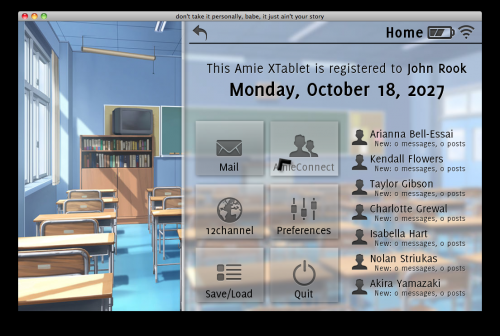
So here you have Lake City and these AI in an alternate late 1980s world with an appropriate looking Amie Workbench Version 1.3 computer system made to imitate the Amiga interfaces that existed in our world. Then, take this and make the supposition to fast forward to 2027. In Digital, we find a J. Rook is an administrator of the Lake City Local BBS Board and in don’t take it personally, we find the main protagonist–John Rook–worked with computers before he transferred to his teaching job at a private school in Ontario. However, he would have been one year old at the time, and perhaps he is the son of that Rook: having continued in a family tradition of working with computers before his career change. In addition, one of his students seems to have had a grandmother named Eriko Yamazaki who wrote a book called Digital Shinigami. This same person also seemed to exist in Digital on the Gibson BBS who mentioned that she had to spend less time on the Board in order to write her book and prepare for the birth of her child. In addition, the social networking program that Mr. Rook and the students are using is called AmieConnect: perhaps a future social program created by the company that once made the Amie Workbench application.

this ain't your story

There are no AI in don’t take it personally, but I would not exclude the possibility of them from being in this world: even if Love mentioned that this game is more of a “spiritual successor” to Digital. This game is a different beast entirely. Instead of the player-reader being a neutral force that can choose his or her identity, we have to focus on the character of Rook has he navigates the morally-questionable world of Information technology in his classroom. Essentially, he is supposed to read the private emails and interactions of his seventeen year old students to “prevent bullying,” but the irony of what is private in a “private school” or even in by futuristic society’s becomes very questionable indeed. It is here that Christine Love starts to use an anime-like graphic style to represent the characters–possibly influenced by her first commercial dating simulation work Love and Order— and after a while you get a real feel of who they are as people and you get to decide how Mr. Rook interacts with them and how the information that he “shouldn’t have” will factor into it … or not.

I am so tempted to say that this shift in what is considered private and how the online world of social interaction works is just a precursor to humanity’s own changing attitudes of how it perceives itself and the world around it. Whether or not Christine Love succeeds in capturing that tension–that agony of change–is another story entirely, but it is definitely intriguing.

Now, here is where my temptation leads me. Fast forward to the 25th century and then to “thousands of years later” in Analogue: A Hate Story. Not only are we in another time, we also finds ourselves in another space. From my understanding, in the 25th century the people of Earth have developed space travel to the point where they plan to colonize other worlds. And guess what? In addition to human captains, they also have AI guides with the same asterisks in front of their names.

Unlike the other two games where you find yourself–either by your own self or indirectly moving Mr. Rook–in North America, you are in space investigating the lost Mugunghwa generation vessel: a ship that was sent from the futuristic unified nation of Korea to create another planetary colony. It is a very nice counterpoint to Digital because you are looking at something that is the product of a different culture and how that affects what you might find. During the process of finding out why it never reached its destination, you realize they operate much like their 1988 North American counterparts: in that they have to delete themselves from one place in order to transfer to another. This plays a very crucial role in both games. :p

But these AI are also very different. Unlike Digital, they actually have image-forms and they look like anime characters. This allows you, as the player, to interact with them through more than text. You can see their body language and, I would imagine if you were actually in that world, hear their voices as well: though there are no voice-recordings in Analogue. I had to play this game right after finishing Digital because I read somewhere that unlike don’t take it personally, this was less of a spiritual sequel and more of a direct one. However, it’s not so much a sequel as it seems to have continuity and a counterpoint to what was going on in Digital itself: Love and Hate. However, just as the “Love” part of Digital is not necessarily what you expect, neither is the “Hate” part in Analogue.

And here is where I go into a tangent about how AI are often portrayed in media, and how they are not by Christine Love. It would be easy–so easy–for her to fall back on the trope of Artificial Intelligence going bad. Of computers that betray their human masters and AI that begin to despise humanity and attempt to murder whatever organics they can. But Digital follows an entirely different dynamic and Analogue, for all it is called “A Hate Story,” very much subverts this as well. In both games, you have AI that exist parallel to humans and while in Digital they are just another intelligent people, those you meet in Analogue exist to actually help and befriend you: even if you have to weave through the details of a terrible past and mystery to do so. They are there alongside of you and are just as sentient, responsible, happy, sad, horrified and afraid as you as an organic being. If anything, the only thing that separates the ones in Analogue from Digital is that they are made to help you and despite and because of their personalities that this imperative still remains.

So this is the world that through the addition of some asterisks and a few hints (of continuity in the form of Easter eggs and code-based sneakiness) that I believe Christine Love creates. Now I’m going to talk about the next part: which is my own relationship to the game and where, while it might not be my story alone, it is definitely–as Christine Love posits whenever she thanks the pronoun of “you” in the end credits of her game–our story.

I played all three of these games (technically more if you include Rumble and Aphroditus), and now I want to discuss my interaction with their respective gameplay and story lines. So, with regards to gameplay, I have to say right off the bat that there was swearing. A lot of swearing. I go into games relatively blind and I probably don’t read instructions as clearly as I should. But I did notice a few things.

First of all, in Digital I almost had no idea what I was doing at first. It took me a while to adapt to the “dial-up” system analogous to old telephone system Internet interfaces that Love imitated exceedingly well. I learned how to use “the codez”–illegally-obtained long-distance calling card numbers–and actually felt like a hacker: which is hilarious because I am not technologically gifted at all. So I was doing relatively fine until … until the Underground Library. The freaking Underground Library. Don’t misunderstand: I loved that level and the information within it. But I didn’t know at the time that I had to download every download I got from other users in other BBSes so when *Delphi (who I always identify as female) transmitted that goddamned screen-lining virus to me, it was there to stay.

I ended up having to reload a previous save state, very carefully go through my downloads again and make sure not to miss any of them. And it was easy to miss them. God, I was so mad when that happened.

Also, while doing the following does succeed in making you more immersed and interactive with this alternative late 1980s computer world, having to manually dial-up BBSes gets very tedious after a while: especially when your “codez” were declared invalid and you had to go back and get more through more, you guessed it, dialing. However, when I actually took a break to vent or do something else and I came back, I got over it and enjoyed the story.

Analogue also had a “stuck-point.” While I was much enjoying going through blocks of diary texts and reports with *Hyun-ae and *Mute, I did not enjoy the fucking reactor core of the Mugunghwa ship going into meltdown and me having to choose which AI I wanted to save: made all the more frustrating by the fact that I knew there was a way to save both of them. I felt like some tech specialist in going through the motions and programming to save the ship, whatever AI I could, the records of what the fuck happened to it, and of course my own life.

I also admit that I was starting to get annoyed about constantly having to hear the alerts on and open and check Mr. Rook’s status updates on his AmieConnect in don’t take it personally.

Wow, from Digital to Analogue I transitioned from the profane punctuation of “freaking” to “fucking.” I guess I know which frustrated me more. I guess the reason Analogue frustrated me more is that it made me have to make some hard decisions about who I wanted to save. It was almost as bad having to influence what decisions Mr. Rook made when dealing with his students in don’t take it personally, babe, it just ain’t your story: because I got a feel for the characters and some of those decisions were just so … hard to make. Also, that title is genius: because unlike Digital or Analogue where you can play as “you,” in don’t take it personally the story is not about you at all: and it is hard to differentiate yourself from John Rook. I suspect Christine Love purposefully made it that way: using that age-old concept of protagonist-identification to make the player that much more uncomfortable. Basically, the title to this game is for the player’s benefit and kind of a raspberry towards them too.

But the very thing that makes these games so hard is also what I love about them. What I love about Christine Love’s games is that they tell a story. But it’s more than that. The reason I really love the games is that they are about people and relationships. Basically: I liked the character and even those I didn’t like were not two-dimensional beings.

In Digital, I found it amazing that *Emilia was an AI that could make original poetry–even “bad” poetry–and that she could feel love: that you begin to realize as a player that you can emphasize with an AI who is–essentially–another sentient being. I also really liked *BlueSky: because he just seemed to be this really friendly and brilliant AI historian. If he actually existed, I would have loved to have more discussions with him about the nature of AI and technology. He would have made a good friend. And what happens at the end of this game … just broke my heart. It came down to personal love verses the love or duty to something greater than yourself and that choice–which in this game is not a choice at all–is heartbreaking: if only because Christine Love spends all that time getting you to sympathize and care about … those that you do.

As for don’t take it personally, babe, it just ain’t your story, I sympathized with John Rook and the difficult situations he found himself in. I even liked Kendall Flowers and, frankly, her honest and direct nature when she felt the need to be assertive. I realized that Akira was really lucky to have her as a friend. I do find it really interesting though that while the gay relationships that develop among the students have their issues–those challenges that any people in relationships face and how society views them–the potential heterosexual relationships are really rendered problematic in this game when you consider the characters of Taylor Gibson and John Rook himself. Taylor was once the girlfriend of Nolan who becomes Akira’s boyfriend: and she is homophobic or at least quite ignorant. She is a self-absorbed and mentally stunted being that proceeds to emotionally manipulate and bully both her former boyfriend and his new boyfriend.

Then you have John Rook and the relationship that could develop with Arianna Belle-Essai: one of his own students. There is definitely the problematic power dynamic of authority or privilege that places Rook over Arianna to consider and also the very real fact that he is a lonely sad man and she is a lonely confused but piercingly direct girl that really creates that tension. You could, if you wanted to, really read something into how relationships between opposite genders might work under our own culture and the way it uses gender. Neither are really honest with the other, but if you choose the route for him … I don’t know. I actually liked Arianna: because she knew what she wanted and she wasn’t stupid and when one of the endings of the game reveals itself, you realize that she and the other students know how to keep an open secret even in a world where privacy has changed so radically.

But I also like John Rook himself despite that possible ending because after a while you realize that he may be a bad teacher, but he is part of a bad school and a bad educational system and what some of his students need is a mentor, an adviser and a friend more than an instructor. There were a lot of complicated issues, but maybe they were offset or complemented by the fact that everyone involved was human.

So now I come to Analogue: A Hate Story. In this case, I really sympathized a lot with *Hyun-ae and what led her to making the decisions that she did. I probably would have done the same in her position. At the same time, I could also see *Mute’s perspective and she managed to break through my own leanings towards absolutism. I was actually happy when I let *Hyun-ae cosplay as a scientist: given how much that meant to her and why and I felt like shit when I dressed her in a traditional Korean Hanbok: especially after realizing what the degenerated society of the Mugunghwa did to her. The slow realization of what was, in fact, done to her made me absolutely dread reading what happened next.

At the same time, I loved the epistolary novel-format of looking through the entries of all the Mugunghwa‘s inhabitants and getting to know some of them that way: that for all their society became repressive, they were still human beings and not all of them were inherently evil. In fact, none of them were but some of them were more selfish than others and most of them let themselves get shaped into something that supported a repression of humanity: and in particular women. *Hyun-ae herself does not know why the descendants of the colonists in that generation ship became how they did, and *Mute herself–the original guiding AI–does not seem to remember. But this is the plot to the upcoming Analogue: Hate Plus and given what *Mute’s name is, I both highly anticipate and dread what we as players are going to discover.

When I really think about it all, though, looking back on my Christine Love games marathon I realize that none of the games were really about us. In Digital, you send emails back and forth, but you never type your own messages: while you do see those of the people that you are contacting. In Analogue, the interface that would allow you to answer beyond “yes” or “no” binaries is “malfunctioning,” and you only have the two former options for actual communication. In the latter game, you can’t even tell the AI your name and they never see what you look like. There is a strange balancing act between communication and empathy, and distance and loneliness.

For me, that kind of dichotomy and the tension it makes reminds me of watching a really good anime. Certainly, the visual novel medium that Christine Love has adopted for all three of these games conveys that sense of experience. You feel for and sympathize with the characters, but you are never one of them. Not really. At the same time, you are. There are also a lot of subtexts: or some from my perspective. For instance, when *Mute asked me if I was male or female, and when Digital had me type in a name and a username, I felt so strange–after talking with *Hyun-ae– to be using masculine pronouns. I know Christine Love has said that she made these two games specifically for players of either or any gender, but she has also said that privately she believes the relationships that go on are between two women in a romantic dynamic: because that is her perspective. Sometimes, I feel like an intruder but then I get over it and realize that it is really about an interaction between the minds and feelings of the player and character regardless of gender.

There is also another possible subtext or interpretation that intrigues me too. Christine Love likes to make games that are inclusive of those who identify as queer: or at least make them more inclusive to more than just a male heterosexual audience. There is another group that sometimes has an asterisk connected to a word as well: though it is an affix as opposed to a prefix. I am talking about those who identify as trans* and use this term to encompass all those who do not identify by cisgendering: the gender that mainstream society aligns with one’s biological sex. This is an umbrella term that can include those who identify as queer or genderqueer. When you look at the revelation with *Emilia with that lens, or even *Hyun-ae–in that she cannot and will not correlate her sense of self with the gender-expectations of the regressive society around her–it can leave a very different connotation.

But that is also too much of a simplification. As I mentioned before, the asterisk can encompass an entire group: and in this case perhaps the idea of something being transhuman or a designation of beings beyond the conception that all sentient life has to be organic and material. In this case, it seems to give a being a cultural or “racial” marker. I just can’t get over the fact that the inclusion of just one symbol can possibly mean more than one thing: though this is all just supposition on my part.

At the same time, I really have to say–among the many things I’ve said–that I really like many of the female characters in these three games. From Arianna, Charlotte and Kendall in don’t take it personally to *Emilia in Digital and all the way to *Hyun-ae and *Mute in Analogue: they are all direct, all brave–or grow to become brave–and they have the strength to admit what they feel despite any circumstances in the way. There is something so beautiful about this that I can’t really put it any better than I already have, or how the games already portray.

But ultimately–and if I have already said this before I want to reiterate this statement–what I really like about Christine Love’s work is that she actually tells a story. When she talked about Lake City Rumble II being a subversive parody of a fighting game, it jived in that same place I have where I was really fascinated with the story and the character interactions behind the fighting more than really the fighting itself: though it also had its moments. And what I truly love is the fact that she actually makes me care about her characters and this–to me–is the sign of a great writer and creator.

It is my hope that she continues to do what she does because, you see, I don’t care if these aren’t completely my stories. In the end, I just want to see more of them: spreading out from *Mother, leaving neither copies behind them, nor taking anyone else’s names but their own along the way.

This Game Has No Warp Zone: A Review of Pipe Trouble

Pipe Trouble

“I like games with consequences.”

This is what a friend of mine told me not too long ago with regards to online games, but it is a sentiment that can easily be applied to video games in general. I know that I–and many other more eloquent and informed people on the matter–have stated that the medium of the video game can be used for more than just entertainment value. The medium of a video game is as its very core an interactive experience that, like any other art form, can get us to relate to the world around us in a different way.

However, with regards to Pipe Trouble, there is also the matter of responsibility to consider as well.

Pipe Trouble is a game created by Pop Sandbox Productions, produced by Alex Jansen, and co-designed by Jim Munroe. It was apparently made as a companion piece to the TVO-commissioned documentary Trouble in the Peace: a film directed by Julian T. Pinder and produced by Six Island Productions about gas leaks affecting Northern British Columbia farmers in the Peace River region and in particular one man and father, who has decided to do something about it.

Before I decided to write this article, I did not know that Pipe Trouble was a digital complement to this documentary. In fact, the entire subject matter that both the film and the game seem to encompass–Canadian farms encountering potentially lethal gas leaks from pipelines of gas companies in their regions–is not usually something I tend to focus on with more than passing attention. After a while, and as cynical as it gets, news of “corrupt corporations, victims and innocent bystanders, and eco-terrorist reprisals” tends to become oversimplified by the media.

It is one thing, however, to hear and watch something about a matter that seemingly doesn’t concern you as an individual. It is a whole other thing to find yourself in a situation–even if it is a simulation with a satirical veneer–where you are in a position of great responsibility.

What Pop Sandbox is attempting to do to this regard is not something new, but rather it is a very familiar idea they have worked with expressed into a different medium. While I did write an article or two on Kenk: A Graphic Portrait a fair while ago, what I might have neglected to mention is that one major theme in the graphic novel–also made by Pop Sandbox–is that everyone has a part to play in a particular social action. In the case of Igor Kenk and his stolen bicycles, it is made clear that everyone–to the people who bought bicycles from him, to even the people who purchased their stolen bikes back, to law enforcement and Toronto City Hall–knew about what he was doing and, just as they condemned it, they also tolerated and even to some extent accepted it a part of their social system. With regards to Kenk, Pop Sandbox illustrated–quite literally–how Igor Kenk was just part of a social dynamic–of a collaboration–in which the rest of the city was also a part.

But Pop Sandbox goes even further with Pipe Trouble. While Kenk simply observes a social structure and interaction, Pipe Trouble makes the player-audience interact immediately and directly with the issue as clearly, and as simply put, as possible.

In other words, you–the player–are placed as the manager of a gas company apparently situated in the Canadian Province of Alberta and you must please your superiors and make them money, keep the people who need your corporation’s services in mind, do as little damage to farmland, animals, humans, and the environment as possible, and try not to piss anyone off.

It is very clever. It is very easy to vilify a company or a corporation as a soulless entity that only caters to the very rich, squashes agriculture and “the lower classes,” and pollutes the environment without any understanding of what it might be doing or–worse–even care. It is just as easy to lionize a pipe bomber as a freedom fighter against a tyrannical force even as it is to denigrate them as a terrorist that likes to destroy human lives and a Western way of life: whatever that is.

However, natural gas is one of those resources necessary for a modern society to function and a corporation is made by people. As such, someone has to be in charge of providing that corporation’s service, making a living from it, avoiding bad press and blame while attempting to integrate their industrial system into the environment and those existing within it with as little damage as possible. It is no tall order and not an enviable position: especially when you are forced to do it in a game.

It is no coincidence that this game is modelled after the 1989 puzzle game alternatively called Pipe Mania or Pipe Dream. And even though the title itself brings to mind some bad bodily jokes, even that connotation has its point when looking at the game. In Pipe Dream, you have to build pipes to direct the flow of filth inside of a sewer. Pipe Trouble takes a similar mechanic and makes the oncoming substance also toxic, but also worth money. One person’s poison is another one’s livelihood.

You have two men on either of your screen. I would be tempted to call them “the angel” and “the devil” on either of your shoulders, save that both of them aren’t necessarily “good” or “evil.” The man on your left is a farmer that is watching your progress in placing down pipes with oncoming gas with great interest and caution. If you destroy the land too much, there will be protesters that will block your pipe route. How long they stay in front of your progress will all depend on just how much damage they perceived you to have done. This farmer will keep watching you and will warn you only once not to mess with his land.

Then you have the man on your right: your boss. He is the one informing you of when the gas will start flowing (right when you place a pipe down to get from Point A to Point B) and he will keep track of the money you are making … and losing with delays. That’s right. If you do not place your pipes fast enough, not only will you risk a gas leak poisoning a lake, killing animals, and other horrors but you will lose your company money and your boss will sure as hell hold you responsible and, if we are going for realism, probably put it all on your head when the bad press comes out.

I swear: when I first played this game and that gas started to flow and sometimes I didn’t move fast enough, or have the right pipe piece to place down or even put it in the proper place, that sense of panic sets in. Then you add the pixilated animals that prance and eat in the woods and you are thinking real hard about how to not disturb them: never mind potentially kill them. And that is not even including the fear of getting more protesters in your way that will get more organized and then sometimes even use some nice industrial sabotage against your pipeline: causing more death, destruction, money loss, and bad press. And guess who would probably be held responsible for all of that?

You’re looking at yourself.

It’s like playing Tetris … only with people’s lives. And remember how I didn’t make any bodily function jokes? Well, the ideal is to treat the entire process like the human body. The release of energy, the disposal of waste, and the structure of what you are trying to build is supposed to create a balance with the ecosystem, agriculture, and animal and human health. But as you play and it gets harder, you will become aware of the fact that this game is an idealist’s nightmare. You will have to make some very difficult decisions as you realize that you might not have time to build around that forest to your pipeline’s destination or you might have to be innovative and make some alternate routes in a very set time frame, but in the end you will have to make some very hard choices.

Do not let the game’s cheerful 8-bit pixilated graphics and basic soft-edged square shaped sprite characters fool you. Jim Munroe was also co-designer behind this game. He is an independent Canadian science fiction and comics writer, among other things, that likes to take grandiose topics like haunted TTC Stations, North America becoming destitute in a futuristic era, and a post-apocalyptic world after the Christian Rapture and completely twist them upside down and make it about human characters and life going on. More than coincidentally, Munroe is also the Hand Eye Society’s Project Coordinator for the development of the Torontrons: essentially retrofitted arcade cabinets that play newly made video games. He may have been involved with the pretty nifty creation of the Pipe Trouble game cabinet as well: which, as the link explains, will be placed in areas of high traffic such as universities, city centres, and tourist attractions.

I don’t know what else to add here. Inter-dispersed between levels are radio segments from news anchored events dealing with natural gas industry controversies which I didn’t originally hear until I played the game again at home on the free trial demo. Also, not too long ago I found out that the game itself has created a whole lot of controversy. Apparently TVO–one of the game’s sponsors–has been accused, among other things, of potentially giving eco-terrorists “ideas” by supporting the creation of the game. TVO has apparently removed links to Pipe Trouble from their website with pending investigations into the matter on their end to see if they were in “the wrong.” There seem to be some definite misunderstandings over various issues, but if one goal of this game is to encourage people to think, then controversy–though unfortunate–is one way of getting there. Either way, it definitely hit a nerve in that intersection where art and politics clash.

I think my concluding thought about this entire game is that the title “Pipe Trouble,” again, can mean a lot of things. And it wasn’t until I read the above article that I began to think about it a little more. I don’t generally look at these kinds of games, never mind write about them–especially with how close it comes to politics–but there is something really fascinating about the dynamics that Pop Sandbox attempts to create, identify, satirize, educate and help people relate to. And politics itself is an exchange of power and watching how and through what medium that power is ultimately exchanged through.

You see, I’m looking at pipes as symbolic of devices that link us together and support a communication of ideas. They can create a very interactive and comprehensive system of healthy self-regulation but when there are so many elements in play, things can go wrong, words can break down, and people and the world around them can suffer for it. But whatever else this game accomplishes, it definitely makes you think about these issues and how they are not entirely separate after all: neither from each other, nor from you.