Change

I spent much of my youth somewhere else.

It’s not too much of a surprise really: especially when you consider what I was and what I would ultimately become.

You would find me reading one of the Oz books during a special session of class. Or reading a book from The Belgariad in the car on the way to a funeral. You’d better believe that I was reading comics when I was dragged to synagogue and philosophy texts were my in-depth friends in my adolescence. I’m not going to even go into the many games, arts and crafts, and stories I wrote to distract myself from being bossed around and general tedium when I was sent off to summer day camp. And I would watch and rewatch old Muppet and Disney cartoon movies on my VCR whenever I was home from school.

But the fact is, from grade School all the way through the end of high school I must have created and read most of my life away. I miss the immersion that staved off the banal mundane world and its gritty, disappointing, adult reality from my life.

It got harder to keep the world away once I got into university. My magical rotes, such as they were, began to falter and fail. Once, when I had to do so many things I hated or tolerated I always had that space to retreat into: that alternate place where I could focus on more intellectual and imaginary matters.

I had so much time. When I was younger, time was limitless and most of it was spent wanting to be somewhere else when I didn’t want to do something else. But then time began to speed up. Sometimes it would slow down again and become stagnant with the dead-end nature of reality.

Reality again. It was creeping in. It’d been doing that towards the end of high school and I always knew it was there: just waiting for me. And it scared me. It was more complex and wondrous than the terrors of daytime Fox talk-shows. It was politics, and plurality, and many experiences, and human horror, and girls.

I’m glad I met the girls.

I think that explains a lot about the person that I am now: for however long that lasts.

It’s strange. These past few years time feels like it slowed down, or went by in the blink of an eye. Sometimes I wonder if that span even existed. You see, time did slow down but in that stagnant place of perceived adult failure. The thing is: I had gotten out into the world, if you want to call academia part of the world as it is.

I couldn’t handle the rest of it. And the refuge of books, films, comics, and cartoons were only temporary retreats in front of a cold, grey reality. And I know that age-old danger: of knowing it could be worse, that it can and for some it really is that.

I got tired.

But something has been happening. Time is moving fast again. These past two years, some of it spent by myself, I still knew that my time was not infinite. But it is getting faster again, if that makes sense. Things are happening. Things have been happening.

My reality marble of purely writing all the time is harder to keep around me against that perception of reality of which I’ve not done much in the way of justice. Things are happening.

Things are changing.

It scares me. It scares me to know that after some years of being sedentary I’m going to be moving around again. I’ve gotten too used to my sense of exile. I know how dramatic that sounds in this somewhat disjointed post. I didn’t even know what I was going to write this time around considering all of my circumstances but I think, when it is all said and done, that this a good thing.

It is the only thing. I’m changing and I can’t always keep up with those changes and their multitude of event horizons. But I can try. And I know and I have to believe that there are people who will be there alongside me, who will still be patient with me, as this continues to happen.

Soon I’m going to be out of my bubble. And you know, it’s time.

My rotes may not work as well as they did, but perhaps now is not the time to dwell in other spaces.

Now is the time to act: in this space.

Matthew and the Daleks

Star Wars: Preludes and Interludes Of A Space Opera

I think that if I were a Time Lord, I’d be a unique one that specializes in travelling to alternate timelines: not because I originally intended to, but due to the fact that these are places to which my senses are attuned.

Lately, not to mix metaphors, I’ve been thinking about Star Wars. I mean, when aren’t I? But bear with me. Imagine, in that period between 1980 and 1983, when The Empire Strikes Back made people truly want to know what happened next, George Lucas came up with a plan: a long-term plan.

We already know and suspect that by Return of The Jedi, Lucas was planning on heavily merchandising the hell out of his universe. Some people even think the addition of Ewoks in the last film was an attempt to particularly appeal to children and their love for toys. Even after the sixth film, we had cartoons like Ewoks and Droids.

But what if it didn’t stop there? What if aside from the made-to-TV Ewoks films George Lucas had wanted even more merchandising. At the time, LucasFilm was in the process of developing its special effects technology that would be utilized not just by itself, but by other companies and film productions as well. Even so, by the time of the cartoons it had only been a few years since Return of The Jedi and people — particularly children — were still fresh off of a galaxy far, far away and wanted more. More than that, and I can speak for myself here, fans had questions: about the Jedi, about the Republic before the Empire, and the Clone Wars themselves.

Many of these questions had been answered with the new CGI Clone Wars cartoons and the Prequel films — albeit with some gaps even now — but there was a gap of at least, what, seventeen years or so, between the films: where many of us waited after the re-release of the Old Trilogy to find our answers and immerse ourselves into new Star Wars.

Yet what if during that time, we had something else to tide us over during near two decades of waiting?

Indulge me and imagine this. After the last film and the initial cartoons, LucasFilm decides to release oncoming series that takes place during The Clone Wars. Perhaps Lucas calls them, collectively, Interludes. During this time, we get to essentially see the Republic and the Separatist Crisis, and the Jedi Knights. We get to see a young Obi-Wan and Anakin actually growing together but, more importantly, we get to see something else as well.

Jedi Team

We are witness to other characters — other Jedi and galactic denizens — and we get to watch them grow. We are introduced to the clone troopers early and see them as individuals: while always wondering why they look so like and unlike stormtroopers. And there are hints of Anakin’s back story and how he met Padme. At this stage, perhaps a few seasons or an interrelated series of cartoons (perhaps aided in the 90s by one young Genndy Tartakovsky) and live-action programs: space opera serials not unlike the material from which their structure was derived. Can you imagine that? Coming home from school to watch your Star Wars show?

And yes, the intervening years between the early 1980s and the late 90s might not have much in the way of advanced graphics or special effects by our contemporary standards but imaginary worlds have been built on much less and with more attention to detail. I mean, look at some anime from that period, or even the Old Trilogy and how immersive it was for looking all run-down, and world-weary and real: letting our minds fill in the rest. I could have seen LucasFilm making a lot of money during this time. I mean, think of an Interlude series of Star Wars: Clone Commandos playing alongside G.I. Joe. Don’t tell me that wouldn’t be bad-ass.

Clone troopers

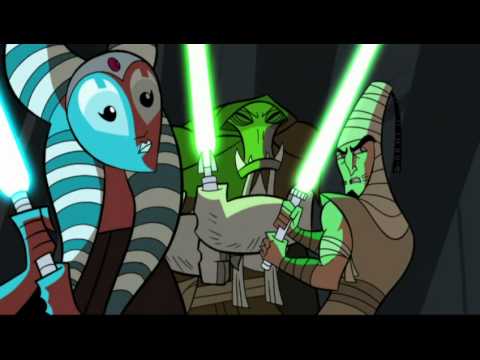
So during this whole time, you have all these background characters getting built up, living, and dying. You get immersed in their lives. Shaak-Ti, Aayla Secura, Kit Fisto, Plo Koon and the other Jedi have many adventures and you get attached to them. You see the Jedi Initiates as children and you want to be a Jedi: relating more to you directly as a child than even Luke does in the movies. Hell, you might even want to be Clone Troopers, have their special armour and play Clones Verses Droids along with Rebels Verses Imperials in the playground.

Of course, there would be comics and books as per usual. And then periods where there are no cartoons or shows. It makes the audience wait with anticipation. You build on the culture that you have already cultivated and created. The important thing is that you leave the questions. You have Anakin refer to his time on Tatooine and being a slave and you never know everything that happened. He has moments of darkness and you don’t know what caused them. You can tell Palpatine is doing something, but you don’t know where it all began or what even started the Clone Wars at all. Then there are the other questions about what will happen to the Jedi: particularly your favourite Jedi and their friends and comrades in the clones.

1999 comes around. Perhaps there has been some intervening years where the Interludes — The Clone Wars cartoons and live-action serials — have died down. Everyone is waiting. Now take the movies know from our timeline. If you want, imagine that the ideas created by George Lucas were written out by other writers: as he had those in the Original Trilogy. Maybe he even has others giving direction to the actors: those who can relate to them and have them react in believable and human ways. Scene-sequencing is interspersed with equal amounts of dialogue and action. CGI is cut down considerably and used sparingly: with a greater reliance on prop development and real world scenery.

The Phantom Menace reveals Anakin’s origins and just why the Jedi think he is so important. Attack of The Clones, three years later, shows us how The Clone Wars began. And, finally and heartbreakingly, we have Revenge of The Sith: where not only do we see Anakin fall, but all those Jedi characters that survived up until this point are mercilessly cut down by the clone troopers that we have, despite our better judgement as adults and adoration as children, grown to love.

Think of the impact of this alternate timeline. Think of how much we could relate to the death of Aayla Secura if we had seen her in various shows fighting for worlds and having her private moments with Kit Fisto. Think about Plo Koon and his time being a part-time mentor for Ahsoka Tano — perhaps even tutoring her in piloting — only to have his ship blown apart by one of his own clones. And the Younglings, those children you saw becoming Jedi … think about the horror in that.

How would you have viewed even the Prequels that we have now if there was all that build-up to the tragedy — a well-written tragedy — that was their Trilogy and the beginning of The Empire.

So now the Prequels are over. You know what happens. And yet … there are still some mysteries. Some Jedi are still alive or unaccounted for. A Rebellion has yet to form. LucasFilm, and perhaps Lucas Arts as it might still be around this alternate timeline can play with that. The fans are devastated by the impact of the Rebellion and Luke Skywalker is felt even more keenly. You watch the films again to know that the Empire fails.

Perhaps Star Wars cartoons and shows are divided into the Preludes — those dealing with the events before the Empire — and Interludes — those focusing on events during the Empire. Maybe some of these shows happen after the Prequels in real-time and others during the 80s and 90s. This is all you have to go on so far.

But everyone wants to know what happens next. They want to know what Luke and Leia do after the Empire falls. They have only had their appetite whet with the Clone Wars and the origins of the Empire. They want more.

And then, after 2005, ten years later after more shows and merchandising — and perhaps with the aid of Disney’s resources — we have: the Sequel Trilogy. The New Trilogy.

Of course, many people might have their own alternate ideal Star Wars watching timeline. Maybe there were no Clone Wars or Prequels. Perhaps the Sequel Trilogy happened right away. But there is something else to consider and it took me a while to personally understand and accept this.

It was Tony Pacitti in his pop culture memoir My Best Friend is a Wookiee that made me consider it. Perhaps one day, if not right now, there will be a new generation of children born. These children might watch The Phantom Menace and Attack of The Clones. Then they might watch The Clone Wars. Then Revenge of The Sith. Then the Old Trilogy. And the New Trilogy. They will see all the standalone films. And right now, it is all open to them. It isn’t perfect and there are gaps and questions, but they have mysteries to explore and wonder to consume.

It would be like us discovering the magic of Star Wars for the first time and their experiences would be different but similar to our own. They have so much more to see and know. They get to do what we can only dream of doing: living a life of imagination inundated by a variety of Star Wars: decades of Star Wars. And no matter way you look at it, this will be their first step into a much larger world.

What I Want To Twine

While I’ve going through some personal and bureaucratic issues lately, I thought I would take the time — late at night and recovering from a cold — to write about some of the things that I’ve been wanting to do.

Both of the projects that particularly weigh on my mind are Twine games. I haven’t made a new Twine narrative since The Looking Glass for the Global Game Jam and I meant to do more before other responsibilities and projects came my way. I don’t want to reveal too many spoilers at this point, but maybe this is as good a place as any to voice out some of my “workshop talk,” as it were.

There is one narrative I’ve been thinking about for a little while. It combines Near Eastern, Far Eastern, and some children’s literature. I’ve gathered notes, done some basic research, and even wrote down my own quotes and sentences that I want to use: those structures that often evolve or become centralized into larger stories. Remember: something always comes from something larger, even if that larger thing doesn’t exist yet … even if you haven’t made it. I’ve really wanted to work on this one as something of a response to a piece — a chapter from a story — that I keep on getting sent to me for some reason which has evolved in my brain into something else entirely.

The other Project I really want to spend at least some time on is my Twine novel. For those of you who have followed this Blog for some time, you may remember what I am talking about. For those of you who don’t know or recall, before I even had a basic working knowledge of Twine I wanted to make an epic story that dealt with some ideological and very personal ideas. I still haven’t finished all of the “chapters” or “worlds” and I have to remember and keep track of which world links to what and how to get them to do so after I’ve written them out.

Yes, I have been writing this Choose Your Own Adventure narrative game by hand: or at least I did for a while before I had to seriously focus on my work for Poets in Hell. As for my game, I know there are three worlds I want to write out. After that, I can take a break from it for a while and do something else and eventually complete it all.

I’ve been so terribly busy and fighting to keep focus and motivation. I just wanted to let you know that although I’m facing some challenges and difficulties, it is not all doom and gloom. I’m glad I got to write a bit about my creative processes again, even as I look forward to actually working on these creations and showing you all what I intend to do.Looking Outward

It’s Been One of Those Weeks, But I Still Live

This is the entry that I should have been working on last night.

Wow, doesn’t that just feel like history repeating itself. To be fair, I actually should have written this weeks ago. And I did. At least, I tried.

When I last left off (this is the point where Marvel would have a footnote under one of my sentences, referring to my previous “issue” of Mythic Bios), I went on vacation for the weekend. I’d just come from finishing off my interview with Will Brooker and creating some press for Poets in Hell: where I have a short story published.

It was a nice trip. There was good food, a cabin, a forest to explore, a river and some really nice company. After so much time in front of a computer, I found myself staring into a great bonfire right in front of me. As the warmth of flames replaced the cold glow of the screen on my face, grateful to be away from my parents’ place for a while and all the other distractions, I began to become aware of something.

It’s as though I keep forgetting it. When you spend a lot of time by yourself, for extended periods, you begin to forget things. I mean, even in the days when I went out more often, I was shy and introverted regardless. I get very quiet and overwhelmed by a large group of people: even people I know. But after I moved to Thornhill, this became even more pronounced. Most of the time I was camping, I mostly talked with a few people about very specialized geeky things and, well, that was about it.

That’s generally about it. You see, I like the things that I like and when I’m nervous or feeling awkward I either “talk shop” or I don’t really talk at all. I’m not really one for small talk and I don’t really talk much about other parts of my life under most circumstances. But, even though I didn’t do any archery, or golf, or even sing karaoke, I did have fun. I even had some really cool discussions with some people towards the end of the second night after a massive rainstorm came down on us all.

After that, I actually found myself used to being around people again. One other thing I’ve noticed about being by yourself a lot is that you forget how to talk with people or even relate to them. So after that weekend, I actually wanted to be around people again. I had these thoughts about going out and hanging out with some friends: even working outside of my house and exploring again.

I’m not quite sure what happened, to be honest. I genuinely meant to do all of these things. Then I had some projects I wanted to work on before dealing with anything else. I thought I could get those out of the way and then do what I needed to do. Of course, none of these went as planned and I am still working on them. I was enthusiastic and as clear-minded about these projects and goals as I could be but I began to get bogged down in a slow, creeping sort of fashion.

I took on some tasks and obligations as well. And then, one day, some people from the city were fixing our side walk and destroyed our cable. It took over a day for them to replace it and even now it’s only a three month temporary one.

Now, this might not sound like a very big deal. I mean, most people would take that as a sign to relax and do something else. But I’d already gotten used to my rhythms back here. The fact is, I had no where really to go in Toronto. Not really. And a lot of my work is dependent on the Internet: personal projects and otherwise. But what is worse, for me, is that somewhere over time a lot of my even more personal relationships have become dependent on the Internet. And when my Internet is not working, I am cut off from a majority of my long-distance friends and loved ones.

I get very angry when someone meddles with the Internet primarily because of the fact that if something happens to it — and cable companies that are near-monopolies have no reason to really expedite or even take the time to fix something properly without endless hassle — my means of communicating some of the few people that keep me sane is gone.

When I spent over a day without the Internet at my own house, I became aware of just how … alone I was.

After that, when it was fixed, I just continued doing what I was doing. But I also noticed I wasn’t really going outside as often anymore. I was staying up late again. And I found I had nothing really to say on Mythic Bios. My mind began to become clouded and murky. I was avoiding people, even people visiting, because I already felt I had work to do that, conversely, I felt I wasn’t doing fast enough.

It even got to the point where communicating with people online became very disassociative. I suppose the signs were an extreme need for perfectionism leading the way to a lack of concentration and then, lately, a sense of frustration and anger. Sometimes, to make a Vampire: The Masquerade reference, I’m like an Antediluvian — an ancient and vampire — waking up from torpor and going into a blood-thirsty rage at existence. Or something suitably melodramatic.  Sometimes anger is easier to feel — to actually feel active and present — than detachment.

But why shouldn’t I just go out? Why not just meet people outside or go to Toronto regardless? The truth is, there are few people I can meet in Toronto. Some others have already moved on with their lives or have their own difficulties to deal with. And I’ve had some bad experiences downtown and I feel very reluctant to open myself that way again. With a very apt, and now unfortunately timely, moment of insight Robin Williams once said something to the effect that the only thing worse than being alone is other people making you feel like you are alone.

So this past while, struggling to write, I’ve been mostly watching interactions. It’s felt easier in a lot of ways: just as corresponding with people over the Internet is still easier for me as I can, usually, express myself well through the written word instead of with the awkward chagrin of dealing with people “out of my element.”

At one point an acquaintance of mine made a joke that I was “better than the rest of them.” Now, when I was out more people did tell me that I have this mien of aloofness. But let me just state that I hope it goes without saying that despite my manner, the way I write and my “big words” that I don’t think I’m better than anyone.

Trust me, I know I’m not.

So, where does this leave us now? Well, I definitely knew my depression was getting stronger when I stopped writing Mythic Bios for a while. I will try to keep up this Blog and there are some other things I’ve wanted to write on here for quite some time. But at the same time I do actually need to do some writing.

I’m also still going to therapy. And my budgie is a source of ridiculous entertainment. I have other plans to actually meet some people as well as some tasks that I still need to fulfill. I think I’ve said everything I’ve needed to in this post. Sometimes, as my friend Fairytaleepidemic once mentioned to me about a year ago now, I wish I had a group of friends that I could just meet and marathon StarGate SG-1, Dr. Who, and other shows and films with — hell, even those bloody Clone Wars cartoons — just to be able to go to someone’s house and have that kind of contact and presence of like geek minds.

Who knows. Maybe it will happen again one day. That all depends on others. And myself.

Also, budgies.

That is all.

Human-Hide Bound: Poets in Hell

My apologies for the false advertising behind the title, but it did grab your attention and lies are just one commodity that are trafficked in hell: where sometimes truths are far greater weapons and torments.

It’s been a long time since I’ve released two posts in one day, but to paraphrase the words of a co-writer you work at least twice as hard when you write for hell. So, really, why shouldn’t that philosophy apply to promoting POETS IN HELL?

So let me start this off by reminding you that POETS IN HELL, with my short story WHEN YOU GAZE INTO AN ABYSS, is available on Kindle. However, not only is it also available on Barnes & Noble’s Nook but it has finally been released in trade paperback.

And, to further entice you, we have the following. First, I now have the privilege of showing you a wrap around book cover:

Poets in Hell Full Cover

And, there is more. Secondly, my aforementioned fellow writer, Joe Bonadonna has written a review of POETS IN HELL for the Black Gate Magazine. In addition to an Afterward written by our leader and Heroes in Hell creator Janet Morris outlining practically every challenge we faced in getting this book to see the light of infernity, you will find a blurb about every story written by every writer involved in POETS.

It’s a big deal to me. When I was younger and back when the Black Gate accepted epic fantasy stories, I very much wanted to write something for them. And so, in a round-about way, I finally did: or at least I got my name and work mentioned in good company for an article written on their site. If only twenty-something year old Matthew could see this now, he’d … probably be shocked at how I write now and where, but I think he would really like it. The fact is, I agree with Joe: it takes a great deal of effort to write for a place as infinite as hell. It challenges you every step of the way, but its white-hot rewards are worth it: along with all the laughs, pathos, and screaming that you earn along the way.

Speaking of being vocal … our fellow writer Zombie Zak and his crack team of Hellions decided to begin a little … project. I’d like to present, to you, some recorded excerpts from POETS IN HELL.

First up, we have a hint of Yelles Hughes’ RED TAIL’S CORNER:

Followed by a little bit of Joe Bonadonna‘s own WE THE FURIOUS:

There will be more excerpts coming, including one of my own. Some of you will even get to hear my actual voice for the first time. I hope I don’t sound too terrible … in a bad way. 😉

In the meantime please fan out the flames of hell and aid us in spreading the word of POETS.

And as I said before, my story in Poets is called: “When You Gaze into an Abyss”: starring Lilith, the first wife of Adam and the German philosopher Friedrich Nietzsche.

Here are the places where you can find our book:

By Book
By Nook
By Kindle

Finally, please have a look see at our publishers’ site: Perseid Press. They make some awesome books.

Poets In Hell: Kindling the Flame Till Wildfire

I’m going to warn you, right now, that I will be promoting and talking about POETS IN HELL for some time.

There is still a lot more left to do. The infernal delights of hell are not finished yet and I will definitely keep you all posted on those: or, rather, they will keep you posted.

It’s funny, you know. When I started Mythic Bios about two years ago, I was in an autobiographical head space. Many of my stories were personal, or taken and worked from personal material.

And now? Well now, I find that I have quite a few ideas for story and projects but –with a few exceptions — none of them are really about me anymore. And perhaps that’s not such a bad thing. Before my work in hell (take that phrase any way you’d like), I wrote about my life as though it was pretty much academic at this point: as though many of my greatest achievements had already been put behind me and I was just existing to record and rework what was left. It was a quiet, contemplative core of time within a chaotic sea of workaholism.

But now, it’s less about me and more about the work: if that makes sense. The work will always be a part of me and my experiences and knowledge-base will inform it. Nevertheless, I like working in other worlds … and making my own.

So now, let me finish this post off by presenting to you our first press release of POETS IN HELL:

Poets in hell press release 1

This was created on Friday the 13th on a full moon. I’m afraid that unless it was also made and released on all Hallows Eve, you can’t get more hellish than this. And that isn’t even taking into account the pain, suffering, diabolical delight, metaphysical explorations, philosophical quandaries, myth-making, and maniacal humour found within these pages. And seeing my name next to all of these awesome writers makes it all worth while.

I’m still a workaholic. There is still chaos, but now my core in this madness is active. And, as I said before, there is still so much work left to do.

So please: spread this release to herald the reign of Poets and consider, if you pardon the phrase, helping to kindle its flame.

Patronage and Poets in Hell Now On Kindle

Hello everyone. I’d like to make two very important announcements.

I have received my first ever patron on my Patreon account. So let me take some time to publicly thank John Chui for his donation. John, thank you for believing in my writing and my work enough to support me and donate $25 a month to my ambitions.

It really makes a difference. It’s not so much the money, which is always both useful and helpful to have, but the fact that someone respects what I do enough to support me. Not only does it provide a little bit of an impetus, but it reminds me that there are people out there who like my writing and believe it is deserving of payment and recognition. John, you are definitely one of those friends who encourages me to keep doing what I do: even when I get tired. Even when I start to question myself.

You have to start somewhere and thanks to John and in words that he can truly appreciate, I will continue to soldier on. I do still expect a Twine out of you personally at some point, however, so don’t think I’ve forgotten. 🙂

And now, for the second announcement. A little while ago, I told all of you that my short story “When You Gaze Into an Abyss” was accepted in Janet Morris’ book Poets in Hell: part of the Heroes in Hell series. I said that I would update all of you when the book came out.

And so here it is:

The Kindle version of Poets in Hell.

Poets in Hell Kindle

And here is a nice description of what you will find within it should you dare to read it:

Where else but Hell can you join Beowulf, Dorothy Parker, Diomedes, Sappho, John Milton, Robert E. Howard, Odysseus, Caliban, Helen of Troy, and Mary Shelley? Where else but Hell can you adventure with Samuel Taylor Coleridge, e.e. cummings, Nietzsche, Shakespeare, Marlowe, Attila the Hun, Napoleon, David Koresh, Eliott Ness, Marconi, and Plato? Where else but Hell can you find the Jabberwocky, Li Po, Albert Camus, the Sphinx, Frank Nitti, Aeschylus, Goethe, Sycorax, and Merlin all in one place? Where else but Hell can you meet Galatea, Robert Burns, Ghengis Khan, Foster, Solon, and Lemuel Gulliver? Where else could you find Homer, Lilith, Victor Frankenstein and his famous Monster, Edgar Allen Poe, Jimmy Hoffa, and Lord Byron’s dog, Boatswain? In POETS IN HELL, that’s where. BYO pitchfork.

The book version of Poets isn’t ready yet, but for those of you who are eager to read the excellent tales — including my own first-ever published story — please download this Kindle version should you have one.

And if you live in the United States, this entire saga will cost you — aside from your peace of mind and soul — $6.66. I’d say that, all things considered, that is a pretty good deal.

This past while has just been a series of firsts for me. Let me tell you. I’ve seen my name on Amazon before, but only as a reviewer: and that was before I created Mythic Bios and placed the majority of my reviews on here. But it is a whole other experience to see my name on Amazon as an author, and right next to the names of giants: of my fellow diabolical, grandiose, and truly hilarious peers.

I’ve come a long way since that person who knew I had something to say but had little under my name to show that I could truly say it. But this is only the beginning and as I said with regards to my Patreon: you have to start somewhere.

And what better a start than writing from a place in Hell: from the hellfire in my soul, from where all of this truly began. Thank you all for reading this and Following my work. Again, please consider reading, supporting, and spreading the flaming word of POETS IN HELL.

You will not be disappointed.

Kids Games Never Finish: Urasawa Naoki’s 20th Century Boys

Children are excellent at creating mythologies. And some of the mythologies that you make with your friends can affect you for the rest of your lives.

That is one of the first thoughts I probably had when I began reading Urasawa Naoki’s manga series 20th Century Boys. Much in the way that its protagonists struggle to remember all the details of their childhood, I find I’m having difficulty recalling how I even found this series.

I found some of the Viz Media-translated books at the Toronto Public Library and read Books One through Fifteen from 2011 to early 2012. They didn’t have all of them yet and I suspect that some of the books themselves weren’t even translated for purchase during that period. I admit: I was attracted to the simple prototypical white, grey and black elegance and faded colouring of the covers and, of course, the premise on the backs of the books themselves.

Yes, it’s not so much that I judge a comic book by its cover, but more specifically its back cover. And I was also intrigued by context.

It didn’t hurt that 20th Century Boys title is was actually taken from the catchy song 20th Century Boy by a music group called T. Rex, that the twentieth century itself covers so much ground with regards to modern history, and footnotes. Yes, a manga series that has footnotes about Japanese culture and–specifically–manga, anime, television, and geek (or otaku) culture. There’s this special magic in starting off a story of any kind with literary and cultural references: hence the reason why I tend to start some of my narratives with epigraphs, or quotes from other works real or imagined that appeal to me.

You can blame Frank Herbert’s Dune for that.

I’m also really hesitant in committing to most series. I admit it. There is this vulnerability in opening yourself up to a story that is bad, becomes bad, or is so good that you get attached to the characters and you just wince at what is about to come: especially when it hit something home for you much in the way of a children’s baseball game.

But as I was saying, it was the story premise that got me. In 1969, the time of the first Moon landing and Uri Geller’s spoon-bending psychic phenomenon, a group of children create a story where they are a society of heroes rising up against a league of evil that has destroyed the world. They create together a Book of Prophecy that outlines all the events that will lead to their battle. This is their symbol: that of friendship.

20th_Century_Boys_symbol

Eventually, when they lose the field with their “secret base” they leave a time-capsule with the book and then, as childhood friendships are want to do, they move and drift apart. However, just as the symbol above represents an image in some manga that tells the reader to turn the page (with an eye drawn over it), this story isn’t over yet.

Years later Endo Kenji, one of the group and the creator of the Book of Prophecy, is an adult and with the suicide of one of his old friends notices the rise of a cult led by a mysterious figure named “Friend:” a man that uses and wears their childhood symbol as a mask. Kenji and his other friends begin to reunite and realize that someone is reenacting the scenarios of their childhood into a very grim adult reality.

What I really liked about this series was how it took the tropes of the superhero, the supervillain, and even Japanese mecha and juxtaposes them over an adult and human world. Even as the protagonists themselves have to suspend their own disbelief and, indeed, try to remember the distant memories of their childhood in order to find out who “Friend” is and to stop him, “Friend” himself subverts the archetypal story and creates something truly horrific. It’s almost as though his actions and their consequences on the world around him not only mock the characters, the genre of adventure hero manga but our own expectations as well.

Friend

[Welcome to the *Real* Friend Zone]

From my perspective, reading 20th Century Boys is like Alan Moore having been born into an alternate universe where he came from Japan and was influenced by Tezuka Osamu, Yoshihiro Tatsumi, anime and manga for most of his formative years and became the person that exists in our world: Urasawa Naoki. However, don’t let my bad analogy deceive you. This is not a comics Revisionist series. While Urasawa did make a grittier and darker version of Tezuka Osamu’s Astro Boy world of robots through his series Pluto, 20th Century Boys is its own world and story that utilizes, parodies, subverts and pays homage to the otaku and twentieth century symbolism of his, and so many others’, childhood and culture.

In fact, now that I think about 20th Century Boys reminds me of the realistic and gritty style of gekiga. I wrote a sloppy Blog post about this a while back with a focus on a lack of superheroes in Japan, but this book is making me reconsider some of my original points. It actually does remind me of Julian Darius’ explanation about Reconstructionism.

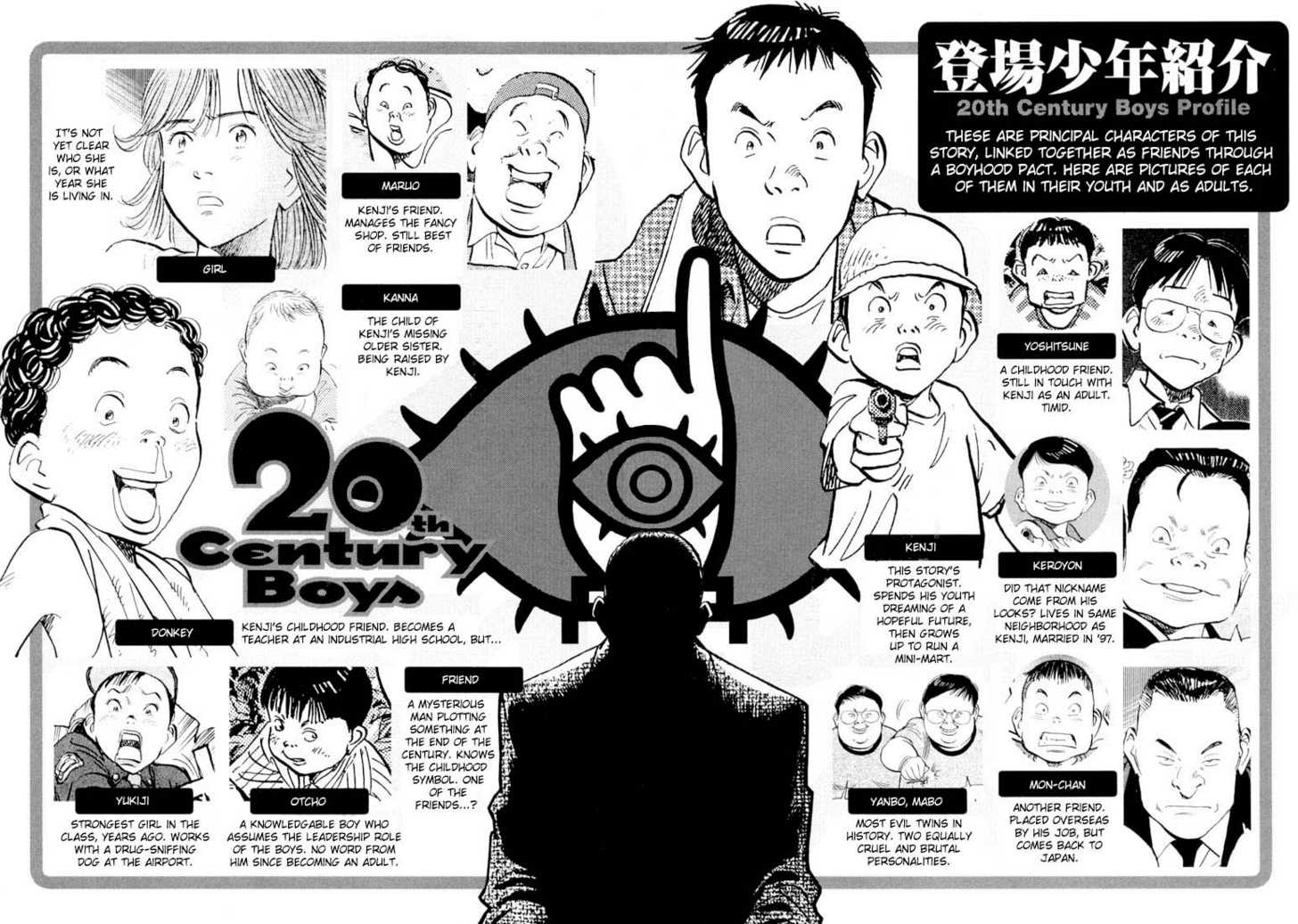
20th Century Boys Characters

As children, the main characters are very iconic and essentialized while they are surrounded by a realistic background. In fact, even when they grow older they still maintain traces of that youth–of that neoteny–only matured and “grown up.” And isn’t Reconstruction what creating stories is ultimately about: especially when you consider that children form stories in much the same way that put Lego pieces together. You have your basic building blocks that exist in reality and then you rearrange them to create some other kind of meaning. That’s what Kenji’s Group does. And then imagine the story continuing to build itself after them. Later in the series, a character even flat-out states “But kids games never finish.”

And sometimes reading 20th Century Boys is like watching a child’s game continue imperfectly. It’s true. Between the introduction of ESP into the story which seems to serve little significance to the characters but to hearken back to the spirit of the late twentieth century, people miraculously being able to walk away from explosions that should have killed them, the use of some stock and stereotypical characters, and a lack of visual closure with regards to the narrative build-up of some emotional relationships (which I hear is typical of Urasawa in his other works as well) the story is not exactly perfect.

However, consider this: the plot of 20th Century Boys is that “Friend” made a children’s playground out of the destruction of the world: turning a childhood dream into a dystopian nightmare used against its dreamers and all humankind. It was like Urasawa combined Field of Dreams with The Prisoner and 1984. It is terrifying and fucking beautiful in that the only way the protagonists can beat him is if they play the game that they all made together.

It makes me wonder what would have happened if some of the roleplaying games of my childhood and long-term friendships were ever applied to the real world. A long time ago, some of my friends, influenced by the Dune II computer game, created a whole world of interactions that I had a part in creating to this very day.

I won’t lie: becoming the secret Emperor of the world does intrigue me from time to time. But what 20th Century Boys illustrates is how even a childhood dream can cost the lives of billions. Even so, what a beautiful story that makes in fiction.

I would definitely recommend this series. It was only recently that I finished reading them online. Unfortunately the ones I read were not Viz English translations: which was one of the reasons why I hesitated in looking elsewhere for so long. No translation, from Japanese to English or any language for that matter is the same. So if you can find those Viz English editions, please read them. If not, consider the following:

The Friend cult sometimes has to purge some of its members. While the literal translation of their euphemism is generally translated as “banish,” the Viz version uses the word “reject.”

So tell me, my … friends, doesn’t the phrase, “Reject him,” sound so much more satisfying? And doesn’t it remind you of childhood: where acceptance and rejection can make all the difference in how your perceive your identity if not your very life? Keep that in mind when you read 20th Century Boys and you wonder who the heroes are, who the villain is, what their motivations are, and how some parts of childhood affect you forever. There is never full closure.

The games of children never end.

20th Century Boys True Friend

What If Comics Had Been a Place Without Codes? Would We Live as Air?

I’ve been having some technical issues these past few days and time hasn’t really been my friend but what I’m going to write here past most reasonable people’s sense of sleep is another down and dirty, and therefore ad hoc, article on comics.  So if anyone out there is an expert or has done their homework, by all means, please correct me if need be.

As some of you already know Sequart created and is now in the process of editing, a Kickstarter called She Makes Comics: a documentary on women in the comics industry and the culture surrounding it. One element in particular that it has focused on is the fact that long ago there were more female readers of comics than they were male. Now, I wrote a short article on what will soon be called GeekPron in which I found some of my own assumptions to the question, well, questioned.

I believed that it was the Comics Code Authority, inspired by the fear of McCarthyism “witch-hunting,” blacklisting, the detrimental testimonials by psychological experts such as Frederic Wertham, and a loss of business that had comics publishers eliminate most of their different genres of comics and focus mainly on watered-down stories about superheroes. All the horror, revenge, gore, westerns, romances, and sexuality all went the way of the dodo at the time because of fear. Anything that challenged the rules of the Comics Code, of authority always being right and just for starters, could not exist in mainstream corporations that published for money.

But the comic book editor Janelle Asselin also mentioned that this female readership of 55% over 45% of male readers changed as the superhero genre became more mainstream. Think about that: the idea that after a time the superhero not only reduced a female readership, but also eliminated or greatly marginalized a whole body of stories and genres that made the medium different. I realize now, looking back on what I wrote earlier, that these two statements are not necessarily mutually exclusive.

I mean, if you are afraid of losing your business and your liberty in telling stories for which you want a certain pay cheque and livelihood then eliminating anything that could be construed as an overt challenge to your culture’s status quo or even subversive to it, it unfortunately makes a horrible kind of sense.

The godfather of manga Tezuka Osamu once said that “Now we are living in the age of comics as air.” And while he was most likely referring to the influence of manga in Japan as becoming more widespread, its connotations can be applied to the comics medium in general. According to Paul Gravett, in Sixty Years of Japanese Comics, Tezuka believed that comics without passion or originality can become damaging and even create pollution. It took me a long time to figure out what this meant. When I first encountered the quote and the explanation, I thought that it referred to the potential damage to the morality of the reader but now I realize that the quote can definitely apply to comics as a medium and what occurred during the heyday of the Comics Code Authority.

The age-old notion of the superhero ghetto that we are so used to hearing about with regards to the comics medium: the notion of an immature all-boys club with shallow depictions of sexuality and simplistic violence with no consequences is damaging not only society’s concept of the medium but also that of its readers and future creators.

I’m not, by any means, saying that the comics that existed before the Code and its predecessors were the fonts of enlightenment for gender or, really, humankind. But there was a lot more experimentation before the Code and it just makes you wonder: what would have happened if these vigilantes and superhuman beings in tights had just remained one of many genres and there had been no Code?

I mean, there is always the scenario that Alan Moore presented in Watchmen: that if masked heroes and one a superhero had been in existence then no one would have paid attention to Wertham and the horror comics of Bill Gaines and friends would have dominated the medium from the fifties all the way into the eighties: becoming darker and more grotesque with time while also innovating itself much like our comics have done.

But that is just one creative interpretation. Who knows? Maybe a flat period of unoriginal and recycled stories would have followed regardless. Perhaps female readership demographics would have changed or something else would have challenged the “morals of comics:” for or against the status quo. Or we could have had another Golden Age: where comics became, earlier on, a widely accepted form of beautiful art and every great artist might have tried their hand at one. Maybe comics could have become widely accepted and mainstream coffee table or instructional as manga has in Japanese society to an almost ubiquitous degree. Instructional comics even had their place in North American society and to some extent they still do.

Of course, those latter thoughts are just me playing at utopia and I’ve never been really good at that. Maybe if there had been no Code comics would have, earlier, been just another form that challenged conventional morality much like any work of great art or literature should. Of course, again, this also happened in the Western world through the advent of what we understand as Underground Comix defying the establishment during about the late 60s: about that same time frame that Asselin gave when she talked about the female comics readership majority existed from the 1950s to the 1960s. Or perhaps the comics medium would have burned itself out as a fad and amateurs such as myself would be wondering, even then, what if: what if it had been different.

As for me, if you really want my honest opinion I will say this. I think that if there had been no Comics Code or anything like it children would have still been influenced by Tales from the Crypt, and Archie, and The Lone Ranger, The Green Hornet and all of those others. And some girls and women would have had Wonder Woman and Black Fury. Many things would have continued on, but sometimes I think about that idea of all people–young, old, straight, LGBTQ, male, and female, different ethnicities, different classes–making their own comics and showing them to their friends and the world. They would realize how different they and everyone else are but also how many things they have in common.

And when you wipe away my pseudo-utopia of a whole loss of potential for a readership of intensely intelligent men, women, and sentient beings, when it comes down to it I do like the idea that without the Code and the forces behind its development, the medium of comics would have been considered more than just silly laughter and transparently hidden BDSM parodies. Those things would have been a part of the kaleidoscope. I think that many more people might have seen comics as a medium that tells all kinds of stories: a space inside and outside of us that is pictures and words. I think many more people may have been more accepting that the medium of comics as that place of sheer variety, like film, between both art and literature.

There is another way to look at Tezuka’s quote about “comics as air.” If you take the pollution of censorship and unoriginality away, what you might ideally have is a fluid art-form that anyone can learn and use. And if you consider that we all live in the continuing Age of Information and in societies that utilize wireless Internet and you include webcomics into the medium … perhaps we can all fly where only superheroes used to tread: up, up, out of the ghetto and away.

Miracleman Balloons

I Found Out I Was a Cambion on my Birthday

It was my birthday yesterday.

It’s funny. I can’t always remember what I did every March 16. I can’t really remember anything particular about 2013. I do recall watching the controversial return of Darth Maul in Clone Wars back in 2012. I also recall my girlfriend buying me a Ms. Fields’ chocolate chip cake in 2011: the same year she had offered to have me move in with her. I didn’t really celebrate my birthday in 2010: though there had been the promise of a celebration that never happened. In 2008 I brought a birth cake to a gathering and before that there was another where someone announced it was my birthday and I was all embarrassed and such.

Before that it was a blur of Undergrad and small family celebration. I do know that every time this day comes along, it feels lighter. I mean there are seasonal reasons for that. When you look at it I was born towards the end of Winter. According to my parents, I was supposed to be born in the Springtime but I was apparently eager. Sometimes I wonder about my infant self’s wisdom, but there it is.

For many years in my childhood I had a birthday party with my friends and such. And yes, I was an eighties child and my parents did rent a party room and we did watch The Neverending Story and gave out memorabilia such as Falcore on a ruler that turned into a wristband. But then I got older and my friends went their separate ways and I found that I had no friends really to celebrate anything with. Birthday parties just started to feel very childish and when many of your friends live downtown or out of province and country, it is hard. Even though it didn’t feel like it, aside from dinners that my parents insist on taking me out on now that I’m at their place and a cake, my birthday just became every other day.

C'Tor Solutions

I was lucky this weekend. My friends, some of whom I’ve known since high school and one who I knew in elementary, told me at the last minute that we had a role-playing game session. This was going to be a special session. This was the point where our characters were going to cross from the ordinary mortal realm into beings of other essences. A new rule system was based and is still being tested by us. We talked, rolled dice, ate, laughed and actually role-played. I was exposed to so much lore from this world that Noah, our DM, has taken great pains to create.

And now because of the revelations of last game, my character’s plans might have changed along with his view of the world.

We spent the first part of our time cutting out cards and writing down our new powers. Then we started playing. I felt really enthusiastic and there were twists and turns and dinner and I could just see Noah waiting to reveal all of this lore: and it is not over yet. It’s funny. I have talked about my friends here before and our games, but I don’t think I ever realized just how long we would know each other. We have evolved over the years and sometimes we are together and other times we are off by ourselves. I think that is what loners of our kind do. But loners do gather from time to time to do awesome things.

And I vowed, for that one day before I even knew we had these plans, that I wasn’t going to dwell on the more difficult elements of my life. Not my welfare, nor my conflicts, or the myriad of other things I want or need to do, or didn’t do. All that mattered was that one day where I got to roleplay with my friends.

So there you go. This is my obligatory post-birthday, well, post.

Oh and, my character found out he was a Cambion: a descendant of a human and a demon. It actually explains a lot about me. It really does.

Happy thirty-secondth birthday to me.

Looking Outward