Other People

Will’s face felt stiff. His smile tightened the muscles around his mouth and looked genuine: at least in his own opinion. When he laughed at another person’s attempt at a joke, he forced it to project into his chest and the resulting hollow feeling only served to make the sound louder. Even so, the clambering background noise of the White Crescent Cafe seemed to drown out everything else and Nor was otherwise preoccupied.

It was a few days after they met at The Club. He watched Nor interact with the others. Will felt strangely deaf without the music of The Club completely drowning out all other conversation. Aside from her one quote from The Day the Earth Stood Still, they had barely talked amid the booming percussion of the speakers. It had just been her hands directing his own to her hips as Orbital’s “Halcyon” reverberated gently and transcendentally into the soft luminosity of The Club.

It was just their eyes as Nor smiled at him and he knew, then, that this was an expression that came easy to her. Then there was the night in his room and the exchange of phone calls that came after.

But here, at the White Crescent Cafe, it was different. The place was trendy with its half-moon caricature eating a croissant and holding a cup of coffee. It was crowded with many different conversations that made it hard to hear Will’s own voice: even in his mind. And while Nor’s acquaintances seemed friendly, Will felt that they were very self-involved.

Will continued to answer generic questions about his job (writing) and his “neo-50s look” (which wasn’t a style so much as what he looked like) until his insides ached. The centre of him was tightening until he felt a hand on his arm and saw Nor beside him.

“I have to borrow him for a moment,” she told them.

“Ah, yes,” Will felt himself wink at them with a cleverness he did not feel, “If you’ll excuse us.”

Everyone smiled and laughed as Nor led will outside the Cafe. They went to the side entrance and came to a stop. Will saw Nor looking directly up into his eyes.

“Are you all right, Will?”

“Yes,” Will said quickly, “It’s nice to talk with your friends and everything. They were just asking me–”

“You know,” Nor said, “it’s okay.”

Will blinked, “…what is?”

“You don’t have to pretend with me, Will.”

He felt Nor cup his cheek. It was almost instantaneous. The knot of tension inside the core of Will untwisted. It was as though Nor’s words and her small touch on his cheek were a knife destroying the great internalized pressure inside of him.

Will stood there as he felt streaks of warm wetness trail down his face like blood. The released pain and discomfort was the most silent of assassins: killing his parody of artifice and granting mercy. The two of them sat near the wall, with Nor holding him and stroking his hair.

“You never have to pretend with me,” Nor spoke softly, “I can talk enough for the two of us.”

For a long while, Will didn’t even make a sound as his released tension dripped out of his face and finally dried.

“T-thank you,” Will managed to reply with a tremendous sense of relief, “Neil … likes to say it’s ourselves, but sometimes it really is other people.”

Nor smiles, “It gets easier with practice and with small numbers. But sometimes, you are right.”

The two close the small amount of distance between their faces and kiss. Then they leaned on each other for a time before Nor came to her feet and pulled Will up to his own.

“We can do that later though,” Nor said, “Right now, let’s just go home.”

“Home?” Will asks with a combination of incredulity and a larger amount of hope.

“Yes,” Nor hooks her arm through his own as they began to walk, “Home. Sometimes, it’s other people too.”

https://i0.wp.com/farm4.staticflickr.com/3193/2735688778_c69e244f11_z.jpg

Credit: artofimperfektion on Flickr … the couple of which whose pictures they really are.

What You Are Left With

So not too long ago I read this post from Amanda Palmer which talks about a few things: but more specifically how Bloggers may be “the next writers,” emails are replacing letters as personal correspondence and how it will be challenging for historians and outside archivists to preserve all of this.

You know, sometimes I look at this. Right here. I look at this: I look at all of this–my Blog, social sites, email and the Internet itself–and I realize how really ephemeral it all is.

I am not a technological or computer expert, but some days I just imagine there being some kind of event that overloads information and backups to the point where this–all of this–is gone. It makes me remember that I don’t back-up any of my Blog posts on here. What I mean is, they are all essentially sent directly onto my WordPress, and if anything happens this would all be gone.

Then I think about the reverse. I think about the Internet and computer technology continuing to evolve: to points where we can’t even dream it will go. Imagine a future where technology becomes more intuitive–as though it is an extension of the human body in how you can easily access it like moving your arm–and all that old information comes with it. Or will it? Will old data from ancient systems survive into newer ones? Would it be the same? I know even from my limited knowledge and terrible chagrin that something like an old USB key can go obsolete.

But let’s say that technology will change to a point where obsolete technology and information on it can be easily passed onward: and accessed by anyone with any degree of knowledge. Let’s also say that this information will be documented and recorded by other people who want to write biographies or otherwise examine the lives of users from this time.

I mean, it is already happening to an extent. Archivists are tackling the gathering of emails and data from websites and online archives. Sometimes, as an exercise, I think about and look at everything I’ve typed up on Mythic Bios and I imagine someone in the future–or even now–trying to reconstruct what I was like as a person through what I allowed to be on here.

Does Mythic Bios represent my entirety as an individual?

I would have to say no.

It does represent a part of me. It represents my interests, some of my thoughts, and even some feelings but it definitely doesn’t have the full breadth and width of me. Sometimes it feels like a really carefully crafted shell or a layer of created artifice. And I enjoy crafting that artifice almost as much as I enjoy writing things on here, if that makes any sense, at least from a writer’s perspective. Amanda also mentions on her Blog that she doesn’t like to tell everyone about what she is doing, or reading, or listening to all the time because she wants a piece of herself for her and her loved ones alone. I think that is part of it too with me.

I think it’s also that I know I am just as ephemeral as my Blog. I am going to change. I am changing even at this moment. I don’t have it all figured out either because of this fact. There is something really comforting about writing a narrative where you place down the facts–“just the facts” of your interests and goals–with hints of the person shining out between them from time to time. I am, if nothing else, also a tease. 😉

But facts and stories can be so much more orderly–and comforting in that order–than an actual human life can be when you are in the process of experiencing it: especially when your other impulse is to chaos and destruction in not always a super-villain kind of way.  So I would be almost comforted if this Blog were to be all that was really left of me, but those human moments of ambiguity–that small amount of embossing–would make me feel a lot better about it.

Now if the Net went down, or suffered a few memory-wipe phases of cataclysm and all everyone had to go by me were the personal things I have written down that would be an entirely different story altogether. I mean, assuming they didn’t think I was crazy, they probably wouldn’t be able to understand me: if only because my handwriting is in ancient Sumerian … also known as messed up scribbling.

Sometimes your hand and pen cannot move as fast as your mind or your imagination.

In some of my more depressed moments, I think all I am going to leave behind are papers and electronic weirdness. Sometimes I think these are the best things about me. I don’t really know just how “inspirational” I actually am when you take the rest of this stuff away. I’m not really doing anything that anyone else can’t do. But maybe it’s just the way that I do it, or that others do it that differentiates us. It’s that mystery of “You-ness” or “I-ness.” I still haven’t solved that mystery yet and you know what? Maybe that’s a good thing:  because that means I’ll keep writing and doing what I need to do. I’ll keep going and when I am not angsty or introspective, I’ll just be ad hoc and silly.

And if that’s what comes through, like I said before, I will be more than okay with that: especially if someone else can relate to it.

https://i0.wp.com/www.photos-public-domain.com/wp-content/uploads/2010/12/spiral_notebooks.jpg

Make-It Me: A Film Review of Wreck-It Ralph

File:Wreckitralphposter.jpeg

When I first saw previews for Wreck-It Ralph, I admit that my expectations were not very high. I immediately thought two things: first that the CGI would be an excuse for a poor story-line and that, second, it would be a rip-off of Donkey Kong. I mean: just look at Ralph and Donkey Kong, or even Fix-It Felix Jr. and Jumpman/Mario.

Then after a while, I heard good things about it and there was one commercial that I saw which really got me attracted to it, namely this one:

After that, I couldn’t not see this movie, seeing as I am interested in super-villains and video games and … I admit I imagine having a Boss musical theme. =)

So I saw it and I’m just going to tell you now, that I will be focusing more on how the world of Wreck-It Ralph works more than really going into the story-line: though the two are very neatly together and excellent. As such, I feel obligated to place a Spoilers warning before I continue on.

So the spoiler warning having been said, I do have to go into the plot a little bit. Essentially, there is this video game boss named Wreck-It Ralph whose role it is to destroy a penthouse building while his heroic counterpart Fix-It Felix Jr. (whom their world and game is named for) fixes what he destroys. However, these are just roles. They, and other video game sprite denizens live their lives and even interact in a hub that exists at an internal intersection between their arcade cabinets. Everyone in the world of Fix-It Felix, Jr. loves Felix, but they do not like Wreck-It Ralph: though all he is doing is essentially his job which is just important as the hero’s job. Wreck-It Ralph decides that he wants to become a hero so that he can live somewhere better than his garbage dump home and also gain friendship.

That is essentially how everything begins. Now let me go into how their world works. So each game is its own world and there are borders that need to be crossed in order to get to the central hub where different game sprites can interact. This particular world exists in an arcade: which is now almost an anachronism given that arcades are not as popular (at least in North America) as they once were. Each world continues to exist so long as their game does not malfunction. That means that all heroes, villains, and supporting characters need to maintain their roles and stay in their games when someone from the arcade is playing them. Otherwise they get a dreaded “out of order sign” and their game is shipped away while they either become homeless in the hub or cease to exist entirely.

So far so good right? Well there are also the existence of beings known as “glitches”: characters that “shouldn’t” exist and are somewhat buggy. They can’t even leave their game world and go into the hub: which is something that plays a larger role later on. Then there is one more rule in this world which is very important. Never go Turbo.

I admit, I felt like I knew that I should know what that term meant. I thought it was a reference to a game that didn’t work out or some homage to some really bad character or video game idea from our world. But essentially, Turbo was a character created solely for this film. He was a racer character that was jealous over a new arcade game brought in that was taking attention away from his game. So he essentially left his own game and hijacked the other one. This caused it to malfunction and as a result both his original game and the one he invaded were declared “out of order” and thrown away. Essentially, because of his selfishness and his inability to accept his role he destroyed two worlds. So he is used as a cautionary tale for other sprites that might have similar ideas. It’s actually a really creepy idea and story when you really think about it: but also really cool too.

It also seems like only the really old arcade games were exposed to the “going Turbo” phenomenon while some of the new games with their more graphically-advanced sprites have either never encountered it yet or never thought of it. And some characters, like Sonic Hedgehog, are apparently so important that they have billboards with automated advertisements coming from them. They are “too good” to show up in this world: though I don’t know what that says about the Bowser and Princess Peach cameos. Maybe Mario himself wasn’t even mentioned either because of copyright or because he would take too much attention away from the protagonists. Yes, I am such a world-building nerd. I know.

Aside from said world-building, I think I really liked this movie because–in addition to drawing on the nostalgia and the video game culture my generation grew up with–I could really sympathize with Ralph. It is ironic that while the film is called Wreck-It Ralph, the game he lives in is called Fix-It Felix, Jr. This is essentially a film about a video game super-villain and boss character: made solely for this movie of course. It shows him subversively overcoming his “villain” role to be a real hero while, at the same time, accepting and coming to peace with his true nature and being a villain again: with everyone else accepting that it is just a role and not everything he is.

The character of Vanellope was also excellent. She is essentially a glitch that Ralph grudgingly befriends in another game. What she sees as a liability ultimately becomes a strength of hers. As a glitch, she flickers in and out of existence, or appears from one spot to another. She looks really cool too with glitter in her hair and a no-nonsense but mischievous attitude. She looked like her game’s main character and, well … 😉 She was also made an outcast because she wanted to get into a race with the main characters of that world: showing a caste-system between “sprites” and “glitches”: although I’m not sure if this distinction is only in her game or in the others as well. I relate to her because I knew that her “weakness” was actually a strength if properly applied.

But I think my favourite part of the whole film was that I couldn’t really predict it. I mean, first you have the danger of the Cy-Bug–a creature accidentally taken by Ralph from a first-person shooter Hero’s Duty world to Vannellope’s kart-racing Sugar Rush game–multiplying and spreading throughout all games. You have Ralph trying to get his Hero’s Medal. And then you have King Candy–who looks like a combination of the Mad-Hatter and the Wizard of Oz–tyrannizing Vanellope and keeping her out of his car race.

And then, then you realize that … Turbo is not quite as gone as the video game urban legends around him make you believe and that he has had a lot of time to … hack other games for his benefit. Thus the roles of hero, villain, player character, protagonist, and glitch get subverted and changed in awesome ways while strange new rules are made for strange playable universes.

That is Wreck-It Ralph for me. Aside from what I mentioned, I think one other reason I really like it is because it reminds me so much of ReBoot in concept: a world called Mainframe that takes place in a computer where sprites and binomes live and Guardians (anti-virus programs) from the Net fight against Viruses and other threats as well as Game Cubes (chortles, and the Nintendo Game Cube, not really related to anything here, didn’t exist at the time of this show) that were sent down by mysterious entities known as Users. I always wondered what sprites would be like in console universes: realities totally dedicated to the playing of games. Perhaps they would be something along the lines of “career game sprites.” 😉 Another Hunger Games reference and show parallel aside, the meta-narrative aspects of both ReBoot and Wreck-It Ralph make me very happy inside. I also had to stop myself at one point from saying, “Game over. User wins,” especially when one arcade winner didn’t in fact win. ;P

The fact is, I hope they make more films set in the world of Wreck-It Ralph. I would love to see how they would handle video game consoles and PCs. But I think what really intrigues me is a character like Turbo that can hack into other game-realities, but instead of doing it to gain attention or simply subverting a pre-existing game, they can actually use all existing information and code in that world as part of a pre-made kit in order to create their own game entirely. Think about that: a sprite can use code to rewrite and make their own world where they are the protagonist or the god of their own game. Maybe it is a homage to the Do It Yourself gaming literature I’ve been reading and watching lately. But essentially, what I’m saying is that Turbo was thinking too small and too petty, and with the skills he learned he could do so much more.

I learn the wrong lessons, it seems. This movie was all about accepting a role but also having the flexibility to go beyond and here I am sounding like I want to be a super-villain.

No comment.

But anyway, this movie gets a 5 of out of 5 and I want to see more of them. This is Make-It Matthew continuing on: to the next level, and the sequel that I keep getting promised. And no, I am not going Turbo.

I am going Make-It. 😀

And I Won A Very Inspiring Blogger Award From A Very Inspiring Blogger

very inspiring blogger award michael allan leonard public domain blog comics humor nerd writing

So I was just talking with a friend of mine about having been Freshly Pressed and getting the Reality Blog Award not too long ago, only to find that I have been nominated for yet another Award meme. 🙂

It was the very inspiring michaelallanleonard who gave me this. You should definitely check out his Blog because it talks about comics, has an awesome aesthetic and is otherwise very geeky. It even has an awesome title: “Public Domain.” It is difficult to get much more awesome than that, though the challenge is always accepted. He even has a really interesting story as to how it took him “so long” to graciously accept his Award.

I mean, I could tell you that I was trapped in a self-contained pocket universe of my own design where I was perfecting the art of giving a god-like Being an existential moral crisis, but that would be fibbing really. So no, I think my greatest challenge will be actually fulfilling the requirements of this Award. So that is what I am going to do.

But before I do that, I just want to add that I’ve found that some people have posted a Link to my Mythic Bios on their Blogs. I would like to thank you for that. It was really gratifying to see my Blog in a Blog-roll: like it is all professional or at least interesting to other people. Unfortunately for me, mentioning this will not fulfill one of my requirements on this meme, but I wanted to thank you for giving me more attention and helping to bring others to the fun that is Mythic Bios. I really appreciate that.

So enough stalling:  let me try to write something inspiring! 🙂

The requirements of The Very Inspiring Blogger Award are as follows:

1. Display the award logo on your blog.
2. Link back to the person who nominated you.
3. State 7 things about yourself.
4. Nominate 15 other bloggers for this award and link to them.
5. Notify those bloggers of the nomination and the award’s requirements.

SEVEN THINGS ABOUT ME

Now, the challenge here is that I’ve probably told you all a lot about myself already. I also tend to mostly talk about my writing and less about me on this Blog anyway, given what it is. But I’m going to do my best, go into my head, and find something that might not have quite made on here as of yet. So now, let me see …

1) I have issues with technology: in that I am probably one of those people who need to have a tech expert on hand and in person, or very specific instructions as to how to deal with a situation that doesn’t always make sense. It is not innate to me, though I can experiment with things and find some solutions on my own. But sometimes, I’m left frustrated–very frustrated–with “technological stupidity.”

2) Writing and creating for me can become a kind of meditation in which I am caught up in the moment or carrying a thought–or series of thoughts–in my head that I need to write down. Often I’m lost in those moments and tend to mutter the words myself, or speak them out loud as I write. I am also a peripatetic: essentially doing my best thinking when I have the freedom to walk around or pace. I need to go with a thought and move around and I would, paradoxically enough, go insane if I didn’t have any opportunity to do either of these things.

3) I am actually diagnosed with a Learning Disability. It manifests as dyscalculia–which is an inherent difficulty either learning or understanding Math–and spatial difficulties as well. Basically, I can’t multiply or divide without using a calculator and I do mental arithmetic very, very slowly. I also get lost on my own, but I navigate places through remembering landmarks and a lot of time memorizing a place through experience. I’ve been told that my writing and art skills “compensate” for these challenges. I also require more specific instructions and clarifications before undertaking an unfamiliar task. It’s less that I have a disability and more that my brain is wired differently: or so one theory goes. I see it more as an alternate mindset more than anything else and while it can be challenging, I have gone–and am still going far–when all things are considered.

4) I did my Master’s Thesis on Herodotus in Neil Gaiman and Alan Moore’s works: specifically in American Gods and Voice of the Fire. I looked at how they described and created their own worlds and as such I looked at Herodotus’ Histories from a literary as opposed to historical perspective: though that is a very fine line even by modern standards when you consider that all historical documents are created by narrative, and objectivity does not really exist. I am pleased with how it turned out and I got to throw some theories out there about American Gods and its protagonist Shadow that Neil will undoubtedly prove wrong in the sequel.

5) There was a period of time where I used to go out a lot more, and with a few exceptions these days, I don’t go out as often anymore. While I was never what others would consider a “social butterfly” (unless you count making mountains crumble on the other side of the world, insert Chaos Theory here), after a lot of the things I learned and experienced it’s almost like I was another person back then and it’s weird to remember another person’s memories that, you know, were pretty much my own. I mean this in a very metaphorical sense: in that like anyone else I am not the same person I was yesterday.

6) The strangest and most unique thing I have is another person’s lost dreams.

7) I have a pet budgie with the multiple names of “You,” “Budgie,” “The Fluff,” “The Fluff Creature” and so on. Her original name was supposed to be “Squawkes.” She is a blue and white bird who lately reminds me of a sleeping cloud.

MY FIFTEEN NOMINEES

So again, this is another difficult decision. I am not sure who will actually fill out this Award meme, but I hope my choices will prove interesting and excellent. These are definitely people that inspire me, and whose Blogs and writings are some of the most interesting things I’ve seen. At the very least, I hope by doing this I will offer the opportunity for their Blogs to gain even more of the attention that they deserve.

And here they are:

diannaswritingden

clotildajamcracker

Mythaxis Magazine

Ad Astra Per Aspera

Pretty and Putrid

The Bombers’ Notebook

Live simply, travel lightly, love passionately & don’t forget to breathe

Mandy DeGeit

Impressions of a Princess

geekchick77

The Modern Chimera

HillbillyZenDotCom

Just Think About It …

Sarah on the go!

Auntie Pixelante

I hope you check these Blogs out and thank you again Michael for being Inspired by me. I hope to continue the strange, good work here.

What I Got Myself Into

I’m sorry this took so long to post, but I underestimated just how potent post-Game Jam lag can be. There have also been some tech issues, so you can look at the previous sentence as a double entendre if you’d like.

In any case, I had my first Toronto Global Game Jam! Yay TGGJ 13!

I started off the day by appropriately enough finishing off Anna Anthropy’s Rise of the Videogame Zinesters: How Freaks, Normals, Amateurs, Artists, Dreamers, Drop-outs, Queers, House Wives, and People Like You Are Taking Back an Art Form (which is an awesome book of historical and cultural perspectives as well as the seed to make you want to make more games) before making my way to George Brown College’s Game Design Centre.

There were many possible scenarios in my head as to how this was going to turn out. And I have to say that none of them actually happened. I registered as a Solo Jammer with the belief and understanding that I would have a chance to become part of a group. What I didn’t know, and what I should have realized in retrospect is that many people would be attending the Jam with their own pre-established groups.

I knew a few people at the Jam and I got to socialize a bit with them before the ultimate theme of the Game Jam was announced: which was the sound of a heart-beat. So after this really excellent theme idea was revealed, I found myself with two choices. The first was to actually Solo it and learn how to use Twine–a text-based choose-your-own-adventure video game maker–on the go while making an entirely new story from scratch, and the second was to find or make a group with whoever else was interested.

So I found a group of two other people: another writer and a graphic designer. We realized that we lacked a programmer or coder, so we decided to make a Board Game. There was a lot of brainstorming, debating and spirited arguing but together we managed to create some working game mechanics. I also kept using the quote from William Faulkner’s Banquet Speech that George R.R. Martin likes to bring out whenever he talks about character development, namely: “the human heart in conflict with itself.” This was an appropriate quotation on so many levels and one that helped me work with the Jam theme.

I don’t know. There was one point where the lack of sleep, food, and the concentration on game rules and content, began to intermix with Anna Anthropy’s Rise of the Videogame Zinesters and Hermann Hesse’s Glass Bead Game inside of my head. I started to realize or remember that games are rituals in which we interact with other people and a created reality: an experience. During those two days, we were all essentially working and manipulating cultural information to create an interactive art form: making some kind of new meaning: or add our own personal touch for others to experience in some way.

Or something like that. At least I didn’t start calling anybody Magister Ludi.

So our group finished the game dynamics and some of the background notes. My fellow writer was taking notes as I was throwing out various ideas. Unfortunately, he had to leave early and he didn’t come back on the last day. In his defence, he did say that I had this, ;P. Also, all printing shops in the immediate area were closed so even when it was just myself and the designer, we didn’t have an accessible way to make a material copy and I didn’t bring any supplies to make a crude prototype. In the end, I had to interpret my co-writer’s notes and charts and tried to make everything as simplified as possible for the designer and myself.

Then to top it all off, we and a good majority of the Jammers missed the deadline for uploading our games and writing files onto the Global Game Jam site. The rules were there, but they were surrounded by a lot of text and weren’t completely clear. I’ve heard that one of the organizers might be talking to the Global site about letting us upload our games, but I have yet to hear back about that. If this does happen, I will definitely give you all a link to the game on the site. If not, I will see what I can do about this.

I think some of the most fun I had at the Game Jam was when I could actually just work on the writing without feeling like I had to manage other aspects in addition to that. I am not technologically skilled and that was why I counted on being in a team to begin with so I could focus on the field that I was good at. But I did learn a lot and we completed what we set out to do.

We made a game.

I also got to socialize a fair amount. It is really something to be surrounded by a group of friendly introverts–volunteers and game-makers–working on their own thing, or sleeping, or drinking free Starbucks coffee and tea, and shooting each other with Nerf guns. I slept on a mat. Someone slept in my sleeping bag and then returned it to me. There was pizza.

And I also helped a new friend with his own game after both my teammates were gone. Talking with other game-makers (now I am getting a Hunger Games reference in addition to The Glass Bead Game, I’m sorry to mention), made me remember my own old attempts to create video games when I was much younger.

I was the kid that messed around with Mario Paint for animation purposes and had vague ideas to record the animations to make a continuous pixelated cartoon with my own music. I made Warcraft II scenarios. I also used Civilization II Fantastic Worlds’ editor to make my own icons and game scenarios. I won’t even go into the board games I’ve made as well: which I had much better skill in doing (inspired by Snakes and Ladders, Monopoly, and The Addams Family Board Game and such). When I talked to people at the Jam about Super Mario Brothers, it occurred to me that I had started playing it in the late 80s, while many of them had played it much later on. I remember when it was all new. It can feel strange to realize that you are suddenly old.

You know, I had a really good time. And I learned some valuable lessons too. If I do plan to be in a group, I will either come with a friend or with a pre-made group to do food runs, stand in lines, and do shifts as we work or whatever we decide to do. The second possibility is that I will learn how to use Twine and come Solo so that I can work on an interactive short story challenge and pace myself: allowing myself time to socialize and relax into the writing process. It all depends. I could go either way.

So, if I were to summarize GGJ 13 into an appropriately creative sentence, I would end it and this post in the following manner:

“I’m sorry, but your princess: she is in another castle … with some coffee and a machine gun.” 🙂

P.S. It also occurs to me that we were all recorded by camera people and even interviewed once. So I might have a link to that as well. I might even go into more detail on our game. We shall see.

A Message from You to Me On An April Fool’s Day 2003

It was 2003. I read American Gods two years before and I wanted to read more. I was in my first year of my University’s Creative Writing Program and not too long before I’d finished my unpublished Read Between the Realities novel. Back in those days, Neil Gaiman was on his Blog a lot more and even answered a few questions of his choice sent to him by the many people that, well, pretty much asked him questions, or made various comments, or frankly just sent him cool things.

I sent him a few emails. I’d finished reading Neverwhere and the novel version of Stardust and I am pretty sure I read Smoke and Mirrors as well. Back then I wasn’t really reading comic books and I missed out on Sandman–some of his greatest work–until much later. I was very impressed with his writing. It was the first time I read such a wide variety of different stories that stitched so many awesome things together and made reality magical. I wanted to more or less know how to do that. All of that.

There was email that I sent him in particular that I would like to quote: because it was something really on my mind then.

In 2003, when I was about twenty-one I wrote the following:

Greetings, my name is Matthew and I am currently in my second year of York University in Thornhill, Ontario. I am almost taking a Creative Writing course in which I have discovered a major weakness of mine in terms of writing.

It is called description of setting. To put it simply, I have difficulty describing geography — be it a city, or a place of any kind that exists in the real world. I’m told though that research helps one around this problem.

Now here is my question (I’ll put some asterixes around them to emphasize its importance):

*(1) When researching a place of any kind in real life, where would one, as a beginning writer, even begin?

I would appreciate an answer to this very much — it is somewhat of a perplexion to me because lack of setting description really adds less depth to my stories. Thank you.

There were so many things wrong with how I phrased this email. It was painfully awkward. I mean, how can one “almost” take a Creative Writing course? I mean, I was either taking it or not. Did I mean that I was accepted into the Program then? That I was still waiting? I don’t think my thirty year old self will ever know and my twenty-one year old self took the secret with him into time. I do know that I was sure I had other questions, but I must have forgotten to write them down after Number One.

But aside from my awkward sentences, I was so lost. Yet I wasn’t lost enough to realize that something was, at the time, lacking with regards to my writing. I reconciled myself to the fact that Neil was more likely than not busy and that my emails would, like many others, would never be answered.

And then, one day, I opened up his website to skim through his entries. It was Tuesday April 1, 2003, April Fool’s Day. I’m not sure whether it was me, or my first girlfriend that found out about this. It has been a long time. But whatever was the case, on that day ten years ago now, I found a familiar question on the page with this reply:

The easiest thing is to go there, and take a notebook, and jot down things that strike you. Tape recorders, if you can conquer the embarassment of talking to yourself in a public place, can be terrific for that. And note the things that make you feel something. Sometimes one detail will stick with you. Write it down, or remember it.

Then, if you want colour and background, use it, and don’t dwell on it. A sodden teddy bear, face down in the grass, in the little section of a cemetery called BABYLAND may be all you ever need to mention…

You can take for granted that people know more or less what a street, a shop, a beach, a sky, an oak tree look like. Tell them what makes this one different.

Find authors you like and see how they do it. They’ll all do it differently, but you can still learn.

In retrospect, I wonder why I didn’t ask myself if this was some magnificent kind of April Fool’s joke. But if I did, and if it was, it was a benevolent joke created by the universe and one of a delight I can’t, to this day, begin to put into words. It was some of the most valuable advice from a person who’s writing I admired and was crucial to my development.

My favourite living author essentially replied to something that I wrote to him. I can’t remember how happy I was, but I must have been ecstatic. I felt special. Granted, it took me many years and trials to take this advice to heart and just write about the strange things that stood out at me. I’d already gotten the talking to myself in public part down-pat ages before this, but I never really touched a tape-recorder again. But Neil was right. I could still learn, and in my way I did.

I could end this story right here and it would be awesome. But it didn’t end there.

At the time that Neil had written me and countless others back on his Blog, he had been working on another novel for quite some time. In 2005 it came out.

It was September or so, and I was burned-out from school and a very unpleasant summer. It seems that a lot of painfully life-changing events have happened to me in the summertime. You know how they say that people have mid-life crises? Well, I can tell you that I have had many-life crises of the psychological kind. A lot of it is a blur now, save a few details, but I do remember Anansi Boys.

I wanted something like American Gods, but just as Neil warned, it wasn’t going to be like that. All of his stories, with a few commonalities, are still all different genders and beasts in themselves. Nevertheless, this story sucked me in. I was reading it non-stop in my house. And then, I came across something.

It was on page 21 of my hardcover edition, at the beginning of Chapter Two where the protagonist Fat Charlie is trying to get to a funeral. It read:

“He ran through Babyland, where multicolored windmills and sodden blue and pink teddy bears joined the artificial flowers on the Florida turf. A mouldering Winnie the Pooh stared up wanly at the blue sky.”

File:Babyland Crittenden Memorial Park Cemetery Marion AR 008.jpg

I read this passage again. And then again. And one more time for good measure. I went online and found the copy of Neil’s reply to my question that my former girlfriend had sent to me a year ago. And even though Winnie the Pooh was staring up at the sky instead of the ground, I felt then what Lucifer must have felt like in Sandman towards the end of the series where he watches a sunset and gives God His due, but far less grudging.

Actually I recall growling something along the lines of, “You magnificent bastard,” and grinning like a maniac.

That day, in what was a very unpleasant year, I got something special. I received a gift. For a few moments, I had a little bit of insight into a writer that I really respected and who shared a little bit of a wink with me. The original post link can be found here if you are interested. I’m actually surprised I never really talked about this, except with a select few people. Maybe, in retrospect, I never particularly had a space to do so.

It’s been ten years since I was that twenty-one year old boy and even though I have never physically met Neil Gaiman–and it grows less likely that I will–for that one moment, from 2003 and 2005 something unique was shared with me, and I’d not give it up for the world.

Sea Shells, See Shells by the Sea Shore: A Review of C. Anthony Martignetti’s Lunatic Heroes

I have been looking forward to reading C. Anthony Martignetti’s Lunatic Heroes: Memories, Lies and Reflections for some time, and now that I have finished reading it, I find I have a lot of different things to say. In fact, what I think I’m going to do is the following.

I am going to write two sections to this review. The first will be an attempt at a more literary perspective of Lunatic Heroes, while the second will deal with my own personal reactions to the stories themselves. Before I go on, however, I just want to say that I will be referring to Anthony by his first name due to the way that I was introduced to him. I will elaborate on that later, but I just want to say that it would feel weird after reading about him and his own work to call him anything else. It’s the not first time I have done this with an author and it probably won’t be the last.

Lunatia heros is a species of Northern moon-snail that likes to live close to the shoreline of bodies of water. They are large gastropods that like to eat clams and other snails: including members of their own species. They consume their prey by drilling holes in their shells, releasing digestive enzymes, and sucking out the partially digested contents of their victims from within those shells. In fact, the only thing left of their fellow snails are these empty shells. According to Wikipedia, these moon snails hunt other mollusks down by searching for those that bury themselves in the sand of the shoreline.

Of all the titles Anthony could have given his work, Lunatic Heroes is by far the most apt. This book is essentially a collection of fifteen short stories or, technically written recollections, of some of the major events in Anthony’s life. Even though the book itself is categorized as a memoir, which it is, each narrative is both interrelated and self-contained.

At least twelve of these stories deal with Anthony’s childhood with his Italian-American family in Boston, while the remaining three focus on Anthony as a developing independent adult all the way to contemporary times. I don’t want to make too much of a generalization, but each story is about the insanity of the human condition. After all, the word lunatic is derived from the Latin word Luna and it was once thought that someone suffering from madness was “moon-touched,” while at the same time the moon itself has always been associated with the other world of the night, creativity and intuition.

In this, the metaphor of Lunatic Heroes functions in a few different ways. On one hand, most of Anthony’s stories are about the dysfunctional elements of his own family and his 1950s childhood: about the way each character would attempt to devour Anthony’s extremely introverted essence, digging under the sand where his self hid in order to successfully–or unsuccessfully–get at it.

On the other hand, Anthony’s narratives also take many of these same characters and portray their other more relatable sides. It is no coincidence, after all, that the heroes of ancient literature–for all of their deplorable moral behaviour by contemporary standards–still possessed a spark of divinity and managed to perform great deeds. In a fiercely passionate and witty voice tempered with a nostalgic unsentimentality not unlike that of Will Eisner, Anthony manages to show that these characters from his own life aren’t always monsters, but are very fallible human beings with some moments of relation, levity, and downright comedy: even and especially in some of the worst situations that he depicts.

What drew me in as a reader were the very mutable archetypes that Anthony managed to identify in his life: specifically with regards to how they transferred and inter-lapped throughout each story that he gathers together into a strange whole. Sometimes each narrative doesn’t always fit in a straight-line–which is more than fair given how a life of human interactions is generally never shaped that way–and he occasionally repeats a sentence from a previous story. But the archetypes really drew me in. Certainly, the whole Scylla and Charybdis parallel childhood dilemma in “Force Fed” was made very uncomfortably clear, just as the figure of a Far Eastern form of enlightenment and a symbolic place of personal transformation is within “Swamp.”

So thus ends the very brief and relatively spoiler free part of my review. Now I am going to talk about my personal reaction to Lunatic Heroes. I will say that I particularly related to “Force Fed.” When I was a boy, I was a very fussy eater and after I started to lose weight at twelve, my family thought that I had some kind of eating disorder. I didn’t really see a problem: in that when I stopped feeling hungry, I simply stopped eating. I was also lactose intolerant and I didn’t know that until my doctor and a slough of very uncomfortable and embarrassing tests happened. I lost a lot of weight from simply no longer eating dairy and then having a growth spurt. It also didn’t help that I was a very nervous child and my stomach suffered for it. But I could definitely relate to Anthony’s account of being made to feel like there was something wrong with you just because you simply weren’t hungry enough by the standards of others or the fact that you didn’t want to become sick.

I could definitely relate to the moments of introversion and hyper-sensitivity from Anthony’s depiction of his childhood self and that paradoxical need to have your parents always in your life, but at the same time that need to keep that bubble of personal space around you from being violated by the rest of the world: sometimes in vain. That is why I particularly related to–and if anyone knows me and is reading this they will be laughing by now–the last story “Hate.”

I admit that I was actually concerned when Anthony ended his memoir with a story entitled “Hate,” but it made sense. The thing is, Anthony is a psychotherapist and there are some things he talks about throughout the entire book–mindfulness, being in your head and needing to be in your body–that is very reminiscent of what my own therapist has been telling me for quite some years now. In “Hate,” Anthony even mentions how he still has snap judgments and immediate–and sometimes unfavourable–superficial impressions of people. They can bring up various associations his life: not all of them pleasant. But he also mentions how by realizing that these same people have pain and loss in their lives, it makes them relatable as human beings. It is still a lesson I have to keep reminding myself of during some of my more misanthropic world-obliterating moments of glee.

I also totally understand where Anthony is coming from in “The Head,” when he writes about the darkness and anger that he is feeling in himself even while he is with his wife and dog at a peaceful retreat: the knowledge of this fact that just made him feel worse until he has one moment of mindfulness. I think Anthony really hit home for me that you can mentally and emotionally awaken many times in life: and for different reasons. In that, “Swamp” and the events with regards to the freak show in “Carnival” really come to the fore. In addition, the story “Nonno” made me really miss my own Zaidy while I can more than sympathize with the need to belong and centre yourself and finding a place like “Harvard Square” home.

I am almost finished this strange review. But to make it even stranger, I want to write down some very notable lines, or moments of text that just made this entire book for me:

Anthony writes about longing: “But this time I felt the ache you get when longing for something you don’t think you have, coupled by the fear that you’d blow it if you did” (107).

He also describes the process of maturity, stating, “I was pulling off the heist of the decade, stealing the truth about myself from every encounter” (108-109).

Finally, there is this: “I imagined eventually befriending the Devil and getting promoted to demon status, sharing the power of evil and control over an infinite number of she-devils who would hungrily do my bidding” (129).

These are just such universal impulses and feelings, and as a writer I kind of wish I had been the one to express myself in such a way. The metaphor of the Lunatic Heroes is even more ingenious because in addition to moon snails being predators, Lunatia heros always leaves perfectly preserved husks from all of its feedings. Think about that for a few moments: even though the snail is gone, like the imprint of a lost self or Virginia Woolf’s spot on a wall, its shell–the testament to its existence–is left unearthed in the sand. It’s left there for others to find and see and marvel in the patterns that they created. In other words, we are the predators and the prey of our selves, but by simply living we take the selves of others with us, and we leave a testament to their existence. It is an excellent extended metaphor for a writer, the act of writing, literature itself and the state of being human.

Now I am finally going to tell you the reason why I refer to Anthony by his first name in this review. Through reading Anthony’s book, I feel like I know him a little more. But that is only part of it. The rest of the reason has to do with how I discovered him.

It was mainly by accident. I was searching for Amanda Palmer’s Blog and I came across her entries about Anthony and just some of what he means to her. I will let you read that entry should you so wish. But what I will say is that Amanda wrote the “Introduction” to Anthony’s book and she said something that really got to me.

Amanda wrote the following, “I had a small glimpse into the act of writing as a direct escape from pain. For the first time, I experienced the physical truth of what it felt like to dwell in the act of creation as the only viable escape from an unbearable, unfaceable reality” (ix). I read this statement and I took a look at myself. I took a look at my notebooks around me in my room. And then I looked at the one hundred or so posts I’ve made on this very Blog. I took a look at what I try to do every single day now and I thought…

Yes. Just … yes.

Amanda also went on to talk about how she and Anthony delve into the uncomfortable, and awkward, and painful moments of clarity that is life. And you will find that and more in exquisite detail if you read this book.

Now I am going to end off now by doing something even stranger. I am going to give Lunatic Heroes a four out of five.

And here is why.

After reading “The Introduction” and Anthony’s “Acknowledgments,” and just hearing about him and some of his life from Amanda’s Blog, I wanted to know … more. Even though the way he describes his childhood, sometimes blatantly and sometimes tinged with hazy mythical half-memories is reminiscent of Neil Gaiman’s Violent Cases, I want to know about the rest of it: the adolescent rebellion you see forming in the latter stories, what happened in the rest of his travels, what his other fights were about, and more about his exposure to other philosophies and other relationships.

When it comes down to it, I want to see more. And as one lunatic hero to another, Anthony, I sincerely hope to.

And Then One Day I Got a Reality Blog Award

So it seems that I have been nominated for the Reality Blog Award.

http://hillbillyzendotcom.files.wordpress.com/2013/01/reality-blog-award1-e1357511854615.jpeg?w=250&h=221

I have to say that I did not see this coming: being that the only reality that I have ever really written about here on Mythic Bios has pretty much been my own. But I am really glad that hillbillyzen13 has nominated me, and believes in the writing and whatever else I’m doing here enough to do so. And let’s face it: as a writer and as a person, I love getting attention.

So, here are the logistics of the meme:

1.) Visit the blog of the person who nominated you, thank them, and acknowledge them on *your* blog.

2.) Answer the five questions listed below and nominate up to 20 bloggers whom you feel deserve recognition.  Visit their blog to let them know.

3.) Cut and paste the award to your wall.

So now, to business:

If you could change one thing, what would you change?

I would create a meritocratic society: where people are acknowledged and supported for their talents and their craft. My society would put education and the arts ahead of everything else save universal health-care and the training of medical professionals of the physical and psychological fields. At the same time, the people who make the day-to-day sanitary and nutritional functioning of society possible would be publicly honoured and assisted. The arts and the sciences would be combined again. And most of all, I would eliminate jealousy. Permanently.

So now that my foray into utopia and idealism is done for the moment, what is the next question?

If you could repeat an age, what would it be?

Oh dear. I would say … twenty. I think this is about biological age. I severely underestimated my intelligence and my appearance at that age. I was a very good looking and creative young man and if I knew then what I know now … well, let’s face it …

I’d probably would have done exactly as I did in the last time-line: waited to mature more. So, my vain streak aside … :p

What one thing really scares you?

Being stuck awkwardly–and painfully–on the outside. Essentially, finding myself in a social situation where I’m the last one to be chosen, or I don’t know how I am going to quite navigate my way to getting into a group. From being the odd child out in Musical Chairs, to needing to choose a partner, and even make connections with people that can help me in the outside world and possibly realize my potential. Going outside myself and my comfort zone is scary: with that spectre of rejection, humiliation or being outright ignored always hovering over me. That said, it is something that I have gotten better at dealing with somewhat.

What is one dream that you have not completed, and do you think you’ll be able to complete it?

I want to get to the point where I can become a professional writer and support myself, improve myself and gain some modest recognition from my craft. Mainly, I just want to make something that I can leave the world: something of meaning that will have everything else–including the process of it all–totally worth it. Do I think I will complete it? Well, it is entirely possible but I for one am going to keep pursuing it in my own way. Slow and steady spider steps.

If you could be someone else for one day, who would it be?

Honestly–and this is the difference between the younger and now current incarnation of me–I just want to be me. Only better: more wise, less anxious, more confident, more independent, more in my body and with a balance of different passions and relationships. Just … more. And I don’t want it merely for one day. Rather, I want it for the rest of my life.

All right. Now, here is the most difficult and interesting part of the Award process. I get to make some nominations as well. There are so many of you and you are all awesome. Here are my list of nominees. I hope that you like and appreciate them as much as I do.

Through the looking glass she tumbles

Peanut Butter Macramé

Zombie Zak

Pretty and Putrid

Mandy DeGeit

Larry Atchley Jr.

Impressions of a Princess

Ad Astra Per Aspera

diannaswritingden

Unbound Boxes Limping Gods

ghosty net

What’s Your Tag?

clotildajamcracker

The Comic Book Lounge and Gallery

Mythaxis Magazine

All right, so now that I’ve nominated you all, remember to nominate other people as well. We all need the inspiration and the support. Keep Blogging my friends, and get ready for some more content next time.

Still Trying to Go Beyond Myth and Legend, Novels and Short Stories

It was in 2002 that I wrote my first complete “adult” novel. I put the word “adult” in quotation marks specifically because I was twenty years old at the time and I barely had any living experience. In fact, it wouldn’t be too much of a stretch to say that I had no living experience at all.

What I did have, however, was the opportunity to absorb a lot of academic experience. I had always been a pretty good student (in fact, I thought it would be the most sensible thing to do with my whole life) and I believed that University would just expand on my knowledge. And it did. I learned many more obscure ancient Greek and Latin roots of words, some mythology, and even more philosophy. To be honest, I had been learning of these elements back in Grade Twelve and the now-lost Canadian Grade OAC (or Grade 13 for those who might not be familiar with it).

Read Between the Realities: Beyond Myth and Legend was essentially a bildungsroman–or a “coming of age”–novel of 136 double-spaced computer pages. This was the point in my development as a writer where things began to really change for me.

Now, I’ve discussed a little of the background behind this novel’s creation, but there are a few more specific things I have to mention. Before this point, I had mostly been working with purely the fantasy genre: in as much of a way as someone at my skill level and knowledge at the time could. In fact, even in my first year of Undergrad I was still working on my fantasy series Deceptions of Nevermore before the change began.

First of all, I’d heard of York’s Creative Writing Program. It was–and as far as I know is–a program where you had to submit a portfolio of poetry and prose in order to be selected for a small number of spots. The Program also discouraged, if not outright rejected genre writing in its courses and, instead, wanted to focus on “realistic fiction.” Now, I was very interested in developing my writing skills in those days and I could only apply in my second year. But that was only part of what helped to create my novel.

The second crucial element in the creation of Read Between the Realities was my discovery of a book called American Gods made by a man named Neil Gaiman. That book, which only in retrospect I realize was Neil Gaiman’s own transition from the format of comic book script writing into solo novel writing, changed things for me in a very big, very real way.

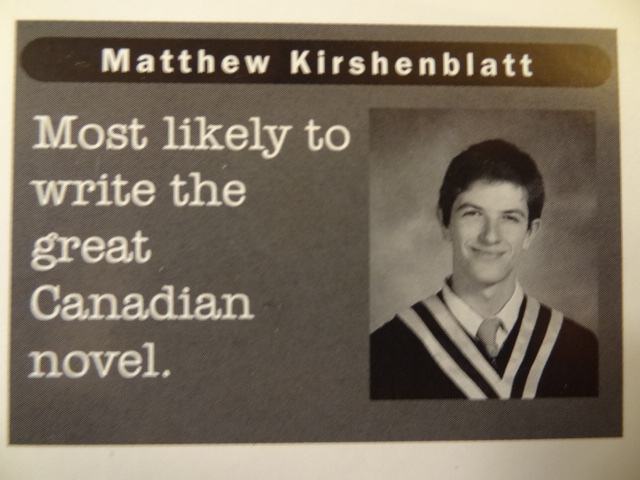
I realized that there were things beyond the confines of genre as I understood it. Then I remembered the film Finding Forrester and how I wanted to write “the great 21st century novel.” So I did something new. Before I even entered the Creative Writing Program, I decided to create my first experimental “adult” novel: a great Canadian novel and all of the grandiosity I still haven’t quite grown out of even in my very early 30s of now.

In Read Between the Realities, I created a pastiche of different stories and attempted to sew them together into an open-ended patchwork reality where you could interpret the novel almost any which way you’d like. I worked on this sucker for a long, long time. I worked on it at home, in parks, on mall benches, at friends’ houses, during sleepovers, when I visited my girlfriend at the time or when she visited me, and even when I moved with my parents to our new house then. Some more marked developments in this novel was how I actually actively incorporated many of my own experiences and thoughts into the work. This was partially influenced by my interest or obsession with philosophy, but also from insights I was having from life.

I was really bad at explaining what my novel was about and I firmly believed that the only way someone could understand it is if they read the damn thing. It also didn’t help that I had the paradigm-shifting magic concept of Mage: The Ascension on my brain too, and I delved into that voraciously.

My book was essentially a story about different realities inter-lapping and how personalized they are. It was about a writer and his relationship issues with his life, a fragmented being seeking something for a demanding master in a labyrinthine subconscious world of ruin, a viciously sadistic monster hunting this being down, and two people on an Internet chat room who bickered all the time. The writer and the two chat room people both believed they were making the story, while the seeker and monster both thought they were living a reality. And none of it was real. And all of it was real.

Of course it all combined, or exploded together–because I always loved epic moments of spectacle–and I played at being profound. Yes, it was a meta-narrative: complete with the characters knowing they are characters or finding out they are and all that fun stuff.

Ten years ago, I thought it was the best thing I had ever written in my whole life, and I actually feared that I could never surpass it. Ever.

Years later after showing it to some friends, I found out that I could indeed “surpass” it. A lot of my characters were two-dimensional archetypes, I didn’t write female characters well, I certainly couldn’t write sex scenes worth a damn then, and I rambled: a lot. And when I tried to simulate experiences I never learned about or experiences I never had, it just fell flat. Also, I wrote combat and adventures as if they were video game levels: though that in itself makes sense given my interests then and now. So yes, I can safely say that I have done better since then, though …

I’ll let you in on a little secret. I actually haven’t really written any, at least official, novel-length works in a very long time. They take a lot of commitment and unique formulas to keep up. I also can’t just write anywhere at anytime anymore. Part of this is that I realized I had more of a life beyond my craft, but I also find that novels can be trapping. They can really take your time and energy. They always get on your mind all the time.

Short stories are explorations into more tightly-knit, self-contained worlds. You can spend less time on these than on a novel, though they take their own toll given that you really need to focus on tying them up all neat-like. On the other hand, sometimes I find short stories to be like little tidbits–even the more complex “four-course meal ones” that some of my friends like to call them–and not as satisfying as the meaty feel of an entire world in a novel. That is, of course, when the short story ideas aren’t overwhelming your bodily and mental limitations to write them all out.

So sometimes, despite my best intentions, I have found myself writing novel-length works because the ideas behind them are either too similar to be placed in anything other than an overarching structure, or they just too big to contain in one short story. And for now, that is all I will say for the others that came after Read Between the Realities.

What is notable about my twenty-year old writer’s novel was that this was about the point when I was also consciously playing with mythology and archetypes in addition to ideas and philosophies. I attempted to combine academics and creation together. I also very reluctantly put more of myself into the work, and–like I said–I went into meta-narrative and irony: which for someone who had just done generic well-meaning fantasy novels before was a big step. And Joss Whedon taught me to be more flippant and referential about popular culture and life too.

I would never have admitted that I created a coming of age novel. I always wanted to make other worlds and other people to get away from the ones I was experiencing–or not experiencing–but I can admit that this was what it was. And for something based on a whole lot of theoretical knowledge, incomplete understanding, video game and pop culture influences and a small if not sheltered, somewhat self-repressed and stagnant amount of personal growth at the time, I did pretty well. It was like building a small Star Gate from the scrap-metal in one’s basement. It did what it was designed to do.

Read Between Realities was made at a time where I went as far as I could go with what I had then–with what I was then–and now, whatever else, I know that I have and definitely can go farther.

Looking Outward

Credit: Beth Ann Dowler, the photographer of this image.

The Rise of a Geek or How Video Games Made Me Want to Write Novels

I wrote my first novel in Grade Ten.

In high school, I carried around a clipboard with a manuscript’s worth of lined paper in my backpack along with a book. I would sit in the front entranceway of Thornhill Secondary, outside the door of a class,  in the cafeteria, in the quad, on one of the chairs in my Drama class, and in classrooms before class began scrawling onto that paper with a black or blue pen.

Almost everyday, someone would see me sitting there: in my strange clothes that I mostly wore because my Mom got them and I had to wear something, my Blue Jay baseball cap to keep me hidden from people, blue jeans (because I was bullied over wearing sweatpants in Grade Nine), and my backpack with its many compartments and my handy-dandy pencil case with all my utilities: colour pencil crayons, pencils, pens, erasers … all of that fun stuff. I even had an Art Kit back when I fancied myself a graphic artist: a large bag with an ink pen that I loved, various sized pencils, a grey puddy eraser and a sketch book.

And yes, I did draw characters from my novel.

My novel was called Order and Chaos. It was seventy-five computer pages long with a glossary at the end. It was about a man named Derem who was born in the future after humankind colonized a new Galaxy and created a brand new Empire. There was a war between the human scientists and mages: and the mages lost … their territory disintegrating into an unstable vortex of space known as the Xarion Region. It was thought that magic had died out, as it had once before back on Earth millennia ago, but there were survivors and people still born with the gift.

My world was ruled by a secular humanist technocracy (which my younger self would have loved to have the words for) that was the Empire: composed of different noble Houses that each had a particular division of labour. This same Empire also made the acquaintance of other alien species who stayed out of the whole conflict, and they have differing relations with them.

Derem was a young man who discovered that he was a mage and a Chronomancer: someone who could manipulate time itself. There was an evil villain named Jagan D’Karos, leader of House D’Karos, that wanted to take over the Empire from House T’Jal: that was dying out. D’Karos was a borderline madman who secretly wanted to rediscover magic in order to essentially dominate existence and there was a rebellion against him, and all that lovely stuff.

There were supposed to be two more books. I created outlines for all of them and tried to fill them out. Book One was the only one that truly lived in its way. I also recall holding the entire stack of paper together with one multi-layered bad-ass paperclip. Yeah. Pretty much.

I know for a fact that people noticed me in my school and when I worked on it at summer camp. In many ways, it was my constant companion in addition to the books I read. I wanted to be the next Tolkien obviously. I also wanted to look busy and to focus all of my imagination in a world of my own creation that no one else could really see as of yet.

I had my influences: the Dune II video game my friends were so interested in and which inspired our own role-playing games, Final Fantasy VI (which I knew as III) where magic was a terrifying lost weapon that even helped make Magitek Armour and where there were Espers and epic moments, and I was probably also influenced by Dragonlance and Forgotten Realms.

But essentially, I was inspired to write my first novel by video games.

I would have once been ashamed to admit that: that video games are just for fun and are not real literature. Of course, by the same token, I was all like “screw real literature,” this is is what really does it for me. Basically, I just wanted to tell a story and Final Fantasy VI and Dune II pushed me to do it. They pushed me to go beyond my limits and keep working on something: something beyond me, but was still a part of me.

They influenced me in other ways. I went from the Dune game to reading Frank Herbert’s books and–in addition to Star Wars–got really interested in human political machinations and manipulations. Final Fantasy VI on the other hand showed me the majestic beauty of soundtracks, the utter diabolical power of evil, story lines, character development from a seemingly simplistic 16-bit sprite model, a great depth of humanity, and a variety of different ways to interact with things.

It was not the last time games would influence me to that extent either. As I went up through the Grades, and people watched me–as I would learn directly later–I discovered Chrono Trigger and really changed. Order and Chaos was, to put it charitably, a novella in length. Deceptions of Nevermore was even longer: though it was supposed to be a Trilogy that didn’t survive past the first book. And the title may have been influenced by Secret of Evermore: that I never actually played.

That one was a story that took place in a high school: in a small town called Eldara. There was a great evil buried before the founding of the town and the last survivors of a civilization of virtually immortal mages try to keep it from awakening. But there is one mage that wants to wake it up. Centuries later, a girl named Rachel stumbles onto all of this with her Wicca friend Chara, a borderline obnoxious half-demon named Karnak and so on. I also admit that Joss Whedon’s Buffy played a large role in the development of this story.

I also recall there being a story I called The Epic Project with the working title Revelation’s Saga. I vaguely recall working on it after Order and Chaos but before Deceptions of Nevermore. In any case, it was a post-apocalyptic world where an empire called The First Technocracy cloned and resurrected different species of magic-using creatures called Psytans as slave-labour. As the First Technocracy fell and became the Second, many lands had free Psytans or some that actually tried to coexist with humankind. The term Psytan was a blanket bastardized term that defined dryads, goblins, elves, and other creatures as an entire species. They were cloned from something older and I made a whole world with different cultures.

How the humans treated the Psytans reflected a lot on the different cultures. I remember the Sor’cerin Imperium: where women ruled because I reasoned that more women than men would be magic-users and thus have more power. Psytans there would be fellow Bond-Mates to the sorceresses and the Empress. Whereas the Technocracy was more or less equal in that they wanted to mechanize and control all life.

I was definitely influenced by X-Men, and Final Fantasy–especially since my main character was a young woman named Amnah–but also … Pokemon. All right, that last revelation was a little more reluctant on my part even now, but back then I had a whole system figured out. This book went on for hundreds of lined pages. It was my first insanely long novel. I remember working on it everywhere and I mean everywhere … even in some places I no longer go to.

Like I said, I felt a combination of shame and defiance for video game inspiration with my first novels but they helped me make all of this. They helped me deal with the realities of high school and adolescence. You know, once I showed an excerpt of my Epic Project to the Del Rey Writer’s Workshop when it was a free online community. One person said I should have made it a children’s story and I got really offended by that. But looking back, I was essentially a young adult writing young adult stories. They may not have been very good, but they were mine and the product of my time.

For a while, like some people, I thought that our time had nothing more to say. But what I like right now is that everything from our childhood and onward has a meaning and isn’t as fragmented or diluted as others might claim. I do read classical literature now, but I also read comics and sometimes I even play video games. It has changed and it is still changing me to this very day. It’s also clear that there were and are many more people like me to this regard: upraising the things we love and even when we make fun of them, still see them and make them beautiful.

And I wouldn’t have it any other way.

That said, I’m still working on fulfilling that prophecy from my last Yearbook:

High School