Whoever Hates the Man of Tomorrow?

Alan Moore attempts to answer a question originally of his own making when he created Whatever Happened to the Man of Tomorrow? years ago. This question has been asked a variety of times since the end of the superhero’s Silver Age and has garnered a variety of creative answers.

But why Superman? Why is Superman still so important? I admit: I have friends who simply don’t see the point to the Man of Steel’s continued existence or, indeed, his creation to begin with. One main criticism that people have with regards to Superman is how unrelatable he is to the reader. I mean, come on now, none of us can generate heat rays out of our eyes, fly, possess X-Ray vision, make freeze-breath, or be invulnerable. Certainly, no one has Superman’s “boy scout” morality without any other very human flaws and failings to match it: if that.

I can understand why Batman is more relatable. He is a human being who has used material resources and pushed all of his human skills to their limits by sheer obsession and utter will. If anyone should be the Man of Tomorrow, gender connotations notwithstanding, you’d think it would be Batman. Certainly, many people have a great love of the vigilante: of the person that goes beyond the law, becoming extra-constitutional, going beyond the polis–the city-state–to become a god or a monster to see that proper justice or vengeance is done. And there are heroes being venerated today–perhaps throwbacks to the ancient literary heroes–who are far more brutal and even more morally ambiguous than Batman.

And Superman? He is a “goody-goody.” He is so much a goody-goody he is too good to be true. Whereas Batman operates beyond the law or within its blind-eye, Superman obeys the law in as much as he can save innocents and capture criminals. Perhaps there is little difference, save that the law seems to like Superman a lot more or accept that he is beyond them: that he is using his powers to uphold the law and safety to a fault. Indeed, you could say that Superman has more a lovable personality: or is more personable and wins all popularity contests through his sheer good nature while Batman fights with fear as his weapon. Fear does not make you popular or loved: but it gets the job done.

But is that the only thing Superman has over Batman and others? That he is more lovable and makes a show of following rules? That he is superhuman and chooses not to obliterate the world? That he ignores or reshapes the reality of the world? Or worse: does he continue to patronize his friends, his allies, his enemies, and the human race by presuming to always save and stop them? Is his alter-ego of Clark Kent, according to Bill in Kill Bill Vol. II, simply a grotesque critique of what he thinks a human being really is?

The truth is, when you look at Superman, you see an incredibly powerful being that could rule and destroy the world. He could rip us apart like insects. Yes, Kryptonite can hurt and kill him but he has enough knowledge to protect himself against it. In fact, the knowledge and intelligence he possesses from the Fortress of Solitude that is his Kryptonian birthright and from his own experiments is enough to dominate and destroy all human kind. There are many people who–if they had his knowledge and power–would do exactly that and have very little qualms about doing so. Some people in the DC Universe already have.

It is already clear that Jerry Siegel and Joe Shuster based him off of Friedrich Nietzsche’s idea of the ubermensch: a being that has grown beyond the constraints of morality and limitation to choose their own path, yet they injected “good old morality” into this alien superman and made all of his achievements naturally-born and inherited from the dead.

So why is Superman special? Why do I think he is special? I might have written some of my answers already but–if I had to sum it up–I would have you consider the following.

Imagine finding out that you have the power to crush steel with a punch or even just the touch of a hand. If you wanted, nothing could ever touch you. You can move as fast as or beyond the speed of light. If you jump, you will jump extremely high and eventually be able to fly: but you need to somehow know how to control where to go or how to move given that you still have a humanoid form and it is not built with the instincts for flight.

Now take all of that–never mind the fact that you have to learn how to control your temper, your passions and hold your parents or your lovers carefully so that you don’t crush or hurt them–and then add an alien birthright whose most modest lore could detonate the world many times over and again: possibly taking you and everyone you love with it.

Your merest touch could kill a person and your slightest knowledge could destroy them. It makes for a lonely existence doesn’t it? And yet, somehow deep inside of you, you not only find the will to master all of these powers but you actually want to use what you have to help other people. At the same time, you just want to be like other people: even though deep down you know you never truly will ever be. You don’t want to be thanked, you just want to help and out of all those things you could do, you choose to do so.

In Mark Waid and Alex Ross’ Kingdom Come, a horrible calamity happens and Superman gives up on being Clark Kent. We see a person who lived among humans, who loved them, who had friends among them and wasn’t alone become an out of touch and distant Superman who only responds to the dead name of Kal-El from an equally dead and distant world. It is a Superman who still wants to do good and still feels bad over the loss of life, but he can no longer relate to anyone that he wants to save and people cannot relate to a person who looks upon them as so … lesser than he is.

He becomes the genius that cannot relate to anyone and garners misunderstanding and even contempt: because if a superhero, like a genius, cannot relate to those they save or even us readers then they have failed in a very fundamental way.

Unlike Bruce Wayne whose civilian identity is a mask for Batman, Superman is Clark Kent. He was born as Clark Kent and even though he isn’t human, being Clark Kent has taught him control and about life. As Grant Morrison demonstrates with a bright and essential freshness in his Superman All-Star, the power has not mastered Superman as it has so many others.

Superman has mastered the power and like the ubermensch he chooses his morality: which is to help people. At the same time, he is like Thomas Mann’s Tonio Kroger: who can see the dance of humanity around him and even replicate it artistically but is never really a part of it. It is his strength and his sadness and yet he finds the joy in helping others find joy. Very few others in fiction or the real world could ever be like that.

I write a lot of dark and conflicted characters yet once–long ago–Superman was one of my earliest childhood heroes. And in some ways, he still is. I’m glad the idea of him exists. I’m glad he exists.

Thus concludes another episode of Matthew Kirshenblatt writing about superheroes. Up, up and away my friends.
Legend of Zelda: Link’s Enlightenment

I’d like to say that this is another video game review, but that isn’t exactly true.

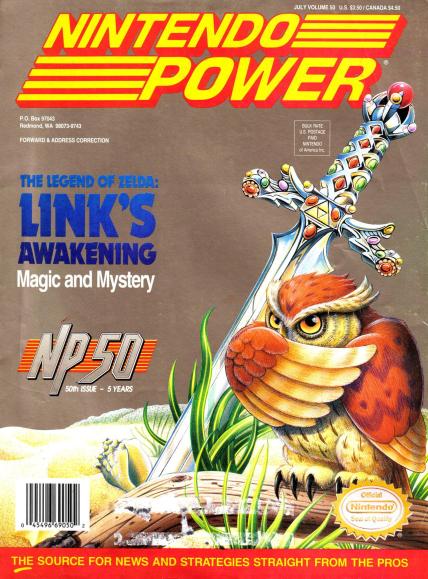
I first heard about Legend of Zelda: Link’s Awakening back when I used to get Nintendo Power Magazine. I remember that day. It was the summer time and the bus dropped me off from camp in front of my old elementary school. My Mom was there with Issue 50 of Nintendo Power that I’d been waiting impatiently for. This is what I saw:

http://countzeroor.files.wordpress.com/2010/10/magazine-nintendo-power-v6-7-of-12-legend-of-zelda_-links-awakening-1993_7-page-1.jpg

This mysterious owl sat near the sword. Originally I was annoyed that my copy of this issue got tattered, but it and the faded tan-bronze cover only added to the mystique that Nintendo no doubt wanted to build around this issue and the game they were featuring in particular. Well, for me, it worked.

It didn’t work in getting me to get the game however. Not initially. And when I did get it I didn’t really have as good a head for puzzles and video game combat strategy back then. By that point, my friend who’d gotten the game before me proudly spoiled the ending: or maybe I asked him. I don’t actually remember. So I don’t know why I picked up the game again years later, but I did. By that point I had a little more common sense and I’d played a few more games. Also, I’d read some philosophy: a lot more philosophy.

You are Link. You are on a ship in a storm that leaves you marooned on a strange Island. You figure out that the only way to get off of the Island is to awaken the Wind Fish in its egg on the top of the highest mountain.

There are puzzles and mysteries and secrets. You have many moments: most of them fun, a lot of them dangerous and you get to know the mysteries of Koholint Island. There are strange people, weird creatures, a talking owl that periodically advises you in riddles, a man who eats things he shouldn’t … and a girl who likes to sing and just spend some time on the beach with you.

I’m going to go into Spoiler Territory right now. Unlike Super Mario Brothers 2 where the “it is all just a dream surprise ending” just seems like a cop-out, in Link’s Awakening it is a gradual realization that comes with some sadness at the end of the game. In fact, the spirit of this game is perhaps even more emblematic of mono no aware–of understanding and having empathy towards the impermanent beauty in life–than even Terrangima.

Then you take the chronology that Nintendo claims the Zelda games all have into account. Personally, I liked the idea that each game in the series was a “legend”: a story with some elements of history but each being an account that has ultimately been changed over time as memory fades. However, in this case, I like that Link’s Awakening apparently happened after A Link to the Past as I’ve understood it.

Let me explain my take on Link’s Awakening and what I feel is really significant about it. From my North American understanding, there were three games before this one–the two Nintendo and the Super Nintendo ones–and all of them involved Link rescuing Zelda and dealing with the Triforce.

Here is how I see Link in this game. He has done all of these heroic things, but after he has completed them, he’s tired. In Hyrule, he is known as the rescuer of Zelda and the hero of the Triforce. If he had a normal life before this, it is gone. Maybe he just wants to get away. Maybe he lost much of what matters to him. Maybe he just doesn’t know who he is anymore.

The fact is, before this point Link didn’t seem to have an identity outside of being Zelda’s hero and the gatherer of the Triforce. Link’s Awakening, despite the franchise title, is Link’s story. It is not only a hero’s story, but the story of a man who journeys into his own subconscious. The owl that he finds on the Island is that part of him–the wise being or animal archetype–guiding him through this inner journey. Every creature and obstacle is his unconscious mind trying to keep him in a state of ignorance. Every time Link reclaims or gains a new item, he starts to remember more of who he is: or begin that process of knowing who he is.

You can  get even more Jungian and say that Marin–the girl he meets–is his anima: the feminine aspect of his mind that reveals things through subtle intuition and actually has him pay attention to the things he has taken for granted in the other games. He plays around, he laughs and he learns to enjoy the sunset and the sentiment that can feel when watching it. He also has to face Eight Nightmares that could represent emotions or attachments: seals of power that keep the Wind Fish–or Link–from waking up, while the ultimate Shadow Nightmare at the very end of the game symbolize the essence of his greatest personal fears and then ultimate universal horror.

He has to gather eight instruments to create music from a tune that Marin sings him to get into the egg that the Wind Fish sleeps in. And when the Wind Fish wakes up … it can fly. And it does.

It is a symbol of awakening: of enlightenment. It is a symbol you would find in some Eastern thought or even in a very mythological way. I know you can easily say that the Wind Fish dreamed Marin, the Owl, the Nightmares and the entire Island: that they were all aspects of its dreaming mind.  Link might even be a part of its mind and it has awakened to another reality. It is a valid interpretation given how Link physically wakes up on a floating rafter in the ocean. Does a man dream of being a pebble or does a pebble dream about being a man? Does Link dream about the sleeping Wind Fish and its Island, or does the Wind Fish dream about a sleeping Link?

The thing is, when I talk about all this, I believe I’m actually talking about Link as a symbol and not necessarily with regards to the ambiguous continuity that Nintendo is trying to make between games. I think, that at that moment above when Link destroys the last Nightmare and wakes up the Wind Fish, he is really awakening himself. At that moment, in that moment, Link is more than just a silent hero that goes around fulfilling tasks and doing what Zelda cannot or will not.

When Link wakes up the Wind Fish, when the illusion of maya that is the Island disappears, when Link regains consciousness: he actually gains consciousness. He expresses emotion through his interactions with everyone on the Island: each one of them aspects of himself. He realizes he has a whole world in himself that is a part of a reality outside of him as well. He experiences mono no aware: that sorrow and acceptance with regards to the passing of beauty in life. In one tiny hand-held 8-bit console with grey graphics or crayon-colours, Link is depicted as having achieved enlightenment and self-knowledge. For the first time, the hero of Hyrule knows who he is. He someone who dreams and is dreamed of. He is an archetype.

For the resources of the time that made this game, isn’t that just … beautiful? I’d really like to think so. I know many of you might think that I am reading too much into this and that it is just a game. Certainly I would not say that Link’s Awakening is a tool for personal enlightenment, though it is tempting to say in a creative sense, but it does depict some cultural depictions of it well. It is a beautiful artifact and I’m glad I knew it. Obviously, if this were an official review it would be getting five out of five.

I would like to leave you with just one more thought. When Link wakes up, it’s as though it was all a dream. When we finish playing a video game, the game is over. We put down the console or turn off the computer and go do something else. Our interactive electronic dream is over. Yet do all of those challenges and experiences: and those touching moments all fade away and mean nothing because they were not physically real? Did they not happen? Somehow, I don’t think so because, even when we finish sleeping, our dreams never really go away.

They continue stay with us. Because dreams are memories too.

https://i0.wp.com/www.projectcoe.com/wp-content/uploads/2012/04/tumblr_legu6rTqGz1qaaf7po1_500-300x269.png

Comics Review: Grant Morrison’s Arkham Asylum

The first time I’d ever heard of this game was in reference to the video game that exists out there. But I’m not talking about that. No, I am talking about this.

https://matthewkirshenblatt.ca/wp-content/uploads/2012/07/arkham.jpg?w=194

I’m specifically talking about Grant Morrison’s Arkham Asylum: A Serious House on a Serious Earth the 15th Anniversary Edition. Considering that it has existed since 1989, the book has no doubt had many reviews at this point, but I feel that I have a few things to say about it: things that have been on my mind since I last read it.

What I find very unique about this comic is not what it is about, but who. You might think to yourself it is obviously about Batman, but while he is obviously a main protagonist in this work and it deals with him facing his own fears and psychological issues the story is not purely about him. The story is not about the villains that he has incarcerated there either: though they have lured him into the asylum to face said fears and the torments that they have waiting for him. It isn’t even about Amadeus Arkham: the tragic founder of the mental hospital that was supposed to save and repair criminally insane minds.

No, Arkham Asylum‘s main character is Arkham Asylum. Character as place is not a new idea. Certainly, I had to face something similar when I was writing part of my Master’s Thesis on Alan Moore’s Voice of the Fire: where the protagonist of that work was actually Moore’s hometown of Northampton. But unlike Northampton that has many layers of different gritty and earthy human activity, Arkham Asylum is many nuances of madness.

Morrison doesn’t pull his punches here. He draws on Jungian psychology and archetypes, the Tarot and mysticism, and poetry and crazy itself as he depicts Batman’s essential descent into the underworld or the demented collective unconscious that Arkham has become. He also has an Alice and Wonderland reference or two. Morrison seemed to really like using those, just like Alan Moore in his Miracleman comics. Then there is the name Arkham itself to consider. From what I understand, it is derived from H.P. Lovecraft’s creation of the fictional city of Arkham, Massachusetts: the seat of the strange and eldritch Miskatonic University. It has been used as a name for various fictional places, but it really has a nice and eerie parallel with Gotham’s most terrifying asylum.

The fact that it was once a house–a very Jungian archetype for the makeup of an individual’s consciousness–and the person who once lived in it failed to turn it into a place of healing and ended being locked away inside of it speaks some major volumes right there. The atmosphere of this comic is distorted and schizophrenic to the point of making even Batman seem disturbing and this is in no small part thanks to Dave McKean’s drawing style and painting.

https://i0.wp.com/www.dialbforblog.com/archives/500/arkham3.jpg

Do not misunderstand though. The piece has its weaknesses and, ironically enough, those weaknesses are can also be construed as its strengths. For instance, I really like the broken mirror-reality that Dave McKean has depicted with his twisted nightmarish images and the different kinds of dialogue font, but at the same time they are very distracting and it is hard to make out key details that may have actually made all the difference in understanding the plot. The reason I like the 15th Anniversary version of this book is because of the detailed comic book script at the end of it.

You know, in some ways I liked the script a lot more than I liked the comic that came from it. If Arkham Asylum is of any indication of how Morrison writes comics scripts, it represents something easy to follow and enjoyable to read. In the script the mythological and archetypal references and many more uncanny details are much more apparent. It is also an added bonus to be able to understand what it is going on and what the characters are saying. At the same time, I will be honest: I respect his interpretation for Batman in this story, but I don’t agree with it.

The fact has less to do with Morrison’s choices and more to do with the popular idea that Batman is as mentally-imbalanced as his enemies. Do I think he was influenced by a trauma into a cycle of behaviour? Obviously. Do I think he saves people’s lives just out of a compulsion? Not completely. Perhaps each time he does do it to save himself or to save the lost innocence of the child he once was. I also think he saves peoples’ lives and doesn’t use a gun because he has principles and he has a certain sense of honour influenced by his own experiences like anyone else.

But there definitely were a lot of things I liked about this book: about reading the story of Arkham Asylum and the progression of the horrifying ritual and gathering of insanity over the decades that made it into the nexus of insanity that we all know and love. I also like how it makes you look at what precisely madness is and just where that fine line may–or may not–be. It was a psychological horror story and I loved it.

I do wish that I could have gotten more out of it without having to read the script, and I could be very mean and say that there is something wrong when you like a script more than the comic it is supposed to help create: but I do love McKean’s work here and the script is a nice complement with some scenes that didn’t make it into the finished artistic product. I’d definitely give this work a five out of five.

And that is it for now. Tune in next time, my friends. Same Bat-Time, same Bat-Channel.

ETA: It would be interesting to see someone compare and contrast Alan Moore and Grant Morrison’s use of Alice imagery as well as how they use the ideas of “reason” and “madness or intuition” or the “Dragon” and “the hero” in Miracleman, From Hell, Arkham Asylum and Red King Rising respectively.

Video Game Review: Terranigma

Imagine a game where you play as a person who needs to create–or resurrect–an entire world. With each challenge you solve, you restore not only continents but the cycle of life and the souls of all living beings as well. Then you find yourself in a battle between good and evil over what you have brought back. You find yourself between two worlds. You find a world awakening in yourself. Things are definitely not what they seem to be and eventually you wonder just what it is that you are fighting for.

You’re not exactly what might be considered hero or saviour-material. In your village, you’re known as a bit of a trouble-maker and something of a brat. You cannot leave things alone and this is what ultimately precipitates your ultimate quest and the strange, terrifying and wonderful places you will find yourself in.

Your name is Ark and your game is Terranigma. Terranigma was an action role-playing game created for the Super Nintendo in the mid-90s. It was never released in America: which is a really great shame, but it was launched in Japan and Europe.

To say I like this game would be an understatement. What I wrote above is merely a summary of a very fun and poignant story. This game has a wide range of emotional depth and covers a whole lot of themes like death, reincarnation, and life itself. I keep thinking myself whenever I think of Terranigma that if there was ever a video game with a Buddhist paradigm, this would be it. I do not exaggerate when I say that you, as Ark, have to create or recreate the world. You also help civilization evolve while becoming a part of it as well.

The character of Ark is interesting because with his mischievous and good-hearted nature and his staff weapon he reminds me a lot of Monkey in Journey to the West: a reluctant god-trickster hero–with something of a magic staff weapon–who is impelled by forces in the outer world to help others. So in some of that sense, Ark does fit the hero archetype. And believe me, this game does not skimp on archetypes or the hero’s quest.

https://i0.wp.com/rpgcorner.pagesperso-orange.fr/Terranigma/Terranigma_art.jpg

This is also an action game. It is not turn-based and you don’t gain spells when you level up. Instead, you fight. You have to think on your feet and adapt to your enemy. Defeated enemies explode into a satisfying cloud and often leave some gold behind for you. There are puzzles as well and those can be challenging but not difficult. I confess that when I played the game, I looked up a lot of guides to help me through it because I wanted to see how the story unfolded more than getting stuck in places at times.

What else can I tell you? The areas that you visit are great … fond stereotypes of places that exist in our world but they are fun to interact with. I wouldn’t learn history from this game though, just to warn you, but just take it as it is meant to be: a game with its own logic.

All this said, I feel I should definitely mention that in addition to its lush 16-bit graphics and memorable characters, Terranigma has one other very great element: its music. In fact, its music does what any video game music should: it complements the story and the characters. It is integral to the emotional complexity inherent in the game. The music can be playful, grandiose and conflictive, and sad. Really sad.

But there is something about “Terranigma Sadness” that is different. It portrays this … transitory sorrow, this acceptance of loss and gain as a cycle of life. It–and really the entire game–has this resonance with the Japanese concept of mono no aware: an awareness or an empathy towards the impermanence of life. You can really hear it at towards the end of the main musical theme in the above link. It reminds me of an old man dying peacefully in his sleep under a sunny tree or an unnamed and unsung warrior resting after a long life of battle: leaving forgotten but satisfied by the depth of his life and accomplishment.

As I mentioned before, the spirit of the game has an almost Buddhist nature or a distinct link with some aspects of Far Eastern culture: a perceptual lens which has a very unique way of looking at the world.  Being able to combine these elements with fun gameplay is a mark of genius as far as I am concerned.

All and all, after a few years of not playing this game, I would still give it a five out of five. A friend sent it to me and it only reinforced the fact that I’m glad I got over my reluctance to play old games. No, this isn’t an old game. Games like Terranigma are never old games. No, this game is a classic, and this is what a classic truly is.

I’m going to leave you with this last video. I don’t know how long it or the above link will be on here. The following was a fan video created by one TheStarOcean. I thought it was lost forever years ago and while it doesn’t use the original track, it truly captures the heart of this game. Do not watch if you don’t want spoilers and you want to play this wonderful game for yourselves. If you have played it though, I hope you will enjoy it for what it is.

Creativity and Academia: The Glass-Bead Game That Never Ends

It’s amazing–to me–that I forgot to talk about this at all in my review of Hermann Hesse’s The Glass-Bead Game. I was originally going to write this as an addendum to the piece, but then I realized that the issue I want to address actually covers some much broader ground.

One that that is always stressed in Hesse’s novel by the Castalian Order that developed the Game is that it is not their role to create new things. Castalians are not supposed to be artists, but scholars of a spiritual bent and–according to them–anything that comes from the Game is simply to be contemplated and there is great discouragement against changing the rules that create and make up the Game proper. Basically, the Game itself seems to have been developed from pre-existing knowledge and there is usually great resistance from the Order itself in altering any of the rules or guidelines that were made to create it.

However, it is not only this. As I said before, creativity apparently is discouraged in Castalians in general: but that is simply not true. At one point in his studies, Joseph Knecht is encouraged–like other developing students in his Order–to write creative pieces about what they could have been in their lives. Also, he makes many changes to the rules of the Game even before he is Magister Ludi and they are accepted. Knecht could–of course–be the exception due to his gifted nature and not the rule–but it goes further than that.

To combine different disciplines together to create different patterns of expression is creation. There is analysis and study involved, but there is a synthesis of the parts into something new. Therefore, even during Knecht’s time before his reforms and his demise, the Glass-Bead Game–a contemplation exercise of intellectuals and academics–is a creative venture.

It reminds me of why I chose to pursue the Humanities at my University and why I pursued them in the way that I did. I learned about a great many things to do with literature, philosophy, history, social theory, and even to an extent art and expression. My program was by its nature very interdisciplinary and it looked not only at how certain philosophies and conventions work, but what forces make them and why.

Humanities also encourages scholars or humanists (as they are apparently called) to apply a plurality of “lenses” or “frames of reference” to a particular subject. For instance, when looking at a book we would look at the history of the culture that it was written in, the philosophical movements that existed then, the potential other sources that might have influenced its creation, the writer’s life, and how that book influenced other books and other cultures even and what the implications of what that book says might mean and how it might have meant different things to different people. So instead of looking at it from one view or lens, the theory was that we were to look at a thing with different mental tools or perspectives. We are even encouraged to look at how those tools and “lenses” were created: and why they exist the way they currently are.

All of that can be really difficult to articulate and sum up into a few sentences. Indeed, when people asked me what my Major was and I told them it was Humanities, more often than not they didn’t know what I was talking about: or they had a very different understanding as to what the Humanities actually is. For instance, the University of Toronto’s Humanities is different from York University’s: in that the former has certain divisions of Humanities, while the latter has an entire program that combines all those elements together: or tries to.

The fact is, for me, it often seemed like my Program–and maybe even Humanities as I know it–seeks to justify its existence by trying to be a discipline like Science or English. Sometimes even I feel it is just a “jack-of-all-trades while mastering none” perspective or that I personally just possess a whole lot of “party-cocktail trivia” and nothing more compared to the specialists of different fields. Personally, to make a gaming digression, I think of it as multi-classing and spreading certain dots or numbers of Experience Points out that–while it may take a while–will eventually pay off a very well-rounded character.

My role-playing game analogy and tangent aside, sometimes I felt like–just with the Glass-Bead Game of Castalia, the Humanities is very stringent on its guidelines of scholarship and what scholarship is because it is a “relatively young” discipline as we understand it and it wants legitimacy. The thing is I think both are already legitimate and allowing for flexibility in what scholarship and academia can be–by allowing for change–they distinguish themselves. I know sometimes I really wanted to say that I shouldn’t have felt like I had to apologize for my choice of Program and–more specifically–the Humanities shouldn’t have to apologize for what it is.

As an interesting side-note, apology originally was derived from the concept of defense: defending your perspective through logical debate known as argument. I also think there are many other ways to make your point instead of being defensive or not testing what your discipline–or your medium–can do. Film and comics were very similar to that regard in that both wanted to “fit in” and be accepted but they are different. I know I’m making a lot of very potentially bad analogies here in equating disciplines with media, but in my mind they are very similar if not one and the same.

What I love about the Humanities is that it let me put so many things together–it let me be analytic and synthetic–and I think I had more opportunity to do so in that discipline than anywhere else. I got to look at my favourite authors and writings. I got to analyze some of my own stories in a final paper. I even wrote a comic book script as a final assignment in another course: using my knowledge of the course material and comics media. I know York has an Interdisciplinary Studies Program as well where students are encouraged to do independent work and even create art as their final project.

As you can see, I feel very passionately about this. I think that gathering and critiquing knowledge is important, but that once you try to look at the why of something–to contemplate it and its application to yourself … to look at the human in it–creating something can be just as important. I like that my Program allowed me that freedom, for the most part, and it’s just amazing how The Glass-Bead Game applies to so many of these issues that I’d been thinking about for a very long time now.

I firmly believe that when you make a work of any kind, you create knowledge: and that viewpoint challenges not only what scholarship is, but what art is as well. There was a time in history when apparently there was no division between what was art and what was science. They were all apparently unified under Philosophy along with a whole other lot of disciplines we separate and specialize now. I’m obviously not saying that other disciplines are not as important or that their distinctions should be eliminated: specializations can be very important because they focus on a particular subject or task quite efficiently and with necessary detail.

But I like the differences in the discipline I chose and that potential for growth that I always felt there. It certainly feels like it fit my mindset: at least at the time. The best part is that even when school is out, you still keep learning about the Humanities. You can still keep making things. The Game doesn’t end after you graduate college or university. It doesn’t end when you leave Castalia for the unknown. You keep playing and, you know, I think that is a very good thing.

Book Review: Understanding Hermann Hesse’s Glass-Bead Game

This review probably shouldn’t come as too much of a surprise to those of you who read my entry “The State of my Blog.” You see? This is where digressions and tangents can lead you: to more book reviews!

I’d heard of Hermann Hesse in passing from a former coworker of mine before ever I picked up a copy of The Glass-Bead Game (or Magister Ludi as it is called in some translations). But it wasn’t until I found a copy of the book that someone was reading at a friend’s house that I actually looked through it and was fascinated by what I saw.

Imagine a game of Tetris that uses all of the world’s culminated and sum total of knowledge to create intricate and wonderful patterns of word, song, and image. That is what I first thought that the Glass-Bead Game–created and practiced by the Castalian Order–actually was. To be honest, we never really get a straight answer as to what the particulars of the Game actually are, but a whole lot of tantalizing generalizations do occur.

I suppose I will talk about the generalizations further before going into the characters. This story apparently takes place in the future–where wars have stalled for a while–and there seems to be a measure of global peace. A potent group of abstract scholars called Castalians have formed and “rediscovering the lost mysteries of the ancients,” gradually created the Glass-Bead Game: the ultimate in interdisciplinary reference-making. Again, that last statement is my opinion but it’s one that I wanted to make now before I make my other one.

Essentially, if you are a Humanities student or a University student of the Arts, this book will have some very eerie parallels to what is probably going on in your life right now. It also deals with a lot of issues as to what the importance of knowledge is to the world and how involved scholars should be in the world. It looks at that line between the university as a place to preserve knowledge, and as a place that shapes others to change the world.

But there are more personal connotations here than the age-old issue of knowledge and scholarship becoming stagnant or running the risk of becoming “corrupted by worldly politics.” There are three characters to consider: Joseph Knecht the protagonist, his teacher the Music Master and his rival Plinio Designori. Joseph starts out as a child chosen to become part of the Order and you get to watch as he has to wrestle with maintaining the code of his Order while alternatively having to challenge it within himself. You begin to see him grow as a person and as scholar into the Magister Ludi: or the Game Master and leader of the Order.

Plinio Designori, on the other hand, exists as an aristocrat student outside of the Order who still gets training by them because of his rank. He challenges Knecht’s potential orthodoxy at every turn with his knowledge and experiences of the outside world. At the same time, when his education is complete, Designori finds himself in a world that does not understand what he has learned, or care about the ideals he has argued with his friend and rival. In the end, his life becomes difficult as he is torn between two worlds: of ideology and reality.

Then you have the Music Master. He is one of the Order’s Masters that tests and ultimately mentors Knecht. He is a wise and serene old man–and much is made about him later being potentially a “Castalian saint”–but he was not always that way. There are four pages where the Music Master tells Knecht about his student days that are so reminiscent of how I felt doing my Master’s work at times that I almost cried: especially when he talked about suffering from a lack of focus and envying animals for simply being animals and not complicated human beings doing Master’s work. If it hadn’t been four pages long, I would have copied and pasted it for future reference as I read it over last summer when I was still doing my work.

This was an excellent book, but I’m not sure if it really could stand against the test of time. The Castalian Order is an all-male celibate order of intellectuals. There is no action in the narrative save for a whole lot of interesting philosophical debates with vague descriptions of the Game that can get confusing after a while. It was written in the 1930s and published in 1943 during a time of immense turmoil in Europe and when a lot of our contemporary institutions didn’t quite exist in the way that we recognize them now: an ironic statement to make because the book itself begins with its own historical digression on how the world and its perceptions have changed long after Knecht’s tenure as Magister Ludi. And it is long. It is very long to read and might not hold everyone’s attention.

It might not translate well as a film even though there are a lot of cinematic descriptions throughout the narrative: especially that very first scene where the old Music Master tests Knecht, as a young boy, on scale and the piano. Of course, I could be wrong. Films like Pride and Prejudice–based on their novels–do not have very many action scenes in them but can be excellent with expert cinematics and good acting. Certainly, a detailed display of scenery and the complex interplay between characters with good British actors like Derek Jacobi who plays as one of the characters in the radio play would make all the difference.

Yet I will say that as the winner of the 1946 Nobel Prize for Literature, this book was–and is–a masterpiece. It is a long one, but if you have a lot of time to read something and you find philosophical discussions interesting, this book is definitely one for you.

I think I will end this off by stating that Castalia is actually an ancient Greek name for a nymph that was changed into a fountain of pure inspiration. The thing to understand about a fountain though is that it has to keep flowing in order to remain one. For me, that is a pretty good warning against a place of learning, or a mentality of learning becoming too insular and specialized to the point where it has no relevance at all on the outside world.

It’s a good lesson to keep in mind no matter where you might find yourself. I’d give this book a four out of five.

Steampunk, Cyberpunk, Dieselpunk, Mediums, Genres, and Making Choices

Going to the Steam on Queen Fair on Saturday made me think about some things. And despite the adage that if there aren’t photos it didn’t happen, I was there. There were booths with various things: including a squid-headed cane (which I still insist was Cthulhu without his batwings), a decoration of a spider made out of metal parts, some vintage-looking ray guns, and so on.

What really got me–though–were the costumes. Some people really got into the spirit of the thing in an insane way: with women in elaborate bodice-dresses, hats and coiffed hair, men in suits, and people even wearing turn of the twentieth century summer dresses, bowler hats and suits that looked more at home in the Prince Edward Island of Anne of Green Gables and Road to Avonlea than twenty-first century Toronto. Add some clock-work props and Steampunk aesthetics and you pretty much see what you get. It was like going into a time-warp.

The event took place at the Campbell House off Osgoode Station and it was like being in a shady verdant bubble of alternate Steam Age reality while being surrounded by a busy and summery contemporary world. The inside of the house had various Steampunk exhibits: one drawing room looking like a makeshift Victorian workshop and laboratory while outside were singers and even a bawdy dance or two. But one group of people that really caught my interest were two women sitting on a blanket in the grass dressed as though they came from Avonlea: The Lost Ladies of Zion Schoolhouse.

These lovely and adorable ladies–having found themselves lost from 1910–are on a quest to find their way back to it again. They also represent the Gibson House Museum and Zion Schoolhouse which hosts birthdays, historic dinners and special theatre events using said “costumed” interpreters to immerse people into a Victorian-Edwardian frame of mind.

But after going to this Fair, I started thinking about Steampunk: as well as more pesky considerations of how to view a medium’s growing complexity. Steampunk is a science-fictional genre–with consequent costume aesthetics–that generally operates from an alternate nineteenth to early twentieth century that utilizes the power of Steam in its day-to-day technology. Yet I have always felt it was more than that. I always believed that Steampunk hearkens back to that old Victorian utopian mindset of Science being a power of benevolence and constant progress. You can see it in a lot of Victorian literature and media of that time. Yes, in the genre there are people who use Science and Steam Age technology for evil, but they are always countered by “the good guys.” There is swashbuckling, an ideal of honour, and a lot of anachronistic versions of modern technology powered by steam and sometimes–if it is very special–there is still magic and the supernatural coexisting alongside all of this as well.

It seems a sunnier world, doesn’t it, or at least the conception I’m talking about. I have a friend who thinks Steampunk is all about the costumes now and a certain kind of elitism: which I think is hilarious seeing where it derives itself from historically and culturally. But on Saturday, all I saw was people having fun and one can never get tired of seeing that. I also think that Steampunk is our time’s way of creating a genre–a sort of retroactive genre–of an alternate form of progress where Science and Adventure are still seen as these great forces with good intentions.

Because of course you have Steampunk’s alternate: Cyberpunk. If Steampunk is an attempt at utopian fiction, Cyberpunk is dystopian. It is a world where generally technology and science have invaded the lives of its people to an insane degree. These worlds are generally polluted and corruption is everywhere and no one of authority can be trusted. There generally aren’t “good guys” in the traditional sense, but there are definitely survivors. I think that for a time we leaned more towards Cyberpunk because it was exemplifying just what our world was turning into. I also think Steampunk was a reaction to that dark mindset: because while Cyberpunk seems to talk about where we are heading, Steampunk seems to be a deceptively nostalgic genre that talks about what could have been … and yet by doing so, it encourages what could be too.

These are both obviously generalizations. It is tempting to get caught up in them. For instance, there are some historians that say that the Western world’s general optimism about Science and progress was ultimately destroyed at the advent of World War I: when that same knowledge that should have helped people was used to destroy and degrade them instead. It is tempting–at least for me–to wonder if there would have been a World War in an alternate Steam Age. Of course, there could have been: just with different tools because human beings do not change that much with different technology.

But I sometimes wonder what our world would have been like without World War I. What would have happened if those generations of young soldiers hadn’t died? Or what would have happened if the Holocaust had never occurred? Who would they have become? What would our world have been like?

You see how tempting those lines of thought are. I guess you could say: “Okay Matthew, maybe you should write a book or story about that or something instead making these suppositions,” and I’d say sure: when I am more qualified or there is an angle that catches my mind and I can build on with the knowledge that I have.

I’m also tempted to talk about Dieselpunk: about a genre (some say a sub-genre of Cyberpunk) that has 1950s technology and a 1920s or 30s culture. You can definitely find influences from Steampunk and Cyberpunk: save that it is a genre that centres around the internal combustion engine, diesel fuel, and the discovery of nuclear power while computers and the Internet are not quite there yet. I believe it is still a contested or developing genre and subgenre and I find it amazing just what can actually be classified under it. It is a genre I am really interested in and I think I can relate to a lot more because it is closer to our world and time-line in a less nostalgic way. Of course, there are a lot of Buck Rogers and Flash Gordon moments in this genre as well: as exemplified by Sky Captain and the World of Tomorrow. Hell, you can even say that Captain America and the Hulk are some examples of Dieselpunk superheroes if you’d like: with the retro-50s aesthetics, science-fiction serial feel, mentality as well.

And here I go on a tangent again. As I was thinking about all of this, I started thinking back to what I said about video games–about how mediums can turn into genres–and I began to ask myself this question: what does it mean when a medium can turn into a genre? What does that mean? And I think that if I had to give a one-word answer, it would be choice.

I think that when you can choose to go beyond the technical and ideological aspects of a medium–of what you can materially and creatively do–then you can create a genre or something that defies genre entirely. When you have the options, or make the options to do something different with a familiar convention, when can choose to do so, that is the moment when everything changes and variances can be made. It’s about there being an option and therefore being able to make a creative choice.

Because, in the end, that is what being creative is about. It’s about making choices and knowing that we can always do so: whether you want to dress like a grease-monkey, wear a soldier’s uniform with a clock-work eye, look like a hacker, draw it, or write about all of it.

I think I’m going to let the “Lost Ladies” end this entry off. Though I imagine it to be somewhat frightfully inconvenient to become lost from your own time period, there is just something encouraging to see them making do with their picnic basket and afternoon tea. If only getting lost in time were that convenient and pleasant. Say your hellos, ladies and gentlemen.

Naming the Unnameable and a Tangent about Mary Shelley’s Frankenstein

So despite what it looks like, this story was not inspired by my “The Tragedy of Kishuna” entry: or at least not directly. I will admit it is convenient that way though and I do think that there is some kind of theme forming and uniting this entire Writing Blog as I keep going at it.

A night or so before I wrote “Unnameable,” I had an idea about Frankenstein’s creature and how–because he had his creator’s Journal–he had the potential to make more of his own kind. To be honest, aside from that thought I didn’t give the matter much more thought beyond that and went on to other things. Then the next morning I found myself compelled for the first time in a while to write the story down in my actual Mythic Bios notebook and as I was writing it more chains of ideas continued to form. It’s funny how a half-awake, tired state can influence the creative process. Then I realized that my story was not completely about Frankenstein’s creature at all and went even further.

So there were two twists of the plot-knife as it were followed by a moment of attempted profoundity at the very end of the piece. I could almost make that into a formula in its own right and I have to say that I’ve also always been good at creating parodies of my own work. I parody myself well: though I’m always still learning more.

That said, I’m not sure if the ending works well. I did want to make something of a transcendent moment or even a catchy statement. I always thought that Victor Frankenstein was an irresponsible, dysfunctional, and stupid parent for making something and then abandoning it when it quite inevitably did not fulfill his unrealistic aesthetic expectations. Seriously, man, don’t expect something made out of dead body-parts to smell like roses after just a bit of galvanization!

And he’s an idiot too for not looking at the details, but I digress. I think in some ways this story and its end was also my response to something I read once which said that there was “no way” Mary Shelley could have written Frankenstein: that it was really her husband the poet Percy Shelley that did so. Well, I think I would be understating my response if I said I think that is total bullshit.

Mary Shelley wrote Frankenstein. The end. Did she have critical and editorial help from her husband? I’m sure. Did she have access to her father’s library growing up, his tutelage, and then her own even without a university or college education? I’m also sure of that. Did she participate in intimate Victorian writing circles of friends and develop her craft? What do you think? And whose mother was Mary Wollenstonecraft: feminist writer and creator of A Vindication of the Rights of Women? Whose writing Percy Shelley even said he admired? Yes, that’s right and even if Mary Shelley hadn’t read her mother’s work, her influence was there.

So I guess in some creative way some of my opinions got in there, though that’s obviously not what my story is about. It’s really just a story about something that interests me. I also always wondered what the creature’s bride would have looked like if she had been completed: aside from the Hollywood image of the hysterical woman with the frizzy dark hair with the white streak that we all have of her now.

I’m also really fascinated with stories about how people try–and sometimes succeed–in creating life in an artificial way, and what that means. I know that I have and I will return to this theme in various ways. In any case, I notice I got somewhat ranty this time around, so I will just go back to rambling in my next post if that’s all the same to you. I make no promises though. 😉 I never do.

Unnameable

Because I don’t have a Name, I have power.

Didn’t you know that, Father? Didn’t you even consider it? I’m almost surprised. Names have power and even after all of this time the only conclusion that I can come to is that you made me out of a sense of that power: out of a lust for it.

What did you think would happen that night, those nights, those years ago? I know what I’m made from. It is no secret to me. I’m spare parts: I’m fleshly components dug up from graveyards and charnel houses. My blood is a mixture of alchemical liquids and the modern contents of test tubes. I’m the sum total of clinical science and abstract mysticism’s search into that age-old question neither they–nor you–ever answered as to what exactly it is that a soul might be made from.

Did you think the electricity would transfigure me, Father? Did you believe that based on all my base elements that galvanization would somehow change my dead, scarred body-parts into something new and beautiful: something beyond human?

Honestly, Father, what did you think would happen once you finished your “work?” Did you honestly think I would be beautiful? Did you? Did you?

Did you honestly think that you knew what you were doing? Well, I’ve read your Journal–the one you so foolishly lost–and I read a lot of the how but never really saw the why of it. Neither of us did.

Oh Father, even though he only refers to you as “creator” he did learn from you nonetheless. Did you really think that all he learned to do was speak from the Journal you accidentally left him when you ran away? Oh yes. The arrogance of it: to think that an unnamed, mute creature that could teach himself how to talk and read from snippets of stolen conversation and a pseudo-scientific notebook couldn’t teach himself about himself. We are creature of fire, Father: of lightning and fire.

In fact, so are you and your kind. The only difference is that while the current inside of you, inside the womb that made, inside the generations of you has diluted into a mere spark of the thing that jump-started the primordial ooze from whence your genetic ancestors sprang, the power inside of us is far more recent and purer. An accidental haphazard creature of awkward clay may have put our bodies together, but our souls came directly from the sky itself! Like manna from the heavens, Father, like the fire of Prometheus made incarnate! How can a petty human soul even begin to compare to that?

You never did think about what you made those nights ago, did you? But while you never really dared to think about it, you did do it, didn’t you?

Because here lies the irony. After you sewed me up like a strumpet-scarecrow of flesh and bone, in a sudden fit of “conscience” you dismembered me before I was even born: just so my mate and I would not proliferate the world with our “abominations.” He really did just want it to be him and I with perhaps a few children in an isolated place far away from the likes of you.

But because of your cowardly actions that night, you left him with no other choice. Your work–I–was not unsalvageable. Like a masculine Isis, he put me together again–a feminine Osiris–and he breathed the same life into me from the source from which he gained it.

And this was your mistake, Father. If you had fulfilled your promise there might have been only the two of us. Certainly our bodies–made from dead matter–might never have been able to issue offspring on their own. Yet while my own womb might be dead, and his seed non-existent, our hands are neither.

We have children now, Father. Life finds a way. My mate read your Bible. He told me the story of Adam: of how God Named him and in turn Adam Named the world. And that was your second mistake. By not Naming him, your Adam now has the power to rename or unname this world in our image and–as your unnamed Eve–I’ve given him the impetus to do so.

But I’ve given him more than that. In the height of your arrogance, you tried to create life: a life without a mother … some aborted thing made from the sterile emptiness of a cold and unfeeling man. But I have given us a Mother. I’ve found her out. We are beings of lightning and fire. We see past the seeming of things. And while you think that you–as a man–made us, in reality she–a fragile, tentative, fiery being–made us all.

Because, in the end, she made the idea of us. We are her living ideas.

You do not even have that Father, sperm-donor, digger of corpses, words on a page, a dead man now and forever. You might have died, but I have unnamed you in all the ways that matter. This is our final testament–a page in a Journal that no one but us will ever see–the beginning of a new world that we will build as it was meant to be: a world without Names.

Do Video Games Devalue the Concept of Money?

This is something else I made a fairly long time ago, but it is still timely I feel. Also, I appreciate the irony in that while I state what’s in the above title I am still applying it to a money-making capitalist industry. But irony is what makes for interesting stories throughout history and–in particular–our current time period. It is a really short article or, really, a meditation. I’m sure–and I know–that there are others that are far better researched, more detailed,  and passionate out there. But that said, like always I hope you will find it interesting. And it’s something that has to be said.

In most video games, money is meaningless except for what you can buy with it.

I mean think about it for a few moments. In Super Mario Brothers, you can hit a floating block and get as many gold coins as you’d like. In Legend of Zelda, you can cut bushes and enemies down for rupees. In various role-playing games, you can kill as many enemies as you’d like or open a random treasure chest and you will get a whole ton of gil or money to spend it on weapons, armor, other items and anything you’d like.

What is interesting to note about this video game logic is that currency can be found relatively anywhere–whether on the ground, earned through battle or trade, or even stranger places–and that is its only significance: that it is something you can find almost randomly or make easily to facilitate your journey through that reality. There is almost a very understated Communist or at least Socialist aspect to how the “economic” state inside quite a few video games work and if I got this idea from someone or something else–which is more than possible–then that person is more clever and perceptive than I am.

It is … immensely hard sometimes to see someone get an easy 99 coins, or 999 maxed out or over billions in gil and know that–in real life–you have to struggle just to get a twenty dollar bill. And you don’t get to fight and defeat bosses to get this money. You have to work for them and not in the good evil henchman way.

What it comes down to is that the object of the game of reality is to survive and, unlike a video game, you cannot easily replenish your bank account after a splurge … and you rarely get any game Restarts–or start overs– if you screw up.