What You Are Left With

So not too long ago I read this post from Amanda Palmer which talks about a few things: but more specifically how Bloggers may be “the next writers,” emails are replacing letters as personal correspondence and how it will be challenging for historians and outside archivists to preserve all of this.

You know, sometimes I look at this. Right here. I look at this: I look at all of this–my Blog, social sites, email and the Internet itself–and I realize how really ephemeral it all is.

I am not a technological or computer expert, but some days I just imagine there being some kind of event that overloads information and backups to the point where this–all of this–is gone. It makes me remember that I don’t back-up any of my Blog posts on here. What I mean is, they are all essentially sent directly onto my WordPress, and if anything happens this would all be gone.

Then I think about the reverse. I think about the Internet and computer technology continuing to evolve: to points where we can’t even dream it will go. Imagine a future where technology becomes more intuitive–as though it is an extension of the human body in how you can easily access it like moving your arm–and all that old information comes with it. Or will it? Will old data from ancient systems survive into newer ones? Would it be the same? I know even from my limited knowledge and terrible chagrin that something like an old USB key can go obsolete.

But let’s say that technology will change to a point where obsolete technology and information on it can be easily passed onward: and accessed by anyone with any degree of knowledge. Let’s also say that this information will be documented and recorded by other people who want to write biographies or otherwise examine the lives of users from this time.

I mean, it is already happening to an extent. Archivists are tackling the gathering of emails and data from websites and online archives. Sometimes, as an exercise, I think about and look at everything I’ve typed up on Mythic Bios and I imagine someone in the future–or even now–trying to reconstruct what I was like as a person through what I allowed to be on here.

Does Mythic Bios represent my entirety as an individual?

I would have to say no.

It does represent a part of me. It represents my interests, some of my thoughts, and even some feelings but it definitely doesn’t have the full breadth and width of me. Sometimes it feels like a really carefully crafted shell or a layer of created artifice. And I enjoy crafting that artifice almost as much as I enjoy writing things on here, if that makes any sense, at least from a writer’s perspective. Amanda also mentions on her Blog that she doesn’t like to tell everyone about what she is doing, or reading, or listening to all the time because she wants a piece of herself for her and her loved ones alone. I think that is part of it too with me.

I think it’s also that I know I am just as ephemeral as my Blog. I am going to change. I am changing even at this moment. I don’t have it all figured out either because of this fact. There is something really comforting about writing a narrative where you place down the facts–“just the facts” of your interests and goals–with hints of the person shining out between them from time to time. I am, if nothing else, also a tease. 😉

But facts and stories can be so much more orderly–and comforting in that order–than an actual human life can be when you are in the process of experiencing it: especially when your other impulse is to chaos and destruction in not always a super-villain kind of way.  So I would be almost comforted if this Blog were to be all that was really left of me, but those human moments of ambiguity–that small amount of embossing–would make me feel a lot better about it.

Now if the Net went down, or suffered a few memory-wipe phases of cataclysm and all everyone had to go by me were the personal things I have written down that would be an entirely different story altogether. I mean, assuming they didn’t think I was crazy, they probably wouldn’t be able to understand me: if only because my handwriting is in ancient Sumerian … also known as messed up scribbling.

Sometimes your hand and pen cannot move as fast as your mind or your imagination.

In some of my more depressed moments, I think all I am going to leave behind are papers and electronic weirdness. Sometimes I think these are the best things about me. I don’t really know just how “inspirational” I actually am when you take the rest of this stuff away. I’m not really doing anything that anyone else can’t do. But maybe it’s just the way that I do it, or that others do it that differentiates us. It’s that mystery of “You-ness” or “I-ness.” I still haven’t solved that mystery yet and you know what? Maybe that’s a good thing:  because that means I’ll keep writing and doing what I need to do. I’ll keep going and when I am not angsty or introspective, I’ll just be ad hoc and silly.

And if that’s what comes through, like I said before, I will be more than okay with that: especially if someone else can relate to it.

https://i0.wp.com/www.photos-public-domain.com/wp-content/uploads/2010/12/spiral_notebooks.jpg

Sea Shells, See Shells by the Sea Shore: A Review of C. Anthony Martignetti’s Lunatic Heroes

I have been looking forward to reading C. Anthony Martignetti’s Lunatic Heroes: Memories, Lies and Reflections for some time, and now that I have finished reading it, I find I have a lot of different things to say. In fact, what I think I’m going to do is the following.

I am going to write two sections to this review. The first will be an attempt at a more literary perspective of Lunatic Heroes, while the second will deal with my own personal reactions to the stories themselves. Before I go on, however, I just want to say that I will be referring to Anthony by his first name due to the way that I was introduced to him. I will elaborate on that later, but I just want to say that it would feel weird after reading about him and his own work to call him anything else. It’s the not first time I have done this with an author and it probably won’t be the last.

Lunatia heros is a species of Northern moon-snail that likes to live close to the shoreline of bodies of water. They are large gastropods that like to eat clams and other snails: including members of their own species. They consume their prey by drilling holes in their shells, releasing digestive enzymes, and sucking out the partially digested contents of their victims from within those shells. In fact, the only thing left of their fellow snails are these empty shells. According to Wikipedia, these moon snails hunt other mollusks down by searching for those that bury themselves in the sand of the shoreline.

Of all the titles Anthony could have given his work, Lunatic Heroes is by far the most apt. This book is essentially a collection of fifteen short stories or, technically written recollections, of some of the major events in Anthony’s life. Even though the book itself is categorized as a memoir, which it is, each narrative is both interrelated and self-contained.

At least twelve of these stories deal with Anthony’s childhood with his Italian-American family in Boston, while the remaining three focus on Anthony as a developing independent adult all the way to contemporary times. I don’t want to make too much of a generalization, but each story is about the insanity of the human condition. After all, the word lunatic is derived from the Latin word Luna and it was once thought that someone suffering from madness was “moon-touched,” while at the same time the moon itself has always been associated with the other world of the night, creativity and intuition.

In this, the metaphor of Lunatic Heroes functions in a few different ways. On one hand, most of Anthony’s stories are about the dysfunctional elements of his own family and his 1950s childhood: about the way each character would attempt to devour Anthony’s extremely introverted essence, digging under the sand where his self hid in order to successfully–or unsuccessfully–get at it.

On the other hand, Anthony’s narratives also take many of these same characters and portray their other more relatable sides. It is no coincidence, after all, that the heroes of ancient literature–for all of their deplorable moral behaviour by contemporary standards–still possessed a spark of divinity and managed to perform great deeds. In a fiercely passionate and witty voice tempered with a nostalgic unsentimentality not unlike that of Will Eisner, Anthony manages to show that these characters from his own life aren’t always monsters, but are very fallible human beings with some moments of relation, levity, and downright comedy: even and especially in some of the worst situations that he depicts.

What drew me in as a reader were the very mutable archetypes that Anthony managed to identify in his life: specifically with regards to how they transferred and inter-lapped throughout each story that he gathers together into a strange whole. Sometimes each narrative doesn’t always fit in a straight-line–which is more than fair given how a life of human interactions is generally never shaped that way–and he occasionally repeats a sentence from a previous story. But the archetypes really drew me in. Certainly, the whole Scylla and Charybdis parallel childhood dilemma in “Force Fed” was made very uncomfortably clear, just as the figure of a Far Eastern form of enlightenment and a symbolic place of personal transformation is within “Swamp.”

So thus ends the very brief and relatively spoiler free part of my review. Now I am going to talk about my personal reaction to Lunatic Heroes. I will say that I particularly related to “Force Fed.” When I was a boy, I was a very fussy eater and after I started to lose weight at twelve, my family thought that I had some kind of eating disorder. I didn’t really see a problem: in that when I stopped feeling hungry, I simply stopped eating. I was also lactose intolerant and I didn’t know that until my doctor and a slough of very uncomfortable and embarrassing tests happened. I lost a lot of weight from simply no longer eating dairy and then having a growth spurt. It also didn’t help that I was a very nervous child and my stomach suffered for it. But I could definitely relate to Anthony’s account of being made to feel like there was something wrong with you just because you simply weren’t hungry enough by the standards of others or the fact that you didn’t want to become sick.

I could definitely relate to the moments of introversion and hyper-sensitivity from Anthony’s depiction of his childhood self and that paradoxical need to have your parents always in your life, but at the same time that need to keep that bubble of personal space around you from being violated by the rest of the world: sometimes in vain. That is why I particularly related to–and if anyone knows me and is reading this they will be laughing by now–the last story “Hate.”

I admit that I was actually concerned when Anthony ended his memoir with a story entitled “Hate,” but it made sense. The thing is, Anthony is a psychotherapist and there are some things he talks about throughout the entire book–mindfulness, being in your head and needing to be in your body–that is very reminiscent of what my own therapist has been telling me for quite some years now. In “Hate,” Anthony even mentions how he still has snap judgments and immediate–and sometimes unfavourable–superficial impressions of people. They can bring up various associations his life: not all of them pleasant. But he also mentions how by realizing that these same people have pain and loss in their lives, it makes them relatable as human beings. It is still a lesson I have to keep reminding myself of during some of my more misanthropic world-obliterating moments of glee.

I also totally understand where Anthony is coming from in “The Head,” when he writes about the darkness and anger that he is feeling in himself even while he is with his wife and dog at a peaceful retreat: the knowledge of this fact that just made him feel worse until he has one moment of mindfulness. I think Anthony really hit home for me that you can mentally and emotionally awaken many times in life: and for different reasons. In that, “Swamp” and the events with regards to the freak show in “Carnival” really come to the fore. In addition, the story “Nonno” made me really miss my own Zaidy while I can more than sympathize with the need to belong and centre yourself and finding a place like “Harvard Square” home.

I am almost finished this strange review. But to make it even stranger, I want to write down some very notable lines, or moments of text that just made this entire book for me:

Anthony writes about longing: “But this time I felt the ache you get when longing for something you don’t think you have, coupled by the fear that you’d blow it if you did” (107).

He also describes the process of maturity, stating, “I was pulling off the heist of the decade, stealing the truth about myself from every encounter” (108-109).

Finally, there is this: “I imagined eventually befriending the Devil and getting promoted to demon status, sharing the power of evil and control over an infinite number of she-devils who would hungrily do my bidding” (129).

These are just such universal impulses and feelings, and as a writer I kind of wish I had been the one to express myself in such a way. The metaphor of the Lunatic Heroes is even more ingenious because in addition to moon snails being predators, Lunatia heros always leaves perfectly preserved husks from all of its feedings. Think about that for a few moments: even though the snail is gone, like the imprint of a lost self or Virginia Woolf’s spot on a wall, its shell–the testament to its existence–is left unearthed in the sand. It’s left there for others to find and see and marvel in the patterns that they created. In other words, we are the predators and the prey of our selves, but by simply living we take the selves of others with us, and we leave a testament to their existence. It is an excellent extended metaphor for a writer, the act of writing, literature itself and the state of being human.

Now I am finally going to tell you the reason why I refer to Anthony by his first name in this review. Through reading Anthony’s book, I feel like I know him a little more. But that is only part of it. The rest of the reason has to do with how I discovered him.

It was mainly by accident. I was searching for Amanda Palmer’s Blog and I came across her entries about Anthony and just some of what he means to her. I will let you read that entry should you so wish. But what I will say is that Amanda wrote the “Introduction” to Anthony’s book and she said something that really got to me.

Amanda wrote the following, “I had a small glimpse into the act of writing as a direct escape from pain. For the first time, I experienced the physical truth of what it felt like to dwell in the act of creation as the only viable escape from an unbearable, unfaceable reality” (ix). I read this statement and I took a look at myself. I took a look at my notebooks around me in my room. And then I looked at the one hundred or so posts I’ve made on this very Blog. I took a look at what I try to do every single day now and I thought…

Yes. Just … yes.

Amanda also went on to talk about how she and Anthony delve into the uncomfortable, and awkward, and painful moments of clarity that is life. And you will find that and more in exquisite detail if you read this book.

Now I am going to end off now by doing something even stranger. I am going to give Lunatic Heroes a four out of five.

And here is why.

After reading “The Introduction” and Anthony’s “Acknowledgments,” and just hearing about him and some of his life from Amanda’s Blog, I wanted to know … more. Even though the way he describes his childhood, sometimes blatantly and sometimes tinged with hazy mythical half-memories is reminiscent of Neil Gaiman’s Violent Cases, I want to know about the rest of it: the adolescent rebellion you see forming in the latter stories, what happened in the rest of his travels, what his other fights were about, and more about his exposure to other philosophies and other relationships.

When it comes down to it, I want to see more. And as one lunatic hero to another, Anthony, I sincerely hope to.

The Magic Killer Formula

I’ve learned that there is one thing that can kill magic.

You might think a few things to yourself at this point. First of all, what do I even mean by magic? When I talk about magic, I am talking about wonder. I’m talking about imagination and a variety of human emotional responses to that practically limitless power.

So with that working definition in mind, how can something like magic get destroyed? After all, energy can neither be created nor destroyed. But that’s just it: I’m not talking about something that can be completely obliterated: if such a thing is even possible.

Magic as I see it can’t be destroyed, but it can be killed. It can die and leave a corpse of some sort behind: an empty pattern or a shadow of what it once was.

But what can kill something like magic?

You might think it would be reality. Reality is gravity, social structure, obligation, physical health, and consequences for any action taken or not. Yet that isn’t enough. In fact, magic can complement and even thrive in such an environment: accentuating and making art from the mundane. It can even make you see reality in a whole other way if you let it, or empathize with what you see and feel.

No. Reality by itself can’t kill magic.

However, try injecting an amount of irony into magic. I don’t mean a little bit of it: that just adds some cleverness and some poetic justice to the flavour if you are good enough. Now, try adding a lot of irony to the magic on your Petri dish: to the point where it even needs one. Usually this is a particular substance distilled from reality and it is like an anaesthetic: capable of creating enough emotional detachment to remove any hint of sensation.

How about a little irony, Scarecrow?

All joking aside, the irony at that point is still small because it is a distillation, but it worms its way into magic’s heart: into the core of it. Very slowly, but surely you will get to the point where the organism mutates. It starts to shrink and shape into a more definite shape: like the aforementioned Petri dish or other container. If you didn’t put too much irony into the mixture, then it still has a chance. It can look at itself and laugh at what it sees. It subverts itself but still has the potential to expand out again and become stronger for it: more multi-layered. Parody is still magic and if you can keep it at a point where the irony allows for comedy and reflection as well as a certain levelheadedness, then it’s all still good. After all, a little bit of cyanide or Iocane powder over time supposedly builds some resistance to such within a subject.

It’s when the cynicism in the cyanide develops that you have to watch out. At first, it all seems very well and good. The mixture you’ve made seems even more clever, even more biting, even more … cold. And then, even when it goes out of control it is so incredibly casual and smarmy that you don’t even see that anything is wrong.

The fact that it breaks things down, and takes things apart isn’t in itself bad. There are plenty of essential acids that do the same thing. However, it never stops and it rarely stays in its container if you keep feeding it. Pretty soon it begins to roll its eyes at anything it can find. It likes to “make fun” of any kind of enthusiasm, any form of passion, any vitality or life that it can find. The reason I put “making fun” in quotation marks is that this form of cynicism–the corrupted remnants of magic–doesn’t even remember what fun actually is, never mind the fact that it no longer has the capacity to make it.

It reaches a point where nothing is good enough for it anymore. It calcifies and stratifies into something with a hard outer shell and, pretty soon, even the most valid forms of expression or emotion are worth nothing more to it than objects of derision. Think about that for a few moments: a valid emotion as a human being means nothing–not even spit and garbage–to this form of cynicism that calls itself “sophistication.”

However, “sophistication” has a secret. Behind its calcified armour and its twisted barbs is the place where its heart used to be: a brittle core. You might think it is empty now, but that isn’t true. Instead, at the core of what this irony-infected magic has become is shallowness, immaturity, and above all else: fear.

Late-stage cynicism or sophistication need not be a terminal condition however. Take just a tincture, a small drop really, of a really strange natural marvel (which even now I hesitate to call an antidote) known as hope and you will see results of some kind. Of course, it might be too late and if you don’t add enough hope, the substance will only invert into its own hole and it will not really come back from that. In fact, it will pretty much die.

But–but–if you mix hope with wonder, enthusiasm, and general interest, then perhaps those barbs will soften, the carapace will begin to fall away, the mass of it will expand again, its temperature will rise, and it will be more malleable, more … open to suggestion. Of, if you’d like, dead magic is just like some kinds of dry flowers I once saw. If you submerge them in clear water, they will at first sink and then rise to the surface again as whole and vital as they once were.

Also, and more than coincidentally, the magic resulting from this form of rejuvenation is reported to be exquisite, if not outright extraordinary.

Still Trying to Go Beyond Myth and Legend, Novels and Short Stories

It was in 2002 that I wrote my first complete “adult” novel. I put the word “adult” in quotation marks specifically because I was twenty years old at the time and I barely had any living experience. In fact, it wouldn’t be too much of a stretch to say that I had no living experience at all.

What I did have, however, was the opportunity to absorb a lot of academic experience. I had always been a pretty good student (in fact, I thought it would be the most sensible thing to do with my whole life) and I believed that University would just expand on my knowledge. And it did. I learned many more obscure ancient Greek and Latin roots of words, some mythology, and even more philosophy. To be honest, I had been learning of these elements back in Grade Twelve and the now-lost Canadian Grade OAC (or Grade 13 for those who might not be familiar with it).

Read Between the Realities: Beyond Myth and Legend was essentially a bildungsroman–or a “coming of age”–novel of 136 double-spaced computer pages. This was the point in my development as a writer where things began to really change for me.

Now, I’ve discussed a little of the background behind this novel’s creation, but there are a few more specific things I have to mention. Before this point, I had mostly been working with purely the fantasy genre: in as much of a way as someone at my skill level and knowledge at the time could. In fact, even in my first year of Undergrad I was still working on my fantasy series Deceptions of Nevermore before the change began.

First of all, I’d heard of York’s Creative Writing Program. It was–and as far as I know is–a program where you had to submit a portfolio of poetry and prose in order to be selected for a small number of spots. The Program also discouraged, if not outright rejected genre writing in its courses and, instead, wanted to focus on “realistic fiction.” Now, I was very interested in developing my writing skills in those days and I could only apply in my second year. But that was only part of what helped to create my novel.

The second crucial element in the creation of Read Between the Realities was my discovery of a book called American Gods made by a man named Neil Gaiman. That book, which only in retrospect I realize was Neil Gaiman’s own transition from the format of comic book script writing into solo novel writing, changed things for me in a very big, very real way.

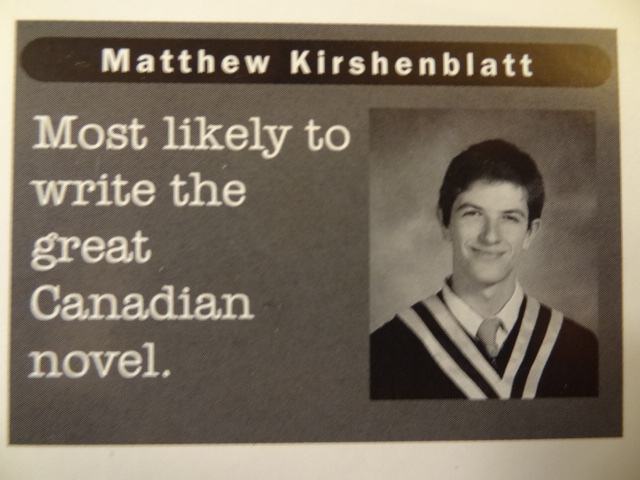
I realized that there were things beyond the confines of genre as I understood it. Then I remembered the film Finding Forrester and how I wanted to write “the great 21st century novel.” So I did something new. Before I even entered the Creative Writing Program, I decided to create my first experimental “adult” novel: a great Canadian novel and all of the grandiosity I still haven’t quite grown out of even in my very early 30s of now.

In Read Between the Realities, I created a pastiche of different stories and attempted to sew them together into an open-ended patchwork reality where you could interpret the novel almost any which way you’d like. I worked on this sucker for a long, long time. I worked on it at home, in parks, on mall benches, at friends’ houses, during sleepovers, when I visited my girlfriend at the time or when she visited me, and even when I moved with my parents to our new house then. Some more marked developments in this novel was how I actually actively incorporated many of my own experiences and thoughts into the work. This was partially influenced by my interest or obsession with philosophy, but also from insights I was having from life.

I was really bad at explaining what my novel was about and I firmly believed that the only way someone could understand it is if they read the damn thing. It also didn’t help that I had the paradigm-shifting magic concept of Mage: The Ascension on my brain too, and I delved into that voraciously.

My book was essentially a story about different realities inter-lapping and how personalized they are. It was about a writer and his relationship issues with his life, a fragmented being seeking something for a demanding master in a labyrinthine subconscious world of ruin, a viciously sadistic monster hunting this being down, and two people on an Internet chat room who bickered all the time. The writer and the two chat room people both believed they were making the story, while the seeker and monster both thought they were living a reality. And none of it was real. And all of it was real.

Of course it all combined, or exploded together–because I always loved epic moments of spectacle–and I played at being profound. Yes, it was a meta-narrative: complete with the characters knowing they are characters or finding out they are and all that fun stuff.

Ten years ago, I thought it was the best thing I had ever written in my whole life, and I actually feared that I could never surpass it. Ever.

Years later after showing it to some friends, I found out that I could indeed “surpass” it. A lot of my characters were two-dimensional archetypes, I didn’t write female characters well, I certainly couldn’t write sex scenes worth a damn then, and I rambled: a lot. And when I tried to simulate experiences I never learned about or experiences I never had, it just fell flat. Also, I wrote combat and adventures as if they were video game levels: though that in itself makes sense given my interests then and now. So yes, I can safely say that I have done better since then, though …

I’ll let you in on a little secret. I actually haven’t really written any, at least official, novel-length works in a very long time. They take a lot of commitment and unique formulas to keep up. I also can’t just write anywhere at anytime anymore. Part of this is that I realized I had more of a life beyond my craft, but I also find that novels can be trapping. They can really take your time and energy. They always get on your mind all the time.

Short stories are explorations into more tightly-knit, self-contained worlds. You can spend less time on these than on a novel, though they take their own toll given that you really need to focus on tying them up all neat-like. On the other hand, sometimes I find short stories to be like little tidbits–even the more complex “four-course meal ones” that some of my friends like to call them–and not as satisfying as the meaty feel of an entire world in a novel. That is, of course, when the short story ideas aren’t overwhelming your bodily and mental limitations to write them all out.

So sometimes, despite my best intentions, I have found myself writing novel-length works because the ideas behind them are either too similar to be placed in anything other than an overarching structure, or they just too big to contain in one short story. And for now, that is all I will say for the others that came after Read Between the Realities.

What is notable about my twenty-year old writer’s novel was that this was about the point when I was also consciously playing with mythology and archetypes in addition to ideas and philosophies. I attempted to combine academics and creation together. I also very reluctantly put more of myself into the work, and–like I said–I went into meta-narrative and irony: which for someone who had just done generic well-meaning fantasy novels before was a big step. And Joss Whedon taught me to be more flippant and referential about popular culture and life too.

I would never have admitted that I created a coming of age novel. I always wanted to make other worlds and other people to get away from the ones I was experiencing–or not experiencing–but I can admit that this was what it was. And for something based on a whole lot of theoretical knowledge, incomplete understanding, video game and pop culture influences and a small if not sheltered, somewhat self-repressed and stagnant amount of personal growth at the time, I did pretty well. It was like building a small Star Gate from the scrap-metal in one’s basement. It did what it was designed to do.

Read Between Realities was made at a time where I went as far as I could go with what I had then–with what I was then–and now, whatever else, I know that I have and definitely can go farther.

Looking Outward

Credit: Beth Ann Dowler, the photographer of this image.

The Rise of a Geek or How Video Games Made Me Want to Write Novels

I wrote my first novel in Grade Ten.

In high school, I carried around a clipboard with a manuscript’s worth of lined paper in my backpack along with a book. I would sit in the front entranceway of Thornhill Secondary, outside the door of a class,  in the cafeteria, in the quad, on one of the chairs in my Drama class, and in classrooms before class began scrawling onto that paper with a black or blue pen.

Almost everyday, someone would see me sitting there: in my strange clothes that I mostly wore because my Mom got them and I had to wear something, my Blue Jay baseball cap to keep me hidden from people, blue jeans (because I was bullied over wearing sweatpants in Grade Nine), and my backpack with its many compartments and my handy-dandy pencil case with all my utilities: colour pencil crayons, pencils, pens, erasers … all of that fun stuff. I even had an Art Kit back when I fancied myself a graphic artist: a large bag with an ink pen that I loved, various sized pencils, a grey puddy eraser and a sketch book.

And yes, I did draw characters from my novel.

My novel was called Order and Chaos. It was seventy-five computer pages long with a glossary at the end. It was about a man named Derem who was born in the future after humankind colonized a new Galaxy and created a brand new Empire. There was a war between the human scientists and mages: and the mages lost … their territory disintegrating into an unstable vortex of space known as the Xarion Region. It was thought that magic had died out, as it had once before back on Earth millennia ago, but there were survivors and people still born with the gift.

My world was ruled by a secular humanist technocracy (which my younger self would have loved to have the words for) that was the Empire: composed of different noble Houses that each had a particular division of labour. This same Empire also made the acquaintance of other alien species who stayed out of the whole conflict, and they have differing relations with them.

Derem was a young man who discovered that he was a mage and a Chronomancer: someone who could manipulate time itself. There was an evil villain named Jagan D’Karos, leader of House D’Karos, that wanted to take over the Empire from House T’Jal: that was dying out. D’Karos was a borderline madman who secretly wanted to rediscover magic in order to essentially dominate existence and there was a rebellion against him, and all that lovely stuff.

There were supposed to be two more books. I created outlines for all of them and tried to fill them out. Book One was the only one that truly lived in its way. I also recall holding the entire stack of paper together with one multi-layered bad-ass paperclip. Yeah. Pretty much.

I know for a fact that people noticed me in my school and when I worked on it at summer camp. In many ways, it was my constant companion in addition to the books I read. I wanted to be the next Tolkien obviously. I also wanted to look busy and to focus all of my imagination in a world of my own creation that no one else could really see as of yet.

I had my influences: the Dune II video game my friends were so interested in and which inspired our own role-playing games, Final Fantasy VI (which I knew as III) where magic was a terrifying lost weapon that even helped make Magitek Armour and where there were Espers and epic moments, and I was probably also influenced by Dragonlance and Forgotten Realms.

But essentially, I was inspired to write my first novel by video games.

I would have once been ashamed to admit that: that video games are just for fun and are not real literature. Of course, by the same token, I was all like “screw real literature,” this is is what really does it for me. Basically, I just wanted to tell a story and Final Fantasy VI and Dune II pushed me to do it. They pushed me to go beyond my limits and keep working on something: something beyond me, but was still a part of me.

They influenced me in other ways. I went from the Dune game to reading Frank Herbert’s books and–in addition to Star Wars–got really interested in human political machinations and manipulations. Final Fantasy VI on the other hand showed me the majestic beauty of soundtracks, the utter diabolical power of evil, story lines, character development from a seemingly simplistic 16-bit sprite model, a great depth of humanity, and a variety of different ways to interact with things.

It was not the last time games would influence me to that extent either. As I went up through the Grades, and people watched me–as I would learn directly later–I discovered Chrono Trigger and really changed. Order and Chaos was, to put it charitably, a novella in length. Deceptions of Nevermore was even longer: though it was supposed to be a Trilogy that didn’t survive past the first book. And the title may have been influenced by Secret of Evermore: that I never actually played.

That one was a story that took place in a high school: in a small town called Eldara. There was a great evil buried before the founding of the town and the last survivors of a civilization of virtually immortal mages try to keep it from awakening. But there is one mage that wants to wake it up. Centuries later, a girl named Rachel stumbles onto all of this with her Wicca friend Chara, a borderline obnoxious half-demon named Karnak and so on. I also admit that Joss Whedon’s Buffy played a large role in the development of this story.

I also recall there being a story I called The Epic Project with the working title Revelation’s Saga. I vaguely recall working on it after Order and Chaos but before Deceptions of Nevermore. In any case, it was a post-apocalyptic world where an empire called The First Technocracy cloned and resurrected different species of magic-using creatures called Psytans as slave-labour. As the First Technocracy fell and became the Second, many lands had free Psytans or some that actually tried to coexist with humankind. The term Psytan was a blanket bastardized term that defined dryads, goblins, elves, and other creatures as an entire species. They were cloned from something older and I made a whole world with different cultures.

How the humans treated the Psytans reflected a lot on the different cultures. I remember the Sor’cerin Imperium: where women ruled because I reasoned that more women than men would be magic-users and thus have more power. Psytans there would be fellow Bond-Mates to the sorceresses and the Empress. Whereas the Technocracy was more or less equal in that they wanted to mechanize and control all life.

I was definitely influenced by X-Men, and Final Fantasy–especially since my main character was a young woman named Amnah–but also … Pokemon. All right, that last revelation was a little more reluctant on my part even now, but back then I had a whole system figured out. This book went on for hundreds of lined pages. It was my first insanely long novel. I remember working on it everywhere and I mean everywhere … even in some places I no longer go to.

Like I said, I felt a combination of shame and defiance for video game inspiration with my first novels but they helped me make all of this. They helped me deal with the realities of high school and adolescence. You know, once I showed an excerpt of my Epic Project to the Del Rey Writer’s Workshop when it was a free online community. One person said I should have made it a children’s story and I got really offended by that. But looking back, I was essentially a young adult writing young adult stories. They may not have been very good, but they were mine and the product of my time.

For a while, like some people, I thought that our time had nothing more to say. But what I like right now is that everything from our childhood and onward has a meaning and isn’t as fragmented or diluted as others might claim. I do read classical literature now, but I also read comics and sometimes I even play video games. It has changed and it is still changing me to this very day. It’s also clear that there were and are many more people like me to this regard: upraising the things we love and even when we make fun of them, still see them and make them beautiful.

And I wouldn’t have it any other way.

That said, I’m still working on fulfilling that prophecy from my last Yearbook:

High School

There and Back Again

Potential Hobbit Book and Film Spoilers. You have been warned.

This past weekend, a day after its first official release, I saw The Hobbit: An Unexpected Journey. And it was important that I did.

I mean, yes, as a fanboy and someone who loves Middle-Earth I would not have been able to look at myself in the elven enchantress Galadriel’s mirror if I hadn’t gone to see it, but I’m talking about something else. It seems like I’m almost always talking about more than one thing these days when I look at, and share, what I love.

I honestly … didn’t know what to think when this movie finally became a reality. It reminded me of all the times back in the early 200os where, once a year on a cold winter’s night I would go with friends to Silver City in Richmond Hill and get to see these films unfold. There is a warm, epic feeling involved in watching something like these films in the heart of the season. I can’t even describe it, but the closest thing I can tell you is that it was like I was coming home.

Home.

Yes, that is the word and it is a very apt one. In 2001, I was nineteen years old. I had just entered University and it was overwhelming. After I’d graduated high school, my friends went to their separate Universities and jobs. Also at this time, I had been involved in an online roleplaying community that just … wasn’t meshing well with me. Or that I wasn’t meshing well with. Really, it was probably a bit of both. I couldn’t find an offline equivalent of this game with actual people–partially because I was shy and introverted–and there never seemed to be a game going on. And I always felt, at the time, that I could never say the right thing. The irony was that it was a game about magic.

In those days, I was pretty smart and I read what I could, but I was also in that age-range or with that personality type back then that either didn’t want to admit that I didn’t know something, or felt entitled to be educated, or by admitting ignorance somehow thinking that this excused it.

I was also not very happy with my life. So here I was at Lord of the Rings: specifically The Fellowship of the Ring. I had no idea what to make of it or what it would be like. And then … it happened.

I was transported into a whole other world that I had read to me as a child. The music was beautiful and terrifying and fun depending on the moments. The characters–as Hobbits–were very relatable. And the scene where Gandalf fell actually made tears come to my eyes. As I watched this movie, then, I thought about everything else in the back of my mind. I found it ironic that I was having so much difficulty and frustration with a game about magic and then it occurred to me that I was watching magic–real magic–right in front of me. I remembered what it was all about.

The only thing that really happened after seeing this incredible movie was that I dropped out of the game and tried to focus on the things that mattered: my work, my friends, my life and … my own stories again.

The long-winded point I’m trying to make is that the first Lord of the Rings movie clicked something back into place way back when. The other two never quite did it, though they were good, and as far as I am concerned Fellowship was the best film of the whole trilogy. It just had such symmetry, and life, and warmth in it. It was complete in itself. I was utterly in love with the magic of it.

So then The Hobbit comes out. It’s December 2012. I’m thirty years old and am in another transitional time. I have moved on from school. My friends tend to do their own thing now and my other friends and I have since drifted apart. I’ve graduated from Graduate School, but I’m still looking for work and money. I’ve been tired and frustrated. I have been dealing with depression and anxiety to the point where sometimes I barely go outside. In addition, I’d recently been delving into personal and creative matters that had left me in a really bad mood. Sometimes being a writer does that: you mine the material inside of you that starts to flame up like any Balrog, and you can delve a little too greedily, a little too deep into that black ore of you.

I used to go out a lot more and explore, but as time has gone on I have become more and more sedentary due to many of the above elements. I gave up on a lot of things, and ensconced myself in my hole almost as much as Bilbo Baggins himself.

A long time ago, my friend Lex forced me to navigate my way to her old place in Toronto on my own. It tells you something that I didn’t have the knowledge or the confidence to do so on my own. I was a very sheltered person and I pretty know that this trait has led me to some of the above difficulties: especially for a natural introvert.

One day, after I did indeed learn how to get to her place, I did something entirely spontaneous and went to a gathering of new and unknown people deep downtown on my own. I remember Lex actually saying that she was proud of me. That day I remembered Bilbo Baggins and something he said that I quoted as a heading on my old online journal. He said, “I think I am quite ready for another adventure.”

I look back on those words that I quoted and the years that I followed them. You know, people think that my role-models are wise figures and Dark Lords, and most of the time I would agree with them. But in that one moment, my role-model was a Hobbit: a particular Hobbit who after a lifetime of anxiety and adventure, very calmly and benignly realized it was time that he went on another one.

So now we have Peter Jackson’s movie opening the day before on Friday. And I pretty much gave up on seeing it anytime soon. I was going to wait maybe a few days or a week. I was in a really black mood: dwelling on things from the past and staying away from people. But somewhere I still hoped that Saturday that my parents and I could go see this film that I wasn’t sure I was waiting for. I was almost scared to see it for reasons that I wasn’t conscious of at the time. So my Dad came to the basement and I had every reason to not only say that there was no way we would be able to see that film the day after its first release, but that I really didn’t want to go out to a movie–or anywhere else–at all.

The truth is, I wanted to see this movie badly. So much that I had to convince myself that I didn’t. I know some people who got advanced screenings and I was a little jealous of this. My reasons for not going to see this movie were pretty sound: there would be a crowd, times would sold out, there would be no parking, I had to meet my friends the next day and so on and so forth.

I had every reason not to go except for one. And this one gnawed at me like a small ember coming a reluctant inferno. And the anger I was feeling towards a lot of things became something else. So I went to my Dad and said to him, “Well, we can try it. If not, well we had an outing and we can try it again some other time.”

So we eventually all left and went to Silver City. We were in luck. We had left early and the line wasn’t bad. My Dad got parking and we got the seats that we wanted. That ember was still burning in me and I didn’t want to fuel it too high, but just enough to get me through this. I was remembering the season of the first movies and how I role-played a custom made world with my friend Noah back when he lived closer by. How I felt then with that magic from that world and ambiance.

Then, in that line that was not as long as I thought it would be, I realized why I was hesitating throughout all of this. I realized I really needed to feel that magic again. I needed to feel it now. Right now. I delved into a necessary darkness, but now was the time to stop delving and writing and just experience something beautiful. And I was afraid–terrified–that The Hobbit wouldn’t provide that magic from 2001, and other times: that I would still be feeling the unhappiness–the sheer bitterness–in me and I just couldn’t bear it.

I’m no fool though. This was a movie: just a movie. It was–and isn’t–a cure-all for all woes. It isn’t a psychologist or medicine. It is a piece of entertainment. But that was exactly what I was looking for. Entertainment. And immersion into a whole other world: a familiar warm world in the cold of the winter night.

Experiencing The Hobbit at thirty was different than experiencing Fellowship at nineteen. Sometimes it felt like it dragged a bit. Other times the fighting got a little much. I over-thought some things and tried to remember the book it was based from. The singing … was strange in that my impulse would have usually been to wince, but I just couldn’t find the strength to.

I think the most poignant moment for me was when Bilbo woke up in his Hobbit hole–after Gandalf almost cheerfully “ruined his good morning” by inviting thirteen questing Dwarves that drank and messed up his place–and found the place spotless again.

And found himself alone.

I thought about that. I thought about Bilbo completely out of his element and Gandalf doing his damnedest to wreck his peaceful life out of very intrinsic good intentions. I thought of the laughter, mirth, the drunkenness, the storytelling, the sombre singing of the Dwarves that lost and wanted to reclaim their stolen home from an impossible monster, and I thought of Bilbo with his books and armchair encountering all of this and finding that spark growing inside him: making him uncomfortable in his comfort that was never really comfortable for who he was at all.

Then I thought of him finding himself alone in the peace and quiet again: with the adventurers’ contract that he never signed.

And I’ll be damned. I will be damned. I will be three-times damned if I had not felt the same way too many damn things (four times) in my own life.

So Bilbo ran like a crazy little man after the Company of boisterous Dwarves and a meddling old red-wine drinking Wizard. I sat there in a theatre seat and watched. I also watched as he entered and left Rivendell: first with wonder at its beauty, and then with longing for its peace. For me, that was the second poignant moment for me: because we all know that the next time Bilbo–now a young man–goes back there, he will be much, much older and with only one journey left to him then. After the film was over, I came home and went on my Facebook. I thought of writing this Blog entry: which in the end took much longer than I thought. Then I thought about how the next day I was going to be playing a favourite old game with Noah and the others.

It didn’t end up happening, but since I was out anyway I decided to explore a bit. I ran into an old friend on the subway, then I hunted unsuccessfully for a camera, and then came back home. That darkness I was feeling is still there. It will always be and I don’t pretend otherwise. But I’m feeling a levity. I’m not “cured” of myself. I have a lot of work to do and I know it will take one step at a time to balance out my life, but now I am remembering that I can actually adapt. I can work around the anxiety and the bad moods.

I might not have a meddling Wizard to carve a strange bit of graffiti into my door, but I guess I can fulfill dual roles for myself. I have to move at my own pace, a little faster than that of an Ent’s, but I will do it. I have plans. My journey isn’t over. The writing is just part of it and will benefit in the long run from the things I plan to do. Each day you live once and I want to do different things each day: even the small things.

So before I wrote this Blog post, I went on my Facebook and wrote the following as my status. And I quote:

“Matthew Kirshenblatt thinks The Hobbit was awesome. In fact, I think I’m quite ready for another adventure.”

So I did find the magic again. And it is home.

Paradigms Lost, Paradigms Regained: Looking Back and Looking Forward Can Be Both One and the Same

Foregone Warning: the title of this post is a play on words and borderline off-key rhyme. It almost verges into the territory of the pun. Actual warning: this article is going to be a very link extensive post and I hope it will all make sense towards the end.

In my post A World Coming Together, A Possible Paradigm Forming, and Other Stories That Find Themselves On Their Way, I make a lot of promises and claims but there is one in particular that I feel I need to go into a little more detail about.

I said before that it seems like we are in the process of the rise of a new paradigm: based on the geek nostalgia of the late seventies, but mostly the eighties onward to early 2000. As I said before, I feel I need to be more specific about this. What I actually mean is that we have been, for some time now, at a point where we can look back what was the present not too long ago and actually subvert and critique it. I mean, we can actually ask some questions about a lot of things that we took for granted: either in all seriousness or through satire.

For instance, look at Robot Chicken and how it makes fun of a lot of popular culture from the 80s and onward. The thing about Robot Chicken, however, is that it makes fun of generally everything to a warped and twisted degree of hilarity: and I wonder if this hasn’t also been a product of the past thirty or forty years or if it takes a paradigm about that amount time to gestate and create itself.

I guess I am trying to talk about a few things at once: which is not the first time something like this has happened for me. So I’m going to take a risk and bring up some theory, and then see what I can do with it from there.

In about the 1980s, there was–or even is–this theory that we had entered something called post-modernism. There is a lot of debate as to what post-modernism actually is, but from my understanding it seemed to be a period in which  literature and other media had become fragmented or combined with one another to make entirely different meanings from what they once were, or could have been. In addition to this was the rise of another idea called deconstructionism which, in the very reduced way I’m explaining it, is a theory that likes to take things apart. When you combine these ideas together, you essentially create writings and cultures that are incredibly ironic, sometimes “self-aware,” and that like to dissect themselves while at the same time attempt to reveal a multiple amount of different meanings.

There are a lot of scholars and artists that dispute these terms, of course, and say that every generation or paradigm goes through a phase of critiquing what came before and making something new from these elements afterwards. I like to think that the 80s and onward really favoured making pastiches–narratives and stories created from parts of things like patchwork monsters–to either subvert something that once existed or make as unique as is humanly possible.

Now, take that idea. You can definitely apply that to Robot Chicken. But it goes further than that and it doesn’t always manifest in the same way. For instance, take ItsJustSomeRandomGuy. As I mentioned in another post, he takes primarily Marvel and DC superheroes and villains and actually makes them aware of their fictional status but keeps them in character in doing so and even manages to make some incredible meta-narrative plots with a whole lot of geek culture references. I‘m A Marvel, I’m a DC is a whole lot less “profane” than Robot Chicken, but they operate on similar principles. I also would be greatly remiss if I forgot the How It Should Have Ended series: where popular movies and videos are depicted as cartoons and their plots are changed or subverted by … well … common sense. But since when do good fictional plots make sense with common sense? 😉 We can argue that point.

The whole idea of popular cultural or geek references, sometimes to the point of being self-referential in different media seems to have originated from Joss Whedon’s Buffy The Vampire Slayer: where in addition to a whole lot of witty “dialogue without pity,” there was a regular string of different kinds of references. The issue, however, is that I’m not sure this where it came from, or one of the points of entry into mainstream culture and entertainment. All I can say is, it was for me.

I have noticed, however, that a lot of my examples of this paradigm are very television and Internet-based. And there it is. I would argue that a paradigm or a culture is created when it evolves to the point of being able to look at itself and critique itself. And right now, this impulse, which may have started in the 80s as we know it, has sky-rocketed as information technology has advanced.

Look at the Abridged series for instance. Abridged series are fan-made parodies of television shows and cartoons. Parodies like LittleKuriboh’s Yu-gi-oh Abridged and Team Four Star’s Dragon Ball Z Abridged have become very popular and entertaining shows among fans: so much so that many other fans create their own Abridged series, or parody the Abridged series that exist. They are practically viral phenomena.

And these are just the fictional examples. I haven’t even begun to go into the actual Critics  like The Nostalgia Critic, The Angry Video Game Nerd and Cinemassacre Productions, Nixie Pixel, G33kPron and countless others who review and critique video games, movies, and geek culture old and new. They also use the pastiche form in some cases to make various verbal and media references. There are also so many more people we do this as well.

Now, somewhere in all of this fictional and non-fictional stuff … is me.

It took me a really long time to realize that not only was I already a part of this nebulous process, but that it was legitimate and more than okay to be so. I’ve had at least one teacher or two who would have once considered comics and video games utter dreck: or at the very least very un-serious diversions from real life. And I’m not going to lie to you or myself: there is a lot of garbage out there that isn’t even entertaining like “YouTube Poop”: videos created specifically to be obnoxious. But every literary and media culture has garbage. They also have gems and other treasures.

Think about this prospect. All the video games you’ve played and the comics you’ve read are becoming references that more people from a generation of thirty or forty years understands. These references make it into literature and criticism. Moreover, we exist in an Age of Information: where many obscure and old elements of our childhood are much more accessible to us now than ever before.

Some scholars have even argued that we are–or we were–in an age of Hypertext: a situation where we can click on a vast amount of chain-information through links and linked words on the Internet. You know, like when you are on Wikipedia or anywhere else, and you search for one thing, and then click on a highlighted word or phrase to be linked to another–or multiple other–online pages. In part, this allows us to look back on “our childish things,” and we don’t turn our backs on them, but instead we embrace them with an adult perspective and understanding that only someone who knew them way back when can give.

Moreover, we can even take this perspective–possibly created from our own nostalgia–and apply it to times that existed before us, or take that and make something entirely new in our time now. But also think about this: in addition to having more information technology, we are developing more interactive technology as well. Video games are much in the same place that comics, and film used to be–and to some extent–still are in public opinion. They have not always been respected, but as we continue to make them we can add more content, more distinction, and more variety. We can–and we have–gotten to the point where video games can even make references or “literary allusions” to other video games and culture in general. I am definitely going to revisit this thought at some other people.

Then consider the other people who participate in these interactive narratives and add the Internet to that fact: which connects people all across the world and different forms of life. Sometimes, I believe–in my more optimistic moments–that we could be on the cusp of creating something truly great and maybe even in our own lifetime. I can’t even imagine what will come after this if all goes well.

So in all of this, I am trying to find my own place: to find my niche. I want to take advantage of this time and do something that matters. This Blog, in no small way, is a part of this drive. It is here that I can combine my geeky interests with my academic background and my creative impulse to construct new things and state my opinions. I want to be a part of this. I want to do something great as well.

I grew up in the nineties or, as a friend of mine likes to chant, “90s 90s, living in the 90s!” Once, it was my present and sometimes it’s weird–really weird–that it and the early 2000s aren’t anymore. Sometimes, I feel time-displaced. I feel lost. I have another acquaintance who once stated that the children of the 80s, and even those before are a Lost Generation: of people who never really achieved their full promise in today’s world. But we’re not. We’re really not. I think we have been coming into our own and we will continue to do so as we ascribe a multiplicity of new meanings to old things, and create things that will make other things together.

Because there it is: perhaps post-modernism and deconstructionism might have taken things apart to see how they work, as they work, but we–whether we are in a Hypertext age or not–are starting to put them back together … and make different things entirely. Now that is something to celebrate.

The Funnies: They Just Keep Coming Back … and They Never Stop

A cartoon is not a frivolous thing. It can look like a silly drawing or a caricature of life. Upon first glance, it seems to only exist on either a screen or a piece of paper. Sometimes, it even says witty things or does something stupid or endearing that can make us laugh.

Cartoons have been around for so long–on television, in movies, in the newspaper funny-pages and even on T-shirts–that we take them for granted. We don’t always take them seriously.

But consider. A cartoon is an archetype. It is an idea given form. In fact, it wouldn’t be too much of a stretch to even state that it is a Platonic Form: living glyphs essentialized to the point of becoming as close to pure concepts as is humanly possible … which of course is a misnomer.

Because cartoons aren’t human at all.

Some of them are wise-talking humanoid animals. Others are parodies of human beings that somehow possess their own sense of agency. There are even some that are inanimate objects given life. Often, the really old cartoons exist in very self-contained two-dimensional pocket-dimensions: in a mythological cycle of trickery, mayhem, and fun-loving nose-thumbing at fate.

And the really old cartoons can’t be destroyed. They can’t be smashed by falling anvils or mallets. They can’t be burned by fire or exploded by dynamite: at least, not for very long. They are used to dealing–and receiving–massive amounts of physical damage, and then coming back for more. And we’re not even talking about the ones that have a supernatural way of avoiding the damages of their enemies altogether just to–through some twisted fluke of fate–make them fall into their own traps.

They are like living rubber or silly-putty that just keeps bouncing back. A human being isn’t like that. When human beings fall, they break.

It’s not too much of a stretch to say that cartoons are beings that are psychopaths or sociopaths by human standards: in worlds and cyclic realities where neither human physical and psychological standards even apply. They come from the same heightened mythic state as faeries, and gods; as legends and archetypes: in a place where slap-stick is not only futility and invincibility, but where the ridiculousness is the superhuman and the sublime. Some people might call this state a perpetual hell, or a utopia. But mostly, it just is and they just are.

In the end, you can’t destroy a cartoon because you can’t destroy an idea. Because even if you break the projector, or the television, or snap the DVD, or rip up the papers they are still there–pure ideas–in your head, mocking you, holding an oversized mallet in one hand as they stand in the darkest corner of your mind, knowing more than they do, doing more than they know, just waiting for that punchline: where you finally have to laugh at yourself.

Worms and Bicycles Or How People Make For Strange Stories: Menocchio and Igor Kenk

I’ve been rereading Pop Sandbox’s Kenk: A Graphic Portrait and I kind of wish that this comics work had been published when I worked on a previous assignment of mine.

In one of my previous Graduate courses, our class had to read Carl Ginzburg’s The Cheese and the Worms: The Cosmos of a Sixteenth Century Miller. It basically dealt with the idea that an individual can not only embody the culture that they come from, but that that person can represent different kinds of culture and actually interpret cultural information differently for themselves. Really, what I got out of it was that an individual can create their own world or mythic reality from information they have access to from their own culture.

As for why the work is called The Cheese and the Worms, it’s due to the fact that it focuses on the record of a man named Menocchio who compared the world’s creation to be not unlike that of rotten cheese. I’m not making this up: the Roman Inquisition that interrogated and took testimony from him apparently got this account from the man. So obviously, I felt compelled to do a presentation on this and focus my course paper on it because, well, look at the title and the subject matter. Really: how could I not?

I think that I found the most interesting about Menocchio himself was the examination of how he possibly came to the conclusions about the world that he did. He was not born of nobility or the upper-class in Italy, but rather came from a merchant culture. As such, while he was literate and he had the means to buy books, he also grew up with an oral literary tradition: a culture that passes on lore through the ages and word of mouth.

Ginzburg seemed to really like to point out the strangeness of this figure of Menocchio: how he was almost an intermediary between the oral and the written as well as peasant and “higher culture.” Menocchio himself lived during a time of transition between oral culture and the development of the printing press and written literacy: a revolution of sorts. Menocchio existed during the time of Martin Luther’s Reformation: where the ideas of Catholicism and Christianity itself were being challenged by the new Protestant movement using said printing presses. It is also worth mentioning that Ginzburg liked to examine colportage–cheaply printed chapbooks detailing songs, tales, and the lives of saints–as a backdrop of Menocchio’s literacy as well.

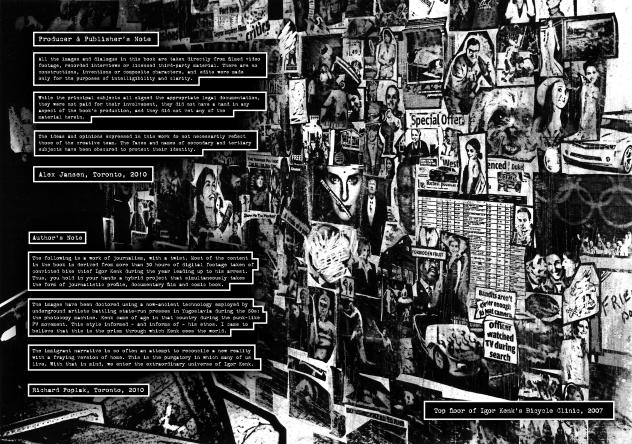
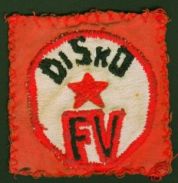
All of these traits and more are eerie parallels with Richard Poplak’s observations about Igor Kenk. Kenk grew up during a time between socialism and capitalism in Slovenia of the former Yugoslavia. One thing that Richard Poplak likes to point out is that it was also during this time period that common citizens in Slovenia were allowed access to photocopy machines: mechanisms of distributing information that were originally in the charge of the State. The counter-cultural Theatre FV 112/15 group– also known as the FV movement–used photocopiers to create a collage art known as FV Disco: a form of which–thanks to the artist Nick Marinkovich–Kenk also utilizes. This was the time and conceptual place where Kenk developed as an adult.

KENK_CHAP-00_07-08

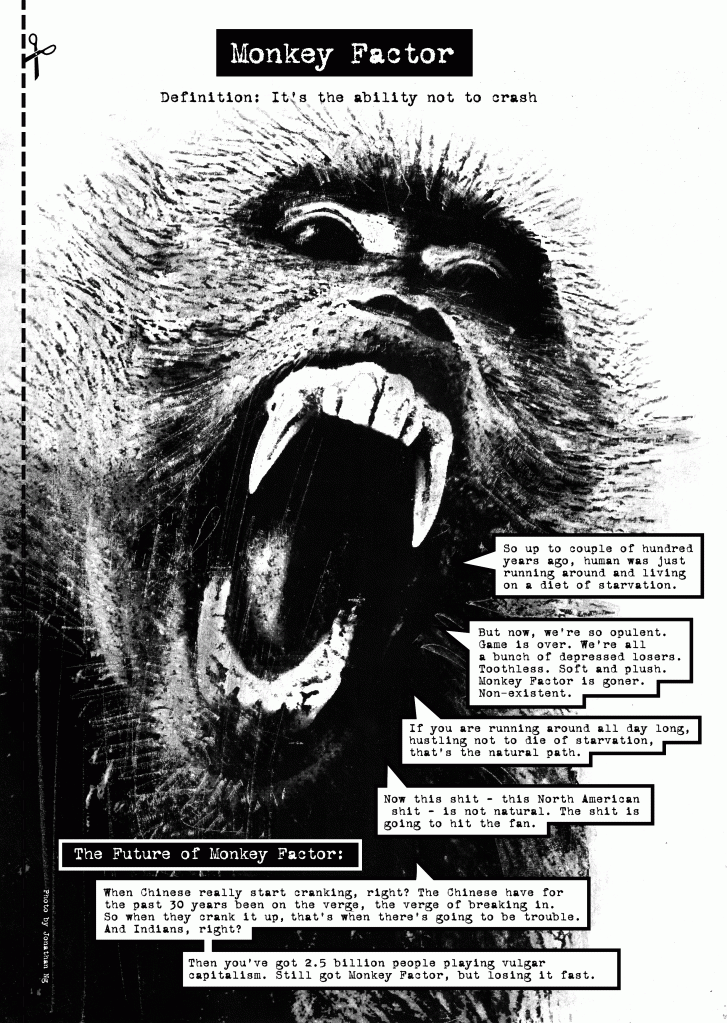
As such, Kenk also possesses a very unique world-view based on the transitional culture of his time: the idea that all things can be recycled and that you need to choose to struggle in life in order to survive as a person: which is part of what he seems to call “The Monkey Factor” or survival. From what I understood of this book, his notion of “recycling” also seems to mean reselling stolen bikes as well as hoarding. As an aside, the fact that Kenk believed the system of debt, borrowing, and capitalism to be doomed is also linked to his philosophies and it’s only now, years after I read the first time, that I wonder what he would think of the Occupy movements back in 2008 before his arrest, and what they might think of him now.

Igor Kenk came from a social order that was radically changing and between extremes. He was considered to be a Math prodigy and did well in his education. For a time he was even a police officer in Slovenia–surviving their harsh regimen–until he was discharged, and then proceeded to cross the border into other countries to get goods as Slovenia’s political alignment and its economy changed. Then he eventually came to Canada and became something of a merchant himself by selling and fixing bicycles in Toronto.

What I’m trying to say is that both Kenk and Menocchio are products of their time and culture, but at the same time how they chose to interpret their changing cultures was very idiosyncratic to them. In other words, they created some very unique world-views. And both of them arguably paid for it by the powers that be: Menocchio with his life for not recanting his beliefs to the Roman Inquisition and Kenk doing jail time and losing his Bicycle Clinic for the thefts he was charged with.

KENK_CHAP-09_18

All of the above can arguably be considered gross simplifications, of course. In my paper that dealt with the implications of Menocchio, I pretty much say the same thing more or less. But I think the reason I’m attempting to compare two men from entirely different time periods, cultures, and countries is due to a greater issue: namely, why are they important?

I mean, come on: neither Menocchio nor Kenk would traditionally be considered important in a historical sense. In the grand scheme of things, someone might say that, while these parallels are interesting, who the hell cares?

The reason that I care, and one of the reasons why modern historians, journalists, and–in some ways more importantly readers–find these accounts so important is because they are narratives that deal with real people. It’s true that neither Menocchio nor Kenk are politicians, or artists, or even popular cultural figures in themselves but they are people that–while arguably normal or common in terms of class or historical significance–symbolize greater historical and cultural shifts by just being who they are.

They are ordinary people with very un-ordinary perspectives and there was a time where we would never have even known about them: or at the very least we’d only get a summary of them in passing … or at least we’d get something like this from a dominant or “higher cultural” narrative. Because there is one thing I keep coming back to in my head: it is the idea of oral history.

What is oral history? We know that oral culture or literacy is something that is passed on verbally from one storyteller to the next throughout many generations. But history, as Westerners, understand it is derived from the ancient Greek word historia: which is something along the lines of scientific inquiry or observation. Oral history, from my understanding, is thus something of verbal origin that is written down for other people to see.

Menocchio’s “worm and cheese world” survived through the written accounts of his interrogators, whereas Kenk seems to have actually been interviewed by the book’s producer Alex Jansen and filmed by Jason Gilmore as he espouses his world-view of “Monkey Factors and recycling” in that context.

KENK_CHAP-08_16

Oral culture in our world is very different in that we have sophisticated image and audio technology to preserve and record the spoken word, and where that spoken word comes from. There is a scholar named Walter Ong–who I looked at in my own studies for my Master’s Thesis–who looked at oral culture and degrees of orality.

Ong believed that there is something called “secondary orality”: in which spoken word is preserved through technological means like video and radio. But I’ve always wondered if he would have included illustrated images in this definition as well, and how problematic it would be if these images were accompanied by written words. Can the visual be considered part of the oral or the written, or is it something by itself? Obviously I’m talking about the medium of comics and what kind of literacy that would be defined as but–this tangent aside for now–right now I’m thinking about the idea of oral history being a historical narrative that records down what life and reality is like for “the common person”: if there is any such thing as a common person.

I actually think that this conception of oral history has led to the idea of journalism: of interviewing and recording down what a particular person or witness has to say, and then researching the environment in which this person came from for a greater perspective. Is journalism the child of oral history? And then you take something like Kenk into consideration too: something that is written down but also given a sequential FV Disco style is that is both an illustrative and video collage aesthetic.

It’s fascinating to think about Kenk as an artifact of not only “comics journalism”–a medium that some comics creators like Joe Sacco have already developed–but also written literacy, oral culture, history, and mass-produced art. I look at Kenk and I wonder if this is our contemporary version of the colportage of Menocchio’s time, or the pamphlets and photocopies of 1980s Slovenia. Because in the end, it’s not just Menocchio and Kenk that have a lot in common, but also the media used to try and capture what they are … and what they are not.

When I started writing this article, I thought it was going to be easy: like it was all fully formed in my head. In a way I’m doing what I said I would not do by delving more into the academics I’ve tried to put some distance from: at least with regards to jargon. My train of thought tends to drift and it has been a struggle to communicate and even cohesively perceive all of these parallels here.

But if this were a paper of mine, if this were some rough form of the Graduate essays I would write, I would end this post in the following manner. As someone who has studied mythic world-building, I believe that art is an engagement with different parts of the world around you, and an expression of who you are as a result of what you choose to accept of that world. In that, the man called Menocchio and Igor Kenk–specifically in how their scholars and artists portray them–not only made their own art, but actually lived their art, and allowed for the creation of more of it.

I also believe that when you take all of this into account oral history, journalism, comics journalism, or whatever you want to call it reveals one more truth. Writing about an individual not only reveals that there are no “ordinary people,” but that it never makes for making any “ordinary stories.” Ever.

Again, I’d like to thank Alex Jansen and Jason Gilmore for lending me these pages of Kenk to place here in my article to make both point and emphasis.

If you are interested in this topic, you might like my What is FV Disco article as well. They both deal with similar subject matter, but in different ways.

What is FV Disco?

Disko FV

All right, so it’s been a while since I have really challenged myself to do something different. This challenge, however, has been a long time in the making and I’ve been trying to find the best way to go about it. It won’t be perfect and I’m sure that there is scholarship and writing out that is far more accurate and well-written on the topic, but really this is just a possible answer to something that’s been nagging at me for a while now.

Anyway, two years ago I read a really cool graphic novel called Kenk: a comics biography of the infamous Torontonian bicycle thief Igor Kenk. It deals with his possible psychological motivations for his actions, his own personal philosophies, and how his background may have influenced the man he has become. The comic was actually conceived and produced by Alex Jansen, written by Richard Poplak, the photographs and filming it was based from–along with its design–created by Jason Gilmore, and Nick Marinkovich was integral in illustrating and creating its aesthetic. I wrote a review on this at Amazon: with very little understanding of the choice of art-style at the time.

I didn’t think much about Nick Marinkovich’s unique art at the time, aside from its strange sharpened and accentuated angles, the occasional blurry lines, the really incredible contrast of the white stark outlines of people and objects containing an inner gritty grey and black, and the pastiche feeling of it until I watched this interview: conducted by QTV on CBC1 Radio with both Richard Poplak and Alex Jansen. Poplak himself talked a little more about the aesthetics of the graphic novel. First he stated that he and the graphic artist Nick Marinkovich used the fumetti comics medium form: which is basically comic book that uses photos or arrangements of altered photos to tell a story. There is a wikipedia entry and other information on the fumetti form.

However, Poplak also mentioned that he traveled to Slovenia–Igor Kenk’s home country where he grew up–and found another form of art: which the Pop Sandbox team ended up using for their creation. When I first heard him say the name, I didn’t understand what he was talking about. I actually missed the word several times before rewinding the video and hearing it again. Now, I pride myself on finding out as much about the comics medium and associated art forms as I can and this bothered me: the fact that I didn’t know what this word was.

Finally, I made out the word “Faeve” or “Fauve.” But then after some more online digging I came across the Kenk book site and I found out that it was FV Disco that Poplak had been talking about. It was in fact the definition that Poplak provided here and on 12:17 of his QTV Interview that I used when describing the style of Fotonixe’s artwork in my entry on TweakerRay’s Collector Chapter 02: the idea of a gritty-collage like arrangement of photos and images with a dark punk-like atmosphere. As I said in my previous entry, Fotonixe’s style reminded me of this and wasn’t necessarily derived from it. But this did get me thinking.

Because I can tell you that I have tried to google FV Disco several times–specifically as an art form–and I didn’t get very much. It also took me ages–in fact very recently–to realize that FV was in fact pronounced as “fauve” or some equivalent and wasn’t an acronym or a pair of letters. A little while ago, I figured out that the term FV Disco seems to have come from an influential Slovenian alternate theatre turned counter-cultural group or club called Theatre FV 112/15: a group that turned into a movement in Ljubljana–the capital of Slovenia–in the changing former Yugoslavia of the 1980s: where Poplak says that FV Disco itself came from. I found out the name of the group by finding an article on a Goth Rock and Electronic Body Music group called Borghesia: that was apparently formed from some of Theatre FV’s original members.

It was greatly involved with video art as well as music and as it transitioned from an amateur theatre group into an alternative club that made a space for sexual, social, and artistic differences: or so this article here claims.

But very recently I found out what “FV” or “Faeve” is might mean. I found–or perhaps–rediscovered an article by Katja Praznik called Theatre, Emancipation and Political Power: Two Cases From the Past in which she explains that FV “refers to France Verbinc’s (FV) local, frequently used Dictionary of Foreign Terms, page 112, entry 15, where we find the following: C’est la guerre – This is war, that’s how it is in war.” In other words, the group’s name seems to have been derived from a citation or a quote that is appropriate given the climate in which the group was created. This was during the time after Tito’s death where Yugoslavia was beginning to change–to separate–and there were great artistic expressions of socialism and capitalism occurring.

Richard Poplak himself argues that this was what was occurring in Igor Kenk’s formative years in Slovenia and it affected him. There is one element of this movement that Poplak pays great attention to when he discusses it in the above synopsis. He states that the primary medium of FV Disco–what seems to be the artistic as opposed to musical and performative aspects of it–was the photocopy machine: “an agent of democracy because it put publishing – which was until then state-run – in the hands of the people.” It is interesting to note that when I’ve looked at Kenk, the images did seem almost like propaganda posters and pictures rearranged into a different collage form entirely. I can see how–as advertisements for FV Disco’s musical and social scenes and as art in itself–just how subversive it was in that changing environment. Add to the fact that there was a “a gritty punk” element alongside it makes for a really interesting aesthetic and atmosphere.

I think what I find most fascinating about it, at least from what Poplak describes, is how FV Disco takes old ideas and objects and rearranges them: in fact recycles them.  But it’s more complex than that. Praznik in her article likes to state that Theatre FV wanted to create “spaces” or alternative realities in a rapidly changing socialist environment where people could express themselves. She also mentions that one objective of this movement, and those like it, were to blur the line between the performance and the viewer: or art and reality.

In a way, Theatre FV was one of those responsible for creating new wombs of artistic culture and reality and I can see–in that sense–just how all the above might have affected Igor Kenk’s philosophies. He liked to recycle and “hoard” things that North Americans apparently take for granted. The man was also aware of how economic and political systems can change rapidly and the crafting of his own world-view and indeed his life, seems like a haphazard collage of grittiness and innovation. Even Kenk’s own “performance stage”–a Bicycle Clinic filled with so many bikes that he had to spill them from the space of his shop into the streets just to open the door–did not separate itself from the rest of Queen Street West Toronto or the sphere of people it brought in.

Customers, and pedestrians alike were brought into his world of bikes and junk. I never saw it like this until I did some of my own amateurish haphazard research into the matter. It really made me look at the aesthetic of the Kenk graphic novel even more closely. In his article Portrait of a Serial Stealer, Richard Poplak goes into a little more detail on FV and even talks about how his artistic collaborator Nick Marinkovich creates the style of the piece: detailing some of the work that he did. It also hits home the fact that Poplak and the rest of the team that made the book adapted it from actual photo and video footage produced by Jansen and Gilmore: the latter of which are the most references I’ve been able to find on the FV movement aside from those from Poplak.

What I think is a real shame though, in all honesty, is that FV Disco–or Theatre FV 112/15–doesn’t have its own Wikipedia page or a more indepth English language entry of some kind: because it is a really fascinating social and artistic phenomenon to come from a socialist nation that no longer exists and I never put much thought about it at the time. It makes me wonder just how much it might have influenced other forms of art: not just in Eastern Europe but the rest of the world as well.

One more interesting of note is that there is a 1997 documentary called Staro in Novo or The Old and The New created by Neven Korda and Zemira Alajbegovic: who were, according to the site Zank, apparently leading members of the old FV Theatre group and then of Borghesia. They made something called FV Video where they created this documentary: of which I could only find excerpts on Youtube. Copies of the video cassette do exist in some Universities even in North America but I’m not sure if there are any DVD versions, but apparently you can download it here. But it would be an interesting thing to look at.

One thing that I also find interesting is on the site VideoDokument, Korda and Alajbegovic not only talk about the creation of video art, they mention that “Although the images move and we can hear them, video takes much more from comics than it does from film. It was comics that encouraged sequencing and the combination and movement of images, sounds and stories.” I find that a really nice parallel to how Kenk was influenced as a comics form by video and other media from the FV movement. I should also point out that Kenk is also being adapted into an animated film: perhaps making the journey between FV-influenced film and comics come full circle.

I’ll tell you now that I’m not up to the task of making a Wikipedia article on this matter. I’ve said before that I am no musical expert or even an artistic one. I am certainly no expert in Slovenia or Eastern European culture, but it would be nice if someone did this: because I think it’s important. It’s also a shame I can’t find any FV Disco art online as well and I will probably post a picture from Kenk. It seems that the scholar in me doesn’t die so easily, but I just like to write about things that interest me and go on an adventure to see what I can uncover from them when they are being too stubborn to be found.

Some special notes and thanks: the really awesome and emblematic “Disko FV” image seen above this post is actually a hand-made security ribbon taken from the collection of Dario Seraval: one of the former members of the Theatre FV-112/15 group and current member and drummer for Borghesia. The images from the graphic novel Kenk were very generously lent to this post by Alex Jansen and Jason Gilmore. Believe or not I underestimated how much time and effort making this post and finding images for it would take, but in the end thanks to correspondence with Aldo Ivancic (another former member of Theatre FV and current member of Borghesia whom I talked with about using said ribbon) and Alex Jansen, as well as Richard Poplak, Neven Korda, and museum counsellor Breda Skrjanec of the MGLC (the Mednarodni Grafični Likovni Center), it was all worth it.

Addendum: If you are particularly interested in FV Disco, you can try to track down the MGLC’s art catalogue from its FV Alternative Scene of the Eighties 2008 Exhibit. It has a Slovene and an English language translation as well. The book is composed of photographs, art samples, an introduction, three essays, and a chronology of events and developments in FV Disco.