So a little while ago, I mentioned I was starting a new project. I know that for some people who know me, that really doesn’t narrow it down a lot. I’m always thinking about short stories still in the queue of my head, the graphic novel script that’s been languishing in my binder, and a few other things as well.
This one is different. A few years ago my friend Angela Jordan, now Angela O’Hara, wanted to do a comics collaboration. At the time, I really wasn’t that skilled with creating comics scripts and–even now–they take more effort to create than a play or film script, or even a short story. Our original idea was very ambitious and I eventually created a very elementary and simple first story that I hoped Angela and I could flesh out into a comic. I had no knowledge of panels then and even now I still have issues with figuring out anything other than some of the basics in my head of how a page layout is supposed to look like.
We went our separate ways for a while: Angela taught in Japan and eventually got married, while I moved out to York residence and started my Humanities Grad Program. Years later we got back in touch and I decided that there was a way we could side-step some of the difficulties we were facing before.
Superhero comics have been done so often that people often see it as the comics medium itself as opposed to a genre. It’s interesting because comics didn’t start out with superheroes–if you look at old slapstick comic strips and political cartoons as examples–but they did gain popularity for the medium.
Based on some of the work I’ve seen Chris Ware–a cartoonist who loves creating beings (including superhero figures) of basic geometrical shapes on vast, empty and existentially lonely backgrounds, the strangely small and greater world of Saint-Exupery’s Le Petit Prince and Alan Moore and Neil Gaiman’s Miracleman along with a great many other superhero comics I’ve looked at in my life something started to come together in my head. It wasn’t really until I looked at Sarah Howell’s silent comic pamphlet–reminding me of their power–that I found the form for this thing I wanted to make with Angela.
Yet a lot of the above is stuff that happened after the fact. Actually, the idea for the entire thing–still in development now–was brought on by a video game song. It’s amazing how music can help you visualize certain scenes in your head.
So right now, I am in the process of creating the story for this “silent superhero comic.” I’ve given Angela some sample art to look at as foundations or influences for the work’s potential style while telling her about the scene I made in my head. But right now I need to do more. I’m now developing a bit of the world and the main characters. I think I will have to crudely sketch out what I want them to look like. One thing I’ve learned through making a few “ordinary” comics scripts, is that drawing out a rough look at what the page should look like does wonders to help you and someone else know what it is you want to write about.
The difference this time is that we plan to make this a small pamphlet of sixteen or seventeen pages–possibly double-sided–for each part. I originally wanted this to be a one-shot thing to allow us to brush up on our skills again before doing anything else, but at the same time I can see the potential in some of this.
It’s funny. I once thought I’d grown past superhero comics but I’ve been researching and talking about concepts behind them a lot this summer. They have certain rules and conventions that can be followed, bent or broken. But I’ve learned that going back to the essentials or “the basics” can be very important no matter what else you might do and all the more so for superhero archetypes that are really extensions of the stories of heroes and gods. When you also think of cartoons and children’s illustrations as archetypes as well, you can see where a lot of my influences want to come in. So you can probably see why I’ve had a bit of a superhero obsession lately. Lately. Okay, somewhat.
Basically, I want to post updates of this as of officially unnamed silent comic project or, as Angela put it even more eloquently, this “superhero fairytale” whenever I possibly can. It’s been a while since I’ve written anything besides stuff on the creative process, reviews and articles: but finally I get to begin to play around with some world-building and alongside a really talented artist.
You can find Angela’s work in two of her Deviant Accounts: her Angela Jordan one, her Angela O’Hara account, and her professional artist’s website. Here is one sample of an image she created from our previous collaboration: one I always look at even to this very day.
As for me, I need to keep working and also keep my creative side fresh. As someone might have said, if it isn’t in writing it doesn’t exist. Well, now it is in writing and now, I hope to to do my part to make it happen.
Tony Pacitti himself has said that the Star Wars galaxy and culture has changed so much that his role is smaller in it now. Some of the Amazon commentators themselves have written that Pacitti talks about his own life more than Star Wars and that at the very worst, his reminisces are very self-indulgent and have no value.
I think it’s safe to say that I disagree with all of the above. Pacitti talks about a period of history: from the 1980s to the 2000s where the cultural impact of Star Wars and geekery is seen on people growing up. He uses himself as a prime example obviously, since his work is a memoir, yet what I find really striking is just how much his childhood and experiences have in common with my own. Pacitti talks about television shows and games that existed during the same period I grew up in: from Saved by the Bell to Magic Cards. But more than that, he captures that feeling many people had after the Original Star Wars Trilogy ended: that need to see more. It was the need to see and experience more of that universe.
So I too delved into the Star Wars Expanded Universe. I too bought as many books that described that universe in more detail. I role-played in that universe and so did my friends: so do we still in fact. My friends and I watched the Old Trilogy long after the 70s where we hadn’t been born yet and we had similar reactions to the Prequel Trilogy: reactions that have great sympathy with Pacitti’s own.
I’ve written about Star Wars on here before with regards to what my actual issues with were and what I think George Lucas had been trying to do in an ideological way. I won’t rehash them except to say that Lucas too had been influenced by his own childhood and young adulthood to create what he did. Pacitti was definitely informed by what Star Wars represents. Star Wars is a space opera: an epic fantasy with a backdrop of space, a setting with technology, droids, and aliens alongside human beings. It begins “Long, long ago in a galaxy far, far away,” but it is closer than you think.
Star Wars contains archetypes that we can all relate to: facets of different kinds of sentient existence. These characters are accompanied by powerful leitmotifs–by thematic music created by John Williams–to bring out the terror and wonder in us. Is it that inconceivable that a film series like Star Wars, having ingrained itself into the popular consciousness and playing our collective unconsciousness, could have informed our time period after the 70s? I know there are many other films that have done something similar, that this element is what people look for when they want to call a creative work a classic or something seminal: a seed of an idea that leads to something else.
Shouldn’t a classic also be judged by how it influences not just a large amount of lives, but one life? Tony Pacitti manages through a caustic wit to identify himself, and himself in relation to a culture that has not changed at all: in that it is only still growing. So I agree that the culture around Star Wars is changing, but it is still Star Wars and I think that Pacitti’s role in Star Wars–at least with regards to what he wrote in this book–is still relevant and important. I for one am really glad that he wrote it and that I bought the thing when I did two years ago.
We all want to identify ourselves with the things we love because we adopt them or feel sympathy with them as a part of us. So once again Tony, thank you for writing this book and thank you for reminding me who my best friend is.
Many posts ago, I set myself the challenge of writing something about Sarah Howell’s silent comic. Today I’m doing the exact opposite. I have been given the challenge of writing an article on a music CD: namely TweakerRay’s Collector Chapter 02.
This might be a little unusual for me, but I have always loved epic music and TweakerRay’s Collector definitely falls under that designation. But how do you write about music? For me, I’ve learned to do that in my own writing: describing the harmonics of certain songs that I like and trying to find words to approximate the sounds that I hear. Certainly I’m not completely familiar with music or music-mixing terminology enough to write about it under those terms. My friend who gave me the request to write this, however, requested that I write about what the music makes me feel and what story is revealed to me by listening to it. In some ways, looking at the soundtracks with that frame in mind makes it easier for me to talk about.
First, let me give you an outline of what you should expect to find on the CD itself.
There are thirteen tracks in Collector Chapter 02. In addition, there is a Demos and Instrumentals section where TweakerRay gives you different mixed versions of his songs, a PDF version of the booklet included with the CD which I will go into more detail about later, and an actual Commentaries section dedicated to many of Collector‘s tracks by TweakerRay himself. So if you want to know more about these soundtracks in a technical way or by music terminology, TweakerRay explores his tracks in that fashion far better than I could.
There actually is a narrative that TweakerRay himself creates in his CD. TweakerRay’s Extended Play Collector Chapter 01 (the second half of which was called “Digital Ghost” and can be found on this Youtube link here) sets up a very strange scenario. Essentially, you hear messages on what appears to be TweakerRay’s voice-mail: a few praising him, one woman asking him what he wants and a man threatening him. The voices all mix together until you hear a man come in, who meets a woman waiting for him there. Not long after, she shoots him and the man calls out TweakerRay’s name before he presumably dies. I always interpret this haunting but active rhythm of hard beats to be TweakerRay himself on the run.
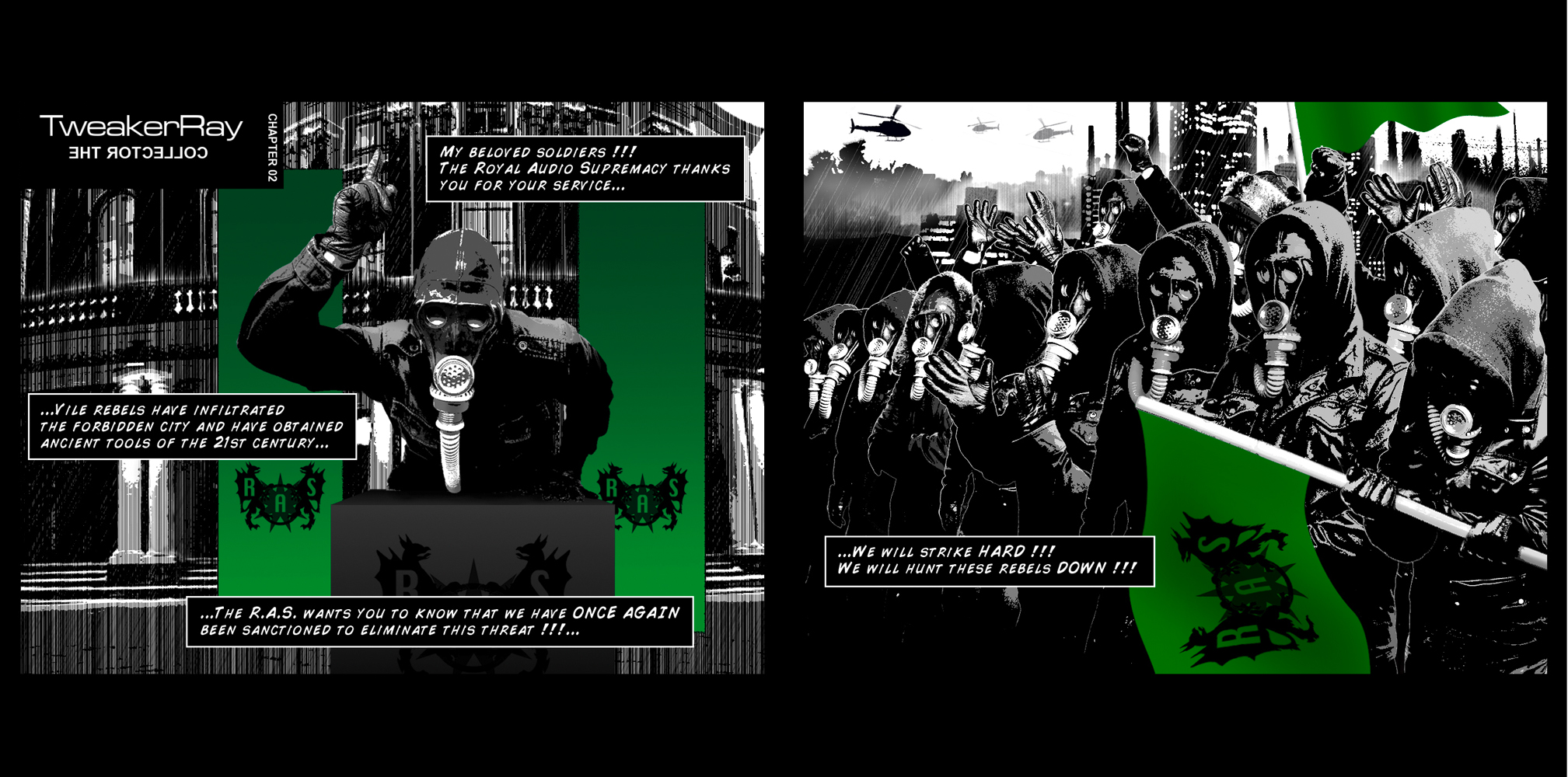
My job, however, is to talk about the songs in Collector 02 … and the booklet. The “Introduction” starts off strong: with a grandiosity and booming power. Years after the events of Chapter o1 and TweakerRay’s disappearance, it heralds and complements the voice of a futuristic dictatorial power: the leader or representative of the R.A.S. (the Royal Audio Supremacy) that talks about how it has banned the dissonance of “old and corrupted” music–declaring it dangerous to people’s minds that is reminiscent of the way that Plato considered art and poetry deadly if not controlled by the morality of the city-state– and how rebels threaten to bring it back. This fascist transmission of censorship also sets the stage of just what kind of world this music exists in. It is a fun, but in other ways a very serious creative premise about freedom of expression and what it faces against a need for perceived safety over that liberty.
Thus begins the instrumentals of Collector Chapter 02: its hard raking beats and piano keys–playing soft like rain–becoming a stride through a fortress city of inhuman glass and metal ruled by this tyranny and one person’s journey in defying this status quo.” Toxic Wasteland’s” rough and wavering rhythms and rising harsh crescendo brings to my mind a panoramic shot of the rest of the world in a stagnant ruin away from the R.A.S. capitol and the passing of forbidden instruments and music between the peoples within it in order to spread this rebellious musical dissonance.
It is “Status Report Sgt. Q” that brings back–with an ominous bell-toll–the vocal to the music. The rhythm is still severe, but there is a realization of horror in it as the rebel Sergeant Q makes us aware of what the R.A.S. has truly done: using censorship and force to pretend to bring peace, but in reality subjugate all people, keep them from questioning and maintain the corruption of their corporations and minions on the Earth. He states that music–the last refuge of creative freedom on and offline–has been censored by the government and its allies. The hard percussive metal beats of the music set the stage for the rebellion that is about to come.
And this is where, as the track title states, some of the citizens of this world “Fight Back.” It starts off smooth and then rises with a reverberating power–with intermittent 8-Bit sounds reminiscent of the Nintendo Entertainment System’s synthesized tones–and the addition of TweakerRay’s voice singing: abjuring that “it’s time to fight back.” But then … something bad happens. In the song “The Shot,” there is one crack of a gunshot that echoes throughout the distance followed by the deep current of a sound almost in denial accompanied by the sad chiming and gradual un-damming of an even more sorrowful crescendo as if the gun-shot itself has become the tragedy. We never know who got shot–if it was a who and not a what … like the idea of expressive freedom itself–but as “The Shot” fades off like a dactyl or a sad lullaby, the listener knows that the stakes have changed.
Sometimes I’m inclined to think it is the death of Sergeant Q that brings on this music or maybe the figure of TweakerRay–the symbol of this rebellion–but those are just my interpretations. TweakerRay himself explains in his Commentary what event motivated him to create this track. As it is, the sound of it just tends to remind me of all the things I’ve lost and it is a powerful song that sings of loss itself.
The tone changes after this. “They Don’t Know” heralds a newer form of rhythmic aggression in a journey or a quest for battle as TweakerRay’s vocal makes its rising fiery resurgence decrying how no one under that government or censorship–that condoned that shot–know exactly what it is that they have done. Aside from the “Introduction” that I love due to its all too seductive fascist overtones and promises of ancient and imminent destruction, as well as the powerful reverberating sadness of “The Shot,” I feel that “They Don’t Know” is one of the most powerful songs of the track and one of my personal favourites. It is empowering in a different way than the trappings of power or deep human sorrow. It is justice and vengeance both synthesized into song.
By “The Hunting,” with its fast–very fast–rhythmic beats and clanking, I can almost see the R.A.S. stepping up its efforts to stamp out the rebels: now realizing that they have only created martyrs by their repressive actions. It’s almost like the conflicting noises symbolize fighting on the streets, in the buildings and in all arenas across the regime. It is the fight for a society’s heart: for a free humanity’s soul.
After this there is an “Interlude,” with even more evidence of winding 8-bit tracks. At this point, it sounds as though there is more subterfuge going on: as though the rebels are passing around more forbidden instruments and sound equipment to the citizens: as though encouraging them to fight for freedom as overt physical fighting happens overhead. Perhaps by “Electronic Beast,” TweakerRay himself, back in vocal form, is abjuring the citizens–who have so far been serving the R.A.S. regime with approved music and mainly silence to “come to him,” to create their own music. While this something of a social perspective, I feel it is a compelling interpretation: where Sgt. Q tells the listener that the Internet has been censored, TweakerRay tells you of “the electronic beast”: of the passion in the communal machine that must yet be released.
Then we go into the steady hard rhythms and rough guitar-string instrumental rhythms of “Collector I” (Collector II and I seem to be reversed order for some reason) which also seems to be something of an interlude as well: perhaps symbolizing the secret actions of citizens deciding what to do with the new furtive powers they’ve been given. Certainly, the synthesized hard-rock crescendos of the song are beautiful to hear in any case.
By “Broken Dreams,” I … seem to run out of words. There is something hard and elegant about this song. It is sad, as though someone–perhaps the figure of TweakerRay–is moving on from his task. It is as though he has done what he has had to. It is less a tragedy, and something more transitory and resolute with its echoing vocals and touching piano keys. He is not that person anymore: he is “broken dreams”: a refracted mirror of many other people now. Maybe at this point in the narrative, he decides to fade into legend, into myth and become not just one person but all people in the musical narrative that want freedom. Thus he sheds his persona to let everyone else free themselves without violence but through acceptance of “what is.” This is also a favourite track of mine, as it seems to symbolize a “moving on” to another life but leaving something important–a legacy–behind.
Finally, there is “Transmission.” The CD could have ended by “Broken Dreams,” but some things transcend that. You see, from what I understand, the message or the medium–the music–has spread. Others are now adding their voices and interpretations and only then–at an ominous screeching echo–does the entire Collector 02 end: on a note feels like it is “to be continued.”
Most–though not all of this–was a creative interpretation brought on by listening to the music and if you expected this to be more of a traditional review of a musical score, I’m sorry to have disappointed you. But not really.
I think that I have said more than enough about how excellent I think this CD is, but before I wrap this up I want to talk about its one other feature.
That’s right: the booklet. The comic booklet.
The booklet was created by the artist and photographer Fotonixe. In fact, each included image in this article is actually the result of her work on this CD. Aside from some very professional stark illustrated green, black and grey backgrounds behind comics-style white font lyrics, Fotonixe actually creates sequential panels of figures to go along with some of the vocals within the CD track. For the most part, she seems to have a very fumetti-style of comics creation: using modified photographs and photo shopped images to illustrate a story. The style is also very reminiscent of the 1980s Slovenian FV Disco: a gritty collage-like yet dark and vibrant artistic style derived from the FV 112/15 Theater that used stills of digital footage, photographs and other images to make–among other things–visual art.
What’s also striking about this reminiscence is that FV Disco was described as crazed mixture of communist and capitalist punk made after the fall of communism in the former Yugoslavia. Even though this may not have been Fotonixe’s intent, it has a great resonance with the themes that TweakerRay has made inherent in his piece and as such is an excellent aesthetic complement to it.
There are two more things I would like to mention: both with regards to TweakerRay’s Chapter 01 and 02. The first is that the excellent audio dialogue of Chapter 02′s “Introduction” was written by the artist B.S. of D., while the artist Freshoil read the audio of Sgt. Q in his “Status Report.”
The other thing I’d like to talk about is that both Chapters 01 and 02 have a very interactive element in them. At some point, TweakerRay asked for vocals and audio from some of his listeners. These elements made their way into 01‘s “Introduction” and 02‘s “Transmission.” In addition to the fact that he wrote his artist persona into his musical narrative as a main protagonist, I’m impressed with how he encourages his fans to essentially collaborate with him in his works and even make remixes of their own. As someone fascinated with interactive storytelling processes I find to be an excellent idea and a good way to cultivate an audience of listeners.
If you are interested in buying Collector Chapter 02, you can get the Limited Deluxe CD here or an MP3 album here. Also, if you are interested in TweakerRay’s work and/or Fotonixe’s art, you can click on both of those links as well.
If you buy the CD or the MP3 album, the following are samples or previews of the tracks that you should expect.
I definitely give this musical work a five out of five. It reminds me of the days when I used to go downtown and dance to hard alternative rock and synthesized electric body music and how epic it all was: and how awesome it can be.
I’m trying to find the best way to phrase this because it’s been on my mind for a while.
As a lot of you–old and new readers alike–know, I’ve been improving and developing this Blog as I’ve gone along. I had a few ideas as to how I would add to it. Really, I had two ideas. The first was that I was going to take my Youtube Channel and create a Vlog. I’d seen some people do this before–such as FreakishLemon–and I wanted an excuse to be able to read some of my stories and opinions aloud and even talk to people about my plans.
It was–and is–a good idea. But there were two factors I didn’t know about until I actually got up the courage to try them out. The first is that while I discovered my Acer netbook can record video and audio with its camera, the transfer rate of said video from my computer to Youtube was something along the lines of 436 minutes. Now, I’m not good with numbers, but there is something really wrong with a five minute video taking over seven hours to upload onto a site that is designed to receive and play videos.
But all right. Fine, perhaps it was my wireless connection, or the quality of my camera. I discovered that Youtube has a recorder. So I used that. I made one video that was ok, but I wanted to do over again. So I attempted that and then … I got a disconnection error on the screen. I kept recording anyway: thinking that I just couldn’t see the camera and the video was playing anyway. I was wrong. The recording cut off right about the time the disconnection error on the camera feed began.
I spent a large amount of time trying to figure out why this was happening and why I couldn’t just upload my videos. It also didn’t help that before all of this I had been doing various retakes of the same video. You know: the one that never made it onto the Net. I researched these problems and partially confirmed some of my suspicions, but mostly it made me frustrated. You have to understand, I get frustrated with technology–very frustrated with technology–whose creators claim it is supposed to be simple to use but it really isn’t. And even barring that, if we follow Gaiman’s Second Rule I believe, we will have all the technology and science we’ve dreamed about in science-fiction but it won’t always work properly.
I wonder how many times holograms and communications channels would lag in Star Trek if that were the case. Or if Data had to reboot several times or freeze in mid-motion before doing anything else.
So I decided to put that on the back-burner for a while, and instead record some audio files of me reading my stories aloud: for the practice. I have a weird program on this Acer which won’t let me listen to the recording I made after I made it, but aside from that it recorded well. Of course I can’t put this onto Youtube because it is audio only. And so I thought I could put it on this WordPress: which I can … for a modest fee. Since I don’t have the money to actually pay for more space or an application on here, that plan is out of the works unless I find a remote audio upload program I can trust.
I also thought about changing the aesthetics of this site. I have a friend who is into graphic design and photography who offered to help me, but I seems that I can customize this site again … for a modest fee a year.
I mean, fair enough. My Blog is changing and may be evolving past the limits of that I wasn’t even aware existed. I want it to look more customized and to add different media onto it. I also wanted to have a once or twice a week Vlog tie-in: to get the Youtube community on this and get further feedback. But it seems that I am lacking money and, quite frankly, patience. I am not going to rely on a recording program that might decide to cut off on me on a whim and I am definitely not going to wait over seven hours for a video to upload.
I’m also thinking about reducing the amount of times I post on this Blog to once or twice a week as well. I need to focus more on my writing and make more posts to keep in reserve. It’s amazing to think that just a few months ago I was writing a Blog post a day or every two days spontaneously and on the spot. I do still have some ideas and when I get more I will be more than happy to share them.
Anyway, I hope by the time I post this I will have figured more things out and maybe by expressing some of this frustration, I can free up my head to do more constructive things. Because I think that is the most frustrating thing of all: spending a lot of this time on technical matters when all I want to do is write. I’m not ruling out the other options too, but things are really going to have to change before anything else.
Maybe these setbacks, in the end, are a good thing in their way: because now I know where the limits are and I can begin to find creative ways around them and work with what I have. One can only hope.
If anyone has any suggestions as to how I can solve any of these issues, my ears are open. Take care, awesome readers.
Alan Moore attempts to answer a question originally of his own making when he created Whatever Happened to the Man of Tomorrow? years ago. This question has been asked a variety of times since the end of the superhero’s Silver Age and has garnered a variety of creative answers.
But why Superman? Why is Superman still so important? I admit: I have friends who simply don’t see the point to the Man of Steel’s continued existence or, indeed, his creation to begin with. One main criticism that people have with regards to Superman is how unrelatable he is to the reader. I mean, come on now, none of us can generate heat rays out of our eyes, fly, possess X-Ray vision, make freeze-breath, or be invulnerable. Certainly, no one has Superman’s “boy scout” morality without any other very human flaws and failings to match it: if that.
I can understand why Batman is more relatable. He is a human being who has used material resources and pushed all of his human skills to their limits by sheer obsession and utter will. If anyone should be the Man of Tomorrow, gender connotations notwithstanding, you’d think it would be Batman. Certainly, many people have a great love of the vigilante: of the person that goes beyond the law, becoming extra-constitutional, going beyond the polis–the city-state–to become a god or a monster to see that proper justice or vengeance is done. And there are heroes being venerated today–perhaps throwbacks to the ancient literary heroes–who are far more brutal and even more morally ambiguous than Batman.
And Superman? He is a “goody-goody.” He is so much a goody-goody he is too good to be true. Whereas Batman operates beyond the law or within its blind-eye, Superman obeys the law in as much as he can save innocents and capture criminals. Perhaps there is little difference, save that the law seems to like Superman a lot more or accept that he is beyond them: that he is using his powers to uphold the law and safety to a fault. Indeed, you could say that Superman has more a lovable personality: or is more personable and wins all popularity contests through his sheer good nature while Batman fights with fear as his weapon. Fear does not make you popular or loved: but it gets the job done.
But is that the only thing Superman has over Batman and others? That he is more lovable and makes a show of following rules? That he is superhuman and chooses not to obliterate the world? That he ignores or reshapes the reality of the world? Or worse: does he continue to patronize his friends, his allies, his enemies, and the human race by presuming to always save and stop them? Is his alter-ego of Clark Kent, according to Bill in Kill Bill Vol. II, simply a grotesque critique of what he thinks a human being really is?
The truth is, when you look at Superman, you see an incredibly powerful being that could rule and destroy the world. He could rip us apart like insects. Yes, Kryptonite can hurt and kill him but he has enough knowledge to protect himself against it. In fact, the knowledge and intelligence he possesses from the Fortress of Solitude that is his Kryptonian birthright and from his own experiments is enough to dominate and destroy all human kind. There are many people who–if they had his knowledge and power–would do exactly that and have very little qualms about doing so. Some people in the DC Universe already have.
It is already clear that Jerry Siegel and Joe Shuster based him off of Friedrich Nietzsche’s idea of the ubermensch: a being that has grown beyond the constraints of morality and limitation to choose their own path, yet they injected “good old morality” into this alien superman and made all of his achievements naturally-born and inherited from the dead.
So why is Superman special? Why do I think he is special? I might have written some of my answers already but–if I had to sum it up–I would have you consider the following.
Imagine finding out that you have the power to crush steel with a punch or even just the touch of a hand. If you wanted, nothing could ever touch you. You can move as fast as or beyond the speed of light. If you jump, you will jump extremely high and eventually be able to fly: but you need to somehow know how to control where to go or how to move given that you still have a humanoid form and it is not built with the instincts for flight.
Now take all of that–never mind the fact that you have to learn how to control your temper, your passions and hold your parents or your lovers carefully so that you don’t crush or hurt them–and then add an alien birthright whose most modest lore could detonate the world many times over and again: possibly taking you and everyone you love with it.
Your merest touch could kill a person and your slightest knowledge could destroy them. It makes for a lonely existence doesn’t it? And yet, somehow deep inside of you, you not only find the will to master all of these powers but you actually want to use what you have to help other people. At the same time, you just want to be like other people: even though deep down you know you never truly will ever be. You don’t want to be thanked, you just want to help and out of all those things you could do, you choose to do so.
In Mark Waid and Alex Ross’ Kingdom Come, a horrible calamity happens and Superman gives up on being Clark Kent. We see a person who lived among humans, who loved them, who had friends among them and wasn’t alone become an out of touch and distant Superman who only responds to the dead name of Kal-El from an equally dead and distant world. It is a Superman who still wants to do good and still feels bad over the loss of life, but he can no longer relate to anyone that he wants to save and people cannot relate to a person who looks upon them as so … lesser than he is.
He becomes the genius that cannot relate to anyone and garners misunderstanding and even contempt: because if a superhero, like a genius, cannot relate to those they save or even us readers then they have failed in a very fundamental way.
Unlike Bruce Wayne whose civilian identity is a mask for Batman, Superman is Clark Kent. He was born as Clark Kent and even though he isn’t human, being Clark Kent has taught him control and about life. As Grant Morrison demonstrates with a bright and essential freshness in his Superman All-Star, the power has not mastered Superman as it has so many others.
Superman has mastered the power and like the ubermensch he chooses his morality: which is to help people. At the same time, he is like Thomas Mann’s Tonio Kroger: who can see the dance of humanity around him and even replicate it artistically but is never really a part of it. It is his strength and his sadness and yet he finds the joy in helping others find joy. Very few others in fiction or the real world could ever be like that.
I write a lot of dark and conflicted characters yet once–long ago–Superman was one of my earliest childhood heroes. And in some ways, he still is. I’m glad the idea of him exists. I’m glad he exists.
Thus concludes another episode of Matthew Kirshenblatt writing about superheroes. Up, up and away my friends.
The first time I’d ever heard of this game was in reference to the video game that exists out there. But I’m not talking about that. No, I am talking about this.
I’m specifically talking about Grant Morrison’s Arkham Asylum: A Serious House on a Serious Earth the 15th Anniversary Edition. Considering that it has existed since 1989, the book has no doubt had many reviews at this point, but I feel that I have a few things to say about it: things that have been on my mind since I last read it.
What I find very unique about this comic is not what it is about, but who. You might think to yourself it is obviously about Batman, but while he is obviously a main protagonist in this work and it deals with him facing his own fears and psychological issues the story is not purely about him. The story is not about the villains that he has incarcerated there either: though they have lured him into the asylum to face said fears and the torments that they have waiting for him. It isn’t even about Amadeus Arkham: the tragic founder of the mental hospital that was supposed to save and repair criminally insane minds.
No, Arkham Asylum‘s main character is Arkham Asylum. Character as place is not a new idea. Certainly, I had to face something similar when I was writing part of my Master’s Thesis on Alan Moore’s Voice of the Fire: where the protagonist of that work was actually Moore’s hometown of Northampton. But unlike Northampton that has many layers of different gritty and earthy human activity, Arkham Asylum is many nuances of madness.
Morrison doesn’t pull his punches here. He draws on Jungian psychology and archetypes, the Tarot and mysticism, and poetry and crazy itself as he depicts Batman’s essential descent into the underworld or the demented collective unconscious that Arkham has become. He also has an Alice and Wonderland reference or two. Morrison seemed to really like using those, just like Alan Moore in his Miracleman comics. Then there is the name Arkham itself to consider. From what I understand, it is derived from H.P. Lovecraft’s creation of the fictional city of Arkham, Massachusetts: the seat of the strange and eldritch Miskatonic University. It has been used as a name for various fictional places, but it really has a nice and eerie parallel with Gotham’s most terrifying asylum.
The fact that it was once a house–a very Jungian archetype for the makeup of an individual’s consciousness–and the person who once lived in it failed to turn it into a place of healing and ended being locked away inside of it speaks some major volumes right there. The atmosphere of this comic is distorted and schizophrenic to the point of making even Batman seem disturbing and this is in no small part thanks to Dave McKean’s drawing style and painting.
Do not misunderstand though. The piece has its weaknesses and, ironically enough, those weaknesses are can also be construed as its strengths. For instance, I really like the broken mirror-reality that Dave McKean has depicted with his twisted nightmarish images and the different kinds of dialogue font, but at the same time they are very distracting and it is hard to make out key details that may have actually made all the difference in understanding the plot. The reason I like the 15th Anniversary version of this book is because of the detailed comic book script at the end of it.
You know, in some ways I liked the script a lot more than I liked the comic that came from it. If Arkham Asylum is of any indication of how Morrison writes comics scripts, it represents something easy to follow and enjoyable to read. In the script the mythological and archetypal references and many more uncanny details are much more apparent. It is also an added bonus to be able to understand what it is going on and what the characters are saying. At the same time, I will be honest: I respect his interpretation for Batman in this story, but I don’t agree with it.
The fact has less to do with Morrison’s choices and more to do with the popular idea that Batman is as mentally-imbalanced as his enemies. Do I think he was influenced by a trauma into a cycle of behaviour? Obviously. Do I think he saves people’s lives just out of a compulsion? Not completely. Perhaps each time he does do it to save himself or to save the lost innocence of the child he once was. I also think he saves peoples’ lives and doesn’t use a gun because he has principles and he has a certain sense of honour influenced by his own experiences like anyone else.
But there definitely were a lot of things I liked about this book: about reading the story of Arkham Asylum and the progression of the horrifying ritual and gathering of insanity over the decades that made it into the nexus of insanity that we all know and love. I also like how it makes you look at what precisely madness is and just where that fine line may–or may not–be. It was a psychological horror story and I loved it.
I do wish that I could have gotten more out of it without having to read the script, and I could be very mean and say that there is something wrong when you like a script more than the comic it is supposed to help create: but I do love McKean’s work here and the script is a nice complement with some scenes that didn’t make it into the finished artistic product. I’d definitely give this work a five out of five.
And that is it for now. Tune in next time, my friends. Same Bat-Time, same Bat-Channel.
ETA: It would be interesting to see someone compare and contrast Alan Moore and Grant Morrison’s use of Alice imagery as well as how they use the ideas of “reason” and “madness or intuition” or the “Dragon” and “the hero” in Miracleman, From Hell, Arkham Asylum and Red King Rising respectively.
I’d almost like to say that Sucker Punch actually sucker punched me, but you can’t claim to be sucker punched when you can pretty much see it coming.
So I watched this film the other day and I almost feel like just giving you my rating right now. What I can I tell you? It could have worked. It could have. All the components were there. You had this girl who was wrongfully put into an insane asylum by her stepfather who wanted her family’s money: and had her unofficially scheduled to be lobotomized to keep her silent about his dealings.
You had different realities going on after this in which you have the protagonist retreating into the fantasy that she was sold to a brothel where she’d learn to dance for the patrons there. You also had a few realities where this same protagonist is a bad-ass warrior who has to fight things that symbolize her inner demons and even has something of a guide: a man who is respectively a sage and a military commander. He is known as the Wise Man and has some pretty crisp, elegant, and pragmatic things to say with a proviso at the end that always comes after him stating, “Oh and one more thing …”
You also had other female protagonists who were also in the asylum, in the brothel and were in her teammates in the combat worlds she found herself in under the guidance of the Wise Man. One of the worlds the girls found themselves in was apparently a steampunk (though I would say dieselpunk) WWI.
Here is essentially a movie where you can play with realities and have some nice transitions between worlds. Here is a romp through the collective unconsciousness: through the subconscious of a girl who is probably being drugged and trying to save herself from a lobotomy in five days’ time. This could have been a movie of character development along with some fitting musical tracks, flashy special effects and fantasy sequences.
Instead, it was just the good soundtracks and the fantasy sequences. A few other critics have actually stated something to the effect of being amazed at how bored they were during the fight scenes and such and I have to agree with them. They could have been cool. If the girls had been developed a lot more, it would have been.
You know, I can almost see how it could have been: like a warped dieselpunk psychological-Alice and Wonderland fairytale. I could see there being very clear, if somewhat distorted, plays between the different realities: even the point where you as the viewer might not be sure where one begins and one ends. Keeping in mind that the initial setting was in an exaggerated 1960s asylum would have been–and I suppose even is–a good start. I also think it would be fascinating to consider that a lot of the music that the protagonist is forced to dance to in the brothel reality does not even exist yet in her actual time line: which makes you wonder if what is construed as madness is something that goes beyond space and time.
Instead, what we have here is a video game with a very flimsy premise and attempt at depicting female empowerment: which did not work and I feel did the exact opposite. But the sad thing is: it could have worked. It could have been done if it had been done a little differently. For instance, in the beginning of the film itself instead of trying to depict a bunch of silent black and white sequences ala Sin City style, the film-makers–in my opinion–should have basically developed some character even then with a few verbal exchanges or what-not. I mean, even the “silent treatment” they were attempting to give us–a “show and don’t tell us” situation, could have worked for me if the body language and facial expressions of the characters weren’t so … over-exaggerated and melodramatic. It seriously made me wince to see that and I hoped it would improve as time went on.
The thing is, in creating this film, they followed a formula and a cycle. They had a quest, they had antagonists, heroines, items that needed to be found, and even a moral: which is that you have all the tools to take care of yourself you just need the will to use them and do what must be done. But it didn’t work. It just didn’t work.
And seriously? Naming the girls Blondie, Rocket, Sweet Pea, Amber and the protagonist Baby Girl made me wince. A lot. You could argue that they are just monikers given in the brothel reality to these girls by patriarchal chauvinist forces, or that they were plays on Charlie’s Angels, but it still makes me wince. Their overly-fetishized little girl costumes did not help matters either. In fact, the way they were depicted in general wasn’t something I could really relate to or sympathize with. That, again, could have been done but it wasn’t. Also, Blue–their “owner”–for all he is a misogynist piece of garbage, and despite his moments of intelligence, really wasn’t that intelligent at all or consistent in how I would think he’d operate: especially when he doles out punishments. He might be a sadistic criminal, but I imagine he is also a pragmatic businessman and would have dealt with things a little more differently.
I do like the idea that he knew that in the brothel reality or fantasy that they were trying to escape and he figured it out, but that twist was never followed through because I’d assume the girls would adapt to it as well somehow. I don’t know how to phrase it beyond that. It just felt like a whole lot of flatness with special effects with a very forced “meaning” or “moral” stapled on at the very end and music sequence in the credits that has nothing to do with anything.
It just felt like a video game and honestly–if I wanted to see Alice with a machine gun with a similar psychological element–I’d probably play a game like American McGee’s Alice or its sequel Alice: Madness Returns. If you want to make a dark and gritty Alice story, make a dark and gritty Alice story or play one of the above games. But I’ll be fair: as a video game this film might have actually been better. If Snyder had created Suck Punch as a video game script and worked with other developers to make the game and then made a film from it, it might have been a lot better.
I guess since I am trying to be fair, it was his first original movie script and you can see these different elements coming together: but they just don’t make it in the spectacle that follows. I could also have seen this as a comic book first: with more development and time. I don’t know if that would have improved a lot about it, but with writing and time stories could have been made and maybe some essence might have been established along with form. Perhaps something along the spirit of David Mack’s excellent and insanely innovative Kabuki comics series might have been something interesting to see.
You might ask why I bothered to review this film at all given what I’ve said about it. I guess if I had to summarize it all under two words, it would be: could have. Although not exactly the same, after mentioning Kabuki I remembered a Noboru Iguchi film I saw at the Toronto After Dark film festival called RoboGeisha: the story of two sisters abducted and termed into geisha-assassin cyborgs. What I find really ironic is how even though it somewhat parodied Bandai’s Power Rangers, a lot of gore, and was in a lot of ways incredibly ridiculous, it laughed at itself and made you laugh with it. But not only did it do that, it got me invested in the characters. And while it didn’t have all of Sucker Punch‘s special effects or mien of grandeur, it was a lot more fun.
Oh, and one more thing: while I do think that Sucker Punch‘s heart might have tried to be in the right place (I appreciated that Baby Girl actually went into a fighting world when she danced to the music: something that I’ve visualized doing when I used to go to dance clubs myself), there was something about that just didn’t sit well with me. I’m glad I didn’t see it in theatres, though it has its entertainment value at times and I’ll give it a two out of five.
I know that the above title covers a vast amount of ground.
First, my Blog’s gotten some more Followers since the last time I wrote here and I want to thank you for adding me: and of course I’d like to thank those who are continuing to read my work as well. It is more than encouraging for me and it’s one of those things that keeps all of this going.
As many of you know, I’ve still been tweaking and fine-tuning this Blog for a while now and I’m still as amazed as ever as to how many new things I keep learning. I won’t lie and say that it’s not without its frustrations–specifically with regards to formatting and technical issues–but it definitely has its rewards as well.
I would definitely like to thank the good Gil Williamson of Mythaxis Magazine–my friend and publisher of many of my own short stories– for his advice in continuing my Writer’s Blog. I am still trying to figure out how to make so that another separate tab will appear when someone clicks on a link here. Hopefully by the time this post is all done and sent out, I will have figured that out properly. You should definitely check out Mythaxis sometime either on this link or on the lower right hand Link Section of this Blog. If you are a science-fiction or “weird story” fan, you will not be disappointed.
One other thing that Gil suggested was that I include more graphics with each post that I make. I know that is good advice: because graphics do catch peoples’ eyes and they are part of a journal-format: but I don’t know. It does add some more work to the process of creating a Blog entry. It’s funny: going through the process of hyper-linking can be just as slow-going but for some reason it registers differently in my brain than actually going out to search and hunt for new graphics.
This isn’t as much of a problem, or it is a different kind of challenge for Bloggers that regularly create photographs or draw and illustrate their own pictures. I’m a perfectionist when it comes to finding the right graphics for things. One cool thing that FreakishLemon, for instance, does on his Vlog–his recorded reviews and public journal on YouTube–is that he includes the graphic of a weird-ass anthropomorphic lemon with a lion roar behind it: hence his handle. The symbol is his mark in a lot of ways and I can see the advantages to having something that distinct to identify you or get peoples’ attention on your Blog. Coincidentally, you should definitely check out FreakishLemon’s book reviews. He is an awesome geek and it shows in the background of his room with all of his books and collectibles as well as just the sheer enthusiasm he has when he examining a book he read. It could I just like a lot of the stuff he’s read already, so I’m somewhat biased, but there it is.
So I might add graphics on here eventually: at least with regards to my future entries. I do have one other thing of note to mention. Gil suggested that I create separate Pages for my stories and creative works. So for future reference, you can find these stories that will periodically come up near my “About” section entitled Stories and Things or you can just link to them on this post.
What can I say? I like it when people look at my Stories and creations. I really like having an audience. That is one of the many reasons I love having a Blog: just to know that there are people viewing my work and it’s not just me looking at my notebook, or just having the occasional glance at a story from someone I know.
In other news, I am going to be sending a long-term story project of mine to an experienced writer to see what she thinks of it and to see if it can be tweaked at all further. It is a story very close to my heart in this case, but I look forward to seeing where it can go. I have a lot of ideas and old projects written down in various places and dwelling in my head that I need to deal with at some point. Do not be surprised if you find more story pages on here.
So that is it for today. I hope to write more about what’s going on at another time. Take care, my friends.
Now, I haven’t tried to make any of these yet–not seriously anyway–but I have been thinking about how to make one a lot. Consider this a follow-up to my “Horror as a Universal Power: The Function of a Creepypasta” only with more emphasis on how to potentially write an effective creepypasta.
Since I wrote my last post on that matter, I’ve been reading a lot more of these stories and coming to a few of my own conclusions. Honestly, some of them are … just not that good. I mean, some of the writing is just awkward and some of it really contrived. At worst, I’ve been confused by a lot of the stuff: with their events and details. In this case, writing something as if it is an urban legend or word of mouth situation–as though it’s the product of a distorted broken telephone–takes away from the story’s readability or worse: eliminates even some of a fun suspension of disbelief.
Then you have the other hand. If you write the story too well, then that suspension of disbelief is all but gone. What I mean by that is if you have precise sentence and even images that you can just tell a writer created, and everything is nice and orderly than you have an excellent story but not always a believable one.
Even as I write this, I’m trying to wrap my head around the entire issue: which is a hilarious image given that these stories are being called “creepypastas.” But like some pastas, there is a certain hollowness inside them as well: a darkness and mystery that can’t always be revealed or it will become something else. Of course, you can say that about the horror genre in general.
So I have been thinking of how I can make one of these. I have a few options actually. One of them is that I bastardize something from my childhood, or use enough elements from to make something reminiscent of Candle Cove. Another option is to do something with a video game: to make a game where actions in it actually have consequences like a few of the stories I’ve already read. I can actually play with a place I actually know–a restaurant in the dark–for another one and make something new from it. Then there is just that perception of something watching you from the side of your vision, or behind you, or hidden in the back of your laptop and one night having the ill-fortune to see the actual thing looking right at you all misshapen and horrible. I could do something with that.
I could even be a total smart-ass and write a story where Jeff the Killer and the Slender Man are playing haunted Pokemon games or talking to Ben online (I can imagine him saying, “You’ve met with a terrible fate, haven’t you?” when one of them loses a game) while Candle Cove and the Dead Bart Simpson episode are playing in the background on the television and computer respectively. And one of them, maybe Jeff, eats a My Little Pony Cupcake. If you type some of these on Creepypasta Wiki, you will know what I’m talking about: including the cupcake. But beware: they will be disturbing … especially the cupcake.
I am not responsible for what you might find. Remember the age-old at least Lovecraftian saying: “Do not call up that which you cannot put down.” You have been warned.
As such the thing is, in my mind, there are two kinds of creepypastas. The first is one that is clearly a story and simply there for one’s enjoyment. The second is a meme that goes around and places doubt as to whether or not this happened or someone thinks it did. Of course there is a third type where an idea just keeps getting passed around and changed by several people.
But I would definitely love to make at least some of the first two types: send them out and see if they would catch on somehow. It will be a project to put in the far corner of the dark back-burner.
So remember, if you take nothing else from these musings, “the uncanny” is the centre of a creepypasta … or a My Little Pony confection: though really that would actually be just a whole lot of “disturbing” filling.
There have been a lot of articles and discussion on this matter. J.C. Maçek III gives a very in-depth background into the history of the creative and legal controversies behind Marvel/Miracleman and his comics, while Julian Darius talks about why Miracleman Matters and how it is a prime example of the Comics Revisionism happening in the 80s. I kid neither myself nor you in that there is a lot more out there: more than the actual comic itself.
I find it amazing how much one superhero and his comic can complicate things. I personally think it is ridiculous and a crime against humanity that the Miracleman series has not been published in ages. In fact, it is patently ridiculous that it still isn’t out yet and it’s been this way for decades. The only way you can even get hard-copies nowadays is to find the single issues at certain comic book stories, or ebay, and be prepared to spend a lot of your hard-earned money: anywhere from hundreds to thousands of dollars. I really wish I was making this up. It is a bloody crime and I hope that any legal bullshit that still exists is rectified at least in my lifetime.
But I’m not here to rant about creative legalities. Rather, I want to talk about this series because I read it and I have a few thoughts on the matter that I really want to get out there. They will probably not be as detailed as those in the above links, but I will do my best as always.
Essentially, without giving much away, Miracleman is about a superhero that finds out–after years of forgetfulness caused by trauma–that he is a lot more than he appears to be: and I don’t mean that he realizes he is a superhero. That last is the least of it. Alan Moore revised this character from the hero’s comics Golden Age days when he was Marvelman and part of the Marvel Family: the latter of which he also revised too.
What can I really say without spoiling it on the off-chance that you might read it one day: or at least not spoiling it too much? Alan Moore takes the archetypal building blocks of this super-hero and to say he revises him and his world is an understatement. It is more like Moore rips into the spine and gives us a “behind the scenes” look at a two-dimensional plane to reveal a gritty, grandiose third-dimensional reality that blows your mind. The comics of Marvelman become a mask for a much larger world.
It is a story about a man who finds himself and does not realize what he has found. It is about a relationship that changes. It is about how a human being would really deal with super-heroism and what that is. It is about a former ally becoming your worst enemy, and showing the world just how horrifying a madman with super-powers truly is. It is about finding out that your old arch-nemesis is your creator and needing to surpass that. It is about Project Zarathustra, the Spookshow, comic books as mythology, and saving people’s lives for “their own good,” and the potential consequences thereof.
To say that Miracleman is a critique of the superhero is another awful understatement. All I can say is imagine Watchmen and what it does to the masked hero and his or her superhero successor, and then imagine a series that is somewhat “broken” (in the sense of it sometimes having gaps but also being insanely powerful) and goes an entirely different route from apocalypse and dystopia.
I was first re-introduced to Miracleman through an article I found in my own Master’s researches into mythic world-building called “What if the Apocalypse Never Happens: Evolutionary Narratives in Contemporary Comics” by Abraham Kawa in a volume entitled Comics and Culture: Analytical and Theoretical Approaches to Comics. Aside from it also talking about Alan Moore’s proposed “Twilight of the Heroes” which is a very fascinating concept in itself, it deals with how humanity would handle the world being saved after becoming so reconciled to its ending.
That is the challenge that Alan Moore leaves Neil Gaiman as he finished his run of the Miracleman series. Some people apparently this was really cruel of Moore. I mean: where do you go from such a seemingly close-ended conclusion? Where do you go from up? How does humanity deal with a utopia on Earth crafted with the best of intentions? Just how does humanity survive perceived perfection?
And that was Neil’s creative challenge to answer. Darius, along with a few others, says that Neil Gaiman’s writing and concepts in his Miracleman run were not on par with Alan Moore’s. However, I disagree. I think that Neil was given an incredible challenge, but one that his mind worked with. Think about it: Alan Moore created a background and a world. He crafted and borrowed and mythologically re-adapted the main players. He set certain events in motion.
But what I think Neil did was that then he looked at the other half of the equation as it were. In his Miracleman: Golden Age run, Neil looks at how ordinary people like you or I would interact with this utopia that Moore left in his wake. They are still human beings and still have their strengths, their weaknesses, and their differences. It is still a physical world. Yet Neil also taps into that great mythological well and he plays with the form of the comic to an awesome degree. Miracleman # 20 was by far one of my favourite stories: reminiscent of Stardust and yet so different. It crafted to look like a children’s story, but it is a children’s story about a very different kind of child and a very different reality where the stars are dangerous but also wonderful. He tells a grown-up and a child’s story. I think it was one of his best works and it is a damned shame that it is not accessible. As far as I am considered, that comic alone demonstrated what great mastery truly is.
Also, Issue 22–with the Carnival celebrating life and death, and the balloons in the sky– actually made me cry because it was that fucking beautiful, and I use my profanity here for tremendous emphasis. Some of the earlier issues were a little awkward, but they definitely hit their stride and there is a lot of innovation but always that human element. Even Darius mentions in the above article that there is some considerable nuance in Neil’s Miracleman stories. Alan Moore can obviously utilize the human element, but he tends to be more grandiose and ideological I find: while Neil always finds the mystery and the human and he shows you that the story never ends where you think it will.
And he could have ended Miracleman after The Golden Age, but he went on to a Silver Age that … never ended because it was unfortunately never continued. Miracleman is almost a lost, and incomplete masterpiece made by two mythopoeic genii. It makes me sad to think about it, but I’m glad I did manage to read this and I feel so much better as a reader and writer for it.
I would give Miracleman five out of five. It may be broken. It may have its issues and some plot gaps, and some copyright issues by having visual references to both Marvel and DC in it, but it was well worth reading and its worth as a story far outweighs its legend as the unfinished, ligated product that people still talk about and wait for. As for me, I earnestly look forward to the day when I can link to it here, and when I can buy copies for myself to hold in my own two hands.








 Mythic Bios