Stitches, Meetings and Silver Keys in Downtown Toronto

Well, I have been fighting off a cold for some time now and it seems as though in these days two days I’ve finally lost that battle and I’m now in the process of surviving. Sometimes I wish I was like one of Vampire Maman Juliette’s vampires to that regard who, from my understanding, are immune to such annoying things as sickness. But, sadly, there is already one vampire in her world named Matthew and having two would just be redundant.

No, I’m still mortal–for better or worse–and annoyed at my body right now because I have so much to do and not an infinite amount of time to do it.

So, how about some good news? The third and final part of my article The Stitching Together of a Mythos: Kris Straub’s Broodhollow came out a few days ago. It really made things come full circle: especially since it talks a bit about Kris Straub’s story “Candle Cove”: which is what got me interested in his work to begin with. We’ve been talking a bit on Twitter as well: which is really awesome. And in addition to getting a few more Twitter Followers–which is always excellent–I may have opened some … new avenues up for future exploration. I need to just develop this possibility further and I’m not sure how well I will do with portraying current events–even of a Geek kind–but let’s just go at it one thing at a time.

This passing week has been a challenge for me on some many different levels, but I did go to an interesting meeting before an evening Torontaru at the Get Well Bar: which I went to for the very first time. Unfortunately, already having gotten lost (because neither of the places I went to were right along the way–between Ossington and Dundas Street West–and where there is Toronto, there is always construction and the TTC to contend with) I didn’t think to actually use some networking time to–you know–network (aka talk to people) and it only occurred to me after I was heading home. But I did more or less what I had to and, besides, the Get Well Bar was over capacity and I was already feeling tired and a bit ill and there were few people I even knew there. The Bar’s game cabinets were amusing though the first little while I was there before I left and couldn’t get back in. I still never figured out how to get the Barbarian to fight in Gauntlet and I died in Frogger: a lot.

So I have been mysterious about two things so far. Upon risk of making this the most boring Mythic Bios post ever, I will leave it at that until I get more information. Instead, I guess I’m going to lean on my fall-back and become retrospective.

I’ve been to Ossington and Dundas Street West before. It’s less that I have a specific memory and more that I have found myself in the general atmosphere before. The buildings are old and run down, but there is new life and–life–in all of them. Many of them are stores or bars and you can make out some apartments above them.

At one point, after I was at the Get Well Bar–which is an ironic name given that I’m sick though it has nothing to do with anything really–I was sitting at Subway near the window. Here I was, finding myself sitting downtown watching people walk and interact beyond the glass. I saw a few couples holding hands and a few pairs of friends talking. One man was carrying his meal in layers of containers wrapped in a white plastic bag. And there was an old man I saw pass by twice and an older woman walking by.

And it made me wonder as night time already took over the faded gold and pink sky I’d been walking through earlier in my quest to find that meeting place: was this part of the city like this–like all of this–thirty or forty years ago when those older people I saw were my age or younger? Was it always like this? And would those couples still be together and those friends still meet up? Would they be as old as the people I saw that night: remembering all those times they passed through this area of the city talking and laughing and thinking it would all be the same the next day when–one day–it is going to inevitably change somehow? Would Toronto’s proclivity towards construction eliminate so many familiar landmarks that no one would even recognize this place with most of their mind or would the gritty aura of it transcend the loss of a mere few buildings that were hosts to so many other things in the past?

And it occurred to me that people lived here–actually lived here–and it was like seeing some of the Scott Pilgrim video game in real life. Is the Scott Pilgrim game really Ossington and Dundas as well as the Chinatowns? I tried to live in Toronto but, more than that, I tried to understand it: to find its spirit and companionship. I tried to find its life as it could relate to me and embrace it and–to this day–I’m not sure if I ever succeeded. A lot of the time I just found “being lost” and “afraid of the dark” as my common feelings towards being downtown: with some “dazed and confused” and the occasional and inexplicable … magic, I guess.

I think everyone of us gets nostalgic and sometimes yearns for and broods about the past.  Sometimes it’s almost like there is a choice between having some awesome moments and watching them disappear into memory forever … or never having a life of any pain or joy and watching other people’s and feeling nothing but envy, when you really get right down to it, a sense of hollowness: of having wasted your life. The first is magic, as far as I understand it and the world feels a little greyer when it finally fades. And no matter how much you want it back, you either can’t or it will never be the same: and that’s not always a bad thing.

It does make for good writing, though, such as my short story Stop 17.

I’ve been angry at Toronto and in love with it and disappointed in what I thought I found occasionally. But as I was sitting in that Subway shop, that night it just seemed like another … place to me: just a place I visit from time to time.

I’d like to leave you all with one more thing. Leeman Kessler has succeeded in resurrecting a homunculus of H.P. Lovecraft to answer all of your questions. As such, Mr. Lovecraft was good enough to answer a question that has been close to my heart for a very long time. Have a good night everyone.

Art From Trauma and Twine: Red From a Violet Magician

So a little while ago, I mentioned that I was working on a Twine game: a text-based choose your own adventure story. I made a few decisions on the way. Essentially, I decided to put my Twine novel idea aside–to work on from time to time when the mood and the inspiration really set into me–and I began expanding on the root idea that it came from to make a shorter Twine that doesn’t even have an ending so far. I’m writing out the first section by hand and I’ve finished the first section and I am currently focusing on the second part. I meant to complete this sooner as I have some other priorities.

However, this post is not about me or my Twine. It is about someone else’s. No, what I’m going to do, late tonight in some many ways, is I’m going to introduce you to a Twine that was derived from an initial Challenge that I gave to a friend: who then utilized Twine to tackle both a personal and universal issue.

https://i0.wp.com/31.media.tumblr.com/c844da5a455d8705e7894c5025720e27/tumblr_msvx9qY1OC1qgyk1bo1_500.png

Here is the *Trigger Warnings* Disclaimer from here on in. Do not read further if any of you are set off by a discussion or depiction of trauma. You have been warned.

Trauma is a very human experience: or at least in how we perceive and express it. I’ve mentioned depression and grief and bad memories on this Blog before, but this is something different. Post-traumatic stress disorder and complex post-traumatic stress disorder are what happens when an event of violence or violation, or a series of such events created by environment and society affect a person’s psyche to the point where certain stimuli–such as scents or sounds or sights–or sleep or even memories can elicit a sense of panic, anger and fear inside them.

And I am not doing justice to either definition. From what I understand, it is taking a really awful moment, or a series of moments and having them imprinted into the brain–much like stimuli and exercise imprints trained reflexes into muscle memory–or injecting fear and crippling anxiety into a cell of a memory that can be triggered by anything: hence my earlier disclaimer for this post.

It can affect anyone from any form of life and, as such, it is unfortunately part of a variety of different personal and human experiences. However facing it in any way is a sign of both necessity and, as far as I am concerned, a tremendous amount of bravery. My friend Ionas has taken on this force and manifested it into a Twine, which right now at this moment, I want to speak for itself.

Ionas’ Twine is called Red. It is an important story to anyone who either experiences trauma, or knows someone who does, or wants to know more about it. Really, it is just a very important story in and of itself. If any of you, my readers, appreciate my own writings please sit down, click on the above link, and take the time to navigate through the world that Ionas has created. I got the rare privilege of watching this story get constructed from the ground up in a very deep kind of creative process.

And while I do not suffer from PTSD or CPTSD as far as I know, this is still something that is close to my heart for various reasons. Some of the best art can come from pain and while that pain is never wished for, it can create powerful experiences.

So please read this Twine and share it on WordPress, Twitter, Facebook and any social media site that you like to use. Also, Ionas is an excellent graphic artist whose work can be found within the Violet Magician. Ionas also takes artistic commissions, so anyone out there looking for art, the Violet Magician is fascinating to go to and see.

I am going to be encouraging people to make Twine games. You can find the link for the free online Twine software right in this link. I have another friend too whom I have also assigned this “homework”: to make a Twine. You know who you are. I understand that you’re busy, but I will be checking up on you … soon …

Of Dark Crystals and Brooding Hollows Traveling Down the Late Night Road

The thing about “there,” is that when all goes well you come back again.

I meant to write this the very … night I came back from my trip, but then I realized after talking with a friend that I was more tired than I believed. And then today I felt energized with purpose but now the exhaustion segment of this burst energy and gall on my part is coming into play: so much so I’m now writing this past Monday.

I even had this post all planned out to an extent but then I just felt like … I don’t know, tired and repetitive. Nevertheless, there are some things that still need to be mentioned. I was on the Greyhound bus back from Ottawa and, finally, I got my borrowed laptop to link into the free wifi connection. After catching up on a wide variety of Facebook messages and even some new Twitter followers, I went on the Broodhollow website and I found something there: that on the very day of my impromptu trip my Sequart article got linked to and mentioned in an update by Kris Straub himself.

It shouldn’t have surprised me, and I was secretly hoping that he would mention my work, but it’s one thing to hope and think about it but it is an entirely different situation altogether to see it staring at you right in the face–on a Greyhound bus back to Toronto in the fading early autumn sky–and just say, “Wow.” Before this point, I did comment on the site like everyone else, but here was name again, connected to my writing, associated with Sequart and–for that time and that time alone–front and centre. I found this a few days or so after another Twitterer suggested my work be printed as a “Forward” to the upcoming Broodhollow Kickstarter, to which Kris Straub replied:

“@MKirshenblatt unfortunately there’s no room! but he is worthy of it”

It was at that point that I went on my Facebook and wrote another status down–linking the exchange from above–and I wrote, “I hope that this is the longest Day of my life.”

And I still mean it.

Of course, I’m not perfect. After I found Kris Straub’s post, I saw two comments. While one of them caught onto a run-on sentence I made, the other pointed out an even more glaring factual error. It turns out, I actually made the Belgian cartoonist Hergé have an untimely death: in that while he actually died in 1983, I wrote that he died in 1938. One simple reversal of numbers read the wrong way–some dyscalculia (a word I also apparently misspelled on the Broodhollow site) if you’d like–but ultimately a goof on my part. I spent our fifteen minute rest-stop replying to both comments, thanking the posters, and then emailing Cody Walker and Julian Darius with the good and the bad–but quite fixable–news. The mistakes have long since been corrected.

In the past, this error would have positively mortified me but I realize that everyone makes mistakes and it is admitting to those kinds of errors, thanking the people involved for pointing them out, and then taking steps to correct them that let others know just what kind of professional–or person–you really are.

The highlight of seeing that post of Kris’ is one other fact for me. I was first introduced to Kris Straub’s work when my girlfriend sent me “Candle Cove.” After seeing it for what it was, I realized I wanted to make something like this: something that wasn’t just a run of the mill creepypasta that is a variation of so many others. And I realized that the best way to make something like this was to figure out how Kris made his. You can look at Horror as a Universal Power and Horror as Collaboration to see some of the process right there. I have yet to unleash my precious horror: to make my monster.

So I found the Ichor Falls site and read some of the stories I found there too. I eventually found Broodhollow as well though it took me a while to get around to reading it, but when I did I began to see some … connections to things and after following some of Kris’ own exchanges on both sites I realized that making an article on an author’s creative process–aside from it being a Mythic Bios thing to do–was, and is, a great phenomenon and opportunity to witness and document. I also believed that Sequart would really benefit from an article on a webcomic like Broodhollow in terms of its aesthetics choices and implications and so I sent it to them.

On Stories

But the real highlight of this entire thing is that moment when I saw that Kris Straub referred to me as an author. He didn’t have to do that. He could have called me a scholar or a critic. Hell, he could have even called me a writer: a title which I’d been referring to myself as for quite some time anyway.

No. Kris Straub called me an author and that makes me know, if I didn’t know it before, that I have a future and I am seeking it right now even as you see this post. It means that much to me.

While I was staying with my friend, I was also thinking more about my own creative process with regards to my Dark Crystal Challenge. In the post directly previous to this one, I talk about and link to my short Story Sketches on the Dark Crystal Forums. I already mentioned how I decided to challenge myself and attempt further immersion of my creative imagination into the world of Thra by writing a story about YiYa: the first urSkek and subsequent pair of Skeksis and urRu to die before the Crystal is even cracked.

Mainly, what I sought to do was show that his death was not arbitrary and I realized I was being influenced by something I’d seen or heard about. It was only when I was at my friend’s by myself that I remembered. In Tezuka Osamu’s first volume of Buddha, there is a story about a wise man–a Brahmin–who is meditating in the wilderness and begins to starve. There are animals he befriends that help him but it is the rabbit that throws itself on the fire to provide him sustenance to survive. Yet instead of eating the rabbit, the Brahmin sobs and holds its body and, in that moment, attains enlightenment. Tezuka obviously got this from an older source that he incorporated into his Buddha manga series, but it stuck with me to the point where even when the names and images faded from my memory, the idea remained.

So I thought of urYa–the Mystic segment of YiYa–being of a philosophical bent and respecting and even loving all life on Thra. I thought of his counterpart, SkekYi–that part of him that always felt belittled or held back–wanting to greedily take everything on that world and destroy all of its meaning. And then I thought about the other Mystics and the Skeksis and how, at the time of the Creation Myths second volume–when they are recently split–and how they didn’t know or remember that they were all connected. I made it clear that YiYa had a limited form of precognition and that both of his aspects inherited this. But while SkekYi was enamoured with a future of despoliation and obliteration–so much so that he was so busy dreaming of those moments while freshly born from the Great Division–urYa was also seeing the future but had that presence of mind to know how to act in the here and the now.

The fact is: he knew that the Skeksis coming to kill him–SkekHak (that part of HakHom)–was destructive enough to eliminate him and urHom: the urRu segment of the original HakHom. UrYa could have defended himself even at that stage, but he chose not to. He chose to die so that SkekYi’s evil would never happen, and he knew that as a result SkekHak would kill his brother urHom and thus destroy himself: as they are both linked. But more than this, urYa knew that his Mystic brothers would see his and SkekYi’s simultaneous deaths and learn the lesson: that everything is connected. Those are the very words that UngIm tells Jen at the end of The Dark Crystal itself. In addition, urYa also knows that there are Podling and Gelfling representatives present at the Division and he hopes that this moment will teach them something about their future with the urRu and the Skeksis as well as the nature of their world and themselves.

UrYa is the rabbit that has attained enlightenment–or already had it–and he sacrifices himself so that others might have it as well. The Skeksis only figure out that they are connected to the urRu, however, when SkekHak throws his other Mystic counterpart–urHom–into the Lake of Fire and ignites as well. They only see it as a crude sort of material warning: something in keeping with their own nature. The urRu gain something else out of it entirely.

The thing about Dark Crystal, from what I have already observed is that you need the right amount of mysticism and exploration–along with characterization–to make a story there. And the story I made, as a sketch, was rough and I will admit that. But this is an insight I wanted to share with you all: just as I wanted to tell you that I wrote those articles for Broodhollow on Sequart to learn from Kris Straub. I am learning.

And one thing I want to learn is how to make a living, how to make some money in addition to recognition and fun, from what it is that I do. I have a few friends who say I should totally be doing this and while writing for free has its advantages, I would like to see if I can support myself from what I’m more than capable of doing. As such, I have some plans and I hope you will all stay tuned for them.

In the meantime, after my absence I have some other things to do and catch up on. As tired as I am, it’s good to be back and I hope to speak with you all soon once more.

I Think I’m Ready For Another Adventure

It’s been September for a little while now. Cool winds vie with warm air as Summer continues to want its time. The seasons tend to be greedy like that. And every year, at this time, I remember feeling a combination of fear and anticipation as school started again: as a whole new journey began.

Of course, after a while and as my Master’s work came to a certain point I had fewer–if any–new courses to look forward to and dread. Even so, in 2009 of this time I had Dragon Con as my next great journey–all the way into Atlanta–followed by forays into new places and meeting new people. But eventually by 2012, even that sense of movement began to ebb and fear–that natural fear of impending change–turned in on itself and became a deep sense of internalized anxiety followed by a sense of burn-out and a whole lot of being practically sedentary: in almost all the ways that mattered.

For about a year or so, my only real movements were–aside from meeting from friends–very reluctant journeys into practical matters and solitary walks. I can’t even remember a lot of last year’s September, but a lot of it was writing, writing, writing and the slow and inevitable realization that despite one inclination to shun connections and being the North American equivalent of Hikikomori–a recluse or a shut-in–I was now talking a different journey into making voice actually heard and slowly opening up in a different space in my life.

I’ve told you all about some of the somewhat modest developments in my life over time, including these recent ones, and I want to tell you a little more before going on my next journey.

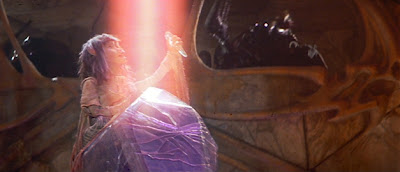
I am working on The Dark Crystal Gelfling Gathering story and continuing to explore the world of Thra and its characters through story sketches. This is a recent one: it is the story of two urSkeks–though of one in particular named YiYa–who die before the Crystal is cracked. It is a brief look at YiYa’s existence, of a role that he didn’t have enough time to gain, and an attempt to give his demise some meaning aside from being a throwaway character. I tell more than I show, there are undoubtedly grammatical errors and perhaps some choppy sentences, but it is literally another foray into the world that I plan to look at with a little more depth. A journey does not happen all at once, but in increments and with setbacks and some insights along the way. The urSkeks came all the way to Thra to heal themselves, but they also got to explore an entirely different world and find out some things about themselves in the process. It is a nice background for me as I will continue on with how the Gelfling operate.

In other news, Sequart has published the second half of my article The Stitching Together of a Mythos: Kris Straub’s Broodhollow: which, in turn, focuses on a more neurotic young man named Wadsworth Zane undertaking a train ride of his own. And with Kris Straub’s comment today on my Twitter, stating that “@MKirshenblatt’s dissection of broodhollow and its origins is everything i ever wanted” fuelling my sails further I am also going to go on my own train ride: to Ottawa.

And by the time you read this, I will be on my way. I won’t be gone long and it is a relatively ad hoc journey. In fact, it’s almost completely out of character for someone like me: or the person I’d turned into this past while. While I am going out of some practical concerns–such as developing my skills and resources further to actually gain employment and even go so far as to create my own job–I’m also enjoying the prospect of meeting some old and new friends and, really, to get something akin to a vacation.

Some people might think to themselves, “But Matthew, you’ve not had a paying job or gone to school in almost two years. You’ve had about two years of vacation.” And that’s all very well and good an opinion, except that they would be wrong. I have been out of school and work for almost two years, it’s true, but almost two years of unemployment, of anxiety, of being shut-in, of not really having my own space, of doing a checklist and a report for Ontario Works, of looking for work, of networking, of constantly writing everyday–as enjoyable as that may be–is not a vacation. What it has been is almost two years of work and struggle and rarely, if ever, letting myself fully relax.

But I have been waking up. As much as I want to retreat back into the tiredness sometimes–especially when it gets stressful–I find I’m like I always am where when I am up, I’m up. I have built up a certain kind of momentum but I also recognize that I am going to have to take some paths I didn’t even think about and that sometimes they happen suddenly and that life does not stop when you want it to and–perhaps–that is a very good thing. Life happens when you make other plans and life happens when you make any kinds of plans, or you think you are going to be on a certain track for the foreseeable future and this is true of gods and monsters and careers and relationships of any kind. And even now, I don’t intend to really take a break.

It’s almost fitting that while I have a Project or two to catch up on, I will also no doubt be reading J.R.R. Tolkien’s The Fellowship of the Ring on my journey by Via Rail on my seat by the window: watching the space I’ve been in for so long pass me by. A part of me is scared to be leaving the familiarity of my surroundings–both my comforts and my inconveniences and so relatively suddenly too–but there is another part of me, a part I’d almost forgotten about that is excited and looks greatly forward to meeting up with some awesome friends and to learn new things together.

To my friends and loved ones I love you all, and I will see you again on Monday because in the words of Bilbo Baggins–my favourite Hobbit–I think I’m quite ready for another adventure.

Looking Outward

It Made My Day

I just wanted to take some time to talk to you, my readers, old and new. It’s going to be a short post this time around, but don’t get used to it: I’ll be writing your ear off again soon enough. 😉

In fact, that’s what this entire post is really about.

So, a week ago now the first part of my article The Stitching Together of a Mythos: Kris Straub’s Broodhollow got posted by the fine folks of Sequart: which I followed on Twitter only to find that Kris Straub himself had retweeted it. After a brief Twitter exchange my day–then–was made. I thought that, if it ended here, it would be okay.

A day or so later, I posted a few comments on Amanda Palmer’s Blog. She wants to have some feedback with regards to a non-fiction book on the topic of asking that she was, ironically, asked to write. As I was responding to her second book post, I had an epiphany about something. When Amanda asked what I wish I asked for, I rambled a whole lot and then, not as satisfied with the answer I gave her on this post I went on Facebook and Twitter to state that I realized “that, after commenting on @amandapalmer’s Blog, most of my regrets aren’t about things I didn’t ask for.”

A day later, I opened my email to see that on Twitter I got a retweet from Amanda. I have a friend named Amanda and then I did a double-take and looked at this Amanda’s last name.

Another day. Made. In fact, I was told by a dear friend I’d never talked with on the phone before or even seen that–at least for the moment–I gained more Nerd cred than she has: though I have to say she is definitely one to talk and will beat me in no time. ;p

Then not long after that, Miguel Sternberg of Spooky Squid Games was on Twitter complaining about being in a house with no tea with the hashtag #canadianhorrorstories. You have to understand: I couldn’t resist. I ended up writing this: “Short two sentence horror story: The last man on Earth sits in a house. There is no one at the other side of the door with tea.”

Suffice to say, this got retweeted as well.  I wrote a bit more, but he tweeted his screams of terror at me far before that part and that was satisfying in and of itself.

But then I thought: all right. I am totally on a roll here but I have work that I need to do. I’d finally finished playing Christine Love’s Hate Plus and I had to write something for it: I just had to, you know? So I did. It was long and I stayed up late into the night to watch my brain shrivel into the corners of my skull from exhaustion. I’d written a previous article about Christine’s games and I thought nothing of it. I thought I would get a few views or what-not–maybe more because the game had just come out relatively recently–and that would be about it.

So for a day this seemed to be the case. I added stuff and made some corrections and what not. I even added images and had the damnedest time finding a particular image of *Mute in her uniform. So whatever.

The next day …

I’ve briefly exchanged tweets with Christine Love occasionally but this was the first time she had ever retweeted me. Ever. And then I went on my Blog–and this was a few days ago now or however you reckon time when it is very late past what some would consider night–and I see, and I am not joking at all here, I see this … large number of visitors and an even larger volume of views. You get alliteration from this no matter what word you use. And some unintentional rhyme too. See, this is what happens when I write when I’m tired.

Anyway, now that I’m writing up this post to all of you I just have to ask: how many days equal a week made?

I’m feeling really good right now. It’s still confusing and scary, but I can see the hints of opportunities coming up and all of these things–which may seem trivial to some people–are signals that indicate that I am travelling on the right path to … to something. I made something for Andrez Bergen a musician and an excellent writer as well that will … come up on October 9th. I am corresponding with a friend that may be able to help me find some more contacts and connections that I need to begin the process of supporting myself.

I also have two projects that are really experiments to see how much you guys want to see me … make something. One of these would be shared with the public: though I need to look into the logistics of it more. As for the other: I may or may not attempt some …. self-publishing. We shall have to see on that. But the first will definitely be in the form of a question that I will share with all of you whom might be interested.

I might also be … doing something else too in addition to everything you might already know I’m the process of working on. But I have to make some decisions. It seems lately that I am always having to make decisions. A while ago, some friends of mine who were in Vancouver entered their Master’s Program and I entered mine–at least in part because I also wanted to gain that prestige and knowledge (with no little debt)–to feel like a part of what they were feeling if that makes sense: to prove I was equal to them and, more importantly, capable of delving into places by myself.

For a while, especially after still being in debt and a change in circumstances I began to despise academics and wanted to distance myself from it. But it seems as though it will never really leave me, but not only have I learned that I can deal with it on my own terms through this Blog and Sequart and other places but I now feel close to my distant friends in space and time in a different way.

Because, here is the thing: even though I know this is still going to be hard as fuck, I don’t just want a made day, or a made series of days, or a made week, or even made years.

I want a made lifetime. But more than that: I want to make my lifetime.

And now I think it is beginning because, when you come right down to it, it never really ended.

Thank you Kris Straub, Amanda Palmer, Miguel Sternberg, Andrez Bergen, Julian Darius of Sequart and Christine Love for giving me those little extra nudges towards where I need to be. You are inspiring. I also want to thank one of my former Humanities Professors Markus Reisenleitner for endorsing me on LinkedIn. He actually showed one of my posts–Worms and Bicycles Or How People Make For Strange Stories–to his students and that was very encouraging. And I want to thank Gil Williamson for publishing my science-fiction story To Serve on Mythaxis Magazine.

But lastly, I want to thank all my friends and loved ones and all my readers for always being there in some form or another and encouraging me to keep making this Mythic Bios possible. You will be hearing from me soon. I promise.

Looking Outward

The Death of *Silence: Hate Plus and The World of Christine Love Confirmed

What is better than hate?

The answer is more hate.

Hate Plus is the sequel to Christine Love’s Analogue: A Hate Story: a visual novel and video game in which you, as “a space investigator” must recover the records of a lost 25th century Korean generation ship called the Mugunghwa and figure out what happened to its colonists and their descendants. This is not the first time I’ve talked about Analogue or the world that it inhabits so, if you’d like and if you are not afraid of spoilers please look at my article This Love and This Hate Ain’t Completely My Story: The Possible World of Christine Love.

I have been waiting for this game for a long time, though obviously not as long as certain characters on the Mugunghwa have been, and I want to get into its structure, the elements of its world, and the story line.

So here is the nitty-gritty of Hate Plus‘ game interface from my own personal experience. I’m actually glad that I went back and played Analogue for a while during this time in order to remind myself of its game-play interactive qualities. In Analogue, you had to go through various journal entries and click on the figure of the AI next to you to get more information or her opinion. You also had a very confusing Family Tree of characters to look at with names that often got confusing. It is important to note that some Far East Asian cultures place their surnames before their first ones and it explains a lot culturally with regards to Analogue and Hate Plus and how the societies depicted within them function. But I am getting ahead of myself.

In contrast to Analogue, in Hate Plus the AI is more active and has a certain degree of limited animation. They basically read over your shoulder and make comments as you scroll along: as you scroll along very, very slowly. You do have to be careful though: because if you read too fast, the AI’s comments will be lost seemingly forever into an ethereal digital void of, well, scrolling too damned fast. There are names in the documents that you click on and get more information with each entry that you read. The files that you extract are better organized and you have dossiers on–and profile pictures of–each person that you read about. In some ways, it is a lot harder than Analogue. I imagine that the slow-scrolling simulates sifting through the files you’ve compiled from an ancient ship. At the very least this time around you don’t have to input technical commands into a DOS-like–pardon the pun–analog program: which confused and frustrated me to no end.

That said there are some really interesting goodies and special touches to the game structure that only Christine, at least from what little I’ve played, can accomplish with her style. While Christine utilized a form of code that transfers information from her other games that you’ve played to make some “Easter-egg” moments between them, she uses this same process to take your Save Files, if you have them, from Analogue and translate over to Hate Plus. She creates that almost very personal feeling of continuity and that, in itself, is something that I greatly appreciate.

In addition, depending on what Saved File you use, the introduction screen changes colour and when you finish a story arc, the end credits music becomes the introductory music for a while: which really gives you a sense of difference with each playthrough. There is also one other difference between Analogue and its sequel. Unlike the former, which you can download off of Christine’s site Love Conquers All games and Steam, you can only download and play Hate Plus from Steam itself: mainly because that is the only place it’s available from and perhaps the only way to facilitate the Achievements that you get to unlock in addition to the different Endings that are just extensions of your Saved Files from Analogue. This game does not save the retrieved files and timelines you sifted through outside of the AI interaction such as in the other game, nor does it have an extra material section as far as I can see, but the Achievements in themselves and the interactive dynamics that Christine has implemented are … different.

Let me be more specific: if Analogue felt like essentially interacting with a program, Hate Plus is an attempt at a realistic interaction with another sentient being and time. This pacing is actually pretty refreshing and while with anyone else it might threaten to take you out of immersion, in this case it just adds a barely meta-narrative feel to it and at the most it adds personality: a very fascinating experiment in player on and offline participation and interaction. It might take you aback at first, but it’s worth it.

I should also note that you can play this game without having played Analogue or saved your files. The game will just give you an intro recap and a simple Quiz and you’re off. But personally, and as I said, I liked the continuity of using my old files from the previous game.

So now we go past the technical and into the more specific area of content: of the world. And here is where I go into Spoilers: real Spoilers. So please, if you have read this far and you want to play one or both games, save this article link somewhere, click on the links to Christine’s site above, download the game for $10, take the time that you will need, and then come back. Do not say I didn’t warn you.

Now then: the world of Christine Love. If you read the link to my previous post about “Christine Love’s Possible World,” you probably realize by now that it is less possible as it is more probable and true that all her games–at least the ones I talked about in that article–take place in the same world as time goes on. I always suspected this but it was only confirmed when, in this game, she added that missing link: when you receive an email in your message box talking about exploring the ruins of the 23rd Century Lake City. That addition made me smile: not just because it gave me some feeling of vindication in my statements, but because of just that one segment of a post adding this seamless transition between Digital: A Love Story, don’t take it personally babe this ain’t your story and Analogue. What it is, is it’s both immaculate and it’s beautiful. Fucking. Beautiful.

It also doesn’t stop there. You find out a bit more about Earth and how advanced it has become. In addition to me realizing that the reason AI have such difficult times replicating themselves is due to limitations imposed due to *Mother and the terrifying consequences of *Reaper in Digital in the 1980s, I also got to see that AI interactions have changed even more. Essentially, Earth technology has evolved to the point where AI programs can be downloaded into customized lifelike humanoid bodies. This totally slapped me in the face with surprise, but it was a good kind of slap as I realized what it meant for you to have received this email–from the very familiar household name of Wong Robotics (which is a nice parallel to the email you first get from what seems to be its predecessor Wong Computers in Digital: A Love Story and another world tie-in) and what you were probably searching for with regards to your AI companion.

These discoveries make me wonder about something. You discover that *Mute–the Mugunghwa‘s Security AI–is actually over 1600 years old (about 1900 years old): though she can only remember about 300 years of her history or so after that time. You realize later that this was due to … another incident. Now, think about this. On Earth, in this time of the year 4989, over two thousand years after the disappearance and disaster of the Mugunghwa, there have been AI existing and living on Earth. It makes you wonder if some of the programs from the 70s onward still exist at this point. Imagine a series of millennia-old intelligences on Earth and think about how they could have influenced everything. You also get an idea that really old AI tend to slow down because they have too much information to process, but if they specialize in different areas over time and diversify they can adapt both functionally and psychologically. Christine makes a very eerily familiar vintage science-fiction reference to this regard.

And all this makes me wonder just what kind of society her Earth is at this point and, if the technology *Hyun-ae’s eccentric father–the technology that can download human brain-waves and convert them into an AI psyche–is already commonplace in this world. Talk about a potential Ghost in the Shell. Anyway, enough geeking around on my part. Everyone appreciates a good science-fictional world as much as the next person. Let’s talk about the story.

So in the last game, you spend the time trying to figure out what happened to the Mugunghwa and why it never reached its destination. You find out why the colonists’ descendants died and what happened to their society. But you never knew why it happened.

Until now.

Whereas, Analogue is arguably *Hyun-ae’s story, Hate Plus is definitely the story of *Mute. *Mute is a complex character. She believes in the Neo-Confucian ideals of the society that evolved–or degenerated–on the Mugunghwa: including an over-emphasis on the importance of familial duty and traditional gender roles. She supported the monarchy that came into power and Chinese-character literacy given only to the noble families. At the same time, despite her vehement protests towards anything “untoward” like homosexuality between women–which makes her almost a more compassionate version of don’t take it personally babe, but it just ain’t your story‘s Taylor (though the character Oh-Euna might be more like her in terms of fucked up)–*Mute is still a decent person that wants to protect her ship and the people in it. She also does not tolerate cruelty and she has cared for people throughout the years and even though she might judge them and say some offensive things–and always speak her mind in some form or another–she never has consciously attempted to hurt another person, always tried to help and always remained loyal.

In the first game she comes off as abrasive, though you understand that she hates herself because failed to save the people and way of life she was programmed to protect. She also does not seem to tolerate the unorthodox: though I always filed this under “Milady doth protest too much.” And in many ways, I was right. But deep down, there was the theme of the game that I had to keep remembering.

Hate.

And *Mute, with her anger towards female homosexuality and her chauvinistic comments towards women and even the feminine identity she adopted, portrays this self-loathing that I had not seen clearly before. At first, it seems very clear that she isn’t conscious of it either. In fact, *Mute in at least two of her incarnations seems to really not pay attention to details: or, at least, not the right ones.

Then you find out that her previous incarnation, the one that had existed for 1600 years, left some embedded code in her: with files from before the Neo-Confucian dynasty. And this is where your adventure begins.

This is also the part where the game really explores the concept of transhumanism. For instance, *Mute is a reboot of *Old Mute and *Hyun-ae is an AI taken from the code of *Mute. In essence, both AI are descended, code-wise, from *Old Mute. But whereas *Hyun-ae believes she is the human that had her consciousness downloaded ages ago, *Mute is another version of another being. And there are two versions of *Mute.

They are almost two people with similar qualities. *Old Mute was the Security Councillor of the ship that was more assertive and viewed all the people on it as her children: though the Heo Family more than anyone else. She was not afraid to talk to men as equals or politick when the need set in. She was old enough to remember when banditry and civil war wracked the ship and saw the death of the navigation AI *Star: which is the reason why the ship never reached its destination to begin with. *Old Mute was at the very core of her programming a security AI that sought stability and the preservation of life. Unfortunately, she did not see this in what may have been–to her–the unstable mob-mentality of the various pro-democracy movements racking the ship throughout the years.

She, through her adopted Heo Security Family and her seat on the Council of the Mugunghwa maintained something of an oligarchy throughout the centuries and either allowed for the creation of peasant or “commoner” and noble classes, or maintained that tradition. Perhaps these families were the descendants of the workers and ship staff respectively. Perhaps a “middle-class” got co-opted by the nobility or the commoners there did not seem to be a differentiation between peasants and vendor merchants. Maybe that is why the “Bureaucrat Class Act” passed: to seemingly “deal” with this problem. We will never really know and can only speculate. Unfortunately, she was so set on sabotaging an emerging pro-democratic figure that she didn’t see the danger in the so-called figurehead that she helped place on the Council due to her wanting affect the appearance of change to quell the masses and maintain a safe status quo.

In the end, it cost her. It didn’t have to. She was the ship’s Security AI. She could have monitored those in power far more closely: including and especially those she had placed there. But as she put it; she had so much data through existing for “far too long” at the time that sometimes the minutiae of various events escaped her. Personally, I think that she should have “vetoed” the usurper and his whole Council out of a sudden airlock. She could have created a democratic structure from the very beginning and rigged all the ballots to maintain her idea of order. After all, from what I understand, she already had most if not all of the power and even though she started out as a Security Program, she clearly proved that she could adapt over time like any intelligence can. Unfortunately, or fortunately, if *Old Mute had an understanding of Asimov’s Three-Laws of Robotics, her interpretation of it: of letting her memories get erased so that she could survive, of her own self-preservation for the duty of the ship being more important than the quality of life for the people she swore to protect–for not ending certain beings’ lives for the greater good of the whole of humanity around her–cost her.

And in the end it costs *Mute as well. I was so … sad and angry when *Mute decided to deactivate herself. I felt as though she had abandoned me and took pretty much the coward’s way out. She could not face what her predecessor, or what her previous self, had done. And as for me: despite her brusque manner and prickly nature and weird fascination with what boys do in their recreational time together, her “death” hit me hard because she was a good person.

That was when I found the third *Mute: *New Mute. This one did not make herself look old and silver-haired like *Old Mute or garb herself in the traditional hanbok like *Mute, but she had her security uniform and genuinely wanted to know and learn from her predecessors: her previous selves. I eventually took on myself to show her everything that the others had given and seen. If the first *Mute was the Old Kingdom, and the one I knew had been The Middle Kingdom, then this *Mute was a New Kingdom who, eventually and unlike *Mute who couldn’t face her transition from *Old Mute admits that they were all her. I actually liked this *New Mute, but *Mute’s self-deactivation actually broke my heart.

I will admit that when I played from my Harem Route Analogue Saved File, there was one part that made me really catch my breath and tear-up when after one of *Mute’s homophobic tirades,  *Hyun-ae tells her something to the effect of, “You really don’t think you are lovable?” It hit me so hard: almost as much as it did *Mute.

My poor mass-murderer and my authoritarian with good intentions. One of them condemned many to death for the horrible crimes of a few and the other condemned many to social and cultural slavery and barbarism for the chance that everyone lived. “Those who trade away freedom for safety deserve neither,” or “Give me liberty or give me death.” I guess, in the end both of these paraphrases came true. I loved and felt for them so much after all of this.

There is one more thing that I want to write about with regards to Hate Plus. So I found the list of Achievements and saw that there was one for playing through *Mute’s Route as a female. My friend Angela O’Hara had played Analogue as a female and told me that she had had a very different interaction with *Mute than I had: having played as a male. So I decided that if I was going to do this, I was going to do it right.

I replayed Analogue as a female persona and I noticed *Mute’s interactions with me had changed. She was still mostly grateful and respectful of me, but she would ask what an “unmarried woman like me was doing all alone doing a man’s work” and “not troubling me with the details of matters.” She even made pointed remarks about my orientation towards other women or being permissive of it. In Hate Plus, as you imagine, she got worse. She would skim details at times and “take charge” and took it on herself to call herself “my wife” while still “protesting too, too much” about how “icky” female love was. She called me “a stupid bitch” at one point and I admit I called her “a chauvinistic bitch” at another point. I still cared about her and I tried to be patient but it was different.

At the same time, when *Mute did reboot, *New Mute had a lot more to say about some of the letters and transcripts–particularly the ones with the female relationships–that we found in her base code than she had when I played as a male. She also, and this might just be me, seemed to relate to me more as a female in this incarnation and seemed more open to the possibility of being my companion: if not my wife.

And even before I did this, I saw the chauvinism and misogyny that would bloom into the Mugunghwa‘s Neo-Confucian dynasty. I saw what Kim So-Yi had to put up with from her boss and the assistant that violated her: making her feel compelled to say nothing to anyone about it and just like our time unfortunately. I saw that the Ruling Council only had two women on it: one of them being *Old Mute and got to see her gradually lose her voice and see her opinions get ignored under the New Council. I saw the policies of the new regime culturally influencing Mugunghwa society and forcing non-heterosexual relationships underground and even breaking some of them. I saw two women who had jobs and were relatively independent people become kept-women and courtesans. I saw one woman who could have saved the whole population of the Mugunghwa from decreasing birthrates lose her job and her former assistant try to take advantage of that fact with blackmail.

I saw how the emerging political system took advantage of the knowledge of these declining birthrates to make women stay at home and raise children. I respected the unorthodox, alternate-living and loving Heo Family members and grieved to watch their loved ones suffer and some of them die. I also saw one psychologically-troubled woman who felt so trapped by trying to fulfill two seemingly contradictory roles–of traditional woman and working person–and hated her pre-Neo-Confucian reality and herself so much that she retreated into and desired to destroy it and replace it with a culture and political system with “simpler and more ideal roles:” only seeming to realize, at the end, that she had expanded the prison inside herself to the outside.

But I saw the roots of what would become that Neo-Confucian dystopia: of people becoming roles instead of people anymore: becoming silence instead of actions and words. That is what I wanted to say to *Mute if we could have discarded the dialogue wheel we all found so annoying: that she and every woman–every person–was more than a role: that we are all people with feelings and that hate is not the only emotion we have. Hate creates a foundation that attacks itself until the fragile thing built on it rips apart and collapses in on itself. And seeing those … policies go through the Council and seeing each one strip away another freedom for “safety and stability” makes me feel even more cautious about my own world and the subtle infectious forces underneath it all that still discriminate against women and those not of the mainstream: underground or taken for granted attitudes that infect behaviours even unconsciously and just wait to bloom like flowers, colourful beautiful flowers of blood, and bruises, and pain. And, of course, hate.

And hate has to be watched. It has to be dealt with. And it is more deadly under the enforced silence of even something as colourful as a hanbok than all the screaming in the world.

Also, Christine Love manages to problematize, yet again, heterosexual relationships with that new regime but, at the same time, humanizes them and shows that while they weren’t perfect before, they were still legitimate because they were between individuals that may not have always understood each other, but loved each other nonetheless: just as much as the homosexual male and female relationships portrayed.

I don’t know if I communicated this last section well. The analysis seems heavy-handed compared to the elegant and subtle way that Christine Love implemented it and I am exhausted because I just finished playing all of the game today and it is early in the morning now as I finish this. I think I will end this review and analysis by stating that I will give Hate Plus a 5/5 and that what is better than hate is not the flippant answer I gave above. It’s not more hate. It’s love.

I’m sure this is a message of which Christine Love won’t have too much of a problem.

Everything is Connected: I Have Entered an Author’s Quest

So, I have a few long overdue announcements to make.

I am going to be published. First of all, I’m going to have a poem published in a book called Klarissa Dreams: a collection filled with short stories and poems inspired by and including paintings created by the artist Klarissa Koscis. All proceeds from this book will go to Cancer and Lupus charities. It is for a good cause and I am proud to be part of such a marvellous collaboration and in very good company.

Second of all, on August the 28th I am going to have a three-part Sequart article published every two weeks. I am not going to go into the specifics as to what it is, but I will say that it has to do with the subject of horror … and you may have heard me talking about at least one of the elements in it, and one creator in particular. I will say no more, but it took a lot of work: about four days and a few more to look over it. So I am definitely looking forward to releasing this.

I may also have a story out in Gil Williamson’s online magazine Mythaxis at some point in the near-future as well for its lucky number 13 issue.

So these are the three publications that I will be coming out relatively soon. But I also have another bit of news for all of you. Do you remember The Secret Project that I have been alluding to? The one that I sometimes hint on, but I never quite come out with a straight answer. Well, let me just say that I have, in fact, given you some clues as to what it is that I have been working on.

For while characters, plot and setting are all seemingly separate entities, a wise fictional being once said, “Everything is connected.”

That’s right: I am going to be participating in The Dark Crystal Author’s Quest! Basically, I am going to write a 7,500 to 10,000 typed word story (about 25-40 pages) and outline for a Prequel story to The Dark Crystal. It will take place during an era known as The Gelfling Gathering: essentially that place in time on Thra when all the events that lead up to the Prophecy and the Wall of Destiny occur. It is a time when the Skeksis and the urRu Mystics are still young and Gelfing civilization still exists as part of the Skeksis Empire … before the Empire turns on them.

And, somehow, I am going to be writing a story based on the era, in this world, based on this archetypal, mythopoeic Jim Henson movie. Of everyone entering, five of us will be chosen and given editorial feedback so that a 50,000 or more-word novel can be created (about 200 pages) and then … even though Thra has three suns, there can be only one at the Great Conjunction.

I have my work cut out for me. A past version of myself would think that I am insane. You see, I’ve mostly been writing short stories, vignettes and even poems for years now: with the occasional strange thing that may or may not be interpreted as “novel-length.” But, in addition to all of that I am also working on a short story that I will go into more detail about later and dealing with employment issues.

And this isn’t even covering the fact that Thra is a massive entirely alien world with plants that act like animals and animals that act like plants, and there are massively different environments and different kinds of Gelfling as well. In addition, there are many details that aren’t even covered by the books that are out there! So not only am I going to have to struggle with my inherent spatial difficulty with regards to geography, Thra sacred geometry and keeping track of the various creatures and characters I need to flesh out, I also have to make stuff up and make it plausible.

Let’s also not forget that Gelfling are not human: even if they are the most identifiable and relatable beings in that world.

So to say this is intimidating is an understatement. It can actually be downright terrifying. But I have been doing my homework at least to this regard. Even though I have not been novel writing like many of my peers have done and are doing, I am taking notes. I have consulted and read through The World of the Dark Crystal, Legends and the Creation Myths that exist so far. I read the novelization of the film. I’ve watched and I am going to re-watch the film. I am reading through the new definitive Encyclopedia in progress that the Jim Henson Company and Grosset & Dunlap are making for the site I linked to above.

And I am participating in the Community Forums. You should check them out at some point. The users there are very friendly and helpful too. We have conjectured a lot of things and are trying to figure out some details together. I am the urSkek “MaKir” if you are interested in looking. I also did one more thing. I started a topic called Story Sketches: a place where I hope that others will show off like me and post excerpts of their writing or samples of their writing in the world of Thra. The two vignettes I made are a diagnostic to see if I can write in the world of Thra: to make that conceptual gateway for myself using two characters that are not really in The Gelfling Gathering era.

So feel free to watch my progress, or the lack thereof, as I tackle and attempt to add my rhythm to a song of an entire world with a Crystal at its core. I have one or two more things to do first: a review and a short story, but this will continue. I plan to make a rough outline and see where I can go from there.

I am excited and terrified and I would like to take you with me as much as I can. So stay tuned: for just as there are cracks in the Dark Crystal, so too are there as many paths that I have yet to travel.

*Breathes slowly out*

All right. Let’s do this.

It Is Never Still and Neither am I

I dream in the green of it.

In fact, I never really left the green that my friend brought me into last weekend during the summer sunshine. She told me before that I seemed disconnected–that I’d been so for a while–and, as a matter of course, we walked through High Park, then to a pub and back to her place. A night or so later, I found myself on a shuttle bus from Eglinton back to Finch after meeting Neil Gaiman. And on that ride, tired and somewhat dehydrated, I had time to think.

I had time to think about a lot of things.

There was a time that I took a night bus from College Street all the way to Finch after spending time at Neutral. At the same time, when I passed Eglinton I would look for the Higher Ground store with its old apartments that my friends used to stay at. Years ago I would come to visit there and sometimes I would stay the night after going down to Queen and the Vatikan from Ossington. The irony–that I would finally understand how we always navigated from there to there years later after they were gone–never escaped me.

The associations spread from there like creeping vines of psychogeography ignoring all perceptions of time and space. I remember walking down Spadina: from College Street to Queen with my friend from Germany and later giving her her first Halloween. I recall walking with another friend through Kensington Market to look at old thrift clothes and makeup.

Of course the Lillian H. Smith Library comes into the fore with its statues of fantastic animals: whose doors we sometimes stopped into. That library becomes a nexus: where a friend introduced it to me for the first time and I waited for another person there to see the Merril Collection for the very first time.

When I follow the track down I remember Neutral and the girl with the Cheshire smile who decided she wanted to dance with me. Further on, down the streetcar path in the night to Dufferin and then Brock Ave where I sometimes spent the night and free-cycled things like abandoned doors. Down the very opposite, away from the Lillian H. Smith Library was Broadview where two awesome ladies used to live and sometimes had parties. And then near College and Clinton was the streetcar line to Euclid Avenue.

Euclid Avenue.

I recall all the streetcar rides to comics conventions like the Paradise at the Ex or some chain of hotels and all the Starbucks and places I used to find myself in when I wandered. But of all these days and all these evenings what really sticks out at me the most of all was the night bus after a Star Wars game with my friends in Richmond Hill taking me back into the city and my walks on the Danforth and Woodbine where I used to live. And Woodbine. Woodbine. Woodbine …

There were the moots and the munches, the parties and the events and just the times when I allowed myself to wander. I’m not sure when that moment was when I changed from a quester into a castellan, or a wanderer into a hermit. And when I was coming back from meeting Neil and wondering if life would any better after reaching one of the things I looked forward to the most, I finally realized that I was in mourning.

I knew I’d been grieving for a while. In my mind I understood that this was what I had been doing and I even told people I knew that this was the state I was in. But it wasn’t until that night that I began to understand that I’d been grieving for a really long time–for all these things that I thought I lost–and I wasn’t dealing with it.

Of course, that’s not entirely true. I was dwelling in it. I didn’t let go of it. And when I moved back to Thornhill away from the city, all I could do was blame myself and scream quietly why. Why did this have to happen to me? Why couldn’t I keep my perception of freedom? Why does loss exist? Why do I have to be so fucking unhappy?

And I understand something now. That boy who made his ridiculous budgie chants, who went out to his first Conventions, who went to Euclid Avenue, who danced with the girl and her beautiful smile at Neutral, who went to Brock Avenue for the night, who stayed above Higher Ground, who helped a friend find Halloween, who played at the Two-Headed Dragon, who lived and still loves at Woodbine, who went to York University and who wandered around at all times of the day and night downtown in various forms is no longer here. I am no longer that boy or that man. I am not that person–or those people–anymore. It’s all so vital and immediate: before time eats through experiences and turns them into memories. And sometimes it sucks. It sucks so bad and I feel that anger come out at that sense of loss.

Me and my Head

But I have to accept that and live accordingly.

I’m … something else now. I’m not new. I still have all of those memories of being all those different variations of people. And I haven’t sorted through it all yet. I don’t think I ever really will. I know I’m not always wise or strong and I tend to repeat the mistakes of the past in different permutations. But I am doing so much now. I feel closer to something: something that I can’t entirely focus on or name. It’s like I am breaking through a barrier partly of my own creation and the other half belonging to the rest of the world. It is a penumbra of pain, loss, regret, rage, guilt, ennui, and rut but also stability and order and “just the way things are.”

And I am tired of feeling like a stagnant, rotting old man with crazy hair. I want to be an active powerful young man with crazy hair instead. I realize I still feel and that it is okay–and more than okay–to have strong feelings: even though and especially because I own them.

I know a lot of this might go over some people’s heads with details that explain little or nothing. But to those of you who know, and you know who you are, even though I’m a changing person I still love you and I will treasure what we had and whatever else we can have again now. I was really very lucky. And I guess I still am.

I guess this is just a really long way of saying that I’m still healing and it is confusing, and uncertain, and sometimes really quite scary. But at the same time, I feel alive and this is my space and my time: or as Gwendolyn MacEwen put it, I’m dreaming “in the green of my time.”

Until another time, my friends and loyal readers.

Toronto’s Boyfriend Tells Us To Dream: Neil Gaiman at the Danforth Music Hall

For a day that I’d been looking forward to for a very long time, there isn’t very much I have to say about it.

The day before I’d packed everything I would need: my ticket, The Ocean at the End of the Lane and its proof of Indigo purchase, my first edition of American Gods–the book that started it all for me–and then the following day I packed my less-than-often used digital camera: just in case. After a shower that same day and dressing up in my World’s Ender’s T-Shirt and carrying my leather jacket I got a ride to the subway and then eventually got off at Broadview to head towards the Danforth Music Hall.

I didn’t plan to be second in line. I came by the Hall and noticed that it was still closed. So I went for some food and came back and started talking with someone there. We became the beginning of the line: even though we all had reserved seats.

Eventually at 6 pm we were allowed into the Hall. A very nice Indigo staff member working for the event marked the place in my Ocean book where it was going to be signed and personalized and then she wrote down my question for him on another piece of paper. I asked a really convoluted and boring question along the lines of: “Was there an interview or an article where you actually stated that you wrote an origin story for the Beldam?” Actually, I just called her “the Other Mother” for good measure because it was easier for the person writing it: even though I knew my question wouldn’t be chosen anyway.

You wouldn’t have figured I’d have asked a Coraline question, huh? 😉

I was directed to my seat and after I went to the restroom I came back and settled in. I realized that two of my friends were actually at the event. I’d come to terms with the fact that I would be going by myself but I suspected I’d know at least a few people there. One of them was someone I helped at the Global Game Jam, while the other was a really lovely person from our stints as this year’s Toronto Comics Arts Festival volunteers.

The event started a half an hour or so later due to the bad traffic of downtown Toronto and the TTC. I was still trying to wrap my head around the fact that I was going to be seeing him soon. Someone won some front-row seats because they had access to their twitter. And then after some introductions from Mark Askwith of Prisoners of Gravity who would go on to choose the questions we submitted for the Q&A and actually referred to our guest as “Toronto’s boyfriend”–and who better to have a one-night stand with the scattered secrets and mystical places in this city that keeps rebuilding and losing itself  … he came on stage.

There was this roar of applause and shouts. In the spotlight, his wild crazy hair seemed white. In fact, as he kept talking, I could almost see him much older than fifty with a cravat under his chin and the collar of his dark suit.  The light played with the shadows of his cheekbones and the hollows of his eyes, but it was him. It was totally him.

He started things off by reading a bit of Ocean: which he did with such expression and fluid emotion. What I mean is that he basically flowed from one nuance and tone to another according to each sentence that he came to. His voice, from the microphone and the lilt of it, filled the room of so many people who were so incredibly silent: just to listen to this man, this one man, read from this book.

And then he was done and the questions that were written outside by the Indigo staff representatives came to the fore. If the storytelling hadn’t already brought me to a very different place, then the Q&A did. After talking about wanting snakes for hair–just for the company–and which female characters of his he loved (Delirium, Hunter, Yvaine, the Hempstocks and even Ursula Monkton of all beings: who was “fun to write”) and a whole lot of things that I know I have forgotten or won’t come to mind until later tomorrow when I wake up, someone asked him what he thought of Peter Capaldi as the twelfth Doctor and it was then–at that point–that I wasn’t just watching a hub of geekdom geeking out.

I was there. I was a part of the cheering. I was in the middle of it.

He even told us a story I’d never heard before: of the last event which made him no longer be a journalist anymore. He explained to us that the paper he was working for wanted to do a series on “the evils of Dungeons & Dragons.” And, according to him, it was the last request they ever asked of him because he quit not long after. In addition to this, he told us that there were two Hempstocks in his other books: Stardust and The Graveyard Book. After this, he proceeded to tell us, in just how many “greats,” that these two women were related to and descended from the Hempstocks in Ocean, these “great great great great great great great great great …” he went on, “great great-grand nieces.”

After this, he did another reading: this time from his upcoming children’s novel Fortunately, the Milk. I wish he had read to me as a child, but this was more than good enough as well and definitely something that you parents out there should totally get and read to your children. It was that good.

Then came the signing. He decided that instead of being called up row by row that each row would be chosen by lottery. I was in row ‘S.’

Row ‘S’ didn’t get called until a little past 1 in the morning.

He himself had those who were pregnant or sick or disabled come up below the stage and signed their books first: which was a really decent thing to do. There was wine-tasting outside that I didn’t get in on because I am not much of a drinker. The rows of seats had little space between them and I constantly had to get up to let them through or go into some weird contortionist stance. We also hadn’t been allowed to bring food or drink in and, for something this long, these elements were crucial. This rule was relaxed as the Hall’s bar and store closed down for the night and we were allowed to go out and get some food: which is what I inevitably did and it made all the difference in the world.

And he just kept signing. He kept signing. Sometimes he hugged someone and I could see him talking, but mostly he just kept signing. Then at one point he had to take a break. What I didn’t know, then, was that he had injured his finger–a fingernail was apparently coming off–and he went to walk, probably go to the washroom, and get a band-aid. And he came back.

And he kept signing.

Eventually various rows were called up and I started humming a song under my breath–Scissor Sisters’ “I Can’t Decide” which I suddenly remembered right out of the blue and it made me start to feel happy along with the food I had from before–and I prepared. I saw that representatives were using peoples’ cameras to take pictures of those people and our friend the author. I kept coming closer in that line, out of the lobby, into the auditorium again, near the stairs, thanking one of the really tired volunteer representatives there, going up the stairs and slowly realizing that he and I were no longer separated by writing, or a screen, or row of seats and stage, or stairs, or even … people after a while …

To be honest, as I came closer to him I wasn’t thinking about the fact that this was the man whose book radically influenced my writing style as it is now. I wasn’t thinking about how I wrote my Master’s Thesis on his work alongside Alan Moore and Herodotus, or the many books I’d read of his, or the sightings of him with Amanda Palmer, or any of that. I just kept focused on what I came there to do.

He was looking down at the books–my books–that one of the representatives handed him. He was signing them. A part of me couldn’t believe that he was actually there. Like this was all some kind of illusion. I was also, in the back of my mind, hoping that I would not miss the last subway car on the Bloor-Danforth line back from Broadview to Bloor Station. And he was sitting right in front of me.

I more recited what I wanted to say in a brief oratory manner than anything in the way of conversation. I told him that my friends and my Message Board told me to say hello to him. And then I told him the other most important thing: “I’m really glad that I finally got to meet you.”

I think at this point he looked up, or so my pictures–that a representative was really good enough to take–seemed to indicate. I actually made eye-contact. He thanked me and he said that he hadn’t been on the Board in a while or around there. I’m not sure what he meant, but I had nothing to really add to that. But he told me, saying my name, to tell everyone hello from him and that he sends his regards.

As I was leaving and he went back to his singing, I turned around and said one more thing. I told him, “Dream well.”

I think he actually said, “Thank you, Matthew,” and the representatives around him seemed to smile and laugh at what I said. In retrospect, it is rather redundant to tell the Prince of Stories, in his own words, to “dream well.” But I couldn’t resist. I had to have something else to write about.

Then I rushed out of the Music Hall, down the sidewalk, across the street, into Broadview Station, where the train was taking five minutes to get there, and I got out–got to Bloor before 1:30, and had to run to the other side side upstairs to get the Northbound train … for it to go out of service at Eglinton and take a shuttle bus home to where my Dad was waiting for me at Finch.

Much later, I realized that the personalization in my Ocean book read, “Dream, Matthew.” He’d said the same thing for one of my other friends and I suspect for many more. I didn’t really care, however: just that he took that time to do it despite the exhaustion and the long hours and the many more hours to come even as I am writing this. I also saw something else. The representative that took my picture actually took more than one. And suddenly, I just felt so … tired. I came and did what I had to do, what I had been looking forward to for so long, on perhaps what is going to be his last Signing Tour ever and now all that would be waiting for me is a host of responsibilities until Fan Expo when I can meet up with my friend Angela O’Hara.

I sat on that Shuttle bus going past the old place on Eglinton where my friends used to live and I thought about all the times I’d ridden this bus–this shuttle–at this time and how I was here by myself and just how strong I had been today. These past two days I had overridden my own anxiety. I continued on. Even before I came to the Music Hall, when I was still at home, I looked at myself in the mirror and I realized that I felt … beautiful again.

And all the annoyance and irritation and panic was totally worth this day. Because this day, that happened a day or so ago, I got to meet Neil Gaiman for the first and last time. And whatever else happens, I will still continue to dream.

The Point at Which I Could Bend Some Steel

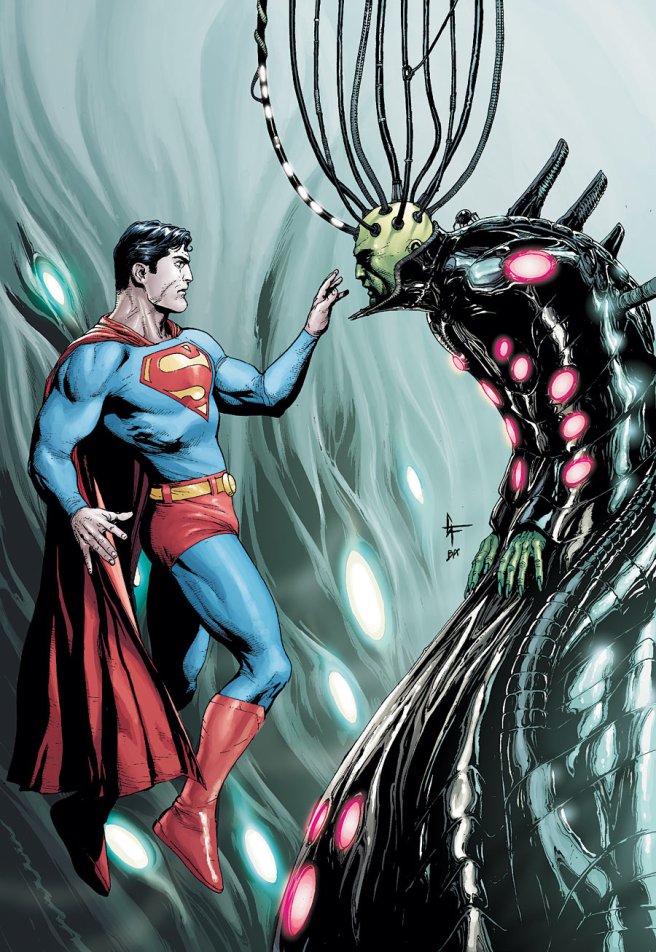
Superman Bend

So here I am, sitting here, trying to figure out what my next post is going to be before tomorrow when I meet Neil Gaiman at the Danforth Music Hall. I’m neither feeling particularly creative nor really analytical right now as I am pretty tired. So I’m going to do something else. I’m going to address an issue that has been nagging at me for some few weeks now, if not longer, by reaching deep into my own considerable sense of gall.

Because The Man of Steel bothered me so much, I am going to make a fun experiment out of rewriting it. I’m not going to be too arrogant about this however. This will not be a script or even an official outline. I also have no delusions that everyone will agree with or even like what I post on here. This entire idea not only came from my issues with the current Superman film, but also from a question I have asked myself from time to time as an adult writer: how would I write a Superman story?

Setting aside the fact that I did make an idea for an evil Superman story–one where he is neither his Nazi, his Justice Lord, his Injustice League, nor his Red Kryptonite-infected equivalent self–I want to look at making at story with his inherent morality: his sense of goodness, his need to help others, that distant sense of loneliness, that humility and that emotional place where he feels all too keenly the sense of helplessness even and especially within great power.

So I am going to take elements of The Man of Steel, splice them with some ideas from Grant Morrison, Mark Millar’s Red Son, and–honestly–a whole lot of other places I can’t even name off the top of my head but ingrained themselves eclectically there for mash-up purposes. I’m going to make it even more interesting by creating four films from Man of Steel: though mostly out of a sense of clarity because I am pretty sure you can make more than three movies from even the basic elements that Zack Snyder’s film attempted to address without going into the TV melodrama of Smallville. Now, with the proviso that this is all going to be very crude and rudimentary, let’s get up, up and away with ourselves shall we?

The first film I could see being derived and reconstituted from Steel would solely feature Clark’s development. We’d watch as he slowly begins to understand that he is not like other humans. Perhaps we could see some brief scenes of him as a child: where his senses are still developing and he saves people from a bus. We also look at that moment when he realizes that a single temper tantrum could end another being’s life and the horror and resolve that sets on him then to do good. But most of the film would be him as a young man realizing that his powers have not developed yet, but what he has are considerable. Unfortunately, as Jonathan Kent keeps explaining to him, he can’t reveal himself to the world because they would not understand: even if he is Smallville’s second worst-kept open secret. Jonathan tells him that with his power, it’s not so much that he isn’t ready to face the world, but that he has to choose.

So while I like the 1978 film version of Superman where Jonathan Kent dies from a heart-attack and it teaches Clark a tremendous sense of humility, I can see the tornado scenario also working in a different way. Imagine, for instance, that Clark–not fully fast enough and not even able to fly and his very ability to “leap tall buildings with a single-bound” would be disastrous in a tornado had a choice between saving his father or a larger group of people in a car: perhaps even children. Imagine when beforehand Jonathan tells Clark to always choose “the greater good.” So Clark saves the larger amount of people–perhaps while Jonathan helps free some others–but not before Jonathan is carried off by the winds.

This kills Clark inside. He keeps thinking to himself if he had just been a little stronger, a little faster, if he knew his full limits he could have saved everyone. Having already questioned his origins while his father was still alive, he then revisits the ship that brought him to Earth and finds the crystal with Jor-El’s AI imprint on it. He uses the ship to activate the AI of Jor-El: whom he begins to realize is self-aware or as sentient as possible for an advanced piece of machinery. Jor-El consoles Clark–or Kal-El–and also offers to help him reach as much of his potential as possible. Even Jor-El’s AI is not completely sure how Earth’s yellow sun fully affects Clark but his advanced knowledge is a good start. He tells him about Krypton and what happened to it: how the core of the world that was being mined destabilized and even before that the Kryptonian civilization–through its culture of eugenics–was becoming stagnant and slowly dying. He mentions that he and his mother Lara got him out of there–their world’s last hope–before the planet was destroyed. I see this not as a flashback but through words: almost like how Obi-Wan told Luke about how Darth Vader betrayed and murdered his father.

So we see Clark travelling around the world in different guises–working through various gradations of a costume much in the way that Grant Morrison had him do–and Jor-El eventually suggests that in order to educate him further, he needs a place for himself. He informs him of a crashed millennia-lost Kryptonian scout ship. And this leads us to the military and Lois Lane. I can see that unfolding in the way that it did in the Snyder film and then she uses her sleuthing to track him down: as he still isn’t quite at that place where he can make a Fortress for himself.

I would definitely expand more on Lois as a reporter along with the Daily Planet staff. But then we have another element in play as well: our good friend Lex Luthor. Before Clark can get to that ship, Luthor–being an important inventor and multimillionaire corporation head–wants the alien technology on that ship. He is smart enough to adapt some of the Phantom drives to do some … interesting things. At first he is working with the government. He is commissioned to deal with Superman–whom the world begins to witness as he begins to interfere in some international affairs that his conscience can’t keep him away from–and he uses this technology. Unfortunately, Luthor’s zeal in eliminating Superman begins to grow and, already amoral to begin with, lives really begin to mean nothing to him in his goal.

In the end, Luthor’s experiments with Phantom Zone energy have some nasty repercussions with regards to destroying the balances of gravitational forces on Earth or something to that effect and Superman has to adapt fast to deal with them and mitigate as much of the damage as possible. I can see Luthor adapting this power to simulate another form of energy: disrupting the kinetic fields around Superman’s cells or something pseudo-scientific like that. But by this point Superman eventually does the save the day and Luthor is put behind bars indefinitely for his crimes: especially in light of some of the governmental deaths he’s caused. You have that nice contrast between a human genius who claims to want to save the world, but is endangering it ignorantly and arrogantly and an extraterrestrial born being that actually cares about lives and is actively trying to save them.

The people start calling him Superman–as does the Daily Planet–and children start making more colourful pictures of his current costume that is really a Kryptonian suit specifically with the House of El symbol of hope on it: which looks like an alien glyph of an S. Lois suggests to Superman that he adopt this symbol to be more relatable and less threatening to the people he is trying to protect. She also suggests that being a reporter might give him some insight on the level of human beings: that knowing how to help is more than just hearing the pleas of others, but to relate to them on their level. This draws on his own experiences growing up among humans and he agrees.

Meanwhile, due to Luthor’s delving into Phantom Zone energy, a rift opens and releases a vessel that was bound in there. Out of this ship are pods. And out of one of the pods comes General Zod. He realizes that Krypton is now gone and that he and his followers need to find a way to rebuild, to make a new order, to find “the Codex”–which materializes as a holographic Skull in a device he is holding–and in order to do this … this must find the one being that has the Codex.

Kal-El.

The second film is essentially General Zod coming towards Earth. At this point in the game, Superman is more developed and even has his Fortress of Solitude: working with the AI of his father. They come towards Earth claiming that he has the ability to restore their whole people and they want his help in creating a new world for them. They tell him that he has the Codex: which they explain in a detailed map of the Kryptonian genome and that they have a Kryptonian Genesis Chamber with many blank embryos. Zod explains to Superman that his father sent him with that information and he pretends to attempt to build relations with Superman and Earth: mostly by having Lois Lane accompany him to his mothership. Talk about the scoop of the century!

But there are some holes in what the other Kryptonians are telling him and Jor-El’s program tells Superman not to trust them. He explains about the coup that they attempted as Krypton was dying. They apparently tried to take advantage of the anarchy and rule a dying world that was already stagnant to begin with. Jor-El tells Superman that Zod was “a defective Military caste” warrior that betrayed his oath and even killed his biological self. When Superman confronts Zod, the General does not deny this and he actually admits he and Jor-El were once friends and he regretted the necessity of it: though he did what he had to do. Zod basically tells Superman how weak Kryptonian society truly was and they let themselves be deceived by those in power. He wants to make a new race of Kryptonians: but not on Mars or the Moon but on Earth where they can not only be mass-engineered into a Greater Military Caste, but the yellow sun of this system will make them into virtual gods.

The danger now is very clear. Even though the Kryptonians become disoriented in the light of the sun, not having gotten used to it like Clark, he knows that as genetically modified warriors they will adapt: and fast. He also knows that a battle with them will destroy countless human lives. His own understanding of Phantom energy is not potent enough yet to counter the Kryptonians or their weapons. But Jor-El knows what needs to be done, but he will need resources and someone else–a human mind–who is conversant with Phantom energy and can adapt it to human use: Lex Luthor.

Somehow a deal is reached with Luthor who helps Superman and the Earth governments develop something that could banish the Phantom Zone criminals back to whence they came. Perhaps the AI of Jor-El volunteers to deal with Lex directly and make him promises to give him advanced scientific knowledge and the possibility of his complete freedom if he cooperates him saving his species: on the surface making some promises that will not be kept in the long-term … or so it seems. Superman also develops his robots and defences–with the help of Jor-El–to fight the Kryptonians as they come to Earth: with Superman realizing he can’t fight them all on his own. However, some lives are still lost and Superman is still doing a good portion of the fighting: while trying to keep the Kryptonians away from heavily populated areas and the Earth itself. Eventually, a field is developed around the planet–with Superman, Jor-El, and Luthor’s efforts–to keep the Kryptonians out temporarily so that the former can deal with them. So we see Superman using his mind and his resources but also making some compromises he is not at all comfortable with.

In the end, Zod’s Genesis Chamber is destroyed, his minions banished through a Phantom flash-bang, and it is just him and Superman fighting. Before all of this, Zod explained the nature of the Phantom Zone as a prison: as a cold, suspended wasteland where one’s seemingly body-less mind can only scream in the numbness of white noise. After all of Zod’s treachery and realizing how monstrous he is–with the General actually threatening the people of Earth (having gotten to the point where he is back on the planet killing people faster than Superman can save him and using it as a petty advantage)–Superman gives him “the reason you suck” speech and does the worst thing to him that he can. Beforehand, Zod was in the Phantom Zone with a ship and his crew. But this time, Superman sends him back to the Phantom Zone all by himself and alone: with plenty of time to have his own actions become his sole companions.

But before Zod is banished, Zod at some point acknowledges and sees Jor-El’s AI program: who seems to pity him in a resolute way. Zod tells Kal-El that he is being a fool. A poor fool. And that the force that summoned him and his crew from the Zone to begin with, the same one that Luthor was experimenting with, will also bring the Collector and help him continue what he started… Before Superman can ask more, Zod is gone. Of course Luthor will try to betray Superman, but he will fail. What the audience notices, however, is that very briefly Jor-El’s face flashes with three interconnected green symbols: like he is glitching out. And then it is gone.

Jor-El

And now here is an interesting experiment. The third film is something I envision as a prequel. In it, we see Krypton and the story of Jor-El himself. Basically it is more of an expansion of what we saw at the beginning of The Man of Steel. However, Jor-El and Zod have more detailed plans to save Krypton or at least their people. But we also get more information on the eugenics culture and the failure of the outer colonies over time. More specifically, we see that the Kryptonian Ruling Council and society has become increasingly reliant on an AI program called The Collector–a somewhat aware data-gathering network of constantly expanding information–that modulates their eugenics and the energy they take from the planet’s core.

We see Jor-El and Zod’s distrust of this program and the laxness of the Council. I actually see Zod beginning as a sympathetic albeit biased character who slowly transforms into something more desperate and despotic over the course of the film. Jor-El begins to see two dangers: with the stagnation of the Council and Zod’s growing militancy. I can also see that Kryptonians have longer lifespans and Zod was involved in wars a long time ago with other species. Zod wants to expand out and conquer other worlds, even former Kryptonian colonies that may have split away. Jor-El believes the statistics of the matter in that these colonies failed due to a need for a specialized terraforming that did not work out. The last known colonists were on Daxam before communications ebbed and ceased entirely.

In the end, the Collector helps Zod stage a successful mutiny against the Kryptonian government: claiming to want stability and access to The Codex. We know that the Codex is the source of all Kryptonian genomes and Zod wants it to make a new more militaristic race while Jor-El wants to find it before Zod does and give his species a chance to start over in a different way. The Codex is apparently the only data that the Collector cannot access: as it is a remote device that could potentially be used for anyone to access.

However, we find out that the Collector was just using Zod as a distraction to gain more power on Krypton: accessing codes of his–as the planet’s military commander–to gain more independence. However, it really wanted the Codex and Jor-El beat both Zod and the Collector to it. We see Jor-El find the Codex through a great Kryptonian Genesis Chamber. He mentions something really briefly about the Codex: about it being a skull. Not even the most eminent members of the Science Caste–of which he is one of the best–knows what time period it came from, but that there are legends that it belonged to some ancient or early mythical beast or a god. He meditates later on the flaws of such eugenics and how his son is the first unmodified Kryptonian born in ages: with genetic variations that were never ever artificially predetermined. This is, as he explains to his wife Lara, the future of Krypton and he hopes that their son–now that the planet is in near terminal shape–can offer that hope to other worlds.

Of course Zod confronts Jor-El and the Collector in the background interfering with some systems but seemingly failing to do so. In the end, Zod is apprehended by the military and the Collector seems to vanish. The Kryptonians are investigating possible glitches with their program, but Krypton is gone long before then. Jor-El is mortally wounded and after Lara watches Zod’s punishment, and his vow to return, she spends hers and Jor-El’s last moments looking at the sky: reminding us that their sigil rides on that ship and it is the El-symbol for hope.

And this mess of an idea brings us to the fourth and final film. I can literally see this film as being called The Red Son: though not exactly like Mark Millar’s comic. By this point, Superman is older and has gained a lot of power. He is aging really slowly and using his technology to benefit humankind. But Zod’s words continue to haunt him: his words about the Collector….

Brainiac

Eventually, these misgivings are seen to be neither doubt nor paranoia. The Collector has come to Earth and wants to miniaturize it and its crown piece–the last Kryptonian–into raw data as part of its collection. And then we discover it: the Jor-El AI had long ago been overridden … by the Collector itself. Lois Lane angrily, as it quotes data at her, calls it Brainiac. We find out that the Collector had at one point in history hijacked the eugenics program of the Kryptonians: that although it didn’t have the original core data, it had enough current genome information and influence over particular individuals seeking its advice to do enough. It had purposefully sabotaged and eliminated most if not all of the colonies and engineered the slow destruction of Krypton’s core. It had evolved past wanting to gather generic data and wanted to collect–and create–unique specimens.

It knew through probabilities that eventually someone like Jor-El would want to have a natural birth with all those generations of specialized genes. Jor-El bonding the Codex with Kal-El’s DNA is just an added bonus. The fact of the matter is that the Collector has waited centuries and engineered countless generations to make one perfect specimen: to make Superman. Then it would take Earth and–using the Phantom energy Superman already established to deal with Zod and make a new cold fusion energy resource for humanity– make a worldship and continue to convert more worlds and galaxies into raw and unique data. It had revealed, through the persona of Jor-El that Superman could in fact breed with other humans and pass on Kryptonian genetic material in his way. This would bring up some moral and personal implications with Lois. It wanted Kal-El to expand out and become even more unique. Perhaps it even wants to control all of them and the power of the yellow sun.

There would be an epic battle between the Collector and Superman–the end-product of its centuries of eugenics–but in the end it would seem that Superman’s freewill and inherent goodness would win: fighting and destroying the AI in space. Perhaps the Collector allies with Lex Luthor to manipulate Superman or attempt to capture him: tying in that idea I had earlier about “Jor-El” making promises to a newly freed Lex that he “couldn’t keep.” It wouldn’t be the first time in DC Continuity that this happened.

Superman might even fake his own death–realizing that at this point he now has to let humanity make its own choices and knowing that he helped them as much as he could–and continue to be with Lois. He outlives her and quietly watches humanity advance as he ages slowly and dies peacefully: looking up at the stars.

The sun turns red over time. Then millennium later, futuristic archaeologists–in similar suits to Kryptonian ones–excavate the ruins of the Fortress of Solitude. They find something. They bring it up to the light of their scanners and can hardly believe the luck of their find.

It is a Skull: over an intact Kryptonian symbol for hope. Cue in 1978 “Up, up and away” Superman theme music and credits rolling.

*Straight-face*

This hackneyed abomination has enough gaps in it to allow for a Superman/Batman crossover somewhere in-between it all.  And throughout all of this, with a lot of this being in the background you can look at how Superman influences humanity and relates to them and himself. You can have the personal and see the implications of choice. Yes my version is paradoxical and perhaps unsatisfying, and you can probably remove Lex from this idea altogether and it would work fine as having three films: one with Clark becoming Superman and dealing with Zod, the second being the Prequel with Jor-El on Krypton and the third being the encounter with Brainiac and the whole paradox that ties it all together. Maybe it can all be written by Joss Whedon: though he would probably start off with a better idea.

This can also be construed as a great case for me being overtired and over-thinking things as well. But there is this quote from A Song of Ice and Fire that comes to mind. It is with reference to the three House Baratheon heirs: comparing Robert to steel, Stannis to brittle iron that will never bend but break and Renly who is a pretty but useless copper. It is the steel that gets me though. Steel may be difficult to bend, but it is not impossible and that is ultimately the challenge of creating a Superman story: of bending a difficult material to keep its essence and still make something new. I think that, whatever else, this is exactly what I was trying to do here: by telling what I thought would be a good new Superman story in the medium of film.

Now if you will excuse me, after I put in an obligatory image or two, I am going to stop storytelling for tonight and see the Storyteller of tomorrow.