Life and Identity, Eden and Hell: The Twines of a Gaming Pixie

The following will talk about–and accordingly link to–games of a graphic nature: if you will pardon the unintentional pun. Reader’s–and player’s discretion–is advised. Do not say that you have not been warned.

It was around February when I discovered Gaming Pixie. Less than a month before, in January, I finished Anna Anthropy’s Rise of the Videogame Zinesters and participated in my first–and so far only–Game Jam. After really hearing more about Twine, I began searching for more information on Anna Anthropy’s works and other Twine games.

I’m not sure how I found Gaming Pixie exactly. Perhaps it was through one of her creative YouTube video game reviews, or I found her Pixie’s Sketch Book before or after. I do remember, however, playing one of her only two Twine games at the time: specifically What’s In a Name? Seeing this really personal Choose Your Own Adventure text game really hit home for me the fact that I wanted to make something similar: something that to this very day along with everything else. Then I played her first Twine game–The Choice–and at the time I stopped playing once I got the good ending. It’s strange that I remember the second game more than the first, but even though I could relate to both of them in some way, I really felt more akin to What’s In a Name? and what I felt that Gaming Pixie was attempting to portray.

But I am getting ahead of myself here. Originally, after getting to know Gaming Pixie more, I was only going to write about her game Eden. However, I know feel compelled–in some way–to trace the development of her game-making, and its content even as both continue to evolve.

As I stated before, Gaming Pixie was best known for her own video game reviews. If you click on the above link, you will see an analytical mind that engages with the mechanics of the games she’s plays: accompanied by a sense of wry bemusement, her personal reactions to the game, how she related to it, and her liking to break the Fourth Wall a lot and interpose herself into the games. She rarely, if ever, indulges in profanity (though there are times it seems as though she is coming close, but instead settles for the tongue-in-cheek), and she has a wide assortment of costumes.

A little girl

But in addition to this past, she is also a talented artist–creating many lush and vital comics and storybook-like illustrations–as well designing a really immaculate website or two. By the time I found her, she had more or less transitioned away from reviews, planning to create some comics, then Flash animations, but ultimately choosing the medium of video games to work in: with Twine as her first tool. She had so far created two games: two very personal games.

The Choice: by Gaming Pixie

Her first Twine game, The Choice, is about suicide. You play from the second-person perspective and, after choosing which way you want to die, a part of you attempts to stop you. And that part of you is tenacious. Let me tell you. When I replayed it recently and made a determined choice to kill myself off, that embodied part of me was relentless in asking me whether or not I was sure I wanted to do this.

And playing The Choice made me also re-examine the perspective I want my games to be from and why. Because, you see, I automatically stated that the game was from my own perspective because of the second-person “you” that the narrative addresses the player from, yet it can also be an attempt to make a player see into the mind or the situation of another person. There is this fine line there. And despite the bleakness in this text-based game, there is hope in it too, and the ornate, story-book illustrative graphics complement it well.

Also, when I was searching through Gaming Pixie’s Sketch Book to get more insight into the game, I also came across a review and link to this really interesting Indie game by Daniel Benmergui called Today I Die: which according to her Sketch Book greatly inspired her to look at the issue of a game being a medium for art and emotional expression. It is a truly brilliant and beautiful game about seizing your life back from depression, and so much more. I wonder if it inspired some of The Choice, but either way I, for one, am really glad that Gaming Pixie’s entry led me there, that I played it and that it gave me a little more insight than I had before.

What's in a Name: by Gaming Pixie

By What’s In a Name? … I think this is where it all begins. While The Choice dealt with a feeling of suicide and either overcoming or giving into it–with an emphasis of the strength of life–this game is about futility. It is that second-person perspective again: except whereas you could argue that the previous game gives you more lee-way in projecting your own identity into the game, this one is very concrete and autobiographical. The character or the perspective is that of a woman who is struggling to understand her bisexual feelings and in a situation where no matter how she reacts to an issue of identity, she always loses: finding herself and her burgeoning sense of self becoming de-legitimized and trapped in a place of pervasive biphobia.

This game must have come at the height or the beginnings of what is called The Twine Revolution, or perhaps there was just a niche that formed there because both Kotaku and The Border House as well as Anna Anthropy made mention of and even reviewed this game. Please look at The Border House’s IF Game of the Day: What’s in a Name? by Gaming Pixie, Patricia Hernandez’s A Game About The Confusion And Difficulties That Come With Being Bisexual and Lana Polansky’s Nameless with regards to how she related to the game’s content for a little more information: but please consider playing the actual game first.

I will admit: when I played that last game I really, really wanted there to be a third option and a “screw you to everyone else because I will live my life the way I want to” ending. The fact is, even though the game was not about me, it touched that place in me, and I’m sure in many of us, where I remember trying to figure things out and having other people and forces tell me what was right: with changes in their treatment towards me if I didn’t comply with their spoken or unspoken views. It is a similar feeling and perhaps, one day, I will go more into it: and you can thank Gaming Pixie–at least in part–for at least reinforcing that possibility.

And then things began to really change. I’d lost track of Gaming Pixie for a while, but by the time I came back I saw that she was working on a much longer and more ambitious Twine. The Twine plot outline chart for Eden is a spider’s web of complex activity for me and I’m amazed that Gaming Pixie could keep track of all of that.

Some Twine source code for Eden. SOME.

[It makes me really think I have my own work cut out for me with my own Twine novel.]

What’s more is that this is the point when her game-making changes. Whereas What’s in a Name? is minimal in terms of graphics and both games are silent, she starts to utilize the royalty-free music of Kevin MacLeod as her soundtrack. In addition, she creates a great many more graphics: lush, colourful, finely lined and utterly beautiful pastel images. One thing I should definitely note here is that she has moved past the short and personal into something larger and far more fictional.

And yet, sexuality and gender play a great role in–and with–Eden. At the beginning of this game, you are asked to choose a name and a gender. You are also asked what your sexual preference is. Unlike The Choice, where you have one or two endings, or What’s in a Name? that is ultimately one ending no matter what you do, Eden has multiple–multiple–endings. It looks at beauty and it examines your morality and just how far you are willing to go to maintain what–and who–you believe in: an element that Soha Kareem, in her Haywire Magazine article Soha Kareem shares four more games made in Twine also points out.

What is even more interesting is that Gaming Pixie has managed to place a lot of randomizing elements into the narrative: so that upon future playthroughs the game and its text do not always react in the same exact way. There is even one ending that happens almost simply by chance.

In a lot of ways, if The Choice is choosing life and What’s in a Name? is a grim coming to terms with one’s identity I feel as though Eden was an answer to What’s in a Name?: that third option that branches out from one persona into so many other choices … so much so that if I had to answer What’s In a Name? as a question, I would reply with Eden. In fact, in one Blog post before she reveals her game, Gaming Pixie goes into further detail on the matter.

Shadow of a Soul

And now, we shift gears from a potential and fragile utopia, into–quite literally–Hell. For Halloween, Gaming Pixie decided to do something different yet again. Shadow of a Soul is a horror game in which you have to make some pretty macabre, and yet strangely erotic, and BDSM-themed choices. It starts off the same way as Eden does: asking what your name is, your gender, and your sexual preference. You can see something of a pattern here: in which your sexuality–particularly bisexuality–has an impact on how you experience both of these text games. However, it is more than that. In addition to an open-ended possibility of a third gender or something beyond binary gender, both games present bisexuality as a valid orientation: and that is a great assertive against the spirits of The Choice and What’s In a Name?

Shadow of a Soul has fewer endings and some of the randomization and knowing how many resources you have can mean all the difference between … being in different states. I will not spoil it further than that except to add that it is very hard to win this game: even when the answer stares you right in the face … or if you choose it: just for the, if you will pardon this pun too, hell of it.

It is fascinating to see someone with clear creativity undergoing the transition point between reviewer and artist, then text game-creator, and now going into the realms of programming beyond Twine. So please keep your eye on Gaming Pixie Games: which you can either click on here to view or find on my Blogroll: because Gaming Pixie can obviously explain her process far better than I can and, trust me fellow Clappers, she is one fairy that you should definitely believe in.

Pixie-art

Another Revolution

On Fame’s eternal camping-ground
Their silent tents are spread,
But Glory guards, with solemn round
The bivouac of the dead.
— Theodore O’Hara, “The Bivouac of the Dead”

They marched among the geometrical angles of granite tombstones, wearing simulated gore and affected awkward staggering gaits, carrying upraised signs made of stick handles and Bristol boards with bloody running red lettering.

Among the people dressed in dried red, white and green make-up, purposefully tattered clothing and horror film t-shirts, were people in uniform. Some of them wore dark helmets and dark-blue padding with realistic plastic rifles and riot gear in hand. They seemed to wave the macabre crowd along with plastic severed limbs: at least those that weren’t holding signs of a merry skeleton man with a top hat and cigar between his teeth pointing and proclaiming, “Baron Samedi Wants You!” or “Occupy the Evans City Chapel! Donate Your Flesh!”

For all the attention it received, the Chapel was a square structure of stacked old grey cement blocks with a steeple-roof of dark slate, and a chimney of faded red bricks. If someone looked closely at the base of the building, they would have seen green mould slowly and almost verdantly eating away at its foundations.

It had once been used as a storage-shed ages ago, before it was finally boarded-up altogether and left a hollow shell: its emptiness dignified with the remnants of almost forgotten hallowedness. But its simple crumbling elegance cast a long shadow of significance over the minds of its protesters, its guardians, its revellers and its other self-appointed friends as they gathered near the grounds of its long-sealed front door.

Whatever these fifty-odd some people saw on the path amongst the gravestones in front of their modest, aging Mecca and beyond the frame of a black and white reality, they all wanted to be here. Most of the Event’s participants were enthusiastic locals, some particularly devoted interstate and even international tourists. The other group that came into the Evans City Cemetery, on the other hand, did not seem local but they were–in their way–no less eager to be there.

The newcomers did not go to the Chapel. Instead, they moved past it. Some of them walked with a familiar stiffness, ramrod straight spines and a seeming lack of joints: with deep blue eyes that glittered from sallow faces in the setting sun. Others were more sombre or even more colourful heaps of mouldering robes that hopped or leapt alongside their compatriots: jumping with arms open enough to embrace the entire world.

Others wore darker investments: grey and black medieval armour, closed visors and ragged peasant garb. Some of the new arrivals hulked over the others: seeming to rise up from the ground like earthen blue-black shadows and wearing helmets of sharpened horns.

Still more followed them: large and small and some in more than worse for wear contemporary clothing carrying bits of playing equipment, tools and debris. Bloated and emaciated green things in rags crawled and whispered after them, and in the lengthened shadows it seemed as though they did not always have a shape at all. Lean beasts followed them with raised hackles and similar expressions of living greed on their muzzles and in their eyes.

Some were writhing, undulating wild-eyed women bathed in old red and cloying vinegar-wine as they alternatively fell over and prostrated themselves in erratic procession; while others were black-haired, dark-skinned, beautiful hollow-eyed women gliding in fine dresses and sporting long, long, fingernails. A significant proportion of the assembling throng were even more skeletal: shrivelled and brown caricatures that walked slowly and ably. Two of them looked like little girls in tattered old dresses holding smoking cups in their hands: their eyes silvery cobwebs of intent.

In front of them loomed a pillar of Quincy granite: nineteen feet high and surmounted by the figure of an eagle perched on a globe. As the grisly travellers surrounded it, its shadow consumed them and they became a part of the evening that it dwelled in. One side was inscribed with the names of forty-five dead men, while another was carved with an emblem of a wreath with crossed swords.

They had travelled all this way to congregate at this one point: the old Civil War memorial stone known as The Soldiers’ Monument. Anyone else in the Cemetery might have wondered why there was so much attention and security paid to the road and the Chapel, but not for the old war memorial. Yet no one other than the throng moved towards this spot. And so they waited.

They did not wait quietly. At first, the stillness was broken by a faint nearby rattling reminiscent of dry hollow bamboo tubes clattering against one another.

Gachi gachi … gachi gachi …

As though in sympathy, parts of the throng itself began to shuffle restlessly. A few gaunt forms covered with shaggy hair peered forlornly at their fellows with bloated faces and held out delicious ethereal food. This food went ignored.

Grumbling shadows seemed to shift back and forth above the closest gravestones, as the motley assortment began to moan and bang their makeshift tools on the nearby graves. The robed group began to hop impatiently in one place. The unseen ones stomped their shrunken feet in defiant rhythm. The brittle moving antiques that were the two girls walked through the throng with their two steaming cups, their soft voices mournfully chiming, “Cafe grille … Cafe grille …”

Even while the freshest among the ranks began to growl and hiss at each other, and the fat and thin green shifting creatures with their hyena brethren whispered to each other like sand and Arabic, a few of the figures in the front closest to the Monument remained solemn and patient.

One of them was a white-eyed woman with skin the texture of old coffee and dressed in the habit of a nun. Another was a man in a World War I Canadian Major’s uniform with a waxen blank-looking face and a black bag at his side. People arranged in a wide assortment of shapes surrounded him. They remained still, they and the shrivelled white-eyed brown ones. The latter held vintage bottles that seemed to flutter with eerie lights. They did not offer these to anyone as they stood near the nun. The two girls skipped to her side and she put a weathered hand on both of their wispy heads.

And so they waited. And so they wait. They wait for me. The vetala.

What is past is now present and what will be is now. Even as the evening comes, as it has come several times before, and the blue, black and pale-skinned Draugar bathe themselves in the fox-fire light of their trollskap runes, and the Jiangshi resemble Chinese paper lanterns filled with glow-worms, I come. I appear at the top of The Soldiers’ Monument: my feet balancing on the eagle statue as though I am a fallen angel perching on the head of a pin.

I smile a serene, demoniac smile as I lean forward. With a balance and flexibility that would put any enlightened yogi to shame, I hang down from the top of the pillar and my sightless eyes stare into each and every one of them. Now they are all still. I have their attention.

“The living claim to know our stories,” I begin, “but only the dead may tell them,” I look through all of them, “Speak.”

I am the vetala. I hear their stories. They speak to me. They speak to each other. They speak to each other in the rustling words and fading dactyls of our kind. Although their words are disparate, they are all unified under one scraping dissonant mother tongue: the language of the dead.

The elders speak first. Some are dressed in furs, archaic bronze, gold and rotten silk. They wail about the stories their fleshly tribes and descendants told, hidden away in their caves and ancient homes at night, while they raged outside pounding the doors: demanding sacrifice or just to be among the living again.

The Ro-Langs say they are tired of being created and hunted by sorcerers and Buddhist priests for their tongues and their golden bones. The Nachzehr contingent in the Cemetery say they have grown to despise having their graves intruded on and having coins shoved into their mouths. The few remaining native Skadegamutc–their long skeletal forms pulsing with stolen blood and their hair tied into feathered braids open their fanged maws to release whooping war cries into the air–decry the loss of their lodges, being forced to dwell in holes in the ground, and the burning finality of fire.

Many murmur among the gathering in sympathy. The shaggy Bukwus lament the fact that the living no longer take their offerings of food, nor join them in the waters. The mariner Drang nod their seaweed-encrusted heads in agreement and state in vehement Germanic that they are sick of being spat on. In equally fluent German, distorted only by the gnashing of their teeth into their death-shrouds underground, the Nachzehr rebuke the Drang with their livid, gesturing shadows: telling them that at least they didn’t have to worry about getting their heads cut off.

These exchanges bring another large murmur of agreement: especially from the Wiedergänger and their European revenant cousins. The Jiangshi say nothing but continue to jump around ignorant of glutinous rice, peach-wood, the I Ching and their own reflection while everyone else is aware of the funerary-mockery of self-transport that sorcerers first made of their bodies. Mostly, they are impatient for more qi. From its sprawling place near the corner of the Monument, the giant collection of the bones from a multitude of starved human beings called the Gashadokuro reiterates this sentiment with a loud rustling gachi gachi giving even the other assembled dead reason to pause.

Even so, the Ro-Langs are quick to mention their solidarity with the Jiangshi and add that they are also tired of having their tongues ripped out to become occult-swords. This draws the ire of the beautiful Pontianak: hissing that just as they were victims in life of the men that impregnated them and forced them to die at childbirth, so too do they still continue to abuse them after their deaths by driving nails through the backs of their necks and cutting off their long nails to make them “more docile” as wives.

Most of the ones arguing now, while a little more numerous than the elders, are fewer than the majority: with even fewer of the living in their native lands telling their stories every day. With some exceptions, theirs are complaints that have less to do with current persecution and more to do with past wrongs, restlessness and hunger.

Out of all of them, it is the Draugar that are collectively the loudest.  The walking remnants of the Northmen boast about their achievements in strength and power, how it took the will of a true hero to wrestle them back into their howes. They say that the living can cut off their heads or burn them to ash, but that they will fight it all the way and retake the world that was once their own. They taunt the other dead, calling them cowards and mindless shells: commanding them to fight.

One of the revenants laughs hoarsely and points out the ever-present truth: the Draugar are few and most of their barrow-homes have been lost. Even with their power and lore of the dead, they are too few to reclaim their own lands of ice and darkness themselves: never mind the entire world. The Draugar become angry: proclaiming they will get all the reinforcements they need from their brethren in Hel once the ships made from dead men’s nails set sail.

The wax-faced Major steps forward. Even as he points at his twisted companions, his voice comes from the black bag in his hand: explaining in a muffled yet cultured tone that he and his fellow Re-animates were the result of horrible medical experiments that forever robbed them of the gift and dignity of death that is the right of all living beings. After they found each other, they methodically hunted down and killed their creator for his crimes against them and defying the will of Nature.

The elders and the avenging dead add their cries to the Major’s words, and even the brown-skinned zonbi contingent in their silence and with their shimmering glass bottles–by their very nature still full of purpose–incline their heads slightly with mutual respect. The nun–the Mother Superior Marie M.–finally speaks.

She talks of how her young body was abducted from her grave and family by a bokor in her native Haiti where she was made into his slave: only for his wife to attempt to sell her until, finally, she was brought to stay at a convent in France where she has been ever since the early twentieth century. Until now. From my vantage point hanging upside down and slowly swinging from the memorial, back and forth like a pendulum between life and death, I nod at her and the Canadian soldier-doctor.

The more numerous modern dead are also angry and hungry. They are not as articulate as the others, but they make their case clear. They throw their debris. They roar. Some of them stagger at each other while others tense and lunge with swift viciously mindless animal instinct.

They cease just as I stop my swinging. From the Chapel, I can already sense some of those who are with child clutching at their bellies from the Draugar’s auras: not enough to kill, but just strong enough to cause discomfort for those not-yet-born. It seems that as this gathering continues, the Pontianak may yet gain more sisters.  Everyone and even the newest among us are cowed by the presence of the vision I have not revealed yet.

I am the vetala. I am the storyteller. I take the story of my being and I shrug out of it–a layer of ego–as I curl up to stand again on the stone eagle and let the tale tell itself.  I point at the words that my body once concealed on the Monument, words they have all waited to see, “We are the bivouac of the dead.”

At my words, I sense a woman at the Chapel cramping into miscarriage. I continue.

“We exist on ground without walls or protection. The living has the luxury of walls between them and the night of us. We have nothing to protect us except us: the cycle of us. The elders understand it best. This world is not linear,” I spread out my arms, “We have no walls because we do not defend. We were the fierce hunger for life given purpose incarnate. We were the agency of celestial wrath and vengeance. But then, we were usurped.”

I lose myself further into the role of storyteller, “The living began to tell our stories. They took them from us. In them, we lost our divine masters and exchanged them for fleshly ones. For millennia after,” I glance poignantly at the zonbi, “in their stories we served the will of witches and sorcerers. We were their servants and their familiars. Their slaves. And those of us that came about without human agency were considered mistakes of Nature and linear Time. There are no coincidences,” I point one long skeletal finger at them all, “and those of us that were made free to appease our hunger were hunted down, burned, decapitated, mutilated and destroyed.

“Only those few like the Ghilan were free,” I finally turn back to look at them — some of the green-fleshed ones, “They are the ghül: a word used to describe us all because of what many of us are compelled to eat … and kill. They were free … in their deserts, haunts, and the abandoned ruins of cities … until Prince Gherib’s forced ‘Conversion of the Ghouls.’”

A sullen, angry rumble begins to grow, “For all here know that it took more than just one day to accomplish and that it was more than merely one Tribe. To this day the story of what happened to the Ghilan–to the ghül–is a lie still told by the living to their children,” I spit the last word, “as entertainment.

“The Ghilan–particularly the Tribe of Saadan–lost their fortresses and treasures in Arabia for the simple crime of keeping property, for eating the meat and bones of things that could no longer move nor even feel! Some fought, but most did not. They were–are–merely survivors and scavengers of food and scraps of knowledge. Very few Ghilan even kill the living, yet even so many of them were sent anyways to ‘sup with Iblis’ during the ‘conversions.’

“The rest of us were no better off.”

I jump down to the base of the Monument, “You have heard the Ro-Langs, the zonbi, and even the Jiangshi. Most of us could not even be conceived of to exist without the aid or presence of a fleshly master. Some of us, like the revenants, occurred ‘naturally’ but were promptly obliterated by fire, prayer and mantra. But some of us learned to rebel.

“Indeed, many of my kindred were powerful enough to do so. I remember the day, millennia ago, when I came to my vamachari’s side–the mortal responsible for binding the churning spirit of me to this cold, dead matter for my knowledge–and I wrapped my fingers around his neck and slowly squeezed the life out of him with my cold, dead left hand. It was one of the few moments I truly wished my own flesh was not unfeeling,” I let the old fury of that ego dissipate as I relax my left fist and become the storyteller again, “Yet even then there were too few of us to do anything more.”

I gesture at the zonbi delegation, “It truly began in West Africa, on an island called St. Domingo in the year of 1791. Slaves taken from many African nations rebelled against their slavers for twelve years until they overthrew them. From the chaos formed an entirely new nation. However, what no one knew was that a few of the former slaves were bokors and they possessed zonbi. The zonbi, however, were not free of their masters. Yet.”

I raise my hands, “That day, in the place that would become Haiti, a new narrative was formed: a story of slaves freeing themselves forever from their masters. And this time, instead of the living learning from the dead, the dead began to learn from the living.

“1863: the very land we stand on now, the place that bought many of those living slaves from St. Domingo, undergoes the Civil War that created the very Monument that I now stand on. This same nation then proclaims manumission for all its slaves! A few freed bokors and, more importantly, their zonbi were also there. And they learned another story.”

I point at the zonbi delegation, “Do you know what they hold in their hands? A zonbi is created when a bokor takes their soul and puts it in a jar. The bokor takes away the zonbi’s name and memories. The bokor keeps their souls in these jars to increase their own strength or sell them to buyers for luck and healing. Souls have become commodities.

“Over time, Marie M. and others have tracked down all zonbi and their names and reminded them of who they are. They carefully crafted a network with others, finding the bokors and their servants. By the end of the twentieth century, all true bokor have gone slowly and quietly extinct and the souls in the jars before you now are not those of the zonbi. They are the souls of their bokors.”

The dead are silent now, but not because they have become inanimate. I hold up one hand. I am not done yet.

“As the bokors and others like them disappeared,” I nod to the wax-faced doctor and a few others, “the living began to tell each other another story. It is not until 1968 that this new narrative fully manifests. The combination of tensions caused by war creates a new era of protests all over the world and in this land: protests against violence and discrimination.

“Also during this time something else happens. Feeding off of the confluence of conflicting energies, a new story is recorded here: created to become a whole new narrative!”

I spread my arms as though to mimic the Jiangshi, to encompass the whole Cemetery, “We above all others know the earth has power. Here, we were reborn. Can you not feel the power of the founding place, in the grave soil coursing through you? We were made to embody the menace hiding right in front of their eyes!”

I turn to the newest, largest part of our gathering, “And you are the epidemic! We have masters no longer! This knowledge: this real fear of an insidious, unreasoning, creeping cancer over the whole of humanity becomes us. But what’s more is simple. I am the vetala. I see Space and Time like no other. I know the secrets and the power of names and words. It was when they called us zombies–after our first liberated brethren–that we began to understand ourselves … and our final transformation began.”

I look at them all for one last time, as I know that very soon the time of the storyteller will be over and that the story will begin soon.

“2012,” I let my voice become a whisper softer than a child’s dying breath, “From the year before, a multitude of scattered protests–only tenuously related as Occupations–crop into being all wanting one thing: change. Here, in this very town, a few of them meld together: into another confluence.

“Many believe this is the final year of linear Time and they invest into it their fear of death: into a great sense of urgency. And here, in this Cemetery, at the Chapel with its charged residue of the story that changed us, at the anniversary of its genesis, the living gather their most vital energies to save their Chapel: to save us … to join us.

“My brethren,” I proclaim, “it was our will consumed fully by our perpetual hunger that enslaved us and now the very recognition of this fact–this same eternal craving for life–will move this world forward and forever.

“I have seen this! I am the storyteller. I am the vetala and soon we will all become the story!”

And then I am no longer the vetala. There is no longer any storyteller. They are the story now. They cheer as the vetala lets himself be carried away into the throng with open arms. In unison the throng of the dead turns away from The Soldiers’ Monument towards the Evans City Chapel: an army that no longer needs walls. But before they move, something appears in front of them.

It is the shrunken brown figure of a dwarf: one of the formerly unseen Tokoloshe. The eyeless, tongueless being croaks at them all: telling them that they will not be privy to the hurting of children. The two zonbi girls stare at it, then slowly bring their cups of steaming, eerily quailing liquid to their mouths and drink. The Tokoloshe seems to consider this for a moment and nods. Then it bites down on the pebble in its mouth and disappears again.

The evening gives way to the night, as the dead smell the ambient energies of life force and blood and meat–of fate–saturating this focal point where they would now re-imagine themselves for themselves.

Then they begin to participate in the feast that is to come.

Evans City Soldiers’ Monument Photo Credit: J.W. Ocker
Evans City Chapel Photo Credit: The Terror Daves

A Film Festival Double-Billing: We Are What We Are and Bounty Killer

So I am going to be doing something different. Not only am I going to make an early Blog post, but it is going to be a movie review: or more specifically two reviews back-to-back courtesy of the Toronto After Dark Film Festival. I literally got an RSVP after applying for a Press Pass that allowed me to attend the opening gala of the Festival with one other guest–in this case my brother–for free. In exchange, however, I am to review both of the  films that we saw.

This has been a very busy but exciting time with regards to my writing, so let me get this underway: after an obligatory Spoilers Warning. The first film we saw was Jim Mickle’s We Are What We Are. However, I would like to state that the film short–which the Toronto After Dark likes to include before every film–also bears some consideration.

It is an abstract film fittingly enough named Kin: which essentially is about a boy child who is on a quest to help a group of dancing shamans with strange masks summon a giant crow or raven. There is also a knight that was travelling by horse to the hilltop where the boy stands with his own wooden sword and shield. In addition, there is a small waif of a girl with pale blonde hair and a gossamer white gown who seems to have been waiting for the boy: only for him move past her, summon the creature, open his arms, and let the gigantic mythological blackbird either devour him or embrace him. The knight gets there just in time as everything ends and he and the girl just watch the sky where the boy had once been.

For me, it was an excellent segue into We Are What We Are because what we see is a child that, at first, seems to be challenging an ancient tradition or ritual while the adult–who seems to have power–almost helplessly follows him just in time for it to be too late. In fact, every time the boy stumbled, the knight seemed to stumble as well: which makes me wonder if the two of them are linked. Is the knight is an archetype that the boy pictures in his own mind before circumstances make him discard him: or pass him onto the girl? But in any case, and in the end, the boy–faced with the sheer power of mythology hovering in front of him–lets it overcome him on his own terms: leaving the idea of the knight behind to perhaps be born from the girl one day in order to continue a new tradition. This is what I got out of it anyway.

But in any case, Kin was an appropriate title when you consider what We Are What We Are entails. Just as it was outside the Scotiabank Theatre, so too was it raining at the beginning of this film. I will admit–much to my own eternal frustration–that there was a quote at the very beginning of the film that I can’t remember and it was even repeated verbally at the funeral scene. The reason I didn’t write it down at the time was because I thought it was a literary quote when, in actually, it came from a book that exists only in the film and I have not been able to find it since. I will get to that soon.

Essentially, We Are What We Are is a film about the Parkers: a family of cannibals that live in relative poverty close to a small town near the Catskill Mountains that eat human meat for religious purposes. In addition to this, the town doctor is still searching for his long-lost daughter amid a lot of flooding: flooding that carries strange objects with it in currents of water like flotsam and … old bones, for instance.

This seems pretty straightforward and not very original. However, there is more. The mother of the family drowns at the beginning of the movie: leaving her husband, two daughters, and young son in tremendous grief. And here we see something very interesting. The family patriarch Frank Parker–who is traditionally in charge of procuring their source of meat–could easily be portrayed as a complete and totally cold-hearted and  abusive monster. But he isn’t. He genuinely grieves for his wife’s death. It makes him completely fall apart to the point where his daughters–who love him–take care of him. If anything, it is the disconnect between what this family eats and how they still act as human beings that makes this film even more disturbing because you end up having sympathy for, well, the monsters.

It is no coincidence, when the middle child Rose Parker is reading to young brother Rory Parker about a “happy monster” that he says–after accidentally seeing the “animal” they were keeping in their basement–that the “monster is actually sad.” And the monster–the secret of the family–is sad. We find out that the Parkers’ holiday of Lamb’s Day began in the 1800s when their early settler ancestors ran out of food and nearly died in the wintertime. We find this out as Iris and Rose Parker are reading the book that has been passed down throughout all the generations of their family: detailing how the first patriarch’s two daughters found their father in front of the body of a woman and partook with him of her flesh. This was the beginning of the family spiritual epiphany: of that transgression to live and then ascendance beyond the taboo of eating human meat to find new meaning. This was the beginning of their Lamb’s Day: a man making a decision to undertake it and two girls deciding to carry on the tradition through their line. And, after all, don’t most religions begin with trauma?

There are, however, obvious consequences for eating human flesh: such as the lovely addition of Prion Disease: which includes tremors and tremendous brain damage. At the beginning, when their mother is trembling and essentially dies from the illness at the general store, a man says that the storm outside will “only get worse before it gets better.” And unfortunately for the matriarch of the Parker family, it only just got worse until it finally ended.

Yet the ending … The thing to understand is that the older daughters were thinking of abandoning Lamb’s Day and trying to become normal: hoping to find some way to get past their overbearing religious father. Unfortunately, this did not end well. The father begins to notice that the old bones of their previous feasts are drifting down the river and he begins to understand–even in his Prion-riddled brain–exactly how screwed they truly are. He also kills Iris’ boyfriend as they are about to have sex: as he is right on top of her. And then to add insult to injury, he puts arsenic in their Lamb’s Day stew–yes, that kind of stew–when he realizes they will all be discovered. So not only does Frank hurt his daughters–and you notice he never lays a hand on them, though he is so imposing he doesn’t even have to–but he betrays his oath to protect the family and the tradition.

What happens next is nothing short of watching a terrifying transgressive religious reformation of sorts unfold as his daughters, both dressed like Gothic Lolitas–fulfill their Electra complexes and consume their own father while he is still alive. Meanwhile, the Doctor–who figured out that Frank killed and ate his daughter–watches this all happen and, assuming they spared his life, I’m thinking at if I were him at this point of seeing this Bacchanalian horror unfolding in front of me I would really reconsider that long overdue retirement to Florida: provided a Dr. Lecter wasn’t staying nearby.

The ending was just beautiful to me in all of its gory horror. Iris and Rose manage to consummate their love and hatred for their father: defeating that monster that he is through even greater depravity. I mean, think about it: he and the family over many years at least prepared and cooked their food. These girls are eating him raw: while he is in agony. There is something more honest about this “back to basics” religious approach and also a rebirth. Because if they didn’t eat the Doctor at the end of the film or even kill him, while they are driving away with their baby brother and the ancestral book in hand what we might be seeing is the creation of a whole new kind of familial cult: of the women–who carried out the line–taking it away from the false civilized nature of the patriarchy and making it something new.

What is even more hilarious is this: at the end of the film, we got to ask the film-makers questions and one of the things that came up was that they not only planned a prequel to the film: in which we find out how Frank meets his wife, gets inducted into the Parker family and takes on the role of matriarch–of actually killing and preparing their human food–but there is going to be a sequel as well which takes place, of all places, in Mexico.

Now, let me make something else clear.

We Are What We Are is a revision, not a remake, of Jorge Michel Grau’s Mexican film Somos lo que hay which has all of the gender-roles reversed and a whole different ending. The idea was transplanted from Mexican social commentary into American religious criticism: and now is being transplanted in a weird sort of creative hybrid way back: to the point where the endings almost meet. I can only imagine Iris, Rose, and Rory Parker making a new family tradition: of only killing and eating criminals and otherwise bad people instead of the “shit where you eat” mentality and hypocrisy of their father who made them eat their town doctor’s young daughter. A shameful secret becomes a religious mystery once again and two girls come of age in blood and sacrifice. Perhaps now, when they finish reading their brother his story for the night they can now safely end it with, “And the monster was happy.”

So, after going twenty minutes later over schedule and a bathroom break my brother and I went to see the next film: which was Henry Saine’s Bounty Killer.

I don’t know how much I have to say about this one, but again the short L’Étranger was a nice and fun lead-in: an action sequence with a cowboy who, after killing and maiming everyone in a bar, was simply there to deliver a package on time. It was amusing.

As was this trailer for the following film.

Bounty Killer is a post-apocalyptic comedy action film that was originally taken from a Kick Start Productions comic book which Jason Dodson and Henry Saine also created–the latter of which seems to only be available in the iBooks Store–along with an idea for a 1997 animated series that never happened. So essentially what we are looking at is a film created from action, almost superheroic animation that didn’t completely happen, and a comic that in addition to its own self was made to help storyboard its very existence.

It is a tongue-and-cheek movie that takes place in a world that has suffered from the Corporate Wars: in which corporations eroded the world governments and caused mass chaos and suffering. In the wake of this, there is a Council of Nine formed in the Wastelands that creates the Bounty Killers: celebrity assassins that hunt down the white collar corporate individuals and their Yellow Tie minions as war criminals … though Darth Vader’s age-old admonition of “No disintegrations” seems to apply at least with regards to their heads.

As you can imagine, the violence is exaggerated not only in a stylized way–ala Matrix-level slow motion scenes cut with fast pacing–but it is literally parodied with some snappy one-liners and moments of pure, fun ridiculousness.

What is also really interesting is the way they set up two of the main characters. Mary Death is the former protégé and on again, off again lover of the first Bounty Killer Drifter: who is literally stylized violent sex. Drifter is not so much this, but he is an extremely pragmatic and clever man who used to be the head of a corporation before his company betrayed him by making weapons and he hunted most of his business partners down. As he put it, he was “sick of being behind a desk.”

In a sense, training Mary Death was one of his best decisions: as she unknowingly distracted everyone else from really looking at his celebrity status and into his past as a former Corporate. In fact, as I think about it now, Drifter most likely purposefully botched his kills–such as, well, disintegrating him–so that people wouldn’t pay too much attention to him compared to Mary Death and start hunting him.

Of course, this all changes as a bounty is seemingly placed on him by the Council of Nine: under his true identity.

Mary Death herself is a former member of a raider and infiltration group known as the Gypsies of all things. She approached Drifter ages ago to be trained by him in the arts of Bounty Killing: though how she actually knew what his real skills were like is unknown. She is a dangerous woman. Aside from my previous description of her, it is the best way to sum her up: although she does like to give autographs. She and Drifter a strange relationship in which she exercises independence and love by stabbing him non-fatally in the spleen and leaving him to chase her: at which on two occasions he has said, “She cut me … deep.”

What is really interesting is that Mary Death is set up in a way that makes her look like the protagonist of the film–even the film’s advertising has her as the central aesthetic figure–but the focus isn’t always on her. The film’s perspective alternates between Mary and Drifter: ending with Mary in an iconic sort of way. This film is also inter-dispersed with Heavy Metal-like animation and illustrations: making it not unlike, as others have pointed out, Kill Bill meets Mad Max.

Really, the film is crazy: just plain crazy. But it is crazy in a fun “what the fuck” way. It is also fascinating to consider how the “white collars” and Bounty Killers evolved as their own cultures in this post-apocalyptic future and how when you strip away that veneer of civilization a lot of this 1% to 99% we keep hearing about would become tribes of a different kind and the film definitely reflects the current cultural reaction against the former.

That said, there is one regret that I share with Henry Saine: namely, the exclusion of one aspect of Mary Death’s origin. He told us in the Question and Answer period that originally Mary Death was supposed to have been a child on an airplane during the Corporate Wars and that when the plane was being attacked; she was actually by what was essentially a bad-ass stewardess. Even though Mary Death was taken by the Gypsies after this, she never forgot that woman who defended her to the death–even though she had once worked for a corporation–and modelled her new uniform in her memory.

I did like this movie, but I have to admit that I was put off by the moral of love and independence being a knife in the spleen. But hey, if you are into that sort of thing who am I to judge?

And, after that film based after the Corporate Wars was over, we appropriately stopped off at the After Dark’s event at The Office Pub.

So this has been an ad hoc review of the Toronto After Dark’s opening salvo. I hope you enjoyed this and please, when you get the chance, watch these films. As for me, after seeing the last one I now definitely need to somehow watch Saine’s The Last Lovecraft: which was shown at an After Dark opening gala a few years back.

And I definitely need to do this sometime again.

Boo

It thinks that I can’t see it, but I can.

I walk up the stairs to my room. Something repellent moves from the corner of my eye, but I ignore it. Now is not the time. It will be gone by the time I look. My back feels exposed and raw. No. Not yet.

I almost expect it to be in the hallway mirror. It likes to do that: staying there in the glass glowing and rotting long enough for your heart to lurch and a keening sense of wrongness–of wrong clarity–yanking your insides down, down, down like a bad realization.

I turn the corner–it always loves to hide in corners–near the bathroom and I half-expect to see its sickening, unnatural face there. But not yet. The floor creaking breaks the stillness of white noise in my ears and then, I know.

I get to my room and then turn on the light. I see it for a few seconds!

Despite myself, my back is ice. I take the time to breathe. The last time it did that, it was a pale woman in a tattered dress and a shredded eyeless face in the middle of the night. I blinked once and she was right in front of me. Then she was gone.

I climb into my bed despite the other memories. It’s worse when you can’t see it. I lean my neck against the headboard as I put my laptop with its makeshift worn plastic box prop onto my stomach. The unsettling feeling that’s been with me for a while now is prickling stronger. It likes it when I think about it. It likes it when you think about all the other times it got you before: playing its sick game of tag, and hide and go seek.

And it cheats every time.

See, it knows. It knows that I know it’s there now. It can smell it on you: that mix of anxiety and anticipation that is human fear. I move my fingers across the small cramped keyboard: looking at my email while I know it’s watching me.

Click.

Click.

Click.

My bladder is filling up. It’s getting closer. I can feel it grinning now. I’m trying not to think about the times I don’t see it … the times I don’t see it as it rocks my bed in the night, or touches me in the dark … even under the covers …

It is the only thing that can be both hider and seeker in its games, but whatever else it is always a predator.

I surf the Net to a page displaying an animated GIF of a Boo Diddley from the Super Mario games. I watch the small pixelated white cartoon ghost making faces at the back of a pot-bellied plumber, soaring towards him with a red-eyed gaze and a vicious fanged grin before the latter turns around and it covers its face: as though fading out of reality with transparent chagrin.

This ridiculous image reinforces my knowledge. I slowly look over the top of my laptop. It’s standing at my desk chair: a hideous, twisted thing out of nowhere, the farthest thing from a cute cartoon or anything else from this world …

And I will it into place.

It’s all over: just like that. I get up and keep my eyes on it. It seems like it’s struggling, but it can’t move. It is fucking repulsive. Every part of me wants to be gone from it. My skin and the nerves underneath want to crawl away from the thing, as my bones become stone. But I make myself look at it.

“I have to admit,” I tell it, as it crouches there misshapen on the carpeted floor, “I made all of you well, but I think I made you best of all.”

I feel the power of my will wash away the dregs of my fear as animal repulsion turns into a strange kind of fascination. Its body is crooked and stunted. The thing is naked too: its skin glistening with a wet kind of pale blue luminosity. It doesn’t have any eyes or ears and there is a flat line, almost like a fine horizontal gash, where its mouth could have been.

I walk slowly towards it, “Just forms in the dark,” I move slightly off to the side, “You were always there. I wanted to see … I wanted to see if I could make something like you: if you’d attack your creator.”

It makes no sound at all. The grim fascination is quickly becoming a morbid disgust: like seeing a particularly bizarre form of insect intruding into a human living space. It shouldn’t belong here, but somehow it does. And that bothers me. I pick up the baseball bat I left leaning on the side of my dresser.

“You thrive on uncertainty and seeming on the fringes of things,” I lift the bat over my head in a two-handed grip, “Sure, when you startle someone, you are all tough shit. But here, in the light, without your cover you look unreal. Fake. Just as I made you.”

It’s that age-old admonition to never reveal the monster in a horror story. Otherwise, it has no more power. It never did. I begin to swing the bat downward … until it chuckles. It is a faint, rustling form of wheezing. My bat is inches away from its face. The thin line that is its mouth twists and I more feel it than hear it speak.

“You didn’t make us.”

I … can’t move. It gets up. The fact that it is several inches shorter than me doesn’t make me feel any better. I can feel it managing to look at me without eyes. It speaks again.

“We were forms in the dark. Things in the shadows. And we’ve watched you,” its voice scraps like leaves across the pavement, “We watch you as you are born in your own filth and blood. We see you become gangly, awkward beasts with sweet-smelling hormones: though you aren’t yet ripe. You put your dripping parts into each other to make more squalling things in perpetual pain and fear of the dark and you delude yourselves into thinking that you are not alone.

“And that is the sweetest of all.”

I’m willing my eyes on the thing I made, willing my arms to swing down, to back away …

“The broken bones are an added bonus, but they aren’t necessary,” it explains to me, “the shattered dreams add spicing. Sometimes, you slit yourselves open, or smash yourselves into adolescent pulp before your maturation, before your time … as if you already know.”

It’s the first time it’s ever spoken to me. I want it to shut up. I want to make it die.

“No. Our favourites are the ones that age to ripeness and perfection: the ones that gradually begin to see themselves for what they really are, what we see you to be,” the thing’s thin mouth peels back, revealing long and yellow stinking teeth, “Hollow brittle shells of dark churning space against the pressures of gravity. You are born in pain, and you live in it, and–in the end–you die in it. Despair aged to perfection has a unique flavour.

“And then you hope it ends in death.”

The last thing I want to hear is the sound of its laughter. It reaches a long, slick bony talon towards my face, “You see, it’s not so much that you created us … it’s that we created you. We made you: to suffer in all the little banal ways first. All the hidden, shameful, unspoken, lonely human ways. We get to watch as you die slowly inside and out … and when we watch, we feast. We feast as you return to the filth you came from. We devour you as you return to the dark … from where we crafted you.

“And we love your sense of self-delusion. Because false hope … it is our delicacy.”

My bat slams down into its skull. It smashes into its face. It’s more like my body is the one in fury, my adrenaline speaking with my voice, my voice being my hands, my feet, and my weapon while my blood is my sheer unadulterated hate. My arms and fists are aching. Somehow the bat is gone and I’m beating the thing. I’m beating it to a pulp. I can’t think. I won’t think.

My fingernails gouge into its slimy skin. My teeth sink into ichor. I taste bitterness. A part of my mind knows that it will be over soon: that others will find me. Maybe it will be my family, or more of these … things. They will find me in my torn clothes with another’s blood on my chin and torn flesh in my mouth with the pulped remains of another sentient being under me. Or maybe they will find me alone, with no one else, crazy and without my mind. Perhaps they’ll take me away where the things will keep laughing at me in the dark: amused enough by my new … enlightenment to let me live on like this.

Perhaps it was never a game of tag or hide and seek. Maybe it was just a joke with the following punch-line.

I am a monster. And I don’t care.

Maybe that’s what I’ve always been. Maybe I’ve finally found what I’m really looking for. Somehow, I see myself smiling just like the Boo still flashing on my laptop screen: looking away from myself and grinning … wickedly.

Lucky 1s

Every year, at every Game Con, there is this one guy.

He usually stands outside in the hallways, but sometimes you find him sitting by himself in the designer panels lost in his own funk. But more often than not, he sits off to the side of the gaming tables and listens to dice clattering, pencils etching on paper and the voices of Dungeon Masters at work and players at play.

He isn’t a cosplayer, but he doesn’t bother them either. For the most part, he looks pretty unremarkable: just a stubbly-chinned man in black jeans and a dark blue hoodie. But there are three things that stand out about him.

The first is that he doesn’t play in any of the games. Ever. You have to understand, I’ve seen him here three days in a row and Game Con is expensive. The three-day pass does not come cheap. But I’ve seen it on his neck, though some reason I can never make out the name on it. Instead of playing, he always watches the players from a distance. And it is always the players too. He doesn’t creep on the girls dressed in anime costumes or as D&D barbarian women. In fact, he doesn’t even seem to register them. Instead, he just watches the players — both male and female — at play.

I never get that creeper vibe from him, but sometimes when there’s laughter I see his hand clench around the one object he always carries with him.

But I’ve noticed something else. Whenever he does come close to a gaming table — and it’s really the most freaking weirdest thing — the players begin to move away from him. I don’t mean that they shift away uncomfortably or pretend he doesn’t exist as most ostracism works. No: I’m talking about people going off somewhere else to another table, or booth, or right out of the Convention Centre.

I didn’t notice this at first, but for some reason this guy would just not stay in the background for me. But the gamers that left when he came close didn’t even so much as look at him: at all.

I said there were three strange things about this guy, right? Well, I should probably be more specific about the last two, and I will be when I tell you a little more about who he is. One day, I asked some of my buddies about this guy.

“Oh shit man, that’s Lucky 1s.”

“The Fumbler.”

“The Die himself.”

Most of that didn’t tell me anything at first, but I caught on to the “Fumbler” title. They told me more, but it was less. Apparently, “Lucky 1s” was a gamer — a table-top role-player — who had the worst luck with dice-rolling ever. No one seemed to know or remember his real name but apparently, according to Con lore, he always rolled 1s on his dice. It didn’t matter what die he used or what game he played with dice.

He always got 1s.

Word was that he was bad luck. Some said he broke up with his girlfriend before an important quest and it had tainted his luck score. Others thought he attempted to melt and manipulate the ultimate die as some cheaters do and it went horrifically wrong: angering the dice gods forever. Some quietly insisted that he had insulted Wil Wheaton when the man had attempted to bless his dice; while others believed — really truly believed — that he just masturbated too much.

So — in other words — aside from the fact that no one clearly shook hands with the man (and they were clearly ones to talk), most of their claims were superstitious bullshit, and a sad kind of D&D superstitious bullshit to boot: which is of the lowest kind.

But none of them ever went near him: ever. They told me they were “afraid” that his bad luck would taint their luck too and there were … stories … vague, menacing stories.

I think I felt bad for him. I mean, many of us are geeks and we should all know better. Ostracizing someone and spreading rumours about them is bullshit: no matter how bad their luck is. That day, he was sitting in the corner of the gaming room at his own table. I was very aware now of the object in his hand: the one that he always carried.

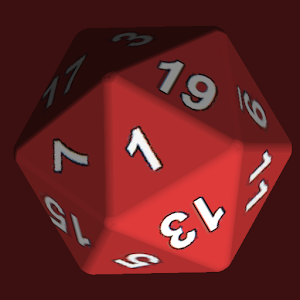
It was, and it is, this cherry red twenty-sided die. He was rolling it on the table. It sounded like clattering bones. At the time there was a game not far from his table and I could hear the beginnings of an argument: mainly what I thought was bickering over rules or some over-enthusiastic debate about combat resolution. You know: just usual disputes.

I sat down with him. His hoodie obscured most of his face — except for his scruffy chin — and completely blocked out his eyes with shadow. I introduced myself. He said nothing. He just kept rolling that one die of his. I saw his three-day pass hung around his neck and I finally got a glimpse at the messy handwriting on it that I couldn’t make out even. I told him what panels and games I’d come for and asked him what he was here for.

Gradually, he started talking. Sometimes I couldn’t make out his words over the sounds of groaning and yelling from the nearby gamer table. We, naturally, started talking about gaming.

“I always loved Dungeons and Dragons,” he said in a soft, soft voice.

“Loved?” I asked, puzzled at the emphasis on the past-tense.

He inclined his head a bit and kept rolling his die, though I didn’t see the number it landed on then, “Yes well … I liked the role-playing element more than most. I found the numbers, the positioning of the figurines and the math to be freaking tedious at times. No offence.”

“None taken,” I told him, “the rules get updated all the time, but they do structure it out and make it interesting.”

“True,” he said after another bone-rattling dice-roll pause, something that looked like a purely mechanical act more than a nervous tic, “But I really loved getting into character: acting it out and immersing myself into the world. I loved problem-solving through role-playing the character out,” he smiled then and it was almost a happy smile, “Yeah. I was one of those kinds of players.”

“Hey, liking Batman doesn’t make your dick bigger,” I said, “though really it’s beautiful women that do it for me.”

He actually chuckled a bit at that, “Yeah. Elitism sucks … especially when you are the only one.”

I didn’t quite know what he meant by that, but it was enough for me to sense that there was a talk coming. For one, he stopped rolling his die. From my own DMing experience I knew this was the time to be quiet and listen.

“You know, some of them think I actually traded all my good rolls to Lord Orkus: to make my dick bigger or some shit like that,” the other looked down at himself, “If that was the case, maybe I should have prayed to the Dragon god Bahamut instead.

“It just … started one day. I don’t even remember when. I can tell you, though, what it feels like.

“You know when you’re going to have a good roll or a bad one. I think every gambler and role-player knows it on some very intrinsic level,” he rolled his die and this time I saw it land on a big, fat, white 1, “When it’s a good roll, or one with great possibility it sings and surges through your blood. There’s hope. There’s excitement. There’s fun,” he rolls the die again and it lands on the same number, “But when you have a bad roll, it feels flat. Your stomach sinks when you cast that die, and you know even before it lands what it’s going to be: if you’re honest with yourself. Dread makes it even more sour and you don’t even want to look at it. It is just that bad.”

He rolled it again, “Every one of us knows what kind of roll we’re going to get. We just lie to ourselves and say it’s purely up to chance. I’m not even sure if the die affects our luck, or if it’s our own spirit — our self-confidence and personal energy — that affects the die.”

The die landed on another 1 as he continued talking, “My friends heckled me. They said I was cursed. ‘You’re cursed, Lucky 1s,’ they told me, ‘you’re cursed …'” he shook his head, “No matter what I rolled, it’s always been the same. I role-played as best I could, but the dice always betrayed me,” I could feel him glaring down at that 1 with a very palpable sense of hatred, “Eventually, I kept being the one to screw up our group quests and they stopped inviting me to games.”

“I’m sorry,” I told him, and meant it, “That was a shitty thing to do.”

“My attitude was getting worse, to be fair,” he rolled the die, making it clatter dangerously near the table’s edge, “I kept this die: where it all started from. I thought I might as well at least be honest about that with myself. I was so … angry, you know? They blamed me for my bad rolls. Blamed me like I was somehow responsible for them. Like I wanted them on some level. It was bullshit.

“Sometimes I think they did it to me. There’s energy in group games–good and bad–and after a while I started to believe it. I started to embody it.”

“Those are a lot of 1s,” I admitted, with a little ripple of goosebumps forming across my arms, “Maybe you have five dots in Entropy.”

“Dots?”

Mage: The Ascension,” I told him, “Well, that’s how stats work in White Wolf’s Old World of Darkness campaigns. In Ascension, the Euthanatos are mages that deal in death and luck: in matter breaking down and continuously changing. Entropy. Somehow, I think you might like that game.”

“Heh. It does sound cool. It would be nice to play again and not suck,” between the sharper sounds of him rolling the die hard against the table and the growing clamour of the other table, it was getting harder to hear him, “You know, some people get Natural 20s on their rolls. All the time. But I get 1s. I get freaking,” he rolled the die, “goddamned,” he rolled the die again, “1s!

Suddenly, he just whipped that die onto the ground beside us. I looked down and, yeah, it was very creepy. Even on the floor, it landed on a 1. I was almost tempted to mention that he needed some Felix Felicis, but that was definitely not the time for a Harry Potter joke.

We were both quiet for a while. His shoulders were slouching. To be honest, he looked miserable and lonely: the kind of person that wished they would be eaten by a Grue.

I don’t know why I did it. I reached down and picked up his die. The noise from the other table was getting very rowdy. Some of the players were leaving. I slid the die over to his hands on the table. And, to this day, I really don’t know why I asked him this one question: but I did.

“Have you ever gotten Natural 20s?”

It was a dumb question after everything that I had observed today. But instead of walking away, or shouting at me, or smirking, he looked down at the red die and said, “Only in a group. And only when I get angry.”

He picked up the die and whipped it on the table with a hard crack. I was almost surprised the Game Con Volunteers and security guards didn’t hear it, but the sounds from the other table probably drowned it out. He did it again. And again. And again. It was like a gunshot each time.

20.

20.

20.

Critical hit.

Critical hit.

Critical hit.

Finally, the whole other table close to us dispersed and I could hear some of the departing conversation, “All bad rolls.”

“And 1s. So many fucking 1s …”

He looked up at me then and I could finally see his eyes. They were dark and sad.

“That is the real reason why no one will play with me. Ever.

“You know, some people just get Natural 20s with a kind of cockiness or an easy grace. I wish I had been one of them. But if ‘should-ofs’ were treasure, we’d all have a lot of fat loots.”

He got up then and handed his die back to me, “I think I’ve finally rolled all the 1s out of this fucker. Maybe a few of the 20s too. There are some solid numbers left though. Good numbers. Not too lucky, but not a fumbler. Damn, I hate being called that … almost as much as Lucky 1s … Anyway, thanks for listening.”

“Hey,” I said before he could leave, “you should really check into LARPing. There’s a Mage game here at the Con. I think you’d like it.”

His back was facing me at this point, but I thought I saw him nod. Then, he vanished into a crowd of oncoming players.

I still see him around, you know, that guy they still call “Lucky 1s.” He doesn’t just stand around as much anymore, I’m glad to say. Evidently he found that Live-Action Mage game I told him about: where he plays as a Euthanatos that feeds on the bad luck of others. He doesn’t wear his hoodie now and he smiles a lot more.

I still have his 20-sided die and I have to say that — to this day — I’ve never failed a roll.

Skeletons Have All the Fun

It isn’t even a ten-minute walk from the Velvet to Rainbow Nosferatu’s club, but his chest still aches. He shakes his head and looks up at his handiwork.

The Scrawling is in the back of the office complex closest to the parking lot. A sign with stylized cursive red font over a black background greets him: complete with a skeleton’s hand drawing a hanged stickman on a white skull with a quill. Rainbow Nosferatu spares a glance at the makeshift bike-rack below the steps of the entrance: knowing he will be back for his ride later as he enters his club.

Despite his name, Rainbow Nosferatu finds himself bathed in the familiar dark red light of the remaining candles in their glasses on the tables closest to the door. A large projector screen dominates the dark red club while slide-shows scroll through a variety of images up overhead. He waves at some of the staff as they continue cleaning up for the night. Chairs and tables scrape across the floor without the music that has no doubt stopped for the night. But this doesn’t bother Rainbow Nosferatu. Instead, he closes his eyes for a few moments and basks in the warmth of the place he made with his few friends, very little money and a great deal of love.

The feeling of sunflowers seems to approach him from behind and he actually smiles a bit–for real this time–as he opens his eyes and watches the slide on the screen transition into another page from a public domain 1950s horror comic.

“You know,” he says, looking up at a scene of skeletons rising up from their graves to embrace a screaming blonde-haired woman in a white bridal gown, “Skeletons used to be so cool in the fifties.”

The sense of sunflowers seemed to laugh with its voice, “Probably because some people needed a real proper boning.”

Rainbow Nosferatu shakes his head, “They weren’t just about the sex. No, there was the vengeance too. Artists in those days could only be so … graphic,” he turns to her as she groans, “What? You just did that earlier Marigold. It’s true though. Underneath all that flesh, we just want to possess each other: out of anger and out of passion. Now it’s all about the zombies: eating flesh indiscriminately and not caring about where your meal has been, or what it even tastes like.”

“I don’t know boss,” Marigold grins up at him through twisted red and yellow dreadlocks, “Flesh-eating has at least a few uses I can think of.”

“True,” Rainbow Nosferatu can’t help but smirk at this game of innuendo, “But a skeleton still has their personality. Even without a bit of flesh on them, they still remember who or what wronged them. They remember what life was like when they had it. Revenge or lust, they keep their eye-socket on the prize and they take what they want. They are the bare essence of want.”

“Ah, so you mean to say ‘kids these days,’ huh Rain?” she wraps an arm around his shoulder and hugs him.

“Yeah, those gosh-darned zombie goth kids these days,” he says ruefully and moves to lean his head against hers in order to return her brief half-hug, “Were there many of them since I was last here?”

Marigold smoothes out the ivory dress on her lithe frame, “Nah boss. A few writer-types. One girl asked for something at the juice-bar and I made it for her. There was a dancer or two. Some Tarot-readers. Oh, and some of the Ancients dropped by and asked about you. Not much else though.”

Rainbow Nosferatu sees as much. The juice stall is closed for the night. Marigold made excellent drinks among hostessing and ticket-collecting. Despite what he told Jake earlier about checking on drinking in his club–which was mostly to get away from him anyway–he couldn’t actually afford a liquor license: yet another thing Linda would remind him of …

“Don’t come back until you have your shit together.”

Rainbow Nosferatu suddenly feels tired, “I guess the All-Ages Nights are going the way of the skeletons too,” he looks sadly around the place, his place, “Has Linda …”

“No,” Marigold shakes her head, “I’m sorry, boss, but I didn’t see her come in or down from the loft,” she puts a hand on his shoulder, “Is everything ok Rain?”

He looks at her for a few moments and senses her warmth and concern. He knows that sometimes she can see right through him: through each other without the details, “Is my aura really that blue?”

“Yeah, well,” she shrugs again, “Let me put it to you this way: your aura might as well be singing ‘I hurt myself today’ in Texican drawl.”

“Heh,” he gives her that, knowing that she is trying to make him laugh and feel a bit better, “I thought … Linda and I thought to ourselves: ‘Wouldn’t it be cool to make a Club for All-Ages where you can sit and write, or dance to Dead Can Dance or Sisters of Mercy while reading projected slides of old horror comics and poetry on the screen instead of watching muted TV shows or music videos?’ But we weren’t prepared for the costs. Now things are changing and I guess, in the end, that’s the way things go.”

“I still think it’s a really awesome idea, Rain,” she squeezes his hand.

“Yeah. Me too,” Rainbow Nosferatu sighs, “we had some good times here. But it’s only a matter of time now … before we go the way of Sanctuary.”

“We lasted a while, Rain.”

“A few months now,” he nods, “I guess we have one more at best. Maybe I can get away with using some epic video game boss battle sound-track for the Last Nights!” he somehow manages to wink against his crushing sadness.

“We’ll have a Gothic Tetris face-off,” Marigold says, “with Dark Soundtracks and Fin de Siecle Tequila Shots!”

“Sounds like a date!” Rainbow Nosferatu hears himself say and inwardly winces at the choice of words, “Well, I’m heading off now. See you next week Marigold.”

“See you. Oh, boss, I almost forgot something.”

Rainbow Nosferatu blinks. He can see the sunflower glow around Marigold become subdued with blue, “What is it Marigold?”

She reaches into her bra and takes out a small envelope, “It’s from … Lily.”

Rainbow Nosferatu feels his hands turn clammy.

“Oh,” he says simply, dumbly, staring at the letter in Marigold’s hand, “I’d been trying to get in touch with her for a while now …”

“I know,” Marigold’s eyes look at him with sympathy, “I didn’t open–”

He waves her off as he takes the letter, “Oh I know that, Mari. I appreciate you holding this for me.”

He doesn’t tell her that he’d been sending emails, texts and voice messages to Lily for a month or so now: every once and a while … trying to be unobtrusive. Trying not to be needy … and slowly going crazy inside from not hearing from her. Dark-haired, pallid, thin slight Lily with her love of Neil Gaiman’s Death and the way she listened to his stories whenever they hung out here at The Scrawling. She’d met Linda and they seemed to have gotten along. He and her would hold hands whenever she made it. That was all they really did for a month. It had made him happy to hold that slight pale hand in his own that made his seem so awkward and gangly by comparison.

He remembered her email quite a few nights ago: finally telling him she would get in contact with him soon. He’d almost forgotten that email. Almost.

“You’d never turn pussy down,” he remembers Linda screaming at him during that fight, “In fact, you pride yourself on it.”

He turns away and opens the letter. It is a simple piece of paper with three words written in beautiful cursive writing.

Stop writing me.

Rainbow Nosferatu blinks. Stop. Writing. Me. Each word hits him. Each word is like a punch to the stomach. Three punches to the stomach. Three times. He swallows.

“Rain?”

Marigold walks in front of him and takes the letter. She looks at it. Her subdued aura becomes a burning one of vivid reds, blues and violets, “Oh Rain, I’m …”

“I-it’s ok, Marigold,” he says, quietly, “I guess … in the end, she’s just a kid. She …”

“She’s twenty years old, Rain,” Marigold looks as angry as she feels to him, “She was adult enough to get into it. She knew what she was doing. I did back in the day. And this … this is just totally uncool! I mean … oh Rain, I’m sorry.”

She hugs him again. It takes him a few moments, but he returns her embrace, “It’s okay, Mari,” he gently pushes her away, “I’m … disappointed, I won’t lie. But with Linda and everything, it’s … just as well now. Wow. I’m really not having a good month,” he shakes his head and finds himself tucking the piece of paper into his pants pocket, “Gosh darn zombie goth kids these days I guess,” he smiles weakly, “I need to go.”

“Are you sure? Rain …”

He looks at her: Marigold the bartender, waitress, ticket-collector, dancer, Goth, one of the few that believed sunflowers were happy accidents of God, who knew what obscure movie that paraphrase came from, one of his few friends who he knows that right now–anytime–but especially right now would do anything for him. Anything. He breaks that half-thought and he’s glad his face is painted white enough to cover the red that threatens it.

“I need some time to myself right now. Thank you. Love you, Mari. See you later,” he hugs her one more time and leaves.

He wonders, as he clears the door and down the stairs, what people might think of the streaks of black mascara and white make-up rolling down his face. Maybe they would think he’s some dumb punk kid. Or maybe a clown. That was it. Maybe they’d think he was the Great Pagliacci.

Pagliacci: the Gothic Clown.

Healing Potions

It began like every one of our quests.

We were fighting a marauding tribe of orcs and, naturally, I was the first person to be brought down. It was just like clockwork–the clockwork that I, as an artificer never truly mastered–in that my companions charged into the fore and I was left on the ground with a gash on my side and a deep cut across the flesh of the tendons of my left hand.

Perhaps I was too used to it by now. The captain of the current company I joined at least had the decency to cut down the orc that slashed into me as the repeater crossbow in my hands jammed: as it repeatedly did. I remember the orc lying there: its purple-tattooed green face glaring sightlessly at a man that killed it without a moment’s glance and ignoring my semi-conscious form lying beside it forever.

My fingers were shaking as I reached for my pouch … with my healing potions. Most of my pay often went into buying those concoctions. Sometimes I had enough coin to purchase some raw ingredients, but the cost of the equipment and the process of making them took ages and even more resources to upkeep.

It was amazing that such mundane details were flitting through my mind at the time as I struggled to take out a flask of potion: along with thoughts of how my current commander, like many others before him, wouldn’t even let the company healer touch me: as a pettiness for my fumbling in the heat of battle.

So I had to keep stocked up on healing potions and my own food or I wouldn’t have survived even half as long as I already had. My hands were so numb and cold as I forced the potion to my lips. I could feel the familiar burning warmth of the healing fluid churning down my throat, heightening my sense of my surroundings followed by a deep coughing fit coming on.

I feel this so many times. It is a pure, cleansing fire in my blood. And then I finally coughed. It was a long racking cough that splattered out some of the potion I was trying to keep down. I couldn’t even swallow a healing potion right, it seemed.

But then my self-disgust was interrupted something else. To this day, I am not sure how I even noticed it. Perhaps it was the heightened state of regeneration that I always felt when I drink a healing potion: a thing that temporarily augmented my eye sight, or cleared my brains enough to focus on minutiae.

Half of the liquid I spewed out had splattered on the orc: or, more specifically, on its severed arm. I hadn’t noticed that my commander had amputated my attacker before killing it. As far as impromptu battle amputations went, it was fairly utilitarian: in that it wasn’t a clean cut. I saw the ripped pieces of ligament and flesh on the cut part of the limb. It was an ugly and jagged hack-job: one that I was glad none of my limbs had experienced as of yet.

But I didn’t expect what happened next.

Allow me to clarify, if you will pardon the pun: for I had not, in fact, drunk a Potion of Clarity. My powers, such as they were then, did not come back to me: especially since I hadn’t even had time to use any of them before being cut down. That was why I could see so clear-headedly at that moment. Maybe I had one too many healing potions over the years and I’d built up a tolerance. Certainly, the little tinctures I drink every day now help me deal with the headaches. To be honest, I’m actually surprised that I never noticed what I saw sooner.

The mutilated flesh and sinew on the ragged end of the orc limb was slowly, and very gradually, knitting itself back together. I just … looked at it. Maybe there was a time where I might have thought it a trick of the eye or a hallucination from trauma. I might have even considered that the dead creature could have had some troll blood in him. But it was like watching fleshly grass growing back, creeping back, at a steady and accelerated rate. I remember not knowing what to think, but being utterly fascinated by it. Yet it didn’t last long. Then.

It must have been only a few seconds at least. Now, this in itself might have–again–proved nothing to me: just some bizarre residual effect of a substance that perhaps all apprentice healers and alchemists may have learned about in their respective guilds and academies, or at the knees of their masters. But then…

It twitched.

At the time, I still had doubts. I knew enough of healer-craft to know that there was enough blood and energy in a limb–if freshly cut–to still have a brief semblance of life. As it was, I didn’t even know how long ago the commander had cut it off: with everything still feeling like it was in this heavy kind of eternal present.

I immediately started looking around at the corpses now littering the field: afraid that the orcs were being led by a dark priest or a necromancer. But none of the other bodies stirred. Just the arm. And when I looked back, it had stopped moving.

But that sight never left me. I looked down at the empty flask in my hand, at the limb, and back again. And I experienced more … clarity.

I quit that adventuring company with little money to spare, but I joined many others. The transition was not as difficult as some might believe. As an artificer, you learn that there are mechanisms that function well and smoothly due to the interconnection of different parts. I kept up my skills in making devices and imbuing power into artifacts, but my main focus had shifted to surround the art of alchemy.

I stayed out of combat: save when my company was often finished with the initial assaults. Eventually, I saved up enough coin to study under an alchemical master or two. Though my skills as an artificer were poor in battle, they were invaluable in maintaining the equipment of my teachers, and I could effort to continue my studies with them.

I also began to observe healers: not the ones that solely drew their power from the gods, but the ones that practised surgery and medicine. Selling them custom-made equipment and supplies–which I could make now as a working apprentice in the Guild of Alchemists– also made them a lot more forthcoming.

I’d never been so focused or so motivated in my life. I’ve also always been a solitary man and thus had no other obligations aside from my livelihood … and my other work.

So, as I said, healing potions are very expensive. It did help, however, that I was not getting injured as often and so when I did buy them–or make them–I could use them for other matters. Sometimes I missed the bitter medicinal tang on my tongue and that uniquely therapeutic burn in the pit of my stomach, but that had been replaced with another form of simmering passion.

I still had my tinctures for my usual body aches and now actual Potions of Clarity to help me with my Great Work.

I realized it was all about the amount of dosage. And on the adventuring assignments that I still undertook on behalf of my tutors, my comrades made enough corpses for my initial studies. My companies didn’t suffer for it either. I sometimes functioned as the healer of our group when there were no priests or paladins among our numbers. And everyone knows that the healer is a vital part of an adventurer group. You can literally hold the power of life or death over your entire group as a healer. Not that this had ever really occurred to me.

I had far loftier goals.

I eventually learned how to make a severed limb move by itself. I definitely began to see evidence of twitching and movement. Most of these limbs were taken from orcs and goblins: generally beings with small cranial capacity. But I did have occasion to deal with some human matter even then. And my preservatives helped make for good flesh-grafting material.

But the real work began after I retired from direct adventuring and my apprenticeships to invest in a potions cart. It helped that I joined the Alchemist Guild as a full member and became licensed to carry–and examine–various alchemical substances. I travelled through many towns until I settled down to make my Potions Shop. I realized after a time that the limbs I reanimated could only function for so long before succumbing to inevitable decay without some kind of more self-contained environment.

So I crafted and invested in vats and various apparatus. I learned how to make Regeneration Potions: essentially more augmented versions of my favourite healing concoctions. They are hard and even dangerous substances to make. Even the Guild only reluctantly makes them available to the public, with more of them being sold bootleg by rogue alchemists and I learned that healing potions are actually a scaled-down version of the substance sold at exorbitant prices in order to make a profit and prevent said danger.

I began to understand what made the Guild so afraid. I’ve always found it easier to work with orc parts. Some say it was because once, long ago, a powerful wizard made them: crafting their flesh from something else altogether. It was an incredibly vague myth and very few outside arcane circles even knew about it beyond just those simple words. But I know that I began to wonder.

Most beings believe that we were all inorganic matter before the gods gave us breath. By comparison, I was doing something far more crude. It is like trying to construct an artifact of an older era by taking it apart and attempting to reverse-engineer it. But the problem was that I was still thinking like a traditional artificer.

Finding components–and yes sometimes I still use an artificer’s terminology–was not difficult. Although I wasn’t on campaigns or battlefields anymore, my shop was in a city. In this world, brawlers and warriors of different races die all the time and their bodies are usually thrown out into those garbage pits known as public graves anyways.

Yet before I began using human material, I had to fine-tune it.

Once, I was curious about something. I knew that there are some plants in the world whose cuttings could grow roots in the right substance and become whole new plants. I began to wonder what would happen if I put even a tincture of blood or tissue into one of my vats of Regeneration Potion.

The plant analogy was an apt one, and not merely because of the cuttings. Certainly limbs were easier to use but the … things that resulted from them are limited in scope. As their brains develop, they are more used to obeying commands drummed into them than making decisions of their own. Most of these were like animals that barely lasted a day in any case. No, the best element about the flora analogy is that in every drop of blood and piece of flesh there are the seeds for something … more.

This took too much time, however, and most of these experiments happened only on a limited basis. It didn’t take much to fake my own death and destroy my old shop. People were beginning to notice that I wasn’t aging like they were and sometimes my creations became more … vocal: even in the basement of my Shop.

I managed to take all of my coin and buy new resources. There is an old tower on the farthest island off the main continent that suits my privacy and that of my creations well. I have enough vats of potion to keep us going for quite some time.

Nowadays I am less interested in cobbling together old creatures and things derived from said beings, and far more intrigued by other prospects. It is said that a long time ago the gods forged us from cold clay and stone. It has been some centuries since I placed those imbued drops into my Generation Vats. I watch marrow grow from nothing into bone with coils of nerves and sinew creeping along … and the first layers of flesh will spread over them soon …

And so I continue to drink my own delicious, home-brewed healing potions, curious to see how what comes from them will live in the land that I give them.

Necromancer

I catch them in a pool
of ruby libation
leisurely prepared
though they try to repent
in haste.

The spirits that always followed
in the grey charnel fields
and faded Edens that trail behind me,
and the ones always loomed ahead
in the spires that haven’t crumbled
and the blankness that is always there
across the furtive lake:
they find the liquid feast
to tide them over before
they return to the repast
of my own mind …

Only to be captured by their hunger.

They scream and cry
as the words come back to them
and they tell me the things
clearly that they hissed
and whispered in the slips
between my vigilance
and the terrible question:

How many red? How many red?
How many … red?

I do not answer what the dead
and the not gone yet already know.

Trapped in silken streams
I take them into my hands
rolling them into my palms
and savour the burning muck
as it finally stains my skin
and self honestly.

I make the pain into a chord
and begin to spread their blended whiteness,
hammering their grey cold feelings,
burning their secrets,
distilling the vapours into an old formula …
until I have all the substance.

Folded edges fold again
upon themselves and each layer,
each wire moulds them
and the sweetness and pleasure
replaces the churning depths of Agon.

For weaving the ghost-metal
into legions of origami weapons:
their stories now my own
to unleash on the planes
of hindsight:
they are perfection every time.

Imagination Is Thicker Than Blood

In a post that Vampire Maman wrote, You Transfix Me Quite, she talks about how the character of Jane Eyre would have made an excellent vampire. Vampire Maman has a lot of very interesting and entertaining creative writing, but it reminded me of something I bring up from time to time out of a sense of sheer silliness.

I never played the Old World of Darkness Vampire: The Masquerade role-playing game, but I heard people talk about it and I researched as much about it as I could online. And I always wondered what kind of vampire I would be in that world.

There are many different Clans and, more specifically, Bloodlines in Vampire: The Masquerade. As a result, each vampire belonging to a particular line had different attributes than his or her fellow. Originally I toyed with being part of Clan Tremere because of their knowledge of blood magic and the fact that they seized their vampirism: they weren’t–at least knowingly–turned by another vampire, but rather they were mages that took blood from a captured vampire to make themselves powerful and immortal … though they didn’t count on the fact that they would still possess the inherent weaknesses of the Kindred.

But I abandoned that idea because they are too stratified in social structure and limited in numbers. So I thought I might have been a Ventrue. And indeed, some people believe that I am a very calm, detached, and dispassionate being whenever they meet me offline. I can be calculating and organizational like this Clan tends to be portrayed but this is not my major strong point and not even a fraction of the personality I really have. Still, I can appreciate the Blood Discipline of Dominate: you know, that stereotypical ability to hypnotize or mesmerize another being.

My girlfriend once said that I would make an excellent member of the Toreadors. A Toreador is either a very beautiful vampire that creates a series of social networks and supports various kinds of art, or they are artists themselves that spend their immortality oftentimes secluded and making new things, or they are both. Generally, they are closest to humanity as they like to watch and support their artistic endeavours and fads. Aside from the compliment of being compared to something beautiful and creative, I also share their obsession with a particular object: such as art. Yet they can also be very vain and fickle, and while I have some of those traits, they are not paramount in who I am.

Which brings me to the final Clan I was told about. One day, my girlfriend changed her mind about something. She thought that I could also be a Brujah. Now, I had heard about this Clan. In the Modern Nights era of that world, they were generally characterized as passionate, frenzied vampires that were usually punks, brawlers, and anarchists. However, in ancient times they were known as disciplined warriors and philosophers that embraced a particular ideal: honing body, mind, soul, and altered power to fight for what they believed in. They were not merely turned from fighters, but also lawmakers, orators, and thinkers. I can also see them having turned some artists along the way as well: much like the Toreador.

I would not be a typical Brujah of the modern period, I would imagine and I would probably seem more like a Toreador on the surface with some Ventrue discipline and calculation. At the same time, I would definitely be a fighter and a defiant force: through the imagery of my words.

But all these distinctions aside, would I make a good vampire? The answer is that I probably would in a very reluctant sort of way. I already have difficulty with a mortal life, and immortality would just be inconceivable with my range of emotions. On the other hand, a lot of physical burdens would no longer be an issue and perhaps–just like in this real world–I would have phases of activity and dormancy. Maybe with time I would surpass many mental challenges and blocks as well. It is hard to say what it would like in a hypothetical and fictional situation but, like I said, it is definitely fun to think about.

Berserker

Unhappiness grows within me,
deep inside until, in the end
it becomes mine.

Unfurling through my being,
it ingrains itself deep into the bone
and the still lips of my mouth.

My face unlined, unsmiling
it hollows out the bore
within the centre of my chest:
leaving only emptiness.

But it is not nothing,
for the blackhole is the prelude to an
exploding star.

Anger turned inward
by powder-pegs of savoury bitterness
and the elegant fabric of contempt stretched thin
rips inside out into the red light
of vital defiance.

I taste it on my tongue
and my faceless mask twists
into a quirk of disdain
and then a tight, tight grin.
And I laugh.

The sound is high and cold, encompassing,
and all inclusive.
For the wound-womb of my soul,
shaped by my unhappiness,
is filled again
with the culmination of all these things.

With bloody glee.

With fire.

With power.

It is perfect symmetry
this force that I use,
that uses me,
that I let use me,
to smash the faces of cowardice,
and treachery, of hypocrisy
and promises never made.
And I enjoy their pain.

Especially my own.

Each blow I make is hard
and potent beyond endurance.
It strains and snaps a part of me,
burning edges of myself away,
as I dance.

But I do not care as I am too caught
in the moment to feel the pain
save for how it adds nuance
to the beauty of my rage.

The shadow of me quickly
becomes the dancer of obliteration.

Then all that is left is destruction:
immune to appearance, to sentiment, to reason,
to responsibility, and to conscience.
And I laugh, and laugh, and laugh
gloriously: because it is good …

Because it is freedom.

My hatred is pure,
purging and scouring fire
leaving no mistakes, no good memories,
nothing behind as it starts from
Before: from Ground Zero.

And the small part that wants
someone to stop me only adds
to the meaning of what I do.
Because finally,
when the world matches the darkness
inside of me,
and hatred finally dies,
perhaps then all that will be left
to fill it is love
and compassion.

If not from me,
then from someone better.

Exhaustion takes me:
and the spot made from my unhappiness
lets me come into itself,
as I curl into the warmth of its comforting shadows.