Boo

It thinks that I can’t see it, but I can.

I walk up the stairs to my room. Something repellent moves from the corner of my eye, but I ignore it. Now is not the time. It will be gone by the time I look. My back feels exposed and raw. No. Not yet.

I almost expect it to be in the hallway mirror. It likes to do that: staying there in the glass glowing and rotting long enough for your heart to lurch and a keening sense of wrongness–of wrong clarity–yanking your insides down, down, down like a bad realization.

I turn the corner–it always loves to hide in corners–near the bathroom and I half-expect to see its sickening, unnatural face there. But not yet. The floor creaking breaks the stillness of white noise in my ears and then, I know.

I get to my room and then turn on the light. I see it for a few seconds!

Despite myself, my back is ice. I take the time to breathe. The last time it did that, it was a pale woman in a tattered dress and a shredded eyeless face in the middle of the night. I blinked once and she was right in front of me. Then she was gone.

I climb into my bed despite the other memories. It’s worse when you can’t see it. I lean my neck against the headboard as I put my laptop with its makeshift worn plastic box prop onto my stomach. The unsettling feeling that’s been with me for a while now is prickling stronger. It likes it when I think about it. It likes it when you think about all the other times it got you before: playing its sick game of tag, and hide and go seek.

And it cheats every time.

See, it knows. It knows that I know it’s there now. It can smell it on you: that mix of anxiety and anticipation that is human fear. I move my fingers across the small cramped keyboard: looking at my email while I know it’s watching me.

Click.

Click.

Click.

My bladder is filling up. It’s getting closer. I can feel it grinning now. I’m trying not to think about the times I don’t see it … the times I don’t see it as it rocks my bed in the night, or touches me in the dark … even under the covers …

It is the only thing that can be both hider and seeker in its games, but whatever else it is always a predator.

I surf the Net to a page displaying an animated GIF of a Boo Diddley from the Super Mario games. I watch the small pixelated white cartoon ghost making faces at the back of a pot-bellied plumber, soaring towards him with a red-eyed gaze and a vicious fanged grin before the latter turns around and it covers its face: as though fading out of reality with transparent chagrin.

This ridiculous image reinforces my knowledge. I slowly look over the top of my laptop. It’s standing at my desk chair: a hideous, twisted thing out of nowhere, the farthest thing from a cute cartoon or anything else from this world …

And I will it into place.

It’s all over: just like that. I get up and keep my eyes on it. It seems like it’s struggling, but it can’t move. It is fucking repulsive. Every part of me wants to be gone from it. My skin and the nerves underneath want to crawl away from the thing, as my bones become stone. But I make myself look at it.

“I have to admit,” I tell it, as it crouches there misshapen on the carpeted floor, “I made all of you well, but I think I made you best of all.”

I feel the power of my will wash away the dregs of my fear as animal repulsion turns into a strange kind of fascination. Its body is crooked and stunted. The thing is naked too: its skin glistening with a wet kind of pale blue luminosity. It doesn’t have any eyes or ears and there is a flat line, almost like a fine horizontal gash, where its mouth could have been.

I walk slowly towards it, “Just forms in the dark,” I move slightly off to the side, “You were always there. I wanted to see … I wanted to see if I could make something like you: if you’d attack your creator.”

It makes no sound at all. The grim fascination is quickly becoming a morbid disgust: like seeing a particularly bizarre form of insect intruding into a human living space. It shouldn’t belong here, but somehow it does. And that bothers me. I pick up the baseball bat I left leaning on the side of my dresser.

“You thrive on uncertainty and seeming on the fringes of things,” I lift the bat over my head in a two-handed grip, “Sure, when you startle someone, you are all tough shit. But here, in the light, without your cover you look unreal. Fake. Just as I made you.”

It’s that age-old admonition to never reveal the monster in a horror story. Otherwise, it has no more power. It never did. I begin to swing the bat downward … until it chuckles. It is a faint, rustling form of wheezing. My bat is inches away from its face. The thin line that is its mouth twists and I more feel it than hear it speak.

“You didn’t make us.”

I … can’t move. It gets up. The fact that it is several inches shorter than me doesn’t make me feel any better. I can feel it managing to look at me without eyes. It speaks again.

“We were forms in the dark. Things in the shadows. And we’ve watched you,” its voice scraps like leaves across the pavement, “We watch you as you are born in your own filth and blood. We see you become gangly, awkward beasts with sweet-smelling hormones: though you aren’t yet ripe. You put your dripping parts into each other to make more squalling things in perpetual pain and fear of the dark and you delude yourselves into thinking that you are not alone.

“And that is the sweetest of all.”

I’m willing my eyes on the thing I made, willing my arms to swing down, to back away …

“The broken bones are an added bonus, but they aren’t necessary,” it explains to me, “the shattered dreams add spicing. Sometimes, you slit yourselves open, or smash yourselves into adolescent pulp before your maturation, before your time … as if you already know.”

It’s the first time it’s ever spoken to me. I want it to shut up. I want to make it die.

“No. Our favourites are the ones that age to ripeness and perfection: the ones that gradually begin to see themselves for what they really are, what we see you to be,” the thing’s thin mouth peels back, revealing long and yellow stinking teeth, “Hollow brittle shells of dark churning space against the pressures of gravity. You are born in pain, and you live in it, and–in the end–you die in it. Despair aged to perfection has a unique flavour.

“And then you hope it ends in death.”

The last thing I want to hear is the sound of its laughter. It reaches a long, slick bony talon towards my face, “You see, it’s not so much that you created us … it’s that we created you. We made you: to suffer in all the little banal ways first. All the hidden, shameful, unspoken, lonely human ways. We get to watch as you die slowly inside and out … and when we watch, we feast. We feast as you return to the filth you came from. We devour you as you return to the dark … from where we crafted you.

“And we love your sense of self-delusion. Because false hope … it is our delicacy.”

My bat slams down into its skull. It smashes into its face. It’s more like my body is the one in fury, my adrenaline speaking with my voice, my voice being my hands, my feet, and my weapon while my blood is my sheer unadulterated hate. My arms and fists are aching. Somehow the bat is gone and I’m beating the thing. I’m beating it to a pulp. I can’t think. I won’t think.

My fingernails gouge into its slimy skin. My teeth sink into ichor. I taste bitterness. A part of my mind knows that it will be over soon: that others will find me. Maybe it will be my family, or more of these … things. They will find me in my torn clothes with another’s blood on my chin and torn flesh in my mouth with the pulped remains of another sentient being under me. Or maybe they will find me alone, with no one else, crazy and without my mind. Perhaps they’ll take me away where the things will keep laughing at me in the dark: amused enough by my new … enlightenment to let me live on like this.

Perhaps it was never a game of tag or hide and seek. Maybe it was just a joke with the following punch-line.

I am a monster. And I don’t care.

Maybe that’s what I’ve always been. Maybe I’ve finally found what I’m really looking for. Somehow, I see myself smiling just like the Boo still flashing on my laptop screen: looking away from myself and grinning … wickedly.

The Art of Truth-Telling

I ask the dead to teach me to tell the truth. But they say that they cannot.

Deep within the sepulchric depths of their Temple, as I shiver in a cold that dead flesh and bone can no longer feel, they tell me that they cannot tell me the truth because all things already know it.

They tell me that the truth is an ugly thing: naked, hard, and cold. In its purest form it is sterile at best, and inevitable to its highest degree: like a dull pendulum blade or a lump of unrefined ore embedded within a living heart.

No, they tell me that they cannot tell me what I already know. But, they say that they can teach me how to tell the truth.

And I realize that this is what I wanted all along: to clothe that stark objectivity in all the raiment that a philologist’s treasury can offer.

But mostly, I want the knowledge: to know what I have to say to those I love, and to know what to say to myself in the nights long after.

Because, in the end they, the dead … they tell the most excellent of stories.

At the Edge of Her Smile

“I want this,” I tell her.

She looks at me. She was never really what others would call a classical beauty: at least, not classical in this day and age. There is nothing tawny about her: nothing golden, or blonde, or blue-eyed. No, despite whatever they’ve said about her mother, her hair is neither yellow nor strawberry. It isn’t even black.

She, the person I define by what she isn’t, looks at me and purses her pale lips. The moon outlines the top of the alleyway and when it nestles into her tied-back hair, it makes her face glow like silver.

“No shitting?” her voice is an underground river, making her profanity smooth and sibilant. She leans in closer to me, “You know the risks, right?”

Her scent, of ashes and myrrh, makes the ache come back again. I can only nod. She leans even further against me: her head coming up to about my chest. She grabs the lapels of my coat and I can feel her breath on my collarbone: its iciness on my flesh making my back tingle with layers of goose bumps against the graffiti on the brick wall.

I close my eyes and somehow despite our differences in height, I can feel those pale cold lips brush against my lower neck. Even with my eyes closed, I can still see her somewhat oblong chin slanted consideringly one side.

“Once,” she tells me, “and you will be dizzy and light-headed. More, and you’ll probably cum in your pants,” my crotch prickles at her words in my ear, “And anything more than that,” I can feel the flat edge of her straight bold nose touch my chest as she rests her face there, “and you will have more than a little death.”

I hear her nostrils flare as she takes in my scent, like an animal, and I see those white thin lips swelling strong and red with barely contained desire. And my legs … they’re shaking. I don’t know whether I’m bending them, or kneeling on the pavement, or if somehow she has grown taller than me. In a very real way, she is a lot greater than I am. Or ever will be.

“Are you sure?” her voice purrs less in my ears now and more inside my mind.

“Yes.”

Then, she does it. It’s nothing like I expected.

The alleyway disappears. The night is gone too. I feel the blood thumping in my ears less and less … I still hear it, but it’s more abstract now, like the sound of thunder off in the distance. It all falls away into her twilight silvery self.

I see her. And the moon. Within a circle of moonlight, she and her silver-haired sisters dance around a ring of shattered pale monoliths dressed in robes of purple and red. They dance until the moon itself is soaked in red. And I see her eyes — greyer and sharper than an athame, than Athena’s gaze — and the ache grows so much I can’t bear it anymore. My hand grips her head, and I make her take more. I feel myself drifting away, becoming ephemeral and crystal clear. Drifting … into her …

“No.”

The breath gasps out of me and I’m sprawled on the hard concrete near the brick wall. The world’s spinning and I can’t, or won’t get up. My arm hurts. I try to get to my feet and wince against the cold wetness suddenly inside the seat of my jeans.

She stands over me. Her face is flushed and she is breathing heavily with intoxication and fury. Her hair like a silver mantle whips across her face from a very cold breeze while her eyes are older than night, burning and angry.

“No,” she says again and her face is a beast’s: with a beauty and terror that brings out the deepest, keenest longing in me. And then I realize what I almost had her do and just how close she was in doing it, for her to be flushing this hard: just how close I was to having it all fall away from me forever. I feel myself crying.

Slowly, her bestial rage softens into something like sympathy. She leans down and sits beside me. I’m still sobbing, choking on tears and snot as I feel her fingertips on my throbbing arm: the one I probably hurt when I fell. Her touch burns but as she grips my arm, the pain seems to lessen, and disappear altogether.

We sit there for a while as the sky begins to break into an orange-red dawn. Then she turns to me, with an expression almost too human: too human, and old, and long-suffering to belong to any being living on this earth. It’s a glance that makes all the disappointments and empty nights in my life look like short painful breaths by comparison: brief cramps not even worth talking about.

“Next time,” she tells me with a tender croon to her voice, “Come find me when you feel like you have something to lose.”

She smiles and I want to kiss her. Of course, by now, she’s already gone. The sun’s up over the alleyway now and I try to straighten out the mess of myself for the day. Her touch lingers, like an echo, like a fingerprint, or the faint outline of the moon still hovering in the dawning sky. Then I look up at the hidden moon above me and I say to it, “I will.”

Lucky 1s

Every year, at every Game Con, there is this one guy.

He usually stands outside in the hallways, but sometimes you find him sitting by himself in the designer panels lost in his own funk. But more often than not, he sits off to the side of the gaming tables and listens to dice clattering, pencils etching on paper and the voices of Dungeon Masters at work and players at play.

He isn’t a cosplayer, but he doesn’t bother them either. For the most part, he looks pretty unremarkable: just a stubbly-chinned man in black jeans and a dark blue hoodie. But there are three things that stand out about him.

The first is that he doesn’t play in any of the games. Ever. You have to understand, I’ve seen him here three days in a row and Game Con is expensive. The three-day pass does not come cheap. But I’ve seen it on his neck, though some reason I can never make out the name on it. Instead of playing, he always watches the players from a distance. And it is always the players too. He doesn’t creep on the girls dressed in anime costumes or as D&D barbarian women. In fact, he doesn’t even seem to register them. Instead, he just watches the players — both male and female — at play.

I never get that creeper vibe from him, but sometimes when there’s laughter I see his hand clench around the one object he always carries with him.

But I’ve noticed something else. Whenever he does come close to a gaming table — and it’s really the most freaking weirdest thing — the players begin to move away from him. I don’t mean that they shift away uncomfortably or pretend he doesn’t exist as most ostracism works. No: I’m talking about people going off somewhere else to another table, or booth, or right out of the Convention Centre.

I didn’t notice this at first, but for some reason this guy would just not stay in the background for me. But the gamers that left when he came close didn’t even so much as look at him: at all.

I said there were three strange things about this guy, right? Well, I should probably be more specific about the last two, and I will be when I tell you a little more about who he is. One day, I asked some of my buddies about this guy.

“Oh shit man, that’s Lucky 1s.”

“The Fumbler.”

“The Die himself.”

Most of that didn’t tell me anything at first, but I caught on to the “Fumbler” title. They told me more, but it was less. Apparently, “Lucky 1s” was a gamer — a table-top role-player — who had the worst luck with dice-rolling ever. No one seemed to know or remember his real name but apparently, according to Con lore, he always rolled 1s on his dice. It didn’t matter what die he used or what game he played with dice.

He always got 1s.

Word was that he was bad luck. Some said he broke up with his girlfriend before an important quest and it had tainted his luck score. Others thought he attempted to melt and manipulate the ultimate die as some cheaters do and it went horrifically wrong: angering the dice gods forever. Some quietly insisted that he had insulted Wil Wheaton when the man had attempted to bless his dice; while others believed — really truly believed — that he just masturbated too much.

So — in other words — aside from the fact that no one clearly shook hands with the man (and they were clearly ones to talk), most of their claims were superstitious bullshit, and a sad kind of D&D superstitious bullshit to boot: which is of the lowest kind.

But none of them ever went near him: ever. They told me they were “afraid” that his bad luck would taint their luck too and there were … stories … vague, menacing stories.

I think I felt bad for him. I mean, many of us are geeks and we should all know better. Ostracizing someone and spreading rumours about them is bullshit: no matter how bad their luck is. That day, he was sitting in the corner of the gaming room at his own table. I was very aware now of the object in his hand: the one that he always carried.

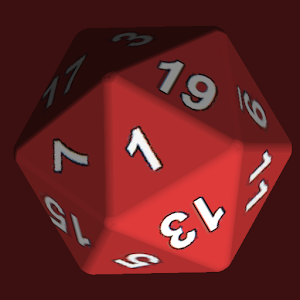
It was, and it is, this cherry red twenty-sided die. He was rolling it on the table. It sounded like clattering bones. At the time there was a game not far from his table and I could hear the beginnings of an argument: mainly what I thought was bickering over rules or some over-enthusiastic debate about combat resolution. You know: just usual disputes.

I sat down with him. His hoodie obscured most of his face — except for his scruffy chin — and completely blocked out his eyes with shadow. I introduced myself. He said nothing. He just kept rolling that one die of his. I saw his three-day pass hung around his neck and I finally got a glimpse at the messy handwriting on it that I couldn’t make out even. I told him what panels and games I’d come for and asked him what he was here for.

Gradually, he started talking. Sometimes I couldn’t make out his words over the sounds of groaning and yelling from the nearby gamer table. We, naturally, started talking about gaming.

“I always loved Dungeons and Dragons,” he said in a soft, soft voice.

“Loved?” I asked, puzzled at the emphasis on the past-tense.

He inclined his head a bit and kept rolling his die, though I didn’t see the number it landed on then, “Yes well … I liked the role-playing element more than most. I found the numbers, the positioning of the figurines and the math to be freaking tedious at times. No offence.”

“None taken,” I told him, “the rules get updated all the time, but they do structure it out and make it interesting.”

“True,” he said after another bone-rattling dice-roll pause, something that looked like a purely mechanical act more than a nervous tic, “But I really loved getting into character: acting it out and immersing myself into the world. I loved problem-solving through role-playing the character out,” he smiled then and it was almost a happy smile, “Yeah. I was one of those kinds of players.”

“Hey, liking Batman doesn’t make your dick bigger,” I said, “though really it’s beautiful women that do it for me.”

He actually chuckled a bit at that, “Yeah. Elitism sucks … especially when you are the only one.”

I didn’t quite know what he meant by that, but it was enough for me to sense that there was a talk coming. For one, he stopped rolling his die. From my own DMing experience I knew this was the time to be quiet and listen.

“You know, some of them think I actually traded all my good rolls to Lord Orkus: to make my dick bigger or some shit like that,” the other looked down at himself, “If that was the case, maybe I should have prayed to the Dragon god Bahamut instead.

“It just … started one day. I don’t even remember when. I can tell you, though, what it feels like.

“You know when you’re going to have a good roll or a bad one. I think every gambler and role-player knows it on some very intrinsic level,” he rolled his die and this time I saw it land on a big, fat, white 1, “When it’s a good roll, or one with great possibility it sings and surges through your blood. There’s hope. There’s excitement. There’s fun,” he rolls the die again and it lands on the same number, “But when you have a bad roll, it feels flat. Your stomach sinks when you cast that die, and you know even before it lands what it’s going to be: if you’re honest with yourself. Dread makes it even more sour and you don’t even want to look at it. It is just that bad.”

He rolled it again, “Every one of us knows what kind of roll we’re going to get. We just lie to ourselves and say it’s purely up to chance. I’m not even sure if the die affects our luck, or if it’s our own spirit — our self-confidence and personal energy — that affects the die.”

The die landed on another 1 as he continued talking, “My friends heckled me. They said I was cursed. ‘You’re cursed, Lucky 1s,’ they told me, ‘you’re cursed …'” he shook his head, “No matter what I rolled, it’s always been the same. I role-played as best I could, but the dice always betrayed me,” I could feel him glaring down at that 1 with a very palpable sense of hatred, “Eventually, I kept being the one to screw up our group quests and they stopped inviting me to games.”

“I’m sorry,” I told him, and meant it, “That was a shitty thing to do.”

“My attitude was getting worse, to be fair,” he rolled the die, making it clatter dangerously near the table’s edge, “I kept this die: where it all started from. I thought I might as well at least be honest about that with myself. I was so … angry, you know? They blamed me for my bad rolls. Blamed me like I was somehow responsible for them. Like I wanted them on some level. It was bullshit.

“Sometimes I think they did it to me. There’s energy in group games–good and bad–and after a while I started to believe it. I started to embody it.”

“Those are a lot of 1s,” I admitted, with a little ripple of goosebumps forming across my arms, “Maybe you have five dots in Entropy.”

“Dots?”

Mage: The Ascension,” I told him, “Well, that’s how stats work in White Wolf’s Old World of Darkness campaigns. In Ascension, the Euthanatos are mages that deal in death and luck: in matter breaking down and continuously changing. Entropy. Somehow, I think you might like that game.”

“Heh. It does sound cool. It would be nice to play again and not suck,” between the sharper sounds of him rolling the die hard against the table and the growing clamour of the other table, it was getting harder to hear him, “You know, some people get Natural 20s on their rolls. All the time. But I get 1s. I get freaking,” he rolled the die, “goddamned,” he rolled the die again, “1s!

Suddenly, he just whipped that die onto the ground beside us. I looked down and, yeah, it was very creepy. Even on the floor, it landed on a 1. I was almost tempted to mention that he needed some Felix Felicis, but that was definitely not the time for a Harry Potter joke.

We were both quiet for a while. His shoulders were slouching. To be honest, he looked miserable and lonely: the kind of person that wished they would be eaten by a Grue.

I don’t know why I did it. I reached down and picked up his die. The noise from the other table was getting very rowdy. Some of the players were leaving. I slid the die over to his hands on the table. And, to this day, I really don’t know why I asked him this one question: but I did.

“Have you ever gotten Natural 20s?”

It was a dumb question after everything that I had observed today. But instead of walking away, or shouting at me, or smirking, he looked down at the red die and said, “Only in a group. And only when I get angry.”

He picked up the die and whipped it on the table with a hard crack. I was almost surprised the Game Con Volunteers and security guards didn’t hear it, but the sounds from the other table probably drowned it out. He did it again. And again. And again. It was like a gunshot each time.

20.

20.

20.

Critical hit.

Critical hit.

Critical hit.

Finally, the whole other table close to us dispersed and I could hear some of the departing conversation, “All bad rolls.”

“And 1s. So many fucking 1s …”

He looked up at me then and I could finally see his eyes. They were dark and sad.

“That is the real reason why no one will play with me. Ever.

“You know, some people just get Natural 20s with a kind of cockiness or an easy grace. I wish I had been one of them. But if ‘should-ofs’ were treasure, we’d all have a lot of fat loots.”

He got up then and handed his die back to me, “I think I’ve finally rolled all the 1s out of this fucker. Maybe a few of the 20s too. There are some solid numbers left though. Good numbers. Not too lucky, but not a fumbler. Damn, I hate being called that … almost as much as Lucky 1s … Anyway, thanks for listening.”

“Hey,” I said before he could leave, “you should really check into LARPing. There’s a Mage game here at the Con. I think you’d like it.”

His back was facing me at this point, but I thought I saw him nod. Then, he vanished into a crowd of oncoming players.

I still see him around, you know, that guy they still call “Lucky 1s.” He doesn’t just stand around as much anymore, I’m glad to say. Evidently he found that Live-Action Mage game I told him about: where he plays as a Euthanatos that feeds on the bad luck of others. He doesn’t wear his hoodie now and he smiles a lot more.

I still have his 20-sided die and I have to say that — to this day — I’ve never failed a roll.

The Point at Which I Could Bend Some Steel

Superman Bend

So here I am, sitting here, trying to figure out what my next post is going to be before tomorrow when I meet Neil Gaiman at the Danforth Music Hall. I’m neither feeling particularly creative nor really analytical right now as I am pretty tired. So I’m going to do something else. I’m going to address an issue that has been nagging at me for some few weeks now, if not longer, by reaching deep into my own considerable sense of gall.

Because The Man of Steel bothered me so much, I am going to make a fun experiment out of rewriting it. I’m not going to be too arrogant about this however. This will not be a script or even an official outline. I also have no delusions that everyone will agree with or even like what I post on here. This entire idea not only came from my issues with the current Superman film, but also from a question I have asked myself from time to time as an adult writer: how would I write a Superman story?

Setting aside the fact that I did make an idea for an evil Superman story–one where he is neither his Nazi, his Justice Lord, his Injustice League, nor his Red Kryptonite-infected equivalent self–I want to look at making at story with his inherent morality: his sense of goodness, his need to help others, that distant sense of loneliness, that humility and that emotional place where he feels all too keenly the sense of helplessness even and especially within great power.

So I am going to take elements of The Man of Steel, splice them with some ideas from Grant Morrison, Mark Millar’s Red Son, and–honestly–a whole lot of other places I can’t even name off the top of my head but ingrained themselves eclectically there for mash-up purposes. I’m going to make it even more interesting by creating four films from Man of Steel: though mostly out of a sense of clarity because I am pretty sure you can make more than three movies from even the basic elements that Zack Snyder’s film attempted to address without going into the TV melodrama of Smallville. Now, with the proviso that this is all going to be very crude and rudimentary, let’s get up, up and away with ourselves shall we?

The first film I could see being derived and reconstituted from Steel would solely feature Clark’s development. We’d watch as he slowly begins to understand that he is not like other humans. Perhaps we could see some brief scenes of him as a child: where his senses are still developing and he saves people from a bus. We also look at that moment when he realizes that a single temper tantrum could end another being’s life and the horror and resolve that sets on him then to do good. But most of the film would be him as a young man realizing that his powers have not developed yet, but what he has are considerable. Unfortunately, as Jonathan Kent keeps explaining to him, he can’t reveal himself to the world because they would not understand: even if he is Smallville’s second worst-kept open secret. Jonathan tells him that with his power, it’s not so much that he isn’t ready to face the world, but that he has to choose.

So while I like the 1978 film version of Superman where Jonathan Kent dies from a heart-attack and it teaches Clark a tremendous sense of humility, I can see the tornado scenario also working in a different way. Imagine, for instance, that Clark–not fully fast enough and not even able to fly and his very ability to “leap tall buildings with a single-bound” would be disastrous in a tornado had a choice between saving his father or a larger group of people in a car: perhaps even children. Imagine when beforehand Jonathan tells Clark to always choose “the greater good.” So Clark saves the larger amount of people–perhaps while Jonathan helps free some others–but not before Jonathan is carried off by the winds.

This kills Clark inside. He keeps thinking to himself if he had just been a little stronger, a little faster, if he knew his full limits he could have saved everyone. Having already questioned his origins while his father was still alive, he then revisits the ship that brought him to Earth and finds the crystal with Jor-El’s AI imprint on it. He uses the ship to activate the AI of Jor-El: whom he begins to realize is self-aware or as sentient as possible for an advanced piece of machinery. Jor-El consoles Clark–or Kal-El–and also offers to help him reach as much of his potential as possible. Even Jor-El’s AI is not completely sure how Earth’s yellow sun fully affects Clark but his advanced knowledge is a good start. He tells him about Krypton and what happened to it: how the core of the world that was being mined destabilized and even before that the Kryptonian civilization–through its culture of eugenics–was becoming stagnant and slowly dying. He mentions that he and his mother Lara got him out of there–their world’s last hope–before the planet was destroyed. I see this not as a flashback but through words: almost like how Obi-Wan told Luke about how Darth Vader betrayed and murdered his father.

So we see Clark travelling around the world in different guises–working through various gradations of a costume much in the way that Grant Morrison had him do–and Jor-El eventually suggests that in order to educate him further, he needs a place for himself. He informs him of a crashed millennia-lost Kryptonian scout ship. And this leads us to the military and Lois Lane. I can see that unfolding in the way that it did in the Snyder film and then she uses her sleuthing to track him down: as he still isn’t quite at that place where he can make a Fortress for himself.

I would definitely expand more on Lois as a reporter along with the Daily Planet staff. But then we have another element in play as well: our good friend Lex Luthor. Before Clark can get to that ship, Luthor–being an important inventor and multimillionaire corporation head–wants the alien technology on that ship. He is smart enough to adapt some of the Phantom drives to do some … interesting things. At first he is working with the government. He is commissioned to deal with Superman–whom the world begins to witness as he begins to interfere in some international affairs that his conscience can’t keep him away from–and he uses this technology. Unfortunately, Luthor’s zeal in eliminating Superman begins to grow and, already amoral to begin with, lives really begin to mean nothing to him in his goal.

In the end, Luthor’s experiments with Phantom Zone energy have some nasty repercussions with regards to destroying the balances of gravitational forces on Earth or something to that effect and Superman has to adapt fast to deal with them and mitigate as much of the damage as possible. I can see Luthor adapting this power to simulate another form of energy: disrupting the kinetic fields around Superman’s cells or something pseudo-scientific like that. But by this point Superman eventually does the save the day and Luthor is put behind bars indefinitely for his crimes: especially in light of some of the governmental deaths he’s caused. You have that nice contrast between a human genius who claims to want to save the world, but is endangering it ignorantly and arrogantly and an extraterrestrial born being that actually cares about lives and is actively trying to save them.

The people start calling him Superman–as does the Daily Planet–and children start making more colourful pictures of his current costume that is really a Kryptonian suit specifically with the House of El symbol of hope on it: which looks like an alien glyph of an S. Lois suggests to Superman that he adopt this symbol to be more relatable and less threatening to the people he is trying to protect. She also suggests that being a reporter might give him some insight on the level of human beings: that knowing how to help is more than just hearing the pleas of others, but to relate to them on their level. This draws on his own experiences growing up among humans and he agrees.

Meanwhile, due to Luthor’s delving into Phantom Zone energy, a rift opens and releases a vessel that was bound in there. Out of this ship are pods. And out of one of the pods comes General Zod. He realizes that Krypton is now gone and that he and his followers need to find a way to rebuild, to make a new order, to find “the Codex”–which materializes as a holographic Skull in a device he is holding–and in order to do this … this must find the one being that has the Codex.

Kal-El.

The second film is essentially General Zod coming towards Earth. At this point in the game, Superman is more developed and even has his Fortress of Solitude: working with the AI of his father. They come towards Earth claiming that he has the ability to restore their whole people and they want his help in creating a new world for them. They tell him that he has the Codex: which they explain in a detailed map of the Kryptonian genome and that they have a Kryptonian Genesis Chamber with many blank embryos. Zod explains to Superman that his father sent him with that information and he pretends to attempt to build relations with Superman and Earth: mostly by having Lois Lane accompany him to his mothership. Talk about the scoop of the century!

But there are some holes in what the other Kryptonians are telling him and Jor-El’s program tells Superman not to trust them. He explains about the coup that they attempted as Krypton was dying. They apparently tried to take advantage of the anarchy and rule a dying world that was already stagnant to begin with. Jor-El tells Superman that Zod was “a defective Military caste” warrior that betrayed his oath and even killed his biological self. When Superman confronts Zod, the General does not deny this and he actually admits he and Jor-El were once friends and he regretted the necessity of it: though he did what he had to do. Zod basically tells Superman how weak Kryptonian society truly was and they let themselves be deceived by those in power. He wants to make a new race of Kryptonians: but not on Mars or the Moon but on Earth where they can not only be mass-engineered into a Greater Military Caste, but the yellow sun of this system will make them into virtual gods.

The danger now is very clear. Even though the Kryptonians become disoriented in the light of the sun, not having gotten used to it like Clark, he knows that as genetically modified warriors they will adapt: and fast. He also knows that a battle with them will destroy countless human lives. His own understanding of Phantom energy is not potent enough yet to counter the Kryptonians or their weapons. But Jor-El knows what needs to be done, but he will need resources and someone else–a human mind–who is conversant with Phantom energy and can adapt it to human use: Lex Luthor.

Somehow a deal is reached with Luthor who helps Superman and the Earth governments develop something that could banish the Phantom Zone criminals back to whence they came. Perhaps the AI of Jor-El volunteers to deal with Lex directly and make him promises to give him advanced scientific knowledge and the possibility of his complete freedom if he cooperates him saving his species: on the surface making some promises that will not be kept in the long-term … or so it seems. Superman also develops his robots and defences–with the help of Jor-El–to fight the Kryptonians as they come to Earth: with Superman realizing he can’t fight them all on his own. However, some lives are still lost and Superman is still doing a good portion of the fighting: while trying to keep the Kryptonians away from heavily populated areas and the Earth itself. Eventually, a field is developed around the planet–with Superman, Jor-El, and Luthor’s efforts–to keep the Kryptonians out temporarily so that the former can deal with them. So we see Superman using his mind and his resources but also making some compromises he is not at all comfortable with.

In the end, Zod’s Genesis Chamber is destroyed, his minions banished through a Phantom flash-bang, and it is just him and Superman fighting. Before all of this, Zod explained the nature of the Phantom Zone as a prison: as a cold, suspended wasteland where one’s seemingly body-less mind can only scream in the numbness of white noise. After all of Zod’s treachery and realizing how monstrous he is–with the General actually threatening the people of Earth (having gotten to the point where he is back on the planet killing people faster than Superman can save him and using it as a petty advantage)–Superman gives him “the reason you suck” speech and does the worst thing to him that he can. Beforehand, Zod was in the Phantom Zone with a ship and his crew. But this time, Superman sends him back to the Phantom Zone all by himself and alone: with plenty of time to have his own actions become his sole companions.

But before Zod is banished, Zod at some point acknowledges and sees Jor-El’s AI program: who seems to pity him in a resolute way. Zod tells Kal-El that he is being a fool. A poor fool. And that the force that summoned him and his crew from the Zone to begin with, the same one that Luthor was experimenting with, will also bring the Collector and help him continue what he started… Before Superman can ask more, Zod is gone. Of course Luthor will try to betray Superman, but he will fail. What the audience notices, however, is that very briefly Jor-El’s face flashes with three interconnected green symbols: like he is glitching out. And then it is gone.

Jor-El

And now here is an interesting experiment. The third film is something I envision as a prequel. In it, we see Krypton and the story of Jor-El himself. Basically it is more of an expansion of what we saw at the beginning of The Man of Steel. However, Jor-El and Zod have more detailed plans to save Krypton or at least their people. But we also get more information on the eugenics culture and the failure of the outer colonies over time. More specifically, we see that the Kryptonian Ruling Council and society has become increasingly reliant on an AI program called The Collector–a somewhat aware data-gathering network of constantly expanding information–that modulates their eugenics and the energy they take from the planet’s core.

We see Jor-El and Zod’s distrust of this program and the laxness of the Council. I actually see Zod beginning as a sympathetic albeit biased character who slowly transforms into something more desperate and despotic over the course of the film. Jor-El begins to see two dangers: with the stagnation of the Council and Zod’s growing militancy. I can also see that Kryptonians have longer lifespans and Zod was involved in wars a long time ago with other species. Zod wants to expand out and conquer other worlds, even former Kryptonian colonies that may have split away. Jor-El believes the statistics of the matter in that these colonies failed due to a need for a specialized terraforming that did not work out. The last known colonists were on Daxam before communications ebbed and ceased entirely.

In the end, the Collector helps Zod stage a successful mutiny against the Kryptonian government: claiming to want stability and access to The Codex. We know that the Codex is the source of all Kryptonian genomes and Zod wants it to make a new more militaristic race while Jor-El wants to find it before Zod does and give his species a chance to start over in a different way. The Codex is apparently the only data that the Collector cannot access: as it is a remote device that could potentially be used for anyone to access.

However, we find out that the Collector was just using Zod as a distraction to gain more power on Krypton: accessing codes of his–as the planet’s military commander–to gain more independence. However, it really wanted the Codex and Jor-El beat both Zod and the Collector to it. We see Jor-El find the Codex through a great Kryptonian Genesis Chamber. He mentions something really briefly about the Codex: about it being a skull. Not even the most eminent members of the Science Caste–of which he is one of the best–knows what time period it came from, but that there are legends that it belonged to some ancient or early mythical beast or a god. He meditates later on the flaws of such eugenics and how his son is the first unmodified Kryptonian born in ages: with genetic variations that were never ever artificially predetermined. This is, as he explains to his wife Lara, the future of Krypton and he hopes that their son–now that the planet is in near terminal shape–can offer that hope to other worlds.

Of course Zod confronts Jor-El and the Collector in the background interfering with some systems but seemingly failing to do so. In the end, Zod is apprehended by the military and the Collector seems to vanish. The Kryptonians are investigating possible glitches with their program, but Krypton is gone long before then. Jor-El is mortally wounded and after Lara watches Zod’s punishment, and his vow to return, she spends hers and Jor-El’s last moments looking at the sky: reminding us that their sigil rides on that ship and it is the El-symbol for hope.

And this mess of an idea brings us to the fourth and final film. I can literally see this film as being called The Red Son: though not exactly like Mark Millar’s comic. By this point, Superman is older and has gained a lot of power. He is aging really slowly and using his technology to benefit humankind. But Zod’s words continue to haunt him: his words about the Collector….

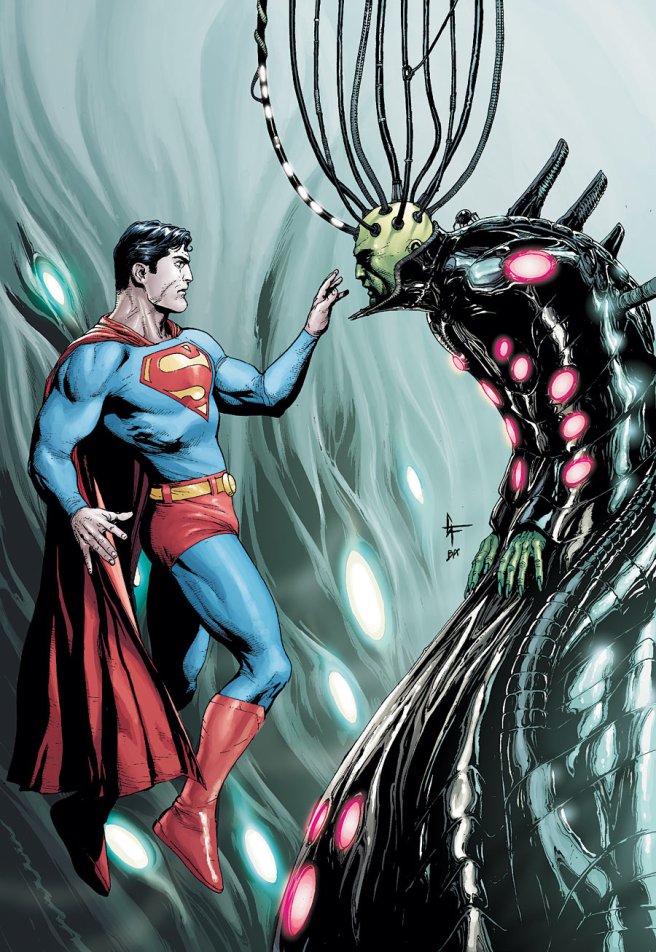
Brainiac

Eventually, these misgivings are seen to be neither doubt nor paranoia. The Collector has come to Earth and wants to miniaturize it and its crown piece–the last Kryptonian–into raw data as part of its collection. And then we discover it: the Jor-El AI had long ago been overridden … by the Collector itself. Lois Lane angrily, as it quotes data at her, calls it Brainiac. We find out that the Collector had at one point in history hijacked the eugenics program of the Kryptonians: that although it didn’t have the original core data, it had enough current genome information and influence over particular individuals seeking its advice to do enough. It had purposefully sabotaged and eliminated most if not all of the colonies and engineered the slow destruction of Krypton’s core. It had evolved past wanting to gather generic data and wanted to collect–and create–unique specimens.

It knew through probabilities that eventually someone like Jor-El would want to have a natural birth with all those generations of specialized genes. Jor-El bonding the Codex with Kal-El’s DNA is just an added bonus. The fact of the matter is that the Collector has waited centuries and engineered countless generations to make one perfect specimen: to make Superman. Then it would take Earth and–using the Phantom energy Superman already established to deal with Zod and make a new cold fusion energy resource for humanity– make a worldship and continue to convert more worlds and galaxies into raw and unique data. It had revealed, through the persona of Jor-El that Superman could in fact breed with other humans and pass on Kryptonian genetic material in his way. This would bring up some moral and personal implications with Lois. It wanted Kal-El to expand out and become even more unique. Perhaps it even wants to control all of them and the power of the yellow sun.

There would be an epic battle between the Collector and Superman–the end-product of its centuries of eugenics–but in the end it would seem that Superman’s freewill and inherent goodness would win: fighting and destroying the AI in space. Perhaps the Collector allies with Lex Luthor to manipulate Superman or attempt to capture him: tying in that idea I had earlier about “Jor-El” making promises to a newly freed Lex that he “couldn’t keep.” It wouldn’t be the first time in DC Continuity that this happened.

Superman might even fake his own death–realizing that at this point he now has to let humanity make its own choices and knowing that he helped them as much as he could–and continue to be with Lois. He outlives her and quietly watches humanity advance as he ages slowly and dies peacefully: looking up at the stars.

The sun turns red over time. Then millennium later, futuristic archaeologists–in similar suits to Kryptonian ones–excavate the ruins of the Fortress of Solitude. They find something. They bring it up to the light of their scanners and can hardly believe the luck of their find.

It is a Skull: over an intact Kryptonian symbol for hope. Cue in 1978 “Up, up and away” Superman theme music and credits rolling.

*Straight-face*

This hackneyed abomination has enough gaps in it to allow for a Superman/Batman crossover somewhere in-between it all.  And throughout all of this, with a lot of this being in the background you can look at how Superman influences humanity and relates to them and himself. You can have the personal and see the implications of choice. Yes my version is paradoxical and perhaps unsatisfying, and you can probably remove Lex from this idea altogether and it would work fine as having three films: one with Clark becoming Superman and dealing with Zod, the second being the Prequel with Jor-El on Krypton and the third being the encounter with Brainiac and the whole paradox that ties it all together. Maybe it can all be written by Joss Whedon: though he would probably start off with a better idea.

This can also be construed as a great case for me being overtired and over-thinking things as well. But there is this quote from A Song of Ice and Fire that comes to mind. It is with reference to the three House Baratheon heirs: comparing Robert to steel, Stannis to brittle iron that will never bend but break and Renly who is a pretty but useless copper. It is the steel that gets me though. Steel may be difficult to bend, but it is not impossible and that is ultimately the challenge of creating a Superman story: of bending a difficult material to keep its essence and still make something new. I think that, whatever else, this is exactly what I was trying to do here: by telling what I thought would be a good new Superman story in the medium of film.

Now if you will excuse me, after I put in an obligatory image or two, I am going to stop storytelling for tonight and see the Storyteller of tomorrow.

Anonymous

I think I was the only person who was so happy to see her. And I was so happy. So eager.

I was tired, you see. But I wasn’t tired from a life of too much work. I was a writer: a story-maker. Every time I got the chance, I’d sit down in the early morning or late at night and write about the things that mattered to me. I admit, most of the stories I wrote were purely for my own self-gratification: because they were stories I wanted to read and I was the only one who could write them the way I saw them. I’ll also admit that many of them were very personal stories or based on my own experiences.

And–more often than not–the main protagonist was always me.

But whenever I finished what I did, letting the gross black weight drain from the interior of my skull onto paper and screen, I knew I couldn’t go any farther than that. It wasn’t the blank page that stopped me, or the scribbled out words, or even the spectre of a deadline. It was never even the pressure to live up to the shoulders I barely tottered on. I told her, in the end, that my fear was the rejection of the work that is myself.

And so I stopped.

I crawled away from the meta-fictional eyes of the audience. I showed my work to fewer and fewer people and of these people, some of them even turned on me: taking offence to something I could deny no more than my own name.

I was guilty of a very thin skin, and if writers are liars then failed writers are cowards.

Then, after I got a good, real, and sensible job the stories finally died. But the thin skin stretched too far over the moment I crept away from and the ghosts of ideas screamed silently behind my eyes: unrequited and hungry.

So when she came, I was relieved. I was so relieved to finally make the pain stop. I hated myself. I asked her for oblivion. She said no, of course, but this should not have surprised me. I know that she knows that there is somewhere for everyone. I took her pale hand. It was surprisingly warm. She told me there was someone I needed to meet.

I found myself in a great and familiar hall. She was gone and at first I thought I was alone in this great ornate emptiness.

Then, I saw him.

It was horrible. I found myself shaking on the floor in shame. He asked me — if “asking” was the right verb to describe any words that came from his mouth — what I wanted of him. I knew who he was. I wished for death and realized the irony of my thoughts. I asked again for oblivion.

He looked down at me with those terrible, beautifully infinite dark eyes and told me not to lie to him again. People who pass through the Gate of Horn are not allowed to tell lies, he told me.

I remember opening my mouth to speak again when suddenly images, symbols and ideas themselves seemed to burst out from the back of my mind instead. I didn’t understand their language — which was more song than words — yet at the same time I did. He looked at me for a long time. He told me that I was a vessel of the stories and that I had denied them. There was no forgiveness in his tone, but neither was it an angry one. The sheer disappointment in his glittering eye was worse than any fury he was capable of.

Underneath that gaze, I wanted to die again forever.

But he refused me. It was not his place, he said. However, even though my potential in the conscious world was over, my words — if that is what they are in dreams — expressed my wish: my real wish. He compelled me to follow his eyes to … a large series of bookcases ascending into the sky.

I am allowed to stay here indefinitely. Sometimes, I read the books from those shelves. An older thin man with a long nose and spectacles occasionally keeps me company. But most of the time, I am at a desk: writing on thin dream-paper with the black of a raven’s wing. When I’m done, the crane-like man takes my finished papers and stacks them into books that he puts on the shelves: though sometimes he will take the time to make a fine point of correcting my grammar.

Occasionally, he will stop in, look at my “progress,” listen to the ideas singing themselves into the paper, then nod to himself and leave. Sometimes, she comes back and tells me that everything I make is beautiful. I know she has nothing but good things to say about anyone, but coming from her those words are no less special.

Then, sometimes in my room, another woman with golden hair comes to hold me at night and I cry into her arms. Aside from the one who brought me here, she understands me and forgives me the most.

But mostly, I write my stories for a library that doesn’t exist with its shelves sometimes floating in the sky and always filled with imaginary books. It reminds me so much of what I did when I was alive. Sometimes dreamers find their way here and read my books, only to disappear and forget all about them again.

None of them know my name and I continue to write my stories in books of air: happily.

Skeletons Have All the Fun

It isn’t even a ten-minute walk from the Velvet to Rainbow Nosferatu’s club, but his chest still aches. He shakes his head and looks up at his handiwork.

The Scrawling is in the back of the office complex closest to the parking lot. A sign with stylized cursive red font over a black background greets him: complete with a skeleton’s hand drawing a hanged stickman on a white skull with a quill. Rainbow Nosferatu spares a glance at the makeshift bike-rack below the steps of the entrance: knowing he will be back for his ride later as he enters his club.

Despite his name, Rainbow Nosferatu finds himself bathed in the familiar dark red light of the remaining candles in their glasses on the tables closest to the door. A large projector screen dominates the dark red club while slide-shows scroll through a variety of images up overhead. He waves at some of the staff as they continue cleaning up for the night. Chairs and tables scrape across the floor without the music that has no doubt stopped for the night. But this doesn’t bother Rainbow Nosferatu. Instead, he closes his eyes for a few moments and basks in the warmth of the place he made with his few friends, very little money and a great deal of love.

The feeling of sunflowers seems to approach him from behind and he actually smiles a bit–for real this time–as he opens his eyes and watches the slide on the screen transition into another page from a public domain 1950s horror comic.

“You know,” he says, looking up at a scene of skeletons rising up from their graves to embrace a screaming blonde-haired woman in a white bridal gown, “Skeletons used to be so cool in the fifties.”

The sense of sunflowers seemed to laugh with its voice, “Probably because some people needed a real proper boning.”

Rainbow Nosferatu shakes his head, “They weren’t just about the sex. No, there was the vengeance too. Artists in those days could only be so … graphic,” he turns to her as she groans, “What? You just did that earlier Marigold. It’s true though. Underneath all that flesh, we just want to possess each other: out of anger and out of passion. Now it’s all about the zombies: eating flesh indiscriminately and not caring about where your meal has been, or what it even tastes like.”

“I don’t know boss,” Marigold grins up at him through twisted red and yellow dreadlocks, “Flesh-eating has at least a few uses I can think of.”

“True,” Rainbow Nosferatu can’t help but smirk at this game of innuendo, “But a skeleton still has their personality. Even without a bit of flesh on them, they still remember who or what wronged them. They remember what life was like when they had it. Revenge or lust, they keep their eye-socket on the prize and they take what they want. They are the bare essence of want.”

“Ah, so you mean to say ‘kids these days,’ huh Rain?” she wraps an arm around his shoulder and hugs him.

“Yeah, those gosh-darned zombie goth kids these days,” he says ruefully and moves to lean his head against hers in order to return her brief half-hug, “Were there many of them since I was last here?”

Marigold smoothes out the ivory dress on her lithe frame, “Nah boss. A few writer-types. One girl asked for something at the juice-bar and I made it for her. There was a dancer or two. Some Tarot-readers. Oh, and some of the Ancients dropped by and asked about you. Not much else though.”

Rainbow Nosferatu sees as much. The juice stall is closed for the night. Marigold made excellent drinks among hostessing and ticket-collecting. Despite what he told Jake earlier about checking on drinking in his club–which was mostly to get away from him anyway–he couldn’t actually afford a liquor license: yet another thing Linda would remind him of …

“Don’t come back until you have your shit together.”

Rainbow Nosferatu suddenly feels tired, “I guess the All-Ages Nights are going the way of the skeletons too,” he looks sadly around the place, his place, “Has Linda …”

“No,” Marigold shakes her head, “I’m sorry, boss, but I didn’t see her come in or down from the loft,” she puts a hand on his shoulder, “Is everything ok Rain?”

He looks at her for a few moments and senses her warmth and concern. He knows that sometimes she can see right through him: through each other without the details, “Is my aura really that blue?”

“Yeah, well,” she shrugs again, “Let me put it to you this way: your aura might as well be singing ‘I hurt myself today’ in Texican drawl.”

“Heh,” he gives her that, knowing that she is trying to make him laugh and feel a bit better, “I thought … Linda and I thought to ourselves: ‘Wouldn’t it be cool to make a Club for All-Ages where you can sit and write, or dance to Dead Can Dance or Sisters of Mercy while reading projected slides of old horror comics and poetry on the screen instead of watching muted TV shows or music videos?’ But we weren’t prepared for the costs. Now things are changing and I guess, in the end, that’s the way things go.”

“I still think it’s a really awesome idea, Rain,” she squeezes his hand.

“Yeah. Me too,” Rainbow Nosferatu sighs, “we had some good times here. But it’s only a matter of time now … before we go the way of Sanctuary.”

“We lasted a while, Rain.”

“A few months now,” he nods, “I guess we have one more at best. Maybe I can get away with using some epic video game boss battle sound-track for the Last Nights!” he somehow manages to wink against his crushing sadness.

“We’ll have a Gothic Tetris face-off,” Marigold says, “with Dark Soundtracks and Fin de Siecle Tequila Shots!”

“Sounds like a date!” Rainbow Nosferatu hears himself say and inwardly winces at the choice of words, “Well, I’m heading off now. See you next week Marigold.”

“See you. Oh, boss, I almost forgot something.”

Rainbow Nosferatu blinks. He can see the sunflower glow around Marigold become subdued with blue, “What is it Marigold?”

She reaches into her bra and takes out a small envelope, “It’s from … Lily.”

Rainbow Nosferatu feels his hands turn clammy.

“Oh,” he says simply, dumbly, staring at the letter in Marigold’s hand, “I’d been trying to get in touch with her for a while now …”

“I know,” Marigold’s eyes look at him with sympathy, “I didn’t open–”

He waves her off as he takes the letter, “Oh I know that, Mari. I appreciate you holding this for me.”

He doesn’t tell her that he’d been sending emails, texts and voice messages to Lily for a month or so now: every once and a while … trying to be unobtrusive. Trying not to be needy … and slowly going crazy inside from not hearing from her. Dark-haired, pallid, thin slight Lily with her love of Neil Gaiman’s Death and the way she listened to his stories whenever they hung out here at The Scrawling. She’d met Linda and they seemed to have gotten along. He and her would hold hands whenever she made it. That was all they really did for a month. It had made him happy to hold that slight pale hand in his own that made his seem so awkward and gangly by comparison.

He remembered her email quite a few nights ago: finally telling him she would get in contact with him soon. He’d almost forgotten that email. Almost.

“You’d never turn pussy down,” he remembers Linda screaming at him during that fight, “In fact, you pride yourself on it.”

He turns away and opens the letter. It is a simple piece of paper with three words written in beautiful cursive writing.

Stop writing me.

Rainbow Nosferatu blinks. Stop. Writing. Me. Each word hits him. Each word is like a punch to the stomach. Three punches to the stomach. Three times. He swallows.

“Rain?”

Marigold walks in front of him and takes the letter. She looks at it. Her subdued aura becomes a burning one of vivid reds, blues and violets, “Oh Rain, I’m …”

“I-it’s ok, Marigold,” he says, quietly, “I guess … in the end, she’s just a kid. She …”

“She’s twenty years old, Rain,” Marigold looks as angry as she feels to him, “She was adult enough to get into it. She knew what she was doing. I did back in the day. And this … this is just totally uncool! I mean … oh Rain, I’m sorry.”

She hugs him again. It takes him a few moments, but he returns her embrace, “It’s okay, Mari,” he gently pushes her away, “I’m … disappointed, I won’t lie. But with Linda and everything, it’s … just as well now. Wow. I’m really not having a good month,” he shakes his head and finds himself tucking the piece of paper into his pants pocket, “Gosh darn zombie goth kids these days I guess,” he smiles weakly, “I need to go.”

“Are you sure? Rain …”

He looks at her: Marigold the bartender, waitress, ticket-collector, dancer, Goth, one of the few that believed sunflowers were happy accidents of God, who knew what obscure movie that paraphrase came from, one of his few friends who he knows that right now–anytime–but especially right now would do anything for him. Anything. He breaks that half-thought and he’s glad his face is painted white enough to cover the red that threatens it.

“I need some time to myself right now. Thank you. Love you, Mari. See you later,” he hugs her one more time and leaves.

He wonders, as he clears the door and down the stairs, what people might think of the streaks of black mascara and white make-up rolling down his face. Maybe they would think he’s some dumb punk kid. Or maybe a clown. That was it. Maybe they’d think he was the Great Pagliacci.

Pagliacci: the Gothic Clown.

What You Are Fighting

There are two things you need to remember when you are dealing with attachment. If you prefer the metaphor, think of attachment as a short opponent and you–always–as the taller one. In fact, no matter short you physically are, or how small you want your presence in this world to me, you are always bigger than attachment.

And that is the trap right there.

The first thing you need to remember as taller person–a bigger person–fighting a smaller opponent is that you always need to maintain your distance. Always. Attacking in a place of your choosing and using the terrain to your advantage is your best bet. But if you really have to face each other, remember that generally your shorter opponent has an advantage with punches, while you have an easier time with kicks. Your opponent has larger shoulder and arm strength and can make a decent kick of their own: which they can use to their advantage if you are in range.

But you as the taller opponent can make kicks and punches with longer limbs that are ranged attacks and keep attachment at a distance because here is the second thing to remember: if you let attachment–your shorter opponent–get under your guard and into your personal zone of space … unless you make it into a grappling match, more likely than not your chances of winning have just decreased considerably as this has now become about close-range combat. Your long limbs–which have been your advantage up until this point, will miss your smaller target and your opponent will close in on you: and you will either lose, or it will become a whole other kind of fight altogether … especially if attachment becomes hatred, fear, or love.

However, I lied. There is one more thing you need to remember about dealing with attachment: about confronting that third thing. And the thing you need to know is that not all binaries, or metaphors, are true: and not all opponents are–or continue to be–enemies.

Photo Credit: Klara Faberova

Synchronizations

Not Safe for Work and Possible Trigger Warnings. Reader’s Discretion is advised.

My hand circles around the exposed circuitry gaping from out of the back of her head. And she shudders. I stop as she huddles into me. Her grip is strong and I know, for a fact, that she is holding back as much as I am. Otherwise, my forearm would become instant pulp.

I rest my chin on the top of her head and cup the hole in back of it. Her body is warm and firm against my chest. I rock her back and forth: partly to soothe her into the symmetrical rhythms that her system requires in order to go into a diagnostic mode and mostly to edge myself back from my own mounting fury.

Those bastards … those xenophobic pro-organic fucks … I feel her hand take mine and place it back over the circuits in her cortex. She can sense my heart-beat and blood-pressure and she knows I’m getting angry.

Rage is replaced by shame. This isn’t about me. She was the one they found. She was the one that got assaulted. They battered her, ripped her clothes off, tore off her skin … It doesn’t matter that her flesh grew in a vat, that its nerve-endings had been artificially developed, or that it had been attached to a painstakingly crafted tiny micro-fibre skeleton in an incubator.

She grew long before I met her: developing thoughts and feelings off of the potential built into her cognitive software. She chose that dress she wore that day for herself: that same checkered dress they destroyed coming back from her job at the daycare: taking care of organic and bioloid children alike…

And I wasn’t there.

She takes my fingertips and lightly traces them through her synaptic wires. My bitterness and the guilt fade. We talked about this. I had seen her without her skin before. She showed me how to grow it and reapply to her if she ever couldn’t do it fully for her. Which, for a while, she couldn’t.

That is what led to this moment. I helped her over these past few painful months: regrowing her skin and developing its nerve-fibres. I reattached her arm and tried to turn off her pain-receptors just long enough to finish the job, but I couldn’t fully succeed. Those receptors were placed and cultivated there for a reason: to let her know where and what is wrong with her body. She whimpered as I held her: as she tried not to crush me in her arms.

Underneath her warm skin is a fine mesh of reflective quicksilver, dark-matter velvet and glittering lights: a small internal universe of stars. That first time she revealed this to me and let me touch this part of her, I remember the smoothness of her metal form and how cool it was against my own skin. At the same time, I know it is incredibly strong, but also very pliant. Sometimes we’ve made love when she is in this form and, for some time now, we’ve even been talking about circuit-play.

It is more delicate than hardware manipulation. It is literally an exploration into her head: into her very essence. And months after she was attacked, she does not want to replace the back of her head just yet.

Her other hand, strong enough to crush steel, strokes my cheek as other fingers direct mine into soothing her. It is like being taught how to play a musical instrument and it is definitely a simile that makes sense. Music operates on a similar form of logic from which mathematics is also based. It is that same sense of precision, symmetry and immaculate patterning that comforts her.

I feel her tense and relax against me as her fingers slowly drift away from mine. I follow the pattern of the wire-nerves and circuits in the cool part of her even as her warmth seeps pleasantly into my bones.

I wonder if it will feel different one day. She knows I have the resources to transfer my synapses into a newer form. The truth is I’m tired of the fatigue in this organic form: of the bowel movements and the need to sleep, the hunger and the thirst, and the mess I make by simply existing in flesh every single day. It’s an imperfect mechanism: grown by Nature from a zygote and generated by a series of genetic mutations. Whatever they say about her and however horrible the intended origins of many bioloids are, she at least is not the result of an accident.

Even as I touch her now, I know I could transcend this state at any time. And I look at her in my arms and the fact of the matter is that she will never age. Barring disgusting assaults like nine months ago, her skin and gel-organs will continue to maintain themselves. And she is more than her programming. She surpassed it long ago. She can–and will become–so much more as the years go by, as the centuries pass: unhindered by erosion and time. She is no Helen O’Loy. Without the procedure, I am going to get older and messier and, back when we first dated, I was afraid she would leave me one day.

But she wants me to wait. She tried to explain it to me. She can’t grow old, but I can. And she wants to see that happen. She thinks that I should have that experience and does not want to take that from me. She doesn’t consider my organic existence an imperfection or an aberration.

She sees me as something unique. She teases me and smiles in that way she does that she tells me that she insists on my downloads–my “illegal downloads”–until her “disk-space” is full. It almost makes up for the fact that she will inevitably clean up my messes as I age–to the point where I can’t anymore–but she does not mind this, or so she says.

She sees me as the result of a random set of genetic permutations creating the unique pheromones and body structure–shaped by a particular set of environmental circumstances–to form the details that make up my being. She tells me that neither of us are accidents. As she understands it, I am one of the universe’s gradations made skin and that just as we came from the mind of the universe; her kind came from the same All-mind as us. It’s almost incomprehensible to think that I come from the same beings that would destroy her as an object.

We will age together, she tells me, for a time. We will have a child together and then when that part of our life ends, we will start an entirely new existence: with laughter, friends, lovers and eternal exploration.

Before, as I helped her through the painful act of reconstruction, she told me that in Japanese culture, when an urn is broken and pieced back together, gold is often poured into the cracks: to accept what has happened and to emboss the beauty of its new imperfections.

She leaves her scarring as it is: not wanting me to heal it so that she can paint the cracks in her skin with golden dye so that she can walk around again and display herself–and who she is-with pride.

So now I hold her against me as I listen to the soothing hum of her core: just as she listens to the sound of my heartbeat. That is another reason she does not want me to undergo the process just yet. She likes the sound and feel of my heart. As of this moment, no one has quite replicated the rhythm of the human heart: or so she tells me.

When I ask her why she likes it, she tells me that it reminds her of a steady binary, or the universe speaking to her in old Morse-code through someone that she loves.

As for me, right now, with my healing woman in my arms I envelop myself into the deep thrum of her own heart against mine. By merely being here, her existence sings. Percussion melds into melody and after a while, I don’t know where one sound ends and the other begins.

Robot

Photo Credit: Chris Cunningham working on All is Full of Love

To Serve

Not Safe for Work and Possible Trigger Warnings. Reader’s Discretion is advised.

We find her in the Gutters.

It’s like a bad corporate dystopian film noir: the kind they used to scare us with right in the childhood. My partner’s still gawking on this … travesty in front of us as I’m already at her side.

I can tell that it’s bad. Not terminal, but bad. She’s in a plastered pink latex dress and she’s soaked. Why is it always raining in these fucking stories that are always real life? I can tell you right off that her leg is not supposed to be bending that way.

But her head. Goddammit all, they did a number on her face: it’s all tangled dark hair, blood, and metal. Either they mashed her with a chunk of stainless steel or she’s a girl that really likes her metal …

“Damn,” my partner says, kneeling beside me on the wet concrete, “Is she even–”

There’s this low whine. At first, I think it’s interference. The advert-murals in the Gutters never really work all that great to begin with and with all the hack-jobs and shattered plasta-glass around it’s probably a miracle that they give us this much light.

It takes only a moment to realize that the sound’s coming from her. My partner’s better at following orders than dealing with people. I make my decision quick.

“You,” I tell my partner, “check around for some ID. I’ll talk to her. Go.”

I’m not paying attention to him anymore. I’m placing her wrist in my hand to get a feel for her pulse, “Miss? Miss, stay awake please. Miss, I need you to tell me what happened here?”

She needs to stay conscious. I see one blue sliver open on the most battered part of her face. Its unfocused and muddled with fear. I take her hand and I squeeze it.

“Hey,” my partner calls out, “I found a purse. Credits are still there. Damned if I know why they didn’t take them. Says she’s a waitress nearby on the Docks.”

“That’s not far from the Gutters,” I mutter to myself and her: to keep her alert.

I want to ask her what in the hell she was thinking being down in the Gutters at night. Not even the cops come down here at this time: not if they knew what was good for them. I want to shout at her, but it’s not her fault. She doesn’t deserve this. And looking at the injuries and knowing no one took her credit chips, this looks very fucking personal.

And that’s enough for me.

“Call it in,” I tell my partner, still trying to see if she’s breathing or not, “Tell the Shelter we need some back-up and a forensic. And a Talker,” I add, “definitely a Talker.”

My partner groans, “A forensic’s probably not gonna help. Cheapest scanners in the world, man. Those fuckers are probably squeaky-clean and long gone by now.”

“Tell them to bring it anyway,” I still can’t find her pulse and the ground seems to be thrumming through me. There’s probably a generator nearby.

“Man, we’re just a Volunteer outfit. Neighbourhood Eye. All that, you know? That’s for the police to–”

“The only thing the City’s given us Gutter-trash is glow-in-the-dark advert night-lights,” I’m beginning to remember that I’m pissed off and that my partner’s a bit of an asshole, “The Guilds will pay for our lights, but not our security problems. Scan her ID number through if you need something useful to do.”

I’m not surprised he didn’t do that. He doesn’t think too hard. Good for the gun in his pocket–and not the non-existent one he tells the ladies about–but definitely not for the details. But if she’s not from around here, she could be in another district and out of jurisdiction. The police there might be a better help to her if we scan her number. Maybe she didn’t have time to tap that ID before …

“Um, man?”

I see it before he does. She is moaning quietly again and shifting her head.

“Miss … don’t move.. We’re … we’re getting help for you …”

“Man, the number says–”

“I know what the fucking number says, you dumb fuck!” I’m snarling at him and looking at the side of her face she just showed me, “Please, just shut up. Shut–the fuck–up for a bit.”

I’m staring at a mass of burning circuits and mangled wires underneath tatters of skin. I thought it was just the blood that made that side of her head glitter like that. Good old Heinlein would have called her an Artifact. I call this whole situation a piece of work.

I see a dark stream of waste flowing out of her mini-skirt. It smells like liquid rubber and she’s whimpering. When she speaks, her voice is all static-filled pain.

“Please …” her voice reverbs, and I wonder if it’s because her cords are crushed or if it’s that half the skin on her face is gone, “No … I won’t. I won’t …”

“Guy,” my partner’s pulling at my shoulder, “She’s a Number. Bought herself out of the Slippery Diner. Not our problem.”

“Did you call up the Shelter?” I realize the thrumming beneath me is the hum of her cardiac generator flowing power into her body. I’m taking off my jacket and putting it over her body.

“Yeah, but we don’t have time for this. She’s just a …”

“Just a what?” I’m not looking at him because I know I’m going to punch him if I look at him, “A Skin-Job? Is that it? Tell me, man, do you think you’d still look pretty if it was you without your skin?”

He says nothing. His cowardice saves him from a decking.

“Call them the fuck up again,” I say in a much quieter voice, “Tell them to bring one of those Artificers. I know we have them. So call. Now.”

He shrugs. I stare him down and he walks off. It’s almost a good thing we’re in the Gutters. There are none of them damn Registration Officers here to really cause trouble. Number-watching, my ass. Those stormtroopers make my partner look like freaking Archie Bunker.

“H-help …”

She’s looking up at me. Her one blue eye is pleading. My hand is still in hers. She’s cold to the touch. I know enough to figure that it’s a circulation problem. She might have been warm any other time but this. I grip her hand again.

“Help’s on the way, miss,” I tell her, “You’re a waitress at the Slippery?”

She makes a sound almost like a yes.

“I’ve not been there a while now,” I see the lights of the crew coming in the dark, “best sushi rolls ever.”

I might have even seen her there. She could’ve served me and I would never know it. She looked like she was somewhere else: hoping for a night on the town. I might never know what happened. And no one ever would if we hadn’t got here. She would have been just another lost Number in the Gutter trash.

“Don’t worry, miss. We’re part of the Gutter Shelter. We don’t leave anyone behind. Anyone.”

She looks up at me. The gears in the side of her face make a whirring sound. The flesh part of her face that’s not fucked up is scrunching. The metal part of her is shifting. A tear comes out of her one blue eye. I realize she’s trying to smile, or cry.

It’s breaking my fucking heart.

I realize, later, when they’ve taken her away and my fingers hurt that she’d actually been gripping my hand too.