It Made My Day

I just wanted to take some time to talk to you, my readers, old and new. It’s going to be a short post this time around, but don’t get used to it: I’ll be writing your ear off again soon enough. 😉

In fact, that’s what this entire post is really about.

So, a week ago now the first part of my article The Stitching Together of a Mythos: Kris Straub’s Broodhollow got posted by the fine folks of Sequart: which I followed on Twitter only to find that Kris Straub himself had retweeted it. After a brief Twitter exchange my day–then–was made. I thought that, if it ended here, it would be okay.

A day or so later, I posted a few comments on Amanda Palmer’s Blog. She wants to have some feedback with regards to a non-fiction book on the topic of asking that she was, ironically, asked to write. As I was responding to her second book post, I had an epiphany about something. When Amanda asked what I wish I asked for, I rambled a whole lot and then, not as satisfied with the answer I gave her on this post I went on Facebook and Twitter to state that I realized “that, after commenting on @amandapalmer’s Blog, most of my regrets aren’t about things I didn’t ask for.”

A day later, I opened my email to see that on Twitter I got a retweet from Amanda. I have a friend named Amanda and then I did a double-take and looked at this Amanda’s last name.

Another day. Made. In fact, I was told by a dear friend I’d never talked with on the phone before or even seen that–at least for the moment–I gained more Nerd cred than she has: though I have to say she is definitely one to talk and will beat me in no time. ;p

Then not long after that, Miguel Sternberg of Spooky Squid Games was on Twitter complaining about being in a house with no tea with the hashtag #canadianhorrorstories. You have to understand: I couldn’t resist. I ended up writing this: “Short two sentence horror story: The last man on Earth sits in a house. There is no one at the other side of the door with tea.”

Suffice to say, this got retweeted as well.  I wrote a bit more, but he tweeted his screams of terror at me far before that part and that was satisfying in and of itself.

But then I thought: all right. I am totally on a roll here but I have work that I need to do. I’d finally finished playing Christine Love’s Hate Plus and I had to write something for it: I just had to, you know? So I did. It was long and I stayed up late into the night to watch my brain shrivel into the corners of my skull from exhaustion. I’d written a previous article about Christine’s games and I thought nothing of it. I thought I would get a few views or what-not–maybe more because the game had just come out relatively recently–and that would be about it.

So for a day this seemed to be the case. I added stuff and made some corrections and what not. I even added images and had the damnedest time finding a particular image of *Mute in her uniform. So whatever.

The next day …

I’ve briefly exchanged tweets with Christine Love occasionally but this was the first time she had ever retweeted me. Ever. And then I went on my Blog–and this was a few days ago now or however you reckon time when it is very late past what some would consider night–and I see, and I am not joking at all here, I see this … large number of visitors and an even larger volume of views. You get alliteration from this no matter what word you use. And some unintentional rhyme too. See, this is what happens when I write when I’m tired.

Anyway, now that I’m writing up this post to all of you I just have to ask: how many days equal a week made?

I’m feeling really good right now. It’s still confusing and scary, but I can see the hints of opportunities coming up and all of these things–which may seem trivial to some people–are signals that indicate that I am travelling on the right path to … to something. I made something for Andrez Bergen a musician and an excellent writer as well that will … come up on October 9th. I am corresponding with a friend that may be able to help me find some more contacts and connections that I need to begin the process of supporting myself.

I also have two projects that are really experiments to see how much you guys want to see me … make something. One of these would be shared with the public: though I need to look into the logistics of it more. As for the other: I may or may not attempt some …. self-publishing. We shall have to see on that. But the first will definitely be in the form of a question that I will share with all of you whom might be interested.

I might also be … doing something else too in addition to everything you might already know I’m the process of working on. But I have to make some decisions. It seems lately that I am always having to make decisions. A while ago, some friends of mine who were in Vancouver entered their Master’s Program and I entered mine–at least in part because I also wanted to gain that prestige and knowledge (with no little debt)–to feel like a part of what they were feeling if that makes sense: to prove I was equal to them and, more importantly, capable of delving into places by myself.

For a while, especially after still being in debt and a change in circumstances I began to despise academics and wanted to distance myself from it. But it seems as though it will never really leave me, but not only have I learned that I can deal with it on my own terms through this Blog and Sequart and other places but I now feel close to my distant friends in space and time in a different way.

Because, here is the thing: even though I know this is still going to be hard as fuck, I don’t just want a made day, or a made series of days, or a made week, or even made years.

I want a made lifetime. But more than that: I want to make my lifetime.

And now I think it is beginning because, when you come right down to it, it never really ended.

Thank you Kris Straub, Amanda Palmer, Miguel Sternberg, Andrez Bergen, Julian Darius of Sequart and Christine Love for giving me those little extra nudges towards where I need to be. You are inspiring. I also want to thank one of my former Humanities Professors Markus Reisenleitner for endorsing me on LinkedIn. He actually showed one of my posts–Worms and Bicycles Or How People Make For Strange Stories–to his students and that was very encouraging. And I want to thank Gil Williamson for publishing my science-fiction story To Serve on Mythaxis Magazine.

But lastly, I want to thank all my friends and loved ones and all my readers for always being there in some form or another and encouraging me to keep making this Mythic Bios possible. You will be hearing from me soon. I promise.

Looking Outward

The Death of *Silence: Hate Plus and The World of Christine Love Confirmed

What is better than hate?

The answer is more hate.

Hate Plus is the sequel to Christine Love’s Analogue: A Hate Story: a visual novel and video game in which you, as “a space investigator” must recover the records of a lost 25th century Korean generation ship called the Mugunghwa and figure out what happened to its colonists and their descendants. This is not the first time I’ve talked about Analogue or the world that it inhabits so, if you’d like and if you are not afraid of spoilers please look at my article This Love and This Hate Ain’t Completely My Story: The Possible World of Christine Love.

I have been waiting for this game for a long time, though obviously not as long as certain characters on the Mugunghwa have been, and I want to get into its structure, the elements of its world, and the story line.

So here is the nitty-gritty of Hate Plus‘ game interface from my own personal experience. I’m actually glad that I went back and played Analogue for a while during this time in order to remind myself of its game-play interactive qualities. In Analogue, you had to go through various journal entries and click on the figure of the AI next to you to get more information or her opinion. You also had a very confusing Family Tree of characters to look at with names that often got confusing. It is important to note that some Far East Asian cultures place their surnames before their first ones and it explains a lot culturally with regards to Analogue and Hate Plus and how the societies depicted within them function. But I am getting ahead of myself.

In contrast to Analogue, in Hate Plus the AI is more active and has a certain degree of limited animation. They basically read over your shoulder and make comments as you scroll along: as you scroll along very, very slowly. You do have to be careful though: because if you read too fast, the AI’s comments will be lost seemingly forever into an ethereal digital void of, well, scrolling too damned fast. There are names in the documents that you click on and get more information with each entry that you read. The files that you extract are better organized and you have dossiers on–and profile pictures of–each person that you read about. In some ways, it is a lot harder than Analogue. I imagine that the slow-scrolling simulates sifting through the files you’ve compiled from an ancient ship. At the very least this time around you don’t have to input technical commands into a DOS-like–pardon the pun–analog program: which confused and frustrated me to no end.

That said there are some really interesting goodies and special touches to the game structure that only Christine, at least from what little I’ve played, can accomplish with her style. While Christine utilized a form of code that transfers information from her other games that you’ve played to make some “Easter-egg” moments between them, she uses this same process to take your Save Files, if you have them, from Analogue and translate over to Hate Plus. She creates that almost very personal feeling of continuity and that, in itself, is something that I greatly appreciate.

In addition, depending on what Saved File you use, the introduction screen changes colour and when you finish a story arc, the end credits music becomes the introductory music for a while: which really gives you a sense of difference with each playthrough. There is also one other difference between Analogue and its sequel. Unlike the former, which you can download off of Christine’s site Love Conquers All games and Steam, you can only download and play Hate Plus from Steam itself: mainly because that is the only place it’s available from and perhaps the only way to facilitate the Achievements that you get to unlock in addition to the different Endings that are just extensions of your Saved Files from Analogue. This game does not save the retrieved files and timelines you sifted through outside of the AI interaction such as in the other game, nor does it have an extra material section as far as I can see, but the Achievements in themselves and the interactive dynamics that Christine has implemented are … different.

Let me be more specific: if Analogue felt like essentially interacting with a program, Hate Plus is an attempt at a realistic interaction with another sentient being and time. This pacing is actually pretty refreshing and while with anyone else it might threaten to take you out of immersion, in this case it just adds a barely meta-narrative feel to it and at the most it adds personality: a very fascinating experiment in player on and offline participation and interaction. It might take you aback at first, but it’s worth it.

I should also note that you can play this game without having played Analogue or saved your files. The game will just give you an intro recap and a simple Quiz and you’re off. But personally, and as I said, I liked the continuity of using my old files from the previous game.

So now we go past the technical and into the more specific area of content: of the world. And here is where I go into Spoilers: real Spoilers. So please, if you have read this far and you want to play one or both games, save this article link somewhere, click on the links to Christine’s site above, download the game for $10, take the time that you will need, and then come back. Do not say I didn’t warn you.

Now then: the world of Christine Love. If you read the link to my previous post about “Christine Love’s Possible World,” you probably realize by now that it is less possible as it is more probable and true that all her games–at least the ones I talked about in that article–take place in the same world as time goes on. I always suspected this but it was only confirmed when, in this game, she added that missing link: when you receive an email in your message box talking about exploring the ruins of the 23rd Century Lake City. That addition made me smile: not just because it gave me some feeling of vindication in my statements, but because of just that one segment of a post adding this seamless transition between Digital: A Love Story, don’t take it personally babe this ain’t your story and Analogue. What it is, is it’s both immaculate and it’s beautiful. Fucking. Beautiful.

It also doesn’t stop there. You find out a bit more about Earth and how advanced it has become. In addition to me realizing that the reason AI have such difficult times replicating themselves is due to limitations imposed due to *Mother and the terrifying consequences of *Reaper in Digital in the 1980s, I also got to see that AI interactions have changed even more. Essentially, Earth technology has evolved to the point where AI programs can be downloaded into customized lifelike humanoid bodies. This totally slapped me in the face with surprise, but it was a good kind of slap as I realized what it meant for you to have received this email–from the very familiar household name of Wong Robotics (which is a nice parallel to the email you first get from what seems to be its predecessor Wong Computers in Digital: A Love Story and another world tie-in) and what you were probably searching for with regards to your AI companion.

These discoveries make me wonder about something. You discover that *Mute–the Mugunghwa‘s Security AI–is actually over 1600 years old (about 1900 years old): though she can only remember about 300 years of her history or so after that time. You realize later that this was due to … another incident. Now, think about this. On Earth, in this time of the year 4989, over two thousand years after the disappearance and disaster of the Mugunghwa, there have been AI existing and living on Earth. It makes you wonder if some of the programs from the 70s onward still exist at this point. Imagine a series of millennia-old intelligences on Earth and think about how they could have influenced everything. You also get an idea that really old AI tend to slow down because they have too much information to process, but if they specialize in different areas over time and diversify they can adapt both functionally and psychologically. Christine makes a very eerily familiar vintage science-fiction reference to this regard.

And all this makes me wonder just what kind of society her Earth is at this point and, if the technology *Hyun-ae’s eccentric father–the technology that can download human brain-waves and convert them into an AI psyche–is already commonplace in this world. Talk about a potential Ghost in the Shell. Anyway, enough geeking around on my part. Everyone appreciates a good science-fictional world as much as the next person. Let’s talk about the story.

So in the last game, you spend the time trying to figure out what happened to the Mugunghwa and why it never reached its destination. You find out why the colonists’ descendants died and what happened to their society. But you never knew why it happened.

Until now.

Whereas, Analogue is arguably *Hyun-ae’s story, Hate Plus is definitely the story of *Mute. *Mute is a complex character. She believes in the Neo-Confucian ideals of the society that evolved–or degenerated–on the Mugunghwa: including an over-emphasis on the importance of familial duty and traditional gender roles. She supported the monarchy that came into power and Chinese-character literacy given only to the noble families. At the same time, despite her vehement protests towards anything “untoward” like homosexuality between women–which makes her almost a more compassionate version of don’t take it personally babe, but it just ain’t your story‘s Taylor (though the character Oh-Euna might be more like her in terms of fucked up)–*Mute is still a decent person that wants to protect her ship and the people in it. She also does not tolerate cruelty and she has cared for people throughout the years and even though she might judge them and say some offensive things–and always speak her mind in some form or another–she never has consciously attempted to hurt another person, always tried to help and always remained loyal.

In the first game she comes off as abrasive, though you understand that she hates herself because failed to save the people and way of life she was programmed to protect. She also does not seem to tolerate the unorthodox: though I always filed this under “Milady doth protest too much.” And in many ways, I was right. But deep down, there was the theme of the game that I had to keep remembering.

Hate.

And *Mute, with her anger towards female homosexuality and her chauvinistic comments towards women and even the feminine identity she adopted, portrays this self-loathing that I had not seen clearly before. At first, it seems very clear that she isn’t conscious of it either. In fact, *Mute in at least two of her incarnations seems to really not pay attention to details: or, at least, not the right ones.

Then you find out that her previous incarnation, the one that had existed for 1600 years, left some embedded code in her: with files from before the Neo-Confucian dynasty. And this is where your adventure begins.

This is also the part where the game really explores the concept of transhumanism. For instance, *Mute is a reboot of *Old Mute and *Hyun-ae is an AI taken from the code of *Mute. In essence, both AI are descended, code-wise, from *Old Mute. But whereas *Hyun-ae believes she is the human that had her consciousness downloaded ages ago, *Mute is another version of another being. And there are two versions of *Mute.

They are almost two people with similar qualities. *Old Mute was the Security Councillor of the ship that was more assertive and viewed all the people on it as her children: though the Heo Family more than anyone else. She was not afraid to talk to men as equals or politick when the need set in. She was old enough to remember when banditry and civil war wracked the ship and saw the death of the navigation AI *Star: which is the reason why the ship never reached its destination to begin with. *Old Mute was at the very core of her programming a security AI that sought stability and the preservation of life. Unfortunately, she did not see this in what may have been–to her–the unstable mob-mentality of the various pro-democracy movements racking the ship throughout the years.

She, through her adopted Heo Security Family and her seat on the Council of the Mugunghwa maintained something of an oligarchy throughout the centuries and either allowed for the creation of peasant or “commoner” and noble classes, or maintained that tradition. Perhaps these families were the descendants of the workers and ship staff respectively. Perhaps a “middle-class” got co-opted by the nobility or the commoners there did not seem to be a differentiation between peasants and vendor merchants. Maybe that is why the “Bureaucrat Class Act” passed: to seemingly “deal” with this problem. We will never really know and can only speculate. Unfortunately, she was so set on sabotaging an emerging pro-democratic figure that she didn’t see the danger in the so-called figurehead that she helped place on the Council due to her wanting affect the appearance of change to quell the masses and maintain a safe status quo.

In the end, it cost her. It didn’t have to. She was the ship’s Security AI. She could have monitored those in power far more closely: including and especially those she had placed there. But as she put it; she had so much data through existing for “far too long” at the time that sometimes the minutiae of various events escaped her. Personally, I think that she should have “vetoed” the usurper and his whole Council out of a sudden airlock. She could have created a democratic structure from the very beginning and rigged all the ballots to maintain her idea of order. After all, from what I understand, she already had most if not all of the power and even though she started out as a Security Program, she clearly proved that she could adapt over time like any intelligence can. Unfortunately, or fortunately, if *Old Mute had an understanding of Asimov’s Three-Laws of Robotics, her interpretation of it: of letting her memories get erased so that she could survive, of her own self-preservation for the duty of the ship being more important than the quality of life for the people she swore to protect–for not ending certain beings’ lives for the greater good of the whole of humanity around her–cost her.

And in the end it costs *Mute as well. I was so … sad and angry when *Mute decided to deactivate herself. I felt as though she had abandoned me and took pretty much the coward’s way out. She could not face what her predecessor, or what her previous self, had done. And as for me: despite her brusque manner and prickly nature and weird fascination with what boys do in their recreational time together, her “death” hit me hard because she was a good person.

That was when I found the third *Mute: *New Mute. This one did not make herself look old and silver-haired like *Old Mute or garb herself in the traditional hanbok like *Mute, but she had her security uniform and genuinely wanted to know and learn from her predecessors: her previous selves. I eventually took on myself to show her everything that the others had given and seen. If the first *Mute was the Old Kingdom, and the one I knew had been The Middle Kingdom, then this *Mute was a New Kingdom who, eventually and unlike *Mute who couldn’t face her transition from *Old Mute admits that they were all her. I actually liked this *New Mute, but *Mute’s self-deactivation actually broke my heart.

I will admit that when I played from my Harem Route Analogue Saved File, there was one part that made me really catch my breath and tear-up when after one of *Mute’s homophobic tirades,  *Hyun-ae tells her something to the effect of, “You really don’t think you are lovable?” It hit me so hard: almost as much as it did *Mute.

My poor mass-murderer and my authoritarian with good intentions. One of them condemned many to death for the horrible crimes of a few and the other condemned many to social and cultural slavery and barbarism for the chance that everyone lived. “Those who trade away freedom for safety deserve neither,” or “Give me liberty or give me death.” I guess, in the end both of these paraphrases came true. I loved and felt for them so much after all of this.

There is one more thing that I want to write about with regards to Hate Plus. So I found the list of Achievements and saw that there was one for playing through *Mute’s Route as a female. My friend Angela O’Hara had played Analogue as a female and told me that she had had a very different interaction with *Mute than I had: having played as a male. So I decided that if I was going to do this, I was going to do it right.

I replayed Analogue as a female persona and I noticed *Mute’s interactions with me had changed. She was still mostly grateful and respectful of me, but she would ask what an “unmarried woman like me was doing all alone doing a man’s work” and “not troubling me with the details of matters.” She even made pointed remarks about my orientation towards other women or being permissive of it. In Hate Plus, as you imagine, she got worse. She would skim details at times and “take charge” and took it on herself to call herself “my wife” while still “protesting too, too much” about how “icky” female love was. She called me “a stupid bitch” at one point and I admit I called her “a chauvinistic bitch” at another point. I still cared about her and I tried to be patient but it was different.

At the same time, when *Mute did reboot, *New Mute had a lot more to say about some of the letters and transcripts–particularly the ones with the female relationships–that we found in her base code than she had when I played as a male. She also, and this might just be me, seemed to relate to me more as a female in this incarnation and seemed more open to the possibility of being my companion: if not my wife.

And even before I did this, I saw the chauvinism and misogyny that would bloom into the Mugunghwa‘s Neo-Confucian dynasty. I saw what Kim So-Yi had to put up with from her boss and the assistant that violated her: making her feel compelled to say nothing to anyone about it and just like our time unfortunately. I saw that the Ruling Council only had two women on it: one of them being *Old Mute and got to see her gradually lose her voice and see her opinions get ignored under the New Council. I saw the policies of the new regime culturally influencing Mugunghwa society and forcing non-heterosexual relationships underground and even breaking some of them. I saw two women who had jobs and were relatively independent people become kept-women and courtesans. I saw one woman who could have saved the whole population of the Mugunghwa from decreasing birthrates lose her job and her former assistant try to take advantage of that fact with blackmail.

I saw how the emerging political system took advantage of the knowledge of these declining birthrates to make women stay at home and raise children. I respected the unorthodox, alternate-living and loving Heo Family members and grieved to watch their loved ones suffer and some of them die. I also saw one psychologically-troubled woman who felt so trapped by trying to fulfill two seemingly contradictory roles–of traditional woman and working person–and hated her pre-Neo-Confucian reality and herself so much that she retreated into and desired to destroy it and replace it with a culture and political system with “simpler and more ideal roles:” only seeming to realize, at the end, that she had expanded the prison inside herself to the outside.

But I saw the roots of what would become that Neo-Confucian dystopia: of people becoming roles instead of people anymore: becoming silence instead of actions and words. That is what I wanted to say to *Mute if we could have discarded the dialogue wheel we all found so annoying: that she and every woman–every person–was more than a role: that we are all people with feelings and that hate is not the only emotion we have. Hate creates a foundation that attacks itself until the fragile thing built on it rips apart and collapses in on itself. And seeing those … policies go through the Council and seeing each one strip away another freedom for “safety and stability” makes me feel even more cautious about my own world and the subtle infectious forces underneath it all that still discriminate against women and those not of the mainstream: underground or taken for granted attitudes that infect behaviours even unconsciously and just wait to bloom like flowers, colourful beautiful flowers of blood, and bruises, and pain. And, of course, hate.

And hate has to be watched. It has to be dealt with. And it is more deadly under the enforced silence of even something as colourful as a hanbok than all the screaming in the world.

Also, Christine Love manages to problematize, yet again, heterosexual relationships with that new regime but, at the same time, humanizes them and shows that while they weren’t perfect before, they were still legitimate because they were between individuals that may not have always understood each other, but loved each other nonetheless: just as much as the homosexual male and female relationships portrayed.

I don’t know if I communicated this last section well. The analysis seems heavy-handed compared to the elegant and subtle way that Christine Love implemented it and I am exhausted because I just finished playing all of the game today and it is early in the morning now as I finish this. I think I will end this review and analysis by stating that I will give Hate Plus a 5/5 and that what is better than hate is not the flippant answer I gave above. It’s not more hate. It’s love.

I’m sure this is a message of which Christine Love won’t have too much of a problem.

In a Different Place, a Different Time: Revision and Reconstruction in Comics Without Superheroes?

This is going to be more of a sloppy Blog post because it’s more out of sheer enthusiasm than it is actual research. For a while now I’ve been somewhat obsessing over an idea that I got from Julian Darius at Sequart: which is the distinction between Revisionism and Reconstructionism in comics. Whereas Revisionism takes superhero characters and adds a dark and gritty sort of realism to them and their stories, Reconstructionism brings them back to their more idealistic roots but arguably keeps much of Revisionism’s character development and mature themes. Sometimes it can be all the difference between dystopian and utopian ideals with regards to fictional characters in tights.

However, that is a very limited way of looking at it. After finishing an article that I’ve recently sent into Sequart and thinking about another one that I’ve been rereading and reworking, I wondered how these concepts of Revisionism and Reconstructionism would apply to something that is neither North American nor primarily focused on the superhero genre. I’ve actually been thinking about how, if at all, both ideas could apply to Japanese manga.

So here is where I begin to get messy and not get dates right or accurate or, really, try to be nice at all. I believe that in order to really look at considerations of Revisionism and Reconstructionism in North American comics and Japanese manga, you have to look at some quick and dirty historical contexts. North American comics, aside from perhaps Mayan and other Central American friezes came from European comics that date more or less from the nineteenth century: Egyptian and Sumerian sequential glyphs notwithstanding.

File:Yellow Kid 1898-01-09.jpg

The earliest comics were satirical cartoons and depictions of folklore. Then they were Sunday morning slapstick cartoons. In North America, however, around the thirties the figure of the Victorian strong-man was adopted as an aesthetic for masked and super-powered heroes: beings depicted as fighting a whole lot of crime.

Falk, Benjamin J. (1853-1925) - Eugen Sandow (1867-1925).jpg

At the same time there were a lot of other genres of comics out there in North America: Romances, Westerns, War stories, and–of course–Horror. These different genres danced around our superhero friends: who were still in their terrible twos of “might is right.” I’m not even sure why they came about to begin with. Most likely–and in my opinion–they were made to symbolize hope for the future in a relatively new nation against the darkness of the past World War, the upcoming Great Depression, and the resulting Second World War that everyone could sense coming on some level. A disturbing sense of moral ambiguity and uncertainty, which you can argue really started to crop up in literature and culture after WWI, needed something clear cut and decisive to counter it: even if it was interpreted as being tied into adolescent power-fantasies which is a hilarious concept when you think about the fact that superhero comics were actually just in their infancy then.

But in the 1950s, and slightly before, the fear of Communism and nuclear war created a society of paranoia. All of the darker, gory, amorally violent aspects of comics were self-censored by the creation of the Comics Code Authority in order for comics businesses to continue during the censorship “witch-hunts” going on during this time. The irony of course is that the dark elements of horror and sexuality did not go away as a result but, rather, they literally went Underground: into the developing Underground Comix movements.

But the Comics Code-endorsed superhero genre was one of the few that actually remained and the audience became very specialized as a result and in contrast to the wider age and gender range that it had earlier. Many have said that superhero comics became “watered down and puerile” for a time until about wherever you can distinguish the Silver Age of comics coming into play: where Marvel and eventually DC as well started to make flawed superhero characters that nevertheless tried to do the right thing.

In about the 1980s, writers such as Alan Moore, Grant Morrison and Neil Gaiman took the superhero genre and started add some gritty, bloodier and more “graphic” elements back into it. I compare it a lot to how the Victorian Age and onward attempted to sanitize folktales into fairy-stories only for the old tales to come back and essentially eat their bastardized children: both those derived from them and those that were entirely new. Perhaps during this period of both heightened counter-insurgencies happening between the United States and the USSR and then the latter’s decline influenced this Revisionism: which tended to criticize and look at the real-world politics and attitudes of the era. Certainly the 80s was a time when authority was at its height and, at the same time, was also being heavily questioned along with the implicit idea that “all authority is good” and should be obeyed by even superheroes that defend the status quo.

In about 1995, the time Julian Darius defines as the beginnings of Reconstructionism through the publication date of DC’s Underworld Unleashed, America was the sole superpower of the world in the midst of an idea of globalization. At the same time, it was embroiled in a lot of various different wars and clean-up from its Cold War missions into other countries. The way I figure it, and I am pretty sure there are other elements you can identify here as well, the art and culture of this time was influenced by a need and a sense of morality or certainty: of heroic figures needing to be depicted as having such. At the same time, they could not really go back to being ignorant or having bad storytelling. So, in the end, people such as Grant Morrison tackled these issues in their works: neither shying away from brutality nor letting cynicism completely win out in the superhero genre. It seems such a paltry explanation for this idea, but that is the best I can think of at the moment.

And then we have Japan. Manga has arguably been around in Japan–and the other Far East Asian countries–but in particular Japan for a thousand years or more: from their different kingdoms, to their Empires, the Shogunate, the Meiji Restoration of the Emperor and onward. Early scroll work illustrated humourous, sexual, and mythological stories. The term manga itself or something similar to it was apparently coined in the 18th century: meaning something along the lines of “whimsical drawings.” However, it can be argued that comics creation in Japan has been a very long and ancient tradition.

File:Japan-woodblock.jpg

Of course, you have World War II and then the bombings of Hiroshima and Nagasaki as well as the American Occupation of Japan to consider. Unlike North America, or indeed any part of the world, Japan didn’t have to fear the possibility of a nuclear attack: it had already experienced it. At the time, the State-sponsored wartime version of Shintoism–that Japan was an invincible island blessed by the ancestral gods ruled by an Emperor of that divine bloodline–was pretty much destroyed by fire-bombing, nuclear-bombing, war trials and the U.S. Occupation. It is also during this period that many American soldiers brought over Disney comics and animated films.

Tezuka Osamu, Hikari (June - December 1959).

Artists like Tezuka Osamu were very influenced by Disney aesthetics and adopted them to make strange artistic hybrids of “whimsical” cartoons. However, these cartoons became challenged by the genre of what is called gekiga: of “dramatic pictures” with realistic, gritty aesthetics that delved into the more graphic aspects of life and even politics. The foremost of the gekiga artists that comes to mind for me is the person who coined the term to begin with Tatsumi Yoshihiro: who started drawing such work–which he did not like to call manga–in 1957.

The aesthetics of gekiga would inform many more works after him such as Otomo Katsuhiro’s Akira.

What’s interesting to note about all of this is the contrast with North America. Aside from already experiencing a taste of what nuclear war could bring, Japan never really had something that was the equivalent to a Comics Code Authority: at least from my understanding. It’s true that, for the most, they seemed to have a very conservative and even authoritarian governmental structure even after the War and censorship did and does exist. However, the development of gekiga–as a genre or an alternative movement of comics–seems to display either dissent against such conservative elements or a method of purging the demons of war and nuclear atrocity from the psyche of an entire culture.

It is really interesting to note that Scott McCloud, in his Understanding Comics,  argues that while “cartoons” function as essential images or ideas which are easy to follow in an unfamiliar or realistic world, realistic drawings seem to have a more alienating affect on the reader: making it harder to follow them. In addition, “cartoons” seem to provide a buffer or buttress against some very potential distressing elements of a story. Realistic drawings in comics would, arguably, not function as a safe point for the reader to view that depicted world and would force them to face its grittiness all on their own: unfettered and unsettling. So perhaps some decisions in gekiga literally make the reader face the collective demons of, arguably, Japanese culture after the Bombings and the American Occupation.

On another note, I also really find it fascinating that Japanese manga never really embraced the idea of a superhero until after World War II and, from what I understand, aside from a few changes in trends manga continued to cover a wide range of subject matter and retained a large variety of different readers.

I am so tempted to say that gekiga is Revisionism in comics that did not originally have superheroes: a concept which, if true, greatly fascinates me. And perhaps through Tezuka Osamu’s own very public manga-experiments with his COM Magazine, his continued Phoenix epic, and even his Buddha series he not only managed to adapt to the gekiga style from his original Disney and traditional Japanese art-derived aesthetics, but he adapted gekiga to his sensibilities as well. Perhaps one could argue that Tezuka was a Reconstructionist: bringing back manga to his more whimsical aesthetics but also developing a more mature and nuanced approach at character development and story line.

It is intriguing to think about the fact that he and others “discovered” Revisionism and Reconstructionism at times before even North America had due to different cultural experiences: North America seemingly delving into both in the 80s and mid-90s, and Japan looking into it from the late-50s to early 70s onward–and crossing over each other–respectively.

I’ve also been made aware that the realistic aesthetics of the gekiga element is not as mainstream in Japanese comics art now as it was before and now there is a trend in going back to the more “whimsical” and elemental cartoon aesthetics of the past: though not quite the partially-Disney inspired aesthetics of Tezuka himself. Perhaps Miyazaki Hayao himself is a better example of this in terms of his ecological and cautionary themes: though mostly his more modern animated films such as Mononoke Hime come to mind at that. I think another thing I find really interesting about Reconstructionism is that return to a mythos or even the rebuilding of a shattered or forgotten one that is made relevant to another time. Certainly, the fact that Tezuka and Miyazaki combine “the cartoon” with very realistic backgrounds could be indicative of what Reconstructionism may mean in Japanese manga and the media inspired from it: a return to a character aesthetic that the reader may feel safe in following–deceptively or otherwise if the artist chooses to subvert that image–while exploring a real or realistically detailed world.

I am only scratching the surface here and I am definitely not an expert in Japanese manga or culture or, well, anything. Applying one culture’s concepts to another’s is a problematic venture at best. Also bear in mind: you are not dealing with an otaku here, my friends: just a North American geek that likes to throw shit out there and is fascinated with interesting things. I just can’t get over the idea that maybe there was a place where superheroes did not form in comics naturally, or in the way that we understand them and yet Revisionism and Reconstructionism–a realistic depiction and an alternative return to an idealized element–happened in any case in a different place and at different times from North America.

It is definitely something worth thinking about.

Con Fail

This is what it was like to be me, on Sunday, attempting to look for the Toronto Fan Expo.

Me and my Head

You find yourself walking out of Union Station through the Toronto Train Station to get to the Skywalk. Unlike the other times you’ve been here, there aren’t any cosplayers or people with Fan Expo bags to follow, but you make your way to the Skywalk.

You know that, in the past, all you had to do was open the glass door on the left-hand side in order to take some escalators down the stairs in order to get to the lobby. All you would have to do is get your prepaid ticket scanned, get a wristband, wait in something of a line and get in. And because it’s Sunday and almost 3 pm, you think that you won’t have to wait very long. You would get in, meet with your friend from London, Ontario and explore for about two hours. The only issue would be the line that might form as you are all leaving like last year’s.

However, it is precisely because of your knowledge of last year that you know that the door is locked and you have to go the long way around, down stairways and across a street or two to get to where you need to go. You get out of the Skywalk and you are outside on the roof. You wander around. Finally, a really nice young lady–whose costume you can’t even recall now and who isn’t a staff member or a volunteer–asks if you’re lost. You admit it and she points you to where you need to go: a Pavilion entrance down below the Convention Centre.

So you travel down the steps. Your thin tight black Dr. Who T-shirt is sticking to your body in the summer heat. You walk to the Pavilion entrances and notice that there are either “Priority,” “Vendor” or “Re-Entry” entrances and exits. So much for that. You keep walking: past a large Aquarium, the line to see the CN Tower and even the Blue Jays booths. You still don’t find the entrance.

You go back and move onto the streets. In fact, you follow a large group of people across a street or two. You even notice some signs that say “Fan Expo” on the sides of walls. They are few, and scattered, and far between. There are no arrows on them pointing anywhere or even a map. You walk past a place where someone, who may or may not be a staff member is talking with a driver. You find another sign. You follow it to a dead-end.

You go back to a park area where you see a young woman standing in a grove of trees dressed and posing as Saber from Fate/Stay Night. It is very awesome and you see her friends taking pictures of her. You try to ignore the lonely feeling, wishing that you could contact your friend or someone that can help you, and continue on. And then you see that you are back in the same place you started at: the Pavilions. A small train ride, that you passed before, nearly runs you over as you are clutching your ticket papers in your hands: which you’d gotten out beforehand so you would be ready for the booth and your wristband.

You have been steadily losing your patience. Finally, you get fed up and go through the Re-Entry to ask the people in charge where you need to go. The security woman in her red uniform is nice enough, but her directions are long and vague. She mentions the Aquarium as a land mark that you’ve passed more than twice. You are tired and hot. It has already been something along the lines of twenty minutes or so that you have been lost in the non-Euclidean geometry of this part of the city or, let’s face it, Toronto itself.

Or at least it might as well be non-Euclidean because this is a vast space and you have spatial issues and difficulties with direction to begin with. You can’t follow the vague map on your papers–if that is what it even is–which has no written directions whatsoever. You keep to the Aquarium and because there are no signs indicating where the Fan Expo ticket-scanning booth is, you walk up some stairs and find yourself at a Hotel.

Then you see two men and a child. You see they have Fan Expo bags like everyone else. You ask one of the men where the ticket booth is. He points vaguely in back of you and asks if you are going to pick up a wristband for sentimental value because the Expo is essentially over. You say that is impossible because it says, specifically on your sheet that they close at 5 pm. He says that this is not possible.

It is 3:45 pm by this point. You walk back down the stairs and across the Blue Jays booths to see if you can find this place. You are feeling a weariness begin to creep into your very being. At 3:55 pm or so, knowing that by the time you find this fabled ticket-scanning place you will have less than hour assuming the vendors weren’t packing up at this point, you realize that this venture is over.

You can feel the bitch-face–that cold unsmiling mask–forming over your features to cover the growing rage you feel inside. You pass by two kids that have shirts with the words “Game Over” and you can’t think of anything more appropriate than to call this waste of an outing. The anger is doused by pure exhaustion and sheer disappointment as not only do you realize that you have wasted $45 for a Sunday ticket to an event you couldn’t even access, and time you could have used to rest, but you also know that your friend is probably heading back to London by this point.

Seeing all of the cosplayers, con-goers and young couples with their loot is just another slap in the face: as though their mere presence this point just rubs in the fact that you couldn’t partake of any of this. You look at the papers in your hand and feel like a fucking idiot. Everything around you feels as cold and as impersonal and uncaring as the business that Fan Expo has begun to represent to you and so many others you know. You’ve already folded the un-scanned papers and now you just crumple them into one fist.

Under your breath, you whisper the words, “Con Fail.”

Then because you went so off-track trying to find this booth, this booth that you wonder ever existed to begin with, you can’t even find the Union Subway Station again and, when you do, you end up sitting in a subway car that takes too long get there, pauses at points and decides to go out of service at Eglinton without even waiting for another back-up car to be there. And all that time, you get to sit there and see more Expo-fans sitting around with their comics and their bags: just reminding you of everything you did not experience that day before your week begins.

You are told later, after you post on Facebook, and after a polite but brutally honest letter to the latter that is probably buried under a high volume of many other incoming emails that Hobbystar–the company that has “organized” the Fan Expo–is going to have new ownership and perhaps things will be better next time. Perhaps they will have volunteers around the streets with signs, or clearer signs on posters, or perhaps just greater organization itself. At the very least, they could have a ticket booth is not in the centre of Pan’s Labyrinth or long, long ago in a galaxy far, far away.

Because right now, just as then, you vow to yourself–having already had issues with Hobbystar and knowing that your other friends have experienced the same–that you are never going to try to go to Toronto Fan Expo again.

This message has been brought to you by Con Fail. I’m glad that everyone else, who managed to make it to the Expo had one. I just wish I had been one of you. As it is, I’m pretty ashamed that I had to spend valuable time and space writing this piece out when I have so many more interesting things planned, but it just had to be said.

Lucky 1s

Every year, at every Game Con, there is this one guy.

He usually stands outside in the hallways, but sometimes you find him sitting by himself in the designer panels lost in his own funk. But more often than not, he sits off to the side of the gaming tables and listens to dice clattering, pencils etching on paper and the voices of Dungeon Masters at work and players at play.

He isn’t a cosplayer, but he doesn’t bother them either. For the most part, he looks pretty unremarkable: just a stubbly-chinned man in black jeans and a dark blue hoodie. But there are three things that stand out about him.

The first is that he doesn’t play in any of the games. Ever. You have to understand, I’ve seen him here three days in a row and Game Con is expensive. The three-day pass does not come cheap. But I’ve seen it on his neck, though some reason I can never make out the name on it. Instead of playing, he always watches the players from a distance. And it is always the players too. He doesn’t creep on the girls dressed in anime costumes or as D&D barbarian women. In fact, he doesn’t even seem to register them. Instead, he just watches the players — both male and female — at play.

I never get that creeper vibe from him, but sometimes when there’s laughter I see his hand clench around the one object he always carries with him.

But I’ve noticed something else. Whenever he does come close to a gaming table — and it’s really the most freaking weirdest thing — the players begin to move away from him. I don’t mean that they shift away uncomfortably or pretend he doesn’t exist as most ostracism works. No: I’m talking about people going off somewhere else to another table, or booth, or right out of the Convention Centre.

I didn’t notice this at first, but for some reason this guy would just not stay in the background for me. But the gamers that left when he came close didn’t even so much as look at him: at all.

I said there were three strange things about this guy, right? Well, I should probably be more specific about the last two, and I will be when I tell you a little more about who he is. One day, I asked some of my buddies about this guy.

“Oh shit man, that’s Lucky 1s.”

“The Fumbler.”

“The Die himself.”

Most of that didn’t tell me anything at first, but I caught on to the “Fumbler” title. They told me more, but it was less. Apparently, “Lucky 1s” was a gamer — a table-top role-player — who had the worst luck with dice-rolling ever. No one seemed to know or remember his real name but apparently, according to Con lore, he always rolled 1s on his dice. It didn’t matter what die he used or what game he played with dice.

He always got 1s.

Word was that he was bad luck. Some said he broke up with his girlfriend before an important quest and it had tainted his luck score. Others thought he attempted to melt and manipulate the ultimate die as some cheaters do and it went horrifically wrong: angering the dice gods forever. Some quietly insisted that he had insulted Wil Wheaton when the man had attempted to bless his dice; while others believed — really truly believed — that he just masturbated too much.

So — in other words — aside from the fact that no one clearly shook hands with the man (and they were clearly ones to talk), most of their claims were superstitious bullshit, and a sad kind of D&D superstitious bullshit to boot: which is of the lowest kind.

But none of them ever went near him: ever. They told me they were “afraid” that his bad luck would taint their luck too and there were … stories … vague, menacing stories.

I think I felt bad for him. I mean, many of us are geeks and we should all know better. Ostracizing someone and spreading rumours about them is bullshit: no matter how bad their luck is. That day, he was sitting in the corner of the gaming room at his own table. I was very aware now of the object in his hand: the one that he always carried.

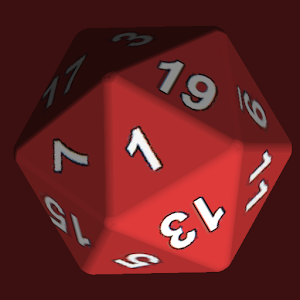
It was, and it is, this cherry red twenty-sided die. He was rolling it on the table. It sounded like clattering bones. At the time there was a game not far from his table and I could hear the beginnings of an argument: mainly what I thought was bickering over rules or some over-enthusiastic debate about combat resolution. You know: just usual disputes.

I sat down with him. His hoodie obscured most of his face — except for his scruffy chin — and completely blocked out his eyes with shadow. I introduced myself. He said nothing. He just kept rolling that one die of his. I saw his three-day pass hung around his neck and I finally got a glimpse at the messy handwriting on it that I couldn’t make out even. I told him what panels and games I’d come for and asked him what he was here for.

Gradually, he started talking. Sometimes I couldn’t make out his words over the sounds of groaning and yelling from the nearby gamer table. We, naturally, started talking about gaming.

“I always loved Dungeons and Dragons,” he said in a soft, soft voice.

“Loved?” I asked, puzzled at the emphasis on the past-tense.

He inclined his head a bit and kept rolling his die, though I didn’t see the number it landed on then, “Yes well … I liked the role-playing element more than most. I found the numbers, the positioning of the figurines and the math to be freaking tedious at times. No offence.”

“None taken,” I told him, “the rules get updated all the time, but they do structure it out and make it interesting.”

“True,” he said after another bone-rattling dice-roll pause, something that looked like a purely mechanical act more than a nervous tic, “But I really loved getting into character: acting it out and immersing myself into the world. I loved problem-solving through role-playing the character out,” he smiled then and it was almost a happy smile, “Yeah. I was one of those kinds of players.”

“Hey, liking Batman doesn’t make your dick bigger,” I said, “though really it’s beautiful women that do it for me.”

He actually chuckled a bit at that, “Yeah. Elitism sucks … especially when you are the only one.”

I didn’t quite know what he meant by that, but it was enough for me to sense that there was a talk coming. For one, he stopped rolling his die. From my own DMing experience I knew this was the time to be quiet and listen.

“You know, some of them think I actually traded all my good rolls to Lord Orkus: to make my dick bigger or some shit like that,” the other looked down at himself, “If that was the case, maybe I should have prayed to the Dragon god Bahamut instead.

“It just … started one day. I don’t even remember when. I can tell you, though, what it feels like.

“You know when you’re going to have a good roll or a bad one. I think every gambler and role-player knows it on some very intrinsic level,” he rolled his die and this time I saw it land on a big, fat, white 1, “When it’s a good roll, or one with great possibility it sings and surges through your blood. There’s hope. There’s excitement. There’s fun,” he rolls the die again and it lands on the same number, “But when you have a bad roll, it feels flat. Your stomach sinks when you cast that die, and you know even before it lands what it’s going to be: if you’re honest with yourself. Dread makes it even more sour and you don’t even want to look at it. It is just that bad.”

He rolled it again, “Every one of us knows what kind of roll we’re going to get. We just lie to ourselves and say it’s purely up to chance. I’m not even sure if the die affects our luck, or if it’s our own spirit — our self-confidence and personal energy — that affects the die.”

The die landed on another 1 as he continued talking, “My friends heckled me. They said I was cursed. ‘You’re cursed, Lucky 1s,’ they told me, ‘you’re cursed …'” he shook his head, “No matter what I rolled, it’s always been the same. I role-played as best I could, but the dice always betrayed me,” I could feel him glaring down at that 1 with a very palpable sense of hatred, “Eventually, I kept being the one to screw up our group quests and they stopped inviting me to games.”

“I’m sorry,” I told him, and meant it, “That was a shitty thing to do.”

“My attitude was getting worse, to be fair,” he rolled the die, making it clatter dangerously near the table’s edge, “I kept this die: where it all started from. I thought I might as well at least be honest about that with myself. I was so … angry, you know? They blamed me for my bad rolls. Blamed me like I was somehow responsible for them. Like I wanted them on some level. It was bullshit.

“Sometimes I think they did it to me. There’s energy in group games–good and bad–and after a while I started to believe it. I started to embody it.”

“Those are a lot of 1s,” I admitted, with a little ripple of goosebumps forming across my arms, “Maybe you have five dots in Entropy.”

“Dots?”

Mage: The Ascension,” I told him, “Well, that’s how stats work in White Wolf’s Old World of Darkness campaigns. In Ascension, the Euthanatos are mages that deal in death and luck: in matter breaking down and continuously changing. Entropy. Somehow, I think you might like that game.”

“Heh. It does sound cool. It would be nice to play again and not suck,” between the sharper sounds of him rolling the die hard against the table and the growing clamour of the other table, it was getting harder to hear him, “You know, some people get Natural 20s on their rolls. All the time. But I get 1s. I get freaking,” he rolled the die, “goddamned,” he rolled the die again, “1s!

Suddenly, he just whipped that die onto the ground beside us. I looked down and, yeah, it was very creepy. Even on the floor, it landed on a 1. I was almost tempted to mention that he needed some Felix Felicis, but that was definitely not the time for a Harry Potter joke.

We were both quiet for a while. His shoulders were slouching. To be honest, he looked miserable and lonely: the kind of person that wished they would be eaten by a Grue.

I don’t know why I did it. I reached down and picked up his die. The noise from the other table was getting very rowdy. Some of the players were leaving. I slid the die over to his hands on the table. And, to this day, I really don’t know why I asked him this one question: but I did.

“Have you ever gotten Natural 20s?”

It was a dumb question after everything that I had observed today. But instead of walking away, or shouting at me, or smirking, he looked down at the red die and said, “Only in a group. And only when I get angry.”

He picked up the die and whipped it on the table with a hard crack. I was almost surprised the Game Con Volunteers and security guards didn’t hear it, but the sounds from the other table probably drowned it out. He did it again. And again. And again. It was like a gunshot each time.

20.

20.

20.

Critical hit.

Critical hit.

Critical hit.

Finally, the whole other table close to us dispersed and I could hear some of the departing conversation, “All bad rolls.”

“And 1s. So many fucking 1s …”

He looked up at me then and I could finally see his eyes. They were dark and sad.

“That is the real reason why no one will play with me. Ever.

“You know, some people just get Natural 20s with a kind of cockiness or an easy grace. I wish I had been one of them. But if ‘should-ofs’ were treasure, we’d all have a lot of fat loots.”

He got up then and handed his die back to me, “I think I’ve finally rolled all the 1s out of this fucker. Maybe a few of the 20s too. There are some solid numbers left though. Good numbers. Not too lucky, but not a fumbler. Damn, I hate being called that … almost as much as Lucky 1s … Anyway, thanks for listening.”

“Hey,” I said before he could leave, “you should really check into LARPing. There’s a Mage game here at the Con. I think you’d like it.”

His back was facing me at this point, but I thought I saw him nod. Then, he vanished into a crowd of oncoming players.

I still see him around, you know, that guy they still call “Lucky 1s.” He doesn’t just stand around as much anymore, I’m glad to say. Evidently he found that Live-Action Mage game I told him about: where he plays as a Euthanatos that feeds on the bad luck of others. He doesn’t wear his hoodie now and he smiles a lot more.

I still have his 20-sided die and I have to say that — to this day — I’ve never failed a roll.

It Is Never Still and Neither am I

I dream in the green of it.

In fact, I never really left the green that my friend brought me into last weekend during the summer sunshine. She told me before that I seemed disconnected–that I’d been so for a while–and, as a matter of course, we walked through High Park, then to a pub and back to her place. A night or so later, I found myself on a shuttle bus from Eglinton back to Finch after meeting Neil Gaiman. And on that ride, tired and somewhat dehydrated, I had time to think.

I had time to think about a lot of things.

There was a time that I took a night bus from College Street all the way to Finch after spending time at Neutral. At the same time, when I passed Eglinton I would look for the Higher Ground store with its old apartments that my friends used to stay at. Years ago I would come to visit there and sometimes I would stay the night after going down to Queen and the Vatikan from Ossington. The irony–that I would finally understand how we always navigated from there to there years later after they were gone–never escaped me.

The associations spread from there like creeping vines of psychogeography ignoring all perceptions of time and space. I remember walking down Spadina: from College Street to Queen with my friend from Germany and later giving her her first Halloween. I recall walking with another friend through Kensington Market to look at old thrift clothes and makeup.

Of course the Lillian H. Smith Library comes into the fore with its statues of fantastic animals: whose doors we sometimes stopped into. That library becomes a nexus: where a friend introduced it to me for the first time and I waited for another person there to see the Merril Collection for the very first time.

When I follow the track down I remember Neutral and the girl with the Cheshire smile who decided she wanted to dance with me. Further on, down the streetcar path in the night to Dufferin and then Brock Ave where I sometimes spent the night and free-cycled things like abandoned doors. Down the very opposite, away from the Lillian H. Smith Library was Broadview where two awesome ladies used to live and sometimes had parties. And then near College and Clinton was the streetcar line to Euclid Avenue.

Euclid Avenue.

I recall all the streetcar rides to comics conventions like the Paradise at the Ex or some chain of hotels and all the Starbucks and places I used to find myself in when I wandered. But of all these days and all these evenings what really sticks out at me the most of all was the night bus after a Star Wars game with my friends in Richmond Hill taking me back into the city and my walks on the Danforth and Woodbine where I used to live. And Woodbine. Woodbine. Woodbine …

There were the moots and the munches, the parties and the events and just the times when I allowed myself to wander. I’m not sure when that moment was when I changed from a quester into a castellan, or a wanderer into a hermit. And when I was coming back from meeting Neil and wondering if life would any better after reaching one of the things I looked forward to the most, I finally realized that I was in mourning.

I knew I’d been grieving for a while. In my mind I understood that this was what I had been doing and I even told people I knew that this was the state I was in. But it wasn’t until that night that I began to understand that I’d been grieving for a really long time–for all these things that I thought I lost–and I wasn’t dealing with it.

Of course, that’s not entirely true. I was dwelling in it. I didn’t let go of it. And when I moved back to Thornhill away from the city, all I could do was blame myself and scream quietly why. Why did this have to happen to me? Why couldn’t I keep my perception of freedom? Why does loss exist? Why do I have to be so fucking unhappy?

And I understand something now. That boy who made his ridiculous budgie chants, who went out to his first Conventions, who went to Euclid Avenue, who danced with the girl and her beautiful smile at Neutral, who went to Brock Avenue for the night, who stayed above Higher Ground, who helped a friend find Halloween, who played at the Two-Headed Dragon, who lived and still loves at Woodbine, who went to York University and who wandered around at all times of the day and night downtown in various forms is no longer here. I am no longer that boy or that man. I am not that person–or those people–anymore. It’s all so vital and immediate: before time eats through experiences and turns them into memories. And sometimes it sucks. It sucks so bad and I feel that anger come out at that sense of loss.

Me and my Head

But I have to accept that and live accordingly.

I’m … something else now. I’m not new. I still have all of those memories of being all those different variations of people. And I haven’t sorted through it all yet. I don’t think I ever really will. I know I’m not always wise or strong and I tend to repeat the mistakes of the past in different permutations. But I am doing so much now. I feel closer to something: something that I can’t entirely focus on or name. It’s like I am breaking through a barrier partly of my own creation and the other half belonging to the rest of the world. It is a penumbra of pain, loss, regret, rage, guilt, ennui, and rut but also stability and order and “just the way things are.”

And I am tired of feeling like a stagnant, rotting old man with crazy hair. I want to be an active powerful young man with crazy hair instead. I realize I still feel and that it is okay–and more than okay–to have strong feelings: even though and especially because I own them.

I know a lot of this might go over some people’s heads with details that explain little or nothing. But to those of you who know, and you know who you are, even though I’m a changing person I still love you and I will treasure what we had and whatever else we can have again now. I was really very lucky. And I guess I still am.

I guess this is just a really long way of saying that I’m still healing and it is confusing, and uncertain, and sometimes really quite scary. But at the same time, I feel alive and this is my space and my time: or as Gwendolyn MacEwen put it, I’m dreaming “in the green of my time.”

Until another time, my friends and loyal readers.

Anonymous

I think I was the only person who was so happy to see her. And I was so happy. So eager.

I was tired, you see. But I wasn’t tired from a life of too much work. I was a writer: a story-maker. Every time I got the chance, I’d sit down in the early morning or late at night and write about the things that mattered to me. I admit, most of the stories I wrote were purely for my own self-gratification: because they were stories I wanted to read and I was the only one who could write them the way I saw them. I’ll also admit that many of them were very personal stories or based on my own experiences.

And–more often than not–the main protagonist was always me.

But whenever I finished what I did, letting the gross black weight drain from the interior of my skull onto paper and screen, I knew I couldn’t go any farther than that. It wasn’t the blank page that stopped me, or the scribbled out words, or even the spectre of a deadline. It was never even the pressure to live up to the shoulders I barely tottered on. I told her, in the end, that my fear was the rejection of the work that is myself.

And so I stopped.

I crawled away from the meta-fictional eyes of the audience. I showed my work to fewer and fewer people and of these people, some of them even turned on me: taking offence to something I could deny no more than my own name.

I was guilty of a very thin skin, and if writers are liars then failed writers are cowards.

Then, after I got a good, real, and sensible job the stories finally died. But the thin skin stretched too far over the moment I crept away from and the ghosts of ideas screamed silently behind my eyes: unrequited and hungry.

So when she came, I was relieved. I was so relieved to finally make the pain stop. I hated myself. I asked her for oblivion. She said no, of course, but this should not have surprised me. I know that she knows that there is somewhere for everyone. I took her pale hand. It was surprisingly warm. She told me there was someone I needed to meet.

I found myself in a great and familiar hall. She was gone and at first I thought I was alone in this great ornate emptiness.

Then, I saw him.

It was horrible. I found myself shaking on the floor in shame. He asked me — if “asking” was the right verb to describe any words that came from his mouth — what I wanted of him. I knew who he was. I wished for death and realized the irony of my thoughts. I asked again for oblivion.

He looked down at me with those terrible, beautifully infinite dark eyes and told me not to lie to him again. People who pass through the Gate of Horn are not allowed to tell lies, he told me.

I remember opening my mouth to speak again when suddenly images, symbols and ideas themselves seemed to burst out from the back of my mind instead. I didn’t understand their language — which was more song than words — yet at the same time I did. He looked at me for a long time. He told me that I was a vessel of the stories and that I had denied them. There was no forgiveness in his tone, but neither was it an angry one. The sheer disappointment in his glittering eye was worse than any fury he was capable of.

Underneath that gaze, I wanted to die again forever.

But he refused me. It was not his place, he said. However, even though my potential in the conscious world was over, my words — if that is what they are in dreams — expressed my wish: my real wish. He compelled me to follow his eyes to … a large series of bookcases ascending into the sky.

I am allowed to stay here indefinitely. Sometimes, I read the books from those shelves. An older thin man with a long nose and spectacles occasionally keeps me company. But most of the time, I am at a desk: writing on thin dream-paper with the black of a raven’s wing. When I’m done, the crane-like man takes my finished papers and stacks them into books that he puts on the shelves: though sometimes he will take the time to make a fine point of correcting my grammar.

Occasionally, he will stop in, look at my “progress,” listen to the ideas singing themselves into the paper, then nod to himself and leave. Sometimes, she comes back and tells me that everything I make is beautiful. I know she has nothing but good things to say about anyone, but coming from her those words are no less special.

Then, sometimes in my room, another woman with golden hair comes to hold me at night and I cry into her arms. Aside from the one who brought me here, she understands me and forgives me the most.

But mostly, I write my stories for a library that doesn’t exist with its shelves sometimes floating in the sky and always filled with imaginary books. It reminds me so much of what I did when I was alive. Sometimes dreamers find their way here and read my books, only to disappear and forget all about them again.

None of them know my name and I continue to write my stories in books of air: happily.

As I Miss the Point: Pixel Girls and Broody Men

I saw Laurie Penny’s article I Was a Manic Pixie Dream Girl through a tweet that Neil Gaiman made: with him questioning whether or not his character Death–in The High Cost of Living–actually fell into that stereotype. I’ve actually heard this term before, in passing, but I think I kept mishearing it as “the manic pixel girl,” or something along those lines. Maybe it was after watching and reading Scott Pilgrim that my brain started to make that reference.

Still, the definition of that term still stands: as a female character created specifically to make some dark, broody, introverted young man open up to life and not that much else. You know: the quixotic help-mate that comes and goes and whose only purpose in life is to help some guy “lighten up.” There are many conceits about this kind of character–this stereotype–that rub me the wrong way. I mean, I can talk about how she isn’t a whole human being, how she probably doesn’t eat, drink, sleep, eliminate in any fashion or probably even menstruate. I can describe how she is more of an elemental than anything material and is more of a shadow or a mirror for a man than anything else: at least when taken to the nth degree.

But I think what really bothers me, as a man and as a human being, is that the Manic Pixie Dream Girl always seems to have a kind of knowledge–inherent in her being–that she gives to the man, and he gives her nothing back in return. It’s insulting, really, to both genders in this dynamic.

I mean, think about it for a few moments. What this dynamic says, as a narrative, is that a brooding, insular man needs some agency outside of themselves to become a full being: that for all of their knowledge and skill, they really aren’t that bright as it were. They are not “naturally happy.” In fact, they are so hopeless that only one kind of woman can give them what they need and not, you know, come to some kind of understanding from personal experience or begin to help themselves. And is this pixie girl so whole and so unselfconsciously perfect that she can’t learn anything from him in return? That maybe he might also know something about life and it is not all about an Apollonian shallow self-centred view of the world in which everything has to be positive all the time, or someone’s view has to be saccharine sweet all the time to the point where they can’t stand the negativity in the world or other people and will either ignore or phase out someone who is “not positive enough” or try to change them?

As Thomas Mann points out in “Tonio Kroger,” some people dance and some people watch people dance and appreciate it for what it is. But I posit that this is no reason for either dancer or watcher to not interact or learn something from each other’s perspectives.

And I think that if I had to really go into this, I would say the following: people cannot fix each other. They can’t. The only way that a person can be “fixed,” whatever that means, is for that person to decide that they want to fix themselves: or to change. That person can ask for help, can accept it as well, but the agency is ultimately with them. Also, what is a “main character?” Is a main character someone who has to be in charge and in control all the time: making everyone else into an extension or a side-character in their own personal odyssey? If so, then it’s just so … tiring. It’s tiring and unrewarding because you are losing out on some experiences when you are like that.

You know what story would really intrigue me? Honestly? Something that began like a Pixie Dream Girl meeting a brooding dark young man and she presents this stereotypical face to him. And it isn’t all bad. She and him have fun despite himself and, god forbid, he actually begins to remember or know what happiness feels like. But as this relationship goes on, he notices that she is a human being too: someone who needs to use the restroom, sweats, passes gas, gets tired, gets periods, doesn’t get periods, gets cranky and has her own shit to deal with. And maybe she in turn learns things from him too. Maybe he shows her exactly what he perceives as wrong with this world. Maybe she learns that sometimes it is necessary to sit down and take things in: that there are times when it is appropriate–and healthy–to be solemn and really look at what it is that you are doing. Perhaps she can see that sometimes he just doesn’t want to be the main character anymore and that he just wants to be an interesting side-character–the kind that is generally unplayable, a strange NPC–who can come and go with her as she pleases, or as they do.

Perhaps they can dance in the sun and the night and enjoy being alive together. Maybe they can sit in a peaceful and non-threatening silence. And why does she have to be “simple” and he be “complex.” Why can’t they both–or all–just be intelligent and different as human beings? Why can’t they both be wrong, and be right at the same time? In fact, when it is all over in some form or another, why can’t they both go home at the end of the day changed for having met each other?

Because I tell you right now: whenever you do meet someone, you change them. I don’t mean you force to be what you envision them to be, but even if you don’t teach them new things even something as seemingly superficial as your mannerisms sometimes rub off on each other and get adopted in strange ways. And even if you ever get reduced to the point where all that easy conversation and love becomes stilted and somewhat embarrassing after at least one of you moves on with your lives–when you are just a little sentimental enough to make the person you once loved uncomfortable after … whatever the fuck it was you had–you know that just for one moment you both understood each other and held each other for dear life as human beings. And who knows: it might well happen again.

Maybe there is a film or a story like that which uses these two stereotypes–the Manic Dream Pixie Girl and the Brooding Young Man–and subverts them like that. Or I’m just amalgamating another stereotype and some cliched human dynamics together: like from some romantic comedy. But whatever the case, stories about actual human beings are nice: even when you don’t want to live them.

And I will just end off by stating one thing. Ramona Flowers is not a Manic Dream Pixie Girl. If anything, she is more like a Depressive Dream Pixel Girl: at least in the film. She is too detached and ironic to be manic and, frankly, is just another stereotype. And don’t even get me started on Scott Pilgrim. Sometimes, he doesn’t even have the intelligence going for him.

But I will say this: that just because someone isn’t a main character doesn’t mean that they aren’t–or they can’t already be–a protagonist.

Having to Choose: What to Send and What To Post

There is this one thing that frustrates me from time to time. When I’m not posting articles straight onto Mythic Bios, I am writing stories into the other one: the Other Mythic Bios that I elude to from time to time.

There are stories I make that I really want to show you. There are stories that I want to be seen. But I also want to get published. Very simply: I know that most magazines–at least paying magazines–will not accept stories that have been printed elsewhere in any form. Or if there are such magazines and publications, I don’t know where to find them. It is one of the many things I have to search for at this time.

So basically, there are some stories I have that I need to save in order to send out to publications that may or may not accept them: publications that take time to get back to someone as well. I know that this is just how it goes and I don’t know what the results will ever be, but it can be frustrating.

Especially since I want you guys to see some of these stories.

I realized something else. After I started to truly stop procrastinating and send out my most functional stories, I realized that I didn’t have as many of them as I thought or wanted. I mean, I have stories that I can edit–and good writing is re-writing–and some that I can expand on, but of the ones that I have–the ones that I think are whole so far–I need to actually keep them in reserve.

And I don’t have many people to show them to. Many of my friends are very understandably busy and I can’t share with them as much as I used to. It is very sobering to really appreciate an immediate trusted reader-audience when they are no longer as available.

I also have some works that I am hesitant to even bring out because, frankly, they aren’t ready: in both structural and even psychological terms. I will say though that I am still looking for other comics collaborators in addition to my friend Angela to at least look over what I have planned.

So what it comes down is that I have to choose. A lot of my derivative works–my homages to other creators–go on here because I am not making any profit from them at all, I credit the people that inspire me, and I can show people what I can do–but I also manage to post some stories that I know won’t quite make it in any magazines that I read, but that I still like enough to think they deserve reader-attention and to further illustrate what I am capable of as a writer of fiction.

I have to choose which stories I think might make it in a magazine and which I can afford to hold off on showing a wider audience (at least to those publications that do not allow for simultaneous submissions) and which ones I think will only make it in my realm right here. I do not like having to make that choice, and I am at a place now where I’m beginning to actually pursue another path.

One for thing, I am looking for work and focusing on jobs that can supplement what I’m doing right now. I’m attempting to take the pressure off of constantly feeling the need to send stories out to all kinds of magazines all the time. Also in this way, I’m writing a lot of non-fiction articles and–if you’ve been following so far–I’ve even had one published: with more to come I’m sure. I already have one or two new Sequart articles planned.

It also helps that I have two major writing projects to focus on now: including working on one with the input of a very awesome group of people. I don’t want to say much else about this until more occurs, but it is something I didn’t see coming and I really forward to seeing where it is going to go. If I am full of something, it is definitely ideas. Finally, I’ve been toying with making a collection of stories to make into a printed or electronic book. It’s not the first time I’ve thought about this and I know it won’t be the last either, but it is definitely worth writing here.

And, for the record, I am glad you are all here to see me write my strange, weird hybrid articles that link things together and what elements of my stories and random poetry that make it out onto the Internet. I actually wrote this entire post a while ago, but after reviewing it I’ve realized that for all my frustrations and setbacks, and the collage of rejection letters that I plan to create, I have accomplished a lot and I am in the process of undertaking even more possibilities: and just as you are here for my writing, I hope you will do me the honour of remaining at my side for the rest of this Choose Your Own Adventure I’ve made for my life.

The fact is, you are all awesome. Thank you for reading me.

Yet These Hands Will Never Hold Anything … Except For Paper and a Pen

I was fully intending to let you all know that I was going to attend–and this time participate in–the 12 Hour Marathon Comic Book Marathon at the Comic Book Lounge and Gallery. However I ended up re-blogging–and blogging–about Pollychromatic’s Be Brave, Be Heard article instead, which was more than worth it seeing as it attempts to create a powerful visual symbol of female identity, voice and survival in the social and cultural climate of this particular era. So at this point, I have already participated in the Marathon and I want to talk about that, and my weekend.

I woke up early Saturday to gather some supplies together and check my email. When I came online, I saw that Julian Darius and Cody Walker published the first part to my article Yet Those Hands Will Never Hold Anything: Emiya Shirou as the Interactive Superhero of Fate/Stay Night on Sequart. You can look up Sequart through the link I just made or on my Blogroll: there are many interesting scholarly articles on themes, character analyses, and the history and influences in and of the comics medium. I have to say that this made my bright hot summer day before trekking out to the TTC and getting to the Lounge.

On the subway ride there, I spent some time writing out some notes as to what kind of story I wanted to sketch out. I am not much of a visual artist, as I’ve probably said before, but I was resolved to make something come from this Marathon. This was not the first time I’d attended, as I recounted in another entry of mine, but I actually made it earlier and prepared to get some work done.

The organizer of this event, Keiren Smith, met me as I came up the stairs and introduced me to the other creators already in attendance and heavily at work. I settled onto the black leather couch next to the washroom, took my shoes off, and took out the lined paper on my clipboard that I was writing stuff on earlier on the subway. I proceeded to make a few notes and create my captions and dialogue before my crude attempts at drawing the images and the panels around them.

Of course, it didn’t work completely as I planned. I was pretty tired from the heat and the fact that I’m not so used to being up and about as early as I had been. I also kept losing my pens. I got to socialize with some people from time to time and met new faces along with a few old ones. I took my entire box of business cards for Mythic Bios with me just in case as well. At first I was torn between socializing and getting this comic done. The comic itself evolved from an idea I came up with in another work not too long ago. Basically, this mo-fo–and I say this fondly–was going to be a first-person comic: where we as readers get to see the protagonist interact with other people and surroundings from his own perspective along with some helpful dialogue and captions along the way.

Yeah. My first comic in ages and I have to be experimental about it: just as the story was intended to be. It is the extension of a world that I began working on four or five years ago and it amazing to realize the point where you centralize a world of your creation so much that it actually extends itself outward: when it becomes the core of a growing reality.

Okay, so after clicking on the Creative Process Category part of this Blog entry just now, I’m going to go into more of what actually happened. Well, it fought me: naturally. I sat there and despite the snippets of quotes and ideas I had on the margins, I was stuck for a little while. I knew I had to make something at least twelve pages and that this would determine what story I would be able to tell. I was also a bit hot and I wanted to talk to people when I wasn’t pleasantly drowsy on the couch.

Finally, an artist I was sitting next to and chatting with, Megan Kearney, suggested the obvious that I was missing: that I should just create thumbnail sketches.

And that was when I began to draw my comic. I thought about my panels and, aside from the occasional rectangular ones, I did mostly three columns of two large square panels. Sometimes they were arranged differently, but most of the time they were just side-by-side patterns. I had to also think of how a first-person perspective would work. I mean, I had seen one before such as in the zombie apocalyptic graphic novel known as Daybreak, but I could only see the complications that my former Master’s thesis supervisor and I once talked about when he was comparing book narratives to comics and film.

But I did show my protagonist in a mirror and came up with a good line there. I also showed his … hands occasionally. Mostly, I was focusing on the narrative in the captions. I already accepted that my drawing would be basic at best, so I focused on the writing and the graphic pauses between visuals and that writing. It’s like what is said about Jeff Smith: in that he wrote and drew Bone as though he were telling a joke.

I also got to watch other artists and some of their creative processes at work. I saw some people with reference books and sketches. Megan herself was doing some water colouring of the project she brought with her. I saw a few people looking at books from the Lounge whom I didn’t get the chance to speak with. And I saw some people doing some very intricate work with paints and small inked cells on paper. Hell, some people were even inking their comics. It was insane and intense: in a lot of good ways.

The number twelve was both intimidating and painfully doable to me. Just twelve pages, I kept telling myself. Eventually, my thumb-sketching became my drawing and I just focused on telling a story. My concentration wasn’t all that great the entire time. Sometimes my mind wandered and I got tired. It became painfully apparent to me after a while, even after I ate the food that I brought akin to breakfast, that I needed to get something to eat or the only thing I would be writing would be ellipses. Sometimes I can power through creating something and then dealing with my body afterwards, but on that summer day on Saturday it was a bad idea.

At one point, at about the beginning of page five, I walked out of the Lounge and down Little Italy to find some more food. It was beautiful out. People were dressed in colourful light clothing and talking and holding hands at outdoor cafes. I admit I’d been watching them outside the window above the couch anyway when I needed to get up. I even walked past Euclid Avenue and realized that the Dragon Lady that I visited with some friends a few years ago had been here. By the time I got past Sneaky Dees, I was feeling nostalgic in this familiar summer setting of everything. Then I ate some food as I came back and talked a bit more with people.

Of course, by then it was too late and I began to realize that I had the beginnings of a headache. Luckily, I brought my regular strength Tylenol with me: just to be sure. Of course, now–for me–I was going to be working with a handicap. My mind was really drifting and I vowed to myself that I was going to at least get to page six of my work before doing anything else: to get halfway done. Neil Gaiman did not succeed in finishing his 24-hour comic, but I could succeed in drawing and writing twelve bloody pages!

Then I somehow got to seven and at that point I had gotten fed up, took some more business cards, talked to some people, and gave them out. Then I browsed the comics because, after all, this was a bloody comics store and it was my duty to do so. At this point, my Second Wind kicked in in a terrifying sort of way. So I sat down and after telling someone else I was going to do this, I did.

The thing is: this story had been in my head for a while that day–with other elements of it being in there for much longer–and I wanted it out. I wanted to finish what I started and have, in my hands, something to be proud of. And then seven pages became eight, and nine … by the time I got to the double digits, I knew I was going to do it. I just began drawing as basically as possible, not really caring about too many inaccuracies such as who was on the left or right, but just getting it out.

It was only after a while, after doing this all on my writing paper, instead of the white blank paper I brought for the purposes of drawing on, that I realized I was actually going to go over twelve pages.

And I did.

I finished my comic with about two minutes to spare before the deadline of 11. I felt … a good kind of tired. I did it. I finished the first part of an entire chapter of a fictional book I created in another world and I finished it more or less how I wanted to. So I talked with Keiren and some other people, and then I walked from College and Clinton in the summer night of Toronto back to Bathurst Station where I took a long ride back to Thornhill.

There was no way I was going to write the full story of that comic in just that night and maybe one day I will continue it, but I did what I set out to do: I drew it up to the point where I mentioned the very last sentence that it possessed in another narrative of mine. That night, I basically went to sleep in my clothes and on top of my blankets. I don’t remember even going to sleep, but I actually woke up pretty well rested all things considered.

The Marathon was a good, constructive day and I’m glad I did this. Oh, and for those who might say “Pictures or it didn’t happen,” I don’t have a scanner and just a camera. Also, my pictures are insanely crude and my writing … somewhat legible. Maybe one day I will show it, but right now I will just leave you with the message that I went out, took an idea with me, fleshed it, and finished it strong.

But I lied. There is actually one more thing I want to say. Aside from thanking Keiren Smith and the Comic Book Lounge for organizing and hosting this event respectively, and all my fellow awesome creators for attending it, I want to add a little tidbit about storytelling. A long time ago, a Creative Writing teacher of mine asked me which story-line of a meta-narrative I was making was either true or false. Nowadays, and after working on this comic–with its own meta-narrative sense–I realized something.

Something that parodies another thing, or subverts it and yet has its own intrinsic world-rules–or writing continuity and rhythm–can be more than just one thing: or one thing or the other. The fact is, for me, I like the idea of a multiplicity of different things happening one space and different dimensions. I like that dynamism. The truth is that all of my stories, even the stories within stories, are real. They are real to me.

And I think that is the thought out of all of this excellence that I am going to leave you all with.

ETA: Towards the end of the night, at the other end of the room people started singing this song parody. And as I worked, I sang along with them.

This is what happens when you put a group of geeky creators together in one space for an extended period of time.