Star Wars Legends: Crisis In Infinite Galaxies

It was a little while ago that Star Wars fanatics were informed, by LucasFilm, that the Star Wars Expanded Universe of novels, comics, video games and other multimedia would no longer be considered canon in the Great Holocron of that Galaxy far, far away. The Star Wars canon, such as it is, has been culled down to the current six films, The Clone Wars animated series and the upcoming Rebels.

For the most part, all other materials belonging to the Expanded Universe have become Legends: stories that have, for all intents and purposes, been regulated to the status of galactic apocrypha. I wrote something on the subject at GeekPr0n, where I was fairly tongue-and-cheek about the entire matter, but I have to admit I had a few more thoughts on the matter.

You see, it’s not the first time a major franchise has rebooted, or attempted even a partial reboot, of itself: where stories that fans have followed for ages become either the relics of Gold, Silver and Bronze Ages, or non-canon entirely. Say what you will about Star Wars Legends becoming different “points of view” in examining that galaxy, that fans will “always get to keep their stories,” or that they will be consulted for those creators making the “new continuity.” I can even sympathize and admit that there were some Expanded Universe elements that simply didn’t make sense or, frankly, were very badly made.

But that all said, despite my own feelings that I wish the Prequels and The Clone Wars CGI series should be relegated into the realm of Legends (because, frankly, I don’t like the majority of their elements) I feel that there is something very cynical about taking a story and characters that people love and saying that they are no longer legitimate. Oh, they get their Legends and you can still read them but, chances are, you will never see them influence mainstream Star Wars and even if they do, they will not be the same. Your stories and characters are no longer in continuity.

For me, and in the words of Obi-Wan Kenobi, this news felt “as if millions of voices suddenly cried out in terror, and were suddenly silenced.”

Obi-Wan

But why stop there? Why simply stop at placing all of the Expanded Universe into its own Legends pocket dimension and go further?

That’s right ladies, gentlemen and other beings throughout the multiverse: perhaps LucasFilm should have “pulled a DC” and created their Crisis In Infinite Galaxies.

I mean, the tools were all there. There were already Star Wars Infinities comics: the very same that are, ironically enough, in Legends right now. But instead of a series of What-ifs, they could easily make a big What-If. And let’s make it a big one that functions a little something like this:

Imagine that each story arc: The Dawn Of The Jedi, Tales Of The Jedi, Knights and The Old Republic, The Star Wars Prequel books, The Clone Wars, Republic Commando, The Force Unleashed, X-Wing, Thrawn all the way to Visions Of The Future, Young Jedi Knights, Star Wars: Jedi Knight, Dark Empire, The New Jedi Order, The Dark Nest Crisis, Legacy Of The Force, Fate Of The Jedi, Star Wars: Legacy, the original Marvel Star Wars comics, The Star Wars, and all other multimedia adventures are their own Galaxies: including the novelizations of the films. Think of them all as alternate timelines and realities like the different Ages of DC and the parallel universes of Marvel.
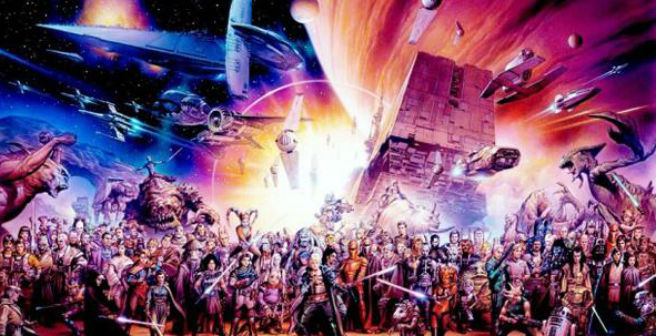
Star Wars Expanded Universe

And each of these realities contains alternate versions of our favourite characters, and some unique characters as well. We take these characters and settings and, through some deus ex machina — through the art of the crossover stolen from the traditional comic book superhero genre — we do what Star Wars does best: we engineer a plot-driven conflict and destroy every reality until there is only one: the accepted one.

Think of this as the premise: there is an imbalance in the Force. In the Splinter Galaxy, an archetypal and primordial power known as the Kaiburr Crystal has been taken from its place in the Temple of Pomojema on Mimban and split into pieces by the forces of the Light and the Dark. Because of the separation of this Crystal and its removal from its resting place, the hyperspace disturbances on the edge of the Galaxy fluctuate.

Kaiburr Crystal

Meanwhile, in other Galaxies the ancient Celestials and the Rakatan Infinite Empire become aware of this shift in the boundaries beyond their Galaxy: or perhaps a hyperspace lane that one of them is manipulating warps into an unstable portal in the Deep Core. The Celestials proceed to explore while the Rakata mobilize their fleet and their Dark side-fuelled technology for invasion. The spirits of Obi-Wan and Yoda appear after a mysterious rift opens up near Endor and give Luke Skywalker a new mission. Then you have the Force Priestesses that taught Qui-Gon Jinn and Master Yoda ascension, along with The Ones, the anchorites in the Clone Wars Galaxy sense the destabilization of reality and summon the Chosen One and his allies to deal with this issue from Mortis.

Of course, this does not go unnoticed by the Dark Side. In addition to the Rakata you have Abeloth from the Fate Galaxy rushing in past the remnants of the Centerpoint and Sinkhole Stations: where a rift opens in the Maw and her realm “beyond shadows.” It gets worse, of course. Palpatine from the Dark Empire Galaxy seeks all of his alternate selves and plans to drain their knowledge and become a god, whereas the Sith Emperor Vitiate from The Old Republic Galaxy plots to destroy, devour all life everywhere and do the same.

Now imagine a young Luke Skywalker meeting all of his alternate selves: including the older Jedi-Bendu version of himself from The First Draft Galaxy, the swashbuckling hero from the Marvel Galaxy, and his Jedi Master selves from the others. Envision Han Solo’s genuine shock when he sees a reptilian version of himself that tells him about the odds. Perhaps Starkiller from the Unleashed Galaxy meets Annikin. The clones from Republic Commando run into their The Clone Wars counterparts. Even now I can see the Delta and Omega squads stating, “Brain chips? Brain chips!? What the kriff is this load of osik?”

Then you have Revan from The Old Republic Galaxy meeting The Clone Wars Anakin Skywalker and making the latter wonder what it is to be the Chosen One. Or Darth Vader encountering his First Draft counterparts: the general sharing his name, Prince Valorum of the Knights of the Sith and the prototype demonic artist’s version of himself. And just imagine the Force spirits of different Galaxies meeting each other: such as the young Anakin and the old Anakin many of us grew up seeing.

Star Wars Conceptual Drawing

And the Space Fortress and Death Stars band together, all survivors band together as a terrifying amalgam of World Devastator and Sun Crusher technology — something with a name like the Cosmic Obliterator — crafted from a Galaxy where a Droid Revolution or an Abominor invasion succeeded, or perhaps even the Star Forge gaining its own sentience and independence — obliterates one Galaxy after another in its quest to reunite the Kaiburr Crystal shards and gain unlimited power.
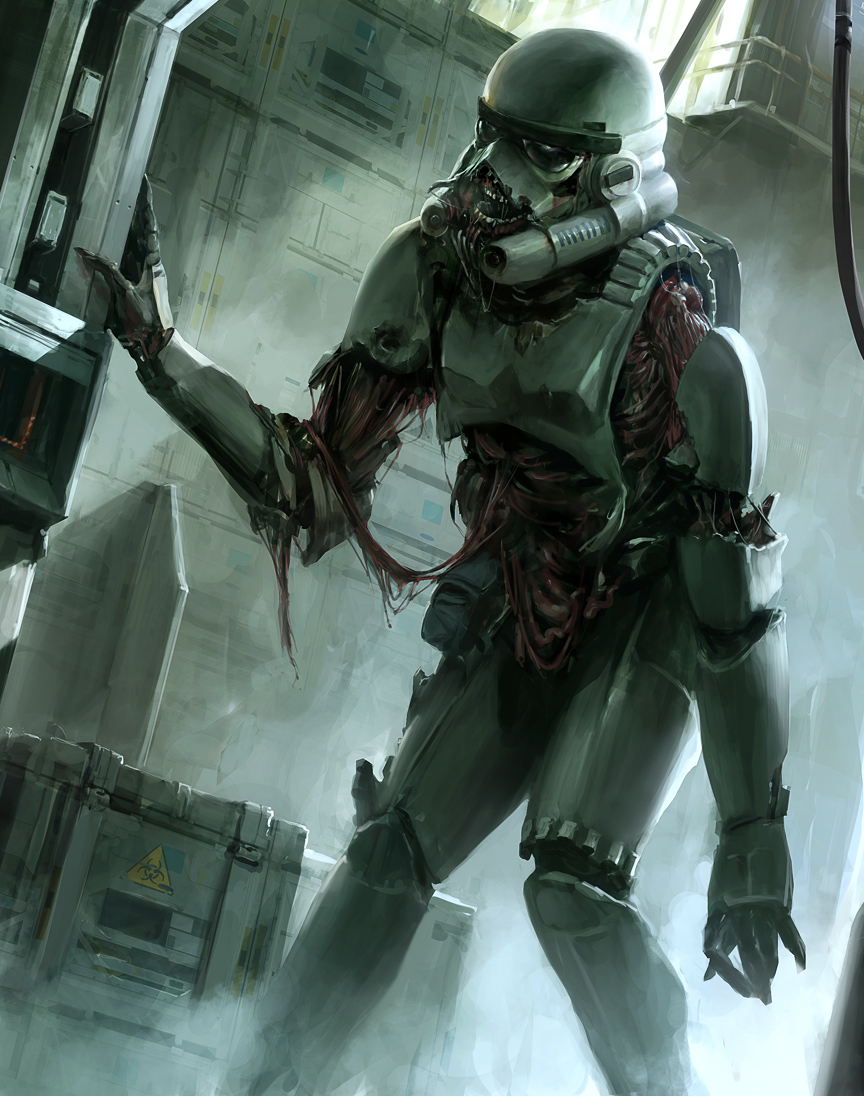
Star Wars Zombies

Or worse … perhaps the malicious Mnggal-Mnggal, coming from the Unknown Regions Galaxy, is seeking to expand its pain, suffering, and self-awareness across all the flesh in existence utilizing the Sith and Imperial-created Blackwing Virus to infect and infiltrate beings in all currently enmeshed realities — the only thing stopping it being a united Kaiburr Crystal. Or the strange and transdimensional Waru, from his Crystal Star Galaxy is drawn into the madness and wants to just go home. That’s right. I went there. I definitely went there. And yes, the blob gets his own Galaxy of that book title’s name. So there.

Yes, I am being incredibly sarcastic. But why not? If each story is no longer canon or set within a Star Wars continuity, why should there be a causality inferred between them? Of course there are copyrights to consider and more fan rage, but just consider the stories you could tell with this attitude. And imagine if the stories were told well. Think of all these characters and their interactions, the stories they themselves can tell. Imagine them making fun of, but respecting their own origins for what they are. And when they die, they can die with some kind of meaning: something more than simply being told they no longer exist.
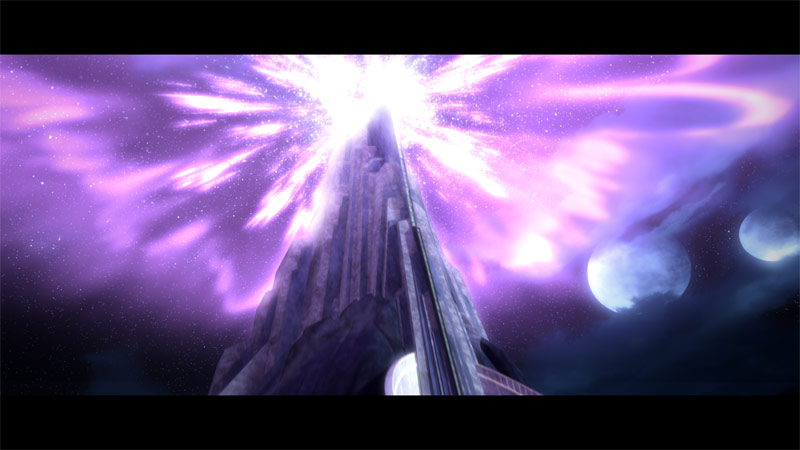
Star Wars Explosion

And even with the cop-out of the reunification of the Kaiburr Crystal in the centre of the First Draft Galaxy’s most potent Force nexus repairing and “rebooting” the Galaxy of long, long ago erasing the characters’ knowledge of past events, does it really matter? Because if they don’t know of the struggles, if they no longer exist as the credits and the epic music roll heralding a new and uncertain reality, we will remain. We will know.

Jedi-Bendu

We will mourn the passing of the strange teleportation, time-travel, advanced droids and lost civilizations of the Marvel and Dark Horse Galaxies, the origins of the Je’daii civilization from the Dawn Galaxy, the short and meaningful lives of Frontline Combat clone commandos, the insane pinnacle of Jedi Grand Master Luke Skywalker who finally comes into his own, beautiful Zeltrons, the varied lives of bounty hunters, scum and villainy, and the love and passion between worlds.

Or, maybe this could be the process by which future writers will decide what goes into the new primary Galaxy. Who knows.

I will tell you now: this is the stuff of fanfiction. But I won’t make this story. I can’t. I recognize my limitations. But if something has to end, it should go out with a bang and everyone should have their time. I salute anyone who can, is, or will be running with this mad jigsaw idea of a crossover.

My rant has turned into a homage. Thank you for reading it. The Force be with you. Always.

What If Comics Had Been a Place Without Codes? Would We Live as Air?

I’ve been having some technical issues these past few days and time hasn’t really been my friend but what I’m going to write here past most reasonable people’s sense of sleep is another down and dirty, and therefore ad hoc, article on comics.  So if anyone out there is an expert or has done their homework, by all means, please correct me if need be.

As some of you already know Sequart created and is now in the process of editing, a Kickstarter called She Makes Comics: a documentary on women in the comics industry and the culture surrounding it. One element in particular that it has focused on is the fact that long ago there were more female readers of comics than they were male. Now, I wrote a short article on what will soon be called GeekPron in which I found some of my own assumptions to the question, well, questioned.

I believed that it was the Comics Code Authority, inspired by the fear of McCarthyism “witch-hunting,” blacklisting, the detrimental testimonials by psychological experts such as Frederic Wertham, and a loss of business that had comics publishers eliminate most of their different genres of comics and focus mainly on watered-down stories about superheroes. All the horror, revenge, gore, westerns, romances, and sexuality all went the way of the dodo at the time because of fear. Anything that challenged the rules of the Comics Code, of authority always being right and just for starters, could not exist in mainstream corporations that published for money.

But the comic book editor Janelle Asselin also mentioned that this female readership of 55% over 45% of male readers changed as the superhero genre became more mainstream. Think about that: the idea that after a time the superhero not only reduced a female readership, but also eliminated or greatly marginalized a whole body of stories and genres that made the medium different. I realize now, looking back on what I wrote earlier, that these two statements are not necessarily mutually exclusive.

I mean, if you are afraid of losing your business and your liberty in telling stories for which you want a certain pay cheque and livelihood then eliminating anything that could be construed as an overt challenge to your culture’s status quo or even subversive to it, it unfortunately makes a horrible kind of sense.

The godfather of manga Tezuka Osamu once said that “Now we are living in the age of comics as air.” And while he was most likely referring to the influence of manga in Japan as becoming more widespread, its connotations can be applied to the comics medium in general. According to Paul Gravett, in Sixty Years of Japanese Comics, Tezuka believed that comics without passion or originality can become damaging and even create pollution. It took me a long time to figure out what this meant. When I first encountered the quote and the explanation, I thought that it referred to the potential damage to the morality of the reader but now I realize that the quote can definitely apply to comics as a medium and what occurred during the heyday of the Comics Code Authority.

The age-old notion of the superhero ghetto that we are so used to hearing about with regards to the comics medium: the notion of an immature all-boys club with shallow depictions of sexuality and simplistic violence with no consequences is damaging not only society’s concept of the medium but also that of its readers and future creators.

I’m not, by any means, saying that the comics that existed before the Code and its predecessors were the fonts of enlightenment for gender or, really, humankind. But there was a lot more experimentation before the Code and it just makes you wonder: what would have happened if these vigilantes and superhuman beings in tights had just remained one of many genres and there had been no Code?

I mean, there is always the scenario that Alan Moore presented in Watchmen: that if masked heroes and one a superhero had been in existence then no one would have paid attention to Wertham and the horror comics of Bill Gaines and friends would have dominated the medium from the fifties all the way into the eighties: becoming darker and more grotesque with time while also innovating itself much like our comics have done.

But that is just one creative interpretation. Who knows? Maybe a flat period of unoriginal and recycled stories would have followed regardless. Perhaps female readership demographics would have changed or something else would have challenged the “morals of comics:” for or against the status quo. Or we could have had another Golden Age: where comics became, earlier on, a widely accepted form of beautiful art and every great artist might have tried their hand at one. Maybe comics could have become widely accepted and mainstream coffee table or instructional as manga has in Japanese society to an almost ubiquitous degree. Instructional comics even had their place in North American society and to some extent they still do.

Of course, those latter thoughts are just me playing at utopia and I’ve never been really good at that. Maybe if there had been no Code comics would have, earlier, been just another form that challenged conventional morality much like any work of great art or literature should. Of course, again, this also happened in the Western world through the advent of what we understand as Underground Comix defying the establishment during about the late 60s: about that same time frame that Asselin gave when she talked about the female comics readership majority existed from the 1950s to the 1960s. Or perhaps the comics medium would have burned itself out as a fad and amateurs such as myself would be wondering, even then, what if: what if it had been different.

As for me, if you really want my honest opinion I will say this. I think that if there had been no Comics Code or anything like it children would have still been influenced by Tales from the Crypt, and Archie, and The Lone Ranger, The Green Hornet and all of those others. And some girls and women would have had Wonder Woman and Black Fury. Many things would have continued on, but sometimes I think about that idea of all people–young, old, straight, LGBTQ, male, and female, different ethnicities, different classes–making their own comics and showing them to their friends and the world. They would realize how different they and everyone else are but also how many things they have in common.

And when you wipe away my pseudo-utopia of a whole loss of potential for a readership of intensely intelligent men, women, and sentient beings, when it comes down to it I do like the idea that without the Code and the forces behind its development, the medium of comics would have been considered more than just silly laughter and transparently hidden BDSM parodies. Those things would have been a part of the kaleidoscope. I think that many more people might have seen comics as a medium that tells all kinds of stories: a space inside and outside of us that is pictures and words. I think many more people may have been more accepting that the medium of comics as that place of sheer variety, like film, between both art and literature.

There is another way to look at Tezuka’s quote about “comics as air.” If you take the pollution of censorship and unoriginality away, what you might ideally have is a fluid art-form that anyone can learn and use. And if you consider that we all live in the continuing Age of Information and in societies that utilize wireless Internet and you include webcomics into the medium … perhaps we can all fly where only superheroes used to tread: up, up, out of the ghetto and away.

Miracleman Balloons

There’s No Place Like Home

“I am Oz! The Great and powerful …”

I ignore the floating green skull and its superior glare, hovering theatrically in its own flames as I make my way to the red curtain not too far away.

“How dare you!” the terrible voice booms, “You have not been given permission to go there!”

The sounds of thunder explode throughout the great chamber. Lights not unlike lightning explode into my eyes. I continue to stalk towards the booth with the red curtain with Apollonian purpose, an ironic reference in itself. Mists and fog swarm around me, and frightening admonitions echo throughout the great throne-room. These sights, and sounds and smells almost make me dizzy.

“Taking a scrap from the Pythia’s scroll, I see,” I speak aloud and continue walking.

“Cease this insolence!” the other cries, his below prompting a burst of orange flame around me, “Or I will summon my Guards to destroy you!”

“No,” I say calmly and without feeling, “you won’t. As an Oracle, you can’t afford to have your men that close,” I get closer to the booth, “besides, we both know they are already dead.”

I walk through the illusionary flames, images channeled there by glittering panels from the corner of my eye.

“Desist, or be struck down by the power of Oz the Great and Terrible!”

“I’m surprised, really,” I tell him as I get closer, “I’m surprised that in a world of magic and strangeness like this one, they wouldn’t have seen right through your disguise. Of course, a magician of any kind–mystical or otherwise–does his best work,” I come up to the curtain, “in plain sight.”

I rip open the curtain. And there is great maniacal laughter.

The man behind the curtain … is not a man at all. It is something else dressed in long emerald coattails. The bronze creature lunges for me with its blade. I barely dodge it, and meet it with the sword in my own hand. Then the curtain completely collapses and two more metallic creatures wielding great silvery wicked-looking scythes surround me. I parry the central construct’s blade even as the others come towards me from the sides …

And promptly collapse into pieces.

The central construct, the Tik-Tok as my companions outside called them, halted. In its beady clockwork eyes, I can almost see fear before it too shudders, steam bursting from its neck-bolts, and falls to the ground with its fellows in one great ruinous scrap-heap.

I hear the click of the weapon at my neck before I even turn around.

“Steam-powered clock-work automatons,” I nod, “I’m impressed.”

“Why thank you,” the voice behind me said, “it took me quite some time to create them.”

“I can imagine.”

“Get up.”

Slowly, I turn around. He’s dressed in the same green coattails that his construct wore. He’s short, and stout, and his receding hair is grey, almost silver. Anyone who saw him would probably have thought him some kind of minor janitor in the Emerald City, a harmless and perhaps even friendly old man. But the hard eyes behind the small rectangular spectacles say otherwise.

“There’s always one in every crowd,” his voice quavers somewhat nasally without the machines to make it sound fearsome, “someone who just won’t believe in the magic.”

“So that’s what you call it,” my words are cold, and final.

He trains his weapon at me, a black antique Colt pistol, “Young man, it is all magic. It’s all one spectacle. Bread, and circuses, you know,” he drawls casually, “It’s just very rare that you find one in the crowd that sees through the trick,” his eyes narrow, “But since you seem to know how my tricks work, it’s only fair–from one magician to another, mind you–that you tell me yours.”

“It’s a trade secret.”

The man laughs, “It was Elphaba, wasn’t it?”

“And what makes you think the Witch is the only one with magic?”

“Well, she isn’t. Not really. She is just more skilled at it than most here. You’d be surprised how much ‘magic’ is left in even these lands.”

“Actually,” I tell him, “I’m not.”

“Tell me what I want to know, young man,” his nasal voice becomes low, the weapon in his hand clicking again, “we are not in Kansas.”

“Though we do come from the same world,” I relish telling him this, now, “Oscar Zoroaster.”

The man seems to freeze in place. His beady eyes seem to dilate like that of a bird’s, “What?”

“Oscar Zoroaster Phadrig Isaac Norman Henkel Emmannuel Ambroise Diggs,” I repeat, “You were a showman in the United States, probably in the late nineteenth century. A minor conjurer, traveling magician, and tinkerer. You know a lot about mirrors, tricks, sleight of hand, sophistry, clock-work devices, and the power of steam, your Age being what it was before you … left.”

“So …” he says after a while, “You are from Earth.”

“From a different time, yes. You missed a lot since you’ve been away, Oscar Zoroaster.”

“I am Oz now,” he grins at me, waving his gun at me, “the great and powerful Wizard of these Lands.”

“You’re an artificer at least,” I amend, “Like I said, you must have spent a lot of time here, letting you hone your craft. You made one great Industrial Revolution here, I’ll grant you that much, but not much else. I wonder though … how much of it was your innovation, magic filling the gaps … or slave-labour.”

“Merely dirty Animals, and savages,” he says dismissively, “no one will miss them. I brought peace here. Stability. I brought them civilization.”

“And all the horrors of Industry to go along with it,” my mouth clenches and I remember why I want to kill this man, “Like I said, you missed a lot after you left us. Pollution, starvation, two World Wars, and mechanized genocide. An entire century of human atrocity and dehumanization, anticipated by and brought to scale right here by a carny-man. You are an Oracle after all, ‘Wizard’: a retrograde Oracle from our world more than anything else.”

“Hush now,” he growls at me, “you only live because I want to know how you know about me. I mean, you could have researched, but there are things … perhaps you read The Book. Elphaba probably learned …” he shakes his head, “a pity I can’t let you live beyond this.”

“It won’t matter what you do or don’t do to me,” I tell him, “you’ve already lost, ‘Wizard.'”

“I can recover easily enough. My men are a dime a dozen, and there are many exits to this place. I know. I had it built myself,” his gaze becomes considering, “And then I will rebuild. It won’t take long. None of it really did in relative terms. Then …”

“Your Madame Morrible is already dead. I’m sure that Elphaba and Glinda of the South made sure of that by now, even as we speak,” I allow a smile to appear on my lips, “By the time you kill me, they will be right here. Them and the flying monkeys you experimented on. And all of this, all of this here will be even more meaningless than it already is.”

“You’d be surprised how quickly one can disappear,” he takes aim at me, and pulls the trigger.

There is a sharp click. And then nothing. I let him pull the trigger of his gun again. And there is still an empty click. His small eyes have dilated further into shock, disbelief, and then fear. Very calmly, I take the gun from his hand.

“This is quite the antique you have here. It’s almost as dated as your Vaudevillian antics,” I throw it on the ground.

“Please …” he backs away from me.

“It is already too late for that. And no, I don’t want emeralds, or power, or ruby slippers,” I grab the collar of his shirt, “you’ve already taken enough from these Lands as is.”

“H-how …”

“Oz is a magical place, as you well know. Back in our world, I always had a knack for causing my machines to malfunction. But Oz … seems to make things less obvious things very pronounced, taking concepts and rounding them up to the next most cosmically ridiculous common denominator. It’s like one great Caricature.”

I let my rage fill my eyes, “But it was a Caricature I loved. Dearly.”

I throw him to the ground, “Your mistake, you murderous charlatan was that I watched this place from the very beginning. I saw it grow. I grew up with it. And saw you. I used to think you were pretty something. I used to think, much like Elphaba did, that you were a wise and benevolent Wizard. Even when I knew you couldn’t use magic. I looked up to you,” my voice cracks, “I liked you, and your hot air balloon until I realized that the only thing in your heart is precisely that. Hot air.”

The next thing I know, I’m shaking with fury, and pointing his own gun at him with one hand, “You ruined the Land I loved, that gave me any meaning in my life — poisoned it with the exact same nationalism, and war, and death from our own world. Our own garbage. You … had … no … right! I should kill you right now.”

I walk back a few paces. And then, I do the unthinkable. I toss his own gun back at him. He catches it, with shaking hands and trains it on me again.

“I helped Elphaba figure out how to read The Book. All of The Book. I didn’t have to do much. You can run anywhere you want. You can hide. You can try to kill your way through. But she will find you. Her and all the citizens of Oz: the Munchkinlanders, the Vinkus, the Quadlings, and the Animals. Especially the Animals. They’ll find you, and make you wish you were dead.

“But I don’t want them to get any more blood on their hands on your account. So you have two choices really. Choose wisely.

I wait and watch him. He knows he can’t run from me. And I can see that he knows that even if he can, they will find him. Elphaba even knows who he is. It doesn’t take long for him to make the choice. I swallow violently and look away after. Even after all he did … I almost wished that what I saw come out of him was spilled oil, and shattered coils and springs. An advanced Tik-Tok mechanism that was created with benevolent intentions, then went out of control and killed his real creator: enchanted to look like a man. Like him. But sadly, all that hot-air inside him was not merely the result of steam-power.

It was just the result of another man playing at being God. I feel less like a child now than ever.

But there is just one more thing for me to do. I search around for a little while until I find it. The green elixir.

I hide it in my pocket before she comes back in. She stands there, surrounded by her winged monkeys and Vinkus allies. They scatter and start securing the room. She sees the body on the floor. Fiyero isn’t here yet, so it falls on me to get to her first. Elphaba doesn’t flinch from the sight. But even after all this man did, I can see in her eyes that her heart is broken. I hold her and she holds me back tightly.

“Glinda is fine,” she says to me, “she handled Madame Morrible. I came here as fast as I could …”

“I know,” suddenly I find a lot of my wordiness is gone.

“It’s done then,” she looks sad, and lost, but at the same time there is a great flush of strength from her emerald skin, “I suppose … you have to go now.”

I look at her. We stand at the same height. None of the literature from my world ever really did her justice. This time, I look away from that penetrating stare, “I … don’t want to,” I admit it. I love this world. I love it and its people, and the magic and the friends I’ve made here. I want to see them grow, and prosper. I want to be with them. There is so much wrong with the world that I came from, so much that disgusts me and isolates me there. There is just too much potential to become petty and small again. To forget everything. And her.

“But you have to,” this is not a question. For a few insane seconds, I want to ask her to come away with me, to fly with me on the Wizard’s hot air balloon back to my world. But although my world is more politically correct in some places, she would be no less green to anyone there as she is here. And she would know that. Those few seconds are gone. She has a life here … and a new life to begin. This entire Land has a new life to begin, and Earth and those few people from it have already done enough to it.

I look at this amazing person who is the best of both worlds–though she would never know it–embodied into a beautiful green form with discerning intelligence and an even greater heart and I know that Fiyero is a lucky man, whatever else he is now. A choking feeling sits hard in my chest, not unlike the one I felt as a child when I saw another farewell scene.

“There must be people who care for you,” she prompts, and then hands me something. It is The Book.

“Elphaba …”

“No, I want you have this. Glinda, and I learned everything we needed to. We want you to have it and keep it safe. Who knows …” she smiled, sadly, “maybe one day it will lead you back to us.”

Then she wraps her arms around me and I hold her.

“What will you do with all of this?” I ask her, looking at the throne-room.

She smiles, “I think I might have a plan or two.”

We hug again, and then I manage to walk away. I don’t know what I’ll do now. Maybe I will go back home. Maybe I will succeed in finding the hot air balloon in one of those workshops that the self-styled Wizard had lying around. Or maybe I’ll take it and ride across the clouds to other places, others untouched by time and always going. A little girl and her family one day will move to Oz, hopefully under better circumstances. Maybe I will find the Oz I knew from my childhood again. Though it would be one without her.

No, it will be better to find other Lands. To keep travelling. A young girl from Kansas once said that there is no place like Home.

But I now know, however, that Home is where I carry The Book: this Book and story, that I now keep on living.

Photo and Collage Credit: Beth Ann Dowler

A Surprise Post Appears! La-Mulana, an Age, and Solo Jamming all Entwined.

I have been meaning to write here for a very long time. So I am going to write behind my own designated schedule and wave hello at all of you.

So I am still alive and I am hoping to write here again a lot more often now. For those of you don’t know, I went on something of a hiatus to finish a short story that may have me see actual print: as in something actually published in print in addition to my poem in the art book Klarissa Dreams. That is all I can really about that at the moment, but please stay tuned.

In the meantime, however, I have been busy with other things as well. So where do I even begin?

Well, I participated in the Unwritten RPG Kickstarter Campaign. I essentially made an Age for them. In case you don’t know, Unwritten is a table-top RPG based on the universe of Myst: in which you must go through several Descriptive and Linking Books that connect to other worlds. The D’Ni civilization figured out a way to write Books that allowed people to link to other worlds or gradations of a particular world: or Ages as they are called. I read the books and played two of the games in my formative years and for about a decade I had an idea for an Age and a people.

There were some changes I had to make, but what resulted is pretty impressive based on a creative collaboration with the team. I can’t wait for it to come out so I can show people that I was part of the Guild of Writers and I finally made my own Age. My nineteen year old self would be proud of what the thirty-one year old me has become capable of doing: at least to that regard.

I also admit one other thing. So you know the game I vowed never to play? Well, I am playing La-Mulana now. In fact, very soon the La-Mulana 2 Kickstarter will be making more Fan Art Updates and my Twine story The Treasure of La-Mulana will be featured in one of them. I will be on the look out for that and at some point I will link that update to all of you. It’s funny. I have gotten to know quite a few people through this game and it is perhaps one of the few sources of real community that I’ve felt in a really long time, if not ever. I am not a game-designer in the programming sense. I am a writer. Of course, Christine Love herself said the same thing and look at the places she is at now. Granted, she has programming knowledge and I don’t. But that’s ok.

In fact, I hit another milestone relatively recently. I attended the 2014 Toronto Global Game Jam. As some of you know I participated in the event last year, but armed with a basic understanding of Twine, I registered as a Solo Jammer and completed my first Twine game as such. I go into a little more detail about that on my G33kPron article Experiences from the 2014 Toronto Global Game Jam, but given what this Blog is about I wanted to talk a little shop about my game.

The Looking Glass was an experiment. After my Treasure of La-Mulana fanfic, I realized I could tell an extensive story with Twine, and use the hyperlinking transitions to control how much text the reader sees, and how much I wanted to pace the narrative. My Haunted Twine was an earlier attempt at this, but it was a lot clunkier and it still has issues that I need to address in future works. But I wanted to add more of an interactive element besides clicking on words this time around.

In addition, I was following a person’s experiences with a particular game online and, as my brain often works, I combined a few ideas together and came up with a concept and a few notes that you can see in all of their natural idiosyncratic handwritten glory down below.

I had a choice between this and a game about a serial killer. I was at first happy with neither of these concepts as I wanted to make something very personal and me for this Jam, but when I realized that my version of a “choose your own adventure” Twine game about my experience at the Jam itself would not be good enough at this stage in my development, and not really feeling the killing thing by the second official day of the 48-hour Jam I went with my original, very complex yet simply elegant idea that I should have taken more than two days to do. I may create more games like this one in the near future. In fact, I may be personally showcasing this one at the Toronto Global Game Jam Arcade in April. We shall see.

So now that I have at least four working Twine games or stories, I decided to expand a branch of Mythic Bios to contain them. You can find it on the menu bar above or click here on this link. I thought I would only make two relatively big Twine novels, but it seems my brain had, and needed, other plans. Perhaps sometime in the near future I will see what will be done with those.

And seriously ladies, gentlemen and other sentient beings, this is it for now. As I said before, I hope to be writing here more often again and I have some plans, as always. I have a few posts that are overdue and I want to fee more time to explore while continuing some of the work that I have been cultivating in my long self-exile. Poor January only had one post. Let’s see how many posts February will have as result shall we? 🙂

La-Mulana 2

Oh and before I go, please support NIGORO and Playism’s La-Mulana 2 Kickstarter Campaign. The universe of La-Mulana is both an archaeologist’s and a gamer’s dream and worst nightmare: it will challenge your ingrained assumptions about gameplay and mechanics. It also has a really nice unfolding story and a quirky character about it that few other games I’ve seen can match. So please check it out. You will not be disappointed and we might get to unlock some goodies without the spikes.

Mostly. Err …

Take care everyone.

2 to 3D Games, Strips and Alternative Comics: A Meditation on Perspective

And now for a bit of armchair medium theorizing: with a control of some sort in my hand.

I ran into something a little while ago now that I found really interesting. When I finally caved into the powers of darkness and bought myself a very discounted copy of La-Mulana, for a rainy day where I really want to be more of a masochist than the workaholic that I usually am these days, I came across something that its company NIGORO actually said with regards to the development of video games.

NIGORO states that it creates its games with one question in mind: “What if games had continued to evolve – but stayed in 2D?”

https://i0.wp.com/upload.wikimedia.org/wikipedia/en/b/b0/La-Mulana_gameplay.png

This is a really interesting question to me on more than a few levels. I looked at the issue, to some extent, in my old post How to Turn a Medium into a Genre: 8 to 16-Bit Video Games but I never quite heard it phrased this way before because, in the end, NIGORO looks at this change from a different perspective. While my original article briefly looked at and defined a medium as something with direct limitations that, when overcome became a genre, this one thematic question on NIGORO’s part not only made me realize that 2D and 3D games can still be considered different mediums based on what they can or can’t do within their own guidelines, there was also a turning point where the emphasis of video games moved away from two-dimensions into the three-dimensional. And this changed things.

I know: that last sentence was very profound in all of its simplicity. 😛 Certainly there were many popular 3D games and attempts at 3D in the past, Doom and Castle Wolfenstein coming to mind, but they were on computers as opposed to consoles. The console systems themselves were becoming dominated by 3D graphics. I’ll admit that my personal exposure to many games was relatively limited growing up and when you add to the fact that I lost interest in many of the new ones after a time–and in video games themselves at a certain point in my life–it certainly showcases some gaps in my own knowledge.

But it’s fascinating to consider that once we used to interact with two-dimensional realities with elemental sprites, always from a distance, and after a while three-dimensional games–successfully or no–attempted to expose us to a more immediate reality. Think about it: 3D games and their approximations allowed us first-person shooter games such as my previous examples and exploration scenarios such as those found in the Myst games. The discovery and approximation of 3D changed many of our gaming experiences and perspectives in various ways. Can you imagine any of these games in two dimensions? As side-scrollers? As platformers?

File:Doom gibs.png

Yet other things changed in the meantime. I do remember playing Mario 64 for the very first time and, while revelling in the advanced polygon graphics of the time, finding the controls extremely difficult to use. Perhaps that early period of adjustment, combined with the reliance of more detailed graphics to wow players, changed some gameplay mechanics. In many ways, these mechanics became more simplistic and remained that way. I do remember the time that Nintendo embraced three dimensions there was also a lot less emphasis on games with storyline, player reflexes and, again, gaming mechanics.

This is of course a generalization and one based on my own limited experiences, but NIGORO’s comment that there was a point where 2D games became very advanced and then all but stopped being created really resonated with me. For a while the 2D game, as a medium of game-play, became associated with “retro” games and recreations of said classic games. NIGORO, however, argues precisely what I just mentioned: that 2D games are not vintage classics, retro-games, or 8-bit dreams of lost nostalgia, but are rather representative of its own art form.

And I agree with this. It still makes me wonder though. It fact, it makes me look at parallels. It is no secret that one day I want to do a creative Comics Vs. Games project with a collaborator. The idea of comics and video games, comparing and contrasting them, has always intrigued me and all the more so ever since I found out about those exhibits. And NIGORO’s question makes me wonder: what would have happened if comics had remained solely in the comic strip form? Or, better yet, what if comics had never moved on from that experimental period very few people ever talk about.

Allow me to elaborate. While the developing comics industry focused on political caricatures, followed by compilations of strips into books and then superheroes and other stories, there were artists that experimented with what the form could actually do. There is a misconception that comics as a medium was inspired by film when, in fact, not only has it sometimes been the other way around but comics itself as a medium has its own unique characteristics. Art Out of Time: Unknown Comics Visionaries, 1900-1969 compiled by Dan Nadel is an example of the above and it makes you wonder what would have happened if many of these artists, some of whom didn’t even create traditional or linear panels and plots had been encouraged to continue their work: if, in most cases, their experiments had not been interrupted by financial concerns, industry-trends, and time. Certainly, newspapers used to afford a lot more space for the comic strip (which makes me wonder if 2D games might not, in themselves have space to do other things that 3D ones can’t). And while Underground Comix alternative movements grew to contain some of these ideas and different modes of graphic storytelling, it still makes me wonder “What if?”

Perhaps that isn’t even the best parallel. Of course, we know at least Alan Moore and his Watchmen’s idea of what might have happened if the Comics Code had never been enforced or created in the mid-1950s: specifically with regards to how comics could have evolved at that point. However, in the case of 2D games giving way to 3D it seems to be more a factor of marketing than changing social and political climes. Both mediums remained after these changes, but they were sometimes watered down compared to what they used to be: with some exceptions.

Of course, 2D games never really died out. They remained on computers and now they exist as phone games. And these are not remakes of classics, though they might be based on their designs, but entirely new games in themselves. Even as the Oculus Rift is being developed to take 3D further into virtual reality, perhaps the resurgence of 2D games is motivated by a sense of nostalgia in the 21st century: much in the same way that NIGORO’s decision to create games like La-Mulana was. It is also interesting to note that Stephanie Carmichael in her article Lovers in a Dangerous Spacetime takes Chris Ware to outer space, whether he wants to go or not determined that the creators of the Spacetime game had actually been influenced by Chris Ware’s experimental comics art aesthetic with its basic elemental shapes, and a sense of space and loneliness. In fact, if you look at the game itself, it almost subverts the trappings of a 3D aesthetic in a 2D world.


But still, I do wonder what kind of world we would have had if only comic strips existed, or there had been no Comics Code, or if comics that told alternative stories and presented its art-forms in non-linear ways had become mainstream far sooner in our history. Oh, and if all we had ever played or known were 2D games: 2D games that didn’t necessarily remain 8 or 16-bit (NIGORO’s decision to remake La-Mulana‘s aesthetics in a manner reminiscent of Super NES graphics in no way takes away from its old-school feel in my opinion) but just kept changing mechanics wise, and story wise alongside of us. It’s really amazing how things turn out when you think of it in that way. It really is all about perspective.

The Treasure of La-Mulana

So I have been stabbing my Mythic Bios notebook with my golden pen, but for one brief moment I am going to re-materialize back from the ether to leave you with something. I made this, my third Twine story, a little while ago after watching Deceased Crab play through both the original and the remake of La-Mulana.

This game … for something I have never played and probably never will because I neither have the patience nor the hand-eye coordination, got into my head: into that mythic space that permeates my very being. La-Mulana is an adventurer-archaeology game created by the game company NIGORO and filled with puzzles, riddles, deathtraps, insanity, lore, and vintage video game goodness. It is a fun, but notoriously hard game. But the world and story that NIGORO created got into my mind so much, and so badly, that I went online at one point and looked for fanfiction based on it.

It was there, online, that I found madamluna’s long slow collision and Bones. It was the first story, a Twine narrative itself, and the news that there would be a sequel to the game itself that cinched it for me.

So now: to business. What you are looking at here is a homage–a fanfic–to a game I’ve only seen on Let’s Plays, written in Twine. Basically in addition to this being my third Twine story, this is my first polished Twine fanfic to an awesome and insane game. So while I might not be a “real” fan of the game, in that I haven’t played it, I hope you can all accept me as one in spirit if nothing else.

In other news, I am still hard at work and I plan to make a New Year’s post of some kind. I hope you enjoyed this surprise and impromptu post of mine. I hope to return relatively soon. But, since you have all been very good readers I now leave you with my modest attempt at a homage, at something that will probably be completely debunked and repudiated by the actual sequel to La-Mulana itself. It is a story with events meant to bridge the gap between the two games. So such, please remember that there are Major Spoilers. I hope you will take this in the spirit that it is given.

So good night, fellow explorers, and allow me to leave you all with The Treasure of La-Mulana.

La-Mulana

The Work Continues and a Peek at Coming Attractions

Yesterday, I was going to post up an article that I already made but then I started to think about I feel that everybody deserves something fresh.

The obligatory zombie reference aside, this time of year is generally harder for me. I mean, winter probably has a seasonal affect on everyone and makes them want to sleep more but more recently I’ve been lucky to wake up in the early afternoon never mind what can be considered morning. I mean, I am up in the morning technically, but I generally haven’t slept before then.

It hasn’t been solely due to procrastination or depression however. If there is one thing I have been consistently this past while, it has been busy. I’ve been experimenting more directly with Twine now and after two experiments, there is another one that I would like to implement sometime soon.

For my next trick, I want to make a story with Headings that you can Rewind to, and selectable options that will determine what endings you will get. I envision a few game-overs, one “normal ending,” and one “true ending.” I have been looking at some tutorials, though I am concerned that I will be going closer into the realm of programming or, at the very least, the kind of “user-accessible” programming that was available in Civilization II: Fantastic Worlds. Twine may well be a gateway drug back into the Hell Temple of coding for me. But I do have help and all I need to keep track of time.

And I have to watch time very carefully. I have a story that I need to write, a Dark Crystal entry that needs to appear, an article that needs to be edited, and … another article that I want to write on Wonder Woman creator William Moulton Marston: on one aspect of his life in particular. I am wondering how much material will exist out there on the latter and when I will have a chance to look at this.

But I also know that I have priorities. This entry is a short one, but it’s good because it will serve as a reminder for what I am doing and what I plan to do. I will be back soon and, hopefully, sooner this time. 🙂

My Second Twine Game: Haunted

Me and my Head

I am apparently now in the habit of posting late. So a week or so after the WordPlay Twine Workshop with Christine Love, and exploring Faerie Dark’s world of interconnected Twine games and stories–essentially the progression of a universe-seed in progress–I felt compelled to make another Twine.

My first Twine game was mostly an experiment to see what I could apply in a very basic way to the software medium. I wanted to see if I could tell a story and use the medium to mimic page-turnings, or panels, or–if you prefer–punctuation. With this game, I wanted to do two things.

First off, I wanted to make sure what I did before wasn’t a one-off and I wanted to keep up the practice for when I create some of my more involved works. Luckily I have the template of “Level-Up” to work off of as well as some Twine tutorials and the instructions of Anna Anthropy and Porpentine as well as Gaming Pixie’s advice to go off of too.

But the second reason I made “Haunted” is because I wanted to make both a longer story and something personal. And this story is personal. I don’t just mean that it is based off of some of my life experience, which it is, but it really taps into feelings. I wanted to make sure that I could do this. It feeds into part of a feeble excuse in which I didn’t edit the text or anything, just because it was something I wanted to say and express while it felt real and fresh and, more importantly, tangible and cohesive in my mind. So, in part, I am basically taking Twine and telling a story as flat-out as I can and I admit that process is rather cathartic, if nothing else.

This also gave me an opportunity to explore the boundaries of my own ignorance. Right now, I am at the stage where I am basically taking basic Twine hyperlinking and knowing how to make titles and attribute my name and nothing more. I don’t know how to grey-out or eliminate links once they are chosen. I don’t know how to affect the game when certain items are chosen or not, or when certain places are clicked on or not selected. I have to be mindful about what words I will be using to click from one plot box to the next.

Sometimes I have made mistakes. In my old Twine story, I didn’t even unload it to Philome.la, a free Twine Twitter-based hosting site, properly. It took a few tries and I succeeded thanks to the very prompt and patient guidance of one Colin Marc. This story, such as it is now, is structurally limited but it is more of a game than the first one is. There is more exploration and you will have some–albeit simple–options. I am still focusing on story and expression, this time more personal expression, but I hope to eventually make a stronger game mechanic to make that exploration more potent … with editing, I assure you.

That said, I can see some “dictatorship of the narrative” going on here and I don’t know how well a more generalized audience will be able to relate to this game, but as I have said many times this is a story and I am working on one thing at least that might be a bit more inclusive. At very least and if nothing else, I made an experience and a story.

So here is my answer to the question of whether or not you can haunt the places of your own life. I hope you will appreciate it, and take it for what it is. Until next time, my friends.

For now, become Haunted.

ETA: Based on scraps of what I can remember from Christine Love’s Workshop, I believe I recall what the vertical bars, the |s do. They actually create Headings so that you can Rewind your game to that point and start off from there again instead of doing it all over. I will keep that in mind next time once I figure out how to utilize it properly.

When the Ghosts Stare Back Into You

In the First World, there were no ghosts.

https://i0.wp.com/upload.wikimedia.org/wikipedia/en/5/50/NES_Super_Mario_Bros.png

Everything was new and colourful in a washed out, nostalgic sort of way: like a lucid mind in an ecstasy of mushrooms and fantasy. And as shells of soldiers fell off ledges or collided with each other in contention, plants burned out by fire, beetles failed by foot, squat things were squashed back into the earth, and fish and squids fell in water and monsters drowned below bridges a princess was found in the right castle and all was well.

As a result, the Second World was a sleep of the just and bounty.

Until the Third World.

Until the ghosts came.

https://i0.wp.com/www.mariowiki.com/images/c/c1/LookinAtBoo.png

Perhaps the ghosts didn’t so much come as they were always there and it was only in the greatest castles, forts and darkest worlds that they began to manifest. Certainly, in the time of the Third World they seemed mostly limited to those spots and, after, they could be rendered out of sight. Out of mind.

Yet perhaps in mockery of the deeds that heroes did not want to admit to, or examine in too much detail, the ghosts would always stare away from their tormentor … they would stare away until his back was turned and, like a guilty conscience no longer assuaged by excuses, his ethereal attendants would catch up with him.

By the Fourth World and the graduation from shaded 8-bits into vibrant cartoon colours the ghosts gained their own castles. And some of them had different faces. And there were so many of them. So many.

https://i0.wp.com/www.mariowiki.com/images/6/66/Circling_Boo_Buddies.PNG

Did the heroes ever stop to count the number of enemies they slaughtered and attempt to match them up with the restless, mocking, vengeful dead?

And now–now–the ghosts have grown in size and intent. And worse yet, not all of them turn away under scrutiny but lunge for their murderers or, worse yet, stare right back into their eyes. But what does it mean? What does it mean?

What does it mean?

My First Twine Game: Level-Up

I know that in my last post, I asked for all of your help. And very soon, I am going to show you how you can help me. There is just a little more work to do, but once that is taken care of I will explain everything in my next post this coming Thursday.

But right now, I want to talk about something else in this belated post of mine. This Saturday, at Christine Love’s Twine Workshop during the first-ever WordPlay event, set up by the Hand-Eye Society, I made my first ever Twine story. The reason I call this my first story is because, technically, it is not a game.

So here is what I am going to do. I am going to paste the link of my creation onto Mythic Bios and then, afterwards, I am going to talk about the Creative Process of it a bit. This is my experiment–my first Twine by action if not in planning–and for what it is, I am extremely proud of it. So without further ado, and without images or sounds or other fanfare allow me introduce to all of you, my loyal readers to …

Level-Up

All right, now that you played through it I want to talk about what went on behind it. Basically, a little while ago I had a story sketch in my head that almost–almost–became an entry for Mythic Bios. Really, like a lot of my creative works, it grew from a single sentence. This single sentence formed in my head and I needed to create a home for it. Then I found out, and signed up for Christine Love’s Workshop. If you have been following this Blog for a while, you will know that I have the utmost respect and enthusiasm for Christine’s storytelling and her game-making. So you will understand that I could not allow the opportunity of attending one of her Workshops to pass.

And when I was accepted onto the reservation list, I realized that I wasn’t just going to learn how to make a Twine game. I was going to make one right there, at the Toronto Reference Library, in about little over than an hour.

You have to understand that I generally plan out my stories in advance, or I take a lot of time actually making them. But Christine took the time to talk about the basics of Twine in fifteen minutes and, the next thing I knew, we had five minutes to think of an idea and then the rest of the time to implement it.

And I did.

What you are about to see here is what happens when a world is being processed in your brain for a lot longer than you thought it did. It seems I am almost always world-building in the back of my head: even when I should be doing something else … or especially then.

But this isn’t a game. This is a story fragment that somehow functions well. I made up for my lack of knowledge and technique with Twine by attempting to create the right transitions or hyperlinks. Basically, I was aiming for making a rhythm for clicking through the story from one screen to the next.

Yet, as a friend of mine who is now working on his own Twine as part of my Challenge to him observed, what I didn’t really do with the medium of Twine at this stage I attempted to do with descriptive storytelling and dialogue. Also, my second-person perspective–you–might have gotten into the mind of the character in question. Or maybe you won’t. You’ve also see that it is extremely short and lacks sound and images: hence the storytelling that is my strength.

So allow me to thank Anna Anthropy for introducing me to Twine through Rise of the Videogame Zinesters, Christine Love for her Workshop and giving me the excuse to finally go beyond the theoretical and do something hands-on with the software I plan to work with, Gaming Pixie for her support and to all you for all experiencing my very first, and not my last, Twine story. It is not part of the two that I have been planning for ages, but I have to remember my priorities at this point. Also, anyone who can guess which line helped to form the entirety of the story will get bonus points from me.

Take care, my reader-player audience. I will be back here this Thursday … with news.

Looking Outward