Connecting the Doughnuts: Amanda Palmer’s The Art of Asking

Even though I’m not a musician, or even a complete music literate (whatever that ultimately means), I had been looking forward to Amanda Palmer’s first book for quite some time. And now that I finally finished reading it a few days ago, I’m now in a place where I can actually say something about it.

Amanda Palmer

It wasn’t easy and, to some extent, it’s still very challenging. The Art of Asking is something like what might happen if you take a blender, to borrow one of Amanda’s creative sayings, put it on a low setting, and introduce autobiographical anecdotes, self-help philosophy, social media excerpts, a few literary quotes, and of course musical lyrics, to the blade and mix. Chronological events are sometimes parallel with each other in the narrative, but these instances are often separated by philosophical musings and personal moments.

Whatever else, The Art of Asking is, it’s definitely not an ordinary book: as if something that’s a fusion of the creative and the personal can ever be ordinary.

I’ll also admit that it took me a while to get into the book, and sometimes I had trouble actually staying inside it. I mean, I knew that — even based on the title — that Amanda’s book would have some significant roots in her TED Talk of the same name, but it is both fascinating and sometimes off-putting to consider that there is a fair amount of her book that you can already find to some extent in her Blog and even in her introduction to Anthony Martignetti’s Lunatic Heroes.

The intertextuality, the way her book relates to the narratives and circumstances behind Anthony’s Lunatic Heroes and Beloved Demons, as well as to Neil Gaiman’s Ocean at the End of the Lane really does intrigue me and it puts some elements into perspective. I’d argue that The Art of Asking has details that can give you something of a holistic approach to looking at all four narratives upon risk of falling into the authorial fallacy: of looking at the people behind the works instead of the works themselves on their own merits.

I mean, it’s no secret that Amanda encouraged Anthony to hone and publish his personal stories — many of which he’d already told her before during their time together — and that Neil’s Ocean was the result of a story that he actually wanted to tell her while she was in the middle of her own solitary creative struggles. When you look at how those narratives talk to each other, like the people that made them and talked to each other in turn, The Art of Asking is almost something of a bridge between three different and creative spaces. It is my opinion that they all belong together.

The downside was that sometimes these references felt like filler. I think what really confused me was something that Amanda said which, ironically, I truly appreciated. It was a reference to another part of her creative process. After a fascinating look at different types of creative processes from her perspective, Amanda mentions that to create something is to “connect the dots” between things that you gather or experience. This, for me, pretty much sums up how creativity happens. As a creator, you take things that don’t seem to relate to each on the surface and you find or make connections between these elements. This thought particularly jived with me.

Unfortunately, at least from my perspective as a reader, I couldn’t always see how Amanda connected the dots of her ideas and anecdotes or even her musical lyric interludes within the structure of The Art of Asking itself. Perhaps I just don’t have a good eye for it, or for that matter even a good ear. Maybe, as Amanda herself isn’t generally a book writer — this being her first one — she writes prose much in the way her mind generates rhythm and lyric: through music. This is just a thought that I’m throwing out there myself. However, maybe the narrative is a lot like Amanda herself in that her art and her performance seems to be a 24/7 deal where you cannot particularly separate them: even in another medium.

The Art of Asking, to me, felt like a balancing act: much like the way I reacted to it. The tone of it got to me sometimes. On one hand it sometimes felt like it was rather self-involved, but on the other hand it is to some extent a memoir and of course Amanda would be talking about her experiences and her feelings. At times I felt a self-help vibe from the book and I had a personal reaction to whenever Amanda would talk about giving herself to trust and love as, in my own experience, most people who expose surrendering themselves to absolute abstracts of benevolence, revolution, peace, and love often want something from you and are anything but the ideals that they claim to represent. Something about Koolaid comes to mind.

Then again, these very sentiments on Amanda’s part are tied into some considerably shrewd business and people sense. The Art of Asking specifically outlines how love and trust are relational. What I mean is that by opening yourself up to other people, by interacting with them, by actually relating to them as fellow human beings you create a bond — at least on some level — and they will become more willing to actually help you. Amanda very correctly identifies this precept in why some crowdfunding campaigns excel and why others fail completely.

In asking for help without shame and taking what is offered you without forced expectations or, again, humiliation, you are attempting to embrace a different mindset. I can personally respect and even understand this idea. Amanda even applies it well to just why her former label and the music industry are simply failing to understand their customers: as they only relate to people as customers, artists as commodities, and not as people.

Really, what I learned from this as a potential crowdfunder artist myself, is that I have a long way to go — in building relationships of some kind with my readers, in networking, and in relating to others — before I can even begin to approach the place where others can support me: and where I can provide consistent content for their support. It’s actually very humbling, and sometimes discouraging as I am not a natural extrovert and I don’t have access to the support that I need to get there, or a coherent and stable vision to attract others. Yet.

In this sense, it’s not about connecting the dots per see.  It isn’t even about giving out “the flower,” a metaphor and literal fact from Amanda’s time as a living bride statue in her early busking years that can be accepted or rejected in an attempt at staring someone in the eye and relating to them.

To me, it’s about doughnuts.

In late November 2014, I actually attended the last part of Amanda’s Book Circus Tour in Toronto. As we waited in line outside of Lee’s Palace, a volunteer kept handing out Timbits: small, round, balls of assorted doughnuts. During the event itself Amanda actually read us a part of her book in which apparently David Thoreau, during the time he wrote Walden, accepted free food from his family as help in completing his work. And Eric Alper, Amanda’s guest and interviewer bought us all tons of Timbits to hit home the point that it is okay to “Take the doughnuts.”

The way I ultimately see it, The Art of Asking is a collection of Timbits: a collection of little doughnuts of many kinds. Some might prefer specific flavours of Timbit, or all of them, or none at all. Yet all of them are doughnuts and all of them are offered to the reader.

As for me, I took my favourite doughnuts from Amanda. Some of them were crisp and instrumental. Some were multiple flavours that branched into different places, that reminded me of other things, and gave me insight about my favourite people behind the scenes. I know I ate one or two confections that Amanda had never offered before outside of her book: and the flavours hit me hard and without mercy: that were real. At least one was a moment that touched me to the core.

But all of them, even the ones I don’t always like or require an acquired taste, are in the same box of words: a bread and circuses on paper thanking everyone that it asks.

If My Mind Were A Movie

Not too long ago, I made an argument that The Room can be seen as the inside of a mind or perspective of life made into a cinematic experience. But as I finished that line of inquiry, two other questions came to mind:

What would happen if I made view of reality into a film? And what would it look like?

I don’t really plan to get all intricate about this but I think the film that represents how my mind works, and how it attempts to relate to reality goes a little something like this.

It would start from different time periods. Some parts would have voice-overs while others would have words on a screen. In fact, voice-overs will be reflections of the past and words on the screen will be internalized thoughts. I would have epic video game electric body music play, in addition to some John Williams and Murray Gold, for some of the most pivotal moments in the movie while the more uncomfortable moments — such as dealing with bureaucracy, breakups, public transportation, and loneliness — will be filled with complete and utter stifling silence. Internalized subtitles here will have ellipses.

There would be scenes of wandering and scenes where I play a character that sits in one place almost all the time. I will have my character in long-shot views of his own life. He will particularly be in the background of his past when he is a child, a teen, and a younger adult. Maybe we can go for blurry after-image effects here. Each version of him will attempt to tell the other something about their future. One might try to change something, while another might say nothing at all. I think I’d also play an antagonist to my protagonist: who enjoys breaking things.

My narrative would be tangents. There would be epic, almost wuxia level, duels and combat with understated special effects. Epic speeches ranging from “the reason you suck” to philosophical digressions all the way to lots of swearing and profanity will happen. There will be intermittent, but gratuitous, intimate sex and a focus on the pull between connection and distance. Human kind would be depicted somehow as ignorant, self-involved, and small, individuals as fascinating, and the whole humanity as sometimes frail and sad and impermanent with a few motes of true self.

That all said, many hijnks will also ensue. There would be melodramatic screams and explosions in the background as punctuation. And budgies: sometimes as pets but also attacking the populace at large. There might even be a budgie totem of imitation and mimicry in a strange version of an Australian Dreamtime involved. My character will find himself walking into different times in the same places. He will get lost a lot in all manner of different interpretations.

I’d have books and comics and, copyright permitting — though most likely through having to create analogues — have my character immersed in a world of them. He lives in there and entering it is this permeable membrane of reality: a portal that gets harder and more narrow to access as he gets older. I’d be tempted to, but probably not use CGI effects, to show a piece of his soul splintering off for every year he gets older.

I think I would design the film like a multiverse of different spaces and times: a kaleidoscope. I would make it so that there are worlds where all of his dreams happened, places where none of them did, some others where he died, and others where he never existed to begin with. Sometimes my character will be a complete bastard, other times weak and wishy washy while spending most of his time remembering his future while another lives in the past. And all of these tangents will circle round and round each other, closer and closer until they collide and everything goes completely crazy and my character jumps from one fractured reality into another: navigating a grand plan gone to chaos … something built up just to be destroyed and rebuilt again.

I also think there would be a reality where concepts are people and they shift around too: and unfinished artwork will be their own entities and have their own world. Maybe they will eat people.

There would be friends on the phone and friends online. Some of them will have strange avatars. And maybe for the end, they will all come together, or perhaps he’ll go to them.

Of course, like a certain other director I won’t name I’d probably keep adding stuff the film as I go along and take stuff out and have constant director’s cuts. If I had to sum this all up, I’d say that my film would be an independent, tragic comedy of a mythic cycle with meta-narrative, nerdy references, and a whole lot of poignant moments and what the ever loving fuck. And crisp, witty dialogue. I can’t stress that enough.

And a good ending. Maybe my film, filled with regret, passionate anger, suffocation, cackling joy, fidgeting anxiety, headaches, serenity and the whole gamut of glorious insanity that we call human experience would be a multiple choice ending situation: if such a cinematic narrative is possible.

I might call it Not My Magic Eight Ball.

Because why not?

But I will leave film directing and script-writing to more capable hands. I’m just describing what my film world would be like if it existed. It’s been a while since I’ve been personal and creative and I just wanted to try something new today: or write about something old that keeps growing.

Writing this actually felt kind of good.

So tell me: what would a film of your mindset look like?

Of Serpents and Foxes

Hello again everyone. I’ve been away, and busy, for a change but I want to start writing again on Mythic Bios at least once a week as I originally planned. I didn’t actually feel like writing anything until I got another Project of mine finished, but I feel the need to you updated on some of the things that I’m doing and to keep a record of some of my work as well.

It’s been tough for me this past while. I’ve had this Twine idea in my mind for some time and it was only at this year’s Toronto Global Game Jam that I’d been able to even start on it beyond the modest notes I’d researched and taken.

Unlike last year, I didn’t force myself to stay up until twelve or two in the afternoon to finish off my game. Aside from the fact that I had a headache during the Jam, even when I was better I realized that rushing through it and making something out of pure exhaustion would only give me sloppy work and very little to show for it: never mind the fact that it wouldn’t have even been a working narrative.

I’d gotten as far as creating an entry for it on the Global Game Jam site. At the moment, my Twine creation is called The Serpent and The Fox. I spent a whole night trying to think up a good abstract summary and a title for my creation in progress. Unfortunately, the late first night of the Jam cost me in stamina: to the point where I couldn’t even create an outline.

In the end, though, it was just as well. Most of my creative works each have their own unique processes and this one didn’t really want a pre-existing outline. Rather, it wants to use the fragments I’ve written down or have in my mind and flesh itself out from there. However, what’s really interesting about this interactive narrative is that it may well be the most structured Twine game that I’ve made to date.

Each part of my story is going to be an interlinking series of haiku: a poetic structure of five syllables, then seven on the next line, and five on the last. Of course, for the sake of storytelling — and sanity on my part — they are probably not all traditional haiku. They don’t all deal with descriptions of nature, and while I attempt to capture emotion in them, sometimes I need to use them to detail other matters. And while haiku apparently aren’t supposed to utilize metaphors, I might have to break those rules: if only to make them part of a metaphorical structure themselves. And while I will be using the five/seven/five schema when I can, I will vary up how many lines I use in each section and take essential creative liberties.

This brief discussion of poetic structure aside (and years ago I wouldn’t have dreamed of talking about this, never mind finding it remotely interesting), I am particularly focusing on the perspective of the story. I can tell you right now that my story seems to start from a third person perspective, but depending on the choices that you make as a reader — on where and what character you click on — this will change.

What I am pondering at the moment is whether to follow the usual Twine and interactive choose your own adventure tradition of the second-person perspective, or go right into the first-person.

If I make it first-person, then you can see into the minds of the characters themselves even as you can choose their actions. However, ironically enough the perspective of “I” can be alienating for a reader: it’s just another divide between them and the character even if it might provide more insight. One of the texts that inspired me to make this Twine uses the first-person and I can see its strengths in that.

On the other hand, the second-person flat out, through its use of “you” makes you — the reader — into the character. It places you into their mind and body. When you make the choices that the game provides you with, you could feel a greater relation to that character. But then there is the issue of what happens when the character feels something and narrative attempts to claim that you are feeling it or thinking it too.

Either way, there is going to be some audacity involved. Another issue is that I wonder if I can get the different character perspectives to intersect again at some point and become unified depending on what the reader-player chooses: without being totally boring and repeating myself. And would the second-person, would “you” be able to relate to another character and feel the beginnings of some kind of relationship compared to whether or not you are an “I.”

I will have to find a healthy medium and keep exploring this issue further. I was reluctant to talk about this, link my entry to Mythic Bios, or even mention the name of a work that isn’t finished yet. I generally like to either link to finished works or just hint on the unfinished. It’s been weighing on my brain for a little while and taking up a good portion of its memory (I am also a less than closeted perfectionist).

Me and my Head


But it’s been a while and I thought you’d find this digression interesting in some way.

I hope I will be able to continue and finish this. I want to see how people react to it and I want to move on with my writing and other plans. I hope the world is treating you all reasonably. Hopefully I’ll be back next week. Until next time.

The Spooky Ghost, The Spider, The Bat, And The Count

I promised you all a second Halloween post a few hours ago and so, somewhat against my better judgement, I am going to show you the first Halloween story I ever made.

And when I say the first I mean the first. I don’t know how old I was when I wrote it, but I must have been extremely young because someone had to transcribe it for me. They may have even helped guide my ideas while somehow letting me keep my child voice. I found this creased and rusted paper wedged somewhere in my old desk drawer. I can also barely remember having toys or some figures that inspired the characters. 

And no matter how much parts of this very short bit of juvenilia make me wince, no matter how many parts of it make me want to edit it and shake my head, I have to remember that we all start from somewhere. So in honour of this Halloween and all the progress I’ve made, I just want to show you a little bit of where I used to be.

Trick-or-treat my friends. Happy Halloween, Past Child Me. 

Once upon a time there was a castle and there lived a spider, a spooky ghost and a red bat. And then count was visiting the witch. The count won’t take too long.

The next day when it was nighttime it was dark in the castle. The bat was sleeping.

“Oh!” Somebody open the door. I’m getting scared!” said the count.

The candle was lighted and one candle was turned off, and one was on, and one was dead. Then the count was sleeping, the spider was sleeping, the bat was sleeping, and the ghost was sleeping.

“What was that?”

They were all afraid.

Something said, “Oww!”

It was a wolf.

“Help!” said the bat and the spider to the count.

“There’s nothing to be afraid of,” said the count, “Just go to sleep.”

The ghost said, “Boo!”

The bat said, “Eee!”

The candles burned and they chased the wolf away. They lived happily ever after.

The end

Child Me

Interviews and More Writing

I’m still doing my writing, but I just thought I’d go into a little more detail about what I was talking about in my last post.

If you remember I talked about an interview I did for GEEKPR0N. That interview was actually with Larry Wilson: the co-writer and co-producer of Beetlejuice, The Addams Family, and the writer and director of Tales From the Crypt for six seasons. Our interview centred around his current project the web series Cindy: a twenty-first century retelling of Cinderella with elements of Reality TV parody, dark humour, and just plain weirdness.

To be honest, I never dreamed that I would be talking to one of the people integral in creating a large feature of my childhood. I first got to know Beetlejuice through the cartoons and it goes without saying that while I knew about The Addams Family before the film, I recall spending a recess in the corner of my elementary school reading its novelization. And I’m not even going into the time where I would to sneak up late and watch some Tales From the Crypt on Fox.

And I will tell you right now that if I had the money and even basic screenwriting experience, I would definitely take up Larry’s script consultation reward. I honestly hope that if I can’t, someone else does.

I’ve also written a little something for Clive Barker. Yes: that’s right. You read that correctly. Basically he has put a challenge out there to write a story for an image he painted and posted on Deviantart. I will link to the image and I’ll post what I wrote here: because one requirement was placing the narrative in the Comments section.

ON WHOSE DREAMS

They built cities to keep them out.

People will tell you all manner of more pragmatic reasons for the creation of cities. They will mention the intersection of culture and trade, of the need for propaganda art to cow enemies and citizens alike, of a place to better house the billions of human beings being born every day.

But some will tell you something else. They’ll inform you, secretly where they think no one else can hear, that all of that art and architecture, the arrangement of the paths, streets, and buildings, and even the placement of certain homes and peoples were arranged as a pattern: to ward them off.

Yet ultimately it is the enclosures that are the thing.

They are no new innovation. It’s well known that ancient humans and their predecessors would hide in their caves during the night after saying farewell to their loved ones, their friends, and their enemies. And even now they would like to forget the howling outside, the scraping against the rock walls and their paintings of animal blood,  the hunger deeper than the tunnels in which they hid and the pleading: to be accepted back among their people.

However, all of them are wrong. They remember it all wrong. Cities weren’t made for the living to hide and hoard their food against the seasons and the predators. The lost weren’t put outside to roam around for eternity. No. The tribes often placed their lost in their homes: sealing them up and painstakingly maintaining them. They would bring them food, tools, and the results of trade. Over time they bargained with them, prayed to them … worshipped their memory and what yet remained.

Caves like wombs became camps. Camps became villages. Villages towns and towns cities. The monuments grew higher each day: growing from the foundation of countless generations and those that tended their ground: which they still do to this very day.

So now do you understand? Do you know why sometimes you feel so tired: so drained? Even as the symbols lengthen like shadows into the sky and expand across the land, nothing truly changes. It is amazing how, simultaneously, you are cramped and alone: like you are the one living in the coffin. You are the one that’s trapped here.

No. Cities were not built to keep them out, but to keep them in.

For cities are not built for the living, but for the dead: in which everything within truly belongs.

So to say I’ve been busy would be something of an understatement. I’ve already told you about the fact that I’m going to be covering the Toronto After Dark. I actually tried to do this last year with Mythic Bios and for my efforts I got an invitation to view and write a review of their opening night. This time, however, I’m attending on behalf of GEEKPR0N. Expect to see me there for the Sunday and Thursday showings.

And I am going to be interviewing someone else. Again, I’m not going to go into any details as of yet but I will say that it will be my first in-person interview ever and I’m both cautious and excited over that prospect.

I remember once being the person that never even dreamed of having these opportunities or being this person as immersed in geek culture as I am now: even when people encouraged me to do so. And well … here we are.

Don’t worry. I will take time to peer in here and update all of you. I just thought you’d like to know about this. And please, read my articles and tell me what you think. It means a lot to me. Yet again, take care everyone. 🙂

Writing Time Again: And More To Come

Hello everyone. I’m glad I got to spoil you with two articles last week, but this will probably be an exception and not the rule. Still, for a while there it felt almost like old times and it was all creative writing: as I obviously have Doctor Who on the brain.

Basically I am going into writing and deadline mode again. So I am going to be focusing a lot of my energies on my current assignment and, when it’s done in some way or form, I’ll be back in force. But before I go, let me tell you a little bit about what has been happening with me so far.

Very soon you are going to be seeing a lot of GeekPr0n articles. In fact, you already have in some ways. Cyan Worlds even retweeted my article on their plans to make a Myst television series. Myst was prevalent in a lot of my young adulthood and there is something very full circle about being recognized by its creators: especially as it is an article about worlds — Ages — linked to by Writing.

But that all said and done, it’s the season of Halloween and I found a lot of current news to talk about. As the zombies moan, spread the love and you know where to follow me.

There are two things of note that I’d like to mention, though, to this regard. First, I had an important interview with someone who has informed many a geeky childhood and is currently doing some good work. The second thing I’d like to mention is that I will be covering some of the upcoming Toronto After Dark for GeekPr0n.

And it’s funny. For years I had nowhere to go and nothing to for Halloween night proper and now I have two events around that time which I am going to attend. I’m excited and I feel different these days. There is still a lot I have to deal with but, and I think this has been happening for a while, I am not the same person that I used to be.

It’s hard to explain and it doesn’t involve spiritual or alien possession, cloning, mutations, or the dark side of the Force as far as I know. I’ve been producing words like a fiend and even though I didn’t get to undertake my Twine projects like I planned, I still haven’t ruled them out and they will be in my thoughts for the future.

In the meantime, I have some other writing to do and I hope to see you all soon and well. Once again, take care everyone. You are all awesome.

What I Want To Twine

While I’ve going through some personal and bureaucratic issues lately, I thought I would take the time — late at night and recovering from a cold — to write about some of the things that I’ve been wanting to do.

Both of the projects that particularly weigh on my mind are Twine games. I haven’t made a new Twine narrative since The Looking Glass for the Global Game Jam and I meant to do more before other responsibilities and projects came my way. I don’t want to reveal too many spoilers at this point, but maybe this is as good a place as any to voice out some of my “workshop talk,” as it were.

There is one narrative I’ve been thinking about for a little while. It combines Near Eastern, Far Eastern, and some children’s literature. I’ve gathered notes, done some basic research, and even wrote down my own quotes and sentences that I want to use: those structures that often evolve or become centralized into larger stories. Remember: something always comes from something larger, even if that larger thing doesn’t exist yet … even if you haven’t made it. I’ve really wanted to work on this one as something of a response to a piece — a chapter from a story — that I keep on getting sent to me for some reason which has evolved in my brain into something else entirely.

The other Project I really want to spend at least some time on is my Twine novel. For those of you who have followed this Blog for some time, you may remember what I am talking about. For those of you who don’t know or recall, before I even had a basic working knowledge of Twine I wanted to make an epic story that dealt with some ideological and very personal ideas. I still haven’t finished all of the “chapters” or “worlds” and I have to remember and keep track of which world links to what and how to get them to do so after I’ve written them out.

Yes, I have been writing this Choose Your Own Adventure narrative game by hand: or at least I did for a while before I had to seriously focus on my work for Poets in Hell. As for my game, I know there are three worlds I want to write out. After that, I can take a break from it for a while and do something else and eventually complete it all.

I’ve been so terribly busy and fighting to keep focus and motivation. I just wanted to let you know that although I’m facing some challenges and difficulties, it is not all doom and gloom. I’m glad I got to write a bit about my creative processes again, even as I look forward to actually working on these creations and showing you all what I intend to do.Looking Outward

What Scares You Will Be Its Soul: My Dead Girlfriend and Project: Dark-Seed

This post contains horror, disturbing images and, worst of all, *spoilers.* Reader’s discretion is advised. 

When Dream created the Corinthian a long time ago in Neil Gaiman’s Sandman, his original aim was to construct a sentient dream that represented humanity’s fear of its own darkness. In the end, of course, he became more like a simple serial killer than anything as grand as a being that could make dreamers face the worst parts of themselves.

Corinthian Uncreated

The Corinthian’s initial failure as a dark mirror in which humanity could see the other part of its soul is a fitting metaphor when you hear discussions about the horror genre: particularly how gore and spectacle can take precedence over slow, creeping, uncanny elements out of the corner of your eye and the fear of the unknown or the forgotten.

And then you have creepypastas.

Kris Straub is already doing a web series called Scared Yet in which he looks at and dissects creepypastas: examining how they work, and how they don’t. He said once, in his now defunct Ichor Falls Blog, that many creepypastas fall into a formula or a series of tropes. You know: Jeff the Killer that is the result of bullying and acid being thrown on his face becoming ala the Joker analogue, a whole series of cursed video games bought from a creepy old man who may or may not vanish after a purchase, every story about Disney symbolizing institutionalized and secretive evil, and all the rest of it.

Many beginning writers can do this: they find stories that appeal to that part of them and they imitate them. Even so, many of these pastas have somehow become viral memes as they tap — sometimes even in a shallow manner — into that sense of universal horror and dread in humanity.

But then there are others …

There. Are. Others.

I have talked about Candle Cove before: created by the aforementioned Kris Straub. But a few days ago this little gem manifested itself:

My dead girlfriend keeps messaging me on Facebook. I’ve got the screenshots. I don’t know what to do. It is a story that was created on a subreddit called r/nosleep: where people seemingly write stories that commenters respond to as if they are real accounts. You can find a more polished version of it right here. But in many ways the original is much more diabolical and I will explain why.

First of all, like Candle Cove, it uses its medium to effect. But while Candle Cove emulates a Message Board, complete with user typos and all that loveliness, My Dead Girlfriend is already on a subreddit: a forum that functions as a series of comments stacked up on each other in a grey background with faded white fonts.

But goes further than that. My Dead Girlfriend also has links to what seem to be screen captures of Facebook Private and Public Chats. It utilizes Tags in empty spaces. And then there is the writing style to consider. While Kris Straub utilizes typos in Candle Cove, natesw or Nathan — which I suspect are personas — writes this from the first-person in something of a epistolary format: a series of journals or reports of the phenomenon occurring. Moreover, the writing from natesw’s persona on r/nosleep is clear, with no typos whatever, and possesses proper sentence structure, spelling, and grammar.

Yet the Facebook Chats he has “screen-captured” have the typos and fragmented sentences. And the dialogue between him and his dead girlfriend gets juxtaposed and played with like a twisted form of poetry. These two modes, the first-person of the subreddit text and the third-person and visual aids of the Facebook images complement each other. Unfortunately, if you go by the subreddit the ending could be lost: if it is indeed the ending.

Read the second, cleaner tickld version though: and look at the very last image that it shows you.

Creepy, no?

Remember, you have to find Candle Cove. My Dead Girlfriend finds you.

Ghost Writer

It’s still finding us. When Candle Cove was first sent to me, it had been around for a few years. Right now, though, My Dead Girlfriend is still spreading.

And the story had me before that image too. My friend and I were talking about this into the wee hours of Sunday and she told me that it had her at “FRE-EZING.” This was the only original word that “Emily” was able to construct, or revealed. You see, we never know whether Nathan’s torment is the result of a sick hacker, Nathan’s own subconscious mind projecting the grief of his trauma into messages from Emily, or … the fragments of Emily’s traumatized essence not completely realizing that she is dead and going to the place and person that she knows more than herself: perhaps even trying to make up for the reluctant displays of affection that she showed Nathan in life before she died on her way to their apartment.

Basically, the story is left open-ended. And there is the challenge in the recipe right there. You have to basically know that balance between detail and that open-endedness. If you have too much detail, people will question the specifics and your creepypasta will deflate into skepticism. On the other hand, if you are too grandiose and you try to encompass everything your structure will either never grow or will fall apart at the seams.

I think one element to know what medium you want to use and how you want to structure it. At the same time, you need to know what story you want to tell. Images, photoshopped or otherwise, help too. Another advantage that My Dead Girlfriend has is the fact that it has many commenters either playing along (being the poster’s friends or general fans of the subreddit) or are so taken by the Orson Welles’ War of the Worlds Effect that they are genuinely giving the poster natesw advice. But this story also manages to tap into the general and the specific. The characters and personas have names. There are dates. The accident that took Emily is revealed in slow and painful detail. The uncanny is tapped.

And that is the difference right there: that last ingredient. You can study the remnants of a miracle, but you can’t really reconstruct its soul from what is left. Or, in my case and in the case of other writers, you can’t create an original soul of a new story by purely examining leftovers alone.

I can tell you how these stories work, but it’s like deconstructing a joke. It’s just not funny after. It’s just not horrifying. And anything that I make from this, as it has been a long-term goal of mine to create a viral horror meme after my girlfriend had showed me Candle Cove, would just be a shallow or empty form.

I have many ideas for a creepypasta. It was the very aim of my Project: Dark-Seed. But after that conversation with my friend last night, I realized something. I realized just why the Corinthian was such a failure to Dream.

Dream even admitted that the fault was his own. Dream created the Corinthian to embody humanity’s fear of its own darkness, but despite the fact that Dream is an embodiment of the sentient impulse of imagination and dreaming, he isn’t human. Until his imprisonment in Preludes and Nocturnes, and slowly before with his human friend Hob he never tried to get close enough to humans to actually understand their perspective.

Dream could observe human darkness, but he didn’t really know how they experienced it. He couldn’t relate to his audience. The Corinthian, who was intended to be a classic horror tale became a gory spectacle because he only engaged humans on that superficial level. Unlike Dream’s other stories, other dreams and nightmares, the Corinthian wasn’t made from a pre-existing concept or a sentient being made into something more. He was Dream’s attempt at original creation and imitation of life and he failed.

He was an empty shell that tried to fill himself with gore and eyeballs and attention. As Dream’s creepypasta to humanity, the Corinthian falls short. That is the same reason why some creepypastas and horrors stories fail because the creator doesn’t try to relate to their audience. In terms of comedy, the joke doesn’t amuse them.

The story doesn’t scare them.

But what would have happened if the Corinthian scared Dream? What would have happened if Dream thought about what scared him and made the Corinthian in that image? What happens when a horror writer creates a monster that scares them, that makes them feel goose flesh at the mere thought of it: of that thing at the corner of their consciousness that they logically know can’t happen or exist, but deep down knows?

Who knows. Perhaps Dream’s re-creation of the Corinthian after his own imprisonment and exile changed the model. Perhaps he just needed a catalyst to tap him into that deep black pool of universal horror and white noise, take a piece of it, and fashion from its substance a soul to fill the emptiness.

Static

Perhaps a creator only needs to find something to be scared of in order to create a nightmare that can be shared with the world.

Now if that isn’t the beginning of a story of one’s descent into creative damnation, I don’t know what is. The powers help me. I think I have been writing too much in hell. But the moral of this story is that some people like their pastas filled with gore or emptiness.

I like my pastas to be filled with darkness: from the heart.

Corinthian

After Hell, Other Dragons, Other People: Gaming Pixie’s She Who Fights Monsters

“He who fights with monsters might take care lest he thereby become a monster. And if you gaze for long into an abyss, the abyss gazes also into you.”
— Friedrich Nietzsche, Beyond Good and Evil, Aphorism 146

When last we left off in my article Life and Identity, Eden and Hell: The Twines of a Gaming Pixie, said Pixie left us in a second-person perspective hell of “You”: having left her penchant for placing us in the autobiographical of her Twine shoes and moving on to other worlds entirely.

But some things always come full-circle before revolving outward into a spiral.

swfm-title-final

Gaming Pixie writes a little bit about the origins behind why she made She Who Fights Monsters, this interactive combination of autobiography and fiction, far better than I ever could. If you want more information about that, read the previous link or look at her other posts on the subject on her developer’s Blog Gaming Pixie Games. This is not what I’m going to be focusing on.

Instead, I’m going to write about my impressions the basic plot and structure of the game, examine a bit of its creative evolution, and focus a bit on some of the game’s implications: especially with regards to its premise, its protagonist, and its ending. I will admit, right now, that I had a lot of trouble initially coming up with a way to write about She Who Fights Monsters. But it was Gaming Pixie herself who told me, when we last talked about the matter, to write about my own reactions to the game. There is something ironic about talking about the personal — about my feelings with regards to interacting with this game and its subject matter — in lieu of scrutinizing the autobiographical.

But in any case, do not read on if you don’t want to be exposed to potential triggers or spoilers. Reader’s discretion is advised.

It is no accident that this article begins with the above aphorism from Friedrich Nietzsche though, when the Alpha Demo for the game first came out, I had no idea this would even play a part in it. The Demo itself was called Fighting the Monster: which took place on Day One of the game’s chronology.

The story premise presented in this Demo translated over to the Beta Demo — called She Who Fights Monsters — and the subsequent game of the same name. You, the player, control the sprite of Jenny: an eight year girl who must survive the presence of a monster in her home for no less than seven days.

Of course, it becomes clear that Jenny’s battle is not merely with one monster.

This distinction is all the difference between two ideas embodied by the Alpha and Beta Demos. I will admit, right now, that I thought it would have been easier for Gaming Pixie to remain with, and work from, the spirit and aesthetics of Fighting the Monster. But make no mistake: both of them came from the same idea.

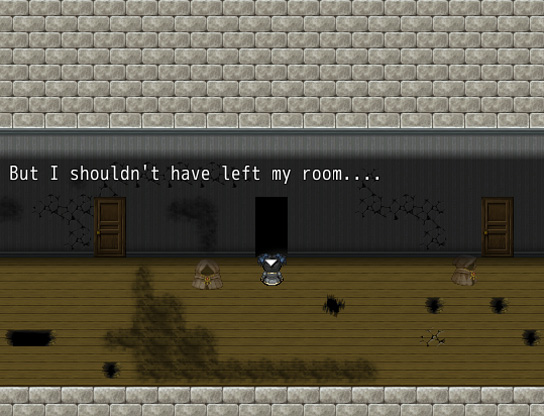
Let me try to articulate this as best I can. The overt antagonist, the monster, in She Who Fights Monsters is Jenny’s alcoholic father. Fighting the Monster, the Alpha Demo, was simpler. It was crude and more elemental for it. For me, it felt a lot more like a generic RPG: especially when you look at Jenny’s room and the imaginary haven inside her closet. But there was an old, faded texture to even these safe childhood places: like that of an old memory. The darker places, however, were dingier. Grittier. It set the tone of a stereotypical, old and dilapidated home where dysfunction and abuse are almost always typically depicted. And even here, it still felt like the aesthetic shell of an old 16-bit role-playing game.

screenshot04

And the monster is clearly Jenny’s father. If you judge the context by the Demo alone, he is the threat that Jenny must avoid. He breaks through all of her childhood illusions of magic, fairness, and innocence through cursing at her. Her Tears and her Innocence do not save her in the simulated turn-based RPG battle. In this one Demo alone, her father’s words feel like a slap in the face but the atmosphere of this world has been building to it. Even so, with Jenny’s mother’s revelation at the end of the Demo, that her father is an alcoholic, it sets a straightforward tone for the game and makes the Demo itself feel self-contained and continuous.

But Gaming Pixie never meant her game to be straightforward. So in the process of changing the game’s name, she also developed its aesthetics in the She Who Fights Monsters Beta Demo that would inform the rest of her game. And I will admit: it felt jarring at first.

screenshot02

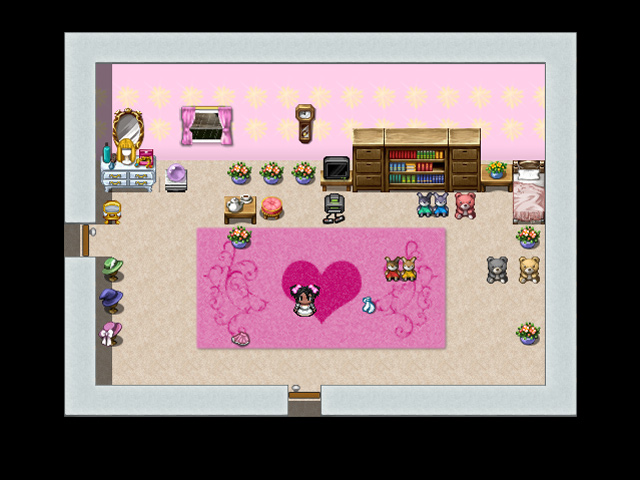
Gone are the dinginess and grit and the fading of peeling memory on the walls. You find yourself with Jenny in a much more colourful and vibrant world. Her toys are brighter. The details around her stand out and the temple that is her imaginary place in her closet is grander and more elegant. Even her home looks more comforting: as much as any middle class home made by 16-bit pixels. Everything, even the nightmares, is vital and alive with colour: as much as any child’s world is at that age.

swfm-room-final

I feel it was designed this way: to make the player feel safe before immediately and brutally introducing them to the world of abuse and its effects on Jenny’s highly impressionable and figurative mind. And, this time around, when the trauma of encountering her verbally abusive father passes she finds herself in her room and her mother entering without even a single explanation. It was most likely made to function as an interactive preview in order create more ambiguity: so that the player could gradually, through the rest of the coming six days, see past the daydreams, imagination, and nightmares of a child to the adult reality of an alcoholic parent.

In some ways, it is even worse this way: to depict a normal childhood and have it impinged upon by the violence of an unknown and terrifying adult world, and the understanding that it will change Jenny’s life. It is a real life horror story of an ordinary world shattered by something aberrant and always lurking under a façade of normalcy.

I felt that both Demos were almost dress rehearsals for the psychodrama that was to come. The title itself says a lot: in that there is more than one kind of monster at work, and as such there are consequences for facing them.

So now we come to the real She Who Fights Monsters. The graphics are further improved — with even greater attention to detail — and you can explore Jenny’s entire house. Day One happens pretty much like it did in the Demos: with one interesting exception. Gaming Pixie ends off Day One from the part depicted in the Alpha Demo where Jenny’s mother flat-out tells her about her father’s alcoholism: the part that did not exist in the Beta Demo. And the scene where Jenny goes out to get some cookies becomes a background reminiscent of strange organic Giger-aesthetics of the horror game Yume Nikki or the Earthbound Giygas battle.

swfm-darkworld02

You, as the player, now know what you are facing and you must play through the remaining days. Yet there is one more thing that you need to consider.

The Memory Bloom is a giant flower that you find past the Temple in the closet. It didn’t exist in the Alpha Demo and I almost missed it in the Beta until Gaming Pixie pointed it out in one of her developer’s blog posts. In the Demo the Bloom itself tells you that it will only become important in the main game and, make no mistake, it is crucial. You will get Locked Memories throughout the game and it is critical to interact — or not interact — with this flower. If you do, you will also realize that not all of Jenny’s memories and experiences with her father are bad. In a lot of ways, it makes it even worse: in that these positive moments and traits in an abuser often make a victim feel bad in attributing negative emotions to that person. It makes the situation all the more complicated than simply Fighting the Monster. What you decide to do will determine Jenny’s future.

swfwm Memory

After all, it took Seven Days, in the Christian New Testament, for God to create the world and its inhabitants and She Who Fights Monsters demonstrates that seven days can create an entire human being depending on the choices that you make, and how Jenny responds to the monster in front of her and the ones forming inside of her head.

There is a quote often attributed to the writer G.K. Chesterton which states that “Fairy tales are more than true — not because they tell us dragons exist, but because they tell us dragons can be beaten.” However, there is another quote, from the fantasy and horror writer Stephen King that is also equally true, that “Monsters are real, and ghosts are real too. They live inside us, and sometimes, they win.”

These are both words to bear in mind as you progress: when on the Seventh Day even the illusion of childhood safety will be ripped away and Jenny will have to start on the path to self-actualization — to adulthood — far sooner than she should. For me, that and my scary and heartbreaking decision to unlock her Final Memory were the hardest parts of this game: to deal with them and to determine what Jenny should do beyond it.

Do you remember when I said that in some ways She Who Fights Monsters is a subversion of a 16-bit RPG? This still holds true even past the Alpha Demo: but in an even more subtle way. I mean, you already understand from Day One that any attempt to fight the game like it is a turn-based battle will end in failure. You already know that not fighting will end in failure. The fact that the game narrative text boxes are in third person-limited perspective, always referring to “Jenny,” “her,” and not “you”: the distance only provides you some illusion of safety.

The perspective is perhaps designed to make you feel that disassociation that a child facing ongoing emotional trauma and abuse would experience: only made more jarring during Jenny’s first-person interludes. These narrative perspectives are very notable departures from Gaming Pixie’s previous Twine-based games: not unlike Christine Love’s don’t take it personally, babe, it just ain’t your story where you are not the character, or even acknowledged as a player. This simply isn’t your story, even if you do influence it.

And when the game does get to the point where it feels like a turn-based RPG battle? Be careful — be very careful — because the thing you need to remember is the end of the first “battle” with Jenny’s father, particularly the words, “Nobody wins.”

The subversion goes deeper when you also consider that there will come a Day where Jenny is hiding in her room and there are clues around. They are extremely clever elements of potential foreshadowing and they are a nice contrast to the beginning of the first Day. For me, the freedom of exploration in Day One — of finding the bathroom, the kitchen, living room, basement, and crawl space —  seemed to set up the beginning of a horror survival game, of knowing all the hiding spots and thinking you have discovered potential secrets only to make it purely about the psychological and the inner world of demons. Aside from the clear mindscape influence of the Silent Hill series, this game is reminiscent of the game Eversion in that sense: only instead of the aesthetics and gameplay changing over time from something brighter into something grimmer, it is a dynamic that goes back and forth between states of atmosphere — always in Jenny’s head, because we are all seeing this from Jenny’s head — until a final decision is made.

When I first heard about the concept behind what would become She Who Fights Monsters, I was reminded of another game based on a child creating an imaginary world to deal with an alcoholic parent called Papo & Yo. Yet aside from the fact that both games have autobiographical elements, child protagonists, and monsters for fathers that hurt them even as they love them there are obvious differences. Papo & Yo takes place in a fantastic equivalent of a favela –a Brazilian slum — and in all realities it is three-dimensional, while despite the aesthetics of its Alpha Demo She Who Fights Monsters takes place in a normal looking middle-class home. Monster, the Papo & Yo protagonist’s enemy is sometimes his companion when he isn’t in a rage, while it is clear that despite some good memories Jenny’s father is never really her friend nor does he help her in her game. While Papo & Yo is more distinctly a puzzle and deadly hide-and-seek game, She Who Fights Monsters is indeed a story that you mostly observe: sometimes very helplessly. And, of course Quico is a young boy and Jenny is a young girl.

You might think that the latter distinctions mean very little and indeed, they are both children placed into situations that no child should ever have to deal with: confronting their parents as enemies. But then there is the elephant in the room to consider. In a segment of her article regarding Gaming Pixie’s epic Twine game Eden, Soha Kareem observes that the former is “an accidentally political game.”

swfm paths

The fact is, Jenny is not only female but she is also “a person of colour.” It can’t be stated enough that, at least to my knowledge, just how rare and unique it is to be playing a game with a young Black girl as its protagonist: in her own story. In a medium that is still struggling to represent different identities in its games, it is definitely something to take note of. However, I am not qualified to talk about “race” or its implications: and how the race and class of Jenny’s family affects her story, if at all, is a matter I will leave to more capable writers than myself. Indeed, this matter seems more “incidental” than “accidental” and Gaming Pixie herself is more focused on the situation and survival of Jenny as opposed to her background.

But there is something else I’d like to note that Soha Kareem also states. In her writing on Gaming Pixie’s Eden, she points out that “The game’s endings and achievements are determined by your karmic choices.” She goes on to explain how, in Eden, how Gaming Pixie subverts the video game trope of the protagonist needing to manipulate their love interest as an object into a relationship by making it so that the player must genuinely act like “a good person” in order to gain that level of trust. The point is, Gaming Pixie is both sneaky and honest in the sense that your choices have clear moral consequences. Even in She Who Fights Monsters, depending on what you do with the Memory Bloom and what you choose to remember, some paths will be open to you, some closed, and some will exist only for one tenuous moment of conscience.

temple-final

I won’t spoil the endings for you, but I will say this. When I play a game, particularly one with this kind of detail, I like to get all of its information so that I can actually make an informed decision. Even so, remember what I mentioned about being careful when you find yourself in a combat situation in this game? Well, if you make a certain choice and you like to be violent and go all Sith you should know that, if you do, there are consequences. You may become the monsters that you are fighting, the demons in your mind, and it might well lead … to a whole other game entirely.

So please, download Gaming Pixie’s She Who Fights Monsters — which is supported by donationware — and determine how this horror story ends, and where others might well begin.

Poets In Hell: Kindling the Flame Till Wildfire

I’m going to warn you, right now, that I will be promoting and talking about POETS IN HELL for some time.

There is still a lot more left to do. The infernal delights of hell are not finished yet and I will definitely keep you all posted on those: or, rather, they will keep you posted.

It’s funny, you know. When I started Mythic Bios about two years ago, I was in an autobiographical head space. Many of my stories were personal, or taken and worked from personal material.

And now? Well now, I find that I have quite a few ideas for story and projects but –with a few exceptions — none of them are really about me anymore. And perhaps that’s not such a bad thing. Before my work in hell (take that phrase any way you’d like), I wrote about my life as though it was pretty much academic at this point: as though many of my greatest achievements had already been put behind me and I was just existing to record and rework what was left. It was a quiet, contemplative core of time within a chaotic sea of workaholism.

But now, it’s less about me and more about the work: if that makes sense. The work will always be a part of me and my experiences and knowledge-base will inform it. Nevertheless, I like working in other worlds … and making my own.

So now, let me finish this post off by presenting to you our first press release of POETS IN HELL:

Poets in hell press release 1

This was created on Friday the 13th on a full moon. I’m afraid that unless it was also made and released on all Hallows Eve, you can’t get more hellish than this. And that isn’t even taking into account the pain, suffering, diabolical delight, metaphysical explorations, philosophical quandaries, myth-making, and maniacal humour found within these pages. And seeing my name next to all of these awesome writers makes it all worth while.

I’m still a workaholic. There is still chaos, but now my core in this madness is active. And, as I said before, there is still so much work left to do.

So please: spread this release to herald the reign of Poets and consider, if you pardon the phrase, helping to kindle its flame.