Worms and Bicycles Or How People Make For Strange Stories: Menocchio and Igor Kenk

I’ve been rereading Pop Sandbox’s Kenk: A Graphic Portrait and I kind of wish that this comics work had been published when I worked on a previous assignment of mine.

In one of my previous Graduate courses, our class had to read Carl Ginzburg’s The Cheese and the Worms: The Cosmos of a Sixteenth Century Miller. It basically dealt with the idea that an individual can not only embody the culture that they come from, but that that person can represent different kinds of culture and actually interpret cultural information differently for themselves. Really, what I got out of it was that an individual can create their own world or mythic reality from information they have access to from their own culture.

As for why the work is called The Cheese and the Worms, it’s due to the fact that it focuses on the record of a man named Menocchio who compared the world’s creation to be not unlike that of rotten cheese. I’m not making this up: the Roman Inquisition that interrogated and took testimony from him apparently got this account from the man. So obviously, I felt compelled to do a presentation on this and focus my course paper on it because, well, look at the title and the subject matter. Really: how could I not?

I think that I found the most interesting about Menocchio himself was the examination of how he possibly came to the conclusions about the world that he did. He was not born of nobility or the upper-class in Italy, but rather came from a merchant culture. As such, while he was literate and he had the means to buy books, he also grew up with an oral literary tradition: a culture that passes on lore through the ages and word of mouth.

Ginzburg seemed to really like to point out the strangeness of this figure of Menocchio: how he was almost an intermediary between the oral and the written as well as peasant and “higher culture.” Menocchio himself lived during a time of transition between oral culture and the development of the printing press and written literacy: a revolution of sorts. Menocchio existed during the time of Martin Luther’s Reformation: where the ideas of Catholicism and Christianity itself were being challenged by the new Protestant movement using said printing presses. It is also worth mentioning that Ginzburg liked to examine colportage–cheaply printed chapbooks detailing songs, tales, and the lives of saints–as a backdrop of Menocchio’s literacy as well.

All of these traits and more are eerie parallels with Richard Poplak’s observations about Igor Kenk. Kenk grew up during a time between socialism and capitalism in Slovenia of the former Yugoslavia. One thing that Richard Poplak likes to point out is that it was also during this time period that common citizens in Slovenia were allowed access to photocopy machines: mechanisms of distributing information that were originally in the charge of the State. The counter-cultural Theatre FV 112/15 group– also known as the FV movement–used photocopiers to create a collage art known as FV Disco: a form of which–thanks to the artist Nick Marinkovich–Kenk also utilizes. This was the time and conceptual place where Kenk developed as an adult.
KENK_CHAP-00_07-08

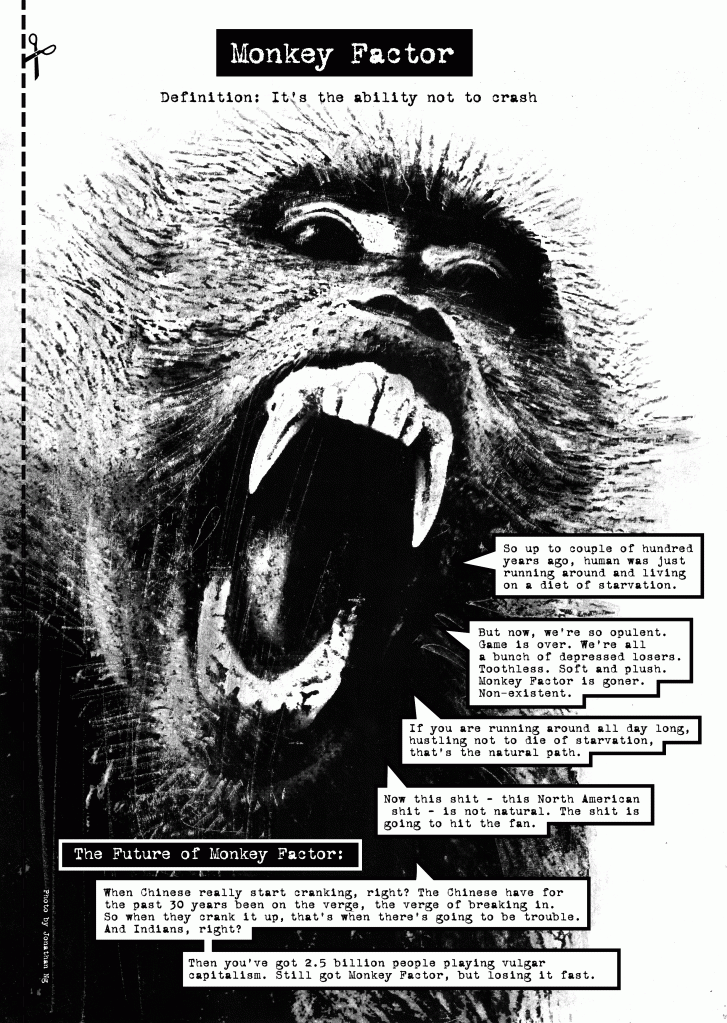
As such, Kenk also possesses a very unique world-view based on the transitional culture of his time: the idea that all things can be recycled and that you need to choose to struggle in life in order to survive as a person: which is part of what he seems to call “The Monkey Factor” or survival. From what I understood of this book, his notion of “recycling” also seems to mean reselling stolen bikes as well as hoarding. As an aside, the fact that Kenk believed the system of debt, borrowing, and capitalism to be doomed is also linked to his philosophies and it’s only now, years after I read the first time, that I wonder what he would think of the Occupy movements back in 2008 before his arrest, and what they might think of him now.

Igor Kenk came from a social order that was radically changing and between extremes. He was considered to be a Math prodigy and did well in his education. For a time he was even a police officer in Slovenia–surviving their harsh regimen–until he was discharged, and then proceeded to cross the border into other countries to get goods as Slovenia’s political alignment and its economy changed. Then he eventually came to Canada and became something of a merchant himself by selling and fixing bicycles in Toronto.

What I’m trying to say is that both Kenk and Menocchio are products of their time and culture, but at the same time how they chose to interpret their changing cultures was very idiosyncratic to them. In other words, they created some very unique world-views. And both of them arguably paid for it by the powers that be: Menocchio with his life for not recanting his beliefs to the Roman Inquisition and Kenk doing jail time and losing his Bicycle Clinic for the thefts he was charged with.

KENK_CHAP-09_18

All of the above can arguably be considered gross simplifications, of course. In my paper that dealt with the implications of Menocchio, I pretty much say the same thing more or less. But I think the reason I’m attempting to compare two men from entirely different time periods, cultures, and countries is due to a greater issue: namely, why are they important?

I mean, come on: neither Menocchio nor Kenk would traditionally be considered important in a historical sense. In the grand scheme of things, someone might say that, while these parallels are interesting, who the hell cares?

The reason that I care, and one of the reasons why modern historians, journalists, and–in some ways more importantly readers–find these accounts so important is because they are narratives that deal with real people. It’s true that neither Menocchio nor Kenk are politicians, or artists, or even popular cultural figures in themselves but they are people that–while arguably normal or common in terms of class or historical significance–symbolize greater historical and cultural shifts by just being who they are.

They are ordinary people with very un-ordinary perspectives and there was a time where we would never have even known about them: or at the very least we’d only get a summary of them in passing … or at least we’d get something like this from a dominant or “higher cultural” narrative. Because there is one thing I keep coming back to in my head: it is the idea of oral history.

What is oral history? We know that oral culture or literacy is something that is passed on verbally from one storyteller to the next throughout many generations. But history, as Westerners, understand it is derived from the ancient Greek word historia: which is something along the lines of scientific inquiry or observation. Oral history, from my understanding, is thus something of verbal origin that is written down for other people to see.

Menocchio’s “worm and cheese world” survived through the written accounts of his interrogators, whereas Kenk seems to have actually been interviewed by the book’s producer Alex Jansen and filmed by Jason Gilmore as he espouses his world-view of “Monkey Factors and recycling” in that context.
KENK_CHAP-08_16

Oral culture in our world is very different in that we have sophisticated image and audio technology to preserve and record the spoken word, and where that spoken word comes from. There is a scholar named Walter Ong–who I looked at in my own studies for my Master’s Thesis–who looked at oral culture and degrees of orality.

Ong believed that there is something called “secondary orality”: in which spoken word is preserved through technological means like video and radio. But I’ve always wondered if he would have included illustrated images in this definition as well, and how problematic it would be if these images were accompanied by written words. Can the visual be considered part of the oral or the written, or is it something by itself? Obviously I’m talking about the medium of comics and what kind of literacy that would be defined as but–this tangent aside for now–right now I’m thinking about the idea of oral history being a historical narrative that records down what life and reality is like for “the common person”: if there is any such thing as a common person.

I actually think that this conception of oral history has led to the idea of journalism: of interviewing and recording down what a particular person or witness has to say, and then researching the environment in which this person came from for a greater perspective. Is journalism the child of oral history? And then you take something like Kenk into consideration too: something that is written down but also given a sequential FV Disco style is that is both an illustrative and video collage aesthetic.

It’s fascinating to think about Kenk as an artifact of not only “comics journalism”–a medium that some comics creators like Joe Sacco have already developed–but also written literacy, oral culture, history, and mass-produced art. I look at Kenk and I wonder if this is our contemporary version of the colportage of Menocchio’s time, or the pamphlets and photocopies of 1980s Slovenia. Because in the end, it’s not just Menocchio and Kenk that have a lot in common, but also the media used to try and capture what they are … and what they are not.

When I started writing this article, I thought it was going to be easy: like it was all fully formed in my head. In a way I’m doing what I said I would not do by delving more into the academics I’ve tried to put some distance from: at least with regards to jargon. My train of thought tends to drift and it has been a struggle to communicate and even cohesively perceive all of these parallels here.

But if this were a paper of mine, if this were some rough form of the Graduate essays I would write, I would end this post in the following manner. As someone who has studied mythic world-building, I believe that art is an engagement with different parts of the world around you, and an expression of who you are as a result of what you choose to accept of that world. In that, the man called Menocchio and Igor Kenk–specifically in how their scholars and artists portray them–not only made their own art, but actually lived their art, and allowed for the creation of more of it.

I also believe that when you take all of this into account oral history, journalism, comics journalism, or whatever you want to call it reveals one more truth. Writing about an individual not only reveals that there are no “ordinary people,” but that it never makes for making any “ordinary stories.” Ever.

Again, I’d like to thank Alex Jansen and Jason Gilmore for lending me these pages of Kenk to place here in my article to make both point and emphasis.

If you are interested in this topic, you might like my What is FV Disco article as well. They both deal with similar subject matter, but in different ways.
What is FV Disco?

Disko FV

All right, so it’s been a while since I have really challenged myself to do something different. This challenge, however, has been a long time in the making and I’ve been trying to find the best way to go about it. It won’t be perfect and I’m sure that there is scholarship and writing out that is far more accurate and well-written on the topic, but really this is just a possible answer to something that’s been nagging at me for a while now.

Anyway, two years ago I read a really cool graphic novel called Kenk: a comics biography of the infamous Torontonian bicycle thief Igor Kenk. It deals with his possible psychological motivations for his actions, his own personal philosophies, and how his background may have influenced the man he has become. The comic was actually conceived and produced by Alex Jansen, written by Richard Poplak, the photographs and filming it was based from–along with its design–created by Jason Gilmore, and Nick Marinkovich was integral in illustrating and creating its aesthetic. I wrote a review on this at Amazon: with very little understanding of the choice of art-style at the time.

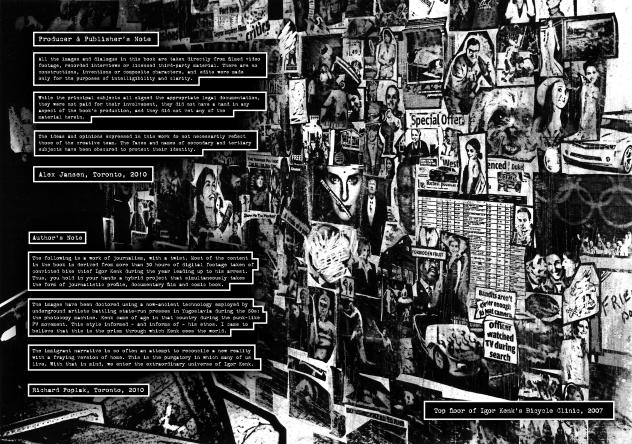
I didn’t think much about Nick Marinkovich’s unique art at the time, aside from its strange sharpened and accentuated angles, the occasional blurry lines, the really incredible contrast of the white stark outlines of people and objects containing an inner gritty grey and black, and the pastiche feeling of it until I watched this interview: conducted by QTV on CBC1 Radio with both Richard Poplak and Alex Jansen. Poplak himself talked a little more about the aesthetics of the graphic novel. First he stated that he and the graphic artist Nick Marinkovich used the fumetti comics medium form: which is basically comic book that uses photos or arrangements of altered photos to tell a story. There is a wikipedia entry and other information on the fumetti form.

However, Poplak also mentioned that he traveled to Slovenia–Igor Kenk’s home country where he grew up–and found another form of art: which the Pop Sandbox team ended up using for their creation. When I first heard him say the name, I didn’t understand what he was talking about. I actually missed the word several times before rewinding the video and hearing it again. Now, I pride myself on finding out as much about the comics medium and associated art forms as I can and this bothered me: the fact that I didn’t know what this word was.

Finally, I made out the word “Faeve” or “Fauve.” But then after some more online digging I came across the Kenk book site and I found out that it was FV Disco that Poplak had been talking about. It was in fact the definition that Poplak provided here and on 12:17 of his QTV Interview that I used when describing the style of Fotonixe’s artwork in my entry on TweakerRay’s Collector Chapter 02: the idea of a gritty-collage like arrangement of photos and images with a dark punk-like atmosphere. As I said in my previous entry, Fotonixe’s style reminded me of this and wasn’t necessarily derived from it. But this did get me thinking.

Because I can tell you that I have tried to google FV Disco several times–specifically as an art form–and I didn’t get very much. It also took me ages–in fact very recently–to realize that FV was in fact pronounced as “fauve” or some equivalent and wasn’t an acronym or a pair of letters. A little while ago, I figured out that the term FV Disco seems to have come from an influential Slovenian alternate theatre turned counter-cultural group or club called Theatre FV 112/15: a group that turned into a movement in Ljubljana–the capital of Slovenia–in the changing former Yugoslavia of the 1980s: where Poplak says that FV Disco itself came from. I found out the name of the group by finding an article on a Goth Rock and Electronic Body Music group called Borghesia: that was apparently formed from some of Theatre FV’s original members.

It was greatly involved with video art as well as music and as it transitioned from an amateur theatre group into an alternative club that made a space for sexual, social, and artistic differences: or so this article here claims.

But very recently I found out what “FV” or “Faeve” is might mean. I found–or perhaps–rediscovered an article by Katja Praznik called Theatre, Emancipation and Political Power: Two Cases From the Past in which she explains that FV “refers to France Verbinc’s (FV) local, frequently used Dictionary of Foreign Terms, page 112, entry 15, where we find the following: C’est la guerre – This is war, that’s how it is in war.” In other words, the group’s name seems to have been derived from a citation or a quote that is appropriate given the climate in which the group was created. This was during the time after Tito’s death where Yugoslavia was beginning to change–to separate–and there were great artistic expressions of socialism and capitalism occurring.

Richard Poplak himself argues that this was what was occurring in Igor Kenk’s formative years in Slovenia and it affected him. There is one element of this movement that Poplak pays great attention to when he discusses it in the above synopsis. He states that the primary medium of FV Disco–what seems to be the artistic as opposed to musical and performative aspects of it–was the photocopy machine: “an agent of democracy because it put publishing – which was until then state-run – in the hands of the people.” It is interesting to note that when I’ve looked at Kenk, the images did seem almost like propaganda posters and pictures rearranged into a different collage form entirely. I can see how–as advertisements for FV Disco’s musical and social scenes and as art in itself–just how subversive it was in that changing environment. Add to the fact that there was a “a gritty punk” element alongside it makes for a really interesting aesthetic and atmosphere.

I think what I find most fascinating about it, at least from what Poplak describes, is how FV Disco takes old ideas and objects and rearranges them: in fact recycles them.  But it’s more complex than that. Praznik in her article likes to state that Theatre FV wanted to create “spaces” or alternative realities in a rapidly changing socialist environment where people could express themselves. She also mentions that one objective of this movement, and those like it, were to blur the line between the performance and the viewer: or art and reality.

In a way, Theatre FV was one of those responsible for creating new wombs of artistic culture and reality and I can see–in that sense–just how all the above might have affected Igor Kenk’s philosophies. He liked to recycle and “hoard” things that North Americans apparently take for granted. The man was also aware of how economic and political systems can change rapidly and the crafting of his own world-view and indeed his life, seems like a haphazard collage of grittiness and innovation. Even Kenk’s own “performance stage”–a Bicycle Clinic filled with so many bikes that he had to spill them from the space of his shop into the streets just to open the door–did not separate itself from the rest of Queen Street West Toronto or the sphere of people it brought in.

Customers, and pedestrians alike were brought into his world of bikes and junk. I never saw it like this until I did some of my own amateurish haphazard research into the matter. It really made me look at the aesthetic of the Kenk graphic novel even more closely. In his article Portrait of a Serial Stealer, Richard Poplak goes into a little more detail on FV and even talks about how his artistic collaborator Nick Marinkovich creates the style of the piece: detailing some of the work that he did. It also hits home the fact that Poplak and the rest of the team that made the book adapted it from actual photo and video footage produced by Jansen and Gilmore: the latter of which are the most references I’ve been able to find on the FV movement aside from those from Poplak.

What I think is a real shame though, in all honesty, is that FV Disco–or Theatre FV 112/15–doesn’t have its own Wikipedia page or a more indepth English language entry of some kind: because it is a really fascinating social and artistic phenomenon to come from a socialist nation that no longer exists and I never put much thought about it at the time. It makes me wonder just how much it might have influenced other forms of art: not just in Eastern Europe but the rest of the world as well.

One more interesting of note is that there is a 1997 documentary called Staro in Novo or The Old and The New created by Neven Korda and Zemira Alajbegovic: who were, according to the site Zank, apparently leading members of the old FV Theatre group and then of Borghesia. They made something called FV Video where they created this documentary: of which I could only find excerpts on Youtube. Copies of the video cassette do exist in some Universities even in North America but I’m not sure if there are any DVD versions, but apparently you can download it here. But it would be an interesting thing to look at.

One thing that I also find interesting is on the site VideoDokument, Korda and Alajbegovic not only talk about the creation of video art, they mention that “Although the images move and we can hear them, video takes much more from comics than it does from film. It was comics that encouraged sequencing and the combination and movement of images, sounds and stories.” I find that a really nice parallel to how Kenk was influenced as a comics form by video and other media from the FV movement. I should also point out that Kenk is also being adapted into an animated film: perhaps making the journey between FV-influenced film and comics come full circle.

I’ll tell you now that I’m not up to the task of making a Wikipedia article on this matter. I’ve said before that I am no musical expert or even an artistic one. I am certainly no expert in Slovenia or Eastern European culture, but it would be nice if someone did this: because I think it’s important. It’s also a shame I can’t find any FV Disco art online as well and I will probably post a picture from Kenk. It seems that the scholar in me doesn’t die so easily, but I just like to write about things that interest me and go on an adventure to see what I can uncover from them when they are being too stubborn to be found.

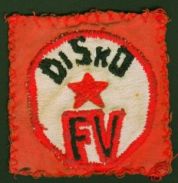
Some special notes and thanks: the really awesome and emblematic “Disko FV” image seen above this post is actually a hand-made security ribbon taken from the collection of Dario Seraval: one of the former members of the Theatre FV-112/15 group and current member and drummer for Borghesia. The images from the graphic novel Kenk were very generously lent to this post by Alex Jansen and Jason Gilmore. Believe or not I underestimated how much time and effort making this post and finding images for it would take, but in the end thanks to correspondence with Aldo Ivancic (another former member of Theatre FV and current member of Borghesia whom I talked with about using said ribbon) and Alex Jansen, as well as Richard Poplak, Neven Korda, and museum counsellor Breda Skrjanec of the MGLC (the Mednarodni Grafični Likovni Center), it was all worth it.

Addendum: If you are particularly interested in FV Disco, you can try to track down the MGLC’s art catalogue from its FV Alternative Scene of the Eighties 2008 Exhibit. It has a Slovene and an English language translation as well. The book is composed of photographs, art samples, an introduction, three essays, and a chronology of events and developments in FV Disco.

Tattoos and Swordplay: Or Musings on a Watcher-Immortal War in Highlander the Series

Now for another geek moment and an old television show.

File:Duncan1-1-.jpg

So after my post on Who Watches the Watchers, I was thinking mainly about the Watchers from the series Highlander. If Immortal sword battles and decapitations are The Game, then the Watchers have always been its shadowy audience of spectators. Be warned, I am going to be making a lot of references to this show as this post goes on.

Essentially, the Watchers were a secret society created in about the time of ancient Sumeria to observe Immortals–human beings with eternal lifespans who can only be killed by beheading–and record all knowledge of them. They have a code that forbids them to reveal information about Immortals to the public, and also of their own existence to Immortals. They recruit from a variety of fields and are essentially a glorified and ancient intelligence service of field agents and researchers.

For a spectator-sport of Immortal-watching, this would obviously take a lot of resources to accomplish. Now, here is the thing. In Highlander, the Watchers have three challenges. The first is to make sure they are never, ever discovered by Immortals or the rest of the mortal public. As such, they do not want any of their lore or information falling in hands beyond their own network. The second is to never interfere with Immortal battles or conflicts, but to merely observe them and never get detected. All right, fair enough. Then there is the third task that they have: to make sure that others not only never find out about their group, but also the very Immortals that they are studying.

But how do you explain the bodies?

Yes. There are natural causalities from The Game: mainly the decapitated bodies of the Immortals that lost against their opponents.

So what happens with that?

In ancient times, when wars were fought almost all the time with swords and sharp blades, and when there were much wider and unobserved spaces either no one gave a thought to a beheaded corpse, or there was a more than a likely chance that they would never find it. Also add to the fact that little conventions like democracy didn’t always exist and people would turn blind-eyes to vigilante mobs, and government pogroms and executions alike.

Unfortunately for both Watchers and Immortals, things have changed. The media now exists, forensics has developed to the point of being able to identify tiny fibres of material and DNA, there are much more extensive public records kept and so on. One thing that was always mentioned in Highlander was how the ability of the Watchers’ resources towards secrecy has dwindled down considerably in the last century or so of information technology.

So what about those dead, decapitated bodies? Because nowadays, not only would they be found but there would be investigations. Pretty soon forensics specialists and police, as well as Interpol would find a pattern developing: some kind of ritualistic killing that seems to span across the world. I can also more than imagine that–say the Watchers have agents on the inside of law-enforcement to discourage such investigations–that someone would eventually ask questions.

All they would need is to find someone, or several someones with a purple almost cult-like Watcher’s tattoo on their wrists, order searches onto their properties, analyze their computers, find evidence carefully collected by said Watchers–who not only sat back and did nothing when these killings happened, but actually recorded them for some unknown purpose–and then go into the homes of Immortals–who they would probably think are “champion serial-killers” in a Watcher-sponsored arena of death for entertainment purposes–and start DNA-testing their swords. It would go downhill from there.

So why didn’t this happen at all in the show? Well, I think it’s very simple. You see, I think that not only did the Watcher network have agents in the media, law-enforcement, politics, medicine, education, and business, but I think they were directly involved in disposing of the bodies.

That’s right. The very organization in the show that went on about non-interference in Immortal battles and mere observation most likely were the ones to get rid of the defeated Immortal corpses. That is the only thing that makes sense, because otherwise there would have been a massively historical international hunt going on.

This also means that the Watchers have a lot of power and they aren’t exactly neutral. They would know that if those bodies were discovered, or the documentation on them weren’t doctored in some way, and Quickenings weren’t played down in the media as strange electrical weather disturbances, their Watching days–and their freedom–would be pretty much over.

So really, in a lot of ways the Watchers are pretty complicit with The Game of Immortals and they know that if the Immortals were ever discovered, chances are they would be too. Now, in Highlander itself, there have been occasional times when some Watchers rebelled against their own code and became Hunters: actually killing Immortals themselves. In a lot of ways, if the whole organization became Hunters it’s argued that they would pretty much fuck up all known Immortals everywhere. They know a lot about their pasts, their assumed identities, their properties, what they had to eat for breakfast that morning, their strengths, their weaknesses and all of that. Intelligence-wise, all the Watchers would have to do is put the right information in the right places and arguably let the governments do their work for them.

There would be complications however. For instance, Immortals like Duncan MacLeod and Darius have figured out–on their own–about the existence of the Watchers. It stands to reason that beings that are always being hunted by their own kind for their Quickenings–or essences–or by people in the past that liked to kill “witches and demons,” that they would have developed sixth senses about being followed, or if one of their mortal companions had … other affiliations that might concern them. And these are the nice Immortals.

I’m not even going to go into Immortals–like Kalas who found out on his own that there were Watchers–that wouldn’t hesitate to use torture and murder as their tools to get more information. And a lot of really old Immortals have their own resources and contacts: along with some alliances with each other. In addition to that, not all Immortals are documented or discovered yet. Some are very young and haven’t even died for the first time yet. The Watchers would need a seriously sophisticated network to keep up with that last fact. But there is more: because if a few Immortals could have discovered the Watchers, they might have been pretty circumspect about what they themselves know and deliberately planted false information of their own. Some, like Methos, might have even go as far as to infiltrate their ranks.

At the very least, it’s also been known in the show that some Watchers might have even been approached by the people they were told to observe and they might have their biases. It’s not been unknown for a Watcher to give out classified information to an Immortal that they like: and I am not just talking about Joe Dawson and Duncan MacLeod.

So really, I guess I’m talking less about the nature of the Watchers’ “neutrality,” and more about what would actually happen in a Watcher-Immortal War: an idea I got during one episode of Highlander when Duncan MacLeod was almost seriously facing down that prospect. It didn’t happen, but it easily could have.

Originally, I would have been tempted to say there would be an even split between the two, and for the most part there would be. I also think there would be factions. There would be Watchers that would withdraw from the whole conflict and preserve what they can: mostly dedicated Researchers. There would be Hunters attempting to use their own skills and governmental resources to create pogroms. There would be Immortals using their resources and bounty-hunters to hunt down anyone with a purple Watcher’s tattoo. While one faction wants heads, the other might want severed forearms as proof of jobs well done.

There would also be Watcher and Immortal alliances: some wanting to help an Immortal win The Game for power and glory, and others just trying to help each other survive. The young Immortals would be alternatively tools for various factions, and even their own agencies: seeing as most of them would not be documented during the chaos of such a War and can take advantage of the conflict as well.

It’s also possible that the governments and corporations would turn on both and both secretive kinds of beings–Immortals and Watchers–would be on the run from scientists, overzealous military and paramilitary organizations, terrorists, religious fanatics, and mobs. A shadow war would quickly become an overt and very nasty mass-conflict with the nature of what humanity is itself as the ultimate prize.

But when this is all said and done, I would just like to state that I would definitely have watched a film or a television show based on the concept of a Watcher-Immortal War. In fact, I would even read a book or fanfic based on this idea. Anyway, that is my major and one of my most long-standing geeky thoughts at the moment.

Artistic Progress Goes Boink!: The Refinement of a Heroine, the Formation of an Antagonist

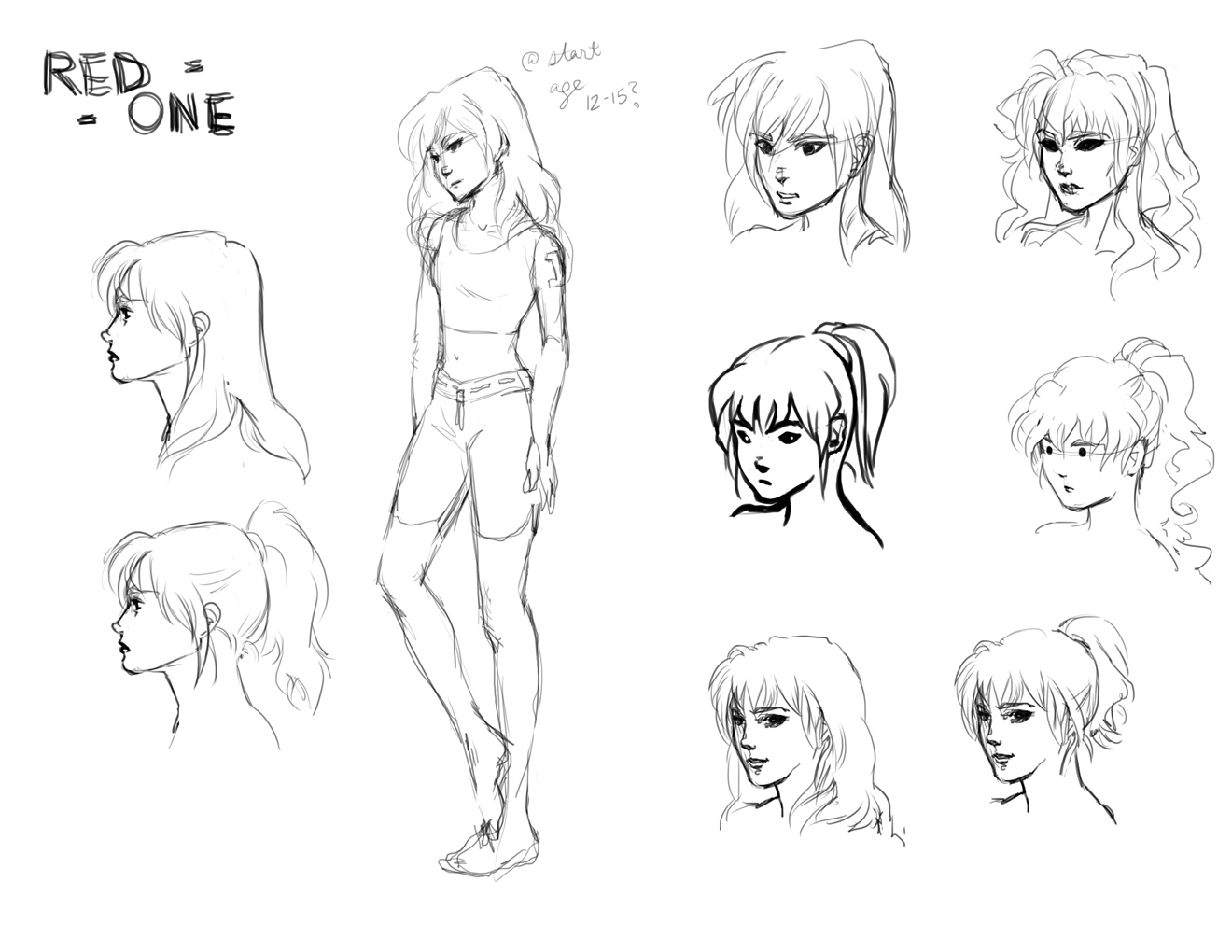
When we last left off, our intrepid heroes were continuing to work on the formative phase of a silent comic. Much of Angela O’Hara’s pictures in the previous Project entry are of our female protagonist and as you can see here, she has been busy with her.

Notice the eyes. They are not only how I thought of them–pure blue–but Angela even went one further by giving them the detail of actual sclera and pupils while also keeping them the same colour. Angela has also been playing with facial expressions, some dimples, and conveying certain kinds of emotion with every facial image that you can see here. There is something very serene, sometimes sad, but ultimately determined in this heroine who is questioning herself as she continues on her path through the strange little world that we are making for her.

While our heroine is getting more detailed, we are also working on fleshing out our antagonist as well.

Like our heroine, I provided and talked with Angela about certain details. He is supposed to be an older man and he is obviously different from our main character. It’s been a challenge to figure out what he’s supposed to look like as of yet. What I find works for me is looking at these conceptual drawings with Angela and picking certain details from these already made illustrations that can be incorporated into a figure closer to what we both want to work with.

For instance, I really like the idea of an X-like scar on his cheek: an aesthetic very reminiscent of the protagonist in the manga Rurouni Kenshin. In fact, as we talked about this online, I figured out exactly how he got that scar even though I didn’t originally plan on having this “X” on his skin. I was more thinking of having it on his costume, but Angela’s initiative worked out well.

So basically I decided he would look older, but not grizzled or ancient. The mask has also been a challenge too because I had been thinking of having it cover his whole face and making him look more mysterious as he watches our protagonist at work. Of course, the advantage to the half-mask–aside from the fact that it plays with our theme–is that it shows more facial expression and therefore more humanity. There is a part of me that does wince at it seeming too much like a stereotypical comic book hero or villain’s mask, but at the same time this is definitely something that want to play with as well.

We are still  working on what the suit should look like. I do like some of these designs in these latter pictures. I like, for instance, how Angela puts the “Zero” symbol at the lower-hand corner of each costume. That was one issue I was having when I was envisioning how to fit the “X” and “Zero” symbols together on his person. I mean, he’d not be very intimidating if his sigil was something derived from a  “Tick-Tack-Toe” game. In terms of the clothing in the latter set of pictures, I can definitely see at least the lab coat becoming a basis for another costume. In fact, we’ve talked about giving him different costumes depending on what environment he’s in and what he is doing. I mean, he has the resources. He has the technology. 😉 We just need to see where he goes from here.

And now to the Boink! part of our creative progress.

This Calvin and Hobbes reference aside, when I was much younger I fancied myself something of a graphic artist as well. The thing is, I had difficulty imitating basic shapes. At the same time, I liked to create monsters. To this day, it’s safe to say that I create better monsters than I do humanoids. I knew that in addition to the heroine and antagonist, we needed to have some other creatures and enemies in our developing environment. Now I could have simply described these, and to some extent I did describe them to Angela on email but pictures speak louder than words and so I unearthed these images.

(No, my blurred face is not one of the monsters … I think.)

See, those three pod-constructs were robot minions that I created for a primitive high school comic about a stick-man from a cartoon dimension who gets crippled and reconstructed into the Styx Demon by aliens. These were supposed to be the aliens. I used to have drawings of these with ink pen and pencil crayon colouring, but they are sadly lost to time. When I sent these to Angela, it was like an archaeology of my drawings: taking pictures of and documenting glyphs from my old high school art kit.

There is more.

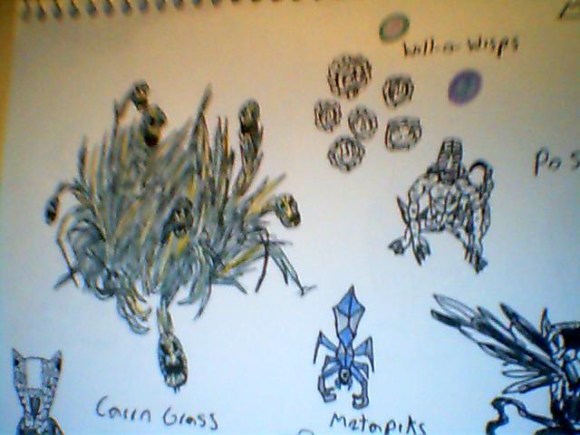
These two kinds of beings in particular, from what I remember, were created as creatures for an old RPG game I had planned: something that people could scroll through a Paint Program to interact with. To this day, I still love that Cairn Grass. These drawings sat in my closet for years, just as the ideas that made them have rested in my mind. The idea is for Angela and myself to use some of these as templates to … make things that our heroine can interact with.

Sometimes, I feel like my part in our creative process is very ad hoc. I don’t have a script ready as of yet though I have created a rough outline of the events that I want to depict along with some notes on character personality and a little bit about how their abilities work. A lot of the interaction between Angela and myself has been exchanging ideas. I admit that sometimes I feel bad for not having a detailed enough script as of yet, but there are still some decisions that need to be made and I’m glad that it is not a case of me dictating to another person. Much of our creative decisions so far have been the result of a mutually creative exchange of ideas, shared enthusiasm, and just throwing stuff out there. I’m given to understand that each comics–and creative–collaboration works differently and so far, our works just fine. 🙂

Angela has just told me that she has some special pictures planned for next time: something that may or may not have been influenced by talking about old video games. I look forward to seeing where this goes from here.

I Would Have Gotten Away With It Too, If It Weren’t For Those Meddling Squids! A Review of Cephalopods: Co-op Cottage Defence

I played this game for one day–just one day–and I hate green Squids.

Not the luminous blue ones, or the black ones. Not even the exploding fiery orange ones. The Greens. Just the Greens.

So I made an unexpected trip to Canzine 2012 this past Sunday: where I was reintroduced to the Comics Vs. Games-premiered The Yawhg, given a paper ninja-star, and talked with a few artists and game creators before finding The Hand Eye Society’s Torontron game cabinet arcade machines outside. I always loved arcade games when I was younger and I never got to play with enough of them. So finding these there was just an added bonus.

My friends and I started to play this game that I later found out was called Cephalopods: Co-op Cottage Defence by Spooky Squid Games. At the time, however, I found myself controlling a 16-bit sprite with a shotgun in a house along with my hammer-wielding friend as we were being surrounded by floating Octopi.

I didn’t have time to admire the Lovecraftian settings of the house’s interior: such as the book with the Squid imagery or the almost Victorian laboratory feel. I also didn’t realize that the hammer-wielding sprite–that the character was a female scientist–nor that her clearly non-human shot-gun wielding companion was a clockwork automaton of her own creation. All of these revelations came later when I looked at them online.

No, instead I was either killing mass-Squids that electrocuted and devoured heads, or hurriedly knocking Squids unconscious with my hammer as I was trying to repair the walls of the house to offer us protection against these tentacle-armed hordes.

This game was fun. I admit, I really liked killing those Squids. I also felt some satisfaction in repairing the walls and seeing those plus numbers come up: which probably represented how much time or durability it had before it fell again. There was another quality to the game in that, aside from the two-player cooperation that is utterly necessary to your survival, you also need a certain amount of coordination as well. Essentially, it is integral that your gun-shooting companion fires as the most of the Squids while you repair the most isolated of the walls: such as the walls that are not being massed by tentacles of doom coming to suck your face in the middle of the night.

However, there is also the option of exchanging tools: throwing your gun or hammer to your friend. It takes timing and coordination and, sadly, we did not manage this. Sometimes the sprite’s maneuverability was a little awkward and stiff. I remember at least a few times I tried repairing a plank and not realizing I had to get very close to it to do anything with it. Apparently, according to the Game Over text, we had something to the effect of having as much coordination and teamwork as a bunch of “golden weasels.” Suffice to say, it wasn’t complimentary, but certainly made us laugh.

But then, as the game went on (after each time we died I mean), it began to occur to me that something was very … eerily familiar about it. It was the Squids that obviously made me start to think this. And I knew I had seen them somewhere before: these 16-bit luminous deceptively cartoonish tentacled monstrosities. I knew it was from some research I did before but I didn’t know the name of the thing. Then much later I realized they were related to this:

Night of the Cephalopods was something I had read about when I was looking at Spooky Squid Games (god I love this studio’s name) for my article Dreams of Lost Pixels and if this is anything like the game I played tonight–and the voice-over narrative actually happens in this game–I may well download it. This is a big thing for me because, like I have said many times before, I don’t often play games. I watch them being played sometimes, and I play a lot of selective games on older Nintendo consoles, but this game makes me happy. In fact, Spooky Squid Games seems to really love H.P. Lovecraft as a thematic influence of theirs and it is one of those influences that makes me want to write a Lovecraftian story tribute of some kind.

My friend today was talking about going to some Indie (Independent artist) Jams sometime: to make ad hoc independent creative collaborations together. I remember Comics Vs. Games and I’d love to collaborate as a writer with a video game artist. I would really love to do a Game Jam sometime. Just as long as it is not a slime. If Cephalopods has taught me anything, it’s that I hate being stuck in slime … and Green Squids.

Oh, and even though I only played the game today and for a little while, I want to give it a five out of five.

Art Consumes Life: The Shadow of the Vampire

I wrote this review in 2009 or 2010 in another Journal while I still lived on campus. I’ll just warn you now that I liked to use big words then: especially back in those days. When I use the word intertexuality, what I’m referring to how different sources and references–like quotations and characters being mentioned in a film, or even how different media–can actually overlap in some really cool ways. I also really love meta-narratives and stories within stories. The metaphor of Achilles’ Shield and its little moving world comes to mind again. Also, it’s the season of Halloween and I feel evil. So enjoy, fellow horror-watchers and blood-drinkers. 🙂

So two days ago I watched the whole of Nosferatu for the very first time. Then yesterday night, I watched Shadow of the Vampire. And then I watched it again in the same night with the Director’s commentary.

There is a lot to be said about this film, and I’m still trying to absorb a lot of what I got out of it. First of all, the blending between Friedrich Wilhelm Murnau’s film and E. Elias Merhige’s creation is almost seamless. Certainly, the scene towards the end of the film where Max Schreck transitions from a black and white scene into the subdued glowing light of colour is nothing short of awesome. I also liked how when they were originally filming Greta Schroeder’s scene as Emma playing with her cat, they mentioned how they had to put it on laudanum to get it to be still in front of the camera.

But that in some ways misses the point of what I really do want to talk about. When I first saw the film without the commentary, I wondered why it was that they had the diagrams at the film’s introduction, and what they possibly meant. The images displayed there made very little sense to me, while at the same time there was a strange … familiarity about them and their arrangements as well. It was only really when Merhige gave his commentary that I started to understand what he meant by making the introduction like this, and what he was attempting to do with this film.

Basically, he explains that the illustrations in the beginning of the movie represent a hybridization of ancient and medieval art along with 1920s cubism. In this way, he attempts to show how humanity has depicted itself and the world around it throughout the millennia, incorporating time all the way to the point of the 1920s and its new expressive medium — namely, film. By the very end of the film, Merhige explains how we have always tried to capture what is around us, what is magical and timeless, on our “cave” — in our cave drawings. We are all mortal, and the materials that we have used to try to capture these moments and life itself are just as frail and brittle.

Enter the camera.

The camera, as Merhige explains, is the new “cave” — the new mechanized interior where we can record these moments for posterity. All moments. It sets a new tone in the world. At the very beginning of Shadow of the Vampire, you see first Murnau’s eye, then the dark lens of a 1920s camera recording Greta’s domestic scene with the cat, and then the crew in the very cool vintage white lab coats and film goggles of that time. From this point onward, this is the entire tone of the movie — this need to capture something in the gaze forever. Once, in a third year University class I watched part of a movie called Ulysses’ Gaze, which I barely even understood. But what I do remember was our professor explaining the idea that through the gaze one attempts to capture everything — to understand and preserve it, and to some extent even possess and control it.

It is, arguably, a visceral and in some ways very patriarchal need. Enter Murnau. As this film would have it, Murnau — played by John Malkovich — is a film pioneer in a medium that is not being taken quite seriously yet. It is still in many ways a novelty. But in his own obsessive and very tightly controlled way, Murnau sees the potential in film and what can be done with it.

Enter the 1920s, a time that I’ve been told I could have fit into rather well. It is 1922, and the first WWI is not that far behind the world, especially not Germany and its humiliating Treaty of Versailles verdict. However, at the same time a whole new decadence and vitality has filled this world, and in this case Berlin. From the culmination of twisted Victorian nationalisms, and the peak of the Industrial Age’s penultimate achievements in creating mechanized death come more advanced pain-numbing drugs, along with looser morals, and social inhibitions.

Society loosens up, but the shadow of death — of the figurative vampire, if you will still lingers. It is a demon that has to be exorcised from Europe and particularly Germany. This much is something you can understand without this film or the director’s guidance. But this is the backdrop of Murnau’s world, and Murnau himself (who was actually a fighter in WWI and needed his laudanum to deal with the physical and possibly psychological pain of his injuries). So there is already this dichotomy between innovation and a new pioneering spirit of the age, of new ideologies and ideas breaking out of social stratification and, at the same time, there is still the dark spirit of the chaos not long left behind. In all of this, a few films are being created to express both principles.

In the film, Greta Schroeder, very much more sassy and sultry than her character Emma Hutter tells Murnau about how much she dislikes film — that while Theatre gives her life, Film seems to steal it away from her. Like a vampire would. But as Murnau very ominously tells her, she will get her chance at fame, and immortality. This is something that can best be expressed from the words of Murnau himself when he says:

“Our battle, our struggle, is to create art. Our weapon is the moving picture. Because we have the moving picture, our paintings will grow and recede; our poetry will be shadows that lengthen and conceal; our light will play across living faces that laugh and agonize; and our music will linger and finally overwhelm, because it will have a context as certain as the grave. We are scientists engaged in the creation of memory… but our memory will neither blur nor fade.”

In essence, Malkovich’s Murnau wants to create an ever-present, something that all people can see happening forever and all be a part of. Of course, there is a price to be paid for this innovation — this enlightenment. The Industrial Age has already cost many lives, and the camera — this neutral dispassionate lens that can supposedly capture everything (including, as some societies would have it, the soul) is but a child of this process. As Merhige attempts to explain again, the old is always replaced or supplanted by the new. And what is the old? The old is nature. It is mystery and magic. It is power, and immortality. It is fear, and it is the unknown.

This is where, finally, the Vampire fits into this structure.

Enter the Vampire. It is difficult to describe all of this without talking about Nosferatu and the novel that loosely inspired it — Dracula. Nosferatu was an unauthorized version of Bram Stoker’s story that his widow did not grant the rights to. She, like many of that time believed that the Theatre was more professional and hallowed than film. This in fact cost Murnau’s company a lot of money in terms of lawsuits, and Nosferatu itself was very nearly destroyed. At the same time, even Dracula is the child of older, much older sources. This is one context of intertextuality that is very interesting to this regard.

In Dracula, the Count is portrayed as a foreign alien menace, something beyond England and “the civilized” world. He is powerful and seductive and almost “Orientalized.” Whereas in Nosferatu and Shadow of the Vampire, the less attractive figures of Count Orlock and Max Schreck respectively live much closer to Germany, and while they do embody something “primitive, ancient and horrible,” they are not so much a foreign terror as much as an old familiar horror just below the collective unconscious of the people living in, or close to the land that they come from. These narratives neither have the luxury of thinking that their monsters come completely from elsewhere, nor that they do not have any role in the human world.

The fact of the matter is that there have always been stories about vampires or things like them — about immortal creatures that feed off of the blood and energies of the living. The analogy between the vampire and the camera can be very apparently seen here. Both feed off of the present and life. Traditionally, a vampire can even preserve a life form in a parody or imitation of the life they once had.

Willem Dafoe’s Max Schreck cannot create other vampires. He is alone and awkward, and twisted. He barely remembers how he became what he is, or what he used to be. He is a monster that unapologetically and unrepentantly feeds off of blood. It is his nature and what he is. At the same time, he is sad, and lonely. This vampire has lived too long, misses the light of the sun, and he reads the poetry of Lord Alfred Tennyson about immortality at the price of always aging. He above everyone in this movie knows how beauty can truly fade and has paid the price for this knowledge just by existing. Of course, every thinks that Max Schreck is merely a character-actor and is always in his role for professional reasons.

To me, in this situation the vampire represents something dark and ugly, but also mystical and incredibly truthful. He does not lie about what he is, or how he feels about what he is. If anyone is the liar, it is Murnau who is willing to risk and throw away all life in order to use this actual vampire in his film — a truth that isn’t revealed until it is all too late. He is the power that Murnau wants to capture, to use a figure of actual immortality to make his film even more timeless. But as I said, there is a tradition to be followed here. Like Grimm’s fairy-tales, like the Germanic folktales before it there is a price for mortals to pay for achieving any form of immortality, for dealing with any kind of it.

A sacrifice. A human sacrifice.

I will not say anything more on that matter, save that despite the theme of the modern overtaking the ancient, there is still a sacrifice — and if anything the modern makes it more clinical, and even more chilling. And the camera lens captures it all. Even as mortal life fades, and immortality ends, and all sanity is lost, the camera continues to take everything in — cold, detached, dispassionate, and hungry. It creates a story for all people to experience for ages to come. Merhige tells us that originally he wasn’t even going to name this film after a vampire: that his film was not about a vampire at all. A vampire is in it, but so are a lot of other people and in many ways they are all equal in how they captured in this narrative. No one escapes it. Not even the vampire. Especially not him.

But after viewing both movies, I felt this deep calm that I haven’t felt in ages. Like it all made sense and something was now gone from me. Perhaps it was catharsis: a powerful combination of pity and fear that are both the essential components of awe. But I wonder — was this ever-present Shadow and all it represented really purged through pity and fear? Was it in fact exorcised or dealt with?

Somehow … I doubt it. Not in the 1920s. Not here. Not now. Perhaps it will never be. But maybe … just maybe, as Merhige stated, through understanding that such living stories could last generations, this is something that can be encountered both consciously and responsibly — through film or any other medium.

Building a Character to Make a World: Our Project Continues

About a month ago, I said that Angela O’Hara and I would working on a comics collaboration together. So here is an update on our Project thus far.

I gave Angela a whole list of comics artists to research in order to get the right aesthetic for our world. The following inspirations were Jonathan Lethem’s Omega the Unknown, Chris Ware’s “The Super-Man” stories, Saint-Exupery’s Le Petit Prince, the rugged elementalism of the anime Gurren Lagann, Sarah Howell, and Neil Gaiman’s run of Miracleman.

At the time, Angela was not completely sure how to go about this: which was fair given the fact that all I had seen of this world I’d envisioned were a few scenes and figures inside of my own head. It’s amazing how something in your mind cannot always be so easily translated into real life.

After a summer of proposing this Project, I was galvanized into action when Angela said she was going to be pursuing her drawing career full-time now: which is excellent because she is a gifted illustrator and a comics-creator. This was when I realized I needed to give her what I had and, once I did, I realized I gave her more than enough to work with at that point.

In the end, I created a fairly detailed back-story (or at least something far more detailed than what I thought it would be), some character outlines and descriptions, and even some notes on the minions that I’m keen on including in this strange new world of ours. So armed with artistic inspirations as well as character descriptions, names, a background story, and a rough idea of the main plot Angela began drawing.

It was when she sent me these first pictures that the challenge really began. As you can see, they are all excellent illustrations of the main female protagonist. Usually, I could have just selected a few and suggested some details here and there, but her features were not as distinct in my mind as I would have liked. Then I started to think about what the world would be like: specifically what we wanted our aesthetic to be.

For two days, I thought about this and luckily Angela and I managed to talk about it. She told me that she wasn’t completely sure what aesthetic–of the inspirations I chose–that she was supposed to use so she decided to draw different pictures of our character in various styles. I felt really torn: because I wanted to see this world as an elemental place of basic shapes but some very realistic elements, but Angela drew all of these really good illustrations. It made me question the fundamental substance of what I wanted our world to look like.

But Angela has a good way of asking the right questions. Not only did I manage to answer some of her questions, but I started to add some details of my own. Another question that really got me was how old our protagonist was going to be and what she would be wearing before she got her costume. These were definitely questions that I needed to answer and in the end we decided on her being twelve or so, with rudimentary clothing that she had been forced to create herself.

Angela was also curious about what costume our character was going to have. She experimented a bit and showed me this:

This is what prompted me to tell her the idea I had with regards to the main character’s costume: and how that was going to fit into the plot. Let’s just say: it’s less than she chooses the costume, but rather that it chooses her … and in unexpected way.

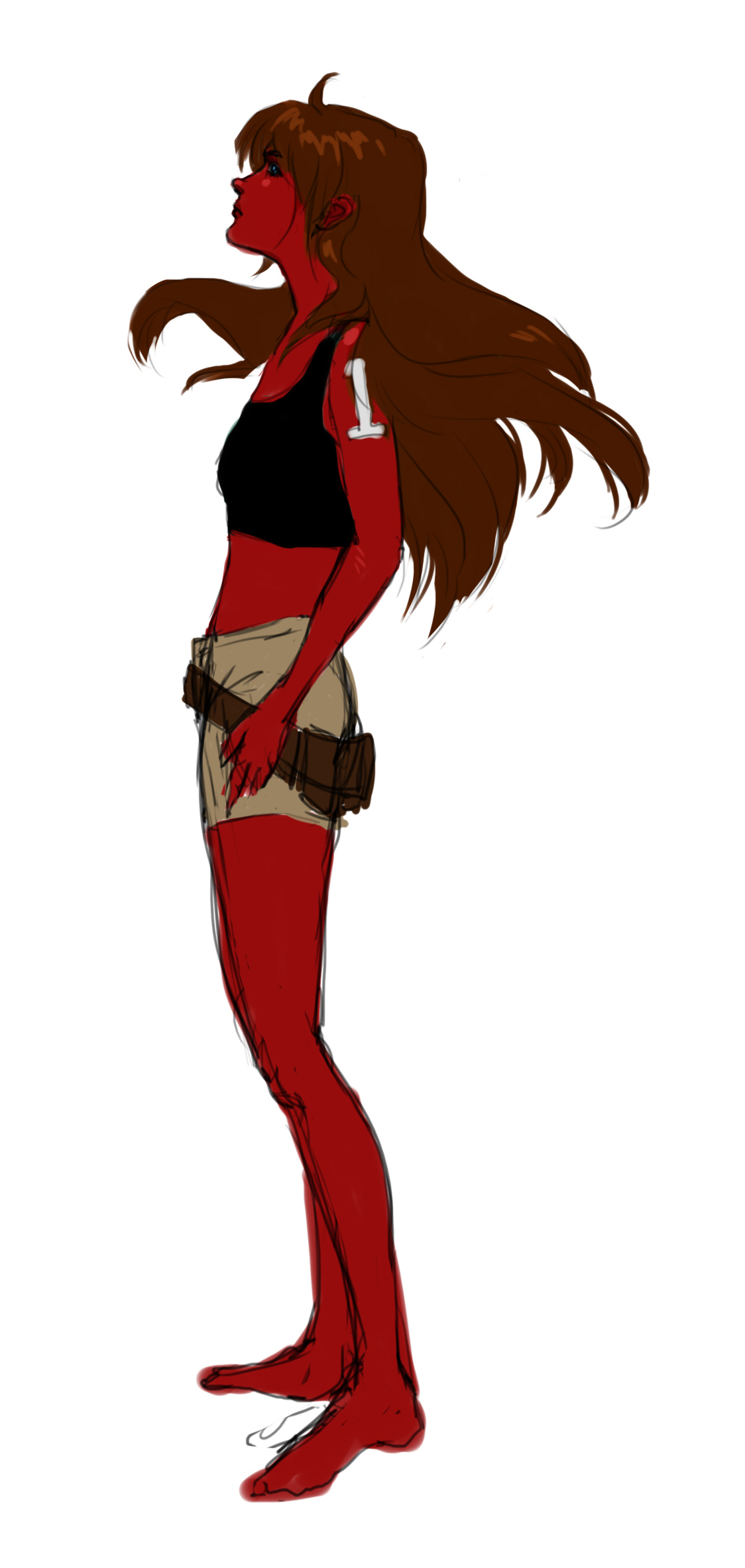
Finally, Angela had an “Aha!” moment and after I chose a few of the profiles that she created and made some suggestions, she managed to mix together something of Saint-Exupery, and something very reminiscent of Mark Buckingham’s drawing style in the illustrated story section of Miracleman #20: Winter’s Tale. As you can see, our protagonist looks like she is painted and has very bright colours. And yes, you’ve seen it right: she is red. 🙂 As of right now, this is the closest working illustration and aesthetic that we have and Angela is still working on it: along with drawing out a few more of our characters. It is just so beautiful, lush, and artful.

Another excellent advantage to having this working model of our whole aesthetic is that I have inspiration. There is nothing more buoying than seeing something you envisioned becoming as close to a tangible image as can be made possible to really encourage you to keep creating. The added bonus of this feeling is that with our last Project, Thebes was supposed to be based off of our re-interpretation of mythology: of stories and characters that already existed. With this Project, we are making something relatively new: something that didn’t exist before quite the way we see it.

I mean, I know: I understand that all superheroes are archetypes and variations of Superman or older mythical figures, but the characters in this story have their personalities and I try to look at the basics of what they can do as much as possible … of which I am now figuring out. It is also very helpful that, right now, Angela and I are on a very similar wavelength in figuring these details out.

In fact, all of this is a process of figuring things out: as though Angela and I are spying on another world and trying to translate it into ours as much as possible. When we’ve done more work on this–and I create at least a rough outline of the booklet–I will start calling the characters and our Project by name. Until then, both will be as silent and as wordless as our comics work itself.

The Power of the Original, the Creativity of Change

In The Source and Its Creative Feelings, I wrote about the emotions and energy that can power inspiration and ideas. In this article, I’m talking about the material and the quality of it that can fuel that kind of inspiration.

So I was watching the classic 1963 film Jason and the Argonauts last night, and it occurred to me just how much it was tangentially in there in the culture of my childhood. It wasn’t so much the movie itself as it was the aesthetics and the attitude of it. In fact, the only film that really comes to my mind with that same spirit is Cecil B. DeMille’s The Ten Commandments.

Whenever I thought of the ancient past or mythology as a child, I used the imagery of these movies and others like them to inform myself of how both should have looked like. Then I fast-forward this concept of mine by a few years. I used to think that the fantasy genre were all stories like The Hobbit and Lord of the Rings, followed by Dragonlance and Forgotten Realms, and I tried to write exactly like them: especially the latter two series.

I thought that some of my more weirder story ideas–including an alternate storyline with The Ten Commandments–were silly and a waste of time, or at the very least beyond my means and personal faculties to create at the time.

This was before I realized that there was original source material.

Every story ever made is an echo of another story that exists before it, or coexists alongside of it in another form. But every story as a source: a prototype or “Ur-Text” (Ur being a term for the mythical first of something, such as the first ever human city-state) or place that is tapped into.

I believe that every creator taps into that source. However, I also think that the strength of a creator’s link to that source all depends on where and how they tap into it. Originally, I was going to say that a creation inspired by an original source–or the closest known or accessible thing–depends on one thing, but after thinking about it a bit more I realize there are two elements involved.

The first element is, like I said, finding the earliest myths or art-forms that you can read, understand, or learn to understand and take inspiration from them. They are the closest things to the source, or what the famous mythologist Joseph Campbell called “the mono-myth”: the supposed first story that all sentient human stories come from. I feel that once you learn to understand the spirit of the earliest story or source that you can find with regards to your work–and specifically use it to gain your own personal creative slant on it–then you have gained something powerful and you are more than on your way to augmenting or discovering your own creative voice.

But then there is the second element that I thought of very recently: which is that once you gain an idea of the original source material that created the story or story-type you are working on, you must make it timeless in a way that everyone can relate to, and therefore make it relevant. Take what you have learned or understood and apply it to your time and the issues and themes that are important to you as a creator, a person, or even both.

Think about it: before DeMille’s Ten Commandments, or Jason and the Argonauts, all there was to determine how the ancient world was, and how their myths functioned were books, broken sculptures and fragments of art. The creators of both films had to go through all of that material and decide what they were going to use or change. I won’t even go into Ten Commandments, because there have been many other films and stories created from that Biblical tale at different points in time, and even the ancient Greek myth of the Argonauts has changed throughout time and culture as well.

But what I am saying is that the creators of both looked at the original sources as much as they could and made something, and added character and motivations that audiences could relate to. Even J.R.R. Tolkien looked at ancient Nordic tales and history in the creation of his Middle-Earth: which in turn informed how a lot of the fantasy genre derived from it would be for a time.

Like I said, I do think that knowing the original source of something gives you a special insight into that thing and in making something that is either a homage to it, or a unique derivation. This is what I have adopted for a lot of my writing and creation process. It gives you more to work with and more to change should you choose to do. And that is the key here: knowing the closest source gives you more choices … especially with what you want to reveal what is important to you about them and other people.

When I was growing up, I took films like Jason and the Argonauts with its stop-motion clay animation less seriously than I did the developing CGI graphics coming around then. But now, looking back I realize just how much of that influenced the creation of CGI and what film-making could be: as well as storytelling. Maybe it’s because as a culture now almost everything that is “retro” or considered old is popular and new again. Of course, as some other popular cultural articles suggest this could be all be just part of a cycle that happens with every decade or era.

My era of the 80s and onward, as well as the things that inspired them in earlier years, has become a lot of my source material and now I am starting to realize that I can express it. This is a good thing. The possibility that some of the quirky weirdness in some of my stories may have been inspired by Joss Whedon’s irreverent flippant dialogue in Buffy and other shows is an added bonus: from my perspective anyway.

Really, I just like creatively messing around and reading and watching old, good things and good new things for universal and innovative storytelling ideas. I probably could have summarized this whole post into that one sentence, but there you go. 😉

What Nostalgia is Made From

It was in the winter of 2008-2009 that I came up with Nostalgia. It was my first winter living on my own and as such I was spending a lot of time in my apartment. This was the point where I was training myself to write something each day–publicly–to put my writing out there and alleviate some of the isolation and loneliness that I was feeling at that time.

Spending a lot of time in such a relatively small space–in a room of my own–gave me time to think. I thought back to the woods behind my old high school of Thornhill Secondary and how a friend of mine and I used to walk through them talking about different things. I had a few key lines of “Nostalgia” written down already at that point, but I needed a context for them.

Originally, I imagined a scenario with two childhood friends–two boys–who meet in the forest. One of them leaves and goes on with his life, while the other one stays in the woods and never ages a day. Then one day, the friend that left returns as a much older adult–having been worn down by time and experience–while the other is still young but in many ways much, much older than the other. I was also inspired by the times when my class in elementary school would go on overnight trips to places like Montreal or Paris, and I’d stay behind in the “skeleton-crew” class. At one point I’m pretty sure I was the only student of my grade in one class.

Sitting in my apartment made me think about a lot of those feelings, and the past, and that essence of it that I wanted to capture in a very precise way: an eternal and universal moment. I’m not sure what made me change the story to what it is, and making it only one central protagonist: one little girl. If I ever knew, I’ve forgotten, but it worked out well.

It is the best vignette I’ve ever made and I am proud of it. It cuts like an icicle into a human heart, and drifts away as transitory as a snowflake … or a shriveled balloon into the distance. It deserves to be seen, and have more company again. One day. Soon.

Seriously, Story? Get Out of My Head! And Then Writing With That

So this was me a few days ago.

I already know that I need to work on my collaboration, but I have this story idea. It was supposed to be a minor one: one of my old usual one-off post stories I’ve made in another forum but something happened.

It’s not an unfamiliar feeling. I found myself staring at a blank screen. The story was there–mostly clear in my head–and I was looking at this screen and became very aware of the fact that I needed to move my hands to write the thing into existence. If I didn’t move my hands, or find the energy, this story would not exist at all.

So I switched away from my writing screen because I got tired of looking at it and vowed to go back and do something with it later. I was in the mindset of that I needed to get this story done so I could do my other work. So I sat at the screen again and condensed what I knew of the events into a post. I had a lot of details that I also needed to keep track of and I didn’t write them down because this was supposed to be a one-off story and it was also supposed to be one bloody post.

This occurred on and off for three days or so: with fits of procrastination and writing some posts for this Blog. The story sat in my head: sagging under this heavy weight that was beginning to put me into a very autistic or at least one-track mentality. I guess some would consider it borderline obsession, but the fact was I couldn’t ignore it and it was too big to warrant one post.

All right, fine. You win story. I’ll give you more room. So finally I started writing it and once I had that first line, I thought, “Okay, now I know you will get on the page.” I even changed one of the main character’s names as I wrote it and it worked. I had everything figured out more or less. So you think that it was smooth sailing from there, right? Right?

The answer is no. Hell no.

Then I found myself making more names. The next thing I know I am calling up back-stories and keeping them in front of my eyes like translucent membranes while writing character dialogue and interaction. After I made my first post, each one came slowly and methodically with many pauses in-between as I had to keep my concentration and self-discipline in line.

Before I know it, my one-off story has a whole ton of world-building behind it for something that was supposed to be a somewhat intelligent parody of a genre. I mean, I was prepared for the fact that I was layering my story and the nuances of my characters, but this was getting ridiculous: fucking ridiculous. I used to be able to write several pages of interactions in a day and I was getting bogged down because I wanted it done and out of the way so I could move onto other things.

I had to fight with some depression: with the possibility that no one was going to read it, with asking myself if I was just trying to impress people, with the fact that it wasn’t going to be any good, and the fact that I was spending way too much time and effort on something that should have been a one-off and very few people are going to see anyway. But I was also asking myself why I wanted to make this story. What was so important about making it and placing it where I did? And that was when I realized something: that sometimes when I create, it’s not a river rushing through the structure of me, but it’s me fighting against myself.

Basically, I was fighting against myself: trying to overcome myself to finish this story because I knew that once the damned thing was done, I would feel a lot better. I don’t think it’s any coincidence that sculptors sometimes beat the shit out of their clay to make what they want. It is just as much frustration as it is a need to create.

And I’m using profanity for a reason here. Creating can be tedious but also an ugly, messy business that tears into the blackest, dirtiest, filthiest parts of your psyche to express something from inside your mind into words. Sometimes, as I wrote this thing, I thought maybe I’m old. Like I said, I used to write several pages a day of things but my brain also likes to keep making things intricate and build-up a conflict to the boiling point.

Now, once that build-up was finished and I got to the action, I actually moved pretty fast and was caught up in the moment. It was so strange. Before this, it was like I was boring holes into a blank screen with my eyes–willing something into existence–and actually feeling my head get congested and feeling heat radiate off of my body as I sweated. It was like that energy kept ebbing and waxing–like I was visualizing something inside me consuming itself–until, finally, I found that rhythm and I just felt that creativity blaze inside of me again.

At one point, I had to eat voraciously because I had burnt that much heat moving and squirming around. But by that point, I was almost done the entire story. And when I did, I felt this tremendous sense of relief. I overcame myself. I’ll tell you, I don’t always succeed in overcoming myself but it is always feels like a success when I do.

Of course, I still feel like writing more things. I also have to remember to pace myself and not rush matters. There are other things going on with my life that also contributed to my sense of needing to do my primary work, but I know that I can’t put all creative and personal facets of me on hold to work on one thing, and I shouldn’t. I put pressure on myself. But at least, even though it may have been an engineered battle in my head, it was–this time–a battle that I didn’t lose.