Full Beings and Perfect Forms: Aristophanes and Plato in Miracleman

Before I begin, I would really like to point out that I’m aware of the fact that I’m talking about a comics series that few people have had the opportunity to read: though perhaps there are more readers of Miracleman out there than I assume. In addition, there will be some spoilers in this article, so for those still interested in reading the comics and can get access to them, read them first before reading this article. And for those who have no idea what I’m talking about, I talk enough about superheroes here and the philosophy of them to probably be followed. It’s up to you whether you want to read the comics.

Like I say every time I make this disclaimers, you have been warned.

Well before Alan Moore revised or deconstructed the figure of the superhero, people always assumed that even though superheroes have their official crime-fighting identities and their civilian alter-egos they are still ultimately the same person. The same was the said for Marvelman (later named Miracleman and possibly Marvelman again depending on whether or not Marvel Comics releases Alan Moore and Neil Gaiman’s runs) and his Family: that even though they spoke a magic word to change from human to superhero and back again, they always had the same personality.

Alan Moore challenges that assumption with his revisionism. We see a vast difference between Kid Miracleman and Johnny Bates: the child that he came from. Of course, that has a lot to do with the fact that Johnny switched into his Kid Miracleman persona as a child and let it grow up separately from his human child form. This, along with the event that forced him to hide and the circumstances of how he got his powers, might have warped his mind into two distinct personalities: though both have access to the same memories which is something to consider.

Moore even makes you begin to question if Miracleman and his alter-ego Mike Moran (though they both share the same initials) are in fact the same person. While both begin with a similar morality and are genuinely good people–and they share memories–key differences begin to occur to differentiate them. It’s probably even further complicated by the fact that Miracleman had been dormant for years after a traumatic event, while Mike Moran himself continued to age and live his own life until another traumatic event forced him to remember the key-word to bring his superhero persona back.

Then there is Young Miracleman–or Dick Dauntless–who died and was brought back to life. From Neil Gaiman’s run, or from what exists of it so far, there is no difference between Young Miracleman and his alter-ego at all. Finally, Miraclewoman seems to be the most balanced of the entire Miracle (or Marvel) Family in that as the doctor Avril Lear and Miraclewoman she also seems to be the same person and has learned a lot about her dual nature by exploring both.

As I read the entire series as it was, I began to notice certain elements that Alan Moore and to some extent Neil Gaiman incorporated into their work. In a lot of ways and I have Alan Moore in particular in mind, they brought the idea of the superhero back to its roots: to the mythologies that created it as they took it apart. The secret British government program that was created to make these super-beings is called Project Zarathustra: based off of Nietzsche’s idea of the ubermensch or the superman. The superman is supposed to be a being that has transcended all conventional morality and chooses to create their own code to live by: possessing the power to do so through sheer will. I talked about this a little bit with my Whoever Hates the Man of Tomorrow? article, but this is a theme that definitely plays out with Miracleman.

There are other mythological references in Miracleman: such as the heroes’ home base being called Olympus, the body-switching Qys as the supposedly unwitting genetic prototypes of the Miracle Family being referred to as the Titans or the Primordials that existed before the “superhero pantheon of gods,” and even the battle with the twisted Kid Miracleman supposedly mirroring Ragnarok or the “twilight of the gods.” Moore even creates a nice mythological analogy between superheroes and supervillains: the former being Heroes and the latter being known as Dragons or monsters to be vanquished. We see a lot of Nordic and Greek mythology being drawn on to create this version of Miracleman. But there is more.

As I continued reading Miracleman, I saw another parallel developing. It began when I saw the twisted fused twin skeletons inside of the British government’s secret Spookshow warehouse: where Miracleman and his kind were created. Originally, I was led to believe that these fused skeletons were the remains of Young Miracleman from his own death, but in reality they were the dual remnants of Young Nastyman: another experiment that went insane and died through mid-transformation within a volcano … or so Miraclewoman says.

That grotesque fusion of two skeletons reminded me of Aristophanes’ myth of love. I know how disturbing that may sound, but I didn’t actually start thinking of it that way until Miracleman himself began to explore his own identity and the line between himself and Mike Moran. According to Plato in his Symposium, Aristophanes explained why love existed by telling a story in which once upon a time mortals were larger beings with two-heads, two sets of genitals, and two sets of limbs. They were powerful and they defied the gods so much that Zeus split them into two. This myth was supposed to explain that love is that need for each person to look for the other person split from them or, as we hear it in our own popular culture, each person looks for “their other half.”

That was the resonance I got when Alan Moore really came to the finer details of how the switch between mortal and divine works with the Miracle Family. It’s almost as though Project Zarathustra, in analyzing the bodies and the technology of the Qys–of fluidly intersexual Titan progenitors–tapped into a place of mythical proportions to recreate that “lost existence” that Aristophanes goes on about. One very interesting thing to note about Aristophanes’ myth is that when human beings were once unified, greater beings it was implied that they could defy and potentially challenge the gods themselves: which was one reason why Zeus and Apollo divided and changed them. Therefore, it can also be implied that Project Zarathustra allowed mere mortals to tap into the divine, to a place beyond the divine, to become a lot more than what they already were and challenge the established order around them.

Aristophanes’ myth that was meant to examine the origins of love and humanity’s potential to divine power is argued by scholars to be a comedic or lampoonish idea to reflect its comedian creator. Yet I find nothing particularly hilarious about this, though it is interesting that it was considered a “comic” idea: one that has translated itself so well throughout the ages. There is also another saying in popular cultural with regards to love as reunion: that just as people are looking for their “other half,” there is also in a relationship reference to one’s “better half.”

This is where I begin to wonder, like a few scholars before me, if the myth of Aristophanes wasn’t created by Plato himself to add a nice neat argument to his Symposium. We can argue whether or not Socrates created his own philosophy too until the cows come home, but that’s not the point here. Plato himself had his own theories about reality and the subjects that exist in reality. He believed that there are two worlds: the World of Forms or Being and the World of Becoming. The World of Being is a plane of perfection. You can find the originals or the perfect forms of anything that has ever existed. You can find the ideal object–such as a chair–or subject–such as a man or a woman as well as thoughts, feelings and knowledge–here.

Then you have the World of Becoming, a gradation of said perfect forms into more worn and degraded shapes. They deviate or change from the ideal and ethereal prototypes that they come from. The idea is that we live in the World of Becoming and that we seek the World of Being. You can see here, and I’m sure my high school philosophy teacher would be proud of me at this moment, how this Platonic thought influenced the Western idea of Heaven and Earth, or Heaven and Hell.
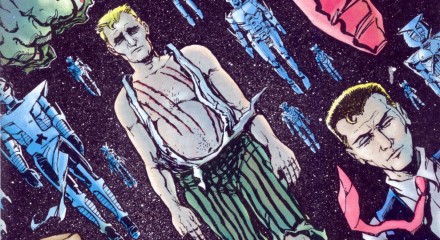
When I read Miracleman, I saw an interesting parallel with this Platonic conception. Miracleman and his kind are the perfect forms. When they are not used, the forms are kept in a place of pure energy known as Under-Space: a nice analog to the World of Forms itself. They rarely ever age, they cannot be destroyed through conventional means, they have extraordinary clarity of thought, devastating power, and even their costumes are engineered from an alien material that cannot be destroyed and reflects the moods of their wearers. Their powers and natures are explained as being the result of a psychic field or harmonic around them that they can control. In other words, the Miracle Family practices mind over matter.

My reading of this is that human scientists–degraded imperfect people like the rest of us from the World of Becoming or matter–used a link to the World of Being or the spirit to reverse engineer near perfect forms that mortals can have access to. Even Miracleman explains that he has the same thoughts that Mike Moran does, but he can see them and perceive his world with far more clarity and insight. We can get even more Platonic or Gnostic and say that through science, the Miracle Family gained a greater link to their spiritual, real, celestial selves. It is also no coincidence that Alan Moore, their revisionist, began to embrace further mythological and spiritual elements in his later works and even in his own life.

So it seems clear cut that Miracleman and his Family are their own essential selves having been unified. Of course, it is not nearly so simple as that. Mike Moran, Johnny Bates, Dick Dauntless, Avril Lear and Young Nastyman (or Terrence Rebbeck) did not seek this enlightenment. They were kidnapped, kept in medically induced comas, experimented on, had essentialized clone bodies made for them, had said bodies transferred into Under-Space where their minds would be trained to switch back and forth to by a word command, and were brainwashed to believe they were superheroes in a comic book-like virtual world before being abandoned as too powerful and too dangerous and marked for a termination order which, inevitably, failed.

It all sounds so banal when I summarize their origins like that. In a lot of ways, the Miracle Family are more like the uncanny Freudian doubles or doppelgangers of the mortals which they are linked to. They have great powers and insight, but they do not always relate well to the World of Becoming around them. Some of them are malicious because of this and even the best-intentioned among them have the potential to cause immense and traumatic change to the world.

I personally think that they are all of these things and more. I think that Moore portrayed them as humanity’s need to reach for and become the divine: or to remember its divinity. What happens after the creation of said beings, their own realizations of what they are,  and how the affect and what to share their perspective with the world around and the people who made them is–in mythological retrospect–an inevitable conclusion.

ETA: After writing this article, I’ve realized that you can examine the Miracle Family with a particular focus on identity. Much in the way that Neil Gaiman’s A Game of You really plays with identity, gender and the fluidity and change of self-identity, his and Alan Moore’s Miracleman can also be examined in a similar light. Maybe one day someone will do that … when the damned thing is republished.

Abraxas, legal issues, Abraxas …

Whoever Hates the Man of Tomorrow?

Alan Moore attempts to answer a question originally of his own making when he created Whatever Happened to the Man of Tomorrow? years ago. This question has been asked a variety of times since the end of the superhero’s Silver Age and has garnered a variety of creative answers.

But why Superman? Why is Superman still so important? I admit: I have friends who simply don’t see the point to the Man of Steel’s continued existence or, indeed, his creation to begin with. One main criticism that people have with regards to Superman is how unrelatable he is to the reader. I mean, come on now, none of us can generate heat rays out of our eyes, fly, possess X-Ray vision, make freeze-breath, or be invulnerable. Certainly, no one has Superman’s “boy scout” morality without any other very human flaws and failings to match it: if that.

I can understand why Batman is more relatable. He is a human being who has used material resources and pushed all of his human skills to their limits by sheer obsession and utter will. If anyone should be the Man of Tomorrow, gender connotations notwithstanding, you’d think it would be Batman. Certainly, many people have a great love of the vigilante: of the person that goes beyond the law, becoming extra-constitutional, going beyond the polis–the city-state–to become a god or a monster to see that proper justice or vengeance is done. And there are heroes being venerated today–perhaps throwbacks to the ancient literary heroes–who are far more brutal and even more morally ambiguous than Batman.

And Superman? He is a “goody-goody.” He is so much a goody-goody he is too good to be true. Whereas Batman operates beyond the law or within its blind-eye, Superman obeys the law in as much as he can save innocents and capture criminals. Perhaps there is little difference, save that the law seems to like Superman a lot more or accept that he is beyond them: that he is using his powers to uphold the law and safety to a fault. Indeed, you could say that Superman has more a lovable personality: or is more personable and wins all popularity contests through his sheer good nature while Batman fights with fear as his weapon. Fear does not make you popular or loved: but it gets the job done.

But is that the only thing Superman has over Batman and others? That he is more lovable and makes a show of following rules? That he is superhuman and chooses not to obliterate the world? That he ignores or reshapes the reality of the world? Or worse: does he continue to patronize his friends, his allies, his enemies, and the human race by presuming to always save and stop them? Is his alter-ego of Clark Kent, according to Bill in Kill Bill Vol. II, simply a grotesque critique of what he thinks a human being really is?

The truth is, when you look at Superman, you see an incredibly powerful being that could rule and destroy the world. He could rip us apart like insects. Yes, Kryptonite can hurt and kill him but he has enough knowledge to protect himself against it. In fact, the knowledge and intelligence he possesses from the Fortress of Solitude that is his Kryptonian birthright and from his own experiments is enough to dominate and destroy all human kind. There are many people who–if they had his knowledge and power–would do exactly that and have very little qualms about doing so. Some people in the DC Universe already have.

It is already clear that Jerry Siegel and Joe Shuster based him off of Friedrich Nietzsche’s idea of the ubermensch: a being that has grown beyond the constraints of morality and limitation to choose their own path, yet they injected “good old morality” into this alien superman and made all of his achievements naturally-born and inherited from the dead.

So why is Superman special? Why do I think he is special? I might have written some of my answers already but–if I had to sum it up–I would have you consider the following.

Imagine finding out that you have the power to crush steel with a punch or even just the touch of a hand. If you wanted, nothing could ever touch you. You can move as fast as or beyond the speed of light. If you jump, you will jump extremely high and eventually be able to fly: but you need to somehow know how to control where to go or how to move given that you still have a humanoid form and it is not built with the instincts for flight.

Now take all of that–never mind the fact that you have to learn how to control your temper, your passions and hold your parents or your lovers carefully so that you don’t crush or hurt them–and then add an alien birthright whose most modest lore could detonate the world many times over and again: possibly taking you and everyone you love with it.

Your merest touch could kill a person and your slightest knowledge could destroy them. It makes for a lonely existence doesn’t it? And yet, somehow deep inside of you, you not only find the will to master all of these powers but you actually want to use what you have to help other people. At the same time, you just want to be like other people: even though deep down you know you never truly will ever be. You don’t want to be thanked, you just want to help and out of all those things you could do, you choose to do so.

In Mark Waid and Alex Ross’ Kingdom Come, a horrible calamity happens and Superman gives up on being Clark Kent. We see a person who lived among humans, who loved them, who had friends among them and wasn’t alone become an out of touch and distant Superman who only responds to the dead name of Kal-El from an equally dead and distant world. It is a Superman who still wants to do good and still feels bad over the loss of life, but he can no longer relate to anyone that he wants to save and people cannot relate to a person who looks upon them as so … lesser than he is.

He becomes the genius that cannot relate to anyone and garners misunderstanding and even contempt: because if a superhero, like a genius, cannot relate to those they save or even us readers then they have failed in a very fundamental way.

Unlike Bruce Wayne whose civilian identity is a mask for Batman, Superman is Clark Kent. He was born as Clark Kent and even though he isn’t human, being Clark Kent has taught him control and about life. As Grant Morrison demonstrates with a bright and essential freshness in his Superman All-Star, the power has not mastered Superman as it has so many others.

Superman has mastered the power and like the ubermensch he chooses his morality: which is to help people. At the same time, he is like Thomas Mann’s Tonio Kroger: who can see the dance of humanity around him and even replicate it artistically but is never really a part of it. It is his strength and his sadness and yet he finds the joy in helping others find joy. Very few others in fiction or the real world could ever be like that.

I write a lot of dark and conflicted characters yet once–long ago–Superman was one of my earliest childhood heroes. And in some ways, he still is. I’m glad the idea of him exists. I’m glad he exists.

Thus concludes another episode of Matthew Kirshenblatt writing about superheroes. Up, up and away my friends.

Comics Review: Grant Morrison’s Arkham Asylum

The first time I’d ever heard of this game was in reference to the video game that exists out there. But I’m not talking about that. No, I am talking about this.

https://matthewkirshenblatt.ca/wp-content/uploads/2012/07/arkham.jpg?w=194

I’m specifically talking about Grant Morrison’s Arkham Asylum: A Serious House on a Serious Earth the 15th Anniversary Edition. Considering that it has existed since 1989, the book has no doubt had many reviews at this point, but I feel that I have a few things to say about it: things that have been on my mind since I last read it.

What I find very unique about this comic is not what it is about, but who. You might think to yourself it is obviously about Batman, but while he is obviously a main protagonist in this work and it deals with him facing his own fears and psychological issues the story is not purely about him. The story is not about the villains that he has incarcerated there either: though they have lured him into the asylum to face said fears and the torments that they have waiting for him. It isn’t even about Amadeus Arkham: the tragic founder of the mental hospital that was supposed to save and repair criminally insane minds.

No, Arkham Asylum‘s main character is Arkham Asylum. Character as place is not a new idea. Certainly, I had to face something similar when I was writing part of my Master’s Thesis on Alan Moore’s Voice of the Fire: where the protagonist of that work was actually Moore’s hometown of Northampton. But unlike Northampton that has many layers of different gritty and earthy human activity, Arkham Asylum is many nuances of madness.

Morrison doesn’t pull his punches here. He draws on Jungian psychology and archetypes, the Tarot and mysticism, and poetry and crazy itself as he depicts Batman’s essential descent into the underworld or the demented collective unconscious that Arkham has become. He also has an Alice and Wonderland reference or two. Morrison seemed to really like using those, just like Alan Moore in his Miracleman comics. Then there is the name Arkham itself to consider. From what I understand, it is derived from H.P. Lovecraft’s creation of the fictional city of Arkham, Massachusetts: the seat of the strange and eldritch Miskatonic University. It has been used as a name for various fictional places, but it really has a nice and eerie parallel with Gotham’s most terrifying asylum.

The fact that it was once a house–a very Jungian archetype for the makeup of an individual’s consciousness–and the person who once lived in it failed to turn it into a place of healing and ended being locked away inside of it speaks some major volumes right there. The atmosphere of this comic is distorted and schizophrenic to the point of making even Batman seem disturbing and this is in no small part thanks to Dave McKean’s drawing style and painting.

https://i0.wp.com/www.dialbforblog.com/archives/500/arkham3.jpg

Do not misunderstand though. The piece has its weaknesses and, ironically enough, those weaknesses are can also be construed as its strengths. For instance, I really like the broken mirror-reality that Dave McKean has depicted with his twisted nightmarish images and the different kinds of dialogue font, but at the same time they are very distracting and it is hard to make out key details that may have actually made all the difference in understanding the plot. The reason I like the 15th Anniversary version of this book is because of the detailed comic book script at the end of it.

You know, in some ways I liked the script a lot more than I liked the comic that came from it. If Arkham Asylum is of any indication of how Morrison writes comics scripts, it represents something easy to follow and enjoyable to read. In the script the mythological and archetypal references and many more uncanny details are much more apparent. It is also an added bonus to be able to understand what it is going on and what the characters are saying. At the same time, I will be honest: I respect his interpretation for Batman in this story, but I don’t agree with it.

The fact has less to do with Morrison’s choices and more to do with the popular idea that Batman is as mentally-imbalanced as his enemies. Do I think he was influenced by a trauma into a cycle of behaviour? Obviously. Do I think he saves people’s lives just out of a compulsion? Not completely. Perhaps each time he does do it to save himself or to save the lost innocence of the child he once was. I also think he saves peoples’ lives and doesn’t use a gun because he has principles and he has a certain sense of honour influenced by his own experiences like anyone else.

But there definitely were a lot of things I liked about this book: about reading the story of Arkham Asylum and the progression of the horrifying ritual and gathering of insanity over the decades that made it into the nexus of insanity that we all know and love. I also like how it makes you look at what precisely madness is and just where that fine line may–or may not–be. It was a psychological horror story and I loved it.

I do wish that I could have gotten more out of it without having to read the script, and I could be very mean and say that there is something wrong when you like a script more than the comic it is supposed to help create: but I do love McKean’s work here and the script is a nice complement with some scenes that didn’t make it into the finished artistic product. I’d definitely give this work a five out of five.

And that is it for now. Tune in next time, my friends. Same Bat-Time, same Bat-Channel.

ETA: It would be interesting to see someone compare and contrast Alan Moore and Grant Morrison’s use of Alice imagery as well as how they use the ideas of “reason” and “madness or intuition” or the “Dragon” and “the hero” in Miracleman, From Hell, Arkham Asylum and Red King Rising respectively.

Film Review: Sucker … PUNCH!

I’d almost like to say that Sucker Punch actually sucker punched me, but you can’t claim to be sucker punched when you can pretty much see it coming.

So I watched this film the other day and I almost feel like just giving you my rating right now. What I can I tell you? It could have worked. It could have. All the components were there. You had this girl who was wrongfully put into an insane asylum by her stepfather who wanted her family’s money: and had her unofficially scheduled to be lobotomized to keep her silent about his dealings.

You had different realities going on after this in which you have the protagonist retreating into the fantasy that she was sold to a brothel where she’d learn to dance for the patrons there. You also had a few realities where this same protagonist is a bad-ass warrior who has to fight things that symbolize her inner demons and even has something of a guide: a man who is respectively a sage and a military commander. He is known as the Wise Man and has some pretty crisp, elegant, and pragmatic things to say with a proviso at the end that always comes after him stating, “Oh and one more thing …”

You also had other female protagonists who were also in the asylum, in the brothel and were in her teammates in the combat worlds she found herself in under the guidance of the Wise Man. One of the worlds the girls found themselves in was apparently a steampunk (though I would say dieselpunk) WWI.

Here is essentially a movie where you can play with realities and have some nice transitions between worlds. Here is a romp through the collective unconsciousness: through the subconscious of a girl who is probably being drugged and trying to save herself from a lobotomy in five days’ time. This could have been a movie of character development along with some fitting musical tracks,  flashy special effects and fantasy sequences.

Instead, it was just the good soundtracks and the fantasy sequences. A few other critics have actually stated something to the effect of being amazed at how bored they were during the fight scenes and such and I have to agree with them. They could have been cool. If the girls had been developed a lot more, it would have been.

You know, I can almost see how it could have been: like a warped dieselpunk psychological-Alice and Wonderland fairytale. I could see there being very clear, if somewhat distorted, plays between the different realities: even the point where you as the viewer might not be sure where one begins and one ends. Keeping in mind that the initial setting was in an exaggerated 1960s asylum would have been–and I suppose even is–a good start. I also think it would be fascinating to consider that a lot of the music that the protagonist is forced to dance to in the brothel reality does not even exist yet in her actual time line: which makes you wonder if what is construed as madness is something that goes beyond space and time.

Instead, what we have here is a video game with a very flimsy premise and attempt at depicting female empowerment: which did not work and I feel did the exact opposite. But the sad thing is: it could have worked. It could have been done if it had been done a little differently. For instance, in the beginning of the film itself instead of trying to depict a bunch of silent black and white sequences ala Sin City style, the film-makers–in my opinion–should have basically developed some character even then with a few verbal exchanges or what-not. I mean, even the “silent treatment” they were attempting to give us–a “show and don’t tell us” situation, could have worked for me if the body language and facial expressions of the characters weren’t so … over-exaggerated and melodramatic. It seriously made me wince to see that and I hoped it would improve as time went on.

The thing is, in creating this film, they followed a formula and a cycle. They had a quest, they had antagonists, heroines, items that needed to be found, and even a moral: which is that you have all the tools to take care of yourself you just need the will to use them and do what must be done. But it didn’t work. It just didn’t work.

And seriously? Naming the girls Blondie, Rocket, Sweet Pea, Amber and the protagonist Baby Girl made me wince. A lot.  You could argue that they are just monikers given in the brothel reality to these girls by patriarchal chauvinist forces, or that they were plays on Charlie’s Angels, but it still makes me wince. Their overly-fetishized little girl costumes did not help matters either. In fact, the way they were depicted in general wasn’t something I could really relate to or sympathize with. That, again, could have been done but it wasn’t. Also, Blue–their “owner”–for all he is a misogynist piece of garbage, and despite his moments of intelligence, really wasn’t that intelligent at all or consistent in how I would think he’d operate: especially when he doles out punishments. He might be a sadistic criminal, but I imagine he is also a pragmatic businessman and would have dealt with things a little more differently.

I do like the idea that he knew that in the brothel reality or fantasy that they were trying to escape and he figured it out, but that twist was never followed through because I’d assume the girls would adapt to it as well somehow. I don’t know how to phrase it beyond that. It just felt like a whole lot of flatness with special effects with a very forced “meaning” or “moral” stapled on at the very end and music sequence in the credits that has nothing to do with anything.

It just felt like a video game and honestly–if I wanted to see Alice with a machine gun with a similar psychological element–I’d probably play a game like American McGee’s Alice or its sequel Alice: Madness Returns. If you want to make a dark and gritty Alice story, make a dark and gritty Alice story or play one of the above games. But I’ll be fair: as a video game this film might have actually been better. If Snyder had created Suck Punch as a video game script and worked with other developers to make the game and then made a film from it, it might have been a lot better.

I guess since I am trying to be fair, it was his first original movie script and you can see these different elements coming together: but they just don’t make it in the spectacle that follows. I could also have seen this as a comic book first: with more development and time. I don’t know if that would have improved a lot about it, but with writing and time stories could have been made and maybe some essence might have been established along with form. Perhaps something along the spirit of David Mack’s excellent and insanely innovative Kabuki comics series might have been something interesting to see.

You might ask why I bothered to review this film at all given what I’ve said about it. I guess if I had to summarize it all under two words, it would be: could have. Although not exactly the same, after mentioning Kabuki I remembered a Noboru Iguchi film I saw at the Toronto After Dark film festival called RoboGeisha: the story of two sisters abducted and termed into geisha-assassin cyborgs. What I find really ironic is how even though it somewhat parodied Bandai’s Power Rangers, a lot of gore, and was in a lot of ways incredibly ridiculous, it laughed at itself and made you laugh with it. But not only did it do that, it got me invested in the characters. And while it didn’t have all of Sucker Punch‘s special effects or mien of grandeur, it was a lot more fun.

Oh, and one more thing: while I do think that Sucker Punch‘s heart might have tried to be in the right place (I appreciated that Baby Girl actually went into a fighting world when she danced to the music: something that I’ve visualized doing when I used to go to dance clubs myself), there was something about that just didn’t sit well with me. I’m glad I didn’t see it in theatres, though it has its entertainment value at times and I’ll give it a two out of five.

In the Superheroes’ Playground: ItsJustSomeRandomGuy’s “I’m a Marvel, I’m a DC”

I don’t remember how exactly it was I found ItsJustSomeRandomGuy. It must have been me looking for material on YouTube with regards to Watchmen or some comics related thing. You know: when I was either researching for my paper or indulging in one of my favourite past-times.

You all probably know and remember the old “I’m a Mac, I’m a PC” commercials. Well, RandomGuy did a spoof of that: with superheroes. He created “I’m a Marvel, I’m a DC”: where he animated action figures of heroes from different franchises comparing and contrasting themselves as well as bantering and even sometimes finding common ground.

The sample below is the very first skit that I came across:

What I like the most about these skits–which are highly satirical pieces that often break the fourth wall–is how JustSomeRandomGuy captures the personalities, and the voices of the superheroes that he represents through his collection of action figures. ItsJustSomeRandomGuy himself is a voice actor and teacher and it shows. Yet it is more than that. The fact of the matter is that he is also extremely well-versed in DC and Marvel story-lines, the comics franchises, and the medium itself. He also brings an incredible wit and creativity all of his own to what he has made.

As he goes on, ItsJustSomeRandomGuy actually begins to build story-lines of his own from the simple skits he began with. The arc begins with After-Hours, followed by Happy Hour and then the Zero Hour that’s still in progress. It is really fascinating to watch this evolution happen: from the usual two figure-skits–partially stop-motioned or edited–to full on interactions between figures from the Marvel and DC Universes.

It’s what a lot of us geeks did when we were children. I mean, let’s face it, a lot of us played with our doll–action figures, making voices and then new story lines for them. But JustSomeRandomGuy takes this–this same love for the superhero and villain toy-box–and does something really wonderful with it that I’d not seen too much of. He essentially, like I said earlier, creates a satire of superheroes with these figures. Yet at the same time, he keeps them in character–with a few humourous exceptions that somehow mesh well anyway–and captures their essences.

Watching these characters interact reminds me of all the Saturday morning cartoons and comic books and actually makes me feel good about myself just by watching them. They are my old friends from childhood–on my cards, in my cartoons, movies, and comics–but at the same time they have kept up with the times and have their own changes. Yet they are for the most part still fundamentally the same: while being very aware that they are actually comic book characters. I like this kind of meta-fiction and the fact that, yeah, if anyone would be intelligent and experienced enough to know that they are characters it would be these guys. Just how many universes and realities have they already been in themselves within their own stories?

ItsJustSomeRandomGuy gives back the Saturday morning and afternoon wonder, but also it also let the heroes and villains grow up with us: the slapstick accompanied by a certain degree of seriousness and the meta-fiction and fourth-wall breaking always placed under Marvel’s much lauded sense of, “Continuity! Issue #Etc.”

ItsJustSomeRandom Guy recreates and creates a golden magic that I am glad I came across. It’s nostalgia without the bitter part of the sweet. It continues to evolve with more hilarious parodies and touching messages.

The fact is, in my opinion, ItsJustSomeRandomGuy is a genius. Through the posing of these toys, he manages to cover issues from inter-character relations, different universes, the nature of and the issues surrounding comics, the effectiveness of the films around the comics, and a whole lot of popular cultural references while never making these self-reflexive heroes anything other than what they are in a series that knows exactly what it is.

If I had, say, two requests of ItsJustSomeRandomGuy–if it is in his power at all–and if you are reading this ItsJustSomeRandomGuy I’d say this. I would love to see an episode with the figurine of Animal Man in the Grant Morrison understanding of the character.

And I would love to see an exchange between Miracle/Marvelman and the rest of the Family–or even Shazam, Captain Marvel, and Superman–talking about the series that has not been published in forever. I would love to see your take on that if you have the figurines (of which I know the Miracle/Marvel Family are rare now and expensive and I do not know the legal elements involved, so I hesitate in asking this). But as a fan of yours, I simply can’t resist asking.

(And there is a custom-made action figure of Miracleman. I think only the Todd McFarlane statues were made, which is a pity)

For those of you who have never watched any of these YouTube videos and just want to surf through them, here is ItsJustSomeRandomGuy’s channel. They are worth every moment.

So to properly conclude this, I would just like to thank ItsJustSomeRandomGuy for his work, and leave you with this message.

So remember kids: the moral of today’s story is that continuity is important. Thank you, and Excelsior!

Creativity and Academia: The Glass-Bead Game That Never Ends

It’s amazing–to me–that I forgot to talk about this at all in my review of Hermann Hesse’s The Glass-Bead Game. I was originally going to write this as an addendum to the piece, but then I realized that the issue I want to address actually covers some much broader ground.

One that that is always stressed in Hesse’s novel by the Castalian Order that developed the Game is that it is not their role to create new things. Castalians are not supposed to be artists, but scholars of a spiritual bent and–according to them–anything that comes from the Game is simply to be contemplated and there is great discouragement against changing the rules that create and make up the Game proper. Basically, the Game itself seems to have been developed from pre-existing knowledge and there is usually great resistance from the Order itself in altering any of the rules or guidelines that were made to create it.

However, it is not only this. As I said before, creativity apparently is discouraged in Castalians in general: but that is simply not true. At one point in his studies, Joseph Knecht is encouraged–like other developing students in his Order–to write creative pieces about what they could have been in their lives. Also, he makes many changes to the rules of the Game even before he is Magister Ludi and they are accepted. Knecht could–of course–be the exception due to his gifted nature and not the rule–but it goes further than that.

To combine different disciplines together to create different patterns of expression is creation. There is analysis and study involved, but there is a synthesis of the parts into something new. Therefore, even during Knecht’s time before his reforms and his demise, the Glass-Bead Game–a contemplation exercise of intellectuals and academics–is a creative venture.

It reminds me of why I chose to pursue the Humanities at my University and why I pursued them in the way that I did. I learned about a great many things to do with literature, philosophy, history, social theory, and even to an extent art and expression. My program was by its nature very interdisciplinary and it looked not only at how certain philosophies and conventions work, but what forces make them and why.

Humanities also encourages scholars or humanists (as they are apparently called) to apply a plurality of “lenses” or “frames of reference” to a particular subject. For instance, when looking at a book we would look at the history of the culture that it was written in, the philosophical movements that existed then, the potential other sources that might have influenced its creation, the writer’s life, and how that book influenced other books and other cultures even and what the implications of what that book says might mean and how it might have meant different things to different people. So instead of looking at it from one view or lens, the theory was that we were to look at a thing with different mental tools or perspectives. We are even encouraged to look at how those tools and “lenses” were created: and why they exist the way they currently are.

All of that can be really difficult to articulate and sum up into a few sentences. Indeed, when people asked me what my Major was and I told them it was Humanities, more often than not they didn’t know what I was talking about: or they had a very different understanding as to what the Humanities actually is. For instance, the University of Toronto’s Humanities is different from York University’s: in that the former has certain divisions of Humanities, while the latter has an entire program that combines all those elements together: or tries to.

The fact is, for me, it often seemed like my Program–and maybe even Humanities as I know it–seeks to justify its existence by trying to be a discipline like Science or English. Sometimes even I feel it is just a “jack-of-all-trades while mastering none” perspective or that I personally just possess a whole lot of “party-cocktail trivia” and nothing more compared to the specialists of different fields. Personally, to make a gaming digression, I think of it as multi-classing and spreading certain dots or numbers of Experience Points out that–while it may take a while–will eventually pay off a very well-rounded character.

My role-playing game analogy and tangent aside, sometimes I felt like–just with the Glass-Bead Game of Castalia, the Humanities is very stringent on its guidelines of scholarship and what scholarship is because it is a “relatively young” discipline as we understand it and it wants legitimacy. The thing is I think both are already legitimate and allowing for flexibility in what scholarship and academia can be–by allowing for change–they distinguish themselves. I know sometimes I really wanted to say that I shouldn’t have felt like I had to apologize for my choice of Program and–more specifically–the Humanities shouldn’t have to apologize for what it is.

As an interesting side-note, apology originally was derived from the concept of defense: defending your perspective through logical debate known as argument. I also think there are many other ways to make your point instead of being defensive or not testing what your discipline–or your medium–can do. Film and comics were very similar to that regard in that both wanted to “fit in” and be accepted but they are different. I know I’m making a lot of very potentially bad analogies here in equating disciplines with media, but in my mind they are very similar if not one and the same.

What I love about the Humanities is that it let me put so many things together–it let me be analytic and synthetic–and I think I had more opportunity to do so in that discipline than anywhere else. I got to look at my favourite authors and writings. I got to analyze some of my own stories in a final paper. I even wrote a comic book script as a final assignment in another course: using my knowledge of the course material and comics media. I know York has an Interdisciplinary Studies Program as well where students are encouraged to do independent work and even create art as their final project.

As you can see, I feel very passionately about this. I think that gathering and critiquing knowledge is important, but that once you try to look at the why of something–to contemplate it and its application to yourself … to look at the human in it–creating something can be just as important. I like that my Program allowed me that freedom, for the most part, and it’s just amazing how The Glass-Bead Game applies to so many of these issues that I’d been thinking about for a very long time now.

I firmly believe that when you make a work of any kind, you create knowledge: and that viewpoint challenges not only what scholarship is, but what art is as well. There was a time in history when apparently there was no division between what was art and what was science. They were all apparently unified under Philosophy along with a whole other lot of disciplines we separate and specialize now. I’m obviously not saying that other disciplines are not as important or that their distinctions should be eliminated: specializations can be very important because they focus on a particular subject or task quite efficiently and with necessary detail.

But I like the differences in the discipline I chose and that potential for growth that I always felt there. It certainly feels like it fit my mindset: at least at the time. The best part is that even when school is out, you still keep learning about the Humanities. You can still keep making things. The Game doesn’t end after you graduate college or university. It doesn’t end when you leave Castalia for the unknown. You keep playing and, you know, I think that is a very good thing.

The Galvanizing of Creative Cuttings, Writing Perfectionism, Amazon, and Art Coming Soon

It seems I’ve been writing more reviews than creative insights lately: which is fine. The fact of the matter is that everything I review on here inspires me–or informs me–in some way to become a better writer. I keep building from that.

But when all that’s all said and done, it’s always good to sit back and look at exactly what it is I’m trying to do.

There have been two or three things on my mind lately to that regard. The first is that I finished writing another Miracleman/Marvelman fanfic tribute, but I don’t quite like how it came out. There were a lot of things I wanted to say in it–as well as display with a very neat and clean narrative perspective–but it didn’t quite get there. I got all my ideas down and some really good lines but I feel like the overall story is a little blurred.

It is frustrating to have a story stuck in your head for a while and then–when you finally get it out to free up your mind for other works–it isn’t quite as clear or “as good” as you wanted it to be. Of course, the natural solution to this would be for me to type it out and rewrite it. They say that a large part of writing is rewriting and that is true even when you write it out right the first time around.

I also wrote out an original story that I had in my head almost as long as the other one: one I wrote a great many notes for. Of course, one of the pieces of paper where I wrote out this really beautiful quote–in my own opinion anyway–got lost. Yet the story still wanted to be written down. You see, unlike that TED Lecture where Elizabeth Gilbert talks about a genius-spirit flowing through you, I think that I create my works not unlike Victor Frankenstein in a hopefully more intelligent way: I get the genius in me, but it comes in pieces sometimes and then I have to grow these “organic pieces” into something whole. Sometimes they do it almost on their own and it can be a wonderful, smooth ride, but other times I have to guide and manipulate them.

Sometimes the spark or the current is easy to translate into words on paper, or on a screen, while other times I have to do my research and add and take things away as I go. So yes, I guess in a way I fulfilled my childhood dream of being a mad scientist.

I guess that’s a nice analogy because this Blog was started as–and is still–one great experiment for me. I can see the cuttings of the things that I say and write continuing to coalesce into an overarching creature. Aside from the different energies and perspectives I put into creative works, or journal entries I make them more or less the same way.

In other news, I am still continuing this Blog experiment. I have smartened up a bit and I am now scheduling some posts in advance: just so that if I run out of things to say or think about I will have something on here for everyone to read while I figure things out or do something else in the meantime. I was told that I should pace myself out and that it is good advice and that is exactly what I am going to do.

Also, I did end up–as the title above suggests–affiliating myself with Amazon Associates. I haven’t put up any banners as of yet, but I have been linking to products being sold by Amazon. The fact is, and I will be honest, I could use the money (don’t we all): so if you want to buy one of the books or things I talk about in some of those reviews, or even want to get something else I would appreciate you getting something through one of these links. Perhaps at some point, I can even change this Blog into matthewkirshenblatt.com this way or even one day sell a book I create through Amazon. So whatever help you can give me I would greatly appreciate.

Lastly, I believe I will be part of a new creative collaboration soon. Do not be surprised if you see samples of said collaboration at some point in the future or–as I said elsewhere–I might be making Art again: sooner than you think.

Take care everyone.

Comics Review: Miracleman: The Making of and the Human in a Superhero Utopia

There have been a lot of articles and discussion on this matter. J.C. Maçek III gives a very in-depth background into the history of the creative and legal controversies behind Marvel/Miracleman and his comics, while Julian Darius talks about why Miracleman Matters and how it is a prime example of the Comics Revisionism happening in the 80s. I kid neither myself nor you in that there is a lot more out there: more than the actual comic itself.

I find it amazing how much one superhero and his comic can complicate things. I personally think it is ridiculous and a crime against humanity that the Miracleman series has not been published in ages. In fact, it is patently ridiculous that it still isn’t out yet and it’s been this way for decades. The only way you can even get hard-copies nowadays is to find the single issues at certain comic book stories, or ebay, and be prepared to spend a lot of your hard-earned money: anywhere from hundreds to thousands of dollars. I really wish I was making this up. It is a bloody crime and I hope that any legal bullshit that still exists is rectified at least in my lifetime.

But I’m not here to rant about creative legalities. Rather, I want to talk about this series because I read it and I have a few thoughts on the matter that I really want to get out there. They will probably not be as detailed as those in the above links, but I will do my best as always.

Essentially, without giving much away, Miracleman is about a superhero that finds out–after years of forgetfulness caused by trauma–that he is a lot more than he appears to be: and I don’t mean that he realizes he is a superhero. That last is the least of it. Alan Moore revised this character from the hero’s comics Golden Age days when he was Marvelman and part of the Marvel Family: the latter of which he also revised too.

What can I really say without spoiling it on the off-chance that you might read it one day: or at least not spoiling it too much? Alan Moore takes the archetypal building blocks of this super-hero and to say he revises him and his world is an understatement. It is more like Moore rips into the spine and gives us a “behind the scenes” look at a two-dimensional plane to reveal a gritty, grandiose third-dimensional reality that blows your mind. The comics of Marvelman become a mask for a much larger world.

It is a story about a man who finds himself and does not realize what he has found. It is about a relationship that changes. It is about how a human being would really deal with super-heroism and what that is. It is about a former ally becoming your worst enemy, and showing the world just how horrifying a madman with super-powers truly is. It is about finding out that your old arch-nemesis is your creator and needing to surpass that. It is about Project Zarathustra, the Spookshow, comic books as mythology, and saving people’s lives for “their own good,” and the potential consequences thereof.

To say that Miracleman is a critique of the superhero is another awful understatement. All I can say is imagine Watchmen and what it does to the masked hero and his or her superhero successor, and then imagine a series that is somewhat “broken” (in the sense of it sometimes having gaps but also being insanely powerful) and goes an entirely different route from apocalypse and dystopia.

I was first re-introduced to Miracleman through an article I found in my own Master’s researches into mythic world-building called “What if the Apocalypse Never Happens: Evolutionary Narratives in Contemporary Comics” by Abraham Kawa in a volume entitled Comics and Culture: Analytical and Theoretical Approaches to Comics. Aside from it also talking about Alan Moore’s proposed “Twilight of the Heroes” which is a very fascinating concept in itself, it deals with how humanity would handle the world being saved after becoming so reconciled to its ending.

That is the challenge that Alan Moore leaves Neil Gaiman as he finished his run of the Miracleman series. Some people apparently this was really cruel of Moore. I mean: where do you go from such a seemingly close-ended conclusion? Where do you go from up? How does humanity deal with a utopia on Earth crafted with the best of intentions? Just how does humanity survive perceived perfection?

And that was Neil’s creative challenge to answer. Darius, along with a few others, says that Neil Gaiman’s writing and concepts in his Miracleman run were not on par with Alan Moore’s. However, I disagree. I think that Neil was given an incredible challenge, but one that his mind worked with. Think about it: Alan Moore created a background and a world. He crafted and borrowed and mythologically re-adapted the main players. He set certain events in motion.

But what I think Neil did was that then he looked at the other half of the equation as it were. In his Miracleman: Golden Age run, Neil looks at how ordinary people like you or I would interact with this utopia that Moore left in his wake. They are still human beings and still have their strengths, their weaknesses, and their differences. It is still a physical world. Yet Neil also taps into that great mythological well and he plays with the form of the comic to an awesome degree. Miracleman # 20 was by far one of my favourite stories: reminiscent of Stardust and yet so different. It crafted to look like a children’s story, but it is a children’s story about a very different kind of child and a very different reality where the stars are dangerous but also wonderful. He tells a grown-up and a child’s story. I think it was one of his best works and it is a damned shame that it is not accessible. As far as I am considered, that comic alone demonstrated what great mastery truly is.

Also, Issue 22–with the Carnival celebrating life and death, and the balloons in the sky– actually made me cry because it was that fucking beautiful, and I use my profanity here for tremendous emphasis. Some of the earlier issues were a little awkward, but they definitely hit their stride and there is a lot of innovation but always that human element. Even Darius mentions in the above article that there is some considerable nuance in Neil’s Miracleman stories. Alan Moore can obviously utilize the human element, but he tends to be more grandiose and ideological I find: while Neil always finds the mystery and the human and he shows you that the story never ends where you think it will.

And he could have ended Miracleman after The Golden Age, but he went on to a Silver Age that … never ended because it was unfortunately never continued. Miracleman is almost a lost, and incomplete masterpiece made by two mythopoeic genii. It makes me sad to think about it, but I’m glad I did manage to read this and I feel so much better as a reader and writer for it.

I would give Miracleman five out of five. It may be broken. It may have its issues and some plot gaps, and some copyright issues by having visual references to both Marvel and DC in it, but it was well worth reading and its worth as a story far outweighs its legend as the unfinished, ligated product that people still talk about and wait for. As for me, I earnestly look forward to the day when I can link to it here, and when I can buy copies for myself to hold in my own two hands.

Kimota, ladies and gentlemen.

Dreams of Lost Pixels, Hand Eye, and More Video Game Ramblings

I know I’ve said this before, but I am not a video game expert. Like I’ve said, I’ve played some video games in recent times but I have been very eclectic about what I will play, or even watch being played. It doesn’t mean I hate them and I do keep track of some that really catch my eye. I’m very partial to role-playing games and the only reason I hadn’t played as many as I would have liked is because I have had issues with time and money: in that I don’t always have a lot of either.

But I am interested in video games: specifically their game-play, their story lines or premises, and their choice of aesthetics. I like the idea of an interactive story that can translate itself or spread itself across multimedia.

I don’t say this often, but at one time I wanted to be a graphic designer in order to make video games and animation. Unfortunately, I didn’t really have the programming skills and the teachers that I had couldn’t teach me in a way that I could engage or absorb. It’s funny because, once, I really used to love technology. Some of you might laugh at this: those of you who know me personally. I used to think that video game technology, for instance, along with the Internet and computers would only get better with time and it could only go up from there.

I’m not sure what happened. I think I was into PC games a lot and I never had a good enough computer. I also didn’t want to get sucked into online games and I saw the quality of some console games change and not for the better. Also, in my How to Turn a Medium into a Genre I mention how I felt a misguided amount of shame for playing “old and obsolete childish games.” I’m also glad I really got over that nonsense. I do think the real reason I don’t like to play many video games is because I know I will get invested into them if they are really good and I get worried about losing time and also getting too … attached to something: to the point of being sad when it is over, or upset when my skills fail me past a certain point. Sometimes, as weird as this sounds, I get concerned about caring too much about a game.

Now, let me say this: I was really happy to be at the Comics Vs. Games element of TCAF this year. I really loved just playing some of the games with some person I just met there. It felt different and new. To make this story, if you want to call it that, even more interesting as a person who has not played a lot of contemporary video games and likes to watch a lot and remember old games, I have been interested in writing plots for and–really–just writing video games.

I know: now I am just a paradox. Now before anyone starts to tell me how foolish these thoughts are, I am aware of that. I have read and heard enough from some people in the industry–or who are getting into it–to have a little bit of an idea as to how hard it is to get into the industry and to do the amount of work and research to create a game. It isn’t something to do on a whim.

So, like I said, I came across Comics Vs. Games and saw this situation where artists were being paired off with video game creators to make games together. And … I don’t really know what to say: something in me just felt really happy to see that. Another part of me also felt immensely jealous because–once–it was a dream of mine. I am a writer. I have not really published anything for monetary gain as of yet and I am not exactly at a stage where my writing is popular. I know I am not there yet.

So I went back on to the above website and saw that Miguel Sternberg–the indie game designer and pixel artist who organized Comics Vs. Games–has been working on a new project. You should definitely check out his page Spooky Squid Games because there are a lot of very innovative and intriguing goodies on there that you probably all know about because you’ve kept with the times: including the game Guerilla Gardening: Seeds of Revolution where the object of the game is to play as protagonist Molly Greenthumb who gardens to subvert a totalitarian regime. Essentially, you grow plants to not only improve your city, to make it “green” again, but to also allow provide morale to other citizens to peacefully overthrow the State. It sounds like a cheerfully subversive game that creates a social commentary about our own culture and also refers to a few similar instances of this phenomena that have actually happened in our world. In fact, it has resonance with Roger Doiron’s TED Lecture My Subversive (Garden) Plot.

But the game that has really gotten my attention–just today–is one called They Bleed Pixels. God, I can’t begin to tell you just how beautiful I find that title. Imagine a pixelated Goth girl character who can change her hands into claws as she goes and kills creatures with pixelated stylized violence and blood. You literally see tiny squares of red gush in fountains as she creates combo attacks–with numbers appearing above them–in midair sometimes. I really like the deceptively simplistic aesthetic and the music suits the background.

It makes me genuinely happy to see something like this. There is also another interesting gameplay element in that “save points” have to be made by you and you have to expend your own points gained in battle to make them. In other words, it costs you to make save points and makes the game more challenging and forces you to be more versatile. It makes you interact with that world much more: giving you the power to manipulate your reality but also having to play by the ad-hoc rule you make for yourself. The controls are apparently very easy and precise to make without having to resort to ridiculously complicated button-mashing to fight, though I am just repeating what I have more or less read. Also, I read that they are making a silent comic to tell this character’s story about her interaction with a Necronomicon-like book and beyond.

I would definitely play this game: if only to relieve some blood-lust, which is always a plus for a game in my opinion. It might not be an RPG, but it looks fun and I like fun.

You know, sometimes I feel like I’m a fake for writing about video games and other things of which I do not have expertise. But do you know why I am writing about this? It’s because it interests me. It is partially the world-building and interactive parts, but it also appeals to a part of me I don’t always get to express. I’ll let you in on a secret too: I actually wrote a very rough script for a RPG video game: one that would definitely need a Restricted Sign if I ever posted it serially here or anywhere else: if only because of its sometimes tasteful, though definitely (if somewhat questionably) mature content. It was a 16-bit game with some ideas for interactive game-play. I actually think of it as a parody of an RPG video game script with a lot of meta-narrative fourth-wall breaking.

I’ll also say this: if I ever get to the point where I am considered a professional or well-known “artist of words” and someone ever offers to do a video game collaboration with me, I will probably not turn them down. In the meantime, I have been looking at the Hand Eye Society which is a non-profit organization that deals with organizing video game projects and supporting Toronto’s video game community. I’m not sure if they are still having socials, but they have mentioned volunteer opportunities on there and I am contemplating finding out more about this.

I may well be an amateur writer and general enthusiast, but when I look at these links I realize that these people do things with the medium of a video game that I never thought possible or really thought about and I think that is just bad-ass. I also really love creative things and it would definitely be something new. In any case, it is something to think about. I hope that this has been an interesting, if somewhat long post.

The End?

Film Review: Inglourious Basterds

I’ve been making a lot of reviews lately, I know, but this film has made itself a special place in my heart. I also made a reference to it in one of my earlier entries–with regards to Marvel’s Nick Fury–and I guess compelled to actually say something about the film now that I actually watched the thing.

If I could sum up Quentin Tarantino’s Inglourious Basterds into two words, it would be these:

Fuck History.

If I could get a mug or zippo lighter in the spirit of Garth Ennis’ Preacher with those words, I would definitely consider it. I think what I really liked about Tarantino’s film is the fact that it plays on your expectations–usually well ingrained film or plot-expectations–and then says “Nope,” and does something else entirely. There is something really exaggerated and almost lampoonish about Inglourious Basterds: from the portrayal of its characters, to the garishness of its iconography and all the way to the messed up situations that occur within it.

But while there are moments of hilarity–yes hilarity in a movie about a group of Jewish-American soldiers sent to kill, torture, and destroy Nazi soldiers in 1944–it is not a comedy or a parody. It is quite serious. It is a film that shows what happens to the best laid plans: especially in a war or an enemy infiltration situation and how quickly some interesting characters can die. It illustrates how evil wins when good men have their families threatened. In addition, it also shows how the “good guys” can be immensely but necessarily cruel in war, and how even an evil, remorseless antagonist can be one of the most captivating characters in the entire film.

There is something very … comic book action hero-like about this film and how it is put together. Tarantino himself stated that he wanted to create a World War II movie over the backdrop and ambiance of a spaghetti Western. There is definitely a resonance of Kill Bill in some of the seemingly ad hoc situations that arise in this film: complete with contemporary music set around a period piece and lots of gore and dead Nazis.

But I definitely think about super-hero comics when I think about this film now in retrospect. Hitler seems to have something of a cape, the American soldiers have a very brash gung-ho Americanism thing going on, the Nazi antagonist is very Machiavellian and over the top, and there is a very clear revenge scenario going on here. It feeds into your sense of blood-lust and satisfaction in watching something “evil” die. At the same time though, Tarantino subverts this. For all the protagonists portray the Nazis in the film as evil, and often most of the people in here are relatively two-dimensional–there are still moments of humanity from the “bad guys” that almost make you feel sorry for them being scalped, or having swastikas carved into their heads, or, you know, killed.

As for those people who think that this, well, obviously not historically inaccurate, consider my reference to action hero comics. Was it accurate for Superman to beat the crap out of Hitler? Was it also accurate for Captain America to have a few swings at him? Probably not, but I’m sure there was definite satisfaction in reading that and these comics–the result of war propaganda and good art–translated into Tarantino’s film very nicely.

But all that is either surface or merely part of the film. There is another aspect as well: more of the details. The multi-lingual segments of the film carried me through and gave me some more of the ambiance of that time. It left it no less charged. And then there is a meta-thematic element: that of film itself.

It is no coincidence that the build-up and the climax of Inglourious Basterds takes place in a film theatre, is centred around the viewing of a propaganda film, is subverted by a “revenge film” and whose antagonists are ultimately destroyed by film–by a moving sequential account of history ignited by the flames of war–itself. Because while many of the events in this movie did not happen, and many of the characters didn’t even exist, I feel like that the enemy’s “death by film” symbolizes a much greater artistic achievement over fascism: that when you seek to destroy something with art, art can ultimately change and destroy you as well.

On the television, Inglourious Basterds didn’t get any stars–which is a shame–but that only suits its personality. It’s not here for the glory, and it is not ornate or nice, but definitely has a lot of very kick-ass–literal and otherwise–moments. I think that I will give this film a five out of five.