A Ghost Arcade In A Festival of Zines and Underground Culture

On October 20, I attended the 2013 Canzine Festival of Zines and Underground Culture at the Bathurst Culture, Arts, Media and Education Centre: an event presented and covered by Broken Pencil Magazine. And here is where a little more background information is order. A zine is usually a self-published work of original or “borrowed” text with images that are usually printed and arranged from photocopied material (though sometimes they are hand-drawn as well), while “underground culture” can generally be seen as an umbrella term for art, politics, philosophies, Do-It-Yourself crafts and games that focus on topics generally not given the same attention by “mainstream culture” such as many of the above including fanfiction, sexuality, and ephemera.

Remember the word ephemera: because it’s integral to the idea behind the Ghost Arcade.

CanZine 2013

I already feel as though I am doing the Canzine Event–which spans the cities of both Toronto and Vancouver–very little justice in my above description. For me, that word ephemera is what comes into play: transitory material and supplements that do not always survive the light of another day. The truth is that I wanted to cover this Event for G33kpr0n. I wanted to talk about how important it is, and focus on some of the glimmering gems that I found among the newspaper-like quality of zines, the Robert Crumb Underground Comix-like drawings, Game of Thrones colouring books (with presumably wide lines for lots and lots of red), abstract Nuit Blanche-worthy art, erotic Choose Your Own Adventure Books, the presence of the Toronto Comics Art Festival, vendors with small tiny cautionary stories about loving someone who does not love you back, chocolate-chip cookies, and so much–oh so much–irony. It’s like a 21st century Portobello Road of sass, cuteness, and the just plain weird: but at the same time it’s also a community where friends can meet, eat $10 vegetarian meals and even make a profit or so as a vendor in a laid-back atmosphere of general good will. But this is a very generalized description and there isn’t very much that I can add beyond it.

Instead, all I can focus on is the Ghost Arcade and how, in my mind, it ties everything–and all of this–together.

I actually heard of it online first and knew that Broken Pencil had specifically gone out of their way to ask Skot Deeming (aka mrghosty) to bring the Ghost Arcade to the Festival: as if it hadn’t already been there … at least outside of its spirit. Skot is an artist, curator, researcher and doctoral student at Concordia University as well as a curator for Team Vector and co-director for its Vector: Game and Art Convergence symposium: which is appropriate given that Skot himself examines how video games influence culture and create various hacker subcultures. This focus determines the Ghost Arcade and, in some ways, draws on the very spirit of the Canzine Festival.

It was the first room I went into as I entered the festival. I didn’t know what to expect and I admit: I was surprised. The room’s blinds were drawn and there were devices with pieces of paper under them. The items ranged from PlayStation Portables, to Gameboys, all the way to miniature laptops. I will also admit that, at first, I was disappointed. Here I was expecting to find game cabinets like the Torontrons painted in white or ethereal colours with strange and unusual pixilated games from a lost time. But I looked at the games themselves and their descriptions within the dim light of the room and the screens that still glowed.

And this is where the power of the Ghost Arcade began to exert itself on my mind. I found a prototype hack of Resident Evil 2–known as Resident Evil 1.5–and a NES or Famicom version of Final Fantasy VII on a hand-held device. There was Somario: which was a game featuring Mario with all of Sonic the Hedgehog’s running and spinning moves. There was also the strange and arcane Polybius game that supposedly drove people insane from a singular black arcade cabinet in the 1980s: in which you as the player must align the environment around you so that your ship–which you can’t move–can shoot the targets properly and not get destroyed in the process. In addition, there was a Marvel Vs. Capcom remix game: a hacked game that plays Michael Jackson’s songs in lieu of the original programmed soundtrack, a Nintendo 64 controller reprogrammed and modified to play games as its own entity–in much the same way H.P. Lovecraft’s Herbert West experimented on dead body parts to make them into singular and independent creatures–and a Pokemon Black game inspired by the creepypasta of the same name: another Internet urban legend made manifest by the will of its hacker-fans.

Ghost Arcade Polybius

Polybius at Ghost Arcade. Do you feel the madness? Photo credit: Skot Deeming.

Did I also mention that at least one Nintendo game was on a PSP and there were just as many hardware modifications as there were software alterations? This is only part of the point that Skot Deeming is trying to illustrate–a perspective that Anna Anthropy in her book Rise of the Videogame Zinesters also shares–in which video games have evolved from being products of an industry to narratives that inspired many childhoods from the late 70s onward the point of being appropriated by hackers acting as programmers, artists, and storytellers. Zines themselves are also historically known as being part of the punk subculture: in which–in addition to punk and grunge music of the late 80s to 90s–zines, remixes, and other counter-culture or DIY artifacts were–and are–crafted. What I’m trying to illustrate is that all of this is tied together: that Skot partially looks at how some of us as players have taken something that was once a consumer product–something considered ephemeral and made for short-term fun–and made it into something beyond the nostalgia factor: made it into something new.

But Skot goes further than that. The Ghost Arcade–in which he curates all these games and customizes their strange bare-bones Frankensteinian hardware–is a one-day event that displays games that not only should have been short-lived and brushed away in the daylight, but also should never have existed at all. And yet they do:  just like ghosts are reported to be. And now, think about what a Ghost Arcade is. An arcade is defined as a succession of arches supported by columns that sometimes enclose a particular space. But what happens when these arches are ideas and the columns are the stuff of daydreams and nightmares made manifest in pixels and old newspaper?

And that, in the end, is what the Ghost Arcade represents to me. It symbolizes the very soul of the Canzine Festival: a one-day market and celebration of media that can easily be modified and thrown away, but whose ideas continue to linger on and find new life in places beyond traditionally established organizations. They exist in unique goings on. They get recycled and modified. They exist in people and every-day individuals.

It’s strange how things come together. A little while ago, I examined the origins of a Slovenian art and music 1980s movement known as FV Disko on my Mythic Bios: and not only did they have punk, DYI, collage, pastiche, and experimental influences but they also used photocopiers and appropriated technology from older authority structures and industrial products to make new art. And after attending the Festival this weekend, I can see where social change and art interlap and it’s just as autumnal, fleeting, modest, and beautiful as an exchange and a celebration of Geeks and ghosts. In fact, and as far as I am concerned, life itself can be defined a Ghost Arcade.

If you are interested in knowing more about Skot Deeming’s Ghost Arcade, please feel free to read his Blog on the subject: in which he describes the importance of saving transitory and ethereal human experiences in pixels far better than I ever could.

Art From Trauma and Twine: Red From a Violet Magician

So a little while ago, I mentioned that I was working on a Twine game: a text-based choose your own adventure story. I made a few decisions on the way. Essentially, I decided to put my Twine novel idea aside–to work on from time to time when the mood and the inspiration really set into me–and I began expanding on the root idea that it came from to make a shorter Twine that doesn’t even have an ending so far. I’m writing out the first section by hand and I’ve finished the first section and I am currently focusing on the second part. I meant to complete this sooner as I have some other priorities.

However, this post is not about me or my Twine. It is about someone else’s. No, what I’m going to do, late tonight in some many ways, is I’m going to introduce you to a Twine that was derived from an initial Challenge that I gave to a friend: who then utilized Twine to tackle both a personal and universal issue.

https://i0.wp.com/31.media.tumblr.com/c844da5a455d8705e7894c5025720e27/tumblr_msvx9qY1OC1qgyk1bo1_500.png

Here is the *Trigger Warnings* Disclaimer from here on in. Do not read further if any of you are set off by a discussion or depiction of trauma. You have been warned.

Trauma is a very human experience: or at least in how we perceive and express it. I’ve mentioned depression and grief and bad memories on this Blog before, but this is something different. Post-traumatic stress disorder and complex post-traumatic stress disorder are what happens when an event of violence or violation, or a series of such events created by environment and society affect a person’s psyche to the point where certain stimuli–such as scents or sounds or sights–or sleep or even memories can elicit a sense of panic, anger and fear inside them.

And I am not doing justice to either definition. From what I understand, it is taking a really awful moment, or a series of moments and having them imprinted into the brain–much like stimuli and exercise imprints trained reflexes into muscle memory–or injecting fear and crippling anxiety into a cell of a memory that can be triggered by anything: hence my earlier disclaimer for this post.

It can affect anyone from any form of life and, as such, it is unfortunately part of a variety of different personal and human experiences. However facing it in any way is a sign of both necessity and, as far as I am concerned, a tremendous amount of bravery. My friend Ionas has taken on this force and manifested it into a Twine, which right now at this moment, I want to speak for itself.

Ionas’ Twine is called Red. It is an important story to anyone who either experiences trauma, or knows someone who does, or wants to know more about it. Really, it is just a very important story in and of itself. If any of you, my readers, appreciate my own writings please sit down, click on the above link, and take the time to navigate through the world that Ionas has created. I got the rare privilege of watching this story get constructed from the ground up in a very deep kind of creative process.

And while I do not suffer from PTSD or CPTSD as far as I know, this is still something that is close to my heart for various reasons. Some of the best art can come from pain and while that pain is never wished for, it can create powerful experiences.

So please read this Twine and share it on WordPress, Twitter, Facebook and any social media site that you like to use. Also, Ionas is an excellent graphic artist whose work can be found within the Violet Magician. Ionas also takes artistic commissions, so anyone out there looking for art, the Violet Magician is fascinating to go to and see.

I am going to be encouraging people to make Twine games. You can find the link for the free online Twine software right in this link. I have another friend too whom I have also assigned this “homework”: to make a Twine. You know who you are. I understand that you’re busy, but I will be checking up on you … soon …

Observations of a Part-Time Poet

Believe it or not, I don’t make poetry often. In fact, poems like Berserker and Necromancer usually come very rarely to me and it is even less often these days that I will post them up publicly for other people to see.

Poetry is not easy for me. It is neither easy to force out nor easy to ignore. It can even be harder to read.

Most of the time when I read prose, I read it silently or skim sentences to absorb the whole and get a greater picture to form in my mind. It is hard for me to explain that in any other way, but that is how it is.

Then there is poetry. I used to avoid it like the plague. I once thought that it was all supposed to be formula and rhyme and iambic pentametre all the time. I only rhyme when I want to be clever, make fake prophecies, or when I am exhausted beyond belief: which is more often than I’m going to talk about. I also used to think it had to be sappy and sentimental and all about those dreaded, diabolical things known to and feared by all humankind as … feelings … ;P

Of course, the wonderful thing about poetry that I had the privilege to learn is that it is the ultimate experimental game of language. You can crystallize whole nuances and depths of thought and emotion into as fewest words as possible. If you are really good at it, you can describe a world in a sentence, discover the rhythm of a very catchy phrase or aphorism (a one-line philosophical quote or word of wisdom to make you look smarter than you really are), actually turn a phrase like a musical note, and word-smithing: actually create entirely new words and meanings from old and strange and wonderful things.

I’ll also tell you this: I’m not sure when I started talking as I write or type, but it helps to catch that rhythm and make things sound far less clunky: though I still manage to ramble and not always make sense anyway. Maybe in some part this is because of some of the poetry that I was encouraged to write and then occasionally have to give vent to.

When you write and read poetry, you really have to read it out loud. That is what I have been doing with John Milton’s Paradise Lost so far. Sometimes it feels like I am chanting from a magical tome and somehow making the energy I find in there mine. What really gets to me is that a lot of the time, aside from the fact that some poetry can be very highly metaphorical and charged with so many symbols verging to the point of attempting to record the speed of thought, feeling, observation, and experience is the structure of a stanza.

You know what I’m talking about: stacks of compact, small sentences stacked above each other and separated by line breaks. You can look at my poem above and see that I gave it a stanza organization: though this one doesn’t rhyme and is more free-verse. What I mean by free-verse is that it is not a form poem: I’m not trying to make a sonnet, or a haiku, or a limerick. As an aside, I’ve been told that my form-based poetry is actually better than my free-verse. I’m also told, and I can see that I use a lot of heightened diction. What I mean by that, and what my former teachers also meant is that I use a lot of big words. Either way, I’m just trying to communicate.

But for some reason I know that I myself will be tempted to try and gloss a narrow stanza-arranged poem like I would a piece of prose and my mind will just not get it. Reading a poem like prose can feel like a real chore, and I know I can get frustrated by this seemingly deceptive short piece of writing that you sometimes think you can just scan through and is actually much denser than its “light-weight” stanza arrangement leads you to believe.

So yeah: in case you’ve been skimming past terms like “stanzas,” and such in this post, maybe what I’m saying is that poetry is like Mithril or Valyrian steel: deceptively slight but it packs a punch when it lands a hit or a graze to the mind.

I would definitely not like to get hit with a psychic conceptual weapon made of a poem: though I would definitely like to make one. Take from that imagery what you will.

I’m actually a fan of poetry that shapes itself like prose into sentence structures. You still have to keep reading it very closely, but it just seems more charged and potent for it. The line between poetry and prose is very blurry and I suspect that the first came well before the second.

When I actually think about it more, I wonder if that is how our minds work: if our thoughts are images and impressions that function on a kind of intuitive continuity. And I like that word: intuition. Maybe poetry is from that time when the words were just forming from the symbols and images in our heads that attempted to come into being through our voices and our scrawling. Maybe we dream in poetry and that is why sometimes it takes certain states of mind to understand it differently from one day to the next.

It can be primordial, or mathematically-precise, or the fragments of a life, or whatever it is you need it to be. I tend to think of poetry as a state of mind or perception of reality that can help you write, speak, and express yourself better. But whatever it is, I think is part of the root of creative writing and the clay of expression and as such it is very important. So you may see more of my poems on here at some point. We shall see.

Becoming a Gateway: Or What Anna Anthropy Twines Together

I will say here, off the bat, that there are some video game and article links below that can be construed as Not Safe For Work. Player’s discretion is advised, though enthusiasm is also encouraged. I am also hoping that I can communicate and do justice to these ideas and some of my own creative license as best I can.

I’m not sure how I first met Anna Anthropy. Actually, that is not entirely true. I do remember first being introduced to her when I discovered Rise of the Video Game Zinesters: though how I came across that book to begin with is a memory now lost to time.

I did plan to buy that book eventually, but then life got in the way. One day, after a series of insane events, I found myself brought to the 2012 CanZine Toronto Event by some friends who thought I needed to see it: and I did. What I didn’t know, or what didn’t really bridge the cognitive dissonance in my head was that Anna Anthropy was there with her partner Daphny David and that they were selling the very book that I had been so interested in.

I’m going to admit that I felt sad, but I was still getting used to that endless process of being social again that I tend to find myself in and by the time I realized that they had been there, it was too late. So I bought the book for myself later instead.

There are many very good reviews that detail what the contents of the book were about: how it worked, how it possibly didn’t, and all of those various details. But there were a few things that stuck out at me. The main message that I got from Rise of the Video Game Zinesters was that Anna Anthropy wants there to be more accessible technology and means for anyone to create a video game. My younger self, the boy that really wanted to make games, would have totally agreed with this concept: even if he didn’t have the knowledge at the time to understand many of the other details surrounding it.

Essentially, Anna Anthropy wants there to be a means for a game-making technology or software–a manifestation of communication and language–that is easily accessible for anyone to use for the purpose of, well, making games and creating ideas. Or taking names and kicking ass: whichever definition you prefer. Of course, there is more than that. The idea is that by having different people of different backgrounds, social classes, career-paths, sexual and gender orientations, queerness, life practices, and a wide gamut of humanity that does not necessarily understand coding you can vary up the content and the gaming experience of a game without an industry-ruled homogeneity: where plots and stereotypes are recycled to keep a sure profit.

It is a very seductive idea. Anthropy compares this “much needed” product and the mindset behind it to the creation of the printing press in Renaissance Europe: thus freeing the production of literary articles from the Catholic Church’s scribes and making them accessible to everyone. The fact that the printing press allowed for religious texts to be made with vernacular language–the words of the everyday layperson–instead of a Latin known only to nobles, priests, and scholars is probably an analogy not lost on Anthropy when she brought up the image to begin with when you consider that she looks at games as a language that all men, women, humans, and other sentient beings should be able to relate and have access to.

She also briefly looks at the history of game-making itself and equates video game development with the earliest forms of games: with symbolic piece and board games, carnival games, arcades, all the way to modern board games and more miniaturized computer games. In addition, Anthropy makes a very compelling case as to how video games were and are in the providence of an elite minority: that it was male computer programmer students and the academy that developed code and the games that came from it. Yet it is also clear that there are changes that are–and have been–in the works to that regard.

I’ll tell right off, as some other reviewers of Anna Anthropy’s work have mentioned, I don’t always agree with what she says but she makes some very intriguing observations. There is one point in particular that sticks out at me. Anthropy writes that a single game creator in sole control of their project can make a much more focused and more personal form of art–a game–than a large team of staff members can. I don’t know if I am articulating that thought as thoroughly as I should, but that is what I got from that. What I find really interesting is that Will Eisner, in his book Comics and Sequential Art, also makes a very similar statement with regards to the development of the comics medium and storytelling within it. These are two different mediums, both of which had to fight to gain recognition as a legitimate medium, yet it is really fascinating how two of their advocates come to similar conclusions.

Eisner did mention, however, that there was nothing wrong with a collaboration between two or more artists on a work. Indeed, in his book Graphic Storytelling he goes into a lot more detail with regards to that. And even Anna Anthropy, in her book, mentions that she is writing the book not merely for game creators but for anyone: writer or scholar that is fascinated with her topic. It should also be noted that Anna Anthropy has collaborated with a few other artists in her own works: such as the fun and frustrating Lesbian Spider-Queens From Mars, the very personal and visceral Dys4ia, and the thought provoking puzzle game Triad. While much of this collaboration has been in the form of graphics and sound, even programming for the latter game, it is still a form of collaboration: though obviously not an industry-mandated one. Rather, these are the product of an agreement between artists that respect one another and actually work together to make something cohesive while still keeping the personal element of Anthropy’s own vision.

Now, to get beyond the book and go a bit into Anna Anthropy’s games. I like them. I like the concept behind them: of taking a video game form and using it to communicate a personal experience. There is something really beautiful about that. I know that Anthropy may not be the only person who does this–and I suspect she hopes she isn’t in the only one either–but she is the one that really introduced this to me on more than a cursory level. I think she is one of those who reinforced for me that the games of my youth–that inspired me as a creator–are more than just frivolity or an inferior art-form. Some have said the same thing about comics, about film, and–back in the day–even theatre and other forms of painting and art.

Some people have been giving Anthropy flak about her games: about how they all tend to follow a very similar pattern or themes of lesbianism, BDSM, and transgender issues. The thing is, well there are two things. The first is that all of the above things are not mainstream in video games: at least not from someone who has all of those elements in their own life. The second is the age-old adage: write about what you know. And Anna Anthropy knows about all of this. She writes about and makes what she knows. Her viewpoint is just as valid as anyone else’s and it is more than okay for her to make games about what interests her: because there are others out there who will relate to it.

The fact that she uses similar themes in her work, and I would say never quite in the same way with regards to game play mechanics, is irrelevant to me: because the industry does the same thing for the most part with many mainstream themes and even the best creators make what they know.

I think what I admire about Anna Anthropy and others like her is that although I can’t always agree with them, they do something that is remarkable. Sometimes the people in charge of publishing or video game industries and coding are called “the gatekeepers.” And what Anthropy and others are doing is they are becoming gateways: gateways and fiery Bodhisattvas into alternate perspectives and the potential for the creation and expression of new game experiences.

This is something that I deeply respect and it is a thing that greatly motivates me now. There is one thing I have mentioned before in this Blog: that I am looking into Twine game-making because of Anthropy’s mention and use of it. Twine is a software that lets you create a “choose your own adventure” style text game without a knowledge of coding, or with enough video tutorials to get into it. I want to do the same thing that she and others are doing now. I want to make a game that can communicate my own–albeit different-experiences: ones I’m not sure even Anthropy will always agree with. I want to have the ability to put someone else into my own shoes: as it were. Or use my experience to make something else entirely and let people make their own choices.

So Anna Anthropy won with regards to me: because she has influenced me to make a game. But I think what is also remarkable is how she even affects her reviewers and critics. Take Jenn Frank’s Rise of the Existential Crisis: How One Woman Nearly Never Finished a Book Review, or Cara Ellison’s Choose Your Own Anna Anthropy Interview.

Frank’s article adopts Anna Anthropy’s writing style from Rise of the Video Game Zinesters: emulating Anthropy’s own combination of history and criticism and inter-dispersing it with her own personal experiences in a seemingly scattered narrative but ultimately bridging the gap between the reviewer and the creator of personal expression while Cara Ellison actually makes a Choose Your Own Adventure Game using Twine–Twine–in order to bring her interaction with Anthropy across. Just looking at the styles and mediums used by these two women is utterly fascinating: Frank does not necessarily agree with Anthropy’s statement that everyone should make a game–though she wishes on some level that she had–while Ellison flat out makes a game to express her interaction and her influence from Anthropy’s philosophy in a very demonstrative manner.

I will also say right now that this article was a long time coming. I just didn’t have the words then. But if Ellison’s Twine article further influenced me to make my own game (and I didn’t even realize she was using Twine to do it at the time, another example of my cognitive dissonance), Frank’s article actually encouraged me to write this. And I have been influenced by Anthropy in other ways as well: you will probably see relatively soon outside of this article.

But if I had to sum up everything I have written here, I will say this: that in terms of video-game storytelling, its potential as a medium, and her own potential influence on its future, Anna Anthropy is immensely important.

P.S. My favourite Anna Anthropy Twine game is this one: Hunt for the Gay Planet. There is a story behind its creation that she can explain far better than I, but what really inspires me is the story of a person who tries to find other people like her and goes on a long well-written intergalactic journey. This piece inspired me so much that I bought the Choose Your Own Adventure book from Anthropy’s own site: which is coincidentally on my Blogroll as well.

I Wanna Cast Magic Missile: Art, Science, Spellcasting, and Making Things

The Dead Alewives comedy skit reference aside, there are two classes of spell-caster in Dungeons and Dragons that have always interested me. I would imagine that most people who are familiar with the fantasy genre know what mages are. Mages are essentially spell-casters that use magic through rigorous study, research, and memorization of rotes and ritual. Much of the phenomenon that they create and observe is practised in a manner not unlike science: although inevitably it is a science based on a different kind of reality and series of physics intrinsically different from our own. Essentially, add animism–the idea of a sentient or semi-sentient spirit–inside all organic and inorganic matter and you see how mages can create a science of pacts, magic circles, and artifacts to understand, classify, and control their surroundings.

Then you have sorcerers. Sorcerers are also people who use magic. However, they can’t learn to harness their power through textbooks or even teachers. Whereas mages have a very stratified and hierarchical arrangement of knowledge–of learning and politics–sorcerers tend to be loners, and have to learn how to use their power through trial and error. You will notice that I make a distinction. Mages use magic and work with or twist the rules that exist around them. Sorcerers have their own power. It is, at least in some depicted worlds, inherent within them. In some D&D worlds, they are considered Dragon-Blooded or something along those lines. Essentially, sorcerers have a power that they can only access through experimentation and direct experience: and the power expresses itself differently depending on the personality and the focus of the person that harnesses it.

I’m also not saying that sorcerers can’t have teachers, but these teachers are generally more like mentors: in that they can give them hints and show them how they use their power, but in the end it is ultimately up to the sorcerer to find their own way.

As you can imagine, mages have an advantage with regards to resources and guidance. They have a craft or a science with very clear rules that they can work with or seek to circumvent entirely. Basically, the most ambitious mage operates on the principle that it is only by knowing the rules that you can eventually get around them, make new rules, or surpass all of them entirely.

However, the sorcerer does not solely depend on a book of spells or external sources to empower them. They have that spark inside of them and, if they survive long enough or adapt to that point, they can summon the power they need and do it in a way that is customized solely to their touch. In other words, no one else can cast magic the way that one sorcerer can. In addition, they do not have centuries of tradition or hierarchy to limit their very perception of what can be experimented with.

Mages are usually part of an academy. Sorcerers are often autodidacts: those people who teach themselves what they need to know. You could make an even greater generalization and state that mages are the academics of a relatively established system of magic while sorcerers are artists of their own personalized mystical arts.

But here is the thing that always strikes me: where is the line?

Let’s say that writing is magic. There is a large amount of theory and documentation about writing. Universities and colleges teach one about grammar, spelling, and various conventions and genres. Schools have teachers. You are taught to view something analytically and you are exposed to various selected texts to influence you. It is also argued that at least in the Modernist era many writers had this form of formal education and knew what the rules were before experimenting with them. You can also apply this model to fine art: learning the basic shapes of various elements before you can experiment with them.

It might be tempted to say that people that work with such matters would be the equivalent of mages. But then consider this. After the academy, the mentorships, and the peer-reviews you are left to your own devices. Or better yet: you were never exposed to these. You were taught just enough to know the basics and then encouraged by something inside of you to seek out those things that greatly interest and resonate with you and work with them. You are not in the classroom with its specialized language and jargon. You often find yourself in strange and unconventional places: perhaps doing even more unorthodox things. You keep recording these experiences inside of you and you express them in different ways: making as though you are dreaming, or screaming, or just being.

But where is the line? Isn’t it possible to have that spark in you from the very beginning: to learn the rules and conventions of an established system and then go out into the world and learn your own words with and beyond that structure? I know that I may have merely described another mage with this extended analogy, but consider when a science and craft verges past that line into personal art. Sometimes a person can’t learn how to use their power of expression through established or conventional means. Sometimes you make or conceive something that can’t be replicated through a formula.

But is it at all possible to learn the basics from a formal education and then use personal experience and that spark–whatever it is and if it even exists–to make something new: or at least a really interesting variant of something that already exists?

I think, for me–in this analogy–that I was born a sorcerer but trained as a mage for most of my life. In my time at the academy, I sought to follow my own work through less travelled paths and eventually came to a point where I realized that I needed to pursue the knowledge I needed on my own. My teachers and my University gave me tools and selected readings and their own perspectives. But I know, after my time in a Creative Writing Program, that while teachers can teach you how to write or how something works, it is ultimately up to you to express your own personal voice. No other writer, artist, academic, book or work can do that for you. It is both a difficult challenge and an incredibly awesome task which, in the end, is entirely up to you.

Therefore, in the end–having gone far past the danger of making faulty analogies and false dichotomies–I feel like a mage with the heart of a sorcerer.

And with that, I cast magic missile into the darkness.

And Then One Day I Got a Reality Blog Award

So it seems that I have been nominated for the Reality Blog Award.

http://hillbillyzendotcom.files.wordpress.com/2013/01/reality-blog-award1-e1357511854615.jpeg?w=250&h=221

I have to say that I did not see this coming: being that the only reality that I have ever really written about here on Mythic Bios has pretty much been my own. But I am really glad that hillbillyzen13 has nominated me, and believes in the writing and whatever else I’m doing here enough to do so. And let’s face it: as a writer and as a person, I love getting attention.

So, here are the logistics of the meme:

1.) Visit the blog of the person who nominated you, thank them, and acknowledge them on *your* blog.

2.) Answer the five questions listed below and nominate up to 20 bloggers whom you feel deserve recognition.  Visit their blog to let them know.

3.) Cut and paste the award to your wall.

So now, to business:

If you could change one thing, what would you change?

I would create a meritocratic society: where people are acknowledged and supported for their talents and their craft. My society would put education and the arts ahead of everything else save universal health-care and the training of medical professionals of the physical and psychological fields. At the same time, the people who make the day-to-day sanitary and nutritional functioning of society possible would be publicly honoured and assisted. The arts and the sciences would be combined again. And most of all, I would eliminate jealousy. Permanently.

So now that my foray into utopia and idealism is done for the moment, what is the next question?

If you could repeat an age, what would it be?

Oh dear. I would say … twenty. I think this is about biological age. I severely underestimated my intelligence and my appearance at that age. I was a very good looking and creative young man and if I knew then what I know now … well, let’s face it …

I’d probably would have done exactly as I did in the last time-line: waited to mature more. So, my vain streak aside … :p

What one thing really scares you?

Being stuck awkwardly–and painfully–on the outside. Essentially, finding myself in a social situation where I’m the last one to be chosen, or I don’t know how I am going to quite navigate my way to getting into a group. From being the odd child out in Musical Chairs, to needing to choose a partner, and even make connections with people that can help me in the outside world and possibly realize my potential. Going outside myself and my comfort zone is scary: with that spectre of rejection, humiliation or being outright ignored always hovering over me. That said, it is something that I have gotten better at dealing with somewhat.

What is one dream that you have not completed, and do you think you’ll be able to complete it?

I want to get to the point where I can become a professional writer and support myself, improve myself and gain some modest recognition from my craft. Mainly, I just want to make something that I can leave the world: something of meaning that will have everything else–including the process of it all–totally worth it. Do I think I will complete it? Well, it is entirely possible but I for one am going to keep pursuing it in my own way. Slow and steady spider steps.

If you could be someone else for one day, who would it be?

Honestly–and this is the difference between the younger and now current incarnation of me–I just want to be me. Only better: more wise, less anxious, more confident, more independent, more in my body and with a balance of different passions and relationships. Just … more. And I don’t want it merely for one day. Rather, I want it for the rest of my life.

All right. Now, here is the most difficult and interesting part of the Award process. I get to make some nominations as well. There are so many of you and you are all awesome. Here are my list of nominees. I hope that you like and appreciate them as much as I do.

Through the looking glass she tumbles

Peanut Butter Macramé

Zombie Zak

Pretty and Putrid

Mandy DeGeit

Larry Atchley Jr.

Impressions of a Princess

Ad Astra Per Aspera

diannaswritingden

Unbound Boxes Limping Gods

ghosty net

What’s Your Tag?

clotildajamcracker

The Comic Book Lounge and Gallery

Mythaxis Magazine

All right, so now that I’ve nominated you all, remember to nominate other people as well. We all need the inspiration and the support. Keep Blogging my friends, and get ready for some more content next time.

The Funnies: They Just Keep Coming Back … and They Never Stop

A cartoon is not a frivolous thing. It can look like a silly drawing or a caricature of life. Upon first glance, it seems to only exist on either a screen or a piece of paper. Sometimes, it even says witty things or does something stupid or endearing that can make us laugh.

Cartoons have been around for so long–on television, in movies, in the newspaper funny-pages and even on T-shirts–that we take them for granted. We don’t always take them seriously.

But consider. A cartoon is an archetype. It is an idea given form. In fact, it wouldn’t be too much of a stretch to even state that it is a Platonic Form: living glyphs essentialized to the point of becoming as close to pure concepts as is humanly possible … which of course is a misnomer.

Because cartoons aren’t human at all.

Some of them are wise-talking humanoid animals. Others are parodies of human beings that somehow possess their own sense of agency. There are even some that are inanimate objects given life. Often, the really old cartoons exist in very self-contained two-dimensional pocket-dimensions: in a mythological cycle of trickery, mayhem, and fun-loving nose-thumbing at fate.

And the really old cartoons can’t be destroyed. They can’t be smashed by falling anvils or mallets. They can’t be burned by fire or exploded by dynamite: at least, not for very long. They are used to dealing–and receiving–massive amounts of physical damage, and then coming back for more. And we’re not even talking about the ones that have a supernatural way of avoiding the damages of their enemies altogether just to–through some twisted fluke of fate–make them fall into their own traps.

They are like living rubber or silly-putty that just keeps bouncing back. A human being isn’t like that. When human beings fall, they break.

It’s not too much of a stretch to say that cartoons are beings that are psychopaths or sociopaths by human standards: in worlds and cyclic realities where neither human physical and psychological standards even apply. They come from the same heightened mythic state as faeries, and gods; as legends and archetypes: in a place where slap-stick is not only futility and invincibility, but where the ridiculousness is the superhuman and the sublime. Some people might call this state a perpetual hell, or a utopia. But mostly, it just is and they just are.

In the end, you can’t destroy a cartoon because you can’t destroy an idea. Because even if you break the projector, or the television, or snap the DVD, or rip up the papers they are still there–pure ideas–in your head, mocking you, holding an oversized mallet in one hand as they stand in the darkest corner of your mind, knowing more than they do, doing more than they know, just waiting for that punchline: where you finally have to laugh at yourself.

A World Coming Together, A Possible Paradigm Forming, and Other Stories That Find Themselves On Their Way

This is Red-One. She is the protagonist of the comics collaboration that Angela O’Hara and myself are undertaking. One day, to inspire herself, Angela decided to create this digital art piece. It is a conceptual drawing of Red-One at about seventeen years old or so, and she is definitely quite beautiful.

So, I did end up naming the characters that we are working on. That might seem strange given that it is supposed to be a silent comic, or a comic without words, but it is a point of reference for us to work from and it adds more character and background to work with too: to bring across onto the page through facial expression, body language, and action.

We have also decided on a structure for the comic. It will be about twenty-four pages and it will have panels. There is just too much, even with the basic story structure that I’ve already made, to dedicate a page each to a different action. Panels will actually give us more room by giving us more pages to work with in expressing the narrative. Like I said, I do have a basic story outline finished and I am going to attempt to do at some point is take a scene from what I wrote, expand on it a bit, give it to Angela and experiment with panels and the page layout.

Panels and page layouts are diabolical in that they both seem to be the same thing, but they’re different. For instance, you can make one panel and then have to decide what goes on in that panel, whereas the page layout is actually how more than one panel–or lack thereof if you want to get experimental about it–is arranged as an overall pattern on paper or screen.

I have attempted with previous works to include panel breakdowns and detailed layout structure for each page into script form–this without an artist partner–and I have to say that it is challenging at best. Luckily in this case, I can hopefully communicate the essentials of what I want to see to Angela, talk through it, see a few versions, and come up with a happy medium. Angela has also been working on a few more conceptual drawings and eventually things will be coming together.

So there is that.

Another thing I have been doing lately is that I am looking into published other works while this collaboration continues. That is to say, I am going to now actively–again–send out stories to electronic and material magazines in order to get more things published. I have a few candidates and a few ideas with regards to what I am going to send. I think I’ll go into that a little now.

I’ve had at least three Lovecraftian story ideas that I have been building on in a purely note-written or scribbled way for a little while now. When I’ve finished one or more, I might send some to Innsmouth Free Press, or Weird Tales (which right now is closed to Fiction Submissions, oh well). I love the fact that Lovecraft is not only public-domain, but there is so much potential to his ideas. His stories are mainly “congeries” (he loves that word, among others)–or connections–of seminal ideas: of things that have informed so many other works long since his time.

Lovecraft’s mythos is not the only thing I am focusing on however. I’m also contemplating sending a science-fiction story of mine to Strange Horizons. There is also a story of mine that I meant to finish long ago, set in Toronto, which I may send to Broken Pencil’s Death Match Contest or directly to the magazine itself.

In addition, I have a few stories I’ve already finished that I realize may be tapping into a niche that is emerging or has been emergent for quite some time now. The niche, paradigm, or Zeitgeist (the “Spirit of the Times”) I’m thinking of is the 1980s-and onward geek nostalgia that is becoming more prevalent every day as well as the usage of allusions and literary references to video games and comics. I have actually been experimenting with this for a long time and I have been polishing off what I have.

I guess the danger is whether what I relate to in this regard will become obsolete sooner than I can do anything with, or even in the future. I mean, will years from now someone know what Google is if it is referenced into a story or will it be some small obscure technical footnote somewhere? Or is our society changing so much with regards to technology that Google and other programs, and even video games will become part of a historical documentation: if only an electronic one? I’m pretty sure cultural shifts celebrating “retro” elements come in cycles, but you can never really predict these things. Sometimes, you just have to go with it.

As for me, the reason I am making strange stories like these–tapping into this–is because I can relate it and it interests me. I can’t tell the future (which is probably for the best) but I’m doing my best to express the forces that have influenced me in the way they have influenced me: if that makes any sense.

So these are my goals along with a few others. I hope to be able to Blog more about these other developments and also be able to keep up with the challenges that I have set myself.

Worms and Bicycles Or How People Make For Strange Stories: Menocchio and Igor Kenk

I’ve been rereading Pop Sandbox’s Kenk: A Graphic Portrait and I kind of wish that this comics work had been published when I worked on a previous assignment of mine.

In one of my previous Graduate courses, our class had to read Carl Ginzburg’s The Cheese and the Worms: The Cosmos of a Sixteenth Century Miller. It basically dealt with the idea that an individual can not only embody the culture that they come from, but that that person can represent different kinds of culture and actually interpret cultural information differently for themselves. Really, what I got out of it was that an individual can create their own world or mythic reality from information they have access to from their own culture.

As for why the work is called The Cheese and the Worms, it’s due to the fact that it focuses on the record of a man named Menocchio who compared the world’s creation to be not unlike that of rotten cheese. I’m not making this up: the Roman Inquisition that interrogated and took testimony from him apparently got this account from the man. So obviously, I felt compelled to do a presentation on this and focus my course paper on it because, well, look at the title and the subject matter. Really: how could I not?

I think that I found the most interesting about Menocchio himself was the examination of how he possibly came to the conclusions about the world that he did. He was not born of nobility or the upper-class in Italy, but rather came from a merchant culture. As such, while he was literate and he had the means to buy books, he also grew up with an oral literary tradition: a culture that passes on lore through the ages and word of mouth.

Ginzburg seemed to really like to point out the strangeness of this figure of Menocchio: how he was almost an intermediary between the oral and the written as well as peasant and “higher culture.” Menocchio himself lived during a time of transition between oral culture and the development of the printing press and written literacy: a revolution of sorts. Menocchio existed during the time of Martin Luther’s Reformation: where the ideas of Catholicism and Christianity itself were being challenged by the new Protestant movement using said printing presses. It is also worth mentioning that Ginzburg liked to examine colportage–cheaply printed chapbooks detailing songs, tales, and the lives of saints–as a backdrop of Menocchio’s literacy as well.

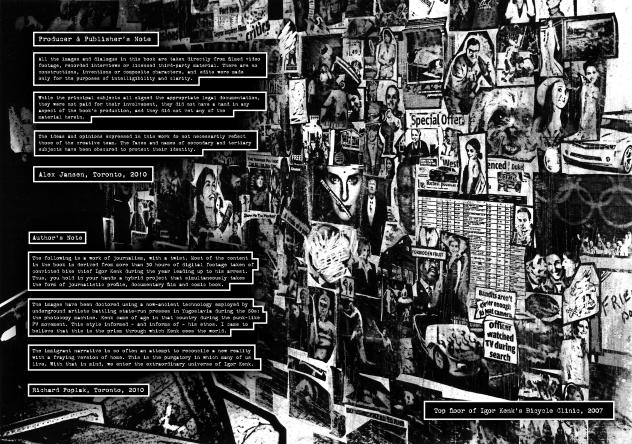
All of these traits and more are eerie parallels with Richard Poplak’s observations about Igor Kenk. Kenk grew up during a time between socialism and capitalism in Slovenia of the former Yugoslavia. One thing that Richard Poplak likes to point out is that it was also during this time period that common citizens in Slovenia were allowed access to photocopy machines: mechanisms of distributing information that were originally in the charge of the State. The counter-cultural Theatre FV 112/15 group– also known as the FV movement–used photocopiers to create a collage art known as FV Disco: a form of which–thanks to the artist Nick Marinkovich–Kenk also utilizes. This was the time and conceptual place where Kenk developed as an adult.

KENK_CHAP-00_07-08

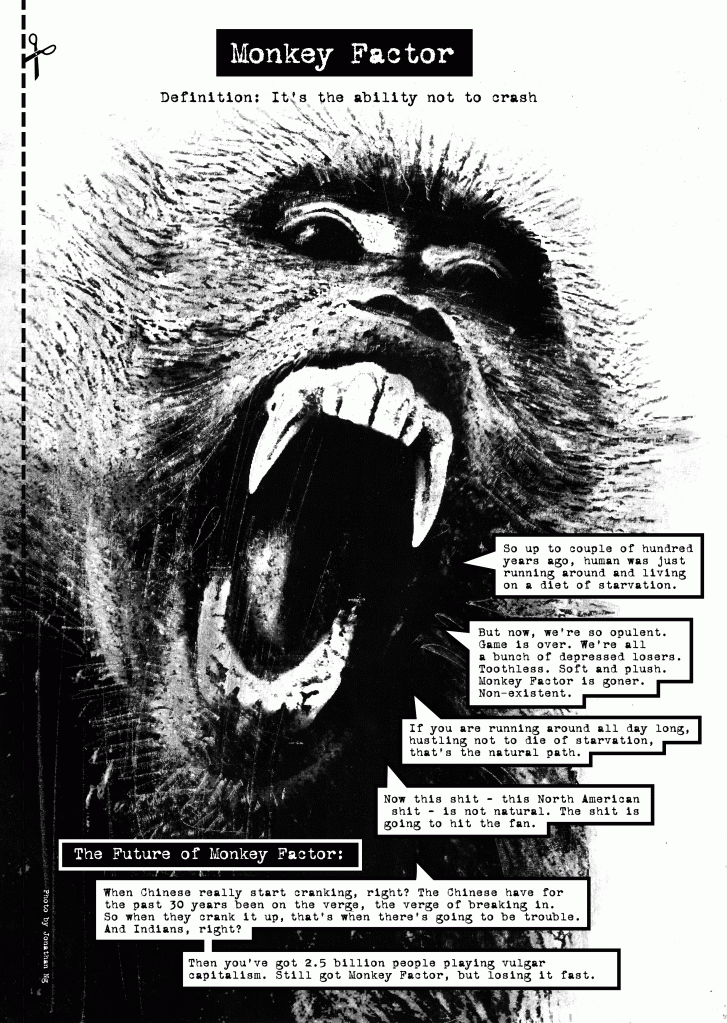
As such, Kenk also possesses a very unique world-view based on the transitional culture of his time: the idea that all things can be recycled and that you need to choose to struggle in life in order to survive as a person: which is part of what he seems to call “The Monkey Factor” or survival. From what I understood of this book, his notion of “recycling” also seems to mean reselling stolen bikes as well as hoarding. As an aside, the fact that Kenk believed the system of debt, borrowing, and capitalism to be doomed is also linked to his philosophies and it’s only now, years after I read the first time, that I wonder what he would think of the Occupy movements back in 2008 before his arrest, and what they might think of him now.

Igor Kenk came from a social order that was radically changing and between extremes. He was considered to be a Math prodigy and did well in his education. For a time he was even a police officer in Slovenia–surviving their harsh regimen–until he was discharged, and then proceeded to cross the border into other countries to get goods as Slovenia’s political alignment and its economy changed. Then he eventually came to Canada and became something of a merchant himself by selling and fixing bicycles in Toronto.

What I’m trying to say is that both Kenk and Menocchio are products of their time and culture, but at the same time how they chose to interpret their changing cultures was very idiosyncratic to them. In other words, they created some very unique world-views. And both of them arguably paid for it by the powers that be: Menocchio with his life for not recanting his beliefs to the Roman Inquisition and Kenk doing jail time and losing his Bicycle Clinic for the thefts he was charged with.

KENK_CHAP-09_18

All of the above can arguably be considered gross simplifications, of course. In my paper that dealt with the implications of Menocchio, I pretty much say the same thing more or less. But I think the reason I’m attempting to compare two men from entirely different time periods, cultures, and countries is due to a greater issue: namely, why are they important?

I mean, come on: neither Menocchio nor Kenk would traditionally be considered important in a historical sense. In the grand scheme of things, someone might say that, while these parallels are interesting, who the hell cares?

The reason that I care, and one of the reasons why modern historians, journalists, and–in some ways more importantly readers–find these accounts so important is because they are narratives that deal with real people. It’s true that neither Menocchio nor Kenk are politicians, or artists, or even popular cultural figures in themselves but they are people that–while arguably normal or common in terms of class or historical significance–symbolize greater historical and cultural shifts by just being who they are.

They are ordinary people with very un-ordinary perspectives and there was a time where we would never have even known about them: or at the very least we’d only get a summary of them in passing … or at least we’d get something like this from a dominant or “higher cultural” narrative. Because there is one thing I keep coming back to in my head: it is the idea of oral history.

What is oral history? We know that oral culture or literacy is something that is passed on verbally from one storyteller to the next throughout many generations. But history, as Westerners, understand it is derived from the ancient Greek word historia: which is something along the lines of scientific inquiry or observation. Oral history, from my understanding, is thus something of verbal origin that is written down for other people to see.

Menocchio’s “worm and cheese world” survived through the written accounts of his interrogators, whereas Kenk seems to have actually been interviewed by the book’s producer Alex Jansen and filmed by Jason Gilmore as he espouses his world-view of “Monkey Factors and recycling” in that context.

KENK_CHAP-08_16

Oral culture in our world is very different in that we have sophisticated image and audio technology to preserve and record the spoken word, and where that spoken word comes from. There is a scholar named Walter Ong–who I looked at in my own studies for my Master’s Thesis–who looked at oral culture and degrees of orality.

Ong believed that there is something called “secondary orality”: in which spoken word is preserved through technological means like video and radio. But I’ve always wondered if he would have included illustrated images in this definition as well, and how problematic it would be if these images were accompanied by written words. Can the visual be considered part of the oral or the written, or is it something by itself? Obviously I’m talking about the medium of comics and what kind of literacy that would be defined as but–this tangent aside for now–right now I’m thinking about the idea of oral history being a historical narrative that records down what life and reality is like for “the common person”: if there is any such thing as a common person.

I actually think that this conception of oral history has led to the idea of journalism: of interviewing and recording down what a particular person or witness has to say, and then researching the environment in which this person came from for a greater perspective. Is journalism the child of oral history? And then you take something like Kenk into consideration too: something that is written down but also given a sequential FV Disco style is that is both an illustrative and video collage aesthetic.

It’s fascinating to think about Kenk as an artifact of not only “comics journalism”–a medium that some comics creators like Joe Sacco have already developed–but also written literacy, oral culture, history, and mass-produced art. I look at Kenk and I wonder if this is our contemporary version of the colportage of Menocchio’s time, or the pamphlets and photocopies of 1980s Slovenia. Because in the end, it’s not just Menocchio and Kenk that have a lot in common, but also the media used to try and capture what they are … and what they are not.

When I started writing this article, I thought it was going to be easy: like it was all fully formed in my head. In a way I’m doing what I said I would not do by delving more into the academics I’ve tried to put some distance from: at least with regards to jargon. My train of thought tends to drift and it has been a struggle to communicate and even cohesively perceive all of these parallels here.

But if this were a paper of mine, if this were some rough form of the Graduate essays I would write, I would end this post in the following manner. As someone who has studied mythic world-building, I believe that art is an engagement with different parts of the world around you, and an expression of who you are as a result of what you choose to accept of that world. In that, the man called Menocchio and Igor Kenk–specifically in how their scholars and artists portray them–not only made their own art, but actually lived their art, and allowed for the creation of more of it.

I also believe that when you take all of this into account oral history, journalism, comics journalism, or whatever you want to call it reveals one more truth. Writing about an individual not only reveals that there are no “ordinary people,” but that it never makes for making any “ordinary stories.” Ever.

Again, I’d like to thank Alex Jansen and Jason Gilmore for lending me these pages of Kenk to place here in my article to make both point and emphasis.

If you are interested in this topic, you might like my What is FV Disco article as well. They both deal with similar subject matter, but in different ways.

Artistic Progress Goes Boink!: The Refinement of a Heroine, the Formation of an Antagonist

When we last left off, our intrepid heroes were continuing to work on the formative phase of a silent comic. Much of Angela O’Hara’s pictures in the previous Project entry are of our female protagonist and as you can see here, she has been busy with her.

Notice the eyes. They are not only how I thought of them–pure blue–but Angela even went one further by giving them the detail of actual sclera and pupils while also keeping them the same colour. Angela has also been playing with facial expressions, some dimples, and conveying certain kinds of emotion with every facial image that you can see here. There is something very serene, sometimes sad, but ultimately determined in this heroine who is questioning herself as she continues on her path through the strange little world that we are making for her.

While our heroine is getting more detailed, we are also working on fleshing out our antagonist as well.

Like our heroine, I provided and talked with Angela about certain details. He is supposed to be an older man and he is obviously different from our main character. It’s been a challenge to figure out what he’s supposed to look like as of yet. What I find works for me is looking at these conceptual drawings with Angela and picking certain details from these already made illustrations that can be incorporated into a figure closer to what we both want to work with.

For instance, I really like the idea of an X-like scar on his cheek: an aesthetic very reminiscent of the protagonist in the manga Rurouni Kenshin. In fact, as we talked about this online, I figured out exactly how he got that scar even though I didn’t originally plan on having this “X” on his skin. I was more thinking of having it on his costume, but Angela’s initiative worked out well.

So basically I decided he would look older, but not grizzled or ancient. The mask has also been a challenge too because I had been thinking of having it cover his whole face and making him look more mysterious as he watches our protagonist at work. Of course, the advantage to the half-mask–aside from the fact that it plays with our theme–is that it shows more facial expression and therefore more humanity. There is a part of me that does wince at it seeming too much like a stereotypical comic book hero or villain’s mask, but at the same time this is definitely something that want to play with as well.

We are still  working on what the suit should look like. I do like some of these designs in these latter pictures. I like, for instance, how Angela puts the “Zero” symbol at the lower-hand corner of each costume. That was one issue I was having when I was envisioning how to fit the “X” and “Zero” symbols together on his person. I mean, he’d not be very intimidating if his sigil was something derived from a  “Tick-Tack-Toe” game. In terms of the clothing in the latter set of pictures, I can definitely see at least the lab coat becoming a basis for another costume. In fact, we’ve talked about giving him different costumes depending on what environment he’s in and what he is doing. I mean, he has the resources. He has the technology. 😉 We just need to see where he goes from here.

And now to the Boink! part of our creative progress.

This Calvin and Hobbes reference aside, when I was much younger I fancied myself something of a graphic artist as well. The thing is, I had difficulty imitating basic shapes. At the same time, I liked to create monsters. To this day, it’s safe to say that I create better monsters than I do humanoids. I knew that in addition to the heroine and antagonist, we needed to have some other creatures and enemies in our developing environment. Now I could have simply described these, and to some extent I did describe them to Angela on email but pictures speak louder than words and so I unearthed these images.

(No, my blurred face is not one of the monsters … I think.)

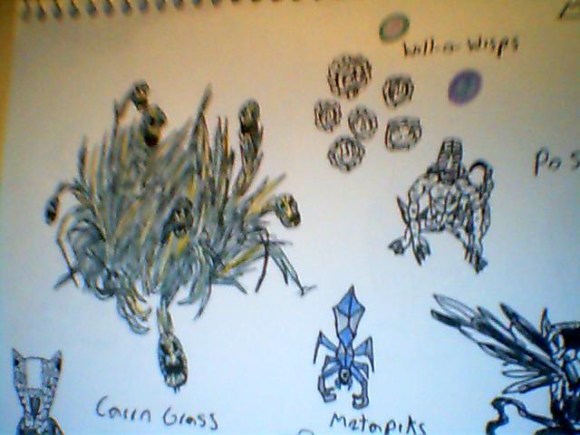
See, those three pod-constructs were robot minions that I created for a primitive high school comic about a stick-man from a cartoon dimension who gets crippled and reconstructed into the Styx Demon by aliens. These were supposed to be the aliens. I used to have drawings of these with ink pen and pencil crayon colouring, but they are sadly lost to time. When I sent these to Angela, it was like an archaeology of my drawings: taking pictures of and documenting glyphs from my old high school art kit.

There is more.

These two kinds of beings in particular, from what I remember, were created as creatures for an old RPG game I had planned: something that people could scroll through a Paint Program to interact with. To this day, I still love that Cairn Grass. These drawings sat in my closet for years, just as the ideas that made them have rested in my mind. The idea is for Angela and myself to use some of these as templates to … make things that our heroine can interact with.

Sometimes, I feel like my part in our creative process is very ad hoc. I don’t have a script ready as of yet though I have created a rough outline of the events that I want to depict along with some notes on character personality and a little bit about how their abilities work. A lot of the interaction between Angela and myself has been exchanging ideas. I admit that sometimes I feel bad for not having a detailed enough script as of yet, but there are still some decisions that need to be made and I’m glad that it is not a case of me dictating to another person. Much of our creative decisions so far have been the result of a mutually creative exchange of ideas, shared enthusiasm, and just throwing stuff out there. I’m given to understand that each comics–and creative–collaboration works differently and so far, our works just fine. 🙂

Angela has just told me that she has some special pictures planned for next time: something that may or may not have been influenced by talking about old video games. I look forward to seeing where this goes from here.