Film Review: The Batman Rises Once Again

I guess it’s about time to pay attention to the Bat Signal. It’s been pretty damned insistent. Cue in the dramatic musical score and …

So a few weeks ago I saw The Dark Knight Rises. What can I tell you. Well, first of all I’m going to make a Spoiler Alert. Then I’m going to say that I liked it. I really liked what Chris Nolan did and what he tried to do. In Batman Begins, we see Bruce Wayne becoming his “true self” after his tragedy and his training with Rais al Ghul and the League of Shadows: which I always thought was a really interesting and new approach to just how disciplined the man had become. In the second film, Dark Knight, we see Batman move away from dealing with fear and the Social Darwinist sense of justice that al Ghul attempted to unleash on Gotham in order to battle the forces of chaos and chance incarnate in the Joker and Harvey Dent-turned Two-Face.

By the third film, we see a very different Bruce Wayne. He’s become a reclusive and something of a broken man. Somehow, he has even sustained a permanent injury from his exploits eight years before. Batman has been blamed for the death of Harvey Dent: to make sure that the latter remains the symbol of justice that he rejected after his accident and has disappeared from the public eye.

Of course, Gotham is never safe ever. Someone always wants to either destroy its corruption or just watch it burn to the ground out of a sense of amusement. Bane seems to want both. Bane is a character from the Batman comics Knightfall story-arc that methodically and brutally breaks the Batman. Of course, everything is not as it seems and as Batman returns to save his city, he realizes that he must unlearn what he has learned: about having no fear.

This was a very intricate film. I really appreciated the details not only in the villains’ plot and the character of Batman himself, but also in the little things. The minor characters actually get a lot more expansion and you see that even as heroes can falter, not everyone has a happy ending and everyone receives a reckoning of some kind. Nolan tries to make everything in this third–and I think final–film come full circle: which is very hard to do considering the show-stealing manic power of Heath Ledger’s Joker from the previous film.

It was fun to figure out who some of the characters were before they were named or revealed. I also liked some of the social commentary that was going on in the film itself. Essentially, Bane creates the ultimate Social Darwinist experiment turned horrible joke where he tells everyone he has a fusion bomb with a counter in the city. Someone in the populace has the trigger and a way to turn it off. He keeps outside aid from coming into Gotham and uses his thugs with stolen Wayne Enterprises technology to help the common people–I guess the 99%–dispense “justice” to the 1% … and anyone else they don’t like. Of course, the joke is that Bane plans to detonate the bomb anyway, but he seems to enjoy watching the ad hoc show-trials–reminiscent of the French Revolutionary tribunals–condemning people to walk on thin ice anyway. Even Anne Hathaway’s Selina Kyle–who is blatantly hostile to the upper-class and steals from them constantly–begins to see just how sick Bane’s sense of “social justice” truly is.

You could read the social narrative under this movie in a variety of ways, but there was a lot of overall depth to the film’s plot and the way that Bane totally uses Commissioner Gordon’s own speech–a document of truth–to damage Gotham’s self-esteem further was genius. I don’t know if I quite agree on how the characters of Bane and Talia al Ghul were used–Talia in the comics would have respected Batman for being able to defeat her father multiple times and she carried his child as well–but for the movie they served their purpose well. Alfred and Lucius Fox were still in character too and I enjoyed seeing them again.

I did have a few other issues with the film. They might seem minor and hard to define, but I will try my best. The plot, while very intricate, seemed very spread out and if you didn’t pay attention to certain details you might have missed a lot. At times, it even seemed to drag on … a lot. Also, I admit that in the dialogue between Batman’s rough voice and Bane’s metallic one, sometimes I’d only get every other word.

Batman: *Rasp*Rasp*Justice. *Rasp*League of Shadows.*Rasp**Rasp*

Bane:*Rumble*Gotham*Rumble*You will be broken.*Rumble*

Maybe it was the theatre I was in or how the sound effects behind them in their fight might have interfered with acoustics, but I really wish I could have gotten everything that those two intelligent “bad asses” were saying.

In some ways, I feel like for all the depth and such that the film had, it fell short as the concluding movie. I find myself wondering sometimes just what might have happened if Heath Ledger hadn’t died. I mean, the Joker wasn’t killed off in Dark Knight–when Nolan could have easily had him terminated–and if all had gone well, he could have made a comeback. Would The Dark Knight Rises have been different if that happened? It would have been really interesting to see the remnant of the League of Shadows deal with the Joker. The thing about the League is that they are trained to deal with logical or sensible enemy psychologies. Even Batman is just another form of idealist to them: just as they are. All of them deal with an understanding of basic human corruption.

But how would they have dealt with the Joker: an almost shamanic madman who cares nothing for money, or power, or even has a steady personality profile. He is literally a wild card that can read his enemies well while always shifting psychologies. Essentially, the Joker’s purpose is pure chaos. He would die just to make chaos. How would the League of Shadows deal with something so unpredictable. Would they see him as a psychological reaction to global corruption? Or as chaos incarnate itself? As an ally or enemy he would dangerous at best. It could have also been a nice dichotomy between villains: between an inhuman need for justice and a sense of pure madness. I guess we will never know that now, if there was ever such a plan or if this film was the thing Nolan was going to make no matter what.

I will give this film a four out of five. It is worth seeing and it ends the trilogy fairly well. Until next time Bat-fans.

Role-Playing as Interactive World-Building

In addition to writing, I’ve been doing some other things with my time as well. A few weeks ago, my old friends and I started another table-top role-playing adventure with the Star Wars D20 system. As you can see, we use Lego to represent our characters and the settings we go into as well.

My friend Noah is our Dungeon Master–or Game Master–for a good portion of the time. A good majority of the Lego that is used in our adventures belongs to him. While I’d started role-playing with Noah and my other friends since high school, our first Star Wars game started in 1999 slightly before the Prequels were released but after the action figures were.

Back in those days we had some group games, but we mostly played solo–which I know was a lot of challenge for Noah to accommodate–and we fought each other a lot. It was a very conflictive game (or what you might call Player Vs. Player) with a whole lot of manipulation and planning but also a lot of mystery and wonder. Back in those days I was a Dark Jedi mercenary named Nagir Taron that eventually became a Sith Lord as time progressed. It was an interesting time: when we still believed that Force lightning could only be used by powerful and experienced Darksiders and where lightsabers were very rare and couldn’t be made until you reached a higher level … and were so easy to lose.

We have played sporadically–on and off–over the years as we’ve all gone from one point in life to the next. Noah himself, along with a few others, have tweaked the rules and added some very idiosyncratic elements into his version of the Star Wars Universe that we all play in. There are some very funny and zany moments and a whole lot of “making fun” which I can really appreciate nowadays.

These days we play a group game with a lot less internal in-game conflict. In the following picture below are the following characters from left to right. They come from a previous game we played: the taciturn and steady mercenary Hal Tavers, the Force-sensitive doctor and archaeologist Dravas C’Tor (who I played), Juyo’Maya (Noah’s Non-Player and alternative Player-Character Half-Twi’lek Jedi Knight), the conniving and gifted slicer Mynock, and the late and unlamented psychotic former Republic soldier turned mercenary Sergeant Sharp.

Dravas C’Tor was my attempt to play a Light-Sider character and I had varying degrees of success with that. The name Dravas C’Tor is an old one I created in elementary school for a Dark Jedi and then an alias I used in the early Star Wars games I played with Noah.

There is a magic to a long-time table-top role-playing game. First, you have to understand that we have been playing this game–and others like it–on and off for over a decade now: which is frightening because it makes me at least realize how old I’m getting. We have invested a lot of time and enthusiasm into the worlds we’ve played and made by playing. During this time, Noah has developed many of his own rules from the D20 systems that exist. In addition, we create actions that change the environments that he creates. Add a twenty-sided die and its other counterparts to this mixture of fate and freewill and fortune and you get a very organic world that uses us to build itself.

And I’m not even talking about the stories that I have written for it, or the in-character journal entries I keep recounting the events of what has transpired. I like the idea of keeping journal logs and having us all do that because we get to see what he role-played through from different perspectives. I try consistently to keep up with this to preserve the events we’ve participated in and to do some character-building. In a lot of ways, I’ve learned how to hone my own writing craft and voice from making these entries.

I’ve not always been able to do this though. There are some games that were never written down beyond Noah’s scenario notes and some of them just exist in our memories. But what I find really remarkable after all this time–whether we play Star Wars D20 or other worlds–is that there is continuity to everything we do. For example, the former Nagir Taron played one game session where he encountered some enemies in retrospect I find eerily familiar. We retconned that and even though I only played one game session then it impacted and has effects on the game that we play now. I didn’t realize this until one day–a week ago–when it all started to flow together in my head. It is really amazing when that happens.

I mean, a lot of that isn’t just decided by Noah but also by ideas that we ourselves either play our or throw out there. I know I suggest a lot of ideas as we go through stuff and really it just makes the game that much more interesting. It is a personal craft and shared artifact made between us all. Some of us were there from high school or early and others came later. Some of us aren’t around anymore, but everything we’ve done remains in this group-creation we all interact with.

Without that magic, without us, it would just be Lego figures, statistics, and dice. But with us, it is so much more than that. I haven’t always been around. I’ve been here, there and everywhere: especially in these past three years of Grad school. And every before that–and after–life happens. I’m just glad that I get back into that and that even without this game I have the memories and my friends.

So this is something else I do when I’m not writing on here, or making my stories, or going on my walking routines. I do need to write up my new log entries though. I’m doing something different this time and playing a droid character named SR-NX or “Nex.” He is a droid that specializes in life sciences, computers and cybernetics: very different from the Force-sensitives and Darksiders that I usually am. He writes with a lot of jargon, but I try to get his sentience to show through it. He is actually a droid that wants to study the strange biotic-energy field phenomenon known as the Force.

I always wondered how a droid would view manifestations of the Force and I get to play that out. I have to customize him some more and familiarize myself with how droids work. But that’s part of the fun. It’s really interesting to see how droid characters exist and are treated as opposed to organic ones. Maybe I’m doing this because despite my issues with technology I feel a strange fascination and kinship to A.I. and I want to show that they can be different kinds of characters as opposed to obedient automatons or megalomaniacal hive-minds.

What can I say: it’s good to have a hobby.

Full Beings and Perfect Forms: Aristophanes and Plato in Miracleman

Before I begin, I would really like to point out that I’m aware of the fact that I’m talking about a comics series that few people have had the opportunity to read: though perhaps there are more readers of Miracleman out there than I assume. In addition, there will be some spoilers in this article, so for those still interested in reading the comics and can get access to them, read them first before reading this article. And for those who have no idea what I’m talking about, I talk enough about superheroes here and the philosophy of them to probably be followed. It’s up to you whether you want to read the comics.

Like I say every time I make this disclaimers, you have been warned.

Well before Alan Moore revised or deconstructed the figure of the superhero, people always assumed that even though superheroes have their official crime-fighting identities and their civilian alter-egos they are still ultimately the same person. The same was the said for Marvelman (later named Miracleman and possibly Marvelman again depending on whether or not Marvel Comics releases Alan Moore and Neil Gaiman’s runs) and his Family: that even though they spoke a magic word to change from human to superhero and back again, they always had the same personality.

Alan Moore challenges that assumption with his revisionism. We see a vast difference between Kid Miracleman and Johnny Bates: the child that he came from. Of course, that has a lot to do with the fact that Johnny switched into his Kid Miracleman persona as a child and let it grow up separately from his human child form. This, along with the event that forced him to hide and the circumstances of how he got his powers, might have warped his mind into two distinct personalities: though both have access to the same memories which is something to consider.

Moore even makes you begin to question if Miracleman and his alter-ego Mike Moran (though they both share the same initials) are in fact the same person. While both begin with a similar morality and are genuinely good people–and they share memories–key differences begin to occur to differentiate them. It’s probably even further complicated by the fact that Miracleman had been dormant for years after a traumatic event, while Mike Moran himself continued to age and live his own life until another traumatic event forced him to remember the key-word to bring his superhero persona back.

Then there is Young Miracleman–or Dick Dauntless–who died and was brought back to life. From Neil Gaiman’s run, or from what exists of it so far, there is no difference between Young Miracleman and his alter-ego at all. Finally, Miraclewoman seems to be the most balanced of the entire Miracle (or Marvel) Family in that as the doctor Avril Lear and Miraclewoman she also seems to be the same person and has learned a lot about her dual nature by exploring both.

As I read the entire series as it was, I began to notice certain elements that Alan Moore and to some extent Neil Gaiman incorporated into their work. In a lot of ways and I have Alan Moore in particular in mind, they brought the idea of the superhero back to its roots: to the mythologies that created it as they took it apart. The secret British government program that was created to make these super-beings is called Project Zarathustra: based off of Nietzsche’s idea of the ubermensch or the superman. The superman is supposed to be a being that has transcended all conventional morality and chooses to create their own code to live by: possessing the power to do so through sheer will. I talked about this a little bit with my Whoever Hates the Man of Tomorrow? article, but this is a theme that definitely plays out with Miracleman.

There are other mythological references in Miracleman: such as the heroes’ home base being called Olympus, the body-switching Qys as the supposedly unwitting genetic prototypes of the Miracle Family being referred to as the Titans or the Primordials that existed before the “superhero pantheon of gods,” and even the battle with the twisted Kid Miracleman supposedly mirroring Ragnarok or the “twilight of the gods.” Moore even creates a nice mythological analogy between superheroes and supervillains: the former being Heroes and the latter being known as Dragons or monsters to be vanquished. We see a lot of Nordic and Greek mythology being drawn on to create this version of Miracleman. But there is more.

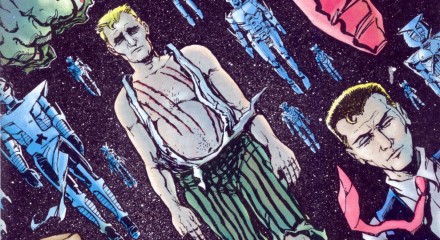
As I continued reading Miracleman, I saw another parallel developing. It began when I saw the twisted fused twin skeletons inside of the British government’s secret Spookshow warehouse: where Miracleman and his kind were created. Originally, I was led to believe that these fused skeletons were the remains of Young Miracleman from his own death, but in reality they were the dual remnants of Young Nastyman: another experiment that went insane and died through mid-transformation within a volcano … or so Miraclewoman says.

That grotesque fusion of two skeletons reminded me of Aristophanes’ myth of love. I know how disturbing that may sound, but I didn’t actually start thinking of it that way until Miracleman himself began to explore his own identity and the line between himself and Mike Moran. According to Plato in his Symposium, Aristophanes explained why love existed by telling a story in which once upon a time mortals were larger beings with two-heads, two sets of genitals, and two sets of limbs. They were powerful and they defied the gods so much that Zeus split them into two. This myth was supposed to explain that love is that need for each person to look for the other person split from them or, as we hear it in our own popular culture, each person looks for “their other half.”

That was the resonance I got when Alan Moore really came to the finer details of how the switch between mortal and divine works with the Miracle Family. It’s almost as though Project Zarathustra, in analyzing the bodies and the technology of the Qys–of fluidly intersexual Titan progenitors–tapped into a place of mythical proportions to recreate that “lost existence” that Aristophanes goes on about. One very interesting thing to note about Aristophanes’ myth is that when human beings were once unified, greater beings it was implied that they could defy and potentially challenge the gods themselves: which was one reason why Zeus and Apollo divided and changed them. Therefore, it can also be implied that Project Zarathustra allowed mere mortals to tap into the divine, to a place beyond the divine, to become a lot more than what they already were and challenge the established order around them.

Aristophanes’ myth that was meant to examine the origins of love and humanity’s potential to divine power is argued by scholars to be a comedic or lampoonish idea to reflect its comedian creator. Yet I find nothing particularly hilarious about this, though it is interesting that it was considered a “comic” idea: one that has translated itself so well throughout the ages. There is also another saying in popular cultural with regards to love as reunion: that just as people are looking for their “other half,” there is also in a relationship reference to one’s “better half.”

This is where I begin to wonder, like a few scholars before me, if the myth of Aristophanes wasn’t created by Plato himself to add a nice neat argument to his Symposium. We can argue whether or not Socrates created his own philosophy too until the cows come home, but that’s not the point here. Plato himself had his own theories about reality and the subjects that exist in reality. He believed that there are two worlds: the World of Forms or Being and the World of Becoming. The World of Being is a plane of perfection. You can find the originals or the perfect forms of anything that has ever existed. You can find the ideal object–such as a chair–or subject–such as a man or a woman as well as thoughts, feelings and knowledge–here.

Then you have the World of Becoming, a gradation of said perfect forms into more worn and degraded shapes. They deviate or change from the ideal and ethereal prototypes that they come from. The idea is that we live in the World of Becoming and that we seek the World of Being. You can see here, and I’m sure my high school philosophy teacher would be proud of me at this moment, how this Platonic thought influenced the Western idea of Heaven and Earth, or Heaven and Hell.

When I read Miracleman, I saw an interesting parallel with this Platonic conception. Miracleman and his kind are the perfect forms. When they are not used, the forms are kept in a place of pure energy known as Under-Space: a nice analog to the World of Forms itself. They rarely ever age, they cannot be destroyed through conventional means, they have extraordinary clarity of thought, devastating power, and even their costumes are engineered from an alien material that cannot be destroyed and reflects the moods of their wearers. Their powers and natures are explained as being the result of a psychic field or harmonic around them that they can control. In other words, the Miracle Family practices mind over matter.

My reading of this is that human scientists–degraded imperfect people like the rest of us from the World of Becoming or matter–used a link to the World of Being or the spirit to reverse engineer near perfect forms that mortals can have access to. Even Miracleman explains that he has the same thoughts that Mike Moran does, but he can see them and perceive his world with far more clarity and insight. We can get even more Platonic or Gnostic and say that through science, the Miracle Family gained a greater link to their spiritual, real, celestial selves. It is also no coincidence that Alan Moore, their revisionist, began to embrace further mythological and spiritual elements in his later works and even in his own life.

So it seems clear cut that Miracleman and his Family are their own essential selves having been unified. Of course, it is not nearly so simple as that. Mike Moran, Johnny Bates, Dick Dauntless, Avril Lear and Young Nastyman (or Terrence Rebbeck) did not seek this enlightenment. They were kidnapped, kept in medically induced comas, experimented on, had essentialized clone bodies made for them, had said bodies transferred into Under-Space where their minds would be trained to switch back and forth to by a word command, and were brainwashed to believe they were superheroes in a comic book-like virtual world before being abandoned as too powerful and too dangerous and marked for a termination order which, inevitably, failed.

It all sounds so banal when I summarize their origins like that. In a lot of ways, the Miracle Family are more like the uncanny Freudian doubles or doppelgangers of the mortals which they are linked to. They have great powers and insight, but they do not always relate well to the World of Becoming around them. Some of them are malicious because of this and even the best-intentioned among them have the potential to cause immense and traumatic change to the world.

I personally think that they are all of these things and more. I think that Moore portrayed them as humanity’s need to reach for and become the divine: or to remember its divinity. What happens after the creation of said beings, their own realizations of what they are,  and how the affect and what to share their perspective with the world around and the people who made them is–in mythological retrospect–an inevitable conclusion.

ETA: After writing this article, I’ve realized that you can examine the Miracle Family with a particular focus on identity. Much in the way that Neil Gaiman’s A Game of You really plays with identity, gender and the fluidity and change of self-identity, his and Alan Moore’s Miracleman can also be examined in a similar light. Maybe one day someone will do that … when the damned thing is republished.

Abraxas, legal issues, Abraxas …

Frustration, Developments and Other Stories

I’m trying to find the best way to phrase this because it’s been on my mind for a while.

As a lot of you–old and new readers alike–know, I’ve been improving and developing this Blog as I’ve gone along. I had a few ideas as to how I would add to it. Really, I had two ideas. The first was that I was going to take my Youtube Channel and create a Vlog. I’d seen some people do this before–such as FreakishLemon–and I wanted an excuse to be able to read some of my stories and opinions aloud and even talk to people about my plans.

It was–and is–a good idea. But there were two factors I didn’t know about until I actually got up the courage to try them out. The first is that while I discovered my Acer netbook can record video and audio with its camera, the transfer rate of said video from my computer to Youtube was something along the lines of 436 minutes. Now, I’m not good with numbers, but there is something really wrong with a five minute video taking over seven hours to upload onto a site that is designed to receive and play videos.

But all right. Fine, perhaps it was my wireless connection, or the quality of my camera. I discovered that Youtube has a recorder. So I used that. I made one video that was ok, but I wanted to do over again. So I attempted that and then … I got a disconnection error on the screen. I kept recording anyway: thinking that I just couldn’t see the camera and the video was playing anyway. I was wrong. The recording cut off right about the time the disconnection error on the camera feed began.

I spent a large amount of time trying to figure out why this was happening and why I couldn’t just upload my videos. It also didn’t help that before all of this I had been doing various retakes of the same video. You know: the one that never made it onto the Net. I researched these problems and partially confirmed some of my suspicions, but mostly it made me frustrated. You have to understand, I get frustrated with technology–very frustrated with technology–whose creators claim it is supposed to be simple to use but it really isn’t. And even barring that, if we follow Gaiman’s Second Rule I believe, we will have all the technology and science we’ve dreamed about in science-fiction but it won’t always work properly.

I wonder how many times holograms and communications channels would lag in Star Trek if that were the case. Or if Data had to reboot several times or freeze in mid-motion before doing anything else.

So I decided to put that on the back-burner for a while, and instead record some audio files of me reading my stories aloud: for the practice. I have a weird program on this Acer which won’t let me listen to the recording I made after I made it, but aside from that it recorded well. Of course I can’t put this onto Youtube because it is audio only. And so I thought I could put it on this WordPress: which I can … for a modest fee. Since I don’t have the money to actually pay for more space or an application on here, that plan is out of the works unless I find a remote audio upload program I can trust.

I also thought about changing the aesthetics of this site. I have a friend who is into graphic design and photography who offered to help me, but I seems that I can customize this site again … for a modest fee a year.

I mean, fair enough. My Blog is changing and may be evolving past the limits of that I wasn’t even aware existed. I want it to look more customized and to add different media onto it. I also wanted to have a once or twice a week Vlog tie-in: to get the Youtube community on this and get further feedback. But it seems that I am lacking money and, quite frankly, patience. I am not going to rely on a recording program that might decide to cut off on me on a whim and I am definitely not going to wait over seven hours for a video to upload.

I’m also thinking about reducing the amount of times I post on this Blog to once or twice a week as well. I need to focus more on my writing and make more posts to keep in reserve. It’s amazing to think that just a few months ago I was writing a Blog post a day or every two days spontaneously and on the spot. I do still have some ideas and when I get more I will be more than happy to share them.

Anyway, I hope by the time I post this I will have figured more things out and maybe by expressing some of this frustration, I can free up my head to do more constructive things. Because I think that is the most frustrating thing of all: spending a lot of this time on technical matters when all I want to do is write. I’m not ruling out the other options too, but things are really going to have to change before anything else.

Maybe these setbacks, in the end, are a good thing in their way: because now I know where the limits are and I can begin to find creative ways around them and work with what I have. One can only hope.

If anyone has any suggestions as to how I can solve any of these issues, my ears are open. Take care, awesome readers.

Just Write It: The Perils of World-Building

When I was in Grad School, I studied the concept of mythic world-building as the focus of my Master’s Thesis. To study and work with archetypes to build a whole other kind of world–reflective of the one we live in–can be a very rewarding and even more time-consuming quest.

I was talking with an acquaintance of mine about world-building: about doing research, getting the details just right, figuring out how the laws that govern your world actually work, what events have happened before the main story, the various back-stories that have occurred before and essentially the entire works. It is a necessary process: whether you are trying to make a narrative copy of the world that exists around you or a whole new one that–let’s face it–has some basis in history or imaginings that have happened before.

However, too much world-building can cause problems. I know: that sounds really weird, doesn’t it? How can world-building cause a writer or a story problems? How can there be such a thing as too much?

Well, the answer is that there is. Earlier on, I said it was very time-consuming and it is. You can spend months and years creating a whole world and know the ins and outs of every rule and power that exists there. You can spend that time modifying it too and rewriting it: which is all very well and good until you ask yourself where the story is. You know: the spark or idea that made you so enthusiastic to make all of this to begin with.

Like I said, it can be fun to create your setting, but it isn’t fun when you get so bogged down with the details that you can’t write the story that you set out to make. I imagine that this happens a lot with novelists, but I know from experience that it can definitely happen to short story writers.

So now that I’ve stated the situations, what is my advice on the matter? Well, I’d say–just like I said to my friend–if you have a story you need to write, write it. Just write it. You can deal with details and and corrections later. You can expand on what you have. But if you  don’t have anything and only notes, you do not have a story. If you have a crude story, it is still a story and you can build from there: like taking a cutting from a plant and putting it in water … or cloning a whole human being from a limb.

So really, before you get bogged down in too many notes, just write the damned thing: or a damned thing. Damned stories being interesting aside, you will thank yourself for doing this later.

Now, to follow my own advice.

Athena Bursting From the Brain: Or Dealing with the Habits of a Creative Mindset

When you make things, do you ever have these moments where something just won’t get out of your head?

You know: there’s a story you know you should be working on, or an article that wants to be written, or some addition to a work you already have just can’t wait or you’re afraid that if do wait in adding it–or creating it–that you’ll soon forget what it was to begin with and it just won’t happen?

Well, since I’m writing about it I can tell you right now that I’ve had all of this happen to me: and more. Sometimes when I have something creative in my mind, it just uses up a significant portion of my memory or mind. It’s like downloading something large on your computer and it only has so much memory space left that can slow things down. That’s a pretty good analogy for being preoccupied with a creative project I think: albeit not perhaps the most positive image in the world.

To mix metaphors even more dangerously, I tend to call it my “autistic mode.” When there is something I’m working on or that I want to make manifest on paper or screen I tend to tune things out a lot. I’m always thinking about it and I have to concentrate on it. My patience can become virtually non-existent (mostly being invested into work or the idea I want to work on) and, as such, I don’t always take to interruptions well. Do not even get me started on telephones or other loud and sudden intrusive noises: you won’t like it after a while. I also tend to retreat a lot more into my natural introverted self and become more of a hermit with less inclination to socialize or make any small talk.

Then when you add to the fact that I have a certain degree of impatience with regards to just writing my work out the first time so I can move onto other things and struggle with some ridiculous perfectionism–of getting it close to being “right” the first time–and you have some of my behaviour during my creative process right there.

It isn’t always this way. Sometimes I can get myself into a calm mindset either right when I wake up or just before I go to bed late at night where things get clearer in my mind and they can actually “come out.” My “process” works even better if I’m just doing something spontaneous and the things in my head flow into place. That is a very nice place to be.

It gets more difficult if I’ve written some quotes that I have to keep in mind beforehand or if I’ve had notes from research. Stories that involve research tend to slow me down a little bit: because it does take time to figure things out and “get them right” in my head. Also, very formulaic mediums like comic book and script forms tend to slow me down a bit as well: though I know that once I complete them I have something very solid to work with. It’s just the journey of getting there that can take a while.

Like I said above, it is that fear of losing “the spark” or impetus in doing the work, or the idea itself that adds probably a lot of unnecessary stress to me. But that’s only part of it. I’ve also noticed that when I have a lot of different ideas that I want to work on simultaneously and I don’t know which to work on first, it can confuse me. I’m no Dr. Manhattan: I have to work with one body and one mind in three-dimensional space and time. It helps when I write down my ideas in note form and I focus on the one that really interests me or seems more imminent in coming.

I just almost always want to get something done now, though I know that’s not always realistic. I have to pace myself, sometimes wait for more details or information, and then move on. Another thing I also try to do is work on something else if the project I’m currently working on is becoming too frustrating.

The alternatives I’ve presented to deal with some of my creative habits and behaviour work with varying degrees of success. A lot of it is attitude and the idea that I need to “download” or finish certain ideas in my head before “making room for more.” I don’t think I will ever fully succeed in doing that and as that TED Lecture Elizabeth Gilbert made with regards to creativity states, some these things happen when they want to.

And sometimes it’s just like Athena: wanting to explode out of Zeus’ brain. Fun times.

Taking Back My Workshop a Bit and After-Bites

Although you could conceivably title this post “Over-Bite” as well.

I’ve had The Sleepwalker and A Natural Selection in my written notebook for quite sometime now and I’d been meaning to transfer them onto this online version of my Mythic Bios.

It’s been strange making separate Pages for the stories that I want seen on here: mostly because they do not show up as unique posts (since they are Pages) and as such there isn’t that much traffic that goes to them. I think the extra effort of linking to these Pages to comment on the stories is something that takes a little bit of getting used to for me as well. As I keep working on this Blog and certain patterns and structure begin to arise, all of this does force me to go about things a little differently than when I first started here. That may be some of the reason why I have been making more reviews and articles than a lot of the more original things I used to make: though you can probably count some of my articles as “alternative perspectives” on subjects in any case.

But now that we’ve seen my penchant for making tangents to be alive and well, I just want to talk about the stories I made. “The Sleepwalker” was the result of me reading up on my Dracula and Kim Newman’s alternate vampire-ruled Victorian England in Anno Dracula: making me further ponder the physiological interpretations and possibilities of vampires and the question of, “What about Lucy?” I could have easily been a total smart-ass and titled this story “I Love Lucy,” but I made one popular culture reference in there already and I like the simple title I gave it.

One challenge I definitely had was that I didn’t even know what she physically looked like. So I had to make some inferences along the way based on some things that I read in passing. I always thought she had red hair, while some sources say she was blonde. Dracula was less than forthcoming on the matter, so I improvised.

I also improvised some more. In the vein (pardon the pun) of “What about Lucy,” I always wondered why she was such a different vampire from the other women in Dracula’s entourage. After a few years reading Anne Rice and the Old World of Darkness’ Vampire the Masquerade, I came up with this interesting gem. What if the amount of blood and the environmental situation of a person affects what kind of vampire they might become? For instance, Lucy was a sleepwalker and Dracula apparently took advantage of this with his hypnotic capabilities. Yet we never know why he chose her.

“A Natural Selection” was a possible answer to that last question. I always saw Dracula as far more intelligent and evil than even Van Helsing gave him credit for. If I were a centuries old vampire with some financial means and intelligence, I know I’d slowly put measures into place and watch the development of said technological innovations before doing anything. I would also be thinking about the future. I wanted the Dracula I portrayed in this story to be a monster not just because he is a vampire, but because of just how his mind works.

I suppose I also wanted readers to feel sympathy for Vampire Lucy and realize that she never had a chance. I originally contemplated giving her some Journal entries in the epistolary form: making a narrative as told from a private diary or something to that effect. I wanted to tell a story from the vampire Lucy’s perspective but then I realized that perhaps she was too … insane to write anything down. Then I thought to myself: she was turned and she died while she was sleepwalking and dreaming, so wouldn’t it follow that she would continue to perpetually dream in undeath as well?

I saw her new existence as a broken lens that reflected the culture in which she grew up in all its literature. Her child-like nature reflects the patronizing pampered sheltered life she has had to live in her society as well as essentially being reborn as a vampire’s plaything. To be honest, I enjoyed writing “The Sleepwalker” more because I really got to be innovative and it was fun to write a character in a constant stream of unconsciousness as it were. It was also really fun to write Vampire Lucy’s story in a way that complemented the original novel more than took away from it. The same can be said for “A Natural Selection”–a title I actually love because Dracula would have been very familiar with the theory of evolution going around at this time and might have even attributed it to vampires and their role with humanity.

Like I said, they are supposed to be short stories or vignettes made to complement Bram Stoker’s novel more than anything else.

I think whenever I write about my Stories on here, I will classify them under Creative Writing and link them to the appropriate Pages. So anyway, this is me: taking back my Blog from too many reviews and opinion pieces and attempting to make it a little more like the mad scientist’s workshop I intended it to be …. or something like that.

I wish this Rembramdt picture was my desk, but it does reflect my working process somewhat. If that makes sense.

Whoever Hates the Man of Tomorrow?

Alan Moore attempts to answer a question originally of his own making when he created Whatever Happened to the Man of Tomorrow? years ago. This question has been asked a variety of times since the end of the superhero’s Silver Age and has garnered a variety of creative answers.

But why Superman? Why is Superman still so important? I admit: I have friends who simply don’t see the point to the Man of Steel’s continued existence or, indeed, his creation to begin with. One main criticism that people have with regards to Superman is how unrelatable he is to the reader. I mean, come on now, none of us can generate heat rays out of our eyes, fly, possess X-Ray vision, make freeze-breath, or be invulnerable. Certainly, no one has Superman’s “boy scout” morality without any other very human flaws and failings to match it: if that.

I can understand why Batman is more relatable. He is a human being who has used material resources and pushed all of his human skills to their limits by sheer obsession and utter will. If anyone should be the Man of Tomorrow, gender connotations notwithstanding, you’d think it would be Batman. Certainly, many people have a great love of the vigilante: of the person that goes beyond the law, becoming extra-constitutional, going beyond the polis–the city-state–to become a god or a monster to see that proper justice or vengeance is done. And there are heroes being venerated today–perhaps throwbacks to the ancient literary heroes–who are far more brutal and even more morally ambiguous than Batman.

And Superman? He is a “goody-goody.” He is so much a goody-goody he is too good to be true. Whereas Batman operates beyond the law or within its blind-eye, Superman obeys the law in as much as he can save innocents and capture criminals. Perhaps there is little difference, save that the law seems to like Superman a lot more or accept that he is beyond them: that he is using his powers to uphold the law and safety to a fault. Indeed, you could say that Superman has more a lovable personality: or is more personable and wins all popularity contests through his sheer good nature while Batman fights with fear as his weapon. Fear does not make you popular or loved: but it gets the job done.

But is that the only thing Superman has over Batman and others? That he is more lovable and makes a show of following rules? That he is superhuman and chooses not to obliterate the world? That he ignores or reshapes the reality of the world? Or worse: does he continue to patronize his friends, his allies, his enemies, and the human race by presuming to always save and stop them? Is his alter-ego of Clark Kent, according to Bill in Kill Bill Vol. II, simply a grotesque critique of what he thinks a human being really is?

The truth is, when you look at Superman, you see an incredibly powerful being that could rule and destroy the world. He could rip us apart like insects. Yes, Kryptonite can hurt and kill him but he has enough knowledge to protect himself against it. In fact, the knowledge and intelligence he possesses from the Fortress of Solitude that is his Kryptonian birthright and from his own experiments is enough to dominate and destroy all human kind. There are many people who–if they had his knowledge and power–would do exactly that and have very little qualms about doing so. Some people in the DC Universe already have.

It is already clear that Jerry Siegel and Joe Shuster based him off of Friedrich Nietzsche’s idea of the ubermensch: a being that has grown beyond the constraints of morality and limitation to choose their own path, yet they injected “good old morality” into this alien superman and made all of his achievements naturally-born and inherited from the dead.

So why is Superman special? Why do I think he is special? I might have written some of my answers already but–if I had to sum it up–I would have you consider the following.

Imagine finding out that you have the power to crush steel with a punch or even just the touch of a hand. If you wanted, nothing could ever touch you. You can move as fast as or beyond the speed of light. If you jump, you will jump extremely high and eventually be able to fly: but you need to somehow know how to control where to go or how to move given that you still have a humanoid form and it is not built with the instincts for flight.

Now take all of that–never mind the fact that you have to learn how to control your temper, your passions and hold your parents or your lovers carefully so that you don’t crush or hurt them–and then add an alien birthright whose most modest lore could detonate the world many times over and again: possibly taking you and everyone you love with it.

Your merest touch could kill a person and your slightest knowledge could destroy them. It makes for a lonely existence doesn’t it? And yet, somehow deep inside of you, you not only find the will to master all of these powers but you actually want to use what you have to help other people. At the same time, you just want to be like other people: even though deep down you know you never truly will ever be. You don’t want to be thanked, you just want to help and out of all those things you could do, you choose to do so.

In Mark Waid and Alex Ross’ Kingdom Come, a horrible calamity happens and Superman gives up on being Clark Kent. We see a person who lived among humans, who loved them, who had friends among them and wasn’t alone become an out of touch and distant Superman who only responds to the dead name of Kal-El from an equally dead and distant world. It is a Superman who still wants to do good and still feels bad over the loss of life, but he can no longer relate to anyone that he wants to save and people cannot relate to a person who looks upon them as so … lesser than he is.

He becomes the genius that cannot relate to anyone and garners misunderstanding and even contempt: because if a superhero, like a genius, cannot relate to those they save or even us readers then they have failed in a very fundamental way.

Unlike Bruce Wayne whose civilian identity is a mask for Batman, Superman is Clark Kent. He was born as Clark Kent and even though he isn’t human, being Clark Kent has taught him control and about life. As Grant Morrison demonstrates with a bright and essential freshness in his Superman All-Star, the power has not mastered Superman as it has so many others.

Superman has mastered the power and like the ubermensch he chooses his morality: which is to help people. At the same time, he is like Thomas Mann’s Tonio Kroger: who can see the dance of humanity around him and even replicate it artistically but is never really a part of it. It is his strength and his sadness and yet he finds the joy in helping others find joy. Very few others in fiction or the real world could ever be like that.

I write a lot of dark and conflicted characters yet once–long ago–Superman was one of my earliest childhood heroes. And in some ways, he still is. I’m glad the idea of him exists. I’m glad he exists.

Thus concludes another episode of Matthew Kirshenblatt writing about superheroes. Up, up and away my friends.

Legend of Zelda: Link’s Enlightenment

I’d like to say that this is another video game review, but that isn’t exactly true.

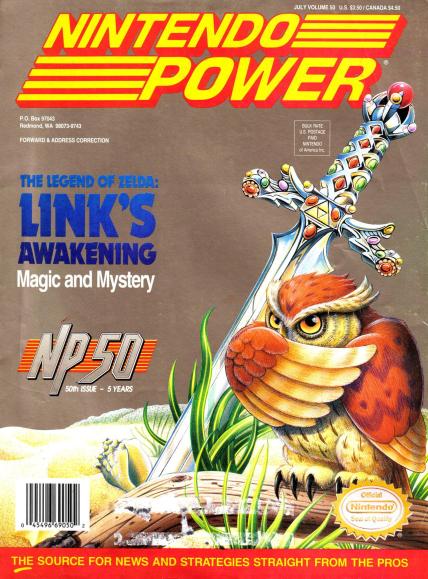
I first heard about Legend of Zelda: Link’s Awakening back when I used to get Nintendo Power Magazine. I remember that day. It was the summer time and the bus dropped me off from camp in front of my old elementary school. My Mom was there with Issue 50 of Nintendo Power that I’d been waiting impatiently for. This is what I saw:

http://countzeroor.files.wordpress.com/2010/10/magazine-nintendo-power-v6-7-of-12-legend-of-zelda_-links-awakening-1993_7-page-1.jpg

This mysterious owl sat near the sword. Originally I was annoyed that my copy of this issue got tattered, but it and the faded tan-bronze cover only added to the mystique that Nintendo no doubt wanted to build around this issue and the game they were featuring in particular. Well, for me, it worked.

It didn’t work in getting me to get the game however. Not initially. And when I did get it I didn’t really have as good a head for puzzles and video game combat strategy back then. By that point, my friend who’d gotten the game before me proudly spoiled the ending: or maybe I asked him. I don’t actually remember. So I don’t know why I picked up the game again years later, but I did. By that point I had a little more common sense and I’d played a few more games. Also, I’d read some philosophy: a lot more philosophy.

You are Link. You are on a ship in a storm that leaves you marooned on a strange Island. You figure out that the only way to get off of the Island is to awaken the Wind Fish in its egg on the top of the highest mountain.

There are puzzles and mysteries and secrets. You have many moments: most of them fun, a lot of them dangerous and you get to know the mysteries of Koholint Island. There are strange people, weird creatures, a talking owl that periodically advises you in riddles, a man who eats things he shouldn’t … and a girl who likes to sing and just spend some time on the beach with you.

I’m going to go into Spoiler Territory right now. Unlike Super Mario Brothers 2 where the “it is all just a dream surprise ending” just seems like a cop-out, in Link’s Awakening it is a gradual realization that comes with some sadness at the end of the game. In fact, the spirit of this game is perhaps even more emblematic of mono no aware–of understanding and having empathy towards the impermanent beauty in life–than even Terrangima.

Then you take the chronology that Nintendo claims the Zelda games all have into account. Personally, I liked the idea that each game in the series was a “legend”: a story with some elements of history but each being an account that has ultimately been changed over time as memory fades. However, in this case, I like that Link’s Awakening apparently happened after A Link to the Past as I’ve understood it.

Let me explain my take on Link’s Awakening and what I feel is really significant about it. From my North American understanding, there were three games before this one–the two Nintendo and the Super Nintendo ones–and all of them involved Link rescuing Zelda and dealing with the Triforce.

Here is how I see Link in this game. He has done all of these heroic things, but after he has completed them, he’s tired. In Hyrule, he is known as the rescuer of Zelda and the hero of the Triforce. If he had a normal life before this, it is gone. Maybe he just wants to get away. Maybe he lost much of what matters to him. Maybe he just doesn’t know who he is anymore.

The fact is, before this point Link didn’t seem to have an identity outside of being Zelda’s hero and the gatherer of the Triforce. Link’s Awakening, despite the franchise title, is Link’s story. It is not only a hero’s story, but the story of a man who journeys into his own subconscious. The owl that he finds on the Island is that part of him–the wise being or animal archetype–guiding him through this inner journey. Every creature and obstacle is his unconscious mind trying to keep him in a state of ignorance. Every time Link reclaims or gains a new item, he starts to remember more of who he is: or begin that process of knowing who he is.

You can  get even more Jungian and say that Marin–the girl he meets–is his anima: the feminine aspect of his mind that reveals things through subtle intuition and actually has him pay attention to the things he has taken for granted in the other games. He plays around, he laughs and he learns to enjoy the sunset and the sentiment that can feel when watching it. He also has to face Eight Nightmares that could represent emotions or attachments: seals of power that keep the Wind Fish–or Link–from waking up, while the ultimate Shadow Nightmare at the very end of the game symbolize the essence of his greatest personal fears and then ultimate universal horror.

He has to gather eight instruments to create music from a tune that Marin sings him to get into the egg that the Wind Fish sleeps in. And when the Wind Fish wakes up … it can fly. And it does.

It is a symbol of awakening: of enlightenment. It is a symbol you would find in some Eastern thought or even in a very mythological way. I know you can easily say that the Wind Fish dreamed Marin, the Owl, the Nightmares and the entire Island: that they were all aspects of its dreaming mind.  Link might even be a part of its mind and it has awakened to another reality. It is a valid interpretation given how Link physically wakes up on a floating rafter in the ocean. Does a man dream of being a pebble or does a pebble dream about being a man? Does Link dream about the sleeping Wind Fish and its Island, or does the Wind Fish dream about a sleeping Link?

The thing is, when I talk about all this, I believe I’m actually talking about Link as a symbol and not necessarily with regards to the ambiguous continuity that Nintendo is trying to make between games. I think, that at that moment above when Link destroys the last Nightmare and wakes up the Wind Fish, he is really awakening himself. At that moment, in that moment, Link is more than just a silent hero that goes around fulfilling tasks and doing what Zelda cannot or will not.

When Link wakes up the Wind Fish, when the illusion of maya that is the Island disappears, when Link regains consciousness: he actually gains consciousness. He expresses emotion through his interactions with everyone on the Island: each one of them aspects of himself. He realizes he has a whole world in himself that is a part of a reality outside of him as well. He experiences mono no aware: that sorrow and acceptance with regards to the passing of beauty in life. In one tiny hand-held 8-bit console with grey graphics or crayon-colours, Link is depicted as having achieved enlightenment and self-knowledge. For the first time, the hero of Hyrule knows who he is. He someone who dreams and is dreamed of. He is an archetype.

For the resources of the time that made this game, isn’t that just … beautiful? I’d really like to think so. I know many of you might think that I am reading too much into this and that it is just a game. Certainly I would not say that Link’s Awakening is a tool for personal enlightenment, though it is tempting to say in a creative sense, but it does depict some cultural depictions of it well. It is a beautiful artifact and I’m glad I knew it. Obviously, if this were an official review it would be getting five out of five.

I would like to leave you with just one more thought. When Link wakes up, it’s as though it was all a dream. When we finish playing a video game, the game is over. We put down the console or turn off the computer and go do something else. Our interactive electronic dream is over. Yet do all of those challenges and experiences: and those touching moments all fade away and mean nothing because they were not physically real? Did they not happen? Somehow, I don’t think so because, even when we finish sleeping, our dreams never really go away.

They continue stay with us. Because dreams are memories too.

https://i0.wp.com/www.projectcoe.com/wp-content/uploads/2012/04/tumblr_legu6rTqGz1qaaf7po1_500-300x269.png

Film Review: The Innkeepers


I’ve been meaning to make this particular review for a while now. I first saw Ti West’s The Innkeepers at the Toronto After-Dark last summer as the last film of the entire festival. It was also the best film to end it off.

I actually didn’t know what to expect from this film and I only got it because it was the last feature. The title of the thing itself along with the little bit of information provided didn’t really say anything. I will say that I knew it was a ghost story or a “ghost film”: about two employees at a hotel wanting to find evidence of a haunting before it closes.

It didn’t start the way that I thought it would. In fact, the film started off with Claire and Luke–the two employees–ribbing and scaring each other. Claire herself–the protagonist of the film–was energetic, positive and very likable. Luke himself had more of a weary, somewhat laconic personality but you could tell he loved what he did: which was managing his paranormal site online. In their spare time they were both ghost hunting enthusiasts. There is something really effective in a horror movie about making protagonists that are so relatable and likable people.

I like the fact that you look at both characters and how they are dealing with their lives. For me, I really felt invested in them and their relationship with each other and they were the kind of people I would like to be friends with. I especially liked Claire and every moment in which she would ring the bell on the front desk just to annoy Luke and just do … do it. Those little touches gave a lot of nuance to the film right there. They almost make you forget that this is a horror film. Almost.

The tone changes from light-hearted interactions and antics to something very creepy and disturbing and then … sad: ultimately so very sad. You see these very human characters pursue something in a very playful way and watch as this something seemingly becomes very serious, very dangerous and very real fast. And I am not just talking about the ghost-hunting either: but rather a divergence between these two characters that costs them. I find at the end that I really wish that didn’t happen to them. That was one of the strengths of Chernobyl Diaries–to have sympathetic characters–except unlike the stupidity in them, these two were really intelligent, if only somewhat more tragically curious and naive.

What the film lacks in blood and gore, it possesses in slow-mounting psychological terror and unexplained creepiness. The Innkeepers reminds me of the ambiance in Are You Afraid of the Dark? with finer tuning, three-dimensional characters and a plausible background made all the more terrifying by hints and moments of building paranormal activity: things made all the more disturbing in that you don’t know whether they exist outside the characters or in their minds. Either way, this film is both scary and tragic.

The Innkeepers gets a five out of five for an excellent story, pacing and brilliant character depictions and interactions. I could not recommend this film more highly than this.