Doctor Who And The Misadventures of Team Not Dead

A team of four amnesiacs: a cantankerous Time Lord, a hapless human, a hacker cyborg, and a shape-shifter walk into the most dangerous bank in the universe …

This is the joke that begins this episode of Doctor Who.

However I would like to point out that while most jokes end with one punchline, “Time Heist” ends with at least two. Imagine some Mission Impossible combined with a bit of the creepiness (though not the gore) of Saw and some Memento for good measure. Then add this concoction to some Doctor Who zaniness that almost always borders a bit on camp or kitsch (the very strange tone that almost turned me off from the series altogether, at the very beginning of my watching experience until I recognized even weirder rhythms and human interactions of the Whoniverse as presented from Davies and onward).

Essentially The Doctor, Clara and their other two companions find themselves trying to rob the Bank of Karabraxos on behalf of a mysterious figure called The Architect after having been exposed to some memory worms. The convolutions and the reversals of fortune (and the re-reversals thereof) throughout the episode were extremely clever and tied back into the nice neat package of a Steve Moffat self-contained episode.

What I mean by that is that, once again, this could have branched out into the overall arc of the series (whatever it is that seems to be happening with Missy, the robots and the Promised Land we keep hearing about) but it doesn’t seem to be the case. In that sense, it’s a lot like “Listen”: in that it begins with something of great import. “Listen” begins with The Doctor becoming fixated on an idea that threatens to become a psychic meme, while “Time Heist” starts with someone actually phoning the TARDIS.

And just how many people are capable of doing that?

Doctor Who What's In the Vault

This episode definitely caught my interest in wondering who could have phoned The Doctor, who The Architect was, and just what could the only Time Lord in current existence possibly want in the Bank of Karabraxos. I will also say that “Time Heist” plays with the idea of just what a Whovian monster actually is, the various ways in which The Doctor deals with it, how self-hatred and regret can manifest, and the novel way that he handles a conflict that someone might solve differently with a gun.

I definitely appreciated seeing a lot more of The Doctor’s humanity and the fact that, unlike his other recent incarnations, he actually gets angry at people attempting to question him: and he is not above putting them in their place. Sometimes I really like this Doctor when I’m not somewhat cautious or outright want to slap him.

And I hope I don’t spoil too much when I state that, not only is this episode constructed immaculately like the trap that it is, but Team Not Dead succeeds in breaking through it: and definitely lives up to its name.  I just hope that Moffat can something similar with the series overall story arc.

So tell me my fellow Whovian watchers, just how long did it take you to figure out this episode’s punchline or two?

Doctor Who Teller

Change

I spent much of my youth somewhere else.

It’s not too much of a surprise really: especially when you consider what I was and what I would ultimately become.

You would find me reading one of the Oz books during a special session of class. Or reading a book from The Belgariad in the car on the way to a funeral. You’d better believe that I was reading comics when I was dragged to synagogue and philosophy texts were my in-depth friends in my adolescence. I’m not going to even go into the many games, arts and crafts, and stories I wrote to distract myself from being bossed around and general tedium when I was sent off to summer day camp. And I would watch and rewatch old Muppet and Disney cartoon movies on my VCR whenever I was home from school.

But the fact is, from grade School all the way through the end of high school I must have created and read most of my life away. I miss the immersion that staved off the banal mundane world and its gritty, disappointing, adult reality from my life.

It got harder to keep the world away once I got into university. My magical rotes, such as they were, began to falter and fail. Once, when I had to do so many things I hated or tolerated I always had that space to retreat into: that alternate place where I could focus on more intellectual and imaginary matters.

I had so much time. When I was younger, time was limitless and most of it was spent wanting to be somewhere else when I didn’t want to do something else. But then time began to speed up. Sometimes it would slow down again and become stagnant with the dead-end nature of reality.

Reality again. It was creeping in. It’d been doing that towards the end of high school and I always knew it was there: just waiting for me. And it scared me. It was more complex and wondrous than the terrors of daytime Fox talk-shows. It was politics, and plurality, and many experiences, and human horror, and girls.

I’m glad I met the girls.

I think that explains a lot about the person that I am now: for however long that lasts.

It’s strange. These past few years time feels like it slowed down, or went by in the blink of an eye. Sometimes I wonder if that span even existed. You see, time did slow down but in that stagnant place of perceived adult failure. The thing is: I had gotten out into the world, if you want to call academia part of the world as it is.

I couldn’t handle the rest of it. And the refuge of books, films, comics, and cartoons were only temporary retreats in front of a cold, grey reality. And I know that age-old danger: of knowing it could be worse, that it can and for some it really is that.

I got tired.

But something has been happening. Time is moving fast again. These past two years, some of it spent by myself, I still knew that my time was not infinite. But it is getting faster again, if that makes sense. Things are happening. Things have been happening.

My reality marble of purely writing all the time is harder to keep around me against that perception of reality of which I’ve not done much in the way of justice. Things are happening.

Things are changing.

It scares me. It scares me to know that after some years of being sedentary I’m going to be moving around again. I’ve gotten too used to my sense of exile. I know how dramatic that sounds in this somewhat disjointed post. I didn’t even know what I was going to write this time around considering all of my circumstances but I think, when it is all said and done, that this a good thing.

It is the only thing. I’m changing and I can’t always keep up with those changes and their multitude of event horizons. But I can try. And I know and I have to believe that there are people who will be there alongside me, who will still be patient with me, as this continues to happen.

Soon I’m going to be out of my bubble. And you know, it’s time.

My rotes may not work as well as they did, but perhaps now is not the time to dwell in other spaces.

Now is the time to act: in this space.

Matthew and the Daleks

Doctor Who: Listen

The last man on Earth sat alone in a room. There was a knock on the door…”

End of the Universe

I find it simply amazing that a Doctor Who episode can begin with a similar creepy premise to Fredric Brown’s short story “Knock” and end with an incredibly heart warming sense of pathos. But what I truly find engaging is the fact that, for the first time in a while, Steven Moffat managed to create a Doctor Who episode whose monster, whose threat, was rather … ambiguous.

I have to admit that I found the last three Doctor Who episodes of this season to be rather heavy-handed at times. In fact, I didn’t think very much about “Listen” from its television preview. I thought it would follow the contrivance of “Robot of Sherwood”: with a new creature and some half-hearted horror resolved within an hour at best.

It should have been clear that something was up when the episode begins and The Doctor just can’t let go of the idea of some ultimate hidden creature. I mean, it could have easily been one of the Silents but that would have, by now, been a familiar, if somewhat forgettable, being. You already have the interplay of some subtle psychological elements: such as The Doctor seeing messages to himself in his own handwriting that he doesn’t remember making and coming to a strange conclusion that the reason people talk to themselves or “misplace things” is because of some hidden shadow that follows them.

Doctor Who Listen

This is not some forgettable terror or something at which you shouldn’t blink. You know it’s there and watching you. You also know that if you look at it, it will manifest and have power over you. And it seems to feed off of fear itself. It’s very tempting to say that Moffat follows an age-old rule of horror when he doesn’t, in fact, reveal what the monster looks like and lets us as the audience imagine the worst for ourselves.

Doctor Who Hidden

But the dark magic involved here is even deeper than that.

The horror in “Listen” is about the things that the characters don’t want to acknowledge. I have to admit that it was refreshing to see Danny Pink finally call Clara out on some of the thoughtless “cheap shots” at his previous life as a soldier, while also having her find out more about his own fears and the motivations that shaped him into the man he is today. And this fear that plagues The Doctor, Pink, Clara and others is often associated with the dark. At the same time, this darkness is a fear of others and loneliness: both with a young Pink alone in his room, the Pink descendant time traveler at the End of the Universe (which was awesome to see again, this time without anyone), and … one other child.

This particular review has been referencing the horror genre quite a bit, but there are two more things that I’d like to add. H.P. Lovecraft liked to say that humanity’s oldest fear is that of the unknown. However Clive Barker, in his own horror writing, seems to posit that what we fear is also what we desire. I don’t want to give any further spoilers as to what The Doctor and his Companion find in this particular adventure, but it is notable that The Doctor, who is always running, tends to also run towards those things that are frightening — that he is ultimately afraid of — and that at when he faced down that hatch door opening at the End of the Universe he very much wanted to see what, if anything, lay beyond it.

Doctor Who Unlocked

It was immaculately done. At the end of the episode you wonder if the monster, if there ever was one, was just a figment of everyone’s imagination. Perhaps someone did pull a prank on the young boy who would become Danny Pink. Maybe The Doctor did write those messages to himself while still adjusting to who he is. Perhaps the stranded time traveler Pink was going insane from isolation and had to believe he wasn’t alone at the End of the Universe:  those messages to himself to keep from suicide.

It might all just be coincidence?

Maybe all everyone in that episode needed to do was simply listen, to pay attention, to what was actually being said to them. The footsteps that never pass your own could be the decisions of your ancestor, the shadow of your past, or even the trepidation of a life not yet lived: or soon to be lived when you place time-traveling into the equation. And then there is the possibility that the monster, the fear, is just hope that you didn’t listen to properly the first time around.

Clara

It’s easy to forget, much in the way that you would encounter a Silent, that Steven Moffat — for all his other faults — is a master of the short episode. We get reminded that there’s so much about The Doctor we still don’t know. We get reminded just how dark Doctor Who can get. But at the same time not only do we see just how far Clara and the TARDIS will go to save their Doctor, but just how much more opportunity we have to learn something new about characters that we thought were long established: that the unknown is both terrifying and fascinating to that regard. I only hope that “Listen” is telling us that this will be the turning point to episodes and an arc of a similar nature.

Doctor Who: Robs From The Rich and Gives With A Spoon

At the end of “Deep Breath” The Doctor tells Clara that he’s made many mistakes and that it’s time for him to “do something about it.”

I’m just wondering when he’s figuring on doing that.

Oh, don’t get me wrong. I understand that in “Deep Breath” he had to get something of his bearings back from his recent Regeneration and forgetting how to pilot the TARDIS. And while I do wonder what he was up to before encountering the Dalek “Rusty” in “Into the Dalek,” to me the episode made sense as it gave him, and the rest of us, some potential further insight into the arch-nemeses of The Doctor.

But then we have “Robot of Sherwood.”

Doctor and Robin Hood

In my last two reviews I mentioned how Doctor Who seemed to be distancing itself from the fairy-tale atmosphere of the latter stages of the Eleventh Doctor’s run and going right back into horror, folklore, and dark science-fiction. Even so, there are aspects of this episode that are really fascinating to look at when you compare Robin Hood to The Doctor. For a Time Lord who has some mistakes to do something about, he sure has time to go on some “side-quests”, or rather “requests”, from his Companion Clara Oswin Oswald. I also find it as hilarious as Clara does that The Doctor believed Robin Hood to be merely a legend: especially when you consider that this sentiment is coming from the Oncoming Storm himself.

There was something really lampoonish and almost satirical about how Robin Hood and, as Clara calls them, his band of “Merry Men.” Here are these swashbuckling and larger than life outlaw heroes that, as the old story goes, “rob from the rich and give to the poor.” But the way that they’re portrayed in the episode — as flat and almost two-dimensional caricatures — makes them out to be people that are “too good to be true” all the way to the point where you can almost believe, like The Doctor, that this is going to go to the “actually a robot” trope: something that does tend to happen a lot in science-fiction and, really, Doctor Who itself.

Still, it is interesting to contrast Robin Hood with The Doctor as he is now. Whereas previously The Doctor himself is a swashbuckling larger than life character himself — especially in latter years as the Tenth Doctor — the Twelfth Doctor seems to be far more cynical. He likes to poke and prod at phenomenon that he has never seen before, and is far less trusting of the process. In fact, it seems as though his discomfort with soldiers is even more amplified when it comes to those that seem to be heroes. Of course, it’s pretty clear that the main reason The Doctor is particularly uncomfortable with heroes (who may or may not exist) is because of his own experiences. Even at his most heroic, The Doctor has never been comfortable in the role of hero and never seems to want to acknowledge this.

But unlike a few of his other incarnations, he doesn’t just shrug off the presence of heroism or acknowledge it in any one other than himself. As the Twelfth Doctor, and when he isn’t sulking like a spoiled child, we see him literally analyzing and becoming critical of the hero: not just in what may or may not be Robin Hood, but the archetype of heroism itself. It is a somewhat heavy-handed reminder to the audience that The Doctor may not be that striking heroic figure that we have been blessed with these past couple of seasons. At the same time however, that question is still in doubt: especially when Robin Hood, having talked with Clara at length, makes The Doctor realize that Clara thinks of him as her hero.

Really, this whole episode just brings a lot more uncertainty as to where this Doctor is going. I mean, in addition to “doing something about his mistakes,” he also has to find Gallifrey at some point: his home world that still lives if “The Day of The Doctor” and “The Time of The Doctor” are of any indication.

Robot of Sherwood

There are some other fascinating elements in this episode. For instance, we have more robots — this time in medieval aesthetics — seeking their “Promised Land” when not helping the Sheriff of Nottingham. It makes me wonder if the “Heaven” of Missy is the same place as this “Promised Land” and just why the robots have been introduced twice in three episodes. It’s also good to see Clara developing more as a character in her own right and calling people on their nonsense  as opposed to someone who is “born to save The Doctor.” But when all this is said and done, I will add this. Even though the element of Robin Hood and his Merry Men was a red herring, I like how The Doctor still has elements of ridiculousness, albeit with something of a nasty streak.

Doctor Vs. Robin Hood

He should really make it part of his new catch-phrase.

Tick Spoon

Or perhaps the Twelfth Doctor should moonlight as a Ginosaji.

Ginosaji

Or maybe he was just trying to demonstrate to Robin Hood that a spoon full of sugar really does help the medicine go down.

Mary Poppins A Spoon Full of Sugar

It’s all right. I’m done. For now.

My Last Geeky Weekend

My last weekend did not go as expected.

There’s an understatement for you. I knew that Fan Expo was happening and I was going to avoid it. I had some bad experiences with it the previous year (in the form of getting a prepaid ticket for the last day, getting lost, and not getting a straight answer of where to go: even from the volunteers). It got me so angry that not only did I write to the previous managers of the event, but I vowed to personally boycott them. It was a sad decision: as I know people who go to it that I rarely ever see.

My original plan was go to GeekPr0n’s Cosplay Ball Friday evening and the next day go to the Silver Snail Black Canary Espresso Bar to meet my friend John, who was coming in from Michigan, for their Midnight Madness sale. In this way, I would avoid the lines, the confusion and be able to take my time at things: while possibly meeting my friends regardless.

But as I said, things did not go as planned.

First let’s start with the GeekPr0n Cosplay Ball. I left late that evening and I hadn’t eaten anything. After nearly getting lost, though not nearly as badly as I used to get because fuck geography, I found a Subway store nearby, only to have less than a half an hour to eat and get out. My original plan was to eat and then put on my make-up: instead of walking through suburban Thornhill, riding the TTC system all in pseudo-goth, and messing up my make-up by eating.

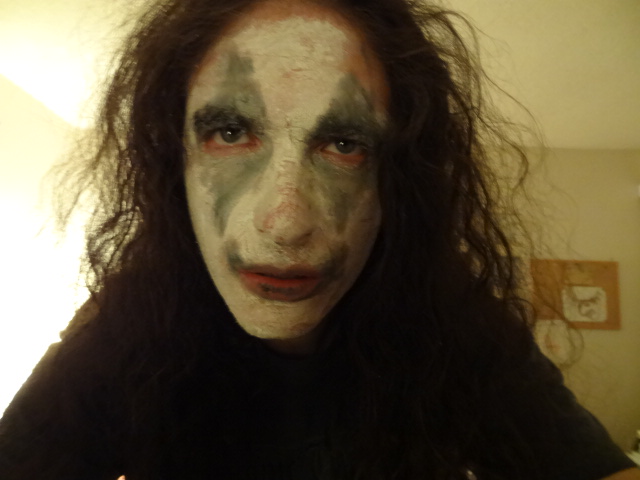
Instead, I was forced to go to a nearby Tim Hortons and do a rush job in the bathroom. Here is a lesson to making yourself up like the Crow. Number One: don’t rush it. Especially if you haven’t put on your own make-up in a few years. And Number Two: remember that putting black make-up over white dilutes it.

And you end up resembling something like this.

DSC00117

So after I left the Tim Hortons as a combination Crow and Kiss Halloween experiment, I got into the Mod Club: where we were having the event and due to my excellent sense of timing I missed a lot of things.

A lot of things.

It actually makes my heart hurt a bit to realize just what I missed. And you can find all of that at GeekPr0n, if you’d like. I’m not in any of those pictures because, yeah, I was late and it’s probably just as well. Still, I got some dancing in and met a few people. Our magazine manager actually got me a drink and I felt bad that I don’t really drink, but I definitely appreciated the sentiment and I still do. After helping pack up some stuff, I walked all the way to College and Spadina from the Mod where I formally said goodbye to the physical resting place of the Neutral Lounge that once meant so much to me.

DSC00118

It’s amazing how people treat you differently when you are wearing a costume. Most Torontonians ignored me, but I got a few jeers (there was one guy at the club that was always dancing near me and patting me on the shoulder and what-not because, you know, men always don’t mind physical contact apparently) and even some appreciation. Sometimes I don’t know whether someone is complimenting me or making a joke at my expense in the form of a compliment. I guess that says a lot about my early life with my peers. But on the bus ride home some giggling young ladies were sitting around and one wanted to take her picture with me. And I thought to myself: so that is how my cosplaying friends feel. It was a pretty cool feeling.

So after a late night walking back and talking with a friend of mine on the phone all the way home, I went to sleep extremely late and planned to slum to the Espresso Bar later in the evening the following day.

All right. Now let’s talk about the rest of that weekend.

So my friend John had this cockamame plan to get into Fan Expo and buy tickets on the busiest day of the event: Saturday. I told him good fucking luck, after trying to make him see the error of this insanity, and quite honestly waited for the messages of horror to come.

The following Saturday I woke up towards two and got a Facebook message from John saying he was heading out. All right. Again, good luck to him. I felt a little disappointment as I knew he was going to be meeting some of our friends, but I made my own plan and I was going to stick with it.

John messages me some minutes later telling me that he’s “here.”

“You’re downtown now?” I asked him.

“Nope. I’m on your driveway.”

My jaw dropped and I have to admit, I swore a lot. I asked him what he was doing here as I told him about my plan and he said he just thought it would be convenient if he drove me to the Snail or to Dundas and we could meet up later. Bear in mind: I was still in bed and I hadn’t eaten breakfast yet. But since John was already here, I decided “Fuck it, I’m going downtown.”

As we were going downtown, we decided to try for the Expo and get tickets for Sunday. Instead, we got tickets for that day and Sunday. You know, a part of me almost thinks that this entire thing was planned. I mean, John did tell our friends that he was going to try to get me down there, but for god’s sakes this was ridiculous.

So we ended up walking around the south building and eventually we met up with my friend Angela O’Hara was cosplaying Ariel: complete with a combing fork. We looked at drawings, sketches, and then comics. We met some more people we knew. I got a signed Manborg comic. And then we got a picture with some Daleks who decided to serve me:

Served by the Daleks

Or whom I decided to serve.

Serving the Daleks

But while language is ambiguous for a reason, Toronto traffic is less so. We spent an hour getting out of the city: and this happened both days. But on Saturday, since we were already out, we decided to meet up with our friend James in Mississauga and see Guardians of the Galaxy. I’d given up hope of seeing it with any one of my friends and I was this close to seeing it by myself to see what the hell everyone was raving about.

So after we had dinner, the first meal of my whole day, and Groot later, I was grandly impressed by the film. It was a story well done with dialogue exchange that is reminiscent of how I like to hear dialogue and write it.  I made a vow to see all the Marvel movies I can access now as I have a fear of commitment and it’s about time to get over that at least to this regard. Suffice to say I passed out pretty hard that night.

The next day I had time to eat, John picked me up, and we went to the Sunday round of the Expo. We hung around a little more in the North building this time around (and there was a lot of walking and escalators involved in that, let me tell you) and I got to meet my fellow horror and Heroes in Hell writer ZombieZak at his booth. We explored until it was almost that time and we headed back into the Toronto traffic before finally escaping on a highway.

And to cap off that day, I watched the Doctor Who episode “Into the Dalek”: which my dad recorded for me the night before. I even wrote a review.

So yeah. My friend John is stubborn and loyal and I got to have the geekiest weekend I had in a very long time. I learned just why we are Groot and that I will never be late for GeekPr0n Party again if I have anything to say about it.

Still, traffic jams need to be exterminated.

Matthew and the Daleks

Doctor Who: We Go Into The Dalek

When The Doctor tells Clara that they are going to travel “into darkness,” what is the first thing on your mind? Is it a blackhole? An abyssal planet? A pocket dimension of death or pure nothingness? And what does this have to do with Daleks?

Well, in the case of the second episode of Doctor Who season eight we have the answer in the title.

“Into The Dalek.”

Dalek Eyestalk

But what does that mean? In my recap of “Deep Breath” I talked about Doctor Who becoming less a fairytale now and more of a folktale: a cautionary tale or a horror story. Now, since 2005 we have seen hints of what is “inside” of a Dalek: the ultimate bogeyman of the Whoniverse. We know they are genetically engineered beings of pure hatred that were once humanoid, either Kaled or even in some instances human. They are bred to destroy anyone that is not them and even those among them that aren’t “pure.” Moreover, they are placed into advanced cybernetic carapaces — essentially miniature tanks — that allow them to obliterate anything at will. They rarely feel touch or light. They are just plain self-hatred and living bile made to kill everyone and everything else in all existence.

Russell T. Davies truly explored that Dalek condition and the horror of them. But Steven Moffat’s attempts to do something of the same somewhat pale in comparison. This time, however, Moffat attempts to do something particularly ambitious. This time he makes us see what a Dalek is from the inside out.

It’s pretty much a misnomer to call any Dalek a “good Dalek.” By the time The Doctor finds himself captured at a secret base studying a damaged Dalek that claims to desire the destruction of its own species most fans aren’t really taken by the novelty. I mean, you had the episode of “Dalek” with the “last Dalek” becoming “infected” by Rose Tyler’s DNA and therefore developing more complex feelings: actually making you feel sorry for it. Then there is Dalek Caan who, after viewing all of time and space, goes insane (or sane) and plots the destruction of his own species.

So it is not new to see a Dalek that hates its own kind. Most of them do so anyway. And honestly, when it explains to The Doctor and the team attempting to repair it, about how it saw the birth of a star and understood the concept of beauty, I was thinking Dalek freaking Caan and all of time.

Even The Doctor’s revelations about his (hopefully) evolving new self hearken back to “Dalek” where he is told that he would make “a very good Dalek” though in this case the Dalek in question tells him that while it is a “bad Dalek” he is “a good Dalek.”

That said, I can appreciate what they attempted to do with this episode. The technology to shrink The Doctor, Clara and their team into the Dalek’s very body, its cybernetic nervous system, is a throwback to some vintage and often B-rated science fiction film. However, I still think a lot more detail could have been put into the function of the Dalek’s immune system: elaborating on the ghastliness of its construction in a more visceral way and the horror of it. It’s actually very similar to some of my issues with the “Asylum of The Daleks” episode where, again, I definitely thought that Moffat could have expanded on the horror of, well again, insane and broken Daleks.

Broken Dalek

It is fascinating to see The Doctor investigating a Dalek from the inside considering his long history with their species and, of course, the inevitable issue that by doing so he is also exploring himself. And, oh boy, does The Doctor deliver for us.

His other incarnations had their moments of sheer terrifying presence: from Nine to even Eleven. But there is something cold about Peter Capaldi’s Doctor: particularly in the way that he clinically and detachedly informs a female soldier of the death of her brother, and writes off a member of their party as dead and even expendable. Not even The War Doctor himself, a battle-hardened ancient forged in the awfulness of the Time War was this seemingly callous.

Doctor 12 and Clara

We remember, again, why The Doctor needs to have his Companions when Clara does something that I totally thought she would do in the first episode and pretty much slapped The Doctor hard across the face. This, of course, serves to get him to help deal with the Dalek, but I will say that if the happy conclusion of this story is the creation of a Dalek serial killer of its own kind — inspired by “the beauty of The Doctor’s hatred” — it speaks volumes about him at this point.

There are two other things of note. The Daleks in this episode do not seem to know who The Doctor is: or at least not this Dalek. I thought that by “The Time of The Doctor” they would have disseminated that intelligence back into their collective conscious across space and time. But one element I found very fascinating was The Doctor’s very heavy-handed and vocal dislike for soldiers. Perhaps this can be explained by his memories of what he did during the Time War, but perhaps seeing the female soldier Journey Blue reminded him of his Eighth incarnation and the encounter he had with the pilot Cass during “The Night of the Doctor.” There were definitely some nice resonances there: not to mention some potential foreshadowing with Clara’s new attraction to the former soldier and current school teacher Danny Pink.

It seems like “Into The Dalek” might as well have been called “Into The Dark” and it does make you wonder where The Doctor’s sheer near-ruthless drive to “correct his mistakes,” as a comparison and contrast to that of his arch-enemies, will actually take him.

Star Wars: Preludes and Interludes Of A Space Opera

I think that if I were a Time Lord, I’d be a unique one that specializes in travelling to alternate timelines: not because I originally intended to, but due to the fact that these are places to which my senses are attuned.

Lately, not to mix metaphors, I’ve been thinking about Star Wars. I mean, when aren’t I? But bear with me. Imagine, in that period between 1980 and 1983, when The Empire Strikes Back made people truly want to know what happened next, George Lucas came up with a plan: a long-term plan.

We already know and suspect that by Return of The Jedi, Lucas was planning on heavily merchandising the hell out of his universe. Some people even think the addition of Ewoks in the last film was an attempt to particularly appeal to children and their love for toys. Even after the sixth film, we had cartoons like Ewoks and Droids.

But what if it didn’t stop there? What if aside from the made-to-TV Ewoks films George Lucas had wanted even more merchandising. At the time, LucasFilm was in the process of developing its special effects technology that would be utilized not just by itself, but by other companies and film productions as well. Even so, by the time of the cartoons it had only been a few years since Return of The Jedi and people — particularly children — were still fresh off of a galaxy far, far away and wanted more. More than that, and I can speak for myself here, fans had questions: about the Jedi, about the Republic before the Empire, and the Clone Wars themselves.

Many of these questions had been answered with the new CGI Clone Wars cartoons and the Prequel films — albeit with some gaps even now — but there was a gap of at least, what, seventeen years or so, between the films: where many of us waited after the re-release of the Old Trilogy to find our answers and immerse ourselves into new Star Wars.

Yet what if during that time, we had something else to tide us over during near two decades of waiting?

Indulge me and imagine this. After the last film and the initial cartoons, LucasFilm decides to release oncoming series that takes place during The Clone Wars. Perhaps Lucas calls them, collectively, Interludes. During this time, we get to essentially see the Republic and the Separatist Crisis, and the Jedi Knights. We get to see a young Obi-Wan and Anakin actually growing together but, more importantly, we get to see something else as well.

Jedi Team

We are witness to other characters — other Jedi and galactic denizens — and we get to watch them grow. We are introduced to the clone troopers early and see them as individuals: while always wondering why they look so like and unlike stormtroopers. And there are hints of Anakin’s back story and how he met Padme. At this stage, perhaps a few seasons or an interrelated series of cartoons (perhaps aided in the 90s by one young Genndy Tartakovsky) and live-action programs: space opera serials not unlike the material from which their structure was derived. Can you imagine that? Coming home from school to watch your Star Wars show?

And yes, the intervening years between the early 1980s and the late 90s might not have much in the way of advanced graphics or special effects by our contemporary standards but imaginary worlds have been built on much less and with more attention to detail. I mean, look at some anime from that period, or even the Old Trilogy and how immersive it was for looking all run-down, and world-weary and real: letting our minds fill in the rest. I could have seen LucasFilm making a lot of money during this time. I mean, think of an Interlude series of Star Wars: Clone Commandos playing alongside G.I. Joe. Don’t tell me that wouldn’t be bad-ass.

Clone troopers

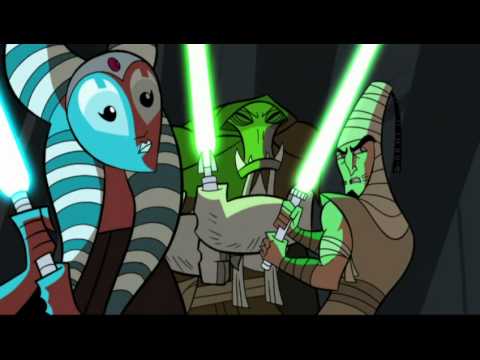
So during this whole time, you have all these background characters getting built up, living, and dying. You get immersed in their lives. Shaak-Ti, Aayla Secura, Kit Fisto, Plo Koon and the other Jedi have many adventures and you get attached to them. You see the Jedi Initiates as children and you want to be a Jedi: relating more to you directly as a child than even Luke does in the movies. Hell, you might even want to be Clone Troopers, have their special armour and play Clones Verses Droids along with Rebels Verses Imperials in the playground.

Of course, there would be comics and books as per usual. And then periods where there are no cartoons or shows. It makes the audience wait with anticipation. You build on the culture that you have already cultivated and created. The important thing is that you leave the questions. You have Anakin refer to his time on Tatooine and being a slave and you never know everything that happened. He has moments of darkness and you don’t know what caused them. You can tell Palpatine is doing something, but you don’t know where it all began or what even started the Clone Wars at all. Then there are the other questions about what will happen to the Jedi: particularly your favourite Jedi and their friends and comrades in the clones.

1999 comes around. Perhaps there has been some intervening years where the Interludes — The Clone Wars cartoons and live-action serials — have died down. Everyone is waiting. Now take the movies know from our timeline. If you want, imagine that the ideas created by George Lucas were written out by other writers: as he had those in the Original Trilogy. Maybe he even has others giving direction to the actors: those who can relate to them and have them react in believable and human ways. Scene-sequencing is interspersed with equal amounts of dialogue and action. CGI is cut down considerably and used sparingly: with a greater reliance on prop development and real world scenery.

The Phantom Menace reveals Anakin’s origins and just why the Jedi think he is so important. Attack of The Clones, three years later, shows us how The Clone Wars began. And, finally and heartbreakingly, we have Revenge of The Sith: where not only do we see Anakin fall, but all those Jedi characters that survived up until this point are mercilessly cut down by the clone troopers that we have, despite our better judgement as adults and adoration as children, grown to love.

Think of the impact of this alternate timeline. Think of how much we could relate to the death of Aayla Secura if we had seen her in various shows fighting for worlds and having her private moments with Kit Fisto. Think about Plo Koon and his time being a part-time mentor for Ahsoka Tano — perhaps even tutoring her in piloting — only to have his ship blown apart by one of his own clones. And the Younglings, those children you saw becoming Jedi … think about the horror in that.

How would you have viewed even the Prequels that we have now if there was all that build-up to the tragedy — a well-written tragedy — that was their Trilogy and the beginning of The Empire.

So now the Prequels are over. You know what happens. And yet … there are still some mysteries. Some Jedi are still alive or unaccounted for. A Rebellion has yet to form. LucasFilm, and perhaps Lucas Arts as it might still be around this alternate timeline can play with that. The fans are devastated by the impact of the Rebellion and Luke Skywalker is felt even more keenly. You watch the films again to know that the Empire fails.

Perhaps Star Wars cartoons and shows are divided into the Preludes — those dealing with the events before the Empire — and Interludes — those focusing on events during the Empire. Maybe some of these shows happen after the Prequels in real-time and others during the 80s and 90s. This is all you have to go on so far.

But everyone wants to know what happens next. They want to know what Luke and Leia do after the Empire falls. They have only had their appetite whet with the Clone Wars and the origins of the Empire. They want more.

And then, after 2005, ten years later after more shows and merchandising — and perhaps with the aid of Disney’s resources — we have: the Sequel Trilogy. The New Trilogy.

Of course, many people might have their own alternate ideal Star Wars watching timeline. Maybe there were no Clone Wars or Prequels. Perhaps the Sequel Trilogy happened right away. But there is something else to consider and it took me a while to personally understand and accept this.

It was Tony Pacitti in his pop culture memoir My Best Friend is a Wookiee that made me consider it. Perhaps one day, if not right now, there will be a new generation of children born. These children might watch The Phantom Menace and Attack of The Clones. Then they might watch The Clone Wars. Then Revenge of The Sith. Then the Old Trilogy. And the New Trilogy. They will see all the standalone films. And right now, it is all open to them. It isn’t perfect and there are gaps and questions, but they have mysteries to explore and wonder to consume.

It would be like us discovering the magic of Star Wars for the first time and their experiences would be different but similar to our own. They have so much more to see and know. They get to do what we can only dream of doing: living a life of imagination inundated by a variety of Star Wars: decades of Star Wars. And no matter way you look at it, this will be their first step into a much larger world.

Doctor Who: A Deep Breath Against Uncertainty

Do you happen to know how to fly this thing?

This was the question posed to us at the end of the last season of Doctor Who. It might as well be the quintessential Whovian question directed towards both The Doctor and the writers of the show. The program itself always explores what it is, always changing, while at the same time attempting to keep the core of itself the same. After watching “Deep Breath,” the first episode of Season Eight, this weekend I realize there are a lot of ways you can look at it.

A little while ago, I was examining the different eras of Doctor Who and comparing them to the Ages in comics. I had a theory that, after “Time of The Doctor,” we would be moving past the dark angst-ridden era of Doctor Who revisionism begun by Russell T. Davies and into a reconstructionist phase: a place where everything went back to basics with a modern sense of storytelling. I actually thought the presence of Tom Baker in “The Day of The Doctor” hinted on a season that was a return to wonder and adventuring. I thought, with the rescue and quest to find Gallifrey, that the darkness would finally be banished or at least heavily minimized.

Of course, I was very wrong.

You see, I forgot something when making these comparisons. I forgot about the so-called “Golden Age” of Doctor Who. Just like the Golden Age of comics, those early adventures could be dangerous, sinister, and downright creepy. And The Doctor himself was not always a trustworthy Time Lord and you always had to kind of watch your back around him. If the Eleventh Doctor’s run felt like witnessing a fairytale, then it really seems like the Twelfth Doctor is a throwback to the terror of the original: like the ancient cautionary folktales of old attempting eat their sanitized offspring … only far grittier and even more discomfiting.

“Deep Breath” is almost a warning to the audience. It starts off with a dinosaur running amok in Victorian England and spitting out the TARDIS that Peter Capaldi’s Doctor hasn’t yet learned to fly. You have the Paternoster Gang: complete with the Silurian detective Madame Vastra, her wife and maid Jenny, and good Sontaran Strax. It seems to begin like any strange wild, wacky Doctor Who adventure. 

Doctor Who Dinosaur

It’s not.

It’s no surprise that The Doctor is confused and disoriented in his new Regeneration. We’ve seen him deal with similar situations in the past. But this time, when you consider how he was an old man in “Day of The Doctor” and all the other events he survived, watching him attempt to remember things and fail is actually quite unsettling. The part where the Gang brings him to a bedroom at Vastra’s home really stands out at me as he was actually terrified of being in a small enclosed space that was small on the inside and separated by different rooms. He just couldn’t understand it and, if your last memories are of being in something like the TARDIS, this disorientation — along with his Time Lord conception of space and time around him — makes a fair amount of sense.

I think it was actually hard for me to watch Clara deal with this. She is watching her best friend, who she doesn’t even recognize any more, suffer from what looks like dementia. This new man is not The Doctor that she loves and it takes her a while to admit that to herself.

It takes Madame Vastra, with Jenny to moderate her patience, to make Clara face this. The Silurian makes a very fascinating point about how The Doctor’s previous Regeneration — if not the other two before it — were attempts to fit in among humankind: almost like a veil. For me as a fan, I was both sympathetic to Clara — as she was very much in love with the Eleventh Doctor — but just as annoyed with her too as Vastra was: though for a different reason. In the previous story arc it was very clear that Clara jumped into The Doctor’s timestream and created different versions of herself throughout his various timelines. While I’m not sure how extensive her memories are of her other scattered selves, the fact is she has seen him in all of his incarnations. Even in “Day of The Doctor” she met the Tenth Doctor and The War Doctor. She knew he could change and that he had been different people. But suppose what we are seeing here is the loss of her Doctor and her process of having to accept this.

Clara Disturbed

Meanwhile, The Doctor himself is trying to get used to the person he has become: or rather becoming the person that he now is. Even though some of his traits are familiar, such as his need to talk to the point of babbling and getting lost in his own thoughts, his anger is much more apparent now.  After running away from Vastra’s house, he calls everyone around him “pudding heads” and promptly dives into a river. At one point, when he demanded a man’s coat I was genuinely concerned that this person — whom many of us saw as a hero — was going to attack and rob some poor, scared drunk old man.

And then there was the part in the show when he seems to actually abandon Clara to their enemies.

I have to admit: even though I’d had some impatience with Clara before, and on some level I knew he wouldn’t just leave her I … actually wondered. Clara’s shock and grief were very clear and a part of me hoped that when she got out of her predicament, she’d get the chance to outright slap him.

That all said, I really loved the monsters in this episode. They were essentially Clockwork droids that had crash landed on Earth ages ago and used human flesh and organs as spare parts to keep them going. They mostly reacted to humans, but there is something very grisly about watching them move around jerkily wearing motley suits in various stages of decorum and decay. Basically, they are from the sister ship to the SS Madame de Pompadour and wear human skin. It’s even at a point where they have absorbed so much human matter that they believe they are attempting to rebuild their ship and find a “promised land.”

Deep Breath Robot

The fact that a “repaired escape-pod” of theirs utilizes a hot-air balloon made of human skin really tells you a lot about the spirit of this episode right there.

What I find fascinating is the clockwork element in this episode and potentially others. The introduction sequence is composed of a collection of synchronized golden-worked gears. At one point I was under the impression that Steven Moffat was attempting to sabotage the Miltonian clockwork perfect universe of Russell T. Davies by creating his “tears in space and time,” but it looks like I was wrong again. In fact, there is a very steampunk look to this episode: even and especially when you look at The Doctor’s new suit with its white shirt, black coat and red in-lining the very end.

I think that, for me, this episode actually — for the first time — made me afraid of Doctor Who. The monsters were genuinely disturbing. The Doctor himself seemed to display more anger, ruthlessness, and a lack of dependability hearkening back to the First. And there was one time I wondered if the Gang was going to survive.

I wondered if The Doctor was even going to come back for Clara: and that sense of abandonment of her and our expectations was a horror far more terrible than any human-harvesting robots.

This isn’t even mentioning the ad in the paper that brought Clara and The Doctor back together, or why The Doctor’s new face seems so familiar to him. There are some hints that go back to previous episodes on those little details alone. And then there is the presence of a mysterious woman named Missy at the very end of the episode.

It’s funny. When Doctor Who began in 1963, it was meant to be a children’s show. At the same time, however, the monsters were always meant to be terrifying and the adventures truly harrowing even as it was clear that The Doctor himself wasn’t necessarily meant to  be a hero. In fact, his new musical theme  such as it is — sounding like a wind raking the night with a hard cold edge — is something I still need to get used to.

Twelfth Doctor

So where might this all be going? Does Steven Moffat know how to fly this thing? In the past, the shaky episodes and moments of questionable continuity have made me wonder. But if “Deep Breath” is any indication of what we might expect in the future, we might be looking a season that isn’t going to pull any punches.

Because there is a difference between personal angst and dark speculative fiction, and while we might have moved past the former there is still a whole wide multiverse of uncanny adventure for which to look forward.

Infinite Diversity in Infinite Combinations: David Mack And Speculative Fiction As A Harbinger of Diversity

Star Trek would have you believe that, one day, Earth will become a virtual utopia. War, famine, and poverty will be eliminated. Advanced civilizations will come and help humanity solve its problems, and even explore the very stars themselves. Humanity, through a United Federation of Planets will encounter new species, societies, and ways of living. And while there will initially be conflict and fear, it will ultimately give way to tolerance, peace, and love.

Personally, I don’t find this realistic. Strip away the technology and science, even accepting the caveat that somehow unlimited resources and energy can be had, and you still have human beings that still feel greed, possess hubris, and fear what they don’t understand. And that is how we treat our own fellow human beings. I think that, if anything, our interactions with each other and other species would be a lot more like the scenario set in the universe of Babylon 5: where there are differences of opinion, internecine and squabbling politics, sanctions, and warfare but a degree of acceptance and understanding among individuals. But that is assuming that human nature will remain the same. Certainly, the anonymous reader that wrote a letter deriding the lesbian relationship between a Vulcan and Klingon in David Mack’s Star Trek novel Harbinger reflects some current human traits all too well.

It can be disheartening to consider that such bigotry exists — and has done so for some time — in speculative fiction and geek fandom. Even David Mack, in his epic open letter rebuttal of this reader’s email, admits that diversity is not nearly as represented in the Star Trek television series as it could have been. And even if the writer of the email to Mack wasn’t a hardcore Trekkie, this is not an original sentiment in whatever might constitute itself as geek culture or the various fandoms that make up some kind of community. I don’t think it is too much of a revelation to state that Star Trek — or speculative fiction itself — and fandoms can be problematic with regards to gender and cultural diversity.

But there is more to this. There always is. I think what really stands out at me is the Star Trek: Deep Space Nine series. Part of the reason I bring this up is because of the image that Katharine Trendacosta uses in her i09 article Star Trek Writer’s Defense of Diversity in Sci-Fi Is Damn Near Perfect. It depicts the episode “Rejoined” where Jadzia Dax encounters Lenara Kahn. In fact, both women are Trill hosts for their respective symbionts: whom had been married. I was either in the latter stages of elementary or in the middle of high school when I first saw this episode, and I didn’t understand it.

Dax and Kahn

It wasn’t that I didn’t understand why Dax had feelings for Kahn. I assumed, then, that she was just experiencing echoes of emotion from her symbiont’s last host. Naively, I was more confused as to how she could even pursue a relationship with her even though the symbiont no longer had a male host and if disrupting the rules of their society was worth the trouble. I will even admit that, at the time, it made me uncomfortable. In retrospect, many adults seemed to feel the same way, or so Star Trek producers believed. Years later, of course, I realize that the Trill philosophy of wanting to prevent symbionts from “limiting their experiences by relationships from their previous lives” was another way of stating that people were uncomfortable with two pansexual beings — who both happened to be women this time around — from continuing and having new experiences with their relationship. You can say that it was the nineties and that we weren’t “quite there yet” (and we still aren’t in a lot of ways), but when I look back at that episode and even my own naivete and ignorance, I feel a kind of righteous anger that they couldn’t pursue that relationship further.

There are many other instances of how Star Trek poorly handled their depictions of gender and ethnic diversity, but there is one other story line that particularly got to me: though not, again, until recent years. There was a story arc between Miles O’Brien, his wife Keiko, and the Bajoran Major Kira Nerys embodied best by the episode “Looking for par’Mach in All the Wrong Places.” Due to a potentially lethal accident, the O’Briens’ unborn son had to be transferred into Kira’s womb. During this episode, Kira moves in with the O’Briens so that they can take care of her in the meantime. Miles and Kira end up spending a lot of time together, which Keiko actively supports. Their family dynamic changes during this time and Miles and Kira actually end up developing feelings for each other. Nothing comes of this, however, and after she carries the child to term Kira leaves the O’Briens.

I definitely remember being distinctly uncomfortable with this arrangement at the time: seeing the two characters bordering on cheating. Certainly, while life happens in chaotic ways, their situation was no time to develop a relationship. But now I can’t help but feel that there were a few possibilities in how that relationship could have turned out. While the resonance feels more like something Robert A. Heinlein would create as opposed to Gene Roddenberry or other like-minded writers, it would have been fascinating to see a polyamorous or non-monogamous relationship dynamic form from that particular episode: another kind of diversity and representation in a futuristic series priding itself on philosophical and human progress.

Kira Miles and Keiko

Even so David Mack, in his own open letter, states that “those of us who write the licensed Trek fiction continue to do our best to depict a more progressive, enlightened, open, and harmonious future, not just for humanity but for all sentient beings.” And maybe it was these words, along with seeing Dax and Kahn again, that reminded me that although the writers of Star Trek couldn’t be too radical, they pushed the envelope of diversity as far as they thought they could: particularly in Deep Space Nine.

It’s funny. When I think about it, Deep Space Nine and Babylon 5 both aired more or less during the same time period. Perhaps that’s why I mentioned both programs in the context of this article. Maybe it reminds me of how different I am from the child and adolescent I used to be. But I also learned something new. David Mack, in his rebuttal to his anonymous reader over the accusation of “remoulding the Vulcan persona to suit himself,” quotes the Vulcan philosophy of IDIC: Infinite Diversity in Infinite Combinations. It even has its own symbol worn by many Vulcans: including Spock himself. Whether or not Gene Roddenberry created the symbol to sell merchandise is kind of irrelevant but it reminds me of something else. I realized that even if that utopian ideal is unrealistic and will never happen, it is something to strive for. That sense of hope and wonder in the form of sheer possibility and diversity is what Star Trek is, and what it should ultimately be about.

This is what speculative fiction and geekdom should be about: what it should be the vanguard for.

David Mack, in not only being unashamed of the lesbian relationship between his two characters but even supporting and rejoicing in it, states that he will continue to support diversity in his writing. When you look at current fandom and some of its displeasure over other changes or recent iterations in franchises such as a Black Captain America, Thor now being a woman, and a female lead in a Spider-Man film you begin to realize something else. Not only is diversity important in representing various people in the franchises that they love, but it is utterly integral in keeping those worlds fresh and alive: keeping them changing.  Closed mindsets will be maintained and never challenged. No one will care about stories that never change or make them feel a part of them.

Without diversity, without change, genres and mediums will die.

It is my hope that writers such as David Mack continue to travel these places and bring us along on the ride: to make a place where a story is judged by the quality of its writing and interactions and not solely by an idea that hasn’t been fully fleshed out, or reactionary responses.

To boldly go where no one has gone before, or to go to where other people go and you don’t.  Frankly, if this is a journey that doesn’t suit you, then you shouldn’t come for the ride. As for me, I want to see where these explorations will take me.

What I Want To Twine

While I’ve going through some personal and bureaucratic issues lately, I thought I would take the time — late at night and recovering from a cold — to write about some of the things that I’ve been wanting to do.

Both of the projects that particularly weigh on my mind are Twine games. I haven’t made a new Twine narrative since The Looking Glass for the Global Game Jam and I meant to do more before other responsibilities and projects came my way. I don’t want to reveal too many spoilers at this point, but maybe this is as good a place as any to voice out some of my “workshop talk,” as it were.

There is one narrative I’ve been thinking about for a little while. It combines Near Eastern, Far Eastern, and some children’s literature. I’ve gathered notes, done some basic research, and even wrote down my own quotes and sentences that I want to use: those structures that often evolve or become centralized into larger stories. Remember: something always comes from something larger, even if that larger thing doesn’t exist yet … even if you haven’t made it. I’ve really wanted to work on this one as something of a response to a piece — a chapter from a story — that I keep on getting sent to me for some reason which has evolved in my brain into something else entirely.

The other Project I really want to spend at least some time on is my Twine novel. For those of you who have followed this Blog for some time, you may remember what I am talking about. For those of you who don’t know or recall, before I even had a basic working knowledge of Twine I wanted to make an epic story that dealt with some ideological and very personal ideas. I still haven’t finished all of the “chapters” or “worlds” and I have to remember and keep track of which world links to what and how to get them to do so after I’ve written them out.

Yes, I have been writing this Choose Your Own Adventure narrative game by hand: or at least I did for a while before I had to seriously focus on my work for Poets in Hell. As for my game, I know there are three worlds I want to write out. After that, I can take a break from it for a while and do something else and eventually complete it all.

I’ve been so terribly busy and fighting to keep focus and motivation. I just wanted to let you know that although I’m facing some challenges and difficulties, it is not all doom and gloom. I’m glad I got to write a bit about my creative processes again, even as I look forward to actually working on these creations and showing you all what I intend to do.Looking Outward