The last time I talked about Star Wars here on GEEKPR0N I was talking about how it was made of mysteries. I thought that was what made the Old Trilogy so effective. You saw characters that died before you could get to know them more like Obi-Wan Kenobi, and even characters you didn’t ever see despite the lead up into thinking you would see them like Bail Organa on Alderaan. These are the stories that, at the time, could have been and it just added another layer to the story that we already had right in front of us. But there is more to Star Wars than mystery.
I eventually found out about the Old Trilogy when I was eleven or twelve years old. Before that, I’d only known about the Ewoks and Droids cartoons, but I never thought they were part of something much more potentially vast. Even so, I loved those stories as they conveyed that age and feeling that I couldn’t name at the time. Then, of course, I saw the Old Trilogy and that specific feeling exploded inside me more fiercely than an obliterated Death Star.
There’s nothing I can really say about the behind the scenes video of Star Wars Episode VII shown at the San Diego Comic-Con of 2015 that hasn’t already been said before. However, there is one thing I can tell you. A little while ago, Kevin Smith was invited onto the set of Episode VII and he described how he felt, without violating confidentiality, just how he felt to be there: especially when he came across the set of the Millennium Falcon.
I know that I’ve shown a lot of hesitation when thinking about more movies in the Star Wars universe after much of the disappointment inherent in the Star Wars Prequel Trilogy. I mean, as a fan I will be honest and say that I will be seeing these films no matter what, but that hesitation — in hoping to avoid more disappointment — is hard to overcome. But my reaction to this behind the scenes video of Episode VII drew on the interest I started to feel in the first full trailer of the movie and it hasn’t been until now that I’ve been able to name that feeling that I had when I first encountered and watched the Star Wars Old Trilogy.
Kevin Smith said it best when he stated that he felt wonder. He felt magic. This is precisely what I felt was missing from the Prequel Trilogy and even a lot of the work drawn from it. But when I did watch this behind the scenes trailer, I’m not sure how it happened really. Perhaps its because J.J. Abrams is insisting on the creation of actual sets and props. Maybe it’s due to the selective use of CGI that will hopefully be implemented to complement instead of overwhelm. Or it could be due to the use of real locations. And yes: the inclusion of the original cast is also a selling point.
But since the Sequel Trilogy and the Star Wars standalone films had been announced, I’m actually starting to feel a bit of that wonder again. I’m starting to really hope for the magic and the movies many of us have been really waiting for since the end of Return of the Jedi.
Yet more than that, watching this behind the scenes video of Star Wars Episode VII: The Force Awakens reminds of another feeling from my childhood that perhaps maybe of us could relate to. Han Solo himself said it, and is hopefully going to say, it best.
What’s coming up is going to be my last full week at the LDEEP Program and, while that’s true, I understand now that the real work is about to truly begin.
I have plans. I always have plans. A good part of those plans is to take what I am good at doing, and what I enjoy, and actually begin the process of making a living from it. And I know what I’m good at doing. I am a good creative consultant when it comes to ideas for stories and editing them. I can tutor adults in subjects in and around the humanities. I can even create writing commissions on subjects in which I am familiar. And I can create content. I am even in the process of making focused and collaborative content. I already have a name for what I want to do. I just need to build on its body of sorts.
And, as such and if all goes well, I might have help.
In fact, I already do. I just want to say that before this week begins I had some excellent tidings happen last Friday. As you know, I am working on story and content for a video game with a group of my friends. Last Friday was the first time I’d ever gotten paid for something I had directly written, or aided in writing.
Admittedly by my friend and the leader and founder of our group it isn’t much, and I will continue to need assistance for a while, but it’s amazing how sixty dollars can feel like a million bucks when someone thinks of your work enough to pay you as the professional that you are: to give you money for something you are good at, and enjoy, doing.
Somehow I feel like I’ve made more progress in collaborating on this project than in a great many other things I’ve done this past while. It is definitely a good start and I don’t intend to have it end here. And it won’t. We believe in what we are creating and I already have some good ideas to expand on to make our game leave a distinctive mark. I can’t wait for the day where I can tell you more about that: and so many other things besides.
Until another time soon, my friends. You will be hearing from me and thank you for all of your continued support. It is greatly appreciated.
And now: for Too Much Information Time. If you do not want Too Much Information Time, please stop reading this post. As I’ve said before, there are a plenty of good and viable articles and writings of mine that you can read instead. But if you do go on, know that these are challenges that I am dealing with and, at the very least, there is some positive problem-solving involved. That said, reader’s discretion — as always — isadvised.
I’ve never really been good with time. Not too long ago, I said that it’s an inescapable fact that projects are monsters that can get away from you but really, if we’re going to be honest with ourselves here, it’s time that’s the greatest monster of them all.
Usually, I’ve been able to update my Blog on Mondays and be able to focus on other things throughout the week. But last week, and a good portion of this one have been … something else I have to say. It’s true that I haven’t really kept you up to date about my fourth and, now practically, the fifth weeks of my time in LDEEP: an Ontario government-sponsored program that helps people with learning disabilities find meaningful employment.
One reason I’d been stuck on saying anything is because I reached a … curve, as it were. A lot of the syllabus that we follow is generic government-mandated material: mainly filling out questionnaires to determine our technical and intellectual skills, resume building, possible interview scenarios, and even cold-calling. We also had sessions on computers to look for jobs.
In the beginning, I could understand the questionnaires: as it would help the workers know us a bit more and eventually aid them in getting us the right placements. But after a while, I started feel a bit … restless. It probably doesn’t help that before I get a ride to the centre, I have to use the washroom three or four times before getting paranoid about being stuck in traffic for far too long. Irritable bowel is manageable when you are not facing a lot of stress. I don’t dare eat anything before I leave for that similar reason: even though it doesn’t seem to make much difference and, in fact, it might actually improve my condition.
I don’t mention this a lot, but especially before I even came to LDEEP I developed this feeling that anything outside my immediate vicinity is ultimately unsafe and I have to be on guard all the time. I can’t relax. I need to know where the facilities are and I need to have the freedom to move around and have access to them. If you have seen Toronto, this is easier said than done in a commuter city where public restrooms are few and far between.
It was … bad the first two weeks of the program as my body was adjusting to waking up earlier again and figuring out what the hell was going on. Actually, it feels like hell: a hell of discomfort and anger I have to work through and I am relieved to get around when I finally get to the centre thanks to my dad. But in the beginning I was all right because I insisted on doing work when I got there, despite some of my experiences before that, and I left — with the work there — and with a sense of accomplishment. I did what I needed to do despite my body and the panic attacks. I put them in their place.
By the end of the three week of the program and through the middle of the fifth, I started to have other doubts. One key issue, when you are dealing with learning disabled or gifted students, is that you can never make an educational program that is one size fits all. It’s just not possible. It’s even less possible when you have a results-driven mandate that you need to keep up in order to keep going.
I’m not going to lie. There have been a lot of interesting elements of the program that I’ve filed away out of curiosity’s sake, but I’ve felt that a lot of it just doesn’t apply to me. The fact is, I know what I want. I am a writer. I knew I would need to do some tasks for LDEEP, but I thought that we could take what I was good at, focus on what I was missing or what needed improvement, and have some more one-on-one sessions to get me there: complete with more networking to make employment for me possible.
I’ve said before that I also had to get used to interacting with a group again, and that hasn’t been so bad. I’ve made some really nice connections and the people there — including the workers — are good people just trying to find their way and help each other out. Some of us have gone through a lot. When you get beaten down so many times, you can begin to internalize it. But everyone in my program wants to get past that and get the employment they deserve.
But there have been times, particularly when left to our own devices on assignments I didn’t really understand or felt applied to me that I got frustrated. I will admit that there were a few times I was even tempted to leave.
I’m used to having things a certain way. I’m used to being able to eat breakfast at home and deal with my functions before interacting with people. Especially due to my past as a Master’s student, I’ve gotten used to being independent, leaving at my own pace, and learning the things that interest me. And I am a published writer. I have not forgotten any of this. Sometimes I’ve honestly felt like in pursuing this, I’d taken one step forward and three steps back in terms of my own independence: getting a ride to the centre, needing to get a lunch before hand instead of finding something on the way, and even dealing with different kinds of people and situations.
It also doesn’t help when I have to fight a burning feeling in my gut and not feeling safe until I’m out of traffic and near facilities — kind of like how you’d feel if you were playing a video game and Save Points were few and far between on your journey — just to do something that I don’t always feel applies to me, or get left doing something that Ontario Works had me do without much in the way of success.
I know what I want and what I need. And I did ask myself: “Why am I here? Why am I putting myself through all of this? What am I hoping to achieve?”
On Wednesday, the leader of our program called me into his office. Somehow, I knew he would, and not for any terrible reason. We get along very well and I enjoy talking with him. But he does get busy. LDEEP itself is very busy and he and the other workers attempt to help as many of us as they can.
We had a long talk that can be summarized like this: he has to find me a job and it has been difficult. But I threw out a few ideas and he is going to help me out with them. One of them is a business plan: which will have roots with some of the things I’d been attempting to do for the past three years. It also helps now that, because of LDEEP, I know what my potential net worth — my salary — actually should be. I’m going to be consulting and editing someone else’s work and using the above, along with some of the program leader’s input, as potential templates.
There is also something else I could do in addition to this that might get some pressure off my back and advance my connections and knowledge further. I know that I am going to have to do some hard work no matter what I choose, but at the very least I can choose what work that will be.
And that’s what it is about for me. Personal agency. The fact is — another fact is — I’ve realized how far I have come. LDEEP’s nine to three schedule makes me keep daylight hours and I actually feel a lot better than I have in years aside from the morning departures. My headaches are more manageable when they happen and I actually go to sleep at midnight now.
It has also gotten to the point where, when I come in to the centre, I socialize and work with my peers and this, along with some directed activities, actually makes me feel better as I can focus on a task at hand: or, really, enjoy a conversation. We are all different in this program, and there is a lot we’ve learned about each other.
I also know what I am going to do now. I’ve realized that I can go to the workers and tell them about my concerns: that I don’t have to do all of this on my own. They are there to help us and I need to remember to do that. I might need some time in the morning and that shouldn’t be an issue. I might need clarification about a task.
And, even better, they might have some suggestions for me. Next week will be our final session. We will have assignments to do, but I have my own assignment now that I can begin to focus on starting Monday. I also feel a growing sense of relief. After next week, I can finally pace my own time again. I will still be going to the centre and interacting with the workers and my peers, but I won’t have to be there as stringently as before. I know my stressors and I can pace myself accordingly.
And look at how far I’ve gotten from where I was. On my Facebook today, I wrote something for my status. I said that I’m starting to feel like my life has just begun.
So, if you have read this far, here is your reward. As you’ve seen from the article image, I got my copy of Doctors in Hell: an appropriate title when all things are considered. So here is an excerpt below, just for you. I just got the hard copy today.
Perhaps, when you get right down to it, it’s not so much that I’m trying to get my life back. Rather, I’m beginning to realize that I have the potential to make a whole new life entirely. And that, my friends, is a very important feeling. I think I will leave you with that for now. Until next time soon.
There have been a lot of Star Wars mysteries after the Old Trilogy. Some of these have been answered: such as how Anakin Skywalker became Darth Vader, what happened to the Skywalker twins’ mother, and how the Empire came to be. Still more mysteries occurred however: such as why Jar Jar Binks ever existed, why Palpatine now has the first name Sheev, and who thought it was such a great idea to give Han Solo a wife.
But I digress because, aside from the fact that we still don’t know what Yoda’s species are, there is also the other matter of Han Solo. No, I’m not talking about whether or not he shot Greedo first in a cantina long long ago in a galaxy far far away, because the answer to that should be painfully obvious at this point.
On the contrary: I’m talking about finding how he got that blaster in his hands to begin with.
As part of a whole slew of planned Star Wars standalone films, in 2018 we are apparently going to see a movie detailing the origins of our smart-mouth smuggler friend. What is even more fascinating about this is that the writers of the script are, none other, than Lawrence Kasdan — the writer of The Empire Strikes Back, Return of the Jedi, and the yet to be released The Force Awakens — along with and his son, Jon Kasdan.
It’s not certain if the film will reveal the entirety of Han’s story, but it certainly show us how he became a scoundrel and a scruffy nerf-herder: and that could be something. I have to admit that I am pretty leery of many prequel ideas after of the disappointments many in geekdom have faced from the Prequel Trilogy and some of Disney`s decisions in the new Expanded Universe. It will also be very strange not to see Harrison Ford who is Han Solo be Han Solo.
But we have the man who created some of the best films of the Star Wars series and the team behind The Lego Movie coming together to make this movie a reality so speaking for myself, I will reserve my judgment on this and The New Trilogy.
And yes, I could definitely see Chris Pratt, Star Lord, playing a young Han Solo. It goes without saying.
A late, but timely prescription. There seems to be a case of DOCTORS IN HELL going around. You can prepare for the upcoming epidemic: now through both Kindle and Book. If you would like to warn people of what is to come, I hope that you will consider sharing this prescription and perhaps even investing into some reviews of your own.
And here is another infernal prescription for you: namely an interview of mine with Jennifer Loiske regarding my own strain of story in Doctors. Apparently in this case, I am the first of the fallen: namely the first Hellion to be featured on her site about our book. Bill Snider (ZombieZak) is right after me and while we are the first, we will definitely not be the last. Seriously, I hope — somehow, as I should have left that outside the gates by virtue and vice of what I have done — that you will check out the works of myself and my fellow Hellions.
My pandering to my readership aside, I think this is going to be a very short post. I’ve vastly overestimated my energies. The first week of my LDEEP program was a major adjustment, but even through the exhaustion at home I would still be able to write and engage more online. But now after the third week of the program, I find I’m more tired than before and it takes actual energy to write anything — or indeed do anything — after an early day and night. I’m honestly just hoping I won’t pass out at my computer again like I’ve, admittedly, been doing from time to time.
I am finding that I really need to pace myself. If I have time to myself for a bit in the morning and I can leave at my own speed, I am generally fine. It’s not an exact science and sometimes I feel like I have traded issues with my headaches for my stomach: though the stress management is universal. Deep breathing really helps: along with, again, having my own space. But either way, it is an ongoing experiment.
I do know, however, what I want. I want to do what I am doing now. I want to write the way I do, and get paid for it. That’s it. That should be one of my focuses. For now, though, I’m going to take a step back and enjoy what I’ve actually achieved so far, and see where I go from here.
If you are a comics geek and you haven’t been reading writer Kelly Sue DeConnick’s and artist co-creator Valentine De Landro’s Bitch Planet, you should be.
My first impression of Bitch Planet, from what I saw of Issue #1 was that it would be a comic not unlike something Pat Mills would make: something gritty with major punk themes that, in particular, would parody an established comics trope or convention. Even more so, I was expecting a highly political grindhouse death battle situation where the characters would screaming “Fuck the Man!” in literal cage grudge matches when not engaging in gang wars or creating anarchist havens for one another.
Of course what I found was something that — while it plays with those themes — is entirely different. I suppose anyone who is part of the Carol Corps would have been able to tell me that. This was before I’d actually started reading Kelly Sue’s Captain Marvel run and while I saw the great potential in the mythos of Pretty Deadly I had a feeling that Bitch Planet would have a very different story.
I’ve read that Bitch Planet essentially exploits the exploitation genre: specifically with regards to fictional stories about women in prison. So picture the following scenario. Imagine you are in the future. Space travel, surveillance, and holographic technology exists. There is at least one civilization, or national government, that seems to be able to colonize other planets. Everyone is in smart suits and dresses and they get their creature comforts. But crime still exists and there still means, read: prisons, to deal with it. There is one prison planet in particular referred to as the Auxiliary Compliance Outpost.
It is this world that deals with particularly extreme female criminals. Their crimes are numerous: theft, assault and battery, murder, infidelity, abortion, gender treason, hysteria, and a slew of other crimes that — when you get right down to it — are all acts of non-compliance.
I think you can see where this is going. Still, I’m now going to go into some spoiler territory so if you want to read this ongoing comics series and you don’t want to be surprised, or should I say too surprised, you might want to stop here.
The fact is, non-compliance is a very real theme in Bitch Planet: not just within the society of the New Protectorate and its Council of Fathers, but also in how Kelly Sue DeConnick and Valentine De Landro play with the comics series’ women in prison exploitation genre itself.
Issue #1 starts off at a place with a woman attempting to get through a crowd to her job constantly apologizing. This in itself might not mean anything on the surface until you see the transition to where the story is going. It’s pretty clear that the Auxiliary Compliance Outpost, or Bitch Planet as many call it, is a metaphor for that entire society. There are little signs of this in how all of the female characters behave. Even in Issue #3, which is a character origin story, a woman at a bakery goes as far as to tell a particularly obnoxious man that she isn’t rolling her eyes at him. Women’s behaviour is observed and policed in this futuristic setting for a variety of reasons: sometimes to the point of incarceration and “re-education.”
Kelly Sue herself is already tapping into that place of patriarchy where women’s behaviour is expected to be conciliatory and passive with regards to men in society. At the very least, she is bringing to light, through her narrative, these traits that women are still expected on some level to embrace to get along in “polite society.” But the creative team go further with this. Kelly Sue DeConnick and Valentine De Landro depict the guards of Bitch Planet wearing visors not unlike mirrors. Virginia Woolf, in A Room of One’s Own utilizes the metaphor of the mirror: of patriarchy needing women to be an inferior or more coveted reflections of men in order to make them more powerful or heroic.
And in Issue # 3 of Bitch Planet it’s shown that the New Protectorate is attempting to see into the minds of women with something called a cerebral action-potential integration and extrapolation machine. It’s purpose is, apparently, to reveal to a committee of men exactly what a woman’s “ideal self” truly is in order to “help her” reach it. Conveniently the device utilizes a mirror.
And Bitch Planet also uses painfully neon holograms to parody the New Protectorate’s “ideal form” of women: to use them to train, indoctrinate, and punish the prisoners at will: a twisted derivative of advertising turned propaganda to a socially — and now physically — captive female audience.
The mirror visors, the mind device, and the holograms are created to symbolize one very important fact: that women in Bitch Planet should prioritize how others see them over how they see themselves.
And, of course, this is always done for “women’s own good.” The New Protectorate seems to have a very paternalistic view of how to deal with women, and this chauvinistic attitude peters down from the Council of Fathers, to the almost exclusively male-committees making decisions about women’s bodies and minds, and to the common man and woman. Even men, if they are not in certain standing within the hierarchy are, at best, useful tools and at worst underlings to be reminded of their place. And either way, they are just another form of commodity that can be disposed of at will.
The fact that Kelly Sue DeConnick and Valentine De Landro are able to convey the humanity of both oppressors and victims only makes this dynamic even more disturbing.
It is also clear that, unlike H.Y.D.R.A. in Marvel’s Agents of S.H.I.E.L.D. it isn’t so much that “compliance will be rewarded.” On the contrary: compliance is expected. And non-compliance will always be punished. And even then, like any good patriarchal model, there is the other side of the same coin: violence. It’s safe to say that beatings are commonplace on Bitch Planet and abuse of power as well. The two male supervisors of Bitch Planet seem to view their prisoners as little more than trite entertainment for their arbitrary attentions, and seem detached from sending guards in to break up riots in any way possible: whether the prisoners are violent or not.
So whether women in Bitch Planet are compliant or not, it almost doesn’t really seem to matter. Their lives are dependent on the whims of men in power and those to whom they give power. Women’s privacy, personal space and sexuality are something to be bartered and compromised. This can be see from Issue #2’s emphasis on a man slapping two waitresses on the buttocks all the way to Issue #4, where there are more unpleasant metaphors abound when the reader finds out there is a hole in the shower areas where two women can be intimate with each other provided that they do so in front of the guard viewing them behind the wall: another metaphor for the male gaze.
There are also some very loaded racial descriptions, body-shaming, and gender terminologies bandied about by those in power: terms that women are expected to accept as commonplace. Bitch Planet shows the reader a patriarchal setting that thrives from “keeping up appearances” and encouraging others to do so: from the guards who hide behind the power of their masked anonymity when doling out violence and violation — perhaps a metaphorical jibe at Internet trolling of women by Kelly Sue and creative company — all the way to using the veneer of events such as funerals, blood sports, and camera smiling to maintain the status quo. And it goes without saying that if this system somehow “makes a mistake,” it will not hesitate to use any means to “correct it” and save face: even if they officially decry state-sponsored murder.
This is the structure of compliance and it is all the more terrifying when you consider that it is only a few steps away from a lot of the attitudes of people in power in our time. Indeed, according to an interaction between the apparent series’ protagonist and one of her jailers, this New Protectorate seems to have developed not too long ago in that world’s future. In fact, the creators could leave this world on its own: as a cautionary tale as to what kind of dystopia might happen if we take our freedoms for granted and let them get legislated out of the way for expediency’s sake or out of fear born from a particular trauma.
But, if there is one thing I’ve learned, Kelly Sue DeConnick does not like to leave these things the way they stand.
The creative team begins with the protagonist. At first, the reader doesn’t know who the main character is going to be or even if there is going to be one. Then the narrative starts to focus on an older white woman named Marian Collins who has apparently been wrongfully imprisoned on Bitch Planet. Kamau Kogo, a Black athletic fighter who, at the moment, seems to be the actual story’s protagonist after starting off as a peripheral or secondary character.
What is even more interesting is that, four issues in, we still don’t know much about Kam or why she is on Bitch Planet. There are clues. In Issue#1 the head prison supervisors actually discuss some of the prisoners and mention the inclusion of one volunteer. Whether or not this person is in the prison program as an inmate or a guard is another story entirely: especially, as by Issue #4, the reader finds out about the existence of an unnamed — an anonymous — prisoner. But what is known is that the protagonist is looking for someone, or something. Only time will tell if these elements will interlap and, at the moment, Kelly Sue is keeping her cards to herself.
Kamau is so bad ass that if V ever approached her the way he did Evey in a hypothetical V For Vendetta / Bitch Planet crossover, she would probably punch him in the face for his troubles.
What we do know is that while Kam comes from one of the most exploited groups in all of history — being a Black female — she is also physically strong, athletic, well-trained and apparently had a career before the establishment of the New Protectorate. And she is extremely smart. For instance, she takes that hole in the shower walls, with its unfortunate dual metaphor of female exploitation and the male gaze, and she smashes through it: making it into a spot on the wall of possibility of which Virginia Woolf may have been proud. The guard behind that hole is brought painfully into the situation. His anonymity and the power behind it is taken from him as she knocks off his helmet: leaving him vulnerable to her as she plans to exploit the system that is exploiting her and her fellow inmates. Essentially, she takes the obligatory shower scene, uses it and destroys it to further her own plans.
In Issue #2 of Bitch Planet, Kam is approached by a special operative with a proposition to create an all-female prisoner sports team to fund the Bureau of the New Protectorate. The sport is called Megaton, or Duemila: a form of Calcio fiorentino: an activity reminiscent of football with the ability to throw punches and kicks. It is a bloodthirsty sport and while there may be “no crying in baseball,” I suspect there might be some dying in Megaton. At the same time, however, the game will give the prisoners a chance to fight an all-male guard team on their own unconventional terms. It will be a publicly viewed game and everyone in the Protectorate and the world will be watching. It is an opportunity to challenge the game: to subvert their own exploitation.
And while I’ve also read that Bitch Planet is considered to be Margaret Atwood’s Handmaid’s Tale meeting Quentin Tarantino’s Inglorious Basterds: I would add that it also has some Orange is the New Black, some Battle Royale and a little bit of A League of Their Own for good measure.
So here we have both Kelly Sue DeConnick and Valentine De Landro playing with stereotypes of femininity, or perceptions of it in much the same way that her characters will be exploiting the hell out of their own system. This may be a dystopia, but there is some resistance: even in the very design of the comic itself. I’ve already mentioned that Valentine De Landro’s art in Bitch Planet has a very gritty punk aesthetic. In fact, I can go further and state that it’s reminiscent of the style of drawing found in many comics from the eighties and nineties: complete with stark colours and eerie neons. But it is the series’ usage of the back matter of each issue — each one designed by Laurenn McCubbin — that is truly something to behold. Each one utilizes the aesthetic of an old, pulpy classified page: in which subliminal patriarchal ads are subverted by feminist messages and parody for the discerning reader.
In fact, one of my few regrets about Bitch Planet being collected into trades is that the back matters, the essays from inspired feminist contributors, and the comments sections won’t be included. At the same time, it makes me very thankful that I’ve started to read Bitch Planet in their separate comics issues. For the first time in ages, I can almost understand what it felt like to be a reader collecting an issue of Sandman, V For Vendetta, or Watchmen each month: while eagerly waiting for the next story to come out and somehow feeling involved in some of the process as a reader. Really, I feel like I am somehow a part of watching a masterpiece continue to grow into fruition. To those who say that no one has created an epic stories equally those of Neil Gaiman, Alan Moore, or Grant Morrison I would just love to direct their attention to what Kelly Sue DeConnick and Valentine De Landro are doing right now.
So, to end this off, let me just say this. If you like murder mysteries, prison dramas, dystopias, political intrigue, grindhouse violence, human characters, and a feminist story that shows clearly what it is critiquing through clever storytelling and human characters — if you yourself are non-compliant — then come acquaint yourselves with Kelly Sue DeConnick and Valentine De Landro’s Bitch Planet.
While I’m writing this, I’m wearing my Lunatic Heroes T-Shirt: a green one.
In 2013, I was lost. I’d been writing in my Mythic Bios for a while to keep my mind off of the pain of a past of perceived independence that had slowly receded away from me and a terrifyingly uncertain future of continued unemployment. But I kept writing in here. I kept reviewing stories and games in the way that I knew how to get noticed. To be seen. For everything that happened to me and that I did to have meant at least … something.
I found out about Anthony the same time as many other people did: through Amanda Palmer’s Blog. She told us about him, his importance, their relationship, and the sickness that he was in the process of battling. She told us that she convinced Anthony to write down some of his most poignant stories. Between her, Neil Gaiman, Nivi Nagiel of 3 Swallys Press, and many others he managed to get his first book published: Lunatic Heroes.
Like I said, I wanted to be seen. But it was more than that. I read and heard an excerpt from Lunatic Heroes: “Bullfrog.” And that was when I knew I needed to read his work. I needed to say something about it. It tapped into that space where I wanted to go: into that place of personal writing. And I read it. I read it and I took my method, my need to go back and look at the source of things, and write a review about it. And after I did that I looked at the quotes that I related to the most and I found that while we had many differences, Anthony and I also had similarities.
So I wrote about the Lunatic Heroes we were. And something happened.
Anthony noticed my writing.
Actually, that is an understatement. After we talked on Twitter and eventually Facebook, Anthony and Nivi added a quote from my review to his Endorsements page: within the same space as Amanda Palmer’s words. Then he actually requested that I write a review of his next book Beloved Demons. It was not without some irritation, of course. I did give his first book four out of five stars and I said I wanted to see more from him: that I knew he could do even better.
They gave me the T-Shirt I’m wearing for my work.
So I had to put my money where my mouth was, especially after he threatened to come to Canada to “hang a rat” (please read his books if you want the context to that particular phrase). It took … a lot more time to review Beloved Demons. While I go into a lot more detail about the circumstances around it in my review, there was a terrible ice storm in December 2013: so much so there was a blackout that essentially eliminated most traffic lights and electronics. I felt alone in this great, icy darkness that had once been my parents’ house and my virtual hermitage.
During this time, somehow the postal worker came and delivered Beloved Demons. I had to wait for my power to come back and actually focus on writing something on this work of Anthony’s. I felt intimated. I had to make sure it was good. I had to make sure it was right. And when I did finish it, from the appropriate place of darkness and ice and fear of mortality, Anthony and Nivi took the time to edit the post and link to it on Anthony’s Endorsement page.
Suffice to say, it got five stars.
Basically, if you go on there, you will see that Anthony placed my reviews about his books among the ranks of such people as Amanda Palmer and Neil Gaiman. He didn’t have to. I would have been content just to have my reviews on his books retweeted or hyperlinked. To place my opinion, even in the context of reviewing his works, in the company of Neil and Amanda really … it really meant a lot to me.
No, it still means a lot to me. It told me what I had to say was worth writing: that what I am doing is worth a damn. For me, in my admittedly biased way, it told me a lot about the person that he was and will always be: at least to me.
Anthony and I exchanged emails and witticisms on Twitter. I showed him some of my stories and he gave me nothing but encouragement. I sent him a copy of Poets In Hell: the volume containing my first print published short story. I introduced his work to my psychotherapist. Anthony even made a crack about me getting my budgie drunk after seeing a FB picture of him wearing one of his bell toys as a hat. I listened to his other short story sketches. I met Neil and then, when I met Amanda I asked her to say hello to him from me if she go the chance. And, when I reviewed Neil’s Ocean at the End of the Lane and Amanda’s The Art of Asking I made a point of illustrating just how the three of them influenced each other, and were influenced by one another.
I am so glad I got to show Anthony my reviews of his work and my other articles showcasing the literary effects he had on two of his best friends: both of whom have also influenced my own creative expression.
I’m sad that he’s gone. Anthony always seemed like he was fighting: that the cancer was just the latest manifestation of an enemy he had been in combat with his entire life. But, in the end, he won. He won in a lot of the ways we will hopefully be allowed to win. It might be somewhat trite, but there is immortality in being remembered by your words and the people that love and care for you. Not everyone gets this, but I am glad that C. Anthony Martignetti — my friend — got to be one of those people. I’d like to believe that he crossed that line: from lunatic hero to beloved demon. In doing so, he made and became his sign on a living door to the real stories: the true ones.
My only regret is that we never ended up talking on the phone, or meeting up to have some owl sandwiches.
The title is not what it seems especially when you take into account the graphic that you’re, no doubt, seeing at this time. It’s funny: I could have written this post up earlier in the weekend but one thing I’ve noticed in having a set schedule in the morning now is how much more tired I am when I finally get home, or finally get to the weekend.
There are a lot of things I wanted to do this weekend: like work on my “Serpent and The Fox” or more background material for the game I’m collaborating on: especially the latter after my sessions at LDEEP.
It’s still taking a while for my body to adjust to being up and functioning again at daylight hours: especially during what is now pretty much the summer time. It feels weird. It’s hard to explain really. Sometimes I feel the stress taking over my body and it seems to react on its own. Having IBS also doesn’t help matters and, to be honest, I could really do without it. It can make travel … interesting: especially in traffic.
At the same time, though, it’s not an exaggeration to say that my head has been light and airy. For a few years now I’ve generally only gone outside later in the day and in limited bursts. My interactions with other people were cursory or perfunctionary at best. Sometimes, even now, I need some space and I find that I need to move around in order to feel comfortable in my body in another space as well. I’ve always had that last element in the form of fidgeting: and it manifests through needing to express excitement and channel nervous energy. But I have also been taking it in stride and working through my body to get my tasks finished. I mean, if I have to deal with matters I might as well get as much from doing so as possible. That is my philosophy now.
Right now I have something of a functional resume and cover letter that I plan to use as a foundation to network and from which to create other elements. Chances are, again, I will be looking for collaborations and contract work, but I wouldn’t rule out using these resources from which I would create my own job. It wouldn’t be the first time.
One other nice thing about LDEEP is the fact that a lot of the work we do stays at the centre. This allows me to come home, rest, and even do some of my own creative work. It isn’t always in my face and it has its own place where I can engage it with help. So that structure does help a lot. And I am dealing: still trying to find a balance of work, rest, and eating as I finished the second week of my program.
Also my flip-phone, which was nearly a decade old, dislocated its head and I had to get a new phone. Last week I wrote a GeekPr0n article on the Netflix series Sense8: which might as well be an extended metaphor for wireless, online and long-distance relationships. My new phone is, by necessity of my career plans and current work, linked to the Internet and while the process of getting and programming it — and sometimes unlocking the damned thing — has been stressful, I feel a lot more connected to some of the people I know. It makes things a little better for me and sometimes that’s all you can ask. That said, I’m also getting to know people in my course and even though we are different, it is still nice to get to interact with other people face-to-face.
And now, for the Hell element of this post. It’s not living in daylight again, or going out more, or doing a ton of work, or even readjusting my body. Rather, it is more information about my upcoming published story. Allow me to reintroduce you to DOCTORS IN HELL.
It is a beautiful advertisement and I just thought I’d share it with all of you: to show you I am there and that this is happening again. It’s also nice to see my name, with my fellow Hellions, all front and centre. A lot of last week was me filling out an interview and biographies and other minutiae after my days at LDEEP. Each interaction left me with a sense of accomplishment.
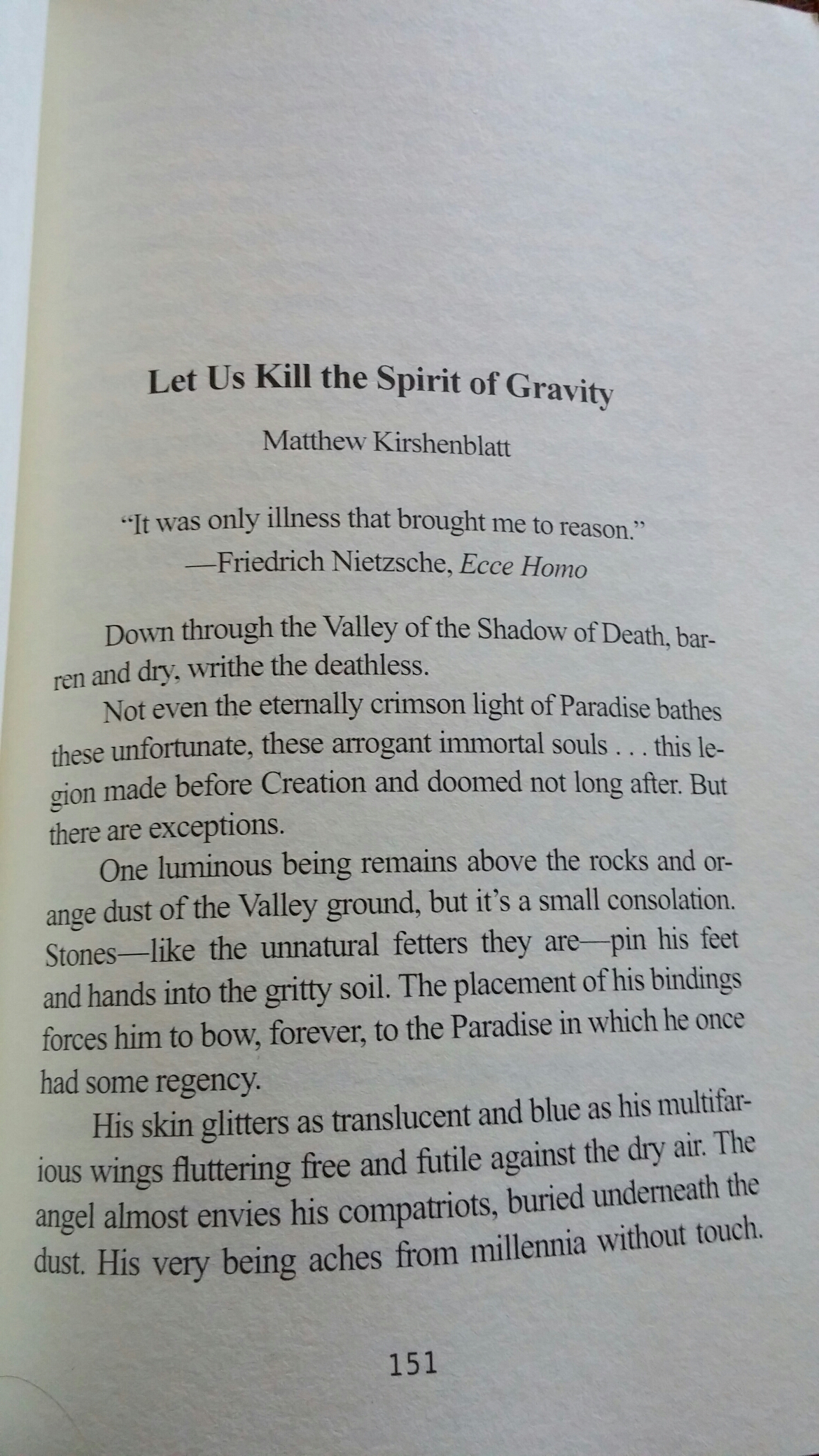
My story inHeroes in Hell Volume 18: Doctors in Hell, “Let Us Kill The Spirit of Gravity” continues just after Nietzsche runs into Lilith for the first time. It can be read on its own, but “When You Gaze Into An Abyss” from Poets in Hell is also a nice read, in my relatively biased opinion, before you start this one.
And you can order it on Kindle today. 🙂
In this sense everything here is not so much that a road to hell paved with good intentions, but rather that an idle mind (read an ever-busy mind) is the devil’s workshop. And I am going to keep working in it, and at it. I promise.
It’s hard to talk about a series like Sense8. I know that, when I first heard about it — this original series coming to Netflix about people whose perceptions were linked with each other — I didn’t think much of it at the time. But in retrospect it makes sense that a series created by J. Michael Straczynski and the Wachowskis, creators of Babylon 5 and The Matrix respectively, would be nothing short of brilliant.
Still, it’d be very easy to write it off a product of vague and exaggerated hype on first glance: especially with a name that sounds like a spell from Final Fantasy or a deadly weapon from science fiction like Ice-Nine. The introduction scenes have a lot going on: with various human activities all over the world that seem to have almost nothing to do with each other aside from the fact that people are doing them. In fact, the only thing that seems to unify these montages are the overall dramatic tones of the music in the background.
Even the premise: of people being able to get into each other’s minds simultaneously felt like more like a vague idea than an actual compelling story: the kind of thing that a director, or writer would use as a guideline into making an actual plot and could just as easily get lost in a desk drawer gathering dust.
Perhaps it’s due to the medium in which the series has been presented. As a film or a once-a-week television show, Sense8 might not have even been considered: or the resources available might not have allowed it to live to even its inherent potential in the first season. Think of an epic story — of reading A Song of Ice and Fire and The Lord of the Rings — and having to wait once a week, or a few years just to read the next chapter. Whereas with Sense8‘s model in Netflix, by June 5 everyone was capable of watching all twelve episodes at once: giving you that feeling of staying up late into the night reading “just one more chapter” to a good and multi-layered story. This form allows you to pretty much follow what is going on and keep it relatable.
Despite what I said earlier, the premise of Sense8 is not just a creative novelty: something that many powers in Hollywood might have just kept at the level of mere spectacle. And it could have gone that route had it not been for J. Michael Straczynski, known for creating indepth characters and complex story lines stepped in mythology and the human experience, and the Wachowskis and their penchant to examine themes of philosophy, metaphysics, and human consciousness.
One of the challenges is that there is so much to explore with the theme of sharing one’s sense of self with other selves. Sense8 manages to look at what is to be human: to have your own individuality and privacy, but also being inherently alone for it. For instance, you live in your own body and no one else can do that for you. But what happens when someone else can not only see you, but read your thoughts, experience your physical state, and feel your emotions? And vice-versa.
And then take it a step further. Imagine you can not only draw on people’s knowledge, but their skill sets as well. For instance, Wolfgang Bogdanow is a safe-cracker who needs to bluff his way out of a situation and draws on Lito Rodriguez’s acting skills to do so, and when Lito needs to actually fight he either draws on Wolfgang’s skills in mayhem, Will Gorski’s self-defense skills as a policeman, or South Korean businesswoman Sun Bak’s martial arts. Or Capheus, a bus driver in Kenya, can draw on the research and skills of the hacker Nomi Marks, or Kala Dandekar’s knowledge to do something ad hoc with her knowledge of chemistry.
Being a Sensate — becoming “aware” in Sense8, is having access to a skills and knowledge pool of your cluster: of seven other people of various places, backgrounds, genders, ethnicities, and sexual orientations. But then there is the matter of memories and feelings to consider as part of the pool as well. Boundaries between individuals can blur in many ways. For instance, if Will gets injured on the job Wolfgang might feel it. The Icelander DJ Riley Blue could be taking some ecstasy and it could effect Kala at her job. And let’s not even go into what happens when the various Sensates in a cluster are having sex … or menstruating.
Season One of Sense8 mostly has the characters realizing just what they are, figuring out how they work, and how it’s played out is one of the most beautiful things of all. The whole Mary Sue moment of realizing that they are different is downplayed a lot by this intrinsic feeling of understanding: they are all interlinked after all. The hows and whys of it are almost secondary to that. Some of them accept it in a dream-like way, while others think they are suffering from hallucinations. But you can see it all coming together.
And Sense8 has a plot.
It’s hard to see and get a feel for it in the first episode. You still wonder where it is going but as you run with it you realize that there are people who knows that the Sensates exist: powerful people that want them dead, neutralized, or controlled. And the main antagonist is a cold and detached being that fits well into the story, even as a renegade Sensate helping the main characters explains that Sensates have existed throughout history: that they may not be the next evolution of humankind, but a throwback to how sentient life began: together instead of separate and isolated.
It leaves you with so many questions. Can Sensates block who sees or selectively reveal what in their minds? Can they control how they are perceived by others in the cluster? Just how far can they synchronize their movements and actions together? Are there ways to override one individual’s consciousness: to make someone into an extension of your will? And is there a danger in becoming too close: in becoming a melded together gestalt consciousness?
The implications and possibilities of Sense8 go much further than this. Imagine if Sensates had existed in history? If Alexander the Great and his inner circle had all been born in the same month and year? Or if there were clusters in the ranks of the Spartans? Or even if someone like Adolf Hitler was a Sensate? The point is, there are so many ways beyond even alternative fictional history to tell more stories with this idea.
Sense8 is also a tremendously geeky series. The concept of clusters some of the situations and events that occur on Sense8 are reminiscent of various polyamorous themes in Robert A. Heinlein stories, while you could make an argument that clusters are similar to the idea of the karass — a group of people linked together in a cosmic manner — in Kurt Vonnegut’s Cat’s Cradle.
But for me, it isn’t so much the fictional and dramatic possibilities of Sense8 that appeal to me. We live in the Information Age: an age of wireless Internet where we communicate with people all across the world. A lot of us have friends, family, and other relationships in Europe, or the Middle-East, Asia, the Americas, and other places. In many places, we are becoming a long-distance species in a world becoming much smaller. This is definitely one theme that Sense8 is bringing to the fore and tapping into: something with which many people can relate.
Certainly, there is a theme of loneliness in physically being around people while feeling more together with someone communicating with you halfway across the world. The best examples of this are when Riley Blue and Will Gorski are communing with each other while the latter is at a bar with his police friends. Will is a seemingly normal and straightforward police officer but it becomes apparent that he really doesn’t relate to most of his colleagues beyond a casual level while Riley, who is in another country can talk with him about the things with which he can actually begin to be himself. Or even how Sun, in one of the worst, most isolating situations of her life can have the seemingly physical and moral support of Riley as she herself is outside looking at the sun.
It’s these moments that really jive with me and they are captured well by the show. So, when all is said and done, if you are geeky in any way and you like diverse human stories and you have been that geeky person with someone you care for across a state line or another ocean — and you know this feeling — then Sense8 is the series for you: with some new seasons with which to look forward.
Also Freema Agyeman, who once played Doctor Who‘s Martha Jones, is an LGBTQ character and bad ass girlfriend of Nomi.
Almost every superhero comic has its own alternative “what if” stories. As a fan myself, it can sometimes be difficult to suspend my disbelief when reading these tales. At the very least, I keep thinking to myself “that’s fascinating, but that’s not how — for example — Superman would be, or that person is not Superman.” We have an interpretation of a hero, villain, or character and we generally compare the alternative to the original. That is how a lot of alternative comics universes work: they work by comparing and contrasting the new with the original.
With superhero comics universes like DC, it often goes further into making those alternate worlds actually relate and connect to each other. Alternate Superman will meet the “real” Superman and we can go home thinking about how fascinating that was, but ultimately finding “our” Superman more valid.
Justice League: Gods and Monsters does something similar. We can see echoes of Batman, Superman, and Wonder Woman in these characters: or at least their roles. However, at least two of the characters already exist in the DC Universe in a different form, and this darker take on that universe says something about what it takes to be a hero with it.
Machinima and Warner Bros. have teamed up to create a trilogy of sorts: of three shorts that will provide backgrounds for the heroes of the main feature Justice League: Gods and Monsters: a DC Universe Animated Movie that will go straight to DVD.
You can view all three of these shorts: “Twisted,” “Bomb” and “Big” online and right here for your viewing pleasure.
Episode One: Twisted: In which there is honour even in one of the darkest of souls.
Episode Two: Bomb: In which the Son of Zod wishes he was a good man, rather than a Superman.
Episode Three: Big: In which Steve Trevor realizes that it is sometimes okay to ask for help. And that “help” can be a safe word.
This season of three shorts will lead into another ten episode long series in 2016. A four-issue prequel comic by J. M. DeMatteis and Bruce Timm will be released along with the movie: which will come out in July 28, 2015. Hopefully we will get to see these three characters stand on their own and look at where they are headed next into the dark, but honest horizon.




 Mythic Bios