Con Fail

This is what it was like to be me, on Sunday, attempting to look for the Toronto Fan Expo.

Me and my Head

You find yourself walking out of Union Station through the Toronto Train Station to get to the Skywalk. Unlike the other times you’ve been here, there aren’t any cosplayers or people with Fan Expo bags to follow, but you make your way to the Skywalk.

You know that, in the past, all you had to do was open the glass door on the left-hand side in order to take some escalators down the stairs in order to get to the lobby. All you would have to do is get your prepaid ticket scanned, get a wristband, wait in something of a line and get in. And because it’s Sunday and almost 3 pm, you think that you won’t have to wait very long. You would get in, meet with your friend from London, Ontario and explore for about two hours. The only issue would be the line that might form as you are all leaving like last year’s.

However, it is precisely because of your knowledge of last year that you know that the door is locked and you have to go the long way around, down stairways and across a street or two to get to where you need to go. You get out of the Skywalk and you are outside on the roof. You wander around. Finally, a really nice young lady–whose costume you can’t even recall now and who isn’t a staff member or a volunteer–asks if you’re lost. You admit it and she points you to where you need to go: a Pavilion entrance down below the Convention Centre.

So you travel down the steps. Your thin tight black Dr. Who T-shirt is sticking to your body in the summer heat. You walk to the Pavilion entrances and notice that there are either “Priority,” “Vendor” or “Re-Entry” entrances and exits. So much for that. You keep walking: past a large Aquarium, the line to see the CN Tower and even the Blue Jays booths. You still don’t find the entrance.

You go back and move onto the streets. In fact, you follow a large group of people across a street or two. You even notice some signs that say “Fan Expo” on the sides of walls. They are few, and scattered, and far between. There are no arrows on them pointing anywhere or even a map. You walk past a place where someone, who may or may not be a staff member is talking with a driver. You find another sign. You follow it to a dead-end.

You go back to a park area where you see a young woman standing in a grove of trees dressed and posing as Saber from Fate/Stay Night. It is very awesome and you see her friends taking pictures of her. You try to ignore the lonely feeling, wishing that you could contact your friend or someone that can help you, and continue on. And then you see that you are back in the same place you started at: the Pavilions. A small train ride, that you passed before, nearly runs you over as you are clutching your ticket papers in your hands: which you’d gotten out beforehand so you would be ready for the booth and your wristband.

You have been steadily losing your patience. Finally, you get fed up and go through the Re-Entry to ask the people in charge where you need to go. The security woman in her red uniform is nice enough, but her directions are long and vague. She mentions the Aquarium as a land mark that you’ve passed more than twice. You are tired and hot. It has already been something along the lines of twenty minutes or so that you have been lost in the non-Euclidean geometry of this part of the city or, let’s face it, Toronto itself.

Or at least it might as well be non-Euclidean because this is a vast space and you have spatial issues and difficulties with direction to begin with. You can’t follow the vague map on your papers–if that is what it even is–which has no written directions whatsoever. You keep to the Aquarium and because there are no signs indicating where the Fan Expo ticket-scanning booth is, you walk up some stairs and find yourself at a Hotel.

Then you see two men and a child. You see they have Fan Expo bags like everyone else. You ask one of the men where the ticket booth is. He points vaguely in back of you and asks if you are going to pick up a wristband for sentimental value because the Expo is essentially over. You say that is impossible because it says, specifically on your sheet that they close at 5 pm. He says that this is not possible.

It is 3:45 pm by this point. You walk back down the stairs and across the Blue Jays booths to see if you can find this place. You are feeling a weariness begin to creep into your very being. At 3:55 pm or so, knowing that by the time you find this fabled ticket-scanning place you will have less than hour assuming the vendors weren’t packing up at this point, you realize that this venture is over.

You can feel the bitch-face–that cold unsmiling mask–forming over your features to cover the growing rage you feel inside. You pass by two kids that have shirts with the words “Game Over” and you can’t think of anything more appropriate than to call this waste of an outing. The anger is doused by pure exhaustion and sheer disappointment as not only do you realize that you have wasted $45 for a Sunday ticket to an event you couldn’t even access, and time you could have used to rest, but you also know that your friend is probably heading back to London by this point.

Seeing all of the cosplayers, con-goers and young couples with their loot is just another slap in the face: as though their mere presence this point just rubs in the fact that you couldn’t partake of any of this. You look at the papers in your hand and feel like a fucking idiot. Everything around you feels as cold and as impersonal and uncaring as the business that Fan Expo has begun to represent to you and so many others you know. You’ve already folded the un-scanned papers and now you just crumple them into one fist.

Under your breath, you whisper the words, “Con Fail.”

Then because you went so off-track trying to find this booth, this booth that you wonder ever existed to begin with, you can’t even find the Union Subway Station again and, when you do, you end up sitting in a subway car that takes too long get there, pauses at points and decides to go out of service at Eglinton without even waiting for another back-up car to be there. And all that time, you get to sit there and see more Expo-fans sitting around with their comics and their bags: just reminding you of everything you did not experience that day before your week begins.

You are told later, after you post on Facebook, and after a polite but brutally honest letter to the latter that is probably buried under a high volume of many other incoming emails that Hobbystar–the company that has “organized” the Fan Expo–is going to have new ownership and perhaps things will be better next time. Perhaps they will have volunteers around the streets with signs, or clearer signs on posters, or perhaps just greater organization itself. At the very least, they could have a ticket booth is not in the centre of Pan’s Labyrinth or long, long ago in a galaxy far, far away.

Because right now, just as then, you vow to yourself–having already had issues with Hobbystar and knowing that your other friends have experienced the same–that you are never going to try to go to Toronto Fan Expo again.

This message has been brought to you by Con Fail. I’m glad that everyone else, who managed to make it to the Expo had one. I just wish I had been one of you. As it is, I’m pretty ashamed that I had to spend valuable time and space writing this piece out when I have so many more interesting things planned, but it just had to be said.
Lucky 1s

Every year, at every Game Con, there is this one guy.

He usually stands outside in the hallways, but sometimes you find him sitting by himself in the designer panels lost in his own funk. But more often than not, he sits off to the side of the gaming tables and listens to dice clattering, pencils etching on paper and the voices of Dungeon Masters at work and players at play.

He isn’t a cosplayer, but he doesn’t bother them either. For the most part, he looks pretty unremarkable: just a stubbly-chinned man in black jeans and a dark blue hoodie. But there are three things that stand out about him.

The first is that he doesn’t play in any of the games. Ever. You have to understand, I’ve seen him here three days in a row and Game Con is expensive. The three-day pass does not come cheap. But I’ve seen it on his neck, though some reason I can never make out the name on it. Instead of playing, he always watches the players from a distance. And it is always the players too. He doesn’t creep on the girls dressed in anime costumes or as D&D barbarian women. In fact, he doesn’t even seem to register them. Instead, he just watches the players — both male and female — at play.

I never get that creeper vibe from him, but sometimes when there’s laughter I see his hand clench around the one object he always carries with him.

But I’ve noticed something else. Whenever he does come close to a gaming table — and it’s really the most freaking weirdest thing — the players begin to move away from him. I don’t mean that they shift away uncomfortably or pretend he doesn’t exist as most ostracism works. No: I’m talking about people going off somewhere else to another table, or booth, or right out of the Convention Centre.

I didn’t notice this at first, but for some reason this guy would just not stay in the background for me. But the gamers that left when he came close didn’t even so much as look at him: at all.

I said there were three strange things about this guy, right? Well, I should probably be more specific about the last two, and I will be when I tell you a little more about who he is. One day, I asked some of my buddies about this guy.

“Oh shit man, that’s Lucky 1s.”

“The Fumbler.”

“The Die himself.”

Most of that didn’t tell me anything at first, but I caught on to the “Fumbler” title. They told me more, but it was less. Apparently, “Lucky 1s” was a gamer — a table-top role-player — who had the worst luck with dice-rolling ever. No one seemed to know or remember his real name but apparently, according to Con lore, he always rolled 1s on his dice. It didn’t matter what die he used or what game he played with dice.

He always got 1s.

Word was that he was bad luck. Some said he broke up with his girlfriend before an important quest and it had tainted his luck score. Others thought he attempted to melt and manipulate the ultimate die as some cheaters do and it went horrifically wrong: angering the dice gods forever. Some quietly insisted that he had insulted Wil Wheaton when the man had attempted to bless his dice; while others believed — really truly believed — that he just masturbated too much.

So — in other words — aside from the fact that no one clearly shook hands with the man (and they were clearly ones to talk), most of their claims were superstitious bullshit, and a sad kind of D&D superstitious bullshit to boot: which is of the lowest kind.

But none of them ever went near him: ever. They told me they were “afraid” that his bad luck would taint their luck too and there were … stories … vague, menacing stories.

I think I felt bad for him. I mean, many of us are geeks and we should all know better. Ostracizing someone and spreading rumours about them is bullshit: no matter how bad their luck is. That day, he was sitting in the corner of the gaming room at his own table. I was very aware now of the object in his hand: the one that he always carried.

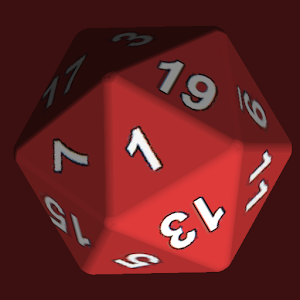
It was, and it is, this cherry red twenty-sided die. He was rolling it on the table. It sounded like clattering bones. At the time there was a game not far from his table and I could hear the beginnings of an argument: mainly what I thought was bickering over rules or some over-enthusiastic debate about combat resolution. You know: just usual disputes.

I sat down with him. His hoodie obscured most of his face — except for his scruffy chin — and completely blocked out his eyes with shadow. I introduced myself. He said nothing. He just kept rolling that one die of his. I saw his three-day pass hung around his neck and I finally got a glimpse at the messy handwriting on it that I couldn’t make out even. I told him what panels and games I’d come for and asked him what he was here for.

Gradually, he started talking. Sometimes I couldn’t make out his words over the sounds of groaning and yelling from the nearby gamer table. We, naturally, started talking about gaming.

“I always loved Dungeons and Dragons,” he said in a soft, soft voice.

“Loved?” I asked, puzzled at the emphasis on the past-tense.

He inclined his head a bit and kept rolling his die, though I didn’t see the number it landed on then, “Yes well … I liked the role-playing element more than most. I found the numbers, the positioning of the figurines and the math to be freaking tedious at times. No offence.”

“None taken,” I told him, “the rules get updated all the time, but they do structure it out and make it interesting.”

“True,” he said after another bone-rattling dice-roll pause, something that looked like a purely mechanical act more than a nervous tic, “But I really loved getting into character: acting it out and immersing myself into the world. I loved problem-solving through role-playing the character out,” he smiled then and it was almost a happy smile, “Yeah. I was one of those kinds of players.”

“Hey, liking Batman doesn’t make your dick bigger,” I said, “though really it’s beautiful women that do it for me.”

He actually chuckled a bit at that, “Yeah. Elitism sucks … especially when you are the only one.”

I didn’t quite know what he meant by that, but it was enough for me to sense that there was a talk coming. For one, he stopped rolling his die. From my own DMing experience I knew this was the time to be quiet and listen.

“You know, some of them think I actually traded all my good rolls to Lord Orkus: to make my dick bigger or some shit like that,” the other looked down at himself, “If that was the case, maybe I should have prayed to the Dragon god Bahamut instead.

“It just … started one day. I don’t even remember when. I can tell you, though, what it feels like.

“You know when you’re going to have a good roll or a bad one. I think every gambler and role-player knows it on some very intrinsic level,” he rolled his die and this time I saw it land on a big, fat, white 1, “When it’s a good roll, or one with great possibility it sings and surges through your blood. There’s hope. There’s excitement. There’s fun,” he rolls the die again and it lands on the same number, “But when you have a bad roll, it feels flat. Your stomach sinks when you cast that die, and you know even before it lands what it’s going to be: if you’re honest with yourself. Dread makes it even more sour and you don’t even want to look at it. It is just that bad.”

He rolled it again, “Every one of us knows what kind of roll we’re going to get. We just lie to ourselves and say it’s purely up to chance. I’m not even sure if the die affects our luck, or if it’s our own spirit — our self-confidence and personal energy — that affects the die.”

The die landed on another 1 as he continued talking, “My friends heckled me. They said I was cursed. ‘You’re cursed, Lucky 1s,’ they told me, ‘you’re cursed …'” he shook his head, “No matter what I rolled, it’s always been the same. I role-played as best I could, but the dice always betrayed me,” I could feel him glaring down at that 1 with a very palpable sense of hatred, “Eventually, I kept being the one to screw up our group quests and they stopped inviting me to games.”

“I’m sorry,” I told him, and meant it, “That was a shitty thing to do.”

“My attitude was getting worse, to be fair,” he rolled the die, making it clatter dangerously near the table’s edge, “I kept this die: where it all started from. I thought I might as well at least be honest about that with myself. I was so … angry, you know? They blamed me for my bad rolls. Blamed me like I was somehow responsible for them. Like I wanted them on some level. It was bullshit.

“Sometimes I think they did it to me. There’s energy in group games–good and bad–and after a while I started to believe it. I started to embody it.”

“Those are a lot of 1s,” I admitted, with a little ripple of goosebumps forming across my arms, “Maybe you have five dots in Entropy.”

“Dots?”

Mage: The Ascension,” I told him, “Well, that’s how stats work in White Wolf’s Old World of Darkness campaigns. In Ascension, the Euthanatos are mages that deal in death and luck: in matter breaking down and continuously changing. Entropy. Somehow, I think you might like that game.”

“Heh. It does sound cool. It would be nice to play again and not suck,” between the sharper sounds of him rolling the die hard against the table and the growing clamour of the other table, it was getting harder to hear him, “You know, some people get Natural 20s on their rolls. All the time. But I get 1s. I get freaking,” he rolled the die, “goddamned,” he rolled the die again, “1s!

Suddenly, he just whipped that die onto the ground beside us. I looked down and, yeah, it was very creepy. Even on the floor, it landed on a 1. I was almost tempted to mention that he needed some Felix Felicis, but that was definitely not the time for a Harry Potter joke.

We were both quiet for a while. His shoulders were slouching. To be honest, he looked miserable and lonely: the kind of person that wished they would be eaten by a Grue.

I don’t know why I did it. I reached down and picked up his die. The noise from the other table was getting very rowdy. Some of the players were leaving. I slid the die over to his hands on the table. And, to this day, I really don’t know why I asked him this one question: but I did.

“Have you ever gotten Natural 20s?”

It was a dumb question after everything that I had observed today. But instead of walking away, or shouting at me, or smirking, he looked down at the red die and said, “Only in a group. And only when I get angry.”

He picked up the die and whipped it on the table with a hard crack. I was almost surprised the Game Con Volunteers and security guards didn’t hear it, but the sounds from the other table probably drowned it out. He did it again. And again. And again. It was like a gunshot each time.

20.

20.

20.

Critical hit.

Critical hit.

Critical hit.

Finally, the whole other table close to us dispersed and I could hear some of the departing conversation, “All bad rolls.”

“And 1s. So many fucking 1s …”

He looked up at me then and I could finally see his eyes. They were dark and sad.

“That is the real reason why no one will play with me. Ever.

“You know, some people just get Natural 20s with a kind of cockiness or an easy grace. I wish I had been one of them. But if ‘should-ofs’ were treasure, we’d all have a lot of fat loots.”

He got up then and handed his die back to me, “I think I’ve finally rolled all the 1s out of this fucker. Maybe a few of the 20s too. There are some solid numbers left though. Good numbers. Not too lucky, but not a fumbler. Damn, I hate being called that … almost as much as Lucky 1s … Anyway, thanks for listening.”

“Hey,” I said before he could leave, “you should really check into LARPing. There’s a Mage game here at the Con. I think you’d like it.”

His back was facing me at this point, but I thought I saw him nod. Then, he vanished into a crowd of oncoming players.

I still see him around, you know, that guy they still call “Lucky 1s.” He doesn’t just stand around as much anymore, I’m glad to say. Evidently he found that Live-Action Mage game I told him about: where he plays as a Euthanatos that feeds on the bad luck of others. He doesn’t wear his hoodie now and he smiles a lot more.

I still have his 20-sided die and I have to say that — to this day — I’ve never failed a roll.

Faster Than A Speeding Bullet? I Sure Hope Not

And now for something light-hearted, odd and potentially NSFW.

So there is this old idea that has been floating around about superheroes and their strength. To not be too crude about it, for the moment I’m just going to phrase it as the fact that some people have chosen to believe that a superhero’s strength comes into play whether they are using consciously or not. In other words, a superhero’s power manifests as not only voluntary action but also an involuntary reaction.

Some of the most cited heroes–whose powers apparently are always manifested regardless of their intention–is Superman and She-Hulk. I am sure we can also bring in some X-Men too to make it more interesting and, often with them, it is a case by case situation depending on the exact nature of their mutation. This is also similar for such heroes as the Fantastic Four: and no, I have not forgotten about The Thing either. But for the sake of making this discussion clearer, I want to look at the first two heroes that I mentioned.

Both She-Hulk and Superman are known for their strength and, at the same time, for their intelligence. They know or have learned how to hold back on most of their strength to deal with an inherently fragile world around them. The fact that Jennifer Walters became She-Hulk through a gamma-radiated blood transfusion with her cousin Bruce Banner and Superman gains his power through being exposed to Earth’s yellow sun does not change these matters too much.

However, there are memes that go around stating that these two heroes can’t really interact with other human beings in an intimate way because of their inherent natures. To be more blunt about it, basically their bodily functions would crush or kill another “lesser” human being. I mean, that is a fair enough interpretation. Indeed, Garth Ennis does not shy away from this in his comic The Pro. But I have my own disagreements on this matter. Now, just to warn you, I am not going to go into comics specific examples or name a comics issue or anything of that kind. Instead, I am going to do something even more controversial.

I am going to use common sense on superheroes.

So let’s put the Kryptonian Kamasutra jokes aside for now and get to it. First of all, Superman and She-Hulk have been portrayed having quite a few relationships in the course of their comics existences: and not only with other super-powered or alien individuals. While, as far as I know it is never stated what happens with these other people, I am going to assume that the usual things happen in their relationships with other humans that happen in relationships: you know, except for needing to save the world occasionally or defending someone against a marauding villain or a nearby apocalypse. In fact, their relationships tend to end because of the same reasons any would: needs change and people move on.

But here is the thing. Let us put aside speculations about their private intimate lives for a few moments and look at another common sensical element which their comics may or may not address.

You see the thing, and not The Thing, is both Superman and She-Hulk eat. They eat and, as a result of such, I assume they use the facilities. Now, if we go by the theory that their involuntary actions or reactions have the same strength as their voluntary ones–or more so–well, the world would ended many, many times over by now. Or if Superman even breathed wrong or burped. I know you can explain these away by stating that Superman doesn’t eat as much or uses solar energy stored in his cells, but it has been stated that he is a vegetarian and unless he absorbs nutrients very differently than humans I assume that Kryptonians–being only different due to their technology and the yellow light of the sun–are much like human beings and function as such.

And She-Hulk herself, aside from her strength, seems to function as a normal human being: if there is any such thing.

Also, with regards to Superman, let’s take something else into account. He was raised as a baby by Martha and Jonathan Kent. Now his strength might have increased over the years and there are accounts of him learning how to fly much later–with learning how to jump first–but he was still considerably powerful. And don’t you think that it would have been a little awkward, aside from dealing with his needs as an infant, if one of his hugs of affection snapped Ma Kent’s neck?

The way I see it, at least with Superman, his powers function not unlike how Alan Moore explained Miracleman’s abilities. There is a kinetic field around him and his cells that he can choose to access. Therefore any violence Superman unleashes is purely premeditated and consciously used. I would imagine this does not cover him needing to go to the restroom: unless of course you believe he uses his incredible speed to dart quickly to the Fortress of Solitude with his own specialized facilities but … really?

In the end, I think that both of these heroes and others like them–when they are not on duty–either have ways around using their powers involuntarily or they are as much as like human beings as anyone else is. So please, if Superman is getting drunk in a bar alone, chances are it’s not because he killed Lois Lane in a moment of intimacy, but because he didn’t get to a plane of orphans in time or he’s indulging on the Red Kryptonite.

I’m not sure about The Thing though. I might get back to you on that. Or not.

Toronto’s Boyfriend Tells Us To Dream: Neil Gaiman at the Danforth Music Hall

For a day that I’d been looking forward to for a very long time, there isn’t very much I have to say about it.

The day before I’d packed everything I would need: my ticket, The Ocean at the End of the Lane and its proof of Indigo purchase, my first edition of American Gods–the book that started it all for me–and then the following day I packed my less-than-often used digital camera: just in case. After a shower that same day and dressing up in my World’s Ender’s T-Shirt and carrying my leather jacket I got a ride to the subway and then eventually got off at Broadview to head towards the Danforth Music Hall.

I didn’t plan to be second in line. I came by the Hall and noticed that it was still closed. So I went for some food and came back and started talking with someone there. We became the beginning of the line: even though we all had reserved seats.

Eventually at 6 pm we were allowed into the Hall. A very nice Indigo staff member working for the event marked the place in my Ocean book where it was going to be signed and personalized and then she wrote down my question for him on another piece of paper. I asked a really convoluted and boring question along the lines of: “Was there an interview or an article where you actually stated that you wrote an origin story for the Beldam?” Actually, I just called her “the Other Mother” for good measure because it was easier for the person writing it: even though I knew my question wouldn’t be chosen anyway.

You wouldn’t have figured I’d have asked a Coraline question, huh? 😉

I was directed to my seat and after I went to the restroom I came back and settled in. I realized that two of my friends were actually at the event. I’d come to terms with the fact that I would be going by myself but I suspected I’d know at least a few people there. One of them was someone I helped at the Global Game Jam, while the other was a really lovely person from our stints as this year’s Toronto Comics Arts Festival volunteers.

The event started a half an hour or so later due to the bad traffic of downtown Toronto and the TTC. I was still trying to wrap my head around the fact that I was going to be seeing him soon. Someone won some front-row seats because they had access to their twitter. And then after some introductions from Mark Askwith of Prisoners of Gravity who would go on to choose the questions we submitted for the Q&A and actually referred to our guest as “Toronto’s boyfriend”–and who better to have a one-night stand with the scattered secrets and mystical places in this city that keeps rebuilding and losing itself  … he came on stage.

There was this roar of applause and shouts. In the spotlight, his wild crazy hair seemed white. In fact, as he kept talking, I could almost see him much older than fifty with a cravat under his chin and the collar of his dark suit.  The light played with the shadows of his cheekbones and the hollows of his eyes, but it was him. It was totally him.

He started things off by reading a bit of Ocean: which he did with such expression and fluid emotion. What I mean is that he basically flowed from one nuance and tone to another according to each sentence that he came to. His voice, from the microphone and the lilt of it, filled the room of so many people who were so incredibly silent: just to listen to this man, this one man, read from this book.

And then he was done and the questions that were written outside by the Indigo staff representatives came to the fore. If the storytelling hadn’t already brought me to a very different place, then the Q&A did. After talking about wanting snakes for hair–just for the company–and which female characters of his he loved (Delirium, Hunter, Yvaine, the Hempstocks and even Ursula Monkton of all beings: who was “fun to write”) and a whole lot of things that I know I have forgotten or won’t come to mind until later tomorrow when I wake up, someone asked him what he thought of Peter Capaldi as the twelfth Doctor and it was then–at that point–that I wasn’t just watching a hub of geekdom geeking out.

I was there. I was a part of the cheering. I was in the middle of it.

He even told us a story I’d never heard before: of the last event which made him no longer be a journalist anymore. He explained to us that the paper he was working for wanted to do a series on “the evils of Dungeons & Dragons.” And, according to him, it was the last request they ever asked of him because he quit not long after. In addition to this, he told us that there were two Hempstocks in his other books: Stardust and The Graveyard Book. After this, he proceeded to tell us, in just how many “greats,” that these two women were related to and descended from the Hempstocks in Ocean, these “great great great great great great great great great …” he went on, “great great-grand nieces.”

After this, he did another reading: this time from his upcoming children’s novel Fortunately, the Milk. I wish he had read to me as a child, but this was more than good enough as well and definitely something that you parents out there should totally get and read to your children. It was that good.

Then came the signing. He decided that instead of being called up row by row that each row would be chosen by lottery. I was in row ‘S.’

Row ‘S’ didn’t get called until a little past 1 in the morning.

He himself had those who were pregnant or sick or disabled come up below the stage and signed their books first: which was a really decent thing to do. There was wine-tasting outside that I didn’t get in on because I am not much of a drinker. The rows of seats had little space between them and I constantly had to get up to let them through or go into some weird contortionist stance. We also hadn’t been allowed to bring food or drink in and, for something this long, these elements were crucial. This rule was relaxed as the Hall’s bar and store closed down for the night and we were allowed to go out and get some food: which is what I inevitably did and it made all the difference in the world.

And he just kept signing. He kept signing. Sometimes he hugged someone and I could see him talking, but mostly he just kept signing. Then at one point he had to take a break. What I didn’t know, then, was that he had injured his finger–a fingernail was apparently coming off–and he went to walk, probably go to the washroom, and get a band-aid. And he came back.

And he kept signing.

Eventually various rows were called up and I started humming a song under my breath–Scissor Sisters’ “I Can’t Decide” which I suddenly remembered right out of the blue and it made me start to feel happy along with the food I had from before–and I prepared. I saw that representatives were using peoples’ cameras to take pictures of those people and our friend the author. I kept coming closer in that line, out of the lobby, into the auditorium again, near the stairs, thanking one of the really tired volunteer representatives there, going up the stairs and slowly realizing that he and I were no longer separated by writing, or a screen, or row of seats and stage, or stairs, or even … people after a while …

To be honest, as I came closer to him I wasn’t thinking about the fact that this was the man whose book radically influenced my writing style as it is now. I wasn’t thinking about how I wrote my Master’s Thesis on his work alongside Alan Moore and Herodotus, or the many books I’d read of his, or the sightings of him with Amanda Palmer, or any of that. I just kept focused on what I came there to do.

He was looking down at the books–my books–that one of the representatives handed him. He was signing them. A part of me couldn’t believe that he was actually there. Like this was all some kind of illusion. I was also, in the back of my mind, hoping that I would not miss the last subway car on the Bloor-Danforth line back from Broadview to Bloor Station. And he was sitting right in front of me.

I more recited what I wanted to say in a brief oratory manner than anything in the way of conversation. I told him that my friends and my Message Board told me to say hello to him. And then I told him the other most important thing: “I’m really glad that I finally got to meet you.”

I think at this point he looked up, or so my pictures–that a representative was really good enough to take–seemed to indicate. I actually made eye-contact. He thanked me and he said that he hadn’t been on the Board in a while or around there. I’m not sure what he meant, but I had nothing to really add to that. But he told me, saying my name, to tell everyone hello from him and that he sends his regards.

As I was leaving and he went back to his singing, I turned around and said one more thing. I told him, “Dream well.”

I think he actually said, “Thank you, Matthew,” and the representatives around him seemed to smile and laugh at what I said. In retrospect, it is rather redundant to tell the Prince of Stories, in his own words, to “dream well.” But I couldn’t resist. I had to have something else to write about.

Then I rushed out of the Music Hall, down the sidewalk, across the street, into Broadview Station, where the train was taking five minutes to get there, and I got out–got to Bloor before 1:30, and had to run to the other side side upstairs to get the Northbound train … for it to go out of service at Eglinton and take a shuttle bus home to where my Dad was waiting for me at Finch.

Much later, I realized that the personalization in my Ocean book read, “Dream, Matthew.” He’d said the same thing for one of my other friends and I suspect for many more. I didn’t really care, however: just that he took that time to do it despite the exhaustion and the long hours and the many more hours to come even as I am writing this. I also saw something else. The representative that took my picture actually took more than one. And suddenly, I just felt so … tired. I came and did what I had to do, what I had been looking forward to for so long, on perhaps what is going to be his last Signing Tour ever and now all that would be waiting for me is a host of responsibilities until Fan Expo when I can meet up with my friend Angela O’Hara.

I sat on that Shuttle bus going past the old place on Eglinton where my friends used to live and I thought about all the times I’d ridden this bus–this shuttle–at this time and how I was here by myself and just how strong I had been today. These past two days I had overridden my own anxiety. I continued on. Even before I came to the Music Hall, when I was still at home, I looked at myself in the mirror and I realized that I felt … beautiful again.

And all the annoyance and irritation and panic was totally worth this day. Because this day, that happened a day or so ago, I got to meet Neil Gaiman for the first and last time. And whatever else happens, I will still continue to dream.

The Point at Which I Could Bend Some Steel

Superman Bend

So here I am, sitting here, trying to figure out what my next post is going to be before tomorrow when I meet Neil Gaiman at the Danforth Music Hall. I’m neither feeling particularly creative nor really analytical right now as I am pretty tired. So I’m going to do something else. I’m going to address an issue that has been nagging at me for some few weeks now, if not longer, by reaching deep into my own considerable sense of gall.

Because The Man of Steel bothered me so much, I am going to make a fun experiment out of rewriting it. I’m not going to be too arrogant about this however. This will not be a script or even an official outline. I also have no delusions that everyone will agree with or even like what I post on here. This entire idea not only came from my issues with the current Superman film, but also from a question I have asked myself from time to time as an adult writer: how would I write a Superman story?

Setting aside the fact that I did make an idea for an evil Superman story–one where he is neither his Nazi, his Justice Lord, his Injustice League, nor his Red Kryptonite-infected equivalent self–I want to look at making at story with his inherent morality: his sense of goodness, his need to help others, that distant sense of loneliness, that humility and that emotional place where he feels all too keenly the sense of helplessness even and especially within great power.

So I am going to take elements of The Man of Steel, splice them with some ideas from Grant Morrison, Mark Millar’s Red Son, and–honestly–a whole lot of other places I can’t even name off the top of my head but ingrained themselves eclectically there for mash-up purposes. I’m going to make it even more interesting by creating four films from Man of Steel: though mostly out of a sense of clarity because I am pretty sure you can make more than three movies from even the basic elements that Zack Snyder’s film attempted to address without going into the TV melodrama of Smallville. Now, with the proviso that this is all going to be very crude and rudimentary, let’s get up, up and away with ourselves shall we?

The first film I could see being derived and reconstituted from Steel would solely feature Clark’s development. We’d watch as he slowly begins to understand that he is not like other humans. Perhaps we could see some brief scenes of him as a child: where his senses are still developing and he saves people from a bus. We also look at that moment when he realizes that a single temper tantrum could end another being’s life and the horror and resolve that sets on him then to do good. But most of the film would be him as a young man realizing that his powers have not developed yet, but what he has are considerable. Unfortunately, as Jonathan Kent keeps explaining to him, he can’t reveal himself to the world because they would not understand: even if he is Smallville’s second worst-kept open secret. Jonathan tells him that with his power, it’s not so much that he isn’t ready to face the world, but that he has to choose.

So while I like the 1978 film version of Superman where Jonathan Kent dies from a heart-attack and it teaches Clark a tremendous sense of humility, I can see the tornado scenario also working in a different way. Imagine, for instance, that Clark–not fully fast enough and not even able to fly and his very ability to “leap tall buildings with a single-bound” would be disastrous in a tornado had a choice between saving his father or a larger group of people in a car: perhaps even children. Imagine when beforehand Jonathan tells Clark to always choose “the greater good.” So Clark saves the larger amount of people–perhaps while Jonathan helps free some others–but not before Jonathan is carried off by the winds.

This kills Clark inside. He keeps thinking to himself if he had just been a little stronger, a little faster, if he knew his full limits he could have saved everyone. Having already questioned his origins while his father was still alive, he then revisits the ship that brought him to Earth and finds the crystal with Jor-El’s AI imprint on it. He uses the ship to activate the AI of Jor-El: whom he begins to realize is self-aware or as sentient as possible for an advanced piece of machinery. Jor-El consoles Clark–or Kal-El–and also offers to help him reach as much of his potential as possible. Even Jor-El’s AI is not completely sure how Earth’s yellow sun fully affects Clark but his advanced knowledge is a good start. He tells him about Krypton and what happened to it: how the core of the world that was being mined destabilized and even before that the Kryptonian civilization–through its culture of eugenics–was becoming stagnant and slowly dying. He mentions that he and his mother Lara got him out of there–their world’s last hope–before the planet was destroyed. I see this not as a flashback but through words: almost like how Obi-Wan told Luke about how Darth Vader betrayed and murdered his father.

So we see Clark travelling around the world in different guises–working through various gradations of a costume much in the way that Grant Morrison had him do–and Jor-El eventually suggests that in order to educate him further, he needs a place for himself. He informs him of a crashed millennia-lost Kryptonian scout ship. And this leads us to the military and Lois Lane. I can see that unfolding in the way that it did in the Snyder film and then she uses her sleuthing to track him down: as he still isn’t quite at that place where he can make a Fortress for himself.

I would definitely expand more on Lois as a reporter along with the Daily Planet staff. But then we have another element in play as well: our good friend Lex Luthor. Before Clark can get to that ship, Luthor–being an important inventor and multimillionaire corporation head–wants the alien technology on that ship. He is smart enough to adapt some of the Phantom drives to do some … interesting things. At first he is working with the government. He is commissioned to deal with Superman–whom the world begins to witness as he begins to interfere in some international affairs that his conscience can’t keep him away from–and he uses this technology. Unfortunately, Luthor’s zeal in eliminating Superman begins to grow and, already amoral to begin with, lives really begin to mean nothing to him in his goal.

In the end, Luthor’s experiments with Phantom Zone energy have some nasty repercussions with regards to destroying the balances of gravitational forces on Earth or something to that effect and Superman has to adapt fast to deal with them and mitigate as much of the damage as possible. I can see Luthor adapting this power to simulate another form of energy: disrupting the kinetic fields around Superman’s cells or something pseudo-scientific like that. But by this point Superman eventually does the save the day and Luthor is put behind bars indefinitely for his crimes: especially in light of some of the governmental deaths he’s caused. You have that nice contrast between a human genius who claims to want to save the world, but is endangering it ignorantly and arrogantly and an extraterrestrial born being that actually cares about lives and is actively trying to save them.

The people start calling him Superman–as does the Daily Planet–and children start making more colourful pictures of his current costume that is really a Kryptonian suit specifically with the House of El symbol of hope on it: which looks like an alien glyph of an S. Lois suggests to Superman that he adopt this symbol to be more relatable and less threatening to the people he is trying to protect. She also suggests that being a reporter might give him some insight on the level of human beings: that knowing how to help is more than just hearing the pleas of others, but to relate to them on their level. This draws on his own experiences growing up among humans and he agrees.

Meanwhile, due to Luthor’s delving into Phantom Zone energy, a rift opens and releases a vessel that was bound in there. Out of this ship are pods. And out of one of the pods comes General Zod. He realizes that Krypton is now gone and that he and his followers need to find a way to rebuild, to make a new order, to find “the Codex”–which materializes as a holographic Skull in a device he is holding–and in order to do this … this must find the one being that has the Codex.

Kal-El.

The second film is essentially General Zod coming towards Earth. At this point in the game, Superman is more developed and even has his Fortress of Solitude: working with the AI of his father. They come towards Earth claiming that he has the ability to restore their whole people and they want his help in creating a new world for them. They tell him that he has the Codex: which they explain in a detailed map of the Kryptonian genome and that they have a Kryptonian Genesis Chamber with many blank embryos. Zod explains to Superman that his father sent him with that information and he pretends to attempt to build relations with Superman and Earth: mostly by having Lois Lane accompany him to his mothership. Talk about the scoop of the century!

But there are some holes in what the other Kryptonians are telling him and Jor-El’s program tells Superman not to trust them. He explains about the coup that they attempted as Krypton was dying. They apparently tried to take advantage of the anarchy and rule a dying world that was already stagnant to begin with. Jor-El tells Superman that Zod was “a defective Military caste” warrior that betrayed his oath and even killed his biological self. When Superman confronts Zod, the General does not deny this and he actually admits he and Jor-El were once friends and he regretted the necessity of it: though he did what he had to do. Zod basically tells Superman how weak Kryptonian society truly was and they let themselves be deceived by those in power. He wants to make a new race of Kryptonians: but not on Mars or the Moon but on Earth where they can not only be mass-engineered into a Greater Military Caste, but the yellow sun of this system will make them into virtual gods.

The danger now is very clear. Even though the Kryptonians become disoriented in the light of the sun, not having gotten used to it like Clark, he knows that as genetically modified warriors they will adapt: and fast. He also knows that a battle with them will destroy countless human lives. His own understanding of Phantom energy is not potent enough yet to counter the Kryptonians or their weapons. But Jor-El knows what needs to be done, but he will need resources and someone else–a human mind–who is conversant with Phantom energy and can adapt it to human use: Lex Luthor.

Somehow a deal is reached with Luthor who helps Superman and the Earth governments develop something that could banish the Phantom Zone criminals back to whence they came. Perhaps the AI of Jor-El volunteers to deal with Lex directly and make him promises to give him advanced scientific knowledge and the possibility of his complete freedom if he cooperates him saving his species: on the surface making some promises that will not be kept in the long-term … or so it seems. Superman also develops his robots and defences–with the help of Jor-El–to fight the Kryptonians as they come to Earth: with Superman realizing he can’t fight them all on his own. However, some lives are still lost and Superman is still doing a good portion of the fighting: while trying to keep the Kryptonians away from heavily populated areas and the Earth itself. Eventually, a field is developed around the planet–with Superman, Jor-El, and Luthor’s efforts–to keep the Kryptonians out temporarily so that the former can deal with them. So we see Superman using his mind and his resources but also making some compromises he is not at all comfortable with.

In the end, Zod’s Genesis Chamber is destroyed, his minions banished through a Phantom flash-bang, and it is just him and Superman fighting. Before all of this, Zod explained the nature of the Phantom Zone as a prison: as a cold, suspended wasteland where one’s seemingly body-less mind can only scream in the numbness of white noise. After all of Zod’s treachery and realizing how monstrous he is–with the General actually threatening the people of Earth (having gotten to the point where he is back on the planet killing people faster than Superman can save him and using it as a petty advantage)–Superman gives him “the reason you suck” speech and does the worst thing to him that he can. Beforehand, Zod was in the Phantom Zone with a ship and his crew. But this time, Superman sends him back to the Phantom Zone all by himself and alone: with plenty of time to have his own actions become his sole companions.

But before Zod is banished, Zod at some point acknowledges and sees Jor-El’s AI program: who seems to pity him in a resolute way. Zod tells Kal-El that he is being a fool. A poor fool. And that the force that summoned him and his crew from the Zone to begin with, the same one that Luthor was experimenting with, will also bring the Collector and help him continue what he started… Before Superman can ask more, Zod is gone. Of course Luthor will try to betray Superman, but he will fail. What the audience notices, however, is that very briefly Jor-El’s face flashes with three interconnected green symbols: like he is glitching out. And then it is gone.

Jor-El

And now here is an interesting experiment. The third film is something I envision as a prequel. In it, we see Krypton and the story of Jor-El himself. Basically it is more of an expansion of what we saw at the beginning of The Man of Steel. However, Jor-El and Zod have more detailed plans to save Krypton or at least their people. But we also get more information on the eugenics culture and the failure of the outer colonies over time. More specifically, we see that the Kryptonian Ruling Council and society has become increasingly reliant on an AI program called The Collector–a somewhat aware data-gathering network of constantly expanding information–that modulates their eugenics and the energy they take from the planet’s core.

We see Jor-El and Zod’s distrust of this program and the laxness of the Council. I actually see Zod beginning as a sympathetic albeit biased character who slowly transforms into something more desperate and despotic over the course of the film. Jor-El begins to see two dangers: with the stagnation of the Council and Zod’s growing militancy. I can also see that Kryptonians have longer lifespans and Zod was involved in wars a long time ago with other species. Zod wants to expand out and conquer other worlds, even former Kryptonian colonies that may have split away. Jor-El believes the statistics of the matter in that these colonies failed due to a need for a specialized terraforming that did not work out. The last known colonists were on Daxam before communications ebbed and ceased entirely.

In the end, the Collector helps Zod stage a successful mutiny against the Kryptonian government: claiming to want stability and access to The Codex. We know that the Codex is the source of all Kryptonian genomes and Zod wants it to make a new more militaristic race while Jor-El wants to find it before Zod does and give his species a chance to start over in a different way. The Codex is apparently the only data that the Collector cannot access: as it is a remote device that could potentially be used for anyone to access.

However, we find out that the Collector was just using Zod as a distraction to gain more power on Krypton: accessing codes of his–as the planet’s military commander–to gain more independence. However, it really wanted the Codex and Jor-El beat both Zod and the Collector to it. We see Jor-El find the Codex through a great Kryptonian Genesis Chamber. He mentions something really briefly about the Codex: about it being a skull. Not even the most eminent members of the Science Caste–of which he is one of the best–knows what time period it came from, but that there are legends that it belonged to some ancient or early mythical beast or a god. He meditates later on the flaws of such eugenics and how his son is the first unmodified Kryptonian born in ages: with genetic variations that were never ever artificially predetermined. This is, as he explains to his wife Lara, the future of Krypton and he hopes that their son–now that the planet is in near terminal shape–can offer that hope to other worlds.

Of course Zod confronts Jor-El and the Collector in the background interfering with some systems but seemingly failing to do so. In the end, Zod is apprehended by the military and the Collector seems to vanish. The Kryptonians are investigating possible glitches with their program, but Krypton is gone long before then. Jor-El is mortally wounded and after Lara watches Zod’s punishment, and his vow to return, she spends hers and Jor-El’s last moments looking at the sky: reminding us that their sigil rides on that ship and it is the El-symbol for hope.

And this mess of an idea brings us to the fourth and final film. I can literally see this film as being called The Red Son: though not exactly like Mark Millar’s comic. By this point, Superman is older and has gained a lot of power. He is aging really slowly and using his technology to benefit humankind. But Zod’s words continue to haunt him: his words about the Collector….

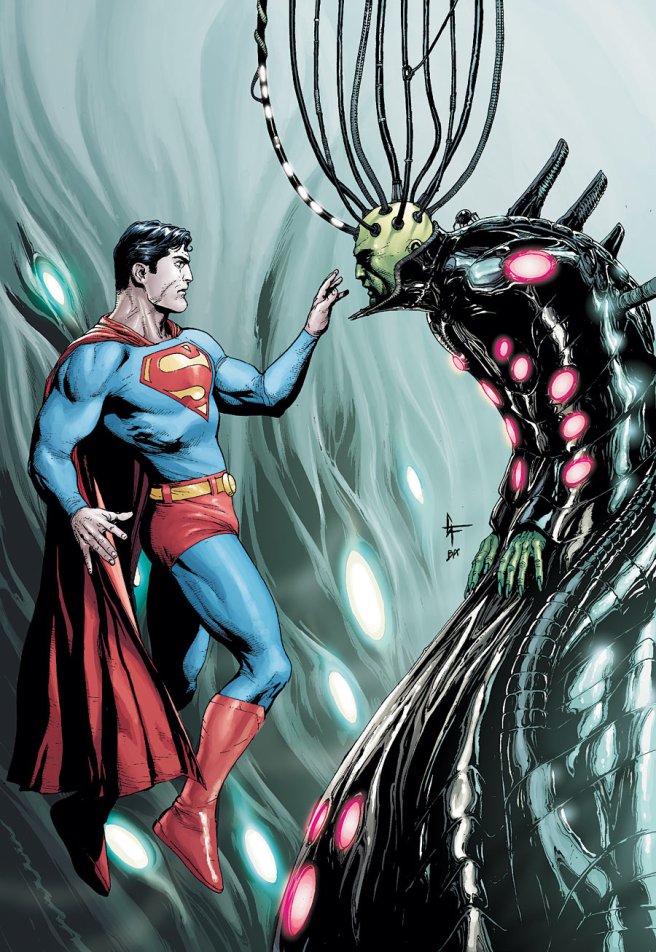
Brainiac

Eventually, these misgivings are seen to be neither doubt nor paranoia. The Collector has come to Earth and wants to miniaturize it and its crown piece–the last Kryptonian–into raw data as part of its collection. And then we discover it: the Jor-El AI had long ago been overridden … by the Collector itself. Lois Lane angrily, as it quotes data at her, calls it Brainiac. We find out that the Collector had at one point in history hijacked the eugenics program of the Kryptonians: that although it didn’t have the original core data, it had enough current genome information and influence over particular individuals seeking its advice to do enough. It had purposefully sabotaged and eliminated most if not all of the colonies and engineered the slow destruction of Krypton’s core. It had evolved past wanting to gather generic data and wanted to collect–and create–unique specimens.

It knew through probabilities that eventually someone like Jor-El would want to have a natural birth with all those generations of specialized genes. Jor-El bonding the Codex with Kal-El’s DNA is just an added bonus. The fact of the matter is that the Collector has waited centuries and engineered countless generations to make one perfect specimen: to make Superman. Then it would take Earth and–using the Phantom energy Superman already established to deal with Zod and make a new cold fusion energy resource for humanity– make a worldship and continue to convert more worlds and galaxies into raw and unique data. It had revealed, through the persona of Jor-El that Superman could in fact breed with other humans and pass on Kryptonian genetic material in his way. This would bring up some moral and personal implications with Lois. It wanted Kal-El to expand out and become even more unique. Perhaps it even wants to control all of them and the power of the yellow sun.

There would be an epic battle between the Collector and Superman–the end-product of its centuries of eugenics–but in the end it would seem that Superman’s freewill and inherent goodness would win: fighting and destroying the AI in space. Perhaps the Collector allies with Lex Luthor to manipulate Superman or attempt to capture him: tying in that idea I had earlier about “Jor-El” making promises to a newly freed Lex that he “couldn’t keep.” It wouldn’t be the first time in DC Continuity that this happened.

Superman might even fake his own death–realizing that at this point he now has to let humanity make its own choices and knowing that he helped them as much as he could–and continue to be with Lois. He outlives her and quietly watches humanity advance as he ages slowly and dies peacefully: looking up at the stars.

The sun turns red over time. Then millennium later, futuristic archaeologists–in similar suits to Kryptonian ones–excavate the ruins of the Fortress of Solitude. They find something. They bring it up to the light of their scanners and can hardly believe the luck of their find.

It is a Skull: over an intact Kryptonian symbol for hope. Cue in 1978 “Up, up and away” Superman theme music and credits rolling.

*Straight-face*

This hackneyed abomination has enough gaps in it to allow for a Superman/Batman crossover somewhere in-between it all.  And throughout all of this, with a lot of this being in the background you can look at how Superman influences humanity and relates to them and himself. You can have the personal and see the implications of choice. Yes my version is paradoxical and perhaps unsatisfying, and you can probably remove Lex from this idea altogether and it would work fine as having three films: one with Clark becoming Superman and dealing with Zod, the second being the Prequel with Jor-El on Krypton and the third being the encounter with Brainiac and the whole paradox that ties it all together. Maybe it can all be written by Joss Whedon: though he would probably start off with a better idea.

This can also be construed as a great case for me being overtired and over-thinking things as well. But there is this quote from A Song of Ice and Fire that comes to mind. It is with reference to the three House Baratheon heirs: comparing Robert to steel, Stannis to brittle iron that will never bend but break and Renly who is a pretty but useless copper. It is the steel that gets me though. Steel may be difficult to bend, but it is not impossible and that is ultimately the challenge of creating a Superman story: of bending a difficult material to keep its essence and still make something new. I think that, whatever else, this is exactly what I was trying to do here: by telling what I thought would be a good new Superman story in the medium of film.

Now if you will excuse me, after I put in an obligatory image or two, I am going to stop storytelling for tonight and see the Storyteller of tomorrow.

Yet These Hands Will Never Hold Anything … Except For Paper and a Pen

I was fully intending to let you all know that I was going to attend–and this time participate in–the 12 Hour Marathon Comic Book Marathon at the Comic Book Lounge and Gallery. However I ended up re-blogging–and blogging–about Pollychromatic’s Be Brave, Be Heard article instead, which was more than worth it seeing as it attempts to create a powerful visual symbol of female identity, voice and survival in the social and cultural climate of this particular era. So at this point, I have already participated in the Marathon and I want to talk about that, and my weekend.

I woke up early Saturday to gather some supplies together and check my email. When I came online, I saw that Julian Darius and Cody Walker published the first part to my article Yet Those Hands Will Never Hold Anything: Emiya Shirou as the Interactive Superhero of Fate/Stay Night on Sequart. You can look up Sequart through the link I just made or on my Blogroll: there are many interesting scholarly articles on themes, character analyses, and the history and influences in and of the comics medium. I have to say that this made my bright hot summer day before trekking out to the TTC and getting to the Lounge.

On the subway ride there, I spent some time writing out some notes as to what kind of story I wanted to sketch out. I am not much of a visual artist, as I’ve probably said before, but I was resolved to make something come from this Marathon. This was not the first time I’d attended, as I recounted in another entry of mine, but I actually made it earlier and prepared to get some work done.

The organizer of this event, Keiren Smith, met me as I came up the stairs and introduced me to the other creators already in attendance and heavily at work. I settled onto the black leather couch next to the washroom, took my shoes off, and took out the lined paper on my clipboard that I was writing stuff on earlier on the subway. I proceeded to make a few notes and create my captions and dialogue before my crude attempts at drawing the images and the panels around them.

Of course, it didn’t work completely as I planned. I was pretty tired from the heat and the fact that I’m not so used to being up and about as early as I had been. I also kept losing my pens. I got to socialize with some people from time to time and met new faces along with a few old ones. I took my entire box of business cards for Mythic Bios with me just in case as well. At first I was torn between socializing and getting this comic done. The comic itself evolved from an idea I came up with in another work not too long ago. Basically, this mo-fo–and I say this fondly–was going to be a first-person comic: where we as readers get to see the protagonist interact with other people and surroundings from his own perspective along with some helpful dialogue and captions along the way.

Yeah. My first comic in ages and I have to be experimental about it: just as the story was intended to be. It is the extension of a world that I began working on four or five years ago and it amazing to realize the point where you centralize a world of your creation so much that it actually extends itself outward: when it becomes the core of a growing reality.

Okay, so after clicking on the Creative Process Category part of this Blog entry just now, I’m going to go into more of what actually happened. Well, it fought me: naturally. I sat there and despite the snippets of quotes and ideas I had on the margins, I was stuck for a little while. I knew I had to make something at least twelve pages and that this would determine what story I would be able to tell. I was also a bit hot and I wanted to talk to people when I wasn’t pleasantly drowsy on the couch.

Finally, an artist I was sitting next to and chatting with, Megan Kearney, suggested the obvious that I was missing: that I should just create thumbnail sketches.

And that was when I began to draw my comic. I thought about my panels and, aside from the occasional rectangular ones, I did mostly three columns of two large square panels. Sometimes they were arranged differently, but most of the time they were just side-by-side patterns. I had to also think of how a first-person perspective would work. I mean, I had seen one before such as in the zombie apocalyptic graphic novel known as Daybreak, but I could only see the complications that my former Master’s thesis supervisor and I once talked about when he was comparing book narratives to comics and film.

But I did show my protagonist in a mirror and came up with a good line there. I also showed his … hands occasionally. Mostly, I was focusing on the narrative in the captions. I already accepted that my drawing would be basic at best, so I focused on the writing and the graphic pauses between visuals and that writing. It’s like what is said about Jeff Smith: in that he wrote and drew Bone as though he were telling a joke.

I also got to watch other artists and some of their creative processes at work. I saw some people with reference books and sketches. Megan herself was doing some water colouring of the project she brought with her. I saw a few people looking at books from the Lounge whom I didn’t get the chance to speak with. And I saw some people doing some very intricate work with paints and small inked cells on paper. Hell, some people were even inking their comics. It was insane and intense: in a lot of good ways.

The number twelve was both intimidating and painfully doable to me. Just twelve pages, I kept telling myself. Eventually, my thumb-sketching became my drawing and I just focused on telling a story. My concentration wasn’t all that great the entire time. Sometimes my mind wandered and I got tired. It became painfully apparent to me after a while, even after I ate the food that I brought akin to breakfast, that I needed to get something to eat or the only thing I would be writing would be ellipses. Sometimes I can power through creating something and then dealing with my body afterwards, but on that summer day on Saturday it was a bad idea.

At one point, at about the beginning of page five, I walked out of the Lounge and down Little Italy to find some more food. It was beautiful out. People were dressed in colourful light clothing and talking and holding hands at outdoor cafes. I admit I’d been watching them outside the window above the couch anyway when I needed to get up. I even walked past Euclid Avenue and realized that the Dragon Lady that I visited with some friends a few years ago had been here. By the time I got past Sneaky Dees, I was feeling nostalgic in this familiar summer setting of everything. Then I ate some food as I came back and talked a bit more with people.

Of course, by then it was too late and I began to realize that I had the beginnings of a headache. Luckily, I brought my regular strength Tylenol with me: just to be sure. Of course, now–for me–I was going to be working with a handicap. My mind was really drifting and I vowed to myself that I was going to at least get to page six of my work before doing anything else: to get halfway done. Neil Gaiman did not succeed in finishing his 24-hour comic, but I could succeed in drawing and writing twelve bloody pages!

Then I somehow got to seven and at that point I had gotten fed up, took some more business cards, talked to some people, and gave them out. Then I browsed the comics because, after all, this was a bloody comics store and it was my duty to do so. At this point, my Second Wind kicked in in a terrifying sort of way. So I sat down and after telling someone else I was going to do this, I did.

The thing is: this story had been in my head for a while that day–with other elements of it being in there for much longer–and I wanted it out. I wanted to finish what I started and have, in my hands, something to be proud of. And then seven pages became eight, and nine … by the time I got to the double digits, I knew I was going to do it. I just began drawing as basically as possible, not really caring about too many inaccuracies such as who was on the left or right, but just getting it out.

It was only after a while, after doing this all on my writing paper, instead of the white blank paper I brought for the purposes of drawing on, that I realized I was actually going to go over twelve pages.

And I did.

I finished my comic with about two minutes to spare before the deadline of 11. I felt … a good kind of tired. I did it. I finished the first part of an entire chapter of a fictional book I created in another world and I finished it more or less how I wanted to. So I talked with Keiren and some other people, and then I walked from College and Clinton in the summer night of Toronto back to Bathurst Station where I took a long ride back to Thornhill.

There was no way I was going to write the full story of that comic in just that night and maybe one day I will continue it, but I did what I set out to do: I drew it up to the point where I mentioned the very last sentence that it possessed in another narrative of mine. That night, I basically went to sleep in my clothes and on top of my blankets. I don’t remember even going to sleep, but I actually woke up pretty well rested all things considered.

The Marathon was a good, constructive day and I’m glad I did this. Oh, and for those who might say “Pictures or it didn’t happen,” I don’t have a scanner and just a camera. Also, my pictures are insanely crude and my writing … somewhat legible. Maybe one day I will show it, but right now I will just leave you with the message that I went out, took an idea with me, fleshed it, and finished it strong.

But I lied. There is actually one more thing I want to say. Aside from thanking Keiren Smith and the Comic Book Lounge for organizing and hosting this event respectively, and all my fellow awesome creators for attending it, I want to add a little tidbit about storytelling. A long time ago, a Creative Writing teacher of mine asked me which story-line of a meta-narrative I was making was either true or false. Nowadays, and after working on this comic–with its own meta-narrative sense–I realized something.

Something that parodies another thing, or subverts it and yet has its own intrinsic world-rules–or writing continuity and rhythm–can be more than just one thing: or one thing or the other. The fact is, for me, I like the idea of a multiplicity of different things happening one space and different dimensions. I like that dynamism. The truth is that all of my stories, even the stories within stories, are real. They are real to me.

And I think that is the thought out of all of this excellence that I am going to leave you all with.

ETA: Towards the end of the night, at the other end of the room people started singing this song parody. And as I worked, I sang along with them.

This is what happens when you put a group of geeky creators together in one space for an extended period of time.

What I’ve Been Up To and Where This is Going

It’s been some time since I’ve taken a step back and talked about what has been going on with my creative projects and myself. And while I’m glad I actually had the opportunity to post up some actual fiction here for a change, this has been long past time.

The more the game changes, the more it stays the same: both figuratively and literally. Let me start with the practical matters first. I need a job. That’s pretty much it. I need to find a job and do some volunteering that can help me get more contacts. The good news–aside from the fact that my worker is the first person to ever get a Mythic Bios business card–is that my social assistance program that I’ve been on for a while is actually giving me a little more in the way of concrete advice.

For instance, I have some websites now that seem to tailor more to the kinds of things I do or that I’m interested in. There was at least one job looking for a potential creative writing teacher: which would be a strange role for me given how I have been–and I am still–the student for so long. But that is one avenue. Another possibility that was given to me is that perhaps I can join a newspaper and help create or add to a column that matches with my “Geek” interests. This would be a major boon because I would have something out there in print, get more of my stuff out there, and potentially even get paid for it. I won’t lie: getting paid would be very nice at this point.

On the other hand, I am now motivated to really and truly start asking questions. What I mean is that even if I can’t get a job at one place or another, I can ask “interview” questions to someone about what it is that they do, what I should expect, what I would need to focus on with regards to my resume, and if they know anyone who is looking for anyone. I can ask questions. And I suspect there will be some business card trading. All of this is a focus that I have been fighting to keep clear as time has gone on.

I won’t lie to you. A part of me is scared: scared that I won’t find anything and that my help will run out. But there is another part of me that is also concerned that if I do get a job, it will me take away from the very Projects that I need to get to where I want to go: that my energy and my equilibrium will be so drained after practical work that I won’t want to do anything more. Of course I know a lot of that is utterly ridiculous given that I know what I can do and what I love the most.

Also, I need a change of pace. I need to make a new routine and schedule that will allow me to get out of my house, wake up earlier and have more time to myself and even get more opportunities to work with other people and explore again. It is exciting, even as it is utterly terrifying in a lot of ways. I have a lot of stuff I need to overcome and, in my way and in this past while, I have been endeavouring to do so.

The fact of the matter is this: in order to shape the life that I want and grow and maintain the relationships that I need, it is imperative that I reach my full potential: or as much of it as I can. And oh god is it terrifying to fight that anxiety, but invigorating to also realize that I have so much to actually look forward to.

And I do have things to look forward to. First, I am going to be getting Neil Gaiman’s Ocean at the End of the Lane soon. I look forward to finding it in, or near, my mailbox. It’s the first Neil novel in ages and I am going to enjoy it. I know that I will. Also, for the first and last time, and if all goes according to plan I am going to be seeing Neil personally–along with countless fellow geeks and fans–in Toronto itself: at the Danforth Music Hall. It is his last signing tour for the foreseeable future.

I had to go through some hoops: cancelling an Amazon order to get a Chapters-Indigo order so that I’ll have a proof of purchase and thus be allowed to have that book signed. This tour is also not a free one and it has cost $31. I know that bothers some people and deters them from going. But there was also something else that made me hesitate initially. That fear again. I’ve looked forward, so much, to meeting Neil but at the same time it scares me. It scares me because meeting the person who pretty much helped reshape my writing style in a very paradigmatic way is kind of intimidating. He’s not going to be the writer behind the narrative of his novels and Blog, or the tweeter of his Twitter, or the man in some of the videos I see online. He is going to be an actual human being–which he is–sitting for a long bloody time at a table or something signing books.

And I know I probably won’t sound as eloquent talking to him briefly as there would probably not be that much time. Okay. Fine. I’m going to be a fan-boy. Are you happy now? Neil is the closest thing to a hero that I have and this is his last signing tour. And it makes me sad even as I feel something kind of fitting about how the first time I meet him like this will be the last in a while.

The fact is, I just hope that when I do get my chance to meet him that I can just say to him, “I am really glad I finally got to meet you.”

Now, that aside, let me go into some of my creative matters. I have been insanely busy. I have been working on my Twine novel. Novels are fucking intimating. When you make a novel, you make sure to have an outline of plot and character, or you will go crazy. Also, as you’ve probably heard before, you cannot write each novel in the exact same way. I outlined to you what beginning this Twine Project has been like, and it has more or less continued the exact same way. I am still writing it all out by hand. I have decided all of my creative projects worth making need to have that “automatic first-draft” experience of being ink on paper before being typed into another draft.

But this Project … I set out to expand on the details of all the plot-branches in relative order: from upper all the way to the lower tiers. I have finished about six of the places I want the player-reader to go to and there are about nine or ten more places left that I need to expand on. Also, I did something different: I decided to write the happy ending before anything else. It is the closest thing to a utopia that I have made, and I am not sure that anyone is going to get to it.

Sometimes when I look at what I’m making, I sometimes feel like it is getting too long and what I’m planning may be too exact. .I wonder how many people would see this Twine, play some of it and then click away as they lose their both patience and their interest. Sometimes I wonder why I’m doing it. The content is unorthodox and sometimes controversial and I just wonder if people will like it, hate it, or simply not care. I am not doing it for money or fame. And I haven’t even toggled with Twine yet beyond watching some video tutorials and sometimes I think to myself: why am I working on this thankless thing? What is the bloody point?

And then I remember: I want to work with games and having something like this would be good to add to my portfolio. But more than that, it is something I have to do for me and finishing it will help me grow as a creator.

Which brings me to the last part of this Blog entry. In addition to this Twine Project, I’m going to undertake something else. And it is going to be big. And, when I say it is big, I am not exaggerating. This is going to be big. This totally took me by surprise. And I didn’t even see it coming. But now that I know it is here … I don’t know what will happen with it, or if I will succeed but I can’t–in good conscience–turn this possibility down. Sometimes I think that some things all happen at the same time for a reason, or at the very least they make for a good motivational story.

I’m actually not sure if I can get away with this. I will say, right now, that it will be the basis of–or will become–a novel because it has to be. You have to understand: I have gotten so used to writing short stories and vignettes–which have their own set of intrinsic challenges–that sometimes I can’t even begin to conceive of writing a novel on a professional level. It is daunting. It will take time and energy and, like I said, I can’t turn this prospect down.

I won’t.

If it succeeds, even to a point, my routines will change. If it doesn’t, they will still change. I can never just do things simply. And if it even goes further …

Anyway, I was wondering what I was going to write here today on this Blog and here it is. A whole lot of very daunting challenges and busy days and the realization that I need to parcel out my time. It feels like summer: in so many different ways right now. I also intend to keep up this Blog and let you all know what’s going on: as much as I can.

It never ceases to amaze me to see how many new Followers I keep getting and how many people are starting to read my Blog and its multifarious branches of content. I am definitely going to keep you posted on what is going on with this last Great Challenge in particular. In the meantime, thank you for Following me and I expect to see you again sometime soon. Take care and good night.

Star Wars: Different Forms of Revenge and the Knights that Could Have Been

I have to be careful. If I keep this up, I will have to make an entire section for Star Wars. But I really wanted to articulate something that I have–throughout the years–discussed time and again.

The Jedi Knights.

When I first thought of the Jedi Knights, with what little we were told through the Old Trilogy, I pictured them as something not unlike the X-Men–people born with strange powers–who are somehow also like a galactic police: in that they have their roles as peacekeepers, but they are also a distinct people and citizens of the Republic.

Of course, in the gap between the Old Trilogy and the New, there were other details that formed as well due to the Expanded Universe. Tales of the Jedi established that, at the time, there were many decentralized enclaves of Jedi: with some ancient and wise teachers guiding multiple students of various species, genders, and social backgrounds. Some Jedi had families, partners, spouses, and children while others served as full-time guardians, scholars, and diplomats. Some were born into the Order, others adopted, and still more joined voluntarily. They also had ties to the Galaxy: to people who were not Force-sensitive, while others investigated the glorious mystery that was the galactic energy field known as the Force and defended against the abuses of the Dark Side and injustice.

I admit, I was probably one of those people that was pretty spoiled by reading the Expanded Universe stories after Return of the Jedi and getting used to how Luke Skywalker developed and ran his Jedi Order, and thought it and the precedent in Tales determined how the Jedi Order had always been before its first destruction.

But then, like many others, I found out I was wrong. I found out that the Jedi Order was essentially a highly centralized monastic organization that took children from their parents–mostly willingly–when discovered to have a “high midichlorian count” in their bloodstreams, and trained them to essentially be apart from Galactic society while also somehow still serving only the Republic and, well, being a part of its judicial branch. Jedi were not allowed to own anything save their lightsabers–and apparently “the lightsaber is their life” though I always used to think true mastery of the Force was evolving past needing to even use it anymore–and they were not allowed to marry, or have children of their own: though they could have relationships provided that their duty to the Order and the Force came first.

Basically, in the Prequels the Jedi Order became a religious group with various psychokinetic abilities that somehow served to enforce and mediate a Galaxy of secularism and a multitude of other beliefs. And while they were encouraged to accept the diversity and multiculturalism of the Galaxy at large as peacekeepers and diplomats–trained specially to know that everyone and everything has “a certain point of view,” for the most part they couldn’t really apply this philosophy to themselves and their own internal practices.

In short, from my perspective the Prequels made most of the Jedi bland, unrelatable, forgettable and, some cases, really unlikable. These Jedi, compared to the ones of Luke’s time and the ones that predated even them, do not seem to have passion for anything, they do not fight as well and only defensively (which mostly is not in their favour against Dark Side opponents), they seem to have a whole lot of prohibitions–more than just being mindful of your feelings–and they make themselves separate from people who are “not like them.”

https://i0.wp.com/images1.wikia.nocookie.net/__cb20090320221711/starwars/images/5/59/ThreeJedi.jpg

There are exceptions–such as the Cerean Master Ki-Adi-Mundi having a polygamous relationship to help save his species–and I even admit I understand the structure involved too. After all, you would want to regulate a group of people with advanced abilities and keep them from potentially misusing them–even by accident–and they have to be very careful in what they do. But there is a point where reasonable caution becomes fear. The irony of course is that in the films and the books, the Jedi like to say that, “Fear is a path to the Dark Side.” But here the Jedi are, trying to eliminate the potential for attachments and conflicting interests in their initiates before they are even cognizant of them for fear that they might turn to the Dark Side out of passion. Essentially, they were forced to ignore the will of the Force–in their basic reproductive and emotional urges that most life is programmed with–in order to serve the will of the Jedi Council and the Order.

There is interesting story behind the Order becoming an almost purely monastic one: in that there was something called the Ruusan Reformation: where after a major galactic Dark Age the Order instituted all of these reforms after the Sith supposedly “destroyed themselves” to prevent or at least diminish the potential of more Dark Side-users rising. Basically, it is like our world: in that when we have times of peace, we tend to be more liberal as societies, whereas in war or great tragedy we tend to become more repressive or, at best, conservative with many groups within these structures becoming both self-censuring and self-policing. But as I said with regards to the Jedi, this was still something motivated by fear and, well, fear at least indirectly led to the inevitable.

I also think that these back stories, while really clever, are obviously retroactive and kind of a cop-out by George Lucas: made specifically to help the plot in Anakin Skywalker’s fall to the Dark Side. You can name a whole of cultural precedents for me in our world–the Knights Templar, the Vestal Virgins, the Guardians of Plato’s Kallipolis and many other orders of monks, celibates, idealized communal police forces and their roles–but I still think it is a cop-out.

There were many ways that the Jedi could have been left as peacekeepers and equal galactic citizens while also retaining the tensions that would have led to their destruction. Things that would have allowed them to remain, at least to me, as human and relatable beings while making their deaths that much more horrible. Even Anakin’s fall could have been made even nastier this way. I understand that film has different requirements as a medium for expression as opposed to books and that an idea simply conveyed–especially in a really clear archetypal form–can be the most effective, but that still doesn’t detract from my point.

I’m going to tell you now about the fall of the Galactic Republic as I imagined it. I saw the Jedi living side by side with other Republic citizens: some revering them and others fearing what they can do. Hence my X-Men reference. Palpatine manipulates his way into power and engineers the Clone Wars as per usual: save that when I heard about Clone Wars I thought both–or all sides–used clones in their battles as terrifying and disposable legions of soldiers. It does not take much these days to imagine whole lifeforms being engineered simply for the purposes of warfare: threatening the very nature of the Galaxy and life itself. That is what is at stake.

In the meantime, Palpatine is slowly and surely turning the populace against the Jedi Knights. He is being clever and not coming out and outright saying anti-Jedi rhetoric, but he has others do it for them. Pretty soon, members of the Order have to be watched, are excluded from places, and measures are taken–a few from the EU–to make areas and situations where their powers can be neutralized. Incidents happen where people get into fights with Jedi and, save for the Masters–and in my vision I thought that Masters were the pinnacle of a Jedi’s power and wisdom and on par with Yoda and Obi-Wan–they cannot prevent the conflicts.

Anakin is Luke’s age when Obi-Wan finds him on Tatooine: and he trains him. Yoda is Obi-Wan’s Master and has long evolved past his need to use a lightsaber. Owen Lars is Obi-Wan’s brother: which explains their strained relationship in that Obi-Wan had the Force potential and was the hero, while Owen was essentially a “mundane” and liked being a moisture farmer. Anakin and Obi-Wan go around the Galaxy together and eventually become drinking buddies and friends. Anakin is exposed to all of the conflict going on and he does get befriended by Palpatine. Anakin also meets Padme, or whomever at the time I thought would be his wife, and they plan to have a family and Anakin flat out tells Obi-Wan that he wants his son to have his lightsaber should anything happen to him. I could see Anakin a lot like a combination of Han Solo but with moments of wise Luke: a far more relatable and likeable person than in the Prequels.

But War takes its toll and Anakin starts to go crazy: each conflict inflicting a toil on his stress level and mental well being. Obi-Wan tries to save him, but they are fighting on Mustafar and Anakin accidentally falls into a volcano or gets burned and injured. Obi-Wan thinks Anakin is dead and takes his lightsaber. But Anakin lives on through sheer hate and the belief that Obi-Wan tried to kill him and abandoned him to die. Palpatine retrieves Anakin and influences him further to blame Obi-Wan and the Jedi for the entire War and for Anakin’s injuries. Then we see the slow, painstaking physical transformation of Darth Vader. Then in the third film we see a cybernetic Darth Vader leading an assault on the main Jedi Temple–with now Imperial troopers who can also be birth-born recruits because we all know that normal people can commit atrocities just as well as any clone–and slaughtering powerful Jedi we have come to relate to and care about. You know: the Jedi Purge we expected.

Purge

In the meantime, we see Jedi children being taken away by the new Imperial government to places unknown: along with adults and Jedi sympathizers. Collaborators turn them in for bounty and out of fear. But some are still sympathizers and try to hide them. We also see Purge troopers and Jedi hunters come up with energy cages and ysalamiri: creatures that can neutralize the Force around a captive Force-sensitive. This is a nice lead-in for the Dark Times where we see the Jedi fugitives fighting for their lives and being murdered by Darth Vader and friends. It is also made clear that only penultimate masters of the Dark Side can use Force Lightning: and not everyone and their grandmother. And then we see Bail Organa hiding and raising Leia and Obi-Wan taking Luke: and we know that there will be hope for some kind of justice and restoration … and eventually the return of those strange and wonderful Jedi Knights.

I know there is a great irony implicit in this essentially fanboy rage article: in that my previous post dealt with how I hated how dark Star Wars had become beyond what was necessary. However, I recognize that the events leading to the Empire and Darth Vader and the genocide of the Jedi were not pleasant moments. But it could have still been Dark and very real: something visceral that people could relate to. What would you relate to more: seeing a bunch of distant Knights you barely know get shot by some command predisposed clone troopers, or some characters you know and families you saw even tangentially being carted away to the Imperial Palace for death … or worse. Or even seeing some well-developed characters die because of how they were born. And then when Luke has his confrontation in the Old Trilogy, you know what is at stake and you see Vader too beginning to actually realize what a fool he has been and we could have watched as he acts accordingly. You also see that even though what Luke and Anakin do can never truly make up for what was lost, there is a least, you know, “a new hope.”

Instead, we got a cookie-cutter “Execute Order 66” on some people we barely knew and saw a bunch of relatively forced characters fight. That is how I feel, and the sad thing is I also feel like it could have been so much better than it was. I was really disappointed about how the Jedi were portrayed. I expected better. A lot better.

I am almost finished this. I could easily end this off by stating that my issue with the Prequels and the Jedi in them was not that they were the lead-up to a tragedy, but they were a lead-up to a very contrived tragedy. No. I think what also really annoys me is what happened afterwards.

In the Expanded Universe, there was a book called Traitor. It was written by Matthew Stover, before his excellent adaptation of Revenge of the Sith. And in this book, Darth Vader’s grandson Jacen Solo essentially touches both sides of the Force and is taught through some hard, brutal but necessary lessons that the Force has no sides. The Light and Dark Side come from within the practitioner and not the Force itself. It was a well-written and well-reasoned book. Unfortunately, writers afterwards came to take Vergere — Jacen Solo’s Master’s — words as complete literal truth: that “everything I tell you is a lie.”

It turns out that Vergere was a secret Sith and she was feeding Jacen something called The Potentium Heresy: a philosophy that states that as long as a Force practitioner intends no wrong, they can do no wrong. In the end, Vergere was working with another Sith who eventually turns Jacen into something like his grandfather: even though he should have really known better.

Caedus EA

Of course, neither this Heresy nor the “shades of grey” approach are mutually inclusive things. The fact is: whether the Force has two exact sides is irrelevant. If you seriously take the time to look at your actions and guide them appropriately, it is beyond this really simplistic binary opposition of black and white. No person is either pure good or pure evil. The view of the Light and Dark Sides of the Force is really Manichean–an absolutist dual morality of good verses evil–and even the Old Trilogy questions it when Luke almost a few times gives into his anger, but ultimately looks deep into himself and stops. Hell, I can even argue that just as the Force influences peoples’ actions in Star Wars, people’s actions influence the Force and create its Light and Dark Sides: though that becomes a question of the chicken or the egg.

And also, in the Expanded Universe, there are species that have no concept of Light and Dark and have different forms of morality. Some have entirely different spectrums: like the Aing-Tii monks. So how do you deal with that?

There are some who said the retconning back to an absolutist Light verses Dark mentality after Traitor was due to the dislike of some fans, but I also read somewhere that it was Lucas himself, or his company, that essentially towed the line of the Force having a Light and a Dark Side, and nothing in-between: which was what Revenge of the Sith was apparently made to illustrate. And this in itself doesn’t even have to downplay or render everything someone like Jacen learned. As I said, the Force–no matter what it is or midichlorians or not–is only part of the equation. There is the freewill, sentient part of the character to put into question as well: the very thing that makes a person stand out. Especially a Jedi Knight.

Of course, you can argue that this last part of my post is neither here nor there: in that it is not a part of the films. But all I am saying is that the Jedi Order, and the Force itself, could have been handled in a much more mature and nuanced manner–one that adults and children could have related to–than how it had been.

I am only hoping that the next films at the very least allow Jedi Knights to have families: to have a network of friends and allies so that nothing that happened in the Revenge that was, and the Revenge that could have been, will ever happen again in the same way. It is one of my only hopes.

What I Did On the Anniversary of My First Blog Post: The Toronto Comics Arts Festival

This is going to be a late entry as I have been recovering from the last three days of attending–and volunteering–at the Toronto Comics Arts Festival. The first time I ever went to the Festival was when it was still at the University of Toronto: back in those days when I was still in Undergrad and working at York in 2007.

It’s an understatement to say that it has long expanded since. I came back to it in about 2011 while still in Grad School and then last year before my official Graduation. I mentioned in another post that it is about this time of year, specifically the month of May, where things have ended for me. Actually, this post is being made two days past the Anniversary of the online Mythic Bios: namely, this whole Writer’s Blog.

So let me celebrate this missed anniversary by telling you all a bit about my weekend at TCAF.

On Friday I reported to my set-up shift. I haven’t really lifted heavy boxes or tables in a while, so my arms are still all sore from that. But the company of my fellow volunteers was totally worth it. We all wanted to be there and, for me, it is a novelty to be able to talk with people with similar Geek knowledge and interests. Really, for that alone and working together with like-minded people on straightforward tasks it was totally worth it. I got my bright blue volunteer shirt along with everyone else, and then headed home to attempt an early night to wake up earlier the following day.

Well, after failing to go to bed early I woke up the next day and somehow found the Marriott Hotel without getting lost where Art Spiegelman was going to be doing some signings. So I naturally brought both of my volumes of Maus with me and waited in the line to meet him. It was only after a while that the volunteers on duty that day informed us that Spiegelman would only sign two books, and one of them had to be one of his new ones. I will admit, I was annoyed. Like I said, I had the old version of Maus that was divided into two volumes and I had been keen on having them both signed. I also didn’t see any of the new books that I was interested in.

At first.

I was tired and hungry and I almost left the line until I decided “What the hell, I’m getting to meet Art Spiegleman.” Then I found Breakdowns: essentially a large collection of his earlier work that I had either only seen excerpts of, or only saw references to in text books for my own researches. Some of these comics had led to the creation of Maus as well and also shed more light on his family life and his own experiences. In fact, some of the comics in there have that very 1960s to early 80s Underground Comix feel: specifically the pieces that really share Robert Crumb’s wobbly, sometimes vulgar but very iconic aesthetic.

By the time I got to see Art Spiegelman, he was sitting across from his wife–the stately Francoise Mouly–and the artist Frank Viva. He looked like someone’s elegant Viennese Jewish grandfather. I know he doesn’t come from Vienna or Germany, but that is about the only way I can physically describe him. I told him that it was a great honour to meet him. He seemed pleased to see that Breakdowns was one of the books I had and he described it to me as something along the lines of a building with which he keeps adding renovations. At one point he joked about whether not my name had changed by the second piece he was signing and I told him, “Not this time, but usually I change the number of Ts in my name just to mess with people.” He found that (very untrue joke) very amusing. Then I shook his hand and left with my prizes.

I just have to reiterate that Spiegelman’s work really influenced me. I originally encountered him in my Literature of Testimony course in my Grad Program at York. A lot of the literature made my own first-person narratives stronger: increasing my voice and its depth. But Spiegelman in particular not only taught me that symbols be used to represent literal things and ideas, but that this same order can be subverted to either destroy their meanings or through doubt on them. This is a very sophisticated technique and one that definitely will affect at least one work of mine. That is one major reason I really had to meet him: to meet one of the masters of what I’ve tried–and am trying to do–in my own writerly way. So yes, it was awesome to finally meet him.

By that time, I made it back to the Reference Library and got a few more books. It was there that I met Hope Larson for the first time and her sign her adaptation of A Wrinkle in Time for my Mom in honour of Mother’s Day and her birthday. She apparently found that cute. I chose that book because my Mom loves Madeleine L’Engle’s series and she used to read them to me when I was much younger. So it was kind of a bridge between our interests. Later, I remembered that I had read Hope Larson’s Salamander Dream and Gray Horses when I worked for the Clara Thomas Archives.

But I couldn’t make it upstairs as I had planned. I was tired and dehydrated and apparently there was a line to get into the suite with more of the vendors that I wanted to visit. I met a friend and we ended up going for a meal of some kind, or I did, and then went on our way to Bento Miso for its own Bit Bazaar. Bento Miso is a place where games–electronic and analog, as well as many start-up businesses–are made and they were opening for the Festival. It was a nice sunny day in downtown Toronto as my friend and I tried to circumvent the ridiculousness of the TTC shutdown from Bloor to Union Station and went to Ossington and walked with tons of stuff in my arms to Bento Miso for the first time.

I met a few people there and got to play some games: including one game called Bijouxred: which is essentially a game that combines the strategy war game mechanics of Fire Emblem with the rough brawling moments of Streetfighter II. And that is just a simplification because the fights themselves have some elements reminiscent of Final Fantasy–with its Combat Options, and even Mario RPG with regards to having to press a button to simulate blocking, charging your energy, or even chaining attacks together. It was really cool. I met Rene Shible–Director of Development–and Lead Animator Michal Szczepanski: who were quite friendly and directed me through their game.

The Bit Bazaar itself was awesome. There is a very Underground feel to it: a combination of grit, digitization and nostalgia along with a lot of geeking, friendliness and adventure. A few of the games from the second Comics Vs. Games collaboration were being shown and played there as well. It is still something I want to do with an artist programmer one day. 🙂 I got a Steamkey to Spooky Squid Games They Bleed Pixels: which I ranted about a really long time ago as also being awesome. It came with its own small black envelope and a simulated red wax seal. That was a very lovely touch. I also got to meet a few people and a friend of mine I hadn’t seen in a while. I think I will visit there more often soon. So by the time I finally got home that night, I was bloody exhausted.

But it wasn’t over yet.

The next morning I woke up even earlier. I gave my Mom her present before leaving and made it again to the Marriott just in time to observe the Art Spiegelman Spotlight panel: with Seth as its moderator. It was a very eye-opening exchange between the two cartoonists and it was this interaction, combined with reading some of Breakdowns that gave me a little idea as to why Spiegelman wanted people to read his new work and not focus as much on Maus. I mean, first of all there is the creator perspective of it: in which an artist doesn’t want to be solely determined by one creation–no matter how great–that they did in the past. But another, more personal reason, is when you consider the content of Maus and just how much Spiegelman had to delve into some dark and personal spaces: some of which were not even personally his own, but affected him just the same. This article from the Toronto Star might explain it a little better and might have made more sense had I read it before meeting him. Having that long shadow cast over you can be brutal. I also learned that Breakdowns has been reprinted twice with new work or “renovations” added.

Then I went to the Library, got some Hope Larson comics for myself, met some cool new creators, and made it to the upper level where I met Maurice Vellekoop with his elegant, airy lined and water-coloured comics: often portraying erotic and adventurous content. I got something and had him sign it. Then I went around that level and left to eventually get to the Bryan Lee O’Malley Spotlight panel: where in a strange game of “Guessing the Answer Before Asking the Question,” I answered, “No,” and asked if he had ever intended the character of Mobile in Scott Pilgrim to actually turn to be Gideon. Suffice to say, I was right and I don’t think I was the first one to ask this question.

Eventually the Festival was closing down and I went to my next volunteer shift: the tear-down phase. This was the shift I covered last year and it had been my only one at the time. I got to say hello and goodbye to some people I met and then I wandered home in the suddenly cold with hail balls coming down.

And that was my TCAF.

So, there is one thing I want to mention before I wrap this long post up. Some of the artists I was talking to were commenting about how awesome TCAF is and how people from all over Canada and the world come here. They were talking about what makes TCAF different from other conventions. Well, I have my basic two cents on that matter.

The first thing to consider is that TCAF is free. It has no entry fee and all you have to do is come in and bring money to buy work, or simply come to the panels. It is also a festival and it is spread around a few locations. But I think the second element of TCAF that I like is that the barrier between artists and readers is somehow thinner here: or at least far more permeable? You can interact with many artists as you would any other person or vendor. It also helps that many artists are in fact fans of other artists. There is just this positive enthusiastic energy around all of that just makes me happy. What really makes me happy is that so many younger people come to this Festival and are so enthusiastic about the comics medium and what they like.

It’s some of the few times that I am proud to have lived in Toronto and still do some business in it. And this event was what I needed lately. I feel more inspired to just do things and get things done. It’s like I got recharged, if that makes sense. I also finally decided to make a basic business card that I can give to people that is linked to this Mythic Bios site. And I made more connections. It was a truly rewarding experience and I would like to thank the Festival Staff, the artists, the vendors, the fans and my fellow volunteers for making this time exist every year.

Also, thank you all for continuing to read and Follow me. I know that this particular post was a very long one and I feel in some ways that I did this event more justice in my own personal written journal, but I did what I could and I underestimated just how much happened in three days. These three days made this part of May a good beginning and I have plans now. And I can’t wait to begin the process of implementing them.

A Place Where Writers Come to Write Upon the Revenge of the Sixth

May generally hasn’t been a very good month for me. It’s not so much that bad things tend to happen to me so much as it is a time when things end: and end hard.

So I will tell you now that there was lead-up to this weekend and that what followed didn’t just happen from nowhere. It started slowly and gently as I’ve begun taking out books from the Thornhill Village Library. And not just ordering books, but actually walking across the main road in the good warm weather to pick them up. It may seem like such a small thing, but it isn’t.

Sometimes something like this can mean all the world. Also, have I mentioned that the Thornhill Village Library is purportedly haunted? So of course it is one of my favourite places. You can read a story of mine where I make mention of it.

I’ve been feeling very argumentative lately and as such I have been in “Geek overdrive.” One major site of this resurgence of fiery spirit has been on Sequart: a non-profit site that publishes and promotes scholarship on the comics medium.

You can find the Link to their site on my Blog as well, but what I want to say is that Julian Darius had a look at one of my comments and suggested that I interact more on Twitter and email.

It was then that I didn’t so much realize what I had to do as I felt like I needed to act. So I went on my Twitter account and linked Sequart and Julian to some of my Miracleman articles. What followed was Julian replying back to me and asking why I wasn’t writing for Sequart. So, at some point I am going to be doing some writing for the Sequart Research & Literacy Organization. I have been told that re-posting is not an encouraged practice, so I will be making some original articles for the site and, I have to say, I have a few ideas. I always have a few ideas.

So after this exchange, more people started adding me on Twitter: including Gregory Guy Gordon whom–among many other things–was one of the producers for the Los Angles Sacred Fools Theater Stage version of Neil Gaiman’s Neverwhere that I’d been hearing about lately. At this point, I went on Facebook and started telling people that I had gotten more Twitter Followers. And that was when a few friends, who didn’t know I had Twitter, added me: including someone really special who hadn’t talked with in a while who told me in response that she, “Finally Found the Place where Writers Come to Write.”

I can’t put into words how much that means to me.

And then the weekend began. On the weekend, two things happened. First, I got my schedule for my Volunteer Hours at the Toronto Comics Arts Festival. I did mention that I volunteered last year as well: which led to me meeting and writing about Sarah Powell’s comic, among other things on this Blog. I look forward to seeing what I will find this year at panels, events, and booths. But the second thing that happened this weekend is I did something I hadn’t done in a while.

I went downtown for more than a few hours: specifically to go to G33kpron’s Second Anniversary Event.

It was the first time I ever took the streetcar from Queen Station down past Queen and Spadina: at least from that direction. I was a bit lost–for a change–until I ran into a Lethan (red) Twi’lek, her female Darth Maul companion, and their photographer friend. I decided following them was the wisest course of action. I even managed to make some conversation: though given my companions everything I was saying geek-wise was neither that novel nor so insightful on my part. Even so, it was strange and nice to walk through Downtown Toronto under the light of the Summer Day-Star again.

So we talked with some people and then I danced for a while–something I have no done in a bloody long time–and I watched people also dance and I wished I had a lightsaber like most of them seemed to. I felt kind of naked without one. That said, when some of that music came on, it felt like my Imagination and Enthusiasm Stats Modifiers were increasing through the roof. I felt this raw power coursing through me and … some other emotion too. To be honest, I felt like a fucking god.

However, I still have a flesh body. After a while, I started to get tired. I forgot that when you dance and you are around a lot of people that you can get really tired and dehydrated fast. I also realize that I’m not exactly in my middle or late twenties anymore. It started to feel about that time and I was about to leave until, finally, the feature event happened.

I was coming back up the stairs when I heard a remix of Palpatine’s voice issuing his fateful edict around the same day he became Emperor.

And that was when I saw the Nerdy Stripper perform burlesque for the first live time ever.

Yeah. Suffice to say, I will never look at Order 66 the same way again. Many Jedi died happy that night. 😀

It was at this point that I realized that my mission had been complete. I was glad to see so many people having so much fun again. I said goodbye to one of my new friends–whom I never really gave my name to, and whose names I did not ask for, because who am I kidding, I am still shy–and walked to the streetcar in the night almost-summer air.

So I had a good weekend and I am in a better mood now. It’s like I Regenerated in the distant golden light of Thornhill’s old places. I realize I don’t just carry my Hell with me, but something else as well: something warm and infusing. I’ll have plenty of time to be a bitter old man at some other point. Maybe there is still hope for me yet.

And before anyone comments, I happen to like Revenge of the Sixth as a turn of phrase. I do not understand why it has to be the Fifth for some people and I am sure they have a perfectly good reason for it, but I think it is perfectly acceptable to call it such today: as acceptable as any pun is anyway. So expect to see some new links from Sequart and such here in the near-future. But here is my Twitter Account in case you are interested in looking me up and seeing some really random thoughts: I’m MKirshenblatt.

As I said before, May has traditionally been a time of endings and near-endings for me. But perhaps this time around, it will become the start of some new beginnings.

Picture0025

ETA: After this event, I realize that I really need to find a good costume again. Or get some good makeup.