Fanfiction and Story Insights: Or Plausible Creativity

It’s been a while, yet again. I know that I have talked about fanfiction before, but I have been working on a particular story on A03 that has made me think about certain elements. It also helps that this DeviantArt article on Mary-Sues was brought to my attention. I don’t know if I agree with a lot of it, necessarily, but there are some good insights within it with regards to making a particularly plausible or believable character in which to make a story of a similar kind around.

It is important to bear in mind that any character you create, as a writer, should have their own strengths and weaknesses, as well as have different relationships with other characters and environments. In other words, a good character is arguably as close to a realistic person as you can make them, even on a basic level, where they have different facets that you as a writer can explore.

But I have been thinking less about this point, and more about how to write fanfiction: specifically setting a story in an established fictional universe. And I’m afraid that I have less advice to give, and more of my own personal insights — or what works for me — to actually talk about.

I find that what really works for me is to use characters that already exist. Often, I can create dialogue and character studies and let them play off of each other. The dialogue is important to me as it embodies who those characters are, how they are different or similar to one another, and what is actually important to them. Sometimes I will even act out those characters, aloud or in my mind — as I do with my original fiction — and see what happens from there.

I research them and their world as much as possible. Sometimes I don’t necessarily read the original work or narrative from where they come from, or the particular element that I want to focus on, but I will read up on it in encyclopedia articles. In some cases, I will look at other media such as animation or film instead of the original texts. This isn’t always the case, but especially for Star Wars Expanded Universe and Fate/Stay Night I tend to do this.

For me, I find the best fanfiction — that I can make — is the more plausible kind. I try to work with continuity and the rules of the world in question as much as I can understand or, learn about them. I do not add new abilities or characters, but if I do I will try to incorporate some kind of logic or description of them that fits that world, and describe their mentalities in a way that makes sense as either influenced by the world or the pre-existing characters.

A lot of it, for me, is extrapolation: seeing how the characters function in that world and then placing them in another situation or series thereof and seeing how they will pan out from there. Often I focus a lot less on physical description, and — as I said before — dialogue, but also a lot of third-person limited introspection. I tend to refer back to events, creating call backs, to both things that happened in canon and things that happened in my fanfic as well — in the narrative — to fully flesh things out further and add to that sense of plausibility.

The way I see it, at least with the fanfic I have been writing for over seventy chapters as of this post, I have done a few things. First, I extrapolated on the characters previous actions and emotions and gradually transitioned them into newer but familiar places. I have made original characters too that I might plan to use in another fanfic, or a sequel, but I use them sparingly. When I build up events or changes, I make sure to show all of the steps. Sometimes I will describe something. Other things I will reveal it through dialogue, limited narrative perspective, or even an italics-based first person point of view throughout the work.

But sometimes, there is the other challenge. Imagine you are trying to work in a creative sand box, but you have this idea that is incredibly fascinating to you. You look at it, and you feel like it would make for an excellent development in the story, a nice chapter for instance, but you don’t know if you can describe it well, or if it works in the lore of that world. Sometimes you have to let it go, for the story’s flow, and for the sake of your own sanity. Certainly, you will have a fanbase of that world watching your every move in some form to consider.

At the same time, though, sometimes it is for the sake of the story itself that you should in fact challenge yourself in adding this new chapter or element. The main challenge is incorporating it into that world. You can do it by making it clear this world is just a gradation or variant of the established one. Or, conversely, you can leave it open and ambiguous: with just enough examination or description to hint on one thing, or another and leave people to wonder. For instance, I gave a character an ability she probably shouldn’t have had, but I played around with the relatively ambiguous and not always orderly rules of that world: and I described a way in which she could have gotten that skill in a few ways, and how it fit her power and her intention.

Basically, I extrapolated a character’s abilities after her time in canon, with what little knowledge we were given of them after the fact, and then added this little surprise. And then I had her and another character address this: where even they were not entirely sure how she could do some of these things, or how it worked. It is a little jaded and self-aware, but I took advantage of a loophole in their knowledge and offered a plausible explanation — or head-canon on my part — to make it possible. To me, it made sense. I had to rewrite some of it, but I think it works and I am glad I took that risk because it makes the whole fanfic stronger for it.

For the most part I have been careful, building it up, but in that particular instance I thought starting with a fight — even in an unfamiliar place to me and the characters — worked. I did research it as much as I could, aspects and all, but in the end I just had to write the damned thing. And like I said, it worked for me.

And then, in this same fic, I have had other challenges which in turn have offered unique solutions. For instance, mythological figures are used in the world in which I am writing. So at a few points, the characters have found or searched for items associated with these figures. Most of these artifacts have been described in the story, or in encyclopedias. However, some of them have not. I found myself in a quandary: where I had to determine what these artifacts were, how powerful they are, and how they were different from each other. There was one in particular that I had no information about beyond a basic description in normal Wikipedia or elsewhere. And it wasn’t even in the fictional universe I was working within.

So what I did, was I took the artifact and described what it could look like. I gave it something of a Whovian perception filter: that some characters could see it and have some idea of it, and others could not. And even the ones that could knew that they saw something subjective. And it matched the nature of what the item was, and what it does. I explained, through dialogue and some thoughts of one mythological figure how this might be so, and how it was different from a similar artifact which went back into this character’s history a bit. I also gave an explanation as to how another enchantment of hers was related or derived from said artifact. And because she is so old, and due to the reason she exists again, she doesn’t remember all of it. But in the end, it isn’t that important. What is important is that I grafted an item related to a mythological character who has been adapted into that universe. I made it plausible. And I covered my own ass, hopefully well, by making that knowledge subjective through that character’s perspective.

I’m not going to say that I’ve been perfect, because I’m not. I have a feeling there might be some loose ends in the tapestry I am forming from my idea of a pre-existing one. And here is the most important thing that I have to tell you.

The best thing you can do when writing a fanfic is to put your slant on that world. Your voice. The way that you want to look at that world. When I write a story, I look at character interactions, and philosophical implications: specifically introspection and development in between the fighting, the fucking, the walking, the sitting, and the discussion of past and present events. I want to deal with actual talking, and dealing with closure: as well as emotions coming from the results of consequences. Not everyone is interested in that focus, and I know that.

Some fanfic readers want to see the minutiae of that world and their favourite characters unfold. Some want to see the stories of their heroes continue. Others want to see those conflicts from canon get resolved or come to a head: to have the good person get their justice, or the jerk get smashed in the head with a baseball bat. Others want to see characters they hate die or suffer, or others ascend to greater potential.

Honestly, I have had commenters on my fic request romantic pairings, and outright fucking.

The point is, everyone has different expectations and you have to tell the story that you want to tell. You will never be the original creator, and that is a good thing. You can explore things and do things in ways they did not. As for me, I like to remain plausible and retain a sense of continuity, but I will suspend it for the sake of what it is all is — entertainment — while backing up what I say with details if I can, or I will fudge it by finding some kind of ambiguous loophole while making it all about those character interactions.

Now this, all of this here, was a lot of text to read. So thank you for reading this far. I have to say, writing so much is exercising my mind: getting me to research, think, and plan creatively. I am still working on my own projects in the mean time and, who knows? Maybe one day I will share some of them with you, once again. I hope to write to you all again soon, as time goes. Take care everyone.
The Plan

It’s been tough.

I’ve been going through a lot of personal issues lately. And these issues have been further compounded by writing problems.

In my last post, my last real one aside from reposts of my other work, I was inspired by Brandy Dawley to actually attempt to personify or give form to my inner critic or judge. If you haven’t seen it already, you should check out her Medium article  On Creative Paralysis, Feeling Naked Online, And My Inner Critic Whose Name is Chad: which is what inspired my Mythic Bios post “Time.”

I’ve been thinking about why I haven’t really been creative writing for a while. Originally, last year now, about the time I saw Stan Lee, Alex Kingston, and Michelle Gomez at Fan Expo I was charged enough — re-energized and inspired — to attempt writing full-time for Sequart. The idea was that I would write my 15K words on the side while I re-innovated my Patreon, and only doing so after having something of a centralized creative project or clear series of goals with regards to said project with which to work towards.

But 15K words a month is a large commitment. And perhaps even more than that, there is a difference between writing something that is analytical as opposed to being creative. It’s true that I am fairly creative in expressing myself and my words and viewpoints in my critical writing, and that does tide me over, but it really isn’t the same. Sometimes I become very mindful of the fact that I am not really making anything original. I’m not making something that is mine. While I have made good contacts and gotten my critical writing out there, and got to examine some fascinating creative processes, I can’t really take credit for them. They aren’t my own: at least not the source material that I write about.

This feeling can fuel Imposter Syndrome considerably. I may have to actually cut back, or down, on my analytical writing into the near future. There are some topics I definitely do what to still address and I won’t rule them out, but I need to make the space to create my own primary material once again.

So what will I do instead? Well, I have comics that I need to catch up on reading. And films and television shows that I definitely need to watch. I do require inspiration to continue my good work. I also need to take care of myself and possibly get to the point where I can go to bed at reasonable — read sane — hours.

And this leaves us at what I want to ultimately do in the future. Well. The good news is that recently I have sent out three creative pitches to the Toronto Comics Anthology. It just felt time to put my money where my mouth is. But that is only a start.

I need to go through my notes and my notebooks. I need to type out and I edit what I have of at least perhaps three or four creative worlds I’ve left for far too long. I need to decipher my notes, type them out, and make sense of it or discard what I have and start fresh.  Then I need to go back to my Patreon, however daunting it may be and challenging as you need to have a strong following and project to get anywhere, and redesign it accordingly. I am not a graphic artist or illustrator or even a video maker, but perhaps I can do something about replacing my picture on the top border, and making my funding goals clearer for me and anyone who potential wants to back my work.

I still have some critical pieces I want out there, but I think what I will do is return back to the Mythic Bios approach to these matters and write the personal into the critical as I used to do.

All of this is easier said than done, and I have said similar things in the past. I realize I can’t force a lot of this, but if I make the space and just record what I have, and read and write and not force it, I could form something else. I know I can still do this. I’ve been working on a public fanfic that is now forty-five chapters long and counting. I find that I actually thrive on just writing, on doing some research when I need it for a day or so, but then just writing on wards and writing more to back up what I wrote before. I am stronger when I just keep going. This and actual feedback through kudos and comments really does help me, and it is something I should definitely bear in mind. I just need to find the format and the media for it as I am not sure, for example, that A03 is the best place to publish original work.

I find I am at my most powerful when I am painfully honest. And that is scary. But if I have any hope of getting to where I need to be, I need to be at my best. I know that hard work is not a guaranteed method of success, but a lack of work is a guarantee method of no success. It isn’t even failure. Failure doesn’t happen when you don’t even try. And not trying is inaction and nothing. But reading and writing aren’t nothing, even if they are just focused on a fan work.

The point is, I hope to make some changes and to continue the ones that I have begun. I hope that those of you that still follow this Blog and my media will be there to see what I will do next.

My Fanfiction Origin Story

The title is more epic than it actually sounds, but when I think about it the entire thing had been a story long in the making.

Some writers believe that fanfiction is a waste of time. Certainly, you can’t really profit off of it unless you have the original writer or creator’s permission, and you do not want to run afoul of copyright infringement. But that’s not what I’m here to talk about today. I’m partly here because it’s been a while since I’ve put anything on this Blog, my Writer’s Blog, that hasn’t been a repost from my Sequart work, or elsewhere.

I suppose I’d … always written fanfiction. In fact, I did it ever since I even learned how to write. Often I’d watch the 1990s Peter Pan cartoons and attempt to write the further stories of Captain Hook, Teenage Mutant Ninja Turtles, and more. In the eighties and nineties though, as a young child, I was mostly interested in horror stories and mostly rehashing the old urban legends and Hammer film derivatives of horror classics more than anything else.

I don’t know if I remember it properly, but I think it really began in Fine Arts Camp. It was at the MacDonald House in Thornhill, once owned by the Canadian Group of Seven artist James Edward Harvey MacDonald. At the time, in the 1990s, I fancied myself something of a graphic artist. I was really passionate about drawing and creating cartoons. It made sense given my interests and my immersion into old DC and Marvel comics and a lot of the stuff coming out in the nineties. Certainly, I wasn’t all that interested in landscapes or other forms of graphic art. Just cartoons. Just comic books.

To be honest, Fine Arts Camp for all its fascinating old MacDonald House that was a good place to tell children urban legends and horror stories near a church and a community swimming pool, wasn’t always so ideal for me. For one, I had terrible allergies and being almost always in the middle of a woodland, surrounded by many trees, did not do me or my lungs that felt like they were getting kicked by horse hooves at night any favours. Also, well, when you are a child and generally an indoors one you have to understand that for all a camp will call itself a Fine Arts Camp, they will still force you go outside in various temperatures and play sports more than you will want. It was the same in the Computer Camp I went to, thinking I’d learn about animation and programming, and it was the same here before it.

Also, when you are extremely introverted like I was, you don’t tend to make a lot of friends: especially not from children your age or, worse, older. To make a long story short, aside from arts and crafts, and even some walks, I didn’t really always like being at Fine Arts Camp. But, I did discover something there that has sat in my head, with me, for the rest of my life.

I don’t remember his name. I’m not even sure he was the same person. But I knew a kid there, a few years older than me. He had in his hands, at the time, something I coveted the most. It was the Wizard Magazine: X-Men 30th Anniversary Special. In that magazine was all the information I’d been looking for about the X-Men and more, so much more than the Marvel cards and their lore that I had been collecting then.

For all the little squabbles we all had there, being kids, this guy was generous and he let me actually read parts of the Magazine. And, even though the other campers really thought I was weird for doing this and it probably gave them more fuel to push me around later, I was actually taking notes on all the information I could find. It wasn’t enough and eventually, after much pleading on my part and my grandmother’s reluctance to spend or let me spend all of twenty dollars, I got my own copy: which is still somewhere down in my basement somewhere.

But the important thing I want to note here is that this same guy, and may not necessarily be the same guy, liked to write. He told us that he would type up his stories on an old computer. Somehow, I remember him saying he had the Internet and frequented BBSes looking at stories based on franchises like Star Trek and Star Wars. I might just be projecting that, as I had no idea what the Internet beyond school was or what a BBS even was at the time. But I remember him saying that he liked to write stories where Star Trek and Star Wars crossed over, and perhaps something about Locutus of Borg meeting the Empire.

It blew my mind.

I don’t remember all the details, but I recall the way he described his ideas and his stories. I think he even brought in some old computer paper with rings on the sides and clunky font. And I definitely remember wanting to write franchise stories.

I wanted to make those crossovers. I wanted to write Star Wars. I wanted to write comics and all the things.

That’s how it really started. There was an attempt at a Star Wars expanded universe story in my Seventh or Eighth Grade Writer’s Club anthology: where Luke Skywalker and the others meet a Dark Jedi fighting against the Empire and the Phantom Fleet. But you can imagine how well that was written at the time, and even more so how it aged since.

But I roleplayed out original Star Wars, X-Men, and Power Rangers episodes with my best friend Sean, and I kept writing. I still attempted to write my own works, but they were derivative of R.L. Stine’s Goosebumps and Fear Street, along with some Christopher Pike, so you can imagine what those might have been like.

I think my writing skills started to be honed after high school, after reading more and writing an original short story in which I won a Senior Literary Award in 1999. I joined TheForce.Net again in 2005 and wrote what I thought were clearer iterations of Prequel stories. Unfortunately, despite all their assurances that everything would be saved, a lot of my works were lost when the Board attempted to transfer its data to a new server and most of my old works were heavily truncated.  It’s something I never really got over, after all this time and, frankly, it’s kept me from really writing there as much anymore.

But I learned a lot out of writing in different pre-made worlds.. I learned about what writing I liked and what I didn’t. They gave me ideas and frameworks for them. And sometimes they gave me an outlet to tell stories I wasn’t prepared to tell when I didn’t have a voice for them. Yet I think, most of all, fanfiction keeps me writing when I don’t feel inspired to write my own work, or when I’m getting overly critical and analytical.

Recently, I’ve joined AO3 to give some of my fanfic pieces a broader audience. I didn’t really like the freeform administrative style of Fanfic.Net, and TheForce.Net’s administration can be … sporadic and highly dogmatic in terms of poster interaction at best. But AO3 has a lot of variety and also maturity at times with regards to their work. So far I am liking it. And I cross-post all the time. Right now, in-between writing critical and opinion pieces for Sequart and thinking of some of my own original pieces, I’ve been writing a Fate/Stay Night fanfic I’ve been pondering over for a while and a few other shorter vignettes as well.

They keep me going, and I don’t think I realized how I missed it until I stopped. In addition, they also keep me writing new things and attempting stuff I hadn’t thought of or had the metaphorical balls to dare try. At the moment, this variance helps keep my mind fresh: and, who knows, I might have some of my own creative breakthroughs.

Some might even say that this how literature itself continues, minus all of these labels and copyright issues. Someone creates something and others want to emulate it: with perhaps reading and interacting with the materials that the original creator made to understand it better and eventually find their own voice.

Even so, fanfiction allows me to interact with the material that I love on a creative level without the pressure of feeling like I have do it professionally or for a need for money. I think there is a lot to be said about it, if you learn and grow from the experience, and even just have fun. I don’t know. I do know that I have come a long way from coveting wanting to write a Star Wars story, which I thought was beyond my ken at the time. With time, research, and will I can write almost anything now.

I guess that, in the end, I just need to remember that. After all, I think it is always useful to pursue inspiration: wherever you can find it.

Some of What I’ve Been Going On

Again, it’s been a while.

Some of this post is just an update on some of the things I’d been working on, but the rest of it is about some of the journey and what it has led to so far.

A little while ago, a YouTuber named the Gentleman Gamer told his viewers that he was opening himself up to answering some questions. The Gentleman, also known as Matthew Dawkins, is a game developer and writer for Onyx Path among other places. I have meant to write about him in the past, especially about his own reviews and the games he’s run that I’ve been privileged to see on his channel, but what I really want to do here is post the response he made to a question that I posed.

What advice would he give to an aspiring RPG writer.

The Gentleman gives out a lot of excellent advice here that can be applied to the art of creative writing and making creative writing an occupation in general. There are also a few points about his experiences that have a nice parallel to my own.

He explains that he got “under the fence” through backing a certain reward for a Kickstarter Campaign and getting to do some writing to that regard. I actually did something similar. A while back, I backed Ink Works’ Unwritten: Adventures in the Ages of Myst and Beyond. I wrote an Age, or a scenario for that universe called the Age of Ser’eti. There are differences between what he did and what I had done, but at the very least it is something I can put on a resume or a CV if applying to a job to write for RPGs. It is good advice if you, at some point in time, have the resources and the will to do it. It leads in well to what I planned to do, and what I am doing now.

Many of you that have been following me also know I sent in a writing sample to Onyx Path for the 20th Anniversary of Changeling: The Dreaming. I sent it and a cover letter in and, well, given that I heard no response I can safely assume I didn’t get the job. It’s just as well anyway. Changeling is not my White Wolf/Onyx Path area of expertise or general knowledge. I wasn’t even interested in it at first, until I started thinking about the premise behind it and the ways that I could interpret those rules and backgrounds to tell an interesting story. What really helped was that, at the time, Onyx Path was looking for fiction and not rules-based material. I knew I could tell a good story about the Fae and learn as I went along. Indeed, I did a lot of research on past versions of the game, stories, and folklore. I honed my story down and I thought of how my own perspectives could influence future stories and writing that I made.

I tried. I actually took time away from something else I was writing to send out this entry. And even though I didn’t get in, a lot of what the Gentleman says is true. You should write about what interests you, that this shows what you do, and if not wait until something that does interest you shows up. I would also add that if you can find an angle that intrigues you about something you might not originally have found in your realm of interest, you can do something really fascinating with that as well.

No, what I took a break from in sending in my writing sample was an article, a part of a series of articles on a comic, that I am writing to be published on Sequart.

I have also decided to write for Sequart full-time.

It isn’t much money, but I will get some pay in addition to becoming a “shareholder” of the site, developing my networks and making my presence better known. It will change Mythic Bios, as many of these plans for articles I have would have made their way here, but I haven’t been on this Blog in a while and it has been changing regardless. At the very least I can put my foot through the door of professional writing. I’ve already done so. I’ve written for Sequart and GeekPr0n about comics and geek culture. I’ve also published two short stories in print.

What I need to do, quite honestly, is to just keep at it. This is a way to find a crack through the door or under it to get to where I need to be: wherever that is.

I think I just wanted to update my Blog, let you know all know what’s been going on, and to show you my attempts and my failures so that you can learn from them. So I can learn from them and continue to do so.

I will be back here, eventually. I might post pieces here that I can’t publish elsewhere and more personal items as well. In the meantime, I have some work to do. I’d like to thank the Gentleman Gamer for taking time to answer my question. And I hope that everyone is well. Take care all.

What If Marvel Cinema

I’m not sure if it will ever come to this, but I would definitely love to see a Marvel What If short film series: on the web, as bonus content on DVDs, or others. But I’m afraid I’m just being a bit misleading with my title. Really, this is just another Thursday geeky conjecture ramble that was a long time coming. What can I say? I am a busy man these days.

There are a few things I would have loved to see happen in the Marvel Cinematic Universe. In fact, there are some things that I could have definitely seen happening in the films that — for obvious reasons — did not.

One thing always bothered me about Avengers: Age of Ultron. You know, for all Joss Whedon had Ultron sing that “there are no strings on me,” Ultron and the way he carried himself felt a lot like Joss Whedon playing Ultron if that makes any sense. What I mean is: it felt less like watching Ultron develop and go into action, and more like Whedon using Ultron as a prop to carry the story onward: being the puppet that he claimed he was not.

Age of Ultron

Like many of you, I saw the trailers. In particular, I saw the trailer where Ultron’s conscious possessed one of Iron Man’s suits and made that twisted, jagged hole of a mouth on its surface. I thought it was creepy and perfect: the sign of an artificial intelligence going completely, maliciously, and utterly insane.

So imagine this. Instead of a long and convoluted plot that starts off with the Avengers going after HYDRA — with perhaps a key streamlining of the process for the sake of continuity with Agents of SHIELD — we get to actually see Ultron get created by Tony Stark and Bruce Banner. But more importantly: imagine if we could have seen Ultron develop.

Picture Tony, Bruce, and JARVIS working on Ultron. Think of them working with him. After deriving all the missing elements of artificial intelligence evolution from the Sceptre’s Gem to further improve on Tony’s own knowledge, I could see Ultron genuinely affecting change and improving on a defense plan: undertaking the monumental task of protecting humanity from all dangers. But perhaps there are … “glitches” or “malfunctions” along the way. Sometimes Ultron complains about “an absence” or “lacking something”: phantom electronic pains. Think of it as an artificial intelligence’s sense of dysphoria: though in this case it is Ultron’s lack of a physical body that plagues him. You even see him experimenting with one of Tony’s suits and attempt to embody it like a ghost in the machine: resenting the people that made him and the constant chronic discomfort that he always feels.

ultron

But it’s only when he begins to fully process the fact that humans are a greater threat to the world than anything that is extraterrestrial that Ultron decides to destroy humanity in the only way he knows how. It’d be a slow burn, perhaps one that has no real place in a superhero action movie where the audience already knows that Ultron is supposed to be evil, but the payoff along with the philosophical implications and the confrontation with Vision could have fleshed it out even further. A sympathetic Ultron, as warped and evil as he is, could have made audiences truly unsettled.

Then consider how Ultron would undertake his goals. It’s true. He could spread his consciousness through many bodies as he already has. But he could take control over SHIELD and general human technology. Hell, he could even release substances into Earth’s atmosphere that would utterly decimate humankind without going through something as grandiose as smashing Sokovia’s capital into the Earth. A subtle, creepy, and ubiquitous Ultron could have gone a long way into making The Age of Ultron an action adventure superhero film bordering on pure science-fiction horror.

Ultron wouldn’t have to look far to realize that humanity is a threat to Earth and itself. All he would really have to do, and what he already did in Whedon’s take, is look at the chaos that HYDRA attempted to unleash in Captain America: The Winter Soldier. It is also interesting to note that there was an AI in that film as well in the form of Arnim Zola: the man responsible for regrowing HYDRA right within the ranks of SHIELD itself.

Zola

It was Zola that ultimately created the data-mining algorithm that HYDRA relied on to eliminate potential enemies. This was done through SHIELD’s Project Insight: taking advantage of three heavily-armed satellite-linked Helicarriers that were supposed to proactively protect the Earth from further alien invasions and using them to destroy HYDRA’s enemies and everything around them. This would allow HYDRA to obliterate the world’s infrastructure and be the only force of civilization left to Earth’s survivors.

But Zola’s algorithm didn’t predict the Avengers: or at least it didn’t deal with them all that well. Imagine what would have happened if HYDRA remained in hiding for a little while longer. Think about it: HYDRA had infiltrated all levels of SHIELD and the World Security Council. HYDRA itself, at least since WWII, had evolved from a para-military branch of Nazi Germany, to its own organization, and into an intelligence sleeper-agent group. Covert operations became the name of their day.

Would it have been too much of a stretch for HYDRA, who had already been privy to most if not all SHIELD operations, to know about Captain America’s retrieval from the ocean? Would it have taken much for one of their operatives, as a SHIELD staff member, to gain a sample of his blood? And I’m not even talking about HYDRA recreating the super-soldier serum: though they sure as hell tried in the Centipede Project. No: certainly the Red Skull wouldn’t have been nearly so trusting of his branch of HYDRA back in the day to take some of his blood as we know the organization thrives on Social Darwinism to its nth degree.

What HYDRA could have done, if they had been clever enough, is create an anti-serum for Erskine’s formula. All they needed to do was inject it into Cap while he was comatose. And, really, who would have been the wiser? Cap was frozen for quite some time: and no one really knew how that formula worked to begin with. It wouldn’t have been inconceivable for Cap to have died of complications in his decades long sleep. And in injecting some sweet sleep painless poison from a hidden fang, HYDRA could have removed one major enemy off the playing board.

What would the Avengers do without him at the very beginning of the game?

Captain America on Ice

And about the rest of the Avengers? Well, most of the technology they had access to came from SHIELD itself and HYDRA has infiltrated many facets of the organization. Imagine if HYDRA had managed to get their hands on the blueprints Howard Stark created for a power source and purposefully engineered a controllable flaw in the device: effectively creating a kill switch to Tony Stark’s heart? Or maybe they could have rigged something explosive into Sam Wilson’s EXO-7 Falcon jet pack or sabotage one of Hawkeye’s arrows.

Thor and The Hulk might also be problems. However, HYDRA has the psychological profile of Thor to work with: or at the very least might be able to prevent him from returning to “Midgard” due to their own researches into Asgardian technology. As for The Hulk: they would need to use some powerful tranquilizing agent on Bruce Banner before he transforms and they would need to do it quickly … or have a very good assassin cut off his head.

The Avenger HYDRA would have the most issue with would be Natasha Romanoff. She is distrustful of everyone and she has millions of contingencies: perhaps as many as Nick Fury himself. Even releasing all the information of her past gruesome deeds to the world and a warrant for her arrest would only buy time with warm bodies. Perhaps forcing her to kill unwitting agents or having her hold back would wear her out. The Winter Soldier has defeated her before as well, and he could either be sent after her or be placed into the Avengers in Cap’s place to turn on her. But you never know with the Black Widow.

Of course, there are many flaws to these possibilities. The Hulk can change really quickly. Hawkeye probably takes care of his own arrows. Tony Stark would spot a design flaw in his Arc Reactor, back in the day, a mile away and he doesn’t even need it to protect his heart now. Even if the alloy and equipment for his armour had initially come from Obadiah Stane’s engineers, Tony would have detected any discrepancies and improved on them. Thor might be a warrior but he is not stupid enough to be manipulated easily into being unworthy of his Hammer, and I doubt anything HYDRA has can incapacitate him or keep Asgard from accessing Earth unless their “real plan” comes to fruition.

And finally, we have Cap. That Super Soldier Serum is built like a motherfucker. It is not going to be poisoned or altered easily. And even if HYDRA somehow had legitimate access to him through medical staff, Nick Fury is paranoid. He has a sixth sense born from battles and infiltration gone wrong. He is a man that trusts his gut and he just knew there was something wrong in The Winter Soldier. Also, it is fairly possible only Fury, Maria Hill, and their confidants knew about Cap’s retrieval and kept it that way.

Winter Soldier

No. if HYDRA had really wanted to win, they needed to pull an Order 66: create a visible enemy to distract SHIELD and the Avengers that wasn’t them, and then simultaneously sabotage and/or kill them with the operatives that served as their “back-up” and “cavalry.” And even if the Winter Soldier himself was brought into play, and there is no way HYDRA’s SHIELD operatives could have convincingly brought him into the Avengers or SHIELD without setting off major warning bells in Natasha Romanoff and Nick Fury’s minds, none of this would be a sure thing.

Seriously: Black Widow should be remembered for just how terrifying her fighting and infiltration abilities truly are … the deeds she did in the past, and what she tries to do about them now. I wish there had been more emphasis on that.

Black Widow

Yet all this aside I can honestly do this all day and all night. But I really don’t have the time and I know there are many flaws with my ideas. Certainly, there are better geeky experts than I who could poke holes in all of these scenarios. But this was a good exercise in creative speculation. I look forward to doing this again sometime in the near future.

As the man says, “Excelsior.”

It’s Always Halloween At Five Nights At Freddy’s

“And under this carnival disguise the heart of an old youngster who is still waiting to give his all. But how to be recognized under this mask? This is what they call a fine career.”
— Jean Anouilh, The Waltz of the Toreadors

Freddy Fazbear

My first disclaimer, right off the bat, is that I haven’t played any of Scott Cawthon’s Five Nights at Freddy’s games. However I have been following them and, specifically, the overall story line.

The reason that the story behind Five Nights intrigues me so much is due to my own particular interests. Some of you who have been following Mythic Bios for a while know that I am absolutely fascinated with a special kind of creepypasta. You know the one: a short story told through different forms of media that become viral memes which proliferate through the Internet and user imaginations in the most strange and disturbingly wonderful ways. At the same time, I am a very nostalgic child of the 1980s and 1990s: especially when it comes to 8-bit and 16-bit video games.

In addition to all of this, for a while now I’ve been following the work of Kris Straub: the creator of Ichor Falls, Broodhollow, and the infamous Candle Cove. And, frankly, if I didn’t know any better I would say that in a lot of ways Scott Cawthon’s Five Nights at Freddy’s feels like stories that Kris Straub would create if he were working in the medium of video games and playing with late twentieth century children’s nostalgia and urban legends eroded by adult decay and a wickedly self-aware sense of humour. At the very least, it taps into a similar place of childhood nightmare fuel from which Straub’s horror work and Christopher Howard Wolf’s (SlimeBeast)’s Abandoned by Disney series also spring.

FNAF Gameplay

As it is, Cawthon takes a multimedia approach to his interactive storytelling. For the most part, each Five Nights game is a point-and-click endoskeleton requiring exacting precision tempered by a slow-burning sense of paranoia and and an ever increasing level of danger: all an attempt to survive long enough before faulty spring-traps snap down in a jump-scare that will leave your peace of mind — in pieces — for at least a night or two.

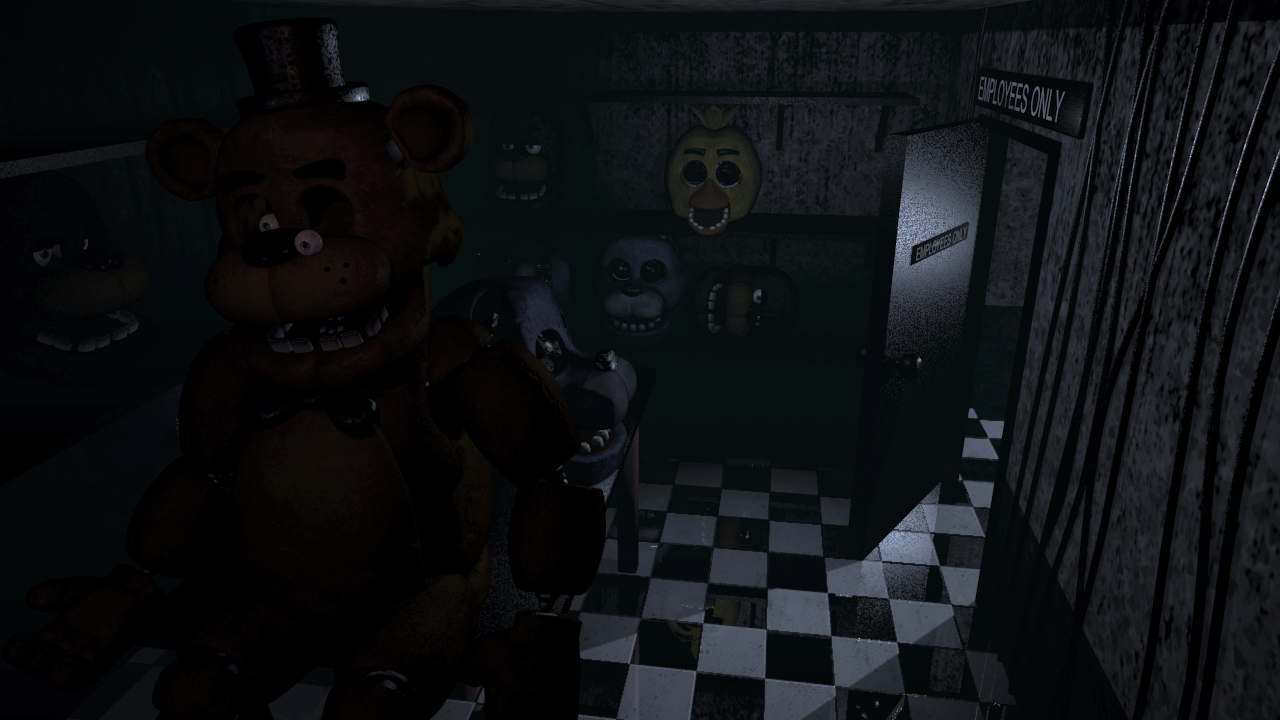
But then there is the rest of the game’s material — its costume — to consider. There are, after all,  the masks that you’re forced to wear, and those that stare at you right in the face before the long dark.

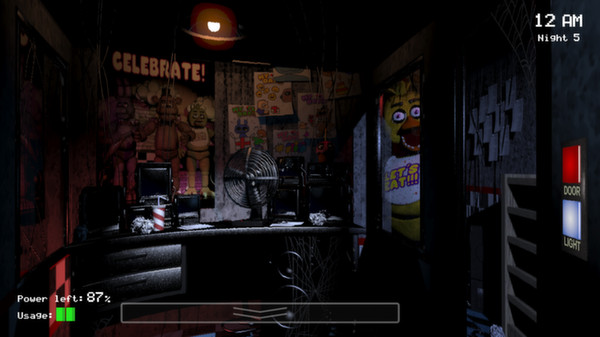
You have the newspaper clippings on the corners of your office. There are the children’s drawings on the walls of the pizzeria which you have to watch through faulty security cameras. You have an answering machine from your supervisor telling you about the dangers of walking animatronics in the night, and then more ominous references such as “The Bite of ’87.”

Then we get into the second disclaimer of this article: namely spoilers. You play this game from a second-person perspective: working six hours at night a week in a pizzeria to keep an eye on the place, but aside from seeing your character’s name on a pay cheque — should you survive to the end of at least two games — you never see your face. In fact, you don’t see any human faces in any of the three games. The only faces you get to see are those of the animatronics, the walking large, cuddly, worn, and mouldering robotic children’s mascots at night as they try to stuff your sad naked flesh “endoskeleton” into an empty suit full of pistons and wires.

FNAF Gameover

Even your supposed ally, Phone Guy, is just a voice on an answering machine: and the person who is responsible for all of this is a loathsome 8-bit purple sprite.

And here is where I think Cawthon’s genius truly shines. In the second and third games of the series, Cawthon institutes a platform game element. These mini-games are often considered reminiscent of those created for the 8-bit Atari 2600. You would totally think that with their blocky graphics and crude sound effects couldn’t be taken seriously. Of course, even if you somehow disregarded the resurgence and adoption of the 8-bit aesthetic by contemporary independent game designers, you would still be dead wrong.

FNAF Death Mini-Game 2

Between the “Death Mini-Games” of Five Nights 2 and the hidden mini-games akin to easter-eggs in Five Nights 3 — morbidly reminiscent of Warren Robinett’s Adventure and the Pac-Man level 256 perfect score glitch respectively — the mythos of Five Nights becomes more fleshed out.

While the animatronics in the point-and-click parts of the games come from a grim place where neoteny — child-like traits often incorporated into exaggerated cartoons — is combined with the uncanny valley — the notion of discomfort caused by an object that unsuccessfully tries to imitate a living being are terrifying because of how realistic they are made to look, they are creepy in a different way when rendered into pixel form. They are like 8-bit hieroglyphics, allowing you to explore the horror with a detached and almost dream-like manner. There is just something incredibly archetypal and gloomy about the graphics of the games that brings out its dark subject matter: especially when you consider that they are traditionally from a child’s medium of entertainment.

FNAF Death Mini-Game

The Death Mini-Games of Five Nights 2 introduce you to the Purple Man and his role in what might be wrong with the animatronics that are attempting to kill you while, at the same time, giving you a little more background into the development of Freddy’s pizzeria and the animatronic characters therein. And in Five Nights 3, instead of having to die in order to gain random access to mini-games, you can voluntarily search for the other mini-games to perhaps change the fate of certain characters in question.

FNAF Game

I think there are two elements that I truly appreciate from the combination of mini-games, newspaper articles, and answering machine information. First, there is what Cawthon is not telling you. There is what he implies and what he leads you, as the player and viewer, to put together. Cawthon even goes further in the advertisements for his games: implanting secret codes and clues into his messages. He makes you do all the work and all of the speculating: somehow making the dread and horror that much worse.

After all, there is a particularly challenge in another form containing the horror genre: how can you keep building up tension in the story when you reveal what the monsters look like? In addition, you certainly don’t want to reveal everything about the horror in the story or it becomes expository and rote. You have to keep a little bit of mystery in horror so that you always ask yourself why: while a part of you is always at least partially afraid of the possible answers.

These are the kinds of elements that inspire fans: that made this series into something of a viral meme on par with creepypastas. There are fan-made stories, games, animations, art, and trailers based on the archetypes that Cawthon creates. A Five Nights at Freddy’s movie is in the works and there is even speculation that Freddy’s is a real restaurant somewhere: probably based off Chuck E. Cheese’s. Certainly the mascot costumes, pizza, and arcade games taps into a resonance in me as a child of the eighties and nineties: a nostalgic feeling that Cawthon is trying to invoke and distort.

The fact of the matter is that, for the most part, the three Five Nights at Freddy’s that exist right now can stand by themselves. There didn’t need to be another game after these. However, I had my suspicions. Perhaps it was because of the empty product page he kept for some time with the discarded top hat. Maybe it was his silence about whether or not there was going to be another game.

But sure enough, come October 31, the fourth and final Five Nights at Freddy’s will arrive. And if you look at the graphic on Cawthon’s page, it is extremely appropriate if you think about it. I think it actually sums up a lot of the second element that has been on my mind, in some form, when I think about this game.

FNAF 4

I mean, of course it makes sense for the last chapter of a horror survival game to come out on Halloween, but here’s what gets to me. Imagine Freddy’s Pizzeria is like Chuck E. Cheese’s or even Disney World or Land. Certainly, a place for children would celebrate Halloween in some fashion: or at least take advantage of it commercially. Maybe “The Bite of ’87” might not come into it as many fans are speculating, but imagine how freaky it would be to be in a haunted children’s restaurant on Halloween of all days: perhaps even during the day this time around. Perhaps there are actual Nightmare toy versions or animatronics for such a lovely occasion.

But all speculation on my part aside, take this a step further. Remember what I said earlier about faces? How you never see any human faces in any of the Five Nights games? There are always costumes involved. There are always roles to consider. You arguably wear a uniform as a security guard. A murderer might have worn a animatronic suit. In Five Nights 2 you have to hide your face under a Freddy Fazbear Head in order to survive an animatronic intrusion. And children might be hiding — or hidden — in other inside the darnedest places. Even Phone Guy, the former security guard who showed you the ropes of your new job and was your only ally for the most part, tells you that he is curious to see what is inside those animatronic suits.

Freddy Fazbear Mask

The fact is: it’s always Halloween at Freddy’s, and I suspect that it’s always been. No one is as they seem, everyone wears masks, no one rests, and everyone wants to play. Sometimes nostalgia is an illusion of the fabled “good old days” that can, when stripped away, becomes a dark, ravenous thing in the late hours of the night. Sometimes you lose track of time when you so desperately want to keep living, and you don’t always want to see what’s under that costume. After all, some seemingly innocent dreams are, at their core, rotting nightmares.

And just when you think its safe to take that mask off, to forget the night time, to mistake the performer taking off his top hat with a flourish and a bow as the end: the story only continues at an elegant pace … and the suspense will kill you.

Freddy Toreador March

Chasing Amy, Finding Alyssa, And Revenge Of The Shit

So I worked on a little bit of a side thing.

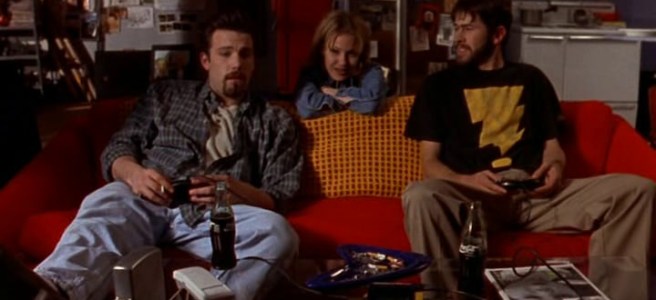
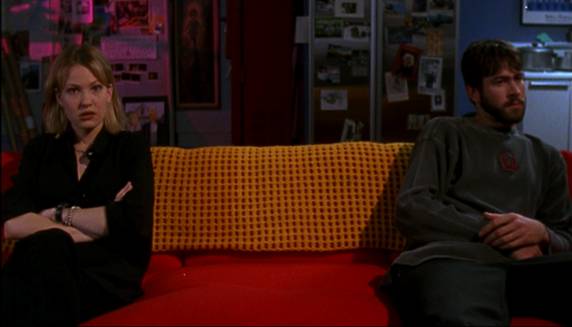
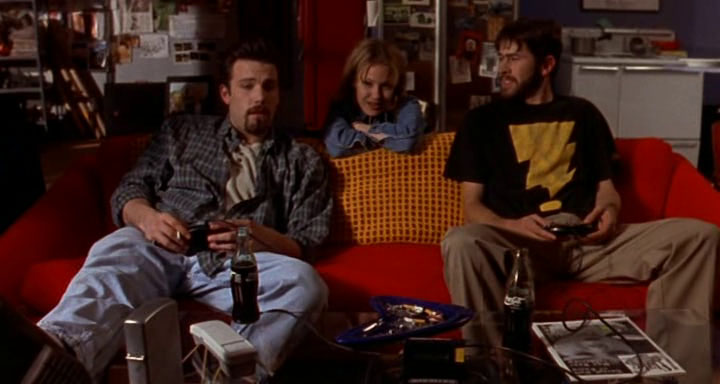
I wouldn’t have even called it a project, at first. As you know, I finally watched Kevin Smith’s Chasing Amy not too long ago and, as a result, it did something my brain. So, one night, I was thinking about the last part of the movie and this rather, shall we say, fucked up parallel occurred to me.

Originally, it was going to be a post written on Mythic Bios after I got the article that I intended to do, for tonight, right on here. Then, as per usual, my brain asked me: “What would happen if you made this into a Twine?” Then I got silly. See, I had this plan. I was going to cut Holden McNeil’s infamous scene with Banky and Alyssa Jones: with Anakin Skywalker jumping into Obi-Wan Kenobi’s lightsaber blade, getting amputated, and igniting on fire.

Alyssa and Banky Scene

Then I was going to end it with Holden McNeil coming out of a movie theatre, having just watched Revenge of the Sith for the first time, and say something smart ass about how bad it was. The implication, of course, was that the film and the prequel Trilogy was so bad to Holden, that it brought back terrible memories. You know the ones.

This short Twine of few scenes, mostly quoted lines with that ending, was going to be called Revenge of the Shit. Personally, I think it’s a title that some of Kevin Smith’s film characters might have appreciated: among other disgruntled Star Wars fans. And yes, I was tempted to put a certain … demon of excrement into the story somewhere: perhaps asking him how the movie was.

Of course, I also came up with another — more grim and random scene — right after that which would have taken the piss out of the comedy right then and there. But, really, what I planned could have been done better by someone with actual video editing and splicing skills: of which I have neither.

It was supposed to be a throwaway project: a one-off. It was supposed to be something that was fun and light and made light of a fictional character’s ridiculous choices and suffering.

But, as usual, I can never really do anything simple.

The fact of the matter is, the little bit of fan fun and snark mutated out of my control: and into something else. At the same time, it took precision to find those quotes, describe those settings and character feelings, and build something from it. It became something else. I realize that even though these characters and lines belong to Kevin Smith, George Lucas, and now Disney, I actually had something of a story to tell.

And I had fun telling this fan homage genetic freak, bordering on a crack fic — an off-the wall story– that I hope also says something meaningful.

My Twine making skills haven’t really progressed since The Looking Glass, save for learning how to format fonts in Twine, but as always I tend to focus on story and pacing the amount of text, of making a rhythm through each hyperlink more than anything else. But before I go on, there is one more thing I’d like to say.

There is one part in this Twine story where, should you choose to find it — and it isn’t hard to do so — Holden enters something of a “What If” or “Infinities” reality with regards to Chasing Amy. There was one story I was so tempted to tell, or outline: where Holden is so overcome by Banky trying to sabotage his relationship with Alyssa, and finding out about Alyssa’s past at a point where he is not mature enough to deal with it that he actually leaves both of them — and his old life behind — without a word.

Holden

Alyssa ends up coming to his and Banky’s apartment to find out where Holden was, even as Banky is left in the lurch with regards to their creative work Bluntman and Chronic, as well as their own friendship. Alyssa demands to know what Banky told Holden after he admits that he said something to him about her past. Suffice to say, she gets mad when she finds out, while Banky gets defensive.

Alyssa decides to go looking for Holden, actually concerned that he has had some kind of mental breakdown. Banky also goes with her and, reluctantly over a car trip start working together. Unlike Holden, she warns Banky that she will do more than tell him to “shut up” if he gets out of line. Banky tells her that the reason he dug into her past, to get “evidence” on her, was because he was protecting his friend: that he was afraid she was just using him as “a sexual phase” or some kind of game. Alyssa actually calls Banky out on the fact that he loves Holden and sees her as a threat.

But they do bond, and perhaps meet some weird characters along the way. At one point they realize that they could have actually been friends if this hadn’t gone down after they begin exchanging more stories. They realize they have a lot in common in addition to their bad experiences with women. At one point, they seem dangerously close to being intimate with each other, but they both go “Nah” at the same time. Banky says something about man-hating lesbians, and Alyssa counters him with misogynous (closeted or not) gay men. It’s Banky that admits he hates the fact he never saw Holden smile more than when he saw him with her. He realizes he hurt his childhood friend badly and, for the first time, actually starts to cry. It occurs to the both of them, in a poignant moment, that they love the same man.

Holden, Alyssa, and Banky

Alyssa also tells Banky that the reason she wants to find Holden is that she’s worried about him, but that if something like her past is enough to get him to leave her, he should do the opposite of being “chicken-shit” and make it clear: giving her closure. So to spoil the ending of this alternate universe “What If” story I’m never going to write, these two flawed but genuine human beings do locate Holden. He has been in the middle of nowhere, in a barnhouse: pretty much acting like J.D. Salinger, the creator of his namesake and working on a new comic. Chasing Amy is that comic: as he had seen Jay and Silent Bob before he left. He’s spent a while regretting having left, but by his logic he “needed some space.”

Holden’s peaceful yet sad Old Ben persona (see what I did there with “Ben”) is shattered as Alyssa brings her fury on him along with Banky. It’s been a while, so Holden doesn’t really know what to feel any more. Alyssa storms off. Holden tells Banky he feels bad about leaving their partnership in the lurch and tells him he’s done with Bluntman and Chronic: giving him his share of the intellectual property which he has prepared in writing and had prepared to mail to him. Banky takes it, and then tells Holden that Alyssa went through the fire to love him, and that he is making a mistake: that he remembers how he smiled at her. Banky tells Holden to go after her. And the story ends right there.

I would have called that story Finding Holden. But this is not my Twine. Instead, my Twine is called Finding Alyssa and I hope that you will enjoy it: for what it is.

Connecting the Doughnuts: Amanda Palmer’s The Art of Asking

Even though I’m not a musician, or even a complete music literate (whatever that ultimately means), I had been looking forward to Amanda Palmer’s first book for quite some time. And now that I finally finished reading it a few days ago, I’m now in a place where I can actually say something about it.

Amanda Palmer

It wasn’t easy and, to some extent, it’s still very challenging. The Art of Asking is something like what might happen if you take a blender, to borrow one of Amanda’s creative sayings, put it on a low setting, and introduce autobiographical anecdotes, self-help philosophy, social media excerpts, a few literary quotes, and of course musical lyrics, to the blade and mix. Chronological events are sometimes parallel with each other in the narrative, but these instances are often separated by philosophical musings and personal moments.

Whatever else, The Art of Asking is, it’s definitely not an ordinary book: as if something that’s a fusion of the creative and the personal can ever be ordinary.

I’ll also admit that it took me a while to get into the book, and sometimes I had trouble actually staying inside it. I mean, I knew that — even based on the title — that Amanda’s book would have some significant roots in her TED Talk of the same name, but it is both fascinating and sometimes off-putting to consider that there is a fair amount of her book that you can already find to some extent in her Blog and even in her introduction to Anthony Martignetti’s Lunatic Heroes.

The intertextuality, the way her book relates to the narratives and circumstances behind Anthony’s Lunatic Heroes and Beloved Demons, as well as to Neil Gaiman’s Ocean at the End of the Lane really does intrigue me and it puts some elements into perspective. I’d argue that The Art of Asking has details that can give you something of a holistic approach to looking at all four narratives upon risk of falling into the authorial fallacy: of looking at the people behind the works instead of the works themselves on their own merits.

I mean, it’s no secret that Amanda encouraged Anthony to hone and publish his personal stories — many of which he’d already told her before during their time together — and that Neil’s Ocean was the result of a story that he actually wanted to tell her while she was in the middle of her own solitary creative struggles. When you look at how those narratives talk to each other, like the people that made them and talked to each other in turn, The Art of Asking is almost something of a bridge between three different and creative spaces. It is my opinion that they all belong together.

The downside was that sometimes these references felt like filler. I think what really confused me was something that Amanda said which, ironically, I truly appreciated. It was a reference to another part of her creative process. After a fascinating look at different types of creative processes from her perspective, Amanda mentions that to create something is to “connect the dots” between things that you gather or experience. This, for me, pretty much sums up how creativity happens. As a creator, you take things that don’t seem to relate to each on the surface and you find or make connections between these elements. This thought particularly jived with me.

Unfortunately, at least from my perspective as a reader, I couldn’t always see how Amanda connected the dots of her ideas and anecdotes or even her musical lyric interludes within the structure of The Art of Asking itself. Perhaps I just don’t have a good eye for it, or for that matter even a good ear. Maybe, as Amanda herself isn’t generally a book writer — this being her first one — she writes prose much in the way her mind generates rhythm and lyric: through music. This is just a thought that I’m throwing out there myself. However, maybe the narrative is a lot like Amanda herself in that her art and her performance seems to be a 24/7 deal where you cannot particularly separate them: even in another medium.

The Art of Asking, to me, felt like a balancing act: much like the way I reacted to it. The tone of it got to me sometimes. On one hand it sometimes felt like it was rather self-involved, but on the other hand it is to some extent a memoir and of course Amanda would be talking about her experiences and her feelings. At times I felt a self-help vibe from the book and I had a personal reaction to whenever Amanda would talk about giving herself to trust and love as, in my own experience, most people who expose surrendering themselves to absolute abstracts of benevolence, revolution, peace, and love often want something from you and are anything but the ideals that they claim to represent. Something about Koolaid comes to mind.

Then again, these very sentiments on Amanda’s part are tied into some considerably shrewd business and people sense. The Art of Asking specifically outlines how love and trust are relational. What I mean is that by opening yourself up to other people, by interacting with them, by actually relating to them as fellow human beings you create a bond — at least on some level — and they will become more willing to actually help you. Amanda very correctly identifies this precept in why some crowdfunding campaigns excel and why others fail completely.

In asking for help without shame and taking what is offered you without forced expectations or, again, humiliation, you are attempting to embrace a different mindset. I can personally respect and even understand this idea. Amanda even applies it well to just why her former label and the music industry are simply failing to understand their customers: as they only relate to people as customers, artists as commodities, and not as people.

Really, what I learned from this as a potential crowdfunder artist myself, is that I have a long way to go — in building relationships of some kind with my readers, in networking, and in relating to others — before I can even begin to approach the place where others can support me: and where I can provide consistent content for their support. It’s actually very humbling, and sometimes discouraging as I am not a natural extrovert and I don’t have access to the support that I need to get there, or a coherent and stable vision to attract others. Yet.

In this sense, it’s not about connecting the dots per see.  It isn’t even about giving out “the flower,” a metaphor and literal fact from Amanda’s time as a living bride statue in her early busking years that can be accepted or rejected in an attempt at staring someone in the eye and relating to them.

To me, it’s about doughnuts.

In late November 2014, I actually attended the last part of Amanda’s Book Circus Tour in Toronto. As we waited in line outside of Lee’s Palace, a volunteer kept handing out Timbits: small, round, balls of assorted doughnuts. During the event itself Amanda actually read us a part of her book in which apparently David Thoreau, during the time he wrote Walden, accepted free food from his family as help in completing his work. And Eric Alper, Amanda’s guest and interviewer bought us all tons of Timbits to hit home the point that it is okay to “Take the doughnuts.”

The way I ultimately see it, The Art of Asking is a collection of Timbits: a collection of little doughnuts of many kinds. Some might prefer specific flavours of Timbit, or all of them, or none at all. Yet all of them are doughnuts and all of them are offered to the reader.

As for me, I took my favourite doughnuts from Amanda. Some of them were crisp and instrumental. Some were multiple flavours that branched into different places, that reminded me of other things, and gave me insight about my favourite people behind the scenes. I know I ate one or two confections that Amanda had never offered before outside of her book: and the flavours hit me hard and without mercy: that were real. At least one was a moment that touched me to the core.

But all of them, even the ones I don’t always like or require an acquired taste, are in the same box of words: a bread and circuses on paper thanking everyone that it asks.

If My Mind Were A Movie

Not too long ago, I made an argument that The Room can be seen as the inside of a mind or perspective of life made into a cinematic experience. But as I finished that line of inquiry, two other questions came to mind:

What would happen if I made view of reality into a film? And what would it look like?

I don’t really plan to get all intricate about this but I think the film that represents how my mind works, and how it attempts to relate to reality goes a little something like this.

It would start from different time periods. Some parts would have voice-overs while others would have words on a screen. In fact, voice-overs will be reflections of the past and words on the screen will be internalized thoughts. I would have epic video game electric body music play, in addition to some John Williams and Murray Gold, for some of the most pivotal moments in the movie while the more uncomfortable moments — such as dealing with bureaucracy, breakups, public transportation, and loneliness — will be filled with complete and utter stifling silence. Internalized subtitles here will have ellipses.

There would be scenes of wandering and scenes where I play a character that sits in one place almost all the time. I will have my character in long-shot views of his own life. He will particularly be in the background of his past when he is a child, a teen, and a younger adult. Maybe we can go for blurry after-image effects here. Each version of him will attempt to tell the other something about their future. One might try to change something, while another might say nothing at all. I think I’d also play an antagonist to my protagonist: who enjoys breaking things.

My narrative would be tangents. There would be epic, almost wuxia level, duels and combat with understated special effects. Epic speeches ranging from “the reason you suck” to philosophical digressions all the way to lots of swearing and profanity will happen. There will be intermittent, but gratuitous, intimate sex and a focus on the pull between connection and distance. Human kind would be depicted somehow as ignorant, self-involved, and small, individuals as fascinating, and the whole humanity as sometimes frail and sad and impermanent with a few motes of true self.

That all said, many hijnks will also ensue. There would be melodramatic screams and explosions in the background as punctuation. And budgies: sometimes as pets but also attacking the populace at large. There might even be a budgie totem of imitation and mimicry in a strange version of an Australian Dreamtime involved. My character will find himself walking into different times in the same places. He will get lost a lot in all manner of different interpretations.

I’d have books and comics and, copyright permitting — though most likely through having to create analogues — have my character immersed in a world of them. He lives in there and entering it is this permeable membrane of reality: a portal that gets harder and more narrow to access as he gets older. I’d be tempted to, but probably not use CGI effects, to show a piece of his soul splintering off for every year he gets older.

I think I would design the film like a multiverse of different spaces and times: a kaleidoscope. I would make it so that there are worlds where all of his dreams happened, places where none of them did, some others where he died, and others where he never existed to begin with. Sometimes my character will be a complete bastard, other times weak and wishy washy while spending most of his time remembering his future while another lives in the past. And all of these tangents will circle round and round each other, closer and closer until they collide and everything goes completely crazy and my character jumps from one fractured reality into another: navigating a grand plan gone to chaos … something built up just to be destroyed and rebuilt again.

I also think there would be a reality where concepts are people and they shift around too: and unfinished artwork will be their own entities and have their own world. Maybe they will eat people.

There would be friends on the phone and friends online. Some of them will have strange avatars. And maybe for the end, they will all come together, or perhaps he’ll go to them.

Of course, like a certain other director I won’t name I’d probably keep adding stuff the film as I go along and take stuff out and have constant director’s cuts. If I had to sum this all up, I’d say that my film would be an independent, tragic comedy of a mythic cycle with meta-narrative, nerdy references, and a whole lot of poignant moments and what the ever loving fuck. And crisp, witty dialogue. I can’t stress that enough.

And a good ending. Maybe my film, filled with regret, passionate anger, suffocation, cackling joy, fidgeting anxiety, headaches, serenity and the whole gamut of glorious insanity that we call human experience would be a multiple choice ending situation: if such a cinematic narrative is possible.

I might call it Not My Magic Eight Ball.

Because why not?

But I will leave film directing and script-writing to more capable hands. I’m just describing what my film world would be like if it existed. It’s been a while since I’ve been personal and creative and I just wanted to try something new today: or write about something old that keeps growing.

Writing this actually felt kind of good.

So tell me: what would a film of your mindset look like?

Of Serpents and Foxes

Hello again everyone. I’ve been away, and busy, for a change but I want to start writing again on Mythic Bios at least once a week as I originally planned. I didn’t actually feel like writing anything until I got another Project of mine finished, but I feel the need to you updated on some of the things that I’m doing and to keep a record of some of my work as well.

It’s been tough for me this past while. I’ve had this Twine idea in my mind for some time and it was only at this year’s Toronto Global Game Jam that I’d been able to even start on it beyond the modest notes I’d researched and taken.

Unlike last year, I didn’t force myself to stay up until twelve or two in the afternoon to finish off my game. Aside from the fact that I had a headache during the Jam, even when I was better I realized that rushing through it and making something out of pure exhaustion would only give me sloppy work and very little to show for it: never mind the fact that it wouldn’t have even been a working narrative.

I’d gotten as far as creating an entry for it on the Global Game Jam site. At the moment, my Twine creation is called The Serpent and The Fox. I spent a whole night trying to think up a good abstract summary and a title for my creation in progress. Unfortunately, the late first night of the Jam cost me in stamina: to the point where I couldn’t even create an outline.

In the end, though, it was just as well. Most of my creative works each have their own unique processes and this one didn’t really want a pre-existing outline. Rather, it wants to use the fragments I’ve written down or have in my mind and flesh itself out from there. However, what’s really interesting about this interactive narrative is that it may well be the most structured Twine game that I’ve made to date.

Each part of my story is going to be an interlinking series of haiku: a poetic structure of five syllables, then seven on the next line, and five on the last. Of course, for the sake of storytelling — and sanity on my part — they are probably not all traditional haiku. They don’t all deal with descriptions of nature, and while I attempt to capture emotion in them, sometimes I need to use them to detail other matters. And while haiku apparently aren’t supposed to utilize metaphors, I might have to break those rules: if only to make them part of a metaphorical structure themselves. And while I will be using the five/seven/five schema when I can, I will vary up how many lines I use in each section and take essential creative liberties.

This brief discussion of poetic structure aside (and years ago I wouldn’t have dreamed of talking about this, never mind finding it remotely interesting), I am particularly focusing on the perspective of the story. I can tell you right now that my story seems to start from a third person perspective, but depending on the choices that you make as a reader — on where and what character you click on — this will change.

What I am pondering at the moment is whether to follow the usual Twine and interactive choose your own adventure tradition of the second-person perspective, or go right into the first-person.

If I make it first-person, then you can see into the minds of the characters themselves even as you can choose their actions. However, ironically enough the perspective of “I” can be alienating for a reader: it’s just another divide between them and the character even if it might provide more insight. One of the texts that inspired me to make this Twine uses the first-person and I can see its strengths in that.

On the other hand, the second-person flat out, through its use of “you” makes you — the reader — into the character. It places you into their mind and body. When you make the choices that the game provides you with, you could feel a greater relation to that character. But then there is the issue of what happens when the character feels something and narrative attempts to claim that you are feeling it or thinking it too.

Either way, there is going to be some audacity involved. Another issue is that I wonder if I can get the different character perspectives to intersect again at some point and become unified depending on what the reader-player chooses: without being totally boring and repeating myself. And would the second-person, would “you” be able to relate to another character and feel the beginnings of some kind of relationship compared to whether or not you are an “I.”

I will have to find a healthy medium and keep exploring this issue further. I was reluctant to talk about this, link my entry to Mythic Bios, or even mention the name of a work that isn’t finished yet. I generally like to either link to finished works or just hint on the unfinished. It’s been weighing on my brain for a little while and taking up a good portion of its memory (I am also a less than closeted perfectionist).

Me and my Head


But it’s been a while and I thought you’d find this digression interesting in some way.

I hope I will be able to continue and finish this. I want to see how people react to it and I want to move on with my writing and other plans. I hope the world is treating you all reasonably. Hopefully I’ll be back next week. Until next time.