The Funnies: They Just Keep Coming Back … and They Never Stop

A cartoon is not a frivolous thing. It can look like a silly drawing or a caricature of life. Upon first glance, it seems to only exist on either a screen or a piece of paper. Sometimes, it even says witty things or does something stupid or endearing that can make us laugh.

Cartoons have been around for so long–on television, in movies, in the newspaper funny-pages and even on T-shirts–that we take them for granted. We don’t always take them seriously.

But consider. A cartoon is an archetype. It is an idea given form. In fact, it wouldn’t be too much of a stretch to even state that it is a Platonic Form: living glyphs essentialized to the point of becoming as close to pure concepts as is humanly possible … which of course is a misnomer.

Because cartoons aren’t human at all.

Some of them are wise-talking humanoid animals. Others are parodies of human beings that somehow possess their own sense of agency. There are even some that are inanimate objects given life. Often, the really old cartoons exist in very self-contained two-dimensional pocket-dimensions: in a mythological cycle of trickery, mayhem, and fun-loving nose-thumbing at fate.

And the really old cartoons can’t be destroyed. They can’t be smashed by falling anvils or mallets. They can’t be burned by fire or exploded by dynamite: at least, not for very long. They are used to dealing–and receiving–massive amounts of physical damage, and then coming back for more. And we’re not even talking about the ones that have a supernatural way of avoiding the damages of their enemies altogether just to–through some twisted fluke of fate–make them fall into their own traps.

They are like living rubber or silly-putty that just keeps bouncing back. A human being isn’t like that. When human beings fall, they break.

It’s not too much of a stretch to say that cartoons are beings that are psychopaths or sociopaths by human standards: in worlds and cyclic realities where neither human physical and psychological standards even apply. They come from the same heightened mythic state as faeries, and gods; as legends and archetypes: in a place where slap-stick is not only futility and invincibility, but where the ridiculousness is the superhuman and the sublime. Some people might call this state a perpetual hell, or a utopia. But mostly, it just is and they just are.

In the end, you can’t destroy a cartoon because you can’t destroy an idea. Because even if you break the projector, or the television, or snap the DVD, or rip up the papers they are still there–pure ideas–in your head, mocking you, holding an oversized mallet in one hand as they stand in the darkest corner of your mind, knowing more than they do, doing more than they know, just waiting for that punchline: where you finally have to laugh at yourself.

A World Coming Together, A Possible Paradigm Forming, and Other Stories That Find Themselves On Their Way

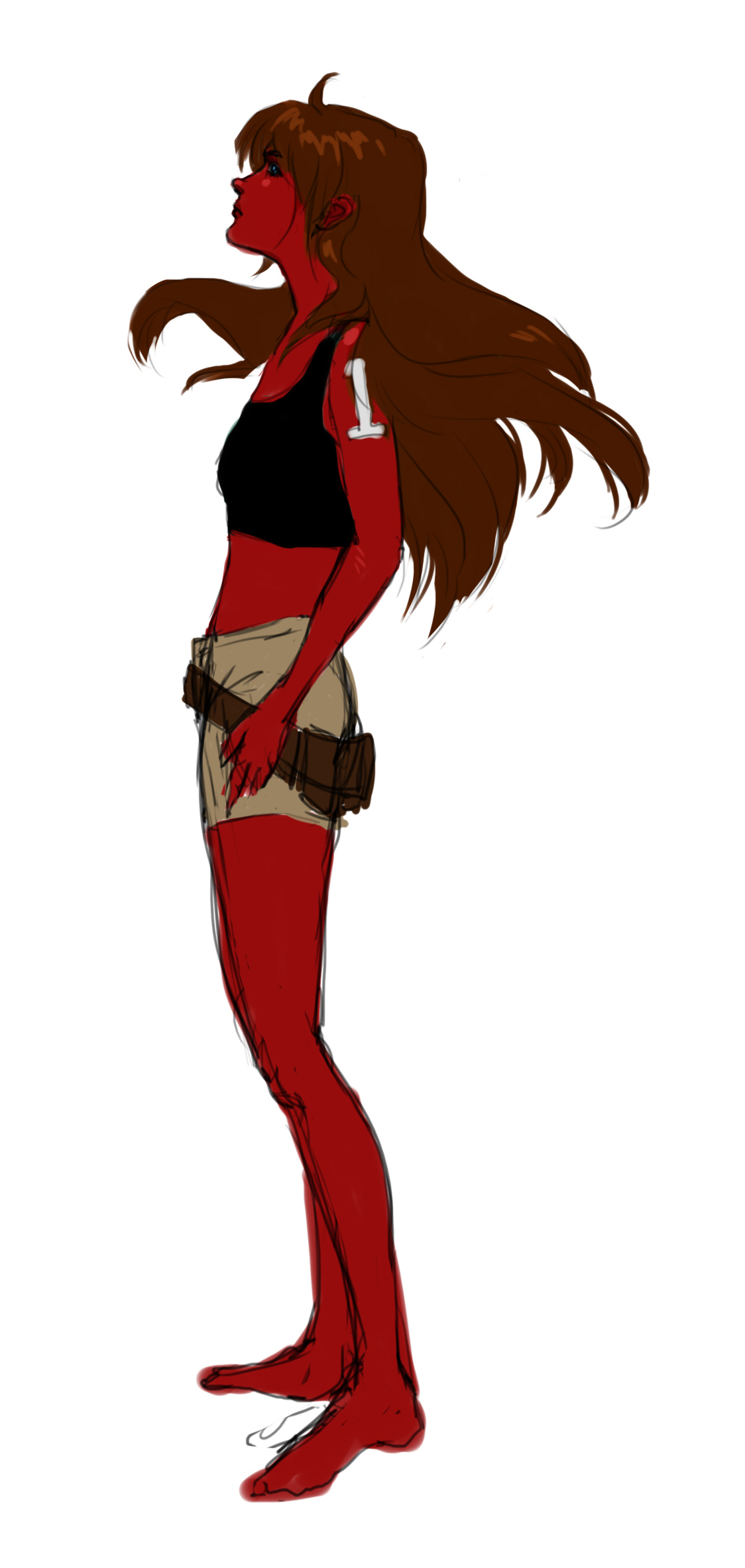
This is Red-One. She is the protagonist of the comics collaboration that Angela O’Hara and myself are undertaking. One day, to inspire herself, Angela decided to create this digital art piece. It is a conceptual drawing of Red-One at about seventeen years old or so, and she is definitely quite beautiful.

So, I did end up naming the characters that we are working on. That might seem strange given that it is supposed to be a silent comic, or a comic without words, but it is a point of reference for us to work from and it adds more character and background to work with too: to bring across onto the page through facial expression, body language, and action.

We have also decided on a structure for the comic. It will be about twenty-four pages and it will have panels. There is just too much, even with the basic story structure that I’ve already made, to dedicate a page each to a different action. Panels will actually give us more room by giving us more pages to work with in expressing the narrative. Like I said, I do have a basic story outline finished and I am going to attempt to do at some point is take a scene from what I wrote, expand on it a bit, give it to Angela and experiment with panels and the page layout.

Panels and page layouts are diabolical in that they both seem to be the same thing, but they’re different. For instance, you can make one panel and then have to decide what goes on in that panel, whereas the page layout is actually how more than one panel–or lack thereof if you want to get experimental about it–is arranged as an overall pattern on paper or screen.

I have attempted with previous works to include panel breakdowns and detailed layout structure for each page into script form–this without an artist partner–and I have to say that it is challenging at best. Luckily in this case, I can hopefully communicate the essentials of what I want to see to Angela, talk through it, see a few versions, and come up with a happy medium. Angela has also been working on a few more conceptual drawings and eventually things will be coming together.

So there is that.

Another thing I have been doing lately is that I am looking into published other works while this collaboration continues. That is to say, I am going to now actively–again–send out stories to electronic and material magazines in order to get more things published. I have a few candidates and a few ideas with regards to what I am going to send. I think I’ll go into that a little now.

I’ve had at least three Lovecraftian story ideas that I have been building on in a purely note-written or scribbled way for a little while now. When I’ve finished one or more, I might send some to Innsmouth Free Press, or Weird Tales (which right now is closed to Fiction Submissions, oh well). I love the fact that Lovecraft is not only public-domain, but there is so much potential to his ideas. His stories are mainly “congeries” (he loves that word, among others)–or connections–of seminal ideas: of things that have informed so many other works long since his time.

Lovecraft’s mythos is not the only thing I am focusing on however. I’m also contemplating sending a science-fiction story of mine to Strange Horizons. There is also a story of mine that I meant to finish long ago, set in Toronto, which I may send to Broken Pencil’s Death Match Contest or directly to the magazine itself.

In addition, I have a few stories I’ve already finished that I realize may be tapping into a niche that is emerging or has been emergent for quite some time now. The niche, paradigm, or Zeitgeist (the “Spirit of the Times”) I’m thinking of is the 1980s-and onward geek nostalgia that is becoming more prevalent every day as well as the usage of allusions and literary references to video games and comics. I have actually been experimenting with this for a long time and I have been polishing off what I have.

I guess the danger is whether what I relate to in this regard will become obsolete sooner than I can do anything with, or even in the future. I mean, will years from now someone know what Google is if it is referenced into a story or will it be some small obscure technical footnote somewhere? Or is our society changing so much with regards to technology that Google and other programs, and even video games will become part of a historical documentation: if only an electronic one? I’m pretty sure cultural shifts celebrating “retro” elements come in cycles, but you can never really predict these things. Sometimes, you just have to go with it.

As for me, the reason I am making strange stories like these–tapping into this–is because I can relate it and it interests me. I can’t tell the future (which is probably for the best) but I’m doing my best to express the forces that have influenced me in the way they have influenced me: if that makes any sense.

So these are my goals along with a few others. I hope to be able to Blog more about these other developments and also be able to keep up with the challenges that I have set myself.

Worms and Bicycles Or How People Make For Strange Stories: Menocchio and Igor Kenk

I’ve been rereading Pop Sandbox’s Kenk: A Graphic Portrait and I kind of wish that this comics work had been published when I worked on a previous assignment of mine.

In one of my previous Graduate courses, our class had to read Carl Ginzburg’s The Cheese and the Worms: The Cosmos of a Sixteenth Century Miller. It basically dealt with the idea that an individual can not only embody the culture that they come from, but that that person can represent different kinds of culture and actually interpret cultural information differently for themselves. Really, what I got out of it was that an individual can create their own world or mythic reality from information they have access to from their own culture.

As for why the work is called The Cheese and the Worms, it’s due to the fact that it focuses on the record of a man named Menocchio who compared the world’s creation to be not unlike that of rotten cheese. I’m not making this up: the Roman Inquisition that interrogated and took testimony from him apparently got this account from the man. So obviously, I felt compelled to do a presentation on this and focus my course paper on it because, well, look at the title and the subject matter. Really: how could I not?

I think that I found the most interesting about Menocchio himself was the examination of how he possibly came to the conclusions about the world that he did. He was not born of nobility or the upper-class in Italy, but rather came from a merchant culture. As such, while he was literate and he had the means to buy books, he also grew up with an oral literary tradition: a culture that passes on lore through the ages and word of mouth.

Ginzburg seemed to really like to point out the strangeness of this figure of Menocchio: how he was almost an intermediary between the oral and the written as well as peasant and “higher culture.” Menocchio himself lived during a time of transition between oral culture and the development of the printing press and written literacy: a revolution of sorts. Menocchio existed during the time of Martin Luther’s Reformation: where the ideas of Catholicism and Christianity itself were being challenged by the new Protestant movement using said printing presses. It is also worth mentioning that Ginzburg liked to examine colportage–cheaply printed chapbooks detailing songs, tales, and the lives of saints–as a backdrop of Menocchio’s literacy as well.

All of these traits and more are eerie parallels with Richard Poplak’s observations about Igor Kenk. Kenk grew up during a time between socialism and capitalism in Slovenia of the former Yugoslavia. One thing that Richard Poplak likes to point out is that it was also during this time period that common citizens in Slovenia were allowed access to photocopy machines: mechanisms of distributing information that were originally in the charge of the State. The counter-cultural Theatre FV 112/15 group– also known as the FV movement–used photocopiers to create a collage art known as FV Disco: a form of which–thanks to the artist Nick Marinkovich–Kenk also utilizes. This was the time and conceptual place where Kenk developed as an adult.
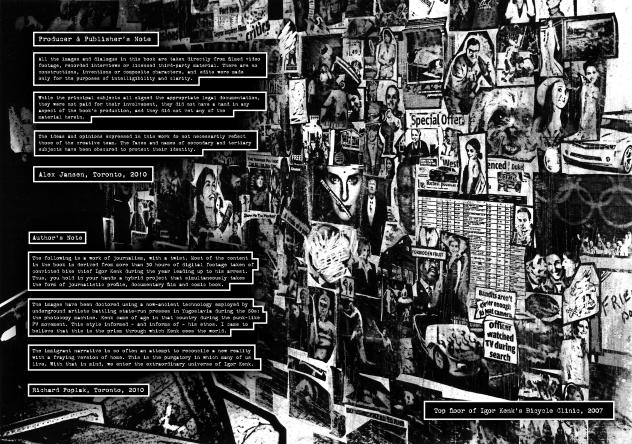
KENK_CHAP-00_07-08

As such, Kenk also possesses a very unique world-view based on the transitional culture of his time: the idea that all things can be recycled and that you need to choose to struggle in life in order to survive as a person: which is part of what he seems to call “The Monkey Factor” or survival. From what I understood of this book, his notion of “recycling” also seems to mean reselling stolen bikes as well as hoarding. As an aside, the fact that Kenk believed the system of debt, borrowing, and capitalism to be doomed is also linked to his philosophies and it’s only now, years after I read the first time, that I wonder what he would think of the Occupy movements back in 2008 before his arrest, and what they might think of him now.

Igor Kenk came from a social order that was radically changing and between extremes. He was considered to be a Math prodigy and did well in his education. For a time he was even a police officer in Slovenia–surviving their harsh regimen–until he was discharged, and then proceeded to cross the border into other countries to get goods as Slovenia’s political alignment and its economy changed. Then he eventually came to Canada and became something of a merchant himself by selling and fixing bicycles in Toronto.

What I’m trying to say is that both Kenk and Menocchio are products of their time and culture, but at the same time how they chose to interpret their changing cultures was very idiosyncratic to them. In other words, they created some very unique world-views. And both of them arguably paid for it by the powers that be: Menocchio with his life for not recanting his beliefs to the Roman Inquisition and Kenk doing jail time and losing his Bicycle Clinic for the thefts he was charged with.

KENK_CHAP-09_18

All of the above can arguably be considered gross simplifications, of course. In my paper that dealt with the implications of Menocchio, I pretty much say the same thing more or less. But I think the reason I’m attempting to compare two men from entirely different time periods, cultures, and countries is due to a greater issue: namely, why are they important?

I mean, come on: neither Menocchio nor Kenk would traditionally be considered important in a historical sense. In the grand scheme of things, someone might say that, while these parallels are interesting, who the hell cares?

The reason that I care, and one of the reasons why modern historians, journalists, and–in some ways more importantly readers–find these accounts so important is because they are narratives that deal with real people. It’s true that neither Menocchio nor Kenk are politicians, or artists, or even popular cultural figures in themselves but they are people that–while arguably normal or common in terms of class or historical significance–symbolize greater historical and cultural shifts by just being who they are.

They are ordinary people with very un-ordinary perspectives and there was a time where we would never have even known about them: or at the very least we’d only get a summary of them in passing … or at least we’d get something like this from a dominant or “higher cultural” narrative. Because there is one thing I keep coming back to in my head: it is the idea of oral history.

What is oral history? We know that oral culture or literacy is something that is passed on verbally from one storyteller to the next throughout many generations. But history, as Westerners, understand it is derived from the ancient Greek word historia: which is something along the lines of scientific inquiry or observation. Oral history, from my understanding, is thus something of verbal origin that is written down for other people to see.

Menocchio’s “worm and cheese world” survived through the written accounts of his interrogators, whereas Kenk seems to have actually been interviewed by the book’s producer Alex Jansen and filmed by Jason Gilmore as he espouses his world-view of “Monkey Factors and recycling” in that context.
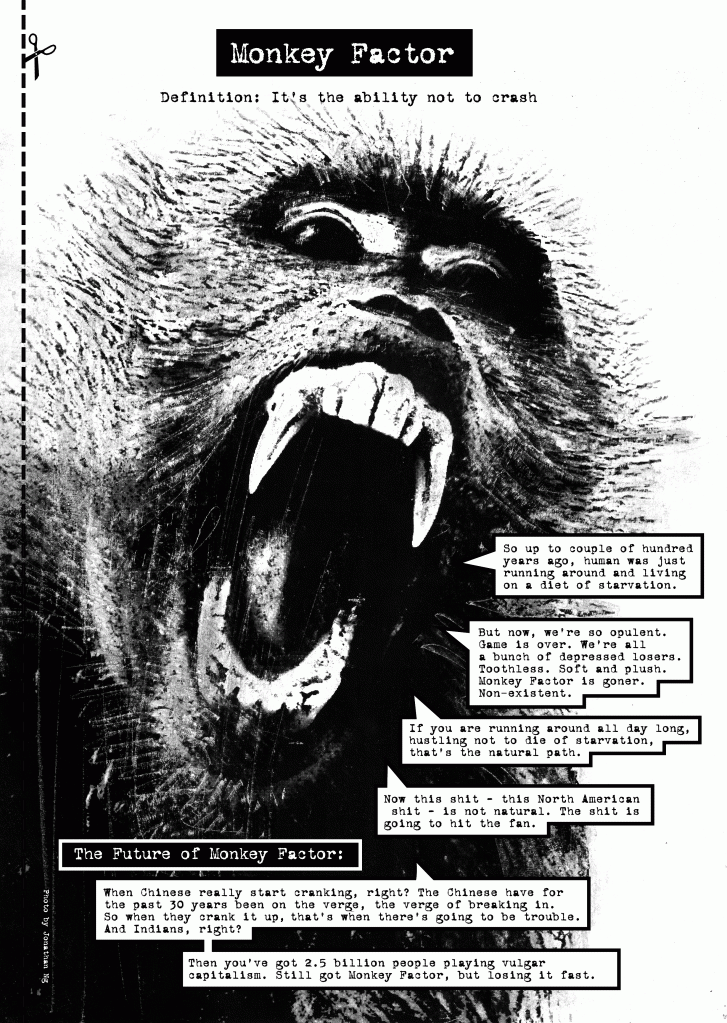
KENK_CHAP-08_16

Oral culture in our world is very different in that we have sophisticated image and audio technology to preserve and record the spoken word, and where that spoken word comes from. There is a scholar named Walter Ong–who I looked at in my own studies for my Master’s Thesis–who looked at oral culture and degrees of orality.

Ong believed that there is something called “secondary orality”: in which spoken word is preserved through technological means like video and radio. But I’ve always wondered if he would have included illustrated images in this definition as well, and how problematic it would be if these images were accompanied by written words. Can the visual be considered part of the oral or the written, or is it something by itself? Obviously I’m talking about the medium of comics and what kind of literacy that would be defined as but–this tangent aside for now–right now I’m thinking about the idea of oral history being a historical narrative that records down what life and reality is like for “the common person”: if there is any such thing as a common person.

I actually think that this conception of oral history has led to the idea of journalism: of interviewing and recording down what a particular person or witness has to say, and then researching the environment in which this person came from for a greater perspective. Is journalism the child of oral history? And then you take something like Kenk into consideration too: something that is written down but also given a sequential FV Disco style is that is both an illustrative and video collage aesthetic.

It’s fascinating to think about Kenk as an artifact of not only “comics journalism”–a medium that some comics creators like Joe Sacco have already developed–but also written literacy, oral culture, history, and mass-produced art. I look at Kenk and I wonder if this is our contemporary version of the colportage of Menocchio’s time, or the pamphlets and photocopies of 1980s Slovenia. Because in the end, it’s not just Menocchio and Kenk that have a lot in common, but also the media used to try and capture what they are … and what they are not.

When I started writing this article, I thought it was going to be easy: like it was all fully formed in my head. In a way I’m doing what I said I would not do by delving more into the academics I’ve tried to put some distance from: at least with regards to jargon. My train of thought tends to drift and it has been a struggle to communicate and even cohesively perceive all of these parallels here.

But if this were a paper of mine, if this were some rough form of the Graduate essays I would write, I would end this post in the following manner. As someone who has studied mythic world-building, I believe that art is an engagement with different parts of the world around you, and an expression of who you are as a result of what you choose to accept of that world. In that, the man called Menocchio and Igor Kenk–specifically in how their scholars and artists portray them–not only made their own art, but actually lived their art, and allowed for the creation of more of it.

I also believe that when you take all of this into account oral history, journalism, comics journalism, or whatever you want to call it reveals one more truth. Writing about an individual not only reveals that there are no “ordinary people,” but that it never makes for making any “ordinary stories.” Ever.

Again, I’d like to thank Alex Jansen and Jason Gilmore for lending me these pages of Kenk to place here in my article to make both point and emphasis.

If you are interested in this topic, you might like my What is FV Disco article as well. They both deal with similar subject matter, but in different ways.

A Hesitant Hero or the Pause Before the Precipice: Alan Moore’s Miracleman and Virgil’s Aeneid

I always find it amazing when you set out to write one simple thing and then not only does it become more complex than you thought it was going to be, but the implications of what it might say can be very difficult to gauge as well.

When I first started reading Alan Moore’s run of Miracleman a while ago, I made a whole lot of notes on the margins of a piece of paper as strange literary parallels occurred to me. One of these, a comparison between the Moore Miracleman’s world, the Platonic World of Being and Aristophanes’ myth of love, made it into an article.

My comparison of the character of Miracleman to the protagonist of Virgil’s Aeneid did not.

Aeneas is depicted by the Roman writer Virgil as not only a demi-god and a high-ranking survivor of Troy after its Sacking by the Achaians, but also as the founder of another greater Empire: Rome. He has a son named Ascanius from his wife who dies during the end of the Trojan War, and has a few adventures dealing with the gods plans for him. In fact, he leads his son and the survivors of Troy to a new life: carrying his father Anchises with him out of the lost city. His father is also notable for having been a mortal man who had been chosen by and ultimately impregnated the goddess Venus (or Aphrodite): who is also the mother of Aeneas himself.

File:Aeneas' Flight from Troy by Federico Barocci.jpg

Later, Anchises dies but due to his intimate association with divine leaves him a whole other legacy: so in a way it is more than fitting that the hero carries his father on his back and ultimately later lays him to rest.

But while he is ultimately loyal to the gods–to their plan to make him the creator of a new Empire–he has his doubts: about himself and about how successful he will be. From what I remember, he mourns his old life and some of the decisions that his destiny forces him to make: such as leaving Queen Dido of Carthage whom he had fallen in love and had a relationship. Much later, he marries Lavinia of the Latins in what will one day become the city-state of Rome while his son becomes his heir.

But before this, Aeneas descends into the Underworld to see the future of the Empire that the gods decreed that he would help build: learning about the future of his people and descendants in immense detail from the spirit of his now deceased father Anchises. This is obviously a transformative experience for him–making him see that reality is far different than he had always known–but what strikes me is that the doubt never really leaves him in Virgil’s depiction. I will go more into that later.

Miracleman, or Marvelman–also known as Mike Moran–is depicted by Alan Moore as a genetically altered human being that survives the destruction of his super-hero team with few of his memories intact. He was engineered with advanced alien organic matter and technology to fulfill a purpose that was ultimately taken away from him when the authorities that made him and his Marvel or Miracle Family believed them to be too dangerous: and sought to destroy them. Despite this, Miracleman and his Family were created by Project Zarathustra to help “save” the world: or at least the status quo version of it at the time.

Miracleman has a wife named Liz while he still believes he is a human being and eventually reawakens his power and many of his lost memories. At first he believes he is a superhero, but after a trip to the Spook Show bunker that created him and his Family, he realizes that he is the result of a physical and psychological weapons experiment: his first trip to the “Underworld,” if you will. Eventually, he meets his creator–and nemesis–Dr. Gargunza who reveals more about his true nature before trying to kill him.

Gargunza himself is a mortal human man that has also–in a way–delved into the divine by adapting crashed alien technology to create Miracleman and his Family. Miracleman also carries him: though in a somewhat different fashion than Aeneas and Anchises.

17

He both honours his nemesis creator and sends him directly into the Underworld where, at least in Neil Gaiman’s run of the comic, he remains in another Underworld … in a sense. 😉

The hero ends up having a child named Winter with Liz, who eventually leaves him when she can no longer relate to either him or his superhuman and intellectually advanced child. He also gains a new lover in the form of Miraclewoman. In the end after a time in his original base of operations–the Silence–to mourn his old life, he, the remainder of his Family, and other heroes he has assembled take it upon themselves to create a utopia on Earth: whether ordinary humans like it or not. This also ushers in the creation of a new race of humans created from his DNA: of which Winter is the first. At the same time, even though he discovers what he truly is and that he seemingly made his own destiny upon the world, Miracleman never loses his sense of doubt in his own motivations or what he has wrought.

So we have two demi-gods that survived the destruction of their way of life, losing loved ones and finding new ones, creating heirs to the Empires that they leave behind, finding knowledge and terrible enlightenment in the Underworld, and reshaping the status quo while always questioning their motivations in doing so. These are the superficial similarities and differences between the two figures, and you can definitely see some eerie parallels at work. I’m not saying that Alan Moore attempted to copy Virgil, or was even consciously inspired by this epic. In fact, I’d venture to say that it is more the case of the hero archetype that functions similarly in both an ancient novel and an early 1980s comics form.

But the implications, for me at least, go deeper than that.

I’m mainly thinking about how both stories end: especially how they end.

Aeneas is told that there are are two kinds of dreams that leave the Underworld from two different gates: prophecies from the Gate of Horn, and false dreams from the Gate of Ivory. After being shown Rome’s future history, Aeneas is shown the way out of the Elysian Fields and the Underworld: specifically through the Gate of Ivory. This act says a lot of things right off the bat and perhaps foreshadows the very end of The Aeneid itself.

It is a strange ending: almost a very abrupt one. Aeneas confronts Turnus, the King of the Rituli and former suitor of Lavinia, on the battlefield. The latter instigates a war with the Trojan survivors with his own subjects after he loses the hand of Lavinia to Aeneas. At the very end of their personal duel, Aeneas gains the upper-hand and Turnus begs for his life. Aeneas actually pauses for a few moments, and as a reader I can almost picture him looking right at the reader somehow, before he lets anger consume him and strike his enemy down. The last obstacle to Aeneas’ destiny over the Latin people and Rome is removed: but it is a troublesome and problematic ending in that Aeneas, despite fulfilling the will of the gods and having seen the future of his actions–or because he saw the future before he left through the Gate of Ivory–hesitated for that one moment of possible doubt.

File:Aeneas and Turnus.jpg

That is one possible reading of The Aeneid in any case. I mean, what could it possibly mean if you saw a glorious future and legacy before leaving it through a Gate of false dreams: of lies?

Then we have the way Alan Moore ended his run of Miracleman. Miracleman’s entire existence, despite his extraordinary powers and advantages, has been a layer of dreams and lies. People have constantly manipulated him in some way or form with either maliciousness, expectations, or even good intentions. Finally, he makes his own decisions: not merely for himself but for the species of fallible beings that created him.

He does this after killing his former friend, Family member, sidekick and now nemesis and mass-murderer Kid Miracleman–or Bates–having him return to his child form, promising to save him, and snapping his neck.

miracleman-kills-johnny

The beginning of a new utopia in Miracleman’s version of a 1980s world starts with him cradling the half naked brutalized child alter-ego of a friend that he failed to save and who he himself kills for the “greater good.” And even after he eliminates capitalism, ends world hunger, encourages the advancement of medical science, creates an Earth alliance with advanced aliens, as well as creating a process of giving normal human beings powers like his own, where he and his heroes have essentially taken rulership of the Earth for themselves in a benevolent dictatorship– they have become the embodiment of the human need to have gods to aspire to and worship–that he stares from a balcony at the very end of the story … and he ponders again, in his garden of horrors and wonders, if he actually did right.

This is the main reason why I see Miracleman as an Aeneas figure within Alan Moore’s and–to some extent–Neil Gaiman’s run of the comic. I was also willing to end it at this point as well: to merely show the parallel between these two heroes with problematic issues to the destinies they’ve taken on themselves. But there is something else that I find interesting.

In one of my courses at University, when I first read The Aeneid, there was this implication presented to us that Virgil may have had some other motivations when he wrote his book. Virgil was around during the time when the princeps Augustus of Rome reigned. Before Augustus, Rome had been a Republic with two consuls in governance, and sometimes a triumvirate after periods of civil unrest. There were many accusations that Augustus had, once becoming ruler of Rome, made it into a monarchy again or controlled it as a tyrant. Some scholars have seen Virgil’s act of writing the glory of Rome and Augustus through the Gate of Ivory and Aeneas’ supposed doubts of the future as a subversive criticism of Augustus’ regime and the way that Rome was heading. It may have been coincidence or premature death that left The Aeneid unfinished after the death of Turnus at the hands of Aeneas, or it may not have.

So what does any of this have to do with Miracleman? Aside from creating a narrative that uses a superhero to criticize and end the late-Cold War politics and social orders of the early 80s? Or Moore himself being an integral force in re-innovating the medium of comics? Well, this is where the theme of prescience–of seeing the future–becomes ironic. I’ve read somewhere that Alan Moore believed that the comics medium–at least that sponsored by the industry–has become stagnant and that it uses techniques and themes that were created about twenty-five or so years ago. He especially goes into this when he talks about DC’s decision to create the Watchmen prequel series: another work of his from the 1980s era. I think about this. Then I think about Miracleman. It was one of the earliest 1980s revisions of the superhero genre, and the comics medium, that Alan Moore ever undertook.

And then I wonder if the iconic Miracleman–Moore’s Aeneas–looked out over the balcony surveying the dark and yet promising structure his writer created around and before him … and found himself afraid.

What is FV Disco?

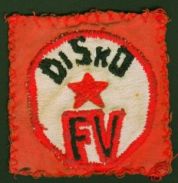
Disko FV

All right, so it’s been a while since I have really challenged myself to do something different. This challenge, however, has been a long time in the making and I’ve been trying to find the best way to go about it. It won’t be perfect and I’m sure that there is scholarship and writing out that is far more accurate and well-written on the topic, but really this is just a possible answer to something that’s been nagging at me for a while now.

Anyway, two years ago I read a really cool graphic novel called Kenk: a comics biography of the infamous Torontonian bicycle thief Igor Kenk. It deals with his possible psychological motivations for his actions, his own personal philosophies, and how his background may have influenced the man he has become. The comic was actually conceived and produced by Alex Jansen, written by Richard Poplak, the photographs and filming it was based from–along with its design–created by Jason Gilmore, and Nick Marinkovich was integral in illustrating and creating its aesthetic. I wrote a review on this at Amazon: with very little understanding of the choice of art-style at the time.

I didn’t think much about Nick Marinkovich’s unique art at the time, aside from its strange sharpened and accentuated angles, the occasional blurry lines, the really incredible contrast of the white stark outlines of people and objects containing an inner gritty grey and black, and the pastiche feeling of it until I watched this interview: conducted by QTV on CBC1 Radio with both Richard Poplak and Alex Jansen. Poplak himself talked a little more about the aesthetics of the graphic novel. First he stated that he and the graphic artist Nick Marinkovich used the fumetti comics medium form: which is basically comic book that uses photos or arrangements of altered photos to tell a story. There is a wikipedia entry and other information on the fumetti form.

However, Poplak also mentioned that he traveled to Slovenia–Igor Kenk’s home country where he grew up–and found another form of art: which the Pop Sandbox team ended up using for their creation. When I first heard him say the name, I didn’t understand what he was talking about. I actually missed the word several times before rewinding the video and hearing it again. Now, I pride myself on finding out as much about the comics medium and associated art forms as I can and this bothered me: the fact that I didn’t know what this word was.

Finally, I made out the word “Faeve” or “Fauve.” But then after some more online digging I came across the Kenk book site and I found out that it was FV Disco that Poplak had been talking about. It was in fact the definition that Poplak provided here and on 12:17 of his QTV Interview that I used when describing the style of Fotonixe’s artwork in my entry on TweakerRay’s Collector Chapter 02: the idea of a gritty-collage like arrangement of photos and images with a dark punk-like atmosphere. As I said in my previous entry, Fotonixe’s style reminded me of this and wasn’t necessarily derived from it. But this did get me thinking.

Because I can tell you that I have tried to google FV Disco several times–specifically as an art form–and I didn’t get very much. It also took me ages–in fact very recently–to realize that FV was in fact pronounced as “fauve” or some equivalent and wasn’t an acronym or a pair of letters. A little while ago, I figured out that the term FV Disco seems to have come from an influential Slovenian alternate theatre turned counter-cultural group or club called Theatre FV 112/15: a group that turned into a movement in Ljubljana–the capital of Slovenia–in the changing former Yugoslavia of the 1980s: where Poplak says that FV Disco itself came from. I found out the name of the group by finding an article on a Goth Rock and Electronic Body Music group called Borghesia: that was apparently formed from some of Theatre FV’s original members.

It was greatly involved with video art as well as music and as it transitioned from an amateur theatre group into an alternative club that made a space for sexual, social, and artistic differences: or so this article here claims.

But very recently I found out what “FV” or “Faeve” is might mean. I found–or perhaps–rediscovered an article by Katja Praznik called Theatre, Emancipation and Political Power: Two Cases From the Past in which she explains that FV “refers to France Verbinc’s (FV) local, frequently used Dictionary of Foreign Terms, page 112, entry 15, where we find the following: C’est la guerre – This is war, that’s how it is in war.” In other words, the group’s name seems to have been derived from a citation or a quote that is appropriate given the climate in which the group was created. This was during the time after Tito’s death where Yugoslavia was beginning to change–to separate–and there were great artistic expressions of socialism and capitalism occurring.

Richard Poplak himself argues that this was what was occurring in Igor Kenk’s formative years in Slovenia and it affected him. There is one element of this movement that Poplak pays great attention to when he discusses it in the above synopsis. He states that the primary medium of FV Disco–what seems to be the artistic as opposed to musical and performative aspects of it–was the photocopy machine: “an agent of democracy because it put publishing – which was until then state-run – in the hands of the people.” It is interesting to note that when I’ve looked at Kenk, the images did seem almost like propaganda posters and pictures rearranged into a different collage form entirely. I can see how–as advertisements for FV Disco’s musical and social scenes and as art in itself–just how subversive it was in that changing environment. Add to the fact that there was a “a gritty punk” element alongside it makes for a really interesting aesthetic and atmosphere.

I think what I find most fascinating about it, at least from what Poplak describes, is how FV Disco takes old ideas and objects and rearranges them: in fact recycles them.  But it’s more complex than that. Praznik in her article likes to state that Theatre FV wanted to create “spaces” or alternative realities in a rapidly changing socialist environment where people could express themselves. She also mentions that one objective of this movement, and those like it, were to blur the line between the performance and the viewer: or art and reality.

In a way, Theatre FV was one of those responsible for creating new wombs of artistic culture and reality and I can see–in that sense–just how all the above might have affected Igor Kenk’s philosophies. He liked to recycle and “hoard” things that North Americans apparently take for granted. The man was also aware of how economic and political systems can change rapidly and the crafting of his own world-view and indeed his life, seems like a haphazard collage of grittiness and innovation. Even Kenk’s own “performance stage”–a Bicycle Clinic filled with so many bikes that he had to spill them from the space of his shop into the streets just to open the door–did not separate itself from the rest of Queen Street West Toronto or the sphere of people it brought in.

Customers, and pedestrians alike were brought into his world of bikes and junk. I never saw it like this until I did some of my own amateurish haphazard research into the matter. It really made me look at the aesthetic of the Kenk graphic novel even more closely. In his article Portrait of a Serial Stealer, Richard Poplak goes into a little more detail on FV and even talks about how his artistic collaborator Nick Marinkovich creates the style of the piece: detailing some of the work that he did. It also hits home the fact that Poplak and the rest of the team that made the book adapted it from actual photo and video footage produced by Jansen and Gilmore: the latter of which are the most references I’ve been able to find on the FV movement aside from those from Poplak.

What I think is a real shame though, in all honesty, is that FV Disco–or Theatre FV 112/15–doesn’t have its own Wikipedia page or a more indepth English language entry of some kind: because it is a really fascinating social and artistic phenomenon to come from a socialist nation that no longer exists and I never put much thought about it at the time. It makes me wonder just how much it might have influenced other forms of art: not just in Eastern Europe but the rest of the world as well.

One more interesting of note is that there is a 1997 documentary called Staro in Novo or The Old and The New created by Neven Korda and Zemira Alajbegovic: who were, according to the site Zank, apparently leading members of the old FV Theatre group and then of Borghesia. They made something called FV Video where they created this documentary: of which I could only find excerpts on Youtube. Copies of the video cassette do exist in some Universities even in North America but I’m not sure if there are any DVD versions, but apparently you can download it here. But it would be an interesting thing to look at.

One thing that I also find interesting is on the site VideoDokument, Korda and Alajbegovic not only talk about the creation of video art, they mention that “Although the images move and we can hear them, video takes much more from comics than it does from film. It was comics that encouraged sequencing and the combination and movement of images, sounds and stories.” I find that a really nice parallel to how Kenk was influenced as a comics form by video and other media from the FV movement. I should also point out that Kenk is also being adapted into an animated film: perhaps making the journey between FV-influenced film and comics come full circle.

I’ll tell you now that I’m not up to the task of making a Wikipedia article on this matter. I’ve said before that I am no musical expert or even an artistic one. I am certainly no expert in Slovenia or Eastern European culture, but it would be nice if someone did this: because I think it’s important. It’s also a shame I can’t find any FV Disco art online as well and I will probably post a picture from Kenk. It seems that the scholar in me doesn’t die so easily, but I just like to write about things that interest me and go on an adventure to see what I can uncover from them when they are being too stubborn to be found.

Some special notes and thanks: the really awesome and emblematic “Disko FV” image seen above this post is actually a hand-made security ribbon taken from the collection of Dario Seraval: one of the former members of the Theatre FV-112/15 group and current member and drummer for Borghesia. The images from the graphic novel Kenk were very generously lent to this post by Alex Jansen and Jason Gilmore. Believe or not I underestimated how much time and effort making this post and finding images for it would take, but in the end thanks to correspondence with Aldo Ivancic (another former member of Theatre FV and current member of Borghesia whom I talked with about using said ribbon) and Alex Jansen, as well as Richard Poplak, Neven Korda, and museum counsellor Breda Skrjanec of the MGLC (the Mednarodni Grafični Likovni Center), it was all worth it.

Addendum: If you are particularly interested in FV Disco, you can try to track down the MGLC’s art catalogue from its FV Alternative Scene of the Eighties 2008 Exhibit. It has a Slovene and an English language translation as well. The book is composed of photographs, art samples, an introduction, three essays, and a chronology of events and developments in FV Disco.

Who Watches the Watchers?

I suppose the title of this post is really rhetorical in that the question already has an answer. We do.

In case you were wondering, this article isn’t about Watchmen. Instead, it’s about Watchers. You can find the idea of them in comics, film, television, and various other media. They are depicted as either very powerful enlightened beings, or hidden organizations with more knowledge than most people. You can find them as a race of cosmic beings with large craniums within Marvel Comics, a secret society of men and women that observe Immortals in the Highlander television series, and even the Ascended in the StarGate series.

Aside from their great power and knowledge, Watchers generally have one more thing in common: they have some sort of code that permits them to observe but rarely–if ever–interfere with the existences of those either “beneath” them, or unaware of certain facts of life. This idea can also be found in Star Trek‘s Prime Directive: where by law the Federation cannot interfere with the development of civilizations that are not as advanced or as cognizant as those of their member worlds.

This means that this agreement of “non-interference” not only prevents these powers from abusing their abilities, but also helping others with them as well. Of course, as I’m sure something like TV Tropes will point out, there is always a conflict of some kind with regards to said beings following these codes and also certain “bending” and “tweaking” of the rules from time to time. Certainly, there have been instances in Star Trek itself where more powerful beings have more than interfered with “lower planes of sentience” … and I’m not just talking about Q either. I mean, you could argue that the Enterprise and the Federation it represents have evolved to the point where certain advanced beings can safely–to some degree–interact with them without causing permanent harm, but there is a really fine line there. It’s also not really what I want to talk about.

No, I think this trope of non-interference has always bothered me on a creative geeky level to some degree and I’m going to try to explain why.

Basically, these advanced beings or secret organizations–who dedicate themselves to observation–do not want to harm anyone intentionally or otherwise, or endanger themselves and existence as they understand it by “interfering.” But my issue is three-fold. First of all, if you follow Einstein’s theory that an observer of an event is also a participant–that an experiment is affected by the mere presence of an observer–then these beings “interfere” all the time simply by existing. If you have a certain amount of power–of any kind–or a presence somewhere it will affect your surroundings. I mean, yes, there is a big difference between sitting and doing nothing, and acting in said space but your mere presence changes things just by you existing.

So perhaps, in these various forms of fiction, said beings are aware of the fact that by existing they do change matters so they try to minimize the effects as much as they consciously can. Maybe some of them make a point of not observing: claiming that the material no longer interests them, or is somehow inferior to them but in reality knowing that the temptation to act would be too great or, again, by simply looking they affect matters. Add telepathy and psycho-kinetic powers along with spatial-temporal manipulation to the mix and you can more or less figure out where it can go from there.

Of course, there is the other side of the weird coin which is that perhaps perception itself by these beings determines the material plane’s very existence or, to quote George Berkeley, “To be is to be perceived.” Imagine if said watchers started perceiving a thing in a different way, or began ignoring it entirely. In essence, they could make something cease to exist by diminishing or denying it. Changing someone’s perceptions or having them ignore a thing can definitely change the world as human beings have proved many times in fiction and in reality.

Essentially, you can also say that by actively not looking or paying attention to the rest of the “normal world,” they also affect reality. In the case of the Highlander Watchers, if they stopped observing and went away, a lot of the historical lore and information on the Immortals that pop up among humanity would be lost. I suppose it could said that this wouldn’t hurt anyone–I mean no one would really ever know what was lost or not–but as these plots unfold it is never really as simple as all that. Imagine, for instance, an evil Immortal is gaining power and you know as a Watcher that if he or she continues at this rate, they will rule the world. You have the knowledge to stop them or at least help someone indirectly in doing so. Of course, the rules exist for a reason and the idea of possibly making things worse or revealing your presence to those who don’t understand you or your work are definitely barriers to overcome right there.

This is not the only series where such a moral conundrum happens. In StarGate, there have been Ascended Ancients and even the character of Daniel Jackson that have realized that if they let events continue unimpeded in the material plane, villains like Anubis or Adria will not only cause damage to that plane but potentially their own as well. Yet the argument is that the code exists for a reason. As a result, they can interfere, but only in small plausible ways in that reality: as though they are playing some sort of game or helping to write a novel where continuity has to be maintained (I really like that word, continuity), but then they aren’t really just watchers anymore are they?

There is also another saying, which only recently I realized was created by the philosopher Edmund Burke, he which he states: “All that is necessary for the triumph of evil is that good men do nothing.”

I know that this is a moral argument and that in the case of actual cosmological beings in fiction, they may have a greater understanding of reality and morality than flesh-based beings do. In fact, we can even go as far as to say they would understand the way of things far more than Einstein ever could. It feels like a cop-out to state, but we are also talking about fiction and imagination.

Yet with our limited understanding of things, you can see why it is very hard for an observer to remain perfectly neutral and not affect the reality around them. These beings and orders are still part of the world and the universe. They may be on a different level, but that doesn’t mean they are removed from everything. In fact, the idea that they have limitations–even and especially self-imposed ones–illustrates that they are not all-knowing, all-powerful, or perfect themselves. Is enlightenment recognizing your own limitations along with those of others and acting, or not acting appropriately?

Is not acting a sign of wisdom or a kind of paralysis: a fear of making things worse than they are when–by not interfering–you could be making a situation dire in any case? Also, if an observer is a part of life, then by not acting are they really living?

How many cultures and civilizations in our world would have reached the places they are at now if they did not bother to even meet each other? I mean, yes, there has been a whole history of colonization and imperialism and destroyed ways of life, but there has also been trade, and innovation, and new knowledge. And what is “higher” or “lesser?” Is it that observers are any better than physical beings, or that they are just different and have different constraints?

I guess, as these things go, this is a whole lot of armchair philosophy, but it is something I’ve been thinking about for a while. So in terms of fiction, who watches the watchers? Well, I will say again that we do.

And it can be very entertaining.

File:JudgeQ.jpg

Artistic Progress Goes Boink!: The Refinement of a Heroine, the Formation of an Antagonist

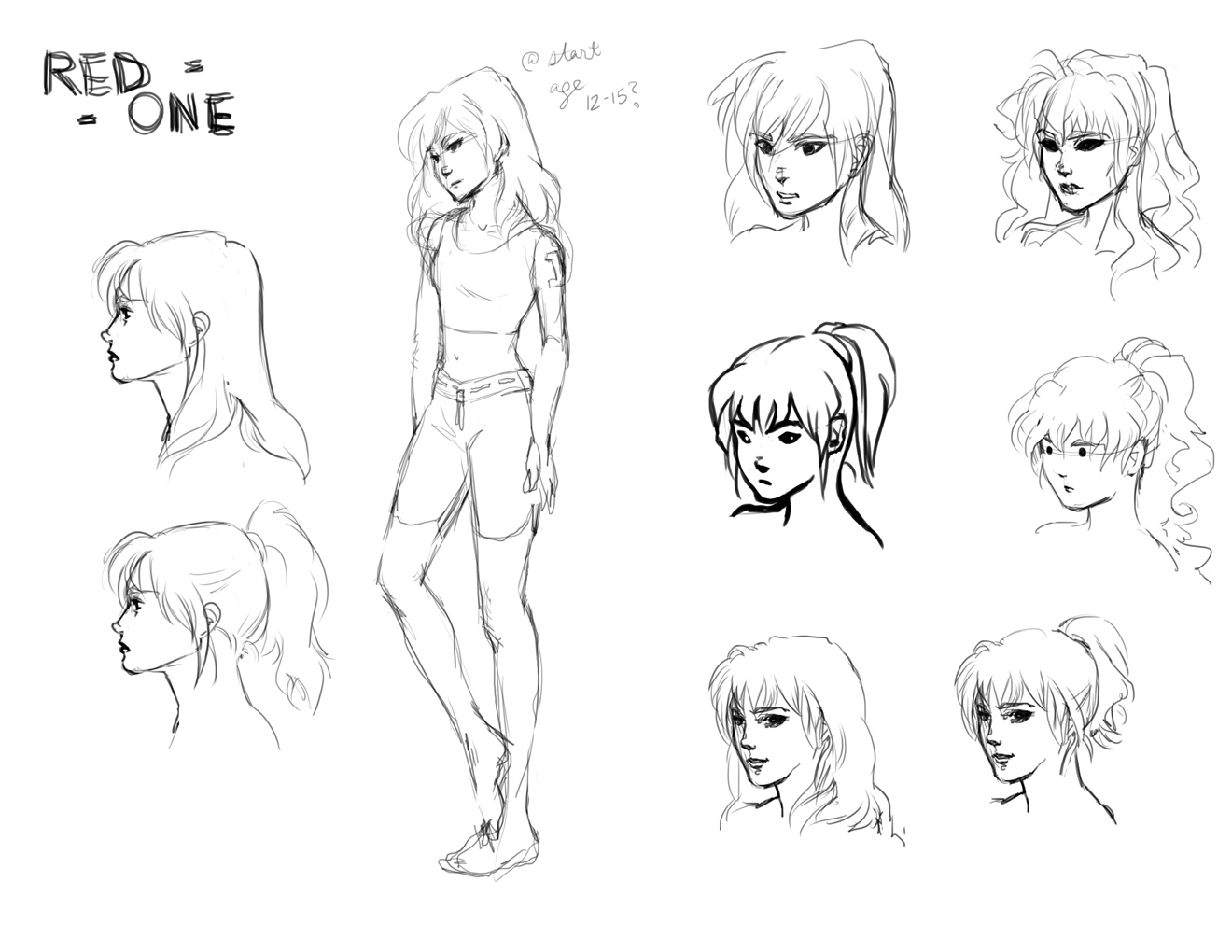
When we last left off, our intrepid heroes were continuing to work on the formative phase of a silent comic. Much of Angela O’Hara’s pictures in the previous Project entry are of our female protagonist and as you can see here, she has been busy with her.

Notice the eyes. They are not only how I thought of them–pure blue–but Angela even went one further by giving them the detail of actual sclera and pupils while also keeping them the same colour. Angela has also been playing with facial expressions, some dimples, and conveying certain kinds of emotion with every facial image that you can see here. There is something very serene, sometimes sad, but ultimately determined in this heroine who is questioning herself as she continues on her path through the strange little world that we are making for her.

While our heroine is getting more detailed, we are also working on fleshing out our antagonist as well.

Like our heroine, I provided and talked with Angela about certain details. He is supposed to be an older man and he is obviously different from our main character. It’s been a challenge to figure out what he’s supposed to look like as of yet. What I find works for me is looking at these conceptual drawings with Angela and picking certain details from these already made illustrations that can be incorporated into a figure closer to what we both want to work with.

For instance, I really like the idea of an X-like scar on his cheek: an aesthetic very reminiscent of the protagonist in the manga Rurouni Kenshin. In fact, as we talked about this online, I figured out exactly how he got that scar even though I didn’t originally plan on having this “X” on his skin. I was more thinking of having it on his costume, but Angela’s initiative worked out well.

So basically I decided he would look older, but not grizzled or ancient. The mask has also been a challenge too because I had been thinking of having it cover his whole face and making him look more mysterious as he watches our protagonist at work. Of course, the advantage to the half-mask–aside from the fact that it plays with our theme–is that it shows more facial expression and therefore more humanity. There is a part of me that does wince at it seeming too much like a stereotypical comic book hero or villain’s mask, but at the same time this is definitely something that want to play with as well.

We are still  working on what the suit should look like. I do like some of these designs in these latter pictures. I like, for instance, how Angela puts the “Zero” symbol at the lower-hand corner of each costume. That was one issue I was having when I was envisioning how to fit the “X” and “Zero” symbols together on his person. I mean, he’d not be very intimidating if his sigil was something derived from a  “Tick-Tack-Toe” game. In terms of the clothing in the latter set of pictures, I can definitely see at least the lab coat becoming a basis for another costume. In fact, we’ve talked about giving him different costumes depending on what environment he’s in and what he is doing. I mean, he has the resources. He has the technology. 😉 We just need to see where he goes from here.

And now to the Boink! part of our creative progress.

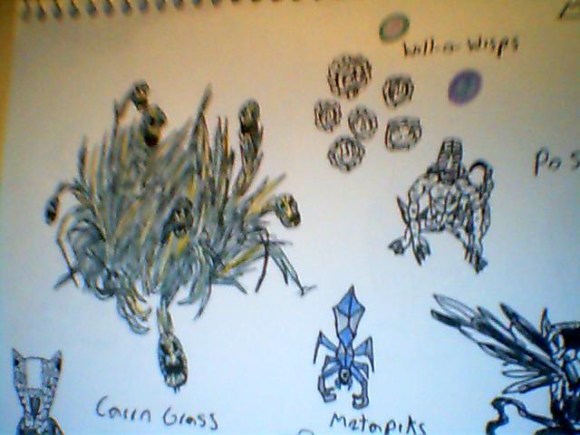
This Calvin and Hobbes reference aside, when I was much younger I fancied myself something of a graphic artist as well. The thing is, I had difficulty imitating basic shapes. At the same time, I liked to create monsters. To this day, it’s safe to say that I create better monsters than I do humanoids. I knew that in addition to the heroine and antagonist, we needed to have some other creatures and enemies in our developing environment. Now I could have simply described these, and to some extent I did describe them to Angela on email but pictures speak louder than words and so I unearthed these images.

(No, my blurred face is not one of the monsters … I think.)

See, those three pod-constructs were robot minions that I created for a primitive high school comic about a stick-man from a cartoon dimension who gets crippled and reconstructed into the Styx Demon by aliens. These were supposed to be the aliens. I used to have drawings of these with ink pen and pencil crayon colouring, but they are sadly lost to time. When I sent these to Angela, it was like an archaeology of my drawings: taking pictures of and documenting glyphs from my old high school art kit.

There is more.

These two kinds of beings in particular, from what I remember, were created as creatures for an old RPG game I had planned: something that people could scroll through a Paint Program to interact with. To this day, I still love that Cairn Grass. These drawings sat in my closet for years, just as the ideas that made them have rested in my mind. The idea is for Angela and myself to use some of these as templates to … make things that our heroine can interact with.

Sometimes, I feel like my part in our creative process is very ad hoc. I don’t have a script ready as of yet though I have created a rough outline of the events that I want to depict along with some notes on character personality and a little bit about how their abilities work. A lot of the interaction between Angela and myself has been exchanging ideas. I admit that sometimes I feel bad for not having a detailed enough script as of yet, but there are still some decisions that need to be made and I’m glad that it is not a case of me dictating to another person. Much of our creative decisions so far have been the result of a mutually creative exchange of ideas, shared enthusiasm, and just throwing stuff out there. I’m given to understand that each comics–and creative–collaboration works differently and so far, our works just fine. 🙂

Angela has just told me that she has some special pictures planned for next time: something that may or may not have been influenced by talking about old video games. I look forward to seeing where this goes from here.

Building a Character to Make a World: Our Project Continues

About a month ago, I said that Angela O’Hara and I would working on a comics collaboration together. So here is an update on our Project thus far.

I gave Angela a whole list of comics artists to research in order to get the right aesthetic for our world. The following inspirations were Jonathan Lethem’s Omega the Unknown, Chris Ware’s “The Super-Man” stories, Saint-Exupery’s Le Petit Prince, the rugged elementalism of the anime Gurren Lagann, Sarah Howell, and Neil Gaiman’s run of Miracleman.

At the time, Angela was not completely sure how to go about this: which was fair given the fact that all I had seen of this world I’d envisioned were a few scenes and figures inside of my own head. It’s amazing how something in your mind cannot always be so easily translated into real life.

After a summer of proposing this Project, I was galvanized into action when Angela said she was going to be pursuing her drawing career full-time now: which is excellent because she is a gifted illustrator and a comics-creator. This was when I realized I needed to give her what I had and, once I did, I realized I gave her more than enough to work with at that point.

In the end, I created a fairly detailed back-story (or at least something far more detailed than what I thought it would be), some character outlines and descriptions, and even some notes on the minions that I’m keen on including in this strange new world of ours. So armed with artistic inspirations as well as character descriptions, names, a background story, and a rough idea of the main plot Angela began drawing.

It was when she sent me these first pictures that the challenge really began. As you can see, they are all excellent illustrations of the main female protagonist. Usually, I could have just selected a few and suggested some details here and there, but her features were not as distinct in my mind as I would have liked. Then I started to think about what the world would be like: specifically what we wanted our aesthetic to be.

For two days, I thought about this and luckily Angela and I managed to talk about it. She told me that she wasn’t completely sure what aesthetic–of the inspirations I chose–that she was supposed to use so she decided to draw different pictures of our character in various styles. I felt really torn: because I wanted to see this world as an elemental place of basic shapes but some very realistic elements, but Angela drew all of these really good illustrations. It made me question the fundamental substance of what I wanted our world to look like.

But Angela has a good way of asking the right questions. Not only did I manage to answer some of her questions, but I started to add some details of my own. Another question that really got me was how old our protagonist was going to be and what she would be wearing before she got her costume. These were definitely questions that I needed to answer and in the end we decided on her being twelve or so, with rudimentary clothing that she had been forced to create herself.

Angela was also curious about what costume our character was going to have. She experimented a bit and showed me this:

This is what prompted me to tell her the idea I had with regards to the main character’s costume: and how that was going to fit into the plot. Let’s just say: it’s less than she chooses the costume, but rather that it chooses her … and in unexpected way.

Finally, Angela had an “Aha!” moment and after I chose a few of the profiles that she created and made some suggestions, she managed to mix together something of Saint-Exupery, and something very reminiscent of Mark Buckingham’s drawing style in the illustrated story section of Miracleman #20: Winter’s Tale. As you can see, our protagonist looks like she is painted and has very bright colours. And yes, you’ve seen it right: she is red. 🙂 As of right now, this is the closest working illustration and aesthetic that we have and Angela is still working on it: along with drawing out a few more of our characters. It is just so beautiful, lush, and artful.

Another excellent advantage to having this working model of our whole aesthetic is that I have inspiration. There is nothing more buoying than seeing something you envisioned becoming as close to a tangible image as can be made possible to really encourage you to keep creating. The added bonus of this feeling is that with our last Project, Thebes was supposed to be based off of our re-interpretation of mythology: of stories and characters that already existed. With this Project, we are making something relatively new: something that didn’t exist before quite the way we see it.

I mean, I know: I understand that all superheroes are archetypes and variations of Superman or older mythical figures, but the characters in this story have their personalities and I try to look at the basics of what they can do as much as possible … of which I am now figuring out. It is also very helpful that, right now, Angela and I are on a very similar wavelength in figuring these details out.

In fact, all of this is a process of figuring things out: as though Angela and I are spying on another world and trying to translate it into ours as much as possible. When we’ve done more work on this–and I create at least a rough outline of the booklet–I will start calling the characters and our Project by name. Until then, both will be as silent and as wordless as our comics work itself.

Book Review: Brian Selznick’s The Invention of Hugo Cabret

One evening, when I was living downtown, I came across a book in a church-run thrift store. It was this big thick-paged book with a very luminously colourful ornate cover. I’d never ever heard of The Invention of Hugo Cabret before this point, but I saw that Scholastics had published it, and it was about five dollars or so. So I bought it and it sat in a cupboard for a while until I finished my initial draft of my Master’s Thesis. Then a day or so before leaving on a trip, I began and finished reading it.

Hugo Cabret is the story of an orphaned boy of the same name who finds himself operating and maintaining the clocks of a Paris train station while attempting to fix an old and broken clockwork automaton. It is when he attempts to steal some parts from an old man’s toy booth at the station that he reveals a far greater story and his life changes forever.

I really don’t want to spoil this book. I will tell you now, though, that it is excellent. Brian Selznick is not only an excellent writer that knows how to pace and flesh-out his characters, but he is a brilliant illustrator. Hugo Cabret is essentially an illustrated novel: with pages of text inter-dispersed with sequential pages of softly shaded drawings and stylistically-faded copies of sketches and photographs. It basically looks like a notebook or a journal: especially with the image of a lock on its cover. Given that there is a notebook that features somewhat heavily in the plot–once belonging to Hugo’s inventor father–the aesthetic follows the form well.

What I also like about Selznick’s aesthetic form is that it is on that border between an illustrated novel and a comic: in that while there are pages of words, and pages with pictures and words, there are also entirely silent panels that display interrelated sequences. It’s a nice borderline form and it adds to the content nicely.

In terms of content, this book is apparently labeled a work of historical fiction. This is an interesting designation because while there is definitely one central character that is real and historical, Selznick has taken some creative liberties. I also wonder in light of this if the other characters may be conceptions of this particular character’s work made into real personalities in a meta-narrative sort of manner. I love that kind of thing, in case you didn’t already get that, but even if it’s not true there are definitely moments where the concepts of the characters could very well fit into … other conceptual places.

But what really intrigues me about this book, aside from its liberties and ambiguities as “historical fiction,” is how it eventually focuses on the medium of film. In contemporary times, we often take moving film for granted. It had to develop from somewhere after all: both technologically and artistically. Even Hollywood itself was a small independent pioneering workshop studio at one time before it gained more resources and popularity.

While this story seems to take place in the 1920s, it refers after a while to the turn of the century when film was being developed: as well looking at the kinds of people who helped to create it. And who were these people? Some of them were magicians. I am not being figurative here. Some of them, including one of the characters in this book, were artificers, artists, and stage magicians before they became directors and creators. And it makes sense. After all, aside from the fact that vaudeville and its acts, along with theatre, and opera preceded a night at the movies in terms of prestige and guaranteed entertainment, film is kind of like watching a magician’s shadow-play on a thin skein of reality. It is a concept that reminds of Clive Barker’s short story “Celluloid”: where the silver screen is a more permeable layer of existence with our world than we would be comfortable to believe.

I love the image of the magician as film-maker and inventor, and if you read this book I assure you, you will understand what I mean. A friend of mine once said to me that if I embodied any kind of film, it would be the black and white 1902 A Trip to the Moon: something that is extremely symbolic, experimental, even comic, but also parodies and is self-reflexive and aware enough to know that by consciously parodying things, it reveals its opinions on what these things are. I mention this film for a reason that has to do specifically with one aspect of the book. What’s also interesting is that not long after I read this strange and awesome artifact, a film was released based off of it: one I’ve still have yet to see.

That digression aside, I give Brian Selznick’s The Invention of Hugo Cabret an unambiguous five out of five. Until next time, au revoir. I seem have something in my eye.

A Collaboration Project in Progress

So a little while ago, I mentioned I was starting a new project. I know that for some people who know me, that really doesn’t narrow it down a lot. I’m always thinking about short stories still in the queue of my head, the graphic novel script that’s been languishing in my binder, and a few other things as well.

This one is different. A few years ago my friend Angela Jordan, now Angela O’Hara, wanted to do a comics collaboration. At the time, I really wasn’t that skilled with creating comics scripts and–even now–they take more effort to create than a play or film script, or even a short story. Our original idea was very ambitious and I eventually created a very elementary and simple first story that I hoped Angela and I could flesh out into a comic. I had no knowledge of panels then and even now I still have issues with figuring out anything other than some of the basics in my head of how a page layout is supposed to look like.

We went our separate ways for a while: Angela taught in Japan and eventually got married, while I moved out to York residence and started my Humanities Grad Program. Years later we got back in touch and I decided that there was a way we could side-step some of the difficulties we were facing before.

Superhero comics have been done so often that people often see it as the comics medium itself as opposed to a genre. It’s interesting because comics didn’t start out with superheroes–if you look at old slapstick comic strips and political cartoons as examples–but they did gain popularity for the medium.

Based on some of the work I’ve seen Chris Ware–a cartoonist who loves creating beings (including superhero figures) of basic geometrical shapes on vast, empty and existentially lonely backgrounds, the strangely small and greater world of Saint-Exupery’s Le Petit Prince and Alan Moore and Neil Gaiman’s Miracleman along with a great many other superhero comics I’ve looked at in my life something started to come together in my head. It wasn’t really until I looked at Sarah Howell’s silent comic pamphlet–reminding me of their power–that I found the form for this thing I wanted to make with Angela.

Yet a lot of the above is stuff that happened after the fact. Actually, the idea for the entire thing–still in development now–was brought on by a video game song. It’s amazing how music can help you visualize certain scenes in your head.

So right now, I am in the process of creating the story for this “silent superhero comic.” I’ve given Angela some sample art to look at as foundations or influences for the work’s potential style while telling her about the scene I made in my head. But right now I need to do more. I’m now developing a bit of the world and the main characters. I think I will have to crudely sketch out what I want them to look like. One thing I’ve learned through making a few “ordinary” comics scripts, is that drawing out a rough look at what the page should look like does wonders to help you and someone else know what it is you want to write about.

The difference this time is that we plan to make this a small pamphlet of sixteen or seventeen pages–possibly double-sided–for each part. I originally wanted this to be a one-shot thing to allow us to brush up on our skills again before doing anything else, but at the same time I can see the potential in some of this.

It’s funny. I once thought I’d grown past superhero comics but I’ve been researching and talking about concepts behind them a lot this summer. They have certain rules and conventions that can be followed, bent or broken. But I’ve learned that going back to the essentials or “the basics” can be very important no matter what else you might do and all the more so for superhero archetypes that are really extensions of the stories of heroes and gods. When you also think of cartoons and children’s illustrations as archetypes as well, you can see where a lot of my influences want to come in. So you can probably see why I’ve had a bit of a superhero obsession lately. Lately. Okay, somewhat.

Basically, I want to post updates of this as of officially unnamed silent comic project or, as Angela put it even more eloquently, this “superhero fairytale” whenever I possibly can. It’s been a while since I’ve written anything besides stuff on the creative process, reviews and articles: but finally I get to begin to play around with some world-building and alongside a really talented artist.

You can find Angela’s work in two of her Deviant Accounts: her Angela Jordan one, her Angela O’Hara account, and her professional artist’s website. Here is one sample of an image she created from our previous collaboration: one I always look at even to this very day.

As for me, I need to keep working and also keep my creative side fresh. As someone might have said, if it isn’t in writing it doesn’t exist. Well, now it is in writing and now, I hope to to do my part to make it happen.