When You Reach *That* Point

Have you ever had a really good story idea and just realized that you were not at that level where you can write it out properly?

I have. Many times. In fact, I’m facing something like this right now.

I suppose it’s rather like coming to a level in Legend of Zelda or Metroid where you discover a new chamber or the location of an item but you can’t get at it yet because you haven’t gotten the right tools. Of course, I would make this thought analogous to video games, but another way of looking at it is that you reach a point in your development–at least with regards to one project–where you find a block that you need to somehow get around or realize is a part of what you seek.

There are several different ways to deal with this conceptual challenge. First off, you can research it. You can research the hell out of it. This research can come from books, or the Web, but it can also come from talking with the appropriate people and even doing some journeying.

It can also take some time. I have probably said before that different stories have different requirements. Some stories need a little bit of work, and others have to start as notes, and then a variety of rough drafts until finally you get something that you are looking for. Each draft, even the notes that precede it, is a prototype and each builds the foundation for what you want.

I also find a few other issues to consider with regards to this challenge. The first is dealing with the fear that your idea will be taken by someone who is more versed in it if you don’t use it first. This sounds really irrational, but that fear can be there. The second issue is energy in the form of enthusiasm.

Both issues can be very interrelated. In fact, I don’t really have any easy answers to dealing with them. I suppose all I can say is that after you do the work, you need to find something new to work on, something doable, some small part to do–piece by piece–each day so that the task remains doable in your mind. As for the fear, I suppose I can tell you that no one will quite write something the same way that you will. And they won’t. No one can write like you.

You will also find that ideas can change depending on your creative circumstance and if they don’t work in one context, they can be adapted to another. It might also help to realize that no idea that you ever make is truly original, that you borrow it from someone or somewhere else, but it is how you execute it and how your “accent” or evolving style affects it that is ultimately you.

This post may seem more haphazard than the ones that I usually make and maybe more theoretical. In a lot of ways, it is my attempt to make a conceptual or mental framework for a challenge that I have been dealing with: an attempt to help me focus on a project or two. But at the very least knowing your own limits is very important so that you can either work with them–and perhaps see the block as another angle of a usable idea (I have a friend who liked to always use the infamous quote, “Think fourth-dimensionally” in role-playing)–or know them so that you can potentially surpass them.

I will finish this off, however, by saying this. When all else fails: when research, accepting that you will change an idea by working it, focusing on the doable parts of the project and eventually moving on to the more complex stuff fails then I believe that this–and the subject of this entire post–is all about your own mindset and the need to challenge it enough to simply write down what is in your head: no matter how rough it may be at first. Once you do that, the rest of it will follow, or you simply move on: having learned something.

Whatever that is. 😉

Still Trying to Go Beyond Myth and Legend, Novels and Short Stories

It was in 2002 that I wrote my first complete “adult” novel. I put the word “adult” in quotation marks specifically because I was twenty years old at the time and I barely had any living experience. In fact, it wouldn’t be too much of a stretch to say that I had no living experience at all.

What I did have, however, was the opportunity to absorb a lot of academic experience. I had always been a pretty good student (in fact, I thought it would be the most sensible thing to do with my whole life) and I believed that University would just expand on my knowledge. And it did. I learned many more obscure ancient Greek and Latin roots of words, some mythology, and even more philosophy. To be honest, I had been learning of these elements back in Grade Twelve and the now-lost Canadian Grade OAC (or Grade 13 for those who might not be familiar with it).

Read Between the Realities: Beyond Myth and Legend was essentially a bildungsroman–or a “coming of age”–novel of 136 double-spaced computer pages. This was the point in my development as a writer where things began to really change for me.

Now, I’ve discussed a little of the background behind this novel’s creation, but there are a few more specific things I have to mention. Before this point, I had mostly been working with purely the fantasy genre: in as much of a way as someone at my skill level and knowledge at the time could. In fact, even in my first year of Undergrad I was still working on my fantasy series Deceptions of Nevermore before the change began.

First of all, I’d heard of York’s Creative Writing Program. It was–and as far as I know is–a program where you had to submit a portfolio of poetry and prose in order to be selected for a small number of spots. The Program also discouraged, if not outright rejected genre writing in its courses and, instead, wanted to focus on “realistic fiction.” Now, I was very interested in developing my writing skills in those days and I could only apply in my second year. But that was only part of what helped to create my novel.

The second crucial element in the creation of Read Between the Realities was my discovery of a book called American Gods made by a man named Neil Gaiman. That book, which only in retrospect I realize was Neil Gaiman’s own transition from the format of comic book script writing into solo novel writing, changed things for me in a very big, very real way.

I realized that there were things beyond the confines of genre as I understood it. Then I remembered the film Finding Forrester and how I wanted to write “the great 21st century novel.” So I did something new. Before I even entered the Creative Writing Program, I decided to create my first experimental “adult” novel: a great Canadian novel and all of the grandiosity I still haven’t quite grown out of even in my very early 30s of now.

In Read Between the Realities, I created a pastiche of different stories and attempted to sew them together into an open-ended patchwork reality where you could interpret the novel almost any which way you’d like. I worked on this sucker for a long, long time. I worked on it at home, in parks, on mall benches, at friends’ houses, during sleepovers, when I visited my girlfriend at the time or when she visited me, and even when I moved with my parents to our new house then. Some more marked developments in this novel was how I actually actively incorporated many of my own experiences and thoughts into the work. This was partially influenced by my interest or obsession with philosophy, but also from insights I was having from life.

I was really bad at explaining what my novel was about and I firmly believed that the only way someone could understand it is if they read the damn thing. It also didn’t help that I had the paradigm-shifting magic concept of Mage: The Ascension on my brain too, and I delved into that voraciously.

My book was essentially a story about different realities inter-lapping and how personalized they are. It was about a writer and his relationship issues with his life, a fragmented being seeking something for a demanding master in a labyrinthine subconscious world of ruin, a viciously sadistic monster hunting this being down, and two people on an Internet chat room who bickered all the time. The writer and the two chat room people both believed they were making the story, while the seeker and monster both thought they were living a reality. And none of it was real. And all of it was real.

Of course it all combined, or exploded together–because I always loved epic moments of spectacle–and I played at being profound. Yes, it was a meta-narrative: complete with the characters knowing they are characters or finding out they are and all that fun stuff.

Ten years ago, I thought it was the best thing I had ever written in my whole life, and I actually feared that I could never surpass it. Ever.

Years later after showing it to some friends, I found out that I could indeed “surpass” it. A lot of my characters were two-dimensional archetypes, I didn’t write female characters well, I certainly couldn’t write sex scenes worth a damn then, and I rambled: a lot. And when I tried to simulate experiences I never learned about or experiences I never had, it just fell flat. Also, I wrote combat and adventures as if they were video game levels: though that in itself makes sense given my interests then and now. So yes, I can safely say that I have done better since then, though …

I’ll let you in on a little secret. I actually haven’t really written any, at least official, novel-length works in a very long time. They take a lot of commitment and unique formulas to keep up. I also can’t just write anywhere at anytime anymore. Part of this is that I realized I had more of a life beyond my craft, but I also find that novels can be trapping. They can really take your time and energy. They always get on your mind all the time.

Short stories are explorations into more tightly-knit, self-contained worlds. You can spend less time on these than on a novel, though they take their own toll given that you really need to focus on tying them up all neat-like. On the other hand, sometimes I find short stories to be like little tidbits–even the more complex “four-course meal ones” that some of my friends like to call them–and not as satisfying as the meaty feel of an entire world in a novel. That is, of course, when the short story ideas aren’t overwhelming your bodily and mental limitations to write them all out.

So sometimes, despite my best intentions, I have found myself writing novel-length works because the ideas behind them are either too similar to be placed in anything other than an overarching structure, or they just too big to contain in one short story. And for now, that is all I will say for the others that came after Read Between the Realities.

What is notable about my twenty-year old writer’s novel was that this was about the point when I was also consciously playing with mythology and archetypes in addition to ideas and philosophies. I attempted to combine academics and creation together. I also very reluctantly put more of myself into the work, and–like I said–I went into meta-narrative and irony: which for someone who had just done generic well-meaning fantasy novels before was a big step. And Joss Whedon taught me to be more flippant and referential about popular culture and life too.

I would never have admitted that I created a coming of age novel. I always wanted to make other worlds and other people to get away from the ones I was experiencing–or not experiencing–but I can admit that this was what it was. And for something based on a whole lot of theoretical knowledge, incomplete understanding, video game and pop culture influences and a small if not sheltered, somewhat self-repressed and stagnant amount of personal growth at the time, I did pretty well. It was like building a small Star Gate from the scrap-metal in one’s basement. It did what it was designed to do.

Read Between Realities was made at a time where I went as far as I could go with what I had then–with what I was then–and now, whatever else, I know that I have and definitely can go farther.

Looking Outward

Credit: Beth Ann Dowler, the photographer of this image.

I Wish You Help, Doing It Yourself, Insight, and a Happy New Year

I was going to put an entirely different post up here at the time that is now yesterday. At the beginning of 2012, this Blog was just an idea: if even that.

For quite a few people, 2012 meant the End which, in various ways, it was.

At least, it was for me.

It was the end of my time at School, my apartment on campus, and living in downtown Toronto. It also saw the finish of two longstanding Projects of mine that hovered over my head for the longest time. I might have even gotten rid of some bad habits along the way as well.

But more than any of this: this year was the end of another old life. I’ll have plenty of time to be melancholy about it, but mostly–right now–I feel like it just is.

I’ve thought about some things that have occurred this past year. I will say that my Writer’s Blog has exceeded my expectations. Most of the time, this is a good thing. I try to make my writing clear, accessible, and relatable. I also attempt to make sure that I know what I am talking about or, at very least, contain my writing to knowledge that I already have. For the most part, I feel that I am accomplishing a lot of these goals. However, sometimes I catch myself becoming very wordy, talking about things I don’t fully understand, or trying to mash things together in a way that just … gets awkward and doesn’t completely work.

I’m looking at you, Clouds and Mirrors. This article, which was more of a fan reaction made right after watching the Dr. Who Episode than a well thought-out and analytical review, had its heart in the right place and some interesting creative parallels but it never sorted its identity out. It took me a long time to write it and I wasn’t completely satisfied with what I made, or really what I did. The fact is: it took longer than I expected and there were many times I almost didn’t finish it.

To be perfectly honest, I almost deleted my “Clouds and Mirrors” article until I realized that the reality of this Blog has changed from when I first made it. Gone are the days where I could post something and few people would barely give any input. I know that the article itself has received quite a few “Likes” and it still gets more than a few Views as well: which may or may not be because of the pictures I embedded into it.

One reason it stays here is because others appreciate it and got something out of the piece. But the other reason I am leaving it is because, like I said, the heart was in the right place. When I see something I like, like any creator or geek, I want to possess it. I want to take its essence, and make it my own. There is this impulse to put something like it in my own words and way, and display my joy out of experiencing it. Perhaps by writing this, I wanted to have some part–some unique kind of relationship with it–as well: even if it was something that I didn’t entirely have full knowledge of.

So it stays.

In this New Year, I do hope to keep to my original promise and post things on here and elsewhere that are more than reviews. Don’t misunderstand: there will still be reviews, but I have some other plans as well …

But getting back to the subject of this passing year, I would like to reflect a bit on some of the things I’ve learned.

The obligatory Animaniacs Wheel of Morality reference aside, 2012 taught me two clear lessons. The first is that this is the time to start pursuing what I need to do. This is the point where I need to hone my writing and expand my network of contacts. May 10, 2012 was when Mythic Bios went from being a series of yearly private notebooks to a public online Journal: where “Oh I should make a Blog, but ..” became, “Here it is and I can now begin using it to my advantage.” Sometimes it is an intimating thought: that what I write on my Blog gains a greater amount of scrutiny and feedback now, but it also makes me feel like I am doing something important and it is good practice if I want to keep writing and doing something with that craft.

The second lesson though, has taken much longer to learn. In fact, I would say that 2012 needed the help of the years that came before to hammer the point home for me. And it is this: you cannot depend on other people to get what you want. The only person you can truly depend on to get what you want is yourself. Other people can help you get to the places where you want to go. They can offer support in physical and emotional ways. If it is given to you, you should value it because those who give you this aid are taking time and resources away from their own lives and labour to help or recognize you. Freshly Pressed, for instance, took the time and consideration to look at and feature my Funnies article.

This helped my Blog a lot. There are many of you that found me because the above article was featured. But I didn’t expect it and I know that it is not a given. I just continue to do my thing and take constructive suggestions along the way when they are offered. Ultimately, my writing and the other aspects of my life depend solely on me: and it is one thing to know that intellectually, but a whole other thing to feel it on an emotional level. It has been a very sorely needed perspective that may help me in all of my endeavours and interactions.

But now, it is 2013. I feel like I am leaving a lot of things out, but I do remember one thing. I can’t expect you to keep Following me or being there for me, but thank you for doing so regardless. Thank you for Linking me to other places. Thank you for Following me here. And thank you for Liking me.

So in the end, like everyone else, The End of 2012 has just been the beginning. As I have said before, you are all awesome and I hope that you will stay–and even come along–as I continue to take this space I’ve made to other places.

Take care and have an excellent New Year everyone.

gravatar

A World Coming Together, A Possible Paradigm Forming, and Other Stories That Find Themselves On Their Way

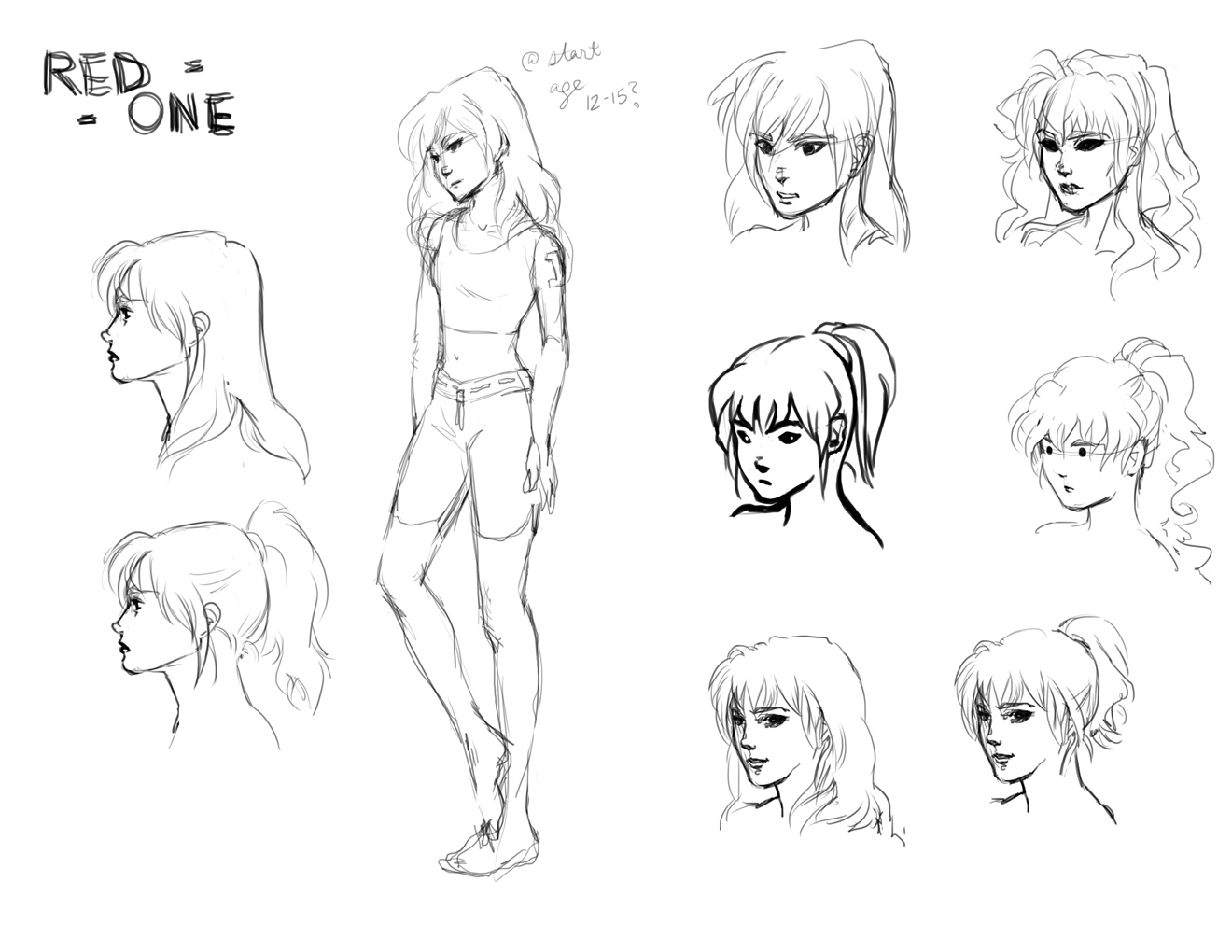
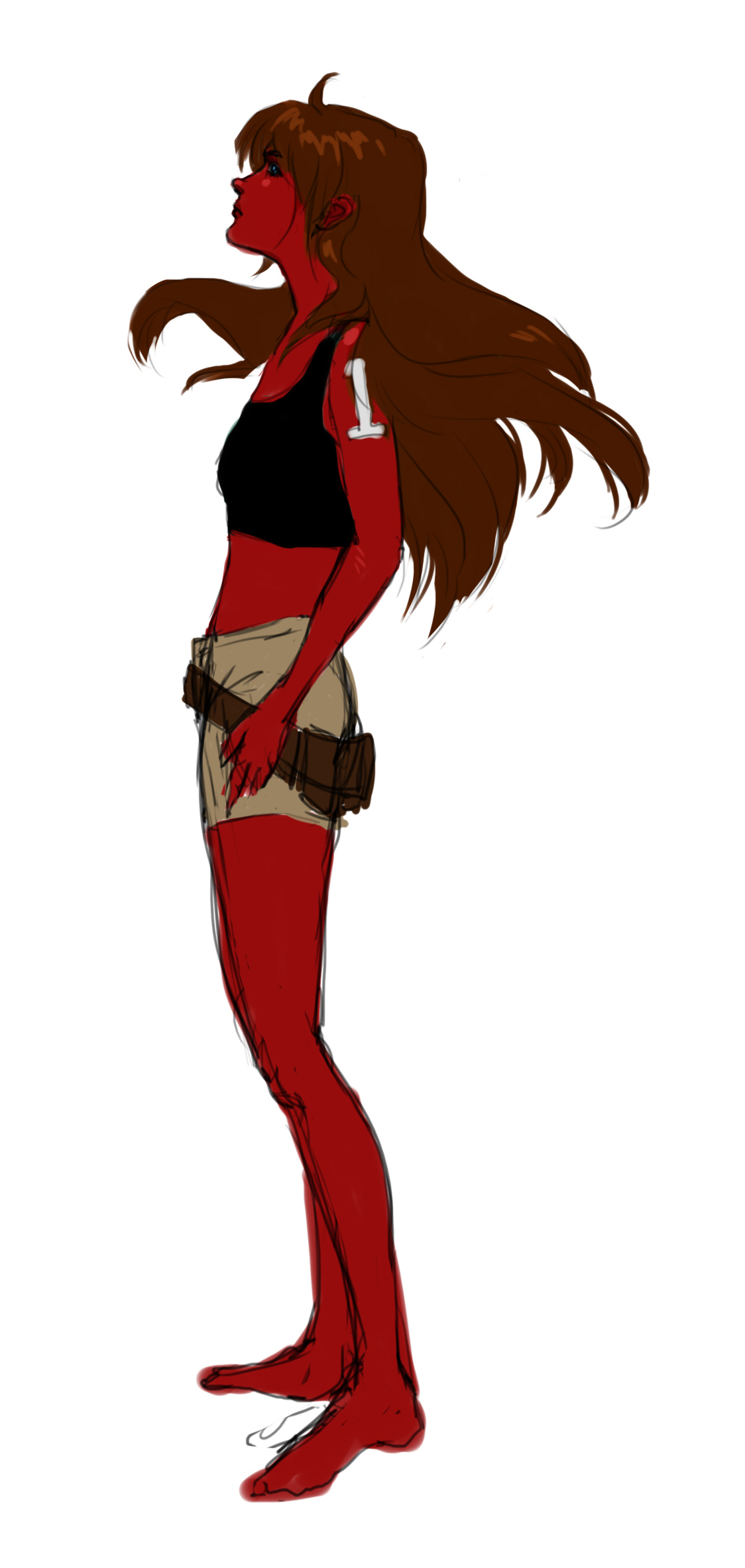
This is Red-One. She is the protagonist of the comics collaboration that Angela O’Hara and myself are undertaking. One day, to inspire herself, Angela decided to create this digital art piece. It is a conceptual drawing of Red-One at about seventeen years old or so, and she is definitely quite beautiful.

So, I did end up naming the characters that we are working on. That might seem strange given that it is supposed to be a silent comic, or a comic without words, but it is a point of reference for us to work from and it adds more character and background to work with too: to bring across onto the page through facial expression, body language, and action.

We have also decided on a structure for the comic. It will be about twenty-four pages and it will have panels. There is just too much, even with the basic story structure that I’ve already made, to dedicate a page each to a different action. Panels will actually give us more room by giving us more pages to work with in expressing the narrative. Like I said, I do have a basic story outline finished and I am going to attempt to do at some point is take a scene from what I wrote, expand on it a bit, give it to Angela and experiment with panels and the page layout.

Panels and page layouts are diabolical in that they both seem to be the same thing, but they’re different. For instance, you can make one panel and then have to decide what goes on in that panel, whereas the page layout is actually how more than one panel–or lack thereof if you want to get experimental about it–is arranged as an overall pattern on paper or screen.

I have attempted with previous works to include panel breakdowns and detailed layout structure for each page into script form–this without an artist partner–and I have to say that it is challenging at best. Luckily in this case, I can hopefully communicate the essentials of what I want to see to Angela, talk through it, see a few versions, and come up with a happy medium. Angela has also been working on a few more conceptual drawings and eventually things will be coming together.

So there is that.

Another thing I have been doing lately is that I am looking into published other works while this collaboration continues. That is to say, I am going to now actively–again–send out stories to electronic and material magazines in order to get more things published. I have a few candidates and a few ideas with regards to what I am going to send. I think I’ll go into that a little now.

I’ve had at least three Lovecraftian story ideas that I have been building on in a purely note-written or scribbled way for a little while now. When I’ve finished one or more, I might send some to Innsmouth Free Press, or Weird Tales (which right now is closed to Fiction Submissions, oh well). I love the fact that Lovecraft is not only public-domain, but there is so much potential to his ideas. His stories are mainly “congeries” (he loves that word, among others)–or connections–of seminal ideas: of things that have informed so many other works long since his time.

Lovecraft’s mythos is not the only thing I am focusing on however. I’m also contemplating sending a science-fiction story of mine to Strange Horizons. There is also a story of mine that I meant to finish long ago, set in Toronto, which I may send to Broken Pencil’s Death Match Contest or directly to the magazine itself.

In addition, I have a few stories I’ve already finished that I realize may be tapping into a niche that is emerging or has been emergent for quite some time now. The niche, paradigm, or Zeitgeist (the “Spirit of the Times”) I’m thinking of is the 1980s-and onward geek nostalgia that is becoming more prevalent every day as well as the usage of allusions and literary references to video games and comics. I have actually been experimenting with this for a long time and I have been polishing off what I have.

I guess the danger is whether what I relate to in this regard will become obsolete sooner than I can do anything with, or even in the future. I mean, will years from now someone know what Google is if it is referenced into a story or will it be some small obscure technical footnote somewhere? Or is our society changing so much with regards to technology that Google and other programs, and even video games will become part of a historical documentation: if only an electronic one? I’m pretty sure cultural shifts celebrating “retro” elements come in cycles, but you can never really predict these things. Sometimes, you just have to go with it.

As for me, the reason I am making strange stories like these–tapping into this–is because I can relate it and it interests me. I can’t tell the future (which is probably for the best) but I’m doing my best to express the forces that have influenced me in the way they have influenced me: if that makes any sense.

So these are my goals along with a few others. I hope to be able to Blog more about these other developments and also be able to keep up with the challenges that I have set myself.

Peering at the Plumbing of a Classic: Super Mario RPG

From what I could remember, I’d never played a video game RPG. It was the mid-nineties and I’d played a few adventure games, but I never really thought of them at all. Whenever I did, I heard mostly about Secret of Evermore, Legend of Mana, or the Final Fantasy games. But it was still the era of Nintendo Power Magazine and I really loved its Epic Center section: a place where they discussed new and upcoming RPGs.

I actually loved the descriptions of these games and the wonderful illustrations that found their way into the magazines more than anything. It was just a pleasure to read through these hints and images of games. So in a way my game voyeurism–of watching or seeing games as opposed to playing them–started around that time. And then, one day, two years after Nintendo and Rare’s Donkey Kong Country and its very exciting “32-bit graphics” (I’d got a video cassette with previews of said game), another game came out for the Super Nintendo.

It was Super Mario RPG: Legend of the Seven Stars.

I don’t even know where to begin with this game. You might wonder why I would be talking about it on this Blog and what it has to do with the spirit of Mythic Bios until you realize that until this point I’d never played a video game RPG. So my brother and I rented it from Hollywood Movies–an old store that used to exist in the plaza closest to us–and we kept it in our possession for a while.

What can I tell you? Mario RPG–as Nintendo and Square’s baby–had the same graphics as Donkey Kong Country, except instead of being a two-dimensional side-scroller venture–or a 2D game–it attempted to simulate a 3D environment. But it was more like having a bird’s view of a well painted clay animated demented doll’s house diorama that was always on an angle. I can’t begin to tell you how that strange perspective both awed and pissed me the hell off.

If you’ve ever played this game, and you have hand-eye coordination issues you know exactly what I’m talking about.

The endless times I would fall through the gaps of floating platforms, or had to manoeuvre the platforms by jumping properly, or just missing something by inches but the perspective or parallax didn’t register properly in my brain. Also, like I may have intimated, my hand-eye-coordination was not that good in those days and it led to swearing. A lot of swearing.

However, once these hurdles were passed, it was a brilliant game. Now that I have my complaining out of the way, I want to talk about what really struck me. First, you start off playing as Mario as a distant third-person character. You go to rescue the Princess from the bad guy as per usual and then …

Shit goes down.

A giant Sword plunges into Bowser’s Keep and throws Mario, Princess Peach, and Bowser in all different directions as the Mushroom Kingdom and the world face a whole new danger … and a whole new game.

That is how Mario RPG begins. Then it gets helpful. There are mushroom-headed Toads and various other beings that are more than willing to give you tutorials as to how to navigate in a RPG. I mean think about it: Mario has always been in a side-scrolling platform world and now he finds himself in a turn-based role-playing world with a fairly structured story. I wasn’t exaggerating when I said that his world had changed, and so has your playing experience with him.

You also begin to realize that the Mushroom Kingdom is only a small part of a much greater world of weirdness and old enemies, and new ones come into the fore. You also get new allies as you realize that Mario can’t fight this new enemy and undertake his new quest on its own.

Remember when I said that Mario RPG reminds me of a weird angled doll-house? I think it would be more appropriate to compare it to a interactive reality bento-box. Yes, that’s right. A bento box. Not an Italian plumber’s feast. I went there. 🙂 At first the jumping and angling can be as awkward as learning how to use chopsticks for the first time (and in my case you never learn how to use them properly), but when you learn the basics you realize that the contents of the open-lidded box are compact, well-organized, elegant, and heart-warming.

This seemingly simple game is complex. There are so many in-jokes and easter-eggs–hidden secrets–it is positively ridiculous. And when actually sit down and take the time to think about Mario RPG, it influences me to add another criterion to what I think defines a classic game. This criterion is replay value and a different experience each time you play it. I can tell you now, if I replayed this game, and I have seen others replay it, my knowledge of some of its secrets now as an adult would change how I played it when I was much younger. Hidden chests, and puzzles, and knowing how to fulfill certain tasks changes a lot of things. You can tell, just by watching someone interact with this strange little world, just how skilled and experienced a gamer they truly are. I feel like was–and is–one of those litmus tests.

When you get past the awkwardness of navigation, you have something really compact and very dynamic. You are not attacked randomly. You either run into enemies, or you don’t: which is awesome because while Final Fantasy VI is an awesome game, the random enemy encounters got annoying fast: just yanking you rudely and obnoxiously out of the immersion of this world you find yourself in. Mario RPG doesn’t have this as much. Moreover, if you press a button– and you time it just right–in combat, you can double hit your opponents, block damage, and even get extra items.

The timed hit mechanism made it seem like the characters have actual reflexes: which was a brilliant piece of innovation in what can become an almost robotic and boring turn-based fight of dealing damage. And then there is also a very personal touch in healing your characters–like Mario–with an item in battle and having him turn to the screen with a dialogue bubble of “Thank you” coming out of his mouth. There is just something really nice about your character thanking you for helping them: especially some you’ve known since childhood.

As the Mario games have continued, they seem a lot like interactive slapstick comedy and this was definitely in Mario RPG: especially with the hilarious dialogue, the Mario-pantomiming that would occur from time-to-time, and the game’s often lighthearted and alternatively epic carnival-toned music box soundtrack.

This game influenced me a lot in more ways than I care to admit, or even know. I was very disappointed when the other Mario RPG games were not direct sequels, but–while really good in their own rights (having played Paper Mario and–even more enthusiastically– Super Paper Mario)–were their own standalone worlds. I mean, they brought all these new characters into play: Croco (who was the humanoid alligator equivalent of the octopus Ultros from FF VI who pissed me to no end in those early days), the sentimental marsh-mellow weather-controlling Mallow (who I didn’t mind), Smithy (who was a bad-ass villain) and his minions, and–of course–Geno: the animated wooden walking puppet guardian seeking to restore the Star Road so that people could have their wishes granted again. I guess at the very least, the game was not going to cop out by stating that it was “just a dream” like another Mario game we all know. ;P *Cough*Mario 2*cough*

I loved to play with Geno and Bowser in my team: Geno because of his powers, and Bowser because he was strong and scary. But they were all awesome and especially Mario. You know, Mario RPG really hit home just how unlikely Mario is as a hero. A plumber that finds himself in a weird world almost defying Alice’s Wonderland who turns into a giant from eating mushrooms, throws fire after finding a flower, and becomes invincible for a brief time with a star and jumps so high. This plumber goes to save a princess and fight a monster. He is quiet and he looks one of the least menacing figures ever. He never speaks but he has a definite affable personality.

In fact, aside from Kirby from Kirby’s Dreamland, the only other heroic figure who is so unlikely is The Doctor from his own television series. But he has that same heart-warming quality and care along with his enemies–even Bowser–and they have continued throughout the years to the point of having their own epic role-playing game. I would have once laughed and found this silly–which it is–but there is just so much packed in just this one little game that it is simply incredible.

So yes, tangents aside I give this awesome classic a five out of five. It was well-made and a joy. As Boltage McGammar in his own “Let’s Play” of this same game liked to say, “later plumbers.”

Going to the Moon With Kan Gao

“To the Moon, Alice! To the Moon!”

The obligatory Honeymooners reference aside– a bit of humour which Doctor Neil Watts, one of the game’s protagonists, would truly appreciate–I would like to talk a bit about Kan Gao’s video game To the Moon.

Before  last Saturday, I’d heard of neither Kan Gao nor his creation. I actually saw him at the Writing for Video Games Workshop organized by Gamer Camp and the Toronto Public Library. I am interested in writing for video games and so I attended both that Workshop and the Journalism for Games Workshop as facilitated by Jamie Woo, Perry Jackson, and Emily Claire Afan: all writers for the online geeky magazine Dork Shelf.

Both Workshops were very important to me: if only to create this review. I’ve made a lot of ad hoc video game reviews–mostly with regards to Super Nintendo classics–but there was one comment that was made in the Journalism Workshop that really hit something home for me. I believe it was Jamie Woo that stated that whenever video games are written about or reviewed, a lot of the history behind the creation of them or the culture surrounding them is almost never mentioned.

I myself find that really unfortunate and makes me look at some of the reviews I’ve made as a result. I’m not going to claim that this review will be any different but, like my others, I will give you a bit of background: if only to my own introduction to this game.

I came to the Writing for Video Games Workshop thinking that Kan Gao would talk about script formats and precise ways to segment your world for potential game company evaluators. Instead, in a soft-spoken but very direct voice he talked about how to tell stories. More specifically, he talked about finding that balance between game-play–actual interaction–and a coherent story-line balancing serious emotional gravitas and the levity of humour. This preview is best symbolizes the spirit of this game.

And this is exactly what he did in To the Moon. He showed us some scenes from the game: where the 16-bit pixel characters and background immediately reminded me of Chrono Trigger: of the graphics in the last days of the Super Nintendo before the push to 3D. You’ll find that happened a lot. Older consoles would continue to coexist with newer ones and improve on the design of some of their game graphics. Look at Kirby’s Dreamland 2 on the original Nintendo Entertainment System and all the variety and sharply defined colourful sprites as another example. Gao’s work seems to borrow from that last bit of graphic grandeur and expand on it into something else and new. This, however, will be the extent of my tangential parallels and where To the Moon is completely different from even the 16-bit reference I used.

To the Moon is an interactive psychological adventure RPG story created by the Independent company Freebird Games. It is about two scientists, the empathic and grouchy Dr. Eva Rosalene and mischievous slacker Dr. Neil Watts, who enter the mind of a dying old man named Johnny to “grant his wish” before he dies. They attempt to do so through using an advanced technology that allows for altering memory from childhood. Essentially, altering memories this way is fatal and that is why it is only used on terminally-ill patients who want to have a wish granted: to do something in their life over again if only in their mind.

Johnny’s wish is to go to the moon: but he doesn’t remember why. A few days after the Workshops, I downloaded the game for Steam and played it all the way through. If I had to sum up this game, I would say it has 16-bit graphics reminiscent of the Super NES’ last days, a lot of mystery, puzzles, a very intricate pattern of linked objects and events, a whole lot of incredibly poignant tear-jerking moments, and occasional interludes of hilarity.

Kan Gao is a masterful storyteller and musician. He and Laura Shigihara–the lead composer of Plants Vs. Zombies–created a soundtrack of haunting melancholic and heart-warming musical themes that represent memory and the past. What I really like about Kan Gao’s work here is how he integrates all of it together: to find that balance that he was talking about in our Workshop. In addition to combining a fine mixture of pathos and comedy, he interlaces his narrative with a whole lot of popular cultural references from the mid-nineties and beyond, and then even goes as far as to parody aspects of the video game RPG medium. If you have played the game, I am only going to mention two words: squirrel battle.

Gao doesn’t stop there however. He also really loves meta-narrative: placing moments where you can tell the video game creator or writer is winking at you through the characters. Essentially, as far as I consider it, one of the main criteria of a classic or a masterpiece is something that comments on the medium that depicts it. In other words, there is a very self-aware element to the storytelling of this game and it is very poignant.

I will say that it took me a while to get the hang of the puzzles. Essentially, most of them were Mementos: physical representations of way-points to travel farther back into Johnny’s memories. You have to decode them and take blocks away from them. I did figure it out after decoding the first Memento. Then there was the latter part of the game where suddenly there was combat and it confused me to the point of being very uncoordinated. It felt a bit like a break in the spirit that Gao was trying to make, yet at the same time it makes sense.

If someone were to ask me what my favourite part in this game was, I would say it is the place where things started to become fragmented and cyclical. If you have played this game, you will understand. Another thing I liked was the various ways that Gao graphically depicted memory. Sometimes you would see sprites interacting, and other times you would see duplicates of them frozen in sequential order. In a way, this game is also reminiscent of Chrono Trigger in that there is “time-travel” of a sort, but you are travelling through one man’s memories and not actual time: whatever that is.

But my favourite thing about To the Moon is how it really makes you think. I know very little about Game Theory, but I am intrigued by the idea of perspective in a video game. What perspective is this story being told from? I know that I said that Drs. Rosalene and Watts were the protagonists of To the Moon, but you could also argue that Johnny is as well: or that his character becomes the mindscape they traverse. You can even say that the game is a third-person limited narrative: a kind of sustained consciousness where we don’t see into the Doctors’ intimate perspectives, but we do see and determine what they discover about Johnny. Looking at perspective in a video game narrative always an intriguing thing to consider.

It also makes me wonder, if I were like Johnny–an old man on my deathbed–what kind of new memories I would like Rosalene and Watts to place in my mind and how I would feel if they had to go throughout my original memories to place that “seed” of a new one. If I really had to pick what my favourite element about Kan Gao’s storytelling in this game is, I would say that it is the characters and how he depicts human nature. I mean, he takes 16-bit sprites and he uses them as the litmus of human behaviour: as both flawed and incredibly beautiful. The relationship between Johnny and his late wife River–in how at times they don’t relate and yet at the same time actually do–and thinking about Johnny dying alone after a life of all these good, bad, awkward, regretful, joyful, and ultimately human choices he makes is just … humbling. I can’t think of any other word to describe that.

I will also add another comment that doesn’t make sense without context: Kan Gao is such a great storyteller that he made me cry over a platypus. A freaking platypus.

I will add a concluding note. In retrospect, I think it’s no coincidence that Kan Gao gave us the assignment he did in the Workshop. It was funny actually: here I was thinking the Workshop would be like a seminar with questions and references to new Indie games I had no idea about because I’m “out of the loop” (of which there were several references anyway) and that was it. Instead, Gao challenged us. He challenged us to take a memory of ours and make it into the last scene of a video game.

It was hard. I pride myself on being a writer and I had this challenge sprung at me. The trained perfectionist in me wanted it to be good. Gao also told us that when he created To the Moon, the last scene was the one that he wrote first and the rest of the story came from it. The Workshop and the game actually makes me want to do something. I’m not sure what yet–because I have a few projects already in the works–but we shall see.

To say that I would give this interactive story a five out of five is a foregone conclusion if you’ve read this article up to this point. Its atmosphere also makes for an excellent autumn game: something you can play on your desktop or laptop computer at home with a cup of tea at your side as the leaves change colour, the air outside turns cold, and the light of the sky becomes a faded gold. I would suggest that anyone that likes games with a powerful story-line should totally download this game: if only to play through Part One of what promises to be a transcendent epic story cycle.

So To the Moon, my friends. To the Moon.

Building a Character to Make a World: Our Project Continues

About a month ago, I said that Angela O’Hara and I would working on a comics collaboration together. So here is an update on our Project thus far.

I gave Angela a whole list of comics artists to research in order to get the right aesthetic for our world. The following inspirations were Jonathan Lethem’s Omega the Unknown, Chris Ware’s “The Super-Man” stories, Saint-Exupery’s Le Petit Prince, the rugged elementalism of the anime Gurren Lagann, Sarah Howell, and Neil Gaiman’s run of Miracleman.

At the time, Angela was not completely sure how to go about this: which was fair given the fact that all I had seen of this world I’d envisioned were a few scenes and figures inside of my own head. It’s amazing how something in your mind cannot always be so easily translated into real life.

After a summer of proposing this Project, I was galvanized into action when Angela said she was going to be pursuing her drawing career full-time now: which is excellent because she is a gifted illustrator and a comics-creator. This was when I realized I needed to give her what I had and, once I did, I realized I gave her more than enough to work with at that point.

In the end, I created a fairly detailed back-story (or at least something far more detailed than what I thought it would be), some character outlines and descriptions, and even some notes on the minions that I’m keen on including in this strange new world of ours. So armed with artistic inspirations as well as character descriptions, names, a background story, and a rough idea of the main plot Angela began drawing.

It was when she sent me these first pictures that the challenge really began. As you can see, they are all excellent illustrations of the main female protagonist. Usually, I could have just selected a few and suggested some details here and there, but her features were not as distinct in my mind as I would have liked. Then I started to think about what the world would be like: specifically what we wanted our aesthetic to be.

For two days, I thought about this and luckily Angela and I managed to talk about it. She told me that she wasn’t completely sure what aesthetic–of the inspirations I chose–that she was supposed to use so she decided to draw different pictures of our character in various styles. I felt really torn: because I wanted to see this world as an elemental place of basic shapes but some very realistic elements, but Angela drew all of these really good illustrations. It made me question the fundamental substance of what I wanted our world to look like.

But Angela has a good way of asking the right questions. Not only did I manage to answer some of her questions, but I started to add some details of my own. Another question that really got me was how old our protagonist was going to be and what she would be wearing before she got her costume. These were definitely questions that I needed to answer and in the end we decided on her being twelve or so, with rudimentary clothing that she had been forced to create herself.

Angela was also curious about what costume our character was going to have. She experimented a bit and showed me this:

This is what prompted me to tell her the idea I had with regards to the main character’s costume: and how that was going to fit into the plot. Let’s just say: it’s less than she chooses the costume, but rather that it chooses her … and in unexpected way.

Finally, Angela had an “Aha!” moment and after I chose a few of the profiles that she created and made some suggestions, she managed to mix together something of Saint-Exupery, and something very reminiscent of Mark Buckingham’s drawing style in the illustrated story section of Miracleman #20: Winter’s Tale. As you can see, our protagonist looks like she is painted and has very bright colours. And yes, you’ve seen it right: she is red. 🙂 As of right now, this is the closest working illustration and aesthetic that we have and Angela is still working on it: along with drawing out a few more of our characters. It is just so beautiful, lush, and artful.

Another excellent advantage to having this working model of our whole aesthetic is that I have inspiration. There is nothing more buoying than seeing something you envisioned becoming as close to a tangible image as can be made possible to really encourage you to keep creating. The added bonus of this feeling is that with our last Project, Thebes was supposed to be based off of our re-interpretation of mythology: of stories and characters that already existed. With this Project, we are making something relatively new: something that didn’t exist before quite the way we see it.

I mean, I know: I understand that all superheroes are archetypes and variations of Superman or older mythical figures, but the characters in this story have their personalities and I try to look at the basics of what they can do as much as possible … of which I am now figuring out. It is also very helpful that, right now, Angela and I are on a very similar wavelength in figuring these details out.

In fact, all of this is a process of figuring things out: as though Angela and I are spying on another world and trying to translate it into ours as much as possible. When we’ve done more work on this–and I create at least a rough outline of the booklet–I will start calling the characters and our Project by name. Until then, both will be as silent and as wordless as our comics work itself.

Horror as Collaboration: A Multimedia Nightmare

Just as the creature from Edison’s 1910 film version of Frankenstein formed, as seen in the picture above, I have been thinking about the best way to go about doing a viral creepypasta.

Then I came across this link from a friend of mine to the story of The Dionea House. It has a very epistolary format: in which a story is narrative constructed through what seems to be correspondence or journal entries. In the case of the above story, they even use online journal links and phone texts.

I was so impressed with Candle Cove, that I wanted to do something like that. In fact, it is the model which I want to create a viral creepypasta: a horror story or account that will be posted throughout the Internet. But now I realize how some of the challenges I proposed in my other posts on Horror as a Universal Power: The Function of a Creepypasta and especially Making a Receipe For a Creepypasta With Uncanny Filling can finally be addressed.

Essentially, I need collaborators. I need to engineer a situation where we can go to a board and have a correspondence discussion: an exchange of posts talking about an event that we create. It is kind of like role-playing and also collaborating on a story together. By writing it like this, we can have all the natural typos, grammatical errors, and some natural energies and improvisation come through. We can begin it through talking about fact, and then slowly getting to the emotional creepy parts.

Of course, we would have some challenges. For instance, what Message Board could we take? Should we make our own? And if so, how do we deal with others posting? Or, rather, would be excellent to get them in on it too? At the very least it can add to the legitimacy of it and make it look like a spontaneous thing if other people who don’t know about this potential Project got in on it. If we can make this a great participatory writing project turned creepy meme, that would be excellent: but it has to be unified and coherent while at the same time have an element of the unexplained and horrific in there as well.

All I need is an idea for a story and I have a few. My list might have something or perhaps even one of my dreams from my dream journal beside my bed. If I can get some people to create photographs, graphics, and artwork as well that would just be an added bonus.

Tis the season of Halloween. This might just be interesting.

The Power of the Original, the Creativity of Change

In The Source and Its Creative Feelings, I wrote about the emotions and energy that can power inspiration and ideas. In this article, I’m talking about the material and the quality of it that can fuel that kind of inspiration.

So I was watching the classic 1963 film Jason and the Argonauts last night, and it occurred to me just how much it was tangentially in there in the culture of my childhood. It wasn’t so much the movie itself as it was the aesthetics and the attitude of it. In fact, the only film that really comes to my mind with that same spirit is Cecil B. DeMille’s The Ten Commandments.

Whenever I thought of the ancient past or mythology as a child, I used the imagery of these movies and others like them to inform myself of how both should have looked like. Then I fast-forward this concept of mine by a few years. I used to think that the fantasy genre were all stories like The Hobbit and Lord of the Rings, followed by Dragonlance and Forgotten Realms, and I tried to write exactly like them: especially the latter two series.

I thought that some of my more weirder story ideas–including an alternate storyline with The Ten Commandments–were silly and a waste of time, or at the very least beyond my means and personal faculties to create at the time.

This was before I realized that there was original source material.

Every story ever made is an echo of another story that exists before it, or coexists alongside of it in another form. But every story as a source: a prototype or “Ur-Text” (Ur being a term for the mythical first of something, such as the first ever human city-state) or place that is tapped into.

I believe that every creator taps into that source. However, I also think that the strength of a creator’s link to that source all depends on where and how they tap into it. Originally, I was going to say that a creation inspired by an original source–or the closest known or accessible thing–depends on one thing, but after thinking about it a bit more I realize there are two elements involved.

The first element is, like I said, finding the earliest myths or art-forms that you can read, understand, or learn to understand and take inspiration from them. They are the closest things to the source, or what the famous mythologist Joseph Campbell called “the mono-myth”: the supposed first story that all sentient human stories come from. I feel that once you learn to understand the spirit of the earliest story or source that you can find with regards to your work–and specifically use it to gain your own personal creative slant on it–then you have gained something powerful and you are more than on your way to augmenting or discovering your own creative voice.

But then there is the second element that I thought of very recently: which is that once you gain an idea of the original source material that created the story or story-type you are working on, you must make it timeless in a way that everyone can relate to, and therefore make it relevant. Take what you have learned or understood and apply it to your time and the issues and themes that are important to you as a creator, a person, or even both.

Think about it: before DeMille’s Ten Commandments, or Jason and the Argonauts, all there was to determine how the ancient world was, and how their myths functioned were books, broken sculptures and fragments of art. The creators of both films had to go through all of that material and decide what they were going to use or change. I won’t even go into Ten Commandments, because there have been many other films and stories created from that Biblical tale at different points in time, and even the ancient Greek myth of the Argonauts has changed throughout time and culture as well.

But what I am saying is that the creators of both looked at the original sources as much as they could and made something, and added character and motivations that audiences could relate to. Even J.R.R. Tolkien looked at ancient Nordic tales and history in the creation of his Middle-Earth: which in turn informed how a lot of the fantasy genre derived from it would be for a time.

Like I said, I do think that knowing the original source of something gives you a special insight into that thing and in making something that is either a homage to it, or a unique derivation. This is what I have adopted for a lot of my writing and creation process. It gives you more to work with and more to change should you choose to do. And that is the key here: knowing the closest source gives you more choices … especially with what you want to reveal what is important to you about them and other people.

When I was growing up, I took films like Jason and the Argonauts with its stop-motion clay animation less seriously than I did the developing CGI graphics coming around then. But now, looking back I realize just how much of that influenced the creation of CGI and what film-making could be: as well as storytelling. Maybe it’s because as a culture now almost everything that is “retro” or considered old is popular and new again. Of course, as some other popular cultural articles suggest this could be all be just part of a cycle that happens with every decade or era.

My era of the 80s and onward, as well as the things that inspired them in earlier years, has become a lot of my source material and now I am starting to realize that I can express it. This is a good thing. The possibility that some of the quirky weirdness in some of my stories may have been inspired by Joss Whedon’s irreverent flippant dialogue in Buffy and other shows is an added bonus: from my perspective anyway.

Really, I just like creatively messing around and reading and watching old, good things and good new things for universal and innovative storytelling ideas. I probably could have summarized this whole post into that one sentence, but there you go. 😉

A Thank You to More Followers, and How We Need to Wander When We Learn

https://i0.wp.com/upload.wikimedia.org/wikipedia/commons/6/6e/Moleskine_ruled_notebook%2C_inside_view.jpg

First of all, I just have to step back and take note of a few things. I’ve gotten many “Likes” on some of my posts. I have many more views on my entries as well, and I enjoy looking at the different places that they come from and guessing to myself who is looking at what. I also now have 53 followers.

Fifty-three.

That may not seem like a lot compared to other Blogs and Journals I’ve seen, but bear in mind that I’m still remembering the summer time when I barely had any Followers in the single digits and–as far as I am concerned–the fact that there are even a few of you is still awesome.

Also, I’ve noticed that some people are specifically typing in matthewkirshenblatt.wordpress.com+the article they’re interested in. It is definitely really flattering and inspiring for me to see that. I honestly don’t know where all of you are coming from, but I think it’s safe to say that you are all awesome and that I feel honoured that you like what I have to say: or at the very least what I write.

Adjusting to this new habit of posting every Monday and Thursday–along with finding what images I can use with every post–was a bit of a challenge at first. Sometimes it still is. I used to write a post here every day and then it became every two days and now I give myself more room. I need to in order to work on some of my other creative pursuits. Still, I do get a tremendous amount of satisfaction in pushing the “Publish” button myself these days, instead of regulating each post to the scheduled automation option. that and I like the quotes of inspiration that come up after I do them. I guess I’m a bit of a sucker for those. But that said, I know I’m going to have more things to say and I want to maintain my place to say them.

One thing that this Blog does encourage me to do is to not only keep creating, but also keep exploring and recording my explorations as well. In many ways, whatever I learn adds to the world that I created inside of me. I search for things that interest me and I try to understand them. Sometimes I will mess around with things and make something I didn’t intend to. A lot of the time I use this as a forum to challenge myself to find or make something new.

I take basic research skills and my own interests–and things that I have picked up over the years that fit into both or were passed on to me–and I go into tangents with them. I always have.

If I were, or ever become a teacher, I would be the kind of person that would try to important basic skills like research and some questions of writing. But I think the kind of people I would meet would be those that already have those skills and ones that I can occasionally throw certain books or works at, or talk about things that I love, and basically let them “have at it.” I would “teach them in increments.” I’d mostly be a guide and I’d really step in if someone had a question or wanted my opinion on something.

Other than that I’d most talk a bit, and throw challenges at people while offering constructive criticism and suggestions where needed. I think I would just like to be that person that can work with a person’s skills and interests: honing them further and expanding on them … especially if they coincide with mine.

But I think I’d be a mostly tangential guide: much like I am whenever I write on here or talk to people in general. Your Following and reading encourages me to keep doing this and I hope that we can continue to view some interesting things together: or, like I always say, be entertained. Take care my friends.