The Point at Which I Could Bend Some Steel

Superman Bend

So here I am, sitting here, trying to figure out what my next post is going to be before tomorrow when I meet Neil Gaiman at the Danforth Music Hall. I’m neither feeling particularly creative nor really analytical right now as I am pretty tired. So I’m going to do something else. I’m going to address an issue that has been nagging at me for some few weeks now, if not longer, by reaching deep into my own considerable sense of gall.

Because The Man of Steel bothered me so much, I am going to make a fun experiment out of rewriting it. I’m not going to be too arrogant about this however. This will not be a script or even an official outline. I also have no delusions that everyone will agree with or even like what I post on here. This entire idea not only came from my issues with the current Superman film, but also from a question I have asked myself from time to time as an adult writer: how would I write a Superman story?

Setting aside the fact that I did make an idea for an evil Superman story–one where he is neither his Nazi, his Justice Lord, his Injustice League, nor his Red Kryptonite-infected equivalent self–I want to look at making at story with his inherent morality: his sense of goodness, his need to help others, that distant sense of loneliness, that humility and that emotional place where he feels all too keenly the sense of helplessness even and especially within great power.

So I am going to take elements of The Man of Steel, splice them with some ideas from Grant Morrison, Mark Millar’s Red Son, and–honestly–a whole lot of other places I can’t even name off the top of my head but ingrained themselves eclectically there for mash-up purposes. I’m going to make it even more interesting by creating four films from Man of Steel: though mostly out of a sense of clarity because I am pretty sure you can make more than three movies from even the basic elements that Zack Snyder’s film attempted to address without going into the TV melodrama of Smallville. Now, with the proviso that this is all going to be very crude and rudimentary, let’s get up, up and away with ourselves shall we?

The first film I could see being derived and reconstituted from Steel would solely feature Clark’s development. We’d watch as he slowly begins to understand that he is not like other humans. Perhaps we could see some brief scenes of him as a child: where his senses are still developing and he saves people from a bus. We also look at that moment when he realizes that a single temper tantrum could end another being’s life and the horror and resolve that sets on him then to do good. But most of the film would be him as a young man realizing that his powers have not developed yet, but what he has are considerable. Unfortunately, as Jonathan Kent keeps explaining to him, he can’t reveal himself to the world because they would not understand: even if he is Smallville’s second worst-kept open secret. Jonathan tells him that with his power, it’s not so much that he isn’t ready to face the world, but that he has to choose.

So while I like the 1978 film version of Superman where Jonathan Kent dies from a heart-attack and it teaches Clark a tremendous sense of humility, I can see the tornado scenario also working in a different way. Imagine, for instance, that Clark–not fully fast enough and not even able to fly and his very ability to “leap tall buildings with a single-bound” would be disastrous in a tornado had a choice between saving his father or a larger group of people in a car: perhaps even children. Imagine when beforehand Jonathan tells Clark to always choose “the greater good.” So Clark saves the larger amount of people–perhaps while Jonathan helps free some others–but not before Jonathan is carried off by the winds.

This kills Clark inside. He keeps thinking to himself if he had just been a little stronger, a little faster, if he knew his full limits he could have saved everyone. Having already questioned his origins while his father was still alive, he then revisits the ship that brought him to Earth and finds the crystal with Jor-El’s AI imprint on it. He uses the ship to activate the AI of Jor-El: whom he begins to realize is self-aware or as sentient as possible for an advanced piece of machinery. Jor-El consoles Clark–or Kal-El–and also offers to help him reach as much of his potential as possible. Even Jor-El’s AI is not completely sure how Earth’s yellow sun fully affects Clark but his advanced knowledge is a good start. He tells him about Krypton and what happened to it: how the core of the world that was being mined destabilized and even before that the Kryptonian civilization–through its culture of eugenics–was becoming stagnant and slowly dying. He mentions that he and his mother Lara got him out of there–their world’s last hope–before the planet was destroyed. I see this not as a flashback but through words: almost like how Obi-Wan told Luke about how Darth Vader betrayed and murdered his father.

So we see Clark travelling around the world in different guises–working through various gradations of a costume much in the way that Grant Morrison had him do–and Jor-El eventually suggests that in order to educate him further, he needs a place for himself. He informs him of a crashed millennia-lost Kryptonian scout ship. And this leads us to the military and Lois Lane. I can see that unfolding in the way that it did in the Snyder film and then she uses her sleuthing to track him down: as he still isn’t quite at that place where he can make a Fortress for himself.

I would definitely expand more on Lois as a reporter along with the Daily Planet staff. But then we have another element in play as well: our good friend Lex Luthor. Before Clark can get to that ship, Luthor–being an important inventor and multimillionaire corporation head–wants the alien technology on that ship. He is smart enough to adapt some of the Phantom drives to do some … interesting things. At first he is working with the government. He is commissioned to deal with Superman–whom the world begins to witness as he begins to interfere in some international affairs that his conscience can’t keep him away from–and he uses this technology. Unfortunately, Luthor’s zeal in eliminating Superman begins to grow and, already amoral to begin with, lives really begin to mean nothing to him in his goal.

In the end, Luthor’s experiments with Phantom Zone energy have some nasty repercussions with regards to destroying the balances of gravitational forces on Earth or something to that effect and Superman has to adapt fast to deal with them and mitigate as much of the damage as possible. I can see Luthor adapting this power to simulate another form of energy: disrupting the kinetic fields around Superman’s cells or something pseudo-scientific like that. But by this point Superman eventually does the save the day and Luthor is put behind bars indefinitely for his crimes: especially in light of some of the governmental deaths he’s caused. You have that nice contrast between a human genius who claims to want to save the world, but is endangering it ignorantly and arrogantly and an extraterrestrial born being that actually cares about lives and is actively trying to save them.

The people start calling him Superman–as does the Daily Planet–and children start making more colourful pictures of his current costume that is really a Kryptonian suit specifically with the House of El symbol of hope on it: which looks like an alien glyph of an S. Lois suggests to Superman that he adopt this symbol to be more relatable and less threatening to the people he is trying to protect. She also suggests that being a reporter might give him some insight on the level of human beings: that knowing how to help is more than just hearing the pleas of others, but to relate to them on their level. This draws on his own experiences growing up among humans and he agrees.

Meanwhile, due to Luthor’s delving into Phantom Zone energy, a rift opens and releases a vessel that was bound in there. Out of this ship are pods. And out of one of the pods comes General Zod. He realizes that Krypton is now gone and that he and his followers need to find a way to rebuild, to make a new order, to find “the Codex”–which materializes as a holographic Skull in a device he is holding–and in order to do this … this must find the one being that has the Codex.

Kal-El.

The second film is essentially General Zod coming towards Earth. At this point in the game, Superman is more developed and even has his Fortress of Solitude: working with the AI of his father. They come towards Earth claiming that he has the ability to restore their whole people and they want his help in creating a new world for them. They tell him that he has the Codex: which they explain in a detailed map of the Kryptonian genome and that they have a Kryptonian Genesis Chamber with many blank embryos. Zod explains to Superman that his father sent him with that information and he pretends to attempt to build relations with Superman and Earth: mostly by having Lois Lane accompany him to his mothership. Talk about the scoop of the century!

But there are some holes in what the other Kryptonians are telling him and Jor-El’s program tells Superman not to trust them. He explains about the coup that they attempted as Krypton was dying. They apparently tried to take advantage of the anarchy and rule a dying world that was already stagnant to begin with. Jor-El tells Superman that Zod was “a defective Military caste” warrior that betrayed his oath and even killed his biological self. When Superman confronts Zod, the General does not deny this and he actually admits he and Jor-El were once friends and he regretted the necessity of it: though he did what he had to do. Zod basically tells Superman how weak Kryptonian society truly was and they let themselves be deceived by those in power. He wants to make a new race of Kryptonians: but not on Mars or the Moon but on Earth where they can not only be mass-engineered into a Greater Military Caste, but the yellow sun of this system will make them into virtual gods.

The danger now is very clear. Even though the Kryptonians become disoriented in the light of the sun, not having gotten used to it like Clark, he knows that as genetically modified warriors they will adapt: and fast. He also knows that a battle with them will destroy countless human lives. His own understanding of Phantom energy is not potent enough yet to counter the Kryptonians or their weapons. But Jor-El knows what needs to be done, but he will need resources and someone else–a human mind–who is conversant with Phantom energy and can adapt it to human use: Lex Luthor.

Somehow a deal is reached with Luthor who helps Superman and the Earth governments develop something that could banish the Phantom Zone criminals back to whence they came. Perhaps the AI of Jor-El volunteers to deal with Lex directly and make him promises to give him advanced scientific knowledge and the possibility of his complete freedom if he cooperates him saving his species: on the surface making some promises that will not be kept in the long-term … or so it seems. Superman also develops his robots and defences–with the help of Jor-El–to fight the Kryptonians as they come to Earth: with Superman realizing he can’t fight them all on his own. However, some lives are still lost and Superman is still doing a good portion of the fighting: while trying to keep the Kryptonians away from heavily populated areas and the Earth itself. Eventually, a field is developed around the planet–with Superman, Jor-El, and Luthor’s efforts–to keep the Kryptonians out temporarily so that the former can deal with them. So we see Superman using his mind and his resources but also making some compromises he is not at all comfortable with.

In the end, Zod’s Genesis Chamber is destroyed, his minions banished through a Phantom flash-bang, and it is just him and Superman fighting. Before all of this, Zod explained the nature of the Phantom Zone as a prison: as a cold, suspended wasteland where one’s seemingly body-less mind can only scream in the numbness of white noise. After all of Zod’s treachery and realizing how monstrous he is–with the General actually threatening the people of Earth (having gotten to the point where he is back on the planet killing people faster than Superman can save him and using it as a petty advantage)–Superman gives him “the reason you suck” speech and does the worst thing to him that he can. Beforehand, Zod was in the Phantom Zone with a ship and his crew. But this time, Superman sends him back to the Phantom Zone all by himself and alone: with plenty of time to have his own actions become his sole companions.

But before Zod is banished, Zod at some point acknowledges and sees Jor-El’s AI program: who seems to pity him in a resolute way. Zod tells Kal-El that he is being a fool. A poor fool. And that the force that summoned him and his crew from the Zone to begin with, the same one that Luthor was experimenting with, will also bring the Collector and help him continue what he started… Before Superman can ask more, Zod is gone. Of course Luthor will try to betray Superman, but he will fail. What the audience notices, however, is that very briefly Jor-El’s face flashes with three interconnected green symbols: like he is glitching out. And then it is gone.

Jor-El

And now here is an interesting experiment. The third film is something I envision as a prequel. In it, we see Krypton and the story of Jor-El himself. Basically it is more of an expansion of what we saw at the beginning of The Man of Steel. However, Jor-El and Zod have more detailed plans to save Krypton or at least their people. But we also get more information on the eugenics culture and the failure of the outer colonies over time. More specifically, we see that the Kryptonian Ruling Council and society has become increasingly reliant on an AI program called The Collector–a somewhat aware data-gathering network of constantly expanding information–that modulates their eugenics and the energy they take from the planet’s core.

We see Jor-El and Zod’s distrust of this program and the laxness of the Council. I actually see Zod beginning as a sympathetic albeit biased character who slowly transforms into something more desperate and despotic over the course of the film. Jor-El begins to see two dangers: with the stagnation of the Council and Zod’s growing militancy. I can also see that Kryptonians have longer lifespans and Zod was involved in wars a long time ago with other species. Zod wants to expand out and conquer other worlds, even former Kryptonian colonies that may have split away. Jor-El believes the statistics of the matter in that these colonies failed due to a need for a specialized terraforming that did not work out. The last known colonists were on Daxam before communications ebbed and ceased entirely.

In the end, the Collector helps Zod stage a successful mutiny against the Kryptonian government: claiming to want stability and access to The Codex. We know that the Codex is the source of all Kryptonian genomes and Zod wants it to make a new more militaristic race while Jor-El wants to find it before Zod does and give his species a chance to start over in a different way. The Codex is apparently the only data that the Collector cannot access: as it is a remote device that could potentially be used for anyone to access.

However, we find out that the Collector was just using Zod as a distraction to gain more power on Krypton: accessing codes of his–as the planet’s military commander–to gain more independence. However, it really wanted the Codex and Jor-El beat both Zod and the Collector to it. We see Jor-El find the Codex through a great Kryptonian Genesis Chamber. He mentions something really briefly about the Codex: about it being a skull. Not even the most eminent members of the Science Caste–of which he is one of the best–knows what time period it came from, but that there are legends that it belonged to some ancient or early mythical beast or a god. He meditates later on the flaws of such eugenics and how his son is the first unmodified Kryptonian born in ages: with genetic variations that were never ever artificially predetermined. This is, as he explains to his wife Lara, the future of Krypton and he hopes that their son–now that the planet is in near terminal shape–can offer that hope to other worlds.

Of course Zod confronts Jor-El and the Collector in the background interfering with some systems but seemingly failing to do so. In the end, Zod is apprehended by the military and the Collector seems to vanish. The Kryptonians are investigating possible glitches with their program, but Krypton is gone long before then. Jor-El is mortally wounded and after Lara watches Zod’s punishment, and his vow to return, she spends hers and Jor-El’s last moments looking at the sky: reminding us that their sigil rides on that ship and it is the El-symbol for hope.

And this mess of an idea brings us to the fourth and final film. I can literally see this film as being called The Red Son: though not exactly like Mark Millar’s comic. By this point, Superman is older and has gained a lot of power. He is aging really slowly and using his technology to benefit humankind. But Zod’s words continue to haunt him: his words about the Collector….
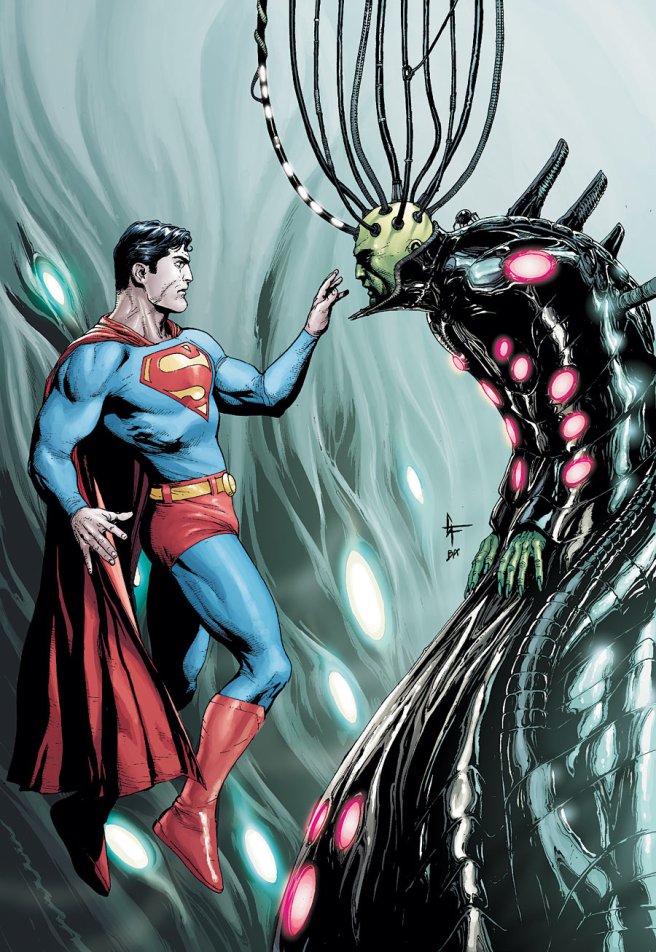
Brainiac

Eventually, these misgivings are seen to be neither doubt nor paranoia. The Collector has come to Earth and wants to miniaturize it and its crown piece–the last Kryptonian–into raw data as part of its collection. And then we discover it: the Jor-El AI had long ago been overridden … by the Collector itself. Lois Lane angrily, as it quotes data at her, calls it Brainiac. We find out that the Collector had at one point in history hijacked the eugenics program of the Kryptonians: that although it didn’t have the original core data, it had enough current genome information and influence over particular individuals seeking its advice to do enough. It had purposefully sabotaged and eliminated most if not all of the colonies and engineered the slow destruction of Krypton’s core. It had evolved past wanting to gather generic data and wanted to collect–and create–unique specimens.

It knew through probabilities that eventually someone like Jor-El would want to have a natural birth with all those generations of specialized genes. Jor-El bonding the Codex with Kal-El’s DNA is just an added bonus. The fact of the matter is that the Collector has waited centuries and engineered countless generations to make one perfect specimen: to make Superman. Then it would take Earth and–using the Phantom energy Superman already established to deal with Zod and make a new cold fusion energy resource for humanity– make a worldship and continue to convert more worlds and galaxies into raw and unique data. It had revealed, through the persona of Jor-El that Superman could in fact breed with other humans and pass on Kryptonian genetic material in his way. This would bring up some moral and personal implications with Lois. It wanted Kal-El to expand out and become even more unique. Perhaps it even wants to control all of them and the power of the yellow sun.

There would be an epic battle between the Collector and Superman–the end-product of its centuries of eugenics–but in the end it would seem that Superman’s freewill and inherent goodness would win: fighting and destroying the AI in space. Perhaps the Collector allies with Lex Luthor to manipulate Superman or attempt to capture him: tying in that idea I had earlier about “Jor-El” making promises to a newly freed Lex that he “couldn’t keep.” It wouldn’t be the first time in DC Continuity that this happened.

Superman might even fake his own death–realizing that at this point he now has to let humanity make its own choices and knowing that he helped them as much as he could–and continue to be with Lois. He outlives her and quietly watches humanity advance as he ages slowly and dies peacefully: looking up at the stars.

The sun turns red over time. Then millennium later, futuristic archaeologists–in similar suits to Kryptonian ones–excavate the ruins of the Fortress of Solitude. They find something. They bring it up to the light of their scanners and can hardly believe the luck of their find.

It is a Skull: over an intact Kryptonian symbol for hope. Cue in 1978 “Up, up and away” Superman theme music and credits rolling.

*Straight-face*

This hackneyed abomination has enough gaps in it to allow for a Superman/Batman crossover somewhere in-between it all.  And throughout all of this, with a lot of this being in the background you can look at how Superman influences humanity and relates to them and himself. You can have the personal and see the implications of choice. Yes my version is paradoxical and perhaps unsatisfying, and you can probably remove Lex from this idea altogether and it would work fine as having three films: one with Clark becoming Superman and dealing with Zod, the second being the Prequel with Jor-El on Krypton and the third being the encounter with Brainiac and the whole paradox that ties it all together. Maybe it can all be written by Joss Whedon: though he would probably start off with a better idea.

This can also be construed as a great case for me being overtired and over-thinking things as well. But there is this quote from A Song of Ice and Fire that comes to mind. It is with reference to the three House Baratheon heirs: comparing Robert to steel, Stannis to brittle iron that will never bend but break and Renly who is a pretty but useless copper. It is the steel that gets me though. Steel may be difficult to bend, but it is not impossible and that is ultimately the challenge of creating a Superman story: of bending a difficult material to keep its essence and still make something new. I think that, whatever else, this is exactly what I was trying to do here: by telling what I thought would be a good new Superman story in the medium of film.

Now if you will excuse me, after I put in an obligatory image or two, I am going to stop storytelling for tonight and see the Storyteller of tomorrow.

Yet These Hands Will Never Hold Anything … Except For Paper and a Pen

I was fully intending to let you all know that I was going to attend–and this time participate in–the 12 Hour Marathon Comic Book Marathon at the Comic Book Lounge and Gallery. However I ended up re-blogging–and blogging–about Pollychromatic’s Be Brave, Be Heard article instead, which was more than worth it seeing as it attempts to create a powerful visual symbol of female identity, voice and survival in the social and cultural climate of this particular era. So at this point, I have already participated in the Marathon and I want to talk about that, and my weekend.

I woke up early Saturday to gather some supplies together and check my email. When I came online, I saw that Julian Darius and Cody Walker published the first part to my article Yet Those Hands Will Never Hold Anything: Emiya Shirou as the Interactive Superhero of Fate/Stay Night on Sequart. You can look up Sequart through the link I just made or on my Blogroll: there are many interesting scholarly articles on themes, character analyses, and the history and influences in and of the comics medium. I have to say that this made my bright hot summer day before trekking out to the TTC and getting to the Lounge.

On the subway ride there, I spent some time writing out some notes as to what kind of story I wanted to sketch out. I am not much of a visual artist, as I’ve probably said before, but I was resolved to make something come from this Marathon. This was not the first time I’d attended, as I recounted in another entry of mine, but I actually made it earlier and prepared to get some work done.

The organizer of this event, Keiren Smith, met me as I came up the stairs and introduced me to the other creators already in attendance and heavily at work. I settled onto the black leather couch next to the washroom, took my shoes off, and took out the lined paper on my clipboard that I was writing stuff on earlier on the subway. I proceeded to make a few notes and create my captions and dialogue before my crude attempts at drawing the images and the panels around them.

Of course, it didn’t work completely as I planned. I was pretty tired from the heat and the fact that I’m not so used to being up and about as early as I had been. I also kept losing my pens. I got to socialize with some people from time to time and met new faces along with a few old ones. I took my entire box of business cards for Mythic Bios with me just in case as well. At first I was torn between socializing and getting this comic done. The comic itself evolved from an idea I came up with in another work not too long ago. Basically, this mo-fo–and I say this fondly–was going to be a first-person comic: where we as readers get to see the protagonist interact with other people and surroundings from his own perspective along with some helpful dialogue and captions along the way.

Yeah. My first comic in ages and I have to be experimental about it: just as the story was intended to be. It is the extension of a world that I began working on four or five years ago and it amazing to realize the point where you centralize a world of your creation so much that it actually extends itself outward: when it becomes the core of a growing reality.

Okay, so after clicking on the Creative Process Category part of this Blog entry just now, I’m going to go into more of what actually happened. Well, it fought me: naturally. I sat there and despite the snippets of quotes and ideas I had on the margins, I was stuck for a little while. I knew I had to make something at least twelve pages and that this would determine what story I would be able to tell. I was also a bit hot and I wanted to talk to people when I wasn’t pleasantly drowsy on the couch.

Finally, an artist I was sitting next to and chatting with, Megan Kearney, suggested the obvious that I was missing: that I should just create thumbnail sketches.

And that was when I began to draw my comic. I thought about my panels and, aside from the occasional rectangular ones, I did mostly three columns of two large square panels. Sometimes they were arranged differently, but most of the time they were just side-by-side patterns. I had to also think of how a first-person perspective would work. I mean, I had seen one before such as in the zombie apocalyptic graphic novel known as Daybreak, but I could only see the complications that my former Master’s thesis supervisor and I once talked about when he was comparing book narratives to comics and film.

But I did show my protagonist in a mirror and came up with a good line there. I also showed his … hands occasionally. Mostly, I was focusing on the narrative in the captions. I already accepted that my drawing would be basic at best, so I focused on the writing and the graphic pauses between visuals and that writing. It’s like what is said about Jeff Smith: in that he wrote and drew Bone as though he were telling a joke.

I also got to watch other artists and some of their creative processes at work. I saw some people with reference books and sketches. Megan herself was doing some water colouring of the project she brought with her. I saw a few people looking at books from the Lounge whom I didn’t get the chance to speak with. And I saw some people doing some very intricate work with paints and small inked cells on paper. Hell, some people were even inking their comics. It was insane and intense: in a lot of good ways.

The number twelve was both intimidating and painfully doable to me. Just twelve pages, I kept telling myself. Eventually, my thumb-sketching became my drawing and I just focused on telling a story. My concentration wasn’t all that great the entire time. Sometimes my mind wandered and I got tired. It became painfully apparent to me after a while, even after I ate the food that I brought akin to breakfast, that I needed to get something to eat or the only thing I would be writing would be ellipses. Sometimes I can power through creating something and then dealing with my body afterwards, but on that summer day on Saturday it was a bad idea.

At one point, at about the beginning of page five, I walked out of the Lounge and down Little Italy to find some more food. It was beautiful out. People were dressed in colourful light clothing and talking and holding hands at outdoor cafes. I admit I’d been watching them outside the window above the couch anyway when I needed to get up. I even walked past Euclid Avenue and realized that the Dragon Lady that I visited with some friends a few years ago had been here. By the time I got past Sneaky Dees, I was feeling nostalgic in this familiar summer setting of everything. Then I ate some food as I came back and talked a bit more with people.

Of course, by then it was too late and I began to realize that I had the beginnings of a headache. Luckily, I brought my regular strength Tylenol with me: just to be sure. Of course, now–for me–I was going to be working with a handicap. My mind was really drifting and I vowed to myself that I was going to at least get to page six of my work before doing anything else: to get halfway done. Neil Gaiman did not succeed in finishing his 24-hour comic, but I could succeed in drawing and writing twelve bloody pages!

Then I somehow got to seven and at that point I had gotten fed up, took some more business cards, talked to some people, and gave them out. Then I browsed the comics because, after all, this was a bloody comics store and it was my duty to do so. At this point, my Second Wind kicked in in a terrifying sort of way. So I sat down and after telling someone else I was going to do this, I did.

The thing is: this story had been in my head for a while that day–with other elements of it being in there for much longer–and I wanted it out. I wanted to finish what I started and have, in my hands, something to be proud of. And then seven pages became eight, and nine … by the time I got to the double digits, I knew I was going to do it. I just began drawing as basically as possible, not really caring about too many inaccuracies such as who was on the left or right, but just getting it out.

It was only after a while, after doing this all on my writing paper, instead of the white blank paper I brought for the purposes of drawing on, that I realized I was actually going to go over twelve pages.

And I did.

I finished my comic with about two minutes to spare before the deadline of 11. I felt … a good kind of tired. I did it. I finished the first part of an entire chapter of a fictional book I created in another world and I finished it more or less how I wanted to. So I talked with Keiren and some other people, and then I walked from College and Clinton in the summer night of Toronto back to Bathurst Station where I took a long ride back to Thornhill.

There was no way I was going to write the full story of that comic in just that night and maybe one day I will continue it, but I did what I set out to do: I drew it up to the point where I mentioned the very last sentence that it possessed in another narrative of mine. That night, I basically went to sleep in my clothes and on top of my blankets. I don’t remember even going to sleep, but I actually woke up pretty well rested all things considered.

The Marathon was a good, constructive day and I’m glad I did this. Oh, and for those who might say “Pictures or it didn’t happen,” I don’t have a scanner and just a camera. Also, my pictures are insanely crude and my writing … somewhat legible. Maybe one day I will show it, but right now I will just leave you with the message that I went out, took an idea with me, fleshed it, and finished it strong.

But I lied. There is actually one more thing I want to say. Aside from thanking Keiren Smith and the Comic Book Lounge for organizing and hosting this event respectively, and all my fellow awesome creators for attending it, I want to add a little tidbit about storytelling. A long time ago, a Creative Writing teacher of mine asked me which story-line of a meta-narrative I was making was either true or false. Nowadays, and after working on this comic–with its own meta-narrative sense–I realized something.

Something that parodies another thing, or subverts it and yet has its own intrinsic world-rules–or writing continuity and rhythm–can be more than just one thing: or one thing or the other. The fact is, for me, I like the idea of a multiplicity of different things happening one space and different dimensions. I like that dynamism. The truth is that all of my stories, even the stories within stories, are real. They are real to me.

And I think that is the thought out of all of this excellence that I am going to leave you all with.

ETA: Towards the end of the night, at the other end of the room people started singing this song parody. And as I worked, I sang along with them.

This is what happens when you put a group of geeky creators together in one space for an extended period of time.

Ready-Made and Waiting for Acknowledgement

A while ago, I finally finished watching the movie Adaptation. And there was something in that movie about writing, meta-narrative and the very essence of fascination that kind of–metaphorically–punched me in the face. There is one part in the film where the protagonist’s brother explains to him that the reason he could deal with rejection and, well, life is that he “owns his feelings.”

Now, I don’t know about you but this is a phrase that I hear a lot from popular culture. I know I’ve heard, and in the past really tended to get told when I got angry or upset in a human interaction to “own my feelings.”  Usually this is used when someone is angry at another person and it tends to come out, at least from my perspective, as some kind of rebuke: to remind that person that no one else is solely responsible for how you feel despite any action or inaction on their part.

But the way that Nicolas Cage’s character (who is both the protagonist and his brother who is telling him this) interprets this is very different. In his case, he is talking about loving someone who not only didn’t love him back, but actually and quite audibly made fun of him behind his back. Yet he still exists that he loved that individual. And how he explained this was that his love was his own. It wasn’t the other person’s, or the world’s, or society’s, or anyone else’s.

That love–that feeling–belonged to him and him alone.

So when he told his brother that he owns his own feelings: he means that his feelings belong to him.

Now, think about it like this if you’d like. Imagine that feelings are resources. They are sources of energy that are already inside of you. These are the basic shapes, eddies and swirls of emotion and they stimulated by external factors. These energies are already inside of you and sometimes it takes something outside to bring them out in varying degrees. Things that stimulate these feelings can be anything from reading a book, watching a movie, hanging out with your friends, playing a game, or having a relationship of any kind. But these energies are inherent in you.

Now imagine, and you don’t have to imagine all too much, that you can control these feelings. You can’t necessarily control experiencing them: because, if this is possible at all, it takes time and perspective to even come close to accomplishing something like that. However, you can control them by having the ability to remember and bring them out. Anyone can do that.

But what I wasn’t able to put into words before came to me when I was watching Adaptation and I realized that both characters were writers. What I realized is this: if you can own your own feelings, and you have the ability to make things, then you can take these feelings and channel their energies into creating. You can make your feelings into your greatest tools or most fearsome weapons. Or whatever metaphor you prefer. You can even view them as your friends if you’d like: as unruly companions that can aid you if you are in the right situation and if you know how to ask them for help.

The fact of the matter, for me, is that I realized that by owning your feelings, you own yourself and you can gain a greater power than you have ever had before. Someone told me once that I create beauty when I write. And this is part of that process for sure.

I guess I could have summarized this whole post as saying that you can take emotions and use them to create in various states of mind, or channel them into constructive forces.

I certainly don’t claim to have “mastered” this. And I suspect no one really has. But I never really thought of it that way and as I said it is definitely an interesting way to look at the creative process: or at least one possible manifestation of it.

The Heavy Weight of an Unwoven Twine

I’m writing late to state that I finally started working on my Twine game in earnest.

It was a long time coming and it is a long time going. This particular odyssey began in the wintertime when I finished reading Anna Anthropy’s Rise of the Videogame Zinesters and I felt this burning urge to create my own game. Yes. The urge is that bad and it’s something that neither medical science nor organized religion can cure. No, my only bet after that is embracing the spiritual practice known as my creativity and delving into a place I know fondly as “What the Fuck.”

“What the Fuck” and I go way back: so much so that I usually use it for punctuated emphasis. But here it has become its own pronoun. Its own self.

So first off, I do have to say though that when you start to make a Choose Your Own Adventure Game of any kind–on paper or electronically–you begin to realize that you will have a lot of work ahead of you.

The first issue was figuring out what kind of story I wanted to tell. I mean, the fact of the matter for me is that I more or less know what I am going to say. It is the details that are challenging. It is not so much what I am going to say, it is how I am going to say it.

I do have a few things in my favour already however.

The main thing is that I know that there will be alternate branches and pathways in this story: and this aesthetic will determine the narrative structure. I won’t leave it at that, though, because I know how entirely boring talking about structures can sound. I actually started working on the idea of this game months ago: specifically writing the different worlds and places that I planned for “you”–the player–to visit and interact with. I typed up said Notes in the Draft section of my gmail account and then printed them out: to which I started writing extra places and notes on the margins.

All of the above has been the easy part. Now I am going to tell you the rest of my experience so far in fulfilling this promise–this challenge–to myself.

After I finished my notes on planes and worlds that embodied some key concepts that really stick my head, it occurred to me that this sucker had neither a title to its name, nor a name to its title. Pick one. ;P You might think that, in the initial stages that I was in, this would be nothing but in actually it is everything. I mean, sometimes I even have difficulty defining a Blog post I’m working on, so you can only imagine what this this like.

A title to a work summarizes and focuses everything that you are trying to say in a clear way that gives the reader, or in this case the player-reader, a sense of your own slant: your own vision. So for a while, I had nothing. I realized that I couldn’t flesh out what I had if I had nothing. Then, to make things even more messed up, I had parallel game ideas start to manifest at the same time: each vying for control over my Notes and trying to unify with one dominating over the others. It is an internal struggle that still threatens to manifest even at this time.

I’m not finished yet. So in addition to not being able to find a name to unify these warring idea-states, I also realized that I didn’t know what my narrative perspective was going to be. Quite simply, you know that second-person “You” pronoun? Yes. You. I’m talking about you. I was stuck between making “you” neutral in a futile attempt to make the illusion of a one size fits all, or a “you” that was more specific and had particular experiences that you, as the person and not the player-reader, do not necessarily have.

This was the state of creation at that time. I left it for a while and then, one day, I was sitting at my parents’ computer and I remembered a place: a particular realm that I wanted to make. So far, I gave my game idea a lot of working titles and names. “Hell” was at least part of one of these.

I was thinking to myself, not for the first time, that I am better at creating hell than I am at heaven. And then I thought to myself, “Matthew: how would you make a utopia?” A perfect world … I mean, we all know here that there is no such thing: at least not on the human plane. But I started thinking about what the closest thing to a utopia there was that I could get behind: something hard but something to work at.

Then I thought of a word I hadn’t remembered in a while. I wrote it down on a pre-scribbled piece of notepad paper in front of me: one of many that tend to form around me in my hazardous capacity as a writer with ideas. And it was then that this idea for a world or a state of being became part of the title for my game.

Hell still remains. You can thank my year-long reading of Paradise Lost for that and my own twisted mind. But I had something else now. I had a much clearer goal and something to work towards. I realized it was always there: I just had to name the bloody thing. Anyway, I still had some issues starting this because the ideas were still not recognizing the title that wanted to unify them into its twisted weird Twine narrative empire. They were still fighting.

So I did something else.

I did what I call now a “work-around.” I sat down and wrote out a list of books and other media that I could relate to. I imagined them as places or references that I could get the reader to relate to: making the outline of a ground that we might have in common. Then I went to sleep. The next day, I began working on the introduction to the game. Actually, that is a lie. It was the second introduction. I wrote the first introduction a while ago before I came up with the working title. It … got my point across, but it was too heavy-handed, kind of contrived and full of jargon. Still, it had some good points and some of those things will have a place in this version of what I am making now. Actually, I am making one world where you can choose to go that has Jargoning in it.

But I wrote the second introduction which hopefully sets the mood for the exploration and struggle that is about to happen. I made that and finished creating the Jargoning World.

And that is when the second level of difficulties have reared their heads.

You see, I am already feeling that this second introduction will potentially have to be rewritten. There is so much that I have to say. But I am also hoping that I can use another place to expand on it. If not, well, hopefully I will have enough of the writing done at that point to revise the beginning accordingly: Time Lord style. I’m also writing a lot of notes on a lot of the margins of this work. Bear in mind: I am writing this all down on note paper before typing it out. Think of this, all of this, as my first draft.

I am in the next part of this Project before I realized that I really needed a Travel Chart linking all of my worlds together: and where you can travel from where. So I did that, somewhat messily, and I know that will change as well: especially since I forgot a place to add already. :p I began to realize that all of these places that my game interrelate in ways I didn’t consider and it is mutating into a writhing nervous system that I need to keep growing and keeping track of.

Then I added another element that I want for the Ending and I am hoping that the Twine software–of which I have not really experimented with–will accommodate me. Yes, I did say that: though the tutorials make the overview look simple and I have played Twine games before I have not even experimented with Twine yet.

So this is the State of Chaos. And it also tells you something about me as well. I originally wanted to make a straightforward game that was, albeit, epic. Then I wanted to narrow it down into something more personalized and accept it as an early and not necessarily refined experiment. Now I realize I might well be writing a Twine novel.

I can never do anything simply. Ever. It tells you a lot about me.

I both love and hate it when this happens. I’m almost kind of … afraid. Because that is a lot of effort and it can take a lot out of me: something I know from experience.So far I’ve only worked on short stories, vignettes, and even some poetry. I have not worked on an epic work in a while and it can be terrifying: especially at the stage in my life right now. Even as it can be glorious.

It also helped, and didn’t help, that I played some awesome games these past couple of days and realized that I might be out of my depth, and even should I finish all of this–and I intend to because I feel like I really do have something to say–I don’t know if I will be making another one. It might be a one-off. And here I start to question if anyone would even bother to play it, or if I should be spending my time trying to find something that will “pay off” for me: whatever that is.

In the end though, I think my major hurdle is how personal this game is to me and I can’t not make it. So there it is. A whole post with vague details about an unmade Twine game with massive emphasis on creative process and no pictures to say that it is happening.

And despite and because of all this, I am still excited to be doing it. I will keep you all posted as this world continues to unfold. Until another time.

Practicing Ideas and Dress-Rehearsal Stories

There is a character in Sandman who gets to the point where he has so many ideas in his head that he can’t write them out, or express them, fast enough. In my case, I have all of these ideas and they each vie to be worked on first: using the energy that I have to focus on one at a time. You know: that energy. It is the energy of vital immediacy and enthusiasm.

The way I think of it, each idea is like a facet of some interesting inorganic material or small components of living substances that need the immediate energy that is inside you to develop them further: to give them the spark of life and order.

And while I do believe in multitasking, it is far easier to multitask when you are doing several different things as opposed to many of the same. At least, that is what I find for myself. I will also admit that there are times when it is more ideal to be able to make the space and time for one particular task as opposed to several others at once.

Of course, there is the other side to it as well. There are the ideas that need time to grow, or those that remain in a kind of fossilization or stasis until enough future energy and knowledge is built up in order to activate it later on. Which brings me to something else I’ve been thinking about lately.

I think one difficulty that I have as a creator is that my mind acts as a kind of cache: I have all of these ideas that I either need to use, save somewhere else in the hopes that they will be activated again one day, or discard completely. If I have too many ideas that I want to work on immediately, I will either slow down or get paralyzed. It also doesn’t help that I have lately been trying to focus on works to send out to places instead of the larger work that my mind is slowly gravitating towards: regardless of my wishes in the matter.

Me and my Head

It does help when I look at the articles and stories that I write on this Blog. I think of them as not only vessels to contain my ideas, but also as “dress rehearsals”: practice sessions of stories that will either become other stories or whose ideas will be added to make something larger and more complex.

Mythic Bios was intended to not only hone my ideas down and let me express and make things I wouldn’t ordinarily have a space for, but to let all of you also get to see as much of the process as possible. I don’t know how successful that might be, but that was the idea anyway. It also occurs to me that once I write my insights about writing and specific works, I tend to forget about them beyond the gist of them. I do classify them to look at later, but I need to find the time to do that.

But I do think I am on to something here and there will be something larger made as a result of all of this: if there isn’t already in some form. Anyway, this is the end of my “thinking to myself” phase online. I will keep you posted, if you will pardon the pun. ;P

Observations of a Part-Time Poet

Believe it or not, I don’t make poetry often. In fact, poems like Berserker and Necromancer usually come very rarely to me and it is even less often these days that I will post them up publicly for other people to see.

Poetry is not easy for me. It is neither easy to force out nor easy to ignore. It can even be harder to read.

Most of the time when I read prose, I read it silently or skim sentences to absorb the whole and get a greater picture to form in my mind. It is hard for me to explain that in any other way, but that is how it is.

Then there is poetry. I used to avoid it like the plague. I once thought that it was all supposed to be formula and rhyme and iambic pentametre all the time. I only rhyme when I want to be clever, make fake prophecies, or when I am exhausted beyond belief: which is more often than I’m going to talk about. I also used to think it had to be sappy and sentimental and all about those dreaded, diabolical things known to and feared by all humankind as … feelings … ;P

Of course, the wonderful thing about poetry that I had the privilege to learn is that it is the ultimate experimental game of language. You can crystallize whole nuances and depths of thought and emotion into as fewest words as possible. If you are really good at it, you can describe a world in a sentence, discover the rhythm of a very catchy phrase or aphorism (a one-line philosophical quote or word of wisdom to make you look smarter than you really are), actually turn a phrase like a musical note, and word-smithing: actually create entirely new words and meanings from old and strange and wonderful things.

I’ll also tell you this: I’m not sure when I started talking as I write or type, but it helps to catch that rhythm and make things sound far less clunky: though I still manage to ramble and not always make sense anyway. Maybe in some part this is because of some of the poetry that I was encouraged to write and then occasionally have to give vent to.

When you write and read poetry, you really have to read it out loud. That is what I have been doing with John Milton’s Paradise Lost so far. Sometimes it feels like I am chanting from a magical tome and somehow making the energy I find in there mine. What really gets to me is that a lot of the time, aside from the fact that some poetry can be very highly metaphorical and charged with so many symbols verging to the point of attempting to record the speed of thought, feeling, observation, and experience is the structure of a stanza.

You know what I’m talking about: stacks of compact, small sentences stacked above each other and separated by line breaks. You can look at my poem above and see that I gave it a stanza organization: though this one doesn’t rhyme and is more free-verse. What I mean by free-verse is that it is not a form poem: I’m not trying to make a sonnet, or a haiku, or a limerick. As an aside, I’ve been told that my form-based poetry is actually better than my free-verse. I’m also told, and I can see that I use a lot of heightened diction. What I mean by that, and what my former teachers also meant is that I use a lot of big words. Either way, I’m just trying to communicate.

But for some reason I know that I myself will be tempted to try and gloss a narrow stanza-arranged poem like I would a piece of prose and my mind will just not get it. Reading a poem like prose can feel like a real chore, and I know I can get frustrated by this seemingly deceptive short piece of writing that you sometimes think you can just scan through and is actually much denser than its “light-weight” stanza arrangement leads you to believe.

So yeah: in case you’ve been skimming past terms like “stanzas,” and such in this post, maybe what I’m saying is that poetry is like Mithril or Valyrian steel: deceptively slight but it packs a punch when it lands a hit or a graze to the mind.

I would definitely not like to get hit with a psychic conceptual weapon made of a poem: though I would definitely like to make one. Take from that imagery what you will.

I’m actually a fan of poetry that shapes itself like prose into sentence structures. You still have to keep reading it very closely, but it just seems more charged and potent for it. The line between poetry and prose is very blurry and I suspect that the first came well before the second.

When I actually think about it more, I wonder if that is how our minds work: if our thoughts are images and impressions that function on a kind of intuitive continuity. And I like that word: intuition. Maybe poetry is from that time when the words were just forming from the symbols and images in our heads that attempted to come into being through our voices and our scrawling. Maybe we dream in poetry and that is why sometimes it takes certain states of mind to understand it differently from one day to the next.

It can be primordial, or mathematically-precise, or the fragments of a life, or whatever it is you need it to be. I tend to think of poetry as a state of mind or perception of reality that can help you write, speak, and express yourself better. But whatever it is, I think is part of the root of creative writing and the clay of expression and as such it is very important. So you may see more of my poems on here at some point. We shall see.

Participant in One Marathon, A Spectator at Another

Originally this weekend I was going to participate in the 12-Hour Comic Book Marathon at the Comics Lounge and Gallery. I didn’t end up writing anything or collaborating with any artists there. If my experience at the Global Game Jam taught me anything it was that most people there probably already knew each other and either way they would have come in some pre-made teams: those that needed them anyway.

As I’ve said before, I am not much of a graphic artist.

Really, I didn’t want to potentially take up someone’s space on the possibility that I couldn’t find a partner and–to be perfectly honest–I didn’t want to be the odd one out: feeling painfully self-conscious.

Later on, I found out that there were still a few writers and artists who cancelled or were actually still looking for a partner, but by then it was too late. However, it was just as well that I decided not to do it because my brain is full with all the work I’ve been doing and I had never actually been to the Lounge before. I would most likely have gotten lost trying to find it.

Essentially: I wanted to get there, get a feel for the space, meet some of the people there, talk a bit with them, maybe make some connections so that I could participate in a later event, or–really–just get to know people who have similar interests to my own.

I still felt bad, though, that I hadn’t participated as I intended and looked forward to doing. Keiran Templeton–who I saw in her tiara as she held court over an assortment of writers and artists–not only organized the entire event, she also had time to go face book and ask if there were any people that wanted to work with others, and she even told me by email that she would keep my name on a list to let me know about next time.

As it was, I made it up to myself by punching some of my procrastination out and starting to really script out my own collaboration with Angela O’Hara: you know, the comic I keep saying that I am working on. In my defence, I have been working on it on and off with little tidbits of notes here and there: much like every other long-standing story I’ve been dealing with. In fact, for The Project I actually made a rough outline of everything that I want to happen in our first issue.

The key of course was actually beginning to flesh it out. I’m beginning to realize that in industry terms, I work entirely too slow on comics scripts. Even from my limited understanding I can see that they take time and a lot of concentration. But the day before the Marathon, I decided to get into the spirit of it and expand on the very first part: to actually take one segment and go wild with some descriptions and leave room to artistic interpretation in others.

And that Friday before the Marathon, I sent something to Angela via inline text and–if it’s not perfect–it is at least something to start from and a good subject for us to discuss. I look forward to talking with her about it when we find the time and see what she will make of it.

So I had this little bit of positive energy to tide me over as I finally did leave to find the Comics Gallery and Lounge I’d been hearing about for so long. The journey was ironic for me. It seems like so long ago that I used to live on the Bloor-Danforth line: specifically close to Woodbine Station. Even before that, when I was at York, I always found that energy to take various transit to get to find my away to College and Clinton: where the Lounge actually is. It’s only now that I’m in Thornhill–in York Region–again that I decided to go somewhere cool that I’d been putting off for so long.

When I found myself outside the shop, I paced around a bit: suddenly really feeling the nervousness. It was strange: being back downtown on the streets again after basically huddling away in Thornhill. And here I was outside a place with people who obviously loved comics and other Geekery and I was hesitating. It would be helpful to mention that I’ve developed some very crippling social anxiety over the years. It probably has roots to older sources, but after so long dealing with Grad School and being by myself a lot I kind of really retreated into myself. It also doesn’t help that I was shy to begin with and … it’s hard for me to put myself out there.

I also was thinking to myself: what if I go in there and no one likes me? I know: it’s a pretty irrational series of thoughts and I have gotten better at dealing with them. I knew that if I needed to, I could leave at any time I wanted and–it being a Lounge–I brought some work to do as well. My plan was to stay there for the party that was going to happen after 11 pm–when the Marathon was officially over–talk with some people and then leave.

So I walked up the stairs and everyone was friendly. I had to get used to, well, being in a new place and around people I didn’t know but I browsed around the shop and entertained myself looking at comics. There was a very comfortable black couch–most of the inner room was set up with benches so people could work–and I sat down to write. I actually started to feel a lot more comfortable writing and having something to do.

It was strange at first. I’d seen a lot of the people around me on Facebook or the Internet when I was finding out more about the Lounge, but actually being around them in person was just different and cool. It turns out some people were late for the Marathon anyway and, really, they just seemed to have a whole lot of fun doing what they did, browsing comics, and just socializing. I didn’t talk with as many people as I wanted to, but my cousin Shane Kirshenblatt–who made such awesome comics as Dorothy Gale: Journey to Oz–and his wife Sari came in and we talked for a while about comfortable things like comics and writing and creation and all that fun stuff.

Coincidentally, I wrote my first Conference paper partially on Shane’s Oz comic and he inspired me through a conversation to write my first ever science-fiction story in ages: one that didn’t win the Friends of the Merrill Short Story Contest granted, but I am still proud of it to this day. He actually talked with me about looking at a script of his to see what I could do with it: something that really intrigues me.

I even briefly talked with Keiran as she was managing her Empire of comics creators and there was a dog or two, and some cheering, and various geeky discussions. I ended up having a really good conversation that night with Debra Jane Shelly. I had seen her before, like many of the other denizens of the Lounge, on their Blog and Facebook. She really stuck out at me the first I saw her and I knew before I ever talked with her that she was a hard-core comics geek. But it is one thing to know that intellectually, but experience it first-hand in a conversation was entirely different and enjoyable. I barely got a word in edge-wise, but I enjoyed listening to what she had to say and I learned a few things.

For instance: I never thought about the first-impression that people got of Watchmen when it came out in the 1980s. As Debra pondered this, I remember thinking that it was true: it was during this time period that meta-narrative and pastiching were being implemented into comics narrative along with a certain more blatant kind of adult irony.

When you think about the comics that came before, during the heyday of the Comics Code–of comics industry self-censorship–and then you look at something like Watchmen you can definitely imagine a kind of “culture shock” for some readers. But, as Debra put it, we will never really know that feeling ourselves: you know, aside from reading about it through secondary sources. It’s like those accounts you hear about from famous writers and comics creators about growing up with the old Pre-Code Horror Comics: with EC Comics’ Tales from the Crypt, Creepshow, and all of that really fun and twisted stuff. But even though we can read a lot of those twistedly ironic and morbid goodies now, the spirit of Zeitgeist of the times where they were written are not really as accessible to us or perceived the same as someone who was there.

I think it was good to talk with someone who knew as much–if not more–about comics: someone who had read some really good and memorable works. It was sort of humbling, to be honest: to know that wasn’t the only one as insane about this stuff as I sometimes delude myself into thinking. There was a whole room of them. :). I did talk with some more people and then I took my leave as it was about that time. Debra actually made me pose for a picture where I am holding Alan Moore’s Nemo: Heart of Ice: a book I actually got there. As for the reason that she took it, if one is needed, she told me that she likes to take pictures of people having found their favourite books: or something to that effect.

It occurred to me–or I remembered–as I smiled at the camera that I rarely ever smile when I’m in public: especially in Toronto. Sometimes the exhaustion, and anger, and sadness ingrains itself in you so bone-deep that it’s difficult to even smile for real. I thought about just how sad that fact really was.

In any case, I said some goodbyes and then I left to find the streetcar back to Bathurst Station. I missed the car, so I decided: “Screw it! I’m going to walk the fucker!” So I walked by myself all the way from Clinton and College to Bathurst Station. I hadn’t walked that long or been in this area in ages. And as I did so, with my travel bag on my shoulder and my black winter coat covering me I felt more alive than I have in a really long time.

Coincidentally, it took me 16 minutes and there was no other streetcar during that entire time.

I know when I wake up tomorrow, or later, I’m going to be very embarrassed by some of the sentimentality and haphazard writing I’ve left here. It’s no new thing, to be fair. Actually, I’m surprised I wrote so much about–well–doing so little: by my standards anyway. However, I really felt the need to write this out while it is still fresh.

I am definitely going to check out the Lounge again. Here is the Toronto Comics Lounge and Gallery Blog in case you are interested and you didn’t see it on my Blogroll section. Thank you for reading this and, next time, I do plan to make something.

Excelsior, ladies and gentlemen.

I Wanna Cast Magic Missile: Art, Science, Spellcasting, and Making Things

The Dead Alewives comedy skit reference aside, there are two classes of spell-caster in Dungeons and Dragons that have always interested me. I would imagine that most people who are familiar with the fantasy genre know what mages are. Mages are essentially spell-casters that use magic through rigorous study, research, and memorization of rotes and ritual. Much of the phenomenon that they create and observe is practised in a manner not unlike science: although inevitably it is a science based on a different kind of reality and series of physics intrinsically different from our own. Essentially, add animism–the idea of a sentient or semi-sentient spirit–inside all organic and inorganic matter and you see how mages can create a science of pacts, magic circles, and artifacts to understand, classify, and control their surroundings.

Then you have sorcerers. Sorcerers are also people who use magic. However, they can’t learn to harness their power through textbooks or even teachers. Whereas mages have a very stratified and hierarchical arrangement of knowledge–of learning and politics–sorcerers tend to be loners, and have to learn how to use their power through trial and error. You will notice that I make a distinction. Mages use magic and work with or twist the rules that exist around them. Sorcerers have their own power. It is, at least in some depicted worlds, inherent within them. In some D&D worlds, they are considered Dragon-Blooded or something along those lines. Essentially, sorcerers have a power that they can only access through experimentation and direct experience: and the power expresses itself differently depending on the personality and the focus of the person that harnesses it.

I’m also not saying that sorcerers can’t have teachers, but these teachers are generally more like mentors: in that they can give them hints and show them how they use their power, but in the end it is ultimately up to the sorcerer to find their own way.

As you can imagine, mages have an advantage with regards to resources and guidance. They have a craft or a science with very clear rules that they can work with or seek to circumvent entirely. Basically, the most ambitious mage operates on the principle that it is only by knowing the rules that you can eventually get around them, make new rules, or surpass all of them entirely.

However, the sorcerer does not solely depend on a book of spells or external sources to empower them. They have that spark inside of them and, if they survive long enough or adapt to that point, they can summon the power they need and do it in a way that is customized solely to their touch. In other words, no one else can cast magic the way that one sorcerer can. In addition, they do not have centuries of tradition or hierarchy to limit their very perception of what can be experimented with.

Mages are usually part of an academy. Sorcerers are often autodidacts: those people who teach themselves what they need to know. You could make an even greater generalization and state that mages are the academics of a relatively established system of magic while sorcerers are artists of their own personalized mystical arts.

But here is the thing that always strikes me: where is the line?

Let’s say that writing is magic. There is a large amount of theory and documentation about writing. Universities and colleges teach one about grammar, spelling, and various conventions and genres. Schools have teachers. You are taught to view something analytically and you are exposed to various selected texts to influence you. It is also argued that at least in the Modernist era many writers had this form of formal education and knew what the rules were before experimenting with them. You can also apply this model to fine art: learning the basic shapes of various elements before you can experiment with them.

It might be tempted to say that people that work with such matters would be the equivalent of mages. But then consider this. After the academy, the mentorships, and the peer-reviews you are left to your own devices. Or better yet: you were never exposed to these. You were taught just enough to know the basics and then encouraged by something inside of you to seek out those things that greatly interest and resonate with you and work with them. You are not in the classroom with its specialized language and jargon. You often find yourself in strange and unconventional places: perhaps doing even more unorthodox things. You keep recording these experiences inside of you and you express them in different ways: making as though you are dreaming, or screaming, or just being.

But where is the line? Isn’t it possible to have that spark in you from the very beginning: to learn the rules and conventions of an established system and then go out into the world and learn your own words with and beyond that structure? I know that I may have merely described another mage with this extended analogy, but consider when a science and craft verges past that line into personal art. Sometimes a person can’t learn how to use their power of expression through established or conventional means. Sometimes you make or conceive something that can’t be replicated through a formula.

But is it at all possible to learn the basics from a formal education and then use personal experience and that spark–whatever it is and if it even exists–to make something new: or at least a really interesting variant of something that already exists?

I think, for me–in this analogy–that I was born a sorcerer but trained as a mage for most of my life. In my time at the academy, I sought to follow my own work through less travelled paths and eventually came to a point where I realized that I needed to pursue the knowledge I needed on my own. My teachers and my University gave me tools and selected readings and their own perspectives. But I know, after my time in a Creative Writing Program, that while teachers can teach you how to write or how something works, it is ultimately up to you to express your own personal voice. No other writer, artist, academic, book or work can do that for you. It is both a difficult challenge and an incredibly awesome task which, in the end, is entirely up to you.

Therefore, in the end–having gone far past the danger of making faulty analogies and false dichotomies–I feel like a mage with the heart of a sorcerer.

And with that, I cast magic missile into the darkness.

Considerations and Experiments

Me and my Head

I’ve been busy and thinking about some things this past while.

This in itself is nothing new, of course. I still have my collaboration with Angela to consider–which I have to flesh out into something like a comics script form (the details of which you can find under the “Project” Category of my Blog)–as well as continuing my quest for further publication and employment.

Ironically, I have been going out a lot more often and I will be doing so in the near future. My friends and I have been playing no less than two role-playing games–of which yesterday we played two sessions in a row–and I have been writing stories of our exploits in at least one of those worlds so far. Sometimes I feel guilty about that. I mean, I have sent stories out to magazines and such, but I feel like I am at a place in my life right now where I need to keep making stories that I can actually send out to places.

As such, I have a few experiments (I always feel like Darth Plagueis when I say “experiments” or some kind of ruthless mad alchemist) that I have not really been undertaking because I have been distracted with some pragmatic concerns, which ironically makes them harder to deal with, and so on.

I actually feel like I need to write more about my own life again. This was partially one principle that “Mythic Bios” was founded on, but I think there are some things that I need to express and there are certain ways of doing that that really intrigue me. It wasn’t too long ago that I wanted to make a Twine game or two based on some experiences or “day in the life thereofs” that people like Anna Anthropy have totally inspired me to do. I do know that I am at the point in my life where I can begin to really express my perspective through my writing. I have done so, and I am continuing to do it as well.

However, I’m not sure all of it can be placed on here. What I like about this “Mythic Bios” is that it is safer. It is a purely theoretical place, but one where I can ponder about different things and maintain that veneer of optimism and positivity. A few of my friends and people who know me are probably finding this one sentence hilarious because for the longest time I have not been a very positive person. I’ve been angry, confused, bitter for sure, and definitely sad.

In every incarnation of “Mythic Bios” I have created–both here online and offline in my written notebooks–I have made a point of trying to not let those other aspects completely consume this space. Believe me, I deal with them more often than not and in private. I need to have a space where I can feel safe while expressing a reasonable and somewhat logical mindset: while making the boundary between fact and fiction a little more clear. But I also need to recognize that other side: the side that knows that stories and reality are not that far removed from each other. I need that place of emotion and expression of that emotion and the messiness that comes with being a human being.

I still find myself in that place where I’m torn between wanting to express that aspect and wondering how this will affect my current–and future–audience’s perception of my writing. While I do feel like I should have a separate space and maybe an aspect, I also feel somewhat cheated by that: as though I feel somehow that I can’t be a whole person. Because, like I said before, this–all of this–is not all of who I am.

At the same time, I want to leave some personal space to myself and even make things that I find interesting and aren’t necessarily related to me personally. I do believe that our writing is an extension of who we are and what we’ve done. On the subject of the personal, I know I still get concerned with offending people with what I can make as well.

But let me repeat: I do feel like I have something, or several somethings, to say. And I have this growing suspicion that there are people out there who will totally want–or even need–to read these “somethings.” I also know there are people who will always disagree with whatever I say, or simply not read these things. It would be almost easier if it were always the latter and not the former.

To be a writer, you have to travel that nebulous territory between the personal and the public, as well as the intellectual and the earthy and perhaps more … uncomfortable places that I’ve only touched on. I know, more or less, what I have to do. The rest of it is just details and finally sitting down to replenish my collection of stories.

I can’t sit around all the time and write. It’s just like never sitting down and writing. Something just has to happen. So I plan to write a story or two that’s been on my mind for a while, work on my part of the collaboration with Angela, send a few more things out and … see what I can do.

Global Game Jams, Big Vikings, Full-On Support, ScrewAttacks and Other Battles

So here is a long overdue update about what has been going on in my own life.

I entered and got accepted into the Global Game Jam in Toronto. This is a 48-hour event in which I and a group of programmers and other artists meet–for the first time–and create a video game together. My profile can be found right here on the site. I’m both anxious and really excited about what what is that my collaborators and I are going to create.

This is my first Game Jam and in fact my first official time helping to create a video game at all. I got accepted into this not too long ago and I thought I should mention this here. Part of the challenge will be the fact that whatever we make will be determined by a theme already created by the Global Game Jam. Of course, we don’t know what this theme is yet: just as most of us, I imagine, don’t know who we will even be working with.

In the end, while I have a few ideas already with regards to story and game-play, whether or not these will happen depends on the theme and what my team will want to be. That’s what I’m going to be doing this coming Friday the 25th all the way until Sunday the 27th. Whatever happens, I really look forward to this.

Now, the second thing of note that I want to mention is that my friend and collaborator Angela O’Hara has gotten a job at Big Viking Games as a video game artist.

I’m excited for Angela because she has essentially fulfilled one of her greatest dreams and can share her wonderful talent in a medium that she loves. It is not every day that someone gets a job doing something that they actually love: their dream job. When you have the opportunity, please check out Angela’s work and look out for her new video game design work as well. You will not be disappointed.

I’ve also gotten a lot of “Likes” and Follows this past while and I would, as always, like to thank everyone for continuing to follow this Blog. I always want to add some new content and vary things up a bit in order to keep things interesting. I don’t know if that is what actually happens, mind you, but I really like being able to express of the ideas I have in the way that I usually do.

There is one totally off-topic, but awesome thing that I do want to address and it is with regards to ScrewAttack’s Death Battle series. It is an excellent pairing of entirely different popular cultural and geek fictional characters: to determine which one would win in a battle to the death. It is that simple. These pairings are all enjoyable with Ben Singer and Chad James’ running commentary and Jordan Lange’s excellent animation. The first two give you a breakdown of what each combatant is capable of, and then a battle “postmortem” while Lange animates the entire fight: usually with 16-bit sprites, but sometimes with much more complex designs.

I will admit that I didn’t quite agree with the result of Batman Vs. Spiderman, but I really liked and agreed with the new and long-talked Dragon Z Star Goku Vs. DC’s Superman Death Battle. They are all things that my friends and I thought about for ages and it is really awesome to see it all animated.

You can even go on ScrewAttack’s Youtube channel or Death Battle’s Facebook page to suggest Death Battles of your own: which apparently ScrewAttack actually looks at. I have suggested the following verses matches:

Emperor Palpatine Verses the Dark Lord Sauron. Alan Moore’s V Verses The Joker. And Superman Verses …

The Doctor.

Yes.

I am that much of a geek and if any else wants to also vote on these, particularly … the latter two fight ideas I really wouldn’t mind. 😉

Anyway, I hope you enjoyed this smaller post, update, and geeking. Let the battles continue.

File:Kampf der untergehenden Götter by F. W. Heine.jpg