Do Video Games Devalue the Concept of Money?

This is something else I made a fairly long time ago, but it is still timely I feel. Also, I appreciate the irony in that while I state what’s in the above title I am still applying it to a money-making capitalist industry. But irony is what makes for interesting stories throughout history and–in particular–our current time period. It is a really short article or, really, a meditation. I’m sure–and I know–that there are others that are far better researched, more detailed,  and passionate out there. But that said, like always I hope you will find it interesting. And it’s something that has to be said.

In most video games, money is meaningless except for what you can buy with it.

I mean think about it for a few moments. In Super Mario Brothers, you can hit a floating block and get as many gold coins as you’d like. In Legend of Zelda, you can cut bushes and enemies down for rupees. In various role-playing games, you can kill as many enemies as you’d like or open a random treasure chest and you will get a whole ton of gil or money to spend it on weapons, armor, other items and anything you’d like.

What is interesting to note about this video game logic is that currency can be found relatively anywhere–whether on the ground, earned through battle or trade, or even stranger places–and that is its only significance: that it is something you can find almost randomly or make easily to facilitate your journey through that reality. There is almost a very understated Communist or at least Socialist aspect to how the “economic” state inside quite a few video games work and if I got this idea from someone or something else–which is more than possible–then that person is more clever and perceptive than I am.

It is … immensely hard sometimes to see someone get an easy 99 coins, or 999 maxed out or over billions in gil and know that–in real life–you have to struggle just to get a twenty dollar bill. And you don’t get to fight and defeat bosses to get this money. You have to work for them and not in the good evil henchman way.

What it comes down to is that the object of the game of reality is to survive and, unlike a video game, you cannot easily replenish your bank account after a splurge … and you rarely get any game Restarts–or start overs– if you screw up.

Star Wars: Back to the Basics

So this is not a new argument. I have been thinking about–and talking about–the Star Wars films and their effectiveness for years. I’ve been talking about George Lucas’ universe to the point of being obnoxious. I have readers on here who have heard me say many of these things before in some way or form: mainly in the form of ranting. I might have even written something like this in another forum, but after a few more years and really not talking about Star Wars for a while I think I can better articulate some of my views.

Let me begin by saying that you would be right if you guessed that I like the Old Trilogy far better then the New one. I will also tell you why, and I will tell you why by delving into something I’d spent some years studying in my Grad Program: mainly mythic world-building.

In the Old Trilogy, you have a universe that is already established. It looks worn and the aliens and droids are its indigenous cast. In other words, they look like they belong there. You have very archetypal environments that these beings can play in and there seem to be stories behind everything. What’s more is that the universe–or Galaxy–presented to us is filled with mysteries. These mysteries are what make the Old Trilogy: the mysticism of the Force, the background of certain characters, the unspoken history behind particular groups such as the Jedi Knights and just how old some places and people really are. There are a lot unspoken stories or rumours in this galaxy as well and when you first enter it amid the swashbuckling and space-fights you really get immersed in it.

It like you just came to this place in the middle of the story–which you have–and there is so much you want to know even when the three films are over. The Old Trilogy is filled with darkness and old history, but also with the hints of glory and just a mythical greatness that pulls you in with the scenery, the hinted upon lore, and John Williams’ musical score.

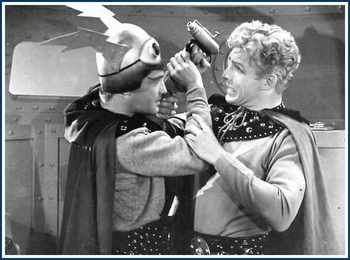
George Lucas has explained that his inspiration for Star Wars–in considerable part–came from the Flash Gordon and Buck Rogers science-fiction shows he watched as a child. These “space-opera serials” helped to inform and create his own. You can see it in the devil-may-care blaster-toting Han Solo, all of the space battles, and even in Luke’s wannabe adventurer character: at least in the beginning. Basically, these old science-fiction elements are integral to Star Wars’ existence.

I just thought this scene from The Star Wars alternate reality comic–the one adapted from an original draft of Star Wars itself–would be appropriate on some many levels considering the subject matter and the character resemblances. But what is definitely from my perspective is the following.

Then you have the Prequels, or the New Trilogy. One thing that most creators of worlds tend to do when they make a world for the first time, or try to re-imagine a pre-established world is to “go back to the basics.” You see a lot of this in comics nowadays: using Golden or Silver Age characters and expanding on them or taking a different slant on how they might be. What I think happened was George Lucas looked at the Star Wars universe he created and decided to “go back to basics”: to tell the story of what caused a lot of the events that happened in the Old Trilogy and at the same time re-imagine Star Wars. Of course there are two kinds of re-imaginings: which are reboots (which the Prequels were not) and matters of continuity.

From my perspective the Jedi are evil … no, George Lucas brought Star Wars closer to the spirit of the source material that informed his own childhood enjoyment: that of Buck Rogers and Flash Gordon. In fact, I believe he said as much in an interview or two in the past.

Flash Gordon aesthetics …

Meet Revenge of the Sith.

I believe that with the Old Trilogy, Lucas started out with those inspirations and expanded from them into something that looked older and actually resembled that strangely wonderful and mysterious phrase, “Long, long ago in a galaxy far, far away” that never gets explained but is still beautiful. With the Prequel Trilogy, I feel like that Lucas “went backward” and started to make something closer to the old shows he was inspired from. It wasn’t old and established anymore. The lines and creases weren’t there: the organic elements were stripped away to reveal this prototypical place.

Not all of the ideas in the New Trilogy were bad. Some were very intriguing and even did expand on certain elements in that galaxy. But unfortunately, they were elements that were poorly executed: if only because they seemed rushed. There was only so much lore you can throw into even three films to hold someone’s interest and sometimes things can get lost when you try to be succinct and “to the point.” Also, and I think you might know all too well the example I’m thinking about, it is a lot like humour: sometimes you can hit that place and sometimes you get far off the mark and actually offend people. Jar Jar, I am looking at you.

But some wooden dialogue and unfortunate caricatures aside, I think there were a lot of concepts that just couldn’t be fit seamlessly into the Prequels. I don’t like all of them and I would have liked to see some different things happen than what did, but I can sympathize with those limitations. That is probably what The Clone Wars CGI cartoons are for: to fill in the gaps between Episodes II and III. Again, they seem to hearken back more to Flash and Rogers and there are some intriguing concepts in them but they can be clumsy and awkward to watch: never mind how they can mess with continuity. And then, of course, there is the humour too.

Some people might even find the closeness to those old science-fiction serials outdated for our time, but I can see how it can be pulled off. I will tell you though that the galaxy of the Prequels does feel like a different galaxy from the Old Trilogy and sometimes it s a jarring thing to realize there supposed to be the same. I miss the mystical elements and mysteries of the Star Wars I grew up with.

And then there is Stars Wars: The Old Republic. I haven’t played this online multi-player game but my friends do and they have been trying to get me on this habit for a while now. But from what I have seen, this galaxy has gone back longer ago, but unlike the Prequels it does not seem farther away. Here you have the grittiness of the Old Trilogy mixed with a massive amount of Jedi and Sith lore. Both Jedi and Sith do not feel as watered-down as those in the Prequels: in fact from what I have seen they are what I always expected them to be. You have your bounty hunters, dynamic smugglers, and all of that stuff with plenty of story and mystery to explore.

I feel that for this game, the creators went back to the basics of Star Wars: but instead of merely just the science-fictional basics, they went back to the archetypal mythological building-blocks that I love so much. And I feel that is a place where the New Trilogy should have gone: that if we had gone to the mythical gravitas of the Jedi at their peak, Anakin Skywalker as a hero, Obi-Wan as a wise mentor even then, with Yoda still in the place of sage, and seeing Anakin go from something of a combination of Luke and Han into a tragic monster instead of the flash of ship and droid battles, and an actual romance between him and Padme in the films it would have made all the difference. Also, seeing Darth Vader slaughter Jedi in his suit, and even seeing the populace turn on and allow soldiers to take away and commit genocide against the Jedi–who’d otherwise been a natural part of their galactic population–would have really been far more striking and effective: from my point of view anyway.

Still, I am glad the New Trilogy exists and has inspired me and others. I like it in that it seems like a prototype or an outline of a movie or another world. But I would go with the timelessness of the Old Trilogy any day.

I would like to mention one more thing though. There are some people that wished Star Wars would be as dark and gritty as the Old Trilogy and remain so. Some people do not like the “cutesy” elements of it. You know the ones: the talking battle droids, the Gungans and the Ewoks.

Let me tell you something about Ewoks. I know that many consider them to be a blemish on Return of the Jedi. I don’t. Long before I watched the movies, I used to watch Saturday afternoon cartoons like Ewoks and Droids. They were the things that made me aware of the Old Trilogy. I really liked the Ewoks and the droids and seeing them in live-adventure with other bad-ass characters made Star Wars seem so much more real to me and that made my childhood self so happy: as though they–my friends–could exist somewhere out there past all we know in our world.

Sometimes when I get annoyed at the droids or Gungans, I ask myself what would it have been like if I hadn’t seen the Ewoks in Episode VI: if Star Wars had remained completely gritty all the time to the very end? People decry marketing the films solely to children, but children have made this universe. I was a child when I saw the films and they changed my life. Do I think that children can handle grittiness, violence, and the concept of the struggle of good verses evil? Of course. I definitely don’t think that things need to be “dumbed down” or completely censored out for children to like them. I also don’t believe good quality films for children should be three-hour long commercials.

At the same time, I also believe that a little light and levity and the comical–when done well–are also good for children and adults too. I wouldn’t have liked Episode VI if Han Solo had died the way it was originally planned or if there had been no Ewoks. They are also a necessary “basic” in the Star Wars universe: almost like a living cartoon–a neoteny–that is different from us but definitely something we can relate to. I always find it funny how we can relate to something that is more simplified than we are more than something that is supposed to be as complex and “serious” as us.

That too is something to keep in mind with regards to Star Wars, or Indiana Jones, or many similar adventure films: that while archetypal dangers and challenges are key, it is only when they are set with humanity and warmth that they feel like you are taking your first step into a much larger world.

Addendum: I DO like Lucas’ film work paralleling scenes between the Old and New Trilogy: especially with regards to what Luke does and what Anakin does. Also, Anakin Skywalker is a very good subversion and critique of the vintage reckless, daring hero archetype.

Horror as a Universal Power: The Function of a Creepypasta

So in my previous Blog entry, “Horror as a Universal Power,” I talked about how I believe horror is a slow-growing epiphany or realization of just how beautiful and terrifying the seemingly normal reality around us truly is: how it is a feeling we are both repulsed by and attracted to in a kind of feedback loop. It’s this kind of perverse fascination with something very strange and uncanny right in front of us.

After something of a Blogging dry-spell, I was watching a few horror movies such as Insidious and Don’t be Afraid of the Dark: you can, in part, blame these films for today’s horror craze on “Mythic Bios,” but it was also due to finding a unique “creepypasta” that I also began this.

When I first saw the term “creepypasta,” I had no idea what the hell it even meant. What first came to mind was a strange of twisted pasta with a pale hollow-eyed doll’s face on the end of it, or a malignant white spiral-worm with a single blood-shot eye. So after I really read a definition of what a creepypasta is, I realized it is derived from a term called “copypasta”  in which someone supposedly copy and pastes a body of text over and over again onto different websites and message-boards. So basically, the pasta is taken from the word “paste,” while the “creepy” part is pretty self-explanatory.

The link I provided above pretty much lists different kinds of formulas or tropes that creepypastas fall under, but that is not why I want to write this article about. I want to look at just how the creepypasta is such an effective medium of communicating the essence of the horror genre.

My first experience with a creepypasta was when I was sent the “message-board transcript” Candle Cove. I actually didn’t know that this was a work of fiction because the person who created it, Kris Straub, did a superb job in crafting the narrative aesthetic. It actually looked like a message board conversation would: complete with screen names and typos in discussion. He also tapped into that place of barely recalled memory and nostalgia–into the zeitgeist or spirit–of 70s children shows to great effect: along with an incredibly effective sense of pacing and different voices for each “poster.” The element of television static and white noise within the story was even more inspired because it plays on the depths of the imagination and just how far someone–particularly a child–can fall into it.

I really liked “Candle Cove” because you don’t know that it is a story and it is written that way. It is also written in a way which taps hard on that collective unconsciousness we all have and actually in some ways made it real. And that is the thing right there. Candle Cove, though fiction, made itself real.

This is what I really want to talk about. Other creepypastas have managed to do something similar based on the characteristics I listed above from “Candle Cove.” The thing that actually influenced me to write these two recent Blog entries was a creepypasta called Ben (or the Haunted Majora’s Mask Game). I came across an account of it on Youtube purely by coincidence. You can read a very long written account of it here or watch the video “footage” that the creator made to complement it here. What we have here is a mixed-media story: a combination of message board posts, a text file, a Nintendo 64 game-hack and video recordings by a user named Jadusable. But look at what he does here.

First, he turns a game made twelve years ago–a Nintendo work firmly entrenched into this generation’s or at least this gaming generation’s collective unconscious–into a medium for his story. He purposefully glitches parts of this hacked game and uses elements of the game itself to add to this story. Bear in mind, Legend of Zelda: Majora’s Mask is a very unsettling but wonderful game to begin with taking place in an alternate dimension from the usual world of Hyrule with various characters and elements to work with: not the least of which being the graphics, soundtrack and some of the dialogue.

Some parts of this creepypasta are, however, somewhat stereotypical and cliche: such as the protagonist and creator Jadusable buying “a haunted bootleg” from a “creepy old man” but that is a trope part and parcel with urban legends in general. Most people would have a lot of trouble suspending disbelief for this–especially gamers–but it does have some very creepy moments: especially for me given that one of the text messages on one of the videos associated with the piece referred directly to a person named “Matt.”

I think the reason I find this creepypasta fascinating is because it uses elements of our generation–specifically video games and the medium of the Internet–to attempt to relate to us in a way might not have affected other generations. Other creepypastas that have utilized Nintendo such as Pokemon Black and Pokemon Lost Silver really tap into that shared popular cultural consciousness, but they do more than that. You’ll find that if you Google or even click on the above links (pardon the unintentional pun), that after these stories became memes–cultural information that spreads to different people–people started creating works based on these pastas to make them more real. Candle Cove now has surviving televised scenes on Youtube. The haunted Majora’s Mask game has many imitators and parodies. Even the Pokemon games I mentioned have been made into actual bootleg games by readers of the things. Basically, they are not only Internet memes, but they become living stories. They become alive inside the people that want them, and I think that is an incredibly bad-ass concept.

It makes me really want to create a creepypasta of my own. I’ve had ideas for some, but I never really followed through with them. You have to get that mixture of intentional typos that look unintentional, a compelling and readable but realistic-looking narrative aesthetic and revealing the horror but not revealing the full origin of the horror down pat because not only do you have to contend with a reader’s disbelief, but also the myriad of other creepypastas out there that share so many–and in some ways too many–characteristics to make yours unique. I tend to get very elaborate in my works and that would definitely count against me in creating such a potent literary hoax.

Still, I know I can’t help thinking about it. It is no coincidence that a loved one chose to give me the strange and wonderful gift of an old newspaper article talking about the effects of the legendary War of the Worlds radio broadcast on its audience at the time.

A creepypasta functions as a horror story pretending to be real and yet even when revealed as fiction, readers make it real by believing in it and paying homage to it. In other words, we make our nightmares real and we actually seem to enjoy doing so which leads me back to my original question of why?

The Internet allows creepypastas to exist: to replicate and spread across not merely servers, message boards, and chat-rooms but imaginations as well. Where is that line between the machine and the human mind these days? What happens when we interact with an increasing body of knowledge that we can manipulate and shape to our whims (technology permitting)? I believe that, in the end, creepypastas exist for three reasons: the first being entertainment, the second being that they are a form of oral storytelling around a pixelated campfire, and the third because we want to believe and make real and manifest the idea that the wondrous and the terrifying can exist in a world where we all live: where something like the Internet exists and not only contains the growing sum of all knowledge and information of what we think exists in our supposed certainty, but also human experience and its less concrete intuitions as well.

I also believe that in light of all of this creepypastas–along with their verbal and written urban legend and folktale predecessors–demonstrate that horror is not only the fear of the unknown. Rather, horror is the love for the unknown–for an unknown–and the sheer limits of human understanding.

How to Turn a Medium into a Genre: 8 to 16-Bit Video Games

So, I am not a programmer. I am not someone who games regularly–online or otherwise on computer and console–and as such I have not played many of the modern games that exist out there. I played all the way to the 64-bit and then the wii era. For all I haven’t played in a while or even having never been an expert player I am–like many children from the 80s–a Nintendo child.

I watched video games evolve into more or less what they are now. I know that there are some older than me who grew up in the 70s that saw what video games were like before and I have watched enough–and read enough–to see that they have come a long way in a lot of ways. I remember the day I saw my first Super Nintendo. It was at a friend’s house and the graphics looked like they were from a cartoon. They were lusher than the 8-bit pixels that existed before and possessed more expression. The music sounded less transparently synthetic and more … fuller in a lot of ways. I am not knocking or putting down 8-bit video game music however: after all, 8-bit tracks sound very expressive in how synthetic they are with clear beats, beeps and keening noises.

But when I saw the Super Nintendo I wanted it. I wanted it so badly. My brother and I scraped together everything we had to buy one. And we weren’t disappointed. The Super Nintendo and many of the games that followed on that console had excellent game-play, good graphics, wonderful sound, and in some cases some brilliant story-lines and expressive characters. There was a lot of innovation for gameplay and mechanics then as well. 8-bit was functional and fun but it was seriously like going from the second to third dimension. At the time, I thought that video games would improve and keep going up and up: that more realistic graphics symbolized this advancement.

There was a point where I actually stopped playing old games because I began to believe that they had become old-fashioned and obsolete: that something that didn’t look as realistic as it could be couldn’t be taken seriously anymore. Yes, back in the day when all one could do was make 8 to 16-bit games, it was all very well and good. But in a more modern age with newer games, I got into the habit of thinking there was no excuse to go back to those and that one had to advance with the times.

I was obviously wrong.

I found Final Fantasy VI and Chrono Trigger long after their console was obsolete. Chrono Trigger in particular was one of those Super Nintendo games made towards the end of that system and it was so sophisticated and its pixels were made in such intimate detail along with its unique choice of game play that it made me happy to see it. There is something very archetypal about the pixel cartoon that others like Scott McCloud (at least with regards to comics) that to some degree one can relate to and emphasize with much more than the gritty and the realistic. They made me start to replay old games and instead of them making me depressed in that they were from the past and a time that didn’t exist, I just wanted to have fun with them.

If you ask me, I would say that my golden age of video-gaming was the Super Nintendo age. Even Sega’s competition added to that. Now fast forward a few decades. Now you have independent game makers and programmers, as well as those working on Internet and cellphone games, going back to those exact 8 to 16-bit forms. They do this for a variety of reasons, but the main one is that what was once a medium–the only way of expressing and symbolizing interactive programming in a game–has become a visual-audio aesthetic. In other words, an old medium has become a genre: it has become a creative choice and I think that is wonderful.

I mentioned that a month ago I went to the Toronto Comics Arts Festival and one thing that I made sure to see there was an exhibit called Comics Vs. Games: the result of collaborations between comics artists and independent video game programmers. I will admit that I have more than a passing interest in writing scripts for video games–and writing for video games–and what I saw and even played at TCAF was excellent.

One of the games that I actually played was The Yawhg: which was basically a game where you had to improve your skill-set before a cataclysm so you can help civilization rebuild itself. It had static screens with expressive backgrounds and artwork and a skill modifier number system: for example you got +3 if you completed a task you selected on a menu. It’s reminiscent of the Math Wizard game on the old computers at school, but it was so much fun because it made you use your imagination and the game mechanics were dynamic enough to make you want to play quite a few more times.

Then you had We’re No Angels where you play these 16-bit music celebrity sprites trying to escape from God and Heaven to go back to the real world and party. I didn’t really get to play the other two games, but as you can from the link they are very interesting. For example, The Mysterious Ambroditus is like an intricately illustrated Victorian Mortal Kombat game using a rock, paper, scissors method of card combat.

I’ll let you in on a secret. I actually enjoy watching people play certain kinds of video games. Often, you’ll find me watching Let’s Play videos on Youtube: particularly those of Boltage McGammar and HcBailly. But I haven’t played many video games myself in a long time. You can even ask my friends who had been trying like crazy to get me to play Knights of the Old Republic. But I played these games. They were even two-player and I played with them along with some random person I met at the Festival.

I know this entry seems a little random considering the other things I write about here, but I think it relates a lot to my mindset as a creator and as someone that enjoys interactive stories. I find it amazing what our time is doing with old games and cartoons from the 80s and onward: things that were once the present day of many of us and I like how there is new life in them. Old mediums are being made into new genres and new mediums and, you know what? I am glad to be here: just for that.

Mini-Opera Contest: Words on a Screen: A 16-Bit Opera on an 8-Bit Track

Notes: The aesthetic of this script as looking like an online chat forum is more than intentional. I visualize two Soloists. This can be an animated 16-bit cartoon with pixelated sprites or even an interactive basic video game. I can see a male and a female character sitting in front of their computers: with their heads to us, but we can see their faces as icons on each other’s screens. For example, the boy’s face would be on her screen and her face would be on his.

I can also see them playing a video game RPG with basic pixel characters: especially when they talk about “epics of epicness.” I also see their dialogue appearing in blue boxes over their heads when they sing.

In addition, I can hear the music as being synthetic and electronic like the soundtracks one would find in old Nintendo video games or old-style arcade games.

These are obviously just suggestions though and live-performers and stagecraft can be used as well.

<<Him>> They say this isn’t real.

<<Her>> They tell me not

to waste my time.

<<Them>> She/he’s not flesh or bone enough

to hold me.

<<Him>> A keyboard is not the texture

of her skin.

<<Her>>  My headphones aren’t his lips at my ear.

<<Him>> But I can look at her text and feel her grin.

<<Her>> I can hear his voice

both deep and

clear.

<<Them>> These are the games we play

when the medium is the message

of connection.

<<Him>> Words on a screen.

<<Her>> Touch on a phone.

<<Him>> Our love can be seen.

<<Her>> But we are forever alone.

<<Him>> But are we?

<<Her>> Are we really?

<<Him>> We live trapped in our

blood and bone.

<<Her>> We put on our social

masks, our created

walls.

<<Him>> You can walk among people

all alone.

<<Her>> We live personal space

where only silence falls.

<<Them>> Background chatter

white noise

to lose yourself in

a distance of static.

<<Him>> So I played the game of life

where you can’t beat your bosses

<<Her>> because you work for them.

<<Him>> Where you can’t find coins

from floating boxes or the bushes

<<Her>>  The money runs out.

<<Him>> And your princess is never in another castle.

<<Her>> There are no extra lives

and few second chances.

<<Him>> Each day lags.

<<Her>> Each day an epic battle of

fail.

<<Them>> Until we played the games we play

where the medium is the message

of connection.

<<Him>> Words on a screen

<<Her>> Touch on a phone

<<Him>> Our love can be seen

<<Her>> But we are forever

alone.

<<Him>> But are we?

<<Her>> Are we really?

<<Him>> I used to hate two-player games.

<<Her>> I’d not be some fanboy’s

“girl-gamer” trophy.

<<Him>> Devolving into

player vs. player

<<Her>> Disgusting words and

harassment

<<Him>> But just when the Flame Wars

seemed to never end

<< Her>> I’d just about given up …

<<Him>> We met on a Fan Site

<< Her>> Looking for an 8-Bit

Convention Flight.

<<Him>> And on the Internet

<< Her>>  something

<<Him>> was

<<Her>> finally

<<Them>> Right.

<<Him>> We planned to share a room

with friends as our cash

was tight.

<<Her>>  We talked on the forum

about our 8-Bit tracks

<<Him>> exchanged e-mails

<<Her>> chatting deep into the

night.

<<Him>> We got to talk

about martial arts.

<<Her>> I got to pick his brain.

<<Him>> I told her in the Matrix

I’d side with the Machines.

<<Her>> I told him about my art

in different fanzines.

<<Him>> Until the glass of the screen became

a permeable thing

<<Her>> As we Skyped

our voices rang with

smiles

<<Him>> Until

<<Her>> After exchanging pictures

<<Him>> wireless electricity crackled

<<Her>> just as Tesla had intended

<<Them>>  And we

exhaled …

pixelations ….

For we played the games we play

where the medium is the message

of connection.

<<Him>> Offline they still say this

isn’t real.

<<Her>> That passion and pain

are just words on a

screen

<<Him>> Sound and fury flying across

digital space,

signifying nothing.

<<Them>> On our 8-Bit Convention Day

we plan to meet

<<Him>> Face-to-face

<<Her>> Flesh-to-flesh

<<Him>> Text-to-text

<<Her>> and brain-to-brain

<<Them>> Even if they think we’re insane.

<<Her>> Perhaps it could be a

mistake.

<< Them>> For words on a screen

connect pure and clean

and Offline can be messy.

<<Him>> I think

<<Her>> Yet I believe

<<Them>> Yet we know

in this 8-Bit Theatre

this 16-Bit Opera

our epics of epicness

will unite past blood,

bone, sex and continents

to make the greatest

multi-player role-playing

game of all!

For words on a screen

and touch on a phone

make love visible

and we are not alone.

Our medium is our message.

We are our medium,

and we are … real.