Tired of Tragedy: The Reclamation of Star Wars?

So I’ve been commenting on some Star Wars news and rumours lately. And it has gotten me to thinking–thinking long and hard–about some issues: specifically about the nature of the Saga as an epic structure, the Expanded Universe, and what I want in the former.

The reason I’ve started writing about Star Wars again–and anyone who knows me is aware that it doesn’t take much to get me to go on about it–is that I became aware of a particular rumour circling around about the existence of Star Wars: Reclamation: essentially what seems to be an animated tie-in into the Episode VII is that is scheduled to happen in 2015. Now, I’m not going to argue whether or not this is legitimate or if it is a hoax, or one of many projects that Disney effectively cancelled by closing down LucasArts not so long ago, but the prospect of it is very fascinating.

Think about it. We have no idea what the next Star Wars film is going to even be like. There are, again, some rumours but nothing definite.

Which brings me to my first point.

Star Wars is a space opera. There is music, there are opening scenes, clearly delineated heroes and villains and all those who fall in-between, epic battles, moments of levity, romance, and tragedy. In fact, most classical operas can–arguably–be divided into the genres of romance and tragedy if you really think about it. Romance in itself is not merely about love, but also the sublime and grandiose in nature. It is a great epic adventure that encompasses many elements: especially the mystery of existence. Tragedy can also arguably have these traits, but there is usually a very clear circular arc in the Classical sense: the hero begins from nothing, becomes great, and through some fatal flaw–hamartia as the Greek word goes–the hero gives into hubris and falls: and falls hard. This is also known as a reversal of fortune.

File:Recoveringvader.png

I would therefore argue that the Star Wars Prequels–in terms of thematic structure–are a great big space tragedy: take from that statement what you will. However I know that when I am watching or reading something and I know that many of the characters I see will eventually die, it is kind of hard to really get attached to them or any of the events that are going on. I mean, that has always been my issue with the Prequels and The Clone Wars cartoons: I just see that every struggle is essentially engineered by Palpatine and it just … cheapened it for me. But if you view these adventures as the ancient Greeks might have known tragedy–because every legend and myth that was adapted into tragedy was already known to the audience and were therefore judged by the skill of the playwright–then I can see the allure.

But I guess it doesn’t help that I: (1) Read the EU books and (2) believe that the plot and some of the characters in the Prequels and Clone Wars were not given as much depth as they deserved: though granted I did not see many of the latter cartoons. Now I want to talk about some other influences on Star Wars with regards to “space” and “opera”: and how this influences what I want to see in the Saga.

When I talk about space operas there is also the science-fiction adventure genre to consider. You know: that Sunday matinee serialization of different episodes that people in the 1950s or so would watch. I always like to bring up the fact that Flash Gordon and Buck Rogers influenced George Lucas a lot in creating Star Wars. You can read the posts, I won’t repeat them. But these particular science fiction adventure stories also leave their mark on Star Wars in another way: one that channels an even older idea.

This idea is that of redemption. It is redemption that really stands out in the Star Wars Saga. If the Prequels were a tragic and angst-filled arc, then the Old Trilogy was arguably an adventurous and redemptive arc.

I can argue that while hubris is more of a human trait, redemption is as mysterious as the Force itself. There is so much of the romantic, the sublime, and the grand adventure in the Old Trilogy–of things we didn’t know–and it just opens a path to seemingly limitless vistas: much akin to that sense of wonder that existed in the science-adventures of George Lucas’ youth and so much more. After all: who could see the villain becoming, for one brief moment, the hero: someone to be both pitied and respected? Yes, it was a twist moment and some people probably predicted something like it, but it was magical: just as what happened afterwards.

Now let me get back to the other matter: the Expanded Universe after the Old Trilogy. I’m not going to lie. I know that many of the stories in the EU–with some exceptions–are pretty inconsistent in themselves and aren’t always on par with what I liked about the Old Trilogy. That much I can personally can let go.

But I’m also going to make another admission. After the publication of Timothy Zahn’s Thrawn Duology, I stopped really reading the Star Wars EU. I think the biggest mistake was the fact that instead of continuing with what that galaxy contained–instead of bringing back the Sith or a Dark Side threat after the peace treaty with the Imperial Remnant, the authors introduced the Yuuzhan Vong: some extra-galactic sadomasochistic warriors using bio-technology and hating machines. As far as I am concerned, that was the beginning of the end of the EU for me and it only got worse when they tried to introduce the Dark Side in some of the most plot-contrived ways I’d ever seen it.

In the end, they killed at least two of the most interesting characters in the Expanded Universe–Jacen Solo and Mara Jade–with the former killing the latter and becoming a half-assed Sith Lord–and the series and what came after it became progressively darker. It is like the criticism that some people have for comics nowadays: that writers are just copying the grit and darkness of larger story arcs before them. But instead of it being comics makers of DC and such imitating Alan Moore and Frank Miller without their nuances, it is writers working with LucasBooks who imitated the darkness of the Prequels: pieces that at least had structural nuances. The mysteries just became contrived and it became all about the angst: all about the tragedy and an attempt to make something epic out of nothing.

It seriously made me just want to quote Lando and say, “This deal is getting worse all the time.” To be fair, I know that the Sith were supposed to be incorporated into the EU earlier, but apparently LucasFilms had issue with that: probably because of the development of the Prequels at the time. Also, George Lucas generally did his own thing, didn’t pay much attention to the EU, and many of these writers always had to “tow the line” as it were with regards to what innovation they could bring to the stories set in Lucas’ universe.

Really, here is what I want to say as succinctly as possible. If there is something like Star Wars: Reclamation–and that title is fitting on so many different levels–then so be it. I wouldn’t mind seeing most of the Expanded Universe rebooted: or at least given an alternative series of stories as they are doing with The Star Wars comic based on the rough draft of the original film script.

Really, the only elements I would miss about the EU as it is now would be the Legacy comics, Mara Jade, the Solo children, Republic Commando, X-Wing, Wraith Squadron and Grand Admiral Thrawn and friends. The rest of it was pretty mediocre in retrospect. I also really don’t like how Luke settled to be another Old Guard when he had so much potential to become something more.

In some ways, the fact that Disney stopped production of Clone Wars and many of the video games–which I feel are rehashings of old ideas and cycles–may be one of its best decisions yet. Even Star Wars 1313, for all of its excellent graphics and the idea that you are not playing as a Force-user, looked like it was just going to be a shooter game set in the Star Wars Universe: and there are so many shooter games out there already.

It all kind of reminds me of how, when something doesn’t work for me anymore, I just destroy it and start from scratch. I am that scarily absolutist when I am driven to that point. My only regret is, aside from potentially losing some characters I did grow attached to, that this is the closest we will ever get to seeing a Star Wars reboot: the best being a silence about the Prequels or anything to do with them after this.

But I am also skeptical about what might be going on. Even if you look at that Reclamation script excerpt you will notice that certain species from the Expanded Universe still exist. This is also assuming the script is legitimate and will survive the light of day. I am however really leery of the fact that Disney closed LucasArts down and and laid off many of their employees: whatever Kotaku and other sources might be saying about its productivity level. It could be that they are, as they say, focusing all of their talent on the future of Star Wars–which theoretically sounds ideal–but I have to wonder about that.

In fact, the very title of this article is a misnomer on my part. I mean, how can any outside party “reclaim” something that wasn’t originally even theirs?

I know it seems like I am saying a lot of things at the same time. And I am. But here is what it comes down to me for me: I am willing to see a lot of the EU disappear–or be placed into an “Old Expanded Universe”–so that something can be created that will need to something potentially new and good. Ideally, I would like to see the Prequels and Clone Wars disappear or change too: leaving only Legacy, The Old Republic, and Tales of the Jedi and other such more “ancient” stories in the Star Wars EU intact. But that is too idealistic for my own good.

I also realize I have gotten a lot more cynical in my old-age of thirty-one. Once, I would never have even considered wanting the EU to be gone or changed. I was just as much into continuity as anyone. To an extent I still am. Tragedy and angst have their place, but I want to see so much more now. I am not completely all Crisis on Infinite Earths DC where I want to see it all burn–much–but just like the viewers of the old days and their adventure serials I do want to anticipate what will happen next as opposed to the minutiae of what is already going to happen. I want to see alternate avenues, new mysteries, and characters that could go anywhere and whose futures are not seen as written yet: new adventures with depth, romance, and wonder.

That is ultimately what “Long, long ago in a Galaxy far, far away” means to me.

I want wonder, and something to look forward to.

File:Spirits copy1.jpg

ETA: Disney has very recently announced that they plan to release a Star Wars film every summer after the release of Episode VII. Now, the idea is that each film will be a spin-off movie aside from the main Episodes. These are more in line in some ways with the old science-adventure serials of the 50s: in that there are more of them. Now whether they will incorporate some of the EU into their creation, or make a whole other alternate story with them from the books and literature that exist is another matter entirely. And really interesting for it. Limitless horizons indeed.

ETA: According to a LucasFilm spokesperson, Star Wars: Reclamation is not real. This does not surprise me, but at least it made for a good title to my post.

Before the Empire, There Was Something Else

This wasn’t a planned post of mine, but it’s amazing how Star Wars makes me do that. Not too long ago, I heard that Disney is shutting LucasArts down. I did grow up with the games that this company made tangentially and it does make me wonder exactly what it is that Disney is planning to do with the Star Wars franchise.

But I don’t really feel like I have much to say on this matter. Yet while LucasArts is currently being dissolved, there is another–perhaps more understated–Star Wars event happening as well. I’m talking about the comics adaptation of George Lucas’ Star Wars film script.

The original draft.

If we go by the theory that the original that a character is based off of has a considerable amount of resonance and power, then these figures will definitely stick to whomever will read this limited edition series.

I won’t go too much into the details of the thing. In fact, if you’d like, you can read some news accounts here or here on the matter. This is not the first time I have heard about or read anything about Lucas’ original script draft. In fact, I’ve seen one or two fanfics take these Star Wars proto-characters and their prototypical universe and make some really interesting things out of them.

But they are, however the writing may be, the root of many of the elements of Star Wars that we recognize today: in the Old Trilogy, in the New, and in a lot of the Expanded Universe.

What we are seeing, in comics form, is an alternate universe in a galaxy far, far away and what was once the providence of fanfiction is now–to some degree–being created and sanctioned by LucasBooks such as it is. It is like finding out that the new J.J. Abrams’ Star Trek alternate universe films were being created in a smaller comics form: save that his alternate universes are his own and not Gene Roddenbery’s.

But what really gets me is looking back on two posts I made on Mythic Bios about Star Wars. I wasn’t really satisfied with Star Wars: Back to the Basics, to be honest, though I do think that my post When You Wish Upon a Star, Far, Far Away does have some merit apart from its rather witty title. I think my issues with the first post were that I had a lot of supposition and hearsay, but not a lot of proof. I wanted to compare Star Wars to Buck Rogers and Flash Gordon: to show that the latter really affected the former from Lucas’ own formative years and that the Prequels were a hearkening back to that original source material. I even had trouble trying to find pictures to make nice parallels: save that at least the “opening crawl” receding into the distance in both the Old and New Trilogies had a parallel with the old Buck Rogers serial introductions.

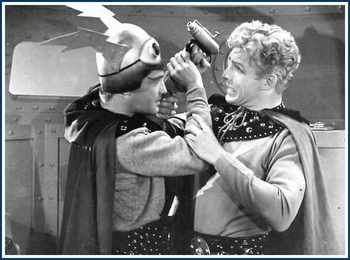
File:Flash Gordon (1940) - Opening Crawl.jpg

But if you look at the links to the news pages that I attached above with regards to the comics being made from the old script draft, just read how the characters are described and look at the accompanying art work that is being made currently. In my second article, I went into some brief speculation about a Star Wars reboot: much in the way of Star Trek. I doubt this is going to be wide spread and I certainly don’t think the next Episodes will be reboots, but it is worth looking at the fact that in some medium this creator-made “pre-boot?” is being made.

The way this script is described, it not only seems to be closer to the film materials that Lucas was inspired by and are mentioned in the linked articles, but there is something very … Princess of Mars about their aesthetics and attitudes.

If you want to talk about prototypes or preceding archetypes, Edgar Rice Burroughs’ world of Barsoom really influenced a lot of science-fiction: with almost archaic looking costumes, vintage laser weapons, and a lot of emphasis on royalty and nobility even beyond the usual Star Wars: or at least the Star Wars of the Old Trilogy. You can also argue that some of the images in the articles I linked to also look a lot like Buck Rogers aesthetics as well. And Star Wars, while it is epic fantasy, borrows and wears enough of the science-fiction aesthetic to be examined in this manner. I would say that this is an attempt to hearken readers back to a retro-Star Wars, but this “predates” and pre-exists that vintage. A Pre-Boot Pre-Retro? Now, that just sounds bulky to say and I am sure there is a better way to say it.

I think that, in the end, what I find really fascinating about this–in this really simple overview of the matter on my part–is that we are in a time now which is really interested in the retroactive: in Retro itself. For many of us born and grown up in the 70s and 80s, perhaps even the 90s, the present has become the past. I go into it a lot here, but this decision on LucasBooks’ part seems to really feed into that growing niche in popular and geek culture now.

Or this is just a very strange and fascinating look into an experiment that could have been and admittedly has a very limited lifespan: an oddity that has existed for years collecting dust on the shelf and in the recesses of Internet chatrooms and forums which is now really getting acknowledged.

I would never have known about any of this as a child and–indeed–if I had known about either LucasArts’ end and the Original Draft comic coming out a few days ago–on April 1–I would not have believed it. As it was, I read about the Original Draft being adapted to a comic during April Fool’s and didn’t know what to even think about that!

But I like oddities and strange things. I make them all the time. I am making them right now. I thought that the Star Wars Prequels were a hearkening to older space opera shows of the 50s or so, but maybe they were also referencing this older, weirder, prototypical universe: an elder reality. I want to see what will come of this. They would at least make for some interesting toys.

And I don’t know about you, but I want to know if the reptilian Han Solo still shoots first. I’m messed up like that. 😉

When You Wish Upon a Star, Far, Far Away …

So this is an unplanned post. For the past couple of weeks I’ve been writing these posts in advance so that I could have a block of time to deal with my creative collaboration and other writings. But this is something that I feel I have to address in some way.

Anyway, a day or so ago I was in the middle of playing Kan Gao’s To the Moon–an excellent game which I will talk about in more detail at another time–about the day after Hurricane Sandy when my Dad starts talking to me about something. He had been listening to the news and he told me that not only did Disney buy out LucasFilm, but there are going to be three more Star Wars films starting in 2015 and onward.

At the time, I thought was some kind of joke. It just didn’t make sense. Then after I finished off To the Moon, I went online to see what was going on and I find out that George Lucas has retired, apparently made some script outlines for Episodes VII, VIII, and IX, and that Disney is going to help make these happen.

So. Here’s the thing.

What do I think about this?

The answer to this question, as of right now, but it may change as I continue writing this post is that I honestly don’t know.

You know, once, a long time ago in a galaxy far, far away that was the last dregs of my childhood, this would have made me fucking ecstatic. I always wanted to see what happened after Return of the Jedi. I wanted there to be more. In fact, I was so attached to the characters to the point of them feeling like friends to me that I really wanted to see them again. When I first heard that there would be more films, I thought this might be it and, hell, they might even incorporate things from the books: of which I am mainly talking about Timothy Zahn’s Thrawn Trilogy.

Instead, after buying those Special Edition video cassettes and listening to interviews with George Lucas, I found out that the new films would be Prequels: the story of how the Star Wars universe as we knew it became what it was. I was a little startled, but I was still very enthusiastic. Mainly, I was kind of scared to wonder what happened to Luke and Leia’s mother: which was a source of great mystery in those days.

Then the Prequels happened.

Yeah. I wrote a post on here which pretty much sums up what I think happened creatively with the Prequels, but I would just like to add that I think a few fanatics like myself were spoiled by two things: that we were no longer children and things like Ewoks (though I would never compare Jar Jar Binks to an Ewok, because Ewoks are awesome) just didn’t really relate to us anymore, and that what we saw in the films didn’t match up with the spirit of the Expanded Universe. I’m talking about the books, comics, and video games. Yes, I know it’s nerdy and also anal to focus on continuity and that it says something about  person when they wince–painfully wince–at every preconceived notion of a creative work becoming no longer … consistent.

But then I look at some aspects of the EU, and realize that there were inconsistencies and painful moments of chagrin even then, but I think I–for one–was so hungry for extra Star Wars then that I just didn’t care. I wanted to see my friends again. Nowadays, I still like seeing them but, wow, I would tell them to lay off the ridiculousness.

I think a lot of my own issues with the Prequels are due to my own idea of what I thought the Expanded Universe was like, and my own sense of continuity (I will not link to ItsJustSomeRandomGuy right now with his “Continuity song,” I will not), but at the same time sometimes you just need to take something as it is: right there, and right in front of you.

So when I hear that there will be more films … I really don’t know what to say. Oh, I will be watching them. I’m not even going to delude myself. I remember my friends and I were talking and some of them thought that a Star Wars “reboot” would do wonders for that universe. But this isn’t a complete reboot: this is a continuation. At the same time though, it’s a new film narrative that can be written and depicted differently. I’m not very familiar with legal and directing processes, or how a corporation manages creative property and, really, the creative process, but Disney bought Marvel and we have The Avengers film. I may be propagating some sort of logical fallacy by writing this, but I felt like I definitely had to mention that.

The truth is, when this is all said and done, I still don’t know what to think. But I guess if I absolutely had to say something, I would say that as long as I am entertained, I am willing to see just how far this can go if only to see more John Williams’ Star Wars music get created … and just to watch the Internet go insane.

And who knows: maybe we will finally know what Yoda is … or something.

So I am going to be evil and wrap this up with these closing statements. When these movies happen, all I can say is may the Force be with you … and let your conscience be your guide. 😉

Fate, Fortune, and Freewill: The Challenges of Table-Top Role-Playing

https://i0.wp.com/us.123rf.com/400wm/400/400/excessmind/excessmind1201/excessmind120100004/12044191-big-orange-marble-twenty-sided-die.jpg

So during my last game session with my friends, one of my characters seems to have died. This would actually be the first time I had a character that died in a table-top role-playing game. Sir Vaeric Aedrin of the Order of the Imperial Knights was last seen drowning in a sandstorm in a desert on Mandalore. Why did this happen? Well, very simply enough: he failed his Survival and Endurance rolls on the D20 system and the last I saw of him was him being buried in sand.

I’ll admit. I wasn’t very happy. But for the most part I really liked how I role-played him. Sometimes you have to understand that, in at least a D20 role-playing game like Dungeons & Dragons or one that uses the former’s rules, a lot of your actions and their consequences are determined by the role of the dice.

It can be frustrating. You come up with these ideas and you plan out what you want to do–though some cases you have enough additional modifiers to add to the dice number to exceed the difficulty number–and then you have to basically trust in the die or dice not to fuck you over. And sometimes that D20, that twenty-sided die, is not always your friend.

That’s not the only challenge in role-playing this kind of game however. There is also the challenge in creating a personality for your character and to keep role-playing that personality consistently. I like to create back stories for my characters and then attempt to have the character act according the nature I made for them. The thing is, even barring the fact that you could make a roll that changes the outcome of a situation, you have to also take into account that your character will change. It’s impossible for them not to. You have to figure that stress and particular situations will greatly influence them. Your Dungeon Master or perhaps more accurately your Game Master–if they are any Game Master at all–will present challenging situations for you to role-play through. I don’t just mean creating physical obstacles or enemies to kill, but moral quandaries and interactive role-play situations as well.

For instance, Sir Vaeric as well as his commander Sir Kentari and the recent addition Sir Hett go into a Mandalorian base to investigate it: as one of their other team-mates had a calling from the Force that there was something important about this place. They end up getting caught in a fire-fight between two Mandalorian factions. Choosing a side becomes easy in that their new companion Sir Hett is on one side. But it’s what happened afterwards that I’m thinking about. Sir Vaeric is a bladesmaster and a man of honour, yet his allegiance is ultimately to the Empress, or as was his battle cry, “For Empress and Empire.” There are these refugees and the surviving Mandalorians that are protecting them. They are all headed to the same place to, presumably, the Resistance of a Death Watch ruled Mandalore.

Sir Vaeric tactically believes that having more Mandos on their side could bolster their chances of survival. He also thinks it’s the right time to do to allow the refugees–victims of Death Watch’s allies–to have some protection and be able to fight in the Resistance: maybe even as a gesture of good will so that the Resistance will be more inclined to give he and his fellow Knights their Prince back. Sir Kentari, on the other hand, along with Sir Hett remember their oaths as Imperial Knights and see their mission to get their Prince back as paramount. They also greatly esteem their abilities over everyone else’s and have a certain degree of arrogance that is something of a trademark among Imperial Knights. They rebuke Sir Vaeric–thinking he is delirious from a neck wound–and in the end even he sees that refugees would slow them down and attract more notice to them.

In the end, the refugees and their Mando Clan are free to leave and both parties go their separate ways: which is just as well because we also encountered a sandstorm that would have killed all of them had they come with us. But you see with this example of how Sir Vaeric’s personality and his oaths conflict. What complicates this even further is that I was also playing Dravas C’Tor: my humanitarian Force-sensitive archaeologist and he would have definitely wanted those refugees saved. In retrospect, separating the two personalities–as well as what I want to as a player–was definitely a challenge and it can be easy to confuse the two.

Another notable example was when we were all in the desert, Sir Kentari had to make a choice between rescuing his Knight Brethren that fell in the winds and C’Tor. Dravas C’Tor in another game accidentally killed his Master and failed to save the life of his Knight Brother in a previous quest. Sir Kentari would have loved to save Sir Vaeric and Sir Hett and left C’Tor to rot. But his mission was to save the Prince and C’Tor was selected by the Empress to be the negotiator between the Empire and the Resistance: since he had ties with the latter. In the end, Sir Kentari had to save a man he despises, “For Empress and Empire.”

I think another confusing matter that does tend to come up is remembering that there is what you as a player wants or knows, and what you as a character would do. You might think that after a long time of role-playing, it would get easier to differentiate the two, but doesn’t. You will always be challenged: especially when you play characters with different experiences and knowledge. I can’t tell you of the times I wanted to access computers just to remember that I’m not my NX droid, or examine the lore of a civilization and I’m not my scholar character, or even sometimes get aggressive and realize that is how my Sith character would be. Now it is wanting to go into direct combat and remembering that I’m not my Imperial Knight anymore.

The thing is that when I make a character, there are commonalities from my own personality. They tend to be knowledge-based or artistic in some way: even if it is being artistic with a lightsaber blade. But what I know as a player or, as someone who has lived a thousand lives as a player to adapt George R.R. Martin’s phrase, is not necessarily something I know or can do in-character.

So really, I can sum it up like this: I have an idea of where my character has been and where they want to go. There are rules in place to see if what they do actually works or how their actions actually happen. At the same time, I have to make decisions that are separate from the dice rolls. Sometimes, I really don’t like dice rolls and numbers: partially because I have difficulty with numbers, but also I tend to role-play or act out my characters more than rely or depend on my statistics. However, I also try to remember my statistics because there do need to be rules in place–to create a structure–and it is a pretty cool thing when you roll your die and you get a 20 or, in my die’s case, an “EQ.”

I would have been very angry if, say, Sir Vaeric died in the desert automatically and there was nothing I could about it. A lot of players would have been pissed that they hadn’t died in battle. But the way our GM did it made a lot of sense. We had to roll to pass Endurance and Survival checks. We had the chance to succeed or fail. We didn’t just immediately die in an arbitrary way. Also, it’s realistic. When you find yourself in unfamiliar terrain and you’re not prepared to be there or deal with harsh environmental conditions, you are at risk. Weather brings armies down. You can be the greatest swordsman in the galaxy, but when a sandstorm and static electric currents assault you, you’re probably going to be screwed.

I’ll admit that numbers and statistics and feats do play a role in something like a D20 game and I am not always the best at figuring our the rules. But I also know it is a lot more than just numbers or the equipment you get or the back-story you make. In my other article, Role-Playing as Interactive World-Building, I talk about how a role-playing is a creative collaboration and it’s no less true here. Your character will evolve. You will roll twos on your D20 and fail a medical procedure that could have saved a companion’s life. Out of character, you know that’s not your fault, but in character there is the reactions of everyone to consider. You incorporate the results of rolls and actual decisions you make into how you and your characters interact with and change the world you make.

In the end, I’d say that when you table-top role-play, your first collaborators along with the GM are fate, fortune, and freewill. There is a plan and the dice can randomize that plan, and your game might have a particular spirit of its own, but your decisions are still very much important.

My Best Friend Was a Sith Lord: Tony Pacitti’s My Best Friend Is a Wookiee

I found out on Facebook today that Tony Pacitti’s book My Best Friend Is a Wookiee: One Boy’s Journey to Find His Place in the Galaxy is going out of print. Now, I wrote a review of it on Amazon, but now I feel like I have to say something more about it.

Tony Pacitti himself has said that the Star Wars galaxy and culture has changed so much that his role is smaller in it now. Some of the Amazon commentators themselves have written that Pacitti talks about his own life more than Star Wars and that at the very worst, his reminisces are very self-indulgent and have no value.

I think it’s safe to say that I disagree with all of the above. Pacitti talks about a period of history: from the 1980s to the 2000s where the cultural impact of Star Wars and geekery is seen on people growing up. He uses himself as a prime example obviously, since his work is a memoir, yet what I find really striking is just how much his childhood and experiences have in common with my own. Pacitti talks about television shows and games that existed during the same period I grew up in: from Saved by the Bell to Magic Cards. But more than that, he captures that feeling many people had after the Original Star Wars Trilogy ended: that need to see more. It was the need to see and experience more of that universe.

So I too delved into the Star Wars Expanded Universe. I too bought as many books that described that universe in more detail. I role-played in that universe and so did my friends: so do we still in fact. My friends and I watched the Old Trilogy long after the 70s where we hadn’t been born yet and we had similar reactions to the Prequel Trilogy: reactions that have great sympathy with Pacitti’s own.

I’ve written about Star Wars on here before with regards to what my actual issues with were and what I think George Lucas had been trying to do in an ideological way. I won’t rehash them except to say that Lucas too had been influenced by his own childhood and young adulthood to create what he did. Pacitti was definitely informed by what Star Wars represents. Star Wars is a space opera: an epic fantasy with a backdrop of space, a setting with technology, droids, and aliens alongside human beings. It begins “Long, long ago in a galaxy far, far away,” but it is closer than you think.

Star Wars contains archetypes that we can all relate to: facets of different kinds of sentient existence. These characters are accompanied by powerful leitmotifs–by thematic music created by John Williams–to bring out the terror and wonder in us. Is it that inconceivable that a film series like Star Wars, having ingrained itself into the popular consciousness and playing our collective unconsciousness, could have informed our time period after the 70s? I know there are many other films that have done something similar, that this element is what people look for when they want to call a creative work a classic or something seminal: a seed of an idea that leads to something else.

Shouldn’t a classic also be judged by how it influences not just a large amount of lives, but one life? Tony Pacitti manages through a caustic wit to identify himself, and himself in relation to a culture that has not changed at all: in that it is only still growing. So I agree that the culture around Star Wars is changing, but it is still Star Wars and I think that Pacitti’s role in Star Wars–at least with regards to what he wrote in this book–is still relevant and important. I for one am really glad that he wrote it and that I bought the thing when I did two years ago.

We all want to identify ourselves with the things we love because we adopt them or feel sympathy with them as a part of us. So once again Tony, thank you for writing this book and thank you for reminding me who my best friend is.

Role-Playing as Interactive World-Building

In addition to writing, I’ve been doing some other things with my time as well. A few weeks ago, my old friends and I started another table-top role-playing adventure with the Star Wars D20 system. As you can see, we use Lego to represent our characters and the settings we go into as well.

My friend Noah is our Dungeon Master–or Game Master–for a good portion of the time. A good majority of the Lego that is used in our adventures belongs to him. While I’d started role-playing with Noah and my other friends since high school, our first Star Wars game started in 1999 slightly before the Prequels were released but after the action figures were.

Back in those days we had some group games, but we mostly played solo–which I know was a lot of challenge for Noah to accommodate–and we fought each other a lot. It was a very conflictive game (or what you might call Player Vs. Player) with a whole lot of manipulation and planning but also a lot of mystery and wonder. Back in those days I was a Dark Jedi mercenary named Nagir Taron that eventually became a Sith Lord as time progressed. It was an interesting time: when we still believed that Force lightning could only be used by powerful and experienced Darksiders and where lightsabers were very rare and couldn’t be made until you reached a higher level … and were so easy to lose.

We have played sporadically–on and off–over the years as we’ve all gone from one point in life to the next. Noah himself, along with a few others, have tweaked the rules and added some very idiosyncratic elements into his version of the Star Wars Universe that we all play in. There are some very funny and zany moments and a whole lot of “making fun” which I can really appreciate nowadays.

These days we play a group game with a lot less internal in-game conflict. In the following picture below are the following characters from left to right. They come from a previous game we played: the taciturn and steady mercenary Hal Tavers, the Force-sensitive doctor and archaeologist Dravas C’Tor (who I played), Juyo’Maya (Noah’s Non-Player and alternative Player-Character Half-Twi’lek Jedi Knight), the conniving and gifted slicer Mynock, and the late and unlamented psychotic former Republic soldier turned mercenary Sergeant Sharp.

Dravas C’Tor was my attempt to play a Light-Sider character and I had varying degrees of success with that. The name Dravas C’Tor is an old one I created in elementary school for a Dark Jedi and then an alias I used in the early Star Wars games I played with Noah.

There is a magic to a long-time table-top role-playing game. First, you have to understand that we have been playing this game–and others like it–on and off for over a decade now: which is frightening because it makes me at least realize how old I’m getting. We have invested a lot of time and enthusiasm into the worlds we’ve played and made by playing. During this time, Noah has developed many of his own rules from the D20 systems that exist. In addition, we create actions that change the environments that he creates. Add a twenty-sided die and its other counterparts to this mixture of fate and freewill and fortune and you get a very organic world that uses us to build itself.

And I’m not even talking about the stories that I have written for it, or the in-character journal entries I keep recounting the events of what has transpired. I like the idea of keeping journal logs and having us all do that because we get to see what he role-played through from different perspectives. I try consistently to keep up with this to preserve the events we’ve participated in and to do some character-building. In a lot of ways, I’ve learned how to hone my own writing craft and voice from making these entries.

I’ve not always been able to do this though. There are some games that were never written down beyond Noah’s scenario notes and some of them just exist in our memories. But what I find really remarkable after all this time–whether we play Star Wars D20 or other worlds–is that there is continuity to everything we do. For example, the former Nagir Taron played one game session where he encountered some enemies in retrospect I find eerily familiar. We retconned that and even though I only played one game session then it impacted and has effects on the game that we play now. I didn’t realize this until one day–a week ago–when it all started to flow together in my head. It is really amazing when that happens.

I mean, a lot of that isn’t just decided by Noah but also by ideas that we ourselves either play our or throw out there. I know I suggest a lot of ideas as we go through stuff and really it just makes the game that much more interesting. It is a personal craft and shared artifact made between us all. Some of us were there from high school or early and others came later. Some of us aren’t around anymore, but everything we’ve done remains in this group-creation we all interact with.

Without that magic, without us, it would just be Lego figures, statistics, and dice. But with us, it is so much more than that. I haven’t always been around. I’ve been here, there and everywhere: especially in these past three years of Grad school. And every before that–and after–life happens. I’m just glad that I get back into that and that even without this game I have the memories and my friends.

So this is something else I do when I’m not writing on here, or making my stories, or going on my walking routines. I do need to write up my new log entries though. I’m doing something different this time and playing a droid character named SR-NX or “Nex.” He is a droid that specializes in life sciences, computers and cybernetics: very different from the Force-sensitives and Darksiders that I usually am. He writes with a lot of jargon, but I try to get his sentience to show through it. He is actually a droid that wants to study the strange biotic-energy field phenomenon known as the Force.

I always wondered how a droid would view manifestations of the Force and I get to play that out. I have to customize him some more and familiarize myself with how droids work. But that’s part of the fun. It’s really interesting to see how droid characters exist and are treated as opposed to organic ones. Maybe I’m doing this because despite my issues with technology I feel a strange fascination and kinship to A.I. and I want to show that they can be different kinds of characters as opposed to obedient automatons or megalomaniacal hive-minds.

What can I say: it’s good to have a hobby.

Star Wars: Back to the Basics

So this is not a new argument. I have been thinking about–and talking about–the Star Wars films and their effectiveness for years. I’ve been talking about George Lucas’ universe to the point of being obnoxious. I have readers on here who have heard me say many of these things before in some way or form: mainly in the form of ranting. I might have even written something like this in another forum, but after a few more years and really not talking about Star Wars for a while I think I can better articulate some of my views.

Let me begin by saying that you would be right if you guessed that I like the Old Trilogy far better then the New one. I will also tell you why, and I will tell you why by delving into something I’d spent some years studying in my Grad Program: mainly mythic world-building.

In the Old Trilogy, you have a universe that is already established. It looks worn and the aliens and droids are its indigenous cast. In other words, they look like they belong there. You have very archetypal environments that these beings can play in and there seem to be stories behind everything. What’s more is that the universe–or Galaxy–presented to us is filled with mysteries. These mysteries are what make the Old Trilogy: the mysticism of the Force, the background of certain characters, the unspoken history behind particular groups such as the Jedi Knights and just how old some places and people really are. There are a lot unspoken stories or rumours in this galaxy as well and when you first enter it amid the swashbuckling and space-fights you really get immersed in it.

It like you just came to this place in the middle of the story–which you have–and there is so much you want to know even when the three films are over. The Old Trilogy is filled with darkness and old history, but also with the hints of glory and just a mythical greatness that pulls you in with the scenery, the hinted upon lore, and John Williams’ musical score.

George Lucas has explained that his inspiration for Star Wars–in considerable part–came from the Flash Gordon and Buck Rogers science-fiction shows he watched as a child. These “space-opera serials” helped to inform and create his own. You can see it in the devil-may-care blaster-toting Han Solo, all of the space battles, and even in Luke’s wannabe adventurer character: at least in the beginning. Basically, these old science-fiction elements are integral to Star Wars’ existence.

I just thought this scene from The Star Wars alternate reality comic–the one adapted from an original draft of Star Wars itself–would be appropriate on some many levels considering the subject matter and the character resemblances. But what is definitely from my perspective is the following.

Then you have the Prequels, or the New Trilogy. One thing that most creators of worlds tend to do when they make a world for the first time, or try to re-imagine a pre-established world is to “go back to the basics.” You see a lot of this in comics nowadays: using Golden or Silver Age characters and expanding on them or taking a different slant on how they might be. What I think happened was George Lucas looked at the Star Wars universe he created and decided to “go back to basics”: to tell the story of what caused a lot of the events that happened in the Old Trilogy and at the same time re-imagine Star Wars. Of course there are two kinds of re-imaginings: which are reboots (which the Prequels were not) and matters of continuity.

From my perspective the Jedi are evil … no, George Lucas brought Star Wars closer to the spirit of the source material that informed his own childhood enjoyment: that of Buck Rogers and Flash Gordon. In fact, I believe he said as much in an interview or two in the past.

Flash Gordon aesthetics …

Meet Revenge of the Sith.

I believe that with the Old Trilogy, Lucas started out with those inspirations and expanded from them into something that looked older and actually resembled that strangely wonderful and mysterious phrase, “Long, long ago in a galaxy far, far away” that never gets explained but is still beautiful. With the Prequel Trilogy, I feel like that Lucas “went backward” and started to make something closer to the old shows he was inspired from. It wasn’t old and established anymore. The lines and creases weren’t there: the organic elements were stripped away to reveal this prototypical place.

Not all of the ideas in the New Trilogy were bad. Some were very intriguing and even did expand on certain elements in that galaxy. But unfortunately, they were elements that were poorly executed: if only because they seemed rushed. There was only so much lore you can throw into even three films to hold someone’s interest and sometimes things can get lost when you try to be succinct and “to the point.” Also, and I think you might know all too well the example I’m thinking about, it is a lot like humour: sometimes you can hit that place and sometimes you get far off the mark and actually offend people. Jar Jar, I am looking at you.

But some wooden dialogue and unfortunate caricatures aside, I think there were a lot of concepts that just couldn’t be fit seamlessly into the Prequels. I don’t like all of them and I would have liked to see some different things happen than what did, but I can sympathize with those limitations. That is probably what The Clone Wars CGI cartoons are for: to fill in the gaps between Episodes II and III. Again, they seem to hearken back more to Flash and Rogers and there are some intriguing concepts in them but they can be clumsy and awkward to watch: never mind how they can mess with continuity. And then, of course, there is the humour too.

Some people might even find the closeness to those old science-fiction serials outdated for our time, but I can see how it can be pulled off. I will tell you though that the galaxy of the Prequels does feel like a different galaxy from the Old Trilogy and sometimes it s a jarring thing to realize there supposed to be the same. I miss the mystical elements and mysteries of the Star Wars I grew up with.

And then there is Stars Wars: The Old Republic. I haven’t played this online multi-player game but my friends do and they have been trying to get me on this habit for a while now. But from what I have seen, this galaxy has gone back longer ago, but unlike the Prequels it does not seem farther away. Here you have the grittiness of the Old Trilogy mixed with a massive amount of Jedi and Sith lore. Both Jedi and Sith do not feel as watered-down as those in the Prequels: in fact from what I have seen they are what I always expected them to be. You have your bounty hunters, dynamic smugglers, and all of that stuff with plenty of story and mystery to explore.

I feel that for this game, the creators went back to the basics of Star Wars: but instead of merely just the science-fictional basics, they went back to the archetypal mythological building-blocks that I love so much. And I feel that is a place where the New Trilogy should have gone: that if we had gone to the mythical gravitas of the Jedi at their peak, Anakin Skywalker as a hero, Obi-Wan as a wise mentor even then, with Yoda still in the place of sage, and seeing Anakin go from something of a combination of Luke and Han into a tragic monster instead of the flash of ship and droid battles, and an actual romance between him and Padme in the films it would have made all the difference. Also, seeing Darth Vader slaughter Jedi in his suit, and even seeing the populace turn on and allow soldiers to take away and commit genocide against the Jedi–who’d otherwise been a natural part of their galactic population–would have really been far more striking and effective: from my point of view anyway.

Still, I am glad the New Trilogy exists and has inspired me and others. I like it in that it seems like a prototype or an outline of a movie or another world. But I would go with the timelessness of the Old Trilogy any day.

I would like to mention one more thing though. There are some people that wished Star Wars would be as dark and gritty as the Old Trilogy and remain so. Some people do not like the “cutesy” elements of it. You know the ones: the talking battle droids, the Gungans and the Ewoks.

Let me tell you something about Ewoks. I know that many consider them to be a blemish on Return of the Jedi. I don’t. Long before I watched the movies, I used to watch Saturday afternoon cartoons like Ewoks and Droids. They were the things that made me aware of the Old Trilogy. I really liked the Ewoks and the droids and seeing them in live-adventure with other bad-ass characters made Star Wars seem so much more real to me and that made my childhood self so happy: as though they–my friends–could exist somewhere out there past all we know in our world.

Sometimes when I get annoyed at the droids or Gungans, I ask myself what would it have been like if I hadn’t seen the Ewoks in Episode VI: if Star Wars had remained completely gritty all the time to the very end? People decry marketing the films solely to children, but children have made this universe. I was a child when I saw the films and they changed my life. Do I think that children can handle grittiness, violence, and the concept of the struggle of good verses evil? Of course. I definitely don’t think that things need to be “dumbed down” or completely censored out for children to like them. I also don’t believe good quality films for children should be three-hour long commercials.

At the same time, I also believe that a little light and levity and the comical–when done well–are also good for children and adults too. I wouldn’t have liked Episode VI if Han Solo had died the way it was originally planned or if there had been no Ewoks. They are also a necessary “basic” in the Star Wars universe: almost like a living cartoon–a neoteny–that is different from us but definitely something we can relate to. I always find it funny how we can relate to something that is more simplified than we are more than something that is supposed to be as complex and “serious” as us.

That too is something to keep in mind with regards to Star Wars, or Indiana Jones, or many similar adventure films: that while archetypal dangers and challenges are key, it is only when they are set with humanity and warmth that they feel like you are taking your first step into a much larger world.

Addendum: I DO like Lucas’ film work paralleling scenes between the Old and New Trilogy: especially with regards to what Luke does and what Anakin does. Also, Anakin Skywalker is a very good subversion and critique of the vintage reckless, daring hero archetype.