There has been a lot of darkness, awkwardness, lies, uncertainty, and mayhem at the end of this season of Doctor Who. We’ve seen robots and balloons made of dead flesh, the insides of a Dalek, the monsters of the mind, a bank robbery, a rampaging weaponized alien robot, spider creatures and a creature hatching from the moon, an invisible mummy that attacks people in sixty-six seconds, and two-dimensional invaders manipulating our universe.
We’ve seen the loss of Danny Pink, who loved his young students, and Clara’s betrayal of The Doctor, and Missy. Just Missy.
So, you have to understand, after an arc with positively magical episodes that are few and far between (at least three of them), that when “Death In Heaven” ends on such a downer, that when Santa Claus decides to make an appearance (played by one Nick Frost and no, that is not a joke: that is really his name): who even says it shouldn’t end on this note and asks what The Doctor wants, you have to wonder where this is going.
This is not the first time Santa Claus has appeared in the Whoniverse. He has been in comics and stories and even got mentioned by the Eleventh Doctor as being called Jeff in “A Christmas Carol.”
The First Doctor first meets Santa Claus in the 1965 comic “A Christmas Story”
And now: here he seems to be in an actual episode.
There seem to be some pretty unfriendly and grotesque-looking creatures in the North Pole. If those are how elves are born, I don’t think I really wanted to know. Or maybe they are of Krampus’ species. But I wonder if, like Robin Hood, this really is Santa. Maybe he is an Eternal or some other immortal being. Verity Lambert once compared The Doctor to Father Christmas.
Perhaps, now, he needs someone to bring him the joy more than ever.
The Doctor and Santa Claus will be appearing this December for the Doctor Who Christmas Special.
Please, don’t read past this point if you haven’t seen this season’s finale of Doctor Who. It’d be something of an understatement to say that there will be spoilers.
I have to say that I think Missy, aside from this incarnation of The Doctor, has been my favourite character in this latest iteration so far. In fact, she is an excellent villain. Don’t misunderstand: I like the sinister, urbane, and hammy tones of Roger Delgado’s Master and the sheer bat-shit zany madness of John Simm’s Master but Michelle Gomez’s Missy manages to take those elements and make them understated and subtle with moments of vicious crazy as punctuation while conveying the Time Lady’s insanity in an overarching and truly horrifying scope.
I mean: what could be worse than decimating one-tenth of the human population and playing pop culture songs while making the survivors suffer in labour camps? Or duplicating one’s self to overwrite the DNA of an entire sentient species? How could anyone top that?
Well, try manipulating the fears of the rich and powerful into giving you their bodies, converting them into new forms of Cybermen, then going back in time and creating a concept of an afterlife (or manipulating existing ones) for an entire species so that you can store all of their consciousnesses onto a Gallifreyan hard-drive and then make a cloud substance — presumably composed of nano-technology — and resurrect all of that species’ dead as Cybermen.
And why? Why would you violate an entire species’ lives and even their deaths? Why would you manipulate your enemy into having a Companion that you can exploit as a weakness on a purely psychological level — to play on his compassion — kill some of his friends, and then turn over the army you made to him?
Poor Osgood. You would have made a dream Companion.
It’s very simple why Missy did all of that. She wanted to show The Doctor that they weren’t that dissimilar. She wanted his validation, his friendship, and even his love. This warped way of showing that love is to unleash as much pain on The Doctor as possible and even after Missy’s supposed “death” (and we have yet to see concrete evidence that she’s actually dead: meaning that given who she is, she probably isn’t) and that hearts-wrenching moment where The Doctor realizes she lied about Gallifrey being at those coordinates is all a part of that.
And I hope Missy isn’t dead because of the wasted opportunity that would be. After all, The Doctor did mention that she must have a TARDIS somewhere.
I like this character, this new incarnation of the being that used to be The Master, because she actually makes The Doctor more human again: bring him out of his cold and detached, even grumpy exterior and seeing him display the emotion of empathy more blatantly again. And the interplay of love, hate, and fear between them just really adds something to the show that has been lacking for a while.
I have to say: I’m still not very impressed with Clara. Her attempt to pretend to be The Doctor was rather underwhelming in itself: although it’s a nice teaser of The Doctor one day becoming a woman … as if Missy weren’t enough on her own for that. Seriously, I like the idea of Time Lords — or Gallifreyans — being able to change sex. There are just so many storytelling possibilities in that if handled right.
But that aside, Clara is just lacklustre and, if anything, it’s Danny’s transformation into a Cyberman that really hits home: and how he takes that and transforms what could have been a psychological mercy killing into something of salvation and personal redemption.
Some hard choices were made.
And, at the end, when you see The Brigadier … well, I would just love to see him become a Cyberman vigilante: protecting the Earth when The Doctor is away. After all, after saving his daughter and seemingly killing Missy, we never saw him self-destruct like the others. And oh man: he waited ages to shoot the being who was once The Master.
Brigadier, we and The Doctor salute you.
The episode almost ends much the way that Clara has been acting for most of this latter season: and The Doctor, arguably, has most of his life. Clara pretends that Danny has returned and The Doctor pretends that he found Gallifrey so that she can stay on Earth. To be honest: as a character I saw so much potential with, I was almost relieved that he didn’t want Clara to come with him. I think it’s time that this — whatever it is that Moffat has been trying to make — with Clara and The Doctor is over. Maybe he can actually go and search for Gallifrey now.
Hugs are just ways to hide one’s face
But I guess we’ll see what Santa Claus has to say about that. And so ends this recap of Doctor Who until Christmas. It’s been fun writing these up and I look forward to the next one. Travel well, fellow Whovians.
I met Jovanka Vuckovic this weekend. It was the second and last day of the Suspect Video and Fangoria-sponsored Torontonian convention Horror-Rama and I stepped behind the curtain to sit in on Jovanka Vuckovic’s Hangout session: to listen to her answer questions about her career and her future plans. I didn’t go into the Hangout with plans to write an article this time. I have written about Jovanka Vuckovic before: specifically about her creating the film adaptation of Clive Barker’s short story The Last Will and Testament of Jacqueline Ess.
But in the midst of hearing about her time at Clive Barker’s house, an anecdote or two about Guillermo del Toro, her plans for and a few more details about Jacqueline Ess, her views on diversifying the roles of women in film as characters and creators, and advice about not necessarily requiring film school to direct a film Jovanka Vuckovic revealed something for the first time that day.
She told us that she would be writing and directing a short film based on Jack Ketchum’s story “The Box.”
I’ll admit that up until that moment I’d never read anything of Jack Ketchum’s, though I watched and loved The Woman that was adapted from his novel a few years ago at the Toronto After Dark. And I definitely heard of him in the horror community: as he is generally highly regarded there. So after being among those who got to hear the news publicly for the first time I just had to find this short story and piece together, in my mind and based on Jovanka’s works and thoughts, just how this might go down.
There was one thing that Jovanka Vuckovic mentioned in her Hangout that really stands out for me: her need to bring her voice to the work in question. As someone who looks at a creator’s own personal bent or slant, and as a creator myself, I can tell you that this is really important and also challenging when you are working in another’s world.
Or someone’s sandbox. A box is created to contain something. It can be put together, and it can be taken apart. It can have beautiful red wrapping paper on the outside and look like a pretty present. It can be a heavy burden or something incredibly light. The thing to remember about a box is that it’s hollow on the inside: perhaps, dare I say, even bigger on the inside. A box has nothing inside of itself except for what you put into it, or how you make it …
Or what you might see in it.
After being introduced to Junji Ito’s bizarre and Impressionistic horror manga Uzumaki this past weekend, it’s tempting for me to say that just as spiral patterns are prevalent in nature and culture, so too are boxes prominent in human society: if only as metaphors. Boxes can be homes and coffins. They can also be check lists and labels. They can carry tools that build, repair, and take things apart.
Children play in boxes and imagine them to be something else.
The way I see it, these considerations are important in speculating just what kind of creative sensibility and voice Jovanka Vuckovic might bring into “The Box” of Jack Ketchum. And in order to ponder further on that, there will be some story spoilers.
“The Box” is a story about a man who watches his family slowly and peacefully starve to death after his son gets a peek at a stranger’s box on a bus ride. This box is like a twisted version of Pulp Fiction‘s MacGuffin. However, unlike that film’s briefcase we only get to see the box once: and even then we never know what’s inside of it. It’s gone: slipped back into the night. But, at the same time, this isn’t true.
The true horror of the story is the fact that the protagonist watches everyone he loves understand something he can’t, seen from that box, while slowly and gradually fading away: leaving him alone and desperate to find that man and his box again so he can finally feel what his family feels, and join them.
Jovanka Vuckovic is no stranger to families, death, and particularly children in horror. She isn’t even unfamiliar with Impressionist or the abstract: the Kafkasque in storytelling sensibility. All you need to do is view her short films The Captured Bird and The Guest to see that much. But here is where Jovanka’s voice comes into play with something like “The Box.”
It’s only in retrospect that I realize that she is making this film for Magnolia Pictures and XYZ Films’ all-female anthology XX and it makes so much sense. At the Hangout, Jovanka told us that she is going to make the film version of “The Box” from the perspective of the mother as opposed to the father. You might think that this doesn’t make a difference, but it does. It really does.
I already have my own speculation as to what was in that box. The story narrator’s son, who looked inside, told his father that he saw “nothing” in the box. At the same time, the man who carried it claimed it was a present. What if the box contained the truth: that life is meaningless in itself and the acceptance of such is positively liberating?
Then you also have to take into account that the father character makes a point of stating that he has always carried a deep sense of detachment and separation from the rest of the world: from all other people including his own family. At the same time, the father believes in routines and order. He believes in protecting and helping his family. He just can’t let go of needing to live so that he can continue that role: and it’s only at the end that he realizes that this role no longer exists. He has no emotional shelter — no box — around him any more. He needs to find a new one.
Now think about this. It’s very clear that society has different roles and classifications for the female gender. There are various expectations for women, some spoken and others not, that they have to struggle with every single day. And motherhood is loaded with even more cultural assumptions and scrutiny. A mother tends to be seen as always related to her family unit, particularly to her children. But a mother is also a woman and a human being first: someone who can’t always relate to people, even her loved ones, all the time. Sometimes she just doesn’t understand her family: and feels distance from them and the guilt that comes with it. Sometimes she needs her own time away from societal and familial obligation and deep down in a place she doesn’t always want to look feels the burden and wants to be rid of it all. In this way, a mother is a person who has to reconcile her own individuality with her family-identity: or a lack thereof.
What happens if her family finds that box and realizes that all of these roles are pointless? There is her love for her family and her sense of obligation. Would she hold onto it with a death-grip towards the very end? Would she be afraid of dropping that heavy burden off of her shoulders? Would she fight to save their lives? Or, at the end of the film, would there be a shift from the personal into the frighteningly transcendent? Would she finally accept the inevitable and realize that she — and they — are and can actually be free?
It would be quite a challenge: to create something that could become a feminist existential horror genre film: a very poignant and human story. But this is all speculation on my part. There is just so much potential here and we will only know if Jovanka Vuckovic turns this “Jack in the Box” inside out after the film is shot this December.
After doing my coverage for the Toronto After Dark Film Festival last week I didn’t really have time to go into the previous Doctor Who episodes “Flatline” and “In The Forest of The Night.” Between an episode dealing with denizens from a gritty revisionist and twisted graffiti version of Flatland and practically a children’s special about the specialness of children and the Earth saving itself respectively I found I didn’t have very much to say about the characters that wasn’t a continuation of previous insights.
Now, Missy — the erstwhile main antagonist of this story arc — did have some appearances in both of these previous episodes. In “Flatline” Missy looks at Clara through her tablet and calls her “Her Clara,” and that she chose her well. This already brought some questions as to who Missy actually is: especially given that she was calling herself The Doctor’s girlfriend. Her appearance “In The Forest of The Night,” expresses pleasant surprise over the world essentially saving itself. There is no lead up, no particular indication as to what is going to happen in “Dark Water.”
Between creepy beings from another dimension attempting to engineer lifeforms in ours and invade our space and a sunny fairytale hearkening back to the ancient tales of the Black Forest, what was about to be revealed in “Dark Water” is blacker than the blackest soul, and appropriate when you think about it in retrospect.
We are going into Spoilers now. Turn back if you have not watched “Dark Water.” Turn back while you still can and see it as soon as possible.
In “Dark Water,” Danny dies.
Even in the Whoniverse, cellphones can be a hazard.
That’s it. In the beginning of the episode he is talking to Clara, freaking out on the phone about telling him she loves him, and he gets hit by a car.
The End.
Now, Clara has already been exhibiting some rather questionable and immature behaviour. In “Flatline” she gets called on her dishonesty to Danny and The Doctor by The Doctor himself — through the backhanded compliment of saying she made a “good Doctor” — and we all know that The Doctor always lies. In “The Forest” Danny pretty well figures out that she had been lying to him about no longer adventuring with The Doctor as well, but he takes it in stride all things considered: as The Doctor is helping them deal with the situation, he is dealing with his duty in chaperoning his young students and, ultimately, tells her he is happy where he is. Personally, I think that Danny is a better man than most people would be in his situation: both then, and now.
And in “Dark Water,” so is The Doctor.
I know you can say that Clara is desperate to save her boyfriend’s life and is willing to destroy all space and time to do so. Very few people would be less than willing to do almost anything to save someone they love if they have the hope and the chance to do so.
But Clara’s character, as she has been written this entire time, seems to have come to a head. Tell me: how would you feel if your best friend, who hadn’t been returning your calls, who then shows up, who had been lying to you for some time, took all the spare keys to your ancient home, seemed to knock you unconscious, takes you to a dangerous place and threatens to destroy all your keys and leave you two there if you don’t break all the rules and potentially cause more pain and suffering than has already happened?
Remember: this is your friend who you searched for ages to find again, who had been with you in all your changes and all your life, and who you never thought would betray you. Ever. How would you feel?
I wonder if either of them remember that The Doctor can open the TARDIS with a snap of his fingers.
I won’t lie: in that time before the commercial break, I really hated Clara. I actually despised her: or at least the way that Moffat has been writing her and wrote her in this one part. And I also won’t lie: when The Doctor revealed that he had simulated all of it through a telepathic connection — after she thought she destroyed all the keys and ruined any chance of her finding Danny or getting anywhere again — and she had to face the fact that she had betrayed her friend, I felt a bit of satisfaction in seeing her crumble.
In fact, I almost wish that when The Doctor told her to, “Go to Hell” that he sincerely meant that …
Beyond, you know, actually being literal and helping her and attempting to take them into the afterlife to save Danny’s existence. To bring him back. Perhaps the afterlife is simply another dimension to the TARDIS, or maybe there is a reason why all TARDISes would, presumably, have safeties in place: even with a Time Lord pilot.
I guess it’s not that accurate to say that The Doctor is a better man than most people in that situation, when someone you love hurts you, but then again he isn’t human: and he did see how far she was willing to go.
So here we are. We follow The Doctor and Clara into a place called The Nethersphere which seems to be the afterlife. Now, we’ve seen this place before. We’ve seen Missy here in what she called The Promised Land dealing with seemingly dead people that encountered or had tangential contact with The Doctor.
But it’s here where we begin to understand how this place works: through Danny. Yes, Danny is now the one sitting at a desk being told that he is dead and the creepy seemingly metaphysical rules for how this afterlife works is just … creepy. It is here, however, that we seem to uncover Danny’s secret.
You know all the times that Danny reacts to his military past being brought up? Well, we get a glimpse as to why it is so devastating for him. And when you consider his previous occupation and what he had done compared to his current one working with children … I feel bad for him. As a viewer, I feel bad for Danny Pink and what he tries to atone for and how he tries to be strong for everyone: even after he is supposedly dead.
By the time you see The Doctor and Clara around the skeletons in their tubes, and if you’ve seen the trailers for this episode and how “the dead out number the living” and how they are told that the liquid in the tubes is dark water that makes all inorganic matter invisible: you can figure out just what those things are.
But then we have Missy.
Oh Missy. You know, I thought that the twelfth incarnation of The Doctor was the ultimate troll — the master of stirring up trouble — but watching Missy do that to The Doctor was nothing short of brilliant.
So yeah … that happened.
Imagine a warped version of Mary Poppins pretending to be a tactile AI simulation, providing hints that she isn’t and, well, manoeuvring The Doctor towards the punchline.
And the punchline is this.
All this time some people have thought that Missy meant “Miss C:” perhaps a corrupted version of Clara. Others thought that Missy was The Rani or Romana. We see all this evidence: the mind-machine interface Matrix-like technology of The Promised Land, the cruel meeting that Danny is introduced to, the most probable lie that he is actually dead and the option to erase his own feelings, even the mechanized sound that the Cybermen — who we knew were there — make when they march.
What do footsteps sound like when they march? Who has a derisive view on a human heaven, or utopia? Who likes to find the weaknesses of humankind and use them against them: changing humans into their own worst enemy?
Missy is not Miss C. Missy is short for Mistress. And Mistress, for all its other connotations, is the female noun for …
Master.
Quite a few people guessed that Missy is a female regeneration of The Master, but Steven Moffat said The Master and the Time Lords wouldn’t be playing a role for a while. Of course it has been said that Moffat lies. And so he did.
The sound of drums isn’t the only thing coming it seems.
So how did Missy survive attacking Rassilon in her previously unstable incarnation while, presumably, being sent to Gallifrey to get sealed into a pocket dimension? How long has she been working unseen and in the shadows? And does Gallifrey play a role in all of this? Missy claims that The Doctor abandoned her but why hasn’t she killed him yet? What are her plans in presumably controlling this army of Cybermen? Will Danny erase his feelings and join the Cybermen after bravely getting Clara to shut off communications between them? And how will Clara deal with facing down the Cyberman that is right behind her?
Where is this all going?
Well, whatever happens next it all seems to be leading into a “Death In Heaven.”
I’ll admit it: when I first came to this film I didn’t really know what to expect. I didn’t know about the 1946 Texarkana Moonlight Murders or the first 1976 The Town That Dreaded Sundown film. I learned a lot about the Phantom serial killer from the Toronto After Dark introductions and Question and Answer period with the 2014 film’s director Alfonso Gomez-Rejon.
It was made clear by Gomez-Rejon himself that The Town That Dreaded Sundown was not strictly a sequel to Charles B. Pierce’s film of the same name. And while I might go as far as to say it is something of a spiritual successor, perhaps the best way to look at it is something of a meta-sequel: not only to Pierce’s film, but the literature of rumours bordering on legend that has surrounded the Moonlight Murders ever since.
The Phantom liked to attack and kill couples.
It’s not an uncommon phenomenon for elements of history to become something of a legend, or form even the core of a myth: especially when many of the facts still pose a mystery. Jami Lerner, the protagonist of the 2014 film, said something to the effect that this is a story about two towns: or two cities. Texarkana is a town created between the American states of Texas and Arkansas. But then you have the Texarkana that exists in reality and the one depicted in Pierce’s film. And that isn’t even taking into account the Texarkana of small town daylight and morality coexisting next to the Texarkana of moonlight murder, guilt, and collective fear.
You could make a case that Texarkana, as portrayed in Gomez-Rejon’s The Town That Dreaded Sundown is at least four towns if not more: the one from our present reality, the one from the past when the murders happened, the one from Pierce’s movie, and the one being depicted in its latest film narrative. I already knew that there was a mythos being built in this film, but what I didn’t realize was that it was created from reality: crafting from it something of a multifaceted nightmare.
This is a film that, on the surface, appears to be a slasher movie — where sex equals death — with urban legend leanings but underneath the gore and violence it is a psychological thriller steeped in the social and cultural effects that a series of murders had on a town’s collective consciousness and that age-old sense of unsolved mystery. It doesn’t attempt to solve or resolve any of the facts from the Moonlight Murders or even the identity of the Phantom from Pierce’s film. It is not a continuation to the latter’s film and it doesn’t pretend to reveal the truth of the past.
In this 2014 film, the Phantom was compared to the Bogeyman.
What this film does do, in my opinion, is that it taps into that place where a murderer becomes a myth — and a masked icon on the level of Guy Fawkes — and that myth is less the story of a man who was never found, but rather that of an entire town. As far as Gomez-Rejon’s Phantom is concerned and in the words of another character, everyone in that town “has blood on their hands” and it all has to do with a person named Mary. You get to watch Lerner as she is charged by the Phantom himself to “make everyone remember” what really happened and experience her journalistic journey into old newspaper clippings, hearsay, and meta-narrative: with the threat of the Phantom continuing his killings and terrorism of her as impetus.
Gomez-Rejon is a master of illustrating the resonances of history and fear through the eerie re-enactments of the murders that the Phantom perpetrated both in real life and in the first movie created about him: including one final murder that didn’t make it into the mainstream arts and media coverage. You can see that he has done his research and, like every good storyteller, understands that sometimes the best story is that which has a grain of truth in it while understanding that he has to say something new in order to maintain that balance.
A film’s re-enactment of a murder scene taken from an older movie and inspired by real life murders.
I have to say that this is actually one of my favourite films from the entire festival. It was a nice counterpoint to The Drownsman in that while the latter film attempts to create a new mythos, The Town That Dreaded Sundown not only taps into an older mythos but adds to it and says something very intelligent about fear while maintaining the emotional depth of actual human characters. In addition to having characters that can you relate to with very human reactions that you can sympathize with, this isn’t a film about spectacle and novelty. It reminds you that people actually suffered and died through senseless murders: and while there are those who will exploit this legacy for their own purposes, there are others will continue to seek its truth out. It may well be similar to the reason why Texarkana still shows the first Town That Dreaded Sundown to this very day: out of a sense of respect for the trauma that made a part of history.
In all honesty, for someone who generally doesn’t like horror without supernatural elements I couldn’t recommend this film any higher: a movie about two towns … and more than one form of ghost.
It’s only fitting that the last film I viewed for the 2014 Toronto After Dark dealt with the first question that exists in every horror movie viewer’s mind in some way or form: why horror?
This documentary’s debut at the festival was an event in and of itself. It got an introduction from Rue Morgue managing editor David Alexander along with the team of writer, journalist, actor and film-maker Tal Zimerman and directors Rob Lindsay and Nicolas Kleiman. Why Horror? itself focused on Tal Zimerman, an utter horror fanatic and his interviews with many prominent figures in the horror film genre along with psychological experts and scholars examining the nature of horror in human life and how that translates over into why people like horror films.
This man really likes his horror.
Why Horror? spans a lot of territory and cultural background in Toronto, Tokyo, Mexico City, Xochimilco, London, New York, Vancouver, and Waterloo. We got some fascinating insights into Zimerman’s childhood, with his very understanding family (and long suffering but good sport of a mother), as he experimented with makeup effects creation on his brothers along with seeing his young son play with gruesome action figures while watching Godzilla films.
We got to see if people’s brains functioned differently through immersing themselves in horror movies through some tests that Zimerman (and at one point his mother who generally avoids horror movies) underwent and we got some history lessons as to how humans in different places used art and folktales to deal with themes of horror before the creation of film. And yes, the beautifully grisly paintings of the artist Goya is definitely used as an example of the former.
Some familiar interview subjects indeed.
But there were a few things in particular that caught my eye in the midst of conversations with George A. Romero, John Carpenter, and witnessing events like the Mexican Day of the Dead.
For instance, there was a discussion with some interview subjects about gender in horror. It was something of a mixed balance. On one hand you had actual dialogue with female participants in the horror genre such as the actress Barbara Crampton and directors Jen and Sylvia Soska. These conversations, if nothing else, cement the fact that women not only watch and enjoy horror, but they are definitely a part of it: and they have been a part of the horror film genre for quite some time. Indeed, there was even a fascinating segment of the documentary where women in Japanese horror are discussed: particularly in how female ghosts can embody the resentment and hatred of a life of, at least traditionally, enforced passivity bleeding into a need for vengeance even beyond the grave.
Yet on the other hand, much of the documentary was very male-centric in scope. In some ways perhaps it can’t be helped considering that the main interviewer, instigator and focus of the Why Horror? documentary is Tal Zimerman and, as such, there is a definite emphasis on how horror affected his developing years as a young male and, by extension, those of other men in the field. Perhaps that’s what led to discussions with subjects about how horror film supposedly elicits fear and sexual arousal in women. There is even a study of sorts in the film focusing on how women, again supposedly, are either impressed with a man’s stoicism in watching such a movie with them or seeking comfort in them as a protector-figure out of fear. There are definitely some gender stereotypes in some of these segments, though it does tend to highlight the presence of the ultimate assumption: that horror is a male-dominated field.
It also brings home the fact that even if horror is a universal human feeling, both perspectives of fear and lived experiences are determined by one’s cultural standards.
Indeed, I think that these segments bring up a lot of questions and thought in the viewer and they lead to other places. After all, there is the title of the documentary to consider here. Why does horror as a film genre or as any kind of genre even exist?
Each interview subject had a fascinating insight into the matter: ranging from horror films functioning as initiation rituals that we no longer have in modern society, to a mode that facilitates the safe catharsis of fear and potentially latent sadism, all the way to being a place that allows us to engage with the inevitability of our own mortality and death: of knowing and coming to terms with the trauma of death that is ultimately inherent in our lives as human beings. Really, fear itself is a force that makes us feel more alive and depictions of danger and death make us more aware of what we are not: and perhaps providing a little more closure from that truth.
One other thing that really got to me personally was another question that got posed throughout the film: what was your first horror movie? I actually had to think about this quite a bit myself based on everything I’d seen in the documentary. My first horror film was actually Gremlins. I remember being very fascinated with the story behind them, the different personalities that developed and multiplied, and being immersed into that campy 1980s night world of very specific world-building rules while wondering how Gizmo got to a point where he never tried to eat after midnight.
I wonder what happens when you review movies after midnight.
But I also know that some don’t consider Gremlins, or its strange sequel, to be a proper horror film: whatever that is. I think, in terms of the “coming of age” discussions that spanned throughout Why Horror? my first ever film was actually Tales From The Crypt: Demon Knight. It was at that point in my youth that I actually first witnessed sex, questionable morality, and profanity combined with the monstrous, the supernatural, and the gory. I remember almost having a panic attack over seeing it: but in retrospect it was more from my own father’s negative reaction to the swearing and graphic themes than it was to the film itself. I think that it was at that point, in my life, that I “awoke” in a fashion: and it’s apparently commonplace for that to happen with adolescents and horror movies.
I suppose Why Horror? is on to something when it seems to hint on the fact that your first horror films say something about you. I’ve always been fascinated with horror from a very early age. In fact, I would go as far as to say that all human story and myth ultimately comes from trauma — from the basic trauma of realizing your own vulnerability and mortality — and that this realization will alter your consciousness and help you integrate with the rest of this strange, uncertain, arbitrary world of why. Perhaps horror is the original darkness from where we got all of our stories out sheer necessity.
Even though I’d be hard pressed at this time to attempt to describe the narrative organization of Why Horror? I would say that Zimerman begins a fascinating journey into the origin of horror as stories. In the Question and Answer period after the documentary, someone from the audience asked Zimerman if he predict horror’s future. This actually prompted Zimerman to bring up the presence of horror stories online in the form of creepypastas: how they seem to have gone back to a new kind of oral storytelling (which the scholar Walter Ong might see as products of “secondary orality”) or an online urban mythical structure. I believe he expressed an interest in perhaps making a documentary on creepypastas one day.
Even though the Toronto After Dark’s Zombie Appreciation Night had passed well, let’s face, since when does a zombie ever pass away short of a bullet to the head? It’s only fitting that there was one undead straggler, one more zombie film that survived the culling and threatened to spread the infection anew at the Toronto After Dark 2014’s Post-Apocalyptic Night in the form of Wyrmwood.
This is the first full-length feature of director Kiah Roache-Turner and his brother, the film’s writer, Tristan Roache-Turner and they have characterized it as something of a mix between Dawn of the Dead and Mad Max. Furthermore, Kiah Roache-Turner refers to Wyrmwood‘s genre as zombie post-apocalyptic science fiction.
It’s an apt description for the most part, but I’d like to take it even further. Imagine a zombie film drunk on a pint or more of absinthe, the traditional green fairy drink made with — fittingly enough — some wormwood, having read one part of Revelations before bed, and possessing a distorted sense of physics and ludicrously sublime perspective of time, narrative, and shots of black comedy: with a literally murderous hangover at the end when it realizes that it’s missing some body parts from its mayhem of fun.
For me, that’s Wyrmwood in a shotgun shell. If the film narrative sensibility of Wyrmwood were a zombie infection, you could trace its spiritual points of origin from the early film shorts directed by Kiah Roache-Turner: Roadrunner and Wargames. Roadrunner contains technology that doesn’t work at the worst time and seemingly arbitrary yet fitting plot developments while Wargames has the element of a protagonist dealing with renegade soldiers. Both of these shorts have violence for punchlines and the same actor playing both protagonists and one of the central characters in Wyrmwood: Jay Gallagher.
The premise of Wyrmwood is that there is a meteor shower and people begin to get infected by a disease that, well, reanimates them. The film actually starts with the main characters killing a mass of zombies while decked out in customized makeshift armour and toting guns. It really caught my eye as I generally watch movies and read books where the military can’t handle zombies or civilians have to survive them.
Then we got into something that was almost an interview section between two characters that describe something of their lives before the outbreak and what happened. I was expecting big things from this: wondering if this movie was going to be a goofy version of what World War Z should have been: if only as something of a parody of an “oral history” from Max Brooks’ novel more than the Hollywood version of it. But even though that did not happen, there is something both banally comic and horribly tragic about these accounts: especially from the perspective of Gallagher’s character Barry.
And somehow the physics of the world changed as well: and it never gets elaborated on except for how the characters actually deal with it. I’ll tell you now: it has to do with the Roache-Turner breed of zombies. Think of some bright-eyed revenants that supposedly move more slowly in the day and lightning fast at night that contain methane that can be used as fuel sources. That’s right: in a world where electricity and gasoline no longer seem to work, you can always fuel your transportation technology by hooking it up to some zombies. But this only works during the day as, apparently, it’s the only time they breathe methane. You can thank Tristan Roache-Turner’s screenwriting idea for that one.
I will mention that sometimes the rules for these new zombies are a little inconsistent, as they slow down or speed up depending on the plot, but I definitely appreciated the fact that this was a film where zombies weren’t just a threat, but they could also be used as weapons and obstacles against rival and enemy humans. We never know if the soldier antagonists the band run into are collecting people to experiment on in order to find a zombie cure, or to harness the natural energy sources of the zombie, to even somehow gain control over the mass of undead or, really, because they are just plain dicks.
But I have to admit: there is an element of Re-Animator developing throughout the film and especially towards the end that, as someone who liked to play as necromancers in D&D when I was younger, I found entertaining to watch. And if that isn’t enough for you: you do get to see an asshole of a soldier become a warm-cooked meal for the hungrily living impaired.
So there you go. Wyrmwood is some dark slapstick slaughter that veers from the ridiculous to the dead fucking serious and its zombies and characters are, if nothing else, some good entertainment fuel.
I guess it’s only fitting that I should write this review past five in the morning given the title of the movie. Adrián García Bogliano’s Late Phases was the second film shown at the Toronto After Dark’s Werewolf Night and the third and last film of the day.
What can I tell you about it? Imagine the following situation, if you will: you are a blind elderly man. You find yourself in a retirement residence surrounded by people who just want to go through a nice and steady rhythm of life. You deal with younger people patronizing: wanting to help you, but not really spend time or actually listen to you. Your only friend is your seeing-eye dog Shadow. Most of the residential people you meet generally keep to themselves, but a few are friendly.
Then one night some creature, some giant beast, comes in and starts killing. And no one knows what it is or does anything about it.
Your name is Ambrose and you are also a former soldier: an American veteran of Vietnam. And while you did some terrible things during that war, while you might have failed to protect life and, indeed, took many lives, you just can’t sit back and do nothing. This is the premise of Late Phases. Do not expect Bubba-hotep here: aside from occasionally laughing at Ambrose’s curmudgeonly smart-ass remarks, there neither fame nor comedy in this story, though the heroism is definitely real.
The first part of the film establishes Ambrose, played by Nick Damici, along with his son Will and some of the other retirees. The werewolf is introduced relatively quickly, though never fully revealed until later. There is heartbreak almost immediately. The second part of the film, roughly, covers a month in which Ambrose finds out about the full moon the night of the attack and without any hesitation believes in and knows exactly what he is dealing with. This is a refreshing element in a werewolf or supernatural film: where it takes the protagonist a while to accept that the supernatural even exists. But Ambrose, if nothing else, is no-nonsense and right to the point.
He mostly knows his enemy. And what he doesn’t know, he slowly and circumspectly, begins to find out. It is so tempting to compare Late Phases with David Hayter’s Wolves: especially as the latter was shown right after the former. Whereas Wolves takes the trope of the werewolf movie and teenage life and subverts their forms into something else, Bogliano fits into the trope of werewolf horror and adds dramatic elements of human relationships and humanity into the mix. Ambrose is an aging man who has lost his sight but retains enough of his senses and military training to fight this werewolf. And the werewolf in this film is not something misunderstood. It is an angry, hungry, twisted thing that rips off its human flesh at a full moon. And it’s human form is not that much better. In fact, I’d say that if there is one thing Wolves and Late Phases has in common it’s the idea that sometimes the human element can be even worse than the animal element in a werewolf.
It takes a far amount time to play the who-done-it and who-is-it werewolf part of the film but after Ambrose gets some silver bullets made and figures out that someone else requested some before him, Bogliano gets right into who that werewolf is. At same time, for all of Ambrose’s careful planning he is still blind and can’t perceive everything going on around him. While his lack of sight is supplemented by improved other senses, he doesn’t always know when someone is looking at him, or if they can see something he doesn’t.
Again, what I think really brings this movie into the fore is, like Wolves, another reference to The Lone Ranger. This time Ambrose talks with a gunsmith about the character and his silver bullets. They also talk about how the ranger doesn’t shoot to kill. Ambrose is unromantic and while he might want to save lives like the Ranger he is not hesitant over doing what he’s spent his whole life doing.
The film ends much like Ambrose has lived a good portion of his life. There is gore, and blood, and ubiquitous evil and animal rage, hypocrisy, and ultimately honour. You get to see a widower put on his ring, a man honouring his dog, and a soldier shooting some motherfucking werewolf monsters with silver bullets, and a rare and heartfelt message left on an answering machine for his son.
Perhaps Ambrose becomes a hero late in his life. But he does his best to save his fellow retired neighbours from a fate worse than death, and he does what he has to do. I couldn’t recommend this movie highly enough. The full moon always rises, but it won’t always be night.
Before the Toronto After Dark’s Werewolf Night, we got to see the emergence of a myth. A myth is less a lie and more of a creation story: a narrative that tells us why things are the way they are. Folktales and urban legends are also made to explain the mysteries and dangers of the world and, sometimes, they come with rhymes and rituals in which the listeners participate. To some cultures, myths are why they have their current reality just as specific individual make their own stories to cope with, or control their environment.
In some ways, horror stories and films — and works similar to such — are extensions of myth-making and ritual. They create the monster or the danger that operates on its own laws: showing you how they can be defeated, or how they are essentially unkillable. This is definitely clear in Chad Archibald’s The Drownsman.
Serial killers can also have their own rituals. They do so in order either justify their murders or out of some kind of warped longing to possess an object. The Drownsman starts off with a story that is pretty much ending. A serial killer drowns his victims in warm water as he embraces them. However, Sebastian Donner — the aforementioned Drownsman — is deceived and drowned himself by his erstwhile victim Isabella.
So here we have the story of a serial killer which, in itself, can be something of a fictional urban myth or legend. But then Archibald does something else. He starts off the story many years after this event. A group of stereotypically depicted young girls in horror, with the feel of being a sorority, are having a party until one of them, a girl named Madison falls, hits her head, falls off a pier and nearly drowns. She begins to have visions of a twisted, green, rot and sea-weed covered man always stalking her. Eventually, she sees him even when she is awake and always in the presence of water.
So now the serial killer becomes a murderous ghost or a monster. This is no new thing. In the Q & A period after the film, Archibald even explains that movies such as Friday The 13th and A Nightmare on Elm Street inspired elements of The Drownsman. I mean, you can see the myth of a ghost or a monster coming from someone that was once human in many horror films and stories. I mean, look at The Candyman. Or Bloody Mary.
Reach for me three times.
But the idea of linking the figure of The Drownsman to water has two elements involved.
First, there is the fear factor. Archibald himself stated that he utilized his fear of swimming or, perhaps more accurately, drowning in tandem with the creation of a monster coming for you in the water to create the twisted, green, pale mouldering heart of The Drownsman. Aquaphobia itself is terrifying enough as a debilitating mental illness. Unfortunately, Madison’s close group of friends tend to take neither mental illness or the possibility of the supernatural seriously. It’s actually very frustrating to watch especially when you consider that most of her friends are genuinely concerned for her and their solution is to stage a fake seance and use ultimatums to get her to obey them: for her “own good” of course.
How many awful things throughout history have happened because people have wanted to do something, supposedly, for someone else’s “own good?”
I mean, this film could be horrifying for that in and of itself. You could, if you’d like, even look at it as a metaphor for mental illness and people’s attitudes towards it. Certainly, sufferers can form rituals and patterns from it. But then we have the supernatural element.
Water is a natural medium in some traditional interpretations of magical practise. It can be seen as an intermediary between worlds: between the mundane and the supernatural. Water is life. Some cultures even use it in baptisms to symbolically rebirth their members. Most of the world is made of it and we also come from it. So what happens when someone drowns people, over and again in the same place, the same bath tub, for the same reason time and again. What happens when that person is seeking essentially the origin of life — seeking to reunite himself with his mother’s heartbeat in the womb or, barring that, some other woman’s — and gets drowned in his own ritual tub?
And then only his victims can see him.
Now consider the age-old phrase from Star Trek in which we, as humans, are described as “ugly bags of mostly water.” We evolved from it, we come from wombs, and we need a lot of it to survive because we are made of it. So what happens if a spirit made from the above process is tied by blood to someone else who has a traumatic experience: a shamanic nearly dying and crossing over (or in this case experiencing your last breath) experience? Doesn’t that give them a tie back to the world somehow? Doesn’t also prove that they can play the long-game to get what they truly want?
This spirit knows that patience and persistence pay off.
It’s funny how one of my gripes with this film is also something that fascinates me. Someone at the After Dark asked how Madison cleans herself if she is afraid of water for attracting The Drownsman. Yet I have two questions. First, wouldn’t someone who gets their water intravenously for a year have some serious medical issues and look a lot rougher as a result? And second: if The Drownsman can manifest through water: why can’t he simply manifest through their bodily fluids? I suppose I’m being rather pedantic at this point and maybe he needs pure uncontained water to do so: or this might have been a whole other kind of horror movie.
I also have to admit that The Drownsman going after Madison’s friends after their failed seance really didn’t surprise me. But what did surprise me was the fact that I didn’t feel the satisfaction of watching, essentially, some gaslighting shallow people die by the very thing they were mocking. There was an even a neo-pagan, Wiccan, or New Age “Fluffy Bunny” stereotype in the form of Cathryn: whose attempt at a seance and a naive overestimation of her supernatural knowledge leads to an inevitable conclusion.
A crystal on a necklace verses the grand medium of water. I mean, what did you think was going to happen?
Yes, for the most part the girls come across as stereotypical but their love and care for each other is unquestioned. And Madison’s friend Hannah, the one whose marriage Madison misses due to her phobia, actually begins to go along with Madison in her own investigation of The Drownsman’s origins. I even enjoyed watching Madison’s character (played by the actress Michelle Mylett) transform from carefree girl to traumatized victim and all the way to reluctant bad-ass.
Water can also show you your own reflection.
This was an excellent beginning to a new horror mythology. The problem is: can there be any stories after this one based on how it ends? I am curious to see if anything can be done and I really admire the story that Chad Archibald and his team took the time to craft.
What are wolves? Are they solitary predators that attack the weak and helpless? Are they a pack of monsters? Or are they a family that merely tries to survive their environment? David Hayter’s Wolves explores these ideas well and, dare I say, quite subversively.
Of course werewolves are subversive in themselves. I mean, think about it: historically they are generally portrayed as human beings with animals inside of them, or at least as something Other that only comes out under a full moon. They are the hunger, the passion, and the violence that are parts of us and the natural world that we keep at bay until such a time as they have to be unleashed. But that, of course, is not the whole story and I will get back to that thought soon, I promise.
Wolves starts off not unlike the 1985 comedy film Teen Wolf. You have a popular student named Cayden, who seems to be a fine specimen of a young man in all ways — a good student and football player — who finds out that there is a beast inside of him. However, there are no kindly secret werewolf parents to guide him or girls attracted to his occasional hairiness. There is fear though: and blood, and horror. The first part of the film is like watching the wolf take off his human skin, his bland human life, or — if you’d like — stepping out of the sheep’s clothing and leaving a great sense of bloodstained shame, and a fear of one’s self.
It’s like watching teenage angst: only with the trappings of tropes shed and murder.
Naturally, Cayden wants to know where he comes from and what he actually is. And then we are introduced to the small town of Lupine Ridge. And David Hayter continues to play with your expectations. He presents you with the first-person narrative voice-over and perspective of an otherwise decent young man who seems to have committed horrible atrocities when he isn’t himself, and then a town of seemingly hostile people in a bar who, well, you expect to act in a certain way.
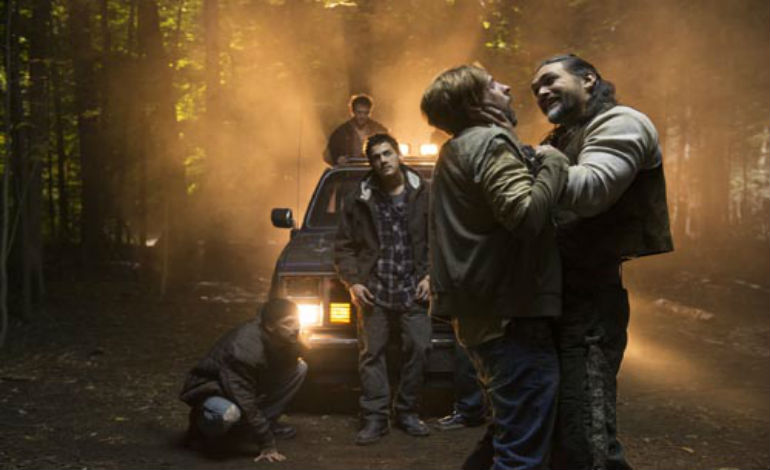
Frankly, I was surprised that Cayden didn’t get into a physical fight right away in that setting and leave battered and bleeding at the onset. And I haven’t gotten to the character of Connor yet. Connor, for all intents and purposes, pretty much rules Lupine Ridge as something of an Alpha Male. Jason Momoa certainly, in terms of physicality, fits into that role but even he is subversive.
For instance, you might expect Connor to be a thug or a beast that pummels and rips apart anyone in his way off the bat. But you would be wrong. Instead, Connor watches. He watches. He waits and he extends all of his senses out and tries to reason things through his mind even as he subtly intimidates. And for an obvious antagonist who could easily fit the thug mold, Connor has, if you will pardon the pun, a rather biting wit and a sense of honour and personal rules not unlike someone of the Lawful Evil variety. You can see a little bit of Khal Drogo in Momoa’s mien in addition to some StarGate Atlantis Ronen with his sarcasm. He does terrible things but, as you watch the film, you will begin to figure out why. Momoa’s performance as Connor is impressive and entertaining.
Just don’t make him angry. You won’t like him when he’s angry.
I also like the addition of Stephen McHattie as the farmer John Tollerman. I admit when I first saw him in the bar I didn’t know whether he was a friend or foe. He was once Gabriel: an antagonist in the Beauty and Beast television series. So in a way it’s fitting that he would be dealing with a beast of a different kind in this story and he really grows on you. And you know, you definitely know when you see the enigmatic one-eyed, metal-braced Wild Joe that there is going to be some craziness and there is something strange about that man.
Some dogs don’t like to follow orders. Sometimes they just like to do what they want.
I think I would have liked to see more character development with the female character and interest Angelina and some of the other characters. Certainly, at first she does seem very resigned to being “mated with” by Connor as only other “Pureborn” werewolf in town, though — granted — she is only doing so to make sure he doesn’t kill her loved ones, and somehow ends up liking Cayden for some reason: as what seems to be a stereotypical love interest. And while she starts off as far more advanced than Cayden is in knowing who she is, she ends up falling a bit into the powerful female assisting the protagonist trope. Still, I do appreciate the fact that Angelina sets a lot of facts straight for Cayden. She has roamed these woods, metaphorically or otherwise, before and her insights make you begin to doubt some of Cayden’s own perceptions of things: particularly about himself.
I suppose sometimes someone just knows you.
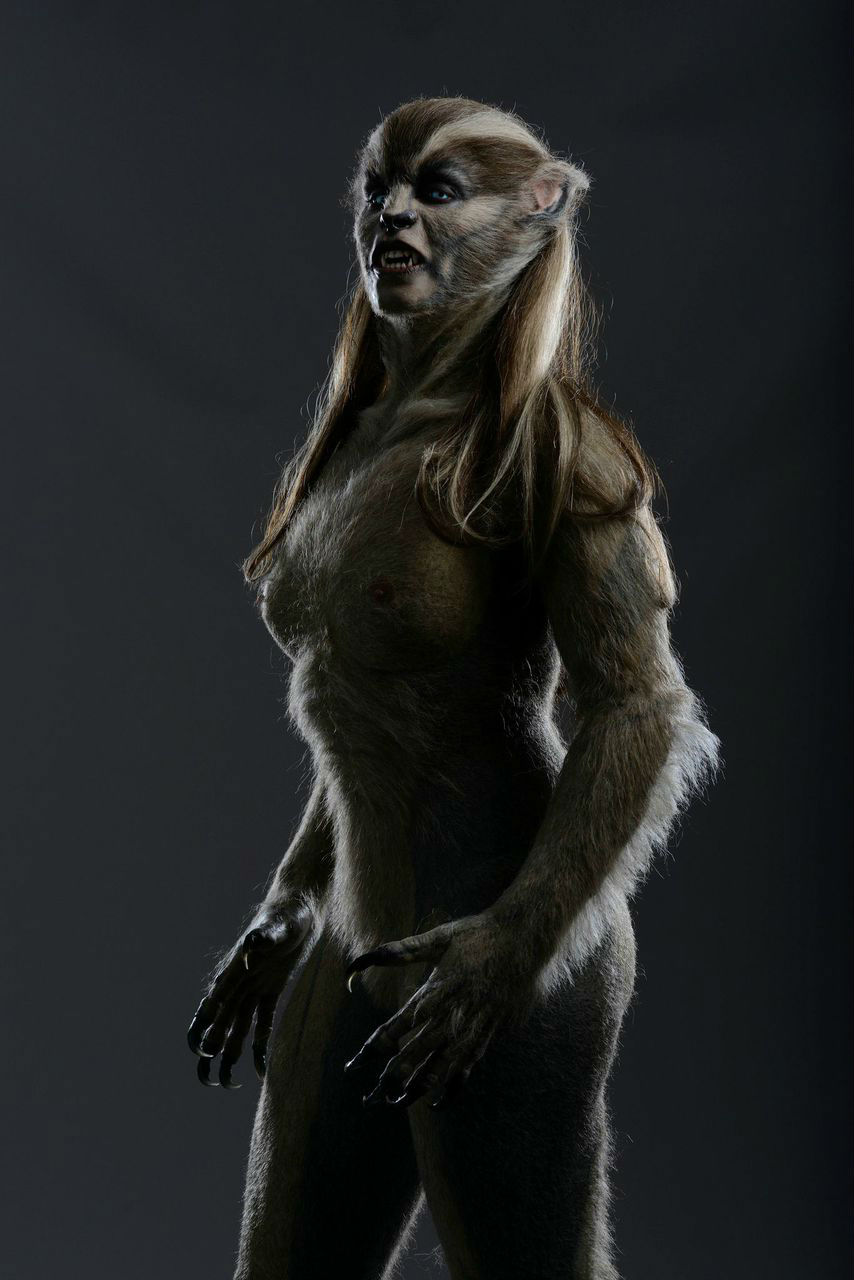
But I think what really strikes me about this film is how Hayter handles werewolves. He starts us off making us think they are monsters because of their bestial nature. We find out about the differences between Mutts (who are humans affected by the lycanthropic bites of werewolves and are always weaker than real werewolves) and Pureborns (who are born werewolves). You can also observe that even in their human forms there are tells: such as the occasional luminescent glint in their eyes, demonstrations of acute senses as well as extraordinary reflexes and strength. In addition you begin to realize that there is a difference between werewolves that stay as wolves and those that have stayed in their human forms for quite some time.
In addition, Dave and Lou Elsey are masters of makeup. They manage to combine the grace and elegance of a wolf and the symmetry and proportions of the human form.
In other words, Dave and Lou Elsey make these film werewolves distinct and beautiful.
And David Hayter plays with film expectations of the werewolf trope. I like how werewolves apparently come from “back east”: seemingly a reference to their origins in Eastern European folklore for this film’s purposes. Yet I think my truly favourite scene was when John, his wife, and Cayden are watching television and The Lone Ranger is playing. If you didn’t think Hayter was winking at you before, he definitely does so at that point.
And just wait until you see what comes from that.
This is actually a good point to get into one other aspect of Hayter’s werewolves: mainly their nature. One expectation of the werewolf is that it is their wolf nature that ultimately makes them into monsters. Time and again we horror film watchers see this primal instinct destroy humanity and cause nothing but suffering in its wake.
But what if it isn’t the animal — the wolf — that is the monster?
If you look at ancient werewolf folklore, werewolves were often depicted as humans — sometimes witches and sorcerers — that took on wolf skins and committed horrible acts of cannibalism and murder. Human minds, twisted by their greed, lust, and madness do horrific things. Wolves are generally more straightforward and attack humans when they are attacked, sick, or starving. Humans kill for power and revenge.
He will make you wish that he just ripped you apart.
Think about that when you see the end of the film. Think about what you actually see in the film. And then remember something else. Remember that Wolves, like its lycanthropes, has more than one skin and it doesn’t always show you its entire story … until something goads it into raw and bloody revelation.





 Mythic Bios