Tired of Tragedy: The Reclamation of Star Wars?

So I’ve been commenting on some Star Wars news and rumours lately. And it has gotten me to thinking–thinking long and hard–about some issues: specifically about the nature of the Saga as an epic structure, the Expanded Universe, and what I want in the former.

The reason I’ve started writing about Star Wars again–and anyone who knows me is aware that it doesn’t take much to get me to go on about it–is that I became aware of a particular rumour circling around about the existence of Star Wars: Reclamation: essentially what seems to be an animated tie-in into the Episode VII is that is scheduled to happen in 2015. Now, I’m not going to argue whether or not this is legitimate or if it is a hoax, or one of many projects that Disney effectively cancelled by closing down LucasArts not so long ago, but the prospect of it is very fascinating.

Think about it. We have no idea what the next Star Wars film is going to even be like. There are, again, some rumours but nothing definite.

Which brings me to my first point.

Star Wars is a space opera. There is music, there are opening scenes, clearly delineated heroes and villains and all those who fall in-between, epic battles, moments of levity, romance, and tragedy. In fact, most classical operas can–arguably–be divided into the genres of romance and tragedy if you really think about it. Romance in itself is not merely about love, but also the sublime and grandiose in nature. It is a great epic adventure that encompasses many elements: especially the mystery of existence. Tragedy can also arguably have these traits, but there is usually a very clear circular arc in the Classical sense: the hero begins from nothing, becomes great, and through some fatal flaw–hamartia as the Greek word goes–the hero gives into hubris and falls: and falls hard. This is also known as a reversal of fortune.

File:Recoveringvader.png

I would therefore argue that the Star Wars Prequels–in terms of thematic structure–are a great big space tragedy: take from that statement what you will. However I know that when I am watching or reading something and I know that many of the characters I see will eventually die, it is kind of hard to really get attached to them or any of the events that are going on. I mean, that has always been my issue with the Prequels and The Clone Wars cartoons: I just see that every struggle is essentially engineered by Palpatine and it just … cheapened it for me. But if you view these adventures as the ancient Greeks might have known tragedy–because every legend and myth that was adapted into tragedy was already known to the audience and were therefore judged by the skill of the playwright–then I can see the allure.

But I guess it doesn’t help that I: (1) Read the EU books and (2) believe that the plot and some of the characters in the Prequels and Clone Wars were not given as much depth as they deserved: though granted I did not see many of the latter cartoons. Now I want to talk about some other influences on Star Wars with regards to “space” and “opera”: and how this influences what I want to see in the Saga.

When I talk about space operas there is also the science-fiction adventure genre to consider. You know: that Sunday matinee serialization of different episodes that people in the 1950s or so would watch. I always like to bring up the fact that Flash Gordon and Buck Rogers influenced George Lucas a lot in creating Star Wars. You can read the posts, I won’t repeat them. But these particular science fiction adventure stories also leave their mark on Star Wars in another way: one that channels an even older idea.

This idea is that of redemption. It is redemption that really stands out in the Star Wars Saga. If the Prequels were a tragic and angst-filled arc, then the Old Trilogy was arguably an adventurous and redemptive arc.

I can argue that while hubris is more of a human trait, redemption is as mysterious as the Force itself. There is so much of the romantic, the sublime, and the grand adventure in the Old Trilogy–of things we didn’t know–and it just opens a path to seemingly limitless vistas: much akin to that sense of wonder that existed in the science-adventures of George Lucas’ youth and so much more. After all: who could see the villain becoming, for one brief moment, the hero: someone to be both pitied and respected? Yes, it was a twist moment and some people probably predicted something like it, but it was magical: just as what happened afterwards.

Now let me get back to the other matter: the Expanded Universe after the Old Trilogy. I’m not going to lie. I know that many of the stories in the EU–with some exceptions–are pretty inconsistent in themselves and aren’t always on par with what I liked about the Old Trilogy. That much I can personally can let go.

But I’m also going to make another admission. After the publication of Timothy Zahn’s Thrawn Duology, I stopped really reading the Star Wars EU. I think the biggest mistake was the fact that instead of continuing with what that galaxy contained–instead of bringing back the Sith or a Dark Side threat after the peace treaty with the Imperial Remnant, the authors introduced the Yuuzhan Vong: some extra-galactic sadomasochistic warriors using bio-technology and hating machines. As far as I am concerned, that was the beginning of the end of the EU for me and it only got worse when they tried to introduce the Dark Side in some of the most plot-contrived ways I’d ever seen it.

In the end, they killed at least two of the most interesting characters in the Expanded Universe–Jacen Solo and Mara Jade–with the former killing the latter and becoming a half-assed Sith Lord–and the series and what came after it became progressively darker. It is like the criticism that some people have for comics nowadays: that writers are just copying the grit and darkness of larger story arcs before them. But instead of it being comics makers of DC and such imitating Alan Moore and Frank Miller without their nuances, it is writers working with LucasBooks who imitated the darkness of the Prequels: pieces that at least had structural nuances. The mysteries just became contrived and it became all about the angst: all about the tragedy and an attempt to make something epic out of nothing.

It seriously made me just want to quote Lando and say, “This deal is getting worse all the time.” To be fair, I know that the Sith were supposed to be incorporated into the EU earlier, but apparently LucasFilms had issue with that: probably because of the development of the Prequels at the time. Also, George Lucas generally did his own thing, didn’t pay much attention to the EU, and many of these writers always had to “tow the line” as it were with regards to what innovation they could bring to the stories set in Lucas’ universe.

Really, here is what I want to say as succinctly as possible. If there is something like Star Wars: Reclamation–and that title is fitting on so many different levels–then so be it. I wouldn’t mind seeing most of the Expanded Universe rebooted: or at least given an alternative series of stories as they are doing with The Star Wars comic based on the rough draft of the original film script.

Really, the only elements I would miss about the EU as it is now would be the Legacy comics, Mara Jade, the Solo children, Republic Commando, X-Wing, Wraith Squadron and Grand Admiral Thrawn and friends. The rest of it was pretty mediocre in retrospect. I also really don’t like how Luke settled to be another Old Guard when he had so much potential to become something more.

In some ways, the fact that Disney stopped production of Clone Wars and many of the video games–which I feel are rehashings of old ideas and cycles–may be one of its best decisions yet. Even Star Wars 1313, for all of its excellent graphics and the idea that you are not playing as a Force-user, looked like it was just going to be a shooter game set in the Star Wars Universe: and there are so many shooter games out there already.

It all kind of reminds me of how, when something doesn’t work for me anymore, I just destroy it and start from scratch. I am that scarily absolutist when I am driven to that point. My only regret is, aside from potentially losing some characters I did grow attached to, that this is the closest we will ever get to seeing a Star Wars reboot: the best being a silence about the Prequels or anything to do with them after this.

But I am also skeptical about what might be going on. Even if you look at that Reclamation script excerpt you will notice that certain species from the Expanded Universe still exist. This is also assuming the script is legitimate and will survive the light of day. I am however really leery of the fact that Disney closed LucasArts down and and laid off many of their employees: whatever Kotaku and other sources might be saying about its productivity level. It could be that they are, as they say, focusing all of their talent on the future of Star Wars–which theoretically sounds ideal–but I have to wonder about that.

In fact, the very title of this article is a misnomer on my part. I mean, how can any outside party “reclaim” something that wasn’t originally even theirs?

I know it seems like I am saying a lot of things at the same time. And I am. But here is what it comes down to me for me: I am willing to see a lot of the EU disappear–or be placed into an “Old Expanded Universe”–so that something can be created that will need to something potentially new and good. Ideally, I would like to see the Prequels and Clone Wars disappear or change too: leaving only Legacy, The Old Republic, and Tales of the Jedi and other such more “ancient” stories in the Star Wars EU intact. But that is too idealistic for my own good.

I also realize I have gotten a lot more cynical in my old-age of thirty-one. Once, I would never have even considered wanting the EU to be gone or changed. I was just as much into continuity as anyone. To an extent I still am. Tragedy and angst have their place, but I want to see so much more now. I am not completely all Crisis on Infinite Earths DC where I want to see it all burn–much–but just like the viewers of the old days and their adventure serials I do want to anticipate what will happen next as opposed to the minutiae of what is already going to happen. I want to see alternate avenues, new mysteries, and characters that could go anywhere and whose futures are not seen as written yet: new adventures with depth, romance, and wonder.

That is ultimately what “Long, long ago in a Galaxy far, far away” means to me.

I want wonder, and something to look forward to.

File:Spirits copy1.jpg

ETA: Disney has very recently announced that they plan to release a Star Wars film every summer after the release of Episode VII. Now, the idea is that each film will be a spin-off movie aside from the main Episodes. These are more in line in some ways with the old science-adventure serials of the 50s: in that there are more of them. Now whether they will incorporate some of the EU into their creation, or make a whole other alternate story with them from the books and literature that exist is another matter entirely. And really interesting for it. Limitless horizons indeed.

ETA: According to a LucasFilm spokesperson, Star Wars: Reclamation is not real. This does not surprise me, but at least it made for a good title to my post.

Becoming a Gateway: Or What Anna Anthropy Twines Together

I will say here, off the bat, that there are some video game and article links below that can be construed as Not Safe For Work. Player’s discretion is advised, though enthusiasm is also encouraged. I am also hoping that I can communicate and do justice to these ideas and some of my own creative license as best I can.

I’m not sure how I first met Anna Anthropy. Actually, that is not entirely true. I do remember first being introduced to her when I discovered Rise of the Video Game Zinesters: though how I came across that book to begin with is a memory now lost to time.

I did plan to buy that book eventually, but then life got in the way. One day, after a series of insane events, I found myself brought to the 2012 CanZine Toronto Event by some friends who thought I needed to see it: and I did. What I didn’t know, or what didn’t really bridge the cognitive dissonance in my head was that Anna Anthropy was there with her partner Daphny David and that they were selling the very book that I had been so interested in.

I’m going to admit that I felt sad, but I was still getting used to that endless process of being social again that I tend to find myself in and by the time I realized that they had been there, it was too late. So I bought the book for myself later instead.

There are many very good reviews that detail what the contents of the book were about: how it worked, how it possibly didn’t, and all of those various details. But there were a few things that stuck out at me. The main message that I got from Rise of the Video Game Zinesters was that Anna Anthropy wants there to be more accessible technology and means for anyone to create a video game. My younger self, the boy that really wanted to make games, would have totally agreed with this concept: even if he didn’t have the knowledge at the time to understand many of the other details surrounding it.

Essentially, Anna Anthropy wants there to be a means for a game-making technology or software–a manifestation of communication and language–that is easily accessible for anyone to use for the purpose of, well, making games and creating ideas. Or taking names and kicking ass: whichever definition you prefer. Of course, there is more than that. The idea is that by having different people of different backgrounds, social classes, career-paths, sexual and gender orientations, queerness, life practices, and a wide gamut of humanity that does not necessarily understand coding you can vary up the content and the gaming experience of a game without an industry-ruled homogeneity: where plots and stereotypes are recycled to keep a sure profit.

It is a very seductive idea. Anthropy compares this “much needed” product and the mindset behind it to the creation of the printing press in Renaissance Europe: thus freeing the production of literary articles from the Catholic Church’s scribes and making them accessible to everyone. The fact that the printing press allowed for religious texts to be made with vernacular language–the words of the everyday layperson–instead of a Latin known only to nobles, priests, and scholars is probably an analogy not lost on Anthropy when she brought up the image to begin with when you consider that she looks at games as a language that all men, women, humans, and other sentient beings should be able to relate and have access to.

She also briefly looks at the history of game-making itself and equates video game development with the earliest forms of games: with symbolic piece and board games, carnival games, arcades, all the way to modern board games and more miniaturized computer games. In addition, Anthropy makes a very compelling case as to how video games were and are in the providence of an elite minority: that it was male computer programmer students and the academy that developed code and the games that came from it. Yet it is also clear that there are changes that are–and have been–in the works to that regard.

I’ll tell right off, as some other reviewers of Anna Anthropy’s work have mentioned, I don’t always agree with what she says but she makes some very intriguing observations. There is one point in particular that sticks out at me. Anthropy writes that a single game creator in sole control of their project can make a much more focused and more personal form of art–a game–than a large team of staff members can. I don’t know if I am articulating that thought as thoroughly as I should, but that is what I got from that. What I find really interesting is that Will Eisner, in his book Comics and Sequential Art, also makes a very similar statement with regards to the development of the comics medium and storytelling within it. These are two different mediums, both of which had to fight to gain recognition as a legitimate medium, yet it is really fascinating how two of their advocates come to similar conclusions.

Eisner did mention, however, that there was nothing wrong with a collaboration between two or more artists on a work. Indeed, in his book Graphic Storytelling he goes into a lot more detail with regards to that. And even Anna Anthropy, in her book, mentions that she is writing the book not merely for game creators but for anyone: writer or scholar that is fascinated with her topic. It should also be noted that Anna Anthropy has collaborated with a few other artists in her own works: such as the fun and frustrating Lesbian Spider-Queens From Mars, the very personal and visceral Dys4ia, and the thought provoking puzzle game Triad. While much of this collaboration has been in the form of graphics and sound, even programming for the latter game, it is still a form of collaboration: though obviously not an industry-mandated one. Rather, these are the product of an agreement between artists that respect one another and actually work together to make something cohesive while still keeping the personal element of Anthropy’s own vision.

Now, to get beyond the book and go a bit into Anna Anthropy’s games. I like them. I like the concept behind them: of taking a video game form and using it to communicate a personal experience. There is something really beautiful about that. I know that Anthropy may not be the only person who does this–and I suspect she hopes she isn’t in the only one either–but she is the one that really introduced this to me on more than a cursory level. I think she is one of those who reinforced for me that the games of my youth–that inspired me as a creator–are more than just frivolity or an inferior art-form. Some have said the same thing about comics, about film, and–back in the day–even theatre and other forms of painting and art.

Some people have been giving Anthropy flak about her games: about how they all tend to follow a very similar pattern or themes of lesbianism, BDSM, and transgender issues. The thing is, well there are two things. The first is that all of the above things are not mainstream in video games: at least not from someone who has all of those elements in their own life. The second is the age-old adage: write about what you know. And Anna Anthropy knows about all of this. She writes about and makes what she knows. Her viewpoint is just as valid as anyone else’s and it is more than okay for her to make games about what interests her: because there are others out there who will relate to it.

The fact that she uses similar themes in her work, and I would say never quite in the same way with regards to game play mechanics, is irrelevant to me: because the industry does the same thing for the most part with many mainstream themes and even the best creators make what they know.

I think what I admire about Anna Anthropy and others like her is that although I can’t always agree with them, they do something that is remarkable. Sometimes the people in charge of publishing or video game industries and coding are called “the gatekeepers.” And what Anthropy and others are doing is they are becoming gateways: gateways and fiery Bodhisattvas into alternate perspectives and the potential for the creation and expression of new game experiences.

This is something that I deeply respect and it is a thing that greatly motivates me now. There is one thing I have mentioned before in this Blog: that I am looking into Twine game-making because of Anthropy’s mention and use of it. Twine is a software that lets you create a “choose your own adventure” style text game without a knowledge of coding, or with enough video tutorials to get into it. I want to do the same thing that she and others are doing now. I want to make a game that can communicate my own–albeit different-experiences: ones I’m not sure even Anthropy will always agree with. I want to have the ability to put someone else into my own shoes: as it were. Or use my experience to make something else entirely and let people make their own choices.

So Anna Anthropy won with regards to me: because she has influenced me to make a game. But I think what is also remarkable is how she even affects her reviewers and critics. Take Jenn Frank’s Rise of the Existential Crisis: How One Woman Nearly Never Finished a Book Review, or Cara Ellison’s Choose Your Own Anna Anthropy Interview.

Frank’s article adopts Anna Anthropy’s writing style from Rise of the Video Game Zinesters: emulating Anthropy’s own combination of history and criticism and inter-dispersing it with her own personal experiences in a seemingly scattered narrative but ultimately bridging the gap between the reviewer and the creator of personal expression while Cara Ellison actually makes a Choose Your Own Adventure Game using Twine–Twine–in order to bring her interaction with Anthropy across. Just looking at the styles and mediums used by these two women is utterly fascinating: Frank does not necessarily agree with Anthropy’s statement that everyone should make a game–though she wishes on some level that she had–while Ellison flat out makes a game to express her interaction and her influence from Anthropy’s philosophy in a very demonstrative manner.

I will also say right now that this article was a long time coming. I just didn’t have the words then. But if Ellison’s Twine article further influenced me to make my own game (and I didn’t even realize she was using Twine to do it at the time, another example of my cognitive dissonance), Frank’s article actually encouraged me to write this. And I have been influenced by Anthropy in other ways as well: you will probably see relatively soon outside of this article.

But if I had to sum up everything I have written here, I will say this: that in terms of video-game storytelling, its potential as a medium, and her own potential influence on its future, Anna Anthropy is immensely important.

P.S. My favourite Anna Anthropy Twine game is this one: Hunt for the Gay Planet. There is a story behind its creation that she can explain far better than I, but what really inspires me is the story of a person who tries to find other people like her and goes on a long well-written intergalactic journey. This piece inspired me so much that I bought the Choose Your Own Adventure book from Anthropy’s own site: which is coincidentally on my Blogroll as well.

Participant in One Marathon, A Spectator at Another

Originally this weekend I was going to participate in the 12-Hour Comic Book Marathon at the Comics Lounge and Gallery. I didn’t end up writing anything or collaborating with any artists there. If my experience at the Global Game Jam taught me anything it was that most people there probably already knew each other and either way they would have come in some pre-made teams: those that needed them anyway.

As I’ve said before, I am not much of a graphic artist.

Really, I didn’t want to potentially take up someone’s space on the possibility that I couldn’t find a partner and–to be perfectly honest–I didn’t want to be the odd one out: feeling painfully self-conscious.

Later on, I found out that there were still a few writers and artists who cancelled or were actually still looking for a partner, but by then it was too late. However, it was just as well that I decided not to do it because my brain is full with all the work I’ve been doing and I had never actually been to the Lounge before. I would most likely have gotten lost trying to find it.

Essentially: I wanted to get there, get a feel for the space, meet some of the people there, talk a bit with them, maybe make some connections so that I could participate in a later event, or–really–just get to know people who have similar interests to my own.

I still felt bad, though, that I hadn’t participated as I intended and looked forward to doing. Keiran Templeton–who I saw in her tiara as she held court over an assortment of writers and artists–not only organized the entire event, she also had time to go face book and ask if there were any people that wanted to work with others, and she even told me by email that she would keep my name on a list to let me know about next time.

As it was, I made it up to myself by punching some of my procrastination out and starting to really script out my own collaboration with Angela O’Hara: you know, the comic I keep saying that I am working on. In my defence, I have been working on it on and off with little tidbits of notes here and there: much like every other long-standing story I’ve been dealing with. In fact, for The Project I actually made a rough outline of everything that I want to happen in our first issue.

The key of course was actually beginning to flesh it out. I’m beginning to realize that in industry terms, I work entirely too slow on comics scripts. Even from my limited understanding I can see that they take time and a lot of concentration. But the day before the Marathon, I decided to get into the spirit of it and expand on the very first part: to actually take one segment and go wild with some descriptions and leave room to artistic interpretation in others.

And that Friday before the Marathon, I sent something to Angela via inline text and–if it’s not perfect–it is at least something to start from and a good subject for us to discuss. I look forward to talking with her about it when we find the time and see what she will make of it.

So I had this little bit of positive energy to tide me over as I finally did leave to find the Comics Gallery and Lounge I’d been hearing about for so long. The journey was ironic for me. It seems like so long ago that I used to live on the Bloor-Danforth line: specifically close to Woodbine Station. Even before that, when I was at York, I always found that energy to take various transit to get to find my away to College and Clinton: where the Lounge actually is. It’s only now that I’m in Thornhill–in York Region–again that I decided to go somewhere cool that I’d been putting off for so long.

When I found myself outside the shop, I paced around a bit: suddenly really feeling the nervousness. It was strange: being back downtown on the streets again after basically huddling away in Thornhill. And here I was outside a place with people who obviously loved comics and other Geekery and I was hesitating. It would be helpful to mention that I’ve developed some very crippling social anxiety over the years. It probably has roots to older sources, but after so long dealing with Grad School and being by myself a lot I kind of really retreated into myself. It also doesn’t help that I was shy to begin with and … it’s hard for me to put myself out there.

I also was thinking to myself: what if I go in there and no one likes me? I know: it’s a pretty irrational series of thoughts and I have gotten better at dealing with them. I knew that if I needed to, I could leave at any time I wanted and–it being a Lounge–I brought some work to do as well. My plan was to stay there for the party that was going to happen after 11 pm–when the Marathon was officially over–talk with some people and then leave.

So I walked up the stairs and everyone was friendly. I had to get used to, well, being in a new place and around people I didn’t know but I browsed around the shop and entertained myself looking at comics. There was a very comfortable black couch–most of the inner room was set up with benches so people could work–and I sat down to write. I actually started to feel a lot more comfortable writing and having something to do.

It was strange at first. I’d seen a lot of the people around me on Facebook or the Internet when I was finding out more about the Lounge, but actually being around them in person was just different and cool. It turns out some people were late for the Marathon anyway and, really, they just seemed to have a whole lot of fun doing what they did, browsing comics, and just socializing. I didn’t talk with as many people as I wanted to, but my cousin Shane Kirshenblatt–who made such awesome comics as Dorothy Gale: Journey to Oz–and his wife Sari came in and we talked for a while about comfortable things like comics and writing and creation and all that fun stuff.

Coincidentally, I wrote my first Conference paper partially on Shane’s Oz comic and he inspired me through a conversation to write my first ever science-fiction story in ages: one that didn’t win the Friends of the Merrill Short Story Contest granted, but I am still proud of it to this day. He actually talked with me about looking at a script of his to see what I could do with it: something that really intrigues me.

I even briefly talked with Keiran as she was managing her Empire of comics creators and there was a dog or two, and some cheering, and various geeky discussions. I ended up having a really good conversation that night with Debra Jane Shelly. I had seen her before, like many of the other denizens of the Lounge, on their Blog and Facebook. She really stuck out at me the first I saw her and I knew before I ever talked with her that she was a hard-core comics geek. But it is one thing to know that intellectually, but experience it first-hand in a conversation was entirely different and enjoyable. I barely got a word in edge-wise, but I enjoyed listening to what she had to say and I learned a few things.

For instance: I never thought about the first-impression that people got of Watchmen when it came out in the 1980s. As Debra pondered this, I remember thinking that it was true: it was during this time period that meta-narrative and pastiching were being implemented into comics narrative along with a certain more blatant kind of adult irony.

When you think about the comics that came before, during the heyday of the Comics Code–of comics industry self-censorship–and then you look at something like Watchmen you can definitely imagine a kind of “culture shock” for some readers. But, as Debra put it, we will never really know that feeling ourselves: you know, aside from reading about it through secondary sources. It’s like those accounts you hear about from famous writers and comics creators about growing up with the old Pre-Code Horror Comics: with EC Comics’ Tales from the Crypt, Creepshow, and all of that really fun and twisted stuff. But even though we can read a lot of those twistedly ironic and morbid goodies now, the spirit of Zeitgeist of the times where they were written are not really as accessible to us or perceived the same as someone who was there.

I think it was good to talk with someone who knew as much–if not more–about comics: someone who had read some really good and memorable works. It was sort of humbling, to be honest: to know that wasn’t the only one as insane about this stuff as I sometimes delude myself into thinking. There was a whole room of them. :). I did talk with some more people and then I took my leave as it was about that time. Debra actually made me pose for a picture where I am holding Alan Moore’s Nemo: Heart of Ice: a book I actually got there. As for the reason that she took it, if one is needed, she told me that she likes to take pictures of people having found their favourite books: or something to that effect.

It occurred to me–or I remembered–as I smiled at the camera that I rarely ever smile when I’m in public: especially in Toronto. Sometimes the exhaustion, and anger, and sadness ingrains itself in you so bone-deep that it’s difficult to even smile for real. I thought about just how sad that fact really was.

In any case, I said some goodbyes and then I left to find the streetcar back to Bathurst Station. I missed the car, so I decided: “Screw it! I’m going to walk the fucker!” So I walked by myself all the way from Clinton and College to Bathurst Station. I hadn’t walked that long or been in this area in ages. And as I did so, with my travel bag on my shoulder and my black winter coat covering me I felt more alive than I have in a really long time.

Coincidentally, it took me 16 minutes and there was no other streetcar during that entire time.

I know when I wake up tomorrow, or later, I’m going to be very embarrassed by some of the sentimentality and haphazard writing I’ve left here. It’s no new thing, to be fair. Actually, I’m surprised I wrote so much about–well–doing so little: by my standards anyway. However, I really felt the need to write this out while it is still fresh.

I am definitely going to check out the Lounge again. Here is the Toronto Comics Lounge and Gallery Blog in case you are interested and you didn’t see it on my Blogroll section. Thank you for reading this and, next time, I do plan to make something.

Excelsior, ladies and gentlemen.

Imagination Is Thicker Than Blood

In a post that Vampire Maman wrote, You Transfix Me Quite, she talks about how the character of Jane Eyre would have made an excellent vampire. Vampire Maman has a lot of very interesting and entertaining creative writing, but it reminded me of something I bring up from time to time out of a sense of sheer silliness.

I never played the Old World of Darkness Vampire: The Masquerade role-playing game, but I heard people talk about it and I researched as much about it as I could online. And I always wondered what kind of vampire I would be in that world.

There are many different Clans and, more specifically, Bloodlines in Vampire: The Masquerade. As a result, each vampire belonging to a particular line had different attributes than his or her fellow. Originally I toyed with being part of Clan Tremere because of their knowledge of blood magic and the fact that they seized their vampirism: they weren’t–at least knowingly–turned by another vampire, but rather they were mages that took blood from a captured vampire to make themselves powerful and immortal … though they didn’t count on the fact that they would still possess the inherent weaknesses of the Kindred.

But I abandoned that idea because they are too stratified in social structure and limited in numbers. So I thought I might have been a Ventrue. And indeed, some people believe that I am a very calm, detached, and dispassionate being whenever they meet me offline. I can be calculating and organizational like this Clan tends to be portrayed but this is not my major strong point and not even a fraction of the personality I really have. Still, I can appreciate the Blood Discipline of Dominate: you know, that stereotypical ability to hypnotize or mesmerize another being.

My girlfriend once said that I would make an excellent member of the Toreadors. A Toreador is either a very beautiful vampire that creates a series of social networks and supports various kinds of art, or they are artists themselves that spend their immortality oftentimes secluded and making new things, or they are both. Generally, they are closest to humanity as they like to watch and support their artistic endeavours and fads. Aside from the compliment of being compared to something beautiful and creative, I also share their obsession with a particular object: such as art. Yet they can also be very vain and fickle, and while I have some of those traits, they are not paramount in who I am.

Which brings me to the final Clan I was told about. One day, my girlfriend changed her mind about something. She thought that I could also be a Brujah. Now, I had heard about this Clan. In the Modern Nights era of that world, they were generally characterized as passionate, frenzied vampires that were usually punks, brawlers, and anarchists. However, in ancient times they were known as disciplined warriors and philosophers that embraced a particular ideal: honing body, mind, soul, and altered power to fight for what they believed in. They were not merely turned from fighters, but also lawmakers, orators, and thinkers. I can also see them having turned some artists along the way as well: much like the Toreador.

I would not be a typical Brujah of the modern period, I would imagine and I would probably seem more like a Toreador on the surface with some Ventrue discipline and calculation. At the same time, I would definitely be a fighter and a defiant force: through the imagery of my words.

But all these distinctions aside, would I make a good vampire? The answer is that I probably would in a very reluctant sort of way. I already have difficulty with a mortal life, and immortality would just be inconceivable with my range of emotions. On the other hand, a lot of physical burdens would no longer be an issue and perhaps–just like in this real world–I would have phases of activity and dormancy. Maybe with time I would surpass many mental challenges and blocks as well. It is hard to say what it would like in a hypothetical and fictional situation but, like I said, it is definitely fun to think about.

I Am Made of Words

About five or six years ago in Niagara Falls, I received a Tarot reading from a lover of mine: the first person I ever went to visit on my own. There aren’t many details I remember from the time except for one thing: the majority of the cards that she drew from her deck–a deck that she ultimately gave to me–had a Sword aspect.

File:Swords01.jpg

We were sitting on my bed and here I was staring at a hand of Swords in front of me. I know we had theories as to what it might mean in the purely open-ended mode of interpretation that you have to use when examining any kind of symbol. And while we agreed on a few things, in the end it was left to me to link things together and make patterns that were–or were not–there.

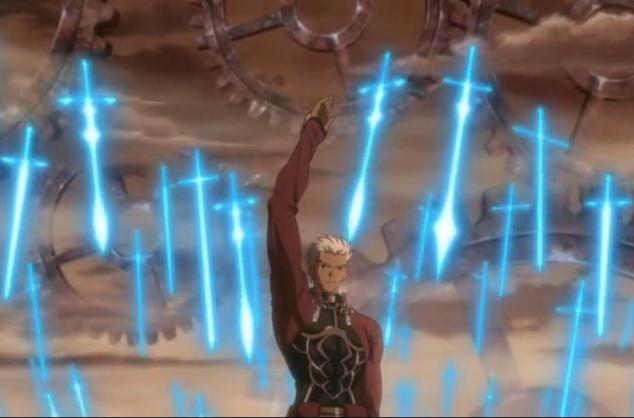
During or after the time we met, I began watching this anime at the York Anime and Manga Association (or YAMA) called Fate/Stay Night. In this anime was a character named Archer: a heroic spirit who could project and create bladed weapons. He gained these from a Reality Marble: a small pocket-universe that developed inside of him due to his dedication and sheer strength of will. When he fully summoned this place, a sphere of flame, turning cogs, and blades consumed the area that he and his opponent were fighting in. In other words, Archer took his inner world and imposed it on the external for a brief period of time.

In this world I describe, he has access to every mortal bladed weapon–every sword–that he has examined and ever replicated with his magic. He stores them all in there and either uses them one at a time–knowing what its history is, the thoughts of its owners, and even their secret abilities–or he can summon and throw them at his opponent all at once. I really admired this anime character and when I did further research on him … I realized that I related to him a lot more than I thought.

I still think that Archer could have done a lot more than simply imitate weapons and memorize their patterns. I think that, even modifying some of them into arrows, he could have used his knowledge of them to create new weapons entirely: new tools and devices to accomplish his goals. He even admitted that his weapon was his own imagination and we all know that the imagination is limitless.

You see, I make weapons too. I make weapons and tools. And they are my words. I’ve spent years honing them: making prototypes, re-making others, imitating more, and learning from my mistakes. I seek to bury my demons in a torrent of words. I desire to make an Empire out of them: to expand my own little world into this one in the best way that I know how.

For a really long time, I have been a very passive individual on the surface. But after Niagara Falls I decided to stop ignoring my natural aggression, my dominant side, my ambition, and the fierce defiance that I realized I’ve always had inside of me. I think that sometimes the manner in which I honed and sharpened my words and that ferocity I view the world at times–as though to defend my own childhood awkwardness and lack of social skill years ago–has ingrained itself in me so much that I seem aloof to people and perhaps a little intimidating. Perhaps that is why I might seem so combative towards life at times.

I grew into my own. I began to see that I was physically attractive, intelligent, creative, and I build a whole world that I can sometimes share with other people. I was told by a friend that in some ways it made me dangerous, but in other ways she greatly admired what I was becoming: whatever that is. When I look back, “aggression” might be too strong word. Perhaps what I was really looking for, and what I still have to fight for– is “confidence.”

Not too long ago, Cristian Mihai wrote a post called Art and Life: where he talks the fact that while he may have done many things in his life he might have regretted, he never regretted any of his stories. It’s very close to those moments where I think the best thing I have ever done with this life of mine so far is write.

So I keep building my world, every day, one blade at a time: because underneath this inconstant fleshy matter of mine and to quote a fictional character, “I am made of swords.” And even though I know I’m not made of weapons, even though I’ve suffered defeat and pain, I’m going to keep fighting because–in the end–I know I am going to win.

File:Swords14.jpg

So when you take the “S” away from Swords, that is what I am made of.

It Was My Birthday and What the Hell …

I turned thirty-one this weekend.

I’d like to say that it came at me by surprise, but I did manage to see it coming. 🙂 It makes me realize that a lot of things have happened between thirty and thirty-one.

I’ve gone from just talking about sending stories out as magazine submissions to actually doing it. I’ve also went from just talking to actually creating a Writer’s Blog with over a hundred articles that has been Freshly Pressed and I’ve gotten peer Awards from some of my most devoted readers. I made a place to put ideas that I originally had no room for. I participated in my first Game Jam. I wrote two ad hoc mini-operas for a contest that Neil Gaiman was one of the judges for. I also got my Master’s Degree and decided not to go back to University.

I wrote some articles for some really excellent producers and writers and on subjects that deserved more information on them. I helped someone in a contest to achieve their dream and made a new friend in the process. I’ve reconnected with my old friend Angela and I will continue my part in working on our comics collaboration once I’ve done some more of my own work. And there is so much that I still have to do, you know? It’s ridiculous. I know I have made a lot of progress and growth this past year, but I feel like I have to keep at it because sometimes it just doesn’t feel like enough.

I’ll admit: this is not where I thought I would see myself at thirty-one. Sometimes I feel like I didn’t have enough time to experiment with my life and now I somehow have to be an adult and, you know, be more responsible in some way. I don’t have a paying career yet and I live with my parents again. A lot of other things changed during that time as well and I feel like I lost a lot of what I once cared about. I’ve been more anxious and more shut-in these days while also working on my projects, sitting on the Internet, and just enveloping myself into a steadier routine. I know I will be facing some more challenges–some of them uphill battles–and I miss the things, relationships, and people that I did lose along the way. It cost a lot to get to this point in my life: as I suspect it always does and it always will.

But these are the things that happened, the things I did during a year’s time, and what I am thinking about now. Sometimes I think that my options are more limited now that I am older. But let’s face it: I was a grumpy old man even before I had a thirty-one year old body and I am set in my ways about some things … more specifically things that I plan and I want to do. I know I want, and I am going to seek for more. So in conclusion, as if this were some kind of formal essay, all I can add is that I will continue doing what I have to do or, as a character of mine once said, I will do what I feel that I have to.

Thank you for reading me, liking me, and Following me. I hope to continue some good journeys and explorations together. Take care, my friends.

Looking Outward

Film Review: Oz The Great and Powerful

So I went off to see the Wizard this past weekend.

I was very eager to see it. I’ve loved The Wizard of Oz for most of my conscious life. I was introduced to it through the famous 1939 film that many know and love. Then I read as many of the books as I could to stay with my friends as much as possible. I also read and saw the Musical version of Wicked: the former of which I respected, and the latter of which I utterly loved.

Now, my two favourite Oz characters have always been the Scarecrow and The Wizard himself. I liked The Wizard because he, well, had a hot air balloon that took him into a magical land. I actually tried weaving a balloon (out of felt and other cloth, not completely aware of what materials a hot weather balloon actually required) but it never got far. Even then, in those days, I wanted to escape this world and go to a better one.

But later on, I liked The Wizard for other reasons. He lacked any magical abilities, but he was a master of sleight-of-hand, illusions and artifice. And for all of his manipulative and deceptive aspects, he just seemed like a kindly old man that actually helped Oz through making himself a symbol if nothing else. He was the one who taught me that the seeming of power can create the greatest form of hope to others. Also, I would like to posit that he was in addition to being a highly flexible thinker and canny stage magician that tricked others–including beings with actual magic–he also was a brilliant artificer: because I am pretty sure the Emerald City’s technological innovations were his doing from his knowledge of late nineteenth century Earth life.

Suffice to say, he was a crafty old man that created a brilliant show as The Wizard of Oz. The Wizard has been depicted in a few ways: as a charlatan, as a villain, and a hapless man trying to figure out what to do in a strange magical land. So I wanted to see what he would be like, as the main character and hero no less, in Oz The Great and Powerful.

Now, I would suggest that, if you do not like Spoilers, you stop following this yellow brick road any further.

All right. So when when we first come across Oscar Diggs, or The Great and Powerful Oz as his magician stage name goes, he is in this black and white world representing 1880s Kansas and looking not unlike the Impressionist world of The Cabinet of Dr. Caligari.

As for Oscar Diggs … what can I tell you? He is supposed to be a complicated man: a rogue and a con artist, a consummate huckster, illusionist and magician, a master of misdirection, a womanizer, but also someone who knows that he is a bad man and feels powerlessness when he can’t help a child and acceptance when a woman that he actually loves is going to marry a better man.

Unfortunately, for the most part the slimy elements outweigh the charm and … he really just comes off as rather, well, less than endearing. Think … less humbug and more … scumbag. Even his jokes, and indeed a lot of the jokes in the world movie situated around him fall a little flat when you right down to it: so much so that you have to force yourself to laugh at them.

Structurally, the film is clever and deals with a lot of misdirection and hood-winks. Aside from the change from black and white to colour–a homage to the 1939 version of Oz–there is also the fact that most of the Wizard’s companions are Oz versions of the people he knew and met in Kansas: much like Dorothy, the farmhands, the travelling conjurer and the mean old woman Elmira Gulch. And then there was the matter of the villain, as far as I’m concerned the person who was becoming the star of the antagonist role …

All right. I liked the scene with the China Girl, Oscar laughing at the people pursuing him as he escaped in a hot air balloon, the little bit of misdirection that Evanora used to try and get Oscar Diggs to do her dirty work for her, Evanora’s green Force lightning, Glinda’s cleverness with the wind and the field of poppies, the Wizard’s scheme in making himself appear to be much more than human towards the end through his old friend misdirection, and some of the more touching scenes like Oscar admitting to what he is. I also really like the parts where he realizes that he has a great advantage over the Witches in terms of technological knowledge and trickery. Oscar asks Glinda, who helps him gather a group of farmers, bakers, inventors, and munchkins together how he is going to defeat the Emerald City’s armies with what he has. But the good Wizard, given the time period where he came from, should have remembered that the most powerful empire in the world at the time was at one point “a nation of shopkeepers”: carrying or having access to most of the resources to not only win a war, but rule a kingdom.

But there were points that really annoyed me. I mean, really annoyed me. For instance, when Oscar finds himself in Oz and hears Theodora talking about how she is a Witch, and then later seeing that she can throw a fireball, my first thought would have been acted out something like this.

Diggs: So … you are a Witch.

Theodora: Yes.

Diggs: And you can use magic?

Theodora: Yes, well, I can.

Diggs: Well okay. I showed you mine. Now show me yours.

Theodora: Um …

Diggs: Show me some magic.

Theodora: Oh ok.

Theodora throws a fireball at something. The Wizard’s jaw drops.

Diggs: That was … incredible …

Theodora: Oh, really?

She blushes.

Diggs: No I mean, you can throw fireballs. Effing fireballs. I mean, pardon my cussing and all, but … just … wait a minute. Just wait one moment. You mean to tell me that you could have thrown fireballs–fireballs–at the winged monkeys attacking us at any time–any freaking time–and you waited for me to sacrifice my poor bird instead?

Theodora: And it was brilliant magic. As expected from the Wizard of prophecy.

Diggs: Yes but … oh dear god, I faced a lion down with a parlour trick and you could have just thrown a fireball at …

The Wizard of Oz spends most of the time walking back trying not to bite through his own tongue at Theodora’s stupidity.

Or something like that. Not that I have anything against Theodora, mind you. She was naive, but really nice: almost unrealistically innocent and Oscar screwed that trust up pretty royally. In fact, I had more sympathy for her than I did for him and turning into the fucking Wicked Witch of the West with a green apple seemed almost as much of a cop-out–and an excuse to place another major iconic Hollywood fictional figure into a movie to give it credence–as it was magically putting Anakin Skywalker into a freaking Darth Vader suit that just happened to be there in case he got amputated and burned alive. I mean … Gah!

I do like the hint of her nature and it works: that her own tears burn her like acid and she wields fire. There were hints and I erroneously believed she would be the Witch of the East at that point and Evanora was the Witch of the West.

In fact, I thought that Theodora was the North Witch and Glinda the South and Evanora the West with the evil Witch in the outlands being the Eastern one, but Disney decided–like the 1939 film–to just have three witches instead of the four from the books. What I can say: even before this film started I over-thought it.

But anyway, aside from the fact that Evanora could have probably had Glinda killed whenever she wanted, given that she could probably find her in the Crystal Ball, and waited for a man who she knew was a fake Wizard to do it anyway, and the fact that her winged Monkeys are freaking incompetent in not following Glinda and the others off the cliff they jumped from, I have another “What the hell are you doing, you are a Witch!” moment.

So yes, speaking of Glinda. She, Oscar, the China Doll, and Finley the Winged Monkey (what is he anyway, a less feral version of the Winged Monkeys of the Witches or another more docile species?) find themselves surrounded by Winkie soldiers and then the monkeys. So here is another hypothetical scene.

Diggs: So, we’re surrounded by soldiers and flying monkeys.

Glinda: Yes. That seems to be the case.

Diggs: Well, you are a Witch, right? I mean, I know you ladies aren’t warty or fly broomsticks but … you do have powers right?

Glinda: Well yes. Perhaps you have a power we can use here Wizard?

Diggs: … um, my powers work a bit differently from where I come from. Maybe you can do something?

Glinda: Hmmm …

So they run to the cliff and the Wizard freaks out about having to jump off a cliff after Glinda jumps. Then he follows them all and they come up in floating bubbles.

Diggs: Wow! Now this is impressive trick! Woooo! Hey wait … couldn’t …

He dodges a cloud.

Diggs: Couldn’t you have done this before!? You know, like when we were all on the ground running from enemies in the fog?

Glinda just smiles at Diggs.

Or later when we see that Glinda’s wand can Force push or block magic. You know, a good Force push might have been excellent against, well, an army. Of course, we can be nicer about this. Glinda did mention later, much later, that no citizen of Oz can kill anyone. I would imagine that the Wizard and anyone outside of Oz is exempt from this geis: this magical rule that keeps all of this from happening? Maybe Theodora also knew this or was too self-conscious to use her destructive magic to defend her and the Emerald City’s potential saviour. If she did, she and Evanora neglected to tell him that. And, for that matter, if no one in Oz can kill anyone, doesn’t that just neutralize the point to an army of Winkies or Winged Monkeys? Does Glinda mean that Oz is a world that prohibits killing, or is Oz just concerned to be the land around the Emerald City and killing happens everywhere? Also, wouldn’t the destruction of the China Girl’s whole village be considered killing? Or the murder of the original Wizard King of Oz?

Perhaps I was missing something. I have been told that the Witches, while they are also citizens of Oz, are also exempt from this rule due to their unique nature. But let’s operate on the assumption that Oz–in this film–prohibits killing from its residents and the Wizard can in fact kill. There is one scene where the Wizard is teaching engineers how to make black powder. Black powder is used–as it was in the film–in fire works, but also as gunpowder and … explosives.

If the Witches’ army if hand-held ornamental weapon wielders and winged monkeys encountered a group of people with muskets and hidden explosives, they would have been decimated. Period. If I had been Diggs and I was being threatened by Theodora *coughtheWickedWitchoftheWestcough* I would have shown no hesitation in destroying their armies. And maybe Oz Witches are immune to explosives or guns, but considering how the Witch of the East got squashed by a falling house and the other one would have to avoid rainfall and I am sure that Glinda knows their weaknesses (such as she did with Evanora), this could have been a whole other kind of story.

Of course, this was supposed to also be a child-friendly film and Disney had to follow certain legal matters. You know, the ones that kept the ruby or silver slippers from being on Evanora: the Witch of the East. It also makes me wonder if that’s why she didn’t have the Golden Cap: the artifact that allowed the Wicked Witch of the West to even control the Monkeys to begin with … although the 1939 film didn’t have that one. I also feel somewhat sad about those cynical ideas above because I would never have suggested them being implemented in the books or the 1939 film.

But this film just … I really wanted to like it. But it is getting a 3/5. I liked the art and the structure and I recognize what they tried to do, but the Wizard was less a lovable scoundrel and more of a douchebag, Theodora’s transformation was forced, and as a friend of mine stated it didn’t have that resonance of a gauche “camp” feeling that is identified with the film and the Wicked Musical too. It is its own world and it wouldn’t really fit into the main series of Oz, but it was an interesting attempt to make a new story.

Even so, I have to state that in the end, if you have followed the old film or the books, there is no place like home.

A Game of Statues: Amanda Palmer, Persona, Expression and Life

When I was in Kindergarten, in a school called Adventure Place, we used to play something called “A Statue Game.”

I knew it as The Statue Game. We would listen to this song–which I now know to have been created by Sandy Offenheim and Family–move around and when the song would tell us to stop, we would freeze in mid-motion. We couldn’t move and the song would tease us, play games with our minds by implanting the suggestion of itchiness or needing to scratch our heads, and then it would start again and we would be allowed to dance and hop around as we did before. It turns out that this music and this game are still being played to this very day: and it is a fact doesn’t surprise me.

There is a reason why I’m bringing this up and I will get to it soon. During Amanda’s Art of Asking TED Talk, we got to see a picture and a little bit of a demonstration of Amanda in her previous occupation as a living statue. This is not the first time I heard her mention this: chances are I probably read it on her Blog or in her Introduction to The Absolute Death. But there were two things that struck me about her time as a living statue.

The first is how, in a way, we are all conditioned to be living statues. At least, that is what looking at “Let’s Play a Statue Game” as an adult makes me feel. I mean, think about it: the song and game is really rather instructional. It teaches children pacing and rhythm. It delineates a time for play and then moments of formalism: of needing to be still and having to listen. Making it a group game also socializes children into a group calisthenic: tapping into that unconscious place where we all unknowing imitate and synchronize with each other. It teaches a time for play and stillness, but it also allows us the space and the capacity to laugh at ourselves. I’d argue that it is one of those early methods of making social interaction into a game that everyone plays along with and is both half-joking, and half-seriousness.

Yet what really grabs my attention is that rituals like “The Statue Game” encourage us to build those early personas: a social facade that allows us to interact with fellow human beings. Personas are not illusions nor are they fake in any way. They are just different aspects of us or personalized mask-tools that we use in different situations of interaction. We make these masks from childhood and things like “The Statue Game” allow give us the basic tools, mental shapes, and situations to do so. In other words, you can look at all of this as an experiment not only in socialization, but in communal art as well.

Of course, some of us have a lot of difficulty with these games. Some children do move under suggestion of the song. Other children have slower reaction time or a different sense of movement, balance, and rhythm. And some just plain get itchy regardless of any song or suggestion. Yet the rules of “The Statue Game” still have an effect on them: they either learn the communal rhythm or make one of their own.

That is what artists do.

So let’s get back to Amanda Palmer. I have imagined her, and now seen images of her as this eight-foot living bride statue holding out a flower and trying to make eye-contact with those people who passed her by. On an intellectual level, I think it was brilliant and an excellent metaphor for an artist learning to keep being relatable to a prospective audience.

Also, it was very subversive of her. Think about it like this: what is an eight-foot living statue of a bride? It–and she–are symbols of of a communal making: an archetype of certain expectations and theoretically immutable traditions. Yet there Amanda was, in a role of monetary exchange granted, using eye-contact and a simple gesture of holding out a flower to appeal to an individual on a basic, human, empathic level. It is ingenious: just as ingenious as making a game for children teaching them how to learn to act as statues and feeling people at the same time. And she was taking that philosophy and applying it to the rest of her work.

She appeals to people directly: or as directly as one artist can to her audience. In addition, she takes the role of a statue–of an untouchable celebrity–and subverts it to remain relatable and to appeal her present and potential fans. Originally, what she did with a statue pose and costume she now does through Kickstarter Projects and her Blog. But one lesson that seems paramount for me is that she originally managed to create this appeal, to hone and develop her own art of asking, but not saying a word. She simply held out a hand and expressed emotion through her facial features and her eyes. It is an experiment in empathy: in relating to people through song, action, and expression through gesture.

Now I’m going to look at how this relates to me.

In a similar way to how her own Blog and Kickstarters function, I have my own 8-foot statue through Mythic Bios. I have admitted that I combine a lot of myself and my observations to make this Blog. I’ve also admitted that I make this Blog to order to find an audience and to relate to them. However much I’m successful is a subjective question. I mean, after all, this Blog still accords me a certain level of distance from everyone else and the role that divides us is still there. I am a writer and you are an audience and sometimes we correspond and sometimes we don’t.

This also functions the same for me offline. One thing that “The Statue Game” does teach children who grow into adults is that there is a distance between us–as fellow statues–but also a closeness in our similar natures. In our statue roles and in a best case scenario, we are polite and formal with a certain social ingrained amount of common decency. But when we get to know each other and playtime happens, we bounce around and jump and sing and dance and cuddle and do all of things kinds of things.

For me, it goes further. Sometimes I feel more like a Weeping Angel from Doctor Who: in which eye contact will freeze me into my vaguely uncomfortable distantly formal polite statue-form, but when others turn their backs I am more like my crazy, warped creative self. Then people leave and I eat the time potential that they leave behind: writing up whatever I glean in different kinds of stories.

Amanda mentioned in her TED Talk that sometimes when she was a statue, people came her way who probably hadn’t talked to anyone in weeks. The Doctor once described the Weeping Angels as “the loneliest beings in the universe since their quantum-lock reaction makes it difficult for them to socialise.” It gets too easy to be the statue and to regain animation when other people are no longer around: a statue that forgets to play or can only dance by themselves now.

https://i0.wp.com/www.caddicks.com/blog/wp-content/weeping-angel-hands-e1351558624422.jpg

I’ve been, and I am one of those statues. So I ask myself what I would feel when someone like Amanda Palmer can actually see through that facade and acknowledge my feelings? I would … feel some discomfort, to be perfectly honest. A statue is often also how we like to present ourselves to the world. And having someone see how I feel makes me feel very … vulnerable.

Don’t misunderstand. I have a lot of people who just see the statue or simply do not get what they see, or ascribe characteristics to it that frankly do not exist. Whenever I acknowledge them, I have plenty of ignorant and misguided people telling me how I feel to last for sometime. But having someone see me for what I am–feeling as though they can see my anger, bitterness, sadness, awkwardness, and general bullshit–makes me feel vulnerable.

I’ve been taught to view the world a potentially hostile place where you always need to have your guard-up–where you always need to save face–and where vulnerability is seen as an exploitable weakness … even when you want, and have the need, to reach out.

On the other hand, I am also an artist. I can write about all of the above through the medium of my Blog and find people who relate who can relate to at least some of it. Artists, to some extent, are empathic beings and have the potential to take their statue-form and open it up to relation. I imagine extroverts and positive, optimistic thinkers who wholeheartedly trust people are better at this.

I am obviously not one of these.

However, I can cheat. I can pretend to be optimistic for a while. I can, as Kurt Vonnegut warns, become what I pretend to be. And I don’t have to pretend to like what I do: because that much of it is true. Also, there are many ways to express vulnerability as strength and I’ve already found a few of these. And as long as I can express it in the best way I know how–through writing–then I will be okay. But more importantly, I am building up to the point where I can ask for help when I need it.

Make no mistake, if I want to move forward in my creative endeavours I will one day need help and I will ask for it. And if I can express vulnerability to the point that Amanda Palmer as: to the point of making other people smile, cry, or feel an uncomfortable, awkward, and twisting form of sympathy–of realness–then I will have begun to do my own job.

So when you get right down to it, and look past all the mixed metaphors, analogies, and references here I’m going to say this: for just as Amanda Palmer states that there should be no shame in asking for help, there should also be no shame in striking an honest pose … itching, sneezing, and all.

P.S. I just want to illustrate what happens when Weeping Angels play the Statue Game.

It’s not very pretty. Or maybe it is. They did ask for it after all.

At Night

It’s past three in the morning. Usually, with a rare few exceptions, I’m not up this late these days. But I am usually awake past everyone else.

It is about the only time I have any peace. At this time of night during the weekday everyone goes to bed, the phone stops ringing, my obligations wait for the next day, and I finally have some time to myself: where I can finally have my own mind again for a while … where I can be me for a few hours.

During this time I write something, or catch up on social networking and emails. Other times I just listen to music or pace around articulating some ideas to myself. Sometimes I used to talk to people online, but I don’t do that as much anymore. Sometimes I even dance: like I used to at clubs in downtown Toronto.

It is generally the time where my mind is at its most clear: where things come together more easily and with fewer external distractions. This doesn’t always happen at night however. There are also times when I first wake up when my mind is more intuitive and still far enough into that dream-state where connections and ideas flow far more naturally and I can write something down that’s either been in my head for far too long, or just occurred to me right then.

But it is harder to do that these days. Perhaps it is the late night mitigating my waking time. Maybe it’s just that I have more things to do now. For the most part, I do feel like a new person whenever I wake up: before the memories of the previous day really come back.

As for the night, sometimes it’s like Londo Mollari from Babylon 5 drinking to reduce to the influence of the Drakh Keeper attached to him while at others … it’s more like remembering the times when I felt a lot more alive, the moments when I still do, and the times when I plan to be again.

Considerations and Experiments

Me and my Head

I’ve been busy and thinking about some things this past while.

This in itself is nothing new, of course. I still have my collaboration with Angela to consider–which I have to flesh out into something like a comics script form (the details of which you can find under the “Project” Category of my Blog)–as well as continuing my quest for further publication and employment.

Ironically, I have been going out a lot more often and I will be doing so in the near future. My friends and I have been playing no less than two role-playing games–of which yesterday we played two sessions in a row–and I have been writing stories of our exploits in at least one of those worlds so far. Sometimes I feel guilty about that. I mean, I have sent stories out to magazines and such, but I feel like I am at a place in my life right now where I need to keep making stories that I can actually send out to places.

As such, I have a few experiments (I always feel like Darth Plagueis when I say “experiments” or some kind of ruthless mad alchemist) that I have not really been undertaking because I have been distracted with some pragmatic concerns, which ironically makes them harder to deal with, and so on.

I actually feel like I need to write more about my own life again. This was partially one principle that “Mythic Bios” was founded on, but I think there are some things that I need to express and there are certain ways of doing that that really intrigue me. It wasn’t too long ago that I wanted to make a Twine game or two based on some experiences or “day in the life thereofs” that people like Anna Anthropy have totally inspired me to do. I do know that I am at the point in my life where I can begin to really express my perspective through my writing. I have done so, and I am continuing to do it as well.

However, I’m not sure all of it can be placed on here. What I like about this “Mythic Bios” is that it is safer. It is a purely theoretical place, but one where I can ponder about different things and maintain that veneer of optimism and positivity. A few of my friends and people who know me are probably finding this one sentence hilarious because for the longest time I have not been a very positive person. I’ve been angry, confused, bitter for sure, and definitely sad.

In every incarnation of “Mythic Bios” I have created–both here online and offline in my written notebooks–I have made a point of trying to not let those other aspects completely consume this space. Believe me, I deal with them more often than not and in private. I need to have a space where I can feel safe while expressing a reasonable and somewhat logical mindset: while making the boundary between fact and fiction a little more clear. But I also need to recognize that other side: the side that knows that stories and reality are not that far removed from each other. I need that place of emotion and expression of that emotion and the messiness that comes with being a human being.

I still find myself in that place where I’m torn between wanting to express that aspect and wondering how this will affect my current–and future–audience’s perception of my writing. While I do feel like I should have a separate space and maybe an aspect, I also feel somewhat cheated by that: as though I feel somehow that I can’t be a whole person. Because, like I said before, this–all of this–is not all of who I am.

At the same time, I want to leave some personal space to myself and even make things that I find interesting and aren’t necessarily related to me personally. I do believe that our writing is an extension of who we are and what we’ve done. On the subject of the personal, I know I still get concerned with offending people with what I can make as well.

But let me repeat: I do feel like I have something, or several somethings, to say. And I have this growing suspicion that there are people out there who will totally want–or even need–to read these “somethings.” I also know there are people who will always disagree with whatever I say, or simply not read these things. It would be almost easier if it were always the latter and not the former.

To be a writer, you have to travel that nebulous territory between the personal and the public, as well as the intellectual and the earthy and perhaps more … uncomfortable places that I’ve only touched on. I know, more or less, what I have to do. The rest of it is just details and finally sitting down to replenish my collection of stories.

I can’t sit around all the time and write. It’s just like never sitting down and writing. Something just has to happen. So I plan to write a story or two that’s been on my mind for a while, work on my part of the collaboration with Angela, send a few more things out and … see what I can do.