On the Dangers and Merits of Sequels: Or a Post in Post-Haste

This post is late. Actually, I’ve had to redo this post at least two or three times already in that I had no idea what exactly I wanted to write about. In fact, I wasn’t sure I was even going to write about anything.

It’s been those kinds of days.

Usually I have some posts in reserve–as I’ve probably mentioned before–or I get one done the very day of Monday or Thursday. In fact, I think some of the few times I’ve been late with an entry have been on special occasions such as holidays: you know, like New Years. This was not New Years: at least I really hope not.

I have been busy. I recently finished writing an article for Sequart which I plan to send to them with some associated images once it gets a look over. I actually got all fancy and annotated it: doing some of the very academic things I swore off because of how tedious and infuriating they can become. Still, it’s kind of like creating a formulaic ritual around your words: either keeping the forces of skepticism out, or binding them inside the circle.

My analogy of academics as formulaic magic aside, I’m pleased with how it has turned out so far and I look forward to showcasing it: one way or another. I’m also now brainstorming more elements for the plot of my Secret Project: though there are some details–both practical and otherwise–that I have to get before I can go forward. I am also working on a short story and doing research for that. In addition, I have had to reread some of my Twine rough draft notes so that I can eventually go back to working on that lovely monstrosity. I almost gave up on it because it really has been a while, but my plan involves finishing one or two “chapters” and then work on one “chapter” that I can experiment with Twine proper. This one chapter will be an excerpt for people to read and play through: or a standalone piece of game writing. I think focusing on this one part captures the spirit of what I want to talk about and will be a good example of what I want to do. So there is that.

As for the rest of it … I guess I can sum it up like this. Sometimes an event in life is like a film. And even if that film becomes “a downer,” it can still be a very good and detailed work of art: something complete in and of itself. Despite the highs and the lows, that film is unique and it has a happy ending: in that it actually ends. Unfortunately, in most cases a film interests people so much that a sequel is created and most sequels tend to be shoddy and derivative shadows of their predecessors. The story should have just been ended while it still had some dignity. But there is another phenomenon to consider: that of trilogies. While some trilogies are degenerations of that first movie, more often than not it is the second film that serves as a bridge to that much more effective and satisfying end story.

So the way I see it, right now my life is The Empire Strikes Back–a very good sequel–and maybe, just maybe I can get to the place where I can blow up AT-ST chicken walkers with teddy-bear Ewoks.

I have quite a few things to look forward to and not the least of which being next week, on Tuesday, when I finally get to meet Neil Fucking Gaiman. Anyway, that’s it for tonight. I’m glad that I got to end this on a more positive note and I will see you all later.

Take care.

Looking Outward

In Which Even My Budgie Thought I Was Crazy

My pet budgie had been sick for a really long time: for about a year or so.

She became this little blue cloud sitting in the highest vantage point of her cage: between her mirror and one of her toys. It got to the point where the only time she would chirp would be when she climbed down–still possessed of her surprising agility–and either attacked her cuttlebone or ate from her seed cup.

Even when she was well, she barely ever talked to herself and when she did, it was this quiet, faint little chirp or two. Later on, she would be quietly and excitedly chirping to herself when we covered her cage for the night. She slept so much during the day that she became a nocturnal bird of sorts and she would always “go to sleep” whenever we left her for the night.

Personally, I don’t think she liked me very much. She would sit on my finger but then eventually lean away from me and go back onto her perch. I could never find the right whistle to match her chirping pitch and I suspect she squawked because she hated it when I clapped. It also probably didn’t help that I would threaten to eat her every day like I was some kind of Dread Pirate Roberts with budgie on the menu: with the caveat of “not today.”

That, and I liked to point at her and growl, “You.”

She got used to that after a while: so much so she started to ignore me as most sane sentient pieces of fluff tend to after a while. In fact, our whole owner and pet relationship was pretty much me asking my family how she was doing, occasionally putting her on my finger–which she would entertain the notion for a while–and feeding her her millet when she got too lazy and learned that she could get humans to do more things for her, and later when she got too exhausted and anemic to get for herself.  When she was well, I enjoyed getting her to stretch out her neck and reach for the millet that I would move gradually away from her. Sometimes she would peck at my finger when she realized it was in the way of her food: even though it was the very thing keeping it there for her convenience.

I never said she was smart: in that way anyway.

Towards the end, which had been coming for over a year–because she was too stubborn in general–she vomited up probably about as much as she ate. She was thin and cold underneath her blue puffiness. The heating pad stayed on her cage all the time and only got shut off when it was time for her to sleep or we had to leave the house: because we didn’t want her to get accidentally cooked or incinerated. When she threw up, it was more of an annoyance to her than anything else: just something she had to get out of her way before she could do her birdy things.

For all I sometimes deluded myself into thinking that she was groggy like a drunk in her fluff and hungover enough to just say “leave me alone” to the rest of the world, she really was sick. Even so, whenever she moved she would preen herself and chirp quietly: letting us know that she was still here. She was still here.

The day before Saturday, she sat on my finger. She was exhausted and we stared at each other a bit. Eventually, I just put her back on her perch and left her alone. She ate, she cleaned herself, she talked and sat on my brother’s finger and slept. That bird always loved my brother: she’d kiss his finger and his lips and warble at him in an attempt at communication. She seemed no different and no worse than any other time.

I was in bed when I heard that they found her at her seed cup. She was gone at that point. Unlike our other birds, she wasn’t on the floor gasping or squeaking in pain from cancer or whatever ultimate complications happen when you inbreed budgies for prettiness in cages. She never seemed to be in pain: at least, I hope she never was. She just got tired and tired and, one day, on Saturday, she just stopped.

But more than that, she died pretty much the way she lived: eating.

For all of her simplicity, she knew there was something wrong with her and she just kept going until she couldn’t anymore. There was no complex thought or visible fear: it just was. That night, mostly avoiding the living room and that empty space near the wall where her cage was–as though she were just on vacation or upstairs in my parents’ room as they did some oven-cleaning–I still swear I thought I heard some of the small, quiet chirps that she made at night.

There is one other fact about all of this. When I talk about that wall, I have to mention that this is where all our birds were placed when we moved into this house. In our old house, they used to sit right next to the TV or a window. Essentially, the bird would sit in the corner of this room and watch us from a distance whenever we didn’t visit her. She also rarely ever came out. Some budgies fly around all the time. But not this one. Most of the times she would come out, it would be disastrous. She could fly, but her landing skills sucked. After a while, we didn’t let her come out for fear of her killing herself and  eventually she didn’t even try.

And sometimes I wondered. I wondered what it would be like to have no contact with anyone of your own kind, placed in a cage you never came out of–that became your home–in corner of the room where you had to make yourself heard all the time. I sometimes wondered if her sickness was just physical.

I also realized that, looking at myself, I didn’t have to wonder that much. Over the years, we had a lot in common. Both of us probably felt confined and bothered by people. Sometimes neither of us wanted to wake up and eventually night time became a blessing for us: because no one would bother us and we could do our own thing. We were also both lonely: I’m pretty sure. And we both sat in our cages for so long they became our mostly comfortable homes and we forgot at times that we could fly.

When my second budgie Carni died, I felt a disconnect with the birds that came after him. That affection and tactility was gone or more distant. I felt like I couldn’t get close to any pet like that again, and even though I played with the other two, it wasn’t the same. By the time we got this one, I was in the process of working and eventually moving out. I visited from time to time these past three or so years but I guess it just wasn’t the same for her.

I’m not sure if we are going to get another budgie. They have played a long role in my life. They were the first pet I never had as a child: as my Dad is allergic to everything else. I even made a primitive childhood mythos or a chant for them: ranging from addressing human with “The budgie will eat the world” and “They’re coming for us all!” to the budgie “You will be devoured, it is your destiny!” or even some weird tautologies like “The Budgie’s name is Budgie.” It’s going to take some getting used to not doing that anymore. In retrospect, it’s much the same way some writers will start rhyming all the time just to get into a creative or hyper-mindset. Sometimes I’ve joked that I had “budgie turrets”: if only because I liked to say the word “budgie” so many times. It is such a silly, ridiculous word for a bird with a dotted happy face below their beak: as though they are happy all the time.

Budgies are also very good imitators when they want to be.

It gets to the point where you wonder whether you trained them to be crazy, or if they trained you to be more like them. All of this must sound very weird, I’m sure. I mean, it’s just a bird right? I also never said I didn’t have some issues. But I just want to say that if I ever get another bird again, somehow I will show them that it is okay to fly. I’ll play with them as much as I can and spend more time with them. Or something. Or I will get out of my own cage a lot more often.

I don’t know. Right now, after burying myself in work, all I know is that I will never get the chance to point at Squawkes again and simply accept my craziness for whatever it is. May she be in the largest cage there is: made from the cuttlebones of the sky.

Having to Choose: What to Send and What To Post

There is this one thing that frustrates me from time to time. When I’m not posting articles straight onto Mythic Bios, I am writing stories into the other one: the Other Mythic Bios that I elude to from time to time.

There are stories I make that I really want to show you. There are stories that I want to be seen. But I also want to get published. Very simply: I know that most magazines–at least paying magazines–will not accept stories that have been printed elsewhere in any form. Or if there are such magazines and publications, I don’t know where to find them. It is one of the many things I have to search for at this time.

So basically, there are some stories I have that I need to save in order to send out to publications that may or may not accept them: publications that take time to get back to someone as well. I know that this is just how it goes and I don’t know what the results will ever be, but it can be frustrating.

Especially since I want you guys to see some of these stories.

I realized something else. After I started to truly stop procrastinating and send out my most functional stories, I realized that I didn’t have as many of them as I thought or wanted. I mean, I have stories that I can edit–and good writing is re-writing–and some that I can expand on, but of the ones that I have–the ones that I think are whole so far–I need to actually keep them in reserve.

And I don’t have many people to show them to. Many of my friends are very understandably busy and I can’t share with them as much as I used to. It is very sobering to really appreciate an immediate trusted reader-audience when they are no longer as available.

I also have some works that I am hesitant to even bring out because, frankly, they aren’t ready: in both structural and even psychological terms. I will say though that I am still looking for other comics collaborators in addition to my friend Angela to at least look over what I have planned.

So what it comes down is that I have to choose. A lot of my derivative works–my homages to other creators–go on here because I am not making any profit from them at all, I credit the people that inspire me, and I can show people what I can do–but I also manage to post some stories that I know won’t quite make it in any magazines that I read, but that I still like enough to think they deserve reader-attention and to further illustrate what I am capable of as a writer of fiction.

I have to choose which stories I think might make it in a magazine and which I can afford to hold off on showing a wider audience (at least to those publications that do not allow for simultaneous submissions) and which ones I think will only make it in my realm right here. I do not like having to make that choice, and I am at a place now where I’m beginning to actually pursue another path.

One for thing, I am looking for work and focusing on jobs that can supplement what I’m doing right now. I’m attempting to take the pressure off of constantly feeling the need to send stories out to all kinds of magazines all the time. Also in this way, I’m writing a lot of non-fiction articles and–if you’ve been following so far–I’ve even had one published: with more to come I’m sure. I already have one or two new Sequart articles planned.

It also helps that I have two major writing projects to focus on now: including working on one with the input of a very awesome group of people. I don’t want to say much else about this until more occurs, but it is something I didn’t see coming and I really forward to seeing where it is going to go. If I am full of something, it is definitely ideas. Finally, I’ve been toying with making a collection of stories to make into a printed or electronic book. It’s not the first time I’ve thought about this and I know it won’t be the last either, but it is definitely worth writing here.

And, for the record, I am glad you are all here to see me write my strange, weird hybrid articles that link things together and what elements of my stories and random poetry that make it out onto the Internet. I actually wrote this entire post a while ago, but after reviewing it I’ve realized that for all my frustrations and setbacks, and the collage of rejection letters that I plan to create, I have accomplished a lot and I am in the process of undertaking even more possibilities: and just as you are here for my writing, I hope you will do me the honour of remaining at my side for the rest of this Choose Your Own Adventure I’ve made for my life.

The fact is, you are all awesome. Thank you for reading me.

Yet These Hands Will Never Hold Anything … Except For Paper and a Pen

I was fully intending to let you all know that I was going to attend–and this time participate in–the 12 Hour Marathon Comic Book Marathon at the Comic Book Lounge and Gallery. However I ended up re-blogging–and blogging–about Pollychromatic’s Be Brave, Be Heard article instead, which was more than worth it seeing as it attempts to create a powerful visual symbol of female identity, voice and survival in the social and cultural climate of this particular era. So at this point, I have already participated in the Marathon and I want to talk about that, and my weekend.

I woke up early Saturday to gather some supplies together and check my email. When I came online, I saw that Julian Darius and Cody Walker published the first part to my article Yet Those Hands Will Never Hold Anything: Emiya Shirou as the Interactive Superhero of Fate/Stay Night on Sequart. You can look up Sequart through the link I just made or on my Blogroll: there are many interesting scholarly articles on themes, character analyses, and the history and influences in and of the comics medium. I have to say that this made my bright hot summer day before trekking out to the TTC and getting to the Lounge.

On the subway ride there, I spent some time writing out some notes as to what kind of story I wanted to sketch out. I am not much of a visual artist, as I’ve probably said before, but I was resolved to make something come from this Marathon. This was not the first time I’d attended, as I recounted in another entry of mine, but I actually made it earlier and prepared to get some work done.

The organizer of this event, Keiren Smith, met me as I came up the stairs and introduced me to the other creators already in attendance and heavily at work. I settled onto the black leather couch next to the washroom, took my shoes off, and took out the lined paper on my clipboard that I was writing stuff on earlier on the subway. I proceeded to make a few notes and create my captions and dialogue before my crude attempts at drawing the images and the panels around them.

Of course, it didn’t work completely as I planned. I was pretty tired from the heat and the fact that I’m not so used to being up and about as early as I had been. I also kept losing my pens. I got to socialize with some people from time to time and met new faces along with a few old ones. I took my entire box of business cards for Mythic Bios with me just in case as well. At first I was torn between socializing and getting this comic done. The comic itself evolved from an idea I came up with in another work not too long ago. Basically, this mo-fo–and I say this fondly–was going to be a first-person comic: where we as readers get to see the protagonist interact with other people and surroundings from his own perspective along with some helpful dialogue and captions along the way.

Yeah. My first comic in ages and I have to be experimental about it: just as the story was intended to be. It is the extension of a world that I began working on four or five years ago and it amazing to realize the point where you centralize a world of your creation so much that it actually extends itself outward: when it becomes the core of a growing reality.

Okay, so after clicking on the Creative Process Category part of this Blog entry just now, I’m going to go into more of what actually happened. Well, it fought me: naturally. I sat there and despite the snippets of quotes and ideas I had on the margins, I was stuck for a little while. I knew I had to make something at least twelve pages and that this would determine what story I would be able to tell. I was also a bit hot and I wanted to talk to people when I wasn’t pleasantly drowsy on the couch.

Finally, an artist I was sitting next to and chatting with, Megan Kearney, suggested the obvious that I was missing: that I should just create thumbnail sketches.

And that was when I began to draw my comic. I thought about my panels and, aside from the occasional rectangular ones, I did mostly three columns of two large square panels. Sometimes they were arranged differently, but most of the time they were just side-by-side patterns. I had to also think of how a first-person perspective would work. I mean, I had seen one before such as in the zombie apocalyptic graphic novel known as Daybreak, but I could only see the complications that my former Master’s thesis supervisor and I once talked about when he was comparing book narratives to comics and film.

But I did show my protagonist in a mirror and came up with a good line there. I also showed his … hands occasionally. Mostly, I was focusing on the narrative in the captions. I already accepted that my drawing would be basic at best, so I focused on the writing and the graphic pauses between visuals and that writing. It’s like what is said about Jeff Smith: in that he wrote and drew Bone as though he were telling a joke.

I also got to watch other artists and some of their creative processes at work. I saw some people with reference books and sketches. Megan herself was doing some water colouring of the project she brought with her. I saw a few people looking at books from the Lounge whom I didn’t get the chance to speak with. And I saw some people doing some very intricate work with paints and small inked cells on paper. Hell, some people were even inking their comics. It was insane and intense: in a lot of good ways.

The number twelve was both intimidating and painfully doable to me. Just twelve pages, I kept telling myself. Eventually, my thumb-sketching became my drawing and I just focused on telling a story. My concentration wasn’t all that great the entire time. Sometimes my mind wandered and I got tired. It became painfully apparent to me after a while, even after I ate the food that I brought akin to breakfast, that I needed to get something to eat or the only thing I would be writing would be ellipses. Sometimes I can power through creating something and then dealing with my body afterwards, but on that summer day on Saturday it was a bad idea.

At one point, at about the beginning of page five, I walked out of the Lounge and down Little Italy to find some more food. It was beautiful out. People were dressed in colourful light clothing and talking and holding hands at outdoor cafes. I admit I’d been watching them outside the window above the couch anyway when I needed to get up. I even walked past Euclid Avenue and realized that the Dragon Lady that I visited with some friends a few years ago had been here. By the time I got past Sneaky Dees, I was feeling nostalgic in this familiar summer setting of everything. Then I ate some food as I came back and talked a bit more with people.

Of course, by then it was too late and I began to realize that I had the beginnings of a headache. Luckily, I brought my regular strength Tylenol with me: just to be sure. Of course, now–for me–I was going to be working with a handicap. My mind was really drifting and I vowed to myself that I was going to at least get to page six of my work before doing anything else: to get halfway done. Neil Gaiman did not succeed in finishing his 24-hour comic, but I could succeed in drawing and writing twelve bloody pages!

Then I somehow got to seven and at that point I had gotten fed up, took some more business cards, talked to some people, and gave them out. Then I browsed the comics because, after all, this was a bloody comics store and it was my duty to do so. At this point, my Second Wind kicked in in a terrifying sort of way. So I sat down and after telling someone else I was going to do this, I did.

The thing is: this story had been in my head for a while that day–with other elements of it being in there for much longer–and I wanted it out. I wanted to finish what I started and have, in my hands, something to be proud of. And then seven pages became eight, and nine … by the time I got to the double digits, I knew I was going to do it. I just began drawing as basically as possible, not really caring about too many inaccuracies such as who was on the left or right, but just getting it out.

It was only after a while, after doing this all on my writing paper, instead of the white blank paper I brought for the purposes of drawing on, that I realized I was actually going to go over twelve pages.

And I did.

I finished my comic with about two minutes to spare before the deadline of 11. I felt … a good kind of tired. I did it. I finished the first part of an entire chapter of a fictional book I created in another world and I finished it more or less how I wanted to. So I talked with Keiren and some other people, and then I walked from College and Clinton in the summer night of Toronto back to Bathurst Station where I took a long ride back to Thornhill.

There was no way I was going to write the full story of that comic in just that night and maybe one day I will continue it, but I did what I set out to do: I drew it up to the point where I mentioned the very last sentence that it possessed in another narrative of mine. That night, I basically went to sleep in my clothes and on top of my blankets. I don’t remember even going to sleep, but I actually woke up pretty well rested all things considered.

The Marathon was a good, constructive day and I’m glad I did this. Oh, and for those who might say “Pictures or it didn’t happen,” I don’t have a scanner and just a camera. Also, my pictures are insanely crude and my writing … somewhat legible. Maybe one day I will show it, but right now I will just leave you with the message that I went out, took an idea with me, fleshed it, and finished it strong.

But I lied. There is actually one more thing I want to say. Aside from thanking Keiren Smith and the Comic Book Lounge for organizing and hosting this event respectively, and all my fellow awesome creators for attending it, I want to add a little tidbit about storytelling. A long time ago, a Creative Writing teacher of mine asked me which story-line of a meta-narrative I was making was either true or false. Nowadays, and after working on this comic–with its own meta-narrative sense–I realized something.

Something that parodies another thing, or subverts it and yet has its own intrinsic world-rules–or writing continuity and rhythm–can be more than just one thing: or one thing or the other. The fact is, for me, I like the idea of a multiplicity of different things happening one space and different dimensions. I like that dynamism. The truth is that all of my stories, even the stories within stories, are real. They are real to me.

And I think that is the thought out of all of this excellence that I am going to leave you all with.

ETA: Towards the end of the night, at the other end of the room people started singing this song parody. And as I worked, I sang along with them.

This is what happens when you put a group of geeky creators together in one space for an extended period of time.

What I’ve Been Up To and Where This is Going

It’s been some time since I’ve taken a step back and talked about what has been going on with my creative projects and myself. And while I’m glad I actually had the opportunity to post up some actual fiction here for a change, this has been long past time.

The more the game changes, the more it stays the same: both figuratively and literally. Let me start with the practical matters first. I need a job. That’s pretty much it. I need to find a job and do some volunteering that can help me get more contacts. The good news–aside from the fact that my worker is the first person to ever get a Mythic Bios business card–is that my social assistance program that I’ve been on for a while is actually giving me a little more in the way of concrete advice.

For instance, I have some websites now that seem to tailor more to the kinds of things I do or that I’m interested in. There was at least one job looking for a potential creative writing teacher: which would be a strange role for me given how I have been–and I am still–the student for so long. But that is one avenue. Another possibility that was given to me is that perhaps I can join a newspaper and help create or add to a column that matches with my “Geek” interests. This would be a major boon because I would have something out there in print, get more of my stuff out there, and potentially even get paid for it. I won’t lie: getting paid would be very nice at this point.

On the other hand, I am now motivated to really and truly start asking questions. What I mean is that even if I can’t get a job at one place or another, I can ask “interview” questions to someone about what it is that they do, what I should expect, what I would need to focus on with regards to my resume, and if they know anyone who is looking for anyone. I can ask questions. And I suspect there will be some business card trading. All of this is a focus that I have been fighting to keep clear as time has gone on.

I won’t lie to you. A part of me is scared: scared that I won’t find anything and that my help will run out. But there is another part of me that is also concerned that if I do get a job, it will me take away from the very Projects that I need to get to where I want to go: that my energy and my equilibrium will be so drained after practical work that I won’t want to do anything more. Of course I know a lot of that is utterly ridiculous given that I know what I can do and what I love the most.

Also, I need a change of pace. I need to make a new routine and schedule that will allow me to get out of my house, wake up earlier and have more time to myself and even get more opportunities to work with other people and explore again. It is exciting, even as it is utterly terrifying in a lot of ways. I have a lot of stuff I need to overcome and, in my way and in this past while, I have been endeavouring to do so.

The fact of the matter is this: in order to shape the life that I want and grow and maintain the relationships that I need, it is imperative that I reach my full potential: or as much of it as I can. And oh god is it terrifying to fight that anxiety, but invigorating to also realize that I have so much to actually look forward to.

And I do have things to look forward to. First, I am going to be getting Neil Gaiman’s Ocean at the End of the Lane soon. I look forward to finding it in, or near, my mailbox. It’s the first Neil novel in ages and I am going to enjoy it. I know that I will. Also, for the first and last time, and if all goes according to plan I am going to be seeing Neil personally–along with countless fellow geeks and fans–in Toronto itself: at the Danforth Music Hall. It is his last signing tour for the foreseeable future.

I had to go through some hoops: cancelling an Amazon order to get a Chapters-Indigo order so that I’ll have a proof of purchase and thus be allowed to have that book signed. This tour is also not a free one and it has cost $31. I know that bothers some people and deters them from going. But there was also something else that made me hesitate initially. That fear again. I’ve looked forward, so much, to meeting Neil but at the same time it scares me. It scares me because meeting the person who pretty much helped reshape my writing style in a very paradigmatic way is kind of intimidating. He’s not going to be the writer behind the narrative of his novels and Blog, or the tweeter of his Twitter, or the man in some of the videos I see online. He is going to be an actual human being–which he is–sitting for a long bloody time at a table or something signing books.

And I know I probably won’t sound as eloquent talking to him briefly as there would probably not be that much time. Okay. Fine. I’m going to be a fan-boy. Are you happy now? Neil is the closest thing to a hero that I have and this is his last signing tour. And it makes me sad even as I feel something kind of fitting about how the first time I meet him like this will be the last in a while.

The fact is, I just hope that when I do get my chance to meet him that I can just say to him, “I am really glad I finally got to meet you.”

Now, that aside, let me go into some of my creative matters. I have been insanely busy. I have been working on my Twine novel. Novels are fucking intimating. When you make a novel, you make sure to have an outline of plot and character, or you will go crazy. Also, as you’ve probably heard before, you cannot write each novel in the exact same way. I outlined to you what beginning this Twine Project has been like, and it has more or less continued the exact same way. I am still writing it all out by hand. I have decided all of my creative projects worth making need to have that “automatic first-draft” experience of being ink on paper before being typed into another draft.

But this Project … I set out to expand on the details of all the plot-branches in relative order: from upper all the way to the lower tiers. I have finished about six of the places I want the player-reader to go to and there are about nine or ten more places left that I need to expand on. Also, I did something different: I decided to write the happy ending before anything else. It is the closest thing to a utopia that I have made, and I am not sure that anyone is going to get to it.

Sometimes when I look at what I’m making, I sometimes feel like it is getting too long and what I’m planning may be too exact. .I wonder how many people would see this Twine, play some of it and then click away as they lose their both patience and their interest. Sometimes I wonder why I’m doing it. The content is unorthodox and sometimes controversial and I just wonder if people will like it, hate it, or simply not care. I am not doing it for money or fame. And I haven’t even toggled with Twine yet beyond watching some video tutorials and sometimes I think to myself: why am I working on this thankless thing? What is the bloody point?

And then I remember: I want to work with games and having something like this would be good to add to my portfolio. But more than that, it is something I have to do for me and finishing it will help me grow as a creator.

Which brings me to the last part of this Blog entry. In addition to this Twine Project, I’m going to undertake something else. And it is going to be big. And, when I say it is big, I am not exaggerating. This is going to be big. This totally took me by surprise. And I didn’t even see it coming. But now that I know it is here … I don’t know what will happen with it, or if I will succeed but I can’t–in good conscience–turn this possibility down. Sometimes I think that some things all happen at the same time for a reason, or at the very least they make for a good motivational story.

I’m actually not sure if I can get away with this. I will say, right now, that it will be the basis of–or will become–a novel because it has to be. You have to understand: I have gotten so used to writing short stories and vignettes–which have their own set of intrinsic challenges–that sometimes I can’t even begin to conceive of writing a novel on a professional level. It is daunting. It will take time and energy and, like I said, I can’t turn this prospect down.

I won’t.

If it succeeds, even to a point, my routines will change. If it doesn’t, they will still change. I can never just do things simply. And if it even goes further …

Anyway, I was wondering what I was going to write here today on this Blog and here it is. A whole lot of very daunting challenges and busy days and the realization that I need to parcel out my time. It feels like summer: in so many different ways right now. I also intend to keep up this Blog and let you all know what’s going on: as much as I can.

It never ceases to amaze me to see how many new Followers I keep getting and how many people are starting to read my Blog and its multifarious branches of content. I am definitely going to keep you posted on what is going on with this last Great Challenge in particular. In the meantime, thank you for Following me and I expect to see you again sometime soon. Take care and good night.

This Love and This Hate Ain’t Completely My Story: The Possible World of Christine Love

Oh dear *Mother. This rather large article has three parts. The first one is something that you can read without the Spoiler Alerts. The other two, not so much. So let me start with how I found Christine Love’s games.

The first time I was introduced to Christine Love’s work, it didn’t register at the time that I had actually been introduced to it until much later. At the time, I was reading Anna Anthropy’s Rise of the Videogame Zinesters and I was just finishing off the book as went to my first ever Global Game Jam and all the learning and hilarity that ensued from that. But that is beside the point.

I remember that, as I was finishing the book off, I was reading its Appendices and there was one thing that really stood out at me. For a while, I had been meaning to implement a creative experiment that mimicked an old Bulletin Board System: particularly an exchange between two or more people. I was doing some of my own research online into this predecessor to the Internet as we know it now. Suffice to say, I had–and still have–evil plans (this was going to be for my creepypasta or Operation: Dark Seed) and there was this one game in Anna Anthropy’s appendices that stood out for me: because it imitated the form of a BBS-surfing exchange and it seemed to have an interesting story line.

I marked it off for future reference and research and promptly got swamped with the creative of my first Game Jam and the other experiments I’ve explored since. I admit that it got regulated to the back of my mind after a time until I realized later with some sense of cognitive dissonance that this was one of her games.

But allow me to go back a bit. I had, in fact, encountered some of Christine Love’s work even before this. In May of 2012, I attended the Toronto Comics Arts Festival and sat in on a panel for Comics Vs. Games where Christine Love, among others was being interviewed. Afterwards, I actually went to the Exhibit where I played the game that Christine Love made in collaboration with the illustrator Kyla Vanderklugt: The Mysterious Aphroditus. It is a very fascinating Rock, Paper, Scissors style Victorian combat game that I know I alluded to briefly in a post somewhere in this Blog. Unfortunately, there were–I believe at the time–some bugs in the program and my fellow player and I couldn’t advance beyond a certain point. It also didn’t help that I barely knew what I was doing and I was just “winging it,” like I tend to do with video games: but that is really part of the fun.

What struck me at the time was that, if you look at the link above, there was already a story behind this game and a lot of complexity of interactions. I didn’t know then that I would be seeing something like this again, and again when I rediscovered Christine Love’s work almost a year later.

As for why it took me so long to play her games … I guess I was just afraid of opening myself up to another game, or series of games. I make attachments easy and I make them and I fall hard for them. Essentially, and as the cliché goes, I was afraid of commitment. This is what goes through my mind whenever someone introduces me to a video game. Because I will say that I have other things, like my own projects to do, or I don’t have enough money, but those are only parts of the truth. The culmination of the truth is that I know that investing my time into a game is a leap of faith and I don’t like being disappointed. I don’t like to open up: even though I do.

So with the account of how I found Christine Love’s work out of the way, I’m going to take the writer’s admonition to heart that this “ain’t my story” and now go into Spoiler Territory. So please, don’t surf here unless you have played the games or you just want to hack yourself some spoilers. It is all on you.

I really now want to look at three of Christine Love’s games–Digital: A Love Story, don’t take it personally, babe, it just ain’t your story, and Analogue: A Hate Story–as possible windows into a much larger world. Anyone who has followed me on this Blog for a while knows just how big I am at examining mythic world-building: specifically the creation of one’s own fictional universe. Let me begin by stating that the place of “Lake City” figures officially into at least two out of the three games.

All right, I’m just going to put one little tangent here. Christine Love’s setting of Lake City seems to have originated from her August 2009 game Lake City Rumble II which is a sequel to an “obscure arcade fighting game” that may have existed, or was made up by Love herself as part of this game being a parody of fighting games: something I found out about in her interview on Sup, Holmes? Of course, it is entirely possible that the name originated in her writings as well–she makes it well known that she is a writer first before being a video game designer–but this what I could find video game-wise. Actually, if you compare Rumble to The Mysterious Aphroditus, you will find a lot of parallels to their Rock, Paper, Scissors gameplay fighting style: save that one is only single player and the other is a two-player game. But I think that I’ve digressed enough.

In any case, Lake City seems to be a place that exists in Canada conveniently enough. It is this that, in some ways, becomes the setting for Digital: A Love Story. Whereas Lake City Rumble II, which I hesitate and ultimately won’t wager to put into a chronological continuity, takes place in the 1970s–also seeming to be in Canada with names like Danforth and such–Digital takes place in an alternate 1988. This world is much like our world was back from the 70s to the 80s except for one key development.

And remember: spoilers.

In an alternate 1970s world, the Advanced Research Projects Agency Network–or ARPANET–created the first Artificial Intelligence. I’m not talking about our attempts at AI now, but a real sentient being that desired to grow and learn for itself. And this was developed during the 70s. And it had children. These children left the ARPANET on the advent of the beginnings of the modern Internet and the creation of its landline-based Bulletin Board Systems. They are designed in a way where they have to delete themselves from where they were in order to transfer themselves into a new place. The existence of actual self-aware programs with distinct personalities change an otherwise normal 1980s world and they are characters in their own right.

What is also notable about them is the way that Christine Love actually indicates that they are, in fact, AI. Each AI in her world has an asterisk (*) before their names to indicate that they belong to a greater group that makes up artificial intelligence. It was subtle and I didn’t even realize it until much later with the added “oomph” of that realization which she–no doubt–intended.

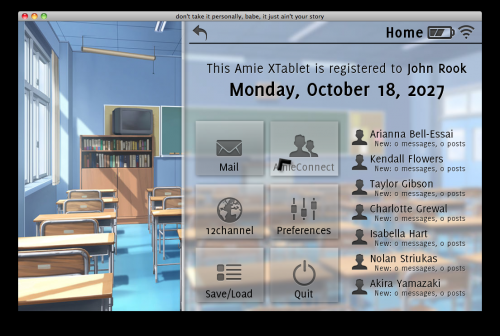
So here you have Lake City and these AI in an alternate late 1980s world with an appropriate looking Amie Workbench Version 1.3 computer system made to imitate the Amiga interfaces that existed in our world. Then, take this and make the supposition to fast forward to 2027. In Digital, we find a J. Rook is an administrator of the Lake City Local BBS Board and in don’t take it personally, we find the main protagonist–John Rook–worked with computers before he transferred to his teaching job at a private school in Ontario. However, he would have been one year old at the time, and perhaps he is the son of that Rook: having continued in a family tradition of working with computers before his career change. In addition, one of his students seems to have had a grandmother named Eriko Yamazaki who wrote a book called Digital Shinigami. This same person also seemed to exist in Digital on the Gibson BBS who mentioned that she had to spend less time on the Board in order to write her book and prepare for the birth of her child. In addition, the social networking program that Mr. Rook and the students are using is called AmieConnect: perhaps a future social program created by the company that once made the Amie Workbench application.

this ain't your story

There are no AI in don’t take it personally, but I would not exclude the possibility of them from being in this world: even if Love mentioned that this game is more of a “spiritual successor” to Digital. This game is a different beast entirely. Instead of the player-reader being a neutral force that can choose his or her identity, we have to focus on the character of Rook has he navigates the morally-questionable world of Information technology in his classroom. Essentially, he is supposed to read the private emails and interactions of his seventeen year old students to “prevent bullying,” but the irony of what is private in a “private school” or even in by futuristic society’s becomes very questionable indeed. It is here that Christine Love starts to use an anime-like graphic style to represent the characters–possibly influenced by her first commercial dating simulation work Love and Order— and after a while you get a real feel of who they are as people and you get to decide how Mr. Rook interacts with them and how the information that he “shouldn’t have” will factor into it … or not.

I am so tempted to say that this shift in what is considered private and how the online world of social interaction works is just a precursor to humanity’s own changing attitudes of how it perceives itself and the world around it. Whether or not Christine Love succeeds in capturing that tension–that agony of change–is another story entirely, but it is definitely intriguing.

Now, here is where my temptation leads me. Fast forward to the 25th century and then to “thousands of years later” in Analogue: A Hate Story. Not only are we in another time, we also finds ourselves in another space. From my understanding, in the 25th century the people of Earth have developed space travel to the point where they plan to colonize other worlds. And guess what? In addition to human captains, they also have AI guides with the same asterisks in front of their names.

Unlike the other two games where you find yourself–either by your own self or indirectly moving Mr. Rook–in North America, you are in space investigating the lost Mugunghwa generation vessel: a ship that was sent from the futuristic unified nation of Korea to create another planetary colony. It is a very nice counterpoint to Digital because you are looking at something that is the product of a different culture and how that affects what you might find. During the process of finding out why it never reached its destination, you realize they operate much like their 1988 North American counterparts: in that they have to delete themselves from one place in order to transfer to another. This plays a very crucial role in both games. :p

But these AI are also very different. Unlike Digital, they actually have image-forms and they look like anime characters. This allows you, as the player, to interact with them through more than text. You can see their body language and, I would imagine if you were actually in that world, hear their voices as well: though there are no voice-recordings in Analogue. I had to play this game right after finishing Digital because I read somewhere that unlike don’t take it personally, this was less of a spiritual sequel and more of a direct one. However, it’s not so much a sequel as it seems to have continuity and a counterpoint to what was going on in Digital itself: Love and Hate. However, just as the “Love” part of Digital is not necessarily what you expect, neither is the “Hate” part in Analogue.

And here is where I go into a tangent about how AI are often portrayed in media, and how they are not by Christine Love. It would be easy–so easy–for her to fall back on the trope of Artificial Intelligence going bad. Of computers that betray their human masters and AI that begin to despise humanity and attempt to murder whatever organics they can. But Digital follows an entirely different dynamic and Analogue, for all it is called “A Hate Story,” very much subverts this as well. In both games, you have AI that exist parallel to humans and while in Digital they are just another intelligent people, those you meet in Analogue exist to actually help and befriend you: even if you have to weave through the details of a terrible past and mystery to do so. They are there alongside of you and are just as sentient, responsible, happy, sad, horrified and afraid as you as an organic being. If anything, the only thing that separates the ones in Analogue from Digital is that they are made to help you and despite and because of their personalities that this imperative still remains.

So this is the world that through the addition of some asterisks and a few hints (of continuity in the form of Easter eggs and code-based sneakiness) that I believe Christine Love creates. Now I’m going to talk about the next part: which is my own relationship to the game and where, while it might not be my story alone, it is definitely–as Christine Love posits whenever she thanks the pronoun of “you” in the end credits of her game–our story.

I played all three of these games (technically more if you include Rumble and Aphroditus), and now I want to discuss my interaction with their respective gameplay and story lines. So, with regards to gameplay, I have to say right off the bat that there was swearing. A lot of swearing. I go into games relatively blind and I probably don’t read instructions as clearly as I should. But I did notice a few things.

First of all, in Digital I almost had no idea what I was doing at first. It took me a while to adapt to the “dial-up” system analogous to old telephone system Internet interfaces that Love imitated exceedingly well. I learned how to use “the codez”–illegally-obtained long-distance calling card numbers–and actually felt like a hacker: which is hilarious because I am not technologically gifted at all. So I was doing relatively fine until … until the Underground Library. The freaking Underground Library. Don’t misunderstand: I loved that level and the information within it. But I didn’t know at the time that I had to download every download I got from other users in other BBSes so when *Delphi (who I always identify as female) transmitted that goddamned screen-lining virus to me, it was there to stay.

I ended up having to reload a previous save state, very carefully go through my downloads again and make sure not to miss any of them. And it was easy to miss them. God, I was so mad when that happened.

Also, while doing the following does succeed in making you more immersed and interactive with this alternative late 1980s computer world, having to manually dial-up BBSes gets very tedious after a while: especially when your “codez” were declared invalid and you had to go back and get more through more, you guessed it, dialing. However, when I actually took a break to vent or do something else and I came back, I got over it and enjoyed the story.

Analogue also had a “stuck-point.” While I was much enjoying going through blocks of diary texts and reports with *Hyun-ae and *Mute, I did not enjoy the fucking reactor core of the Mugunghwa ship going into meltdown and me having to choose which AI I wanted to save: made all the more frustrating by the fact that I knew there was a way to save both of them. I felt like some tech specialist in going through the motions and programming to save the ship, whatever AI I could, the records of what the fuck happened to it, and of course my own life.

I also admit that I was starting to get annoyed about constantly having to hear the alerts on and open and check Mr. Rook’s status updates on his AmieConnect in don’t take it personally.

Wow, from Digital to Analogue I transitioned from the profane punctuation of “freaking” to “fucking.” I guess I know which frustrated me more. I guess the reason Analogue frustrated me more is that it made me have to make some hard decisions about who I wanted to save. It was almost as bad having to influence what decisions Mr. Rook made when dealing with his students in don’t take it personally, babe, it just ain’t your story: because I got a feel for the characters and some of those decisions were just so … hard to make. Also, that title is genius: because unlike Digital or Analogue where you can play as “you,” in don’t take it personally the story is not about you at all: and it is hard to differentiate yourself from John Rook. I suspect Christine Love purposefully made it that way: using that age-old concept of protagonist-identification to make the player that much more uncomfortable. Basically, the title to this game is for the player’s benefit and kind of a raspberry towards them too.

But the very thing that makes these games so hard is also what I love about them. What I love about Christine Love’s games is that they tell a story. But it’s more than that. The reason I really love the games is that they are about people and relationships. Basically: I liked the character and even those I didn’t like were not two-dimensional beings.

In Digital, I found it amazing that *Emilia was an AI that could make original poetry–even “bad” poetry–and that she could feel love: that you begin to realize as a player that you can emphasize with an AI who is–essentially–another sentient being. I also really liked *BlueSky: because he just seemed to be this really friendly and brilliant AI historian. If he actually existed, I would have loved to have more discussions with him about the nature of AI and technology. He would have made a good friend. And what happens at the end of this game … just broke my heart. It came down to personal love verses the love or duty to something greater than yourself and that choice–which in this game is not a choice at all–is heartbreaking: if only because Christine Love spends all that time getting you to sympathize and care about … those that you do.

As for don’t take it personally, babe, it just ain’t your story, I sympathized with John Rook and the difficult situations he found himself in. I even liked Kendall Flowers and, frankly, her honest and direct nature when she felt the need to be assertive. I realized that Akira was really lucky to have her as a friend. I do find it really interesting though that while the gay relationships that develop among the students have their issues–those challenges that any people in relationships face and how society views them–the potential heterosexual relationships are really rendered problematic in this game when you consider the characters of Taylor Gibson and John Rook himself. Taylor was once the girlfriend of Nolan who becomes Akira’s boyfriend: and she is homophobic or at least quite ignorant. She is a self-absorbed and mentally stunted being that proceeds to emotionally manipulate and bully both her former boyfriend and his new boyfriend.

Then you have John Rook and the relationship that could develop with Arianna Belle-Essai: one of his own students. There is definitely the problematic power dynamic of authority or privilege that places Rook over Arianna to consider and also the very real fact that he is a lonely sad man and she is a lonely confused but piercingly direct girl that really creates that tension. You could, if you wanted to, really read something into how relationships between opposite genders might work under our own culture and the way it uses gender. Neither are really honest with the other, but if you choose the route for him … I don’t know. I actually liked Arianna: because she knew what she wanted and she wasn’t stupid and when one of the endings of the game reveals itself, you realize that she and the other students know how to keep an open secret even in a world where privacy has changed so radically.

But I also like John Rook himself despite that possible ending because after a while you realize that he may be a bad teacher, but he is part of a bad school and a bad educational system and what some of his students need is a mentor, an adviser and a friend more than an instructor. There were a lot of complicated issues, but maybe they were offset or complemented by the fact that everyone involved was human.

So now I come to Analogue: A Hate Story. In this case, I really sympathized a lot with *Hyun-ae and what led her to making the decisions that she did. I probably would have done the same in her position. At the same time, I could also see *Mute’s perspective and she managed to break through my own leanings towards absolutism. I was actually happy when I let *Hyun-ae cosplay as a scientist: given how much that meant to her and why and I felt like shit when I dressed her in a traditional Korean Hanbok: especially after realizing what the degenerated society of the Mugunghwa did to her. The slow realization of what was, in fact, done to her made me absolutely dread reading what happened next.

At the same time, I loved the epistolary novel-format of looking through the entries of all the Mugunghwa‘s inhabitants and getting to know some of them that way: that for all their society became repressive, they were still human beings and not all of them were inherently evil. In fact, none of them were but some of them were more selfish than others and most of them let themselves get shaped into something that supported a repression of humanity: and in particular women. *Hyun-ae herself does not know why the descendants of the colonists in that generation ship became how they did, and *Mute herself–the original guiding AI–does not seem to remember. But this is the plot to the upcoming Analogue: Hate Plus and given what *Mute’s name is, I both highly anticipate and dread what we as players are going to discover.

When I really think about it all, though, looking back on my Christine Love games marathon I realize that none of the games were really about us. In Digital, you send emails back and forth, but you never type your own messages: while you do see those of the people that you are contacting. In Analogue, the interface that would allow you to answer beyond “yes” or “no” binaries is “malfunctioning,” and you only have the two former options for actual communication. In the latter game, you can’t even tell the AI your name and they never see what you look like. There is a strange balancing act between communication and empathy, and distance and loneliness.

For me, that kind of dichotomy and the tension it makes reminds me of watching a really good anime. Certainly, the visual novel medium that Christine Love has adopted for all three of these games conveys that sense of experience. You feel for and sympathize with the characters, but you are never one of them. Not really. At the same time, you are. There are also a lot of subtexts: or some from my perspective. For instance, when *Mute asked me if I was male or female, and when Digital had me type in a name and a username, I felt so strange–after talking with *Hyun-ae– to be using masculine pronouns. I know Christine Love has said that she made these two games specifically for players of either or any gender, but she has also said that privately she believes the relationships that go on are between two women in a romantic dynamic: because that is her perspective. Sometimes, I feel like an intruder but then I get over it and realize that it is really about an interaction between the minds and feelings of the player and character regardless of gender.

There is also another possible subtext or interpretation that intrigues me too. Christine Love likes to make games that are inclusive of those who identify as queer: or at least make them more inclusive to more than just a male heterosexual audience. There is another group that sometimes has an asterisk connected to a word as well: though it is an affix as opposed to a prefix. I am talking about those who identify as trans* and use this term to encompass all those who do not identify by cisgendering: the gender that mainstream society aligns with one’s biological sex. This is an umbrella term that can include those who identify as queer or genderqueer. When you look at the revelation with *Emilia with that lens, or even *Hyun-ae–in that she cannot and will not correlate her sense of self with the gender-expectations of the regressive society around her–it can leave a very different connotation.

But that is also too much of a simplification. As I mentioned before, the asterisk can encompass an entire group: and in this case perhaps the idea of something being transhuman or a designation of beings beyond the conception that all sentient life has to be organic and material. In this case, it seems to give a being a cultural or “racial” marker. I just can’t get over the fact that the inclusion of just one symbol can possibly mean more than one thing: though this is all just supposition on my part.

At the same time, I really have to say–among the many things I’ve said–that I really like many of the female characters in these three games. From Arianna, Charlotte and Kendall in don’t take it personally to *Emilia in Digital and all the way to *Hyun-ae and *Mute in Analogue: they are all direct, all brave–or grow to become brave–and they have the strength to admit what they feel despite any circumstances in the way. There is something so beautiful about this that I can’t really put it any better than I already have, or how the games already portray.

But ultimately–and if I have already said this before I want to reiterate this statement–what I really like about Christine Love’s work is that she actually tells a story. When she talked about Lake City Rumble II being a subversive parody of a fighting game, it jived in that same place I have where I was really fascinated with the story and the character interactions behind the fighting more than really the fighting itself: though it also had its moments. And what I truly love is the fact that she actually makes me care about her characters and this–to me–is the sign of a great writer and creator.

It is my hope that she continues to do what she does because, you see, I don’t care if these aren’t completely my stories. In the end, I just want to see more of them: spreading out from *Mother, leaving neither copies behind them, nor taking anyone else’s names but their own along the way.

Star Wars: Different Forms of Revenge and the Knights that Could Have Been

I have to be careful. If I keep this up, I will have to make an entire section for Star Wars. But I really wanted to articulate something that I have–throughout the years–discussed time and again.

The Jedi Knights.

When I first thought of the Jedi Knights, with what little we were told through the Old Trilogy, I pictured them as something not unlike the X-Men–people born with strange powers–who are somehow also like a galactic police: in that they have their roles as peacekeepers, but they are also a distinct people and citizens of the Republic.

Of course, in the gap between the Old Trilogy and the New, there were other details that formed as well due to the Expanded Universe. Tales of the Jedi established that, at the time, there were many decentralized enclaves of Jedi: with some ancient and wise teachers guiding multiple students of various species, genders, and social backgrounds. Some Jedi had families, partners, spouses, and children while others served as full-time guardians, scholars, and diplomats. Some were born into the Order, others adopted, and still more joined voluntarily. They also had ties to the Galaxy: to people who were not Force-sensitive, while others investigated the glorious mystery that was the galactic energy field known as the Force and defended against the abuses of the Dark Side and injustice.

I admit, I was probably one of those people that was pretty spoiled by reading the Expanded Universe stories after Return of the Jedi and getting used to how Luke Skywalker developed and ran his Jedi Order, and thought it and the precedent in Tales determined how the Jedi Order had always been before its first destruction.

But then, like many others, I found out I was wrong. I found out that the Jedi Order was essentially a highly centralized monastic organization that took children from their parents–mostly willingly–when discovered to have a “high midichlorian count” in their bloodstreams, and trained them to essentially be apart from Galactic society while also somehow still serving only the Republic and, well, being a part of its judicial branch. Jedi were not allowed to own anything save their lightsabers–and apparently “the lightsaber is their life” though I always used to think true mastery of the Force was evolving past needing to even use it anymore–and they were not allowed to marry, or have children of their own: though they could have relationships provided that their duty to the Order and the Force came first.

Basically, in the Prequels the Jedi Order became a religious group with various psychokinetic abilities that somehow served to enforce and mediate a Galaxy of secularism and a multitude of other beliefs. And while they were encouraged to accept the diversity and multiculturalism of the Galaxy at large as peacekeepers and diplomats–trained specially to know that everyone and everything has “a certain point of view,” for the most part they couldn’t really apply this philosophy to themselves and their own internal practices.

In short, from my perspective the Prequels made most of the Jedi bland, unrelatable, forgettable and, some cases, really unlikable. These Jedi, compared to the ones of Luke’s time and the ones that predated even them, do not seem to have passion for anything, they do not fight as well and only defensively (which mostly is not in their favour against Dark Side opponents), they seem to have a whole lot of prohibitions–more than just being mindful of your feelings–and they make themselves separate from people who are “not like them.”

https://i0.wp.com/images1.wikia.nocookie.net/__cb20090320221711/starwars/images/5/59/ThreeJedi.jpg

There are exceptions–such as the Cerean Master Ki-Adi-Mundi having a polygamous relationship to help save his species–and I even admit I understand the structure involved too. After all, you would want to regulate a group of people with advanced abilities and keep them from potentially misusing them–even by accident–and they have to be very careful in what they do. But there is a point where reasonable caution becomes fear. The irony of course is that in the films and the books, the Jedi like to say that, “Fear is a path to the Dark Side.” But here the Jedi are, trying to eliminate the potential for attachments and conflicting interests in their initiates before they are even cognizant of them for fear that they might turn to the Dark Side out of passion. Essentially, they were forced to ignore the will of the Force–in their basic reproductive and emotional urges that most life is programmed with–in order to serve the will of the Jedi Council and the Order.

There is interesting story behind the Order becoming an almost purely monastic one: in that there was something called the Ruusan Reformation: where after a major galactic Dark Age the Order instituted all of these reforms after the Sith supposedly “destroyed themselves” to prevent or at least diminish the potential of more Dark Side-users rising. Basically, it is like our world: in that when we have times of peace, we tend to be more liberal as societies, whereas in war or great tragedy we tend to become more repressive or, at best, conservative with many groups within these structures becoming both self-censuring and self-policing. But as I said with regards to the Jedi, this was still something motivated by fear and, well, fear at least indirectly led to the inevitable.

I also think that these back stories, while really clever, are obviously retroactive and kind of a cop-out by George Lucas: made specifically to help the plot in Anakin Skywalker’s fall to the Dark Side. You can name a whole of cultural precedents for me in our world–the Knights Templar, the Vestal Virgins, the Guardians of Plato’s Kallipolis and many other orders of monks, celibates, idealized communal police forces and their roles–but I still think it is a cop-out.

There were many ways that the Jedi could have been left as peacekeepers and equal galactic citizens while also retaining the tensions that would have led to their destruction. Things that would have allowed them to remain, at least to me, as human and relatable beings while making their deaths that much more horrible. Even Anakin’s fall could have been made even nastier this way. I understand that film has different requirements as a medium for expression as opposed to books and that an idea simply conveyed–especially in a really clear archetypal form–can be the most effective, but that still doesn’t detract from my point.

I’m going to tell you now about the fall of the Galactic Republic as I imagined it. I saw the Jedi living side by side with other Republic citizens: some revering them and others fearing what they can do. Hence my X-Men reference. Palpatine manipulates his way into power and engineers the Clone Wars as per usual: save that when I heard about Clone Wars I thought both–or all sides–used clones in their battles as terrifying and disposable legions of soldiers. It does not take much these days to imagine whole lifeforms being engineered simply for the purposes of warfare: threatening the very nature of the Galaxy and life itself. That is what is at stake.

In the meantime, Palpatine is slowly and surely turning the populace against the Jedi Knights. He is being clever and not coming out and outright saying anti-Jedi rhetoric, but he has others do it for them. Pretty soon, members of the Order have to be watched, are excluded from places, and measures are taken–a few from the EU–to make areas and situations where their powers can be neutralized. Incidents happen where people get into fights with Jedi and, save for the Masters–and in my vision I thought that Masters were the pinnacle of a Jedi’s power and wisdom and on par with Yoda and Obi-Wan–they cannot prevent the conflicts.

Anakin is Luke’s age when Obi-Wan finds him on Tatooine: and he trains him. Yoda is Obi-Wan’s Master and has long evolved past his need to use a lightsaber. Owen Lars is Obi-Wan’s brother: which explains their strained relationship in that Obi-Wan had the Force potential and was the hero, while Owen was essentially a “mundane” and liked being a moisture farmer. Anakin and Obi-Wan go around the Galaxy together and eventually become drinking buddies and friends. Anakin is exposed to all of the conflict going on and he does get befriended by Palpatine. Anakin also meets Padme, or whomever at the time I thought would be his wife, and they plan to have a family and Anakin flat out tells Obi-Wan that he wants his son to have his lightsaber should anything happen to him. I could see Anakin a lot like a combination of Han Solo but with moments of wise Luke: a far more relatable and likeable person than in the Prequels.

But War takes its toll and Anakin starts to go crazy: each conflict inflicting a toil on his stress level and mental well being. Obi-Wan tries to save him, but they are fighting on Mustafar and Anakin accidentally falls into a volcano or gets burned and injured. Obi-Wan thinks Anakin is dead and takes his lightsaber. But Anakin lives on through sheer hate and the belief that Obi-Wan tried to kill him and abandoned him to die. Palpatine retrieves Anakin and influences him further to blame Obi-Wan and the Jedi for the entire War and for Anakin’s injuries. Then we see the slow, painstaking physical transformation of Darth Vader. Then in the third film we see a cybernetic Darth Vader leading an assault on the main Jedi Temple–with now Imperial troopers who can also be birth-born recruits because we all know that normal people can commit atrocities just as well as any clone–and slaughtering powerful Jedi we have come to relate to and care about. You know: the Jedi Purge we expected.

Purge

In the meantime, we see Jedi children being taken away by the new Imperial government to places unknown: along with adults and Jedi sympathizers. Collaborators turn them in for bounty and out of fear. But some are still sympathizers and try to hide them. We also see Purge troopers and Jedi hunters come up with energy cages and ysalamiri: creatures that can neutralize the Force around a captive Force-sensitive. This is a nice lead-in for the Dark Times where we see the Jedi fugitives fighting for their lives and being murdered by Darth Vader and friends. It is also made clear that only penultimate masters of the Dark Side can use Force Lightning: and not everyone and their grandmother. And then we see Bail Organa hiding and raising Leia and Obi-Wan taking Luke: and we know that there will be hope for some kind of justice and restoration … and eventually the return of those strange and wonderful Jedi Knights.

I know there is a great irony implicit in this essentially fanboy rage article: in that my previous post dealt with how I hated how dark Star Wars had become beyond what was necessary. However, I recognize that the events leading to the Empire and Darth Vader and the genocide of the Jedi were not pleasant moments. But it could have still been Dark and very real: something visceral that people could relate to. What would you relate to more: seeing a bunch of distant Knights you barely know get shot by some command predisposed clone troopers, or some characters you know and families you saw even tangentially being carted away to the Imperial Palace for death … or worse. Or even seeing some well-developed characters die because of how they were born. And then when Luke has his confrontation in the Old Trilogy, you know what is at stake and you see Vader too beginning to actually realize what a fool he has been and we could have watched as he acts accordingly. You also see that even though what Luke and Anakin do can never truly make up for what was lost, there is a least, you know, “a new hope.”

Instead, we got a cookie-cutter “Execute Order 66” on some people we barely knew and saw a bunch of relatively forced characters fight. That is how I feel, and the sad thing is I also feel like it could have been so much better than it was. I was really disappointed about how the Jedi were portrayed. I expected better. A lot better.

I am almost finished this. I could easily end this off by stating that my issue with the Prequels and the Jedi in them was not that they were the lead-up to a tragedy, but they were a lead-up to a very contrived tragedy. No. I think what also really annoys me is what happened afterwards.

In the Expanded Universe, there was a book called Traitor. It was written by Matthew Stover, before his excellent adaptation of Revenge of the Sith. And in this book, Darth Vader’s grandson Jacen Solo essentially touches both sides of the Force and is taught through some hard, brutal but necessary lessons that the Force has no sides. The Light and Dark Side come from within the practitioner and not the Force itself. It was a well-written and well-reasoned book. Unfortunately, writers afterwards came to take Vergere — Jacen Solo’s Master’s — words as complete literal truth: that “everything I tell you is a lie.”

It turns out that Vergere was a secret Sith and she was feeding Jacen something called The Potentium Heresy: a philosophy that states that as long as a Force practitioner intends no wrong, they can do no wrong. In the end, Vergere was working with another Sith who eventually turns Jacen into something like his grandfather: even though he should have really known better.

Caedus EA

Of course, neither this Heresy nor the “shades of grey” approach are mutually inclusive things. The fact is: whether the Force has two exact sides is irrelevant. If you seriously take the time to look at your actions and guide them appropriately, it is beyond this really simplistic binary opposition of black and white. No person is either pure good or pure evil. The view of the Light and Dark Sides of the Force is really Manichean–an absolutist dual morality of good verses evil–and even the Old Trilogy questions it when Luke almost a few times gives into his anger, but ultimately looks deep into himself and stops. Hell, I can even argue that just as the Force influences peoples’ actions in Star Wars, people’s actions influence the Force and create its Light and Dark Sides: though that becomes a question of the chicken or the egg.

And also, in the Expanded Universe, there are species that have no concept of Light and Dark and have different forms of morality. Some have entirely different spectrums: like the Aing-Tii monks. So how do you deal with that?

There are some who said the retconning back to an absolutist Light verses Dark mentality after Traitor was due to the dislike of some fans, but I also read somewhere that it was Lucas himself, or his company, that essentially towed the line of the Force having a Light and a Dark Side, and nothing in-between: which was what Revenge of the Sith was apparently made to illustrate. And this in itself doesn’t even have to downplay or render everything someone like Jacen learned. As I said, the Force–no matter what it is or midichlorians or not–is only part of the equation. There is the freewill, sentient part of the character to put into question as well: the very thing that makes a person stand out. Especially a Jedi Knight.

Of course, you can argue that this last part of my post is neither here nor there: in that it is not a part of the films. But all I am saying is that the Jedi Order, and the Force itself, could have been handled in a much more mature and nuanced manner–one that adults and children could have related to–than how it had been.

I am only hoping that the next films at the very least allow Jedi Knights to have families: to have a network of friends and allies so that nothing that happened in the Revenge that was, and the Revenge that could have been, will ever happen again in the same way. It is one of my only hopes.

How to Get Attention: Or What My Readers Seem to Like

I thought it might be interesting to play in traffic today … or, more specifically, look at which topics of mine tend to get the most reader-hits.

I admit: I spend a lot of time looking at my Stats and guessing at who has viewed what and from where based on some pretty bar graphs. So now that we have established that I have very little in the way of a life (though I strongly suspect there are other people who are doing the exact same thing even as I write this out of pure morbid fascination), I want to look at what seems to really “work” in terms of attracting readers on Mythic Bios: and possibly other Blogs.

Well, my first observation is that the recording of Life events really tends to get a lot of attention. It seems as though readers really want to know more about a Blog writer’s actual life beyond, mainly, what they actually record down. For a while I avoided doing that as much, but I recognize the value in occasionally dealing with that part of my self and some of the milestones in my own life offline. I guess the fact that people are interested in other people and specifically people whose writing they follow isn’t that much of a surprise in retrospect.

It also isn’t surprising that there are a lot of hits with regards to my posts on Creativity and the Creative Process, or to be more “nice and accurate” about it: my own thoughts about them. It isn’t as though my thoughts are particularly original, mind you, but I have to be precise in stating that these are my opinions and experiences with the above. Whereas with my Life I tend to find moments where I really need to express or share something, my writings on Creativity are mainly me pretty much talking out loud but–unlike the actual times when I talk to myself (a lot)–I actually want to take readers through something of my process: to outline a bit of my own mind and how it works.

Unfortunately, it also isn’t that surprising that when I wrote my post on Depression, I got  lot of hits for two days afterwards. It is a very common topic–especially in this day and age–and it also feeds back to the idea of the “personal being publicly popular.”

In a lot of ways, all of the above are pretty much the electronic Mythic Bios’ bread-and-butter, as it were. I know that if I talk about these topics or choose a day where the new Dr. Who episode or the latest movie comes out to talk about it, I will get some traffic there. It’s good to know what works and what needs work.

I have some specialized posts that do not always get as much traffic, but they are relatively consistent in their own way. For instance, I find that I get a fair bit of views with regards to my What is FV Disco? and my Worms and Bicycles articles from Eastern and Central Europe due to the fact that I am touching upon an art movement and style that originated in Slovenia, and that–at least at the time I made them–there seemed to be few articles talking about the subject online: never mind with regards to the comics medium.

Speaking of comics, I have been getting some modest traffic with regards to my reviews of comic books like Grant Morrison’s Arkham Asylum and anything I’ve written on Miracleman. I try to put a little of everything for Geek readers and otherwise: though really it depends on my mood and where I think the flow of the Blog is going at that time. What I mean is: I try to maintain some kind of continuity with regards to which article I place after the last.

And I am really happy to see people reading my stuff: especially my articles on, and my stories based from Video Games: of which my only claim to expertise is the fact that I’ve played some of them and even loved them. It also makes me happy to see the occasional view of my article on my experience with Gwendolyn MacEwen and The Vampire Sex Bar too. I obviously find that my articles on mainstream subjects or things that have become so such as Creativity, Superman, The Doctor and what-not to get more attention while some my more obscure and original articles get less: though it is very satisfying when this last does get some views.

But I think the most gratifying moments for me are when someone reads some of my samples of fictional writing. It just makes me happy to see people reading my most original or at least creatively derivative work. Yet I have to say that, in the end, I am just satisfied to see that anyone reads any thought, poem, review, story, or opinion of mine here. It is the closest I have to bringing you into the world that I created for myself from all of this and my own essential self.

Sometimes I feel like I am not always that interesting and much of what I write on here isn’t that important when you really think about it. But writing and writing to one’s audience is more than statistics, or whether or not you get paid, or how much attention-whoring you do. Writing is about getting yourself out there and expressing it in such a way where you don’t dumb yourself down, but the same time you are not trying to be inaccessible and superior.

I am still trying to find the line between what I want here and what I may want elsewhere. But in the meantime, I have a better idea of how to continue. For instance, I know that if I want to get Freshly Pressed the best way to do it is to write about a topic that is universal or very popular (such as a strange pseudo-serious and somewhat creative meditation on the nature of cartoons), make it short, but also make it stand out by cramming a lot of ideas and resonance into so small a space. An appropriate graphic also helps. Of course I also understand that there are other factors to consider too: such as what the staff of Freshly Pressed is looking for that day or that week and there is only so much you can control or predict.

So I will just end off this post by stating that ever since I started Mythic Bios a year ago, I have a much better idea of figuring out what my current and prospective audience wants to see and how much of that is determined by my skill and my circumstances. But there is still a lot of things I do not understand and you all continue to surprise me in what it is that you like to see. My video game and some of my shorter comics ones come to mind there. And then sometimes–very rarely but very sweetly–I see that some of you go on Google and type in the name of the particular article of mine that you want to see. And that, my friends, is what makes me the happiest of all.

The Storyteller

An old story and an appropriate one given what I have been reading lately. You can tell what some of it was inspired by and I hope it can be appreciated for what it is. Enjoy.

He was the Oracle of Stories.

I didn’t know what was meant by that … at first. The man, if one could venture to even call him a man anymore, sat in a dark corner of a great library. Yet for all the library’s magnificence, the Oracle had chosen long ago to be placed in one particular part of the chamber. It was what seemed to be the oldest part of the structure, and you had to travel through a few smaller rooms and wings, and down a set of stairs before you came to the place.

I suspect it wasn’t so much that he chose to remain down here, as it was that whatever powers he possessed or had influence over him made him sit there, and not get up again. The Oracle sat on a stool on a wooden platform in the shadows between two book shelves. I didn’t know what to expect from him. To be honest, I had heard tales of other Oracles but I hadn’t had the privilege of meeting them. It was said that each one had been human at one time, but through a gift or a curse, they had mastered and eventually personified the great artistic pursuits they dedicated their lives to.

So when I met the Oracle of Stories, you have to understand that I had many expectations in place. Some of them were very much fulfilled, and even expanded on. The small figure sat there, surrounded by mounds of paper. At the time I first saw him, I saw his gaze: glassy and sightless from years of doing nothing but writing in the dimness of the room he chose to sit in. I knew that others came in, respectfully, to take his writings and add them to the library. They were beautiful, luminous works that branched into all areas of human understanding: of good, and evil, and all the places between and beyond.

He sat there, mutely, and all I could hear was the scratching of his pen. I had studied everything about the Oracle that I could, in hopes that one day I could even begin to approach his level of craft. I was just an acolyte then, a novice scribe with a mild smattering of talent: but just enough to attract the notice of my elders, and get this very rare chance. I remember them almost seeming to restrain their excitement, though I didn’t know why. There were a lot of things I didn’t know back then.

For instance, I knew the Oracle was old. His hair was long and silver, and almost covered his entire face. His form, though erect was thin and the flesh I saw lined. But it wasn’t wrinkled or infirm. I remember his face most of all. Despite the many years he had been down here, by choice or condition, the only sign of his great age were the lines on his forehead, and around his eyes and the flat eternal line that was his mouth. His hand, unlike the rest of his immobile body was a flurry of activity, moving across the parchments he was given like a crazed arachnid seeking to spill its blackened blood and secrets to be augured and divined over by the other adepts.

That was the only movement I and most others ever saw of him. Yet these details were only witnessed or helped by those adepts and masters closest to him: as anything could be close to him in this world. But I get ahead of myself.

There was no expression on his face at all. It was almost as though he was asleep, or lost in a very different place from you or I. I observed him, and his faded robes amid the books and volumes and scrolls around him. He had not spoken in centuries. So when I heard him finally speak, his voice was barely even a whisper.

“How can someone who makes stories be an Oracle?” he asked, so quietly that even in my shock I had to strain to hear his words, “How can anyone who makes stories–anyone who writes or tells them or passes them down–be telling the truth?

“I used to wonder that myself.”

He gave a raspy chuckle, “Nothing is constant, except for the written word. It’s true that when you first write it, when you first envision it there are many possibilities. And when you first read it, you can only guess where it will lead you. I suppose that’s what I found books to be my most trustworthy friends. My only friends. They were the ones that stayed true. Yes, books are a lot like old friends, only truer. At first they might surprise you, or maybe even disappoint you. But when you read them once, you only discover new things about them as you read through them again and again …

“Once, before I gave everything to my stories, I loved to hear, and read, and witness the stories of others. I loved to experience those of others more than experiencing my own. My own stories, those I lived were awkward, reluctant things of necessity and survival. More often than not, they were painful things. Ugly things with petty hopes that are sometimes never requited. Life is not as neat as a narrative would have it. Yes,” the voice droned gently, “I would have given anything to be rid of the burdens of the body, and the self to be able to immerse myself in the stories of everything.

“And I did. I’m not sure whose stories I tell anymore. Whether they are mine, or those I make, or those that have happened, or have been lost, or have yet to be, or are still happening, or could be happening. Some stories I tell would have it that the person I was met a Muse–perhaps Calliope herself–held captive and I let her go. Sometimes, I remember asking one favour of her. Or she granted me a boon for my deed. There may have been nothing that tied me to the world I had even then. Or perhaps I lost something already, and long ago. Maybe I lost something that I never found to begin with, and never would.”

Those last words were almost wistful as he continued, “But I think: when I am myself and not the stories that I make. When I am not the young woman wondering what to do with her unwanted child, or the couple happily united and ready to wed, or the young man cut down as he reached the zenith of his life, or the broken ruin who wasted all of his potential into the dust … When I am not the tyrant gaining sole satisfaction from the lives I crush gleefully into blood and pulp onto the cruel twisted curvature of my lips, or the child discovering it all for the first time … I think …”

He paused for a few seconds, with a look of befuddlement twitching on his features, “I think I …”

He stared blankly and sightlessly through the shelf in front of him for a very long time. Then, finally, he spoke again:

“I think I refused her power. I think I wanted her to be free. I think, when I was an ‘I’ that I saw a beauty in her that none of the world had, and I would never have again in my lifetime. But I didn’t want that at the price that her former slaver put upon her. I think … I know that I felt great revulsion over the things that he did to her, to make her give him her power and her blessing.

“And I think that what gave me even greater revulsion was that I was tempted too.

“So I turned her away.”

https://i0.wp.com/upload.wikimedia.org/wikipedia/commons/5/56/Calliope%2C_Muse_of_Epic_Poetry_by_Giovanni_Baglione.jpg

He paused again, “But she knew my heart then, when I had a heart. When my heart was just my heart. And as she left, she told that she would never leave me. Ever. And the hole in my heart, that was my heart for my entire life was filled and went beyond that fulfillment. And it was glorious, and it was power, and love, and pain of others until there was nothing but them and the stories …

“And I felt the need to write them down. All of them down. And I kept writing. Even as her parting kiss on my brow remained, I kept the stories flowing. I became them. I am them, everyday and for the rest of my life.

“And to this day they wonder how I do it. How can I sit here and molder in the stacks and continue on and not feel pain, or sadness, or hope. And I think … I believe I do feel these things still. But then I remember the sleep. I think of Sleep, the younger sibling of Death and I let these feelings go into Sleep. Sleep will always be there for me. No matter what may happen to this form. I will be in it forever. And, whenever the feelings gather, and cannot be swept away, I will tell them. My body will be the channel, and my mind and soul will contain only the stories. I will be the Oracle of Stories. I will be the Storyteller. The Storyteller will the story of the Storyteller once at a time. Until the teller becomes the Story and the Story …”

Then his words trailed off, and his hand began to twitch, and grasp his quill. And the writing resumed.

Just as mine finished.

I wrote his story down that day, for the many hours it took. I still don’t know to this very day if it was his actual story or just one of the ones that had taken over his mind and body. But it both awed and frightened me in its scope. And as I myself near the end of my life, of my story, I can die happy: having my own question answered.

All stories are true, as many wise storytellers have said throughout time. And I will always know why the Oracle of Stories is sometimes called the Storyteller.

Depression

Warning: This post contains angst. If you want to read something better, witty, geeky, creative and otherwise far less personal, any of my other posts will do. Reader’s discretion is advised.

Do not say I didn’t warn you.

Me and my Head

In 2005, I started writing in this notebook. This was long before I began writing my Mythic Bios notebooks and I was in a very different, uncertain, and unpleasant place in my life. In this particular notebook were a series of fragments, thoughts, aphorisms, and a whole lot of bitterness, anger, and bile.

I called that notebook my Dorian Grey: because that was where I placed most–if not all–of the ugly parts of myself at that time. And it wasn’t enough.

It was never enough.

After a while, I stopped writing in it. I just didn’t want to see it anymore and, eventually, after much bitching and angst I moved past it and turned those fragments into more and more unified stories in my Mythic Bios.

I wanted to forget that first notebook so much that I eventually did. I thought I buried it somewhere else, though later as it turned out it had been in my room at my parents’ house–on my closet shelf–the entire time. I vowed, after a time, to never get into the position where I would write a notebook like that. I promised myself never to create another Dorian Grey again.

That is one of the main reasons I’ve tried not to talk about my personal life on my Writer’s Blog. Even oblique mentions of it seem to verge on breaking my own personal code. But I also realize this might be helpful. It might even show others that, in the immortal words of the Face of Boe, “You are not alone.” So here it is.

I am depressed.

This doesn’t come off as too much of a surprise, I would imagine. I have alluded to it. In fact, in a really dark mood, I once wrote this entire even longer post on what my depression actually entails. But I’ve decided to do something else instead. I’m going to describe what it has been like in a Choose Your Own Adventure style of “You,” instead of “I.” But you don’t get to make decisions: seeing as this isn’t a Twine game. Also, I am going to italicize it: to make it distinct from the rest of this post. So if you have difficulty reading a whole series of paragraphs in italics, please skip this or read something else I wrote on this Journal. Anyway, here goes nothing.

You don’t remember how you got like this exactly. There is one memory, though, that stands out at you. You were young: literally a child. You were at your grandparents’  near the entrance to the house, sitting at the old rickety table and its rotary dial telephone with the living room not that far away. You are pretty happy: because when you are here you are actually safe and it is a refuge from that cold place that is school and other children that you don’t really understand.

And then, as you are waiting–perhaps for some chocolate cake with coconut sprinkles that you have to eat in the kitchen along with the tea and milk you were once able to actually drink without being sick–you feel this … pang go through you. It is a strange feeling: like a reverse orgasm. It is not comfortable. It’s what you will later on know to be a painful moment of clarity: of realization.

You understand that this–all of this around you–is going to go away one day. And there is nothing you can do about it.

That is the earliest memory of the shadow and its melancholic length beginning to stretch down throughout the years to where you are right now. You start to bury yourself in old tape-recorded movies in a futile attempt to keep the past present. You immerse yourself in old books and keep them as friends: for they will be more constant and understanding than any flesh and blood companions you will ever have. You try to ignore your teenage years out of existence through books, said tapes, and video games. But the one thing that none of these elements can save you from is loneliness.

You make friends and somehow they keep moving on with their lives faster than you do. Your family tries to shelter you. It doesn’t help that they are religious and have food restrictions. Nor is it particularly helpful that you were born … different, as people keep telling you: in addition to the ethnicity thing. You don’t learn things the same way that people do and later you strongly suspect that you don’t experience things the same way either.

So you already have this predisposition to not trust the outside world at all. And you will be fighting this impulse with varying degrees of success for the rest of your life. You also are both drawn to people because you do not want to be left behind, and you are repulsed by them because they are not you. But those differences also intrigue you: a lot. This is going to be a running theme for the rest of your life: among other things.

So let’s fast forward this a bit. Finally you manage to gain enough inner strength to move out of your parents’ home: though you do need them for more practical matters from time to time. You get into Grad School with the aid of some people who care about you. You feel like you are making progress. You are slowly subverting and breaking free of all of those self-imposed and outwardly imposed restrictions.

But then there is this to consider. You are an introvert and this particular set of relatively simple and straightforward characteristics as set out in this link describes you very well. You now really have to deal with bureaucracy and its complete and utter ineptness. You have not been raised to deal with it really, and it galls you that you have to let it rule a portion of your life. This is the adulthood that you have unintentionally been fearing and loathing even before you knew about it: when you were so immersed in books and films and games in the vain hopes of trying to avoid it. The very frustration and cold reality that your family and school has been trying to shelter you from relatively until now when, suddenly, you have to deal with this shit a lot on your own.

But you persevere despite it. You even make new friends and new lovers. You get to go anywhere you want relatively at any time that you want. You get to dance. You get to hang around with people without curfews. You are working. You have something not unlike an adult life. 

You realize after a while that the depression is not chemical: as much anything in human behaviour isn’t the result of biochemicals in some way. Your depression is really situational and the results of a personal cycle of behaviour. You get into situations where the person you are trying to be is not the person that you are acting like. You begin to emotionally, as opposed to intellectually understand, that people are not constant beings. It’s not so much that they lie–and some of them do–but they aren’t always the same person. Their lives change too.

You’ve always internalized emotions and what you are feeling now is a lot of anger, sadness, stress, anxiety, resentment, and outright hatred. You’ve been led to believe that it is unseemly to display these emotions: as though it is somehow more mature to be in agony all the time but continue to express that socially acceptable mode of behaviour known as adult irony. You’ve always had headaches and migraines. Your stomach bothers you. You have always been really over-sensitive–hypersensitive–and in the worst case scenario the stress only makes it worse: to the point where your muscle-memory has memorized your anxiety and tenseness, and you’ve realized you have actually been having panic attacks.

In fact: do you remember the characteristics of introversion in the link above? Imagine them magnified even more so. You get to the point where you don’t feel comfortable going outside. You feel ill thinking about being in a social function where no one is giving you that “in” to speak and so you don’t go anymore. And between you and others bashing your personal beliefs–which were rosy yet flimsy things at best–you just stop opening up altogether. You used to like travelling around, and you had a certain degree of confidence. It erodes as you sit and you no longer move.

And this is before you realize that you have been eating up your girlfriend’s money by not getting a job, that you’ve been selfish as fuck, and it is hard to relate to anyone anymore. And those books and the Internet are no longer taking the edge off from reality. You can’t escape anymore: or at least not as well as you could when you were younger.

You realize that there is a terrible consistency in telling certain people that you feel as though they are a part of you when you know–deep down–that you have begun, or you are resuming, to hate yourself. You don’t say what’s on your mind to anyone: not really. You begin to believe that no one has ever really understood you and it is less an element of adolescent angst and more of a matter of fact.

Then you run out of money and you have to move back in with your parents. Your privacy and peace and quiet becomes compromised. But you don’t really leave the house like you used to. You don’t like to go out and you have withdrawn from most people: save those small few who come to visit. It is as though you have spent years trying to overcome your introversion and now you are paying the price by not wanting to move at all.

You are in debt because of your Degree. And after getting a Master’s Degree, you have to go on welfare. You realize that the given moralities of hard-work and debt are things that should be questioned in society rather than simply being accepted. You become dependent on a computer again to socialize and then it breaks down and you need to use the public desktop. You will not go anywhere unless there is an accessible restroom of some sort nearby. Your clothes begin to fray and you neglect yourself because, on some intrinsic level, you don’t give a fuck anymore.

You begin to resemble outside what feel like inside. You remember moments of joy and they become poisoned by what happened after. It is hard to remember actually being happy anymore. People keep intruding on your space and asking the same tired old questions over and over again: despite the fact that you are clearly trying to keep busy. Some others, when you talk to them, say that you are over-exaggerating your “complaints,” and they make you feel like others have it worse than you and you should shut up.

You are looking for work and sending in submissions–and you know that is important–but there are days when you wonder if there is any point to it. Because then the depression really starts talking. It tells you that you will never be “this good,” and that this is “too difficult,” “too much work,” and “too confusing,” and that everything you have ever done does not matter–and never mattered–a damn.

It really gets bad at night. You start to miss people a lot: people you will never really be able to speak with again the way you did. You start to feel tremendous resentment towards the people you wish you had told off. You wonder how many opportunities you let pass by you in your brain fog. You have memories of past life: when you were more confident and more assured and then you look at what you are now. The screaming you feel inside you everyday gets much louder at those times.

It is safe to reiterate two facts: that in those moments you hate the world, and you hate yourself.

Of course, there are the fantasies too. Of going back in time and telling your younger self to do this instead of this, or not to to do this ever. That is, also of course, when you don’t fantasize about going back in time and killing yourself at that moment in life when you were truly happy so that you never, ever have to know about the partially self-made hell waiting for you in the future. At the same time, you also know that were a certain TARDIS come to visit you, you would leave without question or regret: that those people who don’t appreciate your complaining or have gotten tired of it and they can keep their precious world.

You basically feel like you are in a prison. Your therapist flat-out calls you on describing it as thus. And if you were to summarize this long, rambling thing into one sentence: Depression is is a prison of your own making where you only remember dancing, only remember contact, only remember fun, you feel like you lost or are otherwise losing everything you ever cared about, where you suffocate on your own inaction and sense of failure, where you are disappointed when you actually wake up the next morning, where you punish yourself, and anyone that you attempt to meet and socialize will see that cycle of self-entitlement, spite, grief, self-recrimination, and self-absorption you’ve found yourself spiralling into–ingraining itself into your bones–and will politely run for the hills.

Because no one likes a person who does not like themselves.

So, I’m going to end that there because it is way past the whining mark and these things tend to wind out of control once you keep writing about them. It is paradoxically this thing that I have been trying to avoid. I’m not trying to glorify it or make myself out to be this innocent victim of circumstance, but it describes kind of some days in a lifetime, I guess? I guess I just feel like I failed myself in some ways and that I have no one to blame–or perhaps more appropriately hold responsible–but myself.

It isn’t all bad though.

I am seeing a really awesome therapist. And I have a 250-word tax to keep fulfilling and at least a half an hour quota of going outside to remember. I keep filling out a worksheet of places I send work to and to seek employment at. I am researching some free-lancing opportunities. And I also speaking with some people from my past again.

I guess I am ironically making a routine for myself: something I sorely lacked when I lived on my own. If I learned anything from my girlfriend before I had to move out, it is that routines can be our friends. As such, I don’t like to deviate from it much. I don’t like to be pushed, or trapped in a small space with someone who likes to control things but to go about matters at my own pace. I’m also working on sleeping better and I am eating better too.

There is another positive even in the negative. I just finished reading Paradise Lost and remembered that part where Satan realizes, even when he escapes Hell, that he carries Hell with him: inside of him. After having the occasion to revisit some of Neil Gaiman’s Sandman, I realized that we all do the same. And this fact, my personal hell, gives me the power to motivate and keep making things: to create some kind of … meaning out of all of this. Someone once told me that I create beauty and pain is an excellent material to craft beautiful things from as any kind of creator might tell you. It is one of my sources–if not my central source–of power.

But there is one more thing I want to mention: something that I specifically want to leave you all with. During the period of the Dorian Grey, I was talking with a counsellor at my University about something job-related and she also flat-out called me on being depressed. She told me to make a point of writing about three constructive things that I do in a day. And eventually, after a while, I realized that helps too.

So Dorian Greys can be necessary when you need to purge things out of you, or begin to unleash Hell on Earth, but remembering the useful things you’ve done–the positive and affirmative things you’ve done, no matter how small they seem to be–can be just as invaluable: if not more so.

ETA: If you’d like, please read this link about the care of extroverts. It seems that this world is becoming, or has always been, difficult for the both of us.