So What Now?

I know I said that I would write a post every Monday and Thursday, and that this is a little late, but I had to think a while about what it is I wanted to write this time. I do have a story I’ve been meaning to print out on here, but I think I will do that another time.

So what do I want to say? Well, this Blog now has forty-one Followers: forty-one followers and such one of you are awesome. It’s hard to believe that I started this Blog almost four or five months ago. In a lot of ways, it is a summer Blog.

I might have mentioned earlier on in a previous post that Mythic Bios had been a Blog I meant to create for a long time before I eventually got the impetus to do it. Part of the reason I made this journal was to showcase my strange reviews, articles from off the top of my head and, of course, my stories and creative works. I also made this Blog to get my bearings straight.

You see, this month is a weird one for me personally. Many Septembers ago I would have been going to University or school. In terms of University, I had been going there for nearly a decade. Now there is no school in my life. Mind you, school was different for me as a Graduate student because a lot of my work became very independent and existent outside of a classroom. Some past few Septembers I had my Master’s Thesis hanging over my head: my damned Damoclean burden I used to call it.

This September I find myself thinking about my student loans, finding a job and actually beginning to construct a whole new life. The fact of the matter is, it terrifies me. It’s been disconcerting feeling summer turn into fall in the way that only your body and a peripheral sense of atmospheric change can perceive. Once I was a student and I had classes to look forward to, now it’s employment that I’m having to face along with what I’m going to do for the rest of my life.

I can’t really get more eloquent than that and I’m sorry if you were expecting something more clever or creative tonight. It’s just: I was nineteen when I first started Undergrad. I turned thirty as I finished Grad School with few breaks in-between and a lot of life things happened during that time as life often does. There are no schools or planned lessons that teach you how to be an adult: and if there were, I missed them.

This Blog has been helpful in organizing a few things that I do and putting them in a space that I can influence. It is also obviously not my whole life. I do not want to always be creating reviews or be known solely for that. As is, I know that won’t be the case anyway.

I think that I’m going to retire some of my older projects that don’t inspire me at the moment and work on some new things in the meantime: the creative things that I am meant to be doing. And thus ends the update of this week. There will be something else on Thursday as promised. Take care.

Showing and Telling, Ambiguity and Obscurity: Or Author What the Hell is Going On?

So I’ve joined a Creative Writing group and I’ve so far gone to my second session of it. It’s actually been a long while since I’ve gone to a Writing group and it’s about time.  It also  seems we are all learning as we’re going along.

One thing I’m finding, which is both really weird and really interesting, is how Creative Writing advice can be applied “wrong.” I’m talking about something I find in my own stories and writing in particular. For instance, anyone who has ever written anything has probably one time or another clenched their teeth against that age-old cliche and absolute “Show us, don’t tell us.” It’s easy to say, but it is not always something that you can do. One time, I wrote a story as if I were “telling” it just out of pure creative spite. I could even tell you stories about how many times “Show us, don’t tell us” has been told to me, but that would just be boring.

Instead, I’ll tell you how–over the years–this advice helped me and how I haven’t always applied it well. It forced me to stop info-dumping. You know, explaining every single little thing to the point of ridiculousness. I learned to have all that information in the back of my head or–better yet–written down on various sheets of paper for consultations depending on what kind of story I was making.

So I would write things and slowly reveal the information. I even toyed with vague descriptive sentences that played with the seeming of things: especially in paranormal settings. Unfortunately, that is where I went wrong a lot of the time. You see, I was so focused on making a surface of a complex thing that a lot of that complexity was either lost or obscured. My problem was that the line between the ambiguous and the obscure blurred for me. Being ambiguous means that you leave something open, but it’s clear that it’s open whereas being obscure is purposefully with-holding information and thinking that your readers will guess it through reading your work.

There is something to be said about writing clearly and concretely enough so that people know what is going on. I just take it for granted that my readers know what I’m talking about. I mean, granted again, I do write for a particular audience and I never thought I would be a bestseller–which I’m not–but everyone reads differently. There are always different interpretations of things and that is perfectly natural, but it makes it all the more important to write something clearly and concisely.

I tend to go into detail about some things and then skimp on detail in others that some readers might actually be interested in. I guess I show some things and do not show others, or I “tell” the things I should show. I don’t really know. I do know that there is a nice alchemical medium somewhere and that perceptual environment–the mind of the reader–can make all the difference.

Often though, it feels just like this:

And that is my workshop comment for today. I hope it was helpful. As for me, I have plenty of work I still need to do.

Games I Never Played: Mage and Castle Falkenstein

My last post was about the role-playing game that my friends and I have played on and off for some years now. But what began to change my attitudes about table-top role-playing–and what it is actually about–was something else.

For years, I’d played Dungeons and Dragons. I was typically a mage character that backed up the warriors and clerics in my group of friends. We fought generic monsters and all that lovely stuff. Basically, I was used to the Nordic medieval model of what a table-top role-playing fantasy world usually is: often taken from the influential J.R.R. Tolkien model of Middle-Earth. This was often augmented with my own readings of Margaret Weiss and Tracy Hickman’s Dragonlance series as well as those strange and multifarious wonders found in Forgotten Realms.

White Wolf’s Mage series also changed my attitudes about what I thought a game should be. Mage–as part of White Wolf’s Old World of Darkness line–introduced me to a lot of metaphysical concepts as well as new ways of looking at what a mage should be.

In the Old World of Darkness, a mage was much more than a person in robes, with a spell book and a staff: they could be wuxia-adept martial artists (wuxia being a fictionally depicted form of martial art that lets its practitioners unleash supernatural feats), mad scientists, Matrix-like computer-hackers, secret adept societies, shamans, pagan witches and all the different interpretations you could get away with. They even had these people called The Hollow Ones: essentially magic-wielding Goths that delved into countless different sources of knowledge from the Romantic period to the present time while taking their joy as the world burned.

I was in a very pessimistic and cynical mind-set in those days and the idea of a World of Darkness: where everything was degrading and there were secret fonts of knowledge intrigued me a lot. The esoteric and abstract rule-system also fascinated me: by having dots in various skills and attributes and Spheres of Magic. You also had something called Arete–the Greek word for honours or excellence–which was a dot-metre that determined how much of reality you understood and how much enlightenment you had. The more dots you had, the more Sphere dots you could get. That said, it also relied a lot on actual role-playing: on acting out your character.

I did have issues with the fact that there was this thing called Paradox. Essentially, a Mage affects Reality with their power, but Reality is made from consent: Consensual Reality being created from what a majority of people unconsciously believe in. So if you used a blatant display of magic in a reality that did not accept that such a thing could happen (like throwing a fireball from your hand), you would suffer Paradox and if you gained enough of it bad stuff would happen. Of course, this was not counting the fact that some of your spells might not even happen at all because reality doesn’t except it.

So I had issues with that. In retrospect though, the impetus on making subtle magics: on combining minor spells with major overt actions and creating some plausible deniability towards reality is really cool.

But it wasn’t always a very positive world-view and after a while I started to think back on another strange role-playing world I was introduced to. A friend introduced me to a world called Castle Falkenstein. I found it … really bizarre at the time, but in a weird way that was very compelling. Bear in mind that I had up until that moment never even heard of steampunk or understood what it was.

In Castle Falkenstein, I found an alternate Victorian world where fictional and historical characters existed side by side along with magickal lodges, secret societies, spies, mad scientists, Dwarven engineers, Faerie Lords and Dragons. The core book introduces you to the world through a character from our own–Tom Olam–who was a computer game designer and was essentially kidnapped by a wizard and a Faerie Lord to save their version of Earth. Tom Olam actually makes it his duty to make sure that the alternate Earth in Falkenstein does not enter into two World Wars and become like ours. He attempts to save magick, the Faeries and even the Victorian societies and utopian ideals that he sees there.

The plot and structure of Castle Falkenstein is heavily influenced by Anthony Hope’s The Prisoner of Zenda: a story about a man who poses as a king to save a kingdom and a whole lot of other goodies. It does take a very unrealistic view of what our Victorian Age was like–with emphasis on “the good old days where science was always considered good and there was a strong honour-system in place” and ignoring things like the vast divide between social classes and other such lovely things–but it is also an alternate world where these noble things may have actually happened. I like the continent of New Europa and the nation-state issues between Bayern (or Bavaria) and Prussia. Also, America is divided into different nations as well: which is a really cool thing to see.

Castle Falkenstein also had its own unique playing system where you used playing cards instead of dice. Apparently among the upper elite, a die was considered a vulgar form of entertainment while playing cards were perfectly acceptable. I even tried learning and adapting their system to some games I tried to make: with varying degrees of results.You could also be a great many things: various forms of Faerie (including the Daoine Sidhe that looked very elven), a Dragon Lord, a Dwarf inventor, an adventurer, a scientist, a mad scientist, a mage (whose magick actually seemed to involve something like String Theory with its subetheric knots and what-not), a journalist, a diplomat, and all that fun stuff.

But I think the real reason I loved this game so much–one I never actually had the opportunity to play–was because of its emphasis on hope and the alternative ways history could have turned out with fantastic elements. It also showed me that fantasy games could occur in other eras besides a medieval one and also alongside some elements of history.

Where Mage was delightfully dystopian, Castle Falkenstein was unashamedly utopian, swashbuckling and romantic in all the connotations you can take. And there was greater emphasis on role-play and creating a three-dimensional character. You were encouraged to keep journal entries of your exploits so that other people could see them. It was just an awesome idea and I actually all the books long after the series went out of print. I felt a lot like Don Quixote: like a person who wanted to be part of something that no longer existed, that was lost over time, but felt like it should. There is your romanticism again for you. Maybe I also liked having these game books because I needed something good and positive in my life at the time.

I think it says something that I went back to collect the Falkenstein books instead of the Mage ones: though those are awesome as well. I think that in some ways my change from thinking about fantasy as D&D to looking at it from the perspective of these books began my change in how I looked at writing in general. I also think I need to play more games to talk more about them. But I will say that each of these had both their time and their dream.

Legend of Zelda: Link’s Enlightenment

I’d like to say that this is another video game review, but that isn’t exactly true.

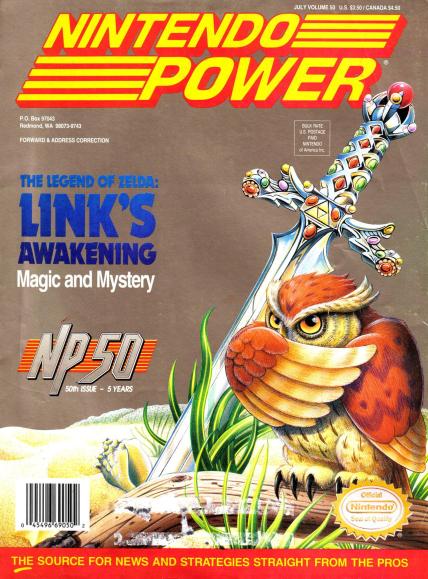
I first heard about Legend of Zelda: Link’s Awakening back when I used to get Nintendo Power Magazine. I remember that day. It was the summer time and the bus dropped me off from camp in front of my old elementary school. My Mom was there with Issue 50 of Nintendo Power that I’d been waiting impatiently for. This is what I saw:

http://countzeroor.files.wordpress.com/2010/10/magazine-nintendo-power-v6-7-of-12-legend-of-zelda_-links-awakening-1993_7-page-1.jpg

This mysterious owl sat near the sword. Originally I was annoyed that my copy of this issue got tattered, but it and the faded tan-bronze cover only added to the mystique that Nintendo no doubt wanted to build around this issue and the game they were featuring in particular. Well, for me, it worked.

It didn’t work in getting me to get the game however. Not initially. And when I did get it I didn’t really have as good a head for puzzles and video game combat strategy back then. By that point, my friend who’d gotten the game before me proudly spoiled the ending: or maybe I asked him. I don’t actually remember. So I don’t know why I picked up the game again years later, but I did. By that point I had a little more common sense and I’d played a few more games. Also, I’d read some philosophy: a lot more philosophy.

You are Link. You are on a ship in a storm that leaves you marooned on a strange Island. You figure out that the only way to get off of the Island is to awaken the Wind Fish in its egg on the top of the highest mountain.

There are puzzles and mysteries and secrets. You have many moments: most of them fun, a lot of them dangerous and you get to know the mysteries of Koholint Island. There are strange people, weird creatures, a talking owl that periodically advises you in riddles, a man who eats things he shouldn’t … and a girl who likes to sing and just spend some time on the beach with you.

I’m going to go into Spoiler Territory right now. Unlike Super Mario Brothers 2 where the “it is all just a dream surprise ending” just seems like a cop-out, in Link’s Awakening it is a gradual realization that comes with some sadness at the end of the game. In fact, the spirit of this game is perhaps even more emblematic of mono no aware–of understanding and having empathy towards the impermanent beauty in life–than even Terrangima.

Then you take the chronology that Nintendo claims the Zelda games all have into account. Personally, I liked the idea that each game in the series was a “legend”: a story with some elements of history but each being an account that has ultimately been changed over time as memory fades. However, in this case, I like that Link’s Awakening apparently happened after A Link to the Past as I’ve understood it.

Let me explain my take on Link’s Awakening and what I feel is really significant about it. From my North American understanding, there were three games before this one–the two Nintendo and the Super Nintendo ones–and all of them involved Link rescuing Zelda and dealing with the Triforce.

Here is how I see Link in this game. He has done all of these heroic things, but after he has completed them, he’s tired. In Hyrule, he is known as the rescuer of Zelda and the hero of the Triforce. If he had a normal life before this, it is gone. Maybe he just wants to get away. Maybe he lost much of what matters to him. Maybe he just doesn’t know who he is anymore.

The fact is, before this point Link didn’t seem to have an identity outside of being Zelda’s hero and the gatherer of the Triforce. Link’s Awakening, despite the franchise title, is Link’s story. It is not only a hero’s story, but the story of a man who journeys into his own subconscious. The owl that he finds on the Island is that part of him–the wise being or animal archetype–guiding him through this inner journey. Every creature and obstacle is his unconscious mind trying to keep him in a state of ignorance. Every time Link reclaims or gains a new item, he starts to remember more of who he is: or begin that process of knowing who he is.

You can  get even more Jungian and say that Marin–the girl he meets–is his anima: the feminine aspect of his mind that reveals things through subtle intuition and actually has him pay attention to the things he has taken for granted in the other games. He plays around, he laughs and he learns to enjoy the sunset and the sentiment that can feel when watching it. He also has to face Eight Nightmares that could represent emotions or attachments: seals of power that keep the Wind Fish–or Link–from waking up, while the ultimate Shadow Nightmare at the very end of the game symbolize the essence of his greatest personal fears and then ultimate universal horror.

He has to gather eight instruments to create music from a tune that Marin sings him to get into the egg that the Wind Fish sleeps in. And when the Wind Fish wakes up … it can fly. And it does.

It is a symbol of awakening: of enlightenment. It is a symbol you would find in some Eastern thought or even in a very mythological way. I know you can easily say that the Wind Fish dreamed Marin, the Owl, the Nightmares and the entire Island: that they were all aspects of its dreaming mind.  Link might even be a part of its mind and it has awakened to another reality. It is a valid interpretation given how Link physically wakes up on a floating rafter in the ocean. Does a man dream of being a pebble or does a pebble dream about being a man? Does Link dream about the sleeping Wind Fish and its Island, or does the Wind Fish dream about a sleeping Link?

The thing is, when I talk about all this, I believe I’m actually talking about Link as a symbol and not necessarily with regards to the ambiguous continuity that Nintendo is trying to make between games. I think, that at that moment above when Link destroys the last Nightmare and wakes up the Wind Fish, he is really awakening himself. At that moment, in that moment, Link is more than just a silent hero that goes around fulfilling tasks and doing what Zelda cannot or will not.

When Link wakes up the Wind Fish, when the illusion of maya that is the Island disappears, when Link regains consciousness: he actually gains consciousness. He expresses emotion through his interactions with everyone on the Island: each one of them aspects of himself. He realizes he has a whole world in himself that is a part of a reality outside of him as well. He experiences mono no aware: that sorrow and acceptance with regards to the passing of beauty in life. In one tiny hand-held 8-bit console with grey graphics or crayon-colours, Link is depicted as having achieved enlightenment and self-knowledge. For the first time, the hero of Hyrule knows who he is. He someone who dreams and is dreamed of. He is an archetype.

For the resources of the time that made this game, isn’t that just … beautiful? I’d really like to think so. I know many of you might think that I am reading too much into this and that it is just a game. Certainly I would not say that Link’s Awakening is a tool for personal enlightenment, though it is tempting to say in a creative sense, but it does depict some cultural depictions of it well. It is a beautiful artifact and I’m glad I knew it. Obviously, if this were an official review it would be getting five out of five.

I would like to leave you with just one more thought. When Link wakes up, it’s as though it was all a dream. When we finish playing a video game, the game is over. We put down the console or turn off the computer and go do something else. Our interactive electronic dream is over. Yet do all of those challenges and experiences: and those touching moments all fade away and mean nothing because they were not physically real? Did they not happen? Somehow, I don’t think so because, even when we finish sleeping, our dreams never really go away.

They continue stay with us. Because dreams are memories too.

https://i0.wp.com/www.projectcoe.com/wp-content/uploads/2012/04/tumblr_legu6rTqGz1qaaf7po1_500-300x269.png

Video Game Review: Terranigma

Imagine a game where you play as a person who needs to create–or resurrect–an entire world. With each challenge you solve, you restore not only continents but the cycle of life and the souls of all living beings as well. Then you find yourself in a battle between good and evil over what you have brought back. You find yourself between two worlds. You find a world awakening in yourself. Things are definitely not what they seem to be and eventually you wonder just what it is that you are fighting for.

You’re not exactly what might be considered hero or saviour-material. In your village, you’re known as a bit of a trouble-maker and something of a brat. You cannot leave things alone and this is what ultimately precipitates your ultimate quest and the strange, terrifying and wonderful places you will find yourself in.

Your name is Ark and your game is Terranigma. Terranigma was an action role-playing game created for the Super Nintendo in the mid-90s. It was never released in America: which is a really great shame, but it was launched in Japan and Europe.

To say I like this game would be an understatement. What I wrote above is merely a summary of a very fun and poignant story. This game has a wide range of emotional depth and covers a whole lot of themes like death, reincarnation, and life itself. I keep thinking myself whenever I think of Terranigma that if there was ever a video game with a Buddhist paradigm, this would be it. I do not exaggerate when I say that you, as Ark, have to create or recreate the world. You also help civilization evolve while becoming a part of it as well.

The character of Ark is interesting because with his mischievous and good-hearted nature and his staff weapon he reminds me a lot of Monkey in Journey to the West: a reluctant god-trickster hero–with something of a magic staff weapon–who is impelled by forces in the outer world to help others. So in some of that sense, Ark does fit the hero archetype. And believe me, this game does not skimp on archetypes or the hero’s quest.

https://i0.wp.com/rpgcorner.pagesperso-orange.fr/Terranigma/Terranigma_art.jpg

This is also an action game. It is not turn-based and you don’t gain spells when you level up. Instead, you fight. You have to think on your feet and adapt to your enemy. Defeated enemies explode into a satisfying cloud and often leave some gold behind for you. There are puzzles as well and those can be challenging but not difficult. I confess that when I played the game, I looked up a lot of guides to help me through it because I wanted to see how the story unfolded more than getting stuck in places at times.

What else can I tell you? The areas that you visit are great … fond stereotypes of places that exist in our world but they are fun to interact with. I wouldn’t learn history from this game though, just to warn you, but just take it as it is meant to be: a game with its own logic.

All this said, I feel I should definitely mention that in addition to its lush 16-bit graphics and memorable characters, Terranigma has one other very great element: its music. In fact, its music does what any video game music should: it complements the story and the characters. It is integral to the emotional complexity inherent in the game. The music can be playful, grandiose and conflictive, and sad. Really sad.

But there is something about “Terranigma Sadness” that is different. It portrays this … transitory sorrow, this acceptance of loss and gain as a cycle of life. It–and really the entire game–has this resonance with the Japanese concept of mono no aware: an awareness or an empathy towards the impermanence of life. You can really hear it at towards the end of the main musical theme in the above link. It reminds me of an old man dying peacefully in his sleep under a sunny tree or an unnamed and unsung warrior resting after a long life of battle: leaving forgotten but satisfied by the depth of his life and accomplishment.

As I mentioned before, the spirit of the game has an almost Buddhist nature or a distinct link with some aspects of Far Eastern culture: a perceptual lens which has a very unique way of looking at the world.  Being able to combine these elements with fun gameplay is a mark of genius as far as I am concerned.

All and all, after a few years of not playing this game, I would still give it a five out of five. A friend sent it to me and it only reinforced the fact that I’m glad I got over my reluctance to play old games. No, this isn’t an old game. Games like Terranigma are never old games. No, this game is a classic, and this is what a classic truly is.

I’m going to leave you with this last video. I don’t know how long it or the above link will be on here. The following was a fan video created by one TheStarOcean. I thought it was lost forever years ago and while it doesn’t use the original track, it truly captures the heart of this game. Do not watch if you don’t want spoilers and you want to play this wonderful game for yourselves. If you have played it though, I hope you will enjoy it for what it is.

In the Superheroes’ Playground: ItsJustSomeRandomGuy’s “I’m a Marvel, I’m a DC”

I don’t remember how exactly it was I found ItsJustSomeRandomGuy. It must have been me looking for material on YouTube with regards to Watchmen or some comics related thing. You know: when I was either researching for my paper or indulging in one of my favourite past-times.

You all probably know and remember the old “I’m a Mac, I’m a PC” commercials. Well, RandomGuy did a spoof of that: with superheroes. He created “I’m a Marvel, I’m a DC”: where he animated action figures of heroes from different franchises comparing and contrasting themselves as well as bantering and even sometimes finding common ground.

The sample below is the very first skit that I came across:

What I like the most about these skits–which are highly satirical pieces that often break the fourth wall–is how JustSomeRandomGuy captures the personalities, and the voices of the superheroes that he represents through his collection of action figures. ItsJustSomeRandomGuy himself is a voice actor and teacher and it shows. Yet it is more than that. The fact of the matter is that he is also extremely well-versed in DC and Marvel story-lines, the comics franchises, and the medium itself. He also brings an incredible wit and creativity all of his own to what he has made.

As he goes on, ItsJustSomeRandomGuy actually begins to build story-lines of his own from the simple skits he began with. The arc begins with After-Hours, followed by Happy Hour and then the Zero Hour that’s still in progress. It is really fascinating to watch this evolution happen: from the usual two figure-skits–partially stop-motioned or edited–to full on interactions between figures from the Marvel and DC Universes.

It’s what a lot of us geeks did when we were children. I mean, let’s face it, a lot of us played with our doll–action figures, making voices and then new story lines for them. But JustSomeRandomGuy takes this–this same love for the superhero and villain toy-box–and does something really wonderful with it that I’d not seen too much of. He essentially, like I said earlier, creates a satire of superheroes with these figures. Yet at the same time, he keeps them in character–with a few humourous exceptions that somehow mesh well anyway–and captures their essences.

Watching these characters interact reminds me of all the Saturday morning cartoons and comic books and actually makes me feel good about myself just by watching them. They are my old friends from childhood–on my cards, in my cartoons, movies, and comics–but at the same time they have kept up with the times and have their own changes. Yet they are for the most part still fundamentally the same: while being very aware that they are actually comic book characters. I like this kind of meta-fiction and the fact that, yeah, if anyone would be intelligent and experienced enough to know that they are characters it would be these guys. Just how many universes and realities have they already been in themselves within their own stories?

ItsJustSomeRandomGuy gives back the Saturday morning and afternoon wonder, but also it also let the heroes and villains grow up with us: the slapstick accompanied by a certain degree of seriousness and the meta-fiction and fourth-wall breaking always placed under Marvel’s much lauded sense of, “Continuity! Issue #Etc.”

ItsJustSomeRandom Guy recreates and creates a golden magic that I am glad I came across. It’s nostalgia without the bitter part of the sweet. It continues to evolve with more hilarious parodies and touching messages.

The fact is, in my opinion, ItsJustSomeRandomGuy is a genius. Through the posing of these toys, he manages to cover issues from inter-character relations, different universes, the nature of and the issues surrounding comics, the effectiveness of the films around the comics, and a whole lot of popular cultural references while never making these self-reflexive heroes anything other than what they are in a series that knows exactly what it is.

If I had, say, two requests of ItsJustSomeRandomGuy–if it is in his power at all–and if you are reading this ItsJustSomeRandomGuy I’d say this. I would love to see an episode with the figurine of Animal Man in the Grant Morrison understanding of the character.

And I would love to see an exchange between Miracle/Marvelman and the rest of the Family–or even Shazam, Captain Marvel, and Superman–talking about the series that has not been published in forever. I would love to see your take on that if you have the figurines (of which I know the Miracle/Marvel Family are rare now and expensive and I do not know the legal elements involved, so I hesitate in asking this). But as a fan of yours, I simply can’t resist asking.

(And there is a custom-made action figure of Miracleman. I think only the Todd McFarlane statues were made, which is a pity)

For those of you who have never watched any of these YouTube videos and just want to surf through them, here is ItsJustSomeRandomGuy’s channel. They are worth every moment.

So to properly conclude this, I would just like to thank ItsJustSomeRandomGuy for his work, and leave you with this message.

So remember kids: the moral of today’s story is that continuity is important. Thank you, and Excelsior!

Creativity and Academia: The Glass-Bead Game That Never Ends

It’s amazing–to me–that I forgot to talk about this at all in my review of Hermann Hesse’s The Glass-Bead Game. I was originally going to write this as an addendum to the piece, but then I realized that the issue I want to address actually covers some much broader ground.

One that that is always stressed in Hesse’s novel by the Castalian Order that developed the Game is that it is not their role to create new things. Castalians are not supposed to be artists, but scholars of a spiritual bent and–according to them–anything that comes from the Game is simply to be contemplated and there is great discouragement against changing the rules that create and make up the Game proper. Basically, the Game itself seems to have been developed from pre-existing knowledge and there is usually great resistance from the Order itself in altering any of the rules or guidelines that were made to create it.

However, it is not only this. As I said before, creativity apparently is discouraged in Castalians in general: but that is simply not true. At one point in his studies, Joseph Knecht is encouraged–like other developing students in his Order–to write creative pieces about what they could have been in their lives. Also, he makes many changes to the rules of the Game even before he is Magister Ludi and they are accepted. Knecht could–of course–be the exception due to his gifted nature and not the rule–but it goes further than that.

To combine different disciplines together to create different patterns of expression is creation. There is analysis and study involved, but there is a synthesis of the parts into something new. Therefore, even during Knecht’s time before his reforms and his demise, the Glass-Bead Game–a contemplation exercise of intellectuals and academics–is a creative venture.

It reminds me of why I chose to pursue the Humanities at my University and why I pursued them in the way that I did. I learned about a great many things to do with literature, philosophy, history, social theory, and even to an extent art and expression. My program was by its nature very interdisciplinary and it looked not only at how certain philosophies and conventions work, but what forces make them and why.

Humanities also encourages scholars or humanists (as they are apparently called) to apply a plurality of “lenses” or “frames of reference” to a particular subject. For instance, when looking at a book we would look at the history of the culture that it was written in, the philosophical movements that existed then, the potential other sources that might have influenced its creation, the writer’s life, and how that book influenced other books and other cultures even and what the implications of what that book says might mean and how it might have meant different things to different people. So instead of looking at it from one view or lens, the theory was that we were to look at a thing with different mental tools or perspectives. We are even encouraged to look at how those tools and “lenses” were created: and why they exist the way they currently are.

All of that can be really difficult to articulate and sum up into a few sentences. Indeed, when people asked me what my Major was and I told them it was Humanities, more often than not they didn’t know what I was talking about: or they had a very different understanding as to what the Humanities actually is. For instance, the University of Toronto’s Humanities is different from York University’s: in that the former has certain divisions of Humanities, while the latter has an entire program that combines all those elements together: or tries to.

The fact is, for me, it often seemed like my Program–and maybe even Humanities as I know it–seeks to justify its existence by trying to be a discipline like Science or English. Sometimes even I feel it is just a “jack-of-all-trades while mastering none” perspective or that I personally just possess a whole lot of “party-cocktail trivia” and nothing more compared to the specialists of different fields. Personally, to make a gaming digression, I think of it as multi-classing and spreading certain dots or numbers of Experience Points out that–while it may take a while–will eventually pay off a very well-rounded character.

My role-playing game analogy and tangent aside, sometimes I felt like–just with the Glass-Bead Game of Castalia, the Humanities is very stringent on its guidelines of scholarship and what scholarship is because it is a “relatively young” discipline as we understand it and it wants legitimacy. The thing is I think both are already legitimate and allowing for flexibility in what scholarship and academia can be–by allowing for change–they distinguish themselves. I know sometimes I really wanted to say that I shouldn’t have felt like I had to apologize for my choice of Program and–more specifically–the Humanities shouldn’t have to apologize for what it is.

As an interesting side-note, apology originally was derived from the concept of defense: defending your perspective through logical debate known as argument. I also think there are many other ways to make your point instead of being defensive or not testing what your discipline–or your medium–can do. Film and comics were very similar to that regard in that both wanted to “fit in” and be accepted but they are different. I know I’m making a lot of very potentially bad analogies here in equating disciplines with media, but in my mind they are very similar if not one and the same.

What I love about the Humanities is that it let me put so many things together–it let me be analytic and synthetic–and I think I had more opportunity to do so in that discipline than anywhere else. I got to look at my favourite authors and writings. I got to analyze some of my own stories in a final paper. I even wrote a comic book script as a final assignment in another course: using my knowledge of the course material and comics media. I know York has an Interdisciplinary Studies Program as well where students are encouraged to do independent work and even create art as their final project.

As you can see, I feel very passionately about this. I think that gathering and critiquing knowledge is important, but that once you try to look at the why of something–to contemplate it and its application to yourself … to look at the human in it–creating something can be just as important. I like that my Program allowed me that freedom, for the most part, and it’s just amazing how The Glass-Bead Game applies to so many of these issues that I’d been thinking about for a very long time now.

I firmly believe that when you make a work of any kind, you create knowledge: and that viewpoint challenges not only what scholarship is, but what art is as well. There was a time in history when apparently there was no division between what was art and what was science. They were all apparently unified under Philosophy along with a whole other lot of disciplines we separate and specialize now. I’m obviously not saying that other disciplines are not as important or that their distinctions should be eliminated: specializations can be very important because they focus on a particular subject or task quite efficiently and with necessary detail.

But I like the differences in the discipline I chose and that potential for growth that I always felt there. It certainly feels like it fit my mindset: at least at the time. The best part is that even when school is out, you still keep learning about the Humanities. You can still keep making things. The Game doesn’t end after you graduate college or university. It doesn’t end when you leave Castalia for the unknown. You keep playing and, you know, I think that is a very good thing.

Book Review: Stephen Andrew Lee’s Tales from Sanctuary: The Vampire Sex Bar

I’m trying to figure out how to begin this. Originally, I was going to talk about this book on Amazon but–back in the day–it had no entry to make a review about. This book is out-of-print. Its publisher Spitfire Books doesn’t seem to exist anymore and the author didn’t seem to have written any other books after this one.

For a book I didn’t even know existed up until four summers ago, it impacted me a lot and carries more resonance than I think most people in Toronto realize. First, before I go on let me give you some background. Sanctuary The Vampire Sex Bar is, as the name of an old Goth nightclub, a misnomer. From what I could tell, no sex happened in the club at all: though it was one of the first Goth nightclubs in Toronto. It was opened by Lance Goth in 1992 and it closed in 2000. The Club itself divided into the Bar above and the Catacombs, fittingly and sensibly enough, in the basement where it was apparently an all-ages space.

This was a time when Goth Nights and indeed the whole subculture was at its peak in Toronto: specifically in the Queen Street West area. There was a very interesting Goth fashion store in that area called Siren and a whole other series of clubs, but Sanctuary lasted for a very long time until its last location became a Starbucks. Sanctuary’s time was also a time of Buffy, the Toronto-based Forever Night series and the old World of Darkness’ Vampire the Masquerade: which I mention to create a little more ambiance before I go on.

Now, as for Tales From Sanctuary: The Vampire Sex Bar the book, it was created in 1997 by Lance Goth: also known as Stephen Andrew Lee. Like I said, I had no idea who he even was or what this book was up until four years ago. I only periodically went downtown in my teen years–to places like the Vatikan or Velvet Underground, even the Bovine Sex Club (another aptly named place, I wonder if anyone will or has written a book on that)–and when I moved out to live on York residence I went to the Neutral Lounge about once a week every Friday for their Goth Night.

So I came into all of this at the remnants of the tail-end of this whole time. Then one day a friend let me read her copy of this book. Apparently, during the late 90s when it came out it was easy to get copies of the thing but now it has become very difficult to do so. So here is my challenge: I want to talk about this book and not give away spoilers on the off-chance that someone can access a copy, yet I also want to give people enough information as to what I’m actually talking about and I feel kind of foolish reviewing a book that people most likely haven’t–or will never–read. But I will do my best.

Tales from Sanctuary is a collection of stories. Each story starts off with a quote of some kind that fits its tone. There is no Table of Contents so you just have to read through them really. I read most of the first story, “The Wind-Walkers” at my friend’s place before I actually ordered my own copy of the book from Alibris.

“Wind-Walkers” is the story of two last remaining members of a long-lived winged humanoid race that fed off of human blood and flesh. They once ruled a kingdom of human worshipers which was betrayed to the Roman Empire by someone they trusted. After being violated, and one of them also mutilated, the two hide for millennia until one day they find Sanctuary and learn to trust again. This story dominates a good seventy-eight pages of the book and it is not without its flaws. The grammar is atrocious. I recall there even being a few spelling mistakes as well. In addition–in the long scene where you see a flashback into the Wind Walkers’ past–they speak far too anachronistically. At the very least, some attempt to make the speech sound more formal or archaic could have gone a long way to suspend that portion of the necessary disbelief I needed to think I was looking at ancient vampiric rulers of Nabatea.

Yet we begin to see here an interesting concept: that beings with monstrous appetites can be sympathetic, even pitied, or emphasized with. Lee actually makes thinking and feeling characters of these Wind-Walkers and I know I wanted to be happy for them. It made me think that they weren’t human and it was not completely fair to hold them to human standards, but at the same time it showed that there was some pain and some compassion and understanding that transcended all of that. It was a bit awkward even there, but through them you begin to experience the club of Sanctuary: that strange dark place of mysteries and humanity where you feel with them as they actually feel like they fit in somewhere in human society after millennia on the run.

At the very back of the book, Lee explains all of his inspirations and some of his methods in crafting these stories. What is fascinating for me is how he crafts a mythological Sanctuary. It is obviously based off of his Club–under his persona of Lance Goth–and perhaps even people he knew or knew of. He plays with the idea of someone from the Goth subculture not feeling like they belong and that Sanctuary is not only a place for them, but also a place for supernatural beings–sometimes understated ones–that feel the exact same way. Lee mentions that when crafting the scenes that lead up to each character going to Sanctuary in each story, he actually amalgamates places from other cities into the background: adding to Toronto’s geography in that way. I don’t know how I feel about that because I hadn’t lived in Toronto city that long and I was–and am–still discovering a lot about it. But he does begin to capture a certain kind of spirit, if you will in that first story and in how he writes this.

So then I got my own copy of the book and proceeded to read through the rest at a relentless pace. In “The Cold Ones,” we see a story about another vampiric group: specifically three sisters that seem to frequent a dark corner of the club and come from a mysterious place with a cab fare of $14.95. Now, this story is from the point of a view of an ordinary person and apparent-staff member of the Bar who gets drawn into the world of these sisters’ and actually is called upon to help them. Again, there was something awkward about this story and while I know that revealing all of “the monster’s” background might be considered “info-dumping,” there were references made such as “the Weir” that in retrospect I kind of get (a thing that traps something) but I wasn’t sure at the time. Also, I’m not a geographical expert but I would assume that Mount Pleasant Cemetery is much farther from Queen Street West than the book portrayed. Still, there was something very compelling in this story in how something can be horrifying, and beautiful, and relatable while still very much a mystery.

I really liked the story “Lillith” which actually has references and a list to various kinds of plants … some of them potentially poisonous. It is about a young woman living downtown who feels awkward in her skin and is terrified of physical and emotional danger. Then something really bad happens to her and she eventually finds she has a problem: a very real and human problem. It’s only at Sanctuary: at a place of seemingly strange people and monsters that she finds a place where she actually feels like she actually belongs and feels safe. There is a bit of a crossover here with characters from an earlier story too and I was glad she got to meet them under those circumstances: and that it let me know what happened to those characters in the meantime.

I related to “The Elixir of Love” in a somewhat different way. It actually comes after “Pins and Needles,” but I wanted to mention it because it was a nice contrast to “Lillith.” It was a story about a young man who thinks he finds love and gets introduced to an eerie and then rather heart-breaking reality: where even if you support the idea that there are different rules for different beings, it isn’t just humans that can be shallow “douchey” people. The last is rather banal, but makes it no less painful for it. In this story, Sanctuary is less of a place where he belongs, and more the site of a humiliation and that sense of cognitive dissonance where you think you have found happiness but it is really the loneliness of a gritty past 4 am downtown night. It was somewhat unsettling, but captured what a friend of mine calls “moments of painful clarity” rather well. Both Lillith and Jayson are very self-conscious characters full of real fear and desire–that do not feel like they fit in–and when they find Sanctuary they meet two entirely different ends.

“Pins and Needles” was a disturbing story, but the build-up of the main character’s development into a self-proclaimed “doctor of bad blood,” is well done and is a nice study into morbidity and “a certain point of view.” Finally, there is “Ricky Las Vegas”: a story about a talented musician that only vaguely wonders why his bands keep disbanding, his friends disappearing, and why Lance won’t let him sing at his Club. It is only towards the end of this really short story that Ricky realizes what he is and what he will do from there. I really liked this story in particular because it deals with psychic vampirism and creativity and how they can be related.

Throughout all of these stories is the presence of a fictional Lance Goth who seems to have some mysteries abilities to sense people in his Club and even come on them without being detected. He is usually the catalyst for the characters wanting to tell their stories or find some information that is integral to us for the plot in some of the stories. He usually takes some small mementos from each person he tells things to, or has told to him. It took me a while to realize that Lance actually existed, and that he was actually Stephen Andrew Lee because I can be dim like that.

All and all, Tales from Sanctuary was not the best-written book or series of stories I’ve ever read. I had immense trouble suspending disbelief for “Wind-Walkers,” no matter how fascinating an idea it was. However, this book did something to me. It is hard to explain, but if I had to put it in writing I would say that it showed me the spirit of the Toronto Goth Nights that once existed or wanted to exist: a night that once flourished until morning came yet still existing somewhere in the city’s cracks. It showed me magic in an urban place that I lived in and in that way it did change me.

For one thing, it made me begin to write about Toronto. I confess I actually wrote three stories based on Tales from Sanctuary–The Wrong Club, To the New Millennium, and Another Time–and I wish I could locate Lee to thank him for making these. I bought a copy of the book for a friend that lost her own years before and it was worth it too to share even some of that understanding. If you are keen on reading a copy and you don’t have a friend with access to it, there are some that were being sold as Used on Alibris and Abebooks. Amazon itself is even advertising a seller that will sell a copy for $998.00, but personally I would check those other Used Book Places first or wait.

For all of its idiosyncrasies, I think that Tales from Sanctuary is an important part of Toronto’s subcultural history that now lost place where as the back cover tells you, “You can hunt, but you cannot feed.”

I give this strange book a three out of five.

The Galvanizing of Creative Cuttings, Writing Perfectionism, Amazon, and Art Coming Soon

It seems I’ve been writing more reviews than creative insights lately: which is fine. The fact of the matter is that everything I review on here inspires me–or informs me–in some way to become a better writer. I keep building from that.

But when all that’s all said and done, it’s always good to sit back and look at exactly what it is I’m trying to do.

There have been two or three things on my mind lately to that regard. The first is that I finished writing another Miracleman/Marvelman fanfic tribute, but I don’t quite like how it came out. There were a lot of things I wanted to say in it–as well as display with a very neat and clean narrative perspective–but it didn’t quite get there. I got all my ideas down and some really good lines but I feel like the overall story is a little blurred.

It is frustrating to have a story stuck in your head for a while and then–when you finally get it out to free up your mind for other works–it isn’t quite as clear or “as good” as you wanted it to be. Of course, the natural solution to this would be for me to type it out and rewrite it. They say that a large part of writing is rewriting and that is true even when you write it out right the first time around.

I also wrote out an original story that I had in my head almost as long as the other one: one I wrote a great many notes for. Of course, one of the pieces of paper where I wrote out this really beautiful quote–in my own opinion anyway–got lost. Yet the story still wanted to be written down. You see, unlike that TED Lecture where Elizabeth Gilbert talks about a genius-spirit flowing through you, I think that I create my works not unlike Victor Frankenstein in a hopefully more intelligent way: I get the genius in me, but it comes in pieces sometimes and then I have to grow these “organic pieces” into something whole. Sometimes they do it almost on their own and it can be a wonderful, smooth ride, but other times I have to guide and manipulate them.

Sometimes the spark or the current is easy to translate into words on paper, or on a screen, while other times I have to do my research and add and take things away as I go. So yes, I guess in a way I fulfilled my childhood dream of being a mad scientist.

I guess that’s a nice analogy because this Blog was started as–and is still–one great experiment for me. I can see the cuttings of the things that I say and write continuing to coalesce into an overarching creature. Aside from the different energies and perspectives I put into creative works, or journal entries I make them more or less the same way.

In other news, I am still continuing this Blog experiment. I have smartened up a bit and I am now scheduling some posts in advance: just so that if I run out of things to say or think about I will have something on here for everyone to read while I figure things out or do something else in the meantime. I was told that I should pace myself out and that it is good advice and that is exactly what I am going to do.

Also, I did end up–as the title above suggests–affiliating myself with Amazon Associates. I haven’t put up any banners as of yet, but I have been linking to products being sold by Amazon. The fact is, and I will be honest, I could use the money (don’t we all): so if you want to buy one of the books or things I talk about in some of those reviews, or even want to get something else I would appreciate you getting something through one of these links. Perhaps at some point, I can even change this Blog into matthewkirshenblatt.com this way or even one day sell a book I create through Amazon. So whatever help you can give me I would greatly appreciate.

Lastly, I believe I will be part of a new creative collaboration soon. Do not be surprised if you see samples of said collaboration at some point in the future or–as I said elsewhere–I might be making Art again: sooner than you think.

Take care everyone.

Dreams of Lost Pixels, Hand Eye, and More Video Game Ramblings

I know I’ve said this before, but I am not a video game expert. Like I’ve said, I’ve played some video games in recent times but I have been very eclectic about what I will play, or even watch being played. It doesn’t mean I hate them and I do keep track of some that really catch my eye. I’m very partial to role-playing games and the only reason I hadn’t played as many as I would have liked is because I have had issues with time and money: in that I don’t always have a lot of either.

But I am interested in video games: specifically their game-play, their story lines or premises, and their choice of aesthetics. I like the idea of an interactive story that can translate itself or spread itself across multimedia.

I don’t say this often, but at one time I wanted to be a graphic designer in order to make video games and animation. Unfortunately, I didn’t really have the programming skills and the teachers that I had couldn’t teach me in a way that I could engage or absorb. It’s funny because, once, I really used to love technology. Some of you might laugh at this: those of you who know me personally. I used to think that video game technology, for instance, along with the Internet and computers would only get better with time and it could only go up from there.

I’m not sure what happened. I think I was into PC games a lot and I never had a good enough computer. I also didn’t want to get sucked into online games and I saw the quality of some console games change and not for the better. Also, in my How to Turn a Medium into a Genre I mention how I felt a misguided amount of shame for playing “old and obsolete childish games.” I’m also glad I really got over that nonsense. I do think the real reason I don’t like to play many video games is because I know I will get invested into them if they are really good and I get worried about losing time and also getting too … attached to something: to the point of being sad when it is over, or upset when my skills fail me past a certain point. Sometimes, as weird as this sounds, I get concerned about caring too much about a game.

Now, let me say this: I was really happy to be at the Comics Vs. Games element of TCAF this year. I really loved just playing some of the games with some person I just met there. It felt different and new. To make this story, if you want to call it that, even more interesting as a person who has not played a lot of contemporary video games and likes to watch a lot and remember old games, I have been interested in writing plots for and–really–just writing video games.

I know: now I am just a paradox. Now before anyone starts to tell me how foolish these thoughts are, I am aware of that. I have read and heard enough from some people in the industry–or who are getting into it–to have a little bit of an idea as to how hard it is to get into the industry and to do the amount of work and research to create a game. It isn’t something to do on a whim.

So, like I said, I came across Comics Vs. Games and saw this situation where artists were being paired off with video game creators to make games together. And … I don’t really know what to say: something in me just felt really happy to see that. Another part of me also felt immensely jealous because–once–it was a dream of mine. I am a writer. I have not really published anything for monetary gain as of yet and I am not exactly at a stage where my writing is popular. I know I am not there yet.

So I went back on to the above website and saw that Miguel Sternberg–the indie game designer and pixel artist who organized Comics Vs. Games–has been working on a new project. You should definitely check out his page Spooky Squid Games because there are a lot of very innovative and intriguing goodies on there that you probably all know about because you’ve kept with the times: including the game Guerilla Gardening: Seeds of Revolution where the object of the game is to play as protagonist Molly Greenthumb who gardens to subvert a totalitarian regime. Essentially, you grow plants to not only improve your city, to make it “green” again, but to also allow provide morale to other citizens to peacefully overthrow the State. It sounds like a cheerfully subversive game that creates a social commentary about our own culture and also refers to a few similar instances of this phenomena that have actually happened in our world. In fact, it has resonance with Roger Doiron’s TED Lecture My Subversive (Garden) Plot.

But the game that has really gotten my attention–just today–is one called They Bleed Pixels. God, I can’t begin to tell you just how beautiful I find that title. Imagine a pixelated Goth girl character who can change her hands into claws as she goes and kills creatures with pixelated stylized violence and blood. You literally see tiny squares of red gush in fountains as she creates combo attacks–with numbers appearing above them–in midair sometimes. I really like the deceptively simplistic aesthetic and the music suits the background.

It makes me genuinely happy to see something like this. There is also another interesting gameplay element in that “save points” have to be made by you and you have to expend your own points gained in battle to make them. In other words, it costs you to make save points and makes the game more challenging and forces you to be more versatile. It makes you interact with that world much more: giving you the power to manipulate your reality but also having to play by the ad-hoc rule you make for yourself. The controls are apparently very easy and precise to make without having to resort to ridiculously complicated button-mashing to fight, though I am just repeating what I have more or less read. Also, I read that they are making a silent comic to tell this character’s story about her interaction with a Necronomicon-like book and beyond.

I would definitely play this game: if only to relieve some blood-lust, which is always a plus for a game in my opinion. It might not be an RPG, but it looks fun and I like fun.

You know, sometimes I feel like I’m a fake for writing about video games and other things of which I do not have expertise. But do you know why I am writing about this? It’s because it interests me. It is partially the world-building and interactive parts, but it also appeals to a part of me I don’t always get to express. I’ll let you in on a secret too: I actually wrote a very rough script for a RPG video game: one that would definitely need a Restricted Sign if I ever posted it serially here or anywhere else: if only because of its sometimes tasteful, though definitely (if somewhat questionably) mature content. It was a 16-bit game with some ideas for interactive game-play. I actually think of it as a parody of an RPG video game script with a lot of meta-narrative fourth-wall breaking.

I’ll also say this: if I ever get to the point where I am considered a professional or well-known “artist of words” and someone ever offers to do a video game collaboration with me, I will probably not turn them down. In the meantime, I have been looking at the Hand Eye Society which is a non-profit organization that deals with organizing video game projects and supporting Toronto’s video game community. I’m not sure if they are still having socials, but they have mentioned volunteer opportunities on there and I am contemplating finding out more about this.

I may well be an amateur writer and general enthusiast, but when I look at these links I realize that these people do things with the medium of a video game that I never thought possible or really thought about and I think that is just bad-ass. I also really love creative things and it would definitely be something new. In any case, it is something to think about. I hope that this has been an interesting, if somewhat long post.

The End?