Tattoos and Swordplay: Or Musings on a Watcher-Immortal War in Highlander the Series

Now for another geek moment and an old television show.

File:Duncan1-1-.jpg

So after my post on Who Watches the Watchers, I was thinking mainly about the Watchers from the series Highlander. If Immortal sword battles and decapitations are The Game, then the Watchers have always been its shadowy audience of spectators. Be warned, I am going to be making a lot of references to this show as this post goes on.

Essentially, the Watchers were a secret society created in about the time of ancient Sumeria to observe Immortals–human beings with eternal lifespans who can only be killed by beheading–and record all knowledge of them. They have a code that forbids them to reveal information about Immortals to the public, and also of their own existence to Immortals. They recruit from a variety of fields and are essentially a glorified and ancient intelligence service of field agents and researchers.

For a spectator-sport of Immortal-watching, this would obviously take a lot of resources to accomplish. Now, here is the thing. In Highlander, the Watchers have three challenges. The first is to make sure they are never, ever discovered by Immortals or the rest of the mortal public. As such, they do not want any of their lore or information falling in hands beyond their own network. The second is to never interfere with Immortal battles or conflicts, but to merely observe them and never get detected. All right, fair enough. Then there is the third task that they have: to make sure that others not only never find out about their group, but also the very Immortals that they are studying.

But how do you explain the bodies?

Yes. There are natural causalities from The Game: mainly the decapitated bodies of the Immortals that lost against their opponents.

So what happens with that?

In ancient times, when wars were fought almost all the time with swords and sharp blades, and when there were much wider and unobserved spaces either no one gave a thought to a beheaded corpse, or there was a more than a likely chance that they would never find it. Also add to the fact that little conventions like democracy didn’t always exist and people would turn blind-eyes to vigilante mobs, and government pogroms and executions alike.

Unfortunately for both Watchers and Immortals, things have changed. The media now exists, forensics has developed to the point of being able to identify tiny fibres of material and DNA, there are much more extensive public records kept and so on. One thing that was always mentioned in Highlander was how the ability of the Watchers’ resources towards secrecy has dwindled down considerably in the last century or so of information technology.

So what about those dead, decapitated bodies? Because nowadays, not only would they be found but there would be investigations. Pretty soon forensics specialists and police, as well as Interpol would find a pattern developing: some kind of ritualistic killing that seems to span across the world. I can also more than imagine that–say the Watchers have agents on the inside of law-enforcement to discourage such investigations–that someone would eventually ask questions.

All they would need is to find someone, or several someones with a purple almost cult-like Watcher’s tattoo on their wrists, order searches onto their properties, analyze their computers, find evidence carefully collected by said Watchers–who not only sat back and did nothing when these killings happened, but actually recorded them for some unknown purpose–and then go into the homes of Immortals–who they would probably think are “champion serial-killers” in a Watcher-sponsored arena of death for entertainment purposes–and start DNA-testing their swords. It would go downhill from there.

So why didn’t this happen at all in the show? Well, I think it’s very simple. You see, I think that not only did the Watcher network have agents in the media, law-enforcement, politics, medicine, education, and business, but I think they were directly involved in disposing of the bodies.

That’s right. The very organization in the show that went on about non-interference in Immortal battles and mere observation most likely were the ones to get rid of the defeated Immortal corpses. That is the only thing that makes sense, because otherwise there would have been a massively historical international hunt going on.

This also means that the Watchers have a lot of power and they aren’t exactly neutral. They would know that if those bodies were discovered, or the documentation on them weren’t doctored in some way, and Quickenings weren’t played down in the media as strange electrical weather disturbances, their Watching days–and their freedom–would be pretty much over.

So really, in a lot of ways the Watchers are pretty complicit with The Game of Immortals and they know that if the Immortals were ever discovered, chances are they would be too. Now, in Highlander itself, there have been occasional times when some Watchers rebelled against their own code and became Hunters: actually killing Immortals themselves. In a lot of ways, if the whole organization became Hunters it’s argued that they would pretty much fuck up all known Immortals everywhere. They know a lot about their pasts, their assumed identities, their properties, what they had to eat for breakfast that morning, their strengths, their weaknesses and all of that. Intelligence-wise, all the Watchers would have to do is put the right information in the right places and arguably let the governments do their work for them.

There would be complications however. For instance, Immortals like Duncan MacLeod and Darius have figured out–on their own–about the existence of the Watchers. It stands to reason that beings that are always being hunted by their own kind for their Quickenings–or essences–or by people in the past that liked to kill “witches and demons,” that they would have developed sixth senses about being followed, or if one of their mortal companions had … other affiliations that might concern them. And these are the nice Immortals.

I’m not even going to go into Immortals–like Kalas who found out on his own that there were Watchers–that wouldn’t hesitate to use torture and murder as their tools to get more information. And a lot of really old Immortals have their own resources and contacts: along with some alliances with each other. In addition to that, not all Immortals are documented or discovered yet. Some are very young and haven’t even died for the first time yet. The Watchers would need a seriously sophisticated network to keep up with that last fact. But there is more: because if a few Immortals could have discovered the Watchers, they might have been pretty circumspect about what they themselves know and deliberately planted false information of their own. Some, like Methos, might have even go as far as to infiltrate their ranks.

At the very least, it’s also been known in the show that some Watchers might have even been approached by the people they were told to observe and they might have their biases. It’s not been unknown for a Watcher to give out classified information to an Immortal that they like: and I am not just talking about Joe Dawson and Duncan MacLeod.

So really, I guess I’m talking less about the nature of the Watchers’ “neutrality,” and more about what would actually happen in a Watcher-Immortal War: an idea I got during one episode of Highlander when Duncan MacLeod was almost seriously facing down that prospect. It didn’t happen, but it easily could have.

Originally, I would have been tempted to say there would be an even split between the two, and for the most part there would be. I also think there would be factions. There would be Watchers that would withdraw from the whole conflict and preserve what they can: mostly dedicated Researchers. There would be Hunters attempting to use their own skills and governmental resources to create pogroms. There would be Immortals using their resources and bounty-hunters to hunt down anyone with a purple Watcher’s tattoo. While one faction wants heads, the other might want severed forearms as proof of jobs well done.

There would also be Watcher and Immortal alliances: some wanting to help an Immortal win The Game for power and glory, and others just trying to help each other survive. The young Immortals would be alternatively tools for various factions, and even their own agencies: seeing as most of them would not be documented during the chaos of such a War and can take advantage of the conflict as well.

It’s also possible that the governments and corporations would turn on both and both secretive kinds of beings–Immortals and Watchers–would be on the run from scientists, overzealous military and paramilitary organizations, terrorists, religious fanatics, and mobs. A shadow war would quickly become an overt and very nasty mass-conflict with the nature of what humanity is itself as the ultimate prize.

But when this is all said and done, I would just like to state that I would definitely have watched a film or a television show based on the concept of a Watcher-Immortal War. In fact, I would even read a book or fanfic based on this idea. Anyway, that is my major and one of my most long-standing geeky thoughts at the moment.

Who Watches the Watchers?

I suppose the title of this post is really rhetorical in that the question already has an answer. We do.

In case you were wondering, this article isn’t about Watchmen. Instead, it’s about Watchers. You can find the idea of them in comics, film, television, and various other media. They are depicted as either very powerful enlightened beings, or hidden organizations with more knowledge than most people. You can find them as a race of cosmic beings with large craniums within Marvel Comics, a secret society of men and women that observe Immortals in the Highlander television series, and even the Ascended in the StarGate series.

Aside from their great power and knowledge, Watchers generally have one more thing in common: they have some sort of code that permits them to observe but rarely–if ever–interfere with the existences of those either “beneath” them, or unaware of certain facts of life. This idea can also be found in Star Trek‘s Prime Directive: where by law the Federation cannot interfere with the development of civilizations that are not as advanced or as cognizant as those of their member worlds.

This means that this agreement of “non-interference” not only prevents these powers from abusing their abilities, but also helping others with them as well. Of course, as I’m sure something like TV Tropes will point out, there is always a conflict of some kind with regards to said beings following these codes and also certain “bending” and “tweaking” of the rules from time to time. Certainly, there have been instances in Star Trek itself where more powerful beings have more than interfered with “lower planes of sentience” … and I’m not just talking about Q either. I mean, you could argue that the Enterprise and the Federation it represents have evolved to the point where certain advanced beings can safely–to some degree–interact with them without causing permanent harm, but there is a really fine line there. It’s also not really what I want to talk about.

No, I think this trope of non-interference has always bothered me on a creative geeky level to some degree and I’m going to try to explain why.

Basically, these advanced beings or secret organizations–who dedicate themselves to observation–do not want to harm anyone intentionally or otherwise, or endanger themselves and existence as they understand it by “interfering.” But my issue is three-fold. First of all, if you follow Einstein’s theory that an observer of an event is also a participant–that an experiment is affected by the mere presence of an observer–then these beings “interfere” all the time simply by existing. If you have a certain amount of power–of any kind–or a presence somewhere it will affect your surroundings. I mean, yes, there is a big difference between sitting and doing nothing, and acting in said space but your mere presence changes things just by you existing.

So perhaps, in these various forms of fiction, said beings are aware of the fact that by existing they do change matters so they try to minimize the effects as much as they consciously can. Maybe some of them make a point of not observing: claiming that the material no longer interests them, or is somehow inferior to them but in reality knowing that the temptation to act would be too great or, again, by simply looking they affect matters. Add telepathy and psycho-kinetic powers along with spatial-temporal manipulation to the mix and you can more or less figure out where it can go from there.

Of course, there is the other side of the weird coin which is that perhaps perception itself by these beings determines the material plane’s very existence or, to quote George Berkeley, “To be is to be perceived.” Imagine if said watchers started perceiving a thing in a different way, or began ignoring it entirely. In essence, they could make something cease to exist by diminishing or denying it. Changing someone’s perceptions or having them ignore a thing can definitely change the world as human beings have proved many times in fiction and in reality.

Essentially, you can also say that by actively not looking or paying attention to the rest of the “normal world,” they also affect reality. In the case of the Highlander Watchers, if they stopped observing and went away, a lot of the historical lore and information on the Immortals that pop up among humanity would be lost. I suppose it could said that this wouldn’t hurt anyone–I mean no one would really ever know what was lost or not–but as these plots unfold it is never really as simple as all that. Imagine, for instance, an evil Immortal is gaining power and you know as a Watcher that if he or she continues at this rate, they will rule the world. You have the knowledge to stop them or at least help someone indirectly in doing so. Of course, the rules exist for a reason and the idea of possibly making things worse or revealing your presence to those who don’t understand you or your work are definitely barriers to overcome right there.

This is not the only series where such a moral conundrum happens. In StarGate, there have been Ascended Ancients and even the character of Daniel Jackson that have realized that if they let events continue unimpeded in the material plane, villains like Anubis or Adria will not only cause damage to that plane but potentially their own as well. Yet the argument is that the code exists for a reason. As a result, they can interfere, but only in small plausible ways in that reality: as though they are playing some sort of game or helping to write a novel where continuity has to be maintained (I really like that word, continuity), but then they aren’t really just watchers anymore are they?

There is also another saying, which only recently I realized was created by the philosopher Edmund Burke, he which he states: “All that is necessary for the triumph of evil is that good men do nothing.”

I know that this is a moral argument and that in the case of actual cosmological beings in fiction, they may have a greater understanding of reality and morality than flesh-based beings do. In fact, we can even go as far as to say they would understand the way of things far more than Einstein ever could. It feels like a cop-out to state, but we are also talking about fiction and imagination.

Yet with our limited understanding of things, you can see why it is very hard for an observer to remain perfectly neutral and not affect the reality around them. These beings and orders are still part of the world and the universe. They may be on a different level, but that doesn’t mean they are removed from everything. In fact, the idea that they have limitations–even and especially self-imposed ones–illustrates that they are not all-knowing, all-powerful, or perfect themselves. Is enlightenment recognizing your own limitations along with those of others and acting, or not acting appropriately?

Is not acting a sign of wisdom or a kind of paralysis: a fear of making things worse than they are when–by not interfering–you could be making a situation dire in any case? Also, if an observer is a part of life, then by not acting are they really living?

How many cultures and civilizations in our world would have reached the places they are at now if they did not bother to even meet each other? I mean, yes, there has been a whole history of colonization and imperialism and destroyed ways of life, but there has also been trade, and innovation, and new knowledge. And what is “higher” or “lesser?” Is it that observers are any better than physical beings, or that they are just different and have different constraints?

I guess, as these things go, this is a whole lot of armchair philosophy, but it is something I’ve been thinking about for a while. So in terms of fiction, who watches the watchers? Well, I will say again that we do.

And it can be very entertaining.

File:JudgeQ.jpg

Here’s Johnny: An Introspective Look at a Life in Kan Gao’s To the Moon

All right, there will be Spoilers, so if you haven’t played To the Moon and you want to, please do so and don’t read this yet. As always, you have been warned.

So in my previous article, Going to the Moon with Kan Gao, I basically reviewed the game, its graphics, some of its game-play and story, and also talked about the Workshop I did with Gao himself as well as a little bit about the nature of video games. In that same post, I went a little bit into my personal reaction towards the game, but not as much as I would have liked. Actually, aside from getting to some of the basics, I was a little dissatisfied with what I wrote and felt that there could be more that I had to say.

I logged onto Steam and came across this Kotaku Gamer’s Guide article Steam Users Can Now Buy To The Moon, A Game About Marriage, Memories, And So Much More by Kate Cox: where she writes her interpretation of the events that occur in Kan Gao’s game. And here is where I stop talking about video games and media and go into the matter that I am really interested in: storytelling and character development.

The game itself has you and your player characters–Dr. Rosalene and Dr. Watts–going back through Johnny’s mindscape in order to find a place to create new memories for him so that you can fulfill his dying wish: to go to the moon. But why does Johnny want to go to the moon?

When you find Johnny to do your job in fulfilling his wish, he is an old man on his deathbed. You end up having to go through his mind, and his home, to find out more about him. You are told by his housekeeper that he has always been a very quiet man that keeps to himself. Then when you get into his mindscape, you do find out a lot more about him.

You follow him backwards through his life. You see him as a sad old man mourning his wife–River’s–passing, as a middle-aged man getting increasingly frustrated with fulfilling his wife’s dream and taking care of her while being deeply afraid of losing her, as a young man that is ignorant of his wife’s condition and yet still wants to help her, as a sullen and scared adolescent who wants to feel like he is different, and finally as a child who has hopes for the future.

It is easy–very easy–to get to the point where you start to think that the story is about River and not Johnny. Even the Doctors Rosalene and Watts sometimes get distracted by these memories to that point. But this isn’t about River. It’s about Johnny.

So here’s Johnny.

Screenshot

As we go back further and farther into his past to implant the new memories that will fulfill his dying wish in his mind, we look at Johnny’s life: the good and the bad.

We see a young boy watching his mother accidentally hit his twin brother with her car as she backs out of the driveway. As the investigation of Rosalene and Watts goes on, we find out Johnny was given beta-blockers to take the edge off of that traumatic memory. In fact, if it weren’t for this discovery, their own work with Johnny would never have been completed: those memories being cut off from Johnny and from their own access.

Johnny is a boy who started off with a twin brother named Joey and dreams: who’s life is shattered before it even begins. What’s worse is that he met River as a child then and they promised to meet in a place once a year to watch the “lighthouses in the sky” and by watching them, making sure they will not ever be lonely. He even gives her a stuffed platypus that she carries with her for the rest of her life. They actually promise to meet on the “the rabbit’s tummy” which is–essentially–the Moon surrounded by a star shape they created themselves. Johnny throws a hackey sack down on the spot they stand in to signify this.

But then he loses his brother Joey and the beta-blockers block or severely blunt all of those memories. In other words, he doesn’t even remember meeting River then.

Johnny gets older and he has friends. He finds himself attracted to River, also in the same high school as they are, and seeks to make a date with her. He tells his friend Nick that he only wants to be with her because she is “strange” and he doesn’t want to be “another typical kid in a sea of typical people.” He wants her strangeness–her Otherness–regardless of what she wants, to fill that … need in him: that emptiness that has probably existed since he lost his brother. On a deep and intrinsic level, Johnny knows he isn’t normal–that everything isn’t all right–and he uses the idea of River and wanting her to somehow fill that need created out of hurt and suppressed memories. Of course, perhaps on some subconscious level, there is a part of him that still feels that kinship with her from that forgotten night all those years ago when they were children, and alone, and they looked at the sky together.

Some people have intimated that River probably has Asperger’s Syndrome, but I am not so sure about that. I know that this condition manifests in different ways and there is a spectrum. I do know that River does not perceive reality in the same way as other people and is often very literal in some ways: while highly figurative in others. As time goes on, Johnny discovers that she thinks of merely being in the same room together, and being close together bodily, as pretty much the same thing. And she always asks him questions about what something means to him and what he sees in that thing. For all River is sometimes quiet, she is also very intuitive in a way that Johnny and most other people are not.

Sadly, Johnny has the ignorance of a lot of young men his age. Combined with the trauma and repressed memories of his early life, there is a disconnect between him and River that–at least initially–limits his empathy. He doesn’t understand River’s condition and he doesn’t want to: which is horrible and even more hypocritical considering how–at least consciously–this was the trait that attracted him to her to begin with. It is also clear that this decision is motivated by fear and perhaps even the guilt of seemingly being attracted to her solely because of her difference: as though he is afraid of actually further reducing his sense of her to the “illness” that her doctor wants him to read about.

At the same time, he also coddles her–even going as far as to say that marriage means having responsibility for her–and ignores statements of hers in which she tells him some very clear things about what she wants. When they do marry, he seems to even think of it as more of a responsibility than a joy while River doesn’t feel anything about it at all. At one point, Johnny admits to her the secret of why he had asked her out to begin with: revealing the shame that he felt. They are in the spot where they first met years ago as children. River ends up taking a hackey sack and throwing it on the ground. After that, she starts making origami rabbits: a lot of origami rabbits.

Maybe Johnny didn’t think she understood, or even worse, was angry and resentful at him for the “initial reason” he liked her. Finally, after a while, River begins to get sick. But before this, Johnny promises her to create a house near the lighthouse Anya–named so by River–so that “this star” that was the lighthouse would never be alone. Unfortunately, River begins to get sick and Johnny finds himself in the situation where he has to choose between spending their money on finishing the house (River’s wish), or saving River’s life.

At this point, Johnny breaks down and almost gives up on finishing the house: just to save River. But this is where River puts her foot down and reiterates her wish. Johnny doesn’t understand why this lighthouse or the house is more important than River’s own sense of health. He creates a song for River that even she can see isn’t really about her, and it is incomplete and fragmentary: a cycle that symbolizes what is going on in Johnny’s mind.

Yet, in the end, he fulfills her wish and continues with the house. And two years before the events of To the Moon begin, River dies.

It’s very easy to judge Johnny for what he did, or didn’t do until you remember and realize a few things. River was not the one who was broken. Johnny was. River seems to have a highly metaphorical mind. She threw that hackey sack down on the hill that night to remind him of the real reason he sought her out all those years ago: mirroring what he did as a boy. She always carried the stuffed platypus toy he gave her: even though he didn’t remember that either. And each origami rabbit she made was her way of trying to remind Johnny that they had promised to meet on “the rabbit’s tummy”: on the moon.

Screenshot

Although these actions were non-verbal, River showed that her mind didn’t seem to be bound by linear time. She even hated the sound of clocks: of a construct of time. Everything he told her about his selfish reason in pursuing her, in be willingly ignorant of her condition–whatever it was–didn’t matter a damn to her. All that mattered to River was the boy that Johnny was promising to meet her so that neither of them would be alone.

Then there is Johnny again. He went from being someone with dreams, to being in a haze, to having friends, to finding someone he loved and didn’t understand–and having the answers right in front of him the whole time–to living the rest of his life in the house that he built for his wife: alone. Another thing to also consider is that even though the beta-blockers made Johnny’s childhood hard to remember, he could ruminate on the rest of it: on every mistake that he ever made with River. It is no coincidence that most of the memories Dr. Rosalene and Dr. Watts travelled through circled around Johnny’s regrets. It also makes you if–when the two doctors gave him the scent of roadkill to reawaken his earlier memories of his brother’s death–if on some level of consciousness it made him remember everything. Absolutely everything.

In any case, when he was conscious Johnny had two years after his wife died to think about everything, to regret everything he had done, and make sense of it all.

Screenshot

At the same time, the mechanism of travelling through his memories only chose particular memories of his. The thing to remember is though certain memories of Johnny–powerful ones–came to the fore in this game, he and River probably had many more and they weren’t all bad. Even the prominent memories weren’t all awful. Johnny and River undertook equestrian therapy and actually had fun despite Johnny’s initial misgivings. They went to the movies. They danced in the lighthouse that Anya made. They spent time with their mutual friends Nick and Isabelle.

After River was gone, Johnny kept everything of hers: rabbits and platypus. And he fulfilled his promise to her: even after his own death by giving his house to his housekeeper and her family so that the star of Anya would never be alone. They spent practically their whole lives together and though there was tragedy and misunderstanding, they still had a life, and it was very clear to me that despite their differences they loved each other. Or, as Death from Neil Gaiman’s Sandman might put it, they got what everyone got. They got a lifetime.

In a strange way, what Dr. Rosalene and Dr. Watts do for Johnny at the end of his lifetime lets him meet River on her own terms: in a figurative reality that specifically bridges the gap between them. Dr. Rosalene herself even states somewhere along the line that what she is creating for Johnny in his memories is what River would have wanted. In essence, they–particularly Dr. Rosalene–write a plausible story based on memories and the emotions that were involved. Johnny doesn’t consciously know why he wants to go to the moon because of trauma, but he does on a very integral level. It is the same reason why River made the rabbits and threw down that hackey sack on the hill. River wanted to meet on the moon because Johnny would be there. And Johnny wanted to go to the moon because River would be there: at that meeting that he never made it to again in life.

Johnny’s story in To the Moon was a heartbreaking story about a very fallible but well-meaning man who had a life that despite misunderstanding, moments of ignorance, selfishness, and loss actually meant something. The last scene where Johnny is in his new memories and River takes his hand as they travel to the moon on their NASA rocket-ship–in retrospect–is a tremendously satisfying moment of completion and understanding beyond words.

It’s a story that really makes you look at the intricacies of a life with people. I know it made me look at mine. And, as I’ve said before, it is a story totally worth playing through.

Art Consumes Life: The Shadow of the Vampire

I wrote this review in 2009 or 2010 in another Journal while I still lived on campus. I’ll just warn you now that I liked to use big words then: especially back in those days. When I use the word intertexuality, what I’m referring to how different sources and references–like quotations and characters being mentioned in a film, or even how different media–can actually overlap in some really cool ways. I also really love meta-narratives and stories within stories. The metaphor of Achilles’ Shield and its little moving world comes to mind again. Also, it’s the season of Halloween and I feel evil. So enjoy, fellow horror-watchers and blood-drinkers. 🙂

So two days ago I watched the whole of Nosferatu for the very first time. Then yesterday night, I watched Shadow of the Vampire. And then I watched it again in the same night with the Director’s commentary.

There is a lot to be said about this film, and I’m still trying to absorb a lot of what I got out of it. First of all, the blending between Friedrich Wilhelm Murnau’s film and E. Elias Merhige’s creation is almost seamless. Certainly, the scene towards the end of the film where Max Schreck transitions from a black and white scene into the subdued glowing light of colour is nothing short of awesome. I also liked how when they were originally filming Greta Schroeder’s scene as Emma playing with her cat, they mentioned how they had to put it on laudanum to get it to be still in front of the camera.

But that in some ways misses the point of what I really do want to talk about. When I first saw the film without the commentary, I wondered why it was that they had the diagrams at the film’s introduction, and what they possibly meant. The images displayed there made very little sense to me, while at the same time there was a strange … familiarity about them and their arrangements as well. It was only really when Merhige gave his commentary that I started to understand what he meant by making the introduction like this, and what he was attempting to do with this film.

Basically, he explains that the illustrations in the beginning of the movie represent a hybridization of ancient and medieval art along with 1920s cubism. In this way, he attempts to show how humanity has depicted itself and the world around it throughout the millennia, incorporating time all the way to the point of the 1920s and its new expressive medium — namely, film. By the very end of the film, Merhige explains how we have always tried to capture what is around us, what is magical and timeless, on our “cave” — in our cave drawings. We are all mortal, and the materials that we have used to try to capture these moments and life itself are just as frail and brittle.

Enter the camera.

The camera, as Merhige explains, is the new “cave” — the new mechanized interior where we can record these moments for posterity. All moments. It sets a new tone in the world. At the very beginning of Shadow of the Vampire, you see first Murnau’s eye, then the dark lens of a 1920s camera recording Greta’s domestic scene with the cat, and then the crew in the very cool vintage white lab coats and film goggles of that time. From this point onward, this is the entire tone of the movie — this need to capture something in the gaze forever. Once, in a third year University class I watched part of a movie called Ulysses’ Gaze, which I barely even understood. But what I do remember was our professor explaining the idea that through the gaze one attempts to capture everything — to understand and preserve it, and to some extent even possess and control it.

It is, arguably, a visceral and in some ways very patriarchal need. Enter Murnau. As this film would have it, Murnau — played by John Malkovich — is a film pioneer in a medium that is not being taken quite seriously yet. It is still in many ways a novelty. But in his own obsessive and very tightly controlled way, Murnau sees the potential in film and what can be done with it.

Enter the 1920s, a time that I’ve been told I could have fit into rather well. It is 1922, and the first WWI is not that far behind the world, especially not Germany and its humiliating Treaty of Versailles verdict. However, at the same time a whole new decadence and vitality has filled this world, and in this case Berlin. From the culmination of twisted Victorian nationalisms, and the peak of the Industrial Age’s penultimate achievements in creating mechanized death come more advanced pain-numbing drugs, along with looser morals, and social inhibitions.

Society loosens up, but the shadow of death — of the figurative vampire, if you will still lingers. It is a demon that has to be exorcised from Europe and particularly Germany. This much is something you can understand without this film or the director’s guidance. But this is the backdrop of Murnau’s world, and Murnau himself (who was actually a fighter in WWI and needed his laudanum to deal with the physical and possibly psychological pain of his injuries). So there is already this dichotomy between innovation and a new pioneering spirit of the age, of new ideologies and ideas breaking out of social stratification and, at the same time, there is still the dark spirit of the chaos not long left behind. In all of this, a few films are being created to express both principles.

In the film, Greta Schroeder, very much more sassy and sultry than her character Emma Hutter tells Murnau about how much she dislikes film — that while Theatre gives her life, Film seems to steal it away from her. Like a vampire would. But as Murnau very ominously tells her, she will get her chance at fame, and immortality. This is something that can best be expressed from the words of Murnau himself when he says:

“Our battle, our struggle, is to create art. Our weapon is the moving picture. Because we have the moving picture, our paintings will grow and recede; our poetry will be shadows that lengthen and conceal; our light will play across living faces that laugh and agonize; and our music will linger and finally overwhelm, because it will have a context as certain as the grave. We are scientists engaged in the creation of memory… but our memory will neither blur nor fade.”

In essence, Malkovich’s Murnau wants to create an ever-present, something that all people can see happening forever and all be a part of. Of course, there is a price to be paid for this innovation — this enlightenment. The Industrial Age has already cost many lives, and the camera — this neutral dispassionate lens that can supposedly capture everything (including, as some societies would have it, the soul) is but a child of this process. As Merhige attempts to explain again, the old is always replaced or supplanted by the new. And what is the old? The old is nature. It is mystery and magic. It is power, and immortality. It is fear, and it is the unknown.

This is where, finally, the Vampire fits into this structure.

Enter the Vampire. It is difficult to describe all of this without talking about Nosferatu and the novel that loosely inspired it — Dracula. Nosferatu was an unauthorized version of Bram Stoker’s story that his widow did not grant the rights to. She, like many of that time believed that the Theatre was more professional and hallowed than film. This in fact cost Murnau’s company a lot of money in terms of lawsuits, and Nosferatu itself was very nearly destroyed. At the same time, even Dracula is the child of older, much older sources. This is one context of intertextuality that is very interesting to this regard.

In Dracula, the Count is portrayed as a foreign alien menace, something beyond England and “the civilized” world. He is powerful and seductive and almost “Orientalized.” Whereas in Nosferatu and Shadow of the Vampire, the less attractive figures of Count Orlock and Max Schreck respectively live much closer to Germany, and while they do embody something “primitive, ancient and horrible,” they are not so much a foreign terror as much as an old familiar horror just below the collective unconscious of the people living in, or close to the land that they come from. These narratives neither have the luxury of thinking that their monsters come completely from elsewhere, nor that they do not have any role in the human world.

The fact of the matter is that there have always been stories about vampires or things like them — about immortal creatures that feed off of the blood and energies of the living. The analogy between the vampire and the camera can be very apparently seen here. Both feed off of the present and life. Traditionally, a vampire can even preserve a life form in a parody or imitation of the life they once had.

Willem Dafoe’s Max Schreck cannot create other vampires. He is alone and awkward, and twisted. He barely remembers how he became what he is, or what he used to be. He is a monster that unapologetically and unrepentantly feeds off of blood. It is his nature and what he is. At the same time, he is sad, and lonely. This vampire has lived too long, misses the light of the sun, and he reads the poetry of Lord Alfred Tennyson about immortality at the price of always aging. He above everyone in this movie knows how beauty can truly fade and has paid the price for this knowledge just by existing. Of course, every thinks that Max Schreck is merely a character-actor and is always in his role for professional reasons.

To me, in this situation the vampire represents something dark and ugly, but also mystical and incredibly truthful. He does not lie about what he is, or how he feels about what he is. If anyone is the liar, it is Murnau who is willing to risk and throw away all life in order to use this actual vampire in his film — a truth that isn’t revealed until it is all too late. He is the power that Murnau wants to capture, to use a figure of actual immortality to make his film even more timeless. But as I said, there is a tradition to be followed here. Like Grimm’s fairy-tales, like the Germanic folktales before it there is a price for mortals to pay for achieving any form of immortality, for dealing with any kind of it.

A sacrifice. A human sacrifice.

I will not say anything more on that matter, save that despite the theme of the modern overtaking the ancient, there is still a sacrifice — and if anything the modern makes it more clinical, and even more chilling. And the camera lens captures it all. Even as mortal life fades, and immortality ends, and all sanity is lost, the camera continues to take everything in — cold, detached, dispassionate, and hungry. It creates a story for all people to experience for ages to come. Merhige tells us that originally he wasn’t even going to name this film after a vampire: that his film was not about a vampire at all. A vampire is in it, but so are a lot of other people and in many ways they are all equal in how they captured in this narrative. No one escapes it. Not even the vampire. Especially not him.

But after viewing both movies, I felt this deep calm that I haven’t felt in ages. Like it all made sense and something was now gone from me. Perhaps it was catharsis: a powerful combination of pity and fear that are both the essential components of awe. But I wonder — was this ever-present Shadow and all it represented really purged through pity and fear? Was it in fact exorcised or dealt with?

Somehow … I doubt it. Not in the 1920s. Not here. Not now. Perhaps it will never be. But maybe … just maybe, as Merhige stated, through understanding that such living stories could last generations, this is something that can be encountered both consciously and responsibly — through film or any other medium.

Fate, Fortune, and Freewill: The Challenges of Table-Top Role-Playing

https://i0.wp.com/us.123rf.com/400wm/400/400/excessmind/excessmind1201/excessmind120100004/12044191-big-orange-marble-twenty-sided-die.jpg

So during my last game session with my friends, one of my characters seems to have died. This would actually be the first time I had a character that died in a table-top role-playing game. Sir Vaeric Aedrin of the Order of the Imperial Knights was last seen drowning in a sandstorm in a desert on Mandalore. Why did this happen? Well, very simply enough: he failed his Survival and Endurance rolls on the D20 system and the last I saw of him was him being buried in sand.

I’ll admit. I wasn’t very happy. But for the most part I really liked how I role-played him. Sometimes you have to understand that, in at least a D20 role-playing game like Dungeons & Dragons or one that uses the former’s rules, a lot of your actions and their consequences are determined by the role of the dice.

It can be frustrating. You come up with these ideas and you plan out what you want to do–though some cases you have enough additional modifiers to add to the dice number to exceed the difficulty number–and then you have to basically trust in the die or dice not to fuck you over. And sometimes that D20, that twenty-sided die, is not always your friend.

That’s not the only challenge in role-playing this kind of game however. There is also the challenge in creating a personality for your character and to keep role-playing that personality consistently. I like to create back stories for my characters and then attempt to have the character act according the nature I made for them. The thing is, even barring the fact that you could make a roll that changes the outcome of a situation, you have to also take into account that your character will change. It’s impossible for them not to. You have to figure that stress and particular situations will greatly influence them. Your Dungeon Master or perhaps more accurately your Game Master–if they are any Game Master at all–will present challenging situations for you to role-play through. I don’t just mean creating physical obstacles or enemies to kill, but moral quandaries and interactive role-play situations as well.

For instance, Sir Vaeric as well as his commander Sir Kentari and the recent addition Sir Hett go into a Mandalorian base to investigate it: as one of their other team-mates had a calling from the Force that there was something important about this place. They end up getting caught in a fire-fight between two Mandalorian factions. Choosing a side becomes easy in that their new companion Sir Hett is on one side. But it’s what happened afterwards that I’m thinking about. Sir Vaeric is a bladesmaster and a man of honour, yet his allegiance is ultimately to the Empress, or as was his battle cry, “For Empress and Empire.” There are these refugees and the surviving Mandalorians that are protecting them. They are all headed to the same place to, presumably, the Resistance of a Death Watch ruled Mandalore.

Sir Vaeric tactically believes that having more Mandos on their side could bolster their chances of survival. He also thinks it’s the right time to do to allow the refugees–victims of Death Watch’s allies–to have some protection and be able to fight in the Resistance: maybe even as a gesture of good will so that the Resistance will be more inclined to give he and his fellow Knights their Prince back. Sir Kentari, on the other hand, along with Sir Hett remember their oaths as Imperial Knights and see their mission to get their Prince back as paramount. They also greatly esteem their abilities over everyone else’s and have a certain degree of arrogance that is something of a trademark among Imperial Knights. They rebuke Sir Vaeric–thinking he is delirious from a neck wound–and in the end even he sees that refugees would slow them down and attract more notice to them.

In the end, the refugees and their Mando Clan are free to leave and both parties go their separate ways: which is just as well because we also encountered a sandstorm that would have killed all of them had they come with us. But you see with this example of how Sir Vaeric’s personality and his oaths conflict. What complicates this even further is that I was also playing Dravas C’Tor: my humanitarian Force-sensitive archaeologist and he would have definitely wanted those refugees saved. In retrospect, separating the two personalities–as well as what I want to as a player–was definitely a challenge and it can be easy to confuse the two.

Another notable example was when we were all in the desert, Sir Kentari had to make a choice between rescuing his Knight Brethren that fell in the winds and C’Tor. Dravas C’Tor in another game accidentally killed his Master and failed to save the life of his Knight Brother in a previous quest. Sir Kentari would have loved to save Sir Vaeric and Sir Hett and left C’Tor to rot. But his mission was to save the Prince and C’Tor was selected by the Empress to be the negotiator between the Empire and the Resistance: since he had ties with the latter. In the end, Sir Kentari had to save a man he despises, “For Empress and Empire.”

I think another confusing matter that does tend to come up is remembering that there is what you as a player wants or knows, and what you as a character would do. You might think that after a long time of role-playing, it would get easier to differentiate the two, but doesn’t. You will always be challenged: especially when you play characters with different experiences and knowledge. I can’t tell you of the times I wanted to access computers just to remember that I’m not my NX droid, or examine the lore of a civilization and I’m not my scholar character, or even sometimes get aggressive and realize that is how my Sith character would be. Now it is wanting to go into direct combat and remembering that I’m not my Imperial Knight anymore.

The thing is that when I make a character, there are commonalities from my own personality. They tend to be knowledge-based or artistic in some way: even if it is being artistic with a lightsaber blade. But what I know as a player or, as someone who has lived a thousand lives as a player to adapt George R.R. Martin’s phrase, is not necessarily something I know or can do in-character.

So really, I can sum it up like this: I have an idea of where my character has been and where they want to go. There are rules in place to see if what they do actually works or how their actions actually happen. At the same time, I have to make decisions that are separate from the dice rolls. Sometimes, I really don’t like dice rolls and numbers: partially because I have difficulty with numbers, but also I tend to role-play or act out my characters more than rely or depend on my statistics. However, I also try to remember my statistics because there do need to be rules in place–to create a structure–and it is a pretty cool thing when you roll your die and you get a 20 or, in my die’s case, an “EQ.”

I would have been very angry if, say, Sir Vaeric died in the desert automatically and there was nothing I could about it. A lot of players would have been pissed that they hadn’t died in battle. But the way our GM did it made a lot of sense. We had to roll to pass Endurance and Survival checks. We had the chance to succeed or fail. We didn’t just immediately die in an arbitrary way. Also, it’s realistic. When you find yourself in unfamiliar terrain and you’re not prepared to be there or deal with harsh environmental conditions, you are at risk. Weather brings armies down. You can be the greatest swordsman in the galaxy, but when a sandstorm and static electric currents assault you, you’re probably going to be screwed.

I’ll admit that numbers and statistics and feats do play a role in something like a D20 game and I am not always the best at figuring our the rules. But I also know it is a lot more than just numbers or the equipment you get or the back-story you make. In my other article, Role-Playing as Interactive World-Building, I talk about how a role-playing is a creative collaboration and it’s no less true here. Your character will evolve. You will roll twos on your D20 and fail a medical procedure that could have saved a companion’s life. Out of character, you know that’s not your fault, but in character there is the reactions of everyone to consider. You incorporate the results of rolls and actual decisions you make into how you and your characters interact with and change the world you make.

In the end, I’d say that when you table-top role-play, your first collaborators along with the GM are fate, fortune, and freewill. There is a plan and the dice can randomize that plan, and your game might have a particular spirit of its own, but your decisions are still very much important.

Dreams and Dragons, Wolves, Wargs and Wights: Shamanism and Magic in A Song of Ice and Fire

So in my last post on this matter, I promised to talk about shamanism in George R.R. Martin’s A Song of Ice and Fire: especially with regards to some particular characters. If you have not read the books yet or you have not finished reading the books in the series that exist so far, please stop reading this post now because there be spoilers here.

All right. So now that I’ve gotten that out of the way, I’m going to unpack some interesting characteristics that I’ve noticed in some of the Targaryens and the Starks. These two Houses are descended from the Valyrians and the First Men respectively: making them the potential heirs to various kinds of magic that manifest subtly at first and then become more overt later.

First, let’s deal with the blood of the dragon. We know from the novels and the novellas in particular that the Targaryens–a family descended from the mystically advanced and dragon-riding Valyrian Freehold–have members with Dragon dreams. These dreams are highly figurative and metaphorical but they can essentially tell the future or even I would imagine say something about the past. Aside from these dreams, however, and inbred family members that are either genii or insane with predilections towards greatness and fire, the current Targaryens do not seem to possess anything else in the way of magic.
Even with dragon eggs and some knowledge of the maegi–with that mystical group’s knowledge of blood magic–other Targaryens could not bring their dragons back from extinction.

With one very notable exception.

daenerys and dragon

While her brother Viserys seems to have inherited the insanity and pettiness of the family, and Maester Aemon has only the dreams and the genius, Daenerys Targaryen has “dragon dreams” and awoke her dragon eggs. But how? How did she, out of all her family,  properly “awaken the dragon” within her? How did she become immune to fire for just enough time to stay with her dragons on Khal Drogo’s and Mirri Maz Duur’s funeral pyre?

The thing to understand is that is how it all happened. The reader already knows that Daenerys has the dreams. But the dreams aren’t enough. They are the first step it seems. When the dragons died in Westeros, a lot of Valyrian lore and ritual about them was lost over the generations: with details such as how to hatch dragons, breed them, and tame them disappearing into the mists of time.

Now the easy answer to how Daenerys awoke her dragons is to say that she used blood sacrifice to awaken them in the flames and access the latent power inside of her. Then you also have to take into account Melisandre of Asshai’s assertion that dragons can only be awakened by royal blood and then consider that Daenerys’ unborn son Rhaego Targaryen died in Mirri Maz Duur’s ritual so that Khal Drogo could “live” again. This–combined with the maegi’s own death–could have awakened the dragons.

However, there is something else to consider. When Ser Jorah carried Daenerys into the tent where Mirri Maz Durr was performing a ritual to “save” Khal Drogo, she either almost died or something far worse threatened to swallow her spirit. She had a dream of running away from a great blackness and, as she did so, she passed several generations of Targaryens urging her onward to save herself: from the earliest to the last. If I recall properly, even her son was there. It is at that point, that I believe, after this experience that something wakes up in Daenerys: namely the power of the blood of the dragon.

I’m not sure if her immunity to fire was temporary, but it probably was as she has burned her hands after these events. But it seems, to me anyway, that Daenerys accessed the blood of her ancestors and maybe even their spirits to become whatever it is she is on the road to being in addition to the Mother of Dragons.

One important rite of the shaman is to die and be reborn. The flames from which Daenerys Targaryen came from seems to cover that in a very symbolic way. But as I said before, there are others aside from the Targaryens who follow something of a shamanic path.

The Starks are the others that I am thinking about: particularly Bran Stark.

We know now that the First Men and their descendants have the capacity to be wargs: to be able to send their spirits into animals and either control them or influence them through symbiosis. We also know that the “simple minded” can be influenced in this way as well by a warg. An interesting real-world parallel is when you look at people accused of being werewolves, it had sometimes been said that they were sorcerers that shed a wolf skin or put in on. It is metaphorically similar to how a warg works and it definitely has shamanic undertones.

Off-tangent, the mere fact that the Westerosi Houses adopt animals for their sigils and familial-identity is pretty totemic. I’d imagine their ancestors also adopted these traits as protective measures: having the belief that by linking these animals to them they would gain their abilities in some spiritual way. They may have even had shamans or wisemen among them. But some of the First Men’s descendants go further than that in taking “animal skins.” In addition, some tend to have “wolf-dreams”: not merely living through their adopted animals, but sometimes having visions as well.

Bran and most of the Stark children, including Jon Snow, have been having these to greater and lesser extents: though not Sansa because of the death of her direwolf Lady. But Bran and Jon are the most striking of the Starks to this regard. We know that wargs are born, but I strongly suspect that if what Bran’s teacher, the Three-Eyed Crow, says is true about a rarer few among the wargs being greenseers, then something must set off this trait.

Bran Stark’s powers as a warg and dreamer only truly manifest when he’s pushed out of the tower and left to die. He is physically crippled: as though he paid the price for this death which he came back from. The young Stark even has an older teacher to guide him. In some shamanic traditions, a shaman loses a physical part of them before gaining power. Usually, it is their eyes or sense of physical sight but not always. They also tend to have mentors or teachers.

While I do think Bran had the potential for being a greenseer in him, there needed to be a traumatic event or powerful catalyst to bring it out: as with some shamanic awakenings. I also imagine that if anyone else had gone through that fall, warg or no, they probably would not have woken up.

But then we have Jon Snow.

Jon has his direwolf Ghost and has been seen to go into the latter’s mind sometimes. He can’t go into multiple animals yet and he probably isn’t a greenseer. But he does have “wolf-dreams,” and one prominent dream he had at one time was being in the crypts of Winterfell where the dead of the Stark family were viewing him from oldest to the most immediate (if only in perceived disapproval because of his bastardy). Does this sound familiar at all to another person having another dream about their ancestors?

As for Jon’s future, I am just as much in the dark about it as everyone else, but I suspect that if he is as close to death as he is now and he somehow comes back he will not be the same … or maybe he will be even more of what he is supposed to be.

These speculations aside, I know there are problematic elements to consider. I mean, Theon Greyjoy has nightmares of the Winterfell crypt and he isn’t even a Stark: not remotely. And others have dreams too besides some of the Starks and the Targaryens. But there are a lot of really eerie parallels going on here that I just wanted to draw attention to and put in some kind of framework.

I guess in the end it comes down to a discussion of what magic in Westeros and Essos actually is. What is fascinating is that the children of the forest had greenseers before the First Men and we know the children taught the First Men about the land and their magic. It’s stated that children and perhaps even humans that are greenseers change eye-colour or have strange eye hue to begin with. Bran’s eyes seem normal, but there is also a rite in which he has to ingest weirwood seed paste to fully awaken his greenseeing abilities: specifically in sending his spirit in the weirwood trees all over the known world. As such, he has to be physically integrated into a tree to do so.

What is striking is Bran’s master. I suspect that the Three-Eyed Crow is the Targaryen bastard Bloodraven and if he is, and I’m sure he is, he is not only an older man than Maester Aemon was–if you can still venture to call him a man at this point–but he is of Targaryen blood and is a greenseer. We know that Bloodraven was an albino and had red eyes. Targaryens have always had different coloured eyes from everyone else. I wonder how a Targaryen can be a greenseer: if only perhaps through his mother’s First Men-descended Blackwood line?

But the Targaryens themselves, like I said, have different coloured eyes and hair from everyone else and they sometimes have strange abilities. I wonder if there is any relation somehow: at least in how some magic works.

It also makes me ponder another matter. The red priests of Rh’llor in Essos use fire to heal, look into the future and even in some cases resurrect the dead by breathing their fire into a body’s mouth. It makes me wonder if there is some relation to them and ancient Valyria: aside from the fact that the Westerosi Prince that Was Promised or the Essoi world saviour Azor Ahai reborn is supposed to come from the Targaryen line if all things are to be believed or be consistent. I also wonder if Rh’llor was one of the gods that the Valyrians worshipped as well before their Doom: though it is also likely that worship of him came from Asshai-by-the-Shadow. Then you also have to consider that Rh’llor’s great nemesis is supposed to be the Great Other and, according to Melisandre, the god or ruler of the Others beyond the Wall. Certainly, like the Others, the priests can reanimate a person yet they lose their short-term memories, they do not heal properly, and they become essentialized versions of their previous selves … or the animated echoes of their last task.

And this brings me to something else. Aside from the fact that I wonder if the order of the green men on the Isle of Faces have any relation to the greenseers, there is also the nature of a greenseer to consider. They link with the weirwood trees and they know how to presumably influence animals and simple-minded beings: even take control of them. They are apparently so potent that it is suggested that the gods of the First Men are actually greenseers: either still conscious or comatose and dreaming in their trees.

The Others apparently use necromancy to animate their wights. The wights seem to have no personality but they do have remnants of memory that allow them to serve their masters. Their eyes also change colour into an ice-blue: a hue matching that of their masters: the whitewalkers. It is also notable that when the warg Varamyr Sixskins abandons his body for his wolf after he unsuccessfully tries to transfer his spirit into a woman, that he only sees the woman later animated as a wight and not his original body with it. Perhaps the presence of warg blood keeps someone from being possessed or being reanimated in the same way: the character of Coldhands being a potential example for instance.

https://i0.wp.com/images4.wikia.nocookie.net/__cb20110411014304/gameofthrones/images/c/cb/White_Walker.jpg

We also don’t know what the Others–specifically the whitewalkers–actually are. They could be a people or maybe they are constructs? What disturbs me is that no one really knows about the lands they come from or like I said what they even are. There are hints of babies being sacrificed or being shaped into them. Certainly, the fact that they dissolve when exposed to dragonglass is a very strange phenomenon and may be indicative of the possibility that they are constructed, but a lot of that is just rumour and conjecture like a lot of this post.

But I wonder what lies beyond the Wall and the known wildling territories. I wonder if something else is lying in wait and also sleeping: but dreaming lucidly. I wonder if the whitewalkers really are the Others … or if the Others are something far more terrifying.

It’s fun to actually go through all of this. I know I don’t have thorough textual evidence or quotes to back up what I say, but I do see there being something of a pattern here. I just don’t know what it is. Ygritte once said, “You know nothing, Jon Snow,” and that makes at least two of us. I do look forward, however, as an avowed fanboy to learning more as the story continues to present itself.

Lost in Books

amaze.me

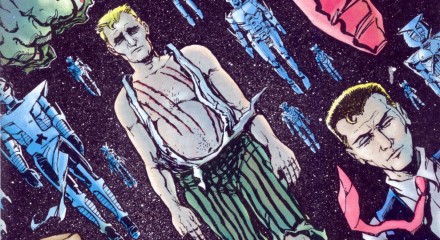
I am at a loss. I wander down long stretches of bookcase winding into shadow, eternity, and dust. I’ve lost all concept of time. The spine of Alan Moore’s Minutemen with its vintage essential 1930s-style artwork next to his Watchmen does not help me: though it would be interesting to read …

I keep moving. The Twilight of the Superheroes–more Alan Moore–sits there in an alcove but promises no solace. I go deeper. There is a manga section on the other side of me. Tezuka Osamu’s Phoenix: Earth stares at me mockingly whole: completing an incomplete saga and a lifetime’s work. I shake my head and keep going. I keep going past the rest of Moore’s Big Numbers, all twelve issues of them, long since past the time to remember how many steps I have given away to be here in this place.

It gets worse. I find myself at a complete run of Marvelman and it’s hard–so hard–to turn away. It’s as though I’ve come to a dead-end, like the middle of a maze in my mind, like the conclusion of Gwendolyn MacEwen’s Black Tunnel Wall right in front of me.

I begin to run.

David Eddings’ Zedar: The Apostate sits on a shelf in loneliness. Myst: The Book of Marrim makes my heart-ache. There are so many Tolkiens. So many Tezukas. So much Alan Moore. Moore. Moore. More. More. More …

It is in the history section of this labyrinth of the literary bibliophiliac where I stop at Maus III: My Mother Breathes Silence–Art Spiegleman’s graphic novel based off the fragments of his mother Anja’s surviving journals from asylums and concentration camps–that I finally understand.

This place doesn’t exist. This is the place where I want to be.

I’m clutching my head in the darkness as the full implications of all this begin to sink in. Then I see something: something else in the dark. I walk past The Continued Works of Keats and The Will to Power that Nietzsche wrote himself to find a gap in the comics section. It is a small gap and I can barely make out the label on the shelf. When I read enough of it, I smile.

I can’t help it. In the Neil Gaiman section, the story of Morpheus before Preludes and Nocturnes is no longer here. It is somewhere else now. I’m smiling: hoping that the Marvelman section and its remaining additional issues will also disappear from this place sooner rather than later. It is is a small hope.

A transvestite Joker seems to laugh at me from a cover of Morrison’s Arkham Asylum as I slump down exhausted in a place more demented than Batman’s Rogues Gallery and more sad than a watch without a watchmaker: a library without librarians.

It is here, huddled in this dark corner, that I wish for a world that makes sense: a place where Homer existed, Shakespeare wrote his plays, Sappho wrote more poetry, and I–finally–know just who it is I am.

An Interactive Music-Making Epic: TweakerRay’s Collector Chapter 02

Many posts ago, I set myself the challenge of writing something about Sarah Howell’s silent comic. Today I’m doing the exact opposite. I have been given the challenge of writing an article on a music CD: namely TweakerRay’s Collector Chapter 02.

This might be a little unusual for me, but I have always loved epic music and TweakerRay’s Collector definitely falls under that designation. But how do you write about music? For me, I’ve learned to do that in my own writing: describing the harmonics of certain songs that I like and trying to find words to approximate the sounds that I hear. Certainly I’m not completely familiar with music or music-mixing terminology enough to write about it under those terms. My friend who gave me the request to write this, however, requested that I write about what the music makes me feel and what story is revealed to me by listening to it. In some ways, looking at the soundtracks with that frame in mind makes it easier for me to talk about.

First, let me give you an outline of what you should expect to find on the CD itself.

There are thirteen tracks in Collector Chapter 02. In addition, there is a Demos and Instrumentals section where TweakerRay gives you different mixed versions of his songs, a PDF version of the booklet included with the CD which I will go into more detail about later, and an actual Commentaries section dedicated to many of Collector‘s tracks by TweakerRay himself. So if you want to know more about these soundtracks in a technical way or by music terminology, TweakerRay explores his tracks in that fashion far better than I could.

There actually is a narrative that TweakerRay himself creates in his CD. TweakerRay’s Extended Play Collector Chapter 01 (the second half of which was called “Digital Ghost” and can be found on this Youtube link here) sets up a very strange scenario. Essentially, you hear messages on what appears to be TweakerRay’s voice-mail: a few praising him, one woman asking him what he wants and a man threatening him. The voices all mix together until you hear a man come in, who meets a woman waiting for him there. Not long after, she shoots him and the man calls out TweakerRay’s name before he presumably dies. I always interpret this haunting but active rhythm of hard beats to be TweakerRay himself on the run.

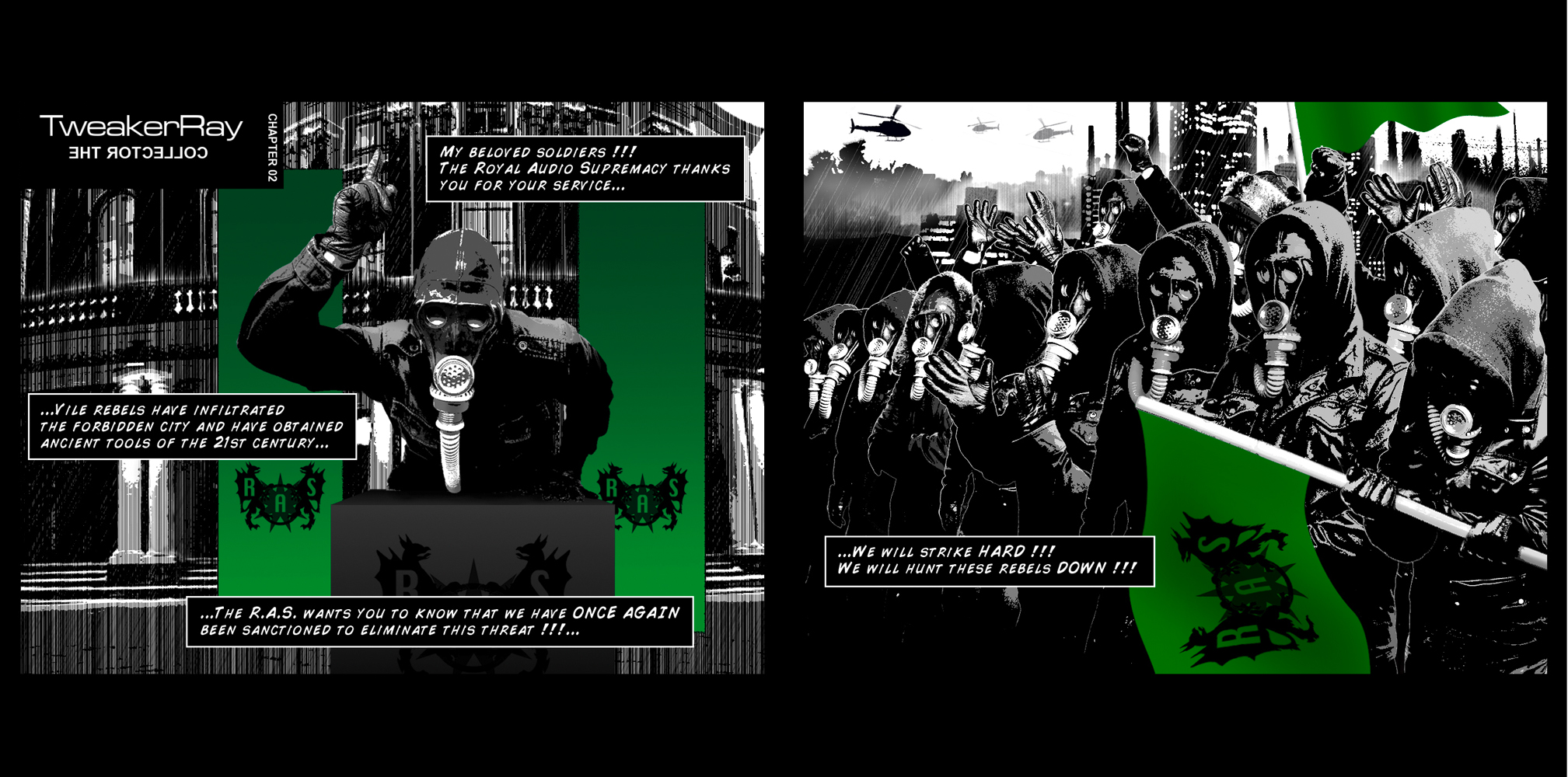
My job, however, is to talk about the songs in Collector 02 … and the booklet. The “Introduction” starts off strong: with a grandiosity and booming power. Years after the events of Chapter o1 and TweakerRay’s disappearance, it heralds and complements the voice of a futuristic dictatorial power: the leader or representative of the R.A.S. (the Royal Audio Supremacy) that talks about how it has banned the dissonance of “old and corrupted” music–declaring it dangerous to people’s minds that is reminiscent of the way that Plato considered art and poetry deadly if not controlled by the morality of the city-state– and how rebels threaten to bring it back. This fascist transmission of censorship also sets the stage of just what kind of world this music exists in. It is a fun, but in other ways a very serious creative premise about freedom of expression and what it faces against a need for perceived safety over that liberty.

Thus begins the instrumentals of Collector Chapter 02: its hard raking beats and piano keys–playing soft like rain–becoming a stride through a fortress city of inhuman glass and metal ruled by this tyranny and one person’s journey in defying this status quo.” Toxic Wasteland’s” rough and wavering rhythms and rising harsh crescendo brings to my mind a panoramic shot of the rest of the world in a stagnant ruin away from the R.A.S. capitol and the passing of forbidden instruments and music between the peoples within it in order to spread this rebellious musical dissonance.

It is “Status Report Sgt. Q” that brings back–with an ominous bell-toll–the vocal to the music. The rhythm is still severe, but there is a realization of horror in it as the rebel Sergeant Q makes us aware of what the R.A.S. has truly done: using censorship and force to pretend to bring peace, but in reality subjugate all people, keep them from questioning and maintain the corruption of their corporations and minions on the Earth. He states that music–the last refuge of creative freedom on and offline–has been censored by the government and its allies. The hard percussive metal beats of the music set the stage for the rebellion that is about to come.

And this is where, as the track title states, some of the citizens of this world “Fight Back.” It starts off smooth and then rises with a reverberating power–with intermittent 8-Bit sounds reminiscent of the Nintendo Entertainment System’s synthesized tones–and the addition of TweakerRay’s voice singing: abjuring that “it’s time to fight back.” But then … something bad happens. In the song “The Shot,” there is one crack of a gunshot that echoes throughout the distance followed by the deep current of a sound almost in denial accompanied by the sad chiming and gradual un-damming of an even more sorrowful crescendo as if the gun-shot itself has become the tragedy. We never know who got shot–if it was a who and not a what … like the idea of expressive freedom itself–but as “The Shot” fades off like a dactyl or a sad lullaby, the listener knows that the stakes have changed.

Sometimes I’m inclined to think it is the death of Sergeant Q that brings on this music or maybe the figure of TweakerRay–the symbol of this rebellion–but those are just my interpretations. TweakerRay himself explains in his Commentary what event motivated him to create this track. As it is, the sound of it just tends to remind me of all the things I’ve lost and it is a powerful song that sings of loss itself.

The tone changes after this. “They Don’t Know” heralds a newer form of rhythmic aggression in a journey or a quest for battle as TweakerRay’s vocal makes its rising fiery resurgence decrying how no one under that government or censorship–that condoned that shot–know exactly what it is that they have done. Aside from the “Introduction” that I love due to its all too seductive fascist overtones and promises of ancient and imminent destruction, as well as the powerful reverberating sadness of “The Shot,” I feel that “They Don’t Know” is one of the most powerful songs of the track and one of my personal favourites. It is empowering in a different way than the trappings of power or deep human sorrow. It is justice and vengeance both synthesized into song.

By “The Hunting,” with its fast–very fast–rhythmic beats and clanking, I can almost see the R.A.S. stepping up its efforts to stamp out the rebels: now realizing that they have only created martyrs by their repressive actions. It’s almost like the conflicting noises symbolize fighting on the streets, in the buildings and in all arenas across the regime. It is the fight for a society’s heart: for a free humanity’s soul.

After this there is an “Interlude,” with even more evidence of winding 8-bit tracks. At this point, it sounds as though there is more subterfuge going on: as though the rebels are passing around more forbidden instruments and sound equipment to the citizens: as though encouraging them to fight for freedom as overt physical fighting happens overhead. Perhaps by “Electronic Beast,” TweakerRay himself, back in vocal form, is abjuring the citizens–who have so far been serving the R.A.S. regime with approved music and mainly silence to “come to him,” to create their own music. While this something of a social perspective, I feel it is a compelling interpretation: where Sgt. Q tells the listener that the Internet has been censored, TweakerRay tells you of “the electronic beast”: of the passion in the communal machine that must yet be released.

Then we go into the steady hard rhythms and rough guitar-string instrumental rhythms of “Collector I” (Collector II and I seem to be reversed order for some reason) which also seems to be something of an interlude as well: perhaps symbolizing the secret actions of citizens deciding what to do with the new furtive powers they’ve been given. Certainly, the synthesized hard-rock crescendos of the song are beautiful to hear in any case.

By “Broken Dreams,” I … seem to run out of words. There is something hard and elegant about this song. It is sad, as though someone–perhaps the figure of TweakerRay–is moving on from his task. It is as though he has done what he has had to. It is less a tragedy, and something more transitory and resolute with its echoing vocals and touching piano keys. He is not that person anymore: he is “broken dreams”: a refracted mirror of many other people now. Maybe at this point in the narrative, he decides to fade into legend, into myth and become not just one person but all people in the musical narrative that want freedom. Thus he sheds his persona to let everyone else free themselves without violence but through acceptance of “what is.” This is also a favourite track of mine, as it seems to symbolize a “moving on” to another life but leaving something important–a legacy–behind.

Finally, there is “Transmission.” The CD could have ended by “Broken Dreams,” but some things transcend that. You see, from what I understand, the message or the medium–the music–has spread. Others are now adding their voices and interpretations and only then–at an ominous screeching echo–does the entire Collector 02 end: on a note feels like it is “to be continued.”

Most–though not all of this–was a creative interpretation brought on by listening to the music and if you expected this to be more of a traditional review of a musical score, I’m sorry to have disappointed you. But not really.

I think that I have said more than enough about how excellent I think this CD is, but before I wrap this up I want to talk about its one other feature.

That’s right: the booklet. The comic booklet.

The booklet was created by the artist and photographer Fotonixe. In fact, each included image in this article is actually the result of her work on this CD. Aside from some very professional stark illustrated green, black and grey backgrounds behind comics-style white font lyrics, Fotonixe actually creates sequential panels of figures to go along with some of the vocals within the CD track. For the most part, she seems to have a very fumetti-style of comics creation: using modified photographs and photo shopped images to illustrate a story. The style is also very reminiscent of the 1980s Slovenian FV Disco: a gritty collage-like yet dark and vibrant artistic style derived from the FV 112/15 Theater that used stills of digital footage, photographs and other images to make–among other things–visual art.

What’s also striking about this reminiscence is that FV Disco was described as crazed mixture of communist and capitalist punk made after the fall of communism in the former Yugoslavia. Even though this may not have been Fotonixe’s intent, it has a great resonance with the themes that TweakerRay has made inherent in his piece and as such is an excellent aesthetic complement to it.

There are two more things I would like to mention: both with regards to TweakerRay’s Chapter 01 and 02. The first is that the excellent audio dialogue of Chapter 02′s “Introduction” was written by the artist B.S. of D., while the artist Freshoil read the audio of Sgt. Q in his “Status Report.”

The other thing I’d like to talk about is that both Chapters 01 and 02 have a very interactive element in them. At some point, TweakerRay asked for vocals and audio from some of his listeners. These elements made their way into 01‘s “Introduction” and 02‘s “Transmission.” In addition to the fact that he wrote his artist persona into his musical narrative as a main protagonist, I’m impressed with how he encourages his fans to essentially collaborate with him in his works and even make remixes of their own. As someone fascinated with interactive storytelling processes I find to be an excellent idea and a good way to cultivate an audience of listeners.

If you are interested in buying Collector Chapter 02, you can get the Limited Deluxe CD here or an MP3 album here. Also, if you are interested in TweakerRay’s work and/or Fotonixe’s art, you can click on both of those links as well.

If you buy the CD or the MP3 album, the following are samples or previews of the tracks that you should expect.

I definitely give this musical work a five out of five. It reminds me of the days when I used to go downtown and dance to hard alternative rock and synthesized electric body music and how epic it all was: and how awesome it can be.

Games I Never Played: Mage and Castle Falkenstein

My last post was about the role-playing game that my friends and I have played on and off for some years now. But what began to change my attitudes about table-top role-playing–and what it is actually about–was something else.

For years, I’d played Dungeons and Dragons. I was typically a mage character that backed up the warriors and clerics in my group of friends. We fought generic monsters and all that lovely stuff. Basically, I was used to the Nordic medieval model of what a table-top role-playing fantasy world usually is: often taken from the influential J.R.R. Tolkien model of Middle-Earth. This was often augmented with my own readings of Margaret Weiss and Tracy Hickman’s Dragonlance series as well as those strange and multifarious wonders found in Forgotten Realms.

White Wolf’s Mage series also changed my attitudes about what I thought a game should be. Mage–as part of White Wolf’s Old World of Darkness line–introduced me to a lot of metaphysical concepts as well as new ways of looking at what a mage should be.

In the Old World of Darkness, a mage was much more than a person in robes, with a spell book and a staff: they could be wuxia-adept martial artists (wuxia being a fictionally depicted form of martial art that lets its practitioners unleash supernatural feats), mad scientists, Matrix-like computer-hackers, secret adept societies, shamans, pagan witches and all the different interpretations you could get away with. They even had these people called The Hollow Ones: essentially magic-wielding Goths that delved into countless different sources of knowledge from the Romantic period to the present time while taking their joy as the world burned.

I was in a very pessimistic and cynical mind-set in those days and the idea of a World of Darkness: where everything was degrading and there were secret fonts of knowledge intrigued me a lot. The esoteric and abstract rule-system also fascinated me: by having dots in various skills and attributes and Spheres of Magic. You also had something called Arete–the Greek word for honours or excellence–which was a dot-metre that determined how much of reality you understood and how much enlightenment you had. The more dots you had, the more Sphere dots you could get. That said, it also relied a lot on actual role-playing: on acting out your character.

I did have issues with the fact that there was this thing called Paradox. Essentially, a Mage affects Reality with their power, but Reality is made from consent: Consensual Reality being created from what a majority of people unconsciously believe in. So if you used a blatant display of magic in a reality that did not accept that such a thing could happen (like throwing a fireball from your hand), you would suffer Paradox and if you gained enough of it bad stuff would happen. Of course, this was not counting the fact that some of your spells might not even happen at all because reality doesn’t except it.

So I had issues with that. In retrospect though, the impetus on making subtle magics: on combining minor spells with major overt actions and creating some plausible deniability towards reality is really cool.

But it wasn’t always a very positive world-view and after a while I started to think back on another strange role-playing world I was introduced to. A friend introduced me to a world called Castle Falkenstein. I found it … really bizarre at the time, but in a weird way that was very compelling. Bear in mind that I had up until that moment never even heard of steampunk or understood what it was.

In Castle Falkenstein, I found an alternate Victorian world where fictional and historical characters existed side by side along with magickal lodges, secret societies, spies, mad scientists, Dwarven engineers, Faerie Lords and Dragons. The core book introduces you to the world through a character from our own–Tom Olam–who was a computer game designer and was essentially kidnapped by a wizard and a Faerie Lord to save their version of Earth. Tom Olam actually makes it his duty to make sure that the alternate Earth in Falkenstein does not enter into two World Wars and become like ours. He attempts to save magick, the Faeries and even the Victorian societies and utopian ideals that he sees there.

The plot and structure of Castle Falkenstein is heavily influenced by Anthony Hope’s The Prisoner of Zenda: a story about a man who poses as a king to save a kingdom and a whole lot of other goodies. It does take a very unrealistic view of what our Victorian Age was like–with emphasis on “the good old days where science was always considered good and there was a strong honour-system in place” and ignoring things like the vast divide between social classes and other such lovely things–but it is also an alternate world where these noble things may have actually happened. I like the continent of New Europa and the nation-state issues between Bayern (or Bavaria) and Prussia. Also, America is divided into different nations as well: which is a really cool thing to see.

Castle Falkenstein also had its own unique playing system where you used playing cards instead of dice. Apparently among the upper elite, a die was considered a vulgar form of entertainment while playing cards were perfectly acceptable. I even tried learning and adapting their system to some games I tried to make: with varying degrees of results.You could also be a great many things: various forms of Faerie (including the Daoine Sidhe that looked very elven), a Dragon Lord, a Dwarf inventor, an adventurer, a scientist, a mad scientist, a mage (whose magick actually seemed to involve something like String Theory with its subetheric knots and what-not), a journalist, a diplomat, and all that fun stuff.

But I think the real reason I loved this game so much–one I never actually had the opportunity to play–was because of its emphasis on hope and the alternative ways history could have turned out with fantastic elements. It also showed me that fantasy games could occur in other eras besides a medieval one and also alongside some elements of history.

Where Mage was delightfully dystopian, Castle Falkenstein was unashamedly utopian, swashbuckling and romantic in all the connotations you can take. And there was greater emphasis on role-play and creating a three-dimensional character. You were encouraged to keep journal entries of your exploits so that other people could see them. It was just an awesome idea and I actually all the books long after the series went out of print. I felt a lot like Don Quixote: like a person who wanted to be part of something that no longer existed, that was lost over time, but felt like it should. There is your romanticism again for you. Maybe I also liked having these game books because I needed something good and positive in my life at the time.

I think it says something that I went back to collect the Falkenstein books instead of the Mage ones: though those are awesome as well. I think that in some ways my change from thinking about fantasy as D&D to looking at it from the perspective of these books began my change in how I looked at writing in general. I also think I need to play more games to talk more about them. But I will say that each of these had both their time and their dream.

Full Beings and Perfect Forms: Aristophanes and Plato in Miracleman

Before I begin, I would really like to point out that I’m aware of the fact that I’m talking about a comics series that few people have had the opportunity to read: though perhaps there are more readers of Miracleman out there than I assume. In addition, there will be some spoilers in this article, so for those still interested in reading the comics and can get access to them, read them first before reading this article. And for those who have no idea what I’m talking about, I talk enough about superheroes here and the philosophy of them to probably be followed. It’s up to you whether you want to read the comics.

Like I say every time I make this disclaimers, you have been warned.

Well before Alan Moore revised or deconstructed the figure of the superhero, people always assumed that even though superheroes have their official crime-fighting identities and their civilian alter-egos they are still ultimately the same person. The same was the said for Marvelman (later named Miracleman and possibly Marvelman again depending on whether or not Marvel Comics releases Alan Moore and Neil Gaiman’s runs) and his Family: that even though they spoke a magic word to change from human to superhero and back again, they always had the same personality.

Alan Moore challenges that assumption with his revisionism. We see a vast difference between Kid Miracleman and Johnny Bates: the child that he came from. Of course, that has a lot to do with the fact that Johnny switched into his Kid Miracleman persona as a child and let it grow up separately from his human child form. This, along with the event that forced him to hide and the circumstances of how he got his powers, might have warped his mind into two distinct personalities: though both have access to the same memories which is something to consider.

Moore even makes you begin to question if Miracleman and his alter-ego Mike Moran (though they both share the same initials) are in fact the same person. While both begin with a similar morality and are genuinely good people–and they share memories–key differences begin to occur to differentiate them. It’s probably even further complicated by the fact that Miracleman had been dormant for years after a traumatic event, while Mike Moran himself continued to age and live his own life until another traumatic event forced him to remember the key-word to bring his superhero persona back.

Then there is Young Miracleman–or Dick Dauntless–who died and was brought back to life. From Neil Gaiman’s run, or from what exists of it so far, there is no difference between Young Miracleman and his alter-ego at all. Finally, Miraclewoman seems to be the most balanced of the entire Miracle (or Marvel) Family in that as the doctor Avril Lear and Miraclewoman she also seems to be the same person and has learned a lot about her dual nature by exploring both.

As I read the entire series as it was, I began to notice certain elements that Alan Moore and to some extent Neil Gaiman incorporated into their work. In a lot of ways and I have Alan Moore in particular in mind, they brought the idea of the superhero back to its roots: to the mythologies that created it as they took it apart. The secret British government program that was created to make these super-beings is called Project Zarathustra: based off of Nietzsche’s idea of the ubermensch or the superman. The superman is supposed to be a being that has transcended all conventional morality and chooses to create their own code to live by: possessing the power to do so through sheer will. I talked about this a little bit with my Whoever Hates the Man of Tomorrow? article, but this is a theme that definitely plays out with Miracleman.

There are other mythological references in Miracleman: such as the heroes’ home base being called Olympus, the body-switching Qys as the supposedly unwitting genetic prototypes of the Miracle Family being referred to as the Titans or the Primordials that existed before the “superhero pantheon of gods,” and even the battle with the twisted Kid Miracleman supposedly mirroring Ragnarok or the “twilight of the gods.” Moore even creates a nice mythological analogy between superheroes and supervillains: the former being Heroes and the latter being known as Dragons or monsters to be vanquished. We see a lot of Nordic and Greek mythology being drawn on to create this version of Miracleman. But there is more.

As I continued reading Miracleman, I saw another parallel developing. It began when I saw the twisted fused twin skeletons inside of the British government’s secret Spookshow warehouse: where Miracleman and his kind were created. Originally, I was led to believe that these fused skeletons were the remains of Young Miracleman from his own death, but in reality they were the dual remnants of Young Nastyman: another experiment that went insane and died through mid-transformation within a volcano … or so Miraclewoman says.

That grotesque fusion of two skeletons reminded me of Aristophanes’ myth of love. I know how disturbing that may sound, but I didn’t actually start thinking of it that way until Miracleman himself began to explore his own identity and the line between himself and Mike Moran. According to Plato in his Symposium, Aristophanes explained why love existed by telling a story in which once upon a time mortals were larger beings with two-heads, two sets of genitals, and two sets of limbs. They were powerful and they defied the gods so much that Zeus split them into two. This myth was supposed to explain that love is that need for each person to look for the other person split from them or, as we hear it in our own popular culture, each person looks for “their other half.”

That was the resonance I got when Alan Moore really came to the finer details of how the switch between mortal and divine works with the Miracle Family. It’s almost as though Project Zarathustra, in analyzing the bodies and the technology of the Qys–of fluidly intersexual Titan progenitors–tapped into a place of mythical proportions to recreate that “lost existence” that Aristophanes goes on about. One very interesting thing to note about Aristophanes’ myth is that when human beings were once unified, greater beings it was implied that they could defy and potentially challenge the gods themselves: which was one reason why Zeus and Apollo divided and changed them. Therefore, it can also be implied that Project Zarathustra allowed mere mortals to tap into the divine, to a place beyond the divine, to become a lot more than what they already were and challenge the established order around them.

Aristophanes’ myth that was meant to examine the origins of love and humanity’s potential to divine power is argued by scholars to be a comedic or lampoonish idea to reflect its comedian creator. Yet I find nothing particularly hilarious about this, though it is interesting that it was considered a “comic” idea: one that has translated itself so well throughout the ages. There is also another saying in popular cultural with regards to love as reunion: that just as people are looking for their “other half,” there is also in a relationship reference to one’s “better half.”

This is where I begin to wonder, like a few scholars before me, if the myth of Aristophanes wasn’t created by Plato himself to add a nice neat argument to his Symposium. We can argue whether or not Socrates created his own philosophy too until the cows come home, but that’s not the point here. Plato himself had his own theories about reality and the subjects that exist in reality. He believed that there are two worlds: the World of Forms or Being and the World of Becoming. The World of Being is a plane of perfection. You can find the originals or the perfect forms of anything that has ever existed. You can find the ideal object–such as a chair–or subject–such as a man or a woman as well as thoughts, feelings and knowledge–here.

Then you have the World of Becoming, a gradation of said perfect forms into more worn and degraded shapes. They deviate or change from the ideal and ethereal prototypes that they come from. The idea is that we live in the World of Becoming and that we seek the World of Being. You can see here, and I’m sure my high school philosophy teacher would be proud of me at this moment, how this Platonic thought influenced the Western idea of Heaven and Earth, or Heaven and Hell.

When I read Miracleman, I saw an interesting parallel with this Platonic conception. Miracleman and his kind are the perfect forms. When they are not used, the forms are kept in a place of pure energy known as Under-Space: a nice analog to the World of Forms itself. They rarely ever age, they cannot be destroyed through conventional means, they have extraordinary clarity of thought, devastating power, and even their costumes are engineered from an alien material that cannot be destroyed and reflects the moods of their wearers. Their powers and natures are explained as being the result of a psychic field or harmonic around them that they can control. In other words, the Miracle Family practices mind over matter.

My reading of this is that human scientists–degraded imperfect people like the rest of us from the World of Becoming or matter–used a link to the World of Being or the spirit to reverse engineer near perfect forms that mortals can have access to. Even Miracleman explains that he has the same thoughts that Mike Moran does, but he can see them and perceive his world with far more clarity and insight. We can get even more Platonic or Gnostic and say that through science, the Miracle Family gained a greater link to their spiritual, real, celestial selves. It is also no coincidence that Alan Moore, their revisionist, began to embrace further mythological and spiritual elements in his later works and even in his own life.

So it seems clear cut that Miracleman and his Family are their own essential selves having been unified. Of course, it is not nearly so simple as that. Mike Moran, Johnny Bates, Dick Dauntless, Avril Lear and Young Nastyman (or Terrence Rebbeck) did not seek this enlightenment. They were kidnapped, kept in medically induced comas, experimented on, had essentialized clone bodies made for them, had said bodies transferred into Under-Space where their minds would be trained to switch back and forth to by a word command, and were brainwashed to believe they were superheroes in a comic book-like virtual world before being abandoned as too powerful and too dangerous and marked for a termination order which, inevitably, failed.

It all sounds so banal when I summarize their origins like that. In a lot of ways, the Miracle Family are more like the uncanny Freudian doubles or doppelgangers of the mortals which they are linked to. They have great powers and insight, but they do not always relate well to the World of Becoming around them. Some of them are malicious because of this and even the best-intentioned among them have the potential to cause immense and traumatic change to the world.

I personally think that they are all of these things and more. I think that Moore portrayed them as humanity’s need to reach for and become the divine: or to remember its divinity. What happens after the creation of said beings, their own realizations of what they are,  and how the affect and what to share their perspective with the world around and the people who made them is–in mythological retrospect–an inevitable conclusion.

ETA: After writing this article, I’ve realized that you can examine the Miracle Family with a particular focus on identity. Much in the way that Neil Gaiman’s A Game of You really plays with identity, gender and the fluidity and change of self-identity, his and Alan Moore’s Miracleman can also be examined in a similar light. Maybe one day someone will do that … when the damned thing is republished.

Abraxas, legal issues, Abraxas …