Ready-Made and Waiting for Acknowledgement

A while ago, I finally finished watching the movie Adaptation. And there was something in that movie about writing, meta-narrative and the very essence of fascination that kind of–metaphorically–punched me in the face. There is one part in the film where the protagonist’s brother explains to him that the reason he could deal with rejection and, well, life is that he “owns his feelings.”

Now, I don’t know about you but this is a phrase that I hear a lot from popular culture. I know I’ve heard, and in the past really tended to get told when I got angry or upset in a human interaction to “own my feelings.”  Usually this is used when someone is angry at another person and it tends to come out, at least from my perspective, as some kind of rebuke: to remind that person that no one else is solely responsible for how you feel despite any action or inaction on their part.

But the way that Nicolas Cage’s character (who is both the protagonist and his brother who is telling him this) interprets this is very different. In his case, he is talking about loving someone who not only didn’t love him back, but actually and quite audibly made fun of him behind his back. Yet he still exists that he loved that individual. And how he explained this was that his love was his own. It wasn’t the other person’s, or the world’s, or society’s, or anyone else’s.

That love–that feeling–belonged to him and him alone.

So when he told his brother that he owns his own feelings: he means that his feelings belong to him.

Now, think about it like this if you’d like. Imagine that feelings are resources. They are sources of energy that are already inside of you. These are the basic shapes, eddies and swirls of emotion and they stimulated by external factors. These energies are already inside of you and sometimes it takes something outside to bring them out in varying degrees. Things that stimulate these feelings can be anything from reading a book, watching a movie, hanging out with your friends, playing a game, or having a relationship of any kind. But these energies are inherent in you.

Now imagine, and you don’t have to imagine all too much, that you can control these feelings. You can’t necessarily control experiencing them: because, if this is possible at all, it takes time and perspective to even come close to accomplishing something like that. However, you can control them by having the ability to remember and bring them out. Anyone can do that.

But what I wasn’t able to put into words before came to me when I was watching Adaptation and I realized that both characters were writers. What I realized is this: if you can own your own feelings, and you have the ability to make things, then you can take these feelings and channel their energies into creating. You can make your feelings into your greatest tools or most fearsome weapons. Or whatever metaphor you prefer. You can even view them as your friends if you’d like: as unruly companions that can aid you if you are in the right situation and if you know how to ask them for help.

The fact of the matter, for me, is that I realized that by owning your feelings, you own yourself and you can gain a greater power than you have ever had before. Someone told me once that I create beauty when I write. And this is part of that process for sure.

I guess I could have summarized this whole post as saying that you can take emotions and use them to create in various states of mind, or channel them into constructive forces.

I certainly don’t claim to have “mastered” this. And I suspect no one really has. But I never really thought of it that way and as I said it is definitely an interesting way to look at the creative process: or at least one possible manifestation of it.

This Game Has No Warp Zone: A Review of Pipe Trouble

Pipe Trouble

“I like games with consequences.”

This is what a friend of mine told me not too long ago with regards to online games, but it is a sentiment that can easily be applied to video games in general. I know that I–and many other more eloquent and informed people on the matter–have stated that the medium of the video game can be used for more than just entertainment value. The medium of a video game is as its very core an interactive experience that, like any other art form, can get us to relate to the world around us in a different way.

However, with regards to Pipe Trouble, there is also the matter of responsibility to consider as well.

Pipe Trouble is a game created by Pop Sandbox Productions, produced by Alex Jansen, and co-designed by Jim Munroe. It was apparently made as a companion piece to the TVO-commissioned documentary Trouble in the Peace: a film directed by Julian T. Pinder and produced by Six Island Productions about gas leaks affecting Northern British Columbia farmers in the Peace River region and in particular one man and father, who has decided to do something about it.

Before I decided to write this article, I did not know that Pipe Trouble was a digital complement to this documentary. In fact, the entire subject matter that both the film and the game seem to encompass–Canadian farms encountering potentially lethal gas leaks from pipelines of gas companies in their regions–is not usually something I tend to focus on with more than passing attention. After a while, and as cynical as it gets, news of “corrupt corporations, victims and innocent bystanders, and eco-terrorist reprisals” tends to become oversimplified by the media.

It is one thing, however, to hear and watch something about a matter that seemingly doesn’t concern you as an individual. It is a whole other thing to find yourself in a situation–even if it is a simulation with a satirical veneer–where you are in a position of great responsibility.

What Pop Sandbox is attempting to do to this regard is not something new, but rather it is a very familiar idea they have worked with expressed into a different medium. While I did write an article or two on Kenk: A Graphic Portrait a fair while ago, what I might have neglected to mention is that one major theme in the graphic novel–also made by Pop Sandbox–is that everyone has a part to play in a particular social action. In the case of Igor Kenk and his stolen bicycles, it is made clear that everyone–to the people who bought bicycles from him, to even the people who purchased their stolen bikes back, to law enforcement and Toronto City Hall–knew about what he was doing and, just as they condemned it, they also tolerated and even to some extent accepted it a part of their social system. With regards to Kenk, Pop Sandbox illustrated–quite literally–how Igor Kenk was just part of a social dynamic–of a collaboration–in which the rest of the city was also a part.

But Pop Sandbox goes even further with Pipe Trouble. While Kenk simply observes a social structure and interaction, Pipe Trouble makes the player-audience interact immediately and directly with the issue as clearly, and as simply put, as possible.

In other words, you–the player–are placed as the manager of a gas company apparently situated in the Canadian Province of Alberta and you must please your superiors and make them money, keep the people who need your corporation’s services in mind, do as little damage to farmland, animals, humans, and the environment as possible, and try not to piss anyone off.

It is very clever. It is very easy to vilify a company or a corporation as a soulless entity that only caters to the very rich, squashes agriculture and “the lower classes,” and pollutes the environment without any understanding of what it might be doing or–worse–even care. It is just as easy to lionize a pipe bomber as a freedom fighter against a tyrannical force even as it is to denigrate them as a terrorist that likes to destroy human lives and a Western way of life: whatever that is.

However, natural gas is one of those resources necessary for a modern society to function and a corporation is made by people. As such, someone has to be in charge of providing that corporation’s service, making a living from it, avoiding bad press and blame while attempting to integrate their industrial system into the environment and those existing within it with as little damage as possible. It is no tall order and not an enviable position: especially when you are forced to do it in a game.

It is no coincidence that this game is modelled after the 1989 puzzle game alternatively called Pipe Mania or Pipe Dream. And even though the title itself brings to mind some bad bodily jokes, even that connotation has its point when looking at the game. In Pipe Dream, you have to build pipes to direct the flow of filth inside of a sewer. Pipe Trouble takes a similar mechanic and makes the oncoming substance also toxic, but also worth money. One person’s poison is another one’s livelihood.

You have two men on either of your screen. I would be tempted to call them “the angel” and “the devil” on either of your shoulders, save that both of them aren’t necessarily “good” or “evil.” The man on your left is a farmer that is watching your progress in placing down pipes with oncoming gas with great interest and caution. If you destroy the land too much, there will be protesters that will block your pipe route. How long they stay in front of your progress will all depend on just how much damage they perceived you to have done. This farmer will keep watching you and will warn you only once not to mess with his land.

Then you have the man on your right: your boss. He is the one informing you of when the gas will start flowing (right when you place a pipe down to get from Point A to Point B) and he will keep track of the money you are making … and losing with delays. That’s right. If you do not place your pipes fast enough, not only will you risk a gas leak poisoning a lake, killing animals, and other horrors but you will lose your company money and your boss will sure as hell hold you responsible and, if we are going for realism, probably put it all on your head when the bad press comes out.

I swear: when I first played this game and that gas started to flow and sometimes I didn’t move fast enough, or have the right pipe piece to place down or even put it in the proper place, that sense of panic sets in. Then you add the pixilated animals that prance and eat in the woods and you are thinking real hard about how to not disturb them: never mind potentially kill them. And that is not even including the fear of getting more protesters in your way that will get more organized and then sometimes even use some nice industrial sabotage against your pipeline: causing more death, destruction, money loss, and bad press. And guess who would probably be held responsible for all of that?

You’re looking at yourself.

It’s like playing Tetris … only with people’s lives. And remember how I didn’t make any bodily function jokes? Well, the ideal is to treat the entire process like the human body. The release of energy, the disposal of waste, and the structure of what you are trying to build is supposed to create a balance with the ecosystem, agriculture, and animal and human health. But as you play and it gets harder, you will become aware of the fact that this game is an idealist’s nightmare. You will have to make some very difficult decisions as you realize that you might not have time to build around that forest to your pipeline’s destination or you might have to be innovative and make some alternate routes in a very set time frame, but in the end you will have to make some very hard choices.

Do not let the game’s cheerful 8-bit pixilated graphics and basic soft-edged square shaped sprite characters fool you. Jim Munroe was also co-designer behind this game. He is an independent Canadian science fiction and comics writer, among other things, that likes to take grandiose topics like haunted TTC Stations, North America becoming destitute in a futuristic era, and a post-apocalyptic world after the Christian Rapture and completely twist them upside down and make it about human characters and life going on. More than coincidentally, Munroe is also the Hand Eye Society’s Project Coordinator for the development of the Torontrons: essentially retrofitted arcade cabinets that play newly made video games. He may have been involved with the pretty nifty creation of the Pipe Trouble game cabinet as well: which, as the link explains, will be placed in areas of high traffic such as universities, city centres, and tourist attractions.

I don’t know what else to add here. Inter-dispersed between levels are radio segments from news anchored events dealing with natural gas industry controversies which I didn’t originally hear until I played the game again at home on the free trial demo. Also, not too long ago I found out that the game itself has created a whole lot of controversy. Apparently TVO–one of the game’s sponsors–has been accused, among other things, of potentially giving eco-terrorists “ideas” by supporting the creation of the game. TVO has apparently removed links to Pipe Trouble from their website with pending investigations into the matter on their end to see if they were in “the wrong.” There seem to be some definite misunderstandings over various issues, but if one goal of this game is to encourage people to think, then controversy–though unfortunate–is one way of getting there. Either way, it definitely hit a nerve in that intersection where art and politics clash.

I think my concluding thought about this entire game is that the title “Pipe Trouble,” again, can mean a lot of things. And it wasn’t until I read the above article that I began to think about it a little more. I don’t generally look at these kinds of games, never mind write about them–especially with how close it comes to politics–but there is something really fascinating about the dynamics that Pop Sandbox attempts to create, identify, satirize, educate and help people relate to. And politics itself is an exchange of power and watching how and through what medium that power is ultimately exchanged through.

You see, I’m looking at pipes as symbolic of devices that link us together and support a communication of ideas. They can create a very interactive and comprehensive system of healthy self-regulation but when there are so many elements in play, things can go wrong, words can break down, and people and the world around them can suffer for it. But whatever else this game accomplishes, it definitely makes you think about these issues and how they are not entirely separate after all: neither from each other, nor from you.

Contains Language: Reader’s Discretion is Advised!

I know the above title is a low blow for attention, but I really couldn’t resist.

Whenever I write something on Mythic Bios, I try to make the language and the content as accessible as possible. I know I don’t always succeed, but in the case that I don’t my hope is that I have a little something for everyone that I am also interested in writing about.

In my later years in high school and throughout my early years at University I was really interested in Philosophy. I liked writing that made me think and that also played around with ideas of varying kinds with regards to, well, pretty much existence. But even then, before I realized how didactic–how dry and rambling it could get–I had one other issue with Philosophy and texts that purported to be as such.

Sometimes, they would reference subject matter that I wouldn’t understand or, in my case even worse, begin to quote a language of what I was not at all familiar. And it annoyed me. A lot. To be honest, it still does.

Philosophical texts are not the only culprit in this non-crime of course. Many literary classics–novels–do this exact same thing: at least from the Modernist era. And, finally, there are comics that do the exact same thing from time to time. Take Alan Moore for instance. Alan Moore is a genius. He creates multi-layered plots that start off very slowly but ultimately become very epic and grandiose. And even though his characters have tended to lean towards the cynical side of humanity, his characterization is very human and excellent.

But I will tell you now: when he has whole passages of From Hell and Lost Girls in German, or I believe Punjabi in The League of Extraordinary Gentlemen: 1910, or even … freaking Martian in the second Volume of The League I start to get … annoyed.

Don’t misunderstand: I like the authenticity he brings to the characters and the fact that you can clearly see how his well-read nature and research is paying off in the background. Now I am not just talking about his appropriate use of other languages, but his many, many literary and historical references that make me feel very under-read as a reader and overwhelmed as a writer. He simply makes so many references and allusions that I can’t always keep track of them, or even know what they are. I can see how other people would really have difficulty relating to this. I guess it’s like what Austrian Emperor Joseph the Second purportedly once told Mozart: that his work has “too many notes.”

I know that when he has used other languages, I feel a bit … cheated: because I want to know what the hell the characters are saying! It’s that simple. Likewise, I want to get all the references. I’m greedy like that and it feels like I’ve reached a certain level of understanding, and then I hit a wall.

A language is another perception of reality. Really, another language is a different world. This leads me to the other perspective on the matter. Anna Anthropy has said a few times that one of the issues with regards to video games is the very exclusive culture or subculture that has developed around them. More specifically, she talks about how video game design and dialogue around it becomes this interaction of in-jokes and references that people outside the circle do not always get. I would imagine that this is something, especially with regards to games as an expression of art–of language–is something that Anthropy believes we should watch out for.

On the other hand, Anna Anthropy is also one of those who wants to allow for a different voice or perspective in the medium of video games. For Anthropy this seems to have been in the form of making games for different genders and practices outside what was–and still is–the social norm. Essentially, and others like her, use this chosen medium to subvert it and change it: to reveal its full potential through a new perspective.

Alan Moore did something very similar. He, and others like Will Eisner, took a medium that became very associated with superheroes and some two-dimensional character development and morality and injected a whole different kind of perspective into it: using comics to talk about scholarly, metaphysical, philosophical, sexual, and realistic matters as well as still telling a story. Eisner and Moore are known for bringing the idea of the novel to the comics form and–eventually–leading to a place where a larger audience could access and relate to the stories being made in this medium.

In a way, they were making a new language as all languages are made: through innovation of an older dialect.

Anna Anthropy seems to believe that video games still need to “grow up” and deal with these matters as well: with gender and sexuality and life experiences in an accessible way. And one of these ways is to make the audience for games grow by trying not to make so many exclusive references within a game’s structure. Geeks by their very nature are exclusive in that they tend to know many obscure facts and bits of knowledge and trivia, and I don’t think that is a bad thing.

But I would argue with Anna Anthropy–at least with regards to knowledge and not necessarily that sense of shared social experience–that if a player doesn’t understand one element in a game, there are resources online and elsewhere that they can access to understand what is going on. And I suppose that is why, with regards to Alan Moore, there are so many Annotations of his works out there. I do think that it is more than okay, especially with regards to continuity and art, to make references that a reader doesn’t always understand: provided that there is enough that they do understand and enough impetus for them to go and learn something new.

It is strange how my knee-jerk reaction to seeing other languages in a primarily English language comic is a feeling of exclusion and also this annoyance: as though the author is trying to be pretentious and show how smart they are instead of telling a story that I can relate to. Sometimes I feel it to be very elitist. This is the same with references at times. On the other hand, I know–especially with regards to the latter–that I do the same thing regardless of how well I might explain it, and that I should really take it as a challenge.

I don’t want to be talked down to, but I also don’t like it when things go over my head. And this is me as a reader and–as such–I need to keep it in mind as a writer too. I also, as I said, don’t always succeed.

I like to think that Alan Moore doesn’t write in different languages in his works for the sake of being clever, but he actually does it to keep his characters in character and to maintain a continuity in his world-building. Granted, he could <do what some other creators do and but triangular brackets around dialogue to indicate a different language like so>, or make a different font for those words, but it would not be the same. There is no real solution to that, I’m afraid: not for me anyway.

But there is something that my studies in Philosophy also taught me. Whenever I do come across things I don’t understand, as I said I look them up, or I try to find a speaker of the language. I can tell you that it was enjoyable having a German-speaking friend of mine translate some words to me as I typed them out to her so long ago. And when I don’t get a reference, I consider it a real challenge and it is like an easter-egg hunt that allows me to reread Alan Moore’s text and graphics all over again. And sometimes, I find something new I didn’t get in the first reading.

I would never bring up any of this at a signing–should Alan Moore ever come to Toronto one day and I can access the line–because that is not the time or the place. But I do have this place to talk about it. Alan Moore helped take a medium that people did not always take seriously and made it into some serious literature: and as long as “serious literature” is always questioned, always makes you think, and can function on its own merit– and can take you into another perspective–then it is definitely a past-time, and a calling, that I want to continue for my own: because there is always room for growth.

So hopefully this made sense. My Mythic Bios is another world itself and perhaps a language of differing ideas sometimes reaching critical mass, or becoming exercises in poetry. Or it’s that fine line between talking down, and or being the wind over someone’s scalp. I’ll leave that up to you, my awesome readers.

Depression

Warning: This post contains angst. If you want to read something better, witty, geeky, creative and otherwise far less personal, any of my other posts will do. Reader’s discretion is advised.

Do not say I didn’t warn you.
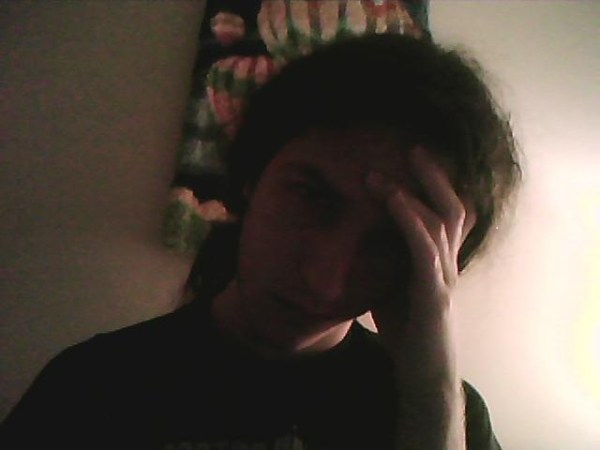
Me and my Head

In 2005, I started writing in this notebook. This was long before I began writing my Mythic Bios notebooks and I was in a very different, uncertain, and unpleasant place in my life. In this particular notebook were a series of fragments, thoughts, aphorisms, and a whole lot of bitterness, anger, and bile.

I called that notebook my Dorian Grey: because that was where I placed most–if not all–of the ugly parts of myself at that time. And it wasn’t enough.

It was never enough.

After a while, I stopped writing in it. I just didn’t want to see it anymore and, eventually, after much bitching and angst I moved past it and turned those fragments into more and more unified stories in my Mythic Bios.

I wanted to forget that first notebook so much that I eventually did. I thought I buried it somewhere else, though later as it turned out it had been in my room at my parents’ house–on my closet shelf–the entire time. I vowed, after a time, to never get into the position where I would write a notebook like that. I promised myself never to create another Dorian Grey again.

That is one of the main reasons I’ve tried not to talk about my personal life on my Writer’s Blog. Even oblique mentions of it seem to verge on breaking my own personal code. But I also realize this might be helpful. It might even show others that, in the immortal words of the Face of Boe, “You are not alone.” So here it is.

I am depressed.

This doesn’t come off as too much of a surprise, I would imagine. I have alluded to it. In fact, in a really dark mood, I once wrote this entire even longer post on what my depression actually entails. But I’ve decided to do something else instead. I’m going to describe what it has been like in a Choose Your Own Adventure style of “You,” instead of “I.” But you don’t get to make decisions: seeing as this isn’t a Twine game. Also, I am going to italicize it: to make it distinct from the rest of this post. So if you have difficulty reading a whole series of paragraphs in italics, please skip this or read something else I wrote on this Journal. Anyway, here goes nothing.

You don’t remember how you got like this exactly. There is one memory, though, that stands out at you. You were young: literally a child. You were at your grandparents’  near the entrance to the house, sitting at the old rickety table and its rotary dial telephone with the living room not that far away. You are pretty happy: because when you are here you are actually safe and it is a refuge from that cold place that is school and other children that you don’t really understand.

And then, as you are waiting–perhaps for some chocolate cake with coconut sprinkles that you have to eat in the kitchen along with the tea and milk you were once able to actually drink without being sick–you feel this … pang go through you. It is a strange feeling: like a reverse orgasm. It is not comfortable. It’s what you will later on know to be a painful moment of clarity: of realization.

You understand that this–all of this around you–is going to go away one day. And there is nothing you can do about it.

That is the earliest memory of the shadow and its melancholic length beginning to stretch down throughout the years to where you are right now. You start to bury yourself in old tape-recorded movies in a futile attempt to keep the past present. You immerse yourself in old books and keep them as friends: for they will be more constant and understanding than any flesh and blood companions you will ever have. You try to ignore your teenage years out of existence through books, said tapes, and video games. But the one thing that none of these elements can save you from is loneliness.

You make friends and somehow they keep moving on with their lives faster than you do. Your family tries to shelter you. It doesn’t help that they are religious and have food restrictions. Nor is it particularly helpful that you were born … different, as people keep telling you: in addition to the ethnicity thing. You don’t learn things the same way that people do and later you strongly suspect that you don’t experience things the same way either.

So you already have this predisposition to not trust the outside world at all. And you will be fighting this impulse with varying degrees of success for the rest of your life. You also are both drawn to people because you do not want to be left behind, and you are repulsed by them because they are not you. But those differences also intrigue you: a lot. This is going to be a running theme for the rest of your life: among other things.

So let’s fast forward this a bit. Finally you manage to gain enough inner strength to move out of your parents’ home: though you do need them for more practical matters from time to time. You get into Grad School with the aid of some people who care about you. You feel like you are making progress. You are slowly subverting and breaking free of all of those self-imposed and outwardly imposed restrictions.

But then there is this to consider. You are an introvert and this particular set of relatively simple and straightforward characteristics as set out in this link describes you very well. You now really have to deal with bureaucracy and its complete and utter ineptness. You have not been raised to deal with it really, and it galls you that you have to let it rule a portion of your life. This is the adulthood that you have unintentionally been fearing and loathing even before you knew about it: when you were so immersed in books and films and games in the vain hopes of trying to avoid it. The very frustration and cold reality that your family and school has been trying to shelter you from relatively until now when, suddenly, you have to deal with this shit a lot on your own.

But you persevere despite it. You even make new friends and new lovers. You get to go anywhere you want relatively at any time that you want. You get to dance. You get to hang around with people without curfews. You are working. You have something not unlike an adult life. 

You realize after a while that the depression is not chemical: as much anything in human behaviour isn’t the result of biochemicals in some way. Your depression is really situational and the results of a personal cycle of behaviour. You get into situations where the person you are trying to be is not the person that you are acting like. You begin to emotionally, as opposed to intellectually understand, that people are not constant beings. It’s not so much that they lie–and some of them do–but they aren’t always the same person. Their lives change too.

You’ve always internalized emotions and what you are feeling now is a lot of anger, sadness, stress, anxiety, resentment, and outright hatred. You’ve been led to believe that it is unseemly to display these emotions: as though it is somehow more mature to be in agony all the time but continue to express that socially acceptable mode of behaviour known as adult irony. You’ve always had headaches and migraines. Your stomach bothers you. You have always been really over-sensitive–hypersensitive–and in the worst case scenario the stress only makes it worse: to the point where your muscle-memory has memorized your anxiety and tenseness, and you’ve realized you have actually been having panic attacks.

In fact: do you remember the characteristics of introversion in the link above? Imagine them magnified even more so. You get to the point where you don’t feel comfortable going outside. You feel ill thinking about being in a social function where no one is giving you that “in” to speak and so you don’t go anymore. And between you and others bashing your personal beliefs–which were rosy yet flimsy things at best–you just stop opening up altogether. You used to like travelling around, and you had a certain degree of confidence. It erodes as you sit and you no longer move.

And this is before you realize that you have been eating up your girlfriend’s money by not getting a job, that you’ve been selfish as fuck, and it is hard to relate to anyone anymore. And those books and the Internet are no longer taking the edge off from reality. You can’t escape anymore: or at least not as well as you could when you were younger.

You realize that there is a terrible consistency in telling certain people that you feel as though they are a part of you when you know–deep down–that you have begun, or you are resuming, to hate yourself. You don’t say what’s on your mind to anyone: not really. You begin to believe that no one has ever really understood you and it is less an element of adolescent angst and more of a matter of fact.

Then you run out of money and you have to move back in with your parents. Your privacy and peace and quiet becomes compromised. But you don’t really leave the house like you used to. You don’t like to go out and you have withdrawn from most people: save those small few who come to visit. It is as though you have spent years trying to overcome your introversion and now you are paying the price by not wanting to move at all.

You are in debt because of your Degree. And after getting a Master’s Degree, you have to go on welfare. You realize that the given moralities of hard-work and debt are things that should be questioned in society rather than simply being accepted. You become dependent on a computer again to socialize and then it breaks down and you need to use the public desktop. You will not go anywhere unless there is an accessible restroom of some sort nearby. Your clothes begin to fray and you neglect yourself because, on some intrinsic level, you don’t give a fuck anymore.

You begin to resemble outside what feel like inside. You remember moments of joy and they become poisoned by what happened after. It is hard to remember actually being happy anymore. People keep intruding on your space and asking the same tired old questions over and over again: despite the fact that you are clearly trying to keep busy. Some others, when you talk to them, say that you are over-exaggerating your “complaints,” and they make you feel like others have it worse than you and you should shut up.

You are looking for work and sending in submissions–and you know that is important–but there are days when you wonder if there is any point to it. Because then the depression really starts talking. It tells you that you will never be “this good,” and that this is “too difficult,” “too much work,” and “too confusing,” and that everything you have ever done does not matter–and never mattered–a damn.

It really gets bad at night. You start to miss people a lot: people you will never really be able to speak with again the way you did. You start to feel tremendous resentment towards the people you wish you had told off. You wonder how many opportunities you let pass by you in your brain fog. You have memories of past life: when you were more confident and more assured and then you look at what you are now. The screaming you feel inside you everyday gets much louder at those times.

It is safe to reiterate two facts: that in those moments you hate the world, and you hate yourself.

Of course, there are the fantasies too. Of going back in time and telling your younger self to do this instead of this, or not to to do this ever. That is, also of course, when you don’t fantasize about going back in time and killing yourself at that moment in life when you were truly happy so that you never, ever have to know about the partially self-made hell waiting for you in the future. At the same time, you also know that were a certain TARDIS come to visit you, you would leave without question or regret: that those people who don’t appreciate your complaining or have gotten tired of it and they can keep their precious world.

You basically feel like you are in a prison. Your therapist flat-out calls you on describing it as thus. And if you were to summarize this long, rambling thing into one sentence: Depression is is a prison of your own making where you only remember dancing, only remember contact, only remember fun, you feel like you lost or are otherwise losing everything you ever cared about, where you suffocate on your own inaction and sense of failure, where you are disappointed when you actually wake up the next morning, where you punish yourself, and anyone that you attempt to meet and socialize will see that cycle of self-entitlement, spite, grief, self-recrimination, and self-absorption you’ve found yourself spiralling into–ingraining itself into your bones–and will politely run for the hills.

Because no one likes a person who does not like themselves.

So, I’m going to end that there because it is way past the whining mark and these things tend to wind out of control once you keep writing about them. It is paradoxically this thing that I have been trying to avoid. I’m not trying to glorify it or make myself out to be this innocent victim of circumstance, but it describes kind of some days in a lifetime, I guess? I guess I just feel like I failed myself in some ways and that I have no one to blame–or perhaps more appropriately hold responsible–but myself.

It isn’t all bad though.

I am seeing a really awesome therapist. And I have a 250-word tax to keep fulfilling and at least a half an hour quota of going outside to remember. I keep filling out a worksheet of places I send work to and to seek employment at. I am researching some free-lancing opportunities. And I also speaking with some people from my past again.

I guess I am ironically making a routine for myself: something I sorely lacked when I lived on my own. If I learned anything from my girlfriend before I had to move out, it is that routines can be our friends. As such, I don’t like to deviate from it much. I don’t like to be pushed, or trapped in a small space with someone who likes to control things but to go about matters at my own pace. I’m also working on sleeping better and I am eating better too.

There is another positive even in the negative. I just finished reading Paradise Lost and remembered that part where Satan realizes, even when he escapes Hell, that he carries Hell with him: inside of him. After having the occasion to revisit some of Neil Gaiman’s Sandman, I realized that we all do the same. And this fact, my personal hell, gives me the power to motivate and keep making things: to create some kind of … meaning out of all of this. Someone once told me that I create beauty and pain is an excellent material to craft beautiful things from as any kind of creator might tell you. It is one of my sources–if not my central source–of power.

But there is one more thing I want to mention: something that I specifically want to leave you all with. During the period of the Dorian Grey, I was talking with a counsellor at my University about something job-related and she also flat-out called me on being depressed. She told me to make a point of writing about three constructive things that I do in a day. And eventually, after a while, I realized that helps too.

So Dorian Greys can be necessary when you need to purge things out of you, or begin to unleash Hell on Earth, but remembering the useful things you’ve done–the positive and affirmative things you’ve done, no matter how small they seem to be–can be just as invaluable: if not more so.

ETA: If you’d like, please read this link about the care of extroverts. It seems that this world is becoming, or has always been, difficult for the both of us.

Becoming a Gateway: Or What Anna Anthropy Twines Together

I will say here, off the bat, that there are some video game and article links below that can be construed as Not Safe For Work. Player’s discretion is advised, though enthusiasm is also encouraged. I am also hoping that I can communicate and do justice to these ideas and some of my own creative license as best I can.

I’m not sure how I first met Anna Anthropy. Actually, that is not entirely true. I do remember first being introduced to her when I discovered Rise of the Video Game Zinesters: though how I came across that book to begin with is a memory now lost to time.

I did plan to buy that book eventually, but then life got in the way. One day, after a series of insane events, I found myself brought to the 2012 CanZine Toronto Event by some friends who thought I needed to see it: and I did. What I didn’t know, or what didn’t really bridge the cognitive dissonance in my head was that Anna Anthropy was there with her partner Daphny David and that they were selling the very book that I had been so interested in.

I’m going to admit that I felt sad, but I was still getting used to that endless process of being social again that I tend to find myself in and by the time I realized that they had been there, it was too late. So I bought the book for myself later instead.

There are many very good reviews that detail what the contents of the book were about: how it worked, how it possibly didn’t, and all of those various details. But there were a few things that stuck out at me. The main message that I got from Rise of the Video Game Zinesters was that Anna Anthropy wants there to be more accessible technology and means for anyone to create a video game. My younger self, the boy that really wanted to make games, would have totally agreed with this concept: even if he didn’t have the knowledge at the time to understand many of the other details surrounding it.

Essentially, Anna Anthropy wants there to be a means for a game-making technology or software–a manifestation of communication and language–that is easily accessible for anyone to use for the purpose of, well, making games and creating ideas. Or taking names and kicking ass: whichever definition you prefer. Of course, there is more than that. The idea is that by having different people of different backgrounds, social classes, career-paths, sexual and gender orientations, queerness, life practices, and a wide gamut of humanity that does not necessarily understand coding you can vary up the content and the gaming experience of a game without an industry-ruled homogeneity: where plots and stereotypes are recycled to keep a sure profit.

It is a very seductive idea. Anthropy compares this “much needed” product and the mindset behind it to the creation of the printing press in Renaissance Europe: thus freeing the production of literary articles from the Catholic Church’s scribes and making them accessible to everyone. The fact that the printing press allowed for religious texts to be made with vernacular language–the words of the everyday layperson–instead of a Latin known only to nobles, priests, and scholars is probably an analogy not lost on Anthropy when she brought up the image to begin with when you consider that she looks at games as a language that all men, women, humans, and other sentient beings should be able to relate and have access to.

She also briefly looks at the history of game-making itself and equates video game development with the earliest forms of games: with symbolic piece and board games, carnival games, arcades, all the way to modern board games and more miniaturized computer games. In addition, Anthropy makes a very compelling case as to how video games were and are in the providence of an elite minority: that it was male computer programmer students and the academy that developed code and the games that came from it. Yet it is also clear that there are changes that are–and have been–in the works to that regard.

I’ll tell right off, as some other reviewers of Anna Anthropy’s work have mentioned, I don’t always agree with what she says but she makes some very intriguing observations. There is one point in particular that sticks out at me. Anthropy writes that a single game creator in sole control of their project can make a much more focused and more personal form of art–a game–than a large team of staff members can. I don’t know if I am articulating that thought as thoroughly as I should, but that is what I got from that. What I find really interesting is that Will Eisner, in his book Comics and Sequential Art, also makes a very similar statement with regards to the development of the comics medium and storytelling within it. These are two different mediums, both of which had to fight to gain recognition as a legitimate medium, yet it is really fascinating how two of their advocates come to similar conclusions.

Eisner did mention, however, that there was nothing wrong with a collaboration between two or more artists on a work. Indeed, in his book Graphic Storytelling he goes into a lot more detail with regards to that. And even Anna Anthropy, in her book, mentions that she is writing the book not merely for game creators but for anyone: writer or scholar that is fascinated with her topic. It should also be noted that Anna Anthropy has collaborated with a few other artists in her own works: such as the fun and frustrating Lesbian Spider-Queens From Mars, the very personal and visceral Dys4ia, and the thought provoking puzzle game Triad. While much of this collaboration has been in the form of graphics and sound, even programming for the latter game, it is still a form of collaboration: though obviously not an industry-mandated one. Rather, these are the product of an agreement between artists that respect one another and actually work together to make something cohesive while still keeping the personal element of Anthropy’s own vision.

Now, to get beyond the book and go a bit into Anna Anthropy’s games. I like them. I like the concept behind them: of taking a video game form and using it to communicate a personal experience. There is something really beautiful about that. I know that Anthropy may not be the only person who does this–and I suspect she hopes she isn’t in the only one either–but she is the one that really introduced this to me on more than a cursory level. I think she is one of those who reinforced for me that the games of my youth–that inspired me as a creator–are more than just frivolity or an inferior art-form. Some have said the same thing about comics, about film, and–back in the day–even theatre and other forms of painting and art.

Some people have been giving Anthropy flak about her games: about how they all tend to follow a very similar pattern or themes of lesbianism, BDSM, and transgender issues. The thing is, well there are two things. The first is that all of the above things are not mainstream in video games: at least not from someone who has all of those elements in their own life. The second is the age-old adage: write about what you know. And Anna Anthropy knows about all of this. She writes about and makes what she knows. Her viewpoint is just as valid as anyone else’s and it is more than okay for her to make games about what interests her: because there are others out there who will relate to it.

The fact that she uses similar themes in her work, and I would say never quite in the same way with regards to game play mechanics, is irrelevant to me: because the industry does the same thing for the most part with many mainstream themes and even the best creators make what they know.

I think what I admire about Anna Anthropy and others like her is that although I can’t always agree with them, they do something that is remarkable. Sometimes the people in charge of publishing or video game industries and coding are called “the gatekeepers.” And what Anthropy and others are doing is they are becoming gateways: gateways and fiery Bodhisattvas into alternate perspectives and the potential for the creation and expression of new game experiences.

This is something that I deeply respect and it is a thing that greatly motivates me now. There is one thing I have mentioned before in this Blog: that I am looking into Twine game-making because of Anthropy’s mention and use of it. Twine is a software that lets you create a “choose your own adventure” style text game without a knowledge of coding, or with enough video tutorials to get into it. I want to do the same thing that she and others are doing now. I want to make a game that can communicate my own–albeit different-experiences: ones I’m not sure even Anthropy will always agree with. I want to have the ability to put someone else into my own shoes: as it were. Or use my experience to make something else entirely and let people make their own choices.

So Anna Anthropy won with regards to me: because she has influenced me to make a game. But I think what is also remarkable is how she even affects her reviewers and critics. Take Jenn Frank’s Rise of the Existential Crisis: How One Woman Nearly Never Finished a Book Review, or Cara Ellison’s Choose Your Own Anna Anthropy Interview.

Frank’s article adopts Anna Anthropy’s writing style from Rise of the Video Game Zinesters: emulating Anthropy’s own combination of history and criticism and inter-dispersing it with her own personal experiences in a seemingly scattered narrative but ultimately bridging the gap between the reviewer and the creator of personal expression while Cara Ellison actually makes a Choose Your Own Adventure Game using Twine–Twine–in order to bring her interaction with Anthropy across. Just looking at the styles and mediums used by these two women is utterly fascinating: Frank does not necessarily agree with Anthropy’s statement that everyone should make a game–though she wishes on some level that she had–while Ellison flat out makes a game to express her interaction and her influence from Anthropy’s philosophy in a very demonstrative manner.

I will also say right now that this article was a long time coming. I just didn’t have the words then. But if Ellison’s Twine article further influenced me to make my own game (and I didn’t even realize she was using Twine to do it at the time, another example of my cognitive dissonance), Frank’s article actually encouraged me to write this. And I have been influenced by Anthropy in other ways as well: you will probably see relatively soon outside of this article.

But if I had to sum up everything I have written here, I will say this: that in terms of video-game storytelling, its potential as a medium, and her own potential influence on its future, Anna Anthropy is immensely important.

P.S. My favourite Anna Anthropy Twine game is this one: Hunt for the Gay Planet. There is a story behind its creation that she can explain far better than I, but what really inspires me is the story of a person who tries to find other people like her and goes on a long well-written intergalactic journey. This piece inspired me so much that I bought the Choose Your Own Adventure book from Anthropy’s own site: which is coincidentally on my Blogroll as well.

Imagination Is Thicker Than Blood

In a post that Vampire Maman wrote, You Transfix Me Quite, she talks about how the character of Jane Eyre would have made an excellent vampire. Vampire Maman has a lot of very interesting and entertaining creative writing, but it reminded me of something I bring up from time to time out of a sense of sheer silliness.

I never played the Old World of Darkness Vampire: The Masquerade role-playing game, but I heard people talk about it and I researched as much about it as I could online. And I always wondered what kind of vampire I would be in that world.

There are many different Clans and, more specifically, Bloodlines in Vampire: The Masquerade. As a result, each vampire belonging to a particular line had different attributes than his or her fellow. Originally I toyed with being part of Clan Tremere because of their knowledge of blood magic and the fact that they seized their vampirism: they weren’t–at least knowingly–turned by another vampire, but rather they were mages that took blood from a captured vampire to make themselves powerful and immortal … though they didn’t count on the fact that they would still possess the inherent weaknesses of the Kindred.

But I abandoned that idea because they are too stratified in social structure and limited in numbers. So I thought I might have been a Ventrue. And indeed, some people believe that I am a very calm, detached, and dispassionate being whenever they meet me offline. I can be calculating and organizational like this Clan tends to be portrayed but this is not my major strong point and not even a fraction of the personality I really have. Still, I can appreciate the Blood Discipline of Dominate: you know, that stereotypical ability to hypnotize or mesmerize another being.

My girlfriend once said that I would make an excellent member of the Toreadors. A Toreador is either a very beautiful vampire that creates a series of social networks and supports various kinds of art, or they are artists themselves that spend their immortality oftentimes secluded and making new things, or they are both. Generally, they are closest to humanity as they like to watch and support their artistic endeavours and fads. Aside from the compliment of being compared to something beautiful and creative, I also share their obsession with a particular object: such as art. Yet they can also be very vain and fickle, and while I have some of those traits, they are not paramount in who I am.

Which brings me to the final Clan I was told about. One day, my girlfriend changed her mind about something. She thought that I could also be a Brujah. Now, I had heard about this Clan. In the Modern Nights era of that world, they were generally characterized as passionate, frenzied vampires that were usually punks, brawlers, and anarchists. However, in ancient times they were known as disciplined warriors and philosophers that embraced a particular ideal: honing body, mind, soul, and altered power to fight for what they believed in. They were not merely turned from fighters, but also lawmakers, orators, and thinkers. I can also see them having turned some artists along the way as well: much like the Toreador.

I would not be a typical Brujah of the modern period, I would imagine and I would probably seem more like a Toreador on the surface with some Ventrue discipline and calculation. At the same time, I would definitely be a fighter and a defiant force: through the imagery of my words.

But all these distinctions aside, would I make a good vampire? The answer is that I probably would in a very reluctant sort of way. I already have difficulty with a mortal life, and immortality would just be inconceivable with my range of emotions. On the other hand, a lot of physical burdens would no longer be an issue and perhaps–just like in this real world–I would have phases of activity and dormancy. Maybe with time I would surpass many mental challenges and blocks as well. It is hard to say what it would like in a hypothetical and fictional situation but, like I said, it is definitely fun to think about.

I Am Made of Words

About five or six years ago in Niagara Falls, I received a Tarot reading from a lover of mine: the first person I ever went to visit on my own. There aren’t many details I remember from the time except for one thing: the majority of the cards that she drew from her deck–a deck that she ultimately gave to me–had a Sword aspect.

File:Swords01.jpg

We were sitting on my bed and here I was staring at a hand of Swords in front of me. I know we had theories as to what it might mean in the purely open-ended mode of interpretation that you have to use when examining any kind of symbol. And while we agreed on a few things, in the end it was left to me to link things together and make patterns that were–or were not–there.

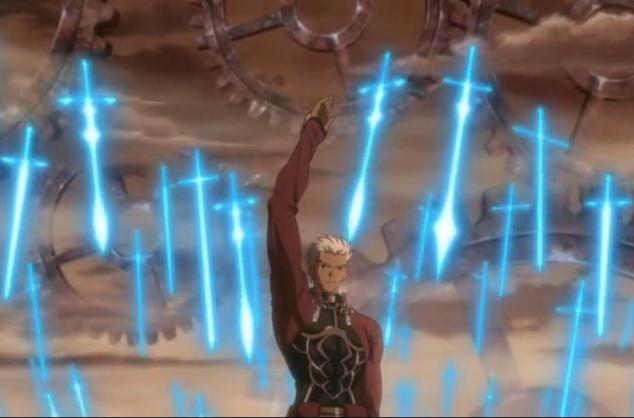
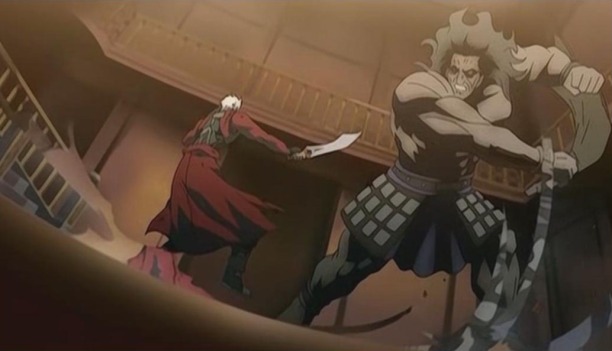
During or after the time we met, I began watching this anime at the York Anime and Manga Association (or YAMA) called Fate/Stay Night. In this anime was a character named Archer: a heroic spirit who could project and create bladed weapons. He gained these from a Reality Marble: a small pocket-universe that developed inside of him due to his dedication and sheer strength of will. When he fully summoned this place, a sphere of flame, turning cogs, and blades consumed the area that he and his opponent were fighting in. In other words, Archer took his inner world and imposed it on the external for a brief period of time.

In this world I describe, he has access to every mortal bladed weapon–every sword–that he has examined and ever replicated with his magic. He stores them all in there and either uses them one at a time–knowing what its history is, the thoughts of its owners, and even their secret abilities–or he can summon and throw them at his opponent all at once. I really admired this anime character and when I did further research on him … I realized that I related to him a lot more than I thought.

I still think that Archer could have done a lot more than simply imitate weapons and memorize their patterns. I think that, even modifying some of them into arrows, he could have used his knowledge of them to create new weapons entirely: new tools and devices to accomplish his goals. He even admitted that his weapon was his own imagination and we all know that the imagination is limitless.

You see, I make weapons too. I make weapons and tools. And they are my words. I’ve spent years honing them: making prototypes, re-making others, imitating more, and learning from my mistakes. I seek to bury my demons in a torrent of words. I desire to make an Empire out of them: to expand my own little world into this one in the best way that I know how.

For a really long time, I have been a very passive individual on the surface. But after Niagara Falls I decided to stop ignoring my natural aggression, my dominant side, my ambition, and the fierce defiance that I realized I’ve always had inside of me. I think that sometimes the manner in which I honed and sharpened my words and that ferocity I view the world at times–as though to defend my own childhood awkwardness and lack of social skill years ago–has ingrained itself in me so much that I seem aloof to people and perhaps a little intimidating. Perhaps that is why I might seem so combative towards life at times.

I grew into my own. I began to see that I was physically attractive, intelligent, creative, and I build a whole world that I can sometimes share with other people. I was told by a friend that in some ways it made me dangerous, but in other ways she greatly admired what I was becoming: whatever that is. When I look back, “aggression” might be too strong word. Perhaps what I was really looking for, and what I still have to fight for– is “confidence.”

Not too long ago, Cristian Mihai wrote a post called Art and Life: where he talks the fact that while he may have done many things in his life he might have regretted, he never regretted any of his stories. It’s very close to those moments where I think the best thing I have ever done with this life of mine so far is write.

So I keep building my world, every day, one blade at a time: because underneath this inconstant fleshy matter of mine and to quote a fictional character, “I am made of swords.” And even though I know I’m not made of weapons, even though I’ve suffered defeat and pain, I’m going to keep fighting because–in the end–I know I am going to win.

File:Swords14.jpg

So when you take the “S” away from Swords, that is what I am made of.

Let’s Play

I have a friend who believed that he could gain enlightenment from a video game. He sat in the school cafeteria and the quad every day: just plugging away at his old Gameboy with its off-white frame, chartreuse buttons and yellow green-grey screen. Come to think of it, I don’t think there was any place I hadn’t seen him playing that game, except after … stuff happened.

His favourite game was Link’s Awakening: the first of the Zelda series ever made on Gameboy. I’d see him there–especially in those latter days before graduation–immersed in piping miniaturized synthetic tones and colourless 8-bit sprites as he sought Link’s sword for the millionth time … and attempted to find something else as well.

He didn’t always play it, mind you. We table-top role-played as well: old-school gaming with paper, pencils, Lego figures and dice. We were part of a group that even now still meets up from time-to-time whenever our schedules allow. My friend was–is–a good, quiet person: the kind of guy that you could always talk to. At the same time, he would sit stiffly and tense: as though uncomfortable in his own body … or his surroundings when he wasn’t occupied with something. But this all changed whenever we had a game on. You just couldn’t get him to shut up. The tension, wound in him like a spring, would uncoil and he’d get crazy energized. He got aggressive and vicious in-character: becoming this very manipulative, charismatic monster of a mage or dark warrior.

It’s funny how an introvert who liked to play Zelda games also liked to play the bad guy.

One time, when we were bored, I asked him why he kept playing that one video game. I mean he passed it several times at that point. Of course, he was still playing it while I asked him that question, but looking back it was one of the only times he really started talking about anything else outside of our game sessions.

He told me that Link’s Awakening was the only game where you got to see Link develop as a person: a person not defined by rescuing a princess. The way he saw it, Link left Hyrule and Zelda to find himself again … or even find himself for the first time. He argued that Koholint Island–the place where Link finds himself marooned–is a space inside his own head where he could confront his personal demons and know who he is.

My friend also told me that every time he played the game, he found something new: some small detail that he’d missed during his last few playthroughs and that over the years many of the challenges, as well as the in-and out-of game references started to gain more sense and nuance with time. He said that the puzzles became like koans that he meditated on through interaction: small little mysteries that he liked to solve.

Although he didn’t go into much more detail than that, which was deep enough, I also think he liked the repetition of it: the symmetry of those puzzles, the rhythm of the battles and the cycle of music that played and linked it all together. It’s really fitting in retrospect that he used the word “koan,” because I think these elements more than anything else let him come close to a Zen-like calm while he played his game. It was probably the most at peace I had ever seen him.

The more … stuff changes though, the more it stays the same.

My friend doesn’t play that game anymore. In fact, he doesn’t play any video games these days. Now he only watches “Let’s Play” YouTube videos. I’ve seen him. Sometimes he looks satisfied watching other people resolve conflict, combat, and puzzle solving in nice, immaculate patterns. Other times, he gets utterly exhausted and falls asleep in front of his laptop: with the forlorn beauty of a nostalgic 8-bit track playing in the background on a feedback loop. But there still many more times where it’s like he’s watching for something, looking intently at those video recordings while trying to find something new or rediscover something lost with a silent kind of desperation.

Ever since he stopped trying to help Link awaken, my friend is a different man. He’s still polite and helpful, but he’s somehow quieter, less tense, but … emptier somehow, and very, very tired. When we role-play nowadays, he doesn’t play villain characters anymore. Instead, my friend likes to play heroic characters with good and honourable intentions: even when they go horribly wrong.

That, more than anything, says something to me. In fact, it speaks volumes.

At Least You’ll Leave a Beautiful Score

You know what it is.

You’ve played that Level. You’ve played that Game.

That Game can be a mess of crude 3D polygon confusion. Other times it is a beautifully rendered realistic environment populated by generic places and shallow souls. Sometimes it is a two-dimensional caricature where you can jump up and down and turn all around on pre-set paths and pre-determined destinies.

Maybe it is turn-based when it is an organized, reasonable world, or a great bird’s eye map somewhat hidden from you as you get to plan out your strategies but–more often than not–it is a side-scrolling affair of linear time. You have to keep moving forward and you can never go back.

Except in your mind.

So you jump through hoops. You try to avoid the spikes and the pitfalls. You repeatedly hit your head against a golden block: always looking for a different result. That edge near the lava, and those platforms over the abyss become far too captivating and even far more terrifying for their 8-bit sense of vertigo.

But you dodge the fire and the ice, the darkness and the light, the electrified mines and the bullets, the cute little walking bombs and the fake-out illusions. You spend time solving the clever and tedious puzzles below the mountains or up in the sky: so much so that you sometimes fear you will be stuck in those places forever. Your musical theme begins to change or it cycles into a cheery purgatorial loop inside of your mind.

And you haven’t even gotten to the Boss yet. The Boss waits for you at the end of the teleological road though, in retrospect, it was always there for you. It almost always seems to be larger than you. Often, it has more power than you do. You know there is an angle in which to approach it, some kind of slant, but it does its very best to allude you.

And even if you figure it out, your eyes are so gritty, your palms are so sweaty on those controls, and your heart is beating so fast that it is a challenge in itself merely to concentrate: because then you realize that this is less about the Game and more about you and this Boss.

That is when you realize the truth.

Sometimes Life is like a Boss with 99 lives while you are a character with only one. But then another thought occurs to you: that as long as you can knock at least two of those lives off before you go down, or in some way engage it as a multi-player effort before leaving it as such, then it was all worth it.

http://menotblogger.files.wordpress.com/2007/09/fsn07.jpg

I Wanna Cast Magic Missile: Art, Science, Spellcasting, and Making Things

The Dead Alewives comedy skit reference aside, there are two classes of spell-caster in Dungeons and Dragons that have always interested me. I would imagine that most people who are familiar with the fantasy genre know what mages are. Mages are essentially spell-casters that use magic through rigorous study, research, and memorization of rotes and ritual. Much of the phenomenon that they create and observe is practised in a manner not unlike science: although inevitably it is a science based on a different kind of reality and series of physics intrinsically different from our own. Essentially, add animism–the idea of a sentient or semi-sentient spirit–inside all organic and inorganic matter and you see how mages can create a science of pacts, magic circles, and artifacts to understand, classify, and control their surroundings.

Then you have sorcerers. Sorcerers are also people who use magic. However, they can’t learn to harness their power through textbooks or even teachers. Whereas mages have a very stratified and hierarchical arrangement of knowledge–of learning and politics–sorcerers tend to be loners, and have to learn how to use their power through trial and error. You will notice that I make a distinction. Mages use magic and work with or twist the rules that exist around them. Sorcerers have their own power. It is, at least in some depicted worlds, inherent within them. In some D&D worlds, they are considered Dragon-Blooded or something along those lines. Essentially, sorcerers have a power that they can only access through experimentation and direct experience: and the power expresses itself differently depending on the personality and the focus of the person that harnesses it.

I’m also not saying that sorcerers can’t have teachers, but these teachers are generally more like mentors: in that they can give them hints and show them how they use their power, but in the end it is ultimately up to the sorcerer to find their own way.

As you can imagine, mages have an advantage with regards to resources and guidance. They have a craft or a science with very clear rules that they can work with or seek to circumvent entirely. Basically, the most ambitious mage operates on the principle that it is only by knowing the rules that you can eventually get around them, make new rules, or surpass all of them entirely.

However, the sorcerer does not solely depend on a book of spells or external sources to empower them. They have that spark inside of them and, if they survive long enough or adapt to that point, they can summon the power they need and do it in a way that is customized solely to their touch. In other words, no one else can cast magic the way that one sorcerer can. In addition, they do not have centuries of tradition or hierarchy to limit their very perception of what can be experimented with.

Mages are usually part of an academy. Sorcerers are often autodidacts: those people who teach themselves what they need to know. You could make an even greater generalization and state that mages are the academics of a relatively established system of magic while sorcerers are artists of their own personalized mystical arts.

But here is the thing that always strikes me: where is the line?

Let’s say that writing is magic. There is a large amount of theory and documentation about writing. Universities and colleges teach one about grammar, spelling, and various conventions and genres. Schools have teachers. You are taught to view something analytically and you are exposed to various selected texts to influence you. It is also argued that at least in the Modernist era many writers had this form of formal education and knew what the rules were before experimenting with them. You can also apply this model to fine art: learning the basic shapes of various elements before you can experiment with them.

It might be tempted to say that people that work with such matters would be the equivalent of mages. But then consider this. After the academy, the mentorships, and the peer-reviews you are left to your own devices. Or better yet: you were never exposed to these. You were taught just enough to know the basics and then encouraged by something inside of you to seek out those things that greatly interest and resonate with you and work with them. You are not in the classroom with its specialized language and jargon. You often find yourself in strange and unconventional places: perhaps doing even more unorthodox things. You keep recording these experiences inside of you and you express them in different ways: making as though you are dreaming, or screaming, or just being.

But where is the line? Isn’t it possible to have that spark in you from the very beginning: to learn the rules and conventions of an established system and then go out into the world and learn your own words with and beyond that structure? I know that I may have merely described another mage with this extended analogy, but consider when a science and craft verges past that line into personal art. Sometimes a person can’t learn how to use their power of expression through established or conventional means. Sometimes you make or conceive something that can’t be replicated through a formula.

But is it at all possible to learn the basics from a formal education and then use personal experience and that spark–whatever it is and if it even exists–to make something new: or at least a really interesting variant of something that already exists?

I think, for me–in this analogy–that I was born a sorcerer but trained as a mage for most of my life. In my time at the academy, I sought to follow my own work through less travelled paths and eventually came to a point where I realized that I needed to pursue the knowledge I needed on my own. My teachers and my University gave me tools and selected readings and their own perspectives. But I know, after my time in a Creative Writing Program, that while teachers can teach you how to write or how something works, it is ultimately up to you to express your own personal voice. No other writer, artist, academic, book or work can do that for you. It is both a difficult challenge and an incredibly awesome task which, in the end, is entirely up to you.

Therefore, in the end–having gone far past the danger of making faulty analogies and false dichotomies–I feel like a mage with the heart of a sorcerer.

And with that, I cast magic missile into the darkness.