It was in 2002 that I wrote my first complete “adult” novel. I put the word “adult” in quotation marks specifically because I was twenty years old at the time and I barely had any living experience. In fact, it wouldn’t be too much of a stretch to say that I had no living experience at all.
What I did have, however, was the opportunity to absorb a lot of academic experience. I had always been a pretty good student (in fact, I thought it would be the most sensible thing to do with my whole life) and I believed that University would just expand on my knowledge. And it did. I learned many more obscure ancient Greek and Latin roots of words, some mythology, and even more philosophy. To be honest, I had been learning of these elements back in Grade Twelve and the now-lost Canadian Grade OAC (or Grade 13 for those who might not be familiar with it).
Read Between the Realities: Beyond Myth and Legend was essentially a bildungsroman–or a “coming of age”–novel of 136 double-spaced computer pages. This was the point in my development as a writer where things began to really change for me.
Now, I’ve discussed a little of the background behind this novel’s creation, but there are a few more specific things I have to mention. Before this point, I had mostly been working with purely the fantasy genre: in as much of a way as someone at my skill level and knowledge at the time could. In fact, even in my first year of Undergrad I was still working on my fantasy series Deceptions of Nevermore before the change began.
First of all, I’d heard of York’s Creative Writing Program. It was–and as far as I know is–a program where you had to submit a portfolio of poetry and prose in order to be selected for a small number of spots. The Program also discouraged, if not outright rejected genre writing in its courses and, instead, wanted to focus on “realistic fiction.” Now, I was very interested in developing my writing skills in those days and I could only apply in my second year. But that was only part of what helped to create my novel.
The second crucial element in the creation of Read Between the Realities was my discovery of a book called American Gods made by a man named Neil Gaiman. That book, which only in retrospect I realize was Neil Gaiman’s own transition from the format of comic book script writing into solo novel writing, changed things for me in a very big, very real way.
I realized that there were things beyond the confines of genre as I understood it. Then I remembered the film Finding Forrester and how I wanted to write “the great 21st century novel.” So I did something new. Before I even entered the Creative Writing Program, I decided to create my first experimental “adult” novel: a great Canadian novel and all of the grandiosity I still haven’t quite grown out of even in my very early 30s of now.
In Read Between the Realities, I created a pastiche of different stories and attempted to sew them together into an open-ended patchwork reality where you could interpret the novel almost any which way you’d like. I worked on this sucker for a long, long time. I worked on it at home, in parks, on mall benches, at friends’ houses, during sleepovers, when I visited my girlfriend at the time or when she visited me, and even when I moved with my parents to our new house then. Some more marked developments in this novel was how I actually actively incorporated many of my own experiences and thoughts into the work. This was partially influenced by my interest or obsession with philosophy, but also from insights I was having from life.
I was really bad at explaining what my novel was about and I firmly believed that the only way someone could understand it is if they read the damn thing. It also didn’t help that I had the paradigm-shifting magic concept of Mage: The Ascension on my brain too, and I delved into that voraciously.
My book was essentially a story about different realities inter-lapping and how personalized they are. It was about a writer and his relationship issues with his life, a fragmented being seeking something for a demanding master in a labyrinthine subconscious world of ruin, a viciously sadistic monster hunting this being down, and two people on an Internet chat room who bickered all the time. The writer and the two chat room people both believed they were making the story, while the seeker and monster both thought they were living a reality. And none of it was real. And all of it was real.
Of course it all combined, or exploded together–because I always loved epic moments of spectacle–and I played at being profound. Yes, it was a meta-narrative: complete with the characters knowing they are characters or finding out they are and all that fun stuff.
Ten years ago, I thought it was the best thing I had ever written in my whole life, and I actually feared that I could never surpass it. Ever.
Years later after showing it to some friends, I found out that I could indeed “surpass” it. A lot of my characters were two-dimensional archetypes, I didn’t write female characters well, I certainly couldn’t write sex scenes worth a damn then, and I rambled: a lot. And when I tried to simulate experiences I never learned about or experiences I never had, it just fell flat. Also, I wrote combat and adventures as if they were video game levels: though that in itself makes sense given my interests then and now. So yes, I can safely say that I have done better since then, though …
I’ll let you in on a little secret. I actually haven’t really written any, at least official, novel-length works in a very long time. They take a lot of commitment and unique formulas to keep up. I also can’t just write anywhere at anytime anymore. Part of this is that I realized I had more of a life beyond my craft, but I also find that novels can be trapping. They can really take your time and energy. They always get on your mind all the time.
Short stories are explorations into more tightly-knit, self-contained worlds. You can spend less time on these than on a novel, though they take their own toll given that you really need to focus on tying them up all neat-like. On the other hand, sometimes I find short stories to be like little tidbits–even the more complex “four-course meal ones” that some of my friends like to call them–and not as satisfying as the meaty feel of an entire world in a novel. That is, of course, when the short story ideas aren’t overwhelming your bodily and mental limitations to write them all out.
So sometimes, despite my best intentions, I have found myself writing novel-length works because the ideas behind them are either too similar to be placed in anything other than an overarching structure, or they just too big to contain in one short story. And for now, that is all I will say for the others that came after Read Between the Realities.
What is notable about my twenty-year old writer’s novel was that this was about the point when I was also consciously playing with mythology and archetypes in addition to ideas and philosophies. I attempted to combine academics and creation together. I also very reluctantly put more of myself into the work, and–like I said–I went into meta-narrative and irony: which for someone who had just done generic well-meaning fantasy novels before was a big step. And Joss Whedon taught me to be more flippant and referential about popular culture and life too.
I would never have admitted that I created a coming of age novel. I always wanted to make other worlds and other people to get away from the ones I was experiencing–or not experiencing–but I can admit that this was what it was. And for something based on a whole lot of theoretical knowledge, incomplete understanding, video game and pop culture influences and a small if not sheltered, somewhat self-repressed and stagnant amount of personal growth at the time, I did pretty well. It was like building a small Star Gate from the scrap-metal in one’s basement. It did what it was designed to do.
Read Between Realities was made at a time where I went as far as I could go with what I had then–with what I was then–and now, whatever else, I know that I have and definitely can go farther.
Credit: Beth Ann Dowler, the photographer of this image.
Imagine Calvin and Hobbes, with A Christmas Carol, a Sherlock Holmes detective mystery parody, an English fairy-tale, some steampunk, and a hint–just a pinch–of true love in a whole lot of wonder.
And those were some of the most immediate feelings I had watching the Prequel to “The Snowmen” Christmas Special of Dr. Who.
Now, I am going to go into “The Snowmen” Episode itself: into Spoiler Territory.
First off, from the trailers and the title alone, I got a major Attack of the Deranged Mutant Killer Monster Snow Goons vibe: especially from the beginning when a young lonely boy–Walter Simeon–has a snowman of his own creation begin to talk back to him in 1842. I couldn’t help but feel sympathy for Walter because most of us have been there: where we don’t understand children our age–or even relate to them–and would rather have imaginary friends instead. Unfortunately, Walter made a very bad imaginary friend who would continue to be there with him for the next fifty years: essentially becoming a giant steampunk snow globe and, well, mutating with more snow being added onto it.
Also, a word of advice: if someone ever offers to feed you, it would probably be prudent to figure out of there are more words in that sentence: you know the ones after “I will feed you …” as the now-Doctor Simeon’s workers discovered to their chagrin.
Anyway, then we get introduced to Clara. And then we get reintroduced to The Doctor.
Clara goes outside of the bar that she is working at to see a Snowman appear there pretty much out of nowhere. We then see The Doctor walking by in passing and she accuses him of making it. The Doctor looks very different now: as much as the same Regeneration can. He looks … tired, and subdued. Really, he is very sad and he has reason to be when you take into consideration what happened to his last Companions. He wants nothing to do with anything save for the bare minimum of contact with some of his allies.
So after he gives her some advice, he leaves. But even when very depressed and angst-ridden, The Doctor says interesting things or his mere existence is a curiosity in itself. So what does Clara the barmaid–and later as it turns out part-time governess do? Well, it’s quite simple.
She follows him.
So we go from a the beginnings of a weird horror story to what is now a Christmas fairy-tale adventure as Clara continues to stalk The Doctor and discovers more strange and new things about him. The Doctor has a Sontaran friend/servant named Strax that attempts to get a memory-worm The Doctor has to erase Clara’s memories under his order. Strax is hilarious in that he often advocates militaristic force in all situations and speaks something like this, “Impudent human scum. Prepare to be destroyed … I mean, may I have your coat please?” The Doctor also refers to him as a Potato more often than not.
Of course, with such a mentality Strax keeps touching the memory-worm and forgetting where it is: though there is evidence to believe that the former clone soldier isn’t quite as “stupid” as he attempts to act and often does these things to annoy people if it amuses him: especially The Doctor. Also, Clara doesn’t really want her memory erased, but plays along with interacting with The Doctor: which is consciously what he doesn’t want to happen–he doesn’t want to make a new bond–but subconsciously continues to converse anyway.
This won’t be a part-by-part dissection of the entire Episode, just to let you know. The Doctor realizes that robbing Clara of her memory wouldn’t be a good idea because she needs to remember to “not-think” about the Snowmen so they don’t multiply and try to kill her … conveniently enough.
But while The Doctor is trying not to get involved with the world or–really–people, there are two other people trying to figure out what Dr. Simeon is up to. So if you watched the Prequel link above, you’ll know that there is a Silurian woman named Madame Vastra and her human maid-wife Jenny Flint who essentially solve crimes in the Victorian era.
Dr. Who has always, aside from being an epic show of crazy linked ideas has–at least in the twenty-first century–been very open-minded and progressive. I mean, Jack Harkness is an omni-sexual being and there is such a wide array of civilizations and times out there in the Whoverse that something like different kinds of sexuality is just a given really. So a primordial lizard woman and a human woman being a couple–and being married–in Victorian times is not very shocking to me.
In fact, aside from Vastra–and even then people rationalize her existence as having something of a “skin-condition” (I find it hilarious how the people of Earth’s past never react at all to aliens in Dr. Who or even The Doctor when he or his Companions are wearing entirely different styles of clothes from that time-frame: it just goes to show you how most humans are either oblivious, more open-minded, or simply do not give a damn than even we believe)–two women having a relationship and even having an arrangement not unlike marriage in Victorian times is not unheard of at all. It is pretty telling that for the past while and it seems especially now in 2012, same-sex marriage has been gaining a lot of acceptance and support in–or at least is now really challenging–the social consciousness of many places. But really, I just like how these two characters work together and understand one another: actually complementing each other’s strengths and actions.
These two confront Dr. Simeon about his activities and he doesn’t seem bothered by this (in fact he doesn’t seem to have much emotion at all), and he states that it doesn’t matter what they do because, get this:
Winter is coming.
Oh, Steve Moffat. That reference to A Song of Ice and Fire was hilarious. My Mom didn’t know why I was laughing so much.
So Vastra and Jenny eventually find Clara: whereupon they ask her why she is so interested in The Doctor. By this point in the game as it were, Clara has seen the TARDIS after climbing a spiralling ladder like Psyche chasing Cupid, or Jack going up the beanstalk, into a cloud where it is resting and she knows that there is some bad stuff about to happen at the house that she is a governess at: particularly with a pool that is frozen over after a previous governess died in it. One of her wards has been having dreams of this former governess coming back to punish her and her brother. She knows she needs The Doctor.
Vastra and Jenny force Clara to answer the former’s questions with one-word answers. At one point, Vastra flat-out asks Jenny why she thinks The Doctor should help her. Of all the words that she could have chosen, she spoke one word.
Pond.
Yeah. Of all the words. That one.
So this does get The Doctor’s attention. So he starts parodying Sherlock Holmes: figuratively and literally. He beats the giant snow globe with a stick. Then he later he does more sleuthing where, despite himself he goes up to the manor where Clara is staying after exchanging hand gestures at each other. After Clara and her wards are being confronted with a snow-version of the former governess that drowned, The Doctor pulls a Punch and Judy play by having the wee-little puppet man of Mr. Punch use his sonic driver on her.
Because, you know, “That’s the way to do it!”
In fact, making another popular cultural reference, this whole episode was–like many of them but particularly this one–a Tragical Comedy, or a Comical Tragedy. Yes, I am a Neil Gaiman fan. It also doesn’t help that Mr. Punch is an enduring English symbol and archetype. Or maybe it does.
It turns out that Dr. Simeon and the Snow Globe want the Ice Governess: to use her as a prototype to make a race of ice people that will supplant humanity. Clara and The Doctor lure the Ice Governess away. This is not before The Doctor tells the children’s father that he is Clara’s “gentleman friend,” though far less eloquently and more abstract-awkwardly as he usually says things and Clara herself decides to take matters into her own hands and kiss him. Because she seems to have a special kind of impulsive streak tempered and complemented by daring and a strange form of intuition. Not deduction like Vastra: Clara is pure intuition with a devil-may-care attitude. Right: that is my last Punch and Judy reference for today.
Finally, in the TARDIS, after Clara surprises The Doctor by not being predictable about her first impressions of said TARDIS, The Doctor finally seems to give into something that he really wants and gives her a key. You know the key: the one to said TARDIS. You also know what that means. This is a big thing for him to do: after everything that has happened. I honestly don’t know how he survives losing everyone he cares for, and I can understand why he has periods where he wants nothing to do with anything.
I also understand how he can’t not stay away when events conspire to bring him and this strange Victorian girl: who speaks Cockney and free in her pub job, and “proper crisp English” with a hint of mischief as a governess for upper middle-class children … and who is also immensely beautiful. Yes. I said it.
Their relationship unfolds fast, but what is Time to a one thousand year old Time Lord and to a human being, who only lives, let’s face it, in a brief moment of said Time? It’s everything.
That is the point where the Ice Governess comes after them and drags Clara and herself to a death by falling off The Doctor’s cloud.
Because the Universe seems to be a bitch to The Doctor like that.
Of course, it’s not so simple as all that: Comical Tragedy or Tragical Comedy as it all may be. The Doctor ends up having his confrontation with Dr. Simeon and his Snow Globe. Dr. Simeon is the proprietor of the Great Intelligence Institute. There was something really ominous about the name “Great Intelligence”: as though it had more significance than being a one-off Dr. Who monster. The Doctor critiques his antagonists as stating that making a world of snow people is “Victorian values” incarnate: at least overt values.
See, that is the thing about Victorian times. There was how you were in public and how you were in private. Some people understood that you could be different in different spheres and there was an implicit understanding that what you did in private was your–and yours–own business. Of course, there is other side of it: in that some people chose–or felt forced–to embody stratified notions of gender and social interaction in all aspects of life.
The father of the two children that Clara cares for does not think it proper to show affection or even take of them himself, for instance. In addition, there were real laws in place that forbid overt or “discovered deviant behaviour”: otherwise known as displaying affection or sexuality in a non-sanctioned manner. Think of Vastra and Jenny’s relationship, or even the fact that Clara did not use her Cockney accent with the children often: to the point where they called it her “other voice” or the other voice of the lower class of Britain perhaps? Perhaps only in a society like this one can an accent be considered another voice.
Now consider that Dr. Walter Simeon grew up in this strange schizophrenic culture. The adults were sad and even considered it unhealthy that he wouldn’t interact with his peers at all. But while Clara flouted and manipulated the rules, and Vastra and Jenny were exceptions and lived as “an open secret”–with a great deal of geniality, politeness, honesty, and a whole lot of “none of your business,” Simeon dealt with it by deciding that human beings were “silly” and that he didn’t need anyone.
The Great Intelligence is a highly psychically-receptive being. It took all of these impulses from Dr. Simeon and anyone around it: shaping itself. Of course, it goes deeper than that. The Doctor talks about how the snow that is the extension of The Great Intelligence only mirrors living beings around it. But there are a lot of mirrors in this entire Episode: especially The Doctor and Dr. Simeon. Both–in a lot of ways–are scared and withdrawn little boys that do not want to interact with the Universe as it is. Dr. Simeon patterns the Great Intelligence with his need for order and an inner emptiness.
It actually reminds me of another mirror that The Doctor’s other mirror possesses:
His new Control Room desktop-theme is much different than the other recent ones. It is apparently reminiscent of the Fourth Doctor’s TARDIS room, but there is something more angular, far sharper in angle and just …. colder about that blue light in there. The inside of his TARDIS represents his past mood and mind after the loss of his Companions. Bear in mind, this is the first time we have seen this desktop of his and it is no coincidence that it looks as cold as the season of 1892. The fact is: Winter came to more than just Great Britain. If things hadn’t been challenged, The Doctor’s life would have been what the Great Intelligence wanted to make the world: a land of “always winter, but never Christmas.”
I also feel I need to make special note here: I do not say that Clara or any of The Doctor’s Companions are mere mirrors of him. Writing about mirrors reminds me of something that Virginia Woolf stated with regards to how women had–and are–perceived only entities in relation to men. This can be applied to Dr. Who and his trend of female Companions. All of them, especially Clara, are entities and fully actualized people in their own right: something that Dr. Who writers Davies and Moffat attempt to express. Whether or not this is successful is something that can be debated at length, but I personally think is something a very fine distinction that needs to be made: that just as The Doctor gives definition to them, they give definition to him as well. As it is, even though The Doctor’s desktop remains as it is so far, The Doctor himself is brought out of that mood by the warmth of another–exemplified by Clara already asking where the kitchen is in his TARDIS–prompting him to express his own and no longer deny what he is feeling.
Then you have Simeon, or the impulses that drive this otherwise emotionless man, that can only seem to function around extensions of himself … or hollow shells. Even the wrathful Ice Governess, the result of his and the Intelligence’s progress is just a mirror–a symbol–for the repressive aspect of the Age of Victoria. But as it turns out, it is Dr. Simeon who becomes the hollow shell when The Doctor’s attempt to destroy Simeon’s memory–as the thing that fuels the Great Intelligence as its mirror–backfires and the Intelligence possesses Simeon. However, as with most of The Doctor’s enemies, it made one miscalculation.
Ignoring the rest of the human emotional spectrum.
Remember Clara? Well, she is dying. And the Intelligence feeds from emotion and memory. So as Clara is dying, everyone in the manor–the children she cared for, their father that cared for her, and the others–grieve and their feelings manifest on the Snowmen and turn into water.
Or, as The Doctor put it, he can no longer stay on his cloud … because it has turned into rain.
So the Great Intelligence seems to dissipate and Clara dies.
Or do they?
In the end, there are some … interesting details about Clara. You know, even without knowing these things before hand, I knew–from her very interaction with The Doctor–that Clara would be special. Each of his Companions is special, but she will be more so.
We have essentially been watching The Doctor grow up from his first incarnation onward. Each Companion has been integral to this. It is strange to watch The Doctor interact with his future wife River Song in temporal-reverse and she will only associate with him so far because she has intimated that he has a long ways to go before he is the man she paradoxically will meet later.
I’m going to intimate some more and possibly be very, very wrong. Now we’ve seen how The Doctor acts with his other female Companions. We know he had a family on Gallifrey ages ago: though they may have all been artificially Loomed. I believe he has been married before and is no stranger to having a romantic relationship. But consider that his whole world was destroyed. He has struggled with survivor’s guilt and has a certain kind of detachment to cope with it. Even when he travels with others it just reinforces that safety protocol of distance.
I will say this now and possibly be wrong, but the only time I had seen him look at someone like he did with Clara was with Rose.
And that says a lot.
Just that one scene where they looked at each other as he gave her that silver key.
All right, I admit it. I am a romantic. But I want to express one main thought: Clara made this entire episode. Period.
So as this look at “The Snowmen” comes to a close, I just want to say a few more things. I looked up The Great Intelligence. It has in fact been in the Whoverse before and … has Lovecraftian origins even. That just makes me smile. And that is it. It is good to see The Doctor up and out again. I look forward to seeing him try to figure out the physical–if not the humanly unique and individual–mystery of Clara Oswin Oswald and where he might have … seen her before…
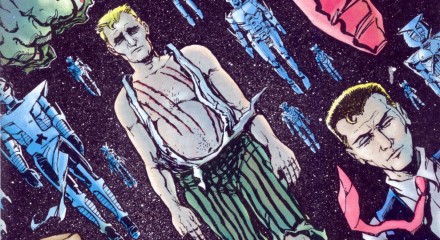
I am at a loss. I wander down long stretches of bookcase winding into shadow, eternity, and dust. I’ve lost all concept of time. The spine of Alan Moore’s Minutemen with its vintage essential 1930s-style artwork next to his Watchmen does not help me: though it would be interesting to read …
I keep moving. The Twilight of the Superheroes–more Alan Moore–sits there in an alcove but promises no solace. I go deeper. There is a manga section on the other side of me. Tezuka Osamu’s Phoenix: Earth stares at me mockingly whole: completing an incomplete saga and a lifetime’s work. I shake my head and keep going. I keep going past the rest of Moore’s Big Numbers, all twelve issues of them, long since past the time to remember how many steps I have given away to be here in this place.
It gets worse. I find myself at a complete run of Marvelman and it’s hard–so hard–to turn away. It’s as though I’ve come to a dead-end, like the middle of a maze in my mind, like the conclusion of Gwendolyn MacEwen’s Black Tunnel Wall right in front of me.
I begin to run.
David Eddings’ Zedar: The Apostate sits on a shelf in loneliness. Myst: The Book of Marrim makes my heart-ache. There are so many Tolkiens. So many Tezukas. So much Alan Moore. Moore. Moore. More. More. More …
It is in the history section of this labyrinth of the literary bibliophiliac where I stop at Maus III: My Mother Breathes Silence–Art Spiegleman’s graphic novel based off the fragments of his mother Anja’s surviving journals from asylums and concentration camps–that I finally understand.
This place doesn’t exist. This is the place where I want to be.
I’m clutching my head in the darkness as the full implications of all this begin to sink in. Then I see something: something else in the dark. I walk past The Continued Works of Keats and The Will to Power that Nietzsche wrote himself to find a gap in the comics section. It is a small gap and I can barely make out the label on the shelf. When I read enough of it, I smile.
I can’t help it. In the Neil Gaiman section, the story of Morpheus before Preludes and Nocturnes is no longer here. It is somewhere else now. I’m smiling: hoping that the Marvelman section and its remaining additional issues will also disappear from this place sooner rather than later. It is is a small hope.
A transvestite Joker seems to laugh at me from a cover of Morrison’s Arkham Asylum as I slump down exhausted in a place more demented than Batman’s Rogues Gallery and more sad than a watch without a watchmaker: a library without librarians.
It is here, huddled in this dark corner, that I wish for a world that makes sense: a place where Homer existed, Shakespeare wrote his plays, Sappho wrote more poetry, and I–finally–know just who it is I am.
Before I begin, I would really like to point out that I’m aware of the fact that I’m talking about a comics series that few people have had the opportunity to read: though perhaps there are more readers of Miracleman out there than I assume. In addition, there will be some spoilers in this article, so for those still interested in reading the comics and can get access to them, read them first before reading this article. And for those who have no idea what I’m talking about, I talk enough about superheroes here and the philosophy of them to probably be followed. It’s up to you whether you want to read the comics.
Like I say every time I make this disclaimers, you have been warned.
Well before Alan Moore revised or deconstructed the figure of the superhero, people always assumed that even though superheroes have their official crime-fighting identities and their civilian alter-egos they are still ultimately the same person. The same was the said for Marvelman (later named Miracleman and possibly Marvelman again depending on whether or not Marvel Comics releases Alan Moore and Neil Gaiman’s runs) and his Family: that even though they spoke a magic word to change from human to superhero and back again, they always had the same personality.
Alan Moore challenges that assumption with his revisionism. We see a vast difference between Kid Miracleman and Johnny Bates: the child that he came from. Of course, that has a lot to do with the fact that Johnny switched into his Kid Miracleman persona as a child and let it grow up separately from his human child form. This, along with the event that forced him to hide and the circumstances of how he got his powers, might have warped his mind into two distinct personalities: though both have access to the same memories which is something to consider.
Moore even makes you begin to question if Miracleman and his alter-ego Mike Moran (though they both share the same initials) are in fact the same person. While both begin with a similar morality and are genuinely good people–and they share memories–key differences begin to occur to differentiate them. It’s probably even further complicated by the fact that Miracleman had been dormant for years after a traumatic event, while Mike Moran himself continued to age and live his own life until another traumatic event forced him to remember the key-word to bring his superhero persona back.
Then there is Young Miracleman–or Dick Dauntless–who died and was brought back to life. From Neil Gaiman’s run, or from what exists of it so far, there is no difference between Young Miracleman and his alter-ego at all. Finally, Miraclewoman seems to be the most balanced of the entire Miracle (or Marvel) Family in that as the doctor Avril Lear and Miraclewoman she also seems to be the same person and has learned a lot about her dual nature by exploring both.
As I read the entire series as it was, I began to notice certain elements that Alan Moore and to some extent Neil Gaiman incorporated into their work. In a lot of ways and I have Alan Moore in particular in mind, they brought the idea of the superhero back to its roots: to the mythologies that created it as they took it apart. The secret British government program that was created to make these super-beings is called Project Zarathustra: based off of Nietzsche’s idea of the ubermensch or the superman. The superman is supposed to be a being that has transcended all conventional morality and chooses to create their own code to live by: possessing the power to do so through sheer will. I talked about this a little bit with my Whoever Hates the Man of Tomorrow? article, but this is a theme that definitely plays out with Miracleman.
There are other mythological references in Miracleman: such as the heroes’ home base being called Olympus, the body-switching Qys as the supposedly unwitting genetic prototypes of the Miracle Family being referred to as the Titans or the Primordials that existed before the “superhero pantheon of gods,” and even the battle with the twisted Kid Miracleman supposedly mirroring Ragnarok or the “twilight of the gods.” Moore even creates a nice mythological analogy between superheroes and supervillains: the former being Heroes and the latter being known as Dragons or monsters to be vanquished. We see a lot of Nordic and Greek mythology being drawn on to create this version of Miracleman. But there is more.
As I continued reading Miracleman, I saw another parallel developing. It began when I saw the twisted fused twin skeletons inside of the British government’s secret Spookshow warehouse: where Miracleman and his kind were created. Originally, I was led to believe that these fused skeletons were the remains of Young Miracleman from his own death, but in reality they were the dual remnants of Young Nastyman: another experiment that went insane and died through mid-transformation within a volcano … or so Miraclewoman says.
That grotesque fusion of two skeletons reminded me of Aristophanes’ myth of love. I know how disturbing that may sound, but I didn’t actually start thinking of it that way until Miracleman himself began to explore his own identity and the line between himself and Mike Moran. According to Plato in his Symposium, Aristophanes explained why love existed by telling a story in which once upon a time mortals were larger beings with two-heads, two sets of genitals, and two sets of limbs. They were powerful and they defied the gods so much that Zeus split them into two. This myth was supposed to explain that love is that need for each person to look for the other person split from them or, as we hear it in our own popular culture, each person looks for “their other half.”
That was the resonance I got when Alan Moore really came to the finer details of how the switch between mortal and divine works with the Miracle Family. It’s almost as though Project Zarathustra, in analyzing the bodies and the technology of the Qys–of fluidly intersexual Titan progenitors–tapped into a place of mythical proportions to recreate that “lost existence” that Aristophanes goes on about. One very interesting thing to note about Aristophanes’ myth is that when human beings were once unified, greater beings it was implied that they could defy and potentially challenge the gods themselves: which was one reason why Zeus and Apollo divided and changed them. Therefore, it can also be implied that Project Zarathustra allowed mere mortals to tap into the divine, to a place beyond the divine, to become a lot more than what they already were and challenge the established order around them.
Aristophanes’ myth that was meant to examine the origins of love and humanity’s potential to divine power is argued by scholars to be a comedic or lampoonish idea to reflect its comedian creator. Yet I find nothing particularly hilarious about this, though it is interesting that it was considered a “comic” idea: one that has translated itself so well throughout the ages. There is also another saying in popular cultural with regards to love as reunion: that just as people are looking for their “other half,” there is also in a relationship reference to one’s “better half.”
This is where I begin to wonder, like a few scholars before me, if the myth of Aristophanes wasn’t created by Plato himself to add a nice neat argument to his Symposium. We can argue whether or not Socrates created his own philosophy too until the cows come home, but that’s not the point here. Plato himself had his own theories about reality and the subjects that exist in reality. He believed that there are two worlds: the World of Forms or Being and the World of Becoming. The World of Being is a plane of perfection. You can find the originals or the perfect forms of anything that has ever existed. You can find the ideal object–such as a chair–or subject–such as a man or a woman as well as thoughts, feelings and knowledge–here.
Then you have the World of Becoming, a gradation of said perfect forms into more worn and degraded shapes. They deviate or change from the ideal and ethereal prototypes that they come from. The idea is that we live in the World of Becoming and that we seek the World of Being. You can see here, and I’m sure my high school philosophy teacher would be proud of me at this moment, how this Platonic thought influenced the Western idea of Heaven and Earth, or Heaven and Hell.
When I read Miracleman, I saw an interesting parallel with this Platonic conception. Miracleman and his kind are the perfect forms. When they are not used, the forms are kept in a place of pure energy known as Under-Space: a nice analog to the World of Forms itself. They rarely ever age, they cannot be destroyed through conventional means, they have extraordinary clarity of thought, devastating power, and even their costumes are engineered from an alien material that cannot be destroyed and reflects the moods of their wearers. Their powers and natures are explained as being the result of a psychic field or harmonic around them that they can control. In other words, the Miracle Family practices mind over matter.
My reading of this is that human scientists–degraded imperfect people like the rest of us from the World of Becoming or matter–used a link to the World of Being or the spirit to reverse engineer near perfect forms that mortals can have access to. Even Miracleman explains that he has the same thoughts that Mike Moran does, but he can see them and perceive his world with far more clarity and insight. We can get even more Platonic or Gnostic and say that through science, the Miracle Family gained a greater link to their spiritual, real, celestial selves. It is also no coincidence that Alan Moore, their revisionist, began to embrace further mythological and spiritual elements in his later works and even in his own life.
So it seems clear cut that Miracleman and his Family are their own essential selves having been unified. Of course, it is not nearly so simple as that. Mike Moran, Johnny Bates, Dick Dauntless, Avril Lear and Young Nastyman (or Terrence Rebbeck) did not seek this enlightenment. They were kidnapped, kept in medically induced comas, experimented on, had essentialized clone bodies made for them, had said bodies transferred into Under-Space where their minds would be trained to switch back and forth to by a word command, and were brainwashed to believe they were superheroes in a comic book-like virtual world before being abandoned as too powerful and too dangerous and marked for a termination order which, inevitably, failed.
It all sounds so banal when I summarize their origins like that. In a lot of ways, the Miracle Family are more like the uncanny Freudian doubles or doppelgangers of the mortals which they are linked to. They have great powers and insight, but they do not always relate well to the World of Becoming around them. Some of them are malicious because of this and even the best-intentioned among them have the potential to cause immense and traumatic change to the world.
I personally think that they are all of these things and more. I think that Moore portrayed them as humanity’s need to reach for and become the divine: or to remember its divinity. What happens after the creation of said beings, their own realizations of what they are, and how the affect and what to share their perspective with the world around and the people who made them is–in mythological retrospect–an inevitable conclusion.
ETA: After writing this article, I’ve realized that you can examine the Miracle Family with a particular focus on identity. Much in the way that Neil Gaiman’s A Game of You really plays with identity, gender and the fluidity and change of self-identity, his and Alan Moore’s Miracleman can also be examined in a similar light. Maybe one day someone will do that … when the damned thing is republished.
I’m trying to find the best way to phrase this because it’s been on my mind for a while.
As a lot of you–old and new readers alike–know, I’ve been improving and developing this Blog as I’ve gone along. I had a few ideas as to how I would add to it. Really, I had two ideas. The first was that I was going to take my Youtube Channel and create a Vlog. I’d seen some people do this before–such as FreakishLemon–and I wanted an excuse to be able to read some of my stories and opinions aloud and even talk to people about my plans.
It was–and is–a good idea. But there were two factors I didn’t know about until I actually got up the courage to try them out. The first is that while I discovered my Acer netbook can record video and audio with its camera, the transfer rate of said video from my computer to Youtube was something along the lines of 436 minutes. Now, I’m not good with numbers, but there is something really wrong with a five minute video taking over seven hours to upload onto a site that is designed to receive and play videos.
But all right. Fine, perhaps it was my wireless connection, or the quality of my camera. I discovered that Youtube has a recorder. So I used that. I made one video that was ok, but I wanted to do over again. So I attempted that and then … I got a disconnection error on the screen. I kept recording anyway: thinking that I just couldn’t see the camera and the video was playing anyway. I was wrong. The recording cut off right about the time the disconnection error on the camera feed began.
I spent a large amount of time trying to figure out why this was happening and why I couldn’t just upload my videos. It also didn’t help that before all of this I had been doing various retakes of the same video. You know: the one that never made it onto the Net. I researched these problems and partially confirmed some of my suspicions, but mostly it made me frustrated. You have to understand, I get frustrated with technology–very frustrated with technology–whose creators claim it is supposed to be simple to use but it really isn’t. And even barring that, if we follow Gaiman’s Second Rule I believe, we will have all the technology and science we’ve dreamed about in science-fiction but it won’t always work properly.
I wonder how many times holograms and communications channels would lag in Star Trek if that were the case. Or if Data had to reboot several times or freeze in mid-motion before doing anything else.
So I decided to put that on the back-burner for a while, and instead record some audio files of me reading my stories aloud: for the practice. I have a weird program on this Acer which won’t let me listen to the recording I made after I made it, but aside from that it recorded well. Of course I can’t put this onto Youtube because it is audio only. And so I thought I could put it on this WordPress: which I can … for a modest fee. Since I don’t have the money to actually pay for more space or an application on here, that plan is out of the works unless I find a remote audio upload program I can trust.
I also thought about changing the aesthetics of this site. I have a friend who is into graphic design and photography who offered to help me, but I seems that I can customize this site again … for a modest fee a year.
I mean, fair enough. My Blog is changing and may be evolving past the limits of that I wasn’t even aware existed. I want it to look more customized and to add different media onto it. I also wanted to have a once or twice a week Vlog tie-in: to get the Youtube community on this and get further feedback. But it seems that I am lacking money and, quite frankly, patience. I am not going to rely on a recording program that might decide to cut off on me on a whim and I am definitely not going to wait over seven hours for a video to upload.
I’m also thinking about reducing the amount of times I post on this Blog to once or twice a week as well. I need to focus more on my writing and make more posts to keep in reserve. It’s amazing to think that just a few months ago I was writing a Blog post a day or every two days spontaneously and on the spot. I do still have some ideas and when I get more I will be more than happy to share them.
Anyway, I hope by the time I post this I will have figured more things out and maybe by expressing some of this frustration, I can free up my head to do more constructive things. Because I think that is the most frustrating thing of all: spending a lot of this time on technical matters when all I want to do is write. I’m not ruling out the other options too, but things are really going to have to change before anything else.
Maybe these setbacks, in the end, are a good thing in their way: because now I know where the limits are and I can begin to find creative ways around them and work with what I have. One can only hope.
If anyone has any suggestions as to how I can solve any of these issues, my ears are open. Take care, awesome readers.
There have been a lot of articles and discussion on this matter. J.C. Maçek III gives a very in-depth background into the history of the creative and legal controversies behind Marvel/Miracleman and his comics, while Julian Darius talks about why Miracleman Matters and how it is a prime example of the Comics Revisionism happening in the 80s. I kid neither myself nor you in that there is a lot more out there: more than the actual comic itself.
I find it amazing how much one superhero and his comic can complicate things. I personally think it is ridiculous and a crime against humanity that the Miracleman series has not been published in ages. In fact, it is patently ridiculous that it still isn’t out yet and it’s been this way for decades. The only way you can even get hard-copies nowadays is to find the single issues at certain comic book stories, or ebay, and be prepared to spend a lot of your hard-earned money: anywhere from hundreds to thousands of dollars. I really wish I was making this up. It is a bloody crime and I hope that any legal bullshit that still exists is rectified at least in my lifetime.
But I’m not here to rant about creative legalities. Rather, I want to talk about this series because I read it and I have a few thoughts on the matter that I really want to get out there. They will probably not be as detailed as those in the above links, but I will do my best as always.
Essentially, without giving much away, Miracleman is about a superhero that finds out–after years of forgetfulness caused by trauma–that he is a lot more than he appears to be: and I don’t mean that he realizes he is a superhero. That last is the least of it. Alan Moore revised this character from the hero’s comics Golden Age days when he was Marvelman and part of the Marvel Family: the latter of which he also revised too.
What can I really say without spoiling it on the off-chance that you might read it one day: or at least not spoiling it too much? Alan Moore takes the archetypal building blocks of this super-hero and to say he revises him and his world is an understatement. It is more like Moore rips into the spine and gives us a “behind the scenes” look at a two-dimensional plane to reveal a gritty, grandiose third-dimensional reality that blows your mind. The comics of Marvelman become a mask for a much larger world.
It is a story about a man who finds himself and does not realize what he has found. It is about a relationship that changes. It is about how a human being would really deal with super-heroism and what that is. It is about a former ally becoming your worst enemy, and showing the world just how horrifying a madman with super-powers truly is. It is about finding out that your old arch-nemesis is your creator and needing to surpass that. It is about Project Zarathustra, the Spookshow, comic books as mythology, and saving people’s lives for “their own good,” and the potential consequences thereof.
To say that Miracleman is a critique of the superhero is another awful understatement. All I can say is imagine Watchmen and what it does to the masked hero and his or her superhero successor, and then imagine a series that is somewhat “broken” (in the sense of it sometimes having gaps but also being insanely powerful) and goes an entirely different route from apocalypse and dystopia.
I was first re-introduced to Miracleman through an article I found in my own Master’s researches into mythic world-building called “What if the Apocalypse Never Happens: Evolutionary Narratives in Contemporary Comics” by Abraham Kawa in a volume entitled Comics and Culture: Analytical and Theoretical Approaches to Comics. Aside from it also talking about Alan Moore’s proposed “Twilight of the Heroes” which is a very fascinating concept in itself, it deals with how humanity would handle the world being saved after becoming so reconciled to its ending.
That is the challenge that Alan Moore leaves Neil Gaiman as he finished his run of the Miracleman series. Some people apparently this was really cruel of Moore. I mean: where do you go from such a seemingly close-ended conclusion? Where do you go from up? How does humanity deal with a utopia on Earth crafted with the best of intentions? Just how does humanity survive perceived perfection?
And that was Neil’s creative challenge to answer. Darius, along with a few others, says that Neil Gaiman’s writing and concepts in his Miracleman run were not on par with Alan Moore’s. However, I disagree. I think that Neil was given an incredible challenge, but one that his mind worked with. Think about it: Alan Moore created a background and a world. He crafted and borrowed and mythologically re-adapted the main players. He set certain events in motion.
But what I think Neil did was that then he looked at the other half of the equation as it were. In his Miracleman: Golden Age run, Neil looks at how ordinary people like you or I would interact with this utopia that Moore left in his wake. They are still human beings and still have their strengths, their weaknesses, and their differences. It is still a physical world. Yet Neil also taps into that great mythological well and he plays with the form of the comic to an awesome degree. Miracleman # 20 was by far one of my favourite stories: reminiscent of Stardust and yet so different. It crafted to look like a children’s story, but it is a children’s story about a very different kind of child and a very different reality where the stars are dangerous but also wonderful. He tells a grown-up and a child’s story. I think it was one of his best works and it is a damned shame that it is not accessible. As far as I am considered, that comic alone demonstrated what great mastery truly is.
Also, Issue 22–with the Carnival celebrating life and death, and the balloons in the sky– actually made me cry because it was that fucking beautiful, and I use my profanity here for tremendous emphasis. Some of the earlier issues were a little awkward, but they definitely hit their stride and there is a lot of innovation but always that human element. Even Darius mentions in the above article that there is some considerable nuance in Neil’s Miracleman stories. Alan Moore can obviously utilize the human element, but he tends to be more grandiose and ideological I find: while Neil always finds the mystery and the human and he shows you that the story never ends where you think it will.
And he could have ended Miracleman after The Golden Age, but he went on to a Silver Age that … never ended because it was unfortunately never continued. Miracleman is almost a lost, and incomplete masterpiece made by two mythopoeic genii. It makes me sad to think about it, but I’m glad I did manage to read this and I feel so much better as a reader and writer for it.
I would give Miracleman five out of five. It may be broken. It may have its issues and some plot gaps, and some copyright issues by having visual references to both Marvel and DC in it, but it was well worth reading and its worth as a story far outweighs its legend as the unfinished, ligated product that people still talk about and wait for. As for me, I earnestly look forward to the day when I can link to it here, and when I can buy copies for myself to hold in my own two hands.
At one point in Neil Gaiman’s American Gods, Mr. Wednesday states that America is the only country that worries about what it is. I do have some disagreements with that statement. You will notice it is not so much that America supposedly doesn’t know what it is, but it seems like it is concerned with what it is, where it came from, and what it might be becoming.
It isn’t uncommon for me to start off a piece of writing, or conversation, with a tangent and slowly try to lead into some kind of relevance. I know there have been many times when I’ve annoyed friends and loved ones with this roundabout way of getting to the point. But I’ll tell you.
I have forty-three Blog entries so far talking about a variety of different, but somewhat related things and it’s only after I deleted a forty-fourth one that I have actually started to get really self-conscious about what I’m writing on here. I’m concerned about what this Blog is and what I want it for. The question is not whether or not I want to continue it, because I obviously do.
The best way to explain it is that I thought I found my voice and–in fact–I sometimes still think I do. My tone and voice is a tenuous mixture of the formal and the profane: heightened diction, like my professors liked to call it, and slang. I focus on writing and the creative process while sometimes I do write a little about my feelings on those matters. It’s a strange alchemical mixture: and a lens through I feel I’m making to engage in information and issues beyond myself.
A little while ago on Facebook, I put as my status that I felt like I was playing Hermann Hesse’s Glass-Bead Game and utterly enjoying it. The Glass-Bead Game was something that was never really described except as something of a creative outline but–from what I understand–it was a game which people would take lore from different sciences and arts to create some kind of very intricate and beautiful interactive pattern. One example that Hesse’s novel likes to use is how some players combine certain kinds of music and historical lore together: to show how they relate to each other even if they are in different forms.
I wish I could explain it more, but basically this is how I feel when I write an entry here. I feel like I am engaging the massive amount of human knowledge that the Internet has, while knowing it comes in different forms of experience, and somehow trying to express their relations and differences in an entry. I obviously choose things that interest me or make me feel passionate. At the same time, I feel sometimes that each entry builds on a theme or an overall structure that I can’t really explain beyond that.
This Blog is important to me. The issue I had with the Blog entry that I deleted–the first entry I deleted–is that I tried to combine two general and personal ideas like I usually do and it didn’t … fit into this Blog. It just stood out in a jarring sort of way. In my review of Craig Thompson’s graphic novel Habibi, I mention how the rhythm was just off and this was a similar situation. I tried editing it, but I realized that it just didn’t fit and–worse–to me it just sounded asinine. I saved it for myself–because I do think there is some personal value in it that might come back here again in some way or form–but it was the wrong way of trying to communicate something. Really, it was a result of me trying to be too damned clever: something that you certainly need to watch out for when you are a writer of any kind because the temptation is definitely there.
Of course, I also realized that–for me–deleting a post would set a precedent for myself here and I began to wonder where to draw the line. Should I delete every post that has an emotion in it? Would anyone read something is simply information? Where do you draw that line?
Of course there are other considerations like thinking about how many times I repeat myself without thinking about it. I think what really bothered me about the post I deleted–which my attempt to combine an examination of money as an extension of the human ritual of exchange, and my decision to eventually affiliate this Blog with Amazon Associates–is that it did sound asinine and I tried to make the fact that I need money more grandiose than it is.
The fact is, I am going to get personal to a degree here. That is a fact. The title of this Blog says as much. The question is: what is the purpose of this Blog? And I will say this right now. It is to get me out there. It is for people to notice what I can do as a writer of fiction and articles. I also want it to supplement my ultimate goal: which is to get paid for my work and to do something that I frankly love. I also want this Blog to point people out to books, films, comics, video games and other things that I like and maybe even encourage them to get them as well.
One thing I was concerned with is that by affiliating myself with Amazon–even though I’ve written reviews for them many times and love their services–is that somehow I’d be selling out: even for a very small amount of income. But the thing is I want to get to the point where I can support myself with what I do and I feel that this is the beginning of that process. So I will make my affiliation with Amazon. Getting money or the potential of that is a bonus to what I want to do here for me and that is exactly what I am going to do in the way that best suits me.
In fact, one of the major reasons I started this Blog was because I know now–and I’ve always known–is that I have to do things in my own way. This obviously not the “be all, end all” for what I want to do, but I really look forward to seeing what I can do with this Blog, with what I write in it, with the connections I can make with it, and beyond all of that. So right now, that is what this Blog is: a companion and aide in discovering what it is I can do after years of studying and writing things here and there.
I’m also going to try to pace myself in what I write here, but just keep writing because I enjoy it and I am so glad that there are people out there that are interested in what I have to say. Sometimes it does feel like the Glass-Bead Game the way I see it in my head: like writing here is one great interactive game of information-shifting, manipulation, and combination.
I said that this Blog and the premise behind it was a promise to myself to keep going and that is exactly what I am going to do. So I hope that you will continue to Follow me, that more of you will Follow me, that maybe sometimes you will click on a highlighted link on a book, film, or video game title here to see if you might want to read or play them, and that you can watch what I do to the best of my ability. Take care everyone.
First, let me again thank all of my new readers for reading as well as “Liking” my posts and “Following” my Blog. I very much appreciate it and it encourages me to keep writing on here: influencing me to believe I have things that are worth saying about what I do.
A question that writers almost always get asked at some point or another–so I’m told–is where do you get your inspiration from?
It’s a similar question to the infamous where do you get your ideas from, and I might get into that as this Blog entry unfolds a bit more. I can be a real smart-ass and say that I get my inspiration and my ideas from inside of the strange, convoluted thing that is my mind. I can even be literal and say that I get them from reading, from watching movies and television, from my time at school, from long walks talking to myself, and from basically experiencing life. I even say as much in this Blog: which was founded on those very principles.
There was a TED Lecture created by the writer Elizabeth Gilbert called On Genius in which she discusses the Western view of what an artist and a creator is. Specifically, Gilbert looks at the symbol of the tormented artist: of the person or “genius” who is the sole producer of all the art and knowledge and expression that comes to them. She contests the view that it is somehow “natural” for a creator to suffer from depression, alcoholism, to be genuinely unhappy a good portion of their lives.
Even though she tries to debunk this, there is something very … seductive about the idea. I mean, look at the very nature of a piece of literature for instance. There is no novel, or short story that doesn’t have a conflict of some kind inherent in the plot or the theme of the thing. Without conflict, there is no story. Not really. Utopias get very boring to talk about after a while, but we love to hear about how they go wrong. Just like nightmares can seem more compelling to write and read about than dreams. So if these traits existence in the makeup of fiction, why shouldn’t they be in the nature of its creators?
Sometimes unhappiness, or tremendous passions fuels a writer. And in some of my darker moments, I believe that true joy is finite, while unhappiness is limitless. Sometimes, I don’t even believe I’m wrong and it is no secret I tend to write about some dark, violent, and sad things. Imagine writing about a world around you that was perfect and always full of joy. Imagine just how hard that would be to hold anyone’s interest for longer than a few minutes. Neil Gaiman managed to do something like this in his run of Marvelman/Miracleman, but even then he had to bring human nature and its inherently conflictive nature towards a paradise that was imposed on it.
When I’m feeling really negative, I feel like my negativity is what makes my writing immensely powerful: hence my above statement. I also know it is not always the case. Passion and conflict are not necessarily inherently unhappy, but necessary things. If anything I’d venture to say that stasis is also a tremendous unhappiness because nothing grows in it. That can be a form of struggle itself for a writer: the struggle against stasis.
In her TED lecture, Gilbert attempts to look at how earlier cultures dealt with the concept of human genius. She talks about how the Greeks believed that each person occasionally meets a daimon–a spirit or muse–that gives them ideas outside of themselves. The Romans also adopted this notion and called this spirit a genius. It’s all a conceptual framework. If anything, I understand that one advantage to this paradigm is that it takes the personal onus or burden of creativity from inside the individual and places on something “outside” of them. Alan Moore, in his Voice of the Fire, even states that he placed the building of said novel on the town of Northampton which he was writing about in a mythological way.
I think that it is a question of cultural and personal attitude towards the creative process and your own life too. I know that I also have a responsibility to write and express myself, but my experiences and knowledge also informs that. Sometimes I do feel a strange energy in me when I write something. Even when I write something with personal emotion, it overlays a kind of calm as well as I feel myself “getting the job done.”
I will tell you now: I almost didn’t post this here because I thought it would potentially be too personal and I want to just make this about writing. At the same time, my writing is powered by my emotions and experiences. It is a dichotomy I have to navigate a lot.
I’d like to finish off this post by quoting from the last eight lines of Gwendolyn MacEwen’s “Dark Pines Under Water,” in which she states:
Explorer, you tell yourself, this is not what you came for
Although it is good here, and green;
You had meant to move with a kind of largeness,
You had planned a heavy grace, an anguished dream.
But the dark pines of your mind dip deeper And you are sinking, sinking, sleeper In an elementary world; There is something down there and you want it told.
Despite what happened to Gwendolyn in her own life, and towards the end of her life these wise words are a gentle admonition to remember and I have to remember them everyday. If you haven’t, you should definitely check out Gilbert’s TED Lecture and the other TED Creativity Lectures as well. I hope that you can all find what suits and works for you as well.
First of all, let me thank everyone from yesterday and today who “liked” and liked my articles on horror. It was the most “Likes” I’d ever gotten on here–in one day and ever–and I more than appreciate it and the new readers that I have Following me. I just love writing about subject matters as though I am some kind of expert, though I tend to expand on just a few thoughts I have rolling around in my head and fill in the blanks with Internet and whatever books or other people I have access to. I also notice that there are some topics and themes that can really strike at the heart of the matter when you write about them or when they are even seen: some human universals if you’d like and I woud definitely like to write about more of them. But let me thank you all again: you are all awesome and I hope to make many more things here that will be worthy of further entertainment.
Well, I didn’t make it to the Finalists on ENO’s Mini-Opera Contest, however they are all pretty bad ass from what little I’ve skimmed through. I’m not surprised I didn’t make it–what with it being my first attempt and being done more or less at the last minute–however, it left me with quite a few ideas that I want to work on in other ways, shapes, and forms. And I also get to say that I dabbled briefly with librettos at one time too. For those of you just tuning in now, you can find my works through my “mini-operas” tag because linking to them apparently makes WordPress believe that I am actually commenting on the post directly and that just plain feels weird.
But speaking of standing ovations and conclusions, I’m going to be Graduating tomorrow. It is my Convocation Ceremony at York University at the Rexall Centre at 10:30 in the morning (I do wish my section had been given the afternoon time-slot and was closer to campus–I’m not used to as early mornings these days though I am working on it). Of course, I will have to be there much earler to wear a bunch of rental robes and then help my guests get their seats and all the fun that entails because I was only able to get three tickets in advance: again making something that should have been simple into rocket-science. So I want to get some writing of various kinds today while my time is still my own. I am kind of nervous, but it is one day and I will get through it. And I get to wear robes and a strange hat legitimately too.
What else can I tell you? I am very proud of finally getting my Master’s. But I also very proud of the Master’s Thesis that got to this point: a paper that used Neil Gaiman, Alan Moore, Herodotus, and their works as its basis. I finished off my first year of Undergrad reading American Gods for the first time and there is some symmetry in ending my Graduate Program with a paper on a good portion of my favourite author’s work as well. There is something really satisfying in that that I can’t explain except to say it is. I think of all the books and articles I used as old friends or collaborators. We all came together, sometimes procrastinating, sometimes arguing, and constantly moving around to make this paper. We’ve been together for a long time, some of us, but we really worked together for two and half years: perhaps even longer. Now some of them are back in the libraries, others still roaming on the Internet and quite a few more back on their respective shelves having said goodbye to one another. We don’t know when we will meet again, but I know that even if I don’t always hold them in my hands, they will always be with me: them and the work that I did.
It’s been a long ride and I am glad I got to tell a little of the story.
I met Gwendolyn MacEwen after she died in 1987. In fact, it was many years later in the early twenty-first century at York University back when I was in its Creative Writing Program. My teacher read us–and then had us read–some of her poems. She chose Dark Pines Under Water and it really left a powerful impression on me.
I recall trying to talk with my teacher about that at the time and I wasn’t even able to remember the poem’s name. I was so ashamed of that fact that when we had to memorize a poem for an assignment, I choose the above. Over the following years, I read all of Gwendolyn’s poems that I could find: though reading poetry is quite different from prose and sometimes difficult to read never mind even explain.
Gwendolyn was a poet deeply concerned with her craft and the power of mythology and the mythopoeic. She approached matters of mysticism along with darkness, sensuality, and a profound sense of psycho-geography: of history and the echoes of all people in the land they used to–and still-live in. Gwendolyn wrote many books of poetry and two published novels: Julian the Magician and King of Egypt, King of Dreams: both of which are dense but incredibly charged and multi-layered stories. An ex-girlfriend of mine bought me the last book as well as two of her selected poetic readings.
What really gets to me, however, is that this woman–who was shy, quiet, small and sleight with a round face, dark hair, and kohl-lined intensely dreamy blue eyes in her youth–was born and lived in Toronto. I think about it sometimes: that she once walked and biked to many of the places I’ve walked or drove on the bus past. She lived in the places that I visited and somehow made poetry and art there. From the sixties to the eighties she did this: learning Kabbalah, a multitude of languages, and she read her poems a loud. And while she did travel from time to time: to Israel, Egypt, Greece and England she tried to find herself–and find–Toronto’s spirit. Her series of short stories in Noman and Noman’s Land are some of the best Canadian literature I’ve ever wanted to read. I remember my time taking those books out of York and the Toronto Public Library fondly: especially since they meshed so well with the mythological writing I was doing, developing and planning on doing.
She was a complex character in herself, something that Rosemary Sullivan explores with a certain creative flair in her Shadow-Maker: The Life of Gwendolyn MacEwen: a book that I liked for the most part, though there were some psychological intimations on some of Gwendolyn’s behaviour on Sullivan’s part that I found to be very reductionist and necessarily the result of simply one particular potential trauma. Nevertheless, I really liked how she incorporated Gwendolyn’s life and works together into her narrative and it gave me another glimpse of the emerging literary scene and talent in Toronto at that time.
I won’t lie. Gwendolyn MacEwen and I have a lot of similarities, and despite years and death I sometimes felt close to her in a way. We both really like Star Wars and, as she knew it, the Marvel Family: though I wonder what she would have thought of Alan Moore and Neil Gaiman’s interpretations of the latter. She even wrote a poem about it called Fragments From a Childhood: a superhero poem which I found online and fell totally in love with. It is also no coincidence that I wrote a glosa in undergrad of her poem Shadow-Maker: something I won’t show here … at least not for some time.
I wanted to write a story somehow from all I learned about her. I still have that idea. I spent a significant amount of time at the Fisher Rare Book Library at the University of Toronto going through the collection of manuscripts and notes that she left open to the public: including an unpublished novel about a female musician’s life growing up in the early years and turmoil of modern Israel called Gabriela. It was so strange to see someone writing about a culture that I grew up in, something that she did not grow up in, and yet get many of the nuances that were there along with some insights I’m not sure even I knew about.
When the Fisher was open until the evenings on Thursdays, I would spend many a time holding the very pages she did when creating her own works as the light of the afternoon sun turned into evening. It was some of the most peaceful and exciting times I had traveling to St. George campus to take a look at her works and hold them in my hands.
I wish I could have met her. I think we would have had a lot to talk about. I also know that she was a genius and she deserved to be acknowledged as such. She did a tremendous amount of research for her second published novel King of Egypt, she wrote prolifically and she did and learned to do so many things having not even been a high school graduate. Although she gained praise from her peers, I feel she deserved much more than she got. Gwendolyn MacEwen, as far as I am concerned, is one of the best Canadian and Torontonian creators we ever had and it is a shame that she’s gone and her work is not that well-known outside Canadian writer and academic circles.
Sometimes I thought about visiting her in the Mount Pleasant Cemetery, but I’ve never gotten around to it and I’m not sure I ever will. I am glad that I looked through her Fonds at the Fisher however. I wish I could convey how it felt to look through the notes, drafts, and unpublished manuscripts of a writer and person that I respect: who influenced me so much and came into my life long after her own had ended so unexpectedly and easily like she was always there without it sounding creepy and ridiculous. But there it is. People come into your life for a reason and I believe she made my life richer for it.
In case you are interested, Gwendolyn’s collection can be accessed by anyone with a registration card at the Fisher. You just need to go and provide an address and ID and you are all set. I really recommend Gabriela because it is still very relevant and timely to today: especially with continued Israeli-Palestinian and Arabic relations being as they are. I wish it had been published, but I also loved reading it in that lovely Reading Room with the miles-high levels of bookshelves that the Fisher possesses.
I also want to link you to a review I did on Julian the Magician–Gwendolyn’s first published novel–on my Goodreads profile. It does get full of a bit of literary jargon, but I am pretty proud of it and what I got out of it. Sometimes I wonder if Neil read Gwendolyn, and if he hasn’t he definitely should.
Finally, I would add that Gwendolyn loved to read her poems aloud and at gatherings such as those at the Bohemian Embassy Club. There is a documentary made about her called Shadowmaker: The Life and Times of Gwendolyn MacEwen by Brenda Longfellow that has some filmed shots of her giving interviews and reading her poems. She has a melodic, resonant voice. It is worth seeing and listening to because her works make up a land that does, in the end, turn you inward.




 Mythic Bios