One Week, Doctors In Hell, The Serpent And The Fox, and The Se’reti Empire

Here is my update for this week. I got through the first week of LDEEP. Right now I am still in the place where I’m trying to figure out where to go from here. The major challenges for me are waking up early and the differences it’s had on my bio-rhythms.

But I think what has really gotten to me is the fact that I’m adjusting to being in something of a classroom setting again and being around people in the morning. I’m lucky in that the people I’m working with, my peers in the program, are very nice and we are trying to figure out similar issues together. Our instructor and advocate is doing a good job relating the government-mandated material to us and giving us extra information and personal anecdotes that can come in handy later down the road.

Yet this last week, it was difficult for me. I had to remind myself that it was okay for me to get up from my chair around the table if I needed to do so. Usually I spend time on my own on my bed with my laptop and I’m generally not around people. Another issue is that our work space is somewhat out of the way for me to get to so I need to rely on my Dad or public transportation to get there and it: causes me some stress.

It’s strange. I’m still hoping that I will get some contract work and flexible hours so I won’t have to wake up so early after my time in the program is done, but after my body was really adjusting to this new schedule last week I also realized I somewhat miss being around people and, when I have the energy to not be so introverted, socializing and helping others can be nice. Just as a part of me would be relieved to have time to myself again as I had before, another part is terrified at losing a sense of structure and getting bogged down in the fog of war in my head again.

I’m also not sure if a job can be found for me: one that can pay reasonably and that I’d actually like. One thing you learn as a learning disabled person is that sometimes you need to find a different criteria for yourself and make your own way. If you have an excellent helper, then they will work with you. Very soon, I will be working with our instructor for one hour to determine what it is I can do and what I want to do. I mean, I want to be a writer. That is not going to change. And I have some ideas. I think what I will do is I will write them down when I get the chance and we can see where to go from there.

So aside from the fact that I act on negative modifiers, especially for motor skills in the morning, I feel like … something is happening. We will just have to see. However, I do have more news.

I am getting published again in Janet Morris’ shared Heroes in Hell universe Doctors in Hell. In my story “Let Us Kill The Spirit of Gravity” we get to meet a fallen angel and the Earth Beast of the Apocalypse. But the most important element will be how Friedrich Nietzsche and Lilith, the First Woman, actually come into an accord that they hope will get them out of hell. I mean, good luck on that you guys. You are going to need it. The book isn’t out yet, but I will let you know when it is. In the meantime, here is a link to the book as a Kindle on Amazon.

Doctors In Hell

I also mentioned that I am working on a game with some friends. But what I haven’t yet is that I’m working with Angela O’Hara on some projects as well: including my Twine “The Serpent and The Fox.” Angela is an excellent illustrator and artist and it is my hope that we can make my story of interlinked haikus have some appropriate and beautiful illustrations to go along with it. I really want to get to work on that Twine, but I am also learning that with something like a “day job” like LDEEP, I have to pace myself accordingly.

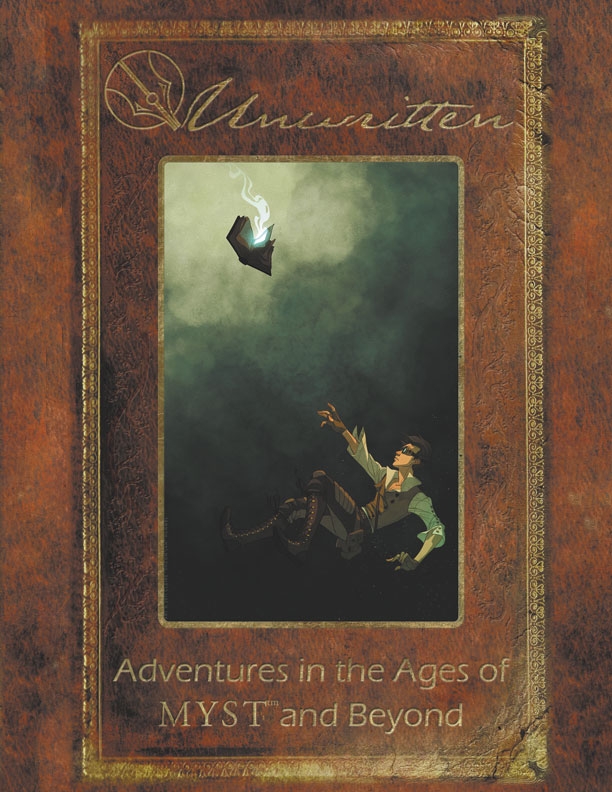
However, I have another excellent bit of news for you. A few days ago, I got my copy of Unwritten: Adventures in the Ages of MYST and Beyond.  It is a table-top RPG based off of the world of Myst and its Ages. Scott L. Hamilton, C. Eleri Hamilton and their team did an excellent job creating this book and I look forward to reading it and hoping others will play in the sandbox that Cyan Inc. has authorized for them. But I … actually wrote a sample Age in this book. You can find it on page 196. It is called “The Ser’eti Empire.”

Unwritten

It’s funny … I actually created the Ser’eti in 2000, when I was nineteen years old. I always wanted to write an Age for Myst and learn D’Ni Writing. Years later I got to be a part of the Guild of Writers for this project and now I got credited again in print. It kind of feels like I’ve gone full circle in a lot of ways. And it was totally worth it. I also love the illustration that Miguel Santos did for my Age. Thank you Miguel, wherever you are.

So there you go. I am still getting out there and I am working relatively hard. The funny thing is, being out from nine to three five days a week has gotten me tired but I still have energy to write things when I get home. I don’t know how that happened or if it will continue to do so, but I like that aspect of this part of my life so far: and this positive and creative energy that will hopefully not lag too much into exhaustion and nerves.

All I can add is this: thanks for continuing to read and let’s see what’s going to happen next.

Changes and Collaborations

So last week was my Orientation Day for LDEEP: the government assistance program that will help me find some work appropriate to my skills. Starting tomorrow and for the foreseeable future, I’m going to be attending workshops from nine in the morning until the late afternoon.

Am I nervous? Yes. It’s been a while since I have had my time structured in this manner. To be honest, I would have preferred to keep more flexible hours. I am definitely not a morning person and, while it’s occasionally a lark to be up in the morning, I am much more of a night-owl. I do a lot of my thinking and writing at night.

I am used to keeping my own hours and, hopefully, I will be able to do so again with perhaps the added benefit of having excuses to go outside, socialize, and get a job that is appropriate for me. This is definitely going to take some getting used to with regards to my routine and I hope I will be able to ask the right questions and take note of advantages when I can.

Things are changing. But they are not all stressful: or at least not stressful in a bad way. I am getting another story published soon — which I will keep you posted on as I get more details — and I am actually working on another creative collaboration. This time I am working with some friends of mine on a video game. Again, I can’t go into too many details as we are still conceptualizing a lot of the world and its minutiae, but I am really excited about it.

Perhaps more than the potential of getting some pay of my part in the collaboration, I get to work with some people whom I’ve known since high school. I will be honest with you: I’ve looked forward to working with these friends of mine for years on a project that could go public or, indeed, any game project at all. We are all talented in our own ways and I know I will do my best to flesh out what we have.

When I am working with them, working on material for the game, I actually feel enthusiasm and a sense of purpose that I don’t get often. For a while now I’ve been working on critical articles or within the sandboxes of other established worlds. This time I am helping to make a world and its background. It’s that feeling of this is what we should be doing. This is what I should be doing. It is my hope that we will continue working on this project and that we will have something awesome to show the world: or at the very least to ourselves and our other friends.

And there are other things I am planning to do besides.

That is pretty much my most recent update. I’m not sure where I am going with all of this. We are just going to have to see. I hope that some of you will join me in the journey.

High School

It’s Almost Time Now

Sometimes you have this dream. You have a dream, or a memory of a good moment in your life. And you run with it. At some of the worst, or most challenging points in your life you let it fuel you. You let it keep you going.

You keep telling yourself that one day if you work hard enough, if you’re honest enough, if you’re brave enough, or if you maintain that dream in your heart that you will attain it. After preserving or holding onto that memory you will find the means to bring it back to life.

But more often than not what really happens is that you hold an ideal in stasis. It never changes, even as you continue to do so by virtue of being made up of flesh and imperfect recollection. Sometimes it rots and becomes a heavy weight inside you that keeps you from moving on.

Somewhere along the line I realized that this one vision of what I wanted just wasn’t going to happen. It simply isn’t possible: at least not in the way that I held onto. A little while ago, I gave up on a Twine novel idea of mine. It was going to be the first Twine creation I ever made and it was going to draw from my life in a heavily abstract but emotionally poignant manner. There were some interesting ideas in that work, and at some point I may rework them into something a lot less long-winded and laboured: something smaller, sleek, and to the point. There is another work I want to continue as well and, perhaps, it may be more doable.

But here I am at the crossroads, or the threshold where I knew I was getting to for a very long time now. The truth is, once I realized that dream was over, I’m wondering what my next one is going to be. Perhaps parts of the old can be integrated into the new. I do know that I want to make new articles and stories. I want to be writing.

And I want to be paid for my writing. Some of you have been reading about how I Have A Disability, and how I am also dealing with Depression. It sucks to be virtually unemployed for about three years, and practically house-bound for a good portion of it: remembering the good old days even if they didn’t actually exist. I will always be dealing with those struggles. That’s just how it’s going to be.

By the time this Blog entry gets posted, I am going to my first orientation at the LDEEP. It is a program that helps people with learning disabilities find employment and perhaps begin to shape their career paths. I’m not going to lie to you: a part of me is afraid. My routine is going to be different very soon. I most likely won’t be able to keep the hours that I have, and my time may well be used differently. I’ve been in something of a twilight world for so many years now that sometimes I don’t know what I’m going to do, or how this is going to work out.

I’m also, through a legal clinic, attempting to get ODSP and get — unironically — the Social Justice Tribunal to reconsider my status: to get me the aid that I need. My hearing is next year. We will see if the clinic will take me on as a client and all I can do is deal with bureaucracy with bureaucracy and hope for the best.

I’m lucky that I had the resources to find this help and that I also have access to psychological counselling: which may give me some more resources in dealing with my anxiety. I’ve realized that I’ve had anxiety and panic attacks my entire life: I just didn’t name them until now. And now that I know them for what they are, I can make strategies in dealing with them.

But what it comes down to, for me, is the fact that I know I can’t go back. I can’t look back. I need to be at the point where I can finally move on and begin that process of actually living my life. So this is my Blog entry to start off this scary but exciting week.

There’s this thing about archetypes. They might be a constant or an essential idea, but they are never in the same form twice. Not really. The myth is the same in essence but different in form and execution. It’s adaptation. I’m terrified of not feeling comfortable or lost in memories anymore. Maybe that is a good thing.

Maybe it’s an old idea waiting to be reborn again.

Looking Outward

Fool Me

Someone begins to tell you a joke.

You’re smiling. Your life is generally serious, or mundane, and a joke is a good distraction. No, it’s more than a distraction. It’s the promise of bounty and plenty. It’s a story that seems inclusive. The teller lets you in. In fact, they do more than that: they outright invite you into the narrative.

So here you are listening to this comedian in front of you. And they are still telling their story. They are still making their joke. Your mouth feels a little tired from smiling so long. But that’s okay. You can see that they are building something. You’re still able to follow each step to the end, to the finish, to the punchline of the thing.

Half-way through, you notice that they are beginning to move away from their premise. It seems as though you are being led into some sort of tangent. And that’s fine, you tell yourself. So long as the pay-off happens, whenever it does, you can deal with it.

You can wait.

And you do wait. You wait as the joke continues to veer further and farther off tangent. Your expectant smile is getting strained as the teller brings in long and longer pauses for what may be dramatic emphasis.

You wait as the words become intermittent and reluctant. Your mouth becomes a flat line matching the ellipses to which you are being subjected. It’s too much. It gives you too much time to think about your day and the grey mundanity in it with all of its petty little details and disappointments. The line that was your smile on your face grows heavier as the performer seems to edge off the stage, and when they disappear — leaving you disconnected — it becomes a grim slash etched deeply into your flesh. It seems to engrave itself into your soul.

And all you can think about is what went wrong before and during the joke. But it is at this moment that you understand.

This isn’t the kind of joke where you laugh with the comedian. You were never even the audience.

Me and my Head

It’s Always Halloween At Five Nights At Freddy’s

“And under this carnival disguise the heart of an old youngster who is still waiting to give his all. But how to be recognized under this mask? This is what they call a fine career.”
— Jean Anouilh, The Waltz of the Toreadors

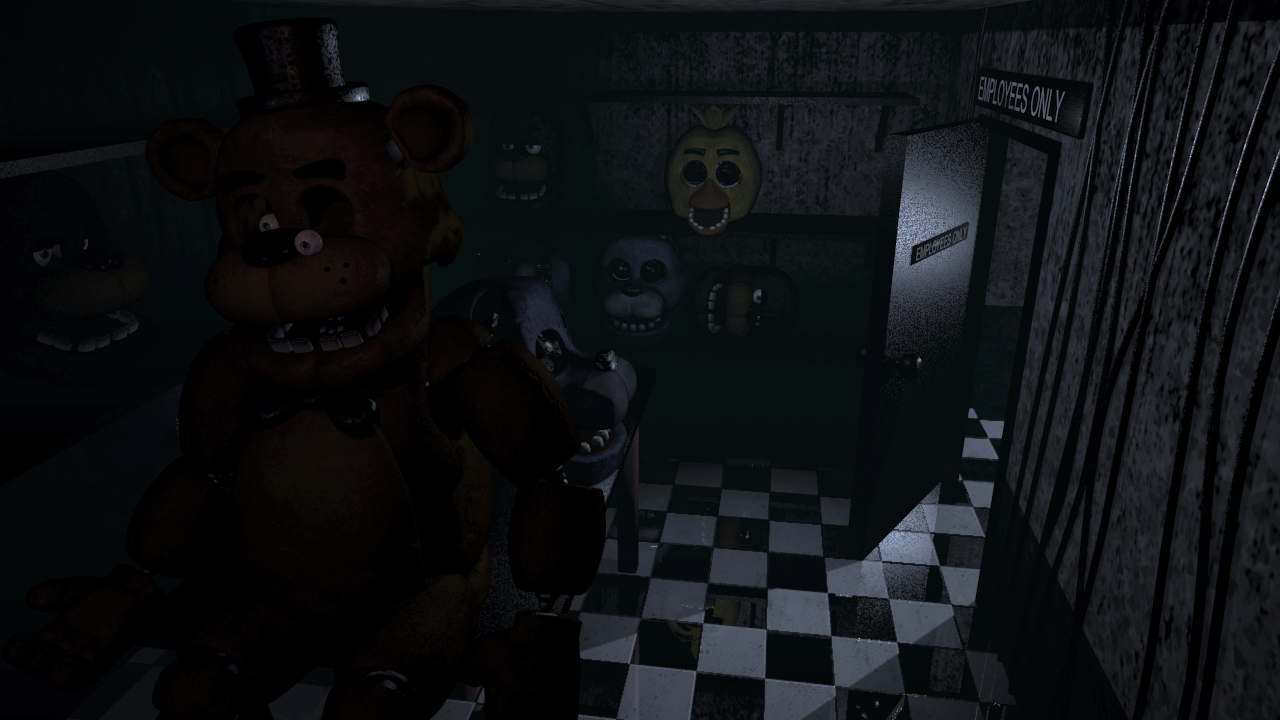
Freddy Fazbear

My first disclaimer, right off the bat, is that I haven’t played any of Scott Cawthon’s Five Nights at Freddy’s games. However I have been following them and, specifically, the overall story line.

The reason that the story behind Five Nights intrigues me so much is due to my own particular interests. Some of you who have been following Mythic Bios for a while know that I am absolutely fascinated with a special kind of creepypasta. You know the one: a short story told through different forms of media that become viral memes which proliferate through the Internet and user imaginations in the most strange and disturbingly wonderful ways. At the same time, I am a very nostalgic child of the 1980s and 1990s: especially when it comes to 8-bit and 16-bit video games.

In addition to all of this, for a while now I’ve been following the work of Kris Straub: the creator of Ichor Falls, Broodhollow, and the infamous Candle Cove. And, frankly, if I didn’t know any better I would say that in a lot of ways Scott Cawthon’s Five Nights at Freddy’s feels like stories that Kris Straub would create if he were working in the medium of video games and playing with late twentieth century children’s nostalgia and urban legends eroded by adult decay and a wickedly self-aware sense of humour. At the very least, it taps into a similar place of childhood nightmare fuel from which Straub’s horror work and Christopher Howard Wolf’s (SlimeBeast)’s Abandoned by Disney series also spring.

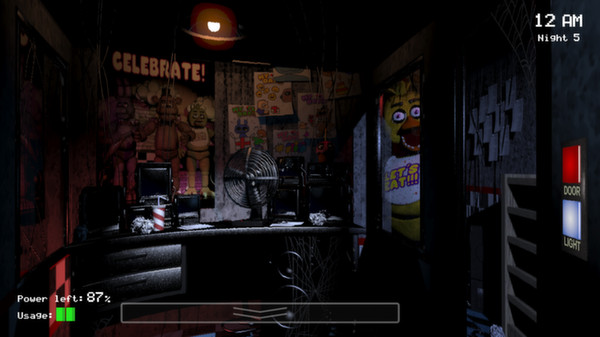
FNAF Gameplay

As it is, Cawthon takes a multimedia approach to his interactive storytelling. For the most part, each Five Nights game is a point-and-click endoskeleton requiring exacting precision tempered by a slow-burning sense of paranoia and and an ever increasing level of danger: all an attempt to survive long enough before faulty spring-traps snap down in a jump-scare that will leave your peace of mind — in pieces — for at least a night or two.

But then there is the rest of the game’s material — its costume — to consider. There are, after all,  the masks that you’re forced to wear, and those that stare at you right in the face before the long dark.

You have the newspaper clippings on the corners of your office. There are the children’s drawings on the walls of the pizzeria which you have to watch through faulty security cameras. You have an answering machine from your supervisor telling you about the dangers of walking animatronics in the night, and then more ominous references such as “The Bite of ’87.”

Then we get into the second disclaimer of this article: namely spoilers. You play this game from a second-person perspective: working six hours at night a week in a pizzeria to keep an eye on the place, but aside from seeing your character’s name on a pay cheque — should you survive to the end of at least two games — you never see your face. In fact, you don’t see any human faces in any of the three games. The only faces you get to see are those of the animatronics, the walking large, cuddly, worn, and mouldering robotic children’s mascots at night as they try to stuff your sad naked flesh “endoskeleton” into an empty suit full of pistons and wires.

FNAF Gameover

Even your supposed ally, Phone Guy, is just a voice on an answering machine: and the person who is responsible for all of this is a loathsome 8-bit purple sprite.

And here is where I think Cawthon’s genius truly shines. In the second and third games of the series, Cawthon institutes a platform game element. These mini-games are often considered reminiscent of those created for the 8-bit Atari 2600. You would totally think that with their blocky graphics and crude sound effects couldn’t be taken seriously. Of course, even if you somehow disregarded the resurgence and adoption of the 8-bit aesthetic by contemporary independent game designers, you would still be dead wrong.

FNAF Death Mini-Game 2

Between the “Death Mini-Games” of Five Nights 2 and the hidden mini-games akin to easter-eggs in Five Nights 3 — morbidly reminiscent of Warren Robinett’s Adventure and the Pac-Man level 256 perfect score glitch respectively — the mythos of Five Nights becomes more fleshed out.

While the animatronics in the point-and-click parts of the games come from a grim place where neoteny — child-like traits often incorporated into exaggerated cartoons — is combined with the uncanny valley — the notion of discomfort caused by an object that unsuccessfully tries to imitate a living being are terrifying because of how realistic they are made to look, they are creepy in a different way when rendered into pixel form. They are like 8-bit hieroglyphics, allowing you to explore the horror with a detached and almost dream-like manner. There is just something incredibly archetypal and gloomy about the graphics of the games that brings out its dark subject matter: especially when you consider that they are traditionally from a child’s medium of entertainment.

FNAF Death Mini-Game

The Death Mini-Games of Five Nights 2 introduce you to the Purple Man and his role in what might be wrong with the animatronics that are attempting to kill you while, at the same time, giving you a little more background into the development of Freddy’s pizzeria and the animatronic characters therein. And in Five Nights 3, instead of having to die in order to gain random access to mini-games, you can voluntarily search for the other mini-games to perhaps change the fate of certain characters in question.

FNAF Game

I think there are two elements that I truly appreciate from the combination of mini-games, newspaper articles, and answering machine information. First, there is what Cawthon is not telling you. There is what he implies and what he leads you, as the player and viewer, to put together. Cawthon even goes further in the advertisements for his games: implanting secret codes and clues into his messages. He makes you do all the work and all of the speculating: somehow making the dread and horror that much worse.

After all, there is a particularly challenge in another form containing the horror genre: how can you keep building up tension in the story when you reveal what the monsters look like? In addition, you certainly don’t want to reveal everything about the horror in the story or it becomes expository and rote. You have to keep a little bit of mystery in horror so that you always ask yourself why: while a part of you is always at least partially afraid of the possible answers.

These are the kinds of elements that inspire fans: that made this series into something of a viral meme on par with creepypastas. There are fan-made stories, games, animations, art, and trailers based on the archetypes that Cawthon creates. A Five Nights at Freddy’s movie is in the works and there is even speculation that Freddy’s is a real restaurant somewhere: probably based off Chuck E. Cheese’s. Certainly the mascot costumes, pizza, and arcade games taps into a resonance in me as a child of the eighties and nineties: a nostalgic feeling that Cawthon is trying to invoke and distort.

The fact of the matter is that, for the most part, the three Five Nights at Freddy’s that exist right now can stand by themselves. There didn’t need to be another game after these. However, I had my suspicions. Perhaps it was because of the empty product page he kept for some time with the discarded top hat. Maybe it was his silence about whether or not there was going to be another game.

But sure enough, come October 31, the fourth and final Five Nights at Freddy’s will arrive. And if you look at the graphic on Cawthon’s page, it is extremely appropriate if you think about it. I think it actually sums up a lot of the second element that has been on my mind, in some form, when I think about this game.

FNAF 4

I mean, of course it makes sense for the last chapter of a horror survival game to come out on Halloween, but here’s what gets to me. Imagine Freddy’s Pizzeria is like Chuck E. Cheese’s or even Disney World or Land. Certainly, a place for children would celebrate Halloween in some fashion: or at least take advantage of it commercially. Maybe “The Bite of ’87” might not come into it as many fans are speculating, but imagine how freaky it would be to be in a haunted children’s restaurant on Halloween of all days: perhaps even during the day this time around. Perhaps there are actual Nightmare toy versions or animatronics for such a lovely occasion.

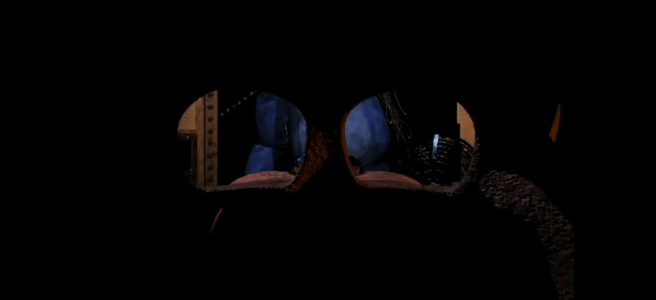
But all speculation on my part aside, take this a step further. Remember what I said earlier about faces? How you never see any human faces in any of the Five Nights games? There are always costumes involved. There are always roles to consider. You arguably wear a uniform as a security guard. A murderer might have worn a animatronic suit. In Five Nights 2 you have to hide your face under a Freddy Fazbear Head in order to survive an animatronic intrusion. And children might be hiding — or hidden — in other inside the darnedest places. Even Phone Guy, the former security guard who showed you the ropes of your new job and was your only ally for the most part, tells you that he is curious to see what is inside those animatronic suits.

Freddy Fazbear Mask

The fact is: it’s always Halloween at Freddy’s, and I suspect that it’s always been. No one is as they seem, everyone wears masks, no one rests, and everyone wants to play. Sometimes nostalgia is an illusion of the fabled “good old days” that can, when stripped away, becomes a dark, ravenous thing in the late hours of the night. Sometimes you lose track of time when you so desperately want to keep living, and you don’t always want to see what’s under that costume. After all, some seemingly innocent dreams are, at their core, rotting nightmares.

And just when you think its safe to take that mask off, to forget the night time, to mistake the performer taking off his top hat with a flourish and a bow as the end: the story only continues at an elegant pace … and the suspense will kill you.

Freddy Toreador March

Commitment

This post isn’t about relationships. Well, at the very least, it’s not about romantic relationships.

Hello everyone. It’s been a while. I didn’t plan it to be a while, honestly. I mean, I didn’t really feel like I had much to say for a while and, really, I wanted to put some emphasis on some of my long-standing projects. So, of course, none of that actually happened.

The fact is, I had to recharge for a while and it’s taking some time for me to get back into the critical and creative way of things. I had a whole other post that’s been sitting in my mind for a while, but I only think it’s appropriate that I write today’s post on what is, yes, May the Fourth.

In nerdy circles, that day has a lot of expectations behind it. And there are even more expectations now. It’s no secret, to anyone that knows me, that I have mixed feelings about Star Wars Episode VII. I mean, we’ve gone down this road before: a new Star Wars movie comes up and we have all of these hopes and dreams for it, sink some time into the experience, and hope that we will not leave it frustrated and disappointed.

I know that I am concerned with getting too attached. It’s one of the reasons why I’ve taken so long updating myself on the Marvel Cinematic Universe, and the DC television programs. They take a lot of time away, if you let them. Geeky things do that. If done well, or even not so well, they can get you attached to the characters and the stories. There might be a whole other ton of things that you have to do, but you end up filling the time dealing with these instead, or you procrastinate while trying to keep your desire for them at bay while unsuccessfully attempting to finish some work.

Good luck on that.

Oh, right. There is no such thing as luck.

You know, I have a queue. I have two Twine Projects that I want to finish. I have a Lovecraftian short story that has been on the back-burner to the point where I sometimes forget it ever existed, never mind remember its details. And I have another idea with which I want to have something to show for all of the research that I’ve put into it: if only in some small way. This also includes publishing more short stories and working on novellas again: and doing new things.

I’ve just not been doing it: or doing it as quickly as I would like. Life keeps getting in the way. I want to do too many things at once and, as a result, little gets done. And while I do value the creative criticism and reviews that I do, it has been a while since I have actually created something. And that fact is frustrating to me. I have to keep asking myself what I am first: a critic or a creator. And I’d like to say I am the latter.

In order to accomplish my goals, I will have to do it — or just not. The obligatory “do, or do not” aside I have gotten some very interesting perspective lately: perspective on what is actually important. If I am going to make a commitment, it needs to be something that is worth it to me. The Marvel and DC cinematic universes have definitely made me feel closer to what I was when I was younger with adult sensibilities. They also give me that time to relax and gather more material. And I will end up seeing the next Star Wars films.

As for the rest of it, I need to sit down and make some decisions. I suspect I already know what I have to do.

Don’t worry everyone. I will do it.

Yoda Waiting

I Have A Disability

Disclaimer: This is a post that comes from my experiences but, ultimately, they form my opinion on this matter. As such, this will get into some “life story” content. This is also a very long post, so if you don’t like reading long posts, don’t read this. Reader’s discretion is advised. 

I was going to post about this earlier, but I wanted to have fun first before getting into something so serious and personal. Hopefully we can get back to those fun things later.

A little while ago, I read some articles about gifted children: or children that are considered gifted. More specifically, these articles were written by the adults that these children would one day become. They wrote about a lot of things: how difficult it had been to focus in mainstream classes, behavioural problems some of them had, and the culture shock of being in a gifted class only to have to deal with “the real world.” Some suffered burn-out, or high expectations of reality that didn’t pan out as — for the most part and barring notable exceptions — their gifted statuses didn’t translate into independent adult success.

I wasn’t a gifted student.

In fact, some might tell you that I was on the very opposite end of the spectrum.

I’m what the educational system calls learning disabled. It’s a misnomer in a lot of ways. The way it’s been described to me, it’s more like I have a different form of brain wiring: or, really, I just learn differently. I have great difficulties with mathematics: in the form of dyscalculia. I can add and subtract basic numbers, but multiplication and division can only happen with a calculator. And even adding and subtracting, without a calculator, takes me a while to do: and a lot of mathematical formulas are beyond me. Certainly, it can get in the way of a game of Dungeons & Dragons. I also have spatial difficulties. I literally struggle to read a map and unless I’ve passed through a place several times and know the landmarks, I will get lost. Sometimes, even then I will still get lost. And this doesn’t even go into a lack of focus or attention that I have sometimes: which can lead to a total lack of motivation. I need to move around a lot. I get very stressed out and tense when I have to sit in one space doing one thing for an extended period of time.

All of this really doesn’t sound like much and, indeed, there are people with far more severe disabilities than I. And I was lucky. Early in my childhood, my parents identified and placed me into programs with professionals that could help me adapt as much as I could to mainstream programs and interactions. They knew and accepted what a learning disability is and gave me the help I needed to get the tools to deal with it and one day live an adult life: as much as anyone really can.

I was also lucky in that by elementary school and after a lot of childhood therapy there were various teachers in an administrative capacity that dealt with a lot of the bureaucracy involved with getting me help. All I had to do was focus on the activities and my studies. Aside from a class or two I had outside my main one, I was otherwise like everyone else.

In fact, I improved. I learned how to hide my fidgeting fits and my poor fine-motor coordination. And after years of childhood teasing over not being in touch with my surroundings, or being tricked out of money, I embraced my strengths. I focused on English and literature. I built up and focused on what I could do: and even though I can always improve and learn more, what I can do I do well.

The point is, I had to work — twice as hard — to be better.

I did so well, in fact, that in elementary school I got a Most Improved Student Award along with my best friend at the time. But by high school, things had changed. Suddenly, the onus was on me to deal with math and geography. There was no extra class or space I could do my work and I had to take extra classes and tutorials to get help: to do the work from those classes in addition to the work I needed help with. And high school kids did notice that I was different and they took pains to remind me of that fact. At least by this point, I wasn’t wearing velcro shoes any more: as laces were an anathema to my motor skills at the time. Still, I had extra time for exams, tutoring, and after dropping many of those courses I did what I always did: I focused on my strengths.

I thought by University my learning disability wouldn’t matter any more. And I wanted that to be true. I took the extra help when I could and when it didn’t interfere with my own time. I was facing more and more stress as finished high school and then got into Undergrad. But I found my stride eventually in Humanities and I had this whole plan figured out. I would ride through the stress, take the Tylenols when I needed them for my headaches and Gravols when my stomach bothered me. I would stay in the academic system. I was good at it: in my way.

My plan was simple. I would work in the system, using what aid I had from learning disabilities and Affirmative Action policies at York to rise up through the ranks. I’d graduate Undergrad, then my Master’s and then get my PhD. I would then get a contract and get a position and teach while writing on the side. I figured it all out. I’d focus on my specialization: on the words that I learned to compensate for looking weak to everyone else from my childhood. And I would use it all to gain personal independence and build a life for myself.

I had it all figured out.

There is something else that some gifted and learning disabled students have in common. In addition to learning in different ways from a mainstream program outline, and having different mindsets, we also have trouble dealing with that same culture shock that I mentioned before. And I thought I’d grown immune to that.

It’s true. I’d become a University Graduate and I was working on my Master’s. I even got my Master’s Degree. But as I worked through the stresses of the academic life, the lack of money, and the personal losses and learning experiences of actually living on my own for the first time in my whole life, I realized I’d lost something. It was a sense of guidance: that sense of guidance and understanding that I’d almost always had.

Of course, I’m not talking about an authoritarian sense of guidance: where someone tells you what you can and can’t do all the time. That kind of authority can be necessary when you are a child, but when you want to be an independent adult it can be extremely counter-productive and patronizing. I will get more into that.

These things all fit together. You see I always thought, and I was always taught, that the work was the most important thing: that academic excellence is what you should strive for. It makes sense when it’s a central force in your life at that time and it will, theoretically, become an important element in determining your social status in the future. For me, things like jobs, dealing with bureaucracy, learning how to drive and so on weren’t particularly on the list in the beginning. And despite my parents’ and even my schools’ best efforts, socializing wasn’t really high on my list either.

So I didn’t really network with many people at my University. Most were nice enough, but I just didn’t relate to many of them and I didn’t know how to approach my professors for help. So I didn’t do the networking, or the grant or bursary seeking. I didn’t realize, or want to realize that these things were just as important as writing that thesis: a thesis I didn’t think anyone in the field was interested in, or — deep down — that I thought was worth it. And I think it’s safe to say that from mid-Undergrad to Grad School onward I was getting intensely frustrated with bureaucracy and student loans: with being run around, having my status changed, dealing with illogical government websites, and not having enough money to live on as a Grad student complete with budgeting.

And all I could think of was that when I was younger someone else dealt with this stuff, or it wasn’t even a factor. Yes, adulthood brings adult responsibilities but when most of your life is made up of people helping you deal with these matters so that you can study and keep studying so that you can get a career, you have certain expectations that others in positions of authority will be just as helpful. And some of these people are, and some of them really, really, are not.

I didn’t want to use my learning disability status to help me. I wanted to think I’d grown past it: that I was finally achieving what I sought to do on my own terms. You can read into this however you want. But I have used it, and I still use it because I’ve realized that the system — however broken it may be — has those statuses for a reason and to those who need them.

It wasn’t just my learning disabilities. I have difficulty handling stress. It gathers into my body. Most of the time it’s headaches, but I have stomach problems and, like I said before, I can’t stand sitting down in one place being passive for too long. I was also burning out on academia: fast. And after I moved in with my girlfriend at the time, I was running out of money only at a slightly slower rate.

I had to get a job.

I got my original job through a learning disability organization outside of my university, though I was hired by my merits. My university’s program was a Career Centre one and, as such, only asked me questions about what I wanted to do and offered a whole ton of workshops. By that point I was so burned out from academia and I’d done so little work outside of it that I had nothing really to offer and resumes confused me and I just didn’t feel motivated to go to a workshop — especially after accidentally going to “the wrong workshop” by the administration’s own error — just to do that.

I needed a job almost immediately. At the same time, I wasn’t going to take just any old job. That is not how it works. If I am not interested in what I’m doing, the task will simply not be completed. It won’t happen.

But I still had that drive, right? I wrote stories and tried to publish them but I didn’t know — and to some extent still didn’t know — how to send them in and everything just seemed to take so much energy from me. It was pretty obvious at this time that my stress and frustration was changing from burn-out into depression.

One of the most frustrating and soul-destroying moments for me during this period was having to move out of my girlfriend’s apartment and go to an Ontario Works appointment that we arranged after I went under her ODSP plan that would have paid me $100 dollars a month for volunteer work — with the worker even offering me an adult teaching program for adults — until we could find an actual job together. This was in the Ontario Works branch of Toronto. Ontario Works is designed to be a relatively a short-term social service program that finds you work of some kind in the community. It theoretically encompasses all of the Province of Ontario.

And I was confronted with the fact that my resume, edited by my university’s Career Counselling Services, was more like a CV: with a list of achievements that couldn’t be applied to the outside world. I was told I had to tailor make each resume to match the job I wanted. I was also told by others to “Cold Call” my resumes in a cookie-cutter style. It was confusing and, honestly, I got sick of it really fast.

And that was the last time I dealt with Toronto’s social services and the city’s benefits. I ended up moving back in with my parents. As of right now, I pay rent and I applied to Ontario Works in York Region. I thought that I could have a similar arrangement to them as I did with the Toronto branch. I thought they were integrated.

I thought a lot of things.

What Ontario Works was, and is, is a program that I had to fight to get into. You know that sullen feeling that seethes in your stomach when you’re put on hold and there is nothing you can do about it? I ended up feeling that sensation more than I ever had with National Student Loans: though they would have their turn. I had to prove that I had a disability and phrase it as such. And when I finally did get in, I ended up needing my dad to drive me to their Woodbridge location as their Richmond Hill one, closer to where I live, “wasn’t in the right jurisdiction.” A situation where a person navigating their way to a long-distance location with a spatial disability and stress issues has all the makings of an insanity tale.

Their counsellors are only temporary and they cycle out a lot to take on new clients. I had to full out a long legal size sheet of paper listing all the jobs I applied for: as if my set of skills and interests could easily be found in the newspapers or the Internet. I simply couldn’t fill out all of those papers. Applying for jobs that don’t, ironically, apply to you for the most part plays on that lack of motivation that I was talking about earlier. It becomes a cycle of de-motivation. Some of my counsellors understood this and let it go. But others would phone me up and tell me I wasn’t “doing my part” in the process. None of them suggested any concrete ideas based on talking about my skill set or my leanings. And I had to re-apply — twice — to be exempt from filling out the sheet because I have a learning disability and stress issues: complete with a note from my psychotherapist (who is, by the way, one of the most awesome human beings I’ve ever met).

The York Region branch didn’t have any community services or job workshops I could participate in. After a few years of making appointments whenever was convenient for me, as adults do, I was assigned appointments with my status in Ontario Works always on the line if I couldn’t show up. I even got some pre-generated punitive letters from time to time stating that I was suspended from the program when, in fact, I met their specifications.

And I’m not even talking about my National Student Loans. University costs money, as does living on residence. Being on social assistance makes sure I don’t have to pay the government money that I don’t have, while theoretically helping me get a job with some benefits to do so. It got to a point, up until fairly recently, where I would wake up almost every weekday with dread coiling in my intestines: wondering if a voice message was left on my phone, or if I got a letter from NSL or OW.

Recently, I’ve been trying to apply for ODSP: which is specifically a government social service that deals with people that have disabilities. So far, I’ve been rejected: on the grounds that I don’t have a recurrent or permanent disability.

Even though I’ve been diagnosed as having both, and I had a doctor’s note. They invited me to write them a letter for an internal review. I can’t begin to tell you how hard it was to write that letter. It felt like NSL all over again where I was applying to go further into debt: except this time I felt like I was arguing that I was crippled in some way: that I wasn’t a complete person. One thing I was taught in school, no matter what direct help I was given, as that being learning disabled isn’t about what you lack, or what kind of deficiencies you have: it’s the fact that you just learn differently and you need other strategies to deal with the obstacles in your way.

So here I was: taking a lifetime of being taught that I could help myself — to the point of getting a Master’s Degree — and being told, now, that the only way I could get the help I needed was to tell them about how ruined I was.

And I did. I told them about the nature of my disability and how it manifests. I told them about the stress I suffer from and how it manifests physically. I even went as far as to give them examples of how this would affect me in most job situations. And, after a while, that sullen anger I’d been feeling became this righteous fury towards a broken system. But my words were cordial, even polite. Even though I was sure nothing would come of it, perhaps nothing will come of it even now, I used my words to take what was there — in me — to help me.

And oh, I wanted to tell them the rest of it. I wanted to tell them about the life I had in Toronto. I wanted to tell them about the loneliness and the peaceful solitude I had in my own apartment. I wanted to tell them how my girlfriend at the time used to tease me about being “independent in the city” and how it chagrined me and made me proud.  I wanted to show them the stories I wrote and the essays I made in my own place. I wanted to tell them about the dreams I had for my university life that never happened, or could have happened, or almost happened. Or how I could come and go with sheer impunity. Or how I explored down town Toronto for new opportunities and to discover new people, and to grow into a better person.

I wanted to tell them about my triumphs and my failures. I wanted to show them that I am a human being and that I gradually retreated from Toronto and that whole other into a small little box of memories and regret that I only occasionally leave: all the while envying the other people who “made it” and dreaming about those times when my life was better, when it was expanding … when I actually had one.

Do you want to know what one of the most important moment in my life was? I think you’d actually be surprised. Almost all my life, even though I didn’t live in Toronto proper I had access to the Toronto Public Library. That place contained the largest amount of books that became my life. And every Saturday I’d go to a branch and get a new book. So when I moved out of the Greater Toronto Area and moved into Toronto itself I realized that I could, for the first time in my whole life, get myself my own card.

And I did. It had my name on it and everything. I took out books and comics. I read them on the TTC, in my apartment, at my girlfriend’s, and everywhere. For the first time, despite the schizophrenic nature of living in and feeling detached from Toronto, I felt like I could belong.

But I don’t own property in Toronto. I don’t go to school in Toronto any more. I don’t work in Toronto any more. And I don’t live in Toronto. Any more.

So I lost my card.

A good part of me died that day. And I became a ghost: remembering all the times when I was still, fully, alive.

It got so bad I sometimes felt tempted to re-enrol in school: to go for that PhD program I used to dream about even if a Degree didn’t guarantee me a job, or a position in today’s market, or if the thought of even more deadlines looming over my head didn’t terrify me. Even if it only bought me a little more time and would never get back the life I had before.

My Mythic Bios saved me. It made me into a writing ghost: of which I can see where a certain pun or turn of phrase might come in. I wrote: keeping as much of my life away from here as possible. I wanted a space where I wasn’t a failure, where I wasn’t bound, or held down into one place. And sometimes, I wasn’t always a ghost. Sometimes, like Tiresias I got to drink the vitality of imagination and companionship and I had inspiration and vision again. I could believe that I was alive and that my body wasn’t a liability.

I’ve accomplished a lot of good things during this time when all these other elements were happening in the background. I published a story, I published some articles, and I started writing for an online geek magazine. I networked and I even made some new friends. I realized that this place, right now, even without money or steady employment isn’t hell because I’ve written about hell and there are still some chances here.

There is something else you need to understand about having a learning disability and, again, it was something taught to me in school. In addition to problem solving, I was also encouraged to ask for help. I think one of the most difficult challenges in being an adult with a learning disability in addition to all the other gritty and uncomfortable adult things is the fact that I didn’t feel like I had an advocate.

An advocate is different from having a teacher or a counsellor. A teacher will show you how to do something, but will ultimately have you do it. A counsellor will advise you or tell you the status quo or the party line and stick to the minutiae of the system. But an advocate can not only teach you, or advise you, or know how the system works but they will listen to you and stand beside you in getting to that place that you need to be.

I haven’t really had an advocate of that level since childhood. But I might be getting one like that right now. For the first time in ages, I don’t feel the dread coiling inside of me. Just yesterday, I turned thirty-three. I’ve been unemployed, but working and trying to find my way — trying to find a focus — for almost three years.

I’m still scared, but in the sense that I know there will be challenges that I’m going to have to face: that I’ve always faced. I am going to need to deal with this world and its realities of rules and regulations. But maybe I won’t have to do it alone. There are already people behind me but maybe, just maybe I can take those obstacles that I have been in my way and turn them into goals, into goal posts until — eventually, I get to where I need to be.

Now, if you’ll excuse me, I have to go sleep now. Tomorrow, I have an appointment to keep.

Looking Outward

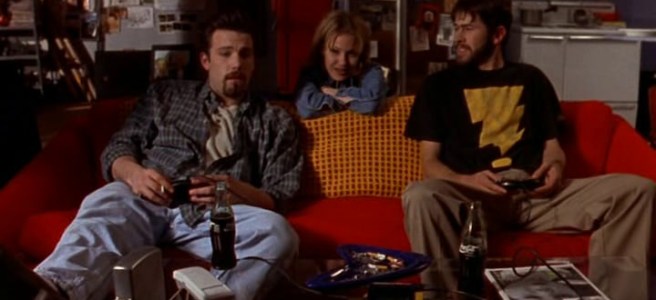
Chasing Amy, Finding Alyssa, And Revenge Of The Shit

So I worked on a little bit of a side thing.

I wouldn’t have even called it a project, at first. As you know, I finally watched Kevin Smith’s Chasing Amy not too long ago and, as a result, it did something my brain. So, one night, I was thinking about the last part of the movie and this rather, shall we say, fucked up parallel occurred to me.

Originally, it was going to be a post written on Mythic Bios after I got the article that I intended to do, for tonight, right on here. Then, as per usual, my brain asked me: “What would happen if you made this into a Twine?” Then I got silly. See, I had this plan. I was going to cut Holden McNeil’s infamous scene with Banky and Alyssa Jones: with Anakin Skywalker jumping into Obi-Wan Kenobi’s lightsaber blade, getting amputated, and igniting on fire.

Alyssa and Banky Scene

Then I was going to end it with Holden McNeil coming out of a movie theatre, having just watched Revenge of the Sith for the first time, and say something smart ass about how bad it was. The implication, of course, was that the film and the prequel Trilogy was so bad to Holden, that it brought back terrible memories. You know the ones.

This short Twine of few scenes, mostly quoted lines with that ending, was going to be called Revenge of the Shit. Personally, I think it’s a title that some of Kevin Smith’s film characters might have appreciated: among other disgruntled Star Wars fans. And yes, I was tempted to put a certain … demon of excrement into the story somewhere: perhaps asking him how the movie was.

Of course, I also came up with another — more grim and random scene — right after that which would have taken the piss out of the comedy right then and there. But, really, what I planned could have been done better by someone with actual video editing and splicing skills: of which I have neither.

It was supposed to be a throwaway project: a one-off. It was supposed to be something that was fun and light and made light of a fictional character’s ridiculous choices and suffering.

But, as usual, I can never really do anything simple.

The fact of the matter is, the little bit of fan fun and snark mutated out of my control: and into something else. At the same time, it took precision to find those quotes, describe those settings and character feelings, and build something from it. It became something else. I realize that even though these characters and lines belong to Kevin Smith, George Lucas, and now Disney, I actually had something of a story to tell.

And I had fun telling this fan homage genetic freak, bordering on a crack fic — an off-the wall story– that I hope also says something meaningful.

My Twine making skills haven’t really progressed since The Looking Glass, save for learning how to format fonts in Twine, but as always I tend to focus on story and pacing the amount of text, of making a rhythm through each hyperlink more than anything else. But before I go on, there is one more thing I’d like to say.

There is one part in this Twine story where, should you choose to find it — and it isn’t hard to do so — Holden enters something of a “What If” or “Infinities” reality with regards to Chasing Amy. There was one story I was so tempted to tell, or outline: where Holden is so overcome by Banky trying to sabotage his relationship with Alyssa, and finding out about Alyssa’s past at a point where he is not mature enough to deal with it that he actually leaves both of them — and his old life behind — without a word.

Holden

Alyssa ends up coming to his and Banky’s apartment to find out where Holden was, even as Banky is left in the lurch with regards to their creative work Bluntman and Chronic, as well as their own friendship. Alyssa demands to know what Banky told Holden after he admits that he said something to him about her past. Suffice to say, she gets mad when she finds out, while Banky gets defensive.

Alyssa decides to go looking for Holden, actually concerned that he has had some kind of mental breakdown. Banky also goes with her and, reluctantly over a car trip start working together. Unlike Holden, she warns Banky that she will do more than tell him to “shut up” if he gets out of line. Banky tells her that the reason he dug into her past, to get “evidence” on her, was because he was protecting his friend: that he was afraid she was just using him as “a sexual phase” or some kind of game. Alyssa actually calls Banky out on the fact that he loves Holden and sees her as a threat.

But they do bond, and perhaps meet some weird characters along the way. At one point they realize that they could have actually been friends if this hadn’t gone down after they begin exchanging more stories. They realize they have a lot in common in addition to their bad experiences with women. At one point, they seem dangerously close to being intimate with each other, but they both go “Nah” at the same time. Banky says something about man-hating lesbians, and Alyssa counters him with misogynous (closeted or not) gay men. It’s Banky that admits he hates the fact he never saw Holden smile more than when he saw him with her. He realizes he hurt his childhood friend badly and, for the first time, actually starts to cry. It occurs to the both of them, in a poignant moment, that they love the same man.

Holden, Alyssa, and Banky

Alyssa also tells Banky that the reason she wants to find Holden is that she’s worried about him, but that if something like her past is enough to get him to leave her, he should do the opposite of being “chicken-shit” and make it clear: giving her closure. So to spoil the ending of this alternate universe “What If” story I’m never going to write, these two flawed but genuine human beings do locate Holden. He has been in the middle of nowhere, in a barnhouse: pretty much acting like J.D. Salinger, the creator of his namesake and working on a new comic. Chasing Amy is that comic: as he had seen Jay and Silent Bob before he left. He’s spent a while regretting having left, but by his logic he “needed some space.”

Holden’s peaceful yet sad Old Ben persona (see what I did there with “Ben”) is shattered as Alyssa brings her fury on him along with Banky. It’s been a while, so Holden doesn’t really know what to feel any more. Alyssa storms off. Holden tells Banky he feels bad about leaving their partnership in the lurch and tells him he’s done with Bluntman and Chronic: giving him his share of the intellectual property which he has prepared in writing and had prepared to mail to him. Banky takes it, and then tells Holden that Alyssa went through the fire to love him, and that he is making a mistake: that he remembers how he smiled at her. Banky tells Holden to go after her. And the story ends right there.

I would have called that story Finding Holden. But this is not my Twine. Instead, my Twine is called Finding Alyssa and I hope that you will enjoy it: for what it is.

Chasing Amy And Reviewing The Laurel Leaves

I wasn’t originally going to watch this film. In fact, my plan was to avoid it into the unforeseeable future. In the beginning, back in 1997 when Kevin Smith’s Chasing Amy was first released, I just wasn’t interested. At the time my interest in comics and superheroes was waning and I was in the phase in my life before I went into any conventions, panels, geek communities, or had any relationships. Later, after I got back into comics and saw them for all the adult potential they could contain, I still didn’t watch this film because I’d heard about the messiness of the relationships between them and, at the time, I didn’t understand and I wasn’t interested in subtexts of other sexualities, geek subcultures, the minutiae of romantic comedy and failed relationships beyond the theoretical, and I felt safer in my own head.

Much later, after opening myself up to more life experiences, the reason I avoided Chasing Amy was out of fear. In retrospect, it was always out of fear. It’s only know that I’ve realized that by avoiding Chasing Amy that I’ve actually been running towards it. And tonight, for the first time, I decided to actively run towards what I can see of its heart.

If you don’t want Spoilers to a 1997 movie, please don’t read any further.

I think there are two reasons I kept away from this film. The first was that I knew how it was going to end. Knowing how a work is going to end before you experience it definitely affects how you might react to it.

And the second reason is that I knew its setting — at a convention amongst comics geeks and creators — would hit close to home. Holden and Banky’s introduction in signing their ridiculous superhero parody comic Bluntman and Chronic (modelled after the in-movie and in-Smith universe Jay and Silent Bob characters), with Holden’s high-brow intelligence and Banky’s sarcastic and hair-trigger irate temper — along with how they dealt with and understood their fandom — already threatened to draw me in. Even Hooper X and his ludicrously over-the-top Black Power White Man hating persona — to the point of claiming Darth Vader to be an icon for Black slavery and repression — got me to smile when I realized it was all a clever subversive act to keep up his image.

Then there is Alyssa Jones. She is the creator of what seems to be an even more subversive take on the Archie comics genre through the creation of Idiosyncratic Routine: a comic with what seems to be lesbian or queer oriented relationships story. I really appreciated some of the subtext here: that throughout the interactions in the beginning of the film towards the end we are seeing the difference between generic superhero comics and the personal stories of which they are capable of telling.

Idiosyncratic Routine

To be honest, I didn’t want to like anyone in this film. To be fair, it would have been worse when I was younger: back when I hated crudity and was taught to think it was wrong. Even now, the fact that all four characters had — at times — had superficial relationships with people. However, I also know there is a difference between casual talk at a bar and a character’s actions: as well as context.

The thing is, I can understand why each character does what they do and Kevin Smith takes pains to show us little details along the way. You can see Banky’s over-insistence that he isn’t gay, his homophobic comments, and his need to carry around an excessive amount of porn magazines as a major source of emotional compensation. He likes, at least his long-time homosocial friendship and creative partnership, with Holden and doesn’t want it disrupted in any way.

You can even understand Holden: at least in the beginning. Imagine being in a small bubble of society and only hearing about other things beyond it through spectacle and fiction. Then imagine you meet someone and you totally hit it off with them, or so you think — even getting invited to event by this person — only for them to begin making out with their partner right in front of you for an extended period of time. When I saw Holden sitting at that bar table with Banky, and watching — or trying not to watch Alyssa and her girlfriend of that time — I could see that for every time he told Banky to shut up, he was really venting his disappointment and discomfort: all the way to the point where he just wanted to straight out leave the bar.

Of course, there is Alyssa herself. As you get to know her, you realize she is a woman of some extremes. Sometimes, she genuinely seems to act like a very perceptive brat: knowing that she’s doing some shit-disturbing but entertaining herself in the process. And I say this with some fondness. She is witty, clever, and awkward in a way in which she can laugh at herself. At the same time, when she gets angry: she gets … angry. I’ll admit, Joey Lauren Adams’ voice has an extremely high-pitch and it can be off-putting: especially when drawing on the self-righteous fury of her character. But often, when she gets angry, it’s because Holden manages to trigger a place of hurt inside of her and she reacts accordingly.

But one thing I like about Alyssa is that even when she is an angry manic pixie girl, she still possesses enough self-consciousness to admit her faults and, honestly, has some painful moments of eloquence.

This is a woman who has spent a good portion of her life discovering who she is: experimenting with what she likes, who she relates to, and going to places that sometimes cause her pain. Unlike Holden and Banky, she’s a lot more aware of who she is and what she wants due to the struggles in getting there.

You have to figure Alyssa has gone through a lot. She experimented with her sexuality when she was younger and less mature. Boys took advantage of her and spread rumours and video tapes depicting her acts with them. By the time where Chasing Amy starts she has already dealt with having to come out of the closet and deal with her sexuality in college, fully identifying herself as a lesbian.

And then she and Holden meet each other.

Alyssa’s sexual orientation is not primarily where the tragedy begins in this dynamic. Imagine coming out of the closet: to yourself, to your family, and friends. You have a group of friends that orient their group and political identity around a particular sexual orientation. Then imagine meeting someone, a person, who challenges all of those preconceived notions. Holden, who seems to be a straight man, can’t begin to understand just what the implications of their attraction actually might mean for her. Alyssa could, and seemingly does, get exiled from her group of lesbian friends. And while I’m sure this doesn’t always happen, this phenomenon is definitely known to occur. In fact, what Alyssa seems to go through, at least in that one brief scene around the table with her friends, is reminiscent of works such as Gaming Pixie’s What’s In A Name? in which some gay-identified people consider bisexuality to be a fake designation: a cover for someone pretending to be gay but who is secretly straight.

It’s tempting to say that just as Banky’s internalized homophobia might be the result of repressed homosexual feelings towards Holden, Alyssa runs — and arguably succumbs — to the danger of dealing with some internalized and externalized biphobia. However, as I said Alyssa has done the work before and gradually accepts Holden as the person that she loves beyond sexual orientation, social structuring and despite — even because — of his messiness as a human being.

Holden, unfortunately, can’t seem to afford her the same courtesy. He has never had to deal with figuring out who he is to this regard. Moreover, he is still hung-up on power dynamics and hierarchy: on needing to feel equal to Alyssa in terms of experience. He ignores the fact that she loves him as an individual and not for the “prestige” of being “the first man” she’s slept with.

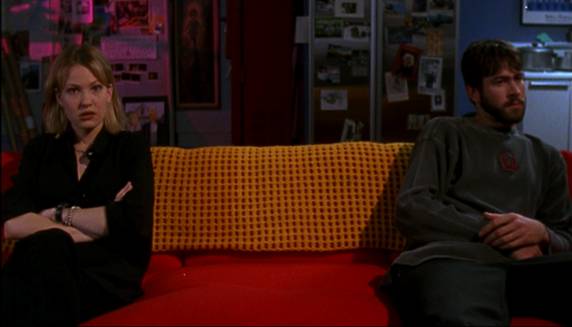
Chasing Amy Breakup Scene

One sad element about Holden is that there are points in the film where you can see him beginning to change. You see him calling out Banky on his homophobia and questioning just what kind of creative work and legacy he wants to undertake instead of the shallow superhero story of Bluntman and Chronic.

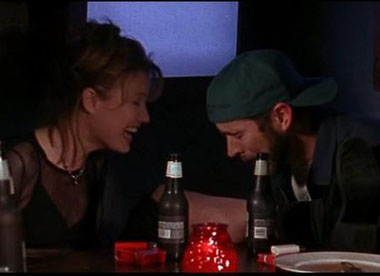
You see just all the time Holden and Alyssa spend together: even before they know they are developing romantic feelings for one another. Hell, there are points when Alyssa and Banky seem to get along. You’d think that she would get incredibly offended by Banky’s homophobic statements, but the way I see it to her they are a lot like Archie Bunker’s comments and she can at least respect the honesty of them if nothing else.

Alyssa and Banky

Certainly, Banky’s prejudices are a whole lot more open than Holden’s internalized ones: ones that he thinks he can overcome by virtue of being with Alyssa. Also, the characters themselves are crude and open about matters generally: though Holden himself due to his more reserved and conservative nature does this a lot less.

For me, Chasing Amy is less a romantic comedy and more of a tragedy: especially as you get this horrible mounting dread as the film moves towards its end. Holden just can’t shake off the taboos and power-structures in his head in time to save his relationships. In a horrible mangle, he tries to create a threesome between him, Banky, and Alyssa: after vehemently rejecting Alyssa for her sexual past with other men. This is a breakdown of communication and the terminal phase of a relationship gone dysfunctional. From my perspective, Alyssa should have told him about this past but, really, Holden should have been the one to ask her in a direct and respectful manner, outside of a hockey game, and with time put aside. Of course, Holden also should have borne in mind that many of the qualities he admires in Alyssa comes from all the experiences, mistakes, and work that she had undertaken.

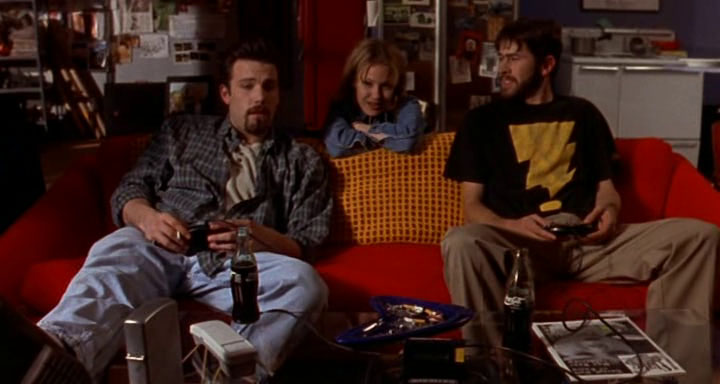
Banky could have looked at himself and realized his feelings for Holden: or at least communicated just why Alyssa bothered him so much. I really noticed that the three of them could have easily been friends if nothing else.

Holden, Alyssa, and Banky

And then there is the fascinating element of Alyssa herself. When I was watching this spectacle unravel and she was explaining to Holden just why it wouldn’t work, I realized that Alyssa wasn’t just talking about the threesomes and play that she had done in the past. Even in her lesbian relationships, I strongly suspect she and previous partners attempted polyamory: or at least some kind of non-monogamy. As she states, there are many permutations of how it might not work out, and Alyssa herself saw those earlier relationships as experiments that she went through before finding what and who she wanted.

Alyssa, at least at this point, is monogamous and wants to be so with Holden. But Holden’s arrogance and insecurity poisons and destroys what they had: or could have had. Certainly, Holden’s fever-logic idea of creating a threesome to eliminate insecurities would, by Alyssa’s own words, have only made things worse. Perhaps with time, effort, patience, and actual talking — maybe even experimentation on Holden’s part and Alyssa’s understanding — all of this could have been salvaged. Instead, Holden loses Alyssa and Banky. Due to his own actions, he is essentially left with nothing.

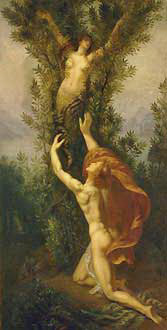
The end of the film reminds me of the ancient Greek myth of Daphne and Apollo. The god Apollo seeks the naiad Daphne and she is not interested in his romantic overtures. He ends up pursuing her: chasing her to the point where she asks her river god father to change her into a tree to escape the god. Daphne became the first laurel tree. Apollo, in his grief, takes on her laurel leaves as his new crown. Laurel leaf crowns were awarded to ancient Greek athletes and victorious Roman warriors: perhaps reminding them of that kernel of defeat and loss at the centre of triumph.

Apollo and Daphne

Silent Bob tells Holden the story about a girl he knew named Amy who, because of her previous experience with multiple men, he couldn’t accept: leaving her and realizing, only too late, that she loved him just for who he was. Hence we have the title of the film: Chasing Amy.

A person is not an ideal even if they can, by their presence and loss, inspire creation. Holden ends up creating a new, personal comic sharing the title of the film. He gives a copy to Alyssa a year after their relationship ended. It is a comic book whose pages are laurel leaves and whose panels are lost moments of time. It is made up of the beauty, maturity, and understanding that he gained after losing the woman he loved by chasing an impossible ideal and, in doing so, chased away the flawed, vulnerable, and ultimately human person that she is.

And Alyssa? She ends up dating women again and doesn’t even acknowledge what Holden was to her newest partner. Even though he still clearly means much to her, he is part of her past now: the same past that she hid from him and so many others in order to psychologically protect herself. I’m even tempted to say, in a very less than qualified way, that she buries down what might have been a delving into bisexuality to embrace the relatively easier notion of homosexuality once more, leaving us with perhaps an example of bisexual self-erasure. Or, again sexuality doesn’t come into it. This was just about people relating to one another: and failing.

I am not in the LGBTQ spectrum and I know this film has been written about many times and probably in better ways, so hopefully you’ll understand when I say that I hope you take everything I’ve written with a grain of salt. After seeing the movie, I kind of wish that we could see another one: not from Holden’s perspective in gaining his laurel leaves, but Alyssa’s, or Amy’s — or even Daphne’s — defiance of that trope.

Chasing Amy Comic Cover

As such I hope it goes without saying that women, obviously, do not exist so that they can “be lost” by men in order to gain them a certain level of maturity and humility. But there is a trope here — a Western and Classic idea in which love is a “forbidden knowledge” that you must fall into, and that only through loss can you begin to understand who you are — and it is tragic in that it exists at all. The truth is, I didn’t want to like Chasing Amy: a personal enlightenment tragedy wearing the layers of romance, comedy, geekdom, comics arts and meta-fiction that it is. And I realize the reason I was so afraid of it was because there were many times in my life that I almost became Holden. Sometimes I’m afraid it still might happen.

Fear of loss is reason is why I didn’t want to get attached to the characters: to become affected by their loss and their pain of loss. But by not becoming attached to something, you attempt to hold off relating to it — and by not relating to it you can let an opportunity pass you by, develop a dysfunctional relationship with it, or let a part of yourself become mangled and ruined before it can grow. And I can’t do that any more.

I’d like to think that, in watching Chasing Amy I took a chance and looked at the forces that shaped it. As I have attempted to do in my own relationships, I accepted the experiences it had — and has with others — and realized that they only made it all the richer for me to learn from and relate to in my own right.

Connecting the Doughnuts: Amanda Palmer’s The Art of Asking

Even though I’m not a musician, or even a complete music literate (whatever that ultimately means), I had been looking forward to Amanda Palmer’s first book for quite some time. And now that I finally finished reading it a few days ago, I’m now in a place where I can actually say something about it.

Amanda Palmer

It wasn’t easy and, to some extent, it’s still very challenging. The Art of Asking is something like what might happen if you take a blender, to borrow one of Amanda’s creative sayings, put it on a low setting, and introduce autobiographical anecdotes, self-help philosophy, social media excerpts, a few literary quotes, and of course musical lyrics, to the blade and mix. Chronological events are sometimes parallel with each other in the narrative, but these instances are often separated by philosophical musings and personal moments.

Whatever else, The Art of Asking is, it’s definitely not an ordinary book: as if something that’s a fusion of the creative and the personal can ever be ordinary.

I’ll also admit that it took me a while to get into the book, and sometimes I had trouble actually staying inside it. I mean, I knew that — even based on the title — that Amanda’s book would have some significant roots in her TED Talk of the same name, but it is both fascinating and sometimes off-putting to consider that there is a fair amount of her book that you can already find to some extent in her Blog and even in her introduction to Anthony Martignetti’s Lunatic Heroes.

The intertextuality, the way her book relates to the narratives and circumstances behind Anthony’s Lunatic Heroes and Beloved Demons, as well as to Neil Gaiman’s Ocean at the End of the Lane really does intrigue me and it puts some elements into perspective. I’d argue that The Art of Asking has details that can give you something of a holistic approach to looking at all four narratives upon risk of falling into the authorial fallacy: of looking at the people behind the works instead of the works themselves on their own merits.

I mean, it’s no secret that Amanda encouraged Anthony to hone and publish his personal stories — many of which he’d already told her before during their time together — and that Neil’s Ocean was the result of a story that he actually wanted to tell her while she was in the middle of her own solitary creative struggles. When you look at how those narratives talk to each other, like the people that made them and talked to each other in turn, The Art of Asking is almost something of a bridge between three different and creative spaces. It is my opinion that they all belong together.

The downside was that sometimes these references felt like filler. I think what really confused me was something that Amanda said which, ironically, I truly appreciated. It was a reference to another part of her creative process. After a fascinating look at different types of creative processes from her perspective, Amanda mentions that to create something is to “connect the dots” between things that you gather or experience. This, for me, pretty much sums up how creativity happens. As a creator, you take things that don’t seem to relate to each on the surface and you find or make connections between these elements. This thought particularly jived with me.

Unfortunately, at least from my perspective as a reader, I couldn’t always see how Amanda connected the dots of her ideas and anecdotes or even her musical lyric interludes within the structure of The Art of Asking itself. Perhaps I just don’t have a good eye for it, or for that matter even a good ear. Maybe, as Amanda herself isn’t generally a book writer — this being her first one — she writes prose much in the way her mind generates rhythm and lyric: through music. This is just a thought that I’m throwing out there myself. However, maybe the narrative is a lot like Amanda herself in that her art and her performance seems to be a 24/7 deal where you cannot particularly separate them: even in another medium.

The Art of Asking, to me, felt like a balancing act: much like the way I reacted to it. The tone of it got to me sometimes. On one hand it sometimes felt like it was rather self-involved, but on the other hand it is to some extent a memoir and of course Amanda would be talking about her experiences and her feelings. At times I felt a self-help vibe from the book and I had a personal reaction to whenever Amanda would talk about giving herself to trust and love as, in my own experience, most people who expose surrendering themselves to absolute abstracts of benevolence, revolution, peace, and love often want something from you and are anything but the ideals that they claim to represent. Something about Koolaid comes to mind.

Then again, these very sentiments on Amanda’s part are tied into some considerably shrewd business and people sense. The Art of Asking specifically outlines how love and trust are relational. What I mean is that by opening yourself up to other people, by interacting with them, by actually relating to them as fellow human beings you create a bond — at least on some level — and they will become more willing to actually help you. Amanda very correctly identifies this precept in why some crowdfunding campaigns excel and why others fail completely.

In asking for help without shame and taking what is offered you without forced expectations or, again, humiliation, you are attempting to embrace a different mindset. I can personally respect and even understand this idea. Amanda even applies it well to just why her former label and the music industry are simply failing to understand their customers: as they only relate to people as customers, artists as commodities, and not as people.

Really, what I learned from this as a potential crowdfunder artist myself, is that I have a long way to go — in building relationships of some kind with my readers, in networking, and in relating to others — before I can even begin to approach the place where others can support me: and where I can provide consistent content for their support. It’s actually very humbling, and sometimes discouraging as I am not a natural extrovert and I don’t have access to the support that I need to get there, or a coherent and stable vision to attract others. Yet.

In this sense, it’s not about connecting the dots per see.  It isn’t even about giving out “the flower,” a metaphor and literal fact from Amanda’s time as a living bride statue in her early busking years that can be accepted or rejected in an attempt at staring someone in the eye and relating to them.

To me, it’s about doughnuts.

In late November 2014, I actually attended the last part of Amanda’s Book Circus Tour in Toronto. As we waited in line outside of Lee’s Palace, a volunteer kept handing out Timbits: small, round, balls of assorted doughnuts. During the event itself Amanda actually read us a part of her book in which apparently David Thoreau, during the time he wrote Walden, accepted free food from his family as help in completing his work. And Eric Alper, Amanda’s guest and interviewer bought us all tons of Timbits to hit home the point that it is okay to “Take the doughnuts.”

The way I ultimately see it, The Art of Asking is a collection of Timbits: a collection of little doughnuts of many kinds. Some might prefer specific flavours of Timbit, or all of them, or none at all. Yet all of them are doughnuts and all of them are offered to the reader.

As for me, I took my favourite doughnuts from Amanda. Some of them were crisp and instrumental. Some were multiple flavours that branched into different places, that reminded me of other things, and gave me insight about my favourite people behind the scenes. I know I ate one or two confections that Amanda had never offered before outside of her book: and the flavours hit me hard and without mercy: that were real. At least one was a moment that touched me to the core.

But all of them, even the ones I don’t always like or require an acquired taste, are in the same box of words: a bread and circuses on paper thanking everyone that it asks.