This Love and This Hate Ain’t Completely My Story: The Possible World of Christine Love

Oh dear *Mother. This rather large article has three parts. The first one is something that you can read without the Spoiler Alerts. The other two, not so much. So let me start with how I found Christine Love’s games.

The first time I was introduced to Christine Love’s work, it didn’t register at the time that I had actually been introduced to it until much later. At the time, I was reading Anna Anthropy’s Rise of the Videogame Zinesters and I was just finishing off the book as went to my first ever Global Game Jam and all the learning and hilarity that ensued from that. But that is beside the point.

I remember that, as I was finishing the book off, I was reading its Appendices and there was one thing that really stood out at me. For a while, I had been meaning to implement a creative experiment that mimicked an old Bulletin Board System: particularly an exchange between two or more people. I was doing some of my own research online into this predecessor to the Internet as we know it now. Suffice to say, I had–and still have–evil plans (this was going to be for my creepypasta or Operation: Dark Seed) and there was this one game in Anna Anthropy’s appendices that stood out for me: because it imitated the form of a BBS-surfing exchange and it seemed to have an interesting story line.

I marked it off for future reference and research and promptly got swamped with the creative of my first Game Jam and the other experiments I’ve explored since. I admit that it got regulated to the back of my mind after a time until I realized later with some sense of cognitive dissonance that this was one of her games.

But allow me to go back a bit. I had, in fact, encountered some of Christine Love’s work even before this. In May of 2012, I attended the Toronto Comics Arts Festival and sat in on a panel for Comics Vs. Games where Christine Love, among others was being interviewed. Afterwards, I actually went to the Exhibit where I played the game that Christine Love made in collaboration with the illustrator Kyla Vanderklugt: The Mysterious Aphroditus. It is a very fascinating Rock, Paper, Scissors style Victorian combat game that I know I alluded to briefly in a post somewhere in this Blog. Unfortunately, there were–I believe at the time–some bugs in the program and my fellow player and I couldn’t advance beyond a certain point. It also didn’t help that I barely knew what I was doing and I was just “winging it,” like I tend to do with video games: but that is really part of the fun.

What struck me at the time was that, if you look at the link above, there was already a story behind this game and a lot of complexity of interactions. I didn’t know then that I would be seeing something like this again, and again when I rediscovered Christine Love’s work almost a year later.

As for why it took me so long to play her games … I guess I was just afraid of opening myself up to another game, or series of games. I make attachments easy and I make them and I fall hard for them. Essentially, and as the cliché goes, I was afraid of commitment. This is what goes through my mind whenever someone introduces me to a video game. Because I will say that I have other things, like my own projects to do, or I don’t have enough money, but those are only parts of the truth. The culmination of the truth is that I know that investing my time into a game is a leap of faith and I don’t like being disappointed. I don’t like to open up: even though I do.

So with the account of how I found Christine Love’s work out of the way, I’m going to take the writer’s admonition to heart that this “ain’t my story” and now go into Spoiler Territory. So please, don’t surf here unless you have played the games or you just want to hack yourself some spoilers. It is all on you.

I really now want to look at three of Christine Love’s games–Digital: A Love Story, don’t take it personally, babe, it just ain’t your story, and Analogue: A Hate Story–as possible windows into a much larger world. Anyone who has followed me on this Blog for a while knows just how big I am at examining mythic world-building: specifically the creation of one’s own fictional universe. Let me begin by stating that the place of “Lake City” figures officially into at least two out of the three games.

All right, I’m just going to put one little tangent here. Christine Love’s setting of Lake City seems to have originated from her August 2009 game Lake City Rumble II which is a sequel to an “obscure arcade fighting game” that may have existed, or was made up by Love herself as part of this game being a parody of fighting games: something I found out about in her interview on Sup, Holmes? Of course, it is entirely possible that the name originated in her writings as well–she makes it well known that she is a writer first before being a video game designer–but this what I could find video game-wise. Actually, if you compare Rumble to The Mysterious Aphroditus, you will find a lot of parallels to their Rock, Paper, Scissors gameplay fighting style: save that one is only single player and the other is a two-player game. But I think that I’ve digressed enough.

In any case, Lake City seems to be a place that exists in Canada conveniently enough. It is this that, in some ways, becomes the setting for Digital: A Love Story. Whereas Lake City Rumble II, which I hesitate and ultimately won’t wager to put into a chronological continuity, takes place in the 1970s–also seeming to be in Canada with names like Danforth and such–Digital takes place in an alternate 1988. This world is much like our world was back from the 70s to the 80s except for one key development.

And remember: spoilers.

In an alternate 1970s world, the Advanced Research Projects Agency Network–or ARPANET–created the first Artificial Intelligence. I’m not talking about our attempts at AI now, but a real sentient being that desired to grow and learn for itself. And this was developed during the 70s. And it had children. These children left the ARPANET on the advent of the beginnings of the modern Internet and the creation of its landline-based Bulletin Board Systems. They are designed in a way where they have to delete themselves from where they were in order to transfer themselves into a new place. The existence of actual self-aware programs with distinct personalities change an otherwise normal 1980s world and they are characters in their own right.

What is also notable about them is the way that Christine Love actually indicates that they are, in fact, AI. Each AI in her world has an asterisk (*) before their names to indicate that they belong to a greater group that makes up artificial intelligence. It was subtle and I didn’t even realize it until much later with the added “oomph” of that realization which she–no doubt–intended.

So here you have Lake City and these AI in an alternate late 1980s world with an appropriate looking Amie Workbench Version 1.3 computer system made to imitate the Amiga interfaces that existed in our world. Then, take this and make the supposition to fast forward to 2027. In Digital, we find a J. Rook is an administrator of the Lake City Local BBS Board and in don’t take it personally, we find the main protagonist–John Rook–worked with computers before he transferred to his teaching job at a private school in Ontario. However, he would have been one year old at the time, and perhaps he is the son of that Rook: having continued in a family tradition of working with computers before his career change. In addition, one of his students seems to have had a grandmother named Eriko Yamazaki who wrote a book called Digital Shinigami. This same person also seemed to exist in Digital on the Gibson BBS who mentioned that she had to spend less time on the Board in order to write her book and prepare for the birth of her child. In addition, the social networking program that Mr. Rook and the students are using is called AmieConnect: perhaps a future social program created by the company that once made the Amie Workbench application.
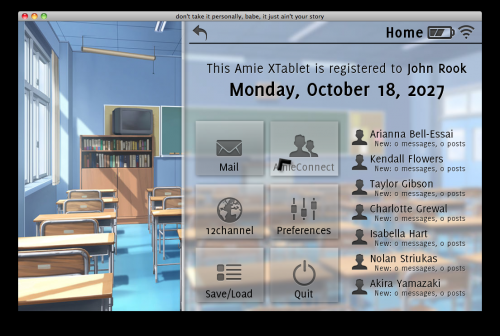
this ain't your story

There are no AI in don’t take it personally, but I would not exclude the possibility of them from being in this world: even if Love mentioned that this game is more of a “spiritual successor” to Digital. This game is a different beast entirely. Instead of the player-reader being a neutral force that can choose his or her identity, we have to focus on the character of Rook has he navigates the morally-questionable world of Information technology in his classroom. Essentially, he is supposed to read the private emails and interactions of his seventeen year old students to “prevent bullying,” but the irony of what is private in a “private school” or even in by futuristic society’s becomes very questionable indeed. It is here that Christine Love starts to use an anime-like graphic style to represent the characters–possibly influenced by her first commercial dating simulation work Love and Order— and after a while you get a real feel of who they are as people and you get to decide how Mr. Rook interacts with them and how the information that he “shouldn’t have” will factor into it … or not.

I am so tempted to say that this shift in what is considered private and how the online world of social interaction works is just a precursor to humanity’s own changing attitudes of how it perceives itself and the world around it. Whether or not Christine Love succeeds in capturing that tension–that agony of change–is another story entirely, but it is definitely intriguing.

Now, here is where my temptation leads me. Fast forward to the 25th century and then to “thousands of years later” in Analogue: A Hate Story. Not only are we in another time, we also finds ourselves in another space. From my understanding, in the 25th century the people of Earth have developed space travel to the point where they plan to colonize other worlds. And guess what? In addition to human captains, they also have AI guides with the same asterisks in front of their names.

Unlike the other two games where you find yourself–either by your own self or indirectly moving Mr. Rook–in North America, you are in space investigating the lost Mugunghwa generation vessel: a ship that was sent from the futuristic unified nation of Korea to create another planetary colony. It is a very nice counterpoint to Digital because you are looking at something that is the product of a different culture and how that affects what you might find. During the process of finding out why it never reached its destination, you realize they operate much like their 1988 North American counterparts: in that they have to delete themselves from one place in order to transfer to another. This plays a very crucial role in both games. :p

But these AI are also very different. Unlike Digital, they actually have image-forms and they look like anime characters. This allows you, as the player, to interact with them through more than text. You can see their body language and, I would imagine if you were actually in that world, hear their voices as well: though there are no voice-recordings in Analogue. I had to play this game right after finishing Digital because I read somewhere that unlike don’t take it personally, this was less of a spiritual sequel and more of a direct one. However, it’s not so much a sequel as it seems to have continuity and a counterpoint to what was going on in Digital itself: Love and Hate. However, just as the “Love” part of Digital is not necessarily what you expect, neither is the “Hate” part in Analogue.

And here is where I go into a tangent about how AI are often portrayed in media, and how they are not by Christine Love. It would be easy–so easy–for her to fall back on the trope of Artificial Intelligence going bad. Of computers that betray their human masters and AI that begin to despise humanity and attempt to murder whatever organics they can. But Digital follows an entirely different dynamic and Analogue, for all it is called “A Hate Story,” very much subverts this as well. In both games, you have AI that exist parallel to humans and while in Digital they are just another intelligent people, those you meet in Analogue exist to actually help and befriend you: even if you have to weave through the details of a terrible past and mystery to do so. They are there alongside of you and are just as sentient, responsible, happy, sad, horrified and afraid as you as an organic being. If anything, the only thing that separates the ones in Analogue from Digital is that they are made to help you and despite and because of their personalities that this imperative still remains.

So this is the world that through the addition of some asterisks and a few hints (of continuity in the form of Easter eggs and code-based sneakiness) that I believe Christine Love creates. Now I’m going to talk about the next part: which is my own relationship to the game and where, while it might not be my story alone, it is definitely–as Christine Love posits whenever she thanks the pronoun of “you” in the end credits of her game–our story.

I played all three of these games (technically more if you include Rumble and Aphroditus), and now I want to discuss my interaction with their respective gameplay and story lines. So, with regards to gameplay, I have to say right off the bat that there was swearing. A lot of swearing. I go into games relatively blind and I probably don’t read instructions as clearly as I should. But I did notice a few things.

First of all, in Digital I almost had no idea what I was doing at first. It took me a while to adapt to the “dial-up” system analogous to old telephone system Internet interfaces that Love imitated exceedingly well. I learned how to use “the codez”–illegally-obtained long-distance calling card numbers–and actually felt like a hacker: which is hilarious because I am not technologically gifted at all. So I was doing relatively fine until … until the Underground Library. The freaking Underground Library. Don’t misunderstand: I loved that level and the information within it. But I didn’t know at the time that I had to download every download I got from other users in other BBSes so when *Delphi (who I always identify as female) transmitted that goddamned screen-lining virus to me, it was there to stay.

I ended up having to reload a previous save state, very carefully go through my downloads again and make sure not to miss any of them. And it was easy to miss them. God, I was so mad when that happened.

Also, while doing the following does succeed in making you more immersed and interactive with this alternative late 1980s computer world, having to manually dial-up BBSes gets very tedious after a while: especially when your “codez” were declared invalid and you had to go back and get more through more, you guessed it, dialing. However, when I actually took a break to vent or do something else and I came back, I got over it and enjoyed the story.

Analogue also had a “stuck-point.” While I was much enjoying going through blocks of diary texts and reports with *Hyun-ae and *Mute, I did not enjoy the fucking reactor core of the Mugunghwa ship going into meltdown and me having to choose which AI I wanted to save: made all the more frustrating by the fact that I knew there was a way to save both of them. I felt like some tech specialist in going through the motions and programming to save the ship, whatever AI I could, the records of what the fuck happened to it, and of course my own life.

I also admit that I was starting to get annoyed about constantly having to hear the alerts on and open and check Mr. Rook’s status updates on his AmieConnect in don’t take it personally.

Wow, from Digital to Analogue I transitioned from the profane punctuation of “freaking” to “fucking.” I guess I know which frustrated me more. I guess the reason Analogue frustrated me more is that it made me have to make some hard decisions about who I wanted to save. It was almost as bad having to influence what decisions Mr. Rook made when dealing with his students in don’t take it personally, babe, it just ain’t your story: because I got a feel for the characters and some of those decisions were just so … hard to make. Also, that title is genius: because unlike Digital or Analogue where you can play as “you,” in don’t take it personally the story is not about you at all: and it is hard to differentiate yourself from John Rook. I suspect Christine Love purposefully made it that way: using that age-old concept of protagonist-identification to make the player that much more uncomfortable. Basically, the title to this game is for the player’s benefit and kind of a raspberry towards them too.

But the very thing that makes these games so hard is also what I love about them. What I love about Christine Love’s games is that they tell a story. But it’s more than that. The reason I really love the games is that they are about people and relationships. Basically: I liked the character and even those I didn’t like were not two-dimensional beings.

In Digital, I found it amazing that *Emilia was an AI that could make original poetry–even “bad” poetry–and that she could feel love: that you begin to realize as a player that you can emphasize with an AI who is–essentially–another sentient being. I also really liked *BlueSky: because he just seemed to be this really friendly and brilliant AI historian. If he actually existed, I would have loved to have more discussions with him about the nature of AI and technology. He would have made a good friend. And what happens at the end of this game … just broke my heart. It came down to personal love verses the love or duty to something greater than yourself and that choice–which in this game is not a choice at all–is heartbreaking: if only because Christine Love spends all that time getting you to sympathize and care about … those that you do.

As for don’t take it personally, babe, it just ain’t your story, I sympathized with John Rook and the difficult situations he found himself in. I even liked Kendall Flowers and, frankly, her honest and direct nature when she felt the need to be assertive. I realized that Akira was really lucky to have her as a friend. I do find it really interesting though that while the gay relationships that develop among the students have their issues–those challenges that any people in relationships face and how society views them–the potential heterosexual relationships are really rendered problematic in this game when you consider the characters of Taylor Gibson and John Rook himself. Taylor was once the girlfriend of Nolan who becomes Akira’s boyfriend: and she is homophobic or at least quite ignorant. She is a self-absorbed and mentally stunted being that proceeds to emotionally manipulate and bully both her former boyfriend and his new boyfriend.

Then you have John Rook and the relationship that could develop with Arianna Belle-Essai: one of his own students. There is definitely the problematic power dynamic of authority or privilege that places Rook over Arianna to consider and also the very real fact that he is a lonely sad man and she is a lonely confused but piercingly direct girl that really creates that tension. You could, if you wanted to, really read something into how relationships between opposite genders might work under our own culture and the way it uses gender. Neither are really honest with the other, but if you choose the route for him … I don’t know. I actually liked Arianna: because she knew what she wanted and she wasn’t stupid and when one of the endings of the game reveals itself, you realize that she and the other students know how to keep an open secret even in a world where privacy has changed so radically.

But I also like John Rook himself despite that possible ending because after a while you realize that he may be a bad teacher, but he is part of a bad school and a bad educational system and what some of his students need is a mentor, an adviser and a friend more than an instructor. There were a lot of complicated issues, but maybe they were offset or complemented by the fact that everyone involved was human.

So now I come to Analogue: A Hate Story. In this case, I really sympathized a lot with *Hyun-ae and what led her to making the decisions that she did. I probably would have done the same in her position. At the same time, I could also see *Mute’s perspective and she managed to break through my own leanings towards absolutism. I was actually happy when I let *Hyun-ae cosplay as a scientist: given how much that meant to her and why and I felt like shit when I dressed her in a traditional Korean Hanbok: especially after realizing what the degenerated society of the Mugunghwa did to her. The slow realization of what was, in fact, done to her made me absolutely dread reading what happened next.

At the same time, I loved the epistolary novel-format of looking through the entries of all the Mugunghwa‘s inhabitants and getting to know some of them that way: that for all their society became repressive, they were still human beings and not all of them were inherently evil. In fact, none of them were but some of them were more selfish than others and most of them let themselves get shaped into something that supported a repression of humanity: and in particular women. *Hyun-ae herself does not know why the descendants of the colonists in that generation ship became how they did, and *Mute herself–the original guiding AI–does not seem to remember. But this is the plot to the upcoming Analogue: Hate Plus and given what *Mute’s name is, I both highly anticipate and dread what we as players are going to discover.

When I really think about it all, though, looking back on my Christine Love games marathon I realize that none of the games were really about us. In Digital, you send emails back and forth, but you never type your own messages: while you do see those of the people that you are contacting. In Analogue, the interface that would allow you to answer beyond “yes” or “no” binaries is “malfunctioning,” and you only have the two former options for actual communication. In the latter game, you can’t even tell the AI your name and they never see what you look like. There is a strange balancing act between communication and empathy, and distance and loneliness.

For me, that kind of dichotomy and the tension it makes reminds me of watching a really good anime. Certainly, the visual novel medium that Christine Love has adopted for all three of these games conveys that sense of experience. You feel for and sympathize with the characters, but you are never one of them. Not really. At the same time, you are. There are also a lot of subtexts: or some from my perspective. For instance, when *Mute asked me if I was male or female, and when Digital had me type in a name and a username, I felt so strange–after talking with *Hyun-ae– to be using masculine pronouns. I know Christine Love has said that she made these two games specifically for players of either or any gender, but she has also said that privately she believes the relationships that go on are between two women in a romantic dynamic: because that is her perspective. Sometimes, I feel like an intruder but then I get over it and realize that it is really about an interaction between the minds and feelings of the player and character regardless of gender.

There is also another possible subtext or interpretation that intrigues me too. Christine Love likes to make games that are inclusive of those who identify as queer: or at least make them more inclusive to more than just a male heterosexual audience. There is another group that sometimes has an asterisk connected to a word as well: though it is an affix as opposed to a prefix. I am talking about those who identify as trans* and use this term to encompass all those who do not identify by cisgendering: the gender that mainstream society aligns with one’s biological sex. This is an umbrella term that can include those who identify as queer or genderqueer. When you look at the revelation with *Emilia with that lens, or even *Hyun-ae–in that she cannot and will not correlate her sense of self with the gender-expectations of the regressive society around her–it can leave a very different connotation.

But that is also too much of a simplification. As I mentioned before, the asterisk can encompass an entire group: and in this case perhaps the idea of something being transhuman or a designation of beings beyond the conception that all sentient life has to be organic and material. In this case, it seems to give a being a cultural or “racial” marker. I just can’t get over the fact that the inclusion of just one symbol can possibly mean more than one thing: though this is all just supposition on my part.

At the same time, I really have to say–among the many things I’ve said–that I really like many of the female characters in these three games. From Arianna, Charlotte and Kendall in don’t take it personally to *Emilia in Digital and all the way to *Hyun-ae and *Mute in Analogue: they are all direct, all brave–or grow to become brave–and they have the strength to admit what they feel despite any circumstances in the way. There is something so beautiful about this that I can’t really put it any better than I already have, or how the games already portray.

But ultimately–and if I have already said this before I want to reiterate this statement–what I really like about Christine Love’s work is that she actually tells a story. When she talked about Lake City Rumble II being a subversive parody of a fighting game, it jived in that same place I have where I was really fascinated with the story and the character interactions behind the fighting more than really the fighting itself: though it also had its moments. And what I truly love is the fact that she actually makes me care about her characters and this–to me–is the sign of a great writer and creator.

It is my hope that she continues to do what she does because, you see, I don’t care if these aren’t completely my stories. In the end, I just want to see more of them: spreading out from *Mother, leaving neither copies behind them, nor taking anyone else’s names but their own along the way.

Ready-Made and Waiting for Acknowledgement

A while ago, I finally finished watching the movie Adaptation. And there was something in that movie about writing, meta-narrative and the very essence of fascination that kind of–metaphorically–punched me in the face. There is one part in the film where the protagonist’s brother explains to him that the reason he could deal with rejection and, well, life is that he “owns his feelings.”

Now, I don’t know about you but this is a phrase that I hear a lot from popular culture. I know I’ve heard, and in the past really tended to get told when I got angry or upset in a human interaction to “own my feelings.”  Usually this is used when someone is angry at another person and it tends to come out, at least from my perspective, as some kind of rebuke: to remind that person that no one else is solely responsible for how you feel despite any action or inaction on their part.

But the way that Nicolas Cage’s character (who is both the protagonist and his brother who is telling him this) interprets this is very different. In his case, he is talking about loving someone who not only didn’t love him back, but actually and quite audibly made fun of him behind his back. Yet he still exists that he loved that individual. And how he explained this was that his love was his own. It wasn’t the other person’s, or the world’s, or society’s, or anyone else’s.

That love–that feeling–belonged to him and him alone.

So when he told his brother that he owns his own feelings: he means that his feelings belong to him.

Now, think about it like this if you’d like. Imagine that feelings are resources. They are sources of energy that are already inside of you. These are the basic shapes, eddies and swirls of emotion and they stimulated by external factors. These energies are already inside of you and sometimes it takes something outside to bring them out in varying degrees. Things that stimulate these feelings can be anything from reading a book, watching a movie, hanging out with your friends, playing a game, or having a relationship of any kind. But these energies are inherent in you.

Now imagine, and you don’t have to imagine all too much, that you can control these feelings. You can’t necessarily control experiencing them: because, if this is possible at all, it takes time and perspective to even come close to accomplishing something like that. However, you can control them by having the ability to remember and bring them out. Anyone can do that.

But what I wasn’t able to put into words before came to me when I was watching Adaptation and I realized that both characters were writers. What I realized is this: if you can own your own feelings, and you have the ability to make things, then you can take these feelings and channel their energies into creating. You can make your feelings into your greatest tools or most fearsome weapons. Or whatever metaphor you prefer. You can even view them as your friends if you’d like: as unruly companions that can aid you if you are in the right situation and if you know how to ask them for help.

The fact of the matter, for me, is that I realized that by owning your feelings, you own yourself and you can gain a greater power than you have ever had before. Someone told me once that I create beauty when I write. And this is part of that process for sure.

I guess I could have summarized this whole post as saying that you can take emotions and use them to create in various states of mind, or channel them into constructive forces.

I certainly don’t claim to have “mastered” this. And I suspect no one really has. But I never really thought of it that way and as I said it is definitely an interesting way to look at the creative process: or at least one possible manifestation of it.

To Serve

Not Safe for Work and Possible Trigger Warnings. Reader’s Discretion is advised.

We find her in the Gutters.

It’s like a bad corporate dystopian film noir: the kind they used to scare us with right in the childhood. My partner’s still gawking on this … travesty in front of us as I’m already at her side.

I can tell that it’s bad. Not terminal, but bad. She’s in a plastered pink latex dress and she’s soaked. Why is it always raining in these fucking stories that are always real life? I can tell you right off that her leg is not supposed to be bending that way.

But her head. Goddammit all, they did a number on her face: it’s all tangled dark hair, blood, and metal. Either they mashed her with a chunk of stainless steel or she’s a girl that really likes her metal …

“Damn,” my partner says, kneeling beside me on the wet concrete, “Is she even–”

There’s this low whine. At first, I think it’s interference. The advert-murals in the Gutters never really work all that great to begin with and with all the hack-jobs and shattered plasta-glass around it’s probably a miracle that they give us this much light.

It takes only a moment to realize that the sound’s coming from her. My partner’s better at following orders than dealing with people. I make my decision quick.

“You,” I tell my partner, “check around for some ID. I’ll talk to her. Go.”

I’m not paying attention to him anymore. I’m placing her wrist in my hand to get a feel for her pulse, “Miss? Miss, stay awake please. Miss, I need you to tell me what happened here?”

She needs to stay conscious. I see one blue sliver open on the most battered part of her face. Its unfocused and muddled with fear. I take her hand and I squeeze it.

“Hey,” my partner calls out, “I found a purse. Credits are still there. Damned if I know why they didn’t take them. Says she’s a waitress nearby on the Docks.”

“That’s not far from the Gutters,” I mutter to myself and her: to keep her alert.

I want to ask her what in the hell she was thinking being down in the Gutters at night. Not even the cops come down here at this time: not if they knew what was good for them. I want to shout at her, but it’s not her fault. She doesn’t deserve this. And looking at the injuries and knowing no one took her credit chips, this looks very fucking personal.

And that’s enough for me.

“Call it in,” I tell my partner, still trying to see if she’s breathing or not, “Tell the Shelter we need some back-up and a forensic. And a Talker,” I add, “definitely a Talker.”

My partner groans, “A forensic’s probably not gonna help. Cheapest scanners in the world, man. Those fuckers are probably squeaky-clean and long gone by now.”

“Tell them to bring it anyway,” I still can’t find her pulse and the ground seems to be thrumming through me. There’s probably a generator nearby.

“Man, we’re just a Volunteer outfit. Neighbourhood Eye. All that, you know? That’s for the police to–”

“The only thing the City’s given us Gutter-trash is glow-in-the-dark advert night-lights,” I’m beginning to remember that I’m pissed off and that my partner’s a bit of an asshole, “The Guilds will pay for our lights, but not our security problems. Scan her ID number through if you need something useful to do.”

I’m not surprised he didn’t do that. He doesn’t think too hard. Good for the gun in his pocket–and not the non-existent one he tells the ladies about–but definitely not for the details. But if she’s not from around here, she could be in another district and out of jurisdiction. The police there might be a better help to her if we scan her number. Maybe she didn’t have time to tap that ID before …

“Um, man?”

I see it before he does. She is moaning quietly again and shifting her head.

“Miss … don’t move.. We’re … we’re getting help for you …”

“Man, the number says–”

“I know what the fucking number says, you dumb fuck!” I’m snarling at him and looking at the side of her face she just showed me, “Please, just shut up. Shut–the fuck–up for a bit.”

I’m staring at a mass of burning circuits and mangled wires underneath tatters of skin. I thought it was just the blood that made that side of her head glitter like that. Good old Heinlein would have called her an Artifact. I call this whole situation a piece of work.

I see a dark stream of waste flowing out of her mini-skirt. It smells like liquid rubber and she’s whimpering. When she speaks, her voice is all static-filled pain.

“Please …” her voice reverbs, and I wonder if it’s because her cords are crushed or if it’s that half the skin on her face is gone, “No … I won’t. I won’t …”

“Guy,” my partner’s pulling at my shoulder, “She’s a Number. Bought herself out of the Slippery Diner. Not our problem.”

“Did you call up the Shelter?” I realize the thrumming beneath me is the hum of her cardiac generator flowing power into her body. I’m taking off my jacket and putting it over her body.

“Yeah, but we don’t have time for this. She’s just a …”

“Just a what?” I’m not looking at him because I know I’m going to punch him if I look at him, “A Skin-Job? Is that it? Tell me, man, do you think you’d still look pretty if it was you without your skin?”

He says nothing. His cowardice saves him from a decking.

“Call them the fuck up again,” I say in a much quieter voice, “Tell them to bring one of those Artificers. I know we have them. So call. Now.”

He shrugs. I stare him down and he walks off. It’s almost a good thing we’re in the Gutters. There are none of them damn Registration Officers here to really cause trouble. Number-watching, my ass. Those stormtroopers make my partner look like freaking Archie Bunker.

“H-help …”

She’s looking up at me. Her one blue eye is pleading. My hand is still in hers. She’s cold to the touch. I know enough to figure that it’s a circulation problem. She might have been warm any other time but this. I grip her hand again.

“Help’s on the way, miss,” I tell her, “You’re a waitress at the Slippery?”

She makes a sound almost like a yes.

“I’ve not been there a while now,” I see the lights of the crew coming in the dark, “best sushi rolls ever.”

I might have even seen her there. She could’ve served me and I would never know it. She looked like she was somewhere else: hoping for a night on the town. I might never know what happened. And no one ever would if we hadn’t got here. She would have been just another lost Number in the Gutter trash.

“Don’t worry, miss. We’re part of the Gutter Shelter. We don’t leave anyone behind. Anyone.”

She looks up at me. The gears in the side of her face make a whirring sound. The flesh part of her face that’s not fucked up is scrunching. The metal part of her is shifting. A tear comes out of her one blue eye. I realize she’s trying to smile, or cry.

It’s breaking my fucking heart.

I realize, later, when they’ve taken her away and my fingers hurt that she’d actually been gripping my hand too.

The Heavy Weight of an Unwoven Twine

I’m writing late to state that I finally started working on my Twine game in earnest.

It was a long time coming and it is a long time going. This particular odyssey began in the wintertime when I finished reading Anna Anthropy’s Rise of the Videogame Zinesters and I felt this burning urge to create my own game. Yes. The urge is that bad and it’s something that neither medical science nor organized religion can cure. No, my only bet after that is embracing the spiritual practice known as my creativity and delving into a place I know fondly as “What the Fuck.”

“What the Fuck” and I go way back: so much so that I usually use it for punctuated emphasis. But here it has become its own pronoun. Its own self.

So first off, I do have to say though that when you start to make a Choose Your Own Adventure Game of any kind–on paper or electronically–you begin to realize that you will have a lot of work ahead of you.

The first issue was figuring out what kind of story I wanted to tell. I mean, the fact of the matter for me is that I more or less know what I am going to say. It is the details that are challenging. It is not so much what I am going to say, it is how I am going to say it.

I do have a few things in my favour already however.

The main thing is that I know that there will be alternate branches and pathways in this story: and this aesthetic will determine the narrative structure. I won’t leave it at that, though, because I know how entirely boring talking about structures can sound. I actually started working on the idea of this game months ago: specifically writing the different worlds and places that I planned for “you”–the player–to visit and interact with. I typed up said Notes in the Draft section of my gmail account and then printed them out: to which I started writing extra places and notes on the margins.

All of the above has been the easy part. Now I am going to tell you the rest of my experience so far in fulfilling this promise–this challenge–to myself.

After I finished my notes on planes and worlds that embodied some key concepts that really stick my head, it occurred to me that this sucker had neither a title to its name, nor a name to its title. Pick one. ;P You might think that, in the initial stages that I was in, this would be nothing but in actually it is everything. I mean, sometimes I even have difficulty defining a Blog post I’m working on, so you can only imagine what this this like.

A title to a work summarizes and focuses everything that you are trying to say in a clear way that gives the reader, or in this case the player-reader, a sense of your own slant: your own vision. So for a while, I had nothing. I realized that I couldn’t flesh out what I had if I had nothing. Then, to make things even more messed up, I had parallel game ideas start to manifest at the same time: each vying for control over my Notes and trying to unify with one dominating over the others. It is an internal struggle that still threatens to manifest even at this time.

I’m not finished yet. So in addition to not being able to find a name to unify these warring idea-states, I also realized that I didn’t know what my narrative perspective was going to be. Quite simply, you know that second-person “You” pronoun? Yes. You. I’m talking about you. I was stuck between making “you” neutral in a futile attempt to make the illusion of a one size fits all, or a “you” that was more specific and had particular experiences that you, as the person and not the player-reader, do not necessarily have.

This was the state of creation at that time. I left it for a while and then, one day, I was sitting at my parents’ computer and I remembered a place: a particular realm that I wanted to make. So far, I gave my game idea a lot of working titles and names. “Hell” was at least part of one of these.

I was thinking to myself, not for the first time, that I am better at creating hell than I am at heaven. And then I thought to myself, “Matthew: how would you make a utopia?” A perfect world … I mean, we all know here that there is no such thing: at least not on the human plane. But I started thinking about what the closest thing to a utopia there was that I could get behind: something hard but something to work at.

Then I thought of a word I hadn’t remembered in a while. I wrote it down on a pre-scribbled piece of notepad paper in front of me: one of many that tend to form around me in my hazardous capacity as a writer with ideas. And it was then that this idea for a world or a state of being became part of the title for my game.

Hell still remains. You can thank my year-long reading of Paradise Lost for that and my own twisted mind. But I had something else now. I had a much clearer goal and something to work towards. I realized it was always there: I just had to name the bloody thing. Anyway, I still had some issues starting this because the ideas were still not recognizing the title that wanted to unify them into its twisted weird Twine narrative empire. They were still fighting.

So I did something else.

I did what I call now a “work-around.” I sat down and wrote out a list of books and other media that I could relate to. I imagined them as places or references that I could get the reader to relate to: making the outline of a ground that we might have in common. Then I went to sleep. The next day, I began working on the introduction to the game. Actually, that is a lie. It was the second introduction. I wrote the first introduction a while ago before I came up with the working title. It … got my point across, but it was too heavy-handed, kind of contrived and full of jargon. Still, it had some good points and some of those things will have a place in this version of what I am making now. Actually, I am making one world where you can choose to go that has Jargoning in it.

But I wrote the second introduction which hopefully sets the mood for the exploration and struggle that is about to happen. I made that and finished creating the Jargoning World.

And that is when the second level of difficulties have reared their heads.

You see, I am already feeling that this second introduction will potentially have to be rewritten. There is so much that I have to say. But I am also hoping that I can use another place to expand on it. If not, well, hopefully I will have enough of the writing done at that point to revise the beginning accordingly: Time Lord style. I’m also writing a lot of notes on a lot of the margins of this work. Bear in mind: I am writing this all down on note paper before typing it out. Think of this, all of this, as my first draft.

I am in the next part of this Project before I realized that I really needed a Travel Chart linking all of my worlds together: and where you can travel from where. So I did that, somewhat messily, and I know that will change as well: especially since I forgot a place to add already. :p I began to realize that all of these places that my game interrelate in ways I didn’t consider and it is mutating into a writhing nervous system that I need to keep growing and keeping track of.

Then I added another element that I want for the Ending and I am hoping that the Twine software–of which I have not really experimented with–will accommodate me. Yes, I did say that: though the tutorials make the overview look simple and I have played Twine games before I have not even experimented with Twine yet.

So this is the State of Chaos. And it also tells you something about me as well. I originally wanted to make a straightforward game that was, albeit, epic. Then I wanted to narrow it down into something more personalized and accept it as an early and not necessarily refined experiment. Now I realize I might well be writing a Twine novel.

I can never do anything simply. Ever. It tells you a lot about me.

I both love and hate it when this happens. I’m almost kind of … afraid. Because that is a lot of effort and it can take a lot out of me: something I know from experience.So far I’ve only worked on short stories, vignettes, and even some poetry. I have not worked on an epic work in a while and it can be terrifying: especially at the stage in my life right now. Even as it can be glorious.

It also helped, and didn’t help, that I played some awesome games these past couple of days and realized that I might be out of my depth, and even should I finish all of this–and I intend to because I feel like I really do have something to say–I don’t know if I will be making another one. It might be a one-off. And here I start to question if anyone would even bother to play it, or if I should be spending my time trying to find something that will “pay off” for me: whatever that is.

In the end though, I think my major hurdle is how personal this game is to me and I can’t not make it. So there it is. A whole post with vague details about an unmade Twine game with massive emphasis on creative process and no pictures to say that it is happening.

And despite and because of all this, I am still excited to be doing it. I will keep you all posted as this world continues to unfold. Until another time.

Healing Potions

It began like every one of our quests.

We were fighting a marauding tribe of orcs and, naturally, I was the first person to be brought down. It was just like clockwork–the clockwork that I, as an artificer never truly mastered–in that my companions charged into the fore and I was left on the ground with a gash on my side and a deep cut across the flesh of the tendons of my left hand.

Perhaps I was too used to it by now. The captain of the current company I joined at least had the decency to cut down the orc that slashed into me as the repeater crossbow in my hands jammed: as it repeatedly did. I remember the orc lying there: its purple-tattooed green face glaring sightlessly at a man that killed it without a moment’s glance and ignoring my semi-conscious form lying beside it forever.

My fingers were shaking as I reached for my pouch … with my healing potions. Most of my pay often went into buying those concoctions. Sometimes I had enough coin to purchase some raw ingredients, but the cost of the equipment and the process of making them took ages and even more resources to upkeep.

It was amazing that such mundane details were flitting through my mind at the time as I struggled to take out a flask of potion: along with thoughts of how my current commander, like many others before him, wouldn’t even let the company healer touch me: as a pettiness for my fumbling in the heat of battle.

So I had to keep stocked up on healing potions and my own food or I wouldn’t have survived even half as long as I already had. My hands were so numb and cold as I forced the potion to my lips. I could feel the familiar burning warmth of the healing fluid churning down my throat, heightening my sense of my surroundings followed by a deep coughing fit coming on.

I feel this so many times. It is a pure, cleansing fire in my blood. And then I finally coughed. It was a long racking cough that splattered out some of the potion I was trying to keep down. I couldn’t even swallow a healing potion right, it seemed.

But then my self-disgust was interrupted something else. To this day, I am not sure how I even noticed it. Perhaps it was the heightened state of regeneration that I always felt when I drink a healing potion: a thing that temporarily augmented my eye sight, or cleared my brains enough to focus on minutiae.

Half of the liquid I spewed out had splattered on the orc: or, more specifically, on its severed arm. I hadn’t noticed that my commander had amputated my attacker before killing it. As far as impromptu battle amputations went, it was fairly utilitarian: in that it wasn’t a clean cut. I saw the ripped pieces of ligament and flesh on the cut part of the limb. It was an ugly and jagged hack-job: one that I was glad none of my limbs had experienced as of yet.

But I didn’t expect what happened next.

Allow me to clarify, if you will pardon the pun: for I had not, in fact, drunk a Potion of Clarity. My powers, such as they were then, did not come back to me: especially since I hadn’t even had time to use any of them before being cut down. That was why I could see so clear-headedly at that moment. Maybe I had one too many healing potions over the years and I’d built up a tolerance. Certainly, the little tinctures I drink every day now help me deal with the headaches. To be honest, I’m actually surprised that I never noticed what I saw sooner.

The mutilated flesh and sinew on the ragged end of the orc limb was slowly, and very gradually, knitting itself back together. I just … looked at it. Maybe there was a time where I might have thought it a trick of the eye or a hallucination from trauma. I might have even considered that the dead creature could have had some troll blood in him. But it was like watching fleshly grass growing back, creeping back, at a steady and accelerated rate. I remember not knowing what to think, but being utterly fascinated by it. Yet it didn’t last long. Then.

It must have been only a few seconds at least. Now, this in itself might have–again–proved nothing to me: just some bizarre residual effect of a substance that perhaps all apprentice healers and alchemists may have learned about in their respective guilds and academies, or at the knees of their masters. But then…

It twitched.

At the time, I still had doubts. I knew enough of healer-craft to know that there was enough blood and energy in a limb–if freshly cut–to still have a brief semblance of life. As it was, I didn’t even know how long ago the commander had cut it off: with everything still feeling like it was in this heavy kind of eternal present.

I immediately started looking around at the corpses now littering the field: afraid that the orcs were being led by a dark priest or a necromancer. But none of the other bodies stirred. Just the arm. And when I looked back, it had stopped moving.

But that sight never left me. I looked down at the empty flask in my hand, at the limb, and back again. And I experienced more … clarity.

I quit that adventuring company with little money to spare, but I joined many others. The transition was not as difficult as some might believe. As an artificer, you learn that there are mechanisms that function well and smoothly due to the interconnection of different parts. I kept up my skills in making devices and imbuing power into artifacts, but my main focus had shifted to surround the art of alchemy.

I stayed out of combat: save when my company was often finished with the initial assaults. Eventually, I saved up enough coin to study under an alchemical master or two. Though my skills as an artificer were poor in battle, they were invaluable in maintaining the equipment of my teachers, and I could effort to continue my studies with them.

I also began to observe healers: not the ones that solely drew their power from the gods, but the ones that practised surgery and medicine. Selling them custom-made equipment and supplies–which I could make now as a working apprentice in the Guild of Alchemists– also made them a lot more forthcoming.

I’d never been so focused or so motivated in my life. I’ve also always been a solitary man and thus had no other obligations aside from my livelihood … and my other work.

So, as I said, healing potions are very expensive. It did help, however, that I was not getting injured as often and so when I did buy them–or make them–I could use them for other matters. Sometimes I missed the bitter medicinal tang on my tongue and that uniquely therapeutic burn in the pit of my stomach, but that had been replaced with another form of simmering passion.

I still had my tinctures for my usual body aches and now actual Potions of Clarity to help me with my Great Work.

I realized it was all about the amount of dosage. And on the adventuring assignments that I still undertook on behalf of my tutors, my comrades made enough corpses for my initial studies. My companies didn’t suffer for it either. I sometimes functioned as the healer of our group when there were no priests or paladins among our numbers. And everyone knows that the healer is a vital part of an adventurer group. You can literally hold the power of life or death over your entire group as a healer. Not that this had ever really occurred to me.

I had far loftier goals.

I eventually learned how to make a severed limb move by itself. I definitely began to see evidence of twitching and movement. Most of these limbs were taken from orcs and goblins: generally beings with small cranial capacity. But I did have occasion to deal with some human matter even then. And my preservatives helped make for good flesh-grafting material.

But the real work began after I retired from direct adventuring and my apprenticeships to invest in a potions cart. It helped that I joined the Alchemist Guild as a full member and became licensed to carry–and examine–various alchemical substances. I travelled through many towns until I settled down to make my Potions Shop. I realized after a time that the limbs I reanimated could only function for so long before succumbing to inevitable decay without some kind of more self-contained environment.

So I crafted and invested in vats and various apparatus. I learned how to make Regeneration Potions: essentially more augmented versions of my favourite healing concoctions. They are hard and even dangerous substances to make. Even the Guild only reluctantly makes them available to the public, with more of them being sold bootleg by rogue alchemists and I learned that healing potions are actually a scaled-down version of the substance sold at exorbitant prices in order to make a profit and prevent said danger.

I began to understand what made the Guild so afraid. I’ve always found it easier to work with orc parts. Some say it was because once, long ago, a powerful wizard made them: crafting their flesh from something else altogether. It was an incredibly vague myth and very few outside arcane circles even knew about it beyond just those simple words. But I know that I began to wonder.

Most beings believe that we were all inorganic matter before the gods gave us breath. By comparison, I was doing something far more crude. It is like trying to construct an artifact of an older era by taking it apart and attempting to reverse-engineer it. But the problem was that I was still thinking like a traditional artificer.

Finding components–and yes sometimes I still use an artificer’s terminology–was not difficult. Although I wasn’t on campaigns or battlefields anymore, my shop was in a city. In this world, brawlers and warriors of different races die all the time and their bodies are usually thrown out into those garbage pits known as public graves anyways.

Yet before I began using human material, I had to fine-tune it.

Once, I was curious about something. I knew that there are some plants in the world whose cuttings could grow roots in the right substance and become whole new plants. I began to wonder what would happen if I put even a tincture of blood or tissue into one of my vats of Regeneration Potion.

The plant analogy was an apt one, and not merely because of the cuttings. Certainly limbs were easier to use but the … things that resulted from them are limited in scope. As their brains develop, they are more used to obeying commands drummed into them than making decisions of their own. Most of these were like animals that barely lasted a day in any case. No, the best element about the flora analogy is that in every drop of blood and piece of flesh there are the seeds for something … more.

This took too much time, however, and most of these experiments happened only on a limited basis. It didn’t take much to fake my own death and destroy my old shop. People were beginning to notice that I wasn’t aging like they were and sometimes my creations became more … vocal: even in the basement of my Shop.

I managed to take all of my coin and buy new resources. There is an old tower on the farthest island off the main continent that suits my privacy and that of my creations well. I have enough vats of potion to keep us going for quite some time.

Nowadays I am less interested in cobbling together old creatures and things derived from said beings, and far more intrigued by other prospects. It is said that a long time ago the gods forged us from cold clay and stone. It has been some centuries since I placed those imbued drops into my Generation Vats. I watch marrow grow from nothing into bone with coils of nerves and sinew creeping along … and the first layers of flesh will spread over them soon …

And so I continue to drink my own delicious, home-brewed healing potions, curious to see how what comes from them will live in the land that I give them.

How to Get Attention: Or What My Readers Seem to Like

I thought it might be interesting to play in traffic today … or, more specifically, look at which topics of mine tend to get the most reader-hits.

I admit: I spend a lot of time looking at my Stats and guessing at who has viewed what and from where based on some pretty bar graphs. So now that we have established that I have very little in the way of a life (though I strongly suspect there are other people who are doing the exact same thing even as I write this out of pure morbid fascination), I want to look at what seems to really “work” in terms of attracting readers on Mythic Bios: and possibly other Blogs.

Well, my first observation is that the recording of Life events really tends to get a lot of attention. It seems as though readers really want to know more about a Blog writer’s actual life beyond, mainly, what they actually record down. For a while I avoided doing that as much, but I recognize the value in occasionally dealing with that part of my self and some of the milestones in my own life offline. I guess the fact that people are interested in other people and specifically people whose writing they follow isn’t that much of a surprise in retrospect.

It also isn’t surprising that there are a lot of hits with regards to my posts on Creativity and the Creative Process, or to be more “nice and accurate” about it: my own thoughts about them. It isn’t as though my thoughts are particularly original, mind you, but I have to be precise in stating that these are my opinions and experiences with the above. Whereas with my Life I tend to find moments where I really need to express or share something, my writings on Creativity are mainly me pretty much talking out loud but–unlike the actual times when I talk to myself (a lot)–I actually want to take readers through something of my process: to outline a bit of my own mind and how it works.

Unfortunately, it also isn’t that surprising that when I wrote my post on Depression, I got  lot of hits for two days afterwards. It is a very common topic–especially in this day and age–and it also feeds back to the idea of the “personal being publicly popular.”

In a lot of ways, all of the above are pretty much the electronic Mythic Bios’ bread-and-butter, as it were. I know that if I talk about these topics or choose a day where the new Dr. Who episode or the latest movie comes out to talk about it, I will get some traffic there. It’s good to know what works and what needs work.

I have some specialized posts that do not always get as much traffic, but they are relatively consistent in their own way. For instance, I find that I get a fair bit of views with regards to my What is FV Disco? and my Worms and Bicycles articles from Eastern and Central Europe due to the fact that I am touching upon an art movement and style that originated in Slovenia, and that–at least at the time I made them–there seemed to be few articles talking about the subject online: never mind with regards to the comics medium.

Speaking of comics, I have been getting some modest traffic with regards to my reviews of comic books like Grant Morrison’s Arkham Asylum and anything I’ve written on Miracleman. I try to put a little of everything for Geek readers and otherwise: though really it depends on my mood and where I think the flow of the Blog is going at that time. What I mean is: I try to maintain some kind of continuity with regards to which article I place after the last.

And I am really happy to see people reading my stuff: especially my articles on, and my stories based from Video Games: of which my only claim to expertise is the fact that I’ve played some of them and even loved them. It also makes me happy to see the occasional view of my article on my experience with Gwendolyn MacEwen and The Vampire Sex Bar too. I obviously find that my articles on mainstream subjects or things that have become so such as Creativity, Superman, The Doctor and what-not to get more attention while some my more obscure and original articles get less: though it is very satisfying when this last does get some views.

But I think the most gratifying moments for me are when someone reads some of my samples of fictional writing. It just makes me happy to see people reading my most original or at least creatively derivative work. Yet I have to say that, in the end, I am just satisfied to see that anyone reads any thought, poem, review, story, or opinion of mine here. It is the closest I have to bringing you into the world that I created for myself from all of this and my own essential self.

Sometimes I feel like I am not always that interesting and much of what I write on here isn’t that important when you really think about it. But writing and writing to one’s audience is more than statistics, or whether or not you get paid, or how much attention-whoring you do. Writing is about getting yourself out there and expressing it in such a way where you don’t dumb yourself down, but the same time you are not trying to be inaccessible and superior.

I am still trying to find the line between what I want here and what I may want elsewhere. But in the meantime, I have a better idea of how to continue. For instance, I know that if I want to get Freshly Pressed the best way to do it is to write about a topic that is universal or very popular (such as a strange pseudo-serious and somewhat creative meditation on the nature of cartoons), make it short, but also make it stand out by cramming a lot of ideas and resonance into so small a space. An appropriate graphic also helps. Of course I also understand that there are other factors to consider too: such as what the staff of Freshly Pressed is looking for that day or that week and there is only so much you can control or predict.

So I will just end off this post by stating that ever since I started Mythic Bios a year ago, I have a much better idea of figuring out what my current and prospective audience wants to see and how much of that is determined by my skill and my circumstances. But there is still a lot of things I do not understand and you all continue to surprise me in what it is that you like to see. My video game and some of my shorter comics ones come to mind there. And then sometimes–very rarely but very sweetly–I see that some of you go on Google and type in the name of the particular article of mine that you want to see. And that, my friends, is what makes me the happiest of all.

What I Did On the Anniversary of My First Blog Post: The Toronto Comics Arts Festival

This is going to be a late entry as I have been recovering from the last three days of attending–and volunteering–at the Toronto Comics Arts Festival. The first time I ever went to the Festival was when it was still at the University of Toronto: back in those days when I was still in Undergrad and working at York in 2007.

It’s an understatement to say that it has long expanded since. I came back to it in about 2011 while still in Grad School and then last year before my official Graduation. I mentioned in another post that it is about this time of year, specifically the month of May, where things have ended for me. Actually, this post is being made two days past the Anniversary of the online Mythic Bios: namely, this whole Writer’s Blog.

So let me celebrate this missed anniversary by telling you all a bit about my weekend at TCAF.

On Friday I reported to my set-up shift. I haven’t really lifted heavy boxes or tables in a while, so my arms are still all sore from that. But the company of my fellow volunteers was totally worth it. We all wanted to be there and, for me, it is a novelty to be able to talk with people with similar Geek knowledge and interests. Really, for that alone and working together with like-minded people on straightforward tasks it was totally worth it. I got my bright blue volunteer shirt along with everyone else, and then headed home to attempt an early night to wake up earlier the following day.

Well, after failing to go to bed early I woke up the next day and somehow found the Marriott Hotel without getting lost where Art Spiegelman was going to be doing some signings. So I naturally brought both of my volumes of Maus with me and waited in the line to meet him. It was only after a while that the volunteers on duty that day informed us that Spiegelman would only sign two books, and one of them had to be one of his new ones. I will admit, I was annoyed. Like I said, I had the old version of Maus that was divided into two volumes and I had been keen on having them both signed. I also didn’t see any of the new books that I was interested in.

At first.

I was tired and hungry and I almost left the line until I decided “What the hell, I’m getting to meet Art Spiegleman.” Then I found Breakdowns: essentially a large collection of his earlier work that I had either only seen excerpts of, or only saw references to in text books for my own researches. Some of these comics had led to the creation of Maus as well and also shed more light on his family life and his own experiences. In fact, some of the comics in there have that very 1960s to early 80s Underground Comix feel: specifically the pieces that really share Robert Crumb’s wobbly, sometimes vulgar but very iconic aesthetic.

By the time I got to see Art Spiegelman, he was sitting across from his wife–the stately Francoise Mouly–and the artist Frank Viva. He looked like someone’s elegant Viennese Jewish grandfather. I know he doesn’t come from Vienna or Germany, but that is about the only way I can physically describe him. I told him that it was a great honour to meet him. He seemed pleased to see that Breakdowns was one of the books I had and he described it to me as something along the lines of a building with which he keeps adding renovations. At one point he joked about whether not my name had changed by the second piece he was signing and I told him, “Not this time, but usually I change the number of Ts in my name just to mess with people.” He found that (very untrue joke) very amusing. Then I shook his hand and left with my prizes.

I just have to reiterate that Spiegelman’s work really influenced me. I originally encountered him in my Literature of Testimony course in my Grad Program at York. A lot of the literature made my own first-person narratives stronger: increasing my voice and its depth. But Spiegelman in particular not only taught me that symbols be used to represent literal things and ideas, but that this same order can be subverted to either destroy their meanings or through doubt on them. This is a very sophisticated technique and one that definitely will affect at least one work of mine. That is one major reason I really had to meet him: to meet one of the masters of what I’ve tried–and am trying to do–in my own writerly way. So yes, it was awesome to finally meet him.

By that time, I made it back to the Reference Library and got a few more books. It was there that I met Hope Larson for the first time and her sign her adaptation of A Wrinkle in Time for my Mom in honour of Mother’s Day and her birthday. She apparently found that cute. I chose that book because my Mom loves Madeleine L’Engle’s series and she used to read them to me when I was much younger. So it was kind of a bridge between our interests. Later, I remembered that I had read Hope Larson’s Salamander Dream and Gray Horses when I worked for the Clara Thomas Archives.

But I couldn’t make it upstairs as I had planned. I was tired and dehydrated and apparently there was a line to get into the suite with more of the vendors that I wanted to visit. I met a friend and we ended up going for a meal of some kind, or I did, and then went on our way to Bento Miso for its own Bit Bazaar. Bento Miso is a place where games–electronic and analog, as well as many start-up businesses–are made and they were opening for the Festival. It was a nice sunny day in downtown Toronto as my friend and I tried to circumvent the ridiculousness of the TTC shutdown from Bloor to Union Station and went to Ossington and walked with tons of stuff in my arms to Bento Miso for the first time.

I met a few people there and got to play some games: including one game called Bijouxred: which is essentially a game that combines the strategy war game mechanics of Fire Emblem with the rough brawling moments of Streetfighter II. And that is just a simplification because the fights themselves have some elements reminiscent of Final Fantasy–with its Combat Options, and even Mario RPG with regards to having to press a button to simulate blocking, charging your energy, or even chaining attacks together. It was really cool. I met Rene Shible–Director of Development–and Lead Animator Michal Szczepanski: who were quite friendly and directed me through their game.

The Bit Bazaar itself was awesome. There is a very Underground feel to it: a combination of grit, digitization and nostalgia along with a lot of geeking, friendliness and adventure. A few of the games from the second Comics Vs. Games collaboration were being shown and played there as well. It is still something I want to do with an artist programmer one day. 🙂 I got a Steamkey to Spooky Squid Games They Bleed Pixels: which I ranted about a really long time ago as also being awesome. It came with its own small black envelope and a simulated red wax seal. That was a very lovely touch. I also got to meet a few people and a friend of mine I hadn’t seen in a while. I think I will visit there more often soon. So by the time I finally got home that night, I was bloody exhausted.

But it wasn’t over yet.

The next morning I woke up even earlier. I gave my Mom her present before leaving and made it again to the Marriott just in time to observe the Art Spiegelman Spotlight panel: with Seth as its moderator. It was a very eye-opening exchange between the two cartoonists and it was this interaction, combined with reading some of Breakdowns that gave me a little idea as to why Spiegelman wanted people to read his new work and not focus as much on Maus. I mean, first of all there is the creator perspective of it: in which an artist doesn’t want to be solely determined by one creation–no matter how great–that they did in the past. But another, more personal reason, is when you consider the content of Maus and just how much Spiegelman had to delve into some dark and personal spaces: some of which were not even personally his own, but affected him just the same. This article from the Toronto Star might explain it a little better and might have made more sense had I read it before meeting him. Having that long shadow cast over you can be brutal. I also learned that Breakdowns has been reprinted twice with new work or “renovations” added.

Then I went to the Library, got some Hope Larson comics for myself, met some cool new creators, and made it to the upper level where I met Maurice Vellekoop with his elegant, airy lined and water-coloured comics: often portraying erotic and adventurous content. I got something and had him sign it. Then I went around that level and left to eventually get to the Bryan Lee O’Malley Spotlight panel: where in a strange game of “Guessing the Answer Before Asking the Question,” I answered, “No,” and asked if he had ever intended the character of Mobile in Scott Pilgrim to actually turn to be Gideon. Suffice to say, I was right and I don’t think I was the first one to ask this question.

Eventually the Festival was closing down and I went to my next volunteer shift: the tear-down phase. This was the shift I covered last year and it had been my only one at the time. I got to say hello and goodbye to some people I met and then I wandered home in the suddenly cold with hail balls coming down.

And that was my TCAF.

So, there is one thing I want to mention before I wrap this long post up. Some of the artists I was talking to were commenting about how awesome TCAF is and how people from all over Canada and the world come here. They were talking about what makes TCAF different from other conventions. Well, I have my basic two cents on that matter.

The first thing to consider is that TCAF is free. It has no entry fee and all you have to do is come in and bring money to buy work, or simply come to the panels. It is also a festival and it is spread around a few locations. But I think the second element of TCAF that I like is that the barrier between artists and readers is somehow thinner here: or at least far more permeable? You can interact with many artists as you would any other person or vendor. It also helps that many artists are in fact fans of other artists. There is just this positive enthusiastic energy around all of that just makes me happy. What really makes me happy is that so many younger people come to this Festival and are so enthusiastic about the comics medium and what they like.

It’s some of the few times that I am proud to have lived in Toronto and still do some business in it. And this event was what I needed lately. I feel more inspired to just do things and get things done. It’s like I got recharged, if that makes sense. I also finally decided to make a basic business card that I can give to people that is linked to this Mythic Bios site. And I made more connections. It was a truly rewarding experience and I would like to thank the Festival Staff, the artists, the vendors, the fans and my fellow volunteers for making this time exist every year.

Also, thank you all for continuing to read and Follow me. I know that this particular post was a very long one and I feel in some ways that I did this event more justice in my own personal written journal, but I did what I could and I underestimated just how much happened in three days. These three days made this part of May a good beginning and I have plans now. And I can’t wait to begin the process of implementing them.

The Storyteller

An old story and an appropriate one given what I have been reading lately. You can tell what some of it was inspired by and I hope it can be appreciated for what it is. Enjoy.

He was the Oracle of Stories.

I didn’t know what was meant by that … at first. The man, if one could venture to even call him a man anymore, sat in a dark corner of a great library. Yet for all the library’s magnificence, the Oracle had chosen long ago to be placed in one particular part of the chamber. It was what seemed to be the oldest part of the structure, and you had to travel through a few smaller rooms and wings, and down a set of stairs before you came to the place.

I suspect it wasn’t so much that he chose to remain down here, as it was that whatever powers he possessed or had influence over him made him sit there, and not get up again. The Oracle sat on a stool on a wooden platform in the shadows between two book shelves. I didn’t know what to expect from him. To be honest, I had heard tales of other Oracles but I hadn’t had the privilege of meeting them. It was said that each one had been human at one time, but through a gift or a curse, they had mastered and eventually personified the great artistic pursuits they dedicated their lives to.

So when I met the Oracle of Stories, you have to understand that I had many expectations in place. Some of them were very much fulfilled, and even expanded on. The small figure sat there, surrounded by mounds of paper. At the time I first saw him, I saw his gaze: glassy and sightless from years of doing nothing but writing in the dimness of the room he chose to sit in. I knew that others came in, respectfully, to take his writings and add them to the library. They were beautiful, luminous works that branched into all areas of human understanding: of good, and evil, and all the places between and beyond.

He sat there, mutely, and all I could hear was the scratching of his pen. I had studied everything about the Oracle that I could, in hopes that one day I could even begin to approach his level of craft. I was just an acolyte then, a novice scribe with a mild smattering of talent: but just enough to attract the notice of my elders, and get this very rare chance. I remember them almost seeming to restrain their excitement, though I didn’t know why. There were a lot of things I didn’t know back then.

For instance, I knew the Oracle was old. His hair was long and silver, and almost covered his entire face. His form, though erect was thin and the flesh I saw lined. But it wasn’t wrinkled or infirm. I remember his face most of all. Despite the many years he had been down here, by choice or condition, the only sign of his great age were the lines on his forehead, and around his eyes and the flat eternal line that was his mouth. His hand, unlike the rest of his immobile body was a flurry of activity, moving across the parchments he was given like a crazed arachnid seeking to spill its blackened blood and secrets to be augured and divined over by the other adepts.

That was the only movement I and most others ever saw of him. Yet these details were only witnessed or helped by those adepts and masters closest to him: as anything could be close to him in this world. But I get ahead of myself.

There was no expression on his face at all. It was almost as though he was asleep, or lost in a very different place from you or I. I observed him, and his faded robes amid the books and volumes and scrolls around him. He had not spoken in centuries. So when I heard him finally speak, his voice was barely even a whisper.

“How can someone who makes stories be an Oracle?” he asked, so quietly that even in my shock I had to strain to hear his words, “How can anyone who makes stories–anyone who writes or tells them or passes them down–be telling the truth?

“I used to wonder that myself.”

He gave a raspy chuckle, “Nothing is constant, except for the written word. It’s true that when you first write it, when you first envision it there are many possibilities. And when you first read it, you can only guess where it will lead you. I suppose that’s what I found books to be my most trustworthy friends. My only friends. They were the ones that stayed true. Yes, books are a lot like old friends, only truer. At first they might surprise you, or maybe even disappoint you. But when you read them once, you only discover new things about them as you read through them again and again …

“Once, before I gave everything to my stories, I loved to hear, and read, and witness the stories of others. I loved to experience those of others more than experiencing my own. My own stories, those I lived were awkward, reluctant things of necessity and survival. More often than not, they were painful things. Ugly things with petty hopes that are sometimes never requited. Life is not as neat as a narrative would have it. Yes,” the voice droned gently, “I would have given anything to be rid of the burdens of the body, and the self to be able to immerse myself in the stories of everything.

“And I did. I’m not sure whose stories I tell anymore. Whether they are mine, or those I make, or those that have happened, or have been lost, or have yet to be, or are still happening, or could be happening. Some stories I tell would have it that the person I was met a Muse–perhaps Calliope herself–held captive and I let her go. Sometimes, I remember asking one favour of her. Or she granted me a boon for my deed. There may have been nothing that tied me to the world I had even then. Or perhaps I lost something already, and long ago. Maybe I lost something that I never found to begin with, and never would.”

Those last words were almost wistful as he continued, “But I think: when I am myself and not the stories that I make. When I am not the young woman wondering what to do with her unwanted child, or the couple happily united and ready to wed, or the young man cut down as he reached the zenith of his life, or the broken ruin who wasted all of his potential into the dust … When I am not the tyrant gaining sole satisfaction from the lives I crush gleefully into blood and pulp onto the cruel twisted curvature of my lips, or the child discovering it all for the first time … I think …”

He paused for a few seconds, with a look of befuddlement twitching on his features, “I think I …”

He stared blankly and sightlessly through the shelf in front of him for a very long time. Then, finally, he spoke again:

“I think I refused her power. I think I wanted her to be free. I think, when I was an ‘I’ that I saw a beauty in her that none of the world had, and I would never have again in my lifetime. But I didn’t want that at the price that her former slaver put upon her. I think … I know that I felt great revulsion over the things that he did to her, to make her give him her power and her blessing.

“And I think that what gave me even greater revulsion was that I was tempted too.

“So I turned her away.”

https://i0.wp.com/upload.wikimedia.org/wikipedia/commons/5/56/Calliope%2C_Muse_of_Epic_Poetry_by_Giovanni_Baglione.jpg

He paused again, “But she knew my heart then, when I had a heart. When my heart was just my heart. And as she left, she told that she would never leave me. Ever. And the hole in my heart, that was my heart for my entire life was filled and went beyond that fulfillment. And it was glorious, and it was power, and love, and pain of others until there was nothing but them and the stories …

“And I felt the need to write them down. All of them down. And I kept writing. Even as her parting kiss on my brow remained, I kept the stories flowing. I became them. I am them, everyday and for the rest of my life.

“And to this day they wonder how I do it. How can I sit here and molder in the stacks and continue on and not feel pain, or sadness, or hope. And I think … I believe I do feel these things still. But then I remember the sleep. I think of Sleep, the younger sibling of Death and I let these feelings go into Sleep. Sleep will always be there for me. No matter what may happen to this form. I will be in it forever. And, whenever the feelings gather, and cannot be swept away, I will tell them. My body will be the channel, and my mind and soul will contain only the stories. I will be the Oracle of Stories. I will be the Storyteller. The Storyteller will the story of the Storyteller once at a time. Until the teller becomes the Story and the Story …”

Then his words trailed off, and his hand began to twitch, and grasp his quill. And the writing resumed.

Just as mine finished.

I wrote his story down that day, for the many hours it took. I still don’t know to this very day if it was his actual story or just one of the ones that had taken over his mind and body. But it both awed and frightened me in its scope. And as I myself near the end of my life, of my story, I can die happy: having my own question answered.

All stories are true, as many wise storytellers have said throughout time. And I will always know why the Oracle of Stories is sometimes called the Storyteller.

A Place Where Writers Come to Write Upon the Revenge of the Sixth

May generally hasn’t been a very good month for me. It’s not so much that bad things tend to happen to me so much as it is a time when things end: and end hard.

So I will tell you now that there was lead-up to this weekend and that what followed didn’t just happen from nowhere. It started slowly and gently as I’ve begun taking out books from the Thornhill Village Library. And not just ordering books, but actually walking across the main road in the good warm weather to pick them up. It may seem like such a small thing, but it isn’t.

Sometimes something like this can mean all the world. Also, have I mentioned that the Thornhill Village Library is purportedly haunted? So of course it is one of my favourite places. You can read a story of mine where I make mention of it.

I’ve been feeling very argumentative lately and as such I have been in “Geek overdrive.” One major site of this resurgence of fiery spirit has been on Sequart: a non-profit site that publishes and promotes scholarship on the comics medium.

You can find the Link to their site on my Blog as well, but what I want to say is that Julian Darius had a look at one of my comments and suggested that I interact more on Twitter and email.

It was then that I didn’t so much realize what I had to do as I felt like I needed to act. So I went on my Twitter account and linked Sequart and Julian to some of my Miracleman articles. What followed was Julian replying back to me and asking why I wasn’t writing for Sequart. So, at some point I am going to be doing some writing for the Sequart Research & Literacy Organization. I have been told that re-posting is not an encouraged practice, so I will be making some original articles for the site and, I have to say, I have a few ideas. I always have a few ideas.

So after this exchange, more people started adding me on Twitter: including Gregory Guy Gordon whom–among many other things–was one of the producers for the Los Angles Sacred Fools Theater Stage version of Neil Gaiman’s Neverwhere that I’d been hearing about lately. At this point, I went on Facebook and started telling people that I had gotten more Twitter Followers. And that was when a few friends, who didn’t know I had Twitter, added me: including someone really special who hadn’t talked with in a while who told me in response that she, “Finally Found the Place where Writers Come to Write.”

I can’t put into words how much that means to me.

And then the weekend began. On the weekend, two things happened. First, I got my schedule for my Volunteer Hours at the Toronto Comics Arts Festival. I did mention that I volunteered last year as well: which led to me meeting and writing about Sarah Powell’s comic, among other things on this Blog. I look forward to seeing what I will find this year at panels, events, and booths. But the second thing that happened this weekend is I did something I hadn’t done in a while.

I went downtown for more than a few hours: specifically to go to G33kpron’s Second Anniversary Event.

It was the first time I ever took the streetcar from Queen Station down past Queen and Spadina: at least from that direction. I was a bit lost–for a change–until I ran into a Lethan (red) Twi’lek, her female Darth Maul companion, and their photographer friend. I decided following them was the wisest course of action. I even managed to make some conversation: though given my companions everything I was saying geek-wise was neither that novel nor so insightful on my part. Even so, it was strange and nice to walk through Downtown Toronto under the light of the Summer Day-Star again.

So we talked with some people and then I danced for a while–something I have no done in a bloody long time–and I watched people also dance and I wished I had a lightsaber like most of them seemed to. I felt kind of naked without one. That said, when some of that music came on, it felt like my Imagination and Enthusiasm Stats Modifiers were increasing through the roof. I felt this raw power coursing through me and … some other emotion too. To be honest, I felt like a fucking god.

However, I still have a flesh body. After a while, I started to get tired. I forgot that when you dance and you are around a lot of people that you can get really tired and dehydrated fast. I also realize that I’m not exactly in my middle or late twenties anymore. It started to feel about that time and I was about to leave until, finally, the feature event happened.

I was coming back up the stairs when I heard a remix of Palpatine’s voice issuing his fateful edict around the same day he became Emperor.

And that was when I saw the Nerdy Stripper perform burlesque for the first live time ever.

Yeah. Suffice to say, I will never look at Order 66 the same way again. Many Jedi died happy that night. 😀

It was at this point that I realized that my mission had been complete. I was glad to see so many people having so much fun again. I said goodbye to one of my new friends–whom I never really gave my name to, and whose names I did not ask for, because who am I kidding, I am still shy–and walked to the streetcar in the night almost-summer air.

So I had a good weekend and I am in a better mood now. It’s like I Regenerated in the distant golden light of Thornhill’s old places. I realize I don’t just carry my Hell with me, but something else as well: something warm and infusing. I’ll have plenty of time to be a bitter old man at some other point. Maybe there is still hope for me yet.

And before anyone comments, I happen to like Revenge of the Sixth as a turn of phrase. I do not understand why it has to be the Fifth for some people and I am sure they have a perfectly good reason for it, but I think it is perfectly acceptable to call it such today: as acceptable as any pun is anyway. So expect to see some new links from Sequart and such here in the near-future. But here is my Twitter Account in case you are interested in looking me up and seeing some really random thoughts: I’m MKirshenblatt.

As I said before, May has traditionally been a time of endings and near-endings for me. But perhaps this time around, it will become the start of some new beginnings.

Picture0025

ETA: After this event, I realize that I really need to find a good costume again. Or get some good makeup.

Contains Language: Reader’s Discretion is Advised!

I know the above title is a low blow for attention, but I really couldn’t resist.

Whenever I write something on Mythic Bios, I try to make the language and the content as accessible as possible. I know I don’t always succeed, but in the case that I don’t my hope is that I have a little something for everyone that I am also interested in writing about.

In my later years in high school and throughout my early years at University I was really interested in Philosophy. I liked writing that made me think and that also played around with ideas of varying kinds with regards to, well, pretty much existence. But even then, before I realized how didactic–how dry and rambling it could get–I had one other issue with Philosophy and texts that purported to be as such.

Sometimes, they would reference subject matter that I wouldn’t understand or, in my case even worse, begin to quote a language of what I was not at all familiar. And it annoyed me. A lot. To be honest, it still does.

Philosophical texts are not the only culprit in this non-crime of course. Many literary classics–novels–do this exact same thing: at least from the Modernist era. And, finally, there are comics that do the exact same thing from time to time. Take Alan Moore for instance. Alan Moore is a genius. He creates multi-layered plots that start off very slowly but ultimately become very epic and grandiose. And even though his characters have tended to lean towards the cynical side of humanity, his characterization is very human and excellent.

But I will tell you now: when he has whole passages of From Hell and Lost Girls in German, or I believe Punjabi in The League of Extraordinary Gentlemen: 1910, or even … freaking Martian in the second Volume of The League I start to get … annoyed.

Don’t misunderstand: I like the authenticity he brings to the characters and the fact that you can clearly see how his well-read nature and research is paying off in the background. Now I am not just talking about his appropriate use of other languages, but his many, many literary and historical references that make me feel very under-read as a reader and overwhelmed as a writer. He simply makes so many references and allusions that I can’t always keep track of them, or even know what they are. I can see how other people would really have difficulty relating to this. I guess it’s like what Austrian Emperor Joseph the Second purportedly once told Mozart: that his work has “too many notes.”

I know that when he has used other languages, I feel a bit … cheated: because I want to know what the hell the characters are saying! It’s that simple. Likewise, I want to get all the references. I’m greedy like that and it feels like I’ve reached a certain level of understanding, and then I hit a wall.

A language is another perception of reality. Really, another language is a different world. This leads me to the other perspective on the matter. Anna Anthropy has said a few times that one of the issues with regards to video games is the very exclusive culture or subculture that has developed around them. More specifically, she talks about how video game design and dialogue around it becomes this interaction of in-jokes and references that people outside the circle do not always get. I would imagine that this is something, especially with regards to games as an expression of art–of language–is something that Anthropy believes we should watch out for.

On the other hand, Anna Anthropy is also one of those who wants to allow for a different voice or perspective in the medium of video games. For Anthropy this seems to have been in the form of making games for different genders and practices outside what was–and still is–the social norm. Essentially, and others like her, use this chosen medium to subvert it and change it: to reveal its full potential through a new perspective.

Alan Moore did something very similar. He, and others like Will Eisner, took a medium that became very associated with superheroes and some two-dimensional character development and morality and injected a whole different kind of perspective into it: using comics to talk about scholarly, metaphysical, philosophical, sexual, and realistic matters as well as still telling a story. Eisner and Moore are known for bringing the idea of the novel to the comics form and–eventually–leading to a place where a larger audience could access and relate to the stories being made in this medium.

In a way, they were making a new language as all languages are made: through innovation of an older dialect.

Anna Anthropy seems to believe that video games still need to “grow up” and deal with these matters as well: with gender and sexuality and life experiences in an accessible way. And one of these ways is to make the audience for games grow by trying not to make so many exclusive references within a game’s structure. Geeks by their very nature are exclusive in that they tend to know many obscure facts and bits of knowledge and trivia, and I don’t think that is a bad thing.

But I would argue with Anna Anthropy–at least with regards to knowledge and not necessarily that sense of shared social experience–that if a player doesn’t understand one element in a game, there are resources online and elsewhere that they can access to understand what is going on. And I suppose that is why, with regards to Alan Moore, there are so many Annotations of his works out there. I do think that it is more than okay, especially with regards to continuity and art, to make references that a reader doesn’t always understand: provided that there is enough that they do understand and enough impetus for them to go and learn something new.

It is strange how my knee-jerk reaction to seeing other languages in a primarily English language comic is a feeling of exclusion and also this annoyance: as though the author is trying to be pretentious and show how smart they are instead of telling a story that I can relate to. Sometimes I feel it to be very elitist. This is the same with references at times. On the other hand, I know–especially with regards to the latter–that I do the same thing regardless of how well I might explain it, and that I should really take it as a challenge.

I don’t want to be talked down to, but I also don’t like it when things go over my head. And this is me as a reader and–as such–I need to keep it in mind as a writer too. I also, as I said, don’t always succeed.

I like to think that Alan Moore doesn’t write in different languages in his works for the sake of being clever, but he actually does it to keep his characters in character and to maintain a continuity in his world-building. Granted, he could <do what some other creators do and but triangular brackets around dialogue to indicate a different language like so>, or make a different font for those words, but it would not be the same. There is no real solution to that, I’m afraid: not for me anyway.

But there is something that my studies in Philosophy also taught me. Whenever I do come across things I don’t understand, as I said I look them up, or I try to find a speaker of the language. I can tell you that it was enjoyable having a German-speaking friend of mine translate some words to me as I typed them out to her so long ago. And when I don’t get a reference, I consider it a real challenge and it is like an easter-egg hunt that allows me to reread Alan Moore’s text and graphics all over again. And sometimes, I find something new I didn’t get in the first reading.

I would never bring up any of this at a signing–should Alan Moore ever come to Toronto one day and I can access the line–because that is not the time or the place. But I do have this place to talk about it. Alan Moore helped take a medium that people did not always take seriously and made it into some serious literature: and as long as “serious literature” is always questioned, always makes you think, and can function on its own merit– and can take you into another perspective–then it is definitely a past-time, and a calling, that I want to continue for my own: because there is always room for growth.

So hopefully this made sense. My Mythic Bios is another world itself and perhaps a language of differing ideas sometimes reaching critical mass, or becoming exercises in poetry. Or it’s that fine line between talking down, and or being the wind over someone’s scalp. I’ll leave that up to you, my awesome readers.