Do What You Fear. Do What You Desire. Write For Clive Barker

Sometimes what you’re scared of the most is the very thing that you desire.

This is the first lesson from horror and fantasy writer Clive Barker: a lesson that branches off into mystery and mythos. So many of his stories have inspired countless other writers and creators. Jovanka Vuckovic, for instance, is in the process of creating a film adaption of Barker’s short story Jacqueline Ess. In fact, last year Clive Barker called out writing submissions for an anthology based on the world of Night Breed.

And now Clive Barker wants to read your writing.

Yes. You read that sentence correctly. You see, Clive Barker is not only an excellent story maker, but he is a talented artist as well. Your task prospective writers, should you accept it, is to look at and keep track of Clive Barker’s drawings on Deviantart, activate or make your login and write a story of anywhere up to two thousand words. Barker will go through your posted entries and decide which words capture the spirit of his artwork the most. He will read all of these stories by October 31.

Now if this isn’t a Halloween Event, I don’t know what is.

I’ll be honest with you ladies, gentlemen, and other beings. The idea of this event both terrifies and excites me. I myself am a writer and I have many projects that I need to do. And it is a rather intimidating prospect to have Clive Barker look at something I wrote. There is a part of me that is actually afraid to try this: for fear of whatever I make not being good enough. But then this is Clive Barker we are talking about here and not only would it be awesome for me to see something I made — even if it doesn’t embody his work — but he gives all of us writers something even more valuable than readership and potential critique and suggestions.

He gives us an excellent prompt to keep writing brilliant stories.

Sometimes that old lesson is true. Fear and desire are often the same sides of the coin, and when they are embraced, that’s where some of the best stories come from. I hope to see everyone in the Deviantart Comments. Oh and the above graphic in this article? It’s taken from the site. And that is your first prompt.

Image Credit: Clive Barker

Doctor Who: Gone In Sixty-Six Seconds

How much can a mystery cost you?

In the case of Doctor Who‘s “Mummy On the Orient Express”: five lives and sixty-six seconds each.

And now: beware spoilers.

From the beginning of the episode, on a futuristic space vessel bearing the name Orient Express, when you see that mummy lurching towards the old woman, a horrible spectre that only she can see and you look at the timer at the corner of the screen you think that you know what you’re going to be dealing with. It’s a monster: a rotting and dessicated creature of the horror film genre in a futuristic Agatha Christie murder mystery novel.

Of course, given the nature of Doctor Who, it is never that simple. In fact nothing is simple in The Doctor’s universe. I mean, there are mysteries, and then there are non-surprises. I suppose I really shouldn’t have been all that surprised to see Clara coming with The Doctor on this cruise: for what is supposedly going to be their last trip before she stops being his Companion… or so the plan goes.

You know that sexual tension we were told about? The one that wasn’t going to be happening between Clara and The Doctor? Well, it’s true: you can take their initial time together on the cruise as something of a father and daughter arrangement but it just doesn’t ring true. Perhaps sexual tension is the wrong term. Perhaps it is a tension of an uncertain relationship: of not really knowing where they stand after everything that happened in “Kill the Moon.” But there is just a way that, when Clara tells The Doctor she thought she hated him but realized she didn’t and never could while nestling herself on his arm that made, at least me, wonder what is going on here? Is this the final moment before a breakup as two people go their separate ways?

Doctor and Clara Orient Express

I admit I really did like the interplay between them: though I personally think Clara came back far too quickly. In my last review I totally thought they would be separate for at least one episode. That said, I’m glad there wasn’t a scene where he had to apologize to her or vice-versa. We got thrown right back into them being together. But I suppose it’s something we all should have seen coming: that this is not over yet and that this “last voyage” is not as it seems.

Just like everything else in this episode.

Here is what I’ve noticed about Doctor Who episodes should I ever want to write one. Basically, you start off with a weird premise of two ideas that ordinarily wouldn’t go together, but eventually blend well and do. You focus on interpersonal relationships and working dynamics as the characters realize something is strange and try to navigate their way through the situation. The Doctor, in the immortal words of the musician Voltaire “makes some shit up” after a while or throughout the episode while making weird references and banter, the situation becomes inverted and you discover what is really going on. The Doctor tries to reason with “the monster” who becomes relatable as a selfish, pitiable, or misunderstood being, whom he either saves that being or lets it destroy itself, while sometimes he is confronting with his dark side in the process. He ends up resolving some crisis through taking a major risk, there is some wrap up with regards to the other characters, and he and his Companion go off to a new place like “Barcelona” or he leaves alone to deal with his demons: all of which to emphasize just how important a Companion is to getting him to relate to existence. And this doesn’t even include the strange moments of workable paradox that you get by including time or time travel in some of these scenarios.

Does this sound about right to you? I suppose that transdimensional “mummy” only comes for you in sixty minutes instead of sixty-six seconds, but “Mummy on the Orient Express” pretty much follows that strange, weird, and wonderful formula: the invisible mummy on the space liner, the relations between Clara and himself, Clara and Danny on the phone, Clara and Maisie, the suspicion that he and Clara both come to as they sense something is wrong, the reveal that the liner is actually a hidden laboratory to gather scientists (who have been gathered there as guests) to seemingly replicate the effects of the mummy for war-like purposes, the sarcophagus that Clara finds is supposed to be where they put the mummy after successfully capturing it for their kidnapper and jailer, the horror and cruelty of the fact that the mummy attacks those who are sick or have psychological trauma, The Doctor brushing with his dark side in letting all those people die just to find out how to stop the mummy, finding out that the mummy is very pitiable (what is with this theme of soldiers fighting eternal and horrific wars?), and then The Doctor risks his life to deal with the situation.

I will leave the rest to your imagination if you haven’t watched the episode. But let me just add this bit. There is a reversal from “Kill the Moon.” This time, after almost putting Clara in another difficult place and making her think he is using her, while revealing some information that may have been pertinent for Clara to know beforehand, he decides to take it all on himself and put himself on the line. The episode ends where The Doctor is genuinely expressing regret for his seemingly callous actions. And for all he criticizes Clara for displaying two emotions at the same time at the beginning of the episode, he does the same through displaying both clear self-doubt and grim certainty over how he would have attempted to save as many lives as he could: even if some had to die for him to do so.

Doctor Talks To Clara

As for Clara: she still needs to find a healthy medium between her relationships and work on her honesty. A lot. In addition, we are left with more questions as to who arranged this entire situation: especially considering that he seems to have received a call about it at least once on the TARDIS when he was with Rory and Amy as The Eleventh Doctor. Is it Missy and her servant that arranged this? Or someone or something else entirely?

And I wonder if every climax and moment of crisis in Doctor Who has resolved itself in at least sixty-six seconds? Well, look at it this way: at least I didn’t make the obligatory mummy joke.

Are you my Mummy

Until next week, fellow travellers.

Doctor Who: Listen

The last man on Earth sat alone in a room. There was a knock on the door…”

End of the Universe

I find it simply amazing that a Doctor Who episode can begin with a similar creepy premise to Fredric Brown’s short story “Knock” and end with an incredibly heart warming sense of pathos. But what I truly find engaging is the fact that, for the first time in a while, Steven Moffat managed to create a Doctor Who episode whose monster, whose threat, was rather … ambiguous.

I have to admit that I found the last three Doctor Who episodes of this season to be rather heavy-handed at times. In fact, I didn’t think very much about “Listen” from its television preview. I thought it would follow the contrivance of “Robot of Sherwood”: with a new creature and some half-hearted horror resolved within an hour at best.

It should have been clear that something was up when the episode begins and The Doctor just can’t let go of the idea of some ultimate hidden creature. I mean, it could have easily been one of the Silents but that would have, by now, been a familiar, if somewhat forgettable, being. You already have the interplay of some subtle psychological elements: such as The Doctor seeing messages to himself in his own handwriting that he doesn’t remember making and coming to a strange conclusion that the reason people talk to themselves or “misplace things” is because of some hidden shadow that follows them.

Doctor Who Listen

This is not some forgettable terror or something at which you shouldn’t blink. You know it’s there and watching you. You also know that if you look at it, it will manifest and have power over you. And it seems to feed off of fear itself. It’s very tempting to say that Moffat follows an age-old rule of horror when he doesn’t, in fact, reveal what the monster looks like and lets us as the audience imagine the worst for ourselves.

Doctor Who Hidden

But the dark magic involved here is even deeper than that.

The horror in “Listen” is about the things that the characters don’t want to acknowledge. I have to admit that it was refreshing to see Danny Pink finally call Clara out on some of the thoughtless “cheap shots” at his previous life as a soldier, while also having her find out more about his own fears and the motivations that shaped him into the man he is today. And this fear that plagues The Doctor, Pink, Clara and others is often associated with the dark. At the same time, this darkness is a fear of others and loneliness: both with a young Pink alone in his room, the Pink descendant time traveler at the End of the Universe (which was awesome to see again, this time without anyone), and … one other child.

This particular review has been referencing the horror genre quite a bit, but there are two more things that I’d like to add. H.P. Lovecraft liked to say that humanity’s oldest fear is that of the unknown. However Clive Barker, in his own horror writing, seems to posit that what we fear is also what we desire. I don’t want to give any further spoilers as to what The Doctor and his Companion find in this particular adventure, but it is notable that The Doctor, who is always running, tends to also run towards those things that are frightening — that he is ultimately afraid of — and that at when he faced down that hatch door opening at the End of the Universe he very much wanted to see what, if anything, lay beyond it.

Doctor Who Unlocked

It was immaculately done. At the end of the episode you wonder if the monster, if there ever was one, was just a figment of everyone’s imagination. Perhaps someone did pull a prank on the young boy who would become Danny Pink. Maybe The Doctor did write those messages to himself while still adjusting to who he is. Perhaps the stranded time traveler Pink was going insane from isolation and had to believe he wasn’t alone at the End of the Universe:  those messages to himself to keep from suicide.

It might all just be coincidence?

Maybe all everyone in that episode needed to do was simply listen, to pay attention, to what was actually being said to them. The footsteps that never pass your own could be the decisions of your ancestor, the shadow of your past, or even the trepidation of a life not yet lived: or soon to be lived when you place time-traveling into the equation. And then there is the possibility that the monster, the fear, is just hope that you didn’t listen to properly the first time around.

Clara

It’s easy to forget, much in the way that you would encounter a Silent, that Steven Moffat — for all his other faults — is a master of the short episode. We get reminded that there’s so much about The Doctor we still don’t know. We get reminded just how dark Doctor Who can get. But at the same time not only do we see just how far Clara and the TARDIS will go to save their Doctor, but just how much more opportunity we have to learn something new about characters that we thought were long established: that the unknown is both terrifying and fascinating to that regard. I only hope that “Listen” is telling us that this will be the turning point to episodes and an arc of a similar nature.

What Scares You Will Be Its Soul: My Dead Girlfriend and Project: Dark-Seed

This post contains horror, disturbing images and, worst of all, *spoilers.* Reader’s discretion is advised. 

When Dream created the Corinthian a long time ago in Neil Gaiman’s Sandman, his original aim was to construct a sentient dream that represented humanity’s fear of its own darkness. In the end, of course, he became more like a simple serial killer than anything as grand as a being that could make dreamers face the worst parts of themselves.

Corinthian Uncreated

The Corinthian’s initial failure as a dark mirror in which humanity could see the other part of its soul is a fitting metaphor when you hear discussions about the horror genre: particularly how gore and spectacle can take precedence over slow, creeping, uncanny elements out of the corner of your eye and the fear of the unknown or the forgotten.

And then you have creepypastas.

Kris Straub is already doing a web series called Scared Yet in which he looks at and dissects creepypastas: examining how they work, and how they don’t. He said once, in his now defunct Ichor Falls Blog, that many creepypastas fall into a formula or a series of tropes. You know: Jeff the Killer that is the result of bullying and acid being thrown on his face becoming ala the Joker analogue, a whole series of cursed video games bought from a creepy old man who may or may not vanish after a purchase, every story about Disney symbolizing institutionalized and secretive evil, and all the rest of it.

Many beginning writers can do this: they find stories that appeal to that part of them and they imitate them. Even so, many of these pastas have somehow become viral memes as they tap — sometimes even in a shallow manner — into that sense of universal horror and dread in humanity.

But then there are others …

There. Are. Others.

I have talked about Candle Cove before: created by the aforementioned Kris Straub. But a few days ago this little gem manifested itself:

My dead girlfriend keeps messaging me on Facebook. I’ve got the screenshots. I don’t know what to do. It is a story that was created on a subreddit called r/nosleep: where people seemingly write stories that commenters respond to as if they are real accounts. You can find a more polished version of it right here. But in many ways the original is much more diabolical and I will explain why.

First of all, like Candle Cove, it uses its medium to effect. But while Candle Cove emulates a Message Board, complete with user typos and all that loveliness, My Dead Girlfriend is already on a subreddit: a forum that functions as a series of comments stacked up on each other in a grey background with faded white fonts.

But goes further than that. My Dead Girlfriend also has links to what seem to be screen captures of Facebook Private and Public Chats. It utilizes Tags in empty spaces. And then there is the writing style to consider. While Kris Straub utilizes typos in Candle Cove, natesw or Nathan — which I suspect are personas — writes this from the first-person in something of a epistolary format: a series of journals or reports of the phenomenon occurring. Moreover, the writing from natesw’s persona on r/nosleep is clear, with no typos whatever, and possesses proper sentence structure, spelling, and grammar.

Yet the Facebook Chats he has “screen-captured” have the typos and fragmented sentences. And the dialogue between him and his dead girlfriend gets juxtaposed and played with like a twisted form of poetry. These two modes, the first-person of the subreddit text and the third-person and visual aids of the Facebook images complement each other. Unfortunately, if you go by the subreddit the ending could be lost: if it is indeed the ending.

Read the second, cleaner tickld version though: and look at the very last image that it shows you.

Creepy, no?

Remember, you have to find Candle Cove. My Dead Girlfriend finds you.

Ghost Writer

It’s still finding us. When Candle Cove was first sent to me, it had been around for a few years. Right now, though, My Dead Girlfriend is still spreading.

And the story had me before that image too. My friend and I were talking about this into the wee hours of Sunday and she told me that it had her at “FRE-EZING.” This was the only original word that “Emily” was able to construct, or revealed. You see, we never know whether Nathan’s torment is the result of a sick hacker, Nathan’s own subconscious mind projecting the grief of his trauma into messages from Emily, or … the fragments of Emily’s traumatized essence not completely realizing that she is dead and going to the place and person that she knows more than herself: perhaps even trying to make up for the reluctant displays of affection that she showed Nathan in life before she died on her way to their apartment.

Basically, the story is left open-ended. And there is the challenge in the recipe right there. You have to basically know that balance between detail and that open-endedness. If you have too much detail, people will question the specifics and your creepypasta will deflate into skepticism. On the other hand, if you are too grandiose and you try to encompass everything your structure will either never grow or will fall apart at the seams.

I think one element to know what medium you want to use and how you want to structure it. At the same time, you need to know what story you want to tell. Images, photoshopped or otherwise, help too. Another advantage that My Dead Girlfriend has is the fact that it has many commenters either playing along (being the poster’s friends or general fans of the subreddit) or are so taken by the Orson Welles’ War of the Worlds Effect that they are genuinely giving the poster natesw advice. But this story also manages to tap into the general and the specific. The characters and personas have names. There are dates. The accident that took Emily is revealed in slow and painful detail. The uncanny is tapped.

And that is the difference right there: that last ingredient. You can study the remnants of a miracle, but you can’t really reconstruct its soul from what is left. Or, in my case and in the case of other writers, you can’t create an original soul of a new story by purely examining leftovers alone.

I can tell you how these stories work, but it’s like deconstructing a joke. It’s just not funny after. It’s just not horrifying. And anything that I make from this, as it has been a long-term goal of mine to create a viral horror meme after my girlfriend had showed me Candle Cove, would just be a shallow or empty form.

I have many ideas for a creepypasta. It was the very aim of my Project: Dark-Seed. But after that conversation with my friend last night, I realized something. I realized just why the Corinthian was such a failure to Dream.

Dream even admitted that the fault was his own. Dream created the Corinthian to embody humanity’s fear of its own darkness, but despite the fact that Dream is an embodiment of the sentient impulse of imagination and dreaming, he isn’t human. Until his imprisonment in Preludes and Nocturnes, and slowly before with his human friend Hob he never tried to get close enough to humans to actually understand their perspective.

Dream could observe human darkness, but he didn’t really know how they experienced it. He couldn’t relate to his audience. The Corinthian, who was intended to be a classic horror tale became a gory spectacle because he only engaged humans on that superficial level. Unlike Dream’s other stories, other dreams and nightmares, the Corinthian wasn’t made from a pre-existing concept or a sentient being made into something more. He was Dream’s attempt at original creation and imitation of life and he failed.

He was an empty shell that tried to fill himself with gore and eyeballs and attention. As Dream’s creepypasta to humanity, the Corinthian falls short. That is the same reason why some creepypastas and horrors stories fail because the creator doesn’t try to relate to their audience. In terms of comedy, the joke doesn’t amuse them.

The story doesn’t scare them.

But what would have happened if the Corinthian scared Dream? What would have happened if Dream thought about what scared him and made the Corinthian in that image? What happens when a horror writer creates a monster that scares them, that makes them feel goose flesh at the mere thought of it: of that thing at the corner of their consciousness that they logically know can’t happen or exist, but deep down knows?

Who knows. Perhaps Dream’s re-creation of the Corinthian after his own imprisonment and exile changed the model. Perhaps he just needed a catalyst to tap him into that deep black pool of universal horror and white noise, take a piece of it, and fashion from its substance a soul to fill the emptiness.

Static

Perhaps a creator only needs to find something to be scared of in order to create a nightmare that can be shared with the world.

Now if that isn’t the beginning of a story of one’s descent into creative damnation, I don’t know what is. The powers help me. I think I have been writing too much in hell. But the moral of this story is that some people like their pastas filled with gore or emptiness.

I like my pastas to be filled with darkness: from the heart.

Corinthian

After Hell, Other Dragons, Other People: Gaming Pixie’s She Who Fights Monsters

“He who fights with monsters might take care lest he thereby become a monster. And if you gaze for long into an abyss, the abyss gazes also into you.”
— Friedrich Nietzsche, Beyond Good and Evil, Aphorism 146

When last we left off in my article Life and Identity, Eden and Hell: The Twines of a Gaming Pixie, said Pixie left us in a second-person perspective hell of “You”: having left her penchant for placing us in the autobiographical of her Twine shoes and moving on to other worlds entirely.

But some things always come full-circle before revolving outward into a spiral.

swfm-title-final

Gaming Pixie writes a little bit about the origins behind why she made She Who Fights Monsters, this interactive combination of autobiography and fiction, far better than I ever could. If you want more information about that, read the previous link or look at her other posts on the subject on her developer’s Blog Gaming Pixie Games. This is not what I’m going to be focusing on.

Instead, I’m going to write about my impressions the basic plot and structure of the game, examine a bit of its creative evolution, and focus a bit on some of the game’s implications: especially with regards to its premise, its protagonist, and its ending. I will admit, right now, that I had a lot of trouble initially coming up with a way to write about She Who Fights Monsters. But it was Gaming Pixie herself who told me, when we last talked about the matter, to write about my own reactions to the game. There is something ironic about talking about the personal — about my feelings with regards to interacting with this game and its subject matter — in lieu of scrutinizing the autobiographical.

But in any case, do not read on if you don’t want to be exposed to potential triggers or spoilers. Reader’s discretion is advised.

It is no accident that this article begins with the above aphorism from Friedrich Nietzsche though, when the Alpha Demo for the game first came out, I had no idea this would even play a part in it. The Demo itself was called Fighting the Monster: which took place on Day One of the game’s chronology.

The story premise presented in this Demo translated over to the Beta Demo — called She Who Fights Monsters — and the subsequent game of the same name. You, the player, control the sprite of Jenny: an eight year girl who must survive the presence of a monster in her home for no less than seven days.

Of course, it becomes clear that Jenny’s battle is not merely with one monster.

This distinction is all the difference between two ideas embodied by the Alpha and Beta Demos. I will admit, right now, that I thought it would have been easier for Gaming Pixie to remain with, and work from, the spirit and aesthetics of Fighting the Monster. But make no mistake: both of them came from the same idea.

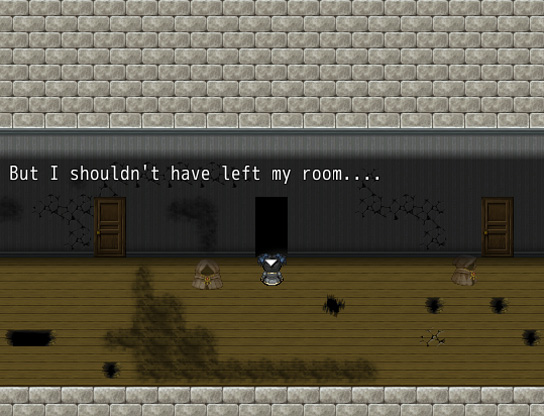
Let me try to articulate this as best I can. The overt antagonist, the monster, in She Who Fights Monsters is Jenny’s alcoholic father. Fighting the Monster, the Alpha Demo, was simpler. It was crude and more elemental for it. For me, it felt a lot more like a generic RPG: especially when you look at Jenny’s room and the imaginary haven inside her closet. But there was an old, faded texture to even these safe childhood places: like that of an old memory. The darker places, however, were dingier. Grittier. It set the tone of a stereotypical, old and dilapidated home where dysfunction and abuse are almost always typically depicted. And even here, it still felt like the aesthetic shell of an old 16-bit role-playing game.

screenshot04

And the monster is clearly Jenny’s father. If you judge the context by the Demo alone, he is the threat that Jenny must avoid. He breaks through all of her childhood illusions of magic, fairness, and innocence through cursing at her. Her Tears and her Innocence do not save her in the simulated turn-based RPG battle. In this one Demo alone, her father’s words feel like a slap in the face but the atmosphere of this world has been building to it. Even so, with Jenny’s mother’s revelation at the end of the Demo, that her father is an alcoholic, it sets a straightforward tone for the game and makes the Demo itself feel self-contained and continuous.

But Gaming Pixie never meant her game to be straightforward. So in the process of changing the game’s name, she also developed its aesthetics in the She Who Fights Monsters Beta Demo that would inform the rest of her game. And I will admit: it felt jarring at first.

screenshot02

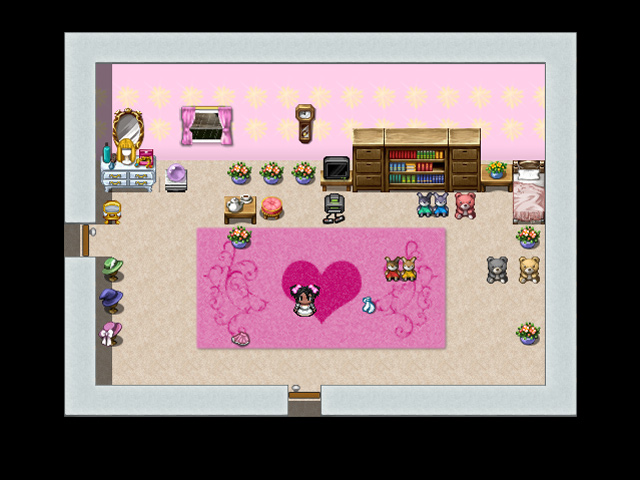
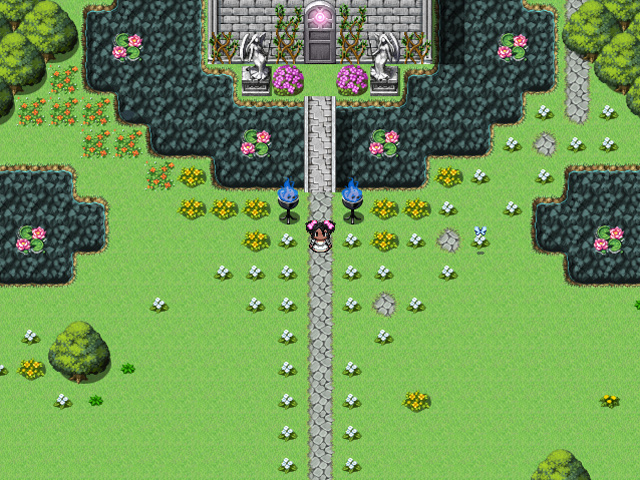
Gone are the dinginess and grit and the fading of peeling memory on the walls. You find yourself with Jenny in a much more colourful and vibrant world. Her toys are brighter. The details around her stand out and the temple that is her imaginary place in her closet is grander and more elegant. Even her home looks more comforting: as much as any middle class home made by 16-bit pixels. Everything, even the nightmares, is vital and alive with colour: as much as any child’s world is at that age.

swfm-room-final

I feel it was designed this way: to make the player feel safe before immediately and brutally introducing them to the world of abuse and its effects on Jenny’s highly impressionable and figurative mind. And, this time around, when the trauma of encountering her verbally abusive father passes she finds herself in her room and her mother entering without even a single explanation. It was most likely made to function as an interactive preview in order create more ambiguity: so that the player could gradually, through the rest of the coming six days, see past the daydreams, imagination, and nightmares of a child to the adult reality of an alcoholic parent.

In some ways, it is even worse this way: to depict a normal childhood and have it impinged upon by the violence of an unknown and terrifying adult world, and the understanding that it will change Jenny’s life. It is a real life horror story of an ordinary world shattered by something aberrant and always lurking under a façade of normalcy.

I felt that both Demos were almost dress rehearsals for the psychodrama that was to come. The title itself says a lot: in that there is more than one kind of monster at work, and as such there are consequences for facing them.

So now we come to the real She Who Fights Monsters. The graphics are further improved — with even greater attention to detail — and you can explore Jenny’s entire house. Day One happens pretty much like it did in the Demos: with one interesting exception. Gaming Pixie ends off Day One from the part depicted in the Alpha Demo where Jenny’s mother flat-out tells her about her father’s alcoholism: the part that did not exist in the Beta Demo. And the scene where Jenny goes out to get some cookies becomes a background reminiscent of strange organic Giger-aesthetics of the horror game Yume Nikki or the Earthbound Giygas battle.

swfm-darkworld02

You, as the player, now know what you are facing and you must play through the remaining days. Yet there is one more thing that you need to consider.

The Memory Bloom is a giant flower that you find past the Temple in the closet. It didn’t exist in the Alpha Demo and I almost missed it in the Beta until Gaming Pixie pointed it out in one of her developer’s blog posts. In the Demo the Bloom itself tells you that it will only become important in the main game and, make no mistake, it is crucial. You will get Locked Memories throughout the game and it is critical to interact — or not interact — with this flower. If you do, you will also realize that not all of Jenny’s memories and experiences with her father are bad. In a lot of ways, it makes it even worse: in that these positive moments and traits in an abuser often make a victim feel bad in attributing negative emotions to that person. It makes the situation all the more complicated than simply Fighting the Monster. What you decide to do will determine Jenny’s future.

swfwm Memory

After all, it took Seven Days, in the Christian New Testament, for God to create the world and its inhabitants and She Who Fights Monsters demonstrates that seven days can create an entire human being depending on the choices that you make, and how Jenny responds to the monster in front of her and the ones forming inside of her head.

There is a quote often attributed to the writer G.K. Chesterton which states that “Fairy tales are more than true — not because they tell us dragons exist, but because they tell us dragons can be beaten.” However, there is another quote, from the fantasy and horror writer Stephen King that is also equally true, that “Monsters are real, and ghosts are real too. They live inside us, and sometimes, they win.”

These are both words to bear in mind as you progress: when on the Seventh Day even the illusion of childhood safety will be ripped away and Jenny will have to start on the path to self-actualization — to adulthood — far sooner than she should. For me, that and my scary and heartbreaking decision to unlock her Final Memory were the hardest parts of this game: to deal with them and to determine what Jenny should do beyond it.

Do you remember when I said that in some ways She Who Fights Monsters is a subversion of a 16-bit RPG? This still holds true even past the Alpha Demo: but in an even more subtle way. I mean, you already understand from Day One that any attempt to fight the game like it is a turn-based battle will end in failure. You already know that not fighting will end in failure. The fact that the game narrative text boxes are in third person-limited perspective, always referring to “Jenny,” “her,” and not “you”: the distance only provides you some illusion of safety.

The perspective is perhaps designed to make you feel that disassociation that a child facing ongoing emotional trauma and abuse would experience: only made more jarring during Jenny’s first-person interludes. These narrative perspectives are very notable departures from Gaming Pixie’s previous Twine-based games: not unlike Christine Love’s don’t take it personally, babe, it just ain’t your story where you are not the character, or even acknowledged as a player. This simply isn’t your story, even if you do influence it.

And when the game does get to the point where it feels like a turn-based RPG battle? Be careful — be very careful — because the thing you need to remember is the end of the first “battle” with Jenny’s father, particularly the words, “Nobody wins.”

The subversion goes deeper when you also consider that there will come a Day where Jenny is hiding in her room and there are clues around. They are extremely clever elements of potential foreshadowing and they are a nice contrast to the beginning of the first Day. For me, the freedom of exploration in Day One — of finding the bathroom, the kitchen, living room, basement, and crawl space —  seemed to set up the beginning of a horror survival game, of knowing all the hiding spots and thinking you have discovered potential secrets only to make it purely about the psychological and the inner world of demons. Aside from the clear mindscape influence of the Silent Hill series, this game is reminiscent of the game Eversion in that sense: only instead of the aesthetics and gameplay changing over time from something brighter into something grimmer, it is a dynamic that goes back and forth between states of atmosphere — always in Jenny’s head, because we are all seeing this from Jenny’s head — until a final decision is made.

When I first heard about the concept behind what would become She Who Fights Monsters, I was reminded of another game based on a child creating an imaginary world to deal with an alcoholic parent called Papo & Yo. Yet aside from the fact that both games have autobiographical elements, child protagonists, and monsters for fathers that hurt them even as they love them there are obvious differences. Papo & Yo takes place in a fantastic equivalent of a favela –a Brazilian slum — and in all realities it is three-dimensional, while despite the aesthetics of its Alpha Demo She Who Fights Monsters takes place in a normal looking middle-class home. Monster, the Papo & Yo protagonist’s enemy is sometimes his companion when he isn’t in a rage, while it is clear that despite some good memories Jenny’s father is never really her friend nor does he help her in her game. While Papo & Yo is more distinctly a puzzle and deadly hide-and-seek game, She Who Fights Monsters is indeed a story that you mostly observe: sometimes very helplessly. And, of course Quico is a young boy and Jenny is a young girl.

You might think that the latter distinctions mean very little and indeed, they are both children placed into situations that no child should ever have to deal with: confronting their parents as enemies. But then there is the elephant in the room to consider. In a segment of her article regarding Gaming Pixie’s epic Twine game Eden, Soha Kareem observes that the former is “an accidentally political game.”

swfm paths

The fact is, Jenny is not only female but she is also “a person of colour.” It can’t be stated enough that, at least to my knowledge, just how rare and unique it is to be playing a game with a young Black girl as its protagonist: in her own story. In a medium that is still struggling to represent different identities in its games, it is definitely something to take note of. However, I am not qualified to talk about “race” or its implications: and how the race and class of Jenny’s family affects her story, if at all, is a matter I will leave to more capable writers than myself. Indeed, this matter seems more “incidental” than “accidental” and Gaming Pixie herself is more focused on the situation and survival of Jenny as opposed to her background.

But there is something else I’d like to note that Soha Kareem also states. In her writing on Gaming Pixie’s Eden, she points out that “The game’s endings and achievements are determined by your karmic choices.” She goes on to explain how, in Eden, how Gaming Pixie subverts the video game trope of the protagonist needing to manipulate their love interest as an object into a relationship by making it so that the player must genuinely act like “a good person” in order to gain that level of trust. The point is, Gaming Pixie is both sneaky and honest in the sense that your choices have clear moral consequences. Even in She Who Fights Monsters, depending on what you do with the Memory Bloom and what you choose to remember, some paths will be open to you, some closed, and some will exist only for one tenuous moment of conscience.
temple-final

I won’t spoil the endings for you, but I will say this. When I play a game, particularly one with this kind of detail, I like to get all of its information so that I can actually make an informed decision. Even so, remember what I mentioned about being careful when you find yourself in a combat situation in this game? Well, if you make a certain choice and you like to be violent and go all Sith you should know that, if you do, there are consequences. You may become the monsters that you are fighting, the demons in your mind, and it might well lead … to a whole other game entirely.

So please, download Gaming Pixie’s She Who Fights Monsters — which is supported by donationware — and determine how this horror story ends, and where others might well begin.

Patronage and Poets in Hell Now On Kindle

Hello everyone. I’d like to make two very important announcements.

I have received my first ever patron on my Patreon account. So let me take some time to publicly thank John Chui for his donation. John, thank you for believing in my writing and my work enough to support me and donate $25 a month to my ambitions.

It really makes a difference. It’s not so much the money, which is always both useful and helpful to have, but the fact that someone respects what I do enough to support me. Not only does it provide a little bit of an impetus, but it reminds me that there are people out there who like my writing and believe it is deserving of payment and recognition. John, you are definitely one of those friends who encourages me to keep doing what I do: even when I get tired. Even when I start to question myself.

You have to start somewhere and thanks to John and in words that he can truly appreciate, I will continue to soldier on. I do still expect a Twine out of you personally at some point, however, so don’t think I’ve forgotten. 🙂

And now, for the second announcement. A little while ago, I told all of you that my short story “When You Gaze Into an Abyss” was accepted in Janet Morris’ book Poets in Hell: part of the Heroes in Hell series. I said that I would update all of you when the book came out.

And so here it is:

The Kindle version of Poets in Hell.

Poets in Hell Kindle

And here is a nice description of what you will find within it should you dare to read it:

Where else but Hell can you join Beowulf, Dorothy Parker, Diomedes, Sappho, John Milton, Robert E. Howard, Odysseus, Caliban, Helen of Troy, and Mary Shelley? Where else but Hell can you adventure with Samuel Taylor Coleridge, e.e. cummings, Nietzsche, Shakespeare, Marlowe, Attila the Hun, Napoleon, David Koresh, Eliott Ness, Marconi, and Plato? Where else but Hell can you find the Jabberwocky, Li Po, Albert Camus, the Sphinx, Frank Nitti, Aeschylus, Goethe, Sycorax, and Merlin all in one place? Where else but Hell can you meet Galatea, Robert Burns, Ghengis Khan, Foster, Solon, and Lemuel Gulliver? Where else could you find Homer, Lilith, Victor Frankenstein and his famous Monster, Edgar Allen Poe, Jimmy Hoffa, and Lord Byron’s dog, Boatswain? In POETS IN HELL, that’s where. BYO pitchfork.

The book version of Poets isn’t ready yet, but for those of you who are eager to read the excellent tales — including my own first-ever published story — please download this Kindle version should you have one.

And if you live in the United States, this entire saga will cost you — aside from your peace of mind and soul — $6.66. I’d say that, all things considered, that is a pretty good deal.

This past while has just been a series of firsts for me. Let me tell you. I’ve seen my name on Amazon before, but only as a reviewer: and that was before I created Mythic Bios and placed the majority of my reviews on here. But it is a whole other experience to see my name on Amazon as an author, and right next to the names of giants: of my fellow diabolical, grandiose, and truly hilarious peers.

I’ve come a long way since that person who knew I had something to say but had little under my name to show that I could truly say it. But this is only the beginning and as I said with regards to my Patreon: you have to start somewhere.

And what better a start than writing from a place in Hell: from the hellfire in my soul, from where all of this truly began. Thank you all for reading this and Following my work. Again, please consider reading, supporting, and spreading the flaming word of POETS IN HELL.

You will not be disappointed.

Vuckovic and Headey Explore Jacqueline Ess: Her Will And Testament

Clive Barker’s short story “Jacqueline Ess: Her Will And Testament” is not only being adapted into a horror film by the Canadian and Torontonian film director Jovanka Vuckovic, but Lena Headey will be playing the role of Jacqueline Ess.

While until this announcement I was unfamiliar with Jovanka Vuckovic or her work, and I only know of Headey through her roles in Game of Thrones and 300 as Queens Cersei and Gorgo respectively, I have read “Jacqueline Ess” and it is a fascinating story. Beware my friends, if you intend to read this story there will be spoilers.

Books of Blood

“Jacqueline Ess” is a story found in Clive Barker’s Books of Blood. It is about a woman by the same name who, after being neglected and passive-aggressively abused by her cheating husband and being dissatisfied with her overall life, attempts to kill herself only to be brought back from death with–for lack of a better word–some strange, flesh-crafting abilities. Think of it as telekinesis that can only affect human flesh and organs. Now imagine all that rage and pain that she has suppressed her whole life in being the good wife or woman and patronizingly being told what how she feels by men.

But the story is so much more than simple revenge. It subverts stereotypes. It changes Ess from a victim to an accidental instigator of manslaughter, to a murderer, and into someone who examines the very nature of power. Her sexuality, which was used by men, becomes her most overt weapon. However, again, she is not simply a monster or a villain, or a Carrie that lets her repressed emotions completely rule her powers. She is an intelligent woman that not only wonders about this power and what it means, having gained it by temporarily piercing the veil beyond death, but she also truly examines what the meaning of life is in light–and despite of–the discovery of her powers.

The very weapon that is her power, that is her sexuality, that is her body, becomes a weapon that ultimately turns on her. What this might say about social perspectives with regards to female gender and sexuality is a whole other subject entirely that will hopefully be explored in further depth, but I will say that the story manages to move this power from the place of the stereotype into the dark, red realm of the archetypal: of that primal place where life comes from, where it is changed, in that plane suspended between sex and death and, when you get right down to it, even a sense of enlightenment and acceptance.

Clive Barker has an interesting sense of horror: at least in his earlier stories such as those found in The Books of Blood. For him, horror is not only your fear of the unknown, but your secret desire for it and that place where your anxiety is forced to meet your sense of anticipation in the language of the flesh.

Lena Heady

I suppose you can tell that I really took a lot away from this story. Certainly, I can see Lena Headey making an excellent Jacqueline. Not only does Headey have a sense of portraying women of power in Game of Thrones and 300–characters that exist in traditionally male-dominated spaces–but particularly in the first Season of Game of Thrones to me she actually portrays a more sympathetic version of Cersei Lannister: someone who has power, and knows she has power as a woman in a traditional role, but who was never trained to understand it to its fullest extent or to protect those that she loves.

Headey’s Cersei understands just how subjugated and micro-managed women in Westeros truly are and even in Season Four you can see just how powerless and vulnerable she can be when her father takes her son from her. To me, it’s almost as though Headey’s Jacqueline may well be a parallel to the character of Cersei: both start out with affluence but are limited by the men and patriarchal structure of their lives, but while Cersei stays with the trappings of power and never seems to explore their origins, hopefully Jacqueline will portray her vulnerability and continue to explore her more literal and supernatural power and its nuances on the environment around her.

As I said before, I didn’t even know who Jovanka Vuckovic was before news about her film came out. However, if she can explore the details of Jacqueline’s evolution and its effects on the men and society around her, while keeping in mind Barker’s own horror genre sensibilities we will definitely see an interesting multifaceted blood-soaked gem of a strong female character and what she says about our own world: as a master of the horror genre, the sub-genre of body horror, and the medium of film tends to do.

Given the fact that Jovanka Vuckovic was an Editor-In-Chief for Rue Morgue magazine, author of Zombies! An Illustrated History of the Undead, founder of She Wolf Films, studied physical anthropology, and the fact that she made The Captured Bird, a horror-fantasy short film about a young girl that discovers a black-inky evil underlying her world only adds to the fact that I very much look forward to seeing what she does with this film. I know that many of her friends in the Toronto geek community–including some here at GEEKPR0N–wish her and her endeavours well.

What If Comics Had Been a Place Without Codes? Would We Live as Air?

I’ve been having some technical issues these past few days and time hasn’t really been my friend but what I’m going to write here past most reasonable people’s sense of sleep is another down and dirty, and therefore ad hoc, article on comics.  So if anyone out there is an expert or has done their homework, by all means, please correct me if need be.

As some of you already know Sequart created and is now in the process of editing, a Kickstarter called She Makes Comics: a documentary on women in the comics industry and the culture surrounding it. One element in particular that it has focused on is the fact that long ago there were more female readers of comics than they were male. Now, I wrote a short article on what will soon be called GeekPron in which I found some of my own assumptions to the question, well, questioned.

I believed that it was the Comics Code Authority, inspired by the fear of McCarthyism “witch-hunting,” blacklisting, the detrimental testimonials by psychological experts such as Frederic Wertham, and a loss of business that had comics publishers eliminate most of their different genres of comics and focus mainly on watered-down stories about superheroes. All the horror, revenge, gore, westerns, romances, and sexuality all went the way of the dodo at the time because of fear. Anything that challenged the rules of the Comics Code, of authority always being right and just for starters, could not exist in mainstream corporations that published for money.

But the comic book editor Janelle Asselin also mentioned that this female readership of 55% over 45% of male readers changed as the superhero genre became more mainstream. Think about that: the idea that after a time the superhero not only reduced a female readership, but also eliminated or greatly marginalized a whole body of stories and genres that made the medium different. I realize now, looking back on what I wrote earlier, that these two statements are not necessarily mutually exclusive.

I mean, if you are afraid of losing your business and your liberty in telling stories for which you want a certain pay cheque and livelihood then eliminating anything that could be construed as an overt challenge to your culture’s status quo or even subversive to it, it unfortunately makes a horrible kind of sense.

The godfather of manga Tezuka Osamu once said that “Now we are living in the age of comics as air.” And while he was most likely referring to the influence of manga in Japan as becoming more widespread, its connotations can be applied to the comics medium in general. According to Paul Gravett, in Sixty Years of Japanese Comics, Tezuka believed that comics without passion or originality can become damaging and even create pollution. It took me a long time to figure out what this meant. When I first encountered the quote and the explanation, I thought that it referred to the potential damage to the morality of the reader but now I realize that the quote can definitely apply to comics as a medium and what occurred during the heyday of the Comics Code Authority.

The age-old notion of the superhero ghetto that we are so used to hearing about with regards to the comics medium: the notion of an immature all-boys club with shallow depictions of sexuality and simplistic violence with no consequences is damaging not only society’s concept of the medium but also that of its readers and future creators.

I’m not, by any means, saying that the comics that existed before the Code and its predecessors were the fonts of enlightenment for gender or, really, humankind. But there was a lot more experimentation before the Code and it just makes you wonder: what would have happened if these vigilantes and superhuman beings in tights had just remained one of many genres and there had been no Code?

I mean, there is always the scenario that Alan Moore presented in Watchmen: that if masked heroes and one a superhero had been in existence then no one would have paid attention to Wertham and the horror comics of Bill Gaines and friends would have dominated the medium from the fifties all the way into the eighties: becoming darker and more grotesque with time while also innovating itself much like our comics have done.

But that is just one creative interpretation. Who knows? Maybe a flat period of unoriginal and recycled stories would have followed regardless. Perhaps female readership demographics would have changed or something else would have challenged the “morals of comics:” for or against the status quo. Or we could have had another Golden Age: where comics became, earlier on, a widely accepted form of beautiful art and every great artist might have tried their hand at one. Maybe comics could have become widely accepted and mainstream coffee table or instructional as manga has in Japanese society to an almost ubiquitous degree. Instructional comics even had their place in North American society and to some extent they still do.

Of course, those latter thoughts are just me playing at utopia and I’ve never been really good at that. Maybe if there had been no Code comics would have, earlier, been just another form that challenged conventional morality much like any work of great art or literature should. Of course, again, this also happened in the Western world through the advent of what we understand as Underground Comix defying the establishment during about the late 60s: about that same time frame that Asselin gave when she talked about the female comics readership majority existed from the 1950s to the 1960s. Or perhaps the comics medium would have burned itself out as a fad and amateurs such as myself would be wondering, even then, what if: what if it had been different.

As for me, if you really want my honest opinion I will say this. I think that if there had been no Comics Code or anything like it children would have still been influenced by Tales from the Crypt, and Archie, and The Lone Ranger, The Green Hornet and all of those others. And some girls and women would have had Wonder Woman and Black Fury. Many things would have continued on, but sometimes I think about that idea of all people–young, old, straight, LGBTQ, male, and female, different ethnicities, different classes–making their own comics and showing them to their friends and the world. They would realize how different they and everyone else are but also how many things they have in common.

And when you wipe away my pseudo-utopia of a whole loss of potential for a readership of intensely intelligent men, women, and sentient beings, when it comes down to it I do like the idea that without the Code and the forces behind its development, the medium of comics would have been considered more than just silly laughter and transparently hidden BDSM parodies. Those things would have been a part of the kaleidoscope. I think that many more people might have seen comics as a medium that tells all kinds of stories: a space inside and outside of us that is pictures and words. I think many more people may have been more accepting that the medium of comics as that place of sheer variety, like film, between both art and literature.

There is another way to look at Tezuka’s quote about “comics as air.” If you take the pollution of censorship and unoriginality away, what you might ideally have is a fluid art-form that anyone can learn and use. And if you consider that we all live in the continuing Age of Information and in societies that utilize wireless Internet and you include webcomics into the medium … perhaps we can all fly where only superheroes used to tread: up, up, out of the ghetto and away.

Miracleman Balloons

The King in Yellow Spreads the Sign

I just want to state, right off the bat, that I am a fan of H.P. Lovecraft. It took a very long time for Lovecraft and his Cthulhu mythos, specifically the idea that something ancient, eternal, and either uncaring or malevolent underlying our conception of space and time, to come to some kind of mainstream appearance in geek culture. It was on my quest to read everything eldritch and gibbous by the man who was Providence and spurred on even further by Alan Moore’s The Courtyard and Neonomicon comics when I came across something called “the yellow sign.”

I followed this up online and found a book called The King in Yellow. The book contains a series of short stories published in 1895 written by Robert W. Chambers: a writer of many genres but especially romance, decadent literature and, in particular, horror. In four of The King in Yellow‘s stories, “The Repairer of Reputations,” “The Mask,” “In the Court of the Dragon,” and “The Yellow Sign” as well as some mention in “The Prophets’ Paradise” we are introduced to the idea of a play in a book that drives people insane, a malevolent entity known as The Yellow King that is a part of the play or summoned by it, and “the yellow sign”: last of which is a symbol associated with the King that can manipulate or distort the minds of those who see it.

They were some fascinating tales, by favourite being “The Repairer of Reputations” but aside from taking some notes on them, I thought that they would remain some fascinating but otherwise obscure stories even though it has a specific following and Lovecraft himself read them and alluded to their content in his story “The Whisperer in Darkness.” But I thought that would be the last I ever saw of them.

So how does this book from 1895 have any bearing on geek culture right now?

The answer is possibly a lot. Very recently I watched a recent video interview with the author and editor Joseph S. Pulver Sr.: who is an expert on the mythos of The King in Yellow. I knew that he would say some very interesting things on the stories, but what I didn’t know then until he and the interviewer, The Arkham Digest’s Justin Steele, mentioned it was that there is a recent television program that draws heavily from The King in Yellow. Please don’t click on the video unless you want spoilers from True Detective.

I’ve had a friend or two suggest that I watch True Detective and I just thought it was another generic police show or a derivative of Criminal Minds until this little nugget was revealed to me. Two detectives undertake a seventeen year old hunt for a serial killer named The Yellow King:  a quest that seemed to have come to its conclusion this past weekend. Steele and Pulver seem really enthusiastic about The King in Yellow becoming more mainstream as a result of this plot development in True Detective. Indeed, for years Pulver himself has been instrumental in gathering The King in Yellow‘s stories for Chaosium anthologies and then even editing and encouraging writers to create stories in Chambers’ particular universe. Pulver takes great pains to point out that despite August Derleth’s attempts to make The King in Yellow a part of the Lovecraftian or Cthulhu mythos that these stories exist in their own continuity and outside of Lovecraft.

In addition, Pulver himself is in the process of gathering further King in Yellow stories from new writers: particularly female horror writers. It is quite fitting in a way. After all, unlike Lovecraft whom the mythos of The Yellow King is often attributed, Chambers was definitely not afraid of writing female characters into his stories that weren’t monsters, one-dimensional throwaway characters, or that just pretty much exist at all.

Justin Steele’s interview with Joseph S. Pulver Sr. is very fascinating and I would definitely recommend watching the above video if you are at all interested in the origins of The King in Yellow as well as reading Pulver’s article on the subject at The Lovecraft eZine. Also, please check out True Detective: Season One is now over and there are only eight episodes in the series, so it shouldn’t take you long to get through them. Finally, I should point out that you can read The King in Yellow for free online.

As an added bonus, it seems that H.P. Lovecraft himself and a Southern doppelganger, reanimated for YoutTube by Leeman Kessler, have their own opinions about both True Detective and The King in Yellow.

In any case, you will find that the mythos of The King in Yellow is a very mysterious thing of poetic fragments and goose bumps not unlike its yellow sign. This is just as well: as that sign, whatever its shape or purpose, makes minds receptive to madness.

See you in Carcosa.


When the Ghosts Stare Back Into You

In the First World, there were no ghosts.

https://i0.wp.com/upload.wikimedia.org/wikipedia/en/5/50/NES_Super_Mario_Bros.png

Everything was new and colourful in a washed out, nostalgic sort of way: like a lucid mind in an ecstasy of mushrooms and fantasy. And as shells of soldiers fell off ledges or collided with each other in contention, plants burned out by fire, beetles failed by foot, squat things were squashed back into the earth, and fish and squids fell in water and monsters drowned below bridges a princess was found in the right castle and all was well.

As a result, the Second World was a sleep of the just and bounty.

Until the Third World.

Until the ghosts came.

https://i0.wp.com/www.mariowiki.com/images/c/c1/LookinAtBoo.png

Perhaps the ghosts didn’t so much come as they were always there and it was only in the greatest castles, forts and darkest worlds that they began to manifest. Certainly, in the time of the Third World they seemed mostly limited to those spots and, after, they could be rendered out of sight. Out of mind.

Yet perhaps in mockery of the deeds that heroes did not want to admit to, or examine in too much detail, the ghosts would always stare away from their tormentor … they would stare away until his back was turned and, like a guilty conscience no longer assuaged by excuses, his ethereal attendants would catch up with him.

By the Fourth World and the graduation from shaded 8-bits into vibrant cartoon colours the ghosts gained their own castles. And some of them had different faces. And there were so many of them. So many.

https://i0.wp.com/www.mariowiki.com/images/6/66/Circling_Boo_Buddies.PNG

Did the heroes ever stop to count the number of enemies they slaughtered and attempt to match them up with the restless, mocking, vengeful dead?

And now–now–the ghosts have grown in size and intent. And worse yet, not all of them turn away under scrutiny but lunge for their murderers or, worse yet, stare right back into their eyes. But what does it mean? What does it mean?

What does it mean?