It’s Always Halloween At Five Nights At Freddy’s

“And under this carnival disguise the heart of an old youngster who is still waiting to give his all. But how to be recognized under this mask? This is what they call a fine career.”
— Jean Anouilh, The Waltz of the Toreadors

Freddy Fazbear

My first disclaimer, right off the bat, is that I haven’t played any of Scott Cawthon’s Five Nights at Freddy’s games. However I have been following them and, specifically, the overall story line.

The reason that the story behind Five Nights intrigues me so much is due to my own particular interests. Some of you who have been following Mythic Bios for a while know that I am absolutely fascinated with a special kind of creepypasta. You know the one: a short story told through different forms of media that become viral memes which proliferate through the Internet and user imaginations in the most strange and disturbingly wonderful ways. At the same time, I am a very nostalgic child of the 1980s and 1990s: especially when it comes to 8-bit and 16-bit video games.

In addition to all of this, for a while now I’ve been following the work of Kris Straub: the creator of Ichor Falls, Broodhollow, and the infamous Candle Cove. And, frankly, if I didn’t know any better I would say that in a lot of ways Scott Cawthon’s Five Nights at Freddy’s feels like stories that Kris Straub would create if he were working in the medium of video games and playing with late twentieth century children’s nostalgia and urban legends eroded by adult decay and a wickedly self-aware sense of humour. At the very least, it taps into a similar place of childhood nightmare fuel from which Straub’s horror work and Christopher Howard Wolf’s (SlimeBeast)’s Abandoned by Disney series also spring.
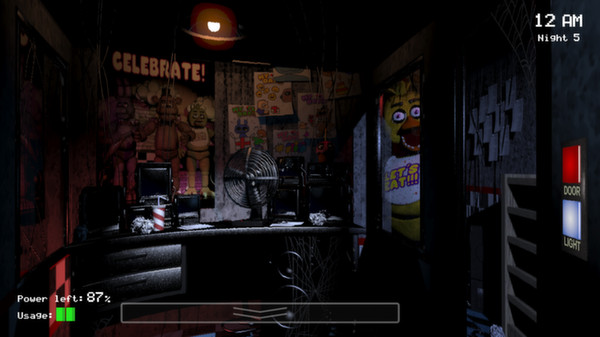
FNAF Gameplay

As it is, Cawthon takes a multimedia approach to his interactive storytelling. For the most part, each Five Nights game is a point-and-click endoskeleton requiring exacting precision tempered by a slow-burning sense of paranoia and and an ever increasing level of danger: all an attempt to survive long enough before faulty spring-traps snap down in a jump-scare that will leave your peace of mind — in pieces — for at least a night or two.

But then there is the rest of the game’s material — its costume — to consider. There are, after all,  the masks that you’re forced to wear, and those that stare at you right in the face before the long dark.

You have the newspaper clippings on the corners of your office. There are the children’s drawings on the walls of the pizzeria which you have to watch through faulty security cameras. You have an answering machine from your supervisor telling you about the dangers of walking animatronics in the night, and then more ominous references such as “The Bite of ’87.”

Then we get into the second disclaimer of this article: namely spoilers. You play this game from a second-person perspective: working six hours at night a week in a pizzeria to keep an eye on the place, but aside from seeing your character’s name on a pay cheque — should you survive to the end of at least two games — you never see your face. In fact, you don’t see any human faces in any of the three games. The only faces you get to see are those of the animatronics, the walking large, cuddly, worn, and mouldering robotic children’s mascots at night as they try to stuff your sad naked flesh “endoskeleton” into an empty suit full of pistons and wires.
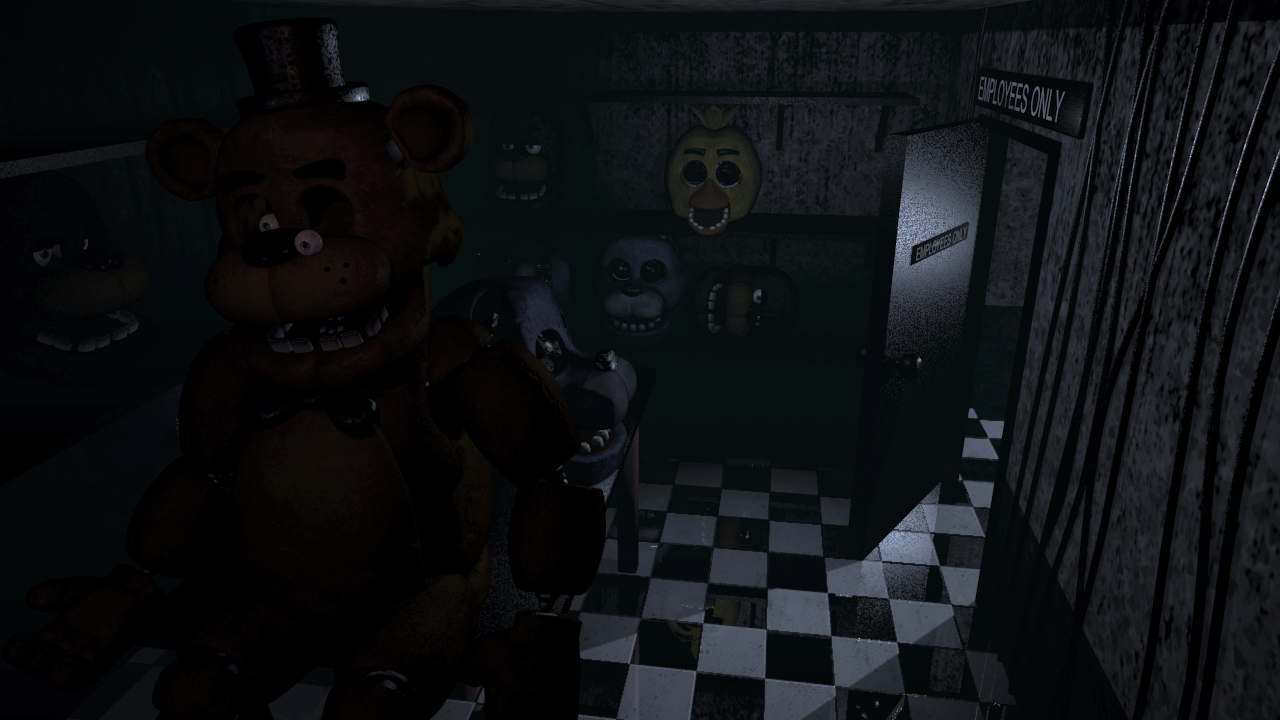
FNAF Gameover

Even your supposed ally, Phone Guy, is just a voice on an answering machine: and the person who is responsible for all of this is a loathsome 8-bit purple sprite.

And here is where I think Cawthon’s genius truly shines. In the second and third games of the series, Cawthon institutes a platform game element. These mini-games are often considered reminiscent of those created for the 8-bit Atari 2600. You would totally think that with their blocky graphics and crude sound effects couldn’t be taken seriously. Of course, even if you somehow disregarded the resurgence and adoption of the 8-bit aesthetic by contemporary independent game designers, you would still be dead wrong.

FNAF Death Mini-Game 2

Between the “Death Mini-Games” of Five Nights 2 and the hidden mini-games akin to easter-eggs in Five Nights 3 — morbidly reminiscent of Warren Robinett’s Adventure and the Pac-Man level 256 perfect score glitch respectively — the mythos of Five Nights becomes more fleshed out.

While the animatronics in the point-and-click parts of the games come from a grim place where neoteny — child-like traits often incorporated into exaggerated cartoons — is combined with the uncanny valley — the notion of discomfort caused by an object that unsuccessfully tries to imitate a living being are terrifying because of how realistic they are made to look, they are creepy in a different way when rendered into pixel form. They are like 8-bit hieroglyphics, allowing you to explore the horror with a detached and almost dream-like manner. There is just something incredibly archetypal and gloomy about the graphics of the games that brings out its dark subject matter: especially when you consider that they are traditionally from a child’s medium of entertainment.

FNAF Death Mini-Game

The Death Mini-Games of Five Nights 2 introduce you to the Purple Man and his role in what might be wrong with the animatronics that are attempting to kill you while, at the same time, giving you a little more background into the development of Freddy’s pizzeria and the animatronic characters therein. And in Five Nights 3, instead of having to die in order to gain random access to mini-games, you can voluntarily search for the other mini-games to perhaps change the fate of certain characters in question.

FNAF Game

I think there are two elements that I truly appreciate from the combination of mini-games, newspaper articles, and answering machine information. First, there is what Cawthon is not telling you. There is what he implies and what he leads you, as the player and viewer, to put together. Cawthon even goes further in the advertisements for his games: implanting secret codes and clues into his messages. He makes you do all the work and all of the speculating: somehow making the dread and horror that much worse.

After all, there is a particularly challenge in another form containing the horror genre: how can you keep building up tension in the story when you reveal what the monsters look like? In addition, you certainly don’t want to reveal everything about the horror in the story or it becomes expository and rote. You have to keep a little bit of mystery in horror so that you always ask yourself why: while a part of you is always at least partially afraid of the possible answers.

These are the kinds of elements that inspire fans: that made this series into something of a viral meme on par with creepypastas. There are fan-made stories, games, animations, art, and trailers based on the archetypes that Cawthon creates. A Five Nights at Freddy’s movie is in the works and there is even speculation that Freddy’s is a real restaurant somewhere: probably based off Chuck E. Cheese’s. Certainly the mascot costumes, pizza, and arcade games taps into a resonance in me as a child of the eighties and nineties: a nostalgic feeling that Cawthon is trying to invoke and distort.

The fact of the matter is that, for the most part, the three Five Nights at Freddy’s that exist right now can stand by themselves. There didn’t need to be another game after these. However, I had my suspicions. Perhaps it was because of the empty product page he kept for some time with the discarded top hat. Maybe it was his silence about whether or not there was going to be another game.

But sure enough, come October 31, the fourth and final Five Nights at Freddy’s will arrive. And if you look at the graphic on Cawthon’s page, it is extremely appropriate if you think about it. I think it actually sums up a lot of the second element that has been on my mind, in some form, when I think about this game.

FNAF 4

I mean, of course it makes sense for the last chapter of a horror survival game to come out on Halloween, but here’s what gets to me. Imagine Freddy’s Pizzeria is like Chuck E. Cheese’s or even Disney World or Land. Certainly, a place for children would celebrate Halloween in some fashion: or at least take advantage of it commercially. Maybe “The Bite of ’87” might not come into it as many fans are speculating, but imagine how freaky it would be to be in a haunted children’s restaurant on Halloween of all days: perhaps even during the day this time around. Perhaps there are actual Nightmare toy versions or animatronics for such a lovely occasion.

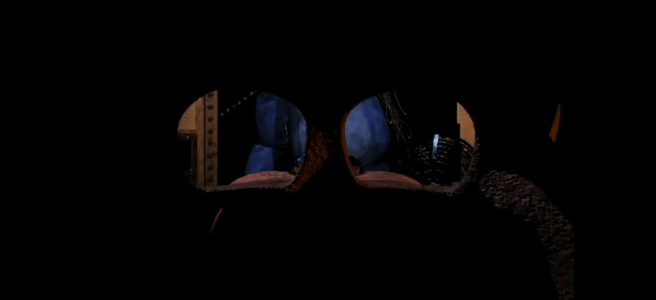
But all speculation on my part aside, take this a step further. Remember what I said earlier about faces? How you never see any human faces in any of the Five Nights games? There are always costumes involved. There are always roles to consider. You arguably wear a uniform as a security guard. A murderer might have worn a animatronic suit. In Five Nights 2 you have to hide your face under a Freddy Fazbear Head in order to survive an animatronic intrusion. And children might be hiding — or hidden — in other inside the darnedest places. Even Phone Guy, the former security guard who showed you the ropes of your new job and was your only ally for the most part, tells you that he is curious to see what is inside those animatronic suits.

Freddy Fazbear Mask

The fact is: it’s always Halloween at Freddy’s, and I suspect that it’s always been. No one is as they seem, everyone wears masks, no one rests, and everyone wants to play. Sometimes nostalgia is an illusion of the fabled “good old days” that can, when stripped away, becomes a dark, ravenous thing in the late hours of the night. Sometimes you lose track of time when you so desperately want to keep living, and you don’t always want to see what’s under that costume. After all, some seemingly innocent dreams are, at their core, rotting nightmares.

And just when you think its safe to take that mask off, to forget the night time, to mistake the performer taking off his top hat with a flourish and a bow as the end: the story only continues at an elegant pace … and the suspense will kill you.

Freddy Toreador March

Finding A Totem To Oblivion: A Review of Black Mountain Side

Writer and director Nick Szostakiwskyj plays the long game in his horror film Black Mountain Side.

It begins, and ends, in the northern most part of the Taiga Cordillera: a place situated on the border between the Yukon and the North West Territories. Only a few hundred people live in the area, its summers are short and cool, and its winters are quite long. In the film itself, there is a lot of wilderness, the considerable presence of forests, mountains, and silence. Certainly the trope of Canada being a large and wide open icy terrain is not lost in this film.

Black Mountain Side‘s story focuses on a team of archaeologists at a site in the Cordillera. The snow and wide expanse of their surroundings always seems to threaten swallowing them up along with their small outpost. Nature is not their friend. It is a patient Other: an enemy that slowly whittles away any warmth, or light that they can get. Even so, there are marks of human inhabitation that even the territory can’t completely erase.

This is the puzzle that Szostakiwskyj initially poses: how can an ancient and long established structure with what seem to be very southern Mesoamerican symbols exist buried in the earth and snow of the far north? How can architecture dating from the Ice Age even exist? These are academic questions that become tinged with anxiety, paranoia, then outright fear, and blood.

This structure, which the team never succeeds in unearthing completely, is far from home if it is Mesoamerican. Even the local workers that the team utilize seem to be the aboriginal Dogrib: from the Dene First Nations. Yet this is only a supposition, however, as one of the archaeologists points out that these workers, employed from an arrangement with their band council, speak the language of Dogrib. Certainly, it may be this people, or their ancestors, that created the marker stones around that area to keep it in memory: though the fact that it may indicate a hunting ground for deer speaks volumes later on in the film.

In fact, the ground is a space that screams isolation so loudly that there is almost absolute quiet. As the site’s communications with other outposts ceases, as sickness spreads, and tensions crystallize into infighting and fracture into a voice that isn’t there and murder there is no soundtrack. Black Mountain Side, for a film that coincidentally shares a title with an instrumental piece, has no music. Instead, it is a movie that eats chronology, the days and months that the archaeological team degenerates from playing cards together into fear and horror, and the sounds of their deaths and the ending of their selves.

There have been a few other reviews on this film. Some compare it to John Carpenter’s The Thing or even H.P. Lovecraft’s At The Mountains of Madness. I would even say that the film is mildly reminiscent of a 2010 movie called The Corridor: where a group of friends go up to a cabin and become exposed to some force that changes them and drives them murderously insane. Certainly, the scenes in Black Mountain Side with one of the archaeologists have something squirming in his skin, the revelation of a structure that may have existed before human civilization, and even the team doctor’s diagnosis that some of the crew has been infected with a cephalopod-like organism definitely leans towards Carpenter and Lovecraft before him.

In fact, the gruesome apparition of the deer god that the latter survivors of the team keep seeing and hearing — what with his comments on the cosmos and actually looking at reality — definitely harken back to a kind of Lovecraftian cosmicism: in which the universe is inherently meaningless and filled only with malignant and indifferent entities of considerable power in which human beings are but small insects by comparison.

But it’s also possible that Black Mountain Side is another kind of story: and it is in what it doesn’t say, or say entirely, that might determine just what kind of horror film this really is. For example, the viewer never really knows if anything the archaeological crew is seeing is actually empirically true. Perhaps the structure they are excavating released an ancient disease. Maybe it is a larger and more complex version of the stone markers warning others in the area of malevolent spirits or forces. The structure might even be a tomb containing a vast evil. Or maybe there are technological problems and the crew are truly mass-hallucinating from a possible lack of sustenance and extreme isolation.

Yet there are other elements at play here that is hard to put a finger on. It’s notable that everyone in the archaeological team is male. It kind of makes me, as a viewer, wonder just why that is the case. Certainly older films and stories often had an all-male cast (such as At The Mountains Of Madness), though sometimes this works against the characters in this movie: as they are a little harder to relate to beyond basic empathy and it’s easy to lose track of who they are. It’s also notable that there is only one non-Caucasian member of the crew as well — a Black man — who ends up going on a shooting spree towards the end of the film (though, granted, two other team members go berserk long before he does). As paranoia takes him, he doesn’t trust the leader of the group and says he has seen his “sociopathic kind” before. This could be seen as him distrusting a certain personality-type under duress, but it is worth further thought. And this isn’t even mentioning the fact that the team makes a point of stating that their aboriginal workers are “superstitious” and immediately come to the conclusion that they ran away from the site due to those beliefs.

There is something really compelling about looking at what happens to the protagonists of Black Mountain Side as a distorted view of their own innate, or unconscious, cultural assumptions: from a possible post-colonial perspective. Certainly, it’s no new idea that the niceties of social morality and behaviour fall away from isolation and a real fear of starvation, a lack of shelter and safety, and imminent sickness to reveal the unspoken human ugliness underneath. And this is where the blatantly Lovecraftian branches out into something deeper in the darkness of the human psyche.

It’s the figure of the deer god that really gets me. When I first saw it, I had to know if there was some kind of basis for it in aboriginal, or First Nations, mythology. I looked into any Dogrib and Dene stories on hand but there was nothing on a deer god. However, deer do have some mythological significances that span beyond North America. For instance, some deer are seen as guardians of the earth while others represent learning and wisdom. Certainly with regards to a Native American connotation, the way that the film’s protagonists encounter the deer god –with its voice sounding like a Nazgul or Sauron himself — is reminiscent of a waking vision or spirit quest gone horribly wrong.

The deer god seems to offer wisdom, but only encourages maiming and murder: senseless trauma without enlightenment. It derides its victims’ expectations of it offering them knowledge or understanding. It seems to hint upon the fact that it is older than humankind and everywhere. It challenges and ruthlessly takes apart what they think they know about other cultures, their empirical subject matter and, indeed, their own perceptions of the world. It’s a subversion of what others might think a spirit animal or totem should be, or indeed the idea of some Great Spirit that is inherently benevolent. If anything, the deer god seems to be a human understanding of the land and how it is killing the protagonists. This deer hunts humans.

And even then, the film follows the tradition of not completely revealing or explaining the nature of the monster in that it is ambiguous as to whether or not this entity really exists, if it’s being hallucinated, or if — indeed — it is the real horror of this situation. Certainly, you could argue that the real terror is Black Mountain Side‘s possible critique of Western cultural values, concepts of race, science, and even a sense of reality.

In any case, when the last survivor gets caught by a 1930s bear-trap while fleeing for help, the atmosphere comes full circle. The environment, which is slowly eroding away their senses of self, wins as the last man realizes he’s trapped and lies in the snow, in silence, giving into oblivion. The lack of music, when the credits start rolling, is poignant. At the beginning of this review, I said that this film was a long game, but perhaps it is more of a slow burn or the slow encroachment of frost bite: of a terror and pain that ultimately turns into numbness and falls off into the darkness. Sometimes that is a limb, or piece of one’s sanity, or even one’s own soul. Snow covers all traces of human traps and tracks.

And in Black Mountain Side, only the silence is left to claim anything.

Jovanka Vuckovic Looks Inside The Box

I met Jovanka Vuckovic this weekend. It was the second and last day of the Suspect Video and Fangoria-sponsored Torontonian convention Horror-Rama and I stepped behind the curtain to sit in on Jovanka Vuckovic’s Hangout session: to listen to her answer questions about her career and her future plans. I didn’t go into the Hangout with plans to write an article this time. I have written about Jovanka Vuckovic before: specifically about her creating the film adaptation of Clive Barker’s short story The Last Will and Testament of Jacqueline Ess.

But in the midst of hearing about her time at Clive Barker’s house, an anecdote or two about Guillermo del Toro, her plans for and a few more details about Jacqueline Ess, her views on diversifying the roles of women in film as characters and creators, and advice about not necessarily requiring film school to direct a film Jovanka Vuckovic revealed something for the first time that day.

She told us that she would be writing and directing a short film based on Jack Ketchum’s story “The Box.”

I’ll admit that up until that moment I’d never read anything of Jack Ketchum’s, though I watched and loved The Woman that was adapted from his novel a few years ago at the Toronto After Dark. And I definitely heard of him in the horror community: as he is generally highly regarded there. So after being among those who got to hear the news publicly for the first time I just had to find this short story and piece together, in my mind and based on Jovanka’s works and thoughts, just how this might go down.

05039b22be9a6af5142899ef57a6ed77_400x400

There was one thing that Jovanka Vuckovic mentioned in her Hangout that really stands out for me: her need to bring her voice to the work in question. As someone who looks at a creator’s own personal bent or slant, and as a creator myself, I can tell you that this is really important and also challenging when you are working in another’s world.

Or someone’s sandbox. A box is created to contain something. It can be put together, and it can be taken apart. It can have beautiful red wrapping paper on the outside and look like a pretty present. It can be a heavy burden or something incredibly light. The thing to remember about a box is that it’s hollow on the inside: perhaps, dare I say, even bigger on the inside. A box has nothing inside of itself except for what you put into it, or how you make it …

Or what you might see in it.

After being introduced to Junji Ito’s bizarre and Impressionistic horror manga Uzumaki this past weekend, it’s tempting for me to say that just as spiral patterns are prevalent in nature and culture, so too are boxes prominent in human society: if only as metaphors. Boxes can be homes and coffins. They can also be check lists and labels. They can carry tools that build, repair, and take things apart.

Children play in boxes and imagine them to be something else.

The way I see it, these considerations are important in speculating just what kind of creative sensibility and voice Jovanka Vuckovic might bring into “The Box” of Jack Ketchum. And in order to ponder further on that, there will be some story spoilers.

Jack Ketchum The Box

“The Box” is a story about a man who watches his family slowly and peacefully starve to death after his son gets a peek at a stranger’s box on a bus ride. This box is like a twisted version of Pulp Fiction‘s MacGuffin. However, unlike that film’s briefcase we only get to see the box once: and even then we never know what’s inside of it. It’s gone: slipped back into the night. But, at the same time, this isn’t true.

The true horror of the story is the fact that the protagonist watches everyone he loves understand something he can’t, seen from that box, while slowly and gradually fading away: leaving him alone and desperate to find that man and his box again so he can finally feel what his family feels, and join them.

Jovanka Vuckovic is no stranger to families, death, and particularly children in horror. She isn’t even unfamiliar with Impressionist or the abstract: the Kafkasque in storytelling sensibility. All you need to do is view her short films The Captured Bird and The Guest to see that much. But here is where Jovanka’s voice comes into play with something like “The Box.”

It’s only in retrospect that I realize that she is making this film for Magnolia Pictures and XYZ Films’ all-female anthology XX and it makes so much sense. At the Hangout, Jovanka told us that she is going to make the film version of “The Box” from the perspective of the mother as opposed to the father. You might think that this doesn’t make a difference, but it does. It really does.

I already have my own speculation as to what was in that box. The story narrator’s son, who looked inside, told his father that he saw “nothing” in the box. At the same time, the man who carried it claimed it was a present. What if the box contained the truth: that life is meaningless in itself and the acceptance of such is positively liberating?

Then you also have to take into account that the father character makes a point of stating that he has always carried a deep sense of detachment and separation from the rest of the world: from all other people including his own family. At the same time, the father believes in routines and order. He believes in protecting and helping his family. He just can’t let go of needing to live so that he can continue that role: and it’s only at the end that he realizes that this role no longer exists. He has no emotional shelter — no box — around him any more. He needs to find a new one.

Now think about this. It’s very clear that society has different roles and classifications for the female gender. There are various expectations for women, some spoken and others not, that they have to struggle with every single day. And motherhood is loaded with even more cultural assumptions and scrutiny. A mother tends to be seen as always related to her family unit, particularly to her children. But a mother is also a woman and a human being first: someone who can’t always relate to people, even her loved ones, all the time. Sometimes she just doesn’t understand her family: and feels distance from them and the guilt that comes with it. Sometimes she needs her own time away from societal and familial obligation and deep down in a place she doesn’t always want to look feels the burden and wants to be rid of it all. In this way, a mother is a person who has to reconcile her own individuality with her family-identity: or a lack thereof.

What happens if her family finds that box and realizes that all of these roles are pointless? There is her love for her family and her sense of obligation. Would she hold onto it with a death-grip towards the very end? Would she be afraid of dropping that heavy burden off of her shoulders? Would she fight to save their lives? Or, at the end of the film, would there be a shift from the personal into the frighteningly transcendent? Would she finally accept the inevitable and realize that she — and they — are and can actually be free?

It would be quite a challenge: to create something that could become a feminist existential horror genre film: a very poignant and human story. But this is all speculation on my part. There is just so much potential here and we will only know if Jovanka Vuckovic turns this “Jack in the Box” inside out after the film is shot this December.

The Spooky Ghost, The Spider, The Bat, And The Count

I promised you all a second Halloween post a few hours ago and so, somewhat against my better judgement, I am going to show you the first Halloween story I ever made.

And when I say the first I mean the first. I don’t know how old I was when I wrote it, but I must have been extremely young because someone had to transcribe it for me. They may have even helped guide my ideas while somehow letting me keep my child voice. I found this creased and rusted paper wedged somewhere in my old desk drawer. I can also barely remember having toys or some figures that inspired the characters. 

And no matter how much parts of this very short bit of juvenilia make me wince, no matter how many parts of it make me want to edit it and shake my head, I have to remember that we all start from somewhere. So in honour of this Halloween and all the progress I’ve made, I just want to show you a little bit of where I used to be.

Trick-or-treat my friends. Happy Halloween, Past Child Me. 

Once upon a time there was a castle and there lived a spider, a spooky ghost and a red bat. And then count was visiting the witch. The count won’t take too long.

The next day when it was nighttime it was dark in the castle. The bat was sleeping.

“Oh!” Somebody open the door. I’m getting scared!” said the count.

The candle was lighted and one candle was turned off, and one was on, and one was dead. Then the count was sleeping, the spider was sleeping, the bat was sleeping, and the ghost was sleeping.

“What was that?”

They were all afraid.

Something said, “Oww!”

It was a wolf.

“Help!” said the bat and the spider to the count.

“There’s nothing to be afraid of,” said the count, “Just go to sleep.”

The ghost said, “Boo!”

The bat said, “Eee!”

The candles burned and they chased the wolf away. They lived happily ever after.

The end

Child Me

This is Halloween

This will be the first of two posts that you will see today.

I spent a lot of weeks before and during Halloween differently. When I was a child I would be inundated with television specials, movies, school events, and trick-or-treating. As an adolescent, I spent some time with my group of friends. In my early adulthood I spent a lot of it by myself trying to remember how happy I used to be and imagining all the other people who were having fun that I did not. I spent the rest of my young adulthood, alternatively, with friends and sometimes on my own.

I almost went to a Halloween party last year but I didn’t. I was too depressed and I did what I often do in that state: sleep and work.

This past while I’ve been doing something different for Halloween. Instead of wandering around outside at night in the dark aimlessly, or watching television, or hanging out with friends and lovers I have been busy.

I have been busy.

Last week or so, I covered six films in the 2014 Toronto After Dark for GEEKPR0N. I even covered an extra day, a Wednesday, so I could watch one film that was recommended to me. Those of you that read this Blog or my work at GEEKPR0N already know about this. I wrote reviews on The Drownsman, Wolves, Late Phases, Wyrmwood, The Town That Dreaded Sundown, and Why Horror?

And it was difficult. There were many times I thought I could just watch the films, then go straight home, and write something out that night. But even though I got wiped out, it was totally worth it. The irony is that once, long ago, I was told that I should write reviews for movies — or movies like these — and I didn’t think I was qualified to do so. It’s only in relatively recent times that I’ve realized that the only way to be qualified to do anything is to make yourself so, and start to believe it.

I got some other things published in honour of Halloween as well. Not only did I write a nice short article on the end of Kris Straub’s Broodhollow Book Two, but I got to examine and see just how a creepypasta created by Eric Heisserer the subreddit no/sleep truly lures readers into fear and trepidation. If you have read my articles on creepypastas, you know something of what you might be in for when you read this particular piece of mine.

But I think there is one achievement in particular that I can really be proud of mentioning. Do you recall, that week or so ago before I went off the Mythic Bios grid again, that I was doing another interview: this one live and in-person? Well, with the help and guidance of GEEKPR0N and Toronto After Dark organization … the following actually occurred.

David Hayter Fav and Retweet

Not only did David Hayter, the screen writer of the first two X-Men films and Watchmen as well as the voice of Solid Snake favourite and retweet my review of his movie Wolves I also got to interview him before Werewolf Night at the Toronto After Dark.

You can find my interview with David Hayter right here.

So that has been my time leading up to Halloween so far. The rest of what I intend to do, however, is as follows. Later this evening I am going to the Silver Snail Halloween Party: the same one I didn’t end up attending last year. I don’t have a costume idea as of yet and I’m having some difficulty finding make-up after my last misadventure but I’m going and to anyone living in Toronto or nearby, I hope that you will join me. It’s organized by GEEKPR0N, in part, and it makes some pretty awesome parties and I don’t intend to miss this one this time around.

The next day I’m going to the Comic Book Lounge and Gallery to pay a visit to Drawing For Deb: In Support of Epilepsy Toronto. There will be signings and a 12-Hour Comics Marathon: Special Edition there to raise money to combat epilepsy which claimed the life of Debra Jane Shelly: a well-known friend of the comics community and someone that I only began to know when I first started coming to the Lounge. She was an awesome person and there will be some good people there. I’ve realized long ago that I am just not an artist with pictures, so I will be attending to pay my respects and I may not be there the entire day.

And then the next day I will be going to Horror-Rama: an all-horror convention where I want to explore and particularly meet Jovanka Vuckovic: the brilliant upcoming director of the Jacqueline Ess film adaptation.

Then somewhere, somehow I will catch up with my Doctor Who recaps and next week get back to my fiction writing and probably sleep for a few centuries as I am bloody exhausted.

So this is both what I have been doing, and what I am going to do. It’s funny. When I was reviewing Why Horror? I started thinking about just how it is effective. When I was a child I read many abridged versions of horror stories, listened to and read written down folktales and urban myths. And I would spend time in the now-defunct Hollywood Movies store reading the backs of horror film VHS tapes. I would attempt to avoid watching them, scared of being caught in the web of their details and becoming committed, but so very fascinated with what I might find.

Not much has changed. I think the reason that horror is so fascinating is the fact that when you look at all the gore, the grisliness, and the uncanny you see what you are not and you also get to see a bit of what you are. You are ultimately safe and in sensible surroundings, or so you think, and it gives you a rush of life — of vitality — in the autumn.

That’s why some people have sex after watching horror. That’s why some people have an urge to create stories and study mythologies after watching horror. That’s why people gather around their friends and celebrate their grisly façades: the orange light in the darkness. That’s ultimately why I’m rambling right now.

I’ve spent my life fascinated by, and avoiding life. But it lures you in. It is the ultimate horror but it is also a spectacle, and best experienced in good company. I hope that, today in sharing all of this with you, that I got to be the latter.

Happy Halloween, my friends.

Building On Speculation: Eric Heisserer and The Door That Isn’t There

There are many kinds of doors. Some close, some remain open, some never exist, and some … remain unseen. Until it is too late.

It is the season for horror. But, for online horror, the season started early. Just three months ago My dead girlfriend keeps messaging me on Facebook was a story spread like a trail of goosebumps from the subreddit r/nosleep to creep out and outright terrify readers on the Internet.

I am very interested in these kinds of stories. They are often called creepypastas: essentially online urban myths and, for lack of a better word, folktales with elements of the uncanny copy-and-pasted across many forums and message boards. Some of these stories have no authors, or none have disclosed themselves while other writers proclaim themselves and their stories as works of fiction and horror after they have become viral. Jeff the Killer is a haphazard example of a creepypasta without named authors that’s circulated for some time, while Candle Cove is the creation of Kris Straub which got circulated and promoted as true on other sites.

But then there are the others: the ones that write their narratives as though they are true and they leave it open as to whether or not you, as the reader, should believe them. They create a door out of the corner of your perception to let your imagination inform you of what you will see if you dare to step through.

Enter Eric Heisserer and his … door.

Eric Heisserer himself is a horror writer and director but, before that, he created an online epistolary horror story called The Dionaea House: a narrative made up of a series of correspondence outlining the investigation and disappearance of friends in a particular house.  You see, I thought I knew Heisserer from his directing work but I actually remembered coming across this story in my research for creepypastas. Eric Heisserer created this work in 2004 — a piece that actually gave him the opportunity to get into screenwriting and directing — and, as such, is no stranger to the kind of writing and mentality in creating a creepypasta. So that might “solve” some questions with regards to the truth behind his current story.

Cautionary message: do not read past this point if you don’t want spoilers. You have been warned or if you’d like, I’d turn back if I were you.

His account begins as Information I’m dumping here for safe keeping on reddit. You might want to view Dread Central‘s version of the story in their article Eric Heisserer Details a Truly Horrific Account as well: not only does it seamlessly incorporate the hyperlinked images directly into the text,  it is also easier to follow.

With regards to this story, there is already some suspension of disbelief needed by that title alone, but r/nosleep has a policy for interacting with any story in its jurisdiction as true. Basically a friend of a friend named Kevin is searching for his sister who went missing in her house some time ago. You then find out that Kevin’s sister Gwen and her estranged husband Robert lost their child Dash: who simply vanished from his room in that same house.

Dash's Room Heisserer

Robert moves back into the house after Gwen’s disappearance and starts to impede any investigation on Heisserer or Kevin’s part. So we already have a few horror tropes and devices happening here: the series of derivative horror stories sent to Heisserer and the one exception, the “friend of a friend,”  a suspicious husband, and of course people going missing in a house. You can also see the similarities between this situation and the disappearances within Heisserer’s The Dionaea House along with some of the epistolary format — what with the first-person perspective and the addition of journal entries — but there are some differences.

For instance, Eric Heisserer is the primary narrator of this story as opposed to his persona and the other fictional narratives that made up The Dionaea House. And there is the nature of the epistolary format. While it’s true that in The Dionaea House Heisserer creates constant additions and updates to Mark’s investigation with links to other characters’ blogs, chat logs, text messages and the like, his subreddit account has something else.

This is in the form of Gwen’s hobby, created to deal with the obsessive compulsive disorder she apparently developed after Dash went missing, and it’s the element that expands the scope of the story and makes it both truly creepy and utterly fascinating.

Essentially, Gwen began researching and practising an obscure form of photography: branching from her fascination with its infra-red variant. This leads to the inclusion of some interesting graphic evidence and the addition of a journal written in the Philippines from 1954 by a photographer’s assistant named Salazar.

Salazar Journal Heisserer

In the initial thread of the story, we see that the scans of the journal entries are all in a dialect of Filipino which Eric Heisserer and Kevin can’t read. Instead there are some disturbing images there to entertain us in the meantime.

And then we get updates and some translations. It also gets better due to the fact that while The Dionaea House adds to its narrative through hyperlinks and blog comments, commentaries in the subreddit actually expand on what could be going on in the latter narrative. The story seems to be participatory: like an improvised collaboration around a camp fire of digital information and helpful hyperlinks. People seem to be helping Eric Heisserer build a nightmare. They are building a nightmare together. This is how viral creepypastas happen

I honestly hope that this story will continue or lead into another project despite “Robert” filing a “cease and desist order” against Eric Heisserer. But in any case, there is a very intriguing comment with which I’d like to end this article.

Salazar Ink Heisserer

In the special form of photography that Salazar creates and Gwen adopts from his journal, one of the chemical developing agents is derived from the leaves of balete or banyan trees. According to an excerpt from a Wikipedia article the commenter StudiousIdiot, among other spiritual connotations “A number of these [balate trees] are known as strangler figs wherein they start upon other trees, later entrapping them entirely and finally killing the host tree,” to which the commenter adds “That other photo we haven’t seen yet – the one with the unseen house? It chills me to read that while thinking of what might be growing there.”

The Jungian image of a new home connected to an old and decrepit old larger house that you can only see when something else points it out to you is precisely just what a creepypasta can become: a story that is linked to an ordinary reality that can turn into a viral meme, an ever-evolving horror mythos, and even a dionaea — a venus flytrap — that can capture your fascination, your fear, and swing shut behind your soul forever. And I hope I and others will get to see the process of its expansion and entrapment over the imaginations of many more.

Pleasant dreams everyone.

eric heisserer door

Kris Straub’s Broodhollow: Luring Readers In With an Angleworm

I’ve said this before in other forums, but horror and comedy have a lot in common. You start off in an innocuous or, conversely, a bizarre place and then escalate the scenario until, right at the end, you deliver the twist: or the punchline.

Kris Straub has managed to do this, at least twice in a major way, for Broodhollow. I have been following this web comic for a while now ever since its start in 2012 and, I have to say, its level of storytelling pushes the envelope on what comics can actually portray. Unlike the other times I’ve talked about Broodhollow, I really don’t want to reveal any spoilers as suspense and reader anxiety, broken only a few times by laughter and warmth, are key to Straub’s work.

Here is what you need to know about the plot. Wadsworth Zane is a young encyclopedia salesman with a behaviour called The Pattern, something bordering on if not outright a symptom of obsessive compulsive disorder, trying to survive during the Great Depression. He gets a letter from his late great-uncle wanting him to claim his inheritance from the strange city of Broodhollow. Wadsworth encounters eccentrics, angry and suspicious citizens, strange creatures, and ghosts.

And it only gets weirder and more disturbing from there.

There is something light, airy, and innocent about the cartoon style in which Kris Straub draws the human denizens of Broodhollow and the daytime of the city itself. It is a nostalgia reminiscent of the old newspaper strips and Disney cartoons of the 1930s: a cheeriness slowly and terrifyingly subverted into warped and twisted Lovecraftian aesthetics of red and fear. Even the juxtaposition of cartoon drawings and serious dialogue, coupled with questionable memories and conflicts of dialogue and thought bubbles makes the reading experience truly jarring: in a way that truly works.

And now the second arc, Broodhollow Book Two: Angleworm, has recently come to a close. And I still don’t even know what to make of it. You can read Book One: Curious Little Thing on the Broodhollow website or purchase it and other sundry, evil things from Kris Straub’s Chainsaw Suit store. Book Two: Angleworm is only available online at the moment, but perhaps come December or so there might be a Kickstarter Campaign to make a book form possible: just as there had been for the first.

In the meantime, keep an eye out on the Broodhollow website for updates. In addition to creating comics, Kris Straub likes to create horror stories and they operate on the same principles of slowly creeping dread and “long game” punchlines as they do in his other works. For instance, he is the creator of Candle Cove.

But let me leave you with a pleasant thought for the season. While I won’t tell you what Book Two is about, I will say this. The thing you need to understand about angleworms is that they come from the soil, they feed off living and dead matter, and they are used as bait … to lure prey to a predator.

Or perhaps, in this case, an opening line bringing sleeping minds to nightmare fuel.

Oh and Kris Straub has announced that Book Three of Broodhollow will be coming out sometime in early 2015 running parallel to the Kickstarter for Book Two. It’s called A Game of Oubliette. Pleasant dreams everyone.

From The Darkness Of The 2014 TADFF: Why Horror?

It’s only fitting that the last film I viewed for the 2014 Toronto After Dark dealt with the first question that exists in every horror movie viewer’s mind in some way or form: why horror?

This documentary’s debut at the festival was an event in and of itself. It got an introduction from Rue Morgue managing editor David Alexander along with the team of writer, journalist, actor and film-maker Tal Zimerman and directors Rob Lindsay and Nicolas Kleiman. Why Horror? itself focused on Tal Zimerman, an utter horror fanatic and his interviews with many prominent figures in the horror film genre along with psychological experts and scholars examining the nature of horror in human life and how that translates over into why people like horror films.

This man really likes his horror.

Why Horror? spans a lot of territory and cultural background in Toronto, Tokyo, Mexico City, Xochimilco, London, New York, Vancouver, and Waterloo. We got some fascinating insights into Zimerman’s childhood, with his very understanding family (and long suffering but good sport of a mother), as he experimented with makeup effects creation on his brothers along with seeing his young son play with gruesome action figures while watching Godzilla films.

We got to see if people’s brains functioned differently through immersing themselves in horror movies through some tests that Zimerman (and at one point his mother who generally avoids horror movies) underwent and we got some history lessons as to how humans in different places used art and folktales to deal with themes of horror before the creation of film. And yes, the beautifully grisly paintings of the artist Goya is definitely used as an example of the former.

Some familiar interview subjects indeed.

But there were a few things in particular that caught my eye in the midst of conversations with George A. Romero, John Carpenter, and witnessing events like the Mexican Day of the Dead.

For instance, there was a discussion with some interview subjects about gender in horror. It was something of a mixed balance. On one hand you had actual dialogue with female participants in the horror genre such as the actress Barbara Crampton and directors Jen and Sylvia Soska. These conversations, if nothing else, cement the fact that women not only watch and enjoy horror, but they are definitely a part of it: and they have been a part of the horror film genre for quite some time. Indeed, there was even a fascinating segment of the documentary where women in Japanese horror are discussed: particularly in how female ghosts can embody the resentment and hatred of a life of, at least traditionally, enforced passivity bleeding into a need for vengeance even beyond the grave.

Yet on the other hand, much of the documentary was very male-centric in scope. In some ways perhaps it can’t be helped considering that the main interviewer, instigator and focus of the Why Horror? documentary is Tal Zimerman and, as such, there is a definite emphasis on how horror affected his developing years as a young male and, by extension, those of other men in the field. Perhaps that’s what led to discussions with subjects about how horror film supposedly elicits fear and sexual arousal in women. There is even a study of sorts in the film focusing on how women, again supposedly, are either impressed with a man’s stoicism in watching such a movie with them or seeking comfort in them as a protector-figure out of fear. There are definitely some gender stereotypes in some of these segments, though it does tend to highlight the presence of the ultimate assumption: that horror is a male-dominated field.

It also brings home the fact that even if horror is a universal human feeling, both perspectives of fear and lived experiences are determined by one’s cultural standards.

Indeed, I think that these segments bring up a lot of questions and thought in the viewer and they lead to other places. After all, there is the title of the documentary to consider here. Why does horror as a film genre or as any kind of genre even exist?

Each interview subject had a fascinating insight into the matter: ranging from horror films functioning as initiation rituals that we no longer have in modern society, to a mode that facilitates the safe catharsis of fear and potentially latent sadism, all the way to being a place that allows us to engage with the inevitability of our own mortality and death: of knowing and coming to terms with the trauma of death that is ultimately inherent in our lives as human beings. Really, fear itself is a force that makes us feel more alive and depictions of danger and death make us more aware of what we are not: and perhaps providing a little more closure from that truth.

One other thing that really got to me personally was another question that got posed throughout the film: what was your first horror movie? I actually had to think about this quite a bit myself based on everything I’d seen in the documentary. My first horror film was actually Gremlins. I remember being very fascinated with the story behind them, the different personalities that developed and multiplied, and being immersed into that campy 1980s night world of very specific world-building rules while wondering how Gizmo got to a point where he never tried to eat after midnight.

I wonder what happens when you review movies after midnight.

But I also know that some don’t consider Gremlins, or its strange sequel, to be a proper horror film: whatever that is. I think, in terms of the “coming of age” discussions that spanned throughout Why Horror? my first ever film was actually Tales From The Crypt: Demon Knight. It was at that point in my youth that I actually first witnessed sex, questionable morality, and profanity combined with the monstrous, the supernatural, and the gory. I remember almost having a panic attack over seeing it: but in retrospect it was more from my own father’s negative reaction to the swearing and graphic themes than it was to the film itself. I think that it was at that point, in my life, that I “awoke” in a fashion: and it’s apparently commonplace for that to happen with adolescents and horror movies.

I suppose Why Horror? is on to something when it seems to hint on the fact that your first horror films say something about you. I’ve always been fascinated with horror from a very early age. In fact, I would go as far as to say that all human story and myth ultimately comes from trauma — from the basic trauma of realizing your own vulnerability and mortality — and that this realization will alter your consciousness and help you integrate with the rest of this strange, uncertain, arbitrary world of why. Perhaps horror is the original darkness from where we got all of our stories out sheer necessity.

Even though I’d be hard pressed at this time to attempt to describe the narrative organization of Why Horror? I would say that Zimerman begins a fascinating journey into the origin of horror as stories. In the Question and Answer period after the documentary, someone from the audience asked Zimerman if he predict horror’s future. This actually prompted Zimerman to bring up the presence of horror stories online in the form of creepypastas: how they seem to have gone back to a new kind of oral storytelling (which the scholar Walter Ong might see as products of “secondary orality”) or an online urban mythical structure. I believe he expressed an interest in perhaps making a documentary on creepypastas one day.

If so, I definitely look forward to it.

TADFF 2014: Late Phases

I guess it’s only fitting that I should write this review past five in the morning given the title of the movie. Adrián García Bogliano’s Late Phases was the second film shown at the Toronto After Dark’s Werewolf Night and the third and last film of the day.

What can I tell you about it? Imagine the following situation, if you will: you are a blind elderly man. You find yourself in a retirement residence surrounded by people who just want to go through a nice and steady rhythm of life. You deal with younger people patronizing: wanting to help you, but not really spend time or actually listen to you. Your only friend is your seeing-eye dog Shadow. Most of the residential people you meet generally keep to themselves, but a few are friendly.

Then one night some creature, some giant beast, comes in and starts killing. And no one knows what it is or does anything about it.

Your name is Ambrose  and you are also a former soldier: an American veteran of Vietnam. And while you did some terrible things during that war, while you might have failed to protect life and, indeed, took many lives, you just can’t sit back and do nothing. This is the premise of Late Phases. Do not expect Bubba-hotep here: aside from occasionally laughing at Ambrose’s curmudgeonly smart-ass remarks, there neither fame nor comedy in this story, though the heroism is definitely real.

The first part of the film establishes Ambrose, played by Nick Damici, along with his son Will and some of the other retirees. The werewolf is introduced relatively quickly, though never fully revealed until later. There is heartbreak almost immediately. The second part of the film, roughly, covers a month in which Ambrose finds out about the full moon the night of the attack and without any hesitation believes in and knows exactly what he is dealing with. This is a refreshing element in a werewolf or supernatural film: where it takes the protagonist a while to accept that the supernatural even exists. But Ambrose, if nothing else, is no-nonsense and right to the point.

He mostly knows his enemy. And what he doesn’t know, he slowly and circumspectly, begins to find out. It is so tempting to compare Late Phases with David Hayter’s Wolves: especially as the latter was shown right after the former. Whereas Wolves takes the trope of the werewolf movie and teenage life and subverts their forms into something else, Bogliano fits into the trope of werewolf horror and adds dramatic elements of human relationships and humanity into the mix. Ambrose is an aging man who has lost his sight but retains enough of his senses and military training to fight this werewolf. And the werewolf in this film is not something misunderstood. It is an angry, hungry, twisted thing that rips off its human flesh at a full moon. And it’s human form is not that much better. In fact, I’d say that if there is one thing Wolves and Late Phases has in common it’s the idea that sometimes the human element can be even worse than the animal element in a werewolf.

It takes a far amount time to play the who-done-it and who-is-it werewolf part of the film but after Ambrose gets some silver bullets made and figures out that someone else requested some before him, Bogliano gets right into who that werewolf is. At same time, for all of Ambrose’s careful planning he is still blind and can’t perceive everything going on around him. While his lack of sight is supplemented by improved other senses, he doesn’t always know when someone is looking at him, or if they can see something he doesn’t.

Again, what I think really brings this movie into the fore is, like Wolves, another reference to The Lone Ranger. This time Ambrose talks with a gunsmith about the character and his silver bullets. They also talk about how the ranger doesn’t shoot to kill. Ambrose is unromantic and while he might want to save lives like the Ranger he is not hesitant over doing what he’s spent his whole life doing.

The film ends much like Ambrose has lived a good portion of his life. There is gore, and blood, and ubiquitous evil and animal rage, hypocrisy, and ultimately honour. You get to see a widower put on his ring, a man honouring his dog, and a soldier shooting some motherfucking werewolf monsters with silver bullets, and a rare and heartfelt message left on an answering machine for his son.

Perhaps Ambrose becomes a hero late in his life. But he does his best to save his fellow retired neighbours from a fate worse than death, and he does what he has to do. I couldn’t recommend this movie highly enough. The full moon always rises, but it won’t always be night.

The Beginnings of a Mythology: The Drownsman At The Toronto After Dark 2014

Before the Toronto After Dark’s Werewolf Night, we got to see the emergence of a myth. A myth is less a lie and more of a creation story: a narrative that tells us why things are the way they are. Folktales and urban legends are also made to explain the mysteries and dangers of the world and, sometimes, they come with rhymes and rituals in which the listeners participate. To some cultures, myths are why they have their current reality just as specific individual make their own stories to cope with, or control their environment.

In some ways, horror stories and films — and works similar to such — are extensions of myth-making and ritual. They create the monster or the danger that operates on its own laws: showing you how they can be defeated, or how they are essentially unkillable. This is definitely clear in Chad Archibald’s The Drownsman.

Serial killers can also have their own rituals. They do so in order either justify their murders or out of some kind of warped longing to possess an object. The Drownsman starts off with a story that is pretty much ending. A serial killer drowns his victims in warm water as he embraces them. However, Sebastian Donner — the aforementioned Drownsman — is deceived and drowned himself by his erstwhile victim Isabella.

So here we have the story of a serial killer which, in itself, can be something of a fictional urban myth or legend. But then Archibald does something else. He starts off the story many years after this event. A group of stereotypically depicted young girls in horror, with the feel of being a sorority, are having a party until one of them, a girl named Madison falls, hits her head, falls off a pier and nearly drowns. She begins to have visions of a twisted, green, rot and sea-weed covered man always stalking her. Eventually, she sees him even when she is awake and always in the presence of water.

So now the serial killer becomes a murderous ghost or a monster. This is no new thing. In the Q & A period after the film, Archibald even explains that movies such as Friday The 13th and A Nightmare on Elm Street inspired elements of The Drownsman. I mean, you can see the myth of a ghost or a monster coming from someone that was once human in many horror films and stories. I mean, look at The Candyman. Or Bloody Mary.

The Drownsman
Reach for me three times.

But the idea of linking the figure of The Drownsman to water has two elements involved.

First, there is the fear factor. Archibald himself stated that he utilized his fear of swimming or, perhaps more accurately, drowning in tandem with the creation of a monster coming for you in the water to create the twisted, green, pale mouldering heart of The Drownsman. Aquaphobia itself is terrifying enough as a debilitating mental illness. Unfortunately, Madison’s close group of friends tend to take neither mental illness or the possibility of the supernatural seriously. It’s actually very frustrating to watch especially when you consider that most of her friends are genuinely concerned for her and their solution is to stage a fake seance and use ultimatums to get her to obey them: for her “own good” of course.

How many awful things throughout history have happened because people have wanted to do something, supposedly, for someone else’s “own good?”

I mean, this film could be horrifying for that in and of itself. You could, if you’d like, even look at it as a metaphor for mental illness and people’s attitudes towards it. Certainly, sufferers can form rituals and patterns from it. But then we have the supernatural element.

Water is a natural medium in some traditional interpretations of magical practise. It can be seen as an intermediary between worlds: between the mundane and the supernatural. Water is life. Some cultures even use it in baptisms to symbolically rebirth their members. Most of the world is made of it and we also come from it. So what happens when someone drowns people, over and again in the same place, the same bath tub, for the same reason time and again. What happens when that person is seeking essentially the origin of life — seeking to reunite himself with his mother’s heartbeat in the womb or, barring that, some other woman’s — and gets drowned in his own ritual tub?

And that others cannot see?
And then only his victims can see him.

Now consider the age-old phrase from Star Trek in which we, as humans, are described as “ugly bags of mostly water.” We evolved from it, we come from wombs, and we need a lot of it to survive because we are made of it. So what happens if a spirit made from the above process is tied by blood to someone else who has a traumatic experience: a shamanic nearly dying and crossing over (or in this case experiencing your last breath) experience? Doesn’t that give them a tie back to the world somehow? Doesn’t also prove that they can play the long-game to get what they truly want?

This spirit knows that patience and persistence pay off.

It’s funny how one of my gripes with this film is also something that fascinates me. Someone at the After Dark asked how Madison cleans herself if she is afraid of water for attracting The Drownsman. Yet I have two questions. First, wouldn’t someone who gets their water intravenously for a year have some serious medical issues and look a lot rougher as a result? And second: if The Drownsman can manifest through water: why can’t he simply manifest through their bodily fluids? I suppose I’m being rather pedantic at this point and maybe he needs pure uncontained water to do so: or this might have been a whole other kind of horror movie.

I also have to admit that The Drownsman going after Madison’s friends after their failed seance really didn’t surprise me. But what did surprise me was the fact that I didn’t feel the satisfaction of watching, essentially, some gaslighting shallow people die by the very thing they were mocking. There was an even a neo-pagan, Wiccan, or New Age “Fluffy Bunny” stereotype in the form of Cathryn: whose attempt at a seance and a naive overestimation of her supernatural knowledge leads to an inevitable conclusion.

A crystal on a necklace verses the grand medium of water. I mean, what did you think was going to happen?

Yes, for the most part the girls come across as stereotypical but their love and care for each other is unquestioned. And Madison’s friend Hannah, the one whose marriage Madison misses due to her phobia, actually begins to go along with Madison in her own investigation of The Drownsman’s origins. I even enjoyed watching Madison’s character (played by the actress Michelle Mylett) transform from carefree girl to traumatized victim and all the way to reluctant bad-ass.

Water can also show you your own reflection.

This was an excellent beginning to a new horror mythology. The problem is: can there be any stories after this one based on how it ends? I am curious to see if anything can be done and I really admire the story that Chad Archibald and his team took the time to craft.