Becoming a Gateway: Or What Anna Anthropy Twines Together

I will say here, off the bat, that there are some video game and article links below that can be construed as Not Safe For Work. Player’s discretion is advised, though enthusiasm is also encouraged. I am also hoping that I can communicate and do justice to these ideas and some of my own creative license as best I can.

I’m not sure how I first met Anna Anthropy. Actually, that is not entirely true. I do remember first being introduced to her when I discovered Rise of the Video Game Zinesters: though how I came across that book to begin with is a memory now lost to time.

I did plan to buy that book eventually, but then life got in the way. One day, after a series of insane events, I found myself brought to the 2012 CanZine Toronto Event by some friends who thought I needed to see it: and I did. What I didn’t know, or what didn’t really bridge the cognitive dissonance in my head was that Anna Anthropy was there with her partner Daphny David and that they were selling the very book that I had been so interested in.

I’m going to admit that I felt sad, but I was still getting used to that endless process of being social again that I tend to find myself in and by the time I realized that they had been there, it was too late. So I bought the book for myself later instead.

There are many very good reviews that detail what the contents of the book were about: how it worked, how it possibly didn’t, and all of those various details. But there were a few things that stuck out at me. The main message that I got from Rise of the Video Game Zinesters was that Anna Anthropy wants there to be more accessible technology and means for anyone to create a video game. My younger self, the boy that really wanted to make games, would have totally agreed with this concept: even if he didn’t have the knowledge at the time to understand many of the other details surrounding it.

Essentially, Anna Anthropy wants there to be a means for a game-making technology or software–a manifestation of communication and language–that is easily accessible for anyone to use for the purpose of, well, making games and creating ideas. Or taking names and kicking ass: whichever definition you prefer. Of course, there is more than that. The idea is that by having different people of different backgrounds, social classes, career-paths, sexual and gender orientations, queerness, life practices, and a wide gamut of humanity that does not necessarily understand coding you can vary up the content and the gaming experience of a game without an industry-ruled homogeneity: where plots and stereotypes are recycled to keep a sure profit.

It is a very seductive idea. Anthropy compares this “much needed” product and the mindset behind it to the creation of the printing press in Renaissance Europe: thus freeing the production of literary articles from the Catholic Church’s scribes and making them accessible to everyone. The fact that the printing press allowed for religious texts to be made with vernacular language–the words of the everyday layperson–instead of a Latin known only to nobles, priests, and scholars is probably an analogy not lost on Anthropy when she brought up the image to begin with when you consider that she looks at games as a language that all men, women, humans, and other sentient beings should be able to relate and have access to.

She also briefly looks at the history of game-making itself and equates video game development with the earliest forms of games: with symbolic piece and board games, carnival games, arcades, all the way to modern board games and more miniaturized computer games. In addition, Anthropy makes a very compelling case as to how video games were and are in the providence of an elite minority: that it was male computer programmer students and the academy that developed code and the games that came from it. Yet it is also clear that there are changes that are–and have been–in the works to that regard.

I’ll tell right off, as some other reviewers of Anna Anthropy’s work have mentioned, I don’t always agree with what she says but she makes some very intriguing observations. There is one point in particular that sticks out at me. Anthropy writes that a single game creator in sole control of their project can make a much more focused and more personal form of art–a game–than a large team of staff members can. I don’t know if I am articulating that thought as thoroughly as I should, but that is what I got from that. What I find really interesting is that Will Eisner, in his book Comics and Sequential Art, also makes a very similar statement with regards to the development of the comics medium and storytelling within it. These are two different mediums, both of which had to fight to gain recognition as a legitimate medium, yet it is really fascinating how two of their advocates come to similar conclusions.

Eisner did mention, however, that there was nothing wrong with a collaboration between two or more artists on a work. Indeed, in his book Graphic Storytelling he goes into a lot more detail with regards to that. And even Anna Anthropy, in her book, mentions that she is writing the book not merely for game creators but for anyone: writer or scholar that is fascinated with her topic. It should also be noted that Anna Anthropy has collaborated with a few other artists in her own works: such as the fun and frustrating Lesbian Spider-Queens From Mars, the very personal and visceral Dys4ia, and the thought provoking puzzle game Triad. While much of this collaboration has been in the form of graphics and sound, even programming for the latter game, it is still a form of collaboration: though obviously not an industry-mandated one. Rather, these are the product of an agreement between artists that respect one another and actually work together to make something cohesive while still keeping the personal element of Anthropy’s own vision.

Now, to get beyond the book and go a bit into Anna Anthropy’s games. I like them. I like the concept behind them: of taking a video game form and using it to communicate a personal experience. There is something really beautiful about that. I know that Anthropy may not be the only person who does this–and I suspect she hopes she isn’t in the only one either–but she is the one that really introduced this to me on more than a cursory level. I think she is one of those who reinforced for me that the games of my youth–that inspired me as a creator–are more than just frivolity or an inferior art-form. Some have said the same thing about comics, about film, and–back in the day–even theatre and other forms of painting and art.

Some people have been giving Anthropy flak about her games: about how they all tend to follow a very similar pattern or themes of lesbianism, BDSM, and transgender issues. The thing is, well there are two things. The first is that all of the above things are not mainstream in video games: at least not from someone who has all of those elements in their own life. The second is the age-old adage: write about what you know. And Anna Anthropy knows about all of this. She writes about and makes what she knows. Her viewpoint is just as valid as anyone else’s and it is more than okay for her to make games about what interests her: because there are others out there who will relate to it.

The fact that she uses similar themes in her work, and I would say never quite in the same way with regards to game play mechanics, is irrelevant to me: because the industry does the same thing for the most part with many mainstream themes and even the best creators make what they know.

I think what I admire about Anna Anthropy and others like her is that although I can’t always agree with them, they do something that is remarkable. Sometimes the people in charge of publishing or video game industries and coding are called “the gatekeepers.” And what Anthropy and others are doing is they are becoming gateways: gateways and fiery Bodhisattvas into alternate perspectives and the potential for the creation and expression of new game experiences.

This is something that I deeply respect and it is a thing that greatly motivates me now. There is one thing I have mentioned before in this Blog: that I am looking into Twine game-making because of Anthropy’s mention and use of it. Twine is a software that lets you create a “choose your own adventure” style text game without a knowledge of coding, or with enough video tutorials to get into it. I want to do the same thing that she and others are doing now. I want to make a game that can communicate my own–albeit different-experiences: ones I’m not sure even Anthropy will always agree with. I want to have the ability to put someone else into my own shoes: as it were. Or use my experience to make something else entirely and let people make their own choices.

So Anna Anthropy won with regards to me: because she has influenced me to make a game. But I think what is also remarkable is how she even affects her reviewers and critics. Take Jenn Frank’s Rise of the Existential Crisis: How One Woman Nearly Never Finished a Book Review, or Cara Ellison’s Choose Your Own Anna Anthropy Interview.

Frank’s article adopts Anna Anthropy’s writing style from Rise of the Video Game Zinesters: emulating Anthropy’s own combination of history and criticism and inter-dispersing it with her own personal experiences in a seemingly scattered narrative but ultimately bridging the gap between the reviewer and the creator of personal expression while Cara Ellison actually makes a Choose Your Own Adventure Game using Twine–Twine–in order to bring her interaction with Anthropy across. Just looking at the styles and mediums used by these two women is utterly fascinating: Frank does not necessarily agree with Anthropy’s statement that everyone should make a game–though she wishes on some level that she had–while Ellison flat out makes a game to express her interaction and her influence from Anthropy’s philosophy in a very demonstrative manner.

I will also say right now that this article was a long time coming. I just didn’t have the words then. But if Ellison’s Twine article further influenced me to make my own game (and I didn’t even realize she was using Twine to do it at the time, another example of my cognitive dissonance), Frank’s article actually encouraged me to write this. And I have been influenced by Anthropy in other ways as well: you will probably see relatively soon outside of this article.

But if I had to sum up everything I have written here, I will say this: that in terms of video-game storytelling, its potential as a medium, and her own potential influence on its future, Anna Anthropy is immensely important.

P.S. My favourite Anna Anthropy Twine game is this one: Hunt for the Gay Planet. There is a story behind its creation that she can explain far better than I, but what really inspires me is the story of a person who tries to find other people like her and goes on a long well-written intergalactic journey. This piece inspired me so much that I bought the Choose Your Own Adventure book from Anthropy’s own site: which is coincidentally on my Blogroll as well.

Berserker

Unhappiness grows within me,
deep inside until, in the end
it becomes mine.

Unfurling through my being,
it ingrains itself deep into the bone
and the still lips of my mouth.

My face unlined, unsmiling
it hollows out the bore
within the centre of my chest:
leaving only emptiness.

But it is not nothing,
for the blackhole is the prelude to an
exploding star.

Anger turned inward
by powder-pegs of savoury bitterness
and the elegant fabric of contempt stretched thin
rips inside out into the red light
of vital defiance.

I taste it on my tongue
and my faceless mask twists
into a quirk of disdain
and then a tight, tight grin.
And I laugh.

The sound is high and cold, encompassing,
and all inclusive.
For the wound-womb of my soul,
shaped by my unhappiness,
is filled again
with the culmination of all these things.

With bloody glee.

With fire.

With power.

It is perfect symmetry
this force that I use,
that uses me,
that I let use me,
to smash the faces of cowardice,
and treachery, of hypocrisy
and promises never made.
And I enjoy their pain.

Especially my own.

Each blow I make is hard
and potent beyond endurance.
It strains and snaps a part of me,
burning edges of myself away,
as I dance.

But I do not care as I am too caught
in the moment to feel the pain
save for how it adds nuance
to the beauty of my rage.

The shadow of me quickly
becomes the dancer of obliteration.

Then all that is left is destruction:
immune to appearance, to sentiment, to reason,
to responsibility, and to conscience.
And I laugh, and laugh, and laugh
gloriously: because it is good …

Because it is freedom.

My hatred is pure,
purging and scouring fire
leaving no mistakes, no good memories,
nothing behind as it starts from
Before: from Ground Zero.

And the small part that wants
someone to stop me only adds
to the meaning of what I do.
Because finally,
when the world matches the darkness
inside of me,
and hatred finally dies,
perhaps then all that will be left
to fill it is love
and compassion.

If not from me,
then from someone better.

Exhaustion takes me:
and the spot made from my unhappiness
lets me come into itself,
as I curl into the warmth of its comforting shadows.

For Red

Her first eye is Gaia and her second is Oceanus.

This, above all else, is the gaze I recollect underneath the plumage of the firebird and the lash of the Eumenides that occasionally comes out from her generous mouth. Yet the red also reminds me of Prometheus: of audacity and the cackling thievery of fire. However, even the Titan himself was punished by the slow, cyclical eating of his liver … save that her fate is more arbitrary than the whims of gods and her own body is not as infinite. I always fear for the day when Medusa might catch her chimeric gaze and the reversal of Galatea might come fully upon her.

Yet even the Gorgon cannot fully meet the eyes that mirror the ancient and glorious horrors of the Bacchanalia. For she who drinks the wine of blood and bathes in its ochre depths dances around the whole of humanity as though skipping through a grove of statues.

So full of utter gall and mocking bile from her revels, she grins at the carnal carnage before her and the perfect white sickle of her smile becomes the blade that castrates her own fear.

I Am Made of Words

About five or six years ago in Niagara Falls, I received a Tarot reading from a lover of mine: the first person I ever went to visit on my own. There aren’t many details I remember from the time except for one thing: the majority of the cards that she drew from her deck–a deck that she ultimately gave to me–had a Sword aspect.

File:Swords01.jpg

We were sitting on my bed and here I was staring at a hand of Swords in front of me. I know we had theories as to what it might mean in the purely open-ended mode of interpretation that you have to use when examining any kind of symbol. And while we agreed on a few things, in the end it was left to me to link things together and make patterns that were–or were not–there.

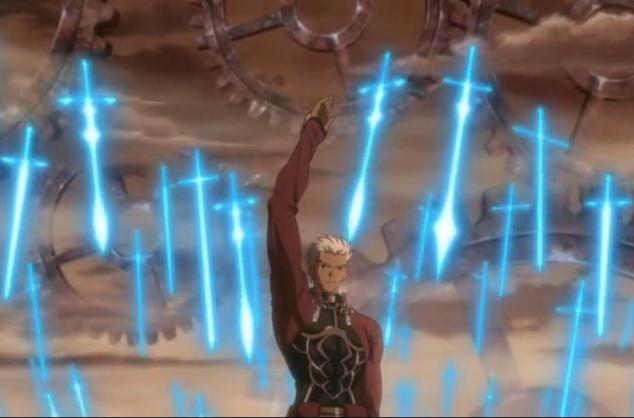
During or after the time we met, I began watching this anime at the York Anime and Manga Association (or YAMA) called Fate/Stay Night. In this anime was a character named Archer: a heroic spirit who could project and create bladed weapons. He gained these from a Reality Marble: a small pocket-universe that developed inside of him due to his dedication and sheer strength of will. When he fully summoned this place, a sphere of flame, turning cogs, and blades consumed the area that he and his opponent were fighting in. In other words, Archer took his inner world and imposed it on the external for a brief period of time.

In this world I describe, he has access to every mortal bladed weapon–every sword–that he has examined and ever replicated with his magic. He stores them all in there and either uses them one at a time–knowing what its history is, the thoughts of its owners, and even their secret abilities–or he can summon and throw them at his opponent all at once. I really admired this anime character and when I did further research on him … I realized that I related to him a lot more than I thought.

I still think that Archer could have done a lot more than simply imitate weapons and memorize their patterns. I think that, even modifying some of them into arrows, he could have used his knowledge of them to create new weapons entirely: new tools and devices to accomplish his goals. He even admitted that his weapon was his own imagination and we all know that the imagination is limitless.

You see, I make weapons too. I make weapons and tools. And they are my words. I’ve spent years honing them: making prototypes, re-making others, imitating more, and learning from my mistakes. I seek to bury my demons in a torrent of words. I desire to make an Empire out of them: to expand my own little world into this one in the best way that I know how.

For a really long time, I have been a very passive individual on the surface. But after Niagara Falls I decided to stop ignoring my natural aggression, my dominant side, my ambition, and the fierce defiance that I realized I’ve always had inside of me. I think that sometimes the manner in which I honed and sharpened my words and that ferocity I view the world at times–as though to defend my own childhood awkwardness and lack of social skill years ago–has ingrained itself in me so much that I seem aloof to people and perhaps a little intimidating. Perhaps that is why I might seem so combative towards life at times.

I grew into my own. I began to see that I was physically attractive, intelligent, creative, and I build a whole world that I can sometimes share with other people. I was told by a friend that in some ways it made me dangerous, but in other ways she greatly admired what I was becoming: whatever that is. When I look back, “aggression” might be too strong word. Perhaps what I was really looking for, and what I still have to fight for– is “confidence.”

Not too long ago, Cristian Mihai wrote a post called Art and Life: where he talks the fact that while he may have done many things in his life he might have regretted, he never regretted any of his stories. It’s very close to those moments where I think the best thing I have ever done with this life of mine so far is write.

So I keep building my world, every day, one blade at a time: because underneath this inconstant fleshy matter of mine and to quote a fictional character, “I am made of swords.” And even though I know I’m not made of weapons, even though I’ve suffered defeat and pain, I’m going to keep fighting because–in the end–I know I am going to win.

File:Swords14.jpg

So when you take the “S” away from Swords, that is what I am made of.

A Game of Statues: Amanda Palmer, Persona, Expression and Life

When I was in Kindergarten, in a school called Adventure Place, we used to play something called “A Statue Game.”

I knew it as The Statue Game. We would listen to this song–which I now know to have been created by Sandy Offenheim and Family–move around and when the song would tell us to stop, we would freeze in mid-motion. We couldn’t move and the song would tease us, play games with our minds by implanting the suggestion of itchiness or needing to scratch our heads, and then it would start again and we would be allowed to dance and hop around as we did before. It turns out that this music and this game are still being played to this very day: and it is a fact doesn’t surprise me.

There is a reason why I’m bringing this up and I will get to it soon. During Amanda’s Art of Asking TED Talk, we got to see a picture and a little bit of a demonstration of Amanda in her previous occupation as a living statue. This is not the first time I heard her mention this: chances are I probably read it on her Blog or in her Introduction to The Absolute Death. But there were two things that struck me about her time as a living statue.

The first is how, in a way, we are all conditioned to be living statues. At least, that is what looking at “Let’s Play a Statue Game” as an adult makes me feel. I mean, think about it: the song and game is really rather instructional. It teaches children pacing and rhythm. It delineates a time for play and then moments of formalism: of needing to be still and having to listen. Making it a group game also socializes children into a group calisthenic: tapping into that unconscious place where we all unknowing imitate and synchronize with each other. It teaches a time for play and stillness, but it also allows us the space and the capacity to laugh at ourselves. I’d argue that it is one of those early methods of making social interaction into a game that everyone plays along with and is both half-joking, and half-seriousness.

Yet what really grabs my attention is that rituals like “The Statue Game” encourage us to build those early personas: a social facade that allows us to interact with fellow human beings. Personas are not illusions nor are they fake in any way. They are just different aspects of us or personalized mask-tools that we use in different situations of interaction. We make these masks from childhood and things like “The Statue Game” allow give us the basic tools, mental shapes, and situations to do so. In other words, you can look at all of this as an experiment not only in socialization, but in communal art as well.

Of course, some of us have a lot of difficulty with these games. Some children do move under suggestion of the song. Other children have slower reaction time or a different sense of movement, balance, and rhythm. And some just plain get itchy regardless of any song or suggestion. Yet the rules of “The Statue Game” still have an effect on them: they either learn the communal rhythm or make one of their own.

That is what artists do.

So let’s get back to Amanda Palmer. I have imagined her, and now seen images of her as this eight-foot living bride statue holding out a flower and trying to make eye-contact with those people who passed her by. On an intellectual level, I think it was brilliant and an excellent metaphor for an artist learning to keep being relatable to a prospective audience.

Also, it was very subversive of her. Think about it like this: what is an eight-foot living statue of a bride? It–and she–are symbols of of a communal making: an archetype of certain expectations and theoretically immutable traditions. Yet there Amanda was, in a role of monetary exchange granted, using eye-contact and a simple gesture of holding out a flower to appeal to an individual on a basic, human, empathic level. It is ingenious: just as ingenious as making a game for children teaching them how to learn to act as statues and feeling people at the same time. And she was taking that philosophy and applying it to the rest of her work.

She appeals to people directly: or as directly as one artist can to her audience. In addition, she takes the role of a statue–of an untouchable celebrity–and subverts it to remain relatable and to appeal her present and potential fans. Originally, what she did with a statue pose and costume she now does through Kickstarter Projects and her Blog. But one lesson that seems paramount for me is that she originally managed to create this appeal, to hone and develop her own art of asking, but not saying a word. She simply held out a hand and expressed emotion through her facial features and her eyes. It is an experiment in empathy: in relating to people through song, action, and expression through gesture.

Now I’m going to look at how this relates to me.

In a similar way to how her own Blog and Kickstarters function, I have my own 8-foot statue through Mythic Bios. I have admitted that I combine a lot of myself and my observations to make this Blog. I’ve also admitted that I make this Blog to order to find an audience and to relate to them. However much I’m successful is a subjective question. I mean, after all, this Blog still accords me a certain level of distance from everyone else and the role that divides us is still there. I am a writer and you are an audience and sometimes we correspond and sometimes we don’t.

This also functions the same for me offline. One thing that “The Statue Game” does teach children who grow into adults is that there is a distance between us–as fellow statues–but also a closeness in our similar natures. In our statue roles and in a best case scenario, we are polite and formal with a certain social ingrained amount of common decency. But when we get to know each other and playtime happens, we bounce around and jump and sing and dance and cuddle and do all of things kinds of things.

For me, it goes further. Sometimes I feel more like a Weeping Angel from Doctor Who: in which eye contact will freeze me into my vaguely uncomfortable distantly formal polite statue-form, but when others turn their backs I am more like my crazy, warped creative self. Then people leave and I eat the time potential that they leave behind: writing up whatever I glean in different kinds of stories.

Amanda mentioned in her TED Talk that sometimes when she was a statue, people came her way who probably hadn’t talked to anyone in weeks. The Doctor once described the Weeping Angels as “the loneliest beings in the universe since their quantum-lock reaction makes it difficult for them to socialise.” It gets too easy to be the statue and to regain animation when other people are no longer around: a statue that forgets to play or can only dance by themselves now.

https://i0.wp.com/www.caddicks.com/blog/wp-content/weeping-angel-hands-e1351558624422.jpg

I’ve been, and I am one of those statues. So I ask myself what I would feel when someone like Amanda Palmer can actually see through that facade and acknowledge my feelings? I would … feel some discomfort, to be perfectly honest. A statue is often also how we like to present ourselves to the world. And having someone see how I feel makes me feel very … vulnerable.

Don’t misunderstand. I have a lot of people who just see the statue or simply do not get what they see, or ascribe characteristics to it that frankly do not exist. Whenever I acknowledge them, I have plenty of ignorant and misguided people telling me how I feel to last for sometime. But having someone see me for what I am–feeling as though they can see my anger, bitterness, sadness, awkwardness, and general bullshit–makes me feel vulnerable.

I’ve been taught to view the world a potentially hostile place where you always need to have your guard-up–where you always need to save face–and where vulnerability is seen as an exploitable weakness … even when you want, and have the need, to reach out.

On the other hand, I am also an artist. I can write about all of the above through the medium of my Blog and find people who relate who can relate to at least some of it. Artists, to some extent, are empathic beings and have the potential to take their statue-form and open it up to relation. I imagine extroverts and positive, optimistic thinkers who wholeheartedly trust people are better at this.

I am obviously not one of these.

However, I can cheat. I can pretend to be optimistic for a while. I can, as Kurt Vonnegut warns, become what I pretend to be. And I don’t have to pretend to like what I do: because that much of it is true. Also, there are many ways to express vulnerability as strength and I’ve already found a few of these. And as long as I can express it in the best way I know how–through writing–then I will be okay. But more importantly, I am building up to the point where I can ask for help when I need it.

Make no mistake, if I want to move forward in my creative endeavours I will one day need help and I will ask for it. And if I can express vulnerability to the point that Amanda Palmer as: to the point of making other people smile, cry, or feel an uncomfortable, awkward, and twisting form of sympathy–of realness–then I will have begun to do my own job.

So when you get right down to it, and look past all the mixed metaphors, analogies, and references here I’m going to say this: for just as Amanda Palmer states that there should be no shame in asking for help, there should also be no shame in striking an honest pose … itching, sneezing, and all.

P.S. I just want to illustrate what happens when Weeping Angels play the Statue Game.

It’s not very pretty. Or maybe it is. They did ask for it after all.

Considerations and Experiments

Me and my Head

I’ve been busy and thinking about some things this past while.

This in itself is nothing new, of course. I still have my collaboration with Angela to consider–which I have to flesh out into something like a comics script form (the details of which you can find under the “Project” Category of my Blog)–as well as continuing my quest for further publication and employment.

Ironically, I have been going out a lot more often and I will be doing so in the near future. My friends and I have been playing no less than two role-playing games–of which yesterday we played two sessions in a row–and I have been writing stories of our exploits in at least one of those worlds so far. Sometimes I feel guilty about that. I mean, I have sent stories out to magazines and such, but I feel like I am at a place in my life right now where I need to keep making stories that I can actually send out to places.

As such, I have a few experiments (I always feel like Darth Plagueis when I say “experiments” or some kind of ruthless mad alchemist) that I have not really been undertaking because I have been distracted with some pragmatic concerns, which ironically makes them harder to deal with, and so on.

I actually feel like I need to write more about my own life again. This was partially one principle that “Mythic Bios” was founded on, but I think there are some things that I need to express and there are certain ways of doing that that really intrigue me. It wasn’t too long ago that I wanted to make a Twine game or two based on some experiences or “day in the life thereofs” that people like Anna Anthropy have totally inspired me to do. I do know that I am at the point in my life where I can begin to really express my perspective through my writing. I have done so, and I am continuing to do it as well.

However, I’m not sure all of it can be placed on here. What I like about this “Mythic Bios” is that it is safer. It is a purely theoretical place, but one where I can ponder about different things and maintain that veneer of optimism and positivity. A few of my friends and people who know me are probably finding this one sentence hilarious because for the longest time I have not been a very positive person. I’ve been angry, confused, bitter for sure, and definitely sad.

In every incarnation of “Mythic Bios” I have created–both here online and offline in my written notebooks–I have made a point of trying to not let those other aspects completely consume this space. Believe me, I deal with them more often than not and in private. I need to have a space where I can feel safe while expressing a reasonable and somewhat logical mindset: while making the boundary between fact and fiction a little more clear. But I also need to recognize that other side: the side that knows that stories and reality are not that far removed from each other. I need that place of emotion and expression of that emotion and the messiness that comes with being a human being.

I still find myself in that place where I’m torn between wanting to express that aspect and wondering how this will affect my current–and future–audience’s perception of my writing. While I do feel like I should have a separate space and maybe an aspect, I also feel somewhat cheated by that: as though I feel somehow that I can’t be a whole person. Because, like I said before, this–all of this–is not all of who I am.

At the same time, I want to leave some personal space to myself and even make things that I find interesting and aren’t necessarily related to me personally. I do believe that our writing is an extension of who we are and what we’ve done. On the subject of the personal, I know I still get concerned with offending people with what I can make as well.

But let me repeat: I do feel like I have something, or several somethings, to say. And I have this growing suspicion that there are people out there who will totally want–or even need–to read these “somethings.” I also know there are people who will always disagree with whatever I say, or simply not read these things. It would be almost easier if it were always the latter and not the former.

To be a writer, you have to travel that nebulous territory between the personal and the public, as well as the intellectual and the earthy and perhaps more … uncomfortable places that I’ve only touched on. I know, more or less, what I have to do. The rest of it is just details and finally sitting down to replenish my collection of stories.

I can’t sit around all the time and write. It’s just like never sitting down and writing. Something just has to happen. So I plan to write a story or two that’s been on my mind for a while, work on my part of the collaboration with Angela, send a few more things out and … see what I can do.