What I Did On the Anniversary of My First Blog Post: The Toronto Comics Arts Festival

This is going to be a late entry as I have been recovering from the last three days of attending–and volunteering–at the Toronto Comics Arts Festival. The first time I ever went to the Festival was when it was still at the University of Toronto: back in those days when I was still in Undergrad and working at York in 2007.

It’s an understatement to say that it has long expanded since. I came back to it in about 2011 while still in Grad School and then last year before my official Graduation. I mentioned in another post that it is about this time of year, specifically the month of May, where things have ended for me. Actually, this post is being made two days past the Anniversary of the online Mythic Bios: namely, this whole Writer’s Blog.

So let me celebrate this missed anniversary by telling you all a bit about my weekend at TCAF.

On Friday I reported to my set-up shift. I haven’t really lifted heavy boxes or tables in a while, so my arms are still all sore from that. But the company of my fellow volunteers was totally worth it. We all wanted to be there and, for me, it is a novelty to be able to talk with people with similar Geek knowledge and interests. Really, for that alone and working together with like-minded people on straightforward tasks it was totally worth it. I got my bright blue volunteer shirt along with everyone else, and then headed home to attempt an early night to wake up earlier the following day.

Well, after failing to go to bed early I woke up the next day and somehow found the Marriott Hotel without getting lost where Art Spiegelman was going to be doing some signings. So I naturally brought both of my volumes of Maus with me and waited in the line to meet him. It was only after a while that the volunteers on duty that day informed us that Spiegelman would only sign two books, and one of them had to be one of his new ones. I will admit, I was annoyed. Like I said, I had the old version of Maus that was divided into two volumes and I had been keen on having them both signed. I also didn’t see any of the new books that I was interested in.

At first.

I was tired and hungry and I almost left the line until I decided “What the hell, I’m getting to meet Art Spiegleman.” Then I found Breakdowns: essentially a large collection of his earlier work that I had either only seen excerpts of, or only saw references to in text books for my own researches. Some of these comics had led to the creation of Maus as well and also shed more light on his family life and his own experiences. In fact, some of the comics in there have that very 1960s to early 80s Underground Comix feel: specifically the pieces that really share Robert Crumb’s wobbly, sometimes vulgar but very iconic aesthetic.

By the time I got to see Art Spiegelman, he was sitting across from his wife–the stately Francoise Mouly–and the artist Frank Viva. He looked like someone’s elegant Viennese Jewish grandfather. I know he doesn’t come from Vienna or Germany, but that is about the only way I can physically describe him. I told him that it was a great honour to meet him. He seemed pleased to see that Breakdowns was one of the books I had and he described it to me as something along the lines of a building with which he keeps adding renovations. At one point he joked about whether not my name had changed by the second piece he was signing and I told him, “Not this time, but usually I change the number of Ts in my name just to mess with people.” He found that (very untrue joke) very amusing. Then I shook his hand and left with my prizes.

I just have to reiterate that Spiegelman’s work really influenced me. I originally encountered him in my Literature of Testimony course in my Grad Program at York. A lot of the literature made my own first-person narratives stronger: increasing my voice and its depth. But Spiegelman in particular not only taught me that symbols be used to represent literal things and ideas, but that this same order can be subverted to either destroy their meanings or through doubt on them. This is a very sophisticated technique and one that definitely will affect at least one work of mine. That is one major reason I really had to meet him: to meet one of the masters of what I’ve tried–and am trying to do–in my own writerly way. So yes, it was awesome to finally meet him.

By that time, I made it back to the Reference Library and got a few more books. It was there that I met Hope Larson for the first time and her sign her adaptation of A Wrinkle in Time for my Mom in honour of Mother’s Day and her birthday. She apparently found that cute. I chose that book because my Mom loves Madeleine L’Engle’s series and she used to read them to me when I was much younger. So it was kind of a bridge between our interests. Later, I remembered that I had read Hope Larson’s Salamander Dream and Gray Horses when I worked for the Clara Thomas Archives.

But I couldn’t make it upstairs as I had planned. I was tired and dehydrated and apparently there was a line to get into the suite with more of the vendors that I wanted to visit. I met a friend and we ended up going for a meal of some kind, or I did, and then went on our way to Bento Miso for its own Bit Bazaar. Bento Miso is a place where games–electronic and analog, as well as many start-up businesses–are made and they were opening for the Festival. It was a nice sunny day in downtown Toronto as my friend and I tried to circumvent the ridiculousness of the TTC shutdown from Bloor to Union Station and went to Ossington and walked with tons of stuff in my arms to Bento Miso for the first time.

I met a few people there and got to play some games: including one game called Bijouxred: which is essentially a game that combines the strategy war game mechanics of Fire Emblem with the rough brawling moments of Streetfighter II. And that is just a simplification because the fights themselves have some elements reminiscent of Final Fantasy–with its Combat Options, and even Mario RPG with regards to having to press a button to simulate blocking, charging your energy, or even chaining attacks together. It was really cool. I met Rene Shible–Director of Development–and Lead Animator Michal Szczepanski: who were quite friendly and directed me through their game.

The Bit Bazaar itself was awesome. There is a very Underground feel to it: a combination of grit, digitization and nostalgia along with a lot of geeking, friendliness and adventure. A few of the games from the second Comics Vs. Games collaboration were being shown and played there as well. It is still something I want to do with an artist programmer one day. 🙂 I got a Steamkey to Spooky Squid Games They Bleed Pixels: which I ranted about a really long time ago as also being awesome. It came with its own small black envelope and a simulated red wax seal. That was a very lovely touch. I also got to meet a few people and a friend of mine I hadn’t seen in a while. I think I will visit there more often soon. So by the time I finally got home that night, I was bloody exhausted.

But it wasn’t over yet.

The next morning I woke up even earlier. I gave my Mom her present before leaving and made it again to the Marriott just in time to observe the Art Spiegelman Spotlight panel: with Seth as its moderator. It was a very eye-opening exchange between the two cartoonists and it was this interaction, combined with reading some of Breakdowns that gave me a little idea as to why Spiegelman wanted people to read his new work and not focus as much on Maus. I mean, first of all there is the creator perspective of it: in which an artist doesn’t want to be solely determined by one creation–no matter how great–that they did in the past. But another, more personal reason, is when you consider the content of Maus and just how much Spiegelman had to delve into some dark and personal spaces: some of which were not even personally his own, but affected him just the same. This article from the Toronto Star might explain it a little better and might have made more sense had I read it before meeting him. Having that long shadow cast over you can be brutal. I also learned that Breakdowns has been reprinted twice with new work or “renovations” added.

Then I went to the Library, got some Hope Larson comics for myself, met some cool new creators, and made it to the upper level where I met Maurice Vellekoop with his elegant, airy lined and water-coloured comics: often portraying erotic and adventurous content. I got something and had him sign it. Then I went around that level and left to eventually get to the Bryan Lee O’Malley Spotlight panel: where in a strange game of “Guessing the Answer Before Asking the Question,” I answered, “No,” and asked if he had ever intended the character of Mobile in Scott Pilgrim to actually turn to be Gideon. Suffice to say, I was right and I don’t think I was the first one to ask this question.

Eventually the Festival was closing down and I went to my next volunteer shift: the tear-down phase. This was the shift I covered last year and it had been my only one at the time. I got to say hello and goodbye to some people I met and then I wandered home in the suddenly cold with hail balls coming down.

And that was my TCAF.

So, there is one thing I want to mention before I wrap this long post up. Some of the artists I was talking to were commenting about how awesome TCAF is and how people from all over Canada and the world come here. They were talking about what makes TCAF different from other conventions. Well, I have my basic two cents on that matter.

The first thing to consider is that TCAF is free. It has no entry fee and all you have to do is come in and bring money to buy work, or simply come to the panels. It is also a festival and it is spread around a few locations. But I think the second element of TCAF that I like is that the barrier between artists and readers is somehow thinner here: or at least far more permeable? You can interact with many artists as you would any other person or vendor. It also helps that many artists are in fact fans of other artists. There is just this positive enthusiastic energy around all of that just makes me happy. What really makes me happy is that so many younger people come to this Festival and are so enthusiastic about the comics medium and what they like.

It’s some of the few times that I am proud to have lived in Toronto and still do some business in it. And this event was what I needed lately. I feel more inspired to just do things and get things done. It’s like I got recharged, if that makes sense. I also finally decided to make a basic business card that I can give to people that is linked to this Mythic Bios site. And I made more connections. It was a truly rewarding experience and I would like to thank the Festival Staff, the artists, the vendors, the fans and my fellow volunteers for making this time exist every year.

Also, thank you all for continuing to read and Follow me. I know that this particular post was a very long one and I feel in some ways that I did this event more justice in my own personal written journal, but I did what I could and I underestimated just how much happened in three days. These three days made this part of May a good beginning and I have plans now. And I can’t wait to begin the process of implementing them.

Contains Language: Reader’s Discretion is Advised!

I know the above title is a low blow for attention, but I really couldn’t resist.

Whenever I write something on Mythic Bios, I try to make the language and the content as accessible as possible. I know I don’t always succeed, but in the case that I don’t my hope is that I have a little something for everyone that I am also interested in writing about.

In my later years in high school and throughout my early years at University I was really interested in Philosophy. I liked writing that made me think and that also played around with ideas of varying kinds with regards to, well, pretty much existence. But even then, before I realized how didactic–how dry and rambling it could get–I had one other issue with Philosophy and texts that purported to be as such.

Sometimes, they would reference subject matter that I wouldn’t understand or, in my case even worse, begin to quote a language of what I was not at all familiar. And it annoyed me. A lot. To be honest, it still does.

Philosophical texts are not the only culprit in this non-crime of course. Many literary classics–novels–do this exact same thing: at least from the Modernist era. And, finally, there are comics that do the exact same thing from time to time. Take Alan Moore for instance. Alan Moore is a genius. He creates multi-layered plots that start off very slowly but ultimately become very epic and grandiose. And even though his characters have tended to lean towards the cynical side of humanity, his characterization is very human and excellent.

But I will tell you now: when he has whole passages of From Hell and Lost Girls in German, or I believe Punjabi in The League of Extraordinary Gentlemen: 1910, or even … freaking Martian in the second Volume of The League I start to get … annoyed.

Don’t misunderstand: I like the authenticity he brings to the characters and the fact that you can clearly see how his well-read nature and research is paying off in the background. Now I am not just talking about his appropriate use of other languages, but his many, many literary and historical references that make me feel very under-read as a reader and overwhelmed as a writer. He simply makes so many references and allusions that I can’t always keep track of them, or even know what they are. I can see how other people would really have difficulty relating to this. I guess it’s like what Austrian Emperor Joseph the Second purportedly once told Mozart: that his work has “too many notes.”

I know that when he has used other languages, I feel a bit … cheated: because I want to know what the hell the characters are saying! It’s that simple. Likewise, I want to get all the references. I’m greedy like that and it feels like I’ve reached a certain level of understanding, and then I hit a wall.

A language is another perception of reality. Really, another language is a different world. This leads me to the other perspective on the matter. Anna Anthropy has said a few times that one of the issues with regards to video games is the very exclusive culture or subculture that has developed around them. More specifically, she talks about how video game design and dialogue around it becomes this interaction of in-jokes and references that people outside the circle do not always get. I would imagine that this is something, especially with regards to games as an expression of art–of language–is something that Anthropy believes we should watch out for.

On the other hand, Anna Anthropy is also one of those who wants to allow for a different voice or perspective in the medium of video games. For Anthropy this seems to have been in the form of making games for different genders and practices outside what was–and still is–the social norm. Essentially, and others like her, use this chosen medium to subvert it and change it: to reveal its full potential through a new perspective.

Alan Moore did something very similar. He, and others like Will Eisner, took a medium that became very associated with superheroes and some two-dimensional character development and morality and injected a whole different kind of perspective into it: using comics to talk about scholarly, metaphysical, philosophical, sexual, and realistic matters as well as still telling a story. Eisner and Moore are known for bringing the idea of the novel to the comics form and–eventually–leading to a place where a larger audience could access and relate to the stories being made in this medium.

In a way, they were making a new language as all languages are made: through innovation of an older dialect.

Anna Anthropy seems to believe that video games still need to “grow up” and deal with these matters as well: with gender and sexuality and life experiences in an accessible way. And one of these ways is to make the audience for games grow by trying not to make so many exclusive references within a game’s structure. Geeks by their very nature are exclusive in that they tend to know many obscure facts and bits of knowledge and trivia, and I don’t think that is a bad thing.

But I would argue with Anna Anthropy–at least with regards to knowledge and not necessarily that sense of shared social experience–that if a player doesn’t understand one element in a game, there are resources online and elsewhere that they can access to understand what is going on. And I suppose that is why, with regards to Alan Moore, there are so many Annotations of his works out there. I do think that it is more than okay, especially with regards to continuity and art, to make references that a reader doesn’t always understand: provided that there is enough that they do understand and enough impetus for them to go and learn something new.

It is strange how my knee-jerk reaction to seeing other languages in a primarily English language comic is a feeling of exclusion and also this annoyance: as though the author is trying to be pretentious and show how smart they are instead of telling a story that I can relate to. Sometimes I feel it to be very elitist. This is the same with references at times. On the other hand, I know–especially with regards to the latter–that I do the same thing regardless of how well I might explain it, and that I should really take it as a challenge.

I don’t want to be talked down to, but I also don’t like it when things go over my head. And this is me as a reader and–as such–I need to keep it in mind as a writer too. I also, as I said, don’t always succeed.

I like to think that Alan Moore doesn’t write in different languages in his works for the sake of being clever, but he actually does it to keep his characters in character and to maintain a continuity in his world-building. Granted, he could <do what some other creators do and but triangular brackets around dialogue to indicate a different language like so>, or make a different font for those words, but it would not be the same. There is no real solution to that, I’m afraid: not for me anyway.

But there is something that my studies in Philosophy also taught me. Whenever I do come across things I don’t understand, as I said I look them up, or I try to find a speaker of the language. I can tell you that it was enjoyable having a German-speaking friend of mine translate some words to me as I typed them out to her so long ago. And when I don’t get a reference, I consider it a real challenge and it is like an easter-egg hunt that allows me to reread Alan Moore’s text and graphics all over again. And sometimes, I find something new I didn’t get in the first reading.

I would never bring up any of this at a signing–should Alan Moore ever come to Toronto one day and I can access the line–because that is not the time or the place. But I do have this place to talk about it. Alan Moore helped take a medium that people did not always take seriously and made it into some serious literature: and as long as “serious literature” is always questioned, always makes you think, and can function on its own merit– and can take you into another perspective–then it is definitely a past-time, and a calling, that I want to continue for my own: because there is always room for growth.

So hopefully this made sense. My Mythic Bios is another world itself and perhaps a language of differing ideas sometimes reaching critical mass, or becoming exercises in poetry. Or it’s that fine line between talking down, and or being the wind over someone’s scalp. I’ll leave that up to you, my awesome readers.

Becoming a Gateway: Or What Anna Anthropy Twines Together

I will say here, off the bat, that there are some video game and article links below that can be construed as Not Safe For Work. Player’s discretion is advised, though enthusiasm is also encouraged. I am also hoping that I can communicate and do justice to these ideas and some of my own creative license as best I can.

I’m not sure how I first met Anna Anthropy. Actually, that is not entirely true. I do remember first being introduced to her when I discovered Rise of the Video Game Zinesters: though how I came across that book to begin with is a memory now lost to time.

I did plan to buy that book eventually, but then life got in the way. One day, after a series of insane events, I found myself brought to the 2012 CanZine Toronto Event by some friends who thought I needed to see it: and I did. What I didn’t know, or what didn’t really bridge the cognitive dissonance in my head was that Anna Anthropy was there with her partner Daphny David and that they were selling the very book that I had been so interested in.

I’m going to admit that I felt sad, but I was still getting used to that endless process of being social again that I tend to find myself in and by the time I realized that they had been there, it was too late. So I bought the book for myself later instead.

There are many very good reviews that detail what the contents of the book were about: how it worked, how it possibly didn’t, and all of those various details. But there were a few things that stuck out at me. The main message that I got from Rise of the Video Game Zinesters was that Anna Anthropy wants there to be more accessible technology and means for anyone to create a video game. My younger self, the boy that really wanted to make games, would have totally agreed with this concept: even if he didn’t have the knowledge at the time to understand many of the other details surrounding it.

Essentially, Anna Anthropy wants there to be a means for a game-making technology or software–a manifestation of communication and language–that is easily accessible for anyone to use for the purpose of, well, making games and creating ideas. Or taking names and kicking ass: whichever definition you prefer. Of course, there is more than that. The idea is that by having different people of different backgrounds, social classes, career-paths, sexual and gender orientations, queerness, life practices, and a wide gamut of humanity that does not necessarily understand coding you can vary up the content and the gaming experience of a game without an industry-ruled homogeneity: where plots and stereotypes are recycled to keep a sure profit.

It is a very seductive idea. Anthropy compares this “much needed” product and the mindset behind it to the creation of the printing press in Renaissance Europe: thus freeing the production of literary articles from the Catholic Church’s scribes and making them accessible to everyone. The fact that the printing press allowed for religious texts to be made with vernacular language–the words of the everyday layperson–instead of a Latin known only to nobles, priests, and scholars is probably an analogy not lost on Anthropy when she brought up the image to begin with when you consider that she looks at games as a language that all men, women, humans, and other sentient beings should be able to relate and have access to.

She also briefly looks at the history of game-making itself and equates video game development with the earliest forms of games: with symbolic piece and board games, carnival games, arcades, all the way to modern board games and more miniaturized computer games. In addition, Anthropy makes a very compelling case as to how video games were and are in the providence of an elite minority: that it was male computer programmer students and the academy that developed code and the games that came from it. Yet it is also clear that there are changes that are–and have been–in the works to that regard.

I’ll tell right off, as some other reviewers of Anna Anthropy’s work have mentioned, I don’t always agree with what she says but she makes some very intriguing observations. There is one point in particular that sticks out at me. Anthropy writes that a single game creator in sole control of their project can make a much more focused and more personal form of art–a game–than a large team of staff members can. I don’t know if I am articulating that thought as thoroughly as I should, but that is what I got from that. What I find really interesting is that Will Eisner, in his book Comics and Sequential Art, also makes a very similar statement with regards to the development of the comics medium and storytelling within it. These are two different mediums, both of which had to fight to gain recognition as a legitimate medium, yet it is really fascinating how two of their advocates come to similar conclusions.

Eisner did mention, however, that there was nothing wrong with a collaboration between two or more artists on a work. Indeed, in his book Graphic Storytelling he goes into a lot more detail with regards to that. And even Anna Anthropy, in her book, mentions that she is writing the book not merely for game creators but for anyone: writer or scholar that is fascinated with her topic. It should also be noted that Anna Anthropy has collaborated with a few other artists in her own works: such as the fun and frustrating Lesbian Spider-Queens From Mars, the very personal and visceral Dys4ia, and the thought provoking puzzle game Triad. While much of this collaboration has been in the form of graphics and sound, even programming for the latter game, it is still a form of collaboration: though obviously not an industry-mandated one. Rather, these are the product of an agreement between artists that respect one another and actually work together to make something cohesive while still keeping the personal element of Anthropy’s own vision.

Now, to get beyond the book and go a bit into Anna Anthropy’s games. I like them. I like the concept behind them: of taking a video game form and using it to communicate a personal experience. There is something really beautiful about that. I know that Anthropy may not be the only person who does this–and I suspect she hopes she isn’t in the only one either–but she is the one that really introduced this to me on more than a cursory level. I think she is one of those who reinforced for me that the games of my youth–that inspired me as a creator–are more than just frivolity or an inferior art-form. Some have said the same thing about comics, about film, and–back in the day–even theatre and other forms of painting and art.

Some people have been giving Anthropy flak about her games: about how they all tend to follow a very similar pattern or themes of lesbianism, BDSM, and transgender issues. The thing is, well there are two things. The first is that all of the above things are not mainstream in video games: at least not from someone who has all of those elements in their own life. The second is the age-old adage: write about what you know. And Anna Anthropy knows about all of this. She writes about and makes what she knows. Her viewpoint is just as valid as anyone else’s and it is more than okay for her to make games about what interests her: because there are others out there who will relate to it.

The fact that she uses similar themes in her work, and I would say never quite in the same way with regards to game play mechanics, is irrelevant to me: because the industry does the same thing for the most part with many mainstream themes and even the best creators make what they know.

I think what I admire about Anna Anthropy and others like her is that although I can’t always agree with them, they do something that is remarkable. Sometimes the people in charge of publishing or video game industries and coding are called “the gatekeepers.” And what Anthropy and others are doing is they are becoming gateways: gateways and fiery Bodhisattvas into alternate perspectives and the potential for the creation and expression of new game experiences.

This is something that I deeply respect and it is a thing that greatly motivates me now. There is one thing I have mentioned before in this Blog: that I am looking into Twine game-making because of Anthropy’s mention and use of it. Twine is a software that lets you create a “choose your own adventure” style text game without a knowledge of coding, or with enough video tutorials to get into it. I want to do the same thing that she and others are doing now. I want to make a game that can communicate my own–albeit different-experiences: ones I’m not sure even Anthropy will always agree with. I want to have the ability to put someone else into my own shoes: as it were. Or use my experience to make something else entirely and let people make their own choices.

So Anna Anthropy won with regards to me: because she has influenced me to make a game. But I think what is also remarkable is how she even affects her reviewers and critics. Take Jenn Frank’s Rise of the Existential Crisis: How One Woman Nearly Never Finished a Book Review, or Cara Ellison’s Choose Your Own Anna Anthropy Interview.

Frank’s article adopts Anna Anthropy’s writing style from Rise of the Video Game Zinesters: emulating Anthropy’s own combination of history and criticism and inter-dispersing it with her own personal experiences in a seemingly scattered narrative but ultimately bridging the gap between the reviewer and the creator of personal expression while Cara Ellison actually makes a Choose Your Own Adventure Game using Twine–Twine–in order to bring her interaction with Anthropy across. Just looking at the styles and mediums used by these two women is utterly fascinating: Frank does not necessarily agree with Anthropy’s statement that everyone should make a game–though she wishes on some level that she had–while Ellison flat out makes a game to express her interaction and her influence from Anthropy’s philosophy in a very demonstrative manner.

I will also say right now that this article was a long time coming. I just didn’t have the words then. But if Ellison’s Twine article further influenced me to make my own game (and I didn’t even realize she was using Twine to do it at the time, another example of my cognitive dissonance), Frank’s article actually encouraged me to write this. And I have been influenced by Anthropy in other ways as well: you will probably see relatively soon outside of this article.

But if I had to sum up everything I have written here, I will say this: that in terms of video-game storytelling, its potential as a medium, and her own potential influence on its future, Anna Anthropy is immensely important.

P.S. My favourite Anna Anthropy Twine game is this one: Hunt for the Gay Planet. There is a story behind its creation that she can explain far better than I, but what really inspires me is the story of a person who tries to find other people like her and goes on a long well-written intergalactic journey. This piece inspired me so much that I bought the Choose Your Own Adventure book from Anthropy’s own site: which is coincidentally on my Blogroll as well.

Participant in One Marathon, A Spectator at Another

Originally this weekend I was going to participate in the 12-Hour Comic Book Marathon at the Comics Lounge and Gallery. I didn’t end up writing anything or collaborating with any artists there. If my experience at the Global Game Jam taught me anything it was that most people there probably already knew each other and either way they would have come in some pre-made teams: those that needed them anyway.

As I’ve said before, I am not much of a graphic artist.

Really, I didn’t want to potentially take up someone’s space on the possibility that I couldn’t find a partner and–to be perfectly honest–I didn’t want to be the odd one out: feeling painfully self-conscious.

Later on, I found out that there were still a few writers and artists who cancelled or were actually still looking for a partner, but by then it was too late. However, it was just as well that I decided not to do it because my brain is full with all the work I’ve been doing and I had never actually been to the Lounge before. I would most likely have gotten lost trying to find it.

Essentially: I wanted to get there, get a feel for the space, meet some of the people there, talk a bit with them, maybe make some connections so that I could participate in a later event, or–really–just get to know people who have similar interests to my own.

I still felt bad, though, that I hadn’t participated as I intended and looked forward to doing. Keiran Templeton–who I saw in her tiara as she held court over an assortment of writers and artists–not only organized the entire event, she also had time to go face book and ask if there were any people that wanted to work with others, and she even told me by email that she would keep my name on a list to let me know about next time.

As it was, I made it up to myself by punching some of my procrastination out and starting to really script out my own collaboration with Angela O’Hara: you know, the comic I keep saying that I am working on. In my defence, I have been working on it on and off with little tidbits of notes here and there: much like every other long-standing story I’ve been dealing with. In fact, for The Project I actually made a rough outline of everything that I want to happen in our first issue.

The key of course was actually beginning to flesh it out. I’m beginning to realize that in industry terms, I work entirely too slow on comics scripts. Even from my limited understanding I can see that they take time and a lot of concentration. But the day before the Marathon, I decided to get into the spirit of it and expand on the very first part: to actually take one segment and go wild with some descriptions and leave room to artistic interpretation in others.

And that Friday before the Marathon, I sent something to Angela via inline text and–if it’s not perfect–it is at least something to start from and a good subject for us to discuss. I look forward to talking with her about it when we find the time and see what she will make of it.

So I had this little bit of positive energy to tide me over as I finally did leave to find the Comics Gallery and Lounge I’d been hearing about for so long. The journey was ironic for me. It seems like so long ago that I used to live on the Bloor-Danforth line: specifically close to Woodbine Station. Even before that, when I was at York, I always found that energy to take various transit to get to find my away to College and Clinton: where the Lounge actually is. It’s only now that I’m in Thornhill–in York Region–again that I decided to go somewhere cool that I’d been putting off for so long.

When I found myself outside the shop, I paced around a bit: suddenly really feeling the nervousness. It was strange: being back downtown on the streets again after basically huddling away in Thornhill. And here I was outside a place with people who obviously loved comics and other Geekery and I was hesitating. It would be helpful to mention that I’ve developed some very crippling social anxiety over the years. It probably has roots to older sources, but after so long dealing with Grad School and being by myself a lot I kind of really retreated into myself. It also doesn’t help that I was shy to begin with and … it’s hard for me to put myself out there.

I also was thinking to myself: what if I go in there and no one likes me? I know: it’s a pretty irrational series of thoughts and I have gotten better at dealing with them. I knew that if I needed to, I could leave at any time I wanted and–it being a Lounge–I brought some work to do as well. My plan was to stay there for the party that was going to happen after 11 pm–when the Marathon was officially over–talk with some people and then leave.

So I walked up the stairs and everyone was friendly. I had to get used to, well, being in a new place and around people I didn’t know but I browsed around the shop and entertained myself looking at comics. There was a very comfortable black couch–most of the inner room was set up with benches so people could work–and I sat down to write. I actually started to feel a lot more comfortable writing and having something to do.

It was strange at first. I’d seen a lot of the people around me on Facebook or the Internet when I was finding out more about the Lounge, but actually being around them in person was just different and cool. It turns out some people were late for the Marathon anyway and, really, they just seemed to have a whole lot of fun doing what they did, browsing comics, and just socializing. I didn’t talk with as many people as I wanted to, but my cousin Shane Kirshenblatt–who made such awesome comics as Dorothy Gale: Journey to Oz–and his wife Sari came in and we talked for a while about comfortable things like comics and writing and creation and all that fun stuff.

Coincidentally, I wrote my first Conference paper partially on Shane’s Oz comic and he inspired me through a conversation to write my first ever science-fiction story in ages: one that didn’t win the Friends of the Merrill Short Story Contest granted, but I am still proud of it to this day. He actually talked with me about looking at a script of his to see what I could do with it: something that really intrigues me.

I even briefly talked with Keiran as she was managing her Empire of comics creators and there was a dog or two, and some cheering, and various geeky discussions. I ended up having a really good conversation that night with Debra Jane Shelly. I had seen her before, like many of the other denizens of the Lounge, on their Blog and Facebook. She really stuck out at me the first I saw her and I knew before I ever talked with her that she was a hard-core comics geek. But it is one thing to know that intellectually, but experience it first-hand in a conversation was entirely different and enjoyable. I barely got a word in edge-wise, but I enjoyed listening to what she had to say and I learned a few things.

For instance: I never thought about the first-impression that people got of Watchmen when it came out in the 1980s. As Debra pondered this, I remember thinking that it was true: it was during this time period that meta-narrative and pastiching were being implemented into comics narrative along with a certain more blatant kind of adult irony.

When you think about the comics that came before, during the heyday of the Comics Code–of comics industry self-censorship–and then you look at something like Watchmen you can definitely imagine a kind of “culture shock” for some readers. But, as Debra put it, we will never really know that feeling ourselves: you know, aside from reading about it through secondary sources. It’s like those accounts you hear about from famous writers and comics creators about growing up with the old Pre-Code Horror Comics: with EC Comics’ Tales from the Crypt, Creepshow, and all of that really fun and twisted stuff. But even though we can read a lot of those twistedly ironic and morbid goodies now, the spirit of Zeitgeist of the times where they were written are not really as accessible to us or perceived the same as someone who was there.

I think it was good to talk with someone who knew as much–if not more–about comics: someone who had read some really good and memorable works. It was sort of humbling, to be honest: to know that wasn’t the only one as insane about this stuff as I sometimes delude myself into thinking. There was a whole room of them. :). I did talk with some more people and then I took my leave as it was about that time. Debra actually made me pose for a picture where I am holding Alan Moore’s Nemo: Heart of Ice: a book I actually got there. As for the reason that she took it, if one is needed, she told me that she likes to take pictures of people having found their favourite books: or something to that effect.

It occurred to me–or I remembered–as I smiled at the camera that I rarely ever smile when I’m in public: especially in Toronto. Sometimes the exhaustion, and anger, and sadness ingrains itself in you so bone-deep that it’s difficult to even smile for real. I thought about just how sad that fact really was.

In any case, I said some goodbyes and then I left to find the streetcar back to Bathurst Station. I missed the car, so I decided: “Screw it! I’m going to walk the fucker!” So I walked by myself all the way from Clinton and College to Bathurst Station. I hadn’t walked that long or been in this area in ages. And as I did so, with my travel bag on my shoulder and my black winter coat covering me I felt more alive than I have in a really long time.

Coincidentally, it took me 16 minutes and there was no other streetcar during that entire time.

I know when I wake up tomorrow, or later, I’m going to be very embarrassed by some of the sentimentality and haphazard writing I’ve left here. It’s no new thing, to be fair. Actually, I’m surprised I wrote so much about–well–doing so little: by my standards anyway. However, I really felt the need to write this out while it is still fresh.

I am definitely going to check out the Lounge again. Here is the Toronto Comics Lounge and Gallery Blog in case you are interested and you didn’t see it on my Blogroll section. Thank you for reading this and, next time, I do plan to make something.

Excelsior, ladies and gentlemen.

Before the Empire, There Was Something Else

This wasn’t a planned post of mine, but it’s amazing how Star Wars makes me do that. Not too long ago, I heard that Disney is shutting LucasArts down. I did grow up with the games that this company made tangentially and it does make me wonder exactly what it is that Disney is planning to do with the Star Wars franchise.

But I don’t really feel like I have much to say on this matter. Yet while LucasArts is currently being dissolved, there is another–perhaps more understated–Star Wars event happening as well. I’m talking about the comics adaptation of George Lucas’ Star Wars film script.

The original draft.

If we go by the theory that the original that a character is based off of has a considerable amount of resonance and power, then these figures will definitely stick to whomever will read this limited edition series.

I won’t go too much into the details of the thing. In fact, if you’d like, you can read some news accounts here or here on the matter. This is not the first time I have heard about or read anything about Lucas’ original script draft. In fact, I’ve seen one or two fanfics take these Star Wars proto-characters and their prototypical universe and make some really interesting things out of them.

But they are, however the writing may be, the root of many of the elements of Star Wars that we recognize today: in the Old Trilogy, in the New, and in a lot of the Expanded Universe.

What we are seeing, in comics form, is an alternate universe in a galaxy far, far away and what was once the providence of fanfiction is now–to some degree–being created and sanctioned by LucasBooks such as it is. It is like finding out that the new J.J. Abrams’ Star Trek alternate universe films were being created in a smaller comics form: save that his alternate universes are his own and not Gene Roddenbery’s.

But what really gets me is looking back on two posts I made on Mythic Bios about Star Wars. I wasn’t really satisfied with Star Wars: Back to the Basics, to be honest, though I do think that my post When You Wish Upon a Star, Far, Far Away does have some merit apart from its rather witty title. I think my issues with the first post were that I had a lot of supposition and hearsay, but not a lot of proof. I wanted to compare Star Wars to Buck Rogers and Flash Gordon: to show that the latter really affected the former from Lucas’ own formative years and that the Prequels were a hearkening back to that original source material. I even had trouble trying to find pictures to make nice parallels: save that at least the “opening crawl” receding into the distance in both the Old and New Trilogies had a parallel with the old Buck Rogers serial introductions.

File:Flash Gordon (1940) - Opening Crawl.jpg

But if you look at the links to the news pages that I attached above with regards to the comics being made from the old script draft, just read how the characters are described and look at the accompanying art work that is being made currently. In my second article, I went into some brief speculation about a Star Wars reboot: much in the way of Star Trek. I doubt this is going to be wide spread and I certainly don’t think the next Episodes will be reboots, but it is worth looking at the fact that in some medium this creator-made “pre-boot?” is being made.

The way this script is described, it not only seems to be closer to the film materials that Lucas was inspired by and are mentioned in the linked articles, but there is something very … Princess of Mars about their aesthetics and attitudes.

If you want to talk about prototypes or preceding archetypes, Edgar Rice Burroughs’ world of Barsoom really influenced a lot of science-fiction: with almost archaic looking costumes, vintage laser weapons, and a lot of emphasis on royalty and nobility even beyond the usual Star Wars: or at least the Star Wars of the Old Trilogy. You can also argue that some of the images in the articles I linked to also look a lot like Buck Rogers aesthetics as well. And Star Wars, while it is epic fantasy, borrows and wears enough of the science-fiction aesthetic to be examined in this manner. I would say that this is an attempt to hearken readers back to a retro-Star Wars, but this “predates” and pre-exists that vintage. A Pre-Boot Pre-Retro? Now, that just sounds bulky to say and I am sure there is a better way to say it.

I think that, in the end, what I find really fascinating about this–in this really simple overview of the matter on my part–is that we are in a time now which is really interested in the retroactive: in Retro itself. For many of us born and grown up in the 70s and 80s, perhaps even the 90s, the present has become the past. I go into it a lot here, but this decision on LucasBooks’ part seems to really feed into that growing niche in popular and geek culture now.

Or this is just a very strange and fascinating look into an experiment that could have been and admittedly has a very limited lifespan: an oddity that has existed for years collecting dust on the shelf and in the recesses of Internet chatrooms and forums which is now really getting acknowledged.

I would never have known about any of this as a child and–indeed–if I had known about either LucasArts’ end and the Original Draft comic coming out a few days ago–on April 1–I would not have believed it. As it was, I read about the Original Draft being adapted to a comic during April Fool’s and didn’t know what to even think about that!

But I like oddities and strange things. I make them all the time. I am making them right now. I thought that the Star Wars Prequels were a hearkening to older space opera shows of the 50s or so, but maybe they were also referencing this older, weirder, prototypical universe: an elder reality. I want to see what will come of this. They would at least make for some interesting toys.

And I don’t know about you, but I want to know if the reptilian Han Solo still shoots first. I’m messed up like that. 😉

Paradigms Lost, Paradigms Regained: Looking Back and Looking Forward Can Be Both One and the Same

Foregone Warning: the title of this post is a play on words and borderline off-key rhyme. It almost verges into the territory of the pun. Actual warning: this article is going to be a very link extensive post and I hope it will all make sense towards the end.

In my post A World Coming Together, A Possible Paradigm Forming, and Other Stories That Find Themselves On Their Way, I make a lot of promises and claims but there is one in particular that I feel I need to go into a little more detail about.

I said before that it seems like we are in the process of the rise of a new paradigm: based on the geek nostalgia of the late seventies, but mostly the eighties onward to early 2000. As I said before, I feel I need to be more specific about this. What I actually mean is that we have been, for some time now, at a point where we can look back what was the present not too long ago and actually subvert and critique it. I mean, we can actually ask some questions about a lot of things that we took for granted: either in all seriousness or through satire.

For instance, look at Robot Chicken and how it makes fun of a lot of popular culture from the 80s and onward. The thing about Robot Chicken, however, is that it makes fun of generally everything to a warped and twisted degree of hilarity: and I wonder if this hasn’t also been a product of the past thirty or forty years or if it takes a paradigm about that amount time to gestate and create itself.

I guess I am trying to talk about a few things at once: which is not the first time something like this has happened for me. So I’m going to take a risk and bring up some theory, and then see what I can do with it from there.

In about the 1980s, there was–or even is–this theory that we had entered something called post-modernism. There is a lot of debate as to what post-modernism actually is, but from my understanding it seemed to be a period in which  literature and other media had become fragmented or combined with one another to make entirely different meanings from what they once were, or could have been. In addition to this was the rise of another idea called deconstructionism which, in the very reduced way I’m explaining it, is a theory that likes to take things apart. When you combine these ideas together, you essentially create writings and cultures that are incredibly ironic, sometimes “self-aware,” and that like to dissect themselves while at the same time attempt to reveal a multiple amount of different meanings.

There are a lot of scholars and artists that dispute these terms, of course, and say that every generation or paradigm goes through a phase of critiquing what came before and making something new from these elements afterwards. I like to think that the 80s and onward really favoured making pastiches–narratives and stories created from parts of things like patchwork monsters–to either subvert something that once existed or make as unique as is humanly possible.

Now, take that idea. You can definitely apply that to Robot Chicken. But it goes further than that and it doesn’t always manifest in the same way. For instance, take ItsJustSomeRandomGuy. As I mentioned in another post, he takes primarily Marvel and DC superheroes and villains and actually makes them aware of their fictional status but keeps them in character in doing so and even manages to make some incredible meta-narrative plots with a whole lot of geek culture references. I‘m A Marvel, I’m a DC is a whole lot less “profane” than Robot Chicken, but they operate on similar principles. I also would be greatly remiss if I forgot the How It Should Have Ended series: where popular movies and videos are depicted as cartoons and their plots are changed or subverted by … well … common sense. But since when do good fictional plots make sense with common sense? 😉 We can argue that point.

The whole idea of popular cultural or geek references, sometimes to the point of being self-referential in different media seems to have originated from Joss Whedon’s Buffy The Vampire Slayer: where in addition to a whole lot of witty “dialogue without pity,” there was a regular string of different kinds of references. The issue, however, is that I’m not sure this where it came from, or one of the points of entry into mainstream culture and entertainment. All I can say is, it was for me.

I have noticed, however, that a lot of my examples of this paradigm are very television and Internet-based. And there it is. I would argue that a paradigm or a culture is created when it evolves to the point of being able to look at itself and critique itself. And right now, this impulse, which may have started in the 80s as we know it, has sky-rocketed as information technology has advanced.

Look at the Abridged series for instance. Abridged series are fan-made parodies of television shows and cartoons. Parodies like LittleKuriboh’s Yu-gi-oh Abridged and Team Four Star’s Dragon Ball Z Abridged have become very popular and entertaining shows among fans: so much so that many other fans create their own Abridged series, or parody the Abridged series that exist. They are practically viral phenomena.

And these are just the fictional examples. I haven’t even begun to go into the actual Critics  like The Nostalgia CriticThe Angry Video Game Nerd and Cinemassacre Productions, Nixie Pixel, G33kPron and countless others who review and critique video games, movies, and geek culture old and new. They also use the pastiche form in some cases to make various verbal and media references. There are also so many more people we do this as well.

Now, somewhere in all of this fictional and non-fictional stuff … is me.

It took me a really long time to realize that not only was I already a part of this nebulous process, but that it was legitimate and more than okay to be so. I’ve had at least one teacher or two who would have once considered comics and video games utter dreck: or at the very least very un-serious diversions from real life. And I’m not going to lie to you or myself: there is a lot of garbage out there that isn’t even entertaining like “YouTube Poop”: videos created specifically to be obnoxious. But every literary and media culture has garbage. They also have gems and other treasures.

Think about this prospect. All the video games you’ve played and the comics you’ve read are becoming references that more people from a generation of thirty or forty years understands. These references make it into literature and criticism. Moreover, we exist in an Age of Information: where many obscure and old elements of our childhood are much more accessible to us now than ever before.

Some scholars have even argued that we are–or we were–in an age of Hypertext: a situation where we can click on a vast amount of chain-information through links and linked words on the Internet. You know, like when you are on Wikipedia or anywhere else, and you search for one thing, and then click on a highlighted word or phrase to be linked to another–or multiple other–online pages. In part, this allows us to look back on “our childish things,” and we don’t turn our backs on them, but instead we embrace them with an adult perspective and understanding that only someone who knew them way back when can give.

Moreover, we can even take this perspective–possibly created from our own nostalgia–and apply it to times that existed before us, or take that and make something entirely new in our time now. But also think about this: in addition to having more information technology, we are developing more interactive technology as well. Video games are much in the same place that comics, and film used to be–and to some extent–still are in public opinion. They have not always been respected, but as we continue to make them we can add more content, more distinction, and more variety. We can–and we have–gotten to the point where video games can even make references or “literary allusions” to other video games and culture in general. I am definitely going to revisit this thought at some other people.

Then consider the other people who participate in these interactive narratives and add the Internet to that fact: which connects people all across the world and different forms of life. Sometimes, I believe–in my more optimistic moments–that we could be on the cusp of creating something truly great and maybe even in our own lifetime. I can’t even imagine what will come after this if all goes well.

So in all of this, I am trying to find my own place: to find my niche. I want to take advantage of this time and do something that matters. This Blog, in no small way, is a part of this drive. It is here that I can combine my geeky interests with my academic background and my creative impulse to construct new things and state my opinions. I want to be a part of this. I want to do something great as well.

I grew up in the nineties or, as a friend of mine likes to chant, “90s 90s, living in the 90s!” Once, it was my present and sometimes it’s weird–really weird–that it and the early 2000s aren’t anymore. Sometimes, I feel time-displaced. I feel lost. I have another acquaintance who once stated that the children of the 80s, and even those before are a Lost Generation: of people who never really achieved their full promise in today’s world. But we’re not. We’re really not. I think we have been coming into our own and we will continue to do so as we ascribe a multiplicity of new meanings to old things, and create things that will make other things together.

Because there it is: perhaps post-modernism and deconstructionism might have taken things apart to see how they work, as they work, but we–whether we are in a Hypertext age or not–are starting to put them back together … and make different things entirely. Now that is something to celebrate.

The Funnies: They Just Keep Coming Back … and They Never Stop

A cartoon is not a frivolous thing. It can look like a silly drawing or a caricature of life. Upon first glance, it seems to only exist on either a screen or a piece of paper. Sometimes, it even says witty things or does something stupid or endearing that can make us laugh.

Cartoons have been around for so long–on television, in movies, in the newspaper funny-pages and even on T-shirts–that we take them for granted. We don’t always take them seriously.

But consider. A cartoon is an archetype. It is an idea given form. In fact, it wouldn’t be too much of a stretch to even state that it is a Platonic Form: living glyphs essentialized to the point of becoming as close to pure concepts as is humanly possible … which of course is a misnomer.

Because cartoons aren’t human at all.

Some of them are wise-talking humanoid animals. Others are parodies of human beings that somehow possess their own sense of agency. There are even some that are inanimate objects given life. Often, the really old cartoons exist in very self-contained two-dimensional pocket-dimensions: in a mythological cycle of trickery, mayhem, and fun-loving nose-thumbing at fate.

And the really old cartoons can’t be destroyed. They can’t be smashed by falling anvils or mallets. They can’t be burned by fire or exploded by dynamite: at least, not for very long. They are used to dealing–and receiving–massive amounts of physical damage, and then coming back for more. And we’re not even talking about the ones that have a supernatural way of avoiding the damages of their enemies altogether just to–through some twisted fluke of fate–make them fall into their own traps.

They are like living rubber or silly-putty that just keeps bouncing back. A human being isn’t like that. When human beings fall, they break.

It’s not too much of a stretch to say that cartoons are beings that are psychopaths or sociopaths by human standards: in worlds and cyclic realities where neither human physical and psychological standards even apply. They come from the same heightened mythic state as faeries, and gods; as legends and archetypes: in a place where slap-stick is not only futility and invincibility, but where the ridiculousness is the superhuman and the sublime. Some people might call this state a perpetual hell, or a utopia. But mostly, it just is and they just are.

In the end, you can’t destroy a cartoon because you can’t destroy an idea. Because even if you break the projector, or the television, or snap the DVD, or rip up the papers they are still there–pure ideas–in your head, mocking you, holding an oversized mallet in one hand as they stand in the darkest corner of your mind, knowing more than they do, doing more than they know, just waiting for that punchline: where you finally have to laugh at yourself.

A World Coming Together, A Possible Paradigm Forming, and Other Stories That Find Themselves On Their Way

This is Red-One. She is the protagonist of the comics collaboration that Angela O’Hara and myself are undertaking. One day, to inspire herself, Angela decided to create this digital art piece. It is a conceptual drawing of Red-One at about seventeen years old or so, and she is definitely quite beautiful.

So, I did end up naming the characters that we are working on. That might seem strange given that it is supposed to be a silent comic, or a comic without words, but it is a point of reference for us to work from and it adds more character and background to work with too: to bring across onto the page through facial expression, body language, and action.

We have also decided on a structure for the comic. It will be about twenty-four pages and it will have panels. There is just too much, even with the basic story structure that I’ve already made, to dedicate a page each to a different action. Panels will actually give us more room by giving us more pages to work with in expressing the narrative. Like I said, I do have a basic story outline finished and I am going to attempt to do at some point is take a scene from what I wrote, expand on it a bit, give it to Angela and experiment with panels and the page layout.

Panels and page layouts are diabolical in that they both seem to be the same thing, but they’re different. For instance, you can make one panel and then have to decide what goes on in that panel, whereas the page layout is actually how more than one panel–or lack thereof if you want to get experimental about it–is arranged as an overall pattern on paper or screen.

I have attempted with previous works to include panel breakdowns and detailed layout structure for each page into script form–this without an artist partner–and I have to say that it is challenging at best. Luckily in this case, I can hopefully communicate the essentials of what I want to see to Angela, talk through it, see a few versions, and come up with a happy medium. Angela has also been working on a few more conceptual drawings and eventually things will be coming together.

So there is that.

Another thing I have been doing lately is that I am looking into published other works while this collaboration continues. That is to say, I am going to now actively–again–send out stories to electronic and material magazines in order to get more things published. I have a few candidates and a few ideas with regards to what I am going to send. I think I’ll go into that a little now.

I’ve had at least three Lovecraftian story ideas that I have been building on in a purely note-written or scribbled way for a little while now. When I’ve finished one or more, I might send some to Innsmouth Free Press, or Weird Tales (which right now is closed to Fiction Submissions, oh well). I love the fact that Lovecraft is not only public-domain, but there is so much potential to his ideas. His stories are mainly “congeries” (he loves that word, among others)–or connections–of seminal ideas: of things that have informed so many other works long since his time.

Lovecraft’s mythos is not the only thing I am focusing on however. I’m also contemplating sending a science-fiction story of mine to Strange Horizons. There is also a story of mine that I meant to finish long ago, set in Toronto, which I may send to Broken Pencil’s Death Match Contest or directly to the magazine itself.

In addition, I have a few stories I’ve already finished that I realize may be tapping into a niche that is emerging or has been emergent for quite some time now. The niche, paradigm, or Zeitgeist (the “Spirit of the Times”) I’m thinking of is the 1980s-and onward geek nostalgia that is becoming more prevalent every day as well as the usage of allusions and literary references to video games and comics. I have actually been experimenting with this for a long time and I have been polishing off what I have.

I guess the danger is whether what I relate to in this regard will become obsolete sooner than I can do anything with, or even in the future. I mean, will years from now someone know what Google is if it is referenced into a story or will it be some small obscure technical footnote somewhere? Or is our society changing so much with regards to technology that Google and other programs, and even video games will become part of a historical documentation: if only an electronic one? I’m pretty sure cultural shifts celebrating “retro” elements come in cycles, but you can never really predict these things. Sometimes, you just have to go with it.

As for me, the reason I am making strange stories like these–tapping into this–is because I can relate it and it interests me. I can’t tell the future (which is probably for the best) but I’m doing my best to express the forces that have influenced me in the way they have influenced me: if that makes any sense.

So these are my goals along with a few others. I hope to be able to Blog more about these other developments and also be able to keep up with the challenges that I have set myself.

Worms and Bicycles Or How People Make For Strange Stories: Menocchio and Igor Kenk

I’ve been rereading Pop Sandbox’s Kenk: A Graphic Portrait and I kind of wish that this comics work had been published when I worked on a previous assignment of mine.

In one of my previous Graduate courses, our class had to read Carl Ginzburg’s The Cheese and the Worms: The Cosmos of a Sixteenth Century Miller. It basically dealt with the idea that an individual can not only embody the culture that they come from, but that that person can represent different kinds of culture and actually interpret cultural information differently for themselves. Really, what I got out of it was that an individual can create their own world or mythic reality from information they have access to from their own culture.

As for why the work is called The Cheese and the Worms, it’s due to the fact that it focuses on the record of a man named Menocchio who compared the world’s creation to be not unlike that of rotten cheese. I’m not making this up: the Roman Inquisition that interrogated and took testimony from him apparently got this account from the man. So obviously, I felt compelled to do a presentation on this and focus my course paper on it because, well, look at the title and the subject matter. Really: how could I not?

I think that I found the most interesting about Menocchio himself was the examination of how he possibly came to the conclusions about the world that he did. He was not born of nobility or the upper-class in Italy, but rather came from a merchant culture. As such, while he was literate and he had the means to buy books, he also grew up with an oral literary tradition: a culture that passes on lore through the ages and word of mouth.

Ginzburg seemed to really like to point out the strangeness of this figure of Menocchio: how he was almost an intermediary between the oral and the written as well as peasant and “higher culture.” Menocchio himself lived during a time of transition between oral culture and the development of the printing press and written literacy: a revolution of sorts. Menocchio existed during the time of Martin Luther’s Reformation: where the ideas of Catholicism and Christianity itself were being challenged by the new Protestant movement using said printing presses. It is also worth mentioning that Ginzburg liked to examine colportage–cheaply printed chapbooks detailing songs, tales, and the lives of saints–as a backdrop of Menocchio’s literacy as well.

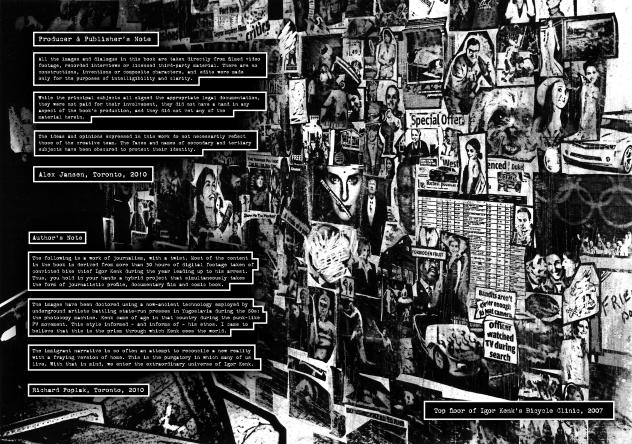
All of these traits and more are eerie parallels with Richard Poplak’s observations about Igor Kenk. Kenk grew up during a time between socialism and capitalism in Slovenia of the former Yugoslavia. One thing that Richard Poplak likes to point out is that it was also during this time period that common citizens in Slovenia were allowed access to photocopy machines: mechanisms of distributing information that were originally in the charge of the State. The counter-cultural Theatre FV 112/15 group– also known as the FV movement–used photocopiers to create a collage art known as FV Disco: a form of which–thanks to the artist Nick Marinkovich–Kenk also utilizes. This was the time and conceptual place where Kenk developed as an adult.

KENK_CHAP-00_07-08

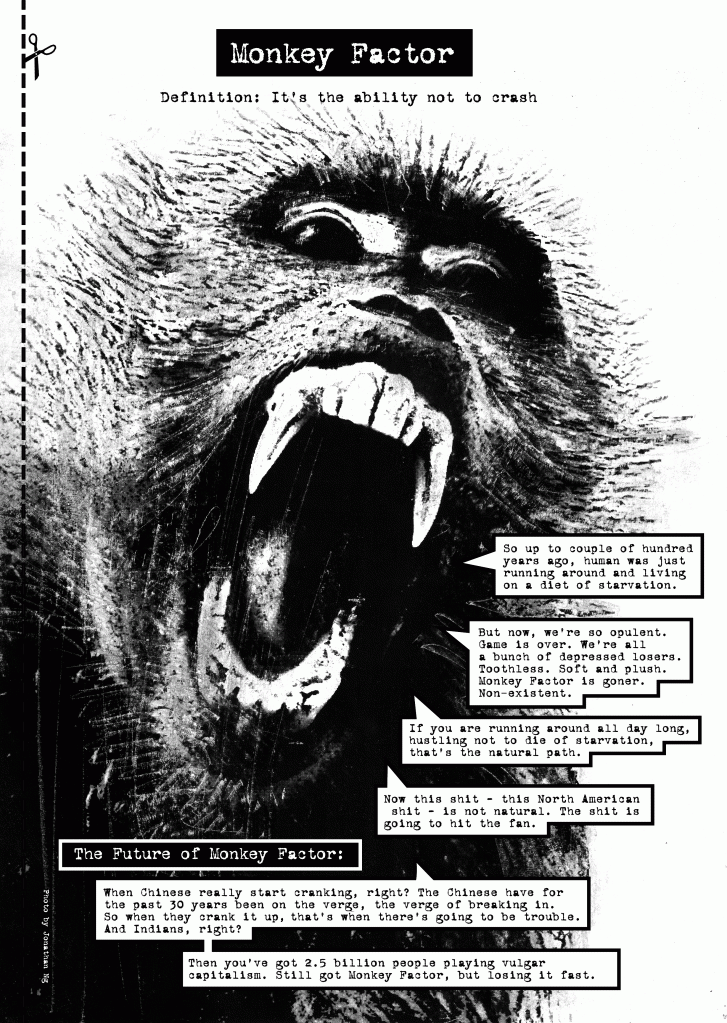
As such, Kenk also possesses a very unique world-view based on the transitional culture of his time: the idea that all things can be recycled and that you need to choose to struggle in life in order to survive as a person: which is part of what he seems to call “The Monkey Factor” or survival. From what I understood of this book, his notion of “recycling” also seems to mean reselling stolen bikes as well as hoarding. As an aside, the fact that Kenk believed the system of debt, borrowing, and capitalism to be doomed is also linked to his philosophies and it’s only now, years after I read the first time, that I wonder what he would think of the Occupy movements back in 2008 before his arrest, and what they might think of him now.

Igor Kenk came from a social order that was radically changing and between extremes. He was considered to be a Math prodigy and did well in his education. For a time he was even a police officer in Slovenia–surviving their harsh regimen–until he was discharged, and then proceeded to cross the border into other countries to get goods as Slovenia’s political alignment and its economy changed. Then he eventually came to Canada and became something of a merchant himself by selling and fixing bicycles in Toronto.

What I’m trying to say is that both Kenk and Menocchio are products of their time and culture, but at the same time how they chose to interpret their changing cultures was very idiosyncratic to them. In other words, they created some very unique world-views. And both of them arguably paid for it by the powers that be: Menocchio with his life for not recanting his beliefs to the Roman Inquisition and Kenk doing jail time and losing his Bicycle Clinic for the thefts he was charged with.

KENK_CHAP-09_18

All of the above can arguably be considered gross simplifications, of course. In my paper that dealt with the implications of Menocchio, I pretty much say the same thing more or less. But I think the reason I’m attempting to compare two men from entirely different time periods, cultures, and countries is due to a greater issue: namely, why are they important?

I mean, come on: neither Menocchio nor Kenk would traditionally be considered important in a historical sense. In the grand scheme of things, someone might say that, while these parallels are interesting, who the hell cares?

The reason that I care, and one of the reasons why modern historians, journalists, and–in some ways more importantly readers–find these accounts so important is because they are narratives that deal with real people. It’s true that neither Menocchio nor Kenk are politicians, or artists, or even popular cultural figures in themselves but they are people that–while arguably normal or common in terms of class or historical significance–symbolize greater historical and cultural shifts by just being who they are.

They are ordinary people with very un-ordinary perspectives and there was a time where we would never have even known about them: or at the very least we’d only get a summary of them in passing … or at least we’d get something like this from a dominant or “higher cultural” narrative. Because there is one thing I keep coming back to in my head: it is the idea of oral history.

What is oral history? We know that oral culture or literacy is something that is passed on verbally from one storyteller to the next throughout many generations. But history, as Westerners, understand it is derived from the ancient Greek word historia: which is something along the lines of scientific inquiry or observation. Oral history, from my understanding, is thus something of verbal origin that is written down for other people to see.

Menocchio’s “worm and cheese world” survived through the written accounts of his interrogators, whereas Kenk seems to have actually been interviewed by the book’s producer Alex Jansen and filmed by Jason Gilmore as he espouses his world-view of “Monkey Factors and recycling” in that context.

KENK_CHAP-08_16

Oral culture in our world is very different in that we have sophisticated image and audio technology to preserve and record the spoken word, and where that spoken word comes from. There is a scholar named Walter Ong–who I looked at in my own studies for my Master’s Thesis–who looked at oral culture and degrees of orality.

Ong believed that there is something called “secondary orality”: in which spoken word is preserved through technological means like video and radio. But I’ve always wondered if he would have included illustrated images in this definition as well, and how problematic it would be if these images were accompanied by written words. Can the visual be considered part of the oral or the written, or is it something by itself? Obviously I’m talking about the medium of comics and what kind of literacy that would be defined as but–this tangent aside for now–right now I’m thinking about the idea of oral history being a historical narrative that records down what life and reality is like for “the common person”: if there is any such thing as a common person.

I actually think that this conception of oral history has led to the idea of journalism: of interviewing and recording down what a particular person or witness has to say, and then researching the environment in which this person came from for a greater perspective. Is journalism the child of oral history? And then you take something like Kenk into consideration too: something that is written down but also given a sequential FV Disco style is that is both an illustrative and video collage aesthetic.

It’s fascinating to think about Kenk as an artifact of not only “comics journalism”–a medium that some comics creators like Joe Sacco have already developed–but also written literacy, oral culture, history, and mass-produced art. I look at Kenk and I wonder if this is our contemporary version of the colportage of Menocchio’s time, or the pamphlets and photocopies of 1980s Slovenia. Because in the end, it’s not just Menocchio and Kenk that have a lot in common, but also the media used to try and capture what they are … and what they are not.

When I started writing this article, I thought it was going to be easy: like it was all fully formed in my head. In a way I’m doing what I said I would not do by delving more into the academics I’ve tried to put some distance from: at least with regards to jargon. My train of thought tends to drift and it has been a struggle to communicate and even cohesively perceive all of these parallels here.

But if this were a paper of mine, if this were some rough form of the Graduate essays I would write, I would end this post in the following manner. As someone who has studied mythic world-building, I believe that art is an engagement with different parts of the world around you, and an expression of who you are as a result of what you choose to accept of that world. In that, the man called Menocchio and Igor Kenk–specifically in how their scholars and artists portray them–not only made their own art, but actually lived their art, and allowed for the creation of more of it.

I also believe that when you take all of this into account oral history, journalism, comics journalism, or whatever you want to call it reveals one more truth. Writing about an individual not only reveals that there are no “ordinary people,” but that it never makes for making any “ordinary stories.” Ever.

Again, I’d like to thank Alex Jansen and Jason Gilmore for lending me these pages of Kenk to place here in my article to make both point and emphasis.

If you are interested in this topic, you might like my What is FV Disco article as well. They both deal with similar subject matter, but in different ways.

I Don’t Have a Witty Title for Sexism or Elitists, But Here is What Really Matters

Me and my Head

For the purpose of the rhetoric in this article–its method of expression–I am going to be using the general second-person pronoun of “you.”

I’ve gone to Conventions before. They are some of the few places that have the opportunity to actually relate to people who have similar interests as mine. I’ve been to the crowded, but varied Toronto Fan Expo. I went to Anime North with all of its variance of cosplayers. I have gone to, and volunteered at the Toronto Comics Arts Festival. I even went all the way to Atlanta to go to what is arguably a grandparent of them all: Dragon Con.

I don’t go to nearly as many as I should: given what this Writer’s Blog is about, and the fact that I’d like to meet with more people who have similar interests to my own.

So I’m not really going to say anything new. There will be no insight into anything here that you already haven’t read a thousand times before. The sad thing is that I feel like I even have to repeat this at all because you would think, by now, that this would be common sense. But I have two points that I’m going to make.

First of all, when a girl or a woman–or anyone–is at a Convention, they want to be there. Period. If they have taken the time, such as at Anime North, or Fan Expo, or Dragon Con, or any other Convention or Festival to dress up as a fictional character or otherwise, chances are they want to be at this Event and they know who they are dressed as. Some good friends of mine, and people I love create their own costumes from raw sewing materials. Also, I’ve been told that–as such–it is more than okay to compliment someone on their costume–self-made or otherwise–and to ask to take pictures of them. Hell, you might even talk with them and make a friend.

Hey, it could happen, or so I hear.

So please do not talk about who knows what about what character, or series, or franchise and then some.

And even if they don’t, they are there–after paying money and a substantial amount of money at that–to have fun. That is what a Comics, Video Game, Film, and Geek Convention or Festival is ultimately about. To have fun.

They are not there for you and they do not have to fulfill your standards as to what a “true geek” should be. And here is some more common sense, I don’t care what their costume looks like, you do not have the right to touch someone without their permission. This is basic kindergarten knowledge. Do not touch someone without their permission. Period.

Also, here is an exercise. Imagine that women can create, buy, review, play, and add to Geek Culture. Or, you know, simply enjoy it.

Well, you don’t have actually imagine this, because this has already happened. And it is happening right now. Because guess what: women are people. People make choices and sometimes different choices from those you might make. Therefore it is pretty foolish to make generalizations or assumptions based on intrinsically different individuals who happen to have flesh bodies like all human beings do.

So here is something constructive that I can suggest. Talk to a woman like a human being and treat her like one (because well, duh, she is one), and you might learn something about another human being who may or may not share the same interests as you. Encourage them to create and review works. In fact, encourage anyone to do that. Moreover, if you do not agree with what they have to say, insults, threats, and sexist remarks really will not help your case or make you look any more intelligent by comparison. If you have something constructive to say, take the time to say it and remember that you are talking to another human being who has their own thoughts, feelings, and experiences.

And as your parents will tell you, if you don’t have anything nice to say, don’t bloody say it. This man here astonishes me not so much because of his views with regards to “a majority” of female cosplayers–of which I don’t agree with in the slightest–but because he is an artist and he decided that it was wise to publicly post this for anyone to see. I can’t really fathom it, to be honest. As an aspiring creator, cultivating an audience is important to getting your work off the ground, and to continue supporting it, and this just looks like a whole lot of personal sabotage of everything he has ever collaborated in. It’s just sad. It’s just really sad and unacceptable.

So I am going to get into the second part of my rant now, which will also begin with the word “unacceptable.”

Just because you like a certain work, or have followed something for a while, or bought a wide range of products, or have Joe Shuster’s autograph, or written ridiculous fanfics, or created other works, or any wide variety of Geeky things does not make you better than other people. I’m now really talking about the overarching issue here in addition to sexism: elitism.

Now, you can find jerks in any human endeavour or culture of some kind. They’re jerks: enough said and you don’t need to waste your time with them if they bother you that much. But–but–that does not give you or anyone else the right to make the judgment that they are not “true geeks” and it doesn’t reflect well on what you love by disparaging others who may not meet “your standards.”

What is a geek? Honestly, I believe that a geek is someone who really loves something to the point of obsession–or bordering on it–and it can be a wide range of different subjects and objects. Just because a geek might not know as much as another, or doesn’t own as many toys doesn’t mean they are any lesser. The term “geek” and indeed any label is problematic at best, so the rest of this is going to be more of my opinion: as if you haven’t already heard enough of it.

Do you know what I think a “true geek” is? I think a true geek is someone that loves something so much that they are willing–and happily so–to share that love with someone else. This could be in the form of education, or telling stories, or hanging around each other, or making things together, or playing games together, or trading knowledge, skills, and experiences, or something even so basic as simply acknowledging that–even if you don’t share the same interest–that you can at least respect it.

Because here’s the thing. When you get to the point of trying to prove you are better than someone, you are entering a pissing match.

And the thing about pissing matches is even if you win, you’re still going to be covered in urine.

So keep that in mind. I actually like Conventions and I’d like to it to stay that way. And if they can be even better, then I am all for that too.

Credit: Matt & Kristy on Flickr, whose picture and costumes these actually are.