An Interview with Bill Watterson in a Magical World

It has been seventeen years or so since Bill Watterson’s last Calvin and Hobbes strip hit the newspapers: the clipping of which still curls and yellows on my bulletin board. It was a comic strip of silliness, philosophy, introspection and–most importantly–pure exploration, adventure and imagination between an overactive child with big dreams and little taste for reality such as it is and his tiger with a penchant for eating tuna fish sandwiches that only he can talk to and play with.

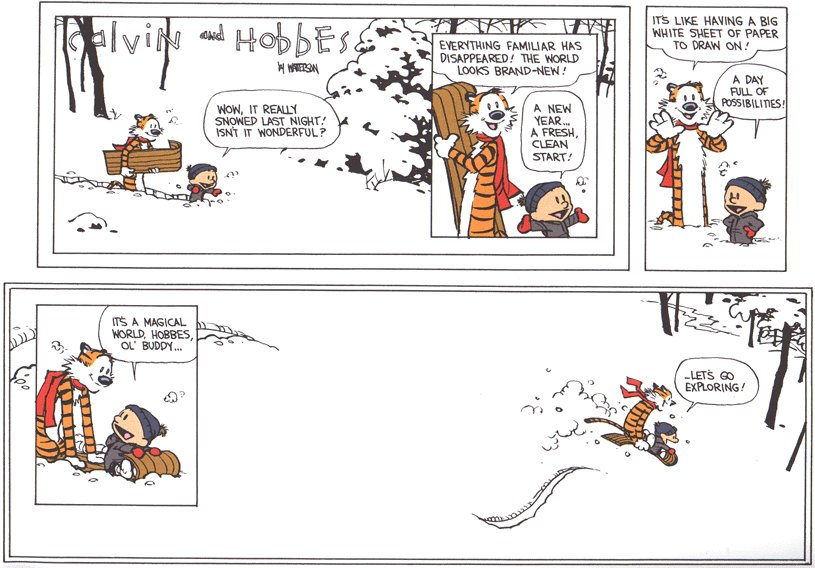
In 1995, Bill Watterson ended off his Calvin and Hobbes newspaper strip series with the words, “It’s a magical world, Hobbes, Ol’Buddy … Let’s go exploring.” In the intervening years, the creator of the imaginative boy and his tiger friend, answered fifteen fan questions in 2005 for Andrews McMeel Publishing and had an interview with The Plain Dealer in 2010. Bill Watterson himself rarely grants interviews: partially because of his own intensely private nature but also due to his desire to distance himself from his completed comic strip. Certainly, many potential interviewers and authors such as Nevin Martell in his Looking for Calvin and Hobbes: The Unconventional Story of Bill Watterson and his Revolutionary Comic Strip had no such luck arranging a meeting with the reclusive artist: resorting to drawing material from The Calvin and Hobbes Tenth Anniversary Book as well as talking with Watterson’s contemporaries, members of his family, and those artistically inspired by his work. Watterson has, on many occasions, claimed he said everything he had to say about his work in the Anniversary book.

Mental Floss Magazine and interviewer Jake Rossen, on the other hand, seems to have had far better luck.

The magazine gives us a brief glimpse of the email exchange between Rossen and Watterson: in which the cartoonist addresses questions such as why he thinks it is so hard for readers to “let go” of his works, what he thinks of a company such as Pixar animating the characters of his strip, the critical point in which he decided his creativity was more important than licensing and syndicate interference, where he thinks the comic strip will fit in today’s society, and other matters. The rest of the interview will be published in the print version of Mental Floss come this December.

Bill Watterson ended Calvin and Hobbes while it was still good, after saying everything he had to say, gaining sole rights to his own creation, and prohibiting any kind of merchandising aside from the sales of the books of collected strips. While I was sad to see it go, it has lived on: becoming an archetype and legendary spot of golden warmth that has inspired the aesthetics and works of future cartoonists as well as countless others over the years long after it was finished.

But those last words that Calvin speaks to Hobbes still haunt me. After the strip ended, I didn’t know how “magical” the future would be afterwards. Certainly, a lot of very unpleasant and difficult things have happened since 1995 but now–in 2013–despite all of the challenges that still exist not much else has changed. There is still that child in all of us, that Calvin that likes to daydream and that need for a friend like Hobbes to always be in our minds. And when I look at the return of Miracleman, the next Sandman comic and so many new and geeky innovations I think back to Calvin’s last words created by Watterson and Watterson now granting this new interview when everything was thought to have been said and I think to myself that perhaps, just perhaps, this is a magical world after all: one that still bears some exploration.
Calvin and Hobbes

Miracleman Returns January 2014!

Miracleman Returns Jan 2014

It was in 1994 that the last official issue of Miracleman–a superhero series creatively revised by Alan Moore in 1982 and continued on by Neil Gaiman–hit the stands. The series was not yet finished but by the time issue #24 came out its publisher, Eclipse Comics, had become defunct. There were many attempts to resurrect this series about a superhero that discovers the unpleasant grittiness of his existence and eventually uses his power to rule the world, but there were many convoluted, legal complications that not only kept new issues from being created, but also prevented the rest of the series from being reprinted as well.

It is only now, nineteen years later, that Marvel Comics has announced at the 2013 New York Comic Con that starting January 2014 it will be republishing Alan Moore and Neil Gaiman’s run of the series and publishing all new Miracleman stories by Neil Gaiman and Mark Buckingham. According to Editor In Chief Axel Alonso, Marvel Comics and its Special Projects Team has been in the process of obtaining the original or the photo-static copies of the artwork as well restoring them to a quality of detail that is up to par with the standard of the Marvel Masterworks line. It is a truly fascinating bit of news especially when you consider that Neil Gaiman, who was given the reins to the comic after Alan Moore left it in a dubious utopia, last worked on it as a young writer and is now back into it as an experienced and best-selling author and storyteller. It is tempting to say that this journey from creation to legal controversy has come full circle for both Neil Gaiman and artist Mark Buckingham, who has since become known for his art work in Bill Willingham’s Fables series.

Above is a video posted by Bleeding Cool of Neil Gaiman talking about his love for Miracleman, Marvel’s republishing of it, and his own work in finishing what was given to him. To all the fans, old and new, I would like to leave you with this article by Julian Darius of Sequart called Why Miracleman Matters. Finally, the years of Miracleman‘s Silence will be broken once again by one word.

Kimota.

Miracleman Ascendant

Fleet-Foot Tales and Hero-Glyphs Part I: Conflict Amongst A League of Marvels

This just in: artist-archaeologist Josh Ln has uncovered what seem to be ancient, and very distinctive, hero-glyphs–or what we have colloquially termed some “Fleet-Foot Tales”–from an ancient period in Earth’s history. Whether or not the sequential narrative stele, scrolls, tablets, or frescoes come from the beginning of Egypt’s Old Kingdom period or some other preceding civilization so advanced it would seem positively anachronistic by today’s standards is unknown at this time.

However,  our branch of Art Historians here at G33kPr0n–with the oversight of our Chief Information Officer G33kBot and a judicious use of the recently uncovered Mind Gem–has managed to transliterate enough of the symbols and images depicted in these astonishingly preserved materials to give some form of passable translations and, failing that, possible interpretations of what these artifacts mean. So with our Blue Gem in tow, we will now attempt to decode these sequential narratives for you, dear readers.

First, let us look at Exhibit A: the first of what we have decoded as Conflict Amongst a League of Marvels.

Avengers Hero-Glyph

In Exhibit A, it seems that on the surface we are met by two images. On the far left is the grown figure of Icarus who–in this version of the tale–fell from the heavens after the death of his father Daedalus and used his knowledge to craft a protective aegis around his body and seal the power of the Sun that brought him down to remake his broken heart. In his hands are auras from the Sun he has chained. In this way, Icarus is combined with Prometheus who–in his hubris–plans to bring the secrets of the Sun and the gods to all mortal kind: on his own terms.

Icarus’ counterpart, facing him in opposition is Rojhaz: the embodiment of a hero archetype from the distant land of America. In the legends, it says that he is one of the few to drink the Serpent’s venom created by long-lost sorcerers and live stronger than most mortal men. Yet this is only part of the spirit of Rojhaz. In addition to his strength, the hero is garbed in reinforced chain-mail coloured with the blue of the ocean’s eroding tides, the red of the blood of his enemies and the white of the souls he was made to protect. His shield is made an indestructible metal–another lost art of sound turned into material–to ward off all evil and turn its own force back against itself.  He is a warrior and a Guardian.

Above them, on the far left is the Nordic deity of Thunder. This is strange in and of itself due to the fact that all of these figures do not seem to be in their places of origin. Thor himself is far from home: though he is depicted as maintaining his place in the sky above these relatively mortal heroes: signifying his divinity. He possesses the short-handled Hammer Mjölnir that will one day be his undoing in Ragnarok: or so the Nordic Sagas would have us believe. There is a look of what seems to be dismay on his face. Notice that all three figures possess celestial connotations: with the Icarus-figure’s circular auras of power, the small wings and the letter “A’ for–presumably–ascendance on either side of Rojhaz’s skull and the much larger wings on Thor’s helmet. Each hero here believes that they are right: that their cause is just.

There are a few ways to interpret this narrative based on the positioning of the characters. Icarus is positioned over a green fist that, according to some interpretation, could be construed as a green djinn or a sealed magical spirit attempting to free itself. This unleashed power sits between Icarus and Rojhaz: perhaps symbolizing a potentially destructive power that helped make both of them after it was split from the Earth or human clay itself. Perhaps Icarus has sympathy with this power given his wanderlust and gall, while Rojhaz is leery and seems to guard a hierarchical tablet behind them: perhaps symbolizing the current social or celestial order of things. As for Thor, he can be seen as looking down in dismay at this mortal strife or, perhaps, one of the other heroes displaced him somehow with the power of the green djinn below and between them. It seems unclear at this time.

However, there are other images in this Exhibit to consider. For instance, just as the gods of the Norse are seen as knowing their Doom–while compelled to follow through with it–Thor seems to see something beyond the clashing of Icarus and Rojhaz. He sees a black panther and what seems to be a red spider with an hourglass or a keyhole in its carapace moving on a three-hold path off of the surface of their narrative. The meaning behind this is still unknown at this time. However, there is something very disturbing in the left-hand corner of the depiction. For while Thor seems distracted with what might-be or will-happen, with a branch of a narrative that is separate and the other two heroes clash, behind Rojhaz is the edifice of a hierarchical society or cosmos: as if there is any different from human perspective.

It is important to draw attention to this structure because, above it, seems to be a horned deity with a staff. It seems to symbolize both cuckolding and fertility: of taking seducing others and holding power. This character, at first, seems to be a trickster-figure. Yet below him is a smaller counterpart that seems to rule over or have usurped an order that is used to his presence. Another figure, a depiction of a citizen or ruler, draws away in fear of this being. One possible interpretation is that the very civilization, or ideal, that Rojhaz is defending is in danger of being corrupted from an enemy they cannot see while Icarus wishes to challenge that status quo with potentially unstable power: regardless of the consequences or necessarily even aware of the Tyrant-figure sitting on the upper part of the hierarchical line. What is worse to consider however, within the context of this piece, is that the Tyrant-Trickster may well be bewitching all of these forces to either conflict with each other or become distracted with paths that may not happen while keeping them divided and ignorant of his real plans. Indeed, another interpretation is that even the God of Thunder seems more distracted or mesmerized by the orb in the Trickster-Tyrant’s staff than the Tyrant himself. Perhaps this is important in and of itself.

In the end, perhaps these heroes are–like the characters in Ragnarok–attempted to get vengeance or avenge a battle or an atrocity that has not happened yet: while their real enemy already plans it right in front of their noses.

Perhaps, in the end, this is a sequential narrative that is not over yet or finds itself “to be continued.” Stay tuned next time for our next segment: in which we will discuss the second narrative found by Josh Ln known as the Celestial Voyages Fragment.

Josh Ln’s original excavated work and restorations of the rest of the “Fleet-Foot Tales” can be found, without translation, in Hero-Glyphics, Proof All Those Time Travel Story Events Were Real for the curious at your perusal and at your leisure. As the ancient farewell goes, “Excelsior.”

The Dark Crystal Author Quest

Jen Dark Crystal

If you were a child that was either born or grew up in the 1980s, chances are you watched the 1982 film called The Dark Crystal: a movie in which Jen–the last of the Gelfling race–undertakes a quest to repair the broken Crystal of Truth in the strange world of Thra while evading its many dangers and the horrors of the evil Skeksis and their Garthim minions. The world of The Dark Crystal–of Thra itself–was created by Jim Henson: the master puppeteer and creator of the Muppets, Labyrinth and many other shows and films.

The Dark Crystal is a world onto itself and despite talk about a sequel this world has only been expanded on so far in two graphic novels: Tokyopop’s Legends of the Dark Crystal and Archaia Entertainment’s The Dark Crystal: Creation Myths. In addition to Brian Froud’s The World of the Dark Crystal–an art book illustrated by the conceptual designer of the film itself which expands further on the actual identities and roles of the Mystics and Skeksis as well as the lore of Thra–there had been no other official creative forays into the world of The Dark Crystal

Until now.

author quest

On October 1, The Dark Crystal Author Quest began accepting submissions for the next Dark Crystal novel. It is a writing contest created and organized by the Jim Henson Company and the publisher Grosset & Dunlap of the Penguin Young Readers Group–While the Rules for this contest can be found under the Author Quest Rules and Regulations section on the site, basically anyone can submit a 75,000-10,000 word entry–either a short story or chapter excerpts–to the Contest in order to qualify for review by the Jim Henson Company and Grosset & Dunlap. Then of all those entries, five writers will be selected and go to the second round where–with revisions and editorial suggestions–they will expand their story into a 50,000 word manuscript. After that process, and in the immortal words of Highlander, there can be only one. The winner of The Dark Crystal Author Quest will thereby receive a $10,000 book contract for the next Dark Crystal young adult novel.

This story is not supposed to be a sequel. It is a prequel event that occurs during that the time of what is called The Gelfling Gathering: in which the Gelfling people, once ruled over by the Skeksis Empire, realize what their overlords truly are and begin the process of creating the Wall of Destiny or the Prophecy that will one day liberate them. It is a time where the Skeksis still rule over Thra and have supporters among the Gelfling that they will one day commit genocide against. During this time there are seven distinct Clans of Gelfling, sixteen pairs of Mystics and Skeksis that are still alive and a lot of world-building toys to work with: found in both The Gelfling Gathering Author’s Resource and the still-developing Encyclopedia, Mythological timeline and other goodies at darkcrystal.com.

As I said, submissions opened October 1 and will close December 31, 2013, so feel free to join this wonderful Contest, or the official Dark Crystal website listed above.

As the urSkek at the end of The Dark Crystal film states, everything is connected. I myself am a participant in The Dark Crystal Author Quest and as a new writer to G33kpr0n I thought I’d be very remiss in neglecting to mention the existence of such a Contest. It is a rare thing for an established creative world to be opened up like a playground to prospective writers to make what has so far generally been fanfiction into a possible literary and fantastic reality. At the top of the page is The Dark Crystal Author Quest Panel from the 2013 San Diego Comic-Con if you would like to hear about some of what it is going on from the Contest organizers themselves.

Whether as a participant or an observer, or a dedicated fan or someone coming in new to the franchise, I hope that you get to experience the expansion of cult-classic mythos that has been so inspirational to so very many.